This is a repository copy of A replication-casting device for manufacturing open-cell Mg foams.
White Rose Research Online URL for this paper: http://eprints.whiterose.ac.uk/110075/
Version: Accepted Version
Article:
Lara-Rodriguez, G.A., Figueroa, I.A., Suarez, M.A. et al. (3 more authors) (2016) A replication-casting device for manufacturing open-cell Mg foams. Journal of Materials Processing Technology, 243. pp. 16-22. ISSN 0924-0136
https://doi.org/10.1016/j.jmatprotec.2016.11.041
[email protected] https://eprints.whiterose.ac.uk/
Reuse
This article is distributed under the terms of the Creative Commons Attribution-NonCommercial-NoDerivs (CC BY-NC-ND) licence. This licence only allows you to download this work and share it with others as long as you credit the authors, but you can’t change the article in any way or use it commercially. More
information and the full terms of the licence here: https://creativecommons.org/licenses/
Takedown
If you consider content in White Rose Research Online to be in breach of UK law, please notify us by
Accepted Manuscript
Title: A replication-casting device for manufacturing open-cell Mg foams
Author: G.A. Lara-Rodriguez I.A. Figueroa M.A. Suarez O. Novelo-Peralta I. Alfonso R. Goodall
PII: S0924-0136(16)30436-8
DOI: http://dx.doi.org/doi:10.1016/j.jmatprotec.2016.11.041 Reference: PROTEC 15042
To appear in: Journal of Materials Processing Technology
Received date: 17-8-2016 Revised date: 29-11-2016 Accepted date: 30-11-2016
Please cite this article as: Lara-Rodriguez, G.A., Figueroa, I.A., Suarez, M.A., Novelo-Peralta, O., Alfonso, I., Goodall, R., A replication-casting device for manufacturing open-cell Mg foams.Journal of Materials Processing Technology http://dx.doi.org/10.1016/j.jmatprotec.2016.11.041
A replication-casting device for manufacturing open-cell Mg
foams
G.A Lara-Rodriguez1, I.A. Figueroa1, M.A. Suarez1, O. Novelo-Peralta1*, I. Alfonso1 and R.
Goodall2.
1Instituto de Investigaciones en Materiales, Universidad Nacional Autónoma de México
(UNAM), Circuito Exterior S/N, Cd. Universitaria, C.P. 04510 México, D.F., México
2Department of Materials Science and Engineering. The University of Sheffield, Mappin St,
Sheffield S1 3JD, UK
Corresponding author: O. Novelo-Peralta; E-mail address: [email protected]; Tel.:
+52 5556224575; fax: +52 5556161371.
ABSTRACT
The development of a replication casting device with the capability of manufacturing open-cell
pure Mg and Mg alloys foams, with melting points lower than 950 °C is described. The device
consists of three basic parts: a cylindrical reaction chamber, a valve system for controlling the
vacuum and the gas injection, and a heating system. The purpose of the present design was to
literature, as well as to optimize the parameters (atmosphere, temperature, injection pressure, etc.)
of the replication casting process. The proposed device has shown significant improvement over
other devices reported, especially in terms of easiness of operation, adjustability and low cost of
maintenance. The design of the device provides the ability to produce large foams free from
defects such as large volumetric shrinkage and large concavities. The latter is minimized by the
implementation of a perforated nozzle for gas impulsion. Examples of manufactured open-cell
pure Mg and Mg-10 wt.% Al alloy foams are also presented. The design is shown in a conceptual
format; however it could be modified to produce larger or smaller samples.
Keywords: Foams, Pure Mg, Replication casting, Device, Manufacture
1. Introduction
Porous metal structures, also known as metallic foams, have shown a combination of physical
and mechanical properties such as high strength-to-weight ratio, high energy absorption capacity,
large specific surface, high gas and liquid permeability and low thermal conductivity as has been
reported by Baumgartner and Gers, 1999. As mentioned Banhart (2001), metallic foams with
open-cells are mainly used in functional applications (heat exchangers, filters, catalysis supports),
while the metallic foams with partially open and closed cells are used in structural applications
(bio-medical implants, silencers, bearings, sound, energy absorbers, etc.).
As pointed by Asbhy et al. (2001), pure aluminum (Al) and Al based alloys foams have been
widely manufactured by several techniques. In contrast, little attention has been paid to
developing pure Mg and Mg alloys foams, due to the high production costs and the difficulty of
and energy absorption capacity, excellent vibration reduction capacity. Wen et al. (2001) found
that Mg foams were promising biomaterial for bone implants due to its open-cellular structure
promote the in-growths of the new-bone tissues and the transport of the body fluids.
Some methods have been used to manufacture closed-cellular pure Mg and Mg alloys foams.
Körner et al. (2004) proposed a method where combined high pressure casting using a
thixomoulding machine in a cavity to add and disperse MgH2 particles as foaming agent. Renger
et al. (2005) obtained Mg foams using a technique called vacuum foaming method.Later,
Dong-Hui et al. (2008) obtained a Mg foam by melt-foaming method, also known as blowing agent
method, using CaCO2 powders as foaming agent and a mixed of CO2 and SF6 atmosphere to
protect Mg alloy from being ignited or oxidized during the process. On the other hand, the
manufacture of the open-cell pure Mg and Mg alloys foams has been limited to the powder
metallurgical method and replication casting process. Hao et al. (2009) obtained pure Mg foams
by four stages powder metallurgy manufacturing process including mixing, compacting,
dissolution and sintering. The space holding filler used was commercially carbamide particles
with a rounded shape. Later, Aghion et al. (2014) produced MRI 201S Mg alloy foams using
Ammonium Hydrogen Carbonate salt particles as a space holding filler. Both works used high
purity argon atmosphere as a protective gas. In contrast, as (San Marchi and Mortensen, 2002)
mentioned, the replication casting process offers the possibility to produce open-cell foams with
high control of the topology. However, the manufacture of open-cell pure Mg foams by the
replication casting method is still limited.
The replication casting process was first proposed by Polonsky et al. (1961). According to
Polonsky this method is able to produce an interconnected open-cell structure by infiltrating the
molten metal under pressure through an open pore preform (or negative of the foam) made from
solvent. However, it was until 2001 when (San Marchi and Mortensen, 2001) retook this method
to produce open-cell aluminum foam. The main parameters for the replication casting process
are: 1) the infiltration pressure, 2) the melting temperature of the metal charge and 3) the design
of the preform (material, size, solubility, etc.). The possibility of controlling these parameters
with different mechanisms, the physic-chemical properties of the metal foams and the design of
the preforms are factors that have led to develop a variety of devices.
The infiltration can be made by a mechanical mechanism or using gas pressure. Fabrizio et al.
(2011) obtained an Al-Si-Mg foam using a hydraulic cylinder to generate the infiltration pressure.
On the other hand, San Marchi and Mortenssen, 2001 used a hot-wall gas-pressure infiltration
apparatus to produce the same type of foams.
In relation to the preforms, these are commonly manufactured with sodium chloride (NaCl) due
to their heat resistance and water solubility.As Gaillard et al. (2004) mentioned, in the foams that
are produced by the replication process, the initial shape of the leachable powder that was used to
produce the infiltrated preform, predominantly controls the pore shape. As a consequence, the
powder shape influences significantly the strain at which the foam stress–strain curve deviates
from power-law behaviour. However, most of the devices used for replication casting process are
limited to produce small foams constituted by not-reactive metals such as Al and Al alloys, Zn
and Zn alloys, among others. The replication casting technique has not been extensively used for
manufacturing pure Mg foams, due its reactivity with oxygen in liquid state and with the material
of the preforms (NaCl) during leaching stage.
The above mentioned limitations open up the possibility of designing new practical devices for
the replication casting process with optimal control of the parameters (atmosphere, injection
other metallic foams. Therefore, the objective of this project is to manufacture a practical
replication casting device for obtaining pure Mg foams, Mg alloys foams and other metallic
foams with melting points lower than 950 °C, with optimum control of the process parameters.
The design of the device allows producing samples with sizes up to 8.8 cm in diameter and 14 cm
height, with the possibility of increasing or decreasing this geometry. With this
replication-casting device, pure Mg foams and Mg alloys foams free from cavities and volumetric shrinkage
defects can be obtained.
2. Description of the infiltration device
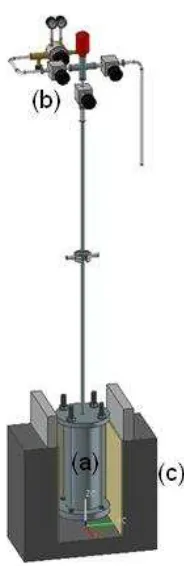
Fig. 1 shows the complete replication-casting device. The replication-casting device is conformed
by three basic parts: First, a reaction chamber (a), followed by a valve system (b) for controlling
the chamber pressure (i.e. vacuum or partial pressure) and gas injection for infiltration, and
finally, a heating system (c). The heating chamber consists in an electrical resistance furnace with
vertical chamber; this could be part of the device or could be external. In the following sections
the design of the parts and operation of the replication-casting device will be described in detail.
2.1. Reaction chamber
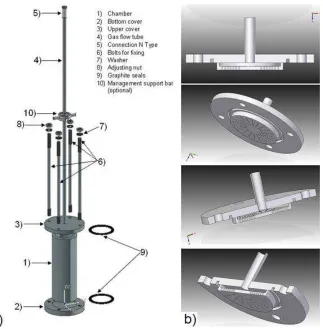
In the reaction chamber the casting and infiltration process takes place. As can be observed in
Fig. 2a, the chamber is composed by a hollow cylinder (1) and two covers (2-3). These parts are
made of stainless steel 316. The stainless steel 316 is considered as the second most common
austenite stainless steel, preferred for use in marine environments for its high resistance to pitting
corrosion. This steel contains nickel and molybdenum elements, which increase the resistance to
chloride-induced stress corrosion cracking (suitable for using preforms NaCl basis). Besides,
point). In addition, this stainless steel has high strength at elevated temperatures and is sometimes
used for structural and pressure-containing applications at temperatures above 500 °C, as has
been reported by Davis (1994). Therefore, the stainless steel 316 was selected for manufacturing
the components of the reaction chamber.
The dimensions of the cylindrical chamber or hollow cylinder are: outer diameter 9.5 cm and
inner diameter 9 cm with a thickness 0.5 cm and a height of 25 cm.
The reaction chamber is closed tightly with two removable circular covers of 16.5 cm in diameter
and 1.25 cm in thickness. In the upper cover a stainless steel 316 tube is attached through which
the injection of gas for the infiltration process is carried out and the fumes produced during
casting are taken away. The dimensions of the tube are 2.5 cm in diameter and 100 cm in length.
The tube length must be long enough to hold the valve system isolated from overheating. On the
top of the tube a NW type connection is attached, this kind of connection is the most appropriate
for joining the valve system. Inside the upper cover, a perforated nozzle for gas impulsion was
assembled; this was also manufactured with the same stainless steel (Fig. 2b). The function of
this nozzle is to evenly distribute the gas pressure throughout the whole sample. This mechanism
prevents the formation of concave recesses on the top of the samples (in the liquid state) when
high gas pressure is used (1.9-2.9 bar).
Four removable bolts of stainless steel 316 of 1.25 cm in diameter and 30 cm long are used to
hold the covers to the cylindrical chamber. It is essential to place graphite seals between the
covers and the cylindrical chamber in order to achieve a high vacuum and prevent the spill of
dimensions i.e. increasing or decreasing the size or total geometry of the reaction chamber
proposed in this work.
2.2 Valve system
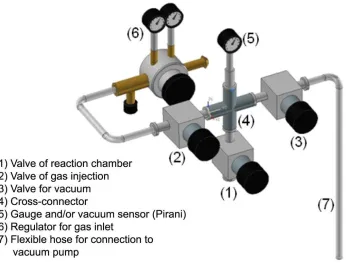
In Fig. 3 the valve system suggested for gas and vacuum control is shown. As it was already
mentioned, the valve system is assembled to the upper part of the tube for gas flow. This system
has three important functions: i) controlling the argon (Ar) injection, ii) withdrawing gases during
the infiltration process, and iii) allowing the connection of the reaction chamber to the vacuum
pump. The valve system is completely detachable and consists of the following components: (1)
a valve for controlling the reaction chamber, (2) a valve for controlling (Ar, He) gas injection, (3)
a valve for controlling the vacuum, (4) cross-connector with terminal NW, (5) gauge and/or
vacuum sensor (Pirani) (6) regulator for the (Ar, He) gas and (7) flexible hose for the connection
to vacuum pump.
For practical purposes, for the operation and maintenance, it is recommended to use valves with
NW terminals (sizes 10 and / or 25) and clamp connections of quick release with O-rings for high
temperature (Fluorocarbon Type A). For the vacuum step, it is necessary to implement a digital
vacuum sensor (Pirani), in order to obtain a more accurate measurement of vacuum in the
reaction chamber. During the casting and infiltration steps, the digital vacuum sensor must be
substituted by an analogue vacuum gauge. This gauge allows measuring pressures from -1 to 5
torr. Most models require an adapter to assemble elements with terminals NW. A rotary vane
2.3. Heating system
An electric resistance furnace of vertical box with covers in the upper part can be used in the
heating process. The design of this kind of furnaces allows that, the valve system can be located
outside of the heating chamber and also facilitates the handling of the reaction chamber during
the various stages of the process. Its capacity depends on the size of the reaction chamber to be
used. An electric resistance furnace with the following dimensions: 50.8 cm side x 50.8 cm side x
50.8 cm height, was employed in this work.
3. The preform (Space holder)
In the replication-casting process the preform is essential for the final properties of the metallic
foam obtained. The final structural and mechanical properties depend on the structural properties
of the preform (porosity and sizes of pores). The particles used in the fabrication of the preform
must achieve some requirements (i.e. high solubility in water to dissolve the preform from solid
material, good adhesion among particles to preserve the integrity of the preform during the
infiltration process). In this sense, as has been reported by Goodall and Mortenssen, 2007 the
particles of NaCl (melting point= 801 °C) and NaCl-based particles of different size and
geometry are appropriate to make preforms for the manufacture of pure Mg and Mg alloys foams
and other metals such as Al, Zn, Sn, and their alloys.
The preform is manufactured inside the reaction chamber. At this stage, the reaction chamber
must be pre-assembly with the bottom cover, including the graphite seal. It is advisable to apply a
thin coat of boron nitride on the inner walls of the reaction chamber in order to further protect it
internal diameter of the reaction chamber; in this case 9 cm in diameter and a height of 14 cm
were used. The maximum height of the preform is limited to half-height of the reaction chamber,
since it requires a similar space to place the metal charge.
4. Assemble of the device parts
4.1. Assemble of the reaction chamber for the infiltration stage
Once the formation of the preform has been completed, the metal charge is placed into the
reaction chamber, above the preform, in a volume ratio similar to that of the preform. In the
infiltration stage, the use of graphite seals and the adjustment of the reaction chamber with bolts
are necessary to reach the required vacuum and prevent leakage of molten metal during the
infiltration process.
4.2. Installation of the valve system
Once the reaction chamber has been sealed, the valve system has to be connected to the NW
terminal located in the upper part of the gas flow tube. For the first stage, the valve system shall
be equipped with a digital vacuum sensor. It is necessary to check out that all the O-rings located
between the clamps are in good condition (no cracks) and lubricated with vacuum grease.
When the valve system has been assembled, two thermocouples should be placed outside of the
reaction chamber; one located at the bottom of the reaction chamber and the other in the area
where the metal charge is located. The purpose of employing such thermocouples is to have a
more accurate measurement of the temperature in the chamber and also monitoring the flow of
liquid metal during infiltration (i.e. when the temperature decreases at the bottom of the reaction
chamber indicates that the liquid metal has infiltrated the preform completely). The number of
(Ar) and the vacuum pump must be connected to the valve system through the appropriate hoses.
Finally, the complete replication-casting device is introduced into the furnace, ensuring that the
valve system remains outside the furnace, with at least 50 cm, to avoid overheating. It is
suggested to use a refractory thermal insulation ceramic fiber cloth between the furnace door and
the stainless steel connecting tube.
5. OPERATION OF THE REPLICATION CASTING DEVICE
The replication casting process is carried out in five steps: A) atmosphere conditioning, B)
melting of the metal charge, C) infiltration of the molten metal charge by gas injection, D)
cooling stage, E) disassembled, salt leaching and preparation of specimens.
5.1. Conditioning of atmosphere
Due to the magnesium and its alloys have high reactivity with oxygen in the air; ignition or
combustion occurs rapidly when they are in contact with oxygen in the molten state. For this
reason is necessary to carried out the process in a controlled atmosphere.
The conditioning of atmosphere involves removing the air from the reaction chamber and
replacing it with an inert atmosphere, typically of Ar. The procedure is as follows: based on the
valve system shown in figure 3, the valves (1) and (3) should be opened and the vacuum pump
and the vacuum digital sensor switched on. The proposed replication-casting device can achieve a
vacuum up to 3.5x10⁻² Torr approximately, within a period of time of 0.2 h. When the required vacuum has been reached, the valve (3) is closed and then the gas (Ar) valve (2) is opened, using
a pressure of 0.9 bar to fill up the reaction chamber. This purging procedure should be repeated at
5.2. Melting stage
Due to the sensitivity of the digital vacuum sensor to high temperatures, it must be replaced by an
analog vacuum gauge before starting the melting of the metal charge. In this step, valve (1) (that
controls the inlet and outlet of the gases from the reaction chamber) should be closed to keep the
inert atmosphere.
With the vacuum gauge already installed, the (Ar) gas pressure is adjusted at 0.49 bar and then
the valve (1) is again open. This valve is kept opened during the melting process. During this
step, the metallic charge positioned above the preform is gradually melted. Therefore, the melting
temperature should be high enough to drop the viscosity of the liquid metal and then, be able to
completely infiltrate the preform through its pores. It is suggested to maintain the heating for
1hour so that the metallic charge, as mentioned above, can be completely melted and the liquid
metal has an adequate fluidity. After this thermalization period, the infiltration process is the next
step.
5.3. Infiltration process
The infiltration process is carried out at a gas pressure greater than that used in the melting
process. In order to start the infiltration process, the valve (1) is closed and the (Ar) argon
pressure is increased, using the regulator of the argon (Ar) cylinder. According to the valve
system and the reaction chamber that are being proposed, it is suggested to use a maximum
pressure of 2.95 bar to prevent damages to any parts of the system. When the injection pressure
has been adjusted, the valve (1) must be opened slowly and stay open for the necessary period of
time so that the molten metal completely fills the pores of the preform. In the present work, 10
5.4. Cooling stage
Before removing the reaction chamber from the furnace, valve (1) that controls the reaction
chamber, and then the valve (2) have to be closed. At this stage, the furnace could be turned off
and then the hoses that connect the vacuum pump and the Ar cylinder with the valve system
should be disassembled. With exception of valve (1), the entire valve system should be removed
from the reaction chamber to facilitate its manipulation. Subsequently, the reaction chamber must
be taken out from the furnace and place it on a suitable surface (copper plate) for cooling to room
temperature. It is important that the solidification of the molten metal begins at the bottom of the
samples and finish in the top this in order to avoid defects such as volumetric shrinkage in the
body of the foams.
5.5. Disassembled and salt leaching and preparation of specimens
When the reaction chamber is completely cold, the bolts and the covers are removed.
Subsequently, the metal-preform sample is extracted from the reaction chamber. The final step in
the magnesium foams manufacturing by infiltration method is the salt leaching. For this purpose,
it is necessary to consider the reactivity of the pure magnesium with water in order to minimize
or prevent the corrosion. Shaw, (2003) reported that according to the Pourbaix diagram for the
magnesium-water system, increasing the pH value above 11.5, a stable Mg(OH)2 layer is formed,
being this layer a good protection against further corrosion. According to the calculations, it is
necessary to dissolve 2g of NaOH in 500 ml of water to obtain a solution with pH=13.
Fig. 4 shows representative foams of: a) pure Mg and b) Mg-10 wt.% Al alloy obtained by the
proposed replication-casting device. The preforms were manufactured with irregular NaCl
granules with an average size of 3.3mm. The size of the preforms was 9 cm in diameter and 10
cm in height. The working temperature used for both materials; a) pure Mg and b) Mg-10 wt.%
Al alloy was of 720 °C, while the pressure and the injection time of Ar were 1.96 bar and 10
minutes, respectively.
The above-mentioned conditions are optimal to obtain complete foams with equivalent preform
size, without defects such as internal voids (several cross section cuts were carried out confirming
this statement) and surface concavities. This can be also attributed to the use of the perforated
nozzle for gas impulsion lid, which evenly distribute the gas pressure (non-centralized) on the
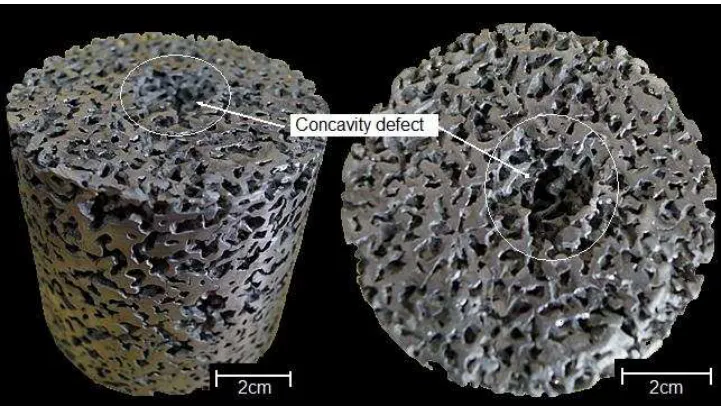
molten metal charge. Fig. 5 shows a sample manufactured without the use of the perforated
nozzle device. It can be seen that in the central part of the foam a deep concavity was formed due
to centralized gas flow. Therefore, an evenly distribution of gas pressure during the infiltration
process and the control of the solidification from the bottom of the reaction chamber to the top
could minimize the formation of defects in the foams.
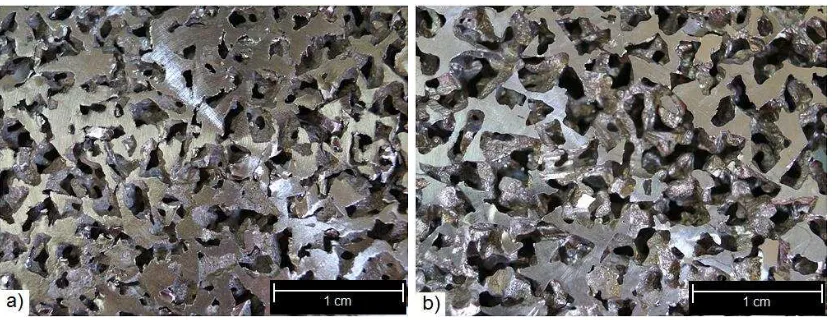
Representative structures of pure Mg and Mg-10 wt.% Al alloy foams are shown in fig. 6a and
fig. 6b. It can be seen that both foams are entirely constituted by open-porosity with a high visual
degree of openness. Furthermore, pore structures are homogeneous with high degree of
can be observed that the metallic structure of the Mg foams was not oxidized, which means that
the protective atmosphere used during the infiltration process as well as the use of a H2O+NaOH
solution with pH=13 for the salt dissolution were effective, protecting the foam from oxidation
and ignition.
The relative density of the pure Mg foam was 0.30, while the relative density of the Mg-10 wt.%
Al alloy foam was 0.33, with porosities of 70% and 67%, respectively. This morphology of the
produced pore structure could be suitable for functional applications such as filters, catalyst
supports, and CO2 captors, among others.
VII. CONCLUSIONS
A replication casting device with the capability of manufacturing open-cell pure Mg and Mg
alloys foams and other metals or alloys with melting points lower than 950 °C was developed. In
comparison with other devices reported in the literature, the device proposed in this work showed
significant advantages, such as easiness operation, feasibility of producing smaller or larger foam
samples, safety and low maintenance costs The experimental results demonstrated the ability of
the replication casting device to optimally produce large open-cell pure Mg and Mg-10 wt.% Al
alloy foams. The design of the device provides the advantage of producing foams free from
defects such as large volumetric shrinkage and large concavities. The latter was drastically
structural properties of the open-cell Mg and Mg-10 wt.% Al alloy foams produced, these foams
could be used in functional applications such as filters, scaffolds, CO2 captors, catalyst supports,
etc.
ACKNOWLEDGMENTS
The authors would like to acknowledge the financial support from DGAPA-PAPIIT-UNAM
101016 and DGAPA-PAPIME-UNAM PE103416 for funding the project. A. Tejeda-Cruz, C.
Flores-Morales, G. Arámburo, S. García-Galán, F. García, A. López-Vivas, J. Romero-Ibarra, J.
M. García León and E. Hernández Mecinas are also acknowledged for their technical support.
REFERENCES
Aghion, E., Perez, Y., 2014. Effects of porosity on corrosion resistance of Mg alloy foam
produced by powder metallurgy technology. Mater. Char. 96, 78–83.
Ashby, M.F., Evans, A., Fleck, N.A., Gibson, L.J., Hutchinson, J.W., Wadley, H.N.G., 2000.
Metal foams: a design guide. Butterworth-Heinemann, Oxford, pp. 6-20.
Banhart, J., 2001. Manufacture, characterization and application of cellular metals and metal
foams. Prog. Mater. Sci. 46, 559-632.
Baumgartner, F., Gers, H., 1999. Industrialization of P/M foaming process. In: Banhart, J.,
Ashby, M.F., Fleck, N.A. (eds.), Metal Foams and Porous Metal Structures. Verlag MIT
Publishing, Bremen, pp. 73-79.
Dong-Hui Yang, Bo-Young Hura, Shang-Run Yang, 2008. Study on fabrication and foaming
mechanism of Mg foam using CaCO3 as blowing agent. J. Alloy Compd. 461, 221-227.
Fabrizio, Q., Boschetto, A., Rovatti, L., Santo, L., 2011. Replication casting of open-cell
AlSi7Mg0.3 foams. Mater. Lett. 65, 2558-2561.
Gaillard, C., Despois, J.F., Mortensen, A., 2004. Processing of NaCl powders of controlled size
and shape for the microstructural tailoring of aluminium foams. Mater. Sci. Eng. A. 374,
250-262.
Goodall, R., Mortensen, A., 2007. Microcellular Aluminium?-Child´s play. Adv. Eng. Mater. 9,
951-954.
Goodall, R., Mortensen, A., 2007. Spherical pore replicated microcellular aluminium: Processing
and influence on properties. Mater. Sci. Eng. A. 465, 124.
Hao, G.L., Han, F.S., Li, W.D., 2009. Processing and mechanical properties of magnesium
foams. J. Porous Mater. 16, 251-256.
Körner, C., Hirschmann, M., Bräutigam, V., Singer, R. F., 2004. Endogenous Particle
Stabilization During Magnesium Integral Foam Production. Adv. Eng. Mater. 6, 385-390.
Lide, D. R., 2001. CRC Handbook of Chem. And Phys. 82 ed. CRC PRESS, Boca Raton.
Polonsky, L., Lipson, S., Markus, H., 1961. Light weight cellular metal. Mod. Cast. 39, 57-71.
Renger, K., Kaufmann, H., 2005. Vacuum Foaming of Magnesium Slurries. Adv. Eng. Mater. 7,
117-123.
San Marchi C., Mortensen A., 2001. Deformation of open-cell aluminum foam. Acta Mater. 49,
3959–3969.
San Marchi, C., Mortensen, A., 2002. Infiltration and the replication process for producing metal
sponges, Handbook of Cellular Materials. Wiley-VCH, 44.
Shaw B.A., 2003. Corrosion Resistance of Magnesium Alloys. In: Cramer S.D., Covino B.S.,
Jr.(Eds.), ASM Handbook 13A, Corrosion: Fundamentals, Testing and Protection. ASM
International, USA. pp. 694.
Wen, C. E., Mabuchi, M., Yamada, Y., Shimojima, K., Chino, Y., Asahina, T., 2001. Processing
Fig. 1. Replication casting device: (a) steel reaction chamber sealed with two covers, (b) valve
[image:19.612.94.186.69.352.2]Fig. 4. Digital images of: a) pure Mg foam, b) Mg-10 wt.% Al alloy foam, manufactured by the
Fig. 6. Cross section of the produced foams showing the open-cell pore morphology of: a) pure