ISSN 0252-8266
%
eurostat
EUROSTATISTIK
Daten zur Konjunkturanalyse
EUROSTATISTICS
Data for short-term economic analysis
EUROSTATISTIQUES
Données pour l'analyse de la conjoncture
Monatlich D Monthly D Mensuel
5 D
1988
i
Themenkreis
D
Theme
D
Thème
Allgemeine Statistik D General statistics
Statistiques générales
Reihe D Series D Série
Konjunktur D Short-term trends
eurostat
OFICINA ESTADÍSTICA DE LAS COMUNIDADES EUROPEAS
DE EUROPÆISKE FÆLLESSKABERS STATISTISKE KONTOR
STATISTISCHES AMT DER EUROPÄISCHEN GEMEINSCHAFTEN
ΣΤΑΤΙΣΤΙΚΗ ΥΠΗΡΕΣΙΑ ΤΩΝ
ΕΥΡΩΠΑΪΚΩΝ ΚΟΙΝΟΤΗΤΩΝ
STATISTICAL OFFICE OF THE EUROPEAN COMMUNITIES
OFFICE STATISTIQUE DES
COMMUNAUTÉS EUROPÉENNES
ISTITUTO STATISTICO DELLE COMUNITÀ EUROPEE
BUREAU VOOR DE STATISTIEK DER EUROPESE GEMEENSCHAPPEN
SERVIÇO DE ESTATÍSTICA DAS COMUNIDADES EUROPEIAS
L-2920 Luxembourg - Tél. 43011 - Télex : Comeur Lu 3423
B-1049 Bruxelles, bâtiment Berlaymont, rue de la Loi 200 (bureau de liaison) - Tél. 2351111
Las publicaciones de Eurostat están clasificadas por temas y por series. La clasificación se encuentra al
final de la obra. Para mayor información sobre las publicaciones, rogamos se pongan en contacto con
Eurostat.
Para los pedidos, diríjanse a las oficinas de venta cuyas direcciones figuran en la página interior de la
contracubierta.
Eurostats publikationer er klassificeret efter emne og serie. En oversigt herover findes bag i hæftet.
Yderligere oplysninger o m publikationerne kan fås ved henvendelse til Eurostat.
Bestilling kan afgives til de salgssteder, der er anført på omslagets side 3.
Die Veröffentlichungen von Eurostat sind nach Themenkreisen und Reihen gegliedert. Die Gliederung ¡st
hinten in jedem Band aufgeführt. Genauere A u s k ü n f t e über die Veröffentlichungen erteilt Eurostat.
Ihre Bestellungen richten Sie bitte an die Verkaufsbüros, deren Anschriften jeweils auf der dritten
Umschlagseite der Veröffentlichungen zu finden sind.
Οι
εκδόσεις της Eurostat ταξινομούνται κατά θέμα και κατά σειρά. Η ακριβής ταξινόμηση αναφέρεται στο
τέλος κάθε έκδοσης. Για λεπτομερέστερες πληροφορίες σχετικά με τις εκδόσεις, μπορείτε να απευθύνεσθε
στην Eurostat.
Για τις παραγγελίες μπορείτε να απευθύνεσθε στα γραφεία πώλησης, των οποίων οι διευθύνσεις αναγράφονται
στη σελίδα 3 του εξωφύλλου.
Eurostat's publications are classified according to themes and series. This classification is indicated at the
end of the publication. For more detailed information on publications, contact Eurostat.
Orders are obtainable from the sales offices mentioned on the inside back cover.
Les publications de l'Eurostat sont
classées par thème et par série. Cette classification est précisée à la fin
de l'ouvrage. Pour des informations plus détaillées sur les publications, contactez l'Eurostat.
Pour les commandes, adressez-vous aux bureaux de vente dont les adresses sont indiquées à la page 3
de la couverture.
Le pubblicazioni dell'Eurostat sono classificate per tema e per serie. Tale classificazione è precisata alla
fine dell'opera. Per informazioni più dettagliate sulle pubblicazioni rivolgersi all'Eurostat.
Per eventuali ordinazioni rivolgersi a uno degli uffici di vendita i cui indirizzi figurano nella 3a pagina
della copertina.
De publikaties van Eurostat zijn ingedeeld naar onderwerp en serie. Deze indeling is achter in het boek
opgenomen. Voor nadere informatie over de publikaties kunt u zich wenden tot Eurostat.
Gelieve bestellingen op te geven bij de verkoopbureaus, waarvan de adressen op bladzijde 3 van de
omslag zijn vermeld.
As publicações do Eurostat estão classificadas por tema e por série. Esta classificação está indicada
no fim da obra. Para mais informações sobre as publicações é favor contactar Eurostat.
EUROSTATISTIK
Daten zur Konjunkturanalyse
EUROSTATISTICS
Data for short-term economic analysis
EUROSTATISTIQUES
Données pour l'analyse de la conjoncture
ACHTUNG: Analyse und Kommentar auf S. 5
ATTENTION: Analysis and commentary on p. 9
ATTENTION: Analyse et commentaires à la page 13
Luxembourg: Office des publications officielles des Communautés européennes, 1988
Kat./cat.: CA-BJ-88-005-3A-C
© EGKS-EWG-EAG, Brüssel — Luxemburg, 1988
Nachdruck — ausgenommen zu kommerziellen Zwecken — mit Quellenangabe gestattet.
© ECSC-EEC-EAEC, Brussels — Luxembourg, 1988
Reproduction is authorized, except for commercial purposes, provided the source is acknowledged.
© CECA-CEE-CEEA, Bruxelles — Luxembourg, 1988
Reproduction autorisée, sauf à des fins commerciales, moyennant mention de la source.
Vorwort
IS
Mit der monatlich erscheinenden Veröffentlichung „Eurostatistik" - Daten zur
Konjunk-turanalyse werden innerhalb kürzester Frist die neuesten statistischen Daten über die
Europäische Gemeinschaft als Ganzes (EUR 12), über jedes Mitgliedsland sowie über
die Vereinigten Staaten und Japan bekanntgegeben.
„Eurostatistik" enthält nicht die Gesamtheit des bei Eurostat verfügbaren statistischen
Materials, sondern eine Auswahl der relevantesten Reihen über die konjunkturelle
Ent-wicklung.
Die Reihen werden jeweils für die letzten 15 Monate, die letzten fünf Quartale und die
letzten vier Jahre veröffentlicht, um eine kurz- oder mittelfristige Analyse -
gegebenen-falls mit überarbeiteten Zahlen - zu ermöglichen.
Schnelligkeit und Pünktlichkeit sind die wichtigsten Vorzüge dieser Veröffentlichung.
Aus diesem Grunde wurde sie im Umfang bewußt klein gehalten und enthält keine
Anmerkungen zur Methodik, die im übrigen in den spezialisierten Veröffentlichungen
von Eurostat zu finden sind.
„Eurostatistik" besteht aus vier Teilen:
- Die Rubrik „kurz notiert" gibt die wichtigsten Ereignisse und Entwicklungen der
jüngsten Zeit im wirtschaftlichen, finanziellen und sozialen Bereich wieder.
- Im Schaubilderteil werden die wichtigsten Reihen über die wirtschaftliche
Entwick-lung in der Gemeinschaft, den Mitgliedstaaten, den Vereinigten Staaten und Japan
veranschaulicht.
- Im Konjunkturdatenteil werden die Daten, die von Eurostat auf der Grundlage
gemeinsamer Kriterien harmonisiert wurden, für sämtliche Mitgliedstaaten
darge-stellt und mit den Daten der Vereinigten Staaten und Japans verglichen.
- Der Ländertabellenteil schließlich gibt für jedes Land auf je einer Seite die
wirt-schaftliche Entwicklung auf der Grundlage einer Anzahl von Indikatoren wieder, die
übrigens immer im Konjunkturdatenteil veröffentlicht werden.
Die in „Eurostatistik" veröffentlichten Daten stammen aus dem „ICG"-Berelch der
On-Iine-Datenbank „Cronos" von Eurostat.
Wer Zugang zu Cronos besitzt, kann jederzeit die Tabellen dieser Veröffentlichung
abfragen, wobei die Daten täglich auf den neuesten Stand gebracht werden. Hinweise
zur ,,on-line"-Benutzung finden sich auf S. 111.
Weitere Informationen über „Eurostatistik" können bei folgender Stelle angefordert
werden:
Eurostat - Direktion A
L-2920 LUXEMBURG
Telephon: (352) 4301-2046
4301-2038
Inhaltsverzeichnis
Zeichen und Abkürzungen
„KURZ NOTIERT"
SCHAUBILDER
.
KONJUNKTURDATEN
1. Volkswirtschaftliche Gesamtrechnungen
2. Beschäftigung
3. Arbeitslosigkeit
4. Industrielle Produktion
5. Meinungsumfrage in der Industrie
6. Industrieerzeugnisse
7. Einzelhandel
8. Landwirtschaftliche Erzeugnisse
9. Außenhandel
10. Verbraucherpreise
1 1 . Landwirtschaftliche Erzeugerpreise
12. Löhne und Gehälter
13. Finanzstatistiken
14. Zahlungsbilanz
LÄNDERTABELLEN
Titel (vollständiges Verzeichnis)
1. BR Deutschland
2. France
3. Italia
4. Nederland
5. Belgique/Belgïe
6. Luxembourg
7. United Kingdom
8. Ireland
9. Danmark
10. España
1 1 . Hellas
12. Portugal
13. United States of America
14. Japan
Seile
5
15
35
39
42
45
52
56
60
61
63
84
87
88
89
93
96
97
98
99
100
101
102
103
104
105
106
107
108
109
110
o
%
%, T4/T0
%,T12/T0
% , T / T - 1 2
%,SALDO
1 9 8 0 = 1 0 0
EUR 1 0 = 1 0 0
EUR 1 2 = 100
MIO
MRD
Τ
TR0EE
GWH
M3
Β
DK
D
GR
E
F
IRL
I
L
NL
Ρ
UK
USA
JAP
USD
ECU
SZR
EG
Eurostat
EUR 10
EUR 12
UEBL/BLEU
ACP
ESVG
NAGE
SITC
Weniger als die Hälfte der v e r w e n d e t e n
Einheit
Prozent
Prozentualer Z u w a c h s eines Vierteljahres
g e g e n ü b e r d e m e n t s p r e c h e n d e n Vierteljahr
des Vorjahres
Prozentualer Z u w a c h s eines Monats
g e g e n ü b e r d e m e n t s p r e c h e n d e n Monat
des Vorjahres
Saldo z w i s c h e n den positiven A n t w o r t e n
(Zunahme, V e r b e s s e r u n g der Situation) und
den negativen A n t w o r t e n ( A b n a h m e ,
V e r s c h l e c h t e r u n g der Situation) der
K o n j u n k t u r b e f r a g u n g bei den
U n t e r n e h m e r n in der Gemeinschaft,
saisonbereinigt (Ländertabellen)
Basisjahr
Prozentuale A n g a b e n im Verhältnis zur
Gemeinschaft der 10 oder 12 ( = 100)
Million
Milliarde
Metrische Tonne
Tonne Rohöleinheiten
Gigawattstunde = 10
6kWh
Kubikmeter
Belgique/België
Danmark
BR Deutschland
Ελλάδα/Griechenland
España
France
Ireland
Italia
Luxembourg
Nederland
Portugal
United Kingdom
United States of America
Japan
US-Dollar
Europäische Währungseinheit
Sonderziehungsrechte
Europäische G e m e i n s c h a f t e n ]
Statistisches A m t der Europäischen
Gemeinschaften
Gesamtheit der Mitgliedsländer der
Europäischen Gemeinschaften vor bzw.
nach dem Beitritt Spaniens und Portugals
Belgisch-luxemburgische Wirtschaftsunion
Länder Afrikas, der Karibik und des Pazifiks
— A b k o m m e n von Lomé
Europäisches System Volkswirtschaftlicher
Gesamtrechnungen
Allgemeine Systematik der
Wirtschaftszweige in den Europäischen
Gemeinschaften
EUROSTATISTIK: kurz notiert
1. ARBEITSLOSIGKEIT: Im April 1988 rückläufige Arbeitslosigkeit
in der Gemeinschaft.
Ausgehend von den gegenwärtig vorliegenden Daten bei
Euro-stat, hat sich die Zahl der bei den Arbeitsämtern der
Gemein-schaft eingeschriebenen Arbeitslosen im März 1988 gegenüber
Februar um ungefähr 2,8 % verringert. Diese Entwicklung ist zum
großen Teil saisonbedingt.
Im Jahresvergleich (April 1988/April 1987) dürfte die Zahl der
ein-geschriebenen Arbeitslosen in der Gemeinschaft dank der
her-vorragenden Ergebnisse des Vereinigten Königsreichs
(-18,4 0/o), Belgiens ( - 8 , 1 o/o), Frankreichs ( - 4 , 4 % ) und Irland
( - 3 , 6 % ) um rund 1,4% zurückgegangen sein. Gegenüber April
1987 ist die Arbeitslosigkeit auch in Luxemburg ( - 3 , 7 % ) , in den
Niederlanden ( — 0,6
Wo)
und in Spanien ( — 0,2 o/o) rückläufig.
Mehr oder weniger starke Anstiege der Arbeitslosenzahlen
wer-den hingegen aus Italien ( + 15,3
Wo),
Dänemark ( + 9,5
Wo)
und der
Bundesrepublik Deutschland (+2,1
Wo)
gemeldet.
Die Entwicklung im Monat April bestätigen die bereits seit einem
Jahr beobachtete rückläufige Tendenz auf der Ebene EUR-12
und das starke Gefälle innerhalb der Gemeinschaft. So herrscht
in der Gemeinschaft als Ganzes eine Situation der strukturellen
Arbeitslosigkeit, die weit hinter den Vereinigten Staaten und
Japan zurückbleibt.
2. VERBRAUCHERPREISINDEX: Deutlicher, jedoch
„traditionel-ler" Anstieg für EUR 12 im April
( +
0,5)
Der Index der Verbraucherpreise stieg zwischen März und April
1988 für die Gemeinschaft insgesamt (EUR 12) um 0,5
Wo
an.
Dieser Anstieg mag zwar als Bruch in der Reihe der relativ
gerin-gen Zunahmen der vergangerin-genen Monate erscheinen, ¡st jedoch
für einen Monat April eher normal.
Im Vereinigten Königreich beispielsweise ist eine Zunahme um
1,6% gegenüber dem Vormonat zu verzeichnen, jedoch haben
wie in jedem Jahr im April die im Haushaltsplan vorgesehenen
Steuererhöhungen stattgefunden, insbesondere die Alkohol-,
Tabak- und Benzinsteuererhöhung, sowie Erhöhungen der
Strom- und Gaspreise, der Kfz-Preise und der Zinssätze für
Hypothekendarlehen.
In Griechenland beläuft sich der Anstieg auf 2,0%, gegenüber
den im April 1987 verzeichneten 2,3%. In den übrigen Ländern
schwanken diese Prozentzahlen zwischen 0,0
Wo
für Luxemburg
und 0,5 o/o für Frankreich, wobei Spanien das einzige Land mit
rückläufigem Index ( - 0 , 3
Wo)
ist.
Im Jahresvergleich (April '88/April '87) beläuft sich die
Inflations-rate für EUR 12 auf 2,7
Wo,
gegenüber 3,9
Wo
in den USA und
0,3 o/o ¡n Japan.
In den einzelnen Mitgliedstaaten waren die folgenden jährlichen
Inflationsraten zu verzeichnen:
Unter dem EUR Über dem EUR
12-Durchschnitt 12-Durchschnitt
Niederlande 0 , 8 % Verein. Königreich 3 , 9 %
Deutschland 1,0 o/o Spanien 3,9 o/o
Belgien 1,0
Wo
Dänemark 4,7
Wo
Luxemburg 1,0% Italien 5,1 o/o
Irland 2 , 0 % Portugal 7 , 9 %
Frankreich 2 , 5 % Griechenland 13,0 o/o
3. INDUSTRIELLE PRODUKTION: Im März weiterhin Anstieg In
der Gemeinschaft.
Der Index für die Gemeinschaft
(EUR 12) für März wird derzeit auf
117,3 veranschlagt, woraus sich eine Zunahme um 2 , 5 %
gegen-über dem gleichen Monat des Vorjahres ergäbe.
Saisonbereinigt
beläuft sich der EUR 12 Index für März auf 109,2.
Für die drei letzten Monate, für die Angaben vorliegen,
beläuft sich
der auf ein Jahr umgerechnete Anstieg des EUR 12 Index auf
3,3 o/o.
In den USA liegt die entsprechende Zuwachsrate bei rund 6,0 °/o
und in Japan bei 9,7
Wo.
Für die Mitgliedstaaten
ergeben sich folgende Veränderungen (1.
Vierteljahr 1988/1. Vierteljahr 1987): +6,0 o/o in Italien, +3,5 o/o in
B.R. Deutschland, +3,4 o/o in Frankreich und 2,1 o/o ¡m Vereinigten
Königreich.
4. STAHL: Neuer Anstieg der Gemeinschaftserzeugung im April
Die Rohstahlerzeugung der Gemeinschaft hat im April 1988 mit
11,1 Mio. t gegenüber dem Vormonat - saisonbereinigt - um
2 , 6 % und gegenüber dem Vergleichszeitraum des Vorjahres um
3,7 o/o zugenommen.
Im ersten Vierteljahr 1988 erreichte die Erzeugung an
Walzstahl-fertigerzeugnissen 28,2 Mio. t; dies entspricht einem Anstieg um
9 bzw. 2,7 o/o verglichen mit dem ersten Vierteljahr 1987 bzw.
1986.
5. EINZELHANDELSUMSATZ: Sehr gute Ergebnisse im Januar
1988, die sich im Februar fortsetzen dürften
Das Volumen des Einzelhandelsumsatzes ist im Januar 1988, im
Vergleich zum entsprechenden Vorjahresmonat, in der
Gesamt-heit der Länder der Gemeinschaft, für die Information vorliegt, um
2,3 o/o gestiegen. Jedoch ist das Verkaufsvolumen nicht in allen
Ländern gestiegen. Rückläufige Entwicklungen, wenn auch in
geringem Maße, wurden für Dänemark und Frankreich (jeweils
— 1,2%) festgestellt. Für die Bundesrepublik Deutschland bleibt
das Niveau nahezu unverändert. Sehr starke Zuwachsraten
konn-ten in Griechenland ( + 11,6%), im Vereinigkonn-ten Königreich
( + 8,8 o/o) und in Belgien ( + 4,6%) beobachtet werden. Einen
bescheideneren Anstieg findet man für Irland ( + 3,1%) und
Luxemburg ( + 1,8%). Nach den Informationen für Februar 1988
zu urteilen, über die EUROSTAT bereits verfügt, wird sich die
positive Entwicklung im Februar 1988 fortsetzen.
6. AUSSENHANDEL
Ausfuhren: Spanische Ausfuhren um 22 o/o gestiegen
Seit Januar 1988 wenden die EG-Mitgliedstaaten ein neues
System zur Kodierung von Produktinformationen an, das
Harmo-nisierte System. Diese und andere Änderungen haben zu
Brü-chen in den Reihen geführt. Einige Länder konnten dieses Jahr
bisher noch keine Handelsdaten zusammenstellen, und viele der
Länder, die Daten produziert haben, können nur vorläufige
Zah-len für den Handel insgesamt liefern. Die verfügbaren Daten sind
in der nachstehenden Tabelle zusammengefaßt.
Ausfuhren insgesamt Mio ECU
DE ES FR IRL UK USA JAPAN
Jan. '88 17566 2228 9957 1028 7695 17863 13863
Febr.'88 20269 3255 10989 1188 9331 19361 16602
März'88 3231 12933 1320 11396 23495 18358
Änderung in o/o-2,7 22,9 14,2 19,4 6,7 18,0 6,7
Die letzte Zeile der Tabelle gibt in Prozent die Änderungen an,
die sich bei den Ausfuhren im ersten Quartal (BR Deutschland:
Januar —Februar) gegenüber dem entsprechenden
Vorjahres-zeitraum ergeben haben.
Die Ausfuhren Spaniens nehmen rasch zu, was nach wie vor auf
den Beitritt zur EG zurückzuführen ist. Auch der schnelle Anstieg
in Irland ist teilweise auf umfassende Ausfuhren in andere
EG-Mitgliedstaaten zurückzuführen. Dagegen spiegelt die
14%ige Zunahme in Frankreich teilweise die starke Position
die-ses Landes auf den Märkten der Dritten Welt wider, die sich
kürz-lich erholt haben. Deutschlands Ausfuhren scheinen durch das
langsamere Wachstum in den USA beeinträchtigt.
Die amerikanischen Ausfuhren sprechen inzwischen auf die
Ver-besserung der Wettbewerbsfähigkeit an, die der billigere Dollar
ermöglicht hat. Japans Ausfuhren dagegen wurden durch den
teureren Yen, das langsamere Wachstum in den USA und den
scharfen Wettbewerb der Schwellenländer des Fernen Ostens
beeinträchtigt.
Einfuhren: Japanische Einfuhren um 27
Wo
gestiegen
Die neuesten Importziffern lauten wie folgt:
Deutschlands Einfuhren gingen in den ersten beiden Monaten
des laufenden Jahres aufgrund besonders niedriger
Januar-Zif-fern zurück. Die Einfuhren in Spanien und im VK nahmen bereits
in der zweiten Hälfte des letzten Jahres schnell zu; dieser Trend
hat sich im ersten Quartal dieses Jahres mit einer Zunahme von
über 20 o/o fortgesetzt.
Japans Einfuhren nahmen um 27
Wo
zu, was auf eine starke
Inlandsnachfrage, einen höherbewerteten Yen und Maßnahmen
zur Liberalisierung des Handels zurückzuführen ist. Dagegen
nahmen die amerikanischen Einfuhren nur in recht gemäßigtem
Tempo zu.
Handelsbilanz: Deutliche Verbesserung beim US-Handelsdefizit
Die nachstehende Tabelle verdeutlicht die neuesten Trends:
Handelsbilanz
Jan. '88
Febr. '88
März '88
DE
4096
3948
Deckungssatz
Jan. '87
Febr. '87
März '87
Jan. '88
Febr. '88
März '88
DE
123,7
132,6
127,6
130,4
124,2
ES
- 6 7 1
- 5 6 1
- 9 1 6
ES
88,1
74,7
75,7
76,9
85,3
77,9
FR
IRL
- 735 132
-1338 178
- 635 124
FR
85,4
90,5
88,7
93,1
89,1
95,3
IRL
103,7
104,3
105,7
114,7
117,6
110,4
UK
-3052
-3948
-2043
UK
80,3
93,4
86,9
71,6
70,3
84,8
I
USA
- 9948
-11363
- 7858
USA
58,4
57,4
62,8
64,2
63,0
74,9
Vlio ECU
JAPAN
2466
4305
6044
JAPAN
140,6
170,6
172,1
121,6
135,0
149,1
Der Außenhandelsüberschuß der BR Deutschland betrug im
lau-fenden Jahr bisher durchschnittlich 4,0 Milliarden ECU im Monat,
womit er um etwa 10
Wo
niedriger lag als 1987. Irlands
Außenhan-delsüberschuß hat zugenommen, das französische Defizit nahm
weiterhin ab. Andererseits hat sich das Defizit des VK jäh erhöht.
Beim Handelsdefizit der USA zeigte sich eine deutliche
Verbesse-rung; im März waren die niedrigsten Zahlen seit mehreren Jahren
zu verzeichnen. Durch den Importboom wurde Japans
Außenhan-delsüberschuß im ersten Quartal auf 4,2 Milliarden ECU pro
Monat reduziert.
7. WECHSELKURSE: Nach verringertem
Handelsbilanzungleich-gewicht Dollar wieder gefestigt
Auch in diesem Monat stand die Entwicklung des
US-Handelsbi-lanzdefizits im Mittelpunkt des Interesses der internationalen
Finanzmärkte. Während das Defizit im Februar unerwartet hoch
war, weisen die jüngsten - vorläufigen - Daten für März auf eine
beträchtliche Verringerung des Defizits von $ 13,8 Mrd. im
Februar auf nunmehr $ 9,7 Mrd. hin.
Diese Entwicklung wurde von den internationalen
Devisenmärkten begrüßt und führte zu einer wenn auch nicht wesentlichen
-Stärkung des Dollarkurses. Die Marktteilnehmer scheinen jetzt
darüber besorgt zu sein, daß durch die starke Inlands- und
Aus-landsnachfrage die Inflationsgefahr steigen könnte.
Das Pfund Sterling setzte in der ersten Maihälfte seine
Aufwärts-bewegung gegenüber den wichtigsten Währungen der Welt fort
und erreichte Mitte Mai den höchsten Stand der letzten zwei
Jahre. Um den auf dem Pfund Sterling lastenden Druck zu
mil-dern, beschloß die Bank of England, den Diskontsatz um 0,5 o/o
auf 7,5 % zu senken. Dadurch und durch die jüngste Festigung
des Dollars wurde das Pfund auf einen etwas niedrigeren Stand
gebracht.
Die Wertsteigerung des Pfund Sterling in den letzten Monaten ist
ein Zeichen dafür, daß die Kombination von floatendem
Wechsel-kurs und freiem Kapitalverkehr ein politisches Problem aufwirft.
Theoretisch erhöht der floatende Wechselkurs die politische
Autonomie des betreffenden Landes. Praktisch ist er ein weiteres
Ziel der Währungspolitik, und sein Verhalten muß überwacht und
oft auch beeinflußt werden.
Innerhalb des EWS blieb die jeweilige Position der einzelnen
Währungen gegenüber dem Stand des Vormonats fast
unverän-dert; der holländische Gulden befand sich am oberen und die
ita-lienische Lira am unteren Ende der Währungsskala.
Unter den nicht dem EWS angehörenden
Gemeinschaftswährun-gen ist die Entwicklung der spanischen Peseta erwähnenswert.
Im April und im Mai verzeichnete sie einen Anstieg gegenüber
dem ECU und den meisten anderen Gemeinschaftswährungen.
Hohe Zinssätze für die Peseta und eine sinkende Inflationsrate
scheinen einen Zufluß an ausländischem Kapital verursacht zu
haben und trugen zu der genannten Wertsteigerung der Peseta
bei.
8. ZINSSÄTZE: Anzeichen steigender Tendenz
Die im März und Anfang April in einigen Ländern festgestellte
Aufwärtsbewegung der langfristigen Zinssätze hat sich durch
neuere Daten bestätigt.
In den USA betrug der durchschnittliche Satz für April 8,9 %, und
für den Monat Mai weisen die Anzeichen auf noch höhere Sätze
hin. Auslöser für den genannten Anstieg der Zinssätze sind das in
der US-Wirtschaft festgestellte anhaltende Wachstum und die
starke Inlandsnachfrage, die die Furcht vor inflationärem Druck
wieder aufleben ließ (in vielen Industriezweigen wurde bereits ein
hoher Kapazitätsauslastungsgrad erreicht). Die Anleihemärkte
wurden durch diese Entwicklung nachteilig beeinflußt, und die
Zinssätze (Anleiherenditen) gingen in die Höhe.
Der Anstieg der Zinssätze in den USA wirkte sich auch auf die
Zinssätze in Europa aus, die ebenfalls zu steigen begannen. Dies
kommt jedoch in den in dieser Ausgabe veröffentlichten
durch-schnittlichen Werten für April noch nicht voll zum Ausdruck.
9. GELDVOLUMEN: Niedrigere Zuwachsraten M 1 in Frankreich
und Griechenland
Nach den jüngsten verfügbaren Daten zeigt die Zuwachsrate des
Geldvolumens im engen Sinne (Banknoten und Sichteinlagen)
gerechnet auf ein Jahr für Frankreich im März einen drastischen
Rückgang auf 0,4
Wo
gegenüber 1,5
Wo
im Februar und 3,1 % im
Januar. Diese Verlangsamung der M 1-Zuwachsrate wird durch
die geringeren Sichteinlagen sowohl der privaten Haushalte als
auch der Unternehmen verursacht, eine Entwicklung, die darauf
zurückgeführt wird, daß bei den verschiedenen Finanzanlagen
eine Umverteilung der Investorenportefeuilles stattgefunden hat.
Die Zuwachsrate für das weitergefaßte Geldmengenkonzept (M 2
und M 3) in Frankreich war nur leicht geringer als in den
Vormo-naten.
Die vorläufigen Daten für Griechenland weisen auf eine
Verlang-samung der M 1-Zuwachsrate von 18,7
Wo
vor 6 Monaten auf
nun-mehr 9,9 o/o hin.
Für das weitergefaßte Geldmengenkonzept (M 3) beträgt in
Grie-chenland dagegen in Übereinstimmung mit dem allgemeinen
Trend die jährliche Zuwachsrate 24 o/o. Bemerkenswert war auch
die Geldmengenentwicklung in Spanien. In den letzten Monaten
stieg die M 1-Zuwachsrate auf 15,8 % (Mittelwert Februar, Januar
und Dezember) gegenüber 12,9
Wo
im vorangegangenen Quartal.
10. WÄHRUNGSRESERVEN: Verdoppelung der Reserven des VK
innerhalb eines Jahres
Foreword
Eurostatistics - data for short-term economic analysis -
is a monthly publication aimed
at providing, as rapidly as possible, the latest statistical data on the European
Com-munity as a whole (EUR 12), each Member State, the United States and Japan.
Eurostatistics
does not present all the statistics held by Eurostat, but a selection of the
most relevant series on the economic situation.
The series are published for the last 15 months, the last five quarters and the last four
years, thus permitting short- or medium-term analysis with figures that may have been
revised where necessary.
Speed of publication and punctuality are the main features of this publication; that is
why it is deliberately streamlined and does not contain any methodological notes, which
are given in Eurostat's specialized publications.
Eurostatistics
comprises four sections:
- The 'In brief' section outlines the main recent events and trends in the economic,
financial and social fields.
- The 'Graphs' section illustrates the most significant economic series for the
Com-munity, its Member States, the United States and Japan.
- The 'Short-term trends' section presents data harmonized by Eurostat on the basis
of common criteria for the Member States as a whole, with comparisons with the
USA and Japan.
- Lastly, the 'Tables by country' section shows on one page the trends in the
econo-mic situation in each country on the basis of a number of indicators, which are not
always published in the 'Short-term trends' section.
The data published in
Eurostatistics
are taken from the ICG domain of Eurostat's
on-line data bank, Cronos.
By linking up to Cronos it is possible to obtain daily the tables presented in this
publica-tion, containing data updated daily. The method of consultation can be found on p. 111
of this publication.
Further information about
Eurostatistics
can be obtained from the following address:
Eurostat - Directorate A
L-2920 Luxembourg
Tel.:(352)4301-2046
4301-2038
Contents
Symbols and abbreviations
'IN BRIEF'
GRAPHICS
SHORT-TERM TRENDS
1. National accounts
2. Employment
3. Unemployment
4. Industrial production
5. Opinions in industry
6. Industrial products
7. Retail sales
8. Agricultural products
9. External trade
10. Consumer prices
11. Producer prices of agricultural products
12. Wages and salaries
13. Financial statistics
14. Balance of payments
TABLES BY COUNTRY
Titles (complete list)
1. BR Deutschland
2. France
3. Italia
4. Nederland
5. Belgique/Belgïe
6. Luxembourg
7. United Kingdom
8. Ireland
9. Danmark
10. España
11. Hellas
12. Portugal
13. United States of America
14. Japan
Page
9
15
35
39
42
45
52
56
60
61
63
84
87
88
89
93
96
97
98
99
100
101
102
103
104
105
106
107
108
109
110
%,T4/T0
%,T12/T0
%,T/T-12
%,BALANCE
1980 = 100
EUR 10 = 100
EUR12=100
MIO
MRD
Τ
TOE
GWH
M3
Β
DK
D
GR
E
F
IRL
I
L
NL
Ρ
UK
USA
JAP
USD
ECU
SDR
EC
Eurostat
EUR 10 1
EUR 12 f
UEBL/BLEU
ACP
ESA
NACE
SITC
Data less than half the unit used
Per cent
Percentage increase on the corresponding
quarter of the previous year
Percentage increase on the corresponding
month of the previous year
Balance between positive replies (increase,
improvement in the situation) and negative
replies (reduction, worsening of the
situation) in the short-term-trends inquiry
conducted among heads of enterprises in
the Community
Seasonally adjusted (Tables by country)
Reference year
Data for countries expressed as a
percentage of the Community of 10 or 12
( = 100) ~
Million
Thousand million
Tonne
Tonne of oil equivalent
Gigawatthour(= 10
6kWh)
Cubic metre
Belgique/België
Danmark
BR Deutschland
Ελλάδα/Greece
España
France
Ireland
Italia
Luxembourg
Nederland
Portugal
United Kingdom
United States
Japan
US dollar
European currency unit
Special Drawing Right
European Communities
Statistical Office of the European
Communities
Total of the member countries of the EC
before and after the accession of Spain and
Portugal
Belgo-Luxembourg Economic Union
African, Caribbean and Pacific countries of
the Lomé Convention
European System of Integrated Economic
Accounts
General Industrial Classification of
Economic Activities within the European
Communities
EUROSTATISTICS: in brief
1. UNEMPLOYMENT: In April 1988, a new slight fall in
unemploy-ment in the Community
On the basis of the data available by Eurostat, the number of
unemployed registered at employment offices in the Community
was some 2.8% lower in April 1988 than in March. This was largely
a seasonal fall.
Over the year (April 1988/April 1987), the number of registered
unemployed in the Community has fallen by I.40/0 owing to highly
encouraging figures from the United Kingdom ( — 18.40/0),
Bel-gium (-8.10/0), France (-4.4%) and Ireland ( - 3 . 6 % ) . Compared
with April 1987, unemployment was lower in Luxembourg
(-3.70/0), the Netherlands (-O.60/0) and Spain (-0.2%). On the
other hand, the figures rose in Italy ( + 15.30/o), Denmark (+9.5%)
and the F.R. of Germany ( + 2.1%).
The April figures confirm the downward trend in unemployment in
EUR 12 over the past year and the marked disparities between
Member States. The Community as a whole is suffering from
structural unemployment which leaves it a long way behind the
United States and Japan.
2. CONSUMER PRICE INDEX: Sharp but 'traditional' increase
for EUR 12 In April
( + O.50/0)
The CPI for the Community as a whole (EUR 12) rose by O.50/0
between March and April 1988.
Although this increase appears to be a break in the sequence of
moderate increases during the last months, it is not unusual for
the month of April.
The United Kingdom for example recorded an increase of 1.6%
compared with March, but as every year in April the index
includes increases as announced in the Budget, e.g. higher taxes
on alcoholic drinks, tobacco and petrol, as well as higher prices
for electricity, gas, motor vehicles and mortgage rates.
In Greece price rose by 2.00/o compared with March (April 1987:
2.30/0).
In the other E.C. countries the rates increase vary from 0.0% in
Luxembourg to 0.5% in France. The only country reporting a
decrease is Spain (-O.30/0).
The inflation rate over 12 months for EUR 12 (April 1988
com-pared with April 1987) is 2.70/0, as against 3.9o/o for the USA and
only 0.3% for Japan.
The rates for the individual Member States are as follows:
Below the
EUR-12 average
Netherlands
Germany
Belgium
Luxembourg
Ireland
France
O.8O/0
1.00/0
1.00/0
1.00/0
2.00/0
2.50/0
About the
EUR-12 average
United Kingdom
Spain
Denmark
Italy
Portugal
Greece
3.90/0
3.90/0
4.70/0
5.10/0
7.90/0
13.00/0
3. INDUSTRIAL PRODUCTION: Continuation of the Community
increase in March
The index for the Community
(EUR 12) in
March
is now estimated
at 117.3 an increase of 2.50/o over March 1987.
After correction for seasonal variations,
the EUR 12 index for
March is 109.2.
For the last three months
for which figures are available, the
EUR 12 index has shown growth of 3.30/0.
The corresponding rate in the USA is some 6.OO/0 and the rate in
Japan is in the region of 9.70/0.
The figures for the Individual Member States
(1st quarter 1988/1 st
quarter 1987) are +6.00/0 in Italy, +3.50/0 in F.R. of Germany,
+ 3.40/0 in France and +2.10/0 in United Kingdom.
4. STEEL: A new rise in Community production in April
In April 1988 Community crude steel production showed, at
11.1 mio. t, a seasonally adjusted rise of 2.60/0 compared with the
previous month and an increase of 3.70/0 compared with April
1987.
In the course of the first quarter of 1988 production of laminated
finished products reached 28.2 mio. t, representing a rise of 9%
and of 2.70/0 compared with the first quarter of 1987 and 1986
res-pectively.
5. RETAIL SALES: Very good returns in January 1988 which are
maintained in February
Volume of sales in the retail trade rose in January 1988 in the
Community countries as a whole, for which information is
avail-able, by 2.30/0 compared with January 1987. Nevertheless, sales
volume did not rise in all the countries: falls, though slight,
occurred in Denmark ( —1.20/0) and France ( — 1.2%). The F.R. of
Germany remained practically at the same level as in January
1987. Sharp rises, on the other hand, occurred in Greece
( + 11.60/0), the United Kingdom (+8.8%) and Belgium (+4.6O/0).
The increase was more moderate in Ireland (+3.1%) and
Luxem-bourg ( + 1.80/0).
According to the information already available to Eurostat for
February 1988 the rise will be maintained.
6. FOREIGN TRADE
EXPORTS: Spanish imports up 220/o.
From January 1988, EC Member States have switched to a new
system of codifying product information, the Harmonized System.
This and other changes have caused a certain amount of
disrup-tion. Some countries have not yet been able to produce any trade
figures this year, and many of those have can only provide
provi-sional figures for total trade. The table below gives what is
avail-able:
Total exports
DE
Jan 88 17566
Feb 88 20269
Mar 88
% change —2.7
ES
2228
3255
3231
22.9
FR
9957
10989
12933
14.2
IRL
1028
1188
1320
19.4
UK
7695
9331
11396
6.7
USA
17863
19361
23495
18.0
mio. ECU
JAPAN
13863
16602
18358
6.7
The last row of the table shows the percentage change of exports
in the fist quarter (January-February for Germany) compared with
the corresponding period of 1987.
Spain's exports are growing rapidly due the continuing stimulus
from entry into the EC. Ireland's fast growth is also partly due to
buoyant exports to other EC members. France's 140/0 growth, on
the other hand, partly reflect its strength in third world markets,
which have revived recently. Germany's exports appear to be
affected by the slower growth in the U.S. market.
American exports are finaly responding to the improvement in
competitiveness afforded by the cheaper dollar. Japan's exports
however have been hit by the higher Yen, slower growth in the
Américain market, and fierce competition from the Newly
indus-trialising countries of the
Far
East.
IMPORTS: Janpanese imports surge 270/o.
The latest import figures are as follows:
Total imports
DE ES FR
13470 2899 10692
16321 3816 12327
4147 13568
- 1 . 7 20.5
8.9
Germany's imports declined in the first two months of the year,
due to a particularly low January figure. Spain's and the UK's
imports grew rapidly in the second half of last year and this trend
continued in the first quarter with a rise of over 200/o.
Japan's imports surged 27%, reflecting strong domestic demand,
an appreciated Yen, and trade liberalisation measures. In
con-trast, American imports rose at a rather sedate pace.
TRADE BALANCE: Marked improvement in US trade deficit.
Recent trends are given in the following table:
Trade Balance mio. ECU
UK USA JAPAN
- 3 0 5 2 - 9948 2466
- 3 9 4 8 - 1 1 3 6 3 4305
- 2 0 4 3 - 7858 6044
Jan 88
Feb 88
Mar 88
0/0 change
IRL
896
1010
1196
9.6
UK
10747
13279
13439
22.3
USA
27811
30724
31353
4.1
mio. ECU
JAPAN
11397
12297
12314
26.8
Jan 88
Feb 88
Mar 88
DE
4096
3948
ES
-671
-561
-916
Cover ratio
Jan 87
Feb 87
Mar 87
Jan 88
Feb 88
Mar 88
DE
123.7
132.6
127.6
130.4
124.2
ES
88.1
74.7
75.7
76.9
85.3
77.9
FR
85.4
90.5
88.7
93.1
89.1
95.3
IRL
103.7
104.3
105.7
114.7
117.6
110.4
UK
80.3
93.4
86.9
71.6
70.3
84.8
USA
58.4
57.4
62.8
64.2
63.0
74.9
JAPAN
140.6
170.6
172.1
121.6
135.0
149.1
Germany's trade surplus has averaged 4.0 billion ECU per mont
so far this year, about 10% lower than in 1987. Ireland's trade
sur-plus has been increasing, and the improvement in the French
deficit has continued. On the other hand the U K ' s deficit has
deteriorated sharply.
The USA's trade deficit has shown a marked improvement, the
March figures being the best for several years. The import boom
reduced Japan's trade surplus to 4.2 billion ECU per month in the
first quarter.
7. EXCHANGE RATES: A firmer Dollar after reduced trade
imbalances.
The evolution of the US trade deficit was again at the centre of
the interest of the international financial markets. In constrast to
the unexpectedly high deficit of February, the latest, provisional,
data for March point to a substantial reduction of the deficit to
$ 9.7 Mrd. down from $ 13.8 Mrd. in February.
This development was welcomed by the foreign exchange
mar-kets and led to a strengthening of the Dollar, though not to a
sub-tantial degree: the market participants seem now to be worried of
the inflation risks the high internal and external demand might
generate in the US economy.
Sterling continued, in the first half of May, its upward movement
against the main world currencies and reached at mid-May its
highest levels over two years. In order to ease the tension of the
pound, the Bank of England decided a cut of the lending rate by
O.50/0 to 7.5%. This, along with the recent strengthening of the
Dollar, pushed the pound down to some what lower levels.
The appreciation of the pound in the recent months is indicative
of the policy problem posed by the combination of a floating
exchange rate and free capital mobility: in theory the floating
exchange rate increased the policy autonomy of the country
con-cerned. In practice, it is another target of the monetary policy
whose behaviour must be monitored and, often, influenced.
Inside the EMS the relative position of the currencies remained
almost unchanged compared to that a month ago, with the Dutch
guilder in the higher end of the currencies grid and the Italian lira
at the lowest.
From the Community currencies non-participating in the EMS,
noteworthy was the performance of the Spanish peseta. During
April and May it appreciated vis-à-vis the ECU and most of the
other Community currencies. High Peseta interest rates and
reduced inflation seem to have attracted an inflow of foreign
capi-tal and have contributed to the said Peseta appreciation.
8. INTEREST RATES: Signs of an upward trend.
The upward movement of the long-term interest rates witnessed
in a number of countries during March and early April, was
corro-borated by more recent data.
Specifically in the US the average rate for April was 8.90/0 and
indications for May point to still higher rates. At the origin of the
said interest rates rise can be found the sustained growth rate of
the US economy, and the strong internal demand, which revived
fears for inflationary pressures (in many industries the capacity
utilization has already reached high levels). The bond markets
were adwersely affected by this development and the interest
rates (bond yields) moved upwards.
The said rise in the US rates affected also the rates in Europe,
which started to move upwards, although this has not yet been
fully reflected in the average April figures published in this
bulle-tin.
9. MONEY SUPPLY: Lower growth rates of M1 in France and
Greece
According to the most recent data available, the rate of growth of
the narrow measure of money (banknotes and sight deposits)
showed a drastic fall in France: O.40/0 in the year to March down
from 1.5% in February and 3.10/0 in January. This deceleration in
the growth of M1 is owed to the decreases in the sight deposits
of both households and enterprises, a phenomenon attributed to
a re-allocation of investors, portfolios between the various
finan-cial assets. The pace of growth of the more bread measure of
money for France (M2 and M3) was only slightly slower than that
of the previous month.
Provisional February data for Greece point to a slowdown in the
M1 rate of growth to 9.90/0 from I8.70/0 six months ago. The broad
measure of money (M3) for Greece is growing, nevertheless, at
an annual rate of 24%, in line with the trend.
Noticeable was also the development in Spain's monetary
aggre-gate: there was, during the last months, an acceleration in the M1
growth to 15.80/o (average of February, January and December)
compared to 12.90/o for the average of the preceding quarter.
10. FOREIGN RESERVES: UK's reserves doubled in a year.
The stock of UK's foreign reserves at 33.1 Mrd. (end of March)
was almost twice as high compared to the that a year ago. The
attractiveness of the pound and the inflow of capital towards
Ster-ling assets (combined with the intervention of the Bank of
Eng-land in the foreign exchange markets) was the main contributing
factor to the said increase in the official foreign reserves.
Concerning the developments during March the most noteworthy
changes were as follows:
Greece's reserves fell by 0.5 Mrd. to 1.8 Mrd. a development
reflecting the deterioration in its current account during March.
This fall should be attributed, to a certain extent, to the adverse
seasonality characterising the Greek balance of payments during
the first semester (receipts from services, mainly tourism, appear
in the second half of the year).
Italy's reserves were also lower by 1.3 Mrd, a development
reflecting the relative weakness of the Lira and the intervention of
the Bank of Italy in its support.
Avant-propos
«Eurostatistiques - Données pour l'analyse de la conjoncture» est une publication
men-suelle qui a comme but de fournir dans les meilleurs délais les données statistiques les
plus récentes pour la Communauté européenne en tant qu'ensemble (EUR 12), pour les
pays membres ainsi que pour leurs principaux partenaires extracommunautaires
(États-Unis d'Amérique et Japon).
«Eurostatistiques» ne publie pas d'une manière exhaustive toutes les statistiques
dis-ponibles auprès de l'Eurostat, mais les plus importantes parmi celles-ci.
Afin de permettre des analyses diverses et, si nécessaire, à plus long terme, sont
publiées généralement des données annuelles sur une période de quatre ans, des
don-nées trimestrielles pour les cinq derniers trimestres et des dondon-nées mensuelles pour
les quinze derniers mois disponibles.
Cette publication se veut rapide et facilement maniable. Pour cette raison, elle ne
com-porte pas de notes méthodologiques, disponibles d'ailleurs dans les publications
spé-cialisées de l'Eurostat.
«Eurostatistiques» contient quatre types d'informations, actualisés mensuellement:
- la rubrique «en bref» commente les principaux événements et tendances résultant
des évaluations récentes;
- la partie «Graphiques» illustre les séries économiques les plus importantes pour la
Communauté, les États membres, les États-Unis et le Japon;
- la partie «Données conjoncturelles» présente des données harmonisées par
l'Euro-stat sur la base des critères communs, pour l'ensemble des États membres et avec
des comparaisons avec les États-Unis et le Japon;
- la partie «Tableaux par pays» présente enfin en une page l'évolution de la situation
économique dans chaque pays sur base d'un certain nombre d'indicateurs qui ne
sont d'ailleurs pas toujours publiés dans la partie «Données conjoncturelles».
Les données publiées dans «Eurostatistiques» proviennent du domaine «ICG» de la
base de données Cronos.
En se connectant à Cronos, il est possible de suivre la mise à jour des tableaux de
cette publication journellement en consultant les données en temps réel. Le mode de
consultation «on line» se trouve à la page 111 de cette publication.
De plus amples informations concernant «Eurostatistiques» peuvent être obtenues à
l'adresse suivante:
Eurostat - Direction A
L-2920 Luxembourg
Tél.: (352)4301-2046
4301-2038
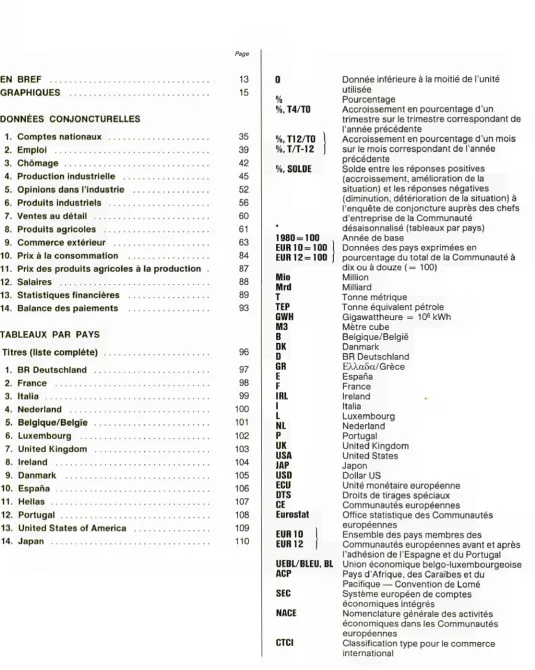
Table des matières
Signes et abréviations
EN BREF
GRAPHIQUES
DONNÉES CONJONCTURELLES
1. Comptes nationaux
2. Emploi
3. Chômage
4. Production industrielle
5. Opinions dans l'industrie
6. Produits industriels
7. Ventes au détail
8. Produits agricoles
9. Commerce extérieur
10. Prix à la consommation
11. Prix des produits agricoles à la production
12. Salaires
13. Statistiques financières
14. Balance des paiements
TABLEAUX PAR PAYS
Titres (liste complète)
1. BR Deutschland
2. France
3. Italia
4. Nederland
5. Belglque/Belgìe
6. Luxembourg
7. United Kingdom
8. Ireland
9. Danmark
10. España
11. Hellas
12. Portugal
13. United States of America
14. Japan
13
15
35
39
42
45
52
56
60
61
63
84
87
88
89
93
96
97
98
99
100
101
102
103
104
105
106
107
108
109
110
%
%,
T4/T0
%,T12/T0
%,T/T-12
%,SOLDE
1980 = 100
EUR10 = 100
EUR 12=100
Mio
Mrd
Τ
TEP
GWH
M3
Β
DK
D
GR
E
F
IRL
I
L
NL
Ρ
UK
USA
JAP
USD
ECU
DTS
GE
Eurostat
EUR 10
EUR 12
UEBL/BLEU, BL
ACP
SEC
NACE
CTCI
Donnée inférieure à la moitié de l'unité
utilisée
Pourcentage
Accroissement en pourcentage d'un
trimestre sur le trimestre correspondant de
l'année précédente
Accroissement en pourcentage d'un mois
sur le mois correspondant de l'année
précédente
Solde entre les réponses positives
(accroissement, amélioration de la
situation) et les réponses négatives
(diminution, détérioration de la situation) à
l'enquête de conjoncture auprès des chefs
d'entreprise de la Communauté
désaisonnalisé (tableaux par pays)
Année de base
Données des pays exprimées en
pourcentage du total de la Communauté à
dix ou à douze ( = 100)
Million
Milliard
Tonne métrique
Tonne équivalent pétrole
Gigawattheure = 10
6kWh
Mètre cube
Belgique/België
Danmark
BR Deutschland
Ελλαδα/Grèce
España
France
Ireland
Italia
Luxembourg
Nederland
Portugal
United Kingdom
United States
Japon
Dollar US
Unité monétaire européenne
Droits de tirages spéciaux
Communautés européennes
Office statistique des Communautés
européennes
Ensemble des pays membres des
Communautés européennes avant et après
l'adhésion de l'Espagne et du Portugal
Union économique belgo-luxembourgeoise
Pays d'Afrique, des Caraïbes et du
Pacifique — Convention de Lomé
Système européen de comptes
économiques intégrés
Nomenclature générale des activités
économiques dans les Communautés
européennes
Classification type pour le commerce
international
[image:14.595.46.582.102.773.2]EUROSTATISTIQUES: en bref
1. CHOMAGE: En avril 1988, le chômage est en légère baisse
dans la Communauté.
Sur base des données disponibles auprès de l'Eurostat, le
nom-bre de chômeurs enregistrés auprès des bureaux de placement
de la Communauté a diminué d'environ 2,8
Wo
en avril 1988 par
rapport à mars. Ceci est en grande partie dû à des raisons
saison-nières.
Sur un an (avril 1988/avril 1987) le nombre des chômeurs inscrits
dans la Communauté serait en baisse d'environ 1,4
Wo
grâce aux
très bons résultats obtenus par le Royaume-Uni ( —18,4 o/o), la
Belgique ( - 8 , 1
Wo),
la France (-4,40/o) et l'Irlande (-3,60/o). Par
rapport à avril 1987, le chômage est en baisse aussi au
Luxem-bourg (—3,7%), aux Pays-Bas (—0,60/o) et en Espagne
( — 0,2 0/o). Par contre des hausses plus ou moins importantes
sont signalées en Italie ( + 15,3 o/o), au Danemark ( + 9,5 %) et en
R. F. d'Allemagne (+2,1o/o).
Les évolutions constatées au mois d'avril confirment la baisse
tendencielle au niveau EUR 12 observée dupuis déjà un an et les
fortes disparités qui existent à l'intérieur de la Communauté. En
fait celle-ci, prise dans son ensemble, connaît une situation de
chômage structurel, qui la place loin derrière les Etats-Unis et le
Japon.
2.
INDICE DES PRIX A LA CONSOMMATION:
Hausse sensible
mais «traditionnelle» en avril pour
EUR
12 ( + 0,5 o/o).
L'indice des prix à la consommation (IPC) a progressé de 0,5 o/o
entre mars et avril 1988 pour l'ensemble de la Communauté
(EUR 12).
Même si cette hausse apparaît comme une rupture de la série
des augmentations modérées des mois derniers, elle est plutôt
normale pour un mois d'avril.
Au Royaume-Uni, par exemple, on enregistre une hausse de
1.6 o/o par rapport au mois de mars. Mais, comme tous les ans au
mois d'avril, Interviennent les augmentations prévues dans le
Budget, notamment des taxes sur l'alcool, le tabac et l'essence
ainsi que des hausses des prix de l'électricité, du gaz, des
auto-mobiles et des taux des prêts hypotécalres.
En Grèce, la hausse est de 2 o/o à comparar avec les 2,3 o/o
enre-gistrés en avril 1987. Dans les autres pays, les taux varient entre
0,0 o/o pour le Luxembourg et 0,5 o/o pour la France, l'Espagne
étant le seul pays où l'indice a régressé ( - 0 , 3 o/o).
Sur douze mois, (avril 1988/avril 1987), le taux d'inflation est de
2.7 o/o pour EUR 12, contre 3,9 o/o aux USA et 0,3 o/o au Japon.
En ce qui concerne les paxs membres pris séparément les taux
sur douze mois sont les suivants:
Inférieur à la Supérieur à la
moyenne EUR 12 moyenne EUR 12
Pays-Bas 0 , 8 % Royaume-Uni 3 , 9 %
Allemagne 1,0 o/o Espagne 3,9 o/o
Belgique 1,0 o/o Danemark 4 , 7 %
Luxembourg 1,0% Italie 5 , 1 %
Irlande 2 , 0 % Portugal 7,9 o/o
France 2,5 o/o Grèce 13,0
Wo
3. PRODUCTION INDUSTRIELLE: Prolongement de la hausse
sensible pour la Communauté en mars.
L'indice pour la Communauté
(EUR 12) du mois de mars est
actuellement estimé à 117,3 soit une hausse de 2 , 5 % par rapport
à mars 1987.
Après correction des variations saisonnières,
l'indice EUR 12 du
mois de mars est de 109,2.
Pour les trois derniers mois connus,
la croissance en un an de
l'indice d'ensemble EUR 12 est de 3,3
Wo.
Les taux correspondants sont voisins de +6,0 % aux USA et de
+ 9,7 o/o au Japon.
Selon les Etats membres
les variations (1er trimestre 1988/1er
tri-mestre 1987) sont de +6,0 o/o en Italie, +3,5 o/o en R. F.
d'Allema-gne, + 3,4 o/o en France et +2,1 o/o au Royaume-Uni.
4. ACIER: Nouvelle augmentation de la production en avril
En avril 1988, la production communautaire d'acier brut a
enregis-tré, avec 11,1 mio. t, une progression désaisonnalisée de 2 , 6 %
par rapport au mois précédent et une augmentation de 3,7 o/o par
rapport à avril 1987.
Au cours du premier trimestre 1988, la production de produits
finis laminés a atteint 28,2 mio. t, ce qui représente une hausse
de 9 % et de 2,7 o/o par rapport au premier trimestre 1987 et 1986
respectivement.
5.
VENTES AU DETAIL:
Très bons résultats en janvier 1988 et
qui persisteront en février.
Le volume des ventes du commerce de détail a augmenté en
jan-vier 1988 dans l'ensemble de pays de la Communauté pour
les-quels l'information est disponible, de 2,3 % par rapport à janvier
1987. Le volume des vents n'a cependant pas augmenté dans
tous les pays: des baisses, bien que légères, se sont manifestées
au Danemark ( — 1,2
Wo)
et en France ( — 1,2
Wo).
La R. F.
d'Allema-gne reste pratiquement au même niveau qu'en janvier 1987. De
fortes augmentations interviennent par contre en Grèce
( + 11,6 0/o), au Royuame-Uni (+8,8 o/o) et en Belgique ( + 4,6
Wo).
L'augmentation est plus modeste en Irlande (+3,1
Wo)
et au
Luxembourg ( +1,8
Wo).
D'après les informations dont dispose déjà Eurostat pour le mois
de février, l'augmentation se maintiendra.
6. COMMERCE EXTERIEUR:
EXPORTATIONS: Les exportations espagnoles en hausse de
22 o/o.
Depuis janvier 1988, les Etats membres de la CE sont passés à un
nouveau système de codification des marchandises, le système
harmonisé. Ce changement et d'autres modifications ont causé
un certain nombre de ruptures. Plusieurs pays n'ont pas encore
été en mesure de produire pour cette année des chiffres du
commerce, et beaucoup d'entre eux ne peuvent que fournir des
chiffres provisoires pour l'ensemble du commerce. Le tableau
suivant reproduit les données disponibles:
Total des exportations Mio d'ECUS
DE ES FR IRL RU USA JAPON
Jan 88 17566 2228 9957 1028 7695 17863 13863
Feb 88 20269 3255 10989 1188 9331 19361 16602
Mar 88 3231 12933 1320 11396 23495 18358
Variation en 0/0-2,7 22,9 14,2 19,4 6,7 18,0 6,7
La dernière ligne du tableau indique en pourcentage la variation
des exportations au cours du premier trimestre (janvier —février
pour l'Allemagne) comparé à la période correspondante en 1987.
Toujours stimulée par son entrée dans la CE, l'Espagne
déve-loppe rapidement ses exportations. La rapide croissance de
l'Irlande est aussi due en partie aux fortes exportations à
destina-tion des autres membres de la CE. D'autre part, la croissance de
14 o/o de la France puise en partie ses forces dans les marchés du
Tiers Monde qui se sont récemment réveillés. Les exportations
de l'Allemagne semblent être affectées par la croissance ralentie
sur le marché US.
Les exportations américaines profitent finalement de
l'améliora-tion de la compétitivité résultant d'un dollar à meilleur marché.
Cependant, les exportations du Japon ont subi le contrecoup
d'un yen élevé, d'un ralentissement de la croissance sur le
mar-ché américain et de la compétition acharnée des nouveaux pays
industrialisés d'Extrême Orient.
IMPORTATIONS CIF: Vagues d'importations au Japon +27 o/o.
Les chiffres les plus récents sur les importations sont les
sui-vants:
l'année dernière et cette tendance s'est affirmée au cours du
premier trimestre avec une hausse supérieure à 20 o/o.
Une vague d'Importations a déferlé au Japon ( + 2 7 % ) en raison
d'une forte demande domestique, de l'appréciation du yen et des
mesures de libéralisation du commerce. En revanche, les
Impor-tations américaines ont progressé à un rythme plutôt lent.
BALANCE COMMERCIALE: Nette amélioration des chiffres du
déficit commercial US.
Les récentes tendances figurent dans le tableau suivant:
Balance commerciale
DE ES
Jan 88 4096 - 6 7 1
Feb 88 3948 - 5 6 1
Mar 88 - 9 1 6
Ratio de couverture
DE ES
Jan 87 123,7 88,1
Feb 87 132,6 74,7
Mar 87 127,6 75,7
FR IRL
- 735 132
-1338 178
- 635 124
FR IRL
85,4 103,7
90,5 104,3
88,7 105,7
Mio
RU USA
-3052 - 9948
-3948 -11363
-2043 - 7858
RU USA
80,3 58,4
93,4 57,4
86,9 62,8
d'ECUS
JAPON
2466
4305
6044
JAPON
140,6
170,6
172,1
Jan 88 130,4 76,9 93,1 114,7 71,6 64,2 121,6
Feb 88 124,2 85,3 89,1 117,6 70,3 63,0 135,0
Mar 88 77,9 95,3 110,4 84,8 74,9 149,1
L'excédent commercial de l'Allemagne s'est établi à 4 milliards
d'Ecus par mois pour l'année en cours, environ 1 0 % de moins
qu'en 1987. L'excédent commercial de l'Irlande s'est accru et le
déficit français a continué de régresser. D'autre part, le déficit du
R. U. s'est brusquement détérioré.
Les chiffres du déficit commercial des USA ont indiqué une nette
amélioration, ceux de mars étant les meilleurs depuis plusieurs
années. Au Japon, le boum des importations ont ramené
l'excé-dent commercial de ce pays à 4,2 milliards d'Ecus par mois au
cours du premier trimestre.
7.
TAUX DE CHANGE:
Un dollar raffermi après la réduction du
déficit commercial.
L'évolution du déficit commercial US est encore au centre de
l'intérêt des marchés financiers internationaux. Contrairement au
déficit inopinément élevé de février les dernières données
provi-soires pour mars font état d'une réduction substantielle du déficit
à $ 9,7 milliards contre $ 13,8 milliards en février.
Cette évolution a été bien accueillie par les marchés des changes
étrangers et a conduit à un raffermissement du dollar, bien que
pas dans des proportions substantielles: les opérateurs semblent
maintenant craindre les risques d'inflation qu'une demande
inté-rieure et extéinté-rieure élevée pourrait générer dans l'économie US.
Le sterling a continué, au cours de la première moitié de mai, son
mouvement ascensionnel contre les principales monnaies
mon-diales et a atteint à la mi-mal ses niveaux les plus élevés depuis
deux ans. Pour amoindrir les tendances sur la livre, la Banque
d'Angleterre a décidé d'abaisser son loyer de l'argent d'un demi
point à 7,5 o/o. Cette mesure, parallèlement au récent
raffermisse-ment du dollar, a ramené la livre à des niveaux un peu plus bas.
L'appréciation de la livre au cours des derniers mois est
révéla-trice des problèmes de politique monétaire posés par
l'associa-tion d'un taux de change flottant à une libre mobilité des
capi-taux: en théorie, le taux de change flottant renforce l'autonomie
d'un pays en matière de politique monétaire. En pratique, c'est
une composante de la politique monétaire dont les mouvement
doivent être surveillés et souvent Influencés.
A l'intérieur du SME, les différentes positions des monnaies n'ont
pratiquement pas bougé par rapport au mois précédent avec
dans la grille des monnaies le florin néerlandais en haut de la lire
italienne en bas.
Parmi les monnaies communautaires ne participant pas au SME,
on notera la performance de la peseta espagnole. Au cours d'avril
et de mal, elle s'est appréciée contre l'ECU et la plupart des
autres monnaies de la Communauté. Les taux d'intérêt élevé sur
la peseta et la réduction de l'inflation semblent avoir provoqué un
afflux de capitaux étrangers et contribué à l'appréciation de la
monnaie espagnole.
8. TAUX D'INTERET A LONG TERME:
Des signes de tension à
la hausse.
Le relèvement des taux d'intérêt à long terme constaté dans
plu-sieurs pays au mois de mars et au début d'avril a été confirmé par
des données plus récentes.
Aux Etats-Unis en particulier, le taux moyen d'avril était de 8,9 o/o
et des indications pour mai indiquent des taux encore plus
éle-vés. A l'origine de cette montée des taux d'intérêt, on peut
rete-nir le taux de croissance soutenu de l'économie américaine et la
forte demande intérieure qui ravivent les craintes de pression
inflationnistes (dans de nombreuses industries, l'utilisation des
capacités a déjà atteint des niveaux élevés). Les marchés
obliga-toires ont été défavorablement affectés par cette évolution et les
taux d'intérêt (rendements) ont pris de la hauteur.
Cette hausse des taux US a aussi influencé les taux en Europe
qui ont pris le chemin de la hausse bien que ceux-ci ne se soient
pas encore totalement reflétés dans les moyennes d'avril
publiées dans ce bulletin.
9. DISPONIBILITES MONETAIRES:
Ralentissement du taux de
croissance de M1 en France et en Grèce.
D'après les plus récentes données disponibles, le taux de
crois-sance de la masse monétaire au sens strict (billets de banque et
dépôts à vue) a marqué une forte chute en France: 0,4
Wo
pour
l'année se terminant en mars, venant de 1,5
Wo
en février et 3,1
Wo
en janvier. Cette décélération de la croissance de M1 est due à la
diminution des dépôts à vue tant des ménages que des
entrepri-ses, un phénomène attribué à une réallocation de portefeuilles
d'investisseurs entre divers avoirs financiers. Le rythme de
crois-sance de la masse monétaire au sens le plus large pour la France
(M2 et M3) ne s'est que très légèrement ralenti par rapport aux
mois précédents.
Les données provisoires de février pour la Grèce indiquent un
ralentissement du taux de croissance de M1 de 9,9 °/o contre
18,7 0/0 ¡ l y a six mois. La masse monétaire au sens large (M3)
pour la Grèce progresse cependant à un taux annuel de 24 %
correspondant a la tendance.
L'attention s'est aussi portée sur l'évolution des agrégats
moné-taires de l'Espagne; au cours des derniers mois, la croissance de
M1 s'est accélérée pour atteindre 15,8% (moyenne de février,
janvier et décembre) comparée à 12,9 % pour la moyenne du
tri-mestre précédent.
10. RESERVES: Les réserves du R. U. ont doublé en un an.
Le stock d'avoirs sur l'étranger du Royaume-Uni. (33,1 milliards à
la fin de mars) a presque doublé par rapport aux chiffres d'il y a
un an. L'attrait de la livre et l'afflux de capitaux pour s'investir en
avoirs en sterlings (combinés avec l'intervention de la Banque
d'Angleterre sur les marchés des changes étrangers) a été la
cause principale de l'accroissement des avoirs officiels sur
l'étranger.
Concernant les développements au cours du mois de mars, les
variations les plus notables ont été les suivantes:
Les réserves de la Grèce ont chuté de 0,5 milliard à 1,8 milliard,
une évolution qui reflète la détérioration des paiements courants
de ce pays au mois de mars. Dans une certaine mesure, cette
chute est attribuable à des événements saisonniers défavorables
qui influencent la balance des paiements grecque au cours du
premier semestre (les recettes provenant de services, surtout du
tourisme, sont perceptibles au cours de la seconde moitié de
l'année).
Les avoirs de l'Italie ont aussi diminué de 1,3 milliard, une
évolu-tion qui reflète la relative faiblesse de la lire et l'intervenévolu-tion de la
Banque d'Italie pour la soutenir.
SCHAUBILDER
GRAPHICS
ARBEITSLOSIGKEIT
INSGESAHT MIOUSA
UNEMPLOYMENT
TOTAL nio
EUR 1 2
20
15
10
J _ L
I I I I ICHOriAGE
TOTAL nio
J A P A N
ι ι Ι ι ι Ι ι ι
I I I I Iι Ι ι ι
::o
. 15
IO
5
¿
_ 3
1985
1986
1987
1988
EINFACH- LOGARΙΤΗΓΊISCHE SKALA SEMI-LOCARΙΤΗΠIC SCALE ECHELLE SEHI-LOGARITHMIQUE
REGISTRo ARBEITSLOSIGKEIT
INSGESAHT
INSGESAITT/SAISONBEREINIGT rlAEIMNER / SA ISONBEREΙNI GT FRAUEN/SAISONBEREINIGT
REGISTERED UNEMPLOYMENT
EUR 12 ΠΙΟTOTAL
TOTAL/SEASONALLY ADJUSTED ΠΕΝ/SEASONALLY ADJUSTED UOflEN/SEASONALLY ADJUSTED
CHOMAGE ENREGISTRE
TOTAL
TOTAL/DESAISONNALISE HOnriES/DESAISONNALISE FEnriES/DESAISONNALISE
15
12
10
r ..- a n . . . . . . ,
, »m ■*■ *w ■" ■» ■** '
ι ι Ι ι ι
1985
I I I I I I I I ' I I J _ I
Ι ι ι
I ι ι ι ι ι ι ι ι ι I20
1'.
12
19