White Rose Research Online URL for this paper:
http://eprints.whiterose.ac.uk/151724/
Version: Published Version
Article:
Gielen, S. orcid.org/0000-0002-8653-5430 and Turok, N. (2016) Perfect quantum
cosmological bounce. Physical Review Letters, 117 (2). ISSN 0031-9007
https://doi.org/10.1103/physrevlett.117.021301
© 2016 American Physical Society. Reproduced in accordance with the publisher's
self-archiving policy. https://doi.org/10.1103/PhysRevLett.117.021301
[email protected] https://eprints.whiterose.ac.uk/
Reuse
Items deposited in White Rose Research Online are protected by copyright, with all rights reserved unless indicated otherwise. They may be downloaded and/or printed for private study, or other acts as permitted by national copyright laws. The publisher or other rights holders may allow further reproduction and re-use of the full text version. This is indicated by the licence information on the White Rose Research Online record for the item.
Takedown
If you consider content in White Rose Research Online to be in breach of UK law, please notify us by
Perfect Quantum Cosmological Bounce
Steffen GielenTheoretical Physics, Blackett Laboratory, Imperial College London, London SW7 2AZ, United Kingdom
Neil Turok
Perimeter Institute for Theoretical Physics, Waterloo, Ontario N2L 2Y5, Canada (Received 14 October 2015; revised manuscript received 14 March 2016; published 6 July 2016)
We study quantum cosmology with conformal matter comprising a perfect radiation fluid and a number of conformally coupled scalar fields. Focusing initially on the collective coordinates (minisuperspace) associated with homogeneous, isotropic backgrounds, we are able to perform the quantum gravity path integral exactly. The evolution describes a “perfect bounce”, in which the Universe passes smoothly through the singularity. We extend the analysis to spatially flat, anisotropic universes, treated exactly, and to generic inhomogeneous, anisotropic perturbations treated at linear and nonlinear order. This picture provides a natural, unitary description of quantum mechanical evolution across a cosmological bounce. We provide evidence for a semiclassical description in which all fields pass “around” the cosmological singularity along complex classical paths.
DOI:10.1103/PhysRevLett.117.021301
Recent observations have revealed extraordinary sim-plicity in the large-scale structure of the Universe: a spatially flat geometry with nearly scale-invariant, Gaussian fluctuations. As yet, there are no indications of tensor (gravitational wave) modes which would signal primordial inflation, nor complications such as curvature, non-Gaussianity, or isocurvature modes. The simplicity of these findings seems at odds with expectations based on inflationary models predicting a“multiverse”with random and unpredictable behavior on large scales. We are there-fore encouraged to seek more economical explanations for the state of the Universe. One of the oldest and simplest ideas[1]is that the big bang was a bounce. Such a bounce is generally forbidden in classical general relativity, but might be allowed in quantum gravity [2].
At the big bang singularity, the density and temperature of matter diverges. General arguments indicate that the only complete quantum field theories are those with a UV fixed point, i.e., which are conformally invariant at high energies [3]. Therefore, it is of particular interest to study cosmol-ogies with conformally invariant matter. A simple example is a spatially flat, homogeneous, and isotropic universe filled with a perfect radiation fluid, with line element
ds2
¼a2
ðηÞð−dη2
þd~x2
Þ; ð1Þ
withaðηÞ∝η, whereηis the conformal time. This is a good metric for all η≠0, and furthermore possesses a unique
analytic continuation around the singularity in the complex η-plane. As we shall see, generic perturbations about this metric share these nice properties; hence, we term this cosmology a“perfect bounce”. Indeed, in a pioneering paper
[4][see discussion following Eq. (5.19)], DeWitt anticipated this idea, stating: “One might hope that an analytic
continuation could be performed around [the singularity] but whether this would have any physical meaning is unclear”. We shall perform just such a continuation and interpret it.
We study the quantum dynamics of a universe with conformal matter consisting of perfect radiation and conformally coupled scalar fields. We first analyze homo-geneous, isotropic backgrounds, showing that the semi-classical approximation to the path integral is exact. We then generalize to anisotropic spatially flat metrics, com-puting the Feynman propagator and clarifying its analytic properties. Finally, we tackle generic inhomogeneous cosmologies, order by order in a perturbative expansion. Although perturbation theory fails as we approachη¼0,
we can maintain its validity by deforming the η-contour into the complex η-plane and bypassing the singularity. This continuation respects all the symmetries of general relativity and yields an unambiguous result. For conformal matter, we show there is no quantum creation of scalar density perturbations or gravitational waves across the bounce, indicating a well-defined vacuum. For theories with nontrivial running and/or soft breaking terms, one would find finite particle production.
Weyl-invariant formulation.—We consider cosmology with perfect radiation andM conformally coupled scalars
~
χ¼ ðχ1
;…;χMÞ. It is convenient to“lift”Einstein gravity to a classically Weyl-invariant action[5],
S¼
Z dDx
ffiffiffiffiffiffi
−g
p 1 2ðð∂ϕÞ
2
−ð∂~χÞ2
Þ
þ8ðD−2Þ ðD−1Þðϕ
2
−~χ2ÞR−ρ
jJj ffiffiffiffiffiffi
−g
p
−Jμ∂ μφ~
: ð2Þ
The fluid is characterized by a densitized particle number flux Jμ with jJj≡ ffiffiffiffiffiffiffiffiffiffiffiffiffiffiffiffiffiffi
−gμνJμJν p
particle number density andρðnÞis the energy density[6]. The Lagrange multiplier φ~ enforces particle number
con-servation: for a homogeneous, isentropic fluid there are no additional constraints. The action (2) is invariant under local Weyl transformations. Whileϕhas the“wrong sign” kinetic term, there is no physical ghost: one can go to “Einstein gauge” where ϕ2−χ~2 is a constant, obtaining
Einstein gravity coupled to scalars with positive kinetic energy. However, other Weyl gauges may be more convenient.
Quantum mechanics of a cosmological bounce.—For homogeneous, isotropic cosmologies, one can choose a Weyl gauge in which the metric is static and the scalars ðϕ; ~χÞ encode all of the dynamics. While the metric is nonsingular in this gauge, the theory is still problematic because the effective Planck mass, given by the coefficient ofR, can vanish, so that gravity becomes strongly coupled. Our strategy is to first identify this singularity in the quantum propagator, and then understand how to analyti-cally continue around it. Our key assumption, which we shall test in various calculations, is that there are no singularities obstructing such a continuation. We set
D¼4unless otherwise stated.
Fixing the metric to ds2
¼−N2
ðtÞdt2
þhijdxidxj,
where hij is a metric of constant three-curvature
Rð3Þ
¼6κ, Eq.(2) reduces to
S¼V0 Z
dt _
~
χ2−ϕ_2
2N þN
κ
2ðϕ 2
−~χ2Þ−ρ
−φ~n_
; ð3Þ
where V0¼R d3
x ffiffiffi h
p
is the comoving spatial volume (which we take to be finite) and n∝ρ34. Define
xα≔ð2ρÞ−1=2
ðϕ; ~χÞ, withα¼0;…; M. Then, withη
αβ¼
diagð−1;1;1;…Þ and m¼2V0ρ, which is a coordinate
scalar, Eq. (3)becomes
S¼ Z dt m 2 1
Nx_ αx_
α−Nðκxαxαþ1Þ
−φm_
; ð4Þ
with φ≔φ~V0ðdn=dmÞ. Equation (4) is the action for a
relativistic oscillator (κ>0), free particle (κ¼0), or
“upside-down”oscillator (κ<0), with massm, extending
earlier work (see, e.g., Ref.[7]) for the case ρ¼0.
From Eq.(2), the effective Newton’s constant is fixed by ðϕ2
−χ~2
Þ ¼−2ρx2 so that, for positive radiation density,
there are two timelike regions of superspace, withx2 <0
and x0
>0 or x0<0, respectively, describing “gravity,” and a spacelike region, x2>0, describing “antigravity.”
The presence of radiation allows real solutions which pass smoothly from a“gravity”region through an“antigravity” region and back to a“gravity”region, i.e., classical bounces
[5]. Once anisotropies and inhomogeneities are included, generically there are no regular, real“bounce” solutions; but thereare regular, complex solutions which are defor-mations of the classical bounces. We claim these are legitimate saddle points of the path integral and provide a consistent semiclassical description of a quantum bounce. To describe these complex solutions, it is convenient to define the Einstein-frame scale factorabyxα
¼avαwithv
an (Mþ1)-vector satisfyingv2¼−1, so that real negative
and positive values ofarepresent the two“gravity”regions, while imaginary values of a represent the “antigravity” region. We shall study generic complex solutions by analytically continuing a into the complex plane and around the singularity at a¼0.
Let us begin with the propagator for homogeneous, isotropic universes.
Feynman propagator from path integral.—The propa-gator is given by a phase-space path integral[8],
Gðx; mjx0; m0Þ≔
Z
DxαDP
αDmDpmDNexp
i
Z 1=2
−1=2 dt
_ xαP
αþmp_ m−N
PαPα
2m þ m
2ðκx αx
αþ1Þ
: ð5Þ
Equation (5) is obtained from a canonical analysis of Eq.(3)using Dirac’s algorithm, after“solving”two second-class constraints to eliminate φ and its momentum [9]. Fixing the gauge N_
¼0 allows us to replace the path
integral overN with an ordinary integral over proper time τ¼Nin this gauge[10]. Integrating overmandpmyields
a delta function for m conservation. The remaining path integrals are Gaussian and are computed exactly using the classical solution
xðtÞ ¼xsin½
ffiffiffi
κ p
τðtþ1=2Þ þx0sin½ ffiffiffi
κ p
τð1=2−tÞ
sinð ffiffiffi
κ p
τÞ : ð6Þ
The final result is
Gðx; mjx0; m0Þ ¼iδðm−m0Þ
Z dτexp
−im 2τ × m ffiffiffi κ p
2iπsinð ffiffiffi
κ p
τÞ
ðMþ1Þ=2
× exp
im ffiffiffi
κ p ðx2
þx02
Þcosð ffiffiffi
κ p
τÞ−2x⋅x0
2sinð ffiffiffi
κ p
τÞ
:
ð7Þ
For the Feynman propagator, τ runs from 0 to ∞. We insert a convergence factor−ϵτ=ð2mÞin the exponent or,
alternatively, define theτ-contour by steepest descent from the appropriate saddle point. The propagator has the usual
short-distance singularities but is otherwise regular. It is defined by analytic continuation inx0 (ora) around these
singularities through the half-plane in which it converges. For example, in extending the amplitude from values for which x0
−x00
<j~x−~x0j to values for which x0
−x00 >
j~x−~x0j, we pass around the singularity in the lower-half
x0-plane. For
κ¼0, we obtain the massive free-particle
propagator on flat spacetime, for which these analyticity properties are well known [9,11].
For homogenous, isotropic quantum cosmology with conformal matter, these calculations explicitly demonstrate that the Feynman propagator is perfectly regular at the“big bang singularity”x2
¼0and that, since the path integrals
are Gaussian, the semiclassical approximation is exact. For a large universe, the background is“heavy”: there is little quantum spreading or backreaction from perturbations [12]. More explicitly, provided radiation dominates, the action associated with its density [the first exponent in Eq. (7)] may be expressed asð3=8πGÞHEVE, where HE
and VE are the Hubble constant and three-volume in
Einstein gauge, and G is Newton’s constant. We shall perform our analytic continuations along complex paths for which this quantity increases at a rate sufficient to maintain the Wentzel-Kramers-Brillouin (WKB) expansion.
We now turn to anisotropic, spatially flat cosmologies. Again, the Feynman propagator will be defined by analytic continuation around its singularities.
Anisotropies.—Consider a spatially flat, anisotropic metric in a conformal gauge where the determinant of the spatial metric is static,
ds2
¼−N2
ðtÞdt2
þX
D−1
i¼1
e4pffiffiffiffiffiffiffiffiffiffiffiffiffiffiffiffiffiffiffiffiðD−1Þ=ðD−2ÞλiðtÞdx2
i;
X
D−1
i¼1
λi¼0
ð8Þ
(restoring the dimension D). The action (4)becomes
S¼ Z
dt m
2 1
N
_ x2
−x2X
i
_
λ2i
−N
−φm_
: ð9Þ
This is again the action of a massive free particle, now moving in a curved “superspace” metric dx2−x2P
idλ2i,
with a Lorentzian signature for a2
¼−x2
>0. Recall, xα¼avα, with v2
¼−1, so the vector v parameterizes a
unit hyperboloid HM. Taking into account the constraint
P
iλi¼0, the λi parameterize RD−2. Although the path
integration is hard to perform directly, there is sufficient symmetry present for the differential equation that the propagator satisfies, the Wheeler-DeWitt equation, to determine it completely. Fourier transforming to the con-served momenta onHM×
RD−2, only the dependence on a
remains to be determined. This, however, is fixed uniquely by the Wheeler-DeWitt equation and analyticity properties. The Wheeler-DeWitt equation reads
ˆ
OaGða; mja0; m0Þ ¼−2ima−ðMþD−2Þ
δðm−m0Þδða−a0Þ; ð10Þ
where
ˆ
Oa≡ d
2
da2þ
MþD−2 a
d da−
C a2þm
2
; ð11Þ
with C≡−14ðM−1Þ2−ζ2−k2
AþξðD−2Þð2MþD−3Þ.
Here, ζ is the momentum on HM, k
A that on the space
of anisotropies, andξis a parameter governing the ordering ambiguity identified by DeWitt [13] and clarified (in the phase-space path integral) by Kuchaˇr [14]. Halliwell has made a strong case that ξ should be taken to be the conformal coupling on superspace, and further shown that this is consistent with the DeWitt inner product [10]. Formally, settingD¼2 and kA¼0 in Eq. (11) removes
the anisotropy degrees of freedom and reduces the equation to that for the isotropic, flat case.
The Feynman propagator is obtained by the Wronskian method from the positive and negative frequency modes, defined to be the solutions to OˆaΨðaÞ ¼0 which
are regular in the lower- and upper-half complexa-plane, respectively. Up to normalization, they are given by
Ψþ;−ðaÞ ¼a−ðMþD−
3Þ=2Hð2;1Þ
ν ðmaÞ; ð12Þ
where ν¼12
ffiffiffiffiffiffiffiffiffiffiffiffiffiffiffiffiffiffiffiffiffiffiffiffiffiffiffiffiffiffiffiffiffiffiffiffiffiffiffi 4Cþ ðMþD−3Þ2 p
, and Hðν1;2Þ are the
Hankel functions of the first and second kind. The propagator is
Gða;mja0;m0Þ ¼π
2mδðm−m
0Þðaa0Þ−ðMþD−3Þ=2
×ðHðν1Þðma0ÞHð 2Þ
ν ðmaÞθða−a0Þþða↔a0ÞÞ:
ð13Þ
For the flat, isotropic case, we obtain the free-particle propagator in the (Mþ1)-dimensional Minkowski space
of fieldsðϕ; ~χÞ; forM¼0,G¼δðm−m0Þe−imja−a0j . The modes appearing in the propagator have remarkable properties: an incoming positive-frequency mode continues to an outgoing positive-frequency mode, without even a phase shift. This surprising behavior follows from these facts: (i) the positive- (negative-)frequency modes are real and decay exponentially asaruns to negative- (positive-) imaginary values and (ii) the WKB approximation holds at largejaj, throughout the lower-half (upper-half) complex
a-plane. Thus, the modes continue to the positive or negative real a-axis where, by Schwarz reflection about the imaginarya-axis, their form is identical. The behavior of the DeWitt inner product is also of interest. In our example, where only thea dependence is nontrivial, this reduces toh1j2i≡aMþD−2
Ψ1ðaÞi∂a
↔
Ψ2ðaÞ. If we
a, their norm is preserved as we pass to positivea, again by Schwarz reflection through ReðaÞ ¼0.
It may seem strange that the singular potential in Oˆa
has no effect on scattering states. However, the classical theory echoes this behavior. Consider the Hamiltonian
H¼N1 2ðp
2
aþC=a2−m2Þ, with C a constant and N a
Lagrange multiplier imposing H¼0. For C >0 (which
can only occur when anisotropies are present), the classical solutions bounce and are nonsingular,
a2
ðτÞ ¼ ðτ−τ0Þ 2
þC=m2
; ð14Þ
withτ¼Ntandτ0an arbitrary constant. We haveaðτÞ≈
ðτ−τ0Þ at large negative or positive τ. The potential
introduces no net time advance or delay: it slows the trajectory but also causesato bounce sooner. For C <0,
the classical solutions are singular but become well defined if one gives the solutions an infinitesimal imaginary part. As a runs in from −∞ and approaches the origin, it turns down the imaginarya-axis toa¼−i ffiffiffiffiffiffiffi
−C
p
=mbefore heading back to the origin and out to þ∞. The speed-up due to the potential and the delay from the excursion into imaginary a cancel. This excursion represents the “ anti-gravity”phase described in Ref.[5]. This suggests that the “antigravity”regime is a consequence of trying to make the quantum behavior look classical, and that it should not be taken literally as a new classical phase.
Noting that, forC >0, one of the two modes diverges
at a¼0, some authors advocate setting Ψð0Þ ¼0.
Effectively this renders Ψ real, but (i) a real Ψ cannot describe a state of nonzeroa-momentum, i.e., an expanding or a contracting universe, (ii) the DeWitt norm is zero, so there is no meaningful notion of unitarity, and (iii) the correspondence principle is violated, due to a phase shift in the reflected mode which (as is easily seen) is independent ofm. Furthermore, askAis increased,Cgoes negative. For
smallC <0, both solutions vanish ata¼0, so there would
be a jump in the allowed modes. At larger C <0 their
prescription again gives a phase shift which violates the correspondence principle. None of these problems occur with our modes.
Inhomogeneities.—Finally, we tackle inhomogeneities in a perturbative expansion around a flat (κ¼0)
back-ground. The amplitude between in and out states is calculated in the saddle point (semiclassical) expansion around the appropriate complex classical solution. At lowest order, the initial state for the perturbations is a Gaussian wave functional for the incoming adiabatic vacuum. The corresponding classical perturbation is the positive frequency mode: any mode mixing with negative frequency modes across the bounce signals particle pro-duction. Here, for simplicity, we setM¼0and study only
planar perturbations, taken to nonlinear order.
We solve the equations of motion following from Eq.(2) in Einstein gauge. The background metric is given in
Eq. (1): since aðηÞ∝η, we can equivalently analytically continue in a or in conformal time η. Assuming planar symmetry, the perturbed metric is
ds2∝
η2
ð−1þ2ϵϕÞdη2
þ ½1þ2ϵðψþγÞdx2
þ
1þϵ
2ψþ1
2h
T
dy2
þ
1þϵ
2ψ−1
2h
T
dz2
; ð15Þ
whereϕ,ψ,γ, and hT are functions ofη andxonly. For
simplicity, we set the second tensor mode ingyzto zero (its
dynamics are analogous to those ofhT).
We adopt a coordinate system in which the radiation is at rest everywhere (comoving gauge); the radiation density is ρðη; xÞ ¼ρ0ðηÞ½1þϵδrðη; xÞ. We expand the
perturbations and Einstein equations in powers of ϵ: ϕðη; xÞ ¼P
n≥1ϵn− 1
ϕðnÞðη; xÞ, etc. At order ϵn, Einstein’s equation for the tensorshTðnÞ is
∂2 hTðnÞ
∂η2 þ 2
η ∂hTðnÞ
∂η − ∂2
hTðnÞ
∂x2 ¼J
nðη; xÞ; ð16Þ
where Jn is nonlinear in the lower-order perturbations.
There are four Einstein equations analogous to Eq.(16)for the scalar perturbations δr, ϕ, ψ, and γ. In Ref. [9], we
derive the tensor and scalar Green’s functions and solve Einstein’s equations order by order inϵ.
Consider the nonlinear extension of positive frequency solutions of the linearized equations, of wave numberk0,
ψð1Þ
¼Acosðk0xÞe
−ik0η= ffiffi3 p
k0η ;
hTð1Þ
¼Bcosðk0xÞe
−ik0η
k0η ; ð17Þ
withϕð1Þ, γð1Þ, andδðr1Þ determined in terms of ψð1Þ.
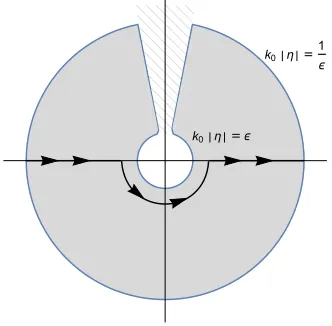
In Ref.[9], we give the positive frequency perturbations at second order, involving gamma functions and loga-rithms. After suitable definition of branch cuts, they are analytic in the lower-halfη-plane, allowing us to avoid the singularity at η¼0 (see Fig. 1), just as for the
homo-geneous background. To calculate the quantum production of scalar or tensor perturbations across the bounce, we compute the leading terms of the nonlinear perturbations as η→∞. At largejηj, hTð2Þ is
ABe−ið1þ1=pffiffi3
Þk0ηð
27þ16pffiffiffi3Þcosð2k0xÞ−6−5pffiffiffi3
ð21þ11pffiffiffi3
Þik0η þ ; ð18Þ
where are terms subleading in ðk0ηÞ, and
ψð2Þ
ðη; xÞ∼A
2
12e
−ð2=pffiffi3Þik
0η½1þ2cosð2k0xÞ þ : ð19Þ
There is no mixing of positive and negative frequencies, and, hence, no particle production. The full functionshTð2Þ
and ψð2Þ decay exponentially for negative imaginary
η. These properties extend to all orders in the perturbation expansion, unambiguously defining nonlinear positive frequency modes [9].
On the real η-axis, ψð2Þ does not decay at large
jηj, indicating a breakdown of perturbation theory. Metric perturbations are gauge dependent; the “gauge-invariant” Newtonian potentialΦ[15]isΦð2Þ∼O
ð1=k0ηÞat largejηj
at second order in ϵ. Comparing with the first-order potential Φð1Þ∼O
ð1=k2 0η
2
Þ still indicates a breakdown of the expansion when k0jηj∼1=ϵ. This phenomenon has a
simple physical explanation. The radiation fluid is gov-erned by nonlinear dynamics, eventually leading to shocks. A careful analysis [16] shows that perturbation theory breaks down when k0jηj∼1=ϵ. Perturbation theory can
thus be trusted for ϵ< k0jηj<1=ϵ (Fig. 1), where we
obtain a perturbation expansion in ϵ for nonsingular, nonlinear solutions in the complexη-plane.
Conclusions.—Our results indicate that a valid semi-classical approximation to quantum cosmology with con-formal matter can be obtained from complex classical paths which avoid the classical big bang singularity. For homo-geneous, isotropic backgrounds, and for anisotropic flat backgrounds, we computed the Feynman propagator exactly, showing its large jaj behavior to be insensitive to the divergent potential introduced by anisotropies near the singularity. Finally, including inhomogeneities, we found global, positive frequency modes; perturbation theory fails at large times, but this is physically well understood[16]. Our investigations suggest the existence of a consistent and complete semiclassical description of a
cosmological bounce, paving the way for detailed inves-tigations of new, simpler and more predictive bouncing models.
The work of S. G. is supported by the People Programme (Marie Curie Actions) of the European Union’s Seventh Framework Programme (FP7/2007-2013) under REA Grant No. 622339. Research at Perimeter Institute is supported by the Government of Canada through Industry Canada and by the Province of Ontario through the Ministry of Research and Innovation.
[1] A. Friedmann, Über die Krümmung des Raumes,Z. Phys. 10, 377 (1922).
[2] M. Bojowald, Absence of Singularity in Loop Quantum Cosmology,Phys. Rev. Lett.86, 5227 (2001); A. Ashtekar and P. Singh, Loop quantum cosmology: A status report,
Classical Quantum Gravity28, 213001 (2011).
[3] A. Shomer, A pedagogical explanation for the non-renormalizability of gravity,arXiv:0709.3555.
[4] B. S. DeWitt, Quantum theory of gravity. I. The canonical theory,Phys. Rev.160, 1113 (1967).
[5] I. Bars, S. H. Chen, P. J. Steinhardt, and N. Turok, Anti-gravity and the big crunch/big bang transition,Phys. Lett. B 715, 278 (2012); I. Bars, P. J. Steinhardt, and N. Turok,
Local conformal symmetry in physics and cosmology,Phys. Rev. D 89, 043515 (2014).
[6] D. Brown, Action functionals for relativistic perfect fluids,
Classical Quantum Gravity10, 1579 (1993).
[7] A. Ashtekar and R. S. Tate, An algebraic extension of Dirac quantization: Examples, J. Math. Phys. (N.Y.) 35, 6434 (1994).
[8] M. Henneaux and C. Teitelboim, Quantization of Gauge Systems(Princeton University Press, Princeton, NJ, 1994). [9] S. Gielen and N. Turok, Quantum cosmology with
con-formal matter (to be published).
[10] J. J. Halliwell, Derivation of the Wheeler-DeWitt equation from a path integral for minisuperspace models,Phys. Rev. D38, 2468 (1988).
[11] N. D. Birrell and P. C. W. Davies, Quantum Fields in Curved Space (Cambridge University Press, Cambridge, England, 1982).
[12] C. Rovelli and E. Wilson-Ewing, Why are the effective equations of loop quantum cosmology so accurate?,Phys. Rev. D 90, 023538 (2014).
[13] B. DeWitt, Dynamical theory in curved spaces. I. A review of the classical and quantum action principles,Rev. Mod. Phys.29, 377 (1957).
[14] K. Kuchaˇr, Measure for measure: Covariant skeletoniza-tions of phase space path integrals for systems moving on Riemannian manifolds, J. Math. Phys. (N.Y.) 24, 2122 (1983).
[15] J. M. Bardeen, Gauge-invariant cosmological perturbations,
Phys. Rev. D22, 1882 (1980).
[16] U.-L. Pen and N. Turok, Shocks in the early Universe,
arXiv:1510.02985.
[image:6.612.92.258.49.212.2]