i
THE EFFECTIVENESS OF WEB 2.0 TOOLS TO ENHANCE THE SMEs PERFORMANCE
LALITAH A/P MANIMARAN
Report submitted in fulfillment of the requirement for the Bachelor Degree of Technology Management in Innovation
Faculty of Technology Management and Technopreneurship Universiti Teknikal Malaysia Melaka
ii
A STUDY ON THE EFFECTIVENESS OF WEB 2.0 TOOLS TO ENHANCE THE SMEs PERFORMANCE
By
LALITAH A/P MANIMARAN
I hereby acknowledge that this project paper has been accepted as a part fulfillment for Bachelor Degree of Technology Management in Innovation
Signature : ……… Supervisor : DR.JUHAINI BINTI JABAR Date : __ June 2016
Signature: ………
iii
“I declared that this project is the result of my own research except as cited in the references. This research project has not been for any degree and is not concurrently
submitted in candidature of any other degree.”
Signature: ………..
Name : LALITAH A/P MANIMARAN
iv
DEDICATION
This research paper is lovingly dedicated to my respective parents, Mr. Manimaran and Mrs.Saraswathy, who have been my constant source of inspiration. They have
given me the drive and discipline to tackle any task with enthusiasm and determination. Without their love and support this project would not have been made
v
ACKNOWLEDGEMENT
First and foremost, I would like to thankful to the god for giving me the ability, time, courage and strength to successfully finish up this Projek Sarjana Muda(PSM) on time. Special thanks also deliver to my beloved supervisor, Dr. Juhaini Binti Jabar and people who involved in my PSM for the valuable guidance and advices for this report. You inspired me greatly to work on this project and your willingness to motivate contributed tremendously to this particular matter. I also would like to thank you for showing me some example that related to the topic of my PSM and giving the opportunity to learn, participate and explore this new area of learning without hesitation. Moreover, I would like to thank the authority of Universiti Teknikal Malaysia Melaka (UTeM) for providing me with a lot of information needed and facilities to complete this project. Last but not least, an honorable mention goes to my family and friends for their understandings and support in completing this project. Without helps of particular that mentioned above, I would face many difficulties while doing this project. Thank you very much for sharing the kindness.
vi
ABSTRAK
Generasi baru aplikasi internet dikenali sebagai media sosial atau Web 2.0 menawarkan perbadanan pelbagai jenis peluang untuk meningkatkan kecekapan pemasaran dan operasi dalaman. Aplikasi Web 2.0 telah menjadi sebahagian daripada kehidupan peningkatan jumlah pengguna yang menganggapnya sebagai saluran utama komunikasi, pertukaran maklumat, perkongsian kepakaran, penyebaran kreativiti individu dan hiburan. Weblog, Podcast, forum dalam talian, dan rangkaian sosial yang pesat menjadi sumber utama pertukaran maklumat pelanggan. Menggunakan alat-alat pemasaran Web 2.0 merupakan satu isu menarik perhatian yang semakin meningkat. Pengalaman sebelum ini adalah bahawa perbadanan awam yang besar adalah, atau mungkin untuk menggunakan instrumen seperti sebahagian daripada pemasaran dan operasi dalaman (McKinsey 2007) .Web 2,0 mencari untuk cara yang berbeza teknik-teknik ini digunakan oleh firma besar dan membuat beberapa cadangan asas pada pendekatan bahawa perusahaan yang lebih kecil harus diambil kira dalam menerapkan Web 2.0 konsep sebagai sebahagian daripada strategi pemasaran langsung mereka. Kajian ini mentakrifkan Web 2.0 fenomena dan berdasarkan pengalaman syarikat-syarikat besar mengkaji bagaimana PKS boleh melibatkan pelbagai instrumen untuk memasarkan produk dan perkhidmatan mereka dengan cekap, meningkatkan prestasi PKS dengan meningkatkan jualan dan keuntungan. Kajian ini terutamanya memberi tumpuan kepada sektor perkhidmatan yang “Spa Health and Care”
vii
ABSTRACT
The new generation of internet application widely known as social media or Web 2.0 offers corporation a whole range of opportunities for improving their marketing efficiency and internal operations. Web 2.0 application has already become a part of life of an increasing number of consumer who regard them as prime channels of communication , information exchange ,sharing of expertise, dissemination of individual creativity and entertainment. Weblogs, Podcast, online forums, and social network are rapidly becoming major sources of customer information exchange. Using the Web 2.0 marketing tools is an issue attracting increasing attention. The hitherto experiences are that large public corporation are, or likely to make use of such instruments as part of their marketing and internal operation (McKinsey, 2007).Web 2.0 looking to different ways these techniques are utilized by large firms and makes some basic recommendation on approaches that smaller enterprises should consider in embedding the Web 2.0 concepts as part of their direct marketing strategies. This study defines the Web 2.0 phenomena and based on the experiences of large corporations examines how SMEs could engage the various instruments in order to efficiently market their product and services, enhance the SMEs performance by increasing the sales and profits. This study especially focuses on the service sector which is Spa Health and Care.
viii
TABLE OF CONTENT
CHAPTER
TITLE
PAGE
SUPERVISOR DECLARATION DECLARATION DEDICATION ACKNOWLEDGEMENTS ABSTRAK ABSTRACK CONTENT LIST OF TABLE LIST OF FIGURE LIST OF APPENDICES
ii iii iv v vi vii viii xii xiv xv CHAPTER 1 1.1 1.2 1.3 1.4 1.5 1.6 1.7 1.8 INTRODUCTION Background Of Study Problem Statement Research Question Research Objective Scope Of Study Limitation Of Study Significant of Study The Definition Terms
1.8.1 Small and Medium Enterprises(SMEs) 1.8.2 SMEs Profile
ix
1.9
1.8.3 Service Sector 1.8.4 Web 2.0 1.8.5 Marketing
1.8.6 Social Media Marketing (SMM) 1.8.7 SMEs Performance
Summary 7 8 8 9 9 9 CHAPTER 2 2.0 2.1 2.2 LITERATURE REVIEW Introduction
How SMEs Define Marketing 2.1.1 Marketing Activities in SMEs Web 2.0 is a Marketing Tools
2.2.1 The Role OF Web 2.0 in Marketing Web 2.0 Tools
10 10 11 12 13 13 2.3 2.4 2.5 2.6 CHAPTER 3 3.0 3.1 3.2 3.3
Factors Influence The Effectiveness Of Web 2.3.1.0 Technological Factor
2.3.1.1 Perceived Benefits 2.3.1.2 Complexity
2.3.1.3 Compatibility
2.3.2.0 Organizational Factor 2.3.3.0 Environmental Factor Enhance SMEs Performance Theoretical Framework 2.5.1 Hypothesis
x 3.4 3.3.1 Action Research
Data Collection 3.4.1 Primary Data 3.4.2 Secondary Data
25 25 26 26 3.5 3.6 3.7 3.8 3.9 3.10 3.11 3.12 Survey Instruments Sampling Method Pilot Test
Validity and Reliability 3.8.1 Validity 3.8.2 Reliability Research Area Time Horizon Research Instruments Summary 26 27 28 28 28 29 30 31 31 31 CHAPTER 4 4.1 4.2 4.3 4.4
RESULD AND ANALYSIS Introduction
Frequency Analyses on Respondent Demographic 4.2.1Gender 4.2.2Age 4.2.3Race 4.2.4Education 4.2.5Occupation 4.2.6About Web 2.0
xi 4.5
4.6
Multiple Regression Analysis
4.5.1Objective and Hypothesis Testing 4.5.1.1Objective Testing 4.5.2Hypothesis Testing Summary 50 51 51 54 60 CHAPTER 5 5.1 5.2 5.3 5.4 5.5 5.6 5.7 5.8 CONCLUSION Introduction
Summary Of The Findings Theoretical Implication Implication on SME Discussion
Limitation Of Study Future Research Direction Conclusion 61 61 62 63 64 65 66 67
REFERENCES 68
xii
LIST OF TABLE
[image:12.595.117.502.262.759.2]NO TITLE PAGE
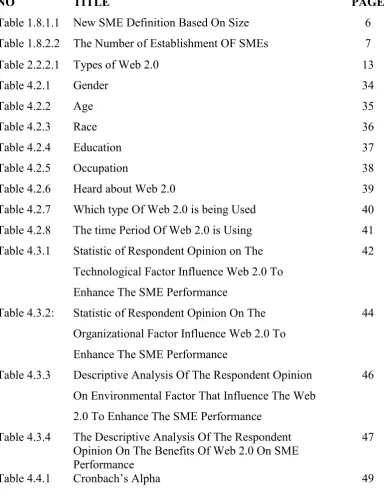
Table 1.8.1.1 New SME Definition Based On Size 6 Table 1.8.2.2 The Number of Establishment OF SMEs 7
Table 2.2.2.1 Types of Web 2.0 13
Table 4.2.1 Gender 34
Table 4.2.2 Age 35
Table 4.2.3 Race 36
Table 4.2.4 Education 37
Table 4.2.5 Occupation 38
Table 4.2.6 Heard about Web 2.0 39
Table 4.2.7 Which type Of Web 2.0 is being Used 40 Table 4.2.8 The time Period Of Web 2.0 is Using 41 Table 4.3.1 Statistic of Respondent Opinion on The
Technological Factor Influence Web 2.0 To Enhance The SME Performance
42
Table 4.3.2: Statistic of Respondent Opinion On The Organizational Factor Influence Web 2.0 To Enhance The SME Performance
44
Table 4.3.3 Descriptive Analysis Of The Respondent Opinion On Environmental Factor That Influence The Web 2.0 To Enhance The SME Performance
46
Table 4.3.4 The Descriptive Analysis Of The Respondent Opinion On The Benefits Of Web 2.0 On SME Performance
47
xiii
Table 4.4.2 Reliability Statistic 50
Table 4.5.1.1 Model summary 51
Table 4.5.1.2 ANOVA 52
Table 4.5.1.3 The Utilization Of Web 2.0 Tools 53 Table 4.5.2.1 Simple Regression Between Technological Factor
And Web 2.0 To Enhance The SME Performance
54
Table 4.5.2.2 Simple Regression Between Organizational Factor And Web 2.0 To Enhance The SME Performance
56
Table 4.5.2.3 Simple Regression Between Environmental Factor And Web 2.0 To Enhance The SME Performance
xiv
LIST OF FIGURE
NO
TITLE
PAGE
Figure 2.1.1.1 Marketing Activities in SMEs 11
Figure 2.5.1 Proposed Research Model 19
Figure 3.9.1 The SMEs Distribution by State and Sector 30
Figure 4.2.1 Gender 34
Figure 4.2.2 Age 35
Figure 4.2.3 Race 36
Figure 4.2.4 Education 37
Figure 4.2.5 Occupation 38
Figure 4.2.6 Heard about Web 2.0 39
xv
LIST OF APPENDICES
NO
TITLE
PAGE
A Gantt Chart 70
B Questionnaire Form 71
1
CHAPTER 1
INTRODUCTION
1.0 Introduction
This chapter provides a brief overview of the study presented in this research. This chapter introduced the problem statement, research question, research objective, scope, significance of the research, and as well as the limitations of this research. The researcher also explains the definition term of this research.
1.1 Background of the Study
2 Care. The researcher describes about the effectiveness of using the Web 2.0 tools to enhance the SME performance and also this study will focus on the innovative marketing tool in marketing field. The particular emphasis will be on SMEs which is focusing on Spa Health and Care in area of Selangor due to the Selangor is the industrial area which contains 2113 SMEs.
1.2Problem Statement
There are many ways to generate the awareness to the SMEs on Web 2.0 marketing tools due to the ICT world. If we continue to believe that there are some reasons, many SMEs does not aware about the Web 2.0 marketing tools in their small business to sell their goods and services. We never understood was the larger question of why a part of SMEs doesn't use the Web 2.0 marketing tool in their own organization?
Researcher clearly understands that the failed of SMEs using Web 2.0 tools was bring back out from their business field due to lack of technological field skill and knowledge to control the process of Web 2.0, not clear planning and the lack of adopting new tools which is the Web 2.0 in their own organization. According to Akomea, 2012 the use of Web 2.0 tool to increase productivity is one of the problems being faced by SMEs presently due to the lack of knowledge on the benefit of Web 2.0 in their businesses. They are still using the traditional tools to stay competitive. Given the chances SMEs can identify the current economic possibilities and benefits in adopting ICT. The SMEs does not focus the marketing as a huge part of business due to several cost needed in this field. The one of the reason is marketing appear in cost. So the SMEs do not willing to take the risk in business.
3 customers is the other problem that faced by SMEs. In order, researcher asserts that the effectiveness of social network of web 2 .0 tools are one of the supplements for the SMEs performance towards the positive benefits. The adoption of new technology can provide the SMEs with valuable information, increase knowledge, improved performance, improve relationships with customers and suppliers, increase efficiency, reduce cost of production among others.
The aim of this research study identifying the effectiveness of Web 2.0 marketing tool to enhance the SMEs performance. This study contributes to the body of knowledge needed and address the problem by answering the following question:-
1.3Research Question
They are three research questions are formatted from problem statement by the researcher as per below:
I. What are the main factors that influence the effectiveness of Web 2.0 to enhance the SMEs performance?
II. What is the impact of Web 2.0 marketing tool towards SMEs performance? III. Which are the most utilize tools of Web 2.0 to enhance the SMEs
performance?
1.4 Research Objective
The researcher things formulated three objectives as per below:
I. To identify the main factors that influences the effectiveness of Web 2.0 to enhance the SMEs performance.
4 III. To identify the most utilized tools of Web 2.0 to enhance the SMEs
performance
1.5 Scope of study
The purpose of this study to propose to identify the effectiveness of Web 2.0 tools to enhance the SMEs performance. And this study also determines the impacts on SME’s performance by creating new marketing tools in the marketing field to the SMEs. Furthermore, the studies are predicting that the SMEs are aware about the Web 2.0 marketing tool in their business strategy.
1.6 Limitation of study
5 1.7 Significant of the study
This study was significant of effectiveness of the marketing tool which is Web 2.0 drives the SME to improve their performance by using the Web 2.0 in their marketing strategy. This study was also being beneficial for the management employees in their strategic management. Moreover, this study was helpful to small and medium enterprise (SME) and informing them in the area of marketing management, objectives and strategies. Other than that, it was also to serve as a future reference for researcher on the subject of Web 2.0 and SME. Lastly, this study was analyzing the strategy of using Web 2.0 marketing tool within their organization.
1.8 The Definition of Term
This study describes about definition of term the innovative marketing tool of Web 2.0, the SME profile category SMEs in Malaysia and the SME performance.
1.8.1 Small and Medium- sized Enterprise (SMEs)
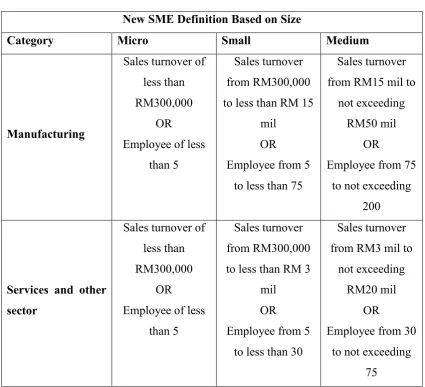
6 Table 1.8.1.1: New SME Definition Based On Size
New SME Definition Based on Size
Category Micro Small Medium
Manufacturing
Sales turnover of less than RM300,000
OR Employee of less
than 5
Sales turnover from RM300,000 to less than RM 15
mil OR Employee from 5
to less than 75
Sales turnover from RM15 mil to
not exceeding RM50 mil
OR
Employee from 75 to not exceeding
200
Services and other sector
Sales turnover of less than RM300,000
OR Employee of less
than 5
Sales turnover from RM300,000 to less than RM 3
mil OR Employee from 5
to less than 30
Sales turnover from RM3 mil to
not exceeding RM20 mil
OR
Employee from 30 to not exceeding
7 1.8.2 SMEs Profile
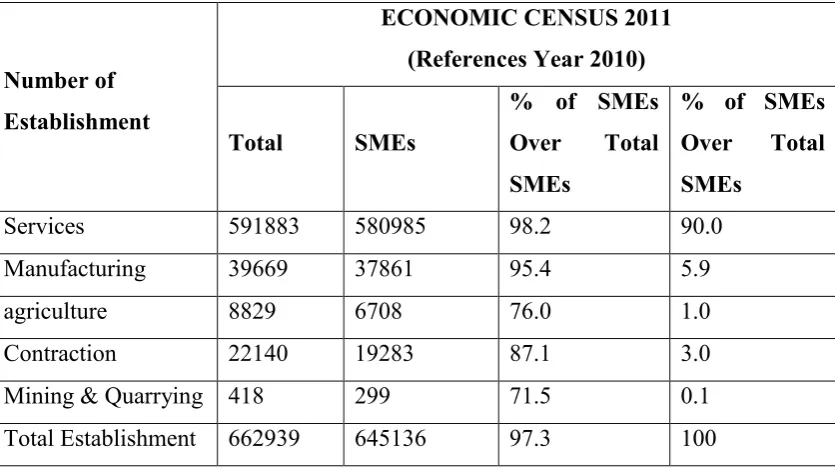
Table 1.8.2.2: The Number of Establishment OF SMEs
Number of Establishment
ECONOMIC CENSUS 2011 (References Year 2010)
Total SMEs
% of SMEs Over Total SMEs
% of SMEs Over Total SMEs
Services 591883 580985 98.2 90.0
Manufacturing 39669 37861 95.4 5.9
agriculture 8829 6708 76.0 1.0
Contraction 22140 19283 87.1 3.0
Mining & Quarrying 418 299 71.5 0.1
Total Establishment 662939 645136 97.3 100 Source: SMEs Annual report Malaysia, 2011/2012.
1.8.3 Service Sector
8 1.8.4 Web 2.0
According to the Andrew Pauxtis (2010), Web 2.0 is the name given to a social and economic trend to the Internet that first appeared in its rudimentary from 2001.The definition of Web 2.0 is broad and typically disputed among researcher and for the most part, is still being defined.
The creating of Facebook and MySpace pages , read blogs , watch YouTube videos, and join in on forums. With instant messaging and webcams that connect us with distant family, and colleagues, the collaborative , user- contributed nature of Web 2.0 has moved from the domain of teenagers to the entire world. Lately, many businesses have started using Web 2.0 to work more efficiently, communicate more widely, and complete on a different level. Although nowadays they plenty of organization does not aware about the Web 2.0 in their business strategy.
Is a generation of technology deployed on the web loosely associated with a set of principles that they help to fulfill, including a rich user experience, a high-level of interaction, both user-to-user and application-to-application, and the radical decentralization of the web (Lewis, Goto, & Gronberg, 2011). A similar definition is ‘a collaborative web development platform that has had tremendous usage in building effective, interactive, and collaborative virtual societies at home and abroad (Hossain & Aydin, 2011).’
1.8.5 Marketing
9 customer about the firm, its products, and services.” SMEs believe marketing is also interested in creating and maintaining customer relationships.
1.8.6 Social Media Marketing (SMM)
Social Media Marketing is marketing through the use of social media or social networking sites. SMM techniques often exist to increase brand awareness, increase sales, improve customer service, and implement marketing campaigns (Mangold & Faulds, 2009).
1.8.7 SME Performance
Investigate of an organization’s performance as compared within corporate goals and objectives. They are three outcomes of analyzing financial performance, market performance and shareholder value performance. According to P.Manik Hamann (2013) enhance organizational performance through management methods and instrument which are strategic planning, zero budget, balanced scorecard.
1.9 Summary