This is a repository copy of How should we do the history of big data?.
White Rose Research Online URL for this paper: http://eprints.whiterose.ac.uk/97690/
Version: Accepted Version
Article:
Beer, David Gareth orcid.org/0000-0002-6926-4595 (2016) How should we do the history of big data? Big Data & Society.
https://doi.org/10.1177/2053951716646135
[email protected] https://eprints.whiterose.ac.uk/ Reuse
["licenses_typename_other" not defined]
Takedown
If you consider content in White Rose Research Online to be in breach of UK law, please notify us by
This is the accepted version of an article to be published in Big Data & Society.
How should we do the history of big data?
David Beer
Abstract
Taking its lead from Ian Hacking’s article ‘How should we do the history of statistics?’, this
article reflects on how we might develop a sociologically informed history of big data. It argues
that within the history of social statistics we have a relatively well developed history of the
material phenomenon of big data. Yet this article argues that we now need to take the concept
of ‘big data’ seriously, there is a pressing need to explore the type of work that is being done
by that concept. The article suggests a programme for work that explores the emergence of
the concept of big data so as to track the institutional, organisational, political and everyday
adoption of this term. It argues that the term big data has the effect of making‐up data and,
as such, is powerful in framing our understanding of those data and the possibilities that they
afford.
How should we do the history of big data?
Around 25 years ago, in a piece that was revised for publication in the highly influential
collection The Foucault Effect, Ian Hacking (1991) asked the question ‘how should we do the
history of statistics?’. An apparently straightforward question that is likely to provoke some
complex answers. What I would like to do here is to revisit that question in light of the
emergence of ‘Big Data’1. Put simply, I’d like to ask the question: how should we do the history of big data? Again this might seem straightforward, but by asking this question I am hinting
at two things. First is the argument that we need to contextualise our understandings of big
data within the history of social statistics. That is to say that we need to place big data within
the genealogy of social data of various types. Second is the argument that we should approach
this history by treating big data as both a material phenomenon and also a concept. Indeed,
my central argument here is that we need to explore the concept of big data in historical,
political and sociological terms. This is important because ‘big data’ is a concept that has
achieved a profile and vitality that very few concepts attain. As such, its influence needs to be
unpicked and understood. We need to understand the work that is being done by this
powerful and prevalent concept.
To get things started though, what I am proposing here is that when thinking about big data
we need to consider its history as being tied‐up with particular ways of thinking. We then
need to consider how this thinking is enacted in the development of certain infrastructures
and in the industry of data analytics. This is to see big data as the entwinement of both a
phenomenon and a concept. Big data itself, with its capacity to track lives through archived
and classified forms of individuated data, can be placed then within the genealogical lineage
of the modern state (Beer, 2016). In this sense, it could be argued that we already have a
history of big data that can be found in accounts of the history of the use of statistics to know
and govern populations (see for example Desrosi!res, 1998; Porter 1986 & 1995; Hacking
1990; Mackenzie, 1981; and Foucault, 2007; which is discussed in Elden, 2007). Similarly, we
also have sociological resources that enable us to understand the power dynamics that reside
Espeland & Sauder, 2007; Espeland & Stevens, 2008; and the various essays collected in
Rottenberg et al, 2015). We even have a discussion of the use of big data in historical work –
which asks how big data can be used by historians to gather or archive resources (Manning,
2013). And yet closer to the aims of this particular article, Halpern (2014), who focuses
predominantly on the aesthetics of data, provides a historical account of the emergence of
data since 1945. Despite all of this though we have something that is yet to be explored from
a historical and sociological perspective, which is the work that is done by the very concept
of ‘big data’. That is to say that we have little understanding of the concept itself, where it
came from, how it is used, what it is used for, how it lends authority, validates, justifies, and
makes promises. In other words, we now need to work through a detailed account of what
might be thought of as the birth of big data.
To reiterate, this stream of work is not concerned with the data itself, but with the discourse,
terminology and rhetoric that surrounds it and which ushers and affords its incorporation into
the social world. This is not to say that the specific material properties of big data are
somehow unimportant, but rather that the way that these data are framed in particular
rationalising discourses is also needs to be treated carefully if we are to form a more detailed
appreciation of the social implications of those data. It could be argued that in many ways the
power dynamics of big data are to be found just as much in the way that those data are
labelled and described as it is in the actual data themselves. Indeed, given the difficulties of
data access and the technical and computing skills required to analyse big data, it might even
be argued that the concept has far greater reach than the material phenomenon. However
far the material consequences of big data might reach, the rationalities within through which
it is understood are likely to reach further. This article is dedicated to beginning to open‐up
this stream of work and is geared to developing a more contextual account of the concept of
big data as it becomes embedded in organisational, political, social, cultural and everyday life.
The ‘avalanche’ of numbers
In Hacking’s (1991) aforementioned essay on the history of statistics, which links into his other
more substantial works on the same topic, he discusses some of the features of what he refers
called big data revolution within a much longer history. Given the date of his piece it is obvious
that when referring to this avalanche of numbers Hacking is not talking about the rise of
digital technologies, smartphones, wearables or social media. Indeed, he is actually talking
about an ‘avalanche of numbers’ that occurred around 1820 to 1840 as a new ‘enthusiasm
for numbers’ (Hacking, 1991: 186) and a growing assemblage for data gathering took hold.
Elsewhere this same period has been referred to as experiencing an ‘explosion’ of numbers.
As Porter (1986: 11) observes, the ‘great explosion of numbers that made the term statistics
indispensable occurred during the 1820s and 1830s’. This ‘explosion’ or ‘avalanche’ of data
occurred as ‘nation‐states classified, counted and tabulated their subjects anew’ (Hacking,
1990: 2). In other words, the sense that we are being faced with a deluge of data about people
is not something that is entirely new, in fact it has a long history. The type of data may have
changed as might its analytics – with the shift toward commercial and algorithmic forms
amongst other changes – but the lineage is clear. There are, of course, features of the current
data moment that are in some ways novel but it is still interesting to note that this idea of a
scaling up of social data, the feeling that we are facing an unfathomable flow of social data,
itself has a history. The notion of an ‘avalanche’ gives the sense of the weight of escalating
data resources that is comparable with the notion that data have suddenly got big. Both are
based upon the feeling that there is a sudden and unstoppable wash of flowing data about
people, a pooling of data that is on a scale that was not previously imagined. We have then
both the phenomenon of the data interweaving with the way that it is imagined – the key
difference here is that Hacking’s terminology is based upon an observation about the
increasing role of metrics in the 19th Century whereas big data is a term that is commonly used in everyday discourse to refer to the data phenomenon of that very moment. Big data
is a concept which, like the data and methods associated with it, has a ‘social life’ (Savage,
2013). Referring back to the 19th Century, Hacking (1991: 189) concludes that ‘almost no
domain of human enquiry is left untouched by the events that I call the avalanche of numbers,
the erosion of determinism and the taming of chance’. We see here that already there was a
sense that data harvesting was spreading out across the social world, and that this was
accompanied by new means for analysing patterns in that data and for dealing with questions
of probability.
By way of illustration let us turn again to Hacking’s essay on how we should do the history of
statistics. In that piece Hacking (1991: 191) points out that the ‘the avalanche of numbers is
at least in part the result of industrialization and the influx of people from the country to the
town’. It was with the move towards industrialisation and the centralization of large parts of
national populations in urban environments that the statistics about people began to
escalate. The possibilities that came with these infrastructural changes were accompanied,
Hacking argues, by a ‘sheer fetishism for numbers’ (Hacking, 1991: 192) and cultural shifts
associated with the ‘new countings’ or ‘new numberings’ (Hacking, 1991: 191). This
combination of social, technological and cultural changes led to an expansion of data that
Hacking refers to as the ‘avalanche of numbers’. As well as being counted in new ways,
populations were also then ordered through categorisations. As Hacking (1991: 192) explains,
‘when the avalanche of numbers began, classifications multiplied because this was the form
of this new kind of discourse’. The emergence of new metrics also led to people being
classified in new ways, which had powerful implications for how individuals and groups were
perceived and treated. This new type of social ordering emerged with the need to manage
the accumulating data about people. Hacking’s (1991: 182) point here is that ‘many of the
modern categories by which we think about people and their activities were put in place by
an attempt to collect numerical data’. Thus new categories emerged through which these
new data might be gathered and by which they might then be analysed – leading to all kinds
of ‘classificatory struggles’ (Tyler, 2015).
Part of the power associated with these escalating numbers, Hacking proposes, was to be
found in their apparent objectivity. Statistical data, Hacking (1991: 184) claims, ‘have a certain
superficial neutrality’. It is this very appearance of neutrality that lends them an air of
authority and which makes them so powerful. Tied in with this neutrality is the ability to use
the numbers and categories to define what is seen to be normal and what is therefore seen
to be abnormal. As Hacking (1991: 183) puts it, ‘there are also statistical meta‐concepts of
which the most notable is ‘normalcy’’. Thus these accumulating data became a central means
by which populations could be known and governed, and where understandings and
expectations were produced alongside powerfully reinforced norms. Put simply, Hacking’s
industrial state’. Industrial modernity brought with it expanded archives of data about
populations (see Featherstone, 2000).
The result of all this is that statistics have become an important component in governance.
Hacking’s argument is that norms and classifications based around these types of data enable
social facts to be brought into existence. Hacking (1991: 181) argues that:
‘Statistics has helped determine the form of laws about society and the character of
social facts. It has engendered concepts and classifications within the human sciences.
Moreover the collection of statistics has created, at the least, a great bureaucratic
machinery. It may think of itself as providing only information, but it is itself part of
the technology of power in a modern state’.
Statistics are then incorporated into the very infrastructures and modes of governance of the
state – in the last twenty or so years we might also add corporate and commercial data
gathering to this. The result is that the categories and modes of reasoning surrounding these
data become part of the formal and legal structures of the state, with direct implications for
how people are treated (for one example in relation to immigration see Schinkel, 2013).
Again, in Hacking’s (1991: 194) words, the ‘bureaucracy of statistics imposes not just by
creating administrative rulings but by determining classifications within which people must
think of themselves and of the actions that are open to them’. These emerging numbers
quickly came to define how people saw themselves, how they saw others and, complimenting
these, how limits and boundaries were placed around actions and opportunity. So, big data
can be placed within this long history of social statistics, but we might also note that there is
undoubtedly an intensification in the scale of data over that time, particularly as commercial
organisations have joined in with the state to increase the infrastructures, scope,
accumulation and deployment of data (Kitchin, 2014; Beer, 2016; Ajana, 2013).
As this would suggest it is important to situate this article within the history of the
development of statistics but this is beginning to take us into territory that resides beyond
the remit of this article, what I’d like us to take from this is that the expansion of data and
metrics is not something that can be isolated to a particular moment in the recent past. Rather
the powerful ordering presence of data has been felt for some time, as has the sense that
What I would like to do here is to put this particular historical context to one side, there are
other places we might go in order to explore the genealogical history of what is now referred
to as big data (for an overview of the history of social statistics in relation to big data see
chapter 2 in Beer, 2016). Instead, let us be aware of the infrastructural, technical and cultural
history of such data whilst focusing our attention upon the relatively short life of the actual
concept or term big data. We may need further work that delimits the particular material and
ontological properties of the current form that this social data takes – such as the work being
conducted by Kitchin (2014; see also Kitchin & McArdle, 2016) – but let us turn out attention
elsewhere for the moment. The concept of big data has a short history which is part of a much
longer series of developments stretching back hundreds of years. I want to use the remainder
of this article though to argue that it is the work that is being done by this particular concept
that requires our attention – particular if we are to continue to attempt to develop a more
complete and contextual understanding of the influence of data today. As such, the point is
that the history of big data as a phenomenon can tracked back through the pages of those
histories of social statistics – even if much more work is needed in order for a more global
and ‘connected’ (Bhambra, 2014) history of statistics to be developed – but what we have
little understanding of is the birth and life of big data as a concept. It is this concept that needs
to be tracked, unpacked and examined. Indeed, the aim of this article is to begin to map‐out
a programme of work that needs to be completed in order for us to fully understand the
politics of big data.
Treating ‘big data’ as a concept
This is where I would like us to prize ourselves away from the data themselves, to begin to
think historically about how these data are conceptualised. It is by acknowledging the long
history of the accumulation of data about individuals and populations that we can begin to
make a departure into seeing the different ways that data are presented in conceptual terms
– and thus where we might begin to see more clearly the importance of the project of
exploring big data as an interweaving of a material phenomenon and circulating concept.
Both Ian Hacking and Stuart Elden suggest that the only way to really understand the power
position is that we need to explore ‘the relationship between concepts in their historical site’
(Hacking, 1991: 184). Similarly, Elden (2013a: 15) argues that ‘conceptual history is important
because of its emphasis on terminology, and the relation between meaning and designation;
contextualist approaches are crucial in stressing the importance of reading texts within the
situations in which they were written’. In relation to territory Elden’s (2013a: 15) position is
that ‘territory is a word, concept and practice; and the relations between these can only be
grasped historically’ – this is a project that Elden (2013b) expands upon in much greater detail
in his book The Birth of Territory. The point here is that we can only understand certain social
phenomena through their discursive and conceptual formulations, and we can only
understand these conceptual formulations by thinking historically about them. Both Hacking
and Elden place concepts at the centre of their historical analyses.
Hacking offers further explanation of his position by claiming that:
‘the organization of our concepts, and the philosophical difficulties that arise from
them, sometimes have to do with their historical origins. When there is a radical
transformation of ideas, whether by evolution or by an abrupt mutation, I think that
whatever made the transformation possible leaves its mark upon subsequent
reasoning.’ (Hacking, 1991: 184)
Concepts are a product of their historical origins, we might conclude, but they then also have
social reach and influence themselves. The organization of our concepts can then be at the
heart of social transformations – the transformation of ideas is a powerful thing. These
concepts and the transformations of which they are a part leave, Hacking suggests, an
indelible mark on future reasoning. They leave their mark on the way that the social world is
comprehended and acted upon. If we are to pursue the concept of big data with this in mind,
then we would not just be looking at the concept for its influence during the lifetime of its
use but also its potential influence on future reasoning. We would also need to look at the
discursive frameworks and modes of reasoning that fed into the concept of big data. Thus a
genealogy of a concept like big data aims to capture the emergence of a concept as a part of
a historical lineage of reasoning that shoots out into the past and the future. It is a moment,
but a moment in which we might reveal something longer term.
We can of course see the influence of Michel Foucault echoing through Hacking and Elden’s
approaches. We can amplify these echoes by turning to a relatively well‐known interview with
Foucault which was originally published in 1980. The interview focuses upon questions of
method. Amongst various aspects of Foucault’s approach discussed in that interview, a
particular theme emerges concerning the role of concepts in shaping social realities. Here
Foucault describes some of the methods he deployed in his works and focuses in particular
upon the need to explore conceptual processes in the formation of the social world. He
focuses upon his concern with understanding the different ways in which truth is produced
through practice. As Foucault explains:
‘To put the matter clearly: my problem is to see how men govern (themselves and
others) by the production of truth (I repeat once again that by production of truth I
mean not the production of true utterances, but the establishment of domains in
which the practice of true and false can be made at once ordered and pertinent).’
(Foucault, 1991: 79)
It is unusual to find something so crucial hidden within brackets. Foucault is interested in
exploring the ways in which truth is produced so as to see how those truths limit
understandings, actions and practices. His intention is to use events and moments to open up
these regimes of truth, and to understand how these regimes of truth activate practices. As
he put it, ‘eventalizing singular ensembles of practices, so as to make them graspable as
different regimes of ‘jurisdication’ and ‘veridiction’: that, to put it in exceedingly barbarous
terms, is what I would like to do’ (Foucault, 1991: 79). His intention then was to grasp the
practices that translate into the boundaries and limits of jurisdictions and, alongside this, to
see how truth is verified in different ways – it is notable that he argues elsewhere that markets
are the ‘sites of veridiction’ (see Foucault, 2008:32). In doing this his aim is to ‘resituate the
production of true and false at the heart of historical analysis and political critique’ (Foucault,
1991: 79). Elsewhere Foucault (2014: 7) describes this production or manifestation of certain
regimes of truth as a process of ‘alethurgy’ – which is concerned with understanding the
‘manifestation of truth’ as central to the formation of power structures. These regimes of
truth and their limited powers can then be seen to be found in the discourse surrounding
certain practices.
At this point in the interview Foucault’s attention shifts to the notion of ‘programmes’ in order
to exemplify and explain these wider objectives. It could be read that when he talks of
programmes he is talking about the set of practices in which regimes of truth are imagined
and then made possible. He talks here of programmes of activity that are not always realised,
but which can be used to explore how ideas are projected onto the social world. In the
interview Foucault is questioned on the separation of these programmes from the reality of
what is happening on the ground. Foucault’s response is to emphasize the importance of
understanding how the world is imagined in order to understand how it unfolds. As he
explains:
‘Bentham’s Panopticon isn’t a very good description of ‘real life’ in nineteenth‐century
prisons. To this I would reply: if I had wanted to describe ‘real life’ in the prisons, I
wouldn’t indeed have gone to Bentham. But the fact that this real life isn’t the same
thing as theoreticians’ schemas doesn’t entail that these schemas are therefore
utopian, imaginary, etc. One could only think that if one had a very impoverished
notion of the real. For one thing, the elaboration of these schemas corresponds to a
whole series of diverse practices and strategies’ (Foucault, 1991: 81)
Obviously referring back to the work he did for his 1975 book Discipline and Punish, Foucault
is arguing that the types of programmes or imagined possibilities captured in concepts like
the panopticon are important. These types of concepts become woven into reality in different
ways, they become part of practice as they are cemented into jurisdictions, boundaries and
as they verify, authorise and select what comes to be. Concepts, or programmes, can then be
elaborated in practice in ways that are not always obvious. Separating them from reality
would be a mistake. Thus we cannot see big data as being a programme that exists outside of
the practices of the use of data on the ground. Similarly, big data may not necessarily be a
very good concept for seeing the ‘reality’ of everyday life, but it is a good concept for
understanding how visions of contemporary data are incorporated into the imagining of life,
the production of truths and the liminal work that contains the social world. Big data is
undoubtedly a part of contemporary strategies and practices. The point here is that big data
may be treated as a programme of thought that needs to be analysed in this way.
Foucault extends this point further. He adds that these ‘programmes induce a whole series of
real): they crystallize into institutions, they inform individual behaviour, they act as grids for
the perception and evaluation of things’ (Foucault, 1991: 81). As such, imagined programmes
and conceptual formations translate into regimes of truth. That is to say that they solidify into
practices, organisations, institutions and behaviours. To apply this to big data we could
imagine how this concept carries with it ‘grids for the perception and evaluation of things’.
That is to say, that it is not just the evaluations that come from the applications of big data
themselves, but that the concept of big data as a programmatic mode of reasoning also brings
with it the values and norms that provide the means for evaluating and judging. It is not just
the data that afford judgments, it is also the very concept of big data itself that shapes
decisions, judgments and notions of value – as it brings with it a vision for particular types of
calculative or numerical knowing about individuals, groups and the social world. These are
legitimised in the case of big data by notions of its scale and the eradication of error and
inefficiency (for a discussion of scale and accuracy in big data see boyd & Crawford, 2012).
These programmes of big data arrive with a thirsty desire to render measurable.
For Foucault, whether or not these imagined programmes are ever fully realised is not
necessarily important, rather it is the influence that those imagined programmes have in
shaping practice. It is also the broader rationality that they reflect. In the case of big data we
might not see the project or its imagined potential realised in full, but the concept has already
been influential far beyond the reach of the data in many respects. Just because programmes
are never fully realised does not mean that they are somehow insignificant, especially when
they achieve the prominence that is enjoyed by the big data movement. Rather we should
see how that programme was pursued and how the imagined outcomes became part of
practices and strategies – or how they relate or encapsulate a broader art of governance,
political economy or prevalent forms of rationality and reasoning. According to Foucault:
‘These programmings of behaviour, these regimes of jurisdiction and veridiction aren’t
abortive schemas for the creation of reality. They are fragments of reality which
induce such particular effects in the real as the distinction between true and false
implicit in the ways men ‘direct’, ‘govern’, and ‘conduct’ themselves and others’
(Foucault, 1991: 82)
Here the programme shifts to being about programming, about setting up the codes of social
reality, for Foucault. It is in the job of unpicking these fragments that he is interested.
Foucault’s use of true and false might seem blunt, but he is pointing to the powerful ways in
which such programmes set rigid limits. Such conceptual programmes, for Foucault then,
‘induce effects’ and make things happen. They are part of governance and they act to shape
conduct by contributing towards these regimes of truth that inform behaviour. As he further
explains, we need to attend to ‘the correlative formation of domains and objects and…the
verifiable, falsifiable discourses that bear on them; and it’s not just their formation that
interests me, but the effects in the real to which they are linked’ (Foucault, 1991: 85). The
challenge, once we take such schema as being important to the conduct of the reality of the
social world, is in thinking about how to explore their emergence and effects.
Framing big data
Recently we have seen some attempts that begin to think through or suggest the need to
think through the role of the concepts and discourses that surround data today. For example,
Rob Kitchin has suggested that we need to the look at the political and economic framing of
big data. He suggests that we should look at ‘how a powerful set of rationalities is being
developed to support the roll‐out and adoption of big data technologies and solutions’
(Kitchin, 2014: 126). Kitchin indicates that this is part of a broader project whilst focusing his
discussion across four ‘major tasks’: ‘governing people’, ‘managing organisations’, ‘leveraging
value’ and ‘producing capital’.
For Kitchin these underpinning rationalities need to be explored because they play such a
potent part in the integration of big data. These rationalities are to be found in the discursive
regimes of big data, and thus these regimes need detailed and careful attention in order to
understand the power dynamics of big data. One way into this is to look at the logic that is
woven into the big data movement. As Kitchin (2014: 126) puts it:
‘The power of the discursive regimes being constructed is illustrated by considering
the counter‐arguments – it is difficult to contend that being less insightful and wise,
productive, competitive, efficient, effective, sustainable, secure, safe, and so on, is a
desirable situation. If big data provide all of these benefits, the regime contends that
Considering the connotations and implications of those powerful underpinning rationalities
reveals the potency of the discourse here. Big data brings with it a force to comply and a
rationality that is hard to critique or resist. This can potentially be seen to have a kind of
neoliberal reasoning or rationality at its core, one based upon the use of data as the
mechanism by which the model of the market may be rolled out across the social world (for
a discussion see Beer, 2016). As a result of these considerations Kitchin concludes that ‘what
is presently required, through specific case studies is a much more detailed mapping out and
deconstruction of the unfolding discursive regimes being constructed.’ (Kitchin, 2014: 126).
There are undoubtedly parallels here between Kitchin’s suggestion and the project I’m
mapping out in this article. Kitchin gives us a starting point through which we might channel
the type of observations drawn out from Foucault, Elden and Hacking’s work. It is pressing,
as Kitchin has put it, that ‘given the utility of the data, there is a critical need to engage with
them from a philosophical and conceptual point of view.’ (Kitchin, 2014: 185). What we need
then are the conceptual and historical resources that will enable us to develop a richer
understanding of the discourses and rationalities of big data. It is this point that we have
reached, we need now to work out ways of expanding such a set of insights and to flesh out
this approach. My suggestion is that we focus our attention centrally upon the term of big
data itself and begin to explore it historically and conceptually. This will provide a focal point
for responding to Kitchin’s more general call. Part of this will require us to not just challenge
or dismiss but to carefully unpick ‘boosterist discourses declaring their positive disruptive
effects.’ (Kitchin, 2014: 192). It is this unfolding discursive regime that needs attention – by
illuminating the rhetoric orbiting around the concept of big data. There is undoubtedly more
to big data than its discursive framing, it has material properties that make it big data (see
Kitchin & McArdle, 2016), yet the particularities of that discursive framing shape those
material presences and the integration of big data into broader social structures and orders.
Elsewhere there are some other rare occasions in which the power of such discourses have
been acknowledged. For library information scientist Ronald E. Day this discourse centres
around a particular set of claims. The shift for Day is away from notions of ‘information’, which
implies something flexible and informed, and toward something much more rigid. According
to Day (2014: 3), ‘more recently, the discourse of “data”, conceived as a form of auto‐affective
towards the notion that data is equivalent to facts, and thus then away from a more open
vision of information. This, for Day, is an important shift that makes contemporary notions of
data much more powerful in social formations. He continues this line of argument by claiming
that these:
‘claims for knowledge are presented as immediate – “factual” – rather than as
emergent through technologies, techniques, and methods, on the one hand, and
interpreted through theory or a priori concepts, on the other hand. The data says…;
the data shows us…; we are only interested in data (not justifications/excuses/your
opinion/your experience)…; big data and its mining and visualizations gives us a
macroscopic view to see the world anew now – these and similar phrases and tropes
now fill the air with what is claimed to be a new form of knowledge and a new tool for
governance that are superior to all others, past and present.’ (Day, 2014: 134; italics
in the original)
This presentation of data as facts is crucial, for Day, in understanding the powerful role played
by those data. Again, as with Kitchin, Day explores how the data are presented in compelling
and even irresistible ways. In the above passage Day offers some illustrations of how this type
of discursive framing works in practice. In these formulations the data is seen to be objective,
neutral and telling – it is not something to be questioned or interrogated it is rather a social
fact around which behaviour should be bent. It is seen to be a tool for governance that cannot
be questioned or rivalled with subjective opinions. Data is seen, in this formation, to be
unquestionable, accurate and over‐arching in its panoramic view of the social world.
These positions provide some revealing opening insights, but we have not really gone much
further than this acknowledgement that there is a need to think about the conceptual and
discursive frames that accompany these data. It is this project that needs to be attended to,
with some urgency. This now needs sustained attention to build upon some of these insights
and to reinvigorate the type of project that Foucault, if you will pardon the assumption, may
have taken on were he to have been around to observe the emergence or birth of big data.
If we were to explore the history of big data in terms of the history of the concept then that
would lead us to try to understand the work that this concept does to shape practices and
to explore the world views or perspectives that the term big data is woven from and provokes.
This would be to approach the term big data as being built in the tensions of veridiction, and
to see how it authorises certain behaviours, actions and outcomes. To see what perspectives
and notions of truth that it endorses. To see how it brings with it a set of preferences and
desires that it then legitimises. This is to see how the term big data itself has political ends as
it comes to demarcate value or worth. We can certainly start by thinking about how the
concept evokes certain feelings of trust through its apparent properties of objectivity and
neutrality. In short, the concept of big data frames and makes‐up the data themselves. With
this in mind we need to see what type of work it does, how it leads us to see those data and how this framing is woven with particular ways of seeing that social world. The framing of the data is particularly powerful in this regard and will dictate not only what we get from the data but also the possibilities that are afforded simply from uttering these two words together. Big data’s ‘grids of perception’:
focal points for analysing the making‐up
and framing of big data
Analytical questions and issues
Promises What promises are being made in the discussion of the data? What hopes and futures are evoked or imagined?
How is big data seen to promise possible outcomes, efficiencies, improvements and forms of progress?
Manifestations of truth How is the data to be used to distinguish truth from falsity? What possibilities are presented in the truths implicit in the discussion of the data?
What are the truths that big data is perceived to enable us to reveal, discover or uncover?
Jurisdiction formation and maintenance How is big data used to set the territories of knowledge? How are boundaries placed around what can be known? Who is responsible for deciding what can be known through the data? How is this position policed and controlled? Who decides what is knowledge and who has the right to use and know it? Veridiction How is big data seen to present opportunities to verify, authorise and render appropriate? How is big data seen to legitimise and justify? What is then seen to be afforded by these legitimising processes? What do these systems verify and why? How does this link to truth making?
The demarcation of value & worth How is big data used to frame what is seen to be valuable or worthwhile?
How is big data used in the boundary work required to demarcate value?
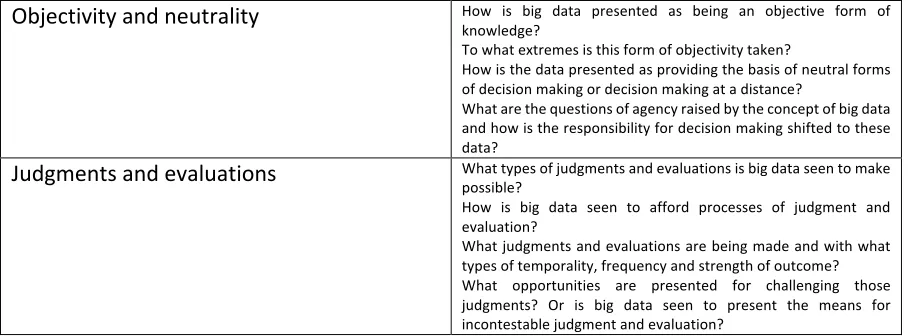
Objectivity and neutrality How is big data presented as being an objective form of knowledge?
To what extremes is this form of objectivity taken?
How is the data presented as providing the basis of neutral forms of decision making or decision making at a distance?
What are the questions of agency raised by the concept of big data and how is the responsibility for decision making shifted to these data?
Judgments and evaluations What types of judgments and evaluations is big data seen to make possible?
How is big data seen to afford processes of judgment and evaluation?
[image:17.595.72.528.72.240.2]What judgments and evaluations are being made and with what types of temporality, frequency and strength of outcome? What opportunities are presented for challenging those judgments? Or is big data seen to present the means for incontestable judgment and evaluation?
Table 1: An analytic framework for structuring the analysis of the work done by the concept ‘big data’.
This approach will require us to look across different sectors to see how big data, the term,
has been used. It will look at how it has been deployed in commercial, political, economic and
organisational discourse, and what type of work it has done in these sectors. Focusing upon
this will hopefully then open up broader political motifs as they find their way into the
language of everyday governance and social ordering.
Based on these discussions, Table 1 attempts to summarise the key analytical points that will
be required to extend this project. Table 1 provides an analytical framework for exploring the
work that is being done by the concept of big data. The left hand column presents the
analytical focal points and the right hand column presents the types of questions and issues
raised by those focal points. These are intended as analytical points of departure that will
reveal the implicit dynamics of the concept of big data and will thus let us analyse it as a
programme of activity and a way of thinking that becomes realised in the limits and practices
of the social world. This framework is a heuristic that can be used to guide and shape our
analysis, but it may well need to be adapted. The suggestion then is that the framework
offered in Table 1 may be used to explore how the concept of big data is enacted and
performed in making‐up data across different social spheres and sectors. In short, this is an
analytical framework that may be drawn upon wherever talk of big data may be found.
Conclusion
To conclude, I’d like to suggest that we have a relatively pronounced understanding of how
data ‘make people up’, to use Hacking’s (1990: 3) term, but we have relatively little
appreciation of how concepts make‐up those data. This is not to say that the particular
material properties of the current data moment are unimportant, they clearly need further
work to understand how those properties relate or differentiate them from that broader
history of social statistics. It is to say though that what is also needed is a detailed exploration
of the trajectory and influence of the concept of big data. We need to ask what work this term
does, and what work it has done. We need to explore how it has become established within
the discourse of organisations, funding bodies, political and policy circles, in journalism, in
social commentary, and in various others sectors. We need to look at the emergence of this
powerful concept and to understand how it has been shaped and reshaped in its use. We also
need to understand how the term big data brings data to life, how it breathes life into data,
how it makes them vital and telling.
Underpinning this approach is the pursuit of a more detailed understanding of how big data,
as a concept, recrafts notions of value and worth. The concept of big data might seem
unimportant – it might be dismissed as “business” or “managerial” talk, it might be seen as a
passing fad, it might be seen to be part of the meaningless verbiage of contemporary media
cultures – but the scale of the use of the term would suggest something different. The term
big data is doing a lot of work, it is a persuasive presence in funding, management, decision
making, “human capital” and the everyday practices of production and consumption. The
work that is being done by the concept of big data needs attention, particularly as it is
frequently doing far more than the actual data itself. Indeed, the term big data can be used
to reveal the type of thinking and the mode of reasoning that ushers data and metric‐led
processes into everyday, organisational and social life. A part of the role that this concept
plays concerns the different ways that it demarcates what is valued or what is seen to be
worthwhile. It is a term that lends confidence, authority and objectivity to decisions that are
then realised through the data themselves. This gives this particular term a very powerful
social presence that needs to be unpicked. The threads then need to be followed back
through the history of its usage.
All of this will require us to understand the visions within which and through which notions
of big data are communicated. To see the way that big data is evoked and the kind of
outcomes and sensibilities that it provokes. The power of big data is not just in the data
themselves, it is in how those data and their potential is imagined and envisioned. To
understand the power, influence and reach of big data requires us to understand the
performative influence of the material data whilst also being attentive to the concept that
frames them. My suggestion is that so far we have focused virtually all of our attention on the
phenomenon and we have given very little attention to the powerful concept that defines,
enacts and ushers in those apparently big data.
By looking back at some important historical accounts we can quickly see that what is most
novel about big data is not necessarily the vast accumulation of data, although that is an
important part or moment of an established and long set of genealogical threads, but the way
that this concept of big data has taken on such commercial, organisational and economic
force and power. For this reason, amongst others, I would suggest that we now need to lavish
some attention on this loaded and powerful concept, particularly as it comes to define
contemporary life in so many ways. It has been argued that when thinking of how our lives
are measured we need to think about the modes or styles of thought that accompany that
measuring, rather than just focusing upon the technical infrastructures (see Elden, 2006: 139‐
148; Hacking, 1990; Porter, 1986 & 1995). This is certainly true for big data. The pursuit of big
data, like the pursuit of statistical measures of populations, is as much about a mode of
reasoning or a way of thinking as it is about the assemblage that it generates.
The way to explore these modes of thought or styles of reasoning is to unpick and illuminate
the role played by that very label of big data in various social spheres. Of course, any clear
separation of the material phenomenon from the concept of big data is misleading, they work
together and are intimately intertwined. My point here is that we need to think about the
historical context in which big data is unfolding, we need to see it as part of the long series of
developments in the measurement of people and populations. At the same time though, in
pursuing a more contextual understanding we should not continue to be preoccupied with
the data itself we also need to examine the type of data‐thinking that is encapsulated in the
moment in the long unfolding of metric based approaches to the social world, there are likely
to be a number of things that are materially distinct about this particular moment in that
history, but the things that need to be said require us to understand these apparently new
forms of data whilst also paying careful attention to the way that they are packed, presented
and rolled‐out in the discourse that surrounds and permeates them. This may or may not be
a unique or important moment in the history of social statistics and metrics, but it is
nevertheless a moment in which a particular concept is taking hold and in which its power is
worth some reflection. We simply cannot understand big data in historically informed and
critical terms unless we analyse the interconnections between its materiality and the concept
through which these material transformations are understood. What is perhaps most
interesting about this moment in this long history is that we have such a prevalent and
prominent term that presents this phenomenon to us as if it were a sudden and unique
moment within that history.
Notes
1. In this article I will not offer a direct definition of ‘big data’ as such. This is for two reasons.
First, this type of definition has been provided elsewhere, such as in Rob Kitchin’s (2014)
excellent and authoritative overview of big data (which includes a chapter detailing the
definition of this term, see Kitchin 2014: 67‐79). And, second, the approach that I outline in
this article aims to explore the meanings and rationalities associated with the term ‘big data’.
As such, it aims to explore the various definitions that are attached to this particular term
rather than treating it as a fixed entity. This article actually aims to use the term big data as a
way into these types of defining statements and understandings – meaning that tying down
the meaning too tightly from the outset may hamper its progress and scope.
References
Ajana, B. (2013) Governing Through Biometrics: The Biopolitics of Identity. Basingstoke:
Palgrave Macmillan.
Beer, D. (2016) Metric Power. London: Palgrave Macmillan.
Bhambra, G.K. (2014) Connected Sociologies. London: Bloomsbury.
boyd, d. & Crawford, K. (2012) ‘Critical questions for big data: provocations for a cultural,
technological and scholarly phenomenon’, Information, Communication & Society 15(5): 662‐
679.
Day, R. (2014) Indexing it all: The subject in the age of documentation, information, and data.
Cambridge, Massachusetts: MIT Press.
Desrosi!res, A. (1998) The Politics of Numbers: A History of Statistical Reasoning. Cambridge,
Massachusetts: Harvard University Press.
Elden, S. (2006) Speaking Against Number: Heidegger, Language and the Politics of
Calculation. Edinburgh: Edinburgh University Press.
Elden, S. (2007) ‘Governmentality, calculation, territory’, Environment and Planning D: Society
and Space 25(3): 562‐580.
Elden, S. (2013a) ‘How should we do the history of territory?’, Territory, Politics, Governance
1(1): 5‐20.
Elden, S. (2013b) The Birth of Territory. Chicago: Chicago University Press.
Espeland, W.N. & Sauder, M. (2007) ‘Rankings and reactivity: How public measures recreate
social worlds’, American Journal of Sociology 113(1): 1‐40.
Espeland, W.N. & Stevens, M.L. (2008) ‘A Sociology of Quantification’, European Journal of
Sociology 49(3): 401‐436.
Foucault, M. (1991a) ‘Questions of Method’, in, Burchill, G., Gordon, C. & Miller, P. (eds) The
Foucault Effect. Chicago: The University of Chicago Press. pp. 73‐86.
Foucault, M. (2007) Security, Territory, Population: Lectures at the Coll!ge de France 1977‐
1978. Basingstoke: Palgrave Macmillan.
Foucault, M. (2008) The Birth of Biopolitics: Lectures at the Coll!ge de France 1978‐1979.
Basingstoke: Palgrave Macmillan.
Foucault, M. (2014) On the Government of the Living: Lectures at the Coll!ge de France 1979‐
1980. Basingstoke: Palgrave Macmillan.
Hacking, I. (1990) The Taming of Chance. Cambridge: Cambridge University Press.
Hacking, I. (1991) ‘How should we do the history of statistics?’, in, Burchill, G., Gordon, C. &
Miller, P. (eds) The Foucault Effect. Chicago: The University of Chicago Press. pp.181‐195.
Halpern, O. (2014) Beautiful Data: A history of vision and reason since 1945. Durham: Duke
University Press.
Kitchin, R. (2014) The data revolution: Big data, open data, data infrastructures & their
consequences. London: Sage.
Kitchin, R. & McArdle, G. (2016) ‘What makes Big Data, Big Data? Exploring the ontological
characteristics of 26 datasets’, Big Data & Society 3(January‐June 2016): 1‐10.
MacKenzie, D. (1981) Statistics in Britain: The Social Construction of Scientific Knowledge.
Edinburgh: Edinburgh University Press.
Manning, P. (2013) Big Data in History. Basingstoke: Palgrave Macmillan.
Porter, T.M. (1986) The Rise of Statistical Thinking 1820‐1900. Princeton: Princeton University
Press.
Porter, T.M. (1995) Trust in Numbers: The Pursuit of Objectivity in Science and Public Life.
Princeton: Princeton University Press.
Rottenburg, R., Merry, S.E., Park, S.J. & Mugler, J. (eds) (2015) The World of Indicators: The
Making of Governmental Knowledge Through Quantification. Cambridge: Cambridge
University Press.
Savage, M. (2013) ‘The ‘Social Life of Methods’: A Critical Introduction’, Theory, Culture &
Society 30(4): 3‐21.
Schinkel, W. (2013) ‘The imagination of ‘society’ in measurements of immigrant integration’,
Ethnic and Racial Studies 36(7): 1142‐1161.
Tyler, I. (2015) ‘Classificatory struggles: Class, culture and inequality in neoliberal times’, The
Sociological Review 63(2): 493‐511.