BRIEFING PAPER 4
TOWARDS ENERGY ACCESS FOR ALL:
PLANNING FOR IMPACT
By Surabhi Rajagopal
With contributions from: Sarah Wykes and Aran Eales
The authors would like to thank the following individuals and organizations: the community members involved in various projects that contributed to enhancing the key messages of this paper; Romain Cres (GERES) and the SELCO Foundation team for sharing information from their experiences of the field and the broader social impact sector; Nipunika Pereira and Ben Garside (IIED), Jon Cloke, Richard Sieff and Ed Brown (Loughborough University) for their inputs, reviews and comments.
This content is made available under a Creative Commons license: CC-BY
Reproduction of part or all of this work is actively encouraged and does not require permission, as long as an appropriate reference is given.
Low Carbon Energy for Development Network
Department of Geography
Geography Building
Loughborough University
Leicestershire, LE11 3TU, UK
[email protected]
+44 (0)1509 228423
www.lcedn.com
This material has been funded by UK Aid from the UK government, however the views expressed do not necessarily reflect the UK government’s official policies.
This Briefing Paper has been produced with the generous support of the UK Department for International Development (DfID) under the project ‘Partnerships for Skills Development: An LCEDN Programme of Support for DFID’s Transforming Energy Access Initiative’.
The views expressed in this report are those of the authors and do not necessarily reflect the views and policies of the LCEDN or DfID.
This paper builds on the collective body of knowledge from CAFOD-IIED and the LCEDN, and uses examples from the field experiences of other organizations.
Surabhi Rajagopal1 (2019), Towards Energy Access for All: Planning for Impact, LCEDN Briefing Paper 4, LCEDN,
Loughborough.
With contributions from: Sarah Wykes2 and Aran Eales3
Series Editors: Surabhi Rajagopal1 & Long Seng To1.
Design: Loughborough Print Services
Photo credits: Cover photos (from left to right): GERES, SELCO Foundation, CAFOD/Thomas Delamere
1 Low Carbon Energy for Development Network (LCEDN),
Loughborough University, UK
BRIEFING PAPER 4
TOWARDS ENERGY ACCESS FOR ALL:
PLANNING FOR IMPACT
Executive Summary:
More than 1 billion people across the world lack access to electricity, while the figure rises to more than 3 billion for those lacking access to clean fuels and technologies for cooking. Sustainable Development Goal (SDG) 7 aims to ensure access to reliable, affordable, sustainable and modern energy for all by 2030. Strong and inclusive planning that ensures meaningful participation from local
communities and effectively integrates various developmental needs is a critical component of achieving this goal. Until recently, the energy access narrative has been dominated by a binary approach focused on having electricity connections or not, on cooking with solid fuels or not, with little understanding of factors such as reliability, affordability and the drivers behind phenomena such as fuel and stove ‘stacking’.
As a step towards more effective approaches to energy access, the Multi-Tier Framework (MTF), developed by the World Bank in 2015, provides a framework to assess energy service provision in terms of tiers of access at household level but also for community services and productive uses. It assesses the availability, quality, reliability, affordability and legality of energy services and can, thereby, enable target setting and monitoring of progress on delivering different levels of energy access.
However, the current supply-oriented planning approaches of governments and enterprises overlook the need for clearer understanding of the demand for energy in different locations, and the impact energy access can potentially have on meeting wider end-user
development needs, delivering on a range of SDGs. Better understanding of end-user energy demand would have significant
implications for the kinds of solutions that could be planned for and the type of enabling environment required to support the long-term sustainability of these solutions.
More inclusive, context-specific planning approaches are therefore required to understand the range and interrelatedness of energy services that can meet household, livelihood and community needs in specific locations, with better engagement of end users and key stakeholders. This would lead to more sustainable energy solutions with greater impact.
This briefing paper suggests how energy planning can be made more inclusive and context-appropriate and contribute to larger developmental impacts. The paper also refers to tools and frameworks that have been developed to support this kind of planning approach, with examples of what has worked and what has not. It highlights the importance of holistic impact assessment, the current challenges faced in measuring impacts and possible ways to address them. The learning can be summarized in three key points:
1. Energy planning needs to be an inclusive, multi-stakeholder process that understands and addresses energy needs from an
integrated development perspective;
2. Sustainable delivery of energy solutions depends on the development of a strong ecosystem and supporting services; 3. Measuring the impact of energy access needs to go beyond numbers of electricity connections and products sold to a tiered
INTRODUCTION
At the international level there is acknowledgement that simply measuring whether a household has an electricity connection or not, is insufficient. In response to previous binary assessments, the Multi-Tier Framework (MTF) for measuring energy access was developed by the Sustainable Energy for All (SE4ALL) initiative in collaboration with the World Bank and ESMAP [1]. The MTF rates energy access provision for households, productive uses and community facilities in terms of being ‘adequate in quantity, available when needed, of good quality, reliable, convenient, affordable, legal, healthy, and safe’.
The MTF measures energy access using a multi-tiered-spectrum, which ranges from Tier 0 (no access) to Tier 5 (the highest level of access)1, seeking to provide governments with a tool that can enable target setting, planning and monitoring of energy access solutions.
It also seeks to indicate the kind of investments required to enable the provision of higher tiers of access. The framework has therefore begun to enable civil society organizations (CSOs) and clean energy enterprises to begin benchmarking energy provision efforts, while also highlighting the need for more customized metrics at a country level [2]. Over the last 2 years, the World Bank has initiated surveys using the MTF methodology to develop country level baselines on energy service levels, for all households and a sample set of enterprises and institutions. So far, this has been completed for 3 countries, including Cambodia, Rwanda and Ethiopia2, while the
report for Kenya is underway. The results from MTF surveys in other High Impact Countries (HICs)3 including Zambia, Uganda, Nigeria
and select regions of Democratic Republic of Congo (DRC) and Niger, are also expected to be reported in the coming months.
While these are significant steps forward in tracking progress and determining future actions, it is important to recognize that the MTF on its own will not ensure more inclusive, bottom-up and integrated energy planning. The uptake of MTF amongst governments in
measuring energy provision is still limited as they continue to use household or institutional electricity connections as a proxy for energy
access. Further and sustained engagement with governments will be needed to better understand the value add of the MTF approach and how it can inform more cost-effective energy planning.
Currently, most government planning on electrification becomes a supply-oriented exercise in estimating required increases in
generation capacity based on expected economic growth and population growth, combined with extension of the transmission and
distribution infrastructure. This is based on the inference that capacity growth and spatial extension will directly result in economic improvement and enhanced livelihoods. Electricity planning thus comes down to modelling increases in megawatts and gigawatts of electricity to be produced and kilometers of transmission lines to be drawn.
Over the last decade, there has been an increase in impact investments in private sector enterprises providing Decentralized Renewable Energy (DRE) solutions in communities that are un-served or unreliably served by the grid. These enterprises have an opportunity to look at energy needs from the bottom-up and design decentralized systems to meet these needs. However, challenges associated with unrealistic return expectations, emphasis on primarily financial metrics for impact assessment and so on result in enterprises having to prioritize product sales and standardization to make product roll-out faster, rather than build customized solutions [3] [4].
These supply-oriented approaches of governments and enterprises miss out on the opportunity to develop a clearer understanding of the demand for energy services that can meet household, livelihood and community needs across regions in a context-specific manner. This in turn has significant implications on the kinds of energy services that are planned for and the type of enabling environment required to support the long-term sustainability of these solutions [5]. It also limits the potential socio-economic impact of energy initiatives.
This briefing paper suggests how planning can be made more inclusive and meaningful, while also integrating larger developmental impacts. The paper also suggests tools and frameworks to support this process. The next section outlines three key messages that are critical in approaching energy planning, with examples of successes and learnings. The paper concludes with a set of lessons for key influencers and stakeholders involved in the planning process.
1 The levels of energy and applications under Tier 5 differ across household electricity, cooking, space heating, productive use and so
on. For more details, refer Bhatia, M and Angelou, N. (2015).
2 Reports from MTF country surveys: Cambodia https://energydata.info/dataset/cambodia-multi-tier-framework-mtf-survey-2018;
Ethiopia - https://energydata.info/dataset/ethiopia---multi-tier-framework--mtf--survey--2018-; Rwanda - https://energydata.info/
dataset/rwanda---multi-tier-framework--mtf--survey--2018-3 See here for the full list of High Impact Countries across cooking, electricity and energy efficiency: https://www.seforall.org/sites/
KEY MESSAGES
The process of designing the energy service is as important and as valuable for the end users as the solutions that are being
designed or delivered. It helps build community buy-in and a shared understanding of end-user development needs [5] [6]. The
importance of such inclusive, bottom up planning must be clearly understood and operationalized by government agencies, especially those responsible for energy sector investments, but also by social energy enterprises, energy service providers and
development organizations, and clearly advocated by CSOs.
Broadly speaking, integrated energy planning involves the following aspects:
• Firstly, understanding the role that energy services may play in delivering key developmental needs of target groups such as education, healthcare, livelihoods- and designing solutions that address the energy and non-energy ‘gaps’ preventing these needs
being met;
• Secondly, ensuring an optimum mix- based on resource availability, geography, local contexts- of on-grid, grid-interactive and decentralized approaches in enabling the required energy provision;
• Finally, strengthening supporting services that can enable sustainable delivery of energy services through aspects such as better access to credit, community awareness, improved capacity of local government and private sector actors involved [5].
A mere focus on achieving scale can result in governments and enterprises using a cookie-cutter approach to address the varied needs of end users. Pressure from investors to sell systems and provide returns means that newer energy enterprises are having to focus primarily on product distribution and sales. Their customer base also tends to be more affluent where credit access is less of an issue, leaving behind the poorest and most remote communities that are harder to reach. This reduces the possibilities of undertaking more in-depth needs assessments at a community level and designing more holistic, integrated energy systems that meet the myriad energy needs in a community across household, livelihoods, education and healthcare.
Sub-optimal planning also results in additional costs. For example, widespread distribution of decentralized energy products or systems such as lanterns, home systems or micro grids- in remote regions, without adequate attention to the human capacity and financial resources required to undertake aftersales servicing and maintenance has many detrimental effects. In addition to directly impacting the daily lives of end-users expecting reliable energy supply, it also affects community confidence in decentralized energy systems and requires additional costs to replace broken systems.
Engaging with local communities in an inclusive and integrated planning process plays an important role in preventing such adverse consequences. But this requires resources, and there is a dearth of patient capital and grants allocated for local governments, NGOs and the private sector to carry out such activities [4]. Culture and vested interests driving top-down planning approaches and limited capacity and knowledge further exacerbate the situation. Together, these prevent practitioners from understanding the specific energy and non-energy needs required to achieve community priorities. Box 1 outlines the Energy Delivery Model framework developed by CAFOD (Catholic Agency for Overseas Development) and IIED (International Institute for Environment and Development) to help project developers and end-users undertake more streamlined, inclusive planning, design and implementation of energy solutions.
MESSAGE 1
Box 1 – The Energy Delivery Model planning approach: starting from end users’
development needs
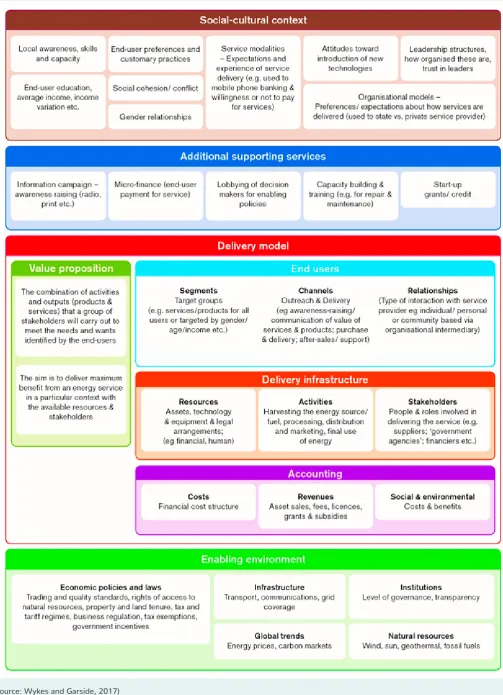
The Energy Delivery Model (EDM) is a systematic and participatory approach to designing energy services for people living in poverty developed by CAFOD and IIED in 2013. It builds on the insights of previous practice and research undertaken by Practical Action, IIED and other groups delivering energy services to poor and marginal groups [7].
The delivery model is influenced by the socio-cultural context, the enabling environment and supporting services. The model uses a combination of the technology, finance, management activities, policy support, legal arrangements and relationship types required to supply energy to a group of people or end users (who are affected by income poverty and/or energy poverty [5]. The model highlights the importance of socio-cultural factors that could hinder or enable delivery of energy solutions. These are important not just in getting a buy-in from the community but also in ensuring the long-term sustainability of the energy system. It also highlights the supporting services that enable effective and impactful delivery of energy services.
The energy delivery model approach was later refined in to a toolkit which includes a 6-step design process and two innovative design tools which helps designers and end-users develop a potential solution that addresses their developmental priorities. The schematic below outlines the steps.
Given below is the delivery model map that summarizes the various aspects covered by the EDM [5], followed by an example of the application of the EDM in gaining a nuanced understanding of needs and priorities in a rural community in Indonesia.
Figure 1: EDM 6 step design process
Figure 2: The Delivery Model Map
Over a 6-month period, CAFOD and IIED worked with partners in Flores island in Eastern Indonesia to use the EDM planning approach with a community. Increased income from coffee farming was identified as one of the three development priorities for the community. During the initial discussions, the instinct of the community was to jump straight into the types of solutions, for example having a mechanical coffee grinding machine and an affordable energy service to power this machine, given the cost of diesel and the lack of other power options, rather than to start by exploring what the ‘gaps’ – both energy and ‘non-energy’ related - were preventing them increasing their income from coffee farming.
However, through the iterative EDM design process, the group began to question “whether the increased income from coffee farming could be related to the quality of the crop or also related to post-harvesting activities and the need to improve processing practices” [5]. This resulted in them clarifying the need to address several gaps to improve crop quality. Analysis of the coffee-value chain was undertaken to explore current market channels, the feasibility of alternatives and to identify where they could best add value, to feed into the development of potential solutions.
Following this analysis, it became clear that the least risky way for the farmers to increase their income was to continue to sell their raw product through existing market channels but in greater volume. Addressing non-energy gaps was critical to increasing crop productivity, for example through training on good agricultural practice (GAP), using improved inputs and establishing a farmers’ cooperative to access further support. The energy gap of electricity to power coffee processing machinery identified initially proved not to be significant given that only a small amount of processed coffee was sold to the local market and there was sufficient power supply for that. Exploring the use of new packaging and, in the longer term, better ways of processing, would add greater value to this processed product.
The in-depth planning process with the community enabled them to explore and prioritize their development needs and understand the most significant barriers to meeting them. It allowed for the end-users and project partners to co-create more holistic solutions, identifying all the stakeholders and supporting services required to deliver the solution – including beyond the energy delivery infrastructure. It also helped identify synergies between potential solutions across the priority needs. The EDM framework highlights how energy is an enabler for other development areas and must be viewed as part of a more holistic solution to maximize developmental impact and ensure long-term sustainability.
The Energy Delivery Model has also been used in Kenya as an analytical framework to evaluate the impacts of a programme to improve the livelihoods of farmers groups by providing energy for productive uses. The analysis suggested changes in the design process that could have enhanced the programme impacts and addressed areas of failure (discussed later in this paper). It was also used to review the business model for a solar lantern business in Nigeria and to test and optimize the design of a proposed cookstove distribution project in Myanmar.
Box 2 – Coordinating planning efforts across counties in Kenya
With the devolution of governance in Kenya in 2013, there has been a redistribution of powers and responsibilities between
the national and county governments. Energy planning, coordination of actors and implementation of energy plans are now the responsibility of county governments. They are responsible to develop county energy plans by understanding demands of various categories of end users including households, livelihoods and community spaces and determining the kind of supply options that can meet these needs.
While there is significant interest from county governments, energy is a new portfolio for the county and hence there is little experience and a lack of local level data to undertake effective and inclusive energy planning. In order to support counties in addressing these challenges, particularly by supporting more integrated planning, on-ground experimentation of energy projects and the facilitation of greater interactions between counties, the concept of a collaborative County Energy Access Platform is
being explored4.
The platform would seek to support counties in their energy planning as well as map financing sources. It will support
implementation of new, innovative energy projects that can be used as demonstrations for future energy system financing and fundraising. It aims to enable replication of best practices and sharing of learnings across county governments.
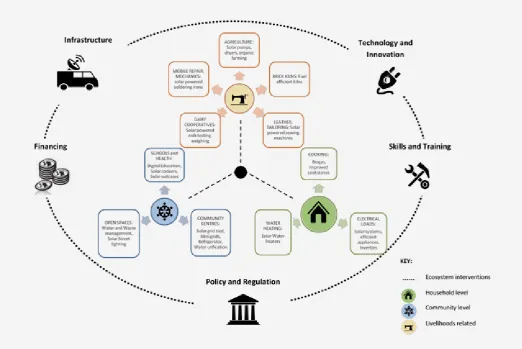
Access to energy alone is insufficient in achieving transformative change. Development of an ecosystem or enabling environment is critical to the sustainable, long-term delivery of solutions. This ecosystem can be described in terms of a set of factors that includes technology innovation, access to finance, skills development and entrepreneurship, policy and regulation and infrastructure [8], as represented in the figure below- within the broader environment of policy and regulation are aspects such as tax and tariff regimes, economic laws, land tenures and so on. In the case of productive use solutions, market linkages are another important aspect of the ecosystem. Resource availability and institutional capacity also constitute part of the enabling environment as highlighted in the EDM delivery model map above (Figure 2). In addition to the more formal enabling environment, there are socio-cultural factors such as
customary practices, gender relationships and leadership structures within the community that must be considered in the design
[image:10.595.36.559.292.641.2]process and which could affect the success (or not) of initiatives when they are implemented.
Figure 3: Representation of the ecosystem or enabling environment for energy access
MESSAGE 2
Sustainable delivery of solutions depends on the development of a strong ecosystem and support services
(Source: WWF-India and SELCO Foundation, 2015)
Box 3 – Green Business Area: energy for local entrepreneurship
5GERES, a French NGO, has been working in Mali for over 10 years now, on aspects of climate change mitigation and inter-linked development. Over 73% of rural areas across Mali have no access to electricity. With 30,000 inhabitants, the municipality of
Konseguela is one such area, where local businesses were primarily dependent on diesel to run their business. Volatile fuel prices and economic shortages resulted in the shutting down of 95% of the town’s mills between 2008 and 2013, forcing women to return to traditional, labour intensive mechanisms for processing cereals.
Left to right: A small business using equipment powered by the micro-grid; Solar PV array of the micro-grid; A sign displaying the various activities and businesses operating in the GBA. Photo credits: GERES
The Green Business Area (GBA) is an attempt to provide electricity for productive use needs using decentralized sustainable energy solutions. This first GBA in Mali which has been running since the end of 2015 is established on a dedicated site close to the community and powered using a 12.5 KW micro grid powered through a combination solar PV system and a generator that uses locally-produced agro-fuels. It caters to the energy needs of small businesses including milling, bakery and restaurant, cold storage unit, digital services, mechanical workshop, pharmacy, egg incubator, carpentry and tailoring and embroidery.
This first pilot was subsidized in large part by public funds to cover the cost of infrastructure, engineering and support for community activities. The Small and Micro Enterprises (SMEs) also invested about 1/5th of the project cost, using their own funds and microloans for specific productive activities. On an ongoing basis, these SMEs pay a monthly rent for their workshop, a subscription for their electricity meter and the monthly electricity bill based on their consumption. These revenues generated are set aside to finance the replacement of assets in the future.
The second pilot, which has recently been commissioned, has been financed with a larger share of private funds and the aim is to increase SME investment to about one-third of the total project cost in the near term.
The operator of the GBA is present on-site and is involved in the management, maintenance of infrastructure, collection of rent and energy payments as well as the provision of energy services including the sale and installation of solar kits and improved cook stoves.
Lack of credit access is a challenge often faced by small enterprises. SMEs were not only in need of the infrastructure to power their business operations but also the financial capital and training/coaching to improve their business including production processes, sales, and marketing, accounting, management, market linkages and so on. Without such support, a very small percentage of entrepreneurs are strong enough to start and establish their business.
Going beyond the mere provision of energy services, the GBA sought to address these enabling environment needs of growing businesses. The clustering of businesses on the same space facilitated the implementation of entrepreneurship and business development support as well as access to financing services. This is a key value-added of the GBA. Entrepreneurs selected to be part of the GBA were supported to develop their business plans and apply for loans where required. Business development and technical trainings on management, marketing and production techniques were also provided to at various stages of the development of their enterprises. Access to finance was also facilitated to enable entrepreneurs to purchase equipment or expand their business. After facilitating credit access for the first set of SMEs through an agreement with a microfinance institution, relations have now developed independently between them.
Box 4 – Building an ecosystem for productive use solutions
6The importance of building an ecosystem is also demonstrated in the productive use solutions enabled by the SELCO Foundation [9]. For example, tailoring is a common livelihood in villages and towns across India. Most tailoring entrepreneurs use manual sewing machines owing to the lack of reliable electricity to run motorized machines. In addition to solar powering the sewing machine with an efficient motor that is locally available, there is an active engagement of local banks to develop loan products for small tailors to purchase these machines. The details of the solution and associated loan product have all been included as part of banker training programmes to enable a better understanding of the risk mitigation mechanisms.
Two years ago, the loan product was institutionalized by a nationalized bank as part of its Women’s entrepreneurship loan scheme. The solar powered sewing machine has also been installed in vocational training institutions as part of a demonstration and learning unit for the ‘Electrician trade’ course. This was done with the intention of enabling electricians to learn about the
installation and maintenance of solar systems for livelihood appliances, thereby creating a larger human resource base to support
with installation and servicing of DRE systems.
As of today, there are more than 300 solar powered sewing machines installed across India by SELCO Foundation and its partner organizations across India.
By partnering with manufacturers (to develop more efficient motors), working with livelihood organizations and cooperatives (to increase awareness and uptake of the solar powered sewing machine solution) and by engaging with local banks (to increase the availability of small loans for the system), a larger ecosystem for solar powered productive use solutions is being developed. Planning for such a larger ecosystem includes a longer time horizon but will provide the much-needed sustainability to the solution in the long term.
Tailoring businesses using sewing machines powered by decentralized solar systems, financed through local bank loans and informal savings and credit mechanisms. (Left: System installation by Mangaal- a social energy enterprise in Manipur, North East India; Right: solar system installed by SELCO India). Photo credits: SELCO Foundation
6 This box has been written based on multiple discussions with individuals at SELCO Foundation between May 2018 and Feb 2019,
Measuring the real impact of the energy solutions delivered is a complex undertaking that includes an understanding of all the possible stakeholders and the other developmental areas that may be impacted. Well-designed energy solutions and systems have the potential to impact the end-users in the community as well as strengthen the larger ecosystem for energy provision.
Despite the general acceptance of positive impacts accruing from rural electrification, there is limited published data on the specifics owing to (among other factors), the costs or perceived costs of data collection, types of data to be collected and processes and
challenges with standardizing aggregated data [10] Research suggests that in particular, there are limitations in data for productive and public community-based uses of energy, and a lack of evidence to disaggregate benefits for higher tiers of energy (Tier 3- Tier 5) [11].
There is some way to go before impact can be comprehensively defined and measured. At the broadest level, the challenges may be grouped into two questions.
1. What constitutes impact, i.e. what is being measured or evaluated?
2. How can these impacts be measured, i.e. what types of data need to be collected?
The first question warrants a discussion on what different stakeholders consider impact, what incentivizes them to collect data and the types of indicators that can be used to measure change.
For some investors and enterprises driven solely by investor interests, the focus often shifts to products and sales volumes (or customer connections and kWh paid for in the case of mini-grids) rather than a measurement of systemic change. There is an assumption that the Bottom of the Pyramid (BoP) constitutes a large untouched market, and hence that larger scale operations or implementation can translate into higher profits7. This means expectations around Internal Rates of Return (IRRs) and exit strategies are often comparable to commercial rates, ignoring the context in which the energy access sector operates [3]. This risks missing the multi-faceted nature of energy poverty and the challenges of reaching the ‘last mile’, as well as ignoring the kind of ecosystem building required to sustainably deliver energy services. For governments on the other hand, provision of an electricity connection or basic hours of supply become proxies for impact.
A review of existing literature on mini-grids, for example, reveals that most academic and industry-led project evaluations undertaken focus on techno-commercial aspects while social impact factors are often missing [10]. Social impacts are identified in terms of effects on schools, health, security and income generation but these are rarely quantified or validated through a robust Monitoring & Evaluation (M&E) framework. Undoubtedly, impact assessment is complex but necessary and warrants a clearer identification of indicators, which need to go beyond financial returns for enterprises to include social returns for communities. In the recent past, organisations like GOGLA have put forward some metrics that can be adopted by members and stakeholders in the off-grid solar sector to begin estimating their impact beyond product numbers or financial returns8. Beyond these efforts, there is a strong need for further analysis of different impact methodologies and primary research of real-world interventions including failure rates of projects or solutions. A recent publication on the ‘Social impact of mini-grids’ takes a step in this direction and seeks to list key performance indicators to enable better M&E of mini-grid systems [7]. They are categorized in terms of core indicators (minimum to track the overall performance of the mini-grid) and optimal indicators (an additional list that can be selected based on the priorities of specific organizations/projects) .
As well as recommending indicators to track social impact, practitioners are advised to engage with academia to conduct deeper longitudinal studies or evaluations to explore causality of energy interventions and wider community development. In addition to
the impact on households, productive use activities, education and healthcare services, it would be useful to expand the indicators
to include impacts on the larger ecosystem for energy access and other developmental services. This should include an analysis of the unintended benefits or negative impacts of a project on ecosystem aspects such as the local infrastructure, access to other developmental services including affordable finance, capacity of key stakeholders and associated policy changes. Box 5 discusses the unintended impacts of a community based green energy project in Kenya, assessed using EDM as an analytical approach.
MESSAGE 3
Measuring the impact of energy access needs to go beyond the number of electricity connections and
products sold to a tiered approach that treats energy as a service and assesses how usable that service is
7 Discussed in books such as ‘The fortune at the Bottom of the Pyramid’ by C.K. Prahalad, published in 2004 by Wharton School Publishing
Box 5 – Understanding (intended and unintended) impacts: The case of energy for
small scale agriculture in Kenya
The Kenyan agricultural sector has significant potential but is hampered by lack of electricity and water availability. From 2011 to 2014, CAFOD and local partners implemented a Community Based Green Energy Project aimed at addressing some of the challenges by providing energy services for rural and peri-urban communities. One component involved providing greenhouses, solar-powered pumping systems and supporting services to 56 women farmer groups. In 2017, a review of the project’s impact on a sample of farmers groups in Kitui county was undertaken by CAFOD and IIED using the EDM toolkit, and the learnings were used to identify how challenges can be overcome, and future project design improved. [6]
In the original project, the farmers’ groups were mobilized and supported with training around financial management, accounting, agronomy to grow horticultural produce using solar-powered water pumps and drip irrigation systems in greenhouses. During the review, it became clear that one of the key benefits of the project was group membership itself including enhanced credit access. Members would engage in ‘table banking’- a mechanism by which every member in the group regularly contributes a specific amount into the group’s corpus fund, and members can then borrow from this fund at a specific interest for a specific time period. With credit being difficult to access from Kenya’s formal banking institutions, communities greatly valued this savings-credit facility.
Members used the money primarily for household needs, such as school fees and unforeseen medical bills, and for investment
into their individual farms such as buying seeds. They also recognized the value of the social support that came with being a part of the group. This was not an intended outcome of the project but came up in response to questions in the EDM canvas about the value being created for end users and the social benefits accruing from the provision of services.
Left) Members of one of the farmers’ groups in Kitui who were part of the evaluation; (Right) Solar array for the water pumping system belonging to one of the farmer’s group that was still functional. Photo credits: CAFOD-IIED
Learnings from the experiences so far, and relevance for future planning efforts
Reflecting on the experiences illustrated above, this paper seeks to outline the lessons for key stakeholders, particularly those that are involved in and influence planning and impact measurement.
1. Localized planning and adequate support and tools for strong planning processes: The process for energy planning is as
important as the final energy solution itself. For both governments, and NGOs and energy enterprises, there is a need to move beyond a tick-box exercise of providing an electricity connection or a basic energy product, to undertaking long term planning.
With devolution in countries like Kenya, Malawi, Nepal, localized planning efforts are gaining momentum, and this is a great opportunity to ensure more sustainable processes are put in place for long-term integrated development planning. Efforts like the County Energy Access Platform in Kenya are steps in the right direction. However, there is a need for additional resources and capacity to enable such initiatives to work more closely with government. This includes access to tools at the local level, increased financial resources and increased buy-in from the philanthropic institutions, donors, governments, bilateral and multilateral agencies that provide technical assistance and invest in energy access programmes.
2. Strong principles for multi-stakeholder collaboration: As the gamut of stakeholders involved in energy planning increases, there is a need to ensure greater cohesion and replicability in the approaches being used to support local governments or enterprises. There is also a need for greater coordination and optimum use of grid-connected, grid-interactive and decentralized approaches to energy provision. Civil society organizations, academics, energy enterprises, government actors are all involved in facilitating energy access provision. Without strong principles that all of these actors can adhere to/ buy-in to and frequent experience sharing, there is likely to be duplication of efforts, or worse, a duplication of failed approaches.
3. Understanding the costs of sub-optimal planning and learning from failed experiences: Long term, sustainable planning is a time and resource-intensive process and it is critical to avoid underestimating the costs of planning, and more importantly, the costs of sub-optimal planning. There are important learnings to be gained from examples of failed projects providing solar solutions in an ad-hoc manner without an appropriate understanding of all the energy needs, socio-cultural norms, maintenance mechanisms, factors influencing ownership, affordability and decision making. The costs of sub-optimal planning include the reputational risks for future decentralized solar energy programmes in these regions.
4. Changing the approach to impact tracking and measurement: Monitoring and Evaluation frameworks need to be developed alongside planning processes to ensure they are feasible and have the community’s buy-in prior to implementation. Such practices should be the norm for all projects, whether initiated by community members themselves, or by enterprises, CSOs, Government or external donors.
To complement ongoing efforts, this is a ‘call to action’ for donors, Development Finance Institutions (DFIs) and governments to: (a) invest more systemically in research and analysis into improving methodologies for impact tracking and reporting in the energy access sector, and (b) actively track and analyse real-world projects to better understand the impacts in project delivery, including project sustainability and failure rates. This would help inform the case for greater investments not just in the planning process but in the types of planning approaches for different contexts.
In order to capitalize effectively on the momentum and bolster efforts towards achieving SDG7, there is a need to take stock of the current approaches to energy service delivery, the impacts of existing projects and learn from the successes and failures. Investing in inclusive and integrated planning processes and impact assessment approaches will play an important role in ensuring that the efforts
Based on the research and interaction with practitioners, a process is laid out not only for impact monitoring and evaluation
specifically for mini-grids but also for aspects that can be extended to any energy intervention. One of the first steps is obtaining institutional and employee buy-in to M&E whereby there is a clear communication about the importance of M&E itself and the process by which data will be collected, analysed, used and shared. Steps are then presented around developing a clear theory of change of what the impact, outcomes and outputs should be, and choosing the indicators by which the impacts of the project will be measured. The next step focusses on the development of tools for data collection. These range from smart meters for data on
generation and consumption, survey designs on usage, service and social impact, and focus group discussions and expert
interviews for deeper evaluations.
References
1. Bhatia, M and Angelou, N. (2015). Beyond Connections: Energy Access Redefined. ESMAP Technical Report; 008/15. World Bank, Washington, DC. © World Bank. Available at: https://openknowledge.worldbank.org/handle/10986/24368. License: CC BY 3.0
2. Jain, A., Urpelainen, J., Stevens, L. (2016). Energy Access in India, Rugby, UK: Practical Action Publishing. Available at: http://dx.doi.org/10.3362/9781780446639.
3. Bolis, M. and Alexander, S. (2017 Oct 30). Impact Investing Has it Backward: It’s Time to Prioritize the Needs of Social Enterprises, Not Just Investors. Next Billion. Retrieved from https://nextbillion.net/impact-investing-backward-time-prioritize-needs-social-enterprises-not-just-investors/
4. Schützeichel, H. (2019 Feb 22). The “Gretchen Question” of the Off-Grid Industry: to serve investors or the poor? Sun-Connect East Africa News. Available at: https://sun-connect-ea.org/the-gretchen-question-of-the-off-grid-industry-to-serve-investors-or-the-poor/
5. Garside, B. and Wykes, S. (2017). Planning pro-poor energy services for maximum impact: The Energy Delivery Model Toolkit, CAFO-IIED, London. Available at: http://pubs.iied.org/pdfs/16638IIED.pdf
6. Rajagopal, S. et al. (2017) Using the EDM toolkit to analyse impact: a small-scale horticulture project in Kenya. CAFOD and IIED, London. Available at: http://pubs.iied.org/16637IIED
7. Bellanca, R. and Garside, B. (2013) An approach to designing energy delivery models that work for people living in poverty. CAFOD and IIED, London. Available at: www.iied.org/energy-deliverymodels-work-for-people-living-poverty
8. WWF- India and SELCO Foundation. (2015). Deployment of Decentralised Renewable Energy solutions: An Ecosystem approach. WWF-India and SELCO Foundation, New Delhi. Available at: https://www.wwfindia.org/?14861/Ecosystem-approach-vital-for-clean-energy-access-WWF-India--SELCO
9. SELCO Foundation. (2018). SELCO Foundation Annual Report 2017-18, Bangalore, India. Available at: https:// selcofoundation.org/wp-content/uploads/2019/01/Annual-Report-17-18-merged.pdf
10. Eales, A., Walley, L., Colenbrander, E. (2018). Social Impact of mini grids: Monitoring, Evaluation and Learning. Available at: https://www.researchgate.net/publication/329424742_Social_Impact_of_Mini-grids_Monitoring_Evaluation_and_Learning 11. Scott,A. (2017). Why Wait? Seizing the Energy Access Dividend. Sustainable Energy for All, Power for All and Overseas
The Low Carbon Energy for
Development Network (LCEDN)
brings together researchers,
policy-makers, practitioners and
the private sector from across
the United Kingdom (and indeed
the rest of the world) to expand
research capacity around
low-carbon energy development in
the Global South. The LCEDN
was launched in January 2012
centred around hubs at the
Durham Energy Institute and
Loughborough University.
CAFOD is the Catholic Agency
For Overseas Development. We
are an international development
charity and the official aid
agency of the Catholic Church
in England and Wales. We work
with communities across Africa,
Asia, Latin America and the
Middle East, helping people to
tackle the poverty and injustice
they face. We work wherever
the need is greatest, with people
of all faiths and none.
The International Institute for
Environment and Development
(IIED) promotes sustainable
development, linking local
priorities to global challenges.
We support some of the
world’s most vulnerable people
to strengthen their voice in
decision making.
Low Carbon Energy for
Development Network
Department of Geography
and Environment
Geography Building
Loughborough University
Leicestershire, LE11 3TU, UK
[email protected]
+44 (0)1509 228423
Catholic Agency for
Overseas Development
Romero House,
55 Westminster Bridge Road
London, SE1 7JB, UK
Tel: +44 (0)20 7733 7900
Registered Charity No. 1160384 Company Limited by guarantee 09387398