High-dimensional one-way quantum processing
implemented on d-level cluster states
Christian Reimer1,2,*, Stefania Sciara1,3, Piotr Roztocki1, Mehedi Islam1, Luis Romero Cortés1,
Yanbing Zhang1, Bennet Fischer1, Sébastien Loranger4, Raman Kashyap4,5, Alfonso Cino3, Sai T.
Chu6, Brent E. Little7, David J. Moss8, Lucia Caspani9, William J. Munro10, José Azaña1, Michael
Kues1,11,*,+, and Roberto Morandotti1,12,13,+
1Institut National de la Recherche Scientifique (INRS-EMT), 1650 Blvd. Lionel-Boulet, Varennes, J3X1S2, Canada 2John A. Paulson School of Engineering and Applied Sciences, Harvard University, Cambridge, 02138, USA 3Department of Energy, Information Engineering and Mathematical Models, University of Palermo, Palermo, Italy 4Engineering Physics Department, Polytechnique Montreal, 2900 Blvd. Édouard-Montpetit, Montreal H3T 1J4,
Canada
5Electrical Engineering Department, Polytechnique Montreal, 2900 Blvd. Édouard-Montpetit, Montreal H3T 1J4,
Canada
6Department of Physics and Material Science, City University of Hong Kong, Tat Chee Avenue, Hong Kong, China 7State Key Laboratory of Transient Optics and Photonics, Xi’an Institute of Optics and Precision Mechanics, Chinese
Academy of Science, Xi’an, China
8Centre for Micro Photonics, Swinburne University of Technology, Hawthorn, Victoria 3122, Australia 9Institute of Photonics, Department of Physics, University of Strathclyde, Glasgow G1 1RD, UK
10NTT Basic Research Laboratories, NTT Corporation, 3-1 Morinosato-Wakamiya, Kanagawa, 243-0198, Japan 11School of Engineering, University of Glasgow, Rankine Building, Oakfield Avenue, Glasgow G12 8LT, UK 12Institute of Fundamental and Frontier Sciences, University of Electronic Science and Technology of China, Chengdu
610054, China
13National Research University of Information Technologies, Mechanics and Optics, St Petersburg, Russia
*these authors contributed equally
Quantum mechanics can resolve important problems, such as executing certain computational tasks exponentially faster than classical computers1 and to perform measurements with precision exceeding the classical limit2,3. Of significant interest are cluster states4, which can enable the realization of universal quantum computers by means of a
‘one-way’ scheme5, where processing is performed through measurements6. The use of d-level
cluster states can increase the quantum resources while keeping the number of parties constant7 and enable novel algorithms8. Here, we achieve their experimental realization,
characterization, and test their noise sensitivity. We create three-level, four-partite cluster states formed by two photons in the time9 and frequency10 domain and confirm genuine
multi-partite entanglement with higher noise robustness compared to conventional two-level cluster states6,11–13. We perform high-dimensional one-way quantum computation operations,
where the cluster states are transformed into different orthogonal, maximally entangled d-level two-partite states by means of projection measurements. Our scalable approach is based on integrated photonic chips9,10 and optical fiber communication components and achieves
new and deterministic functionalities.
Cluster states are a particularly important type of multi-partite states (i.e. those formed by more than two parties, like multiple atoms, photons, etc.) characterized by two unique properties: maximal connectedness4 (i.e. any two parties of the state can be projected into a maximally
entangled state through measurements on the remaining parties), as well as by the highest persistency of entanglement4 (i.e. cluster states require a maximal number of projection
measurements to fully destroy entanglement in the system). These properties make cluster states equivalent to universal one-way (also called measurement-based) quantum computers5, where
the cluster states5,6. This approach greatly simplifies quantum processing, since measurement
settings can be usually implemented more easily than the gate operations required in other approaches1,14. Furthermore, cluster states have structural properties that protect the quantum
information, i.e. they enable topological quantum error correction11 for minimizing computation
errors. Due to the significant importance of cluster states, they have been studied in many different platforms. In particular, experimental realizations can be separated into two classes: discrete
two-level6,11–13 (i.e. qubit) and continuous-variable15,16 cluster states. Continuous-variable systems are
intrinsically high-dimensional, and they can be achieved using squeezed states15,16. However, the
quantum resource of these states relies on the level of squeezing, which is very sensitive to noise17.
Further, in the framework of today’s squeezed state realisation with bulk optical parametric oscillators, the individual quantum modes cannot be independently addressed. In contrast, discrete quantum states are less sensitive to noise than squeezed states17, and even more importantly, the
individual modes of the quantum states can be fully accessed and individually manipulated, making their use especially appealing.
Nevertheless, increasing the number of particles to boost the computational resource comes at the price of significantly reduced coherence times, detection rates, and increased sensitivity to noise. These limitations have restricted the realization of discrete cluster states to a record of eight qubits11. In a novel approach, the use of discrete but d-level entangled states has the potential to
address several limitations of qubit cluster states. First, the quantum resource can be increased without changing the number of parties7; second, d-level quantum states enable the implementation
of highly efficient computation protocols8; and third, which we show here, higher dimensions
ill-suited for increasing the dimensionality of discrete multi-partite entangled states. For example, atomic18 and superconducting19 systems are mainly based on qubit schemes, and demonstrated
high-dimensional photonic systems20,21 become experimentally complex, inefficient and typically
suffer from degraded state purity when the number of photons used increases. The only d-level quantum states with more than two parties generated so far are three-level, three-photon states in a bulk, free-space setup22. Cluster states with two and three parties are equivalent to Bell and GHZ
states, respectively4, while genuine discrete d-level cluster states require at least four parties4. To
date, these states have not been realized, nor have their entanglement properties and their tolerance to noise been investigated.
Here, we present a general approach to prepare and coherently manipulate discrete d-level multi-partite quantum systems based on the simultaneous entanglement – i.e. hyper-entanglement23
– of two photons in time and frequency, by exploiting integrated photonic chips combined with fiber-optics telecommunications components9,10. Using this method, we present the first
experimental realization and characterization of qudit cluster states. Further, we use these states to perform high-dimensional one-way quantum processing.
As a basis for the generation of d-level clusters, we used intrinsically linked and non-commuting observables, specifically photon frequency and time, to create hyper-entangled states that support higher dimensions.In contrast, hyper-entangled photon states have so far only been realized using combinations of independent degrees of freedom, described by commuting operators, such as polarization, optical paths and temporal modes23–25. In detail, we consider two
discrete forms of energy-time entanglement, namely time-bin9 and frequency-bin10. Time-bin
parametric process in an optical nonlinear medium with multiple phase-locked pulses9, see Fig.
1a). On the other hand, frequency-bin entanglement can be realized when the nonlinear medium is placed within an optical resonator, where the emission bandwidth covers multiple resonances10,
see Fig. 1b). Remarkably, if the time scales (and frequency separations) corresponding to the individual modes are different, frequency-bin and time-bin entanglement become independent, allowing one to generate hyper-entangled, multi-partite states. Such hyper-entangled states can be produced by exciting the nonlinear element, placed inside the resonator, with a coherent set of multiple pulses, see Fig. 1c), as long as the pulse separation is much larger than the photon lifetime in the resonator. In this case, the time-bin component can be fully controlled in the temporal domain, while the frequency-bin component can be completely and independently controlled in the frequency domain.
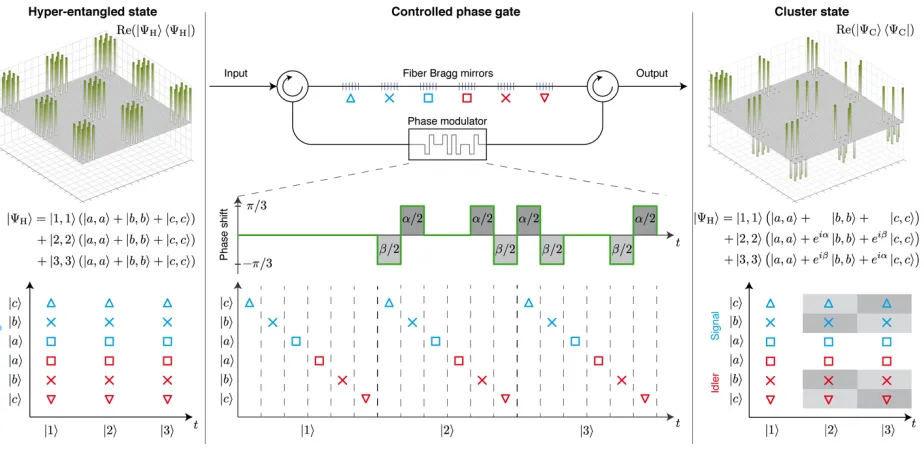
In our experimental implementation, we produced photon pairs using the nonlinear process of spontaneous four-wave mixing within a microring resonator, see Methods. By exciting the resonator with three phase-locked pulses and considering three frequency mode pairs, we generated photon states simultaneously entangled in time and frequency, described by the following expression (Eq. 1):
!Ψ#$%&'( = (|1-, 1/⟩ + |2-, 2/⟩ + |3-, 3/⟩) ⨂(|a-, a/⟩ + |b-, b/⟩ + |c-, c/⟩)
= |1-, 1/, a-, a/⟩ + |1-, 1/, b-, b/⟩ + |1-, 1/, c-, c/⟩ +|2-, 2/, a-, a/⟩ + |2-, 2/, b-, b/⟩ + |2-, 2/, c-, c/⟩ +|3-, 3/, a-, a/⟩ + |3-, 3/, b-, b/⟩ + |3-, 3/, c-, c/⟩,
where numbers indicate time-bins and letters indicate frequency-bins with the indices s and i
vice versa). In contrast, a cluster state is characterized by the fact that a projection measurement of one party affects the remaining portion of the state. An ideal compact three-level cluster state can be obtained by judiciously modifying the phase terms in Eq. 1, which then reads (Eq. 2):
|Ψ:;<=>&'⟩ = |1-, 1/, a-, a/⟩ + |1-, 1/, b-, b/⟩ + |1-, 1/, c-, c/⟩
+ |2-, 2/, a-, a/⟩ + 𝑒/ @A
B |2-, 2/, b-, b/⟩ + 𝑒C/@AB |2-, 2/, c-, c/⟩
+ |3-, 3/, a-, a/⟩ + 𝑒C/ @A
B|3-, 3/, b-, b/⟩ + 𝑒/@AB |3-, 3/, c-, c/⟩.
In order to experimentally transform the hyper-entangled state (Eq. 1) into this cluster state (Eq. 2), access to the individual terms of the state is necessary, while maintaining coherence. For multi-particle states this is technically very challenging, requiring two-party quantum gates, which are usually probabilistic26. The hyper-entangled time-frequency approach allows for a deterministic
and coherent implementation of this operation. Specifically, since we are employing two different types of discrete energy-time entanglement associated with different time scales (i.e. time-bin and frequency-bin), it is possible to fully map the entangled state into the time-domain to perform state manipulations using synchronized electro-optic modulation. The realized gate (see Fig. 2) provides coherent access to the individual state terms. The frequency-to-time mapping was performed by a fiber Bragg grating array placed in a self-referenced and phase-stable loop configuration, see Methods. By choosing the appropriate phase pattern (see Fig. 2), the bi-separable hyper-entangled state was transformed into a three-level four-partite cluster state.
To confirm genuine multi-partite entanglement, we determined an optimal entanglement witness 𝒲FGHI𝒞K,LM= N
@𝕀 − B
witness 𝒲@SI𝒞K,LM, containing two orthogonal measurement settings represented by the generalized
three-dimensional Pauli matrices X and Z, see Methods. To experimentally determine the expectation value of the cluster state witness, given by (Eq. 3)
〈𝒲@SI𝒞K,LM〉 =5
3− 1
3𝑅𝑒I〈𝕀N𝕀@𝑍B𝑍YZ〉 + 〈𝑍NZ𝑍@𝕀B𝕀Y〉 + 〈𝕀N𝑍@𝑋B𝑋Y〉 + 〈XN𝑋@𝑍B𝕀Y〉 + 〈𝑍N𝕀@𝑋B𝑋Y〉
+ 〈𝑍NZ𝑍@Z𝑋B𝑋Y〉 + 〈𝑋N𝑋@𝕀B𝑍Y〉 + 〈𝑋N𝑋@𝑍BZ𝑍YZ〉M,
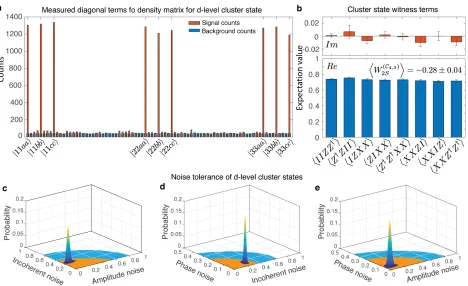
we measured the diagonal elements of the density matrix (see Fig. 3a), as well as the expectation values of the eight witness terms individually (see Fig. 3b). This was achieved by means of projection measurements implemented by imbalanced interferometers and electro-optical modulators, see Methods. We measured a witness expectation value of 〈𝒲@SI𝒞K,LM〉 = −0.28 ± 0.04,
confirming (within the range of 7 standard deviations) the presence of a cluster state featured by genuine three-level multi-partite entanglement.
state (having slightly lower computational power compared to the here demonstrated four-qutrit state) can only tolerate 50% for the optimal and 28.5% for the measurement witness, see Methods. Our findings therefore show that d-level cluster states not only increase the quantum resource, but also provide better noise tolerance compared to qubit cluster states with comparable computational power.
To confirm the potential of d-level cluster states for quantum computation, we demonstrated that different and orthogonal entangled states can be generated by simply performing projection measurements on the parties of the cluster, which is the working principle of one-way quantum computation5,7. Indeed, one-way quantum computation is implemented by projecting the remaining
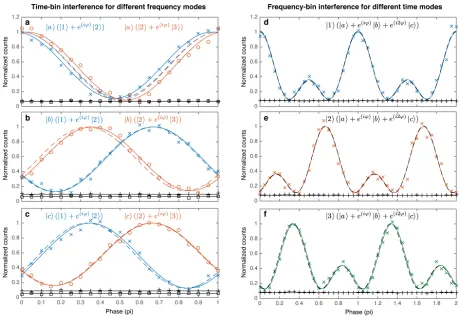
entangled state through subsequent measurements on the parties. We here show this shaping of the cluster states and transform them into different orthogonal bi-partite states. For this, we carried out two-partite projections in either the frequency or time domain, and verified, via quantum interference measurements, that the resultant states are mutually orthogonal and entangled. In detail, we projected on the frequency-bins |a, a⟩, |b, b⟩, or |c, c⟩ individually, and confirmed the generation of three-level time-bin entangled states !ψb,b( = |1,1⟩ + |2,2⟩ + |3,3⟩, !ψc,c( = |1,1⟩ + 𝑒/deL|2,2⟩ + 𝑒C/
de
L|3,3⟩, and !ψf,f( = |1,1⟩ + 𝑒C/ de
L|2,2⟩ + 𝑒/ de
L|3,3⟩, which are mutually
orthogonal (see Fig. 4 a-c). Similarly, we projected on the time-bins |1,1⟩, |2,2⟩, or |3,3⟩, and confirmed the generation of the orthogonal three-level frequency-bin entangled states !ψN,N( = |a, a⟩ + |b, b⟩ + |c, c⟩,!ψ@,@( = |a, a⟩ + 𝑒/deL|b, b⟩ + 𝑒C/
de
L|c, c⟩, and !ψB,B( = |a, a⟩ + 𝑒C/ de
L|b, b⟩ +
𝑒/deL|c, c⟩ (see Fig. 4 d-e). The orthogonality of these target states was confirmed by the relative
represent high-dimensional one-way quantum computing operations. Future universal quantum computation will require the application of d-level Hadamard gates, that have already been achieved for time-bin qubits27, as well as frequency-bin qubits and qutrits28.
In conclusion, our results show that high-dimensional one-way quantum computation with discrete multi-partite entangled states is experimentally viable. The cluster state realization was enabled by the use of on-chip and fiber-telecommunication components that provide highly stable, scalable and, most importantly, deterministic operations. Furthermore, our work also shows that integration is not, as it is often regarded, simply limited to miniaturizing devices and reducing cost (typically at the expense of lower performance), but can in fact enable novel and powerful capabilities. Most significantly, our approach is advantageous compared to current methods based on two-level cluster states, since it can provide a better noise tolerance and a significant improvement in terms of an effective quantum resource rate (EQRR). In particular, multi-photon states that are generated by multiple spontaneous parametric processes are hampered by a decrease in state purity with increased photon number29. In contrast, our approach allows imprinting a
multi-partite high-dimensional quantum system in a two-photon state with high purity, since only a single, efficient spontaneous parametric process is used. This allows increasing the amount of quantum information for each successfully detected two-photon event, which in turn can pave the way towards highly efficient and practical quantum computing systems. Here, the ability to implement active feed-forward to speed up the computation30 when multiple parties are detected
and eight-photon detection rates (DR) of DR6,2 = 12 mHz and DR8,2 = 0.89 mHz, resulting in effective quantum resource rates (EQRRH = H∗DR) of EQRR64 = 0.768 Hz and EQRR256 = 0.228 Hz, respectively. In the multi-photon cluster state approach, the detection rate diminishes more than the gain obtained through the increase in Hilbert space size, thus reducing the EQRR. In contrast, we achieved a Hilbert space size of H4,3 = 81 (corresponding to 6.34 qubits), yet at a much higher detection rate of DR4,3 = 1 Hz, resulting in an EQRR81 = 81 Hz. This corresponds to a hundred-fold increase with respect to the six-photon state. The Hilbert space size can be further enlarged by increasing the number of frequency and temporal modes, without compromising the detection rate. In turn, this further boosts the EQRR. For example, a moderate improvement to D = 4 will already lead to quantum states equivalent to 8 qubits (H4,4 = 256) and enhancing the dimensionality to D = 6 will correspond to an equivalent of 10.3 qubits (H4,6 = 1296), thus exceeding the largest multi-photon state (GHZ, with EQRR1024 = 3.17 Hz) measured to date29.
References:
1. Lloyd, S. Universal quantum simulators. Science 273, 1073–1078 (1996).
2. Israel, Y., Rosen, S. & Silberberg, Y. Supersensitive polarization microscopy using NOON states of light. Phys. Rev. Lett. 112, 12–15 (2014).
3. Hodaei, H. et al. Enhanced sensitivity at higher-order exceptional points. Nature 548, 187 (2017).
4. Briegel, H. J. & Raussendorf, R. Persistent entanglement in arrays of interacting particles.
Phys. Rev. Lett. 86, 910–913 (2001).
5. Raussendorf, R. & Briegel, H. J. A one-way quantum computer. Phys. Rev. Lett. 86, 5188– 5191 (2001).
6. Walther, P. et al. Experimental one-way quantum computing. Nature 434, 169–176 (2005).
7. Zhou, D., Zeng, B., Xu, Z. & Sun, C. Quantum computation based on d-level cluster state.
Phys. Rev. A 68, 062303 (2003).
8. Wang, D.-S., Stephen, D. T. & Raussendorf, R. Qudit quantum computation on matrix product states with global symmetry. Phys. Rev. A 95, 032312 (2017).
9. Reimer, C. et al. Generation of multiphoton entangled quantum states by means of integrated frequency combs. Science 351, 1176–1180 (2016).
10. Kues, M. et al. On-chip generation of high-dimensional entangled quantum states and their coherent control. Nature 546, 622–626 (2017).
11. Yao, X.-C. et al. Experimental demonstration of topological error correction. Nature 482, 489–94 (2012).
12. Lanyon, B. P. et al. Measurement-based quantum computation with trapped ions. Phys. Rev. Lett. 111, 210501 (2013).
13. Lu, C. Y. et al. Experimental entanglement of six photons in graph states. Nat. Phys. 3, 91–95 (2007).
14. Knill, E., Laflamme, R. & Milburn, G. J. A scheme for efficient quantum computation with linear optics. Nature 409, 46–52 (2001).
16. Yokoyama, S. et al. Ultra-large-scale continuous-variable cluster states multiplexed in the time domain. Nat. Photonics 7, 982–986 (2013).
17. Lloyd, S. & Braunstein, S. L. Quantum computation over continuous variables. Phys. Rev. Lett. 82, 1784–1787 (1999).
18. Blatt, R. & Wineland, D. Entangled states of trapped atomic ions. Nature 453, 1008–1015 (2008).
19. Kandala, A. et al. Hardware-efficient variational quantum eigensolver for small molecules and quantum magnets. Nature 549, 242–246 (2017).
20. Dada, A. C., Leach, J., Buller, G. S., Padgett, M. J. & Andersson, E. Experimental high-dimensional two-photon entanglement and violations of generalized Bell inequalities. Nat. Phys. 7, 677–680 (2011).
21. Gräfe, M. et al. On-chip generation of high-order single-photon W-states. Nat. Photonics
8, 791–795 (2014).
22. Malik, M. et al. Multi-photon entanglement in high dimensions. Nat. Photonics 10, 248– 252 (2016).
23. Barreiro, J., Langford, N., Peters, N. & Kwiat, P. Generation of hyperentangled photon pairs. Phys. Rev. Lett. 95, 260501 (2005).
24. Chen, K. et al. Experimental realization of one-way quantum computing with two-photon four-qubit cluster states. Phys. Rev. Lett. 99, 120503 (2007).
25. Vallone, G., Pomarico, E., Mataloni, P., Martini, F. De & Berardi, V. Realization and Characterization of a Two-Photon Four-Qubit Linear Cluster State. Phys. Rev. Lett. 98, 180502 (2007).
26. O’Brien, J. L., Pryde, G. J., White, A. G., Ralph, T. C. & Branning, D. Demonstration of an all-optical quantum controlled-NOT gate. Nature 426, 264–267 (2003).
27. Humphreys, P. C. et al. Linear optical quantum computing in a single spatial mode. Phys. Rev. Lett. 111, 150501 (2013).
28. Lu, H.-H. et al. Electro-optic frequency beam splitters and tritters for high-fidelity photonic quantum information processing. Phys. Rev. Lett. 120, 030502 (2018).
29. Wang, X. L. et al. Experimental ten-photon entanglement. Phys. Rev. Lett. 117, 210502 (2016).
30. Prevedel, R. et al. High-speed linear optics quantum computing using active feed-forward.
Figures
Fig. 2: Generation of level cluster states with a controlled phase gate. The two-photon d-level hyper-entangled state is simultaneously composed of three temporal modes |1⟩, |2⟩, and |3⟩
Fig. 4: High-dimensional one-way computation operations by measurement-based generation of orthogonal d-level two-party entangled quantum states. The cluster state was projected on specific time- and frequency-modes, resulting in different, orthogonal two-partite three-level entangled states in the frequency- and the time-domain, respectively. Quantum interference measurements were performed to confirm the presence of these two-partite states, as well as their entanglement. The time-bin quantum interference (a, b, c), measured by selecting two temporal modes, results in different phase-shifts (the relative position of the maximum with respect to the zero phase) after projecting the cluster states on the frequency modes {|𝑎𝑎⟩, |𝑏𝑏⟩, |𝑐𝑐⟩}. Likewise, the frequency-bin quantum interference (d, e, f) measured by selecting three frequency modes, results in different phase-shifts after projecting the cluster state on the temporal modes
[image:16.612.76.537.68.385.2]Methods:
Experimental setup. The full experimental setup including all components is shown in Extended Data Figure 1. To generate phase-locked triple pulses, we used a carrier-envelope phase (CEP) stabilized mode-locked laser (Menlo Systems Inc.) operating at 250 MHz repetition rate (i.e. 4 ns pulse separation) and locked the CEP frequency to 250/6 = 41.667 MHz. We then employed an electro-optic intensity modulator, driven by an arbitrary waveform generator (Tektronix), to temporally gate triple pulses that were separated by 24 ns (i.e. taking each 6th pulse from the initial
pulse train), where the set of pulses was repeated at a rate of 10 MHz (i.e. every 100 ns). The triple pulses were then spectrally filtered, amplified and coupled into the microring resonator at the resonance wavelength of 1555.93 nm. The microring resonator was fabricated from a high refractive index glass10, with a free spectral range of 200 GHz and a Q-factor of 235,000 31,32. The
input and output waveguides were featured by mode converters and were connected to polarization-maintaining fibers, resulting in coupling losses of <1.6 dB per facet. The average pump power coupled through the chip was 2.4 mW, measured at the drop-port. After the microring resonator, the excitation field was removed using a high-isolation (150 dB) notch filter, and the entangled photons were coupled into the controlled phase gate (see Fig. 2). This allowed to generate a hyper-entangled state23,33 simultaneously exploiting the time-bin34 and frequency-bin35 approach. The
phase-gate achieved frequency-to-time mapping via a custom-made fiber Bragg grating (FBG) array, consisting of six independent FBGs matched to the photon wavelengths (1551.08, 1552.70, 1554.31, 1557.55, 1559.17 and 1560.80 nm) and spatially separated in the fiber to achieve a 3.96 ns temporal delay between adjacent frequency modes (i.e. to introduce the frequency-time mapping). The FBGs were written into a photosensitive and deuterium loaded polarization-maintaining fiber (Nufern) using a 213 nm wavelength laser (5th harmonic of a Nd:YBO laser,
interferometer with a moving fiber36.The FBGs were apodized using a squared cosine function,
implemented by means of moving the Talbot phase mask with a piezo actuator36. The FBGs were
then heated to 80°C for 48 hours to remove the deuterium, thus decreasing losses. They were subsequently spliced to standard polarization-maintaining Panda fibers using a tapered splice to decrease mode-matching losses. To implement the optical phase modulation within the gate, we used an electro-optic phase modulator (EOSpace), which was driven by an arbitrary waveform generator (Tektronix), synchronized to the 10 MHz reference clock of the mode-locked laser. After the phase-gate, the photons were sent to a computer-controlled amplitude and phase filter with two output ports (Finisar Waveshaper). This filter was used to route the photons to different characterization setups. One output was connected to a stabilized fiber interferometer with 24 ns unbalance to perform temporal projection measurements9,37, and the other output was connected to
an electro-optic phase modulator, which mixes different frequency components to perform frequency projection measurements10,38,39. Finally, the photons were separated using spectral
programmable filters and sent to superconducting single photon detectors (Quantum Opus).
Entanglement witness for cluster states of qutrits. Multi-partite entangled quantum systems provide powerful resources for the implementation and advancement of many such applications40.
The presence of a genuine pure multi-partite quantum state |𝜓⟩, and those states close to them (e.g. states degraded by noise) can be identified by measuring the expectation value of an entanglement witness operator41:
𝒲w = 𝛿 ∙ 𝕀 − |𝜓⟩⟨𝜓|
the witness is negative. For convention, we normalize this witness such that the optimal state results in an expectation value of minus one:
𝒲 = 1
1 − 𝛿(𝛿 ∙ 𝕀 − |𝜓⟩⟨𝜓|)
The factor 𝛿 is given by the square of the largest Schmidt coefficient of all singlet states between
any combination of qutrits41,42. Determining this for cluster states is straight forward, since a cluster
state can be projected under local operations on maximally entangled singlet states between any combination of qutrits. This immediately leads to the fact that the maximal Schmidt coefficient of a three-level cluster state when performing Schmidt-mode decomposition with respect to an arbitrary bipartite split does not exceed the maximal Schmidt coefficient of the singlet43, which is
given by 1 √3⁄ for three-level cluster states. This means that 𝛿 =NB for a four qutrit cluster state. The optimal witness operator for a four partite, three-level cluster state !𝐶Y,B( is therefore given by:
𝒲FGHI𝒞K,LM =1
2𝕀 − 3
2!𝐶Y,B(|𝐶Y,B!
Measuring the optimal witness would require full state tomography, which is experimentally very demanding. For this reason, the optimal witness is usually reduced to a witness that only includes two orthogonal measurement settings42, which can be achieved for cluster states using the stabilizer
formalism42. Stabilizers are operators that are expressed as products of (generalized) Pauli matrices
and are thus locally measurable by means of single-quDit projection measurements. Following the stabilizer formalism for d-level cluster states, developed in Ref. 7, we determined the stabilizers of
the generated three-level, four-partite cluster state. In general, cluster state |𝐶h,}⟩ can be uniquely defined by a set of main eigenvalue equations, where 𝑁 is the number of parties and 𝑑 the number of levels. These equations are:
𝑋b € 𝑍c
c∈𝒩(b)
where 𝑎 denotes the quDit and
𝒩(𝑎) = ƒ
{2}, 𝑎 = 1 {𝑁 − 1}, 𝑎 = 𝑁 {𝑎 − 1, 𝑎 + 1}, 𝑎 ∉ {1, 𝑁}
denotes the neighbors of the quDit 𝑎. In the case of four qutrits, there is a set of four main eigenvalue equations that uniquely describe the cluster state |𝐶Y,@⟩ generated here, i.e.
𝑆/(sK,L)|𝐶
Y,B⟩ = |𝐶Y,B⟩ with
𝑆N(sK,L) = 𝑍
NZ𝑍@𝕀B𝕀Y,
𝑆@(sK,L) = 𝑋
N𝑋@𝑍B𝕀Y,
𝑆B(sK,L) = 𝕀
N𝑍@𝑋B𝑋Y,
𝑆Y(sK,L) = 𝕀
N𝕀@𝑍B𝑍YZ,
where 𝑋 and 𝑍 are the generalized Pauli matrices, 𝕀 is the Identity, and † denotes the transpose conjugate. In particular
𝑍 = ‡
1 0 0 0 𝑞 0
0 0 𝑞@‰, 𝑋 = Š
0 0 1 1 0 0 0 1 0
‹, 𝕀 = Š1 0 00 1 0 0 0 1
‹,
with 𝑞 = 𝑒/@A/B. The matrices composing the stabilizers belong to the orthonormal Pauli group 44
𝑃 = {𝐼, 𝑋, 𝑋Z, 𝑍, 𝑍Z, 𝑌, 𝑌Z, 𝑉, 𝑉Z}, with 𝑌 = 𝑋𝑍, 𝑉 = 𝑋𝑍Z.
Using the stabilizers, the density matrix of the cluster state can be written as
!𝐶Y,B(|𝐶Y,B! = •𝑆‘
(sK,L)+ 𝑆
‘
Z(sK,L)+ 𝕀
3
Y
‘’N
We can separate the stabilizers into two orthogonal sets that only include X and Z 42, which leads
𝒲@SI𝒞K,LM = 2𝕀 −3
2•
𝑆‘IsK,LM+ 𝑆
‘
ZIsK,LM+ 𝕀
3
Y
“”“•
−3 2•
𝑆‘(sK,L)+ 𝑆
‘
Z(sK,L)+ 𝕀
3
Y
F}}
Considering the stabilizers listed above, this witness has an expectation value of:
〈𝒲@SI𝒞K,LM〉 =5
3− 1
3𝑅𝑒I〈𝕀N𝕀@𝑍B𝑍YZ〉 + 〈𝑍NZ𝑍@𝕀B𝕀Y〉 + 〈𝕀N𝑍@𝑋B𝑋Y〉 + 〈XN𝑋@𝑍B𝕀Y〉 + 〈𝑍N𝕀@𝑋B𝑋Y〉
+ 〈𝑍NZ𝑍@Z𝑋B𝑋Y〉 + 〈𝑋N𝑋@𝕀B𝑍Y〉 + 〈𝑋N𝑋@𝑍BZ𝑍YZ〉M,
where Re( ) refers to the real-part of the operators, and considering that the real part of an imaginary number C is given by 𝑅𝑒(𝐶) =s–s@ —. The witness operator therefore always has a real expectation value, as required for a measurable value with physical meaning. Note that the generalized Pauli matrices (i.e. for d-level systems) are non-Hermitian and have complex eigenvalues, and therefore the expectation values of the individual stabilizers can have imaginary components.
In a similar way as described above, witnesses were previously derived for cluster states of qubits42.
The optimal witness for all cluster states of qubits is given by
𝒲FGHI𝒞˜,dM= 𝕀 − 2!𝐶
h,@(|𝐶h,@!
Which results in a noise tolerance for a cluster state of qubits mixed with linear incoherent noise of 50%. The reduced witness for cluster states of qubits was derived in Ref. 42, and reads:
𝒲@SI𝒞˜,dM = 3𝕝 − 2 •𝑆‘
Is˜,dM+ 𝕀
2
h
“”“•
− 2 •𝑆‘
(s˜,d)+ 𝕀
2
h
F}}
Measurement of witness expectation value. To measure the expectation value of the entanglement witness, the individual expectation values eight stabilizers have to be measured separately. Each stabilizer expectation value can be extracted by means of 81 separate measurements, which can be performed by projecting the state on the respective combinations of the stabilizer eigenvectors. In particular, the witness terms 𝑍NZ𝑍@𝐼B𝐼Y and 𝐼N𝐼@𝑍B𝑍YZ have eigenvectors |1⟩, |2⟩, |3⟩, |𝑎⟩, |𝑏⟩, and |𝑐⟩; while 𝐼N𝑍@𝑋B𝑋Y, 𝑍N𝐼@𝑋B𝑋Y and 𝑍NZ𝑍@Z𝑋B𝑋Y have eigenvectors |1⟩, |2⟩, |3⟩, |𝑓1⟩, |𝑓2⟩, and |𝑓3⟩, with |𝑓1⟩ = |𝑎⟩ + |𝑏⟩ + |𝑐⟩, |𝑓2⟩ = |𝑎⟩ + 𝑒/@A/B|𝑏⟩ + 𝑒C/@A/B|𝑐⟩, |𝑓3⟩ = |𝑎⟩ + 𝑒C/@A/B|𝑏⟩ + 𝑒/@A/B|𝑐⟩; finally 𝑋
N𝑋@𝑍B𝐼Y, 𝑋N𝑋@𝐼B𝑍Y and
𝑋N𝑋@𝑍BZ𝑍YZ have eigenvectors |𝑡1⟩, |𝑡2⟩, |𝑡3⟩, |𝑎⟩, |𝑏⟩, and |𝑐⟩, with |𝑡1⟩ = |1⟩ + |2⟩ + |3⟩, |𝑡2⟩ = |1⟩ + 𝑒/@A/B|2⟩ + 𝑒C/@A/B|3⟩, |𝑡3⟩ = |1⟩ + 𝑒C/@A/B|2⟩ + 𝑒/@A/B|3⟩. To extract all projection values, 3∗81=242 parameters, which can take real values between zero and one, have to be experimentally determined. From these 242 measurement outcomes, the expectation values of the individual witness terms (stabilizers) can be calculated, which are complex numbers with an absolute smaller than one. The witness is then calculated from the real parts of the eight stabilizer terms. Projections on time and frequency modes (|1⟩, |𝑎⟩, etc.), as well as frequency-bin superpositions (|𝑓1⟩, etc.) can be immediately obtained with the experimental setup. Projections on time-bin superpositions were achieved as follows: We assessed the state phases through simultaneous projection measurements on the superposition of two time-bins each, implemented by unbalanced two-arm interferometers. The time-bin projections |𝑡1⟩, |𝑡2⟩ and |𝑡3⟩ were then reconstructed taking into account the measured interference patterns.
+𝑚@,b|2,2, a, a⟩ + 𝑚@,c|2,2, b, b⟩ + 𝑚@,f|2,2, c, c⟩ +𝑚B,b|3,3, a, a⟩ + 𝑚B,c|3,3, b, b⟩ + 𝑚B,f|3,3, c, c⟩, where 𝑚H,• = |𝑚H,•|𝑒/žŸ, are complex numbers with amplitude |𝑚
H,•| and phase 𝜙H,•. Here, 𝑡 =
1, 2, 3 and 𝑓 = 𝑎, 𝑏, 𝑐. We determined the amplitudes by performing 81 coincidence measurements between all combinations of temporal and frequency modes, and confirmed that, as expected, the wave function only has the above-stated nine non-zero elements, see Figure 3a). To extract the phases 𝜙H,•, we used the nine quantum interference measurements shown in Fig. 4. We then fitted the predicted functions to the quantum interference patterns in order to extract the individual phases of the wave function, listed in Table S1, including the estimated error for these values. All measured visibilities exceed the threshold (also shown in Table S1) required to violate two-partite Bell inequalities45.
parameters, we generated one billion random input settings. For each simulation input, we calculated the witness expectation value. The outcomes were then sorted according to positive and negative witness values as well as their average noise. We defined the amplitude noise as the average over the absolute deviations from the ideal value, normalized by the latter: 𝜎b£G¤. = 3 ∗
N
¥∑|𝑎/− 1/3|, where 𝑎/ are the nine different amplitude values in the wave function and 1/3 is the ideal value. We define the phase noise as the average over the absolute phase deviation from the ideal value, normalized by the optimal phase terms: 𝜎b£G¤. = @AB ∗N¥∑|𝜃/ − 𝜑/}“b¤|, where
𝜑/}“b¤ = [0,@AB ,C@AB ] are the ideal phase settings, and 𝜃/ are the nine different determined phase values in the wave function. The stated bound for the witness was determined as the points where over 95% of all calculated witness values were negative.
Author contribution: C.R. and M.K. contributed equally. M.K., C.R., P.R., and S.S. developed the idea. C.R., M.K. P.R., M.I., Y.Z., L.R.C., and B.F. performed the measurements and analyzed the data. S.S., C.R., M.K., L.C., and W.M. performed the theoretical analysis. S.T.C. and B.E.L designed and fabricated the microring resonator. S.L and R.K designed and fabricated the fiber Bragg gratings. D.J.M. and A.C. contributed to discussions. R.M and J.A. managed the project. All authors contributed to the writing of the manuscript.
Author information: Correspondence and requests for materials should be addressed to M.K. ([email protected]) or R.M. ([email protected]).
Methods References:
31. Moss, D. J., Morandotti, R., Gaeta, A. L. & Lipson, M. New CMOS-compatible platforms based on silicon nitride and Hydex for nonlinear optics. Nat. Photonics 7, 597–607 (2013). 32. Pasquazi, A. et al. Micro-combs: A novel generation of optical sources. Phys. Rep. 729, 1–
81 (2017).
33. Kwiat, P. G. Hyper-entangled states. J. Mod. Opt. 44, 2173–2184 (1997).
34. Brendel, J., Gisin, N., Tittel, W. & Zbinden, H. Pulsed energy-time entangled twin-photon source for quantum communication. Phys. Rev. Lett. 82, 2594–2597 (1999).
35. Olislager, L. et al. Frequency-bin entangled photons. Phys. Rev. A 82, 013804 (2010). 36. Loranger, S., Karpov, V., Schinn, G. W. & Kashyap, R. Single-frequency low-threshold
linearly polarized DFB Raman fiber lasers. Opt. Lett. 42, 3864 (2017).
37. Xiong, C. et al. Compact and reconfigurable silicon nitride time-bin entanglement circuit.
Optica 2, 724 (2015).
38. Lukens, J. M. & Lougovski, P. Frequency-encoded photonic qubits for scalable quantum information processing. 4, 8–16 (2017).
39. Imany, P. et al. 50-GHz-spaced comb of high-dimensional frequency-bin entangled photons from an on-chip silicon nitride microresonator. Opt. Lett. 26, 1825–1840 (2018). 40. Hein, M., Eisert, J. & Briegel, H. J. Multiparty entanglement in graph states. Phys. Rev. A
69, 062311 (2004).
41. Bourennane, M. et al. Experimental detection of multipartite entanglement using witness operators. Phys. Rev. Lett. 92, 087902 (2004).
42. Toth, G. & Guehne, O. Entanglement detection in the stabilizer formalism. Phys. Rev. A
72, 022340 (2005).
43. Nielsen, M. A. Conditions for a class of entanglement transformations. Phys. Rev. Lett. 83, 436–439 (1999).
44. Lawrence, J. Mutually unbiased bases and trinary operator sets for N qutrits. Phys. Rev. A
70, 012302 (2004).
Extended Data
Extended Data Table 1 | Phases and visibilities extracted from the quantum interference characterization for measurement-based generated frequency- and time-bin quDits from the cluster state
Projection 𝜙N,•− 𝜙@,• 𝜙@,•− 𝜙B,• Visibility Vt(11,22) Visibility Vt(22,33)
|𝑎𝑎⟩ -0.06 ± 0.02 0.06 ± 0.02 80.2 % > 70.7% 83.7 % > 70.7 %
|𝑏𝑏⟩ 0.65 ± 0.02 -0.72 ± 0.03 76.7 % > 70.7 % 74.9 % > 70.7 %
|𝑐𝑐⟩ 0.67 ± 0.02 -0.69 ± 0.03 77.6 % > 70.7 % 72.2 % > 70.7 %
𝜙H,N− 𝜙H,@ 𝜙H,N− 𝜙H,B Visibility Vf
(aa,bb,cc)
|11⟩ 0.087 ± 0.03 0.001 ± 0.03 0.83 % > 77.4%
|22⟩ -0.594 ± 0.03 0.667 ± 0.03 0.80 % >77.4%