City, University of London Institutional Repository
Citation
: Khrennikov, A., Basieva, I., Pothos, E. M. ORCID: 0000-0003-1919-387X and
Yamato, I. (2018). Quantum probability in decision making from quantum information
representation of neuronal states. Scientific Reports, 8, 16225.. doi:
10.1038/s41598-018-34531-3
This is the published version of the paper.
This version of the publication may differ from the final published
version.
Permanent repository link:
http://openaccess.city.ac.uk/20351/
Link to published version
: http://dx.doi.org/10.1038/s41598-018-34531-3
Copyright and reuse:
City Research Online aims to make research
outputs of City, University of London available to a wider audience.
Copyright and Moral Rights remain with the author(s) and/or copyright
holders. URLs from City Research Online may be freely distributed and
linked to.
City Research Online:
http://openaccess.city.ac.uk/
[email protected]
Quantum probability in decision making from
quantum information representation of neuronal
states
Andrei Khrennikov
1,*, Irina Basieva
2, Emmanuel M. Pothos
2, and Ichiro Yamato
31International Center for Mathematical Modeling in Physics and Cognitive Sciences Linnaeus University, V ¨axj ¨o,
S-35195 Sweden, National Research University of Information Technologies, , Mechanics and Optics (ITMO), St. Petersburg, Russia
2Department of Psychology, City, University of London, UK
3Department of Biological Science and Technology, Tokyo University of Science, 2641 Yamazaki, Noda-shi, Chiba
278-8510, Japan, Department of Chemistry, Graduate School of Science, Chiba University, 1-33 Yayoi-cho, Inage, Chiba 263-8522, Japan
ABSTRACT
The recent wave of interest to modeling the process of decision making with the aid of the quantum formalism gives rise to the following question: ‘How can neurons generate quantum-like statistical data?’ (There is a plenty of such data in cognitive psychology and social science.) Our model is based on quantum-like representation of uncertainty in generation of action potentials. This uncertainty is a consequence of complexity of electrochemical processes in the brain; in particular, uncertainty of triggering an action potential by the membrane potential. Quantum information state spaces can be considered as extensions of classical information spaces corresponding to neural codes; e.g., 0/1, quiescent/firing neural code. The key point is that processing of information by the brain involves superpositions of such states. Another key point is that a neuronal group performing some psychological functionF is an open quantum system. It interacts with the surrounding electrochemical environment. The process of decision making is described as decoherence in the basis of eigenstates ofF.A decision state is a steady state. This is a linear representation of complex nonlinear dynamics of electrochemical states. Linearity guarantees
exponentially fast convergence to the decision state.
+
Introduction
The recent revolution in quantum information has a strong foundational impact, in particular, development of the quantum information interpretation (Zeilinger and Brukner16, Plotnitsky41, D’ Ariano20, Fuchs and Schack25). According to this interpretation, the quantum formalism is about information and probability which can be gained through observations (cf. Bohr13). In principle, the quantum formalism endowed with the information interpretation can be applied to other areas of research35, e.g., modeling the process of decision making by humans and, more generally, human cognition. We remark that the same conclusion can be derived on the basis of consistent consideration of the principles of quantum logic: violation of the laws of Boolean logic needs not be rigidly coupled to observation on quantum physical systems (see especially Svozil45and Ozawa38,39).
We now turn to theory of decision making and recall that Tversky and Kahenman46and other researchers in psychology and economics (starting with the seminal paradoxes of Allais3and Ellsberg24) demonstrated cases whereclassical probability(CP) prescription and actual human thinking persistently diverge, at least relative to baseline classical intuitions. There is a plenty of probabilistic data that do not match the laws of CP. These data was typically related to probability fallacies and irrational behavior.
Do people follow the CP-rules? Are there any other laws that can be applied to formalize human judgments?
After demonstrating first evidence on deviation from the postulates of CP-based decision models, Tversky, Kahenman started to advertise the heuristic approach as an alternative to probabilistic modeling of decision making.
describing probability distributions of observations’ outputs. The description is formal and it is based on the calculus of Hermitian operators in complex Hilbert space.
Researchers use the quantum formalism to describe aforementioned nonclassical data, to resolve paradoxes and to model various psychological effects such as conjunction, disjunction, and order effects, see, e.g., monographs9,17,29,35and some representative papers4,6,18,42,43,50. The main tool is the machinery of quantum interference for incompatible observables17,35; see also5,23for tests of contextuality in decision making based on the Bell-type11inequalities. In many cases, models based on quantum theory can be seen as providing a formalization of relevant heuristic principles (e.g., the quantum model for the
conjunction fallacy18, can be thought of as a formalization of Tversky and Kahneman’srepresentativeness heuristic47). As is often the case with cognitive models27, in this approach the brain is considered as a black boxthat processes information in accordance with the laws of quantum information theory and generates QP-data. To distinguish this operational approach from the approaches based on quantum physical processes in the brain (e.g.,28,40), we call it the‘quantum-like’.
The quantum-like community is multi-disciplinary: around two hundred experts in cognitive, social, and political sciences, psychology, quantum physics, economics, finances, genetics, and molecular biology . For the expression ‘quantum-like’, Google scholar gives 5260 links. However, the absence of connection with neurophysiological processes makes the grounds of the quantum-like modeling rather shaky. There is a deep gap between neurophysiology and the quantum-like approach or cognitive informatics in general. The aim of this paper is to make this gap less deep, cf.19,36.
From the philosophical viewpoint, we handle the problem of reduction of mental processes to electrochemical processes at the neuron level. This reduction is not straightforward and it is based on the methodology of theontic-epistemic approach, see Atmanspacher8.
Results
Modeling information processing by neurons with theory of open quantum systems
The main idea behind our model connecting functioning of neuronal structures to quantum-like statistics of decision making by humans is that neuron’s state space must have the Hilbert space structure, i.e., a single neuron has to ‘work’ with probabilistic
superpositionsof states caring cognitive information. At the same time a neuron is treated as an open system, which state of superposition is affected by information flows from the electrochemical environment composed of signals (electrical currents, electromagnetic field, neurotransmitters) generated by other neurons.
Authors developing the genuine quantum physical models of the brain functioning pointed to impossibility of considering neurons in a state of superposition28,40. As a consequence, neurons were not considered as the basic units of information processing. This viewpoint on neurons’ role in information processing diminished the interest of neurophysiologists to such models. In our model, we present a natural electrochemical basis for superposition states of a neuron or a group of neurons (in the latter case, states are generally non-separable - entangled).
The classical information approach to modeling of the brain functioning uses discrete states of a neuron corresponding to various neural codes14; e.g., 0/1,quiescent/firing neural code.We stress the role of states of uncertainty, e.g.,neither quiescent nor firing,in information processing. Such states can be represented as superpositions. Our aim is to lift processing of such states to the quantum-like statistics of outputs of a psychological functionF.
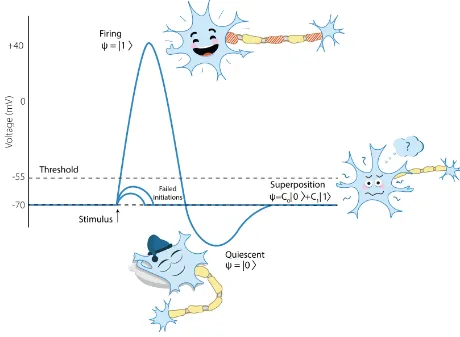
Here we make a short remark about terminology. The standard neural code is based on non-firing/firing states. We make the non-firing state more . The quiescent state is still encoded by 0 and understood as the state of inactivity, i.e., the refractory state. However, besides of firing and quiescent states, a neuron can be in a state of uncertainty characterized by the range of values of the membrane potential,V ∈[−70,−55].In this state a neuron can generate an action potential with some probability. Uncertainty in generation of action potentials is a consequence of stochastic operation of ion channels. We also point to random failure of generation, conduction, and acceptance of action potentials (by other neurons)22,33.
Another distinguishing feature of our model is that a neuronal group, sayG,performing some psychological functionF
is an open quantum information system. It interacts withthe surrounding electrochemical environmentE,which also can modeled with the operational quantum information approach. Interaction of a neuronal groupGperforming theF-task withE is modeled at the information level by using the quantum master equation.
The process of decision making is described as decoherence of the quantum(-like) information state ofGin the basis of eigenstates ofF.A decision state ¯ρis asteady stateof the dynamicsρ(t)of theG-state; ¯ρ is diagonal in theF-basis. The existence of steady states is a consequence of interaction withE.In short, by our model a group of neuronsGis ‘working’ on a functionF,but then convergence forGis driven by the broader electrochemical environment treated as an information reservoir. The steady state ¯ρ represents the weights of possible outputs ofF.In our model a concreteF-output is selected by a
classical random generatorwith probabilities encoded in the decision state. This is the simplest way to reproduce statistics given by the Born rule. However, there is a plenty of other possibilities to model completion of the process of decision making. We recall that a decision state can be treated as a classical state (forF)and a variety of rules of the CP-decision theory can be explored.
In our model even a single neuron can be in a state of superposition representing uncertainty generated by the membrane potentialV.The main source of this uncertainty is interactions with surrounding neural network (cf.19), which may be of huge
complexity. Roughly speaking, an isolated neuron is a classical system, cf.28,40 (but, of course, an isolated bio-system is dead,
cf. Schr¨odinger44). Thus the basis of the quantum-like representation for a single neuron is its openness as an electrochemical system.
The crucial feature of the quantum-like representation of information is its linearity. The complex nonlinear dynamics of electrical and chemical flows is lifted to the linear dynamics described, e.g., byGorini-Kossakowski-Sudarshan-Lindblad
equation32. Here convergence to a steady state is exponentially rapid: state fluctuations are damped by the factors of the form
e−λt,whereλ=a+ib,a>0.This makes it possible to approach the decision state very quickly. In some sense, the brain transforms the disadvantage of complex fluctuations in information processing (in the form of electrochemical uncertainty) into advantage given by the linear representation. We emphasize that the latter is probabilistic.
We point to another important implication of the use of the quantum-like representation. By coupling some psychological functions to different orthonormal bases the brain is able to realize these functions in the state space of the same group of neurons. Generally, two functions are incompatible (complementary): it is impossible to approach the decision state that is diagonal with respect to both bases. The statistical patterns of such incompatibility in neuronal performance can be found at the behavioral level4–6,10,17,18,29,35,43,50
Quantum-like superposition from generation of action potentials
[image:4.612.76.536.341.678.2]We propose to describe uncertainty in generation of an action potential by a neuron, sayN ,by using states’ superposition. Consider two dimensional complex Hilbert spaceH (qubit space). At a concrete instant of time neuron’s state can be
mathematically described by a superposition of two states,quiescent and firing,labeled by|0i,|1i:
ψ=c0|0i+c1|1i,|c0|2+|c1|2=1. (1) It is assumed that these states are orthogonal and normalized, i.e.,h0|1i=0 andhα|αi=1,α=0,1.Here the coordinatesc0 andc1with respect to the quiescent-firing basis are complex amplitudes representing potentialities for a neuron to be quiescent or firing. Probabilistically these potentialities are expressed bythe Born rule of quantum theory:
pα=|cα|2=|hψ|αi|2. (2)
These probabilities can be interpreted statistically. Letψ be a steady state (with respect to the dynamics performing a
psychological function). Consider a single neuronN and a sufficiently long time intervalT=M∆,M>>1,and find the frequencyν1=n1/M,wheren1is the number of∆-intervals such thatN produces a spike. Thenp1≈ν1.We repeat that steady states play the exceptional role in our model as decision states.
This is a good place to mention that the frequentist interpretation of QM was used by von Neumann in book49where he referred to von Mises’ frequency approach to probability, probability as the limit of frequencies in a long series of trials, in a collective48. The frequencist interpretation of QM was actively used by one of coauthors34, in particular, for demystification of quantum probability. Recently this interpretation was explored in article2in connection with the known law of combining density matrices for subensembles.
This is the ‘observational definition’ of probability. An observer can count spikes. But who is the observer? In our model the brain (more concretely, each psychological function) is a system that is able to performself-observations, detection of information states of neurons and neuronal groups (but not electrochemical states).
General quantum-like representation of neurons’ states
Neuron’s state space is a complex Hilbert spaceH of dimensionm.In this space we consider the fixed orthonormal basis
|αi,α=0, ...,m−1,consisting of states which can be identified by self-observations of some psychological functionF.Thus each state of a neuron can be represented by superposition
ψ=
∑
α
cα|αi,
∑
α|cα|2=1, (3)
where complex probability amplitudescαrepresent potentiality of observation of this neuron in the state|αi.
Now consider a groupGof neurons. The state space of this group is the tensor productHGof single neuron’s state spaces. Since neurons inGinteract with each other and with the surrounding electrochemical environment, generally theG-state is
entangled.(The meaning of entanglement here is simply a statement that we cannot decompose the state for two neurons into a product state from each neuron individually.)
Consider two neurons and firing/quiescent coding. Generally the state of the compound systemGhas the form
ψ=c00|00i+c01|01i+c10|10i+c11|11i, (4) where the complex probability amplitudesc00, ...,c11represent the potentiality of the compound systemGto occupy one of the states|00i, ...,|11i.This potentiality is interpreted probabilistically, e.g.,p11=|c11|2is the probability of both neurons firing. Superposition (4) represents correlated behavior of two neurons inG.Consider, for example, the state of the form:
ψ=√1
2(|00i+|11i) (5)
(this is one of the Bell states, see (6). A couple of neurons in these state fire and relax simultaneously (up to the time window ∆).
Example of incompatible representations: distinguishable versus indistinguishable neurons
In the same Hilbert state space, there can be selected a variety of orthonormal bases which can be used by various psychological functions. Hence, the same neuronal group can perform a variety of generally incompatible psychological functions. We illustrate this possibility by a simple example.
Consider two neurons,G={N1,N2}in the state (5). In this state the neurons inGare indistinguishable. We stress that this isinformation indistinguashability.Physically,N1andN2are distingushable: they are located in different places, they have different geometry of connections and so on. Thereby such quantum states match perfectlythe ensemble neural coding with indistinguishable neurons.To model quantum-like information processing by indistinguishable neurons, we represent the
state spaceHGas the direct sum of the symmetric and anti-symmetric tensor product spaces:HG=Hs
G⊕HGas.Permutation in any pair of neurons does not change vectors belonging toHs
G,but it changes the sign for vectors beloning toHGas.We illustrate this decomposition in the four-dimensional caseHG=H ⊗H.Consider the orthonormal basis known in quantum information theory as the Bell basis:
ψ1= 1
√
2(|00i+|11i),ψ2= 1
√
2(|00i − |11i), ψ3= 1
√
2(|01i+|10i), (6)
ψ4= 1
√
2(|01i − |10i). (7)
It is clear that the statesψ1,ψ2,ψ3are invariant with respect to permutations of the neurons. This is the basis inHGs.Thus any state of the ensemble of two (informationally) indistinguishable neurons can be represented as superposition of these states. We remark thatψ4is the only anti-symmetric state, so hereHGasis one-dimensional.
It is convenient to work inthe Fock representation. For 0/1 coding (quiescent/firing), this is a representation based on
counting the number of firing neurons. The basis of the Fock space consists of the states
n
E
,n=0,1,2.(big brackets are used
to distinguish Fock states from neurons’ states|α βi,α,β=0,1).Here
0
E
=|00i=√1
2(ψ1+ψ2),
1
E
=ψ3,
2
E
=|11i=√1
2(ψ1−ψ2). (8)
So, working in the Fock representation we are concerned only with the number of firing neurons. Each stateψ∈HGscan be
represented in the form of superposition:
ψ=d0
0
E
+d1
1
E
+d2
2
E
, (9)
where∑n|dn|2=1.Thus if the configuration of two indistinguishable neurons is prepared in the stateψsufficiently many times, then relative frequency of findingn=0,1,2,firing neurons approximately equals toPn=|dn|2,(This is again the (self-)observation interpretation of probability.)
Quantum-like representation of psychological functions
Consider the space of quantum-like states of the group of neuronesGinvolved in realization of some psychological functionF. We proceed with modelling both possibilities: distinguishable and indistinguishable neurons.
Mathematically a psychologicalFis coupled to some fixed orthonormal basis{|αi}in the space of quantum-like states.
This basis may be considered as a quantum information representation of the concrete neural code. Suppose thatFhas values
f1, ...,fs(e.g., just two values±1).It is assumed that each valuefjis coupled to the corresponding set of basis vectors (neuronal states)Af,f =f1, ...,fs.ThusFis mathematically represented by decomposition of the basis in disjoint blocksAf.FormallyF can be written as the Hermitian operator of the form:
F=
∑
f
f
∑
α∈Af
|αihα|. (10)
We remark that the expression
πf =
∑
α∈Af
|αihα| (11)
has the mathematical meaning of orthogonal projector on the subspaceLf generated by basis vectors from the blockAf. Therefore formally the psychological function can be written in the form:F=∑f fjπf.However, in our model the process of information processing by neurons is based on the concrete states of the neuronal groupGperformingF.Thus the concrete decomposition ofπf,see (11), plays an important role in modeling of the functioning ofF.We remark that in quantum theory selection of the concrete basis can be interpreted as selection of the context of measurement. Thus a psychological function is represented not simply by a Hermitian operator, but by an orthonormal basis (or more precisely, by its decomposition into disjoint blocks corresponding to the values ofF).
In the simplest caseF is represented by the Hermitian operator with non-degenerate spectrum, i.e., there is one-to-one correspondence between theF-values and basis vectors, f → |αfi.In this case,F=∑f f|αfihαf|.However, generally the
Discussion
We presented a quantum-like model of processing of information by a group of neurons interacting with the surrounding electrochemical environment. The crucial element of the model is encoding uncertainty in generation of action potentials by su-perpositions of discrete states representing clusters of electrochemical states (classical or genuine quantum). Such superposition representation of uncertainty can be lifted to generation of QP-features of outputs of a psychological functionFthat are reflected in statistical data collected in cognitive psychology, game theory, social and political sciences, e.g.,4,6,9,17,18,29,35,42,43,50. A psychological function is coupled to the fixed basis in the neuronal state space and in principle the latter can be coupled to some classical neural code. From this viewpoint, the complex problem of the neural code is resolved by recognizing that the brain can work with a variety of ‘quantum-like neural codes’ corresponding to orthonormal bases in the state spaces of groups of neurons working on psychological functions.
The basic feature of the presented model is that even the state of a single neuron can be described as a quantum-like state. In the real situation of neuronal network, such network interact with a neuron by neurotransmitters, which modify the membrane potential of the neuron’s cell body. In other words, the neuron’s potential is influenced by the inputs from other neurons. The modified potential changes the probability of firing of this neuron. This effect can be called ‘uncertainty’. Then we can treat one neuron as a quantum-like machine. The further analysis of information processing of a neuron or neuronal network becomes simple (and, in particular, linear).
In future we plan to generalize the present quantum-like model of brain’s functioning by taking into account the structure of the electrochemical environment, especially the role of neurotransmitters in creation of the superposition representation of information states processed by neurons. At the same time our model can be treated more abstractly, namely, as a quantum-like model of artificial intelligence, cf. Briegel15.
Methods
Density operators as signatures of environments
The theory of open quantum systems requires us to consider not only pure states ofG,but also states given by density operators. (A density operatorρis a Hermitian positively semidefinite operator with unit trace.) Each pure state (given by a normalized vectorψof the state space, i.e.,hψ|ψi=1)can be represented by the density operator, the orthogonal projector onψ.Typically
theρ-state is interpreted as a mixed state, i.e., a state representing a statistical mixture of pure states. This interpretation is
quite ambiguous, because the same density operator can be represented as a mixture of different ensembles of states. We use the interpretation related to theNaimark’s dilation theoremby which each density operatorρ(describing the state of some
systemS)can be obtained as a partial trace of a pure state of a larger system, composed ofSand its environment. The trace is taken with respect to the degrees of freedom of the environment. Then, following D’Ariano20we interpret a pure state as an informationally complete state. Generally, a state given by a density operator is informationally incomplete, since it contains the impact of some environment and a variety of environments may generate the sameρ-state.
Information dynamics of open neuronal systems
In quantum information theory the dynamics of the state of an open system is typically described by the Gorini-Kossakowski-Sudarshan-Lindblad(GKSL) equation32. It can be written in the form
dρ
dt(t) =−[H,ρ(t)] +γLρ(t),ρ(0) =ρ0, (12)
whereH is a Hermitian operator (Hamiltonian) acting in the state space of a system (in our case a group of neuronsG
‘working’ for a psychological functionF)andLis a linear operator acting in the space of linear operators (such maps are often calledsuper-operators). In quantum physics, typically the operatorHrepresents the state dynamics in the absence of outer environment. (It is assumed thatHis positively defined.) Generally, HamiltonianH can also contain effects of the environment. The superoperatorLhas to map density operators into density operators, i.e., it has to preserve ‘Hermitianity’, positive definiteness, and the trace. For the present paper, its concrete form is not important, see, e.g.,32. The real parameter
γ>0 is the coupling constant; it represents strength of (information) interaction with environmentE.Generally bothHandL
depend on the initial state of the environment and its interaction with neurons (described in the information framework). In quantum physics the dynamics of an isolated system is described by the Schr¨odinger equation. For a biological system, it seems to be meaningless to use the notion of an isolated system, even in the approximate setting. (An isolated bio-system is dead, cf. Schr¨odinger44.) Therefore the operatorHin equation (12) has to be treated on the equal grounds with the superoperator
L,i.e., as representing (information) interaction with the environment.
The GKSL-equation is a linear ordinary differential equation with constant coefficients. For such an equation, one can quite easily understand whether its solutions ‘stabilize’ to a steady state (by writing it in the vector form and finding the corresponding
eigenvalues). Stabilization ofρ(t)is understood as damping of fluctuations around the final (stable) state. In the mathematical model this is the limiting process ¯ρ=limt→∞ρ(t).However, in reality fluctuations may become negligibly small quite fast.
Suppose that functionFoperates with fluctuations’ thresholdε>0.Then the exponentially decreasing factors in a solution
very quickly approachε.
Probabilistic functioning of psychological functions
Consider some psychological functionF and its representation (10) with the basis{|αi}.Let ¯ρ be a steady state for the neuronal information dynamics (modeled mathematically with, e.g., equation (12)) and let it bediagonalin theα-basis. Thus ¯ρ
can be considered a classical state (for the psychological functionF),cf.51. Now we can present the frequentist interpretation of the probabilities encoded in diagonal representation of ¯ρ (its Schatten decomposition),
¯
ρ=
∑
α
pα|αihα|, (13)
wherepα≥0,and∑αpα=1.
The stateρ¯ represents statistics of realization of the basis states{|αi}in the time series of self-observations on the neuronal group G involved in realization of the psychological function F.
Thereby, we reserve the statistical mixture interpretation only for the Schatten decomposition, see7for the motivation based on entropic considerations.
The psychological functionFis modeled as an observer for the neuronal groupG.Since, for this psychological function, the steady state ¯ρis classical, observations performed byFcan be modeled as classical monitoring of the state ofG.
Consider again some time window∆.This is the ‘interval of state determination’: by monitoringGduring the time window ∆the psychological functionFreports (to itself) that theG-state is|αi.Consider now some period of timeT=M∆,M>>1. TheFmonitors theG-states during this period. Suppose that theα-state was observednα times. Define the relative frequency:
να=∑nα βnβ
.Then by the frequentist interpretationpα≈να.We remark that this probabilistic representation is used in statistical
signal processing in neuroscience.
ThusFapproaches the steady state with the Schatten decomposition corresponding to the basisF-eigenstates. ThenF
determines the frequency probability distributionp={pα}encoded in this steady state. This probability distribution is easily
transformed into the probability distribution of the possible outcomes ofF:pF(f) =∑α∈Af pα,see decomposition (10) ofF.
Formally
pF(f) =Tr ¯ρ πf, (14)
whereπfis the projector corresponding to the value f.But the latter is only a formal mathematical representation. TheF-neural code is represented by the basis{|αi}andFmonitors appearance of these basis states.
Finally,F should select one concrete outcome f.Since the probability distributionpF is classical, we are now in the framework of classical theory of decision making. In principle any decision rule of this theory can be used. The quantum statistics, given by Born rule (14), is preserved if finalization ofF-functioning is based on the use classical random generator with the probability distributionpF.Such random generator can be easily realized through some electrochemical process in the brain.
One can relate this final step with thefree will.Even if, for some value f,probabilitypF(f)<<1,there is still a chance thatFmay select this alternative. (On the other hand, ifFwere working, e.g., with odds, it would never select this output.)
References
1. Allahverdyan, A., Khrennikov, A., Nieuwenhuizen, Th. M. Brownian entanglement,Phys. Rev. A,71, 032102-1 –032102-14 (2005).
2. Allahverdyan, A., Ballian, R., and Nieuwenhuizen, Th. M. A sub-ensemble theory of ideal quantum measurement processes,Annals of Phys.,376, 324-352 (2017).
3. Allais, M. Le comportement de l’homme rationnel devant le risque: critique des postulats et axiomes de l’ cole amricaine.
Econometrica21, 503-536 (1953).
4. Asano, M., Basieva, I., Khrennikov, A., Ohya, M., Tanaka, Y. A quantum-like model of selection behavior.J. Math. Psychology78, 2-12 (2017).
6. Asano, M., Basieva, I., Khrennikov, A., Yamato, I. A model of differentiation in quantum bioinformatics.Progress in Biophysics and Molecular Biology130, Part A, 88-98 (2017).
7. Asano, M., Basieva, I., Pothos, E. M., Khrennikov, A. State entropy and differentiation phenomenon.Entropy20(6), 394 (2018).
https://doi.org/10.3390/e20060394
8. Atmanspacher, H. Determinism is ontic, determinability is epistemic, in H. Atmanspacher and R. C. Bishop (eds.),
Between Chance and Choice: Interdisciplinary Perspectives on Determinism(Imprint Academic, Thorverton UK), 2002, pp. 49–74.
9. Bagarello, F.Quantum dynamics for classical systems: with applications of the number operator, (J. Wiley, New York, 2012).
10. Bagarello, F., Basieva, I., Pothos, E., Khrennikov, A. Quantum like modeling of decision making: Quantifying uncertainty with the aid of Heisenberg-Robertson inequality.J. Math. Psychology84, 49-56 (2018).
11. Bell, J.Speakable and unspeakable in quantum mechanics, (Cambridge Univ. Press, Cambridge, 1987).
12. beim Graben, P. & Atmanspacher, H. Complementarity in classical dynamical systems.Found. Phys.36, 291-306 (2006).
13. Bohr, N.The philosophical writings of Niels Bohr, 3 vols. (Ox Bow Press, Woodbridge, CT, 1987).
14. Brown, E. N., Kass, R. E., Mitra, P. P. Multiple neural spike train data analysis: state-of-the-art and future challenges.Nat. Neuroscience7(5), 456-461 (2004).
15. Briegel, H. J. On creative machines and the physical origins of freedom.Scientific Reports2, Art. n. 522 (2012).
16. Brukner, C. and Zeilinger, A. Operationally invariant information in quantum mechanics.Phys. Rev. Lett.83, 3354–3357 (1999).
17. Busemeyer, J. R., Bruza, P. D.Quantum models of cognition and decision, (Cambridge Univ. Press, Cambridge, 2012).
18. Busemeyer, J. R., Pothos, E. M., Franco, R., and Trueblood, J. A quantum theoretical explanation for probability judgment errors.Psych. Rev.118, 193-218 (2011).
19. Busemeyer, J. R. Fakhari, P., Kvam, P. Neural implementation of operations used in quantum cognition.Progress in Biophysics and Molecular Biology130A, 53-60 (2017).
20. D’Ariano, G. M. Operational axioms for quantum mechanics,Foundations of Probability and Physics-3(AIP Conf. Proc.) 889, pp. 79-105 (2007).
21. Davies, E. B.Quantum theory of open systems, (Academic Press, London, 1976).
22. Dyball, R. E. J., Grossman, R., Leng, G., Shibuki, K. Spike propagation and conduction failure in the rat neural lobe.J. Physiology401, 241-256 (1988).
23. Dzhafarov E. N., Kujala J. V. On selective influences, marginal selectivity, and Bell/CHSH inequalities.Topics Cogn. Sc. 6, 121-128 (2014).
24. Ellsberg, D. Risk, ambiguity and the Savage axioms.Q. J. Econ.75, 643-669 1961.
25. Fuchs, C. A., Schack, R., A quantum-Bayesian route to quantum-state space.Found. Phys.41, 345-356 (2011).
26. Genovese, M. Research on hidden variable theories: a review of recent progresses.Phys. Rep.413, 319 (2005).
27. Griffiths, T. L., Chater, N., Kemp, C., Perfors, A., & Tenenbaum, J. B. Probabilistic models of cognition: exploring representations and inductive biases.Trends in Cogn. Sc.14, 357-364 (2010).
28. Hameroff, S. Quantum coherence in microtubules. A neural basis for emergent consciousness?J. Cons. Stud.1, 91-118 (1994).
29. Haven, E. Khrennikov, A.Quantum social science, (Cambridge University Press, Cambridge, 2013).
30. Hodgkin, A. L., Huxley A. F. A quantitative description of membrane current and its application to conduction and excitation in nerve.J. Physiology117(4), 500-544 (1952).
31. Igamberdiev, A. U., Shklovskiy-Kordi, N. E. The quantum basis of spatiotemporality in perception and consciousness.
Progress in Biophysics and Molecular Biology,130A, 15-25 (2017).
32. Ingarden, R. S., Kossakowski, A. Ohya, M.Information dynamics and open systems: Classical and quantum approach.
Fundamental Theories of Physics (Book 86), (Springer, Berlin-Heidelberg, 1997).
33. Khaliq Z. M. & Raman, I. M. Axonal propagation of simple and complex spikes in cerebellar Purkinje neurons.J. Neurosc. 25(2), 454-463 (2005).
34. Khrennikov, A. Linear representations of probabilistic transformations induced by context transitions,J. Phys.A: Math. Gen.,34, 9965-9981 (2001).
35. Khrennikov, A.Ubiquitous quantum structure: from psychology to finances, (Springer, Berlin-Heidelberg-New York, 2010).
36. Khrennikov, A. Quantum-like model of processing of information in the brain based on classical electromagnetic field.
Biosystems105(3), 250-262 (2011).
37. Khrennikov, A. Yurova, E. Automaton model of protein: Dynamics of conformational and functional states.Progress in Biophysics and Molecular Biology130A, 2-14 (2017).
38. Ozawa, M. Quantum perfect correlations.An. Phys.321, 744-769 (2006).
39. Ozawa, M. Probabilistic interpretation of quantum theory.New Generation Computing34, 125-152 (2016).
40. Penrose, R.:The Emperor’s new mind, (Oxford Univ. Press, New-York, 1989)
41. Plotnitsky, A. Quantum atomicity and quantum information: Bohr, Heisenberg, and quantum mechanics as an information theory, inQuantum theory: reconsideration of foundations, 2002, pp. 309-343.
42. Plotnitsky, A. Are quantum-mechanical-like models possible, or necessary, outside quantum physics?Phys. ScriptaT163, 014011 (2014).
43. Pothos, E. M., Busemeyer, J. R. A quantum probability explanation for violation of rational decision theory.Proc. Royal. Soc. B,276, 2171-2178 (2009).
44. Schr¨odinger, E.What Is life? The physical aspect of the living cell, (Cambridge Univ. Press, Cambridge, 1944).
45. Svozil, K.Quantum logic(Discrete Mathematics and Theoretical Computer Science), (Springer, Heidelberg-Berlin, 1998)
46. Tversky, A., Kahneman, D. Judgment under uncertainty: Heuristics and biases.Science185(4157), 1124-1131 (1974).
47. Tversky, A., Kahneman, D. Extensional versus intuitive reasoning: The conjunction fallacy in probability judgment.
Psych. Rev.90(4), 293-315 (1983).
48. von Mises, R.The mathematical theory of probability and statistics(Academic, London, 1964).
49. von Neumann, J. (1955).Mathematical Foundations of Quantum Mechanics(Princeton Univ. Press, Princenton).
50. Wang, Z., Solloway, T., Shiffrin, R. M., and Busemeyer, J. R. Context effects produced by question orders reveal quantum nature of human judgments.PNAS111, 9431-9436 (2014).
51. Zurek, W. H. Decoherence, einselection, and the quantum origins of the classical.Rev. Mod. Phys.75, 715 (2003).
Acknowledgements
I.B. was supported by Marie Curie Fellowship at City University of London, H2020-MSA-IF-2015, grant N 696331, and A.K. was partially supported by the EU-project Quantum Information Access and Retrieval Theory (QUARTZ), Grant No. 721321.
Author contributions statement
All authors carried out the research and contributed to design and development of the model. All authors reviewed the manuscript.A.K.and I.B. wrote the manuscript; E.M.P. also contributed as an expert in cognitive psychology and decision making; I. Ya. contributed as an expert in molecular biology. The idea to encode uncertainty in generation of action potential by using the quantum information representation was proposed by A.K, who also prepared paper’s revision based pn reviewers’ comments.