City, University of London Institutional Repository
Citation
:
Al Ashaikh, R. (2017). Studying and Supporting Activity Awareness in Collaborative Learning Groups: Using a Persuasive Social Actor. (Unpublished Doctoral thesis, City, University of London)This is the accepted version of the paper.
This version of the publication may differ from the final published
version.
Permanent repository link:
http://openaccess.city.ac.uk/19018/Link to published version
:
Copyright and reuse:
City Research Online aims to make research
outputs of City, University of London available to a wider audience.
Copyright and Moral Rights remain with the author(s) and/or copyright
holders. URLs from City Research Online may be freely distributed and
linked to.
Studying and Supporting Activity Awareness in Collaborative
Learning Groups: Using a Persuasive Social Actor
Reem Al Ashaikh
Thesis submitted for the degree of Doctor of Philosophy in Human-Computer Interaction
Centre for Human-Computer Interaction Design
Department of Computer Science
City, University of London
Table of Contents
Table of Contents ... 1
List of Tables ... 7
List of Figures ... 12
Dedication ... 16
Acknowledgements ... 17
Declaration... 18
Abstract ... 19
Abbreviations ... 20
Chapter 1: Introduction ... 21
1.1 Background and Motivation ... 21
1.1.1 Collaborative Learning ... 22
1.1.2 Activity Awareness ... 24
1.1.3 Persuasive Technologies ... 26
1.2 Problem Definition ... 27
1.3 Research Aim, Questions, and Objectives ... 29
1.4 Approaches and Methods Used in This Doctoral Research ... 31
1.5 Contributions ... 34
1.6 Published Papers... 35
1.7 Thesis Structure ... 35
Chapter 2: Literature Review ... 38
2.1 Learning ... 39
2.1.1 What is Learning? ... 39
2.1.2 Collaborative Learning ... 40
2.2 Awareness ... 48
2.2.1 Awareness Definition and Characteristics ... 48
2.2.2 Awareness Types ... 48
2.3 Technologies ... 53
2.3.1 Computer-Supported Collaborative Learning ... 53
2.3.2 Technologies for Collaborative Learning ... 55
2.3.3 Technologies for Awareness ... 61
2.3.4 Persuasive Technologies ... 63
2.4 Summary ... 71
Chapter 3: Exploring Collaborative Learning Groups – Pilot Study ... 72
3.1 Motivation ... 73
3.2 Research Aim and Research Questions ... 74
3.3 Method ... 74
3.3.1 Participants ... 75
3.3.2 Data Collection ... 75
3.3.3 Data Analysis ... 75
3.3.4 The Coding Scheme ... 76
3.4 Results ... 77
3.4.1 Meeting ... 78
3.4.2 Applications and Tools ... 78
3.4.3 Collaboration ... 79
3.4.4 Preferences ... 84
3.5 Discussion ... 85
3.5.1 Awareness ... 89
3.5 Limitations ... 91
3.6 Summary ... 91
4.1 Motivation ... 93
4.2 Research Aim and Research Questions ... 93
4.3 Method ... 94
4.3.1 Participants ... 94
4.3.2 Data Collection ... 95
4.3.3 Data Analysis ... 98
4.4 Results ... 103
4.4.1 Description of Groups ... 103
4.4.2 Questionnaire Results ... 104
4.4.3 Interview Results ... 108
4.4.4 Observation Results ... 112
4.4.5 Activity Awareness Analysis ... 129
4.5 Discussion ... 137
4.6 Limitations ... 142
4.7 Summary ... 142
Chapter 5: Evaluating Activity Awareness in Learning Groups ... 143
5.1 Motivation ... 143
5.2 Research Aim and Research Questions ... 143
5.3 Method ... 144
5.3.1 Participants ... 144
5.3.2 Data Collection ... 144
5.3.3 Data Analysis ... 146
5.4 Results ... 147
5.4.1 Description of Groups ... 147
5.4.2 Questionnaire Results ... 147
5.4.3 Activity Awareness Analysis ... 152
5.5 Discussion ... 162
5.7 Summary ... 169
Chapter 6: The Design of the Social Actor ... 170
6.1 Persuasion Theories ... 170
6.2 Designing for a Persuasive Technology ... 174
6.2.1 Type of Behaviour or Attitude Change ... 174
6.2.2 Guidelines for Designing a Persuasive Technology ... 177
6.2.3 What is a Social Actor? ... 180
6.3 The Process of Designing the Social Actor ... 181
6.3.1 Choosing the Target Behaviours and Attitudes ... 182
6.3.2 Using the PSD Model ... 184
6.3.3 Applied Social Cues for Mr. Mentor App ... 186
6.3.4 Paper Prototype ... 186
6.3.5 Implementation... 187
6.3.6 How Does the Mr. Mentor App Work? ... 195
6.3.7 Key Design Decisions ... 199
6.3.8 Testing ... 200
6.4 Summary ... 201
Chapter 7: A Persuasive Social Actor for Activity Awareness in Learning Groups ... 202
7.1 Motivation ... 202
7.2 Research Aim and Research Questions ... 202
7.3 Method and Study Design ... 203
7.3.1 Participants ... 204
7.3.2 Data Collection ... 205
7.3.3 Data Analysis ... 206
7.3.4 Expert Reviews ... 207
7.4 Results ... 209
7.4.1 Measuring Changes in Attitudes and Behaviours ... 209
7.4.3 Reliability Check ... 220
7.4.4 Users’ Opinions towards the App ... 220
7.4.5 Open-ended Questions Results ... 221
7.4.6 User Evaluation of the PSD Techniques ... 223
7.4.7 Expert Review Results ... 225
7.4.8 Explaining the Change ... 228
7.5 Discussion ... 232
7.6 Limitations ... 240
7.7 Summary ... 240
Chapter 8: Discussion and Conclusion ... 241
8.1 Overview ... 241
8.2 Summary of the Studies ... 241
8.2.1 Study 1: Exploring Collaborative Learning Groups – Pilot study ... 242
8.2.2 Study 2: Understanding Activity Awareness and Collaborative Behaviours in Learning Groups ... 243
8.2.3 Study 3: Evaluating Activity Awareness in Learning Groups ... 245
8.2.4 Study 4: A Persuasive Social Actor for Activity Awareness in Learning Groups ... 246
8.3 Answers to Research Questions ... 247
8.3.1 RQ1: How do students collaborate in long-term collaborative learning groups? ... 247
8.3.2 RQ2: How can activity awareness be measured in long-term collaborative learning groups? ... 250
8.3.3 RQ3: What activity awareness do group members have in long-term collaborative learning groups? ... 252
8.3.4 RQ4: How can a persuasive social actor for activity awareness in long-term collaborative learning groups be designed and evaluated? ... 254
8.3.5 RQ5: Can a persuasive technology support students’ activity awareness in long-term collaborative learning projects? ... 257
8.4 Contributions ... 259
8.4.2 A new method to evaluate activity awareness ... 261
8.4.3 Insights into designing and evaluating social actors using the PSD model... 263
8.4.4 Analysis of long-term collaborative learning in naturalistic settings ... 264
8.5 Limitations ... 265
8.5.1 Number and Type of Participants ... 265
8.5.2 Limited Data and Resources... 266
8.5.3 Study Design Decisions ... 268
8.5.4 Limitations in the Social Actor App... 268
8.5.5 Generalisability ... 269
8.6 Future Work ... 270
8.6.1 Bigger Sample for Further Studies ... 270
8.6.2 Collect Additional Data ... 270
8.6.3 Different Study Design Decisions ... 271
8.6.4 Improvements to the Social Actor App ... 272
8.6.5 Future Ideas ... 272
8.7 Conclusion ... 273
References ... 275
Appendix A: First Study ... 288
Appendix B: Second Study ... 299
Appendix C: Third Study ... 330
Appendix D: Social Actor Design ... 356
Appendix E: Last Study ... 374
List of Tables
Table 1.1: Research questions and objectives in each chapter ... 30
Table 1.2: Research questions, objectives and contributions in each chapter ... 35
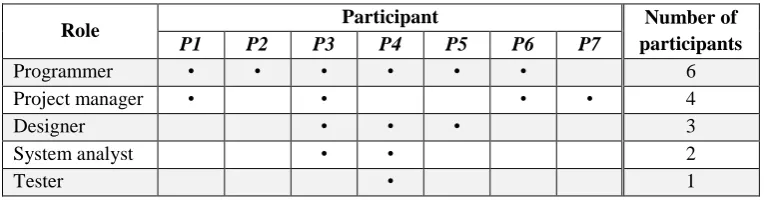
Table 3.1: Participants’ roles in their groups ... 78
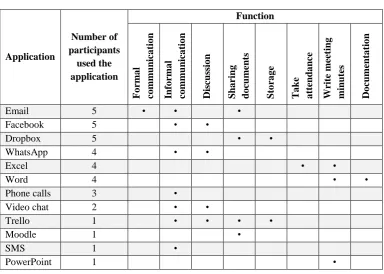
Table 3.2: Applications used by participants and their functions ... 79
Table 3.3: Discussion types identified in the groups ... 80
Table 3.4: Collaboration activities identified in the groups ... 80
Table 3.5: How tasks were assigned to group members ... 81
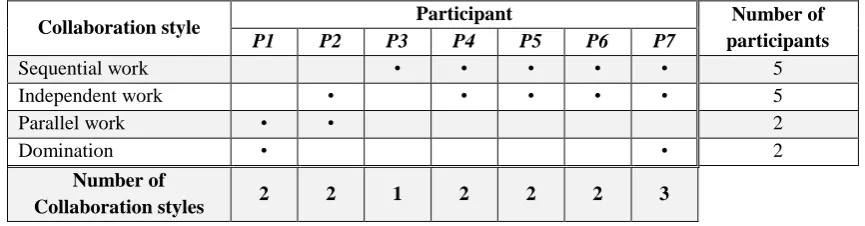
Table 3.6: Collaboration styles identified in groups ... 81
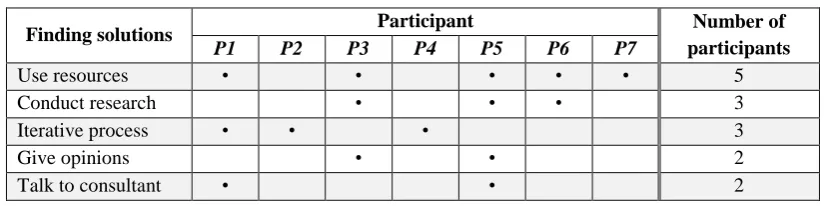
Table 3.7: Most common ways to find solutions for tasks ... 82
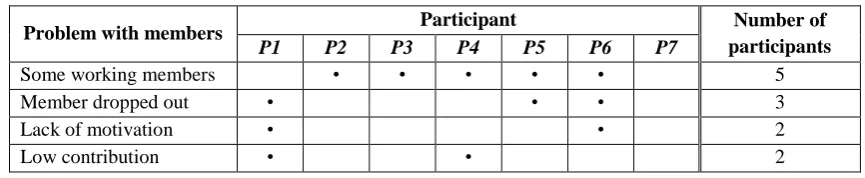
Table 3.8: Most common problems with members ... 83
Table 3.9: Most common communication problems ... 83
Table 3.10: Participants’ satisfaction with working in their groups ... 83
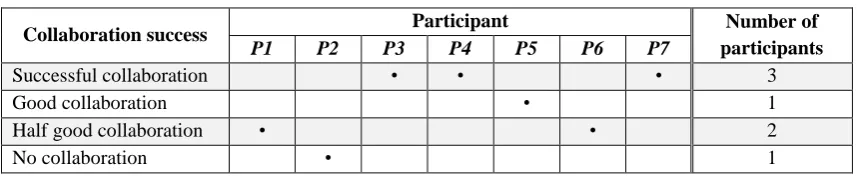
Table 3.11: Collaboration success in the groups ... 84
Table 3.12: Preferences ... 85
Table 3.13: Relation between task assigning by skills and grades ... 86
Table 3.14: Relation among awareness, collaboration, and grades ... 86
Table 3.15: Relation among collaboration activities, collaboration success, and grades ... 87
Table 3.16: Parallel work compared to other styles for P1 and P2 ... 87
Table 3.17: Sequential work compared to other styles for P3, P4, P5, P6, & P7 ... 88
Table 3.18: Independent work compared to other styles for P2, P4, P5, P6, & P7 ... 88
Table 3.19: Domination compared to other styles for P1& P7 ... 88
Table 4.1: The timeline plan for data collection ... 95
Table 4.3: Number of participants in each age group ... 104
Table 4.4: Number of males and females in each group ... 104
Table 4.5: Distribution of participants as full-time or part-time students... 105
Table 4.6: Distribution of participants across MSc programmes ... 105
Table 4.7: Averages and standard deviations for questions 1 to 13 for group A (7-point Likert-scale) ... 106
Table 4.8: The average of self-assessment questionnaire for participants and their groups .. 107
Table 4.9: Answers for preferences’ questions 14 to 17 for group A (7-point Likert-scale) 108 Table 4.10: Application used and their purposes for each group ... 109
Table 4.11: Reported collaboration styles in the first and second interviews for all groups . 111 Table 4.12: Groups’ grades for the group report part ... 112
Table 4.13: Activity awareness comparison grid of the first interview for group A (Grey: What participant did, Green: Fully aware, Blue: Partially aware, Red: Unaware) ... 131
Table 4.14: Activity awareness comparison grid of the second interview for group A (Grey: What participant did, Green: Fully aware, Blue: Partially aware, Red: Unaware) ... 132
Table 4.15: Activity awareness level in the first and second interviews for group A ... 133
Table 4.16: Activity awareness level in the first and second interviews for group B ... 133
Table 4.17: Activity awareness level in the first interview for group C ... 133
Table 4.18: Activity awareness level in the first and second interviews for group D ... 133
Table 4.19: Activity awareness level in the first and second interviews for group E ... 133
Table 4.20: Changes in activity awareness of each participant ... 136
Table 4.21: Data collection methods used to answer each research questions ... 137
Table 4.22: Groups’ grades and their self-assessment averages ... 140
Table 5.1: The timeline plan for data collection ... 145
Table 5.2: Number of participants in each age group ... 148
Table 5.3: Number of males and females in each group ... 148
Table 5.5: Distribution of participants across MSc programmes ... 149
Table 5.6: Applications used by each group ... 149
Table 5.7: Average and standard deviation for each question for group A (7-point Likert-scale) ... 150
Table 5.8: Overall averages for each question for all groups ... 151
Table 5.9: The timeline for interview collection for group A... 152
Table 5.10: The timeline for interview collection for group B ... 153
Table 5.11: The timeline for interview collection for group C ... 153
Table 5.12: The timeline for interview collection for group D... 153
Table 5.13: Activity awareness comparison grid of the first interview for group A (Grey: What participant did, Green: Fully aware, Blue: Partially aware, Red: Unaware, Yellow: No enough information) ... 156
Table 5.14: Activity awareness comparison grid of the second interview for group A (Grey: What participant did, Green: Fully aware, Blue: Partially aware, Red: Unaware, Yellow: No enough information) ... 157
Table 5.15: Activity awareness comparison grid of the third interview for group A (Grey: What participant did, Green: Fully aware, Blue: Partially aware, Red: Unaware, Yellow: No enough information) ... 158
Table 5.16: Activity awareness level in each interview for group A... 158
Table 5.17: Activity awareness level in each interview for group B ... 159
Table 5.18: Activity awareness level in each interview for group C ... 159
Table 5.19: Activity awareness level in each interview for group D... 159
Table 5.20: Groups’ grades for the group report part ... 161
Table 5.21: Changes in activity awareness of each participant ... 168
Table 6.1: The Behaviour Grid (Fogg, 2009c) ... 175
Table 6.2: The Behaviour Wizard (Fogg & Hreha, 2010) ... 176
Table 6.3: Outcome/change design matrix (Oinas-Kukkonen, 2012) ... 177
Table 6.5: Software system characteristics (Oinas-kukkonen & Harjumaa, 2009) ... 179
Table 6.6: Social cues with examples (Fogg, 2003) ... 180
Table 6.7: Potential examples of each outcome/change design in collaborative learning ... 182
Table 6.8: The O/C design matrix for the target behaviours ... 183
Table 6.9: Persuasion context of Mr. Mentor app ... 184
Table 6.10: Persuasive techniques in each app version and corresponding statement numbers ... 185
Table 6.11: The social cues in Mr. Mentor app ... 186
Table 7.1: Number of participants from each group ... 204
Table 7.2: Attitude statements with averages in pre- and post-test questions and their corresponding p-values for Wilcoxon signed rank test ... 210
Table 7.3: Behaviour statements with averages in pre- and post-test questions and their corresponding p-values for Wilcoxon signed rank test ... 212
Table 7.4: Statements A and B and their averages ... 213
Table 7.5: Activity awareness comparison grid of the first interview for group A (Grey: What participant did, Green: Fully aware, Blue: Partially aware, Red: Unaware) ... 215
Table 7.6: Activity awareness comparison grid of the second interview for group A (Grey: What participant did, Green: Fully aware, Blue: Partially aware, Red: Unaware) ... 215
Table 7.7: Number of activity awareness instances ... 216
Table 7.8: Activity awareness level in the first and second interviews for group A ... 217
Table 7.9: Activity awareness level in the first and second interviews for group B ... 217
Table 7.10: Activity awareness level in the first and second interviews for group D ... 217
Table 7.11: Activity awareness level in the first and second interviews for group E ... 217
Table 7.12: Activity awareness level in the first and second interviews for group F ... 217
Table 7.13: Activity awareness level in the first and second interviews for group G ... 217
Table 7.14: Activity awareness level in the first and second interviews for group H ... 217
Table 7.16: Activity awareness level in the first and second interviews for group J ... 218
Table 7.17: Activity awareness level in the first and second interviews for all groups ... 218
Table 7.18: Changes in activity awareness of each participant ... 219
Table 7.19: Participants opinions towards Mr. Mentor app... 220
Table 7.20: Participants who found the app was annoying and the used app version ... 221
Table 7.21: Participants who suggested having more customisation options and the used app version ... 221
Table 7.22: Participants who suggested having more interactive options and the used app version ... 222
Table 7.23: Positive comments on the app ... 222
Table 7.24: The corresponding statements for each applied persuasive technique ... 223
Table 7.25: Expert reviews for the iPhone app vs. web app ... 225
Table 7.26: Averages of TAM statements for all users and for each app version ... 230
List of Figures
Figure 1.1: Research scope ... 28
Figure 1.2: Inductive approach ... 32
Figure 1.3: Deductive approach ... 34
Figure 2.1: The functional triad (Fogg, 2003) ... 64
Figure 2.2: Fogg Behaviour Model (Fogg, 2009b) ... 66
Figure 4.1: Awareness behaviours across all groups ... 113
Figure 4.2: Awareness behaviours codes identified in group A ... 115
Figure 4.3: Percentages of awareness behaviours codes for group A ... 115
Figure 4.4: Awareness behaviours codes identified in group B ... 116
Figure 4.5: Percentages of awareness behaviours codes for group B ... 117
Figure 4.6: Awareness behaviours codes identified in group C ... 118
Figure 4.7: Percentages of awareness behaviours codes for group C ... 118
Figure 4.8: Awareness behaviours codes identified in group D ... 119
Figure 4.9: Percentages of awareness behaviours codes for group D ... 120
Figure 4.10: Awareness behaviours codes identified in group E... 121
Figure 4.11: Percentages of awareness behaviours codes for group E ... 122
Figure 4.12: Collaboration activities codes identified in group A ... 124
Figure 4.13: Percentages of collaboration activities codes for group A ... 124
Figure 4.14: Collaboration activities codes identified in group B ... 125
Figure 4.15: Percentages of collaboration activities codes for group B ... 125
Figure 4.16: Collaboration activities codes identified in group C ... 126
Figure 4.17: Percentages of collaboration activities codes for group C ... 127
Figure 4.19: Percentages of collaboration activities codes for group D ... 128
Figure 4.20: Collaboration activities codes identified in group E ... 128
Figure 4.21: Percentages of collaboration activities codes for group E ... 129
Figure 4.22: Activity awareness level for group A ... 134
Figure 4.23: Activity awareness level for group B ... 134
Figure 4.24: Activity awareness level for group D ... 135
Figure 4.25: Activity awareness level for group E ... 135
Figure 4.26: Summary of collaboration in long-term learning projects ... 141
Figure 5.1: Activity awareness level for group A ... 159
Figure 5.2: Activity awareness level for group B ... 160
Figure 5.3: Activity awareness level for group C ... 160
Figure 5.4: Activity awareness level for group D ... 161
Figure 5.5: Activity awareness percentages for all groups ... 163
Figure 5.6: Activity awareness percentages for group A for each member... 164
Figure 5.7: Activity awareness percentage for group A for each interview ... 164
Figure 5.8: Activity awareness percentages for group B for each member ... 165
Figure 5.9: Activity awareness percentage for group B for each interview ... 165
Figure 5.10: Activity awareness percentages for group C for each member ... 166
Figure 5.11: Activity awareness percentage for group C for each interview ... 166
Figure 5.12: Activity awareness percentages for group D for each member ... 167
Figure 5.13: Activity awareness percentage for group D for each interview ... 167
Figure 6.1: Triadic influence in social cognitive theory (Bandura, 1986) ... 171
Figure 6.2: Theory of Reasoned Action (Fishbein & Ajzen, 1975)... 172
Figure 6.3: Theory of Planned Behaviour (Ajzen, 1991) ... 172
Figure 6.4: A paper prototype for Mr. Mentor app ... 187
Figure 6.6: A screenshot for reduction implementation ... 188
Figure 6.7: Screenshots for tunneling implementation ... 189
Figure 6.8: A screenshot for personalization implementation ... 190
Figure 6.9: Screenshots for self-monitoring implementation ... 190
Figure 6.10: A screenshot for praise implementation ... 191
Figure 6.11: Screenshots for rewards implementation ... 191
Figure 6.12: A screenshot for reminders implementation ... 192
Figure 6.13: Screenshots describing suggestion ... 192
Figure 6.14: A screenshot for liking implementation ... 193
Figure 6.15: A screenshot for social role implementation ... 193
Figure 6.16: A screenshot for trustworthiness implementation ... 194
Figure 6.17: A screenshot for surface credibility implementation ... 194
Figure 6.18: An example of the praise that Mr. Mentor offers to the user saying: “You are awesome” (iPhone version) ... 196
Figure 6.19: Mr. Mentor feels sad and suggests reminding the user after 2 hours (web version) ... 196
Figure 6.20: A screenshot for the notification after 2 hours (iPhone version) ... 197
Figure 6.21: An example of possible interaction with positive feedback (iPhone version) .. 197
Figure 6.22: An example of possible interaction with suggestion and reminder (iPhone version) ... 198
Figure 6.23: Screenshots of the interactions with Mr. Mentor app (iPhone version) ... 199
Figure 7.1: Pre-test and post-test averages for attitudes’ statements ... 211
Figure 7.2: Pre-test and post-test averages for behaviours’ statements ... 212
Figure 7.3: Participants' responses to statement A and B (1 = strongly disagree, 7 = strongly agree)... 213
Figure 7.5: User evaluation of features resulting from persuasive techniques (1 = strongly
disagree, 7 = strongly agree) ... 224
Figure 7.6: User evaluation of features resulting from persuasive techniques in the iPhone app (1 = strongly disagree, 7 = strongly agree) ... 233
Figure 7.7: User evaluation of features resulting from persuasive techniques in the web app (1 = strongly disagree, 7 = strongly agree) ... 234
Figure 7.8: Expert reviews for iPhone version (0 no support, 3 high support) ... 235
Figure 7.9: Expert reviews for web version (0 no support, 3 high support) ... 236
Figure 8.1: Awareness behaviours types ... 244
Figure 8.2: Awareness types identified in the learning groups ... 245
Dedication
I would like to dedicate this work to my late father; I am really indebted to him more than he knows.
Acknowledgements
First and foremost, I would like to praise and thank our God the Almighty Allah for giving me the strength, knowledge, ability and opportunity to undertake this research study and to persevere and complete it successfully. Without His blessings, this achievement would not have been possible.
This work owes to many people who have supported me to complete the research work directly or indirectly. First, I would like to thank and express my gratitude and appreciation to my first supervisor Stephanie Wilson for her generous guidance and support throughout this research. Her invaluable guidance helped me from the early stage of the research until the writing of this thesis, without her assistance I would have never been able to bring it to an end. It was a pleasure working with her. I could not have imagined having a better advisor and mentor for my PhD study.
I would also like to thank my second supervisor Dr. Sara Jones for her insightful comments and encouragement. In addition, I would like to express my gratitude to all members of the Centre for HCID for their support and encouragement. Special thanks go to Dr. Dara Al-Sherwani, Waleed Al Nuwaiser, and Aamna Toor for their cooperation and support. I am particularly grateful to all participants who took part in my studies, without their input it would not be possible to conduct this research.
Declaration
The work described in this thesis is based on research carried out at the Centre for Human-Computer Interaction Design at City, University of London, London, United Kingdom. No part of this thesis has been submitted elsewhere for any other degree or qualification. All work is my own unless otherwise stated.
_______________________ ___________________
Reem Al Ashaikh Date
Copyright© 2017 by Reem Al Ashaikh. “The copyright of this thesis rests with the author.
Abstract
Collaborative learning is known as an effective learning method and various different kinds of technologies have been developed to support and facilitate collaborative learning. Many of these technologies are used to support the functional activities of a group of learners by enabling students to communicate, share documents and materials, track the work of the group, or distribute and allocate tasks.
One factor that influences the success of collaborative groups is the awareness that members have of each others' activities i.e. activity awareness (Gutwin et al., 2004). Limited attention has been paid to promoting activity awareness in the collaborative learning literature. The work that does exist has focused on enhancing activity awareness by capturing and sharing details of the activity (e.g. Ganoe et al., 2003; Carroll et al., 2003). In contrast, there are no technologies that focus on the learners’ attitudes and behaviours with regard to activity awareness without considering the functional aspects of the group's work.
This PhD hypothesises that persuasive technologies can offer a novel way of promoting activity awareness by changing learners’ attitudes and behaviours and persuading them to be more aware of fellow group members’ activities. This approach to enhancing activity awareness was investigated by using a persuasive social actor to change the attitudes and behaviours of learners who were working on collaborative learning projects over extended periods of time.
Four studies were conducted: a pilot study to explore collaborative learning groups, an exploratory study to understand collaboration and activity awareness, a follow-up study to study activity awareness in depth, and a main study where a persuasive social actor for activity awareness in collaborative learning groups was developed and tested. All of these studies focused on a specific collaborative learning setting, in which small numbers of students (3 to 5) worked together in collaborative groups to complete real learning projects over approximately 6 weeks.
Abbreviations
Abbreviation Full form
BCSS Behaviour Change Support Systems
CSCL Computer-Supported Collaborative Learning CSCW Computer-Supported Collaborative Work
Chapter 1:
Introduction
1.1 Background and Motivation
Learning is an ongoing process that occurs when people gain new knowledge or skills either as a result of education or life experience. It can be defined as “the acquisition of knowledge or skills through study, experience, or being taught”1. It can also be defined as “a process of change that occurs as a result of an individual’s experience” (Mazur, 1998). Knowles (1973) defines learning as “the process of gaining knowledge and expertise”, while Ambrose et al. (2010) define learning as “a process that leads to change, which occurs as a result of experience and increases the potential for improved performance and future learning”. Researchers have argued that learning is not only a process, but it is also a product. It is a process where learning takes place; and it is a product in terms of the outcome of the learning experience (Mazur, 1998).
In higher education, learning requires opportunities for exploration and practice, some space for thinking and reflecting, the potential for interaction with others, and learning with and from colleagues and professionals. Many students continue to higher education after finishing high school to carry on their learning journeys, with the hope of getting better careers in future. For instance, there were over two and a quarter million students in higher education in the UK for the year 2014/2015 (Higher Education Statistics Agency, 2015), and around one million and a half students in higher education in Saudi Arabia for the same year (Observatory on Education, 2015). Given these large numbers of students in higher education, there is significant interest in different methods that could enhance their learning experience and learning outcomes. Unsurprisingly many research publications and conferences are dedicated to the latest research and practice in education (e.g. Teaching and Learning, E-learning, and Technology-Enhanced Learning, Association for Learning Technology (ALT)).
1
Learning is an important research area that has been investigated through history. Many theories and models have been created to identify how learning happens and many tools and technologies have been developed to support learning.
1.1.1 Collaborative Learning
In education, people study different subjects and acquire different qualifications, and educational institutes use different techniques and methods to facilitate knowledge building, from very direct informative methods to more complex ones such as collaborative learning. Collaborative learning has been identified as an effective approach to supporting the learning process (Smith & Macgregor, 1992; Dillenbourg, 1999; and Anderson & Lin, 2009). Alavi (1994) defines collaborative learning as the situation in which a small group of students work together as a team to complete an academic problem-solving task designed to support their learning. Smith and Macgregor (1992) describe collaborative learning as “an umbrella term for a variety of educational approaches involving joint intellectual effort by students, or students and teachers together”. On the other hand, Gokhale (1995) defines collaborative learning as “an instruction method in which students at various performance levels work together in small groups toward a common goal” and Dillenbourg (1999) describes collaborative learning as the situation in which a group of learners work together to complete a common task. Tiessen and Ward (1999) define collaboration in learning as “the process of creating new knowledge and involves communication through a shared artifact for the sake of creating a new understanding that the participants could not have achieved on their own”. All these definitions of collaborative learning have the same concept in terms of the number of learners, which should be at least two learners, and what they do which is working together to complete some work.
In collaborative learning, the teacher usually becomes a facilitator instead of being the primary source of knowledge or control. Collaborative learning also has benefits for generic skills, such as the development of general communication abilities, empathy, and social skills (Bower & Richards, 2006).
many other learning approaches and methods (Schunk, 2012). Project-based learning is a student-centred pedagogical approach that has become popular and well-received in higher education. Project-based learning and collaborative learning are interrelated and important to each other for effective work in university courses (Lou & MacGregor, 2004). In active learning, students are involved in the learning process, while in traditional lectures they are likely to be passive learners (Hakimzadeh et al., 2011).
Dillenbourg et al. (1996) suggested three different learning theories that could be used to develop collaborative learning systems: socio-constructivist theory, socio-cultural theory, and shared cognition theory. Socio-constructivist theory focuses on the development of individual cognition through social interactions. This allows the individual to construct new cognitive levels by interacting with others and participating in particular social interactions. The socio-cultural approach concentrates on the relationship between social interaction and individual cognitive change. In shared cognition theory, the environment is an essential part of the cognitive activity and it involves both social and physical contexts and it takes into account the social communities of the collaborators.
In collaborative learning, students are responsible for their learning and for each other’s learning, and the success of one student facilitates the success of the other students (Gokhale, 1995). Research has shown that collaborative learning has advantages over individual learning. For instance, Tiessen and Ward (1999) report that collaborative learning has more potential to facilitate knowledge construction than individual learning. Gokhale (1995) found that students achieved better scores in critical thinking in collaborative learning than individual learning. Moreover, according to Dillenbourg (1999), collaborative learning activates more learning mechanisms than individual learning such as knowledge elicitation, internalisation, and reduced cognitive load; these mechanisms can be activated by performing activities that require two learners or more, such as explanation, disagreement and mutual regulation.
contribution of each student accurately and to be fair when allocating the marks (Bower & Richards, 2006).
Some literature has reported factors that influence success in collaborative learning. For example, Crook (1998) asserts that successful collaborations occur through three social interaction features: closeness and understanding among participants; full access to external resources (e.g. computers); and histories of joint activity between participants (i.e. friendship status). Similarly, Dillenbourg (2002) reports that the effectiveness of collaborative learning depends on several factors, such as the group structure, the task characteristics, and the communication media. One factor that has been reported as influencing the success of collaborative groups (i.e. not just in learning settings) more generally is the awareness that members have of each others' activities, known as “activity awareness” (Gutwin et al., 2004). This notion of activity awareness in collaborative learning is the focus of the research undertaken in this PhD. One of the difficulties of collaborative learning is when awareness of the activities of the group members is lacking specially in long-term collaboration (Carroll et al., 2003). In this thesis, I focus on solving the problem of lacking activity awareness in long-term collaboration.
Long-term collaboration is an elastic expression; it could refer to a week, several weeks, a month, several months, a year, or even longer. Lindstaedt and Schneider (1997) conducted two case studies of long-term collaboration: one for 9 months and the other one for 2 months. Convertino et al. (2004) conducted a study of long-term collaboration for 4 weeks. On the other hand, Blumen and Stern (2011) conducted a comparative study between short-term and long-term collaborations, where short-term collaboration was for around 30 minutes and long-term collaboration was for one week. Trochim (2002) states that a longitudinal study is one that takes place over time, with at least two (and often more) waves of measurement in a longitudinal design. A number of studies were conducted with at least two waves of measurement as described throughout this thesis. In this PhD, long-term collaboration refers to 1 to 2 months of collaboration.
1.1.2 Activity Awareness
environments such as learning, training, air traffic control, medical, and military and can be described based on the context. In Human Computer Interaction (HCI) and Computer Supported Collaborative Learning (CSCL), awareness can be defined as “an understanding of the activities of others, which provides a context for your own activity” (Dourish & Bellotti, 1992).
One type of awareness is activity awareness, which is a widely adopted concept in studying collaboration. Carroll et al. (2006) define activity awareness as an active process in which different kinds of information are continuously shared, tested, and updated to guide group behaviour. Activity awareness is significant concept in collaborative learning in order to enable students to coordinate tasks effectively (Dourish & Bellotti, 1992). Activity awareness requires awareness of synchronous and asynchronous interactions over long periods of time (Convertino et al., 2004).
Another type of awareness that is commonly reported in collaborative environments is situation awareness. Endsley (1995) suggests three levels of situation awareness: the perception of elements in the environment; the comprehension of their meaning; and the projection of their status into near future. This concept of awareness is widely used in training, air traffic control, and military. However, in the learning context, situation awareness subsumes the concept of activity awareness (Carroll et al., 2003).
Other types of awareness have also been reported in collaborative environments, such as knowledge awareness and workspace awareness. The concept of knowledge awareness is used to enhance collaborations in collaborative learning environments by providing information for each learner about up-to-the-minute activities of other learners in a shared knowledge space (Ogata & Yano, 2000). This information helps to make the learner aware of someone with the same problem or knowledge, or with a different view about the problem or knowledge, or with potential to help in solving the problem. The concept of workspace awareness is used to support collaboration activities in a shared digital workspace by providing information about where people work, what they do, and what they will do next (Gutwin & Greenberg, 2004).
limitation in existing studies looking at activity awareness, they were conducted in artificial settings, i.e. designed tasks and scenarios (e.g. Convertino et al., 2004), and therefore they were not representative of real learning projects. Therefore, the research reported in this thesis addresses this gap by studying activity awareness in real collaborative groups who are working in naturalistic settings i.e. in the wild. Naturalistic settings means that students work on real learning projects and decide how they collaborate and which applications and tools they will use in their collaboration without any external intervention.
1.1.3 Persuasive Technologies
Nowadays, technologies are integrated into our daily lives, as we use them in almost every activity at home, work, education, health, communication, entertainment, and in many other areas. Technologies play a significant role in education and learning and different kinds of technologies have been used to support collaborative learning including general-purpose applications (e.g. email, discussion forums (Phielix et al., 2010), blogs and user groups (Anderson & Lin, 2009)); and CSCL tools (e.g. Blackboard and Wimba Live Classroom (Carrington et al., 2010)). Most of these technologies are used to communicate (e.g. email), share documents and materials (e.g. Dropbox and email), track the work of a group (e.g. Blackboard), or distribute and allocate tasks, i.e. to support sharing of data and/or the functional activities of the group.
In recent years, innovative technologies such as persuasive technologies have also been used in learning and many other areas. Fogg (2003) defines persuasive technology as “any interactive computing system designed to change people's attitudes or behaviours or both, without using coercion or deception”.
improve their social skills. In the HANDS projects, they employed the persuasive design elements of reduction, tunneling, tailoring, personalisation, self-monitoring, credibility, praise and rewards. Behringer and Øhrstrøm (2013) used Persuasive Learning and Technologies (PLOTs) in four real-world case studies covering different teaching and learning situations; these are: adult learning in industry, informal learning at a museum, literature studies, and language learning. In each case they used different persuasive features, for instance, they used tailoring and simulation in adult learning in industry and reduction, conditioning, and suggestion in language learning. Janssen (2012) suggested two prototypes to support self-directed learning; the first one was based on social comparison and the other one was based on social learning.
However, there has been no attempt to investigate and consider the use of persuasive technologies to support collaborative learning specifically. Therefore, my focus is to explore the potential of using a persuasive technology for this purpose.
Several models have been created to support the design of persuasive technologies, such as Fogg’s design model (Fogg, 2009a) and the Persuasive Systems Design model (PSD) (Oinas-kukkonen & Harjumaa, 2009). Fogg (2009a) suggests an eight-step design process to follow in order to create a robust persuasive technology. The steps involve choosing a target behaviour, an audience, and a common technology channel, finding what prevents that behaviour, finding relevant examples, reproducing successful ones, testing and iterating quickly, and finally expanding on success.
The PSD model was proposed by Oinas-kukkonen and Harjumaa (2009) and it consists of two parts: the persuasion context and system characteristics. The persuasion context includes: defining the intent of persuasion, describing the event, and finally determining the strategies that will be used in the persuasion. Regarding system characteristics, the model focuses on the persuasive techniques that will be implemented in the persuasive technology and these fall into four categories: primary task support, dialogue support, system credibility support and social support.
1.2 Problem Definition
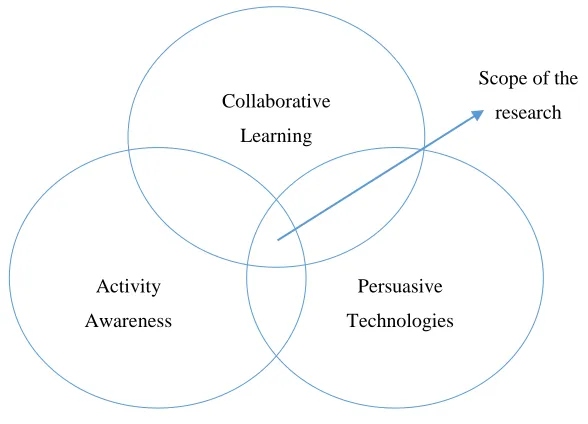
Blackboard (Carrington et al., 2010)). They focus on enabling students to communicate, share materials, and collaborate; or they produce notifications when someone completes a task or adds new inputs. These technologies tend to be heavyweight and comprehensive. In general, limited attention has been paid to promoting activity awareness in the collaborative learning literature. The work that does exist has focused on enhancing activity awareness by capturing and sharing details of the activity (e.g. Ganoe et al., 2003; Carroll et al., 2003). In contrast, there are no technologies that focus on the learners and their attitudes to collaboration without considering the functional aspects of the group's work. Moreover, no studies have explored collaborative learning in long-term learning projects in naturalistic settings and or evaluated students’ activity awareness over the course of such projects. In this PhD, I hypothesise that persuasive technologies can offer a novel way of promoting activity awareness by changing learners’ attitudes and behaviours and persuading them to be more aware of fellow group members’ activities. Therefore, this research has investigated an alternative approach to accomplish the outcome of enhancing activity awareness – by using persuasive technology to change the attitudes and behaviours of the learners. Figure 1.1 describes areas covered in this research.
Figure 1.1: Research scope
The scope of this research is focused on persuasive technologies to promote activity awareness in collaborative learning groups. In the context of this thesis, collaborative learning groups are small groups of students who are working on learning projects for several
Activity Awareness
Collaborative Learning
Persuasive Technologies
weeks and who practice both co-located and remote collaboration in naturalistic settings. In higher education, it is common for the syllabus of subjects such as computer science to incorporate collaborative group projects that run over several weeks. The empirical work undertaken here has been with students who are working on real group projects as part of their academic study.
1.3 Research Aim, Questions, and Objectives
The overall aim of this research was to investigate a new approach to supporting students who are working on long-term collaborative projects by promoting their activity awareness, through the use of persuasive technology. Five research questions addressed this aim:
RQ1: How do students collaborate in long-term collaborative learning groups? This has four sub-questions:
RQ1.1: What collaboration styles and activities are identified in long-term collaborative learning groups?
RQ1.2: What awareness behaviours and awareness types are exhibited in long-term collaborative learning groups?
RQ1.3: What applications and tools do groups use during meetings and for collaboration outside of meetings?
RQ1.4: What problems do students encounter during their collaboration?
RQ2: How can activity awareness be measured in long-term collaborative learning groups?
RQ3: What activity awareness do group members have in long-term collaborative learning groups?
RQ4: How can a persuasive social actor for activity awareness in long-term collaborative learning groups be designed and evaluated? It has three sub-questions:
RQ4.1: How can a persuasive social actor for activity awareness in long-term collaborative learning groups be designed?
RQ4.3:How can the success of the persuasive social actor be evaluated from expert reviews?
RQ5: Can a persuasive technology support students’ activity awareness in long-term collaborative learning projects?
The research questions were addressed through the following main research objectives:
O1: To identify how students collaborate in long-term collaborative learning groups, which includes the following sub-objectives:
O1.1: To identify collaboration styles and activities.
O1.2: To identify awareness types and behaviours.
O1.3: To identify applications and tools used during meetings and for collaboration outside of meetings.
O1.4: To identify problems that students encounter while they are collaborating.
O2: To develop a method to measure the level of students’ activity awareness in learning groups.
O3: To investigate activity awareness in long-term collaborative learning groups.
O4: To design and evaluate a persuasive social actor based on the Persuasive Systems Design model in order to promote activity awareness in long-term collaborative learning groups.
O5: To investigate the potential of using persuasive technologies to support students’ activity awareness in their long-term collaborative learning projects.
The research questions and objectives are addressed in chapters 3 to 7 of this thesis as presented in Table 1.1:
Table 1.1: Research questions and objectives in each chapter
Research question RQ1 RQ2 RQ3 RQ4 RQ5
Objective O1 O2 O3 O4 O5
1.4 Approaches and Methods Used in This Doctoral Research
This research is divided into two parts: exploratory research and persuasive technologies research. The exploratory research includes three studies to explore collaboration and activity awareness in collaborative learning groups. Then, research on persuasive technologies was conducted based on the behaviour change support system (BCSS) framework suggested by Oinas-Kukkonen (2010) which is described later in this section.
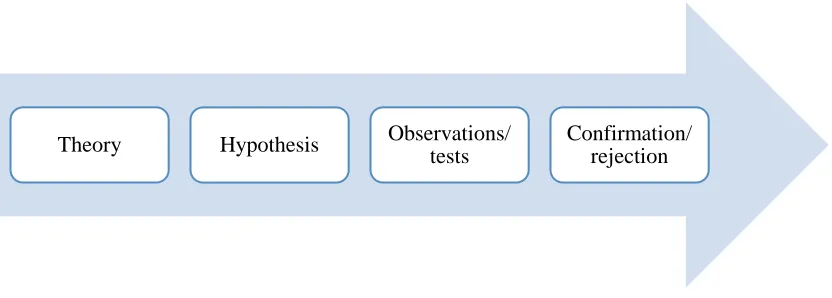
At the beginning of this PhD, the focus was on collaborative learning in general. A small pilot study was conducted to understand how students collaborate and to find out what problems students encounter during their collaboration (Chapter 3). Interviews were used for data collection and conducted with seven participants who had worked on a collaborative learning project. A general inductive analysis was applied to derive themes from the collected data. In an inductive analysis, a detailed reading of raw data is used to develop themes, concepts, or a model (Thomas, 2006). All interview transcripts were read several times to identify themes (see Figure 1.2). Although data were limited, there were some interesting findings. Results showed that some problems in collaboration arose due to a lack of awareness; for example, group members duplicated work or they did not reply to messages or emails from other members. This study started to answer part of the first research question RQ1 and the first objective O1.
Figure 1.2: Inductive approach
A third study was then conducted and studied a similar collaborative learning situation (Chapter 5); this time the aim was to validate the application of the method for measuring activity awareness, which had been proposed in the second study. Data were collected through questionnaires and interviews over a 6-week period. There was no observation this time as the focus was only on validating the method of measuring activity awareness. This study also employed a mixed qualitative and quantitative approach. Qualitative data sources included transcripts of interviews with students; and quantitative data included group report grades and students’ responses to a Likert-scale questionnaire about their awareness and satisfaction with their learning experience. Participants were students involved in a collaborative learning project. Results again showed that students were not always fully aware of their colleagues’ activity awareness. The method for evaluating activity awareness was also refined as part of this study and a set of rules was created to ensure that the method was rigorous and reliable. This study was used to answer part of the second and third research questions: RQ2 and RQ3, along with their mapped objectives: O2, and O3.
Distilling the results of these three studies framed the remainder of the PhD. Results showed that students’ activity awareness was variable over the duration of their projects. Various technologies have been used to support collaborative learning in other research, and some of these studies have focused on promoting activity awareness. However, none of these studies have focused on promoting activity awareness by changing students’ behaviours without considering the functional aspects of the group's work. Therefore, I decided to investigate the use of persuasive technology to promote students’ activity awareness, as the main concept of persuasive technology is changing users’ behaviours and/or attitudes without coercion or deception.
Observations/
Oinas-Kukkonen (2010) defines a behaviour change support system (BCSS) as “an information system designed to form, alter or reinforce attitudes, behaviours or an act of complying without using deception, coercion or inducements”. He suggests a five-step process model for conducting research on behaviour change support systems (BCSS):
1. Select the theoretical basis for research.
2. Analyse the intent through the O/C Matrix (Outcome/Change).
3. Analyse the BCSS through the PSD model (Persuasive Systems Design). 4. Measure the behaviour change.
5. Explain the change through the theories, the O/C Matrix, and the PSD Model.
This model was followed in the later stages of this doctoral research to conduct research on persuasive technologies for activity awareness in learning groups. The first step of the model is to choose supportive theories for the research. This is followed by analysing the intent of change using the O/C Matrix, which suggests three potential outcomes: the formation, alteration or reinforcement of three change types: attitudes, behaviours, or complying. The third step is to analyse the BCSS using the PSD model, which includes analysing the persuasion context and the software system characteristics. The final steps are to measure the behaviour change and explain the change based on the chosen theories, the O/C Matrix, and the PSD model. Each step is described in detail later on in Chapters 6 and 7.
Thus, a novel approach was investigated to promote activity awareness in collaborative learning groups by using persuasive technology to change learners’ behaviours. Accordingly, a persuasive social actor was designed and developed for this purpose in the form of an iPhone app (Chapter 6). Finally, an empirical study was conducted to test this social actor app (Chapter 7). In this study, a deductive analysis was applied to test the hypothesis that using a persuasive social actor will promote learners’ activity awareness (see Figure 1.3).
Figure 1.3: Deductive approach
Two data collection methods were used: questionnaires and interviews to collect mixed qualitative and quantitative data. Qualitative data sources included transcripts of interviews with students and open-ended questions from the questionnaires. Quantitative data included students’ responses to Likert-scale questionnaires. Results showed that persuasive technologies could influence students’ attitudes and behaviours and promote their activity awareness.
For all studies, the participants were a convenience sample and ethical approval was granted from the School of Mathematics, Computer Science, and Engineering of City, University of London to conduct the studies.
1.5 Contributions
This research makes four main contributions to the field of HCI and persuasive technologies. Table 1.2 summarises contributions, research questions and objectives according to the chapter where they are addressed. The contributions are:
1. The main contribution is presenting a novel approach to enhance or maintain activity awareness in collaborative learning groups by changing learners’ attitudes and behaviours using a persuasive social actor. (Chapters 6 & 7)
2. The research proposes a new method to study activity awareness, by conducting interviews at different intervals across the duration of the project, and provides a structured framework to evaluate the level of activity awareness. (Chapters 4, 5, & 7) 3. The research gives insights into designing and evaluating a persuasive social actor
using the Persuasive Systems Design (PSD) model. (Chapters 6 & 7)
Theory Hypothesis Observations/
tests
4. The research contributes to the existing research on collaborative learning, specifically long-term collaborative groups who worked in naturalistic settings and the collaboration activities and behaviours that support awareness. (Chapters 3 & 4)
Table 1.2: Research questions, objectives and contributions in each chapter
Research question RQ1 RQ2 RQ3 RQ4 RQ5
Objective O1 O2 O3 O4 O5
Contribution 4 2 & 4 2 1 1, 2, & 3
Chapter 3 & 4 4, 5 & 7 4, 5 & 7 6 & 7 7
1.6 Published Papers
Two papers have been published and peer reviewed based on the research undertaken in this thesis. These papers are in Appendix F.1 and F.2:
Al Ashaikh, R., Wilson, S, & Jones, S. (2016). A Persuasive Social Actor for Activity Awareness in Learning Groups. In: BCS Learning and Development Ltd. Proceedings of British HCI 2016 - Fusion, Bournemouth, UK.
Al Ashaikh, R., Wilson, S., & Jones, S. (2014). Exploring Awareness Behaviours and Collaboration Activities in Learning Groups. In: BCS Learning and Development Ltd. Proceedings of HCI 2014, Southport, UK. 376–377.
1.7 Thesis Structure
Chapter 2: Literature Review. This chapter presents an overview of the literature on collaborative learning, awareness, and technologies. It gives a deep understanding of the published research related to the topic.
Chapter 3: Exploring Collaborative Learning Groups – pilot study. This chapter presents
a detailed report of the pilot study. It includes the motivation for conducting the study, and methods used in data collection and analysis. It also discusses results and highlights the limitations of the study. It helps in answering three sub-question of the first research question RQ1: RQ1.1, RQ1.3 and RQ1.4, and to meet sub-objectives of the first objective O1: O1.1, O1.3 and O1.4.
Chapter 4: Exploring Awareness Behaviours and Collaboration Activities in Learning
Groups. This chapter presents an exploratory study in detail including motivation,
methodology, results, and discussion. It helps in answering the first three research questions RQ1 (particularly RQ1.1, RQ1.2 and RQ1.3), RQ2, and RQ3, and to meet the first three objectives O1 (particularly O1.1, O1.2 and O1.3), O2, and O3.
Chapter 5: Evaluating Activity Awareness in Learning Groups. This chapter presents a
follow-up study to evaluate activity awareness. It includes motivation, methodology, results, and discussion. It helps in answering the second and third research questions RQ2, and RQ3, and to meet objectives O2, and O3.
Chapter 6: The Design of the Social Actor. This chapter presents the design and
development of the social actor. It helps in answering one sub-question of the fourth research question RQ4: RQ4.1, and to meet objective O4.
Chapter 7: A Persuasive Social Actor for Activity Awareness in Learning Groups. This
Chapter 8: Discussion and Conclusion. This chapter provides a further discussion on the thesis and draws a conclusion.
Chapter 2:
Literature Review
This PhD is primarily located within the discipline of HCI but draws on others, such as: learning, collaborative learning, learning styles and theories, awareness, CSCW/CSCL, technologies used in collaborative learning and awareness, and persuasive technologies. In this chapter, these topics are reviewed. First, learning is introduced briefly, and then it talks about a specific type of learning, which is collaborative learning, and presents learning theories that are related to collaborative learning, the significance of collaborative learning over other types of learning, advantages and potential disadvantages of collaborative learning, and then reviews some learning styles. Then, a detailed report on awareness is provided, and some key awareness types that associated with collaborative learning are described. Finally, technologies that used in collaborative learning and awareness were reviewed, and then a detailed summary of persuasive technologies with some examples of their use is presented.
2.1 Learning
Many students continue to higher education after finishing high school to carry on their learning journeys, with the hope of getting better careers in the future. For instance, there were over two and a quarter million students in higher education in the UK for the year 2014/2015, which is 3.48% of the population (Higher Education Statistics Agency, 2015), and around 1 million and a half students in higher education in Saudi Arabia for the same year, which is around 4.7% of the population (Observatory on Education, 2015). Given these large numbers of students in higher education, there is significant interest in different methods that might enhance their learning experience and learning outcomes. Unsurprisingly many research and conferences are dedicated to the latest research and practice in education (e.g. Teaching and Learning, E-learning, and Technology-Enhanced Learning, Association for Learning Technology (ALT)).
2.1.1 What is Learning?
While learning is not the primary focus of this research, some of the most influential definitions of learning are summarised here. Knowles (1973) defines learning as “the process of gaining knowledge and expertise.” From the view of psychology, learning can be defined as “a process of change that occurs as a result of an individual’s experience” (Mazur, 1998). Most of the psychological scientists used this definition for learning where the keyword is the change (Mazur, 1998). Gagne (1985) defines learning as “a change in human disposition or capability that persists over a period of time and is not simply ascribable to processes of growth”. Moreover, Ambrose et al. (2010) define learning as “a process that leads to change, which occurs as a result of experience and increases the potential of improved performance and future learning”. Smith (1992) expands the definition of learning to refer to “the acquisition and mastery of what is already known about something, the extension and clarification of meaning of one’s experience, or an organised, intentional process of testing ideas relevant to problems”. From another view, the Oxford dictionary defines learning as “the acquisition of knowledge or skills through study, experience, or being taught”. These definitions either rely on “change” or “knowledge acquisition” as keywords for defining learning.
experience (Mazur, 1998). For example, Smith (1992) states that learning can be a product, a process, or a function. On the other hand, some researchers (e.g. Ambrose, et al., 2010) argue that learning is only a process, not a product, and because this process happens in the mind, the only way to know that it has occurred is from students’ products or performances.
2.1.2 Collaborative Learning
Collaborative learning has been reported to be an effective approach to supporting the learning process (Dillenbourg, 1999; Anderson & Lin, 2009). First, collaboration in general is defined and compared it to cooperation, and then collaborative learning is described. One influential definition of collaboration is presented by Roschelle and Teasley (1995): they define collaboration as “a coordinated, synchronous activity that is the result of a continued attempt to construct and maintain a shared conception of a problem”. Adding to that definition, Lipponen (2002) states that collaboration can be defined as any activity performed by pairs or groups and can be described as “a process of participating in knowledge communities”.
Engeström (1992) categorised the level of interaction in any collaborative work situation into three levels: coordination, cooperation, and reflective communication. The coordination level describes the role and actions of each member. In the cooperation level, members attempt to solve a common problem by conceptualising it. In reflective communication, members concentrate on reconceptualising their own interactions. The cooperation level defined by Engeström (1992) matches the definition of collaboration given by Roschelle and Teasley (1995). Likewise, Lipponen (2002) states that collaboration can be described as “a special form of interaction”. In some literature, cooperation and collaboration are treated the same, but Roschelle and Teasley (1995) differentiate between them: in cooperation, each member is responsible for completing a specific task, while in collaboration, members work together to solve a problem.
and Ward (1999) define collaboration in learning as “the process of creating new knowledge and involves communication through a shared artifact for the sake of creating a new understanding that the participants could not have achieved on their own”. This definition indicates that collaborative learning has more potential to facilitate knowledge construction than individual learning.
These definitions of collaborative learning share the same concept in which there should be at least two learners and they work together to complete some work. However, acquiring new knowledge or sharing new understanding is not clearly acknowledged in some definitions. In collaborative learning, students are responsible for their learning and for each other’s learning, and the success of one student facilitates the success of the other students (Gokhale, 1995). Some literature has suggested different ways to construct a successful and effective collaborative learning situation. For example, Crook (1998) asserts that successful collaborations occur through three social interaction features: closeness and understanding among participants; full access to external resources (e.g. computers); and histories of joint activity between participants (i.e. friendship status). Similarly, Dillenbourg (2002) reports that the effectiveness of collaborative learning depends on several factors, such as the group structure, the task characteristics, and the communication media. The group structure involves group size, age, gender, and heterogeneity.
Some researchers have assumed that collaborative learning usually includes some collaborative activities within an educational environment, for instance, studying a course material (Dillenbourg, 1999). “Collaborative activities enhance learning by allowing individuals to exercise, verify, solidify, and improve their mental models through discussions and information sharing during the problem-solving process” (Alavi, 1994).
2.1.2.1 Learning Theories and Approaches
Knowles (1984) coins the term andragogy for adult learning. Initially, he defined andragogy as the ‘art and science of helping adults learn’ (Knowles, 1984). Then after decades of work, he redefined andragogy to have five principles:
“As a person matures he or she becomes more self-directed.
Adults have accumulated experiences that can be a rich resource for learning.
Adults become ready to learn when they experience a need to know something.
Adults tend to be less subject-centred than children; they are increasingly problem-centred
For adults the most potent motivators are internal.”
Dillenbourg's (1999) theory of collaborative learning involves four items: the situation, interactions, processes and effects. He claims that the key for understanding collaborative learning is in the relations among these four items. Accordingly, the situation generates interactions types; and these interactions activate process and mechanisms, which then produce effects as a result. The collaborative situation usually affected by two scales: group size and time span. The group size could be pairs, a small group of 3-5, or a larger group (e.g. society); and the time span could be an hour, day, week, month, or even years (Dillenbourg, 1999). A long-term collaborative learning project is any group project designed for learning purposes that lasts for several weeks or months, in which group of students work together to solve a given problem or task. Hence, the situation of this collaborative learning is affected by time span, which is several weeks or months.
There are different learning theories and approaches that can support collaboration such as constructivist theory, project-based learning and the active learning method. Dillenbourg et al. (1996) suggested three different learning theories that could be used to develop collaborative learning systems: socio-constructivist theory, socio-cultural theory, and shared cognition theory.