ICASP5-CSSCR5
IOP Conf. Series: Materials Science and Engineering 529 (2019) 012061
IOP Publishing doi:10.1088/1757-899X/529/1/012061
Simulation of casting filling process using the lattice
Boltzmann method
Y J Zhang1, X W Qian1*, J X Zhou1*, Y J Yin1, X Shen1, X Y Ji1 and J L Huang2 1 State Key Laboratory of Material Processing and Die & Mould Technology, Huazhong University of Science and Technology, Wuhan, 430074, China
2 Advanced Forming Research Centre, University of Strathclyde, 85 Inchinnan Drive, Renfrew PA4 9LJ, United Kingdom
E-mail: [email protected], [email protected]
Abstract. Numerical simulation of casting filling process with complex shape is time-consuming. Compared with the traditional SOLA-VOF method, the lattice Boltzmann method (LBM) calculates the pressure field by particle distribution functions instead of the correction of the velocity and pressure fields, which greatly simplifies the calculation process. In addition, the LBM provides a flexible approach which can be easily parallelized. In this study, the LBM is employed to simulate casting filling process. An implementation of a volume-of-fluid (VOF) method within the lattice Boltzmann framework is proposed to capture the free surface of the casting filling process. A Smagorinsky large eddy simulation (LES) model is adopted to improve the numerical stability of the LBM. An adaptive time stepping technique is implemented to ensure an efficient and stable simulation. The model is validated by the experimental and simulation results of Campbell box filling process. The filling process of complex casting is simulated, and the result is compared with the filling process obtained by the SOLA-VOF method. The prediction accuracy and reliability of free surface profile is analysed.
1. Introduction
Casting process is an efficient manufacturing process, which can produce parts with complex shape. The filling process is crucial for the casting quality. An unstable filling process is accompanied with turbulences, splashes, and bubbles, which leads to casting defects. Therefore, the motion of liquid metal during filling process remains to be investigated. As the filling process is hard to capture, the numerical simulation becomes an alternative approach to understand the filling process. However, most simulation methods, such as SOLA-VOF method, the correction of velocity and pressure field is a time-consuming process. Compared with these conventional methods, the lattice Boltzmann method (LBM) calculates the pressure field by particle distribution functions, which simplifies the calculation process. Another advantage of the LBM is that it can be easily parallelized, which shows the potential for massive parallel simulation. But an evitable drawback of the LBM method is the numerical instability at low viscosity.
volume-of-ICASP5-CSSCR5
IOP Conf. Series: Materials Science and Engineering 529 (2019) 012061
IOP Publishing doi:10.1088/1757-899X/529/1/012061
fluid-based LBM model. The breaking dam case and flow past a weir case are validated. Zhao [5] performed the simulation of the continuous casting process by the LBM.
However, the above studies mainly focus on the simulation of LBM based free surface flow with a simple geometric shape. Numerical stability of the LBM is also influenced by the geometric shape [6]. Whether the LBM is capable of simulating the free surface flow with complex shape accurately remains to be investigated. Therefore, in this study, the LBM coupled with volume-of-fluid method is employed to simulate the casting filling process. The Smagorinsky LES model [7] is adopted to improve the numerical stability and the adaptive time stepping technique [3] is used to decrease simulation time. In addition, the explicit upwind scheme proposed by Ginzburg [1] is adopted due to its robustness for free surface simulations with high Reynolds number. The model is validated by the filling process of Campbell box [8]. The results are compared with the simulation results by SOLA-VOF method. Then the filling process with complex shape is simulated to analyze the accuracy and stability of the LBM.
2. Model description
2.1. Lattice Boltzmann model
In this study, the Bhatnagar-Gross-Krook (BGK) model is used and is defined by
,
, 1
, eq
,i i i i i i
f t t t f t f t f t F
x e x x x (1)
where fi
x,t is the distribution function at position x and time t in one particular lattice direction,
, eq if xt is the equilibrium distribution function, eiis the discrete lattice velocity, tis the time step,
is the dimensionless relaxation time and Fi is the external force (e.g., gravity).The non-dimensional relaxation time
depends on the fluid kinematic viscosityv
2 1 3 2 v t c
(2)
where c x/tis the particle velocity.
The D3Q19 lattice model, which has better numerical stability than the D3Q15 lattice model [6], is used in the LBM model. The macroscopic quantities for density and velocity are calculated by the first two moments of the distribution functions
18 0 i i f
(3)18 0 1 i i i f
u e (4)
As the model is a weakly-compressible scheme for impressible flows, the fluid pressure is calculated by the equation of state
2
s
p c
(5)where csc/ 3is the sound speed in D3Q19 lattice model.
2.2. Smagorinsky large eddy simulation
Casting filling process usually occurs at very high Reynolds numbers in the turbulent state. The low kinematic viscosity of liquid metal and high velocity will cause the relaxation time
close to 0.5, which decreases the numerical stability. While the Smagorinsky LES model introduces an additional turbulent viscosityvT. In a Smagorinsky model, vTis defined by
2T s
v C x S (6)
ICASP5-CSSCR5
IOP Conf. Series: Materials Science and Engineering 529 (2019) 012061
IOP Publishing doi:10.1088/1757-899X/529/1/012061
2
2 s
Q S
c
(7)
where Q is the moment flux tensor [7]. The relaxation time in the Smagorinsky model is given by
0 T
2
1 3
2
v v t
c
(8)
where v0 is the relaxation time related to the kinematic viscosity. From Eq.(6), (7) and (8), the total relaxation time is obtained, which is given by
2 2 2
0 0
1
18
2 Cs x Q
(9)
After using the LES model, the simulation becomes robust for different problems due to the increase of the total relaxation time [1] and requires less calculation time than the multi-relaxation-time model.
2.3. Free surface model
An important aim of casting filling process simulation is the interface capturing. The filling process is accompanied by complex interaction between gas and liquid metal. As the large density difference between liquid phase and gas phase during filling process, the dynamics of the gas phase is neglected. Therefore, the filling process can be described as a single phase flow within an acceptable accuracy. Various kinds of VOF methods have been proposed for the LBM, however, these methods adopt a simplified advection scheme in which no interface velocity is included. Therefore the mass flux terms are not calculated exactly and the sharp interface is captured approximately. In this study, the implement of VOF-based method within the lattice Boltzmann framework is proposed to improve the accuracy for interface capturing. The VOF indicator function is given by
0 t
v (10)
where
is the fluid fraction andv
is the fluid velocity in a control volume. Eq.(10) can be discretized with a control volume method and the advection scheme is obtained6
1
t t t
k k k k
t
v n (11)where vk is the fluid velocity at the kth face of the control volume, nk is the outer normal vector of the
[image:3.595.114.499.541.689.2]kth face and k is the fill level at the kth face, which can be calculated using the upwind scheme. The time step and space step are set to be 1.0 with non-dimensional form.
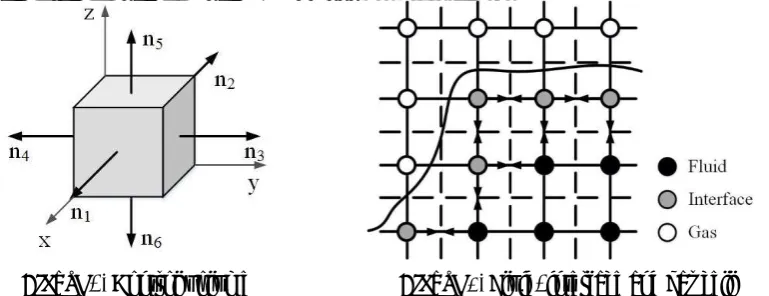
Figure 1. Control volume Figure 2. Fluid, interface and gas cell
The last term of Eq.(11), which represents the mass flux between the control volumes, shown in figure 1, with six neighboring control volumes, can be expressed as
6 18
1 0
/ 2
k k i i i i i k i
f f
ICASP5-CSSCR5
IOP Conf. Series: Materials Science and Engineering 529 (2019) 012061
IOP Publishing doi:10.1088/1757-899X/529/1/012061
The mass flux is calculated between fluid cell and interface cell. The mass exchange shown in figure 2, doesn’t occur between interface cell and gas cell as the fluid fraction of gas cell is zero, which is similar to the treatment in reference [2, 3]. In addition, the adaptive time stepping technique [3] is used to speed up the simulation without reducing the numerical stability.
3. Numerical simulation
3.1. Model validation
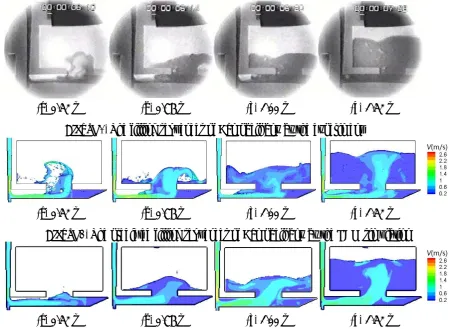
A benchmark test of Campbell box [8] is simulated to validate its ability to capture the free surface. Instead of adjusting its value to satisfy the stability condition, the kinematic viscosity is set to be 5.5e-7 m2/s, which is the physical parameter of the liquid aluminum. The turbulent model and upwind scheme are used to avoid numerical instability, which is different from the treatment of the benchmark test in the simulations of Ginzburg [1]. The inlet velocity is 0.7 m/s. The space step is set to be 1 mm, which results in the total grid number of 246 19 411 (including the mold cavity). The time step is set to be
5
1 10 s. The Smagorinsky constant is set to be 0.12 within a suitable range. The free-slip boundary
conditions are applied to the solid wall of the mold cavity.
[image:4.595.67.517.331.660.2](a) 0.52 s (b) 0.76 s (c) 1.00 s (d) 1.52 s
Figure 3. The filling sequences of Campbell box by the experiment
(a) 0.52 s (b) 0.76 s (c) 1.00 s (d) 1.52 s
Figure 4. The predicted filling sequences of Campbell box by the LBM simulation
(a) 0.52 s (b) 0.76 s (c) 1.00 s (d) 1.52 s
Figure 5. The predicted filling sequences of Campbell box by the SOLA-VOF simulation
ICASP5-CSSCR5
IOP Conf. Series: Materials Science and Engineering 529 (2019) 012061
IOP Publishing doi:10.1088/1757-899X/529/1/012061
results. The splash shape simulated by the LBM agrees well with the X-ray radiograph of the filling process. When the liquid metal begins to enter the bottom casting zone, the hole is formed due to the falling of the flow frontier, which is well predicted by the proposed LBM model. The irregular interface is caused by the turbulent flow as the Reynold number reaches 25000 approximately. In figure 5 the filling process is consistent with the laminar flow predictions [8], where no splash occurs during the whole filling process. Therefore, the LBM model coupled with the Smagorinsky LES model is capable of predicting the turbulent filling process. When the filling process becomes stable and the flow slows down after t=1.0 s, the interface shape predicted by these two methods is consistent. Compared with the laminar prediction, the suitable turbulent model, such as the Smagorinsky LES model, contributes to capturing interface with bubbles and splashes. The LES-coupled LBM model performs acceptable accuracy and numerical stability.
3.2. Practical application
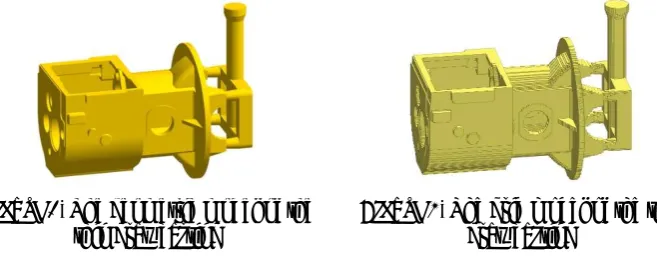
The filling process of a practical thin gray iron casting shown in figure 6 is studied. The wall thickness of the casting is 10 mm. The gating system consists of four ingates and the total weight is 60 kilogram. The inlet velocity is 1.0 m/s. The grid size is 3 mm and the total grid number is 151 217 179
[image:5.595.131.460.357.487.2](including the mold cavity). The grid model used for calculation is shown in figure 7. The filling time is 5.3 s.
Figure 6. The geometric model of the
thin gray casting Figure 7.
The grid model of the thin gray casting
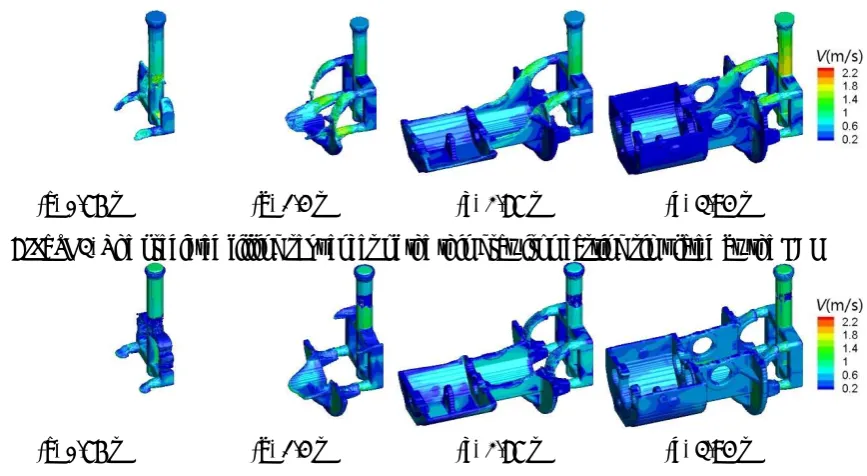
The filling sequences at different time simulated by the LBM and the SOLA-VOF method are shown in figure 8 and figure 9, respectively. The liquid metal runs through the sprue and arrives at the bottom of the runner. In figure 8 (a) and figure 9 (a), the two ingates at the bottom are fully filled with liquid metal and the two upper ingates are partially filled due to the small flow rate. The low velocity at the upper ingates causes the discontinuous flow at t=0.76 s. At t=1.4 s, fours ingates are fully filled and the liquid fountains to the cavity quickly which can be clearly observed in figure 8 (b). In the casting cavity, the asymmetric liquid metal frontier caused by the casting structure can be observed in the results of these two methods. At t=2.87 s and t=3.94 s, the filling process becomes steady as the fluid slows down, which can be observed in figure 8 (c), (d) and figure 9 (c), (d). The free surface profiles obtained by the LBM model are in agreement with the SOLA-VOF method, as shown in figure 8 (c), (d) and figure 9 (c), (d). Therefore, the LBM model has an acceptable prediction accuracy of the free surface during the casting filling process.
ICASP5-CSSCR5
IOP Conf. Series: Materials Science and Engineering 529 (2019) 012061
IOP Publishing doi:10.1088/1757-899X/529/1/012061
[image:6.595.85.519.109.347.2](a) 0.76 s (b) 1.4 s (c) 2.87 s (d) 3.94 s
Figure 8. The predicted filling sequences of the thin gray iron casting simulated by the LBM
(a) 0.76 s (b) 1.4 s (c) 2.87 s (d) 3.94 s
Figure 9. The predicted filling sequences of the thin gray iron casting simulated by the SOLA-VOF method
4. Conclusions
The VOF-based LBM model is implemented and applied to the simulation of the casting filling process. The comparison with the available experiments and SOLA-VOF simulation results proves the proposed model is reliable to capture the free surface during casting filling process. Also, the turbulent flow at high Reynold number is well described with Smagorinsky LES model implemented in the framework of the LBM. Thus, the model is prospective for high accuracy simulation of the casting filling process.
Acknowledgements
This research was financially supported by National Natural Science Foundation of China (No. 51775205).
References
[1] Ginzburg I and Steiner K 2003 Lattice Boltzmann model for free-surface flow and its application to filling process in casting J COMPUT PHYS185 61-99
[2] Körner C, Thies M, Hofmann T, Thürey N and Rüde U 2005 Lattice Boltzmann Model for Free
Surface Flow for Modeling Foaming J STAT PHYS121 179-96
[3] Thürey N and Rüde U 2009 Stable free surface flows with the lattice Boltzmann method on adaptively coarsened grids Computing & Visualization in Science12 247-63
[4] Janßen C and Krafczyk M 2011 Free surface flow simulations on GPGPUs using the LBM
COMPUT MATH APPL61 3549-63
[5] Zhao P, Li Q, Kuang S B and Zou Z 2017 LBM-LES Simulation of the Transient Asymmetric
Flow and Free Surface Fluctuations under Steady Operating Conditions of Slab Continuous Casting Process Metallurgical & Materials Transactions B48 456-70
[6] Krüger T, Kusumaatmaja H, Kuzmin A, Shardt O, Silva G and Viggen E M 2017 The Lattice
Boltzmann Method
[7] Hou S, Sterling J, Chen S and Doolen G D 1994 A Lattice Boltzmann Subgrid Model for High Reynolds Number Flows Fields Institute Communications6 151