City, University of London Institutional Repository
Citation
:
Kokkola, N., Mondragon, E. and Alonso, E. ORCID: 0000-0002-3306-695X (2019). A Double Error Dynamic Asymptote Model of Associative Learning. Psychological Review, 126(4), pp. 506-549. doi: 10.1037/rev0000147This is the accepted version of the paper.
This version of the publication may differ from the final published
version.
Permanent repository link: http://openaccess.city.ac.uk/id/eprint/21188/
Link to published version
:
http://dx.doi.org/10.1037/rev0000147Copyright and reuse:
City Research Online aims to make research
outputs of City, University of London available to a wider audience.
Copyright and Moral Rights remain with the author(s) and/or copyright
holders. URLs from City Research Online may be freely distributed and
linked to.
City Research Online: http://openaccess.city.ac.uk/ [email protected]
A Double Error Dynamic Asymptote Model of Associative Learning
Niklas H. Kokkola, Esther Mondragón and Eduardo Alonso
City, University of London
Centre for Computational and Animal Learning Research
Correspondence:
Esther Mondragón, Centre for Computational and Animal Learning Research, 21 Bardwell
Road, St Albans, Hertfordshire AL1 1RQ, United Kingdom. E-mail: [email protected]
Author Note:
Preliminary versions of the model and simulations have been presented at the Associative
Learning Symposium (Gregynog, 2016), meetings of the Spanish Society for Comparative
Psychology (Braga, 2015; Barcelona, 2016), and at the First Workshop on Computational
Modelling of Classical Conditioning (London, 2016). A preprint version of the manuscript is
available at https://www.biorxiv.org/content/early/2018/04/30/210674.
ABSTRACT
In this paper a formal model of associative learning is presented which incorporates
representational and computational mechanisms that, as a coherent corpus, empower it to
make accurate predictions of a wide variety of phenomena that so far have eluded a unified
account in learning theory. In particular, the Double Error Dynamic Asymptote (DDA) model
introduces: 1) a fully-connected network architecture in which stimuli are represented as
temporally clustered elements that associate to each other, so that elements of one cluster
engender activity on other clusters, which naturally implements neutral stimuli associations
and mediated learning; 2) a predictor error term within the traditional error correction rule
(the double error), which reduces the rate of learning for expected predictors; 3) a revaluation
associability rate that operates on the assumption that the outcome predictiveness is tracked
over time so that prolonged uncertainty is learned, reducing the levels of attention to initially
surprising outcomes; and critically 4) a biologically plausible variable asymptote, which
encapsulates the principle of Hebbian learning, leading to stronger associations for similar
levels of cluster activity. The outputs of a set of simulations of the DDA model are presented
along with empirical results from the literature. Finally, the predictive scope of the model is
discussed.
Keywords: associative learning, classical conditioning, computational modeling,
Associative learning aims at understanding the precise mechanisms by which
humans and animals learn to relate events in their environment. Associative learning has been
replicated across numerous species and procedures (Hall, 2002; Pearce & Bouton, 2001;
Turkkan, 1989); its neural correlates have been extensively studied (Gomez et al., 2001;
Kobayashi & Poo, 2004; Marschner, Kalisch, Vervliet, Vansteenwegen, & Büchel, 2011;
Panayi & Killcross, 2014; Roesch, Esber, Li, Daw, & Schoenbaum, 2012); it has proved to be
a core learning mechanism in high-order cognitive processes such as judgment of causality
and categorization (Shanks, 1995), and rule learning (Murphy, Mondragón, & Murphy,
2008); it underpins a good number of clinical models (Haselgrove & Hogarth, 2011;
Schachtman & Reilly, 2011); and its evolutionary origins are beginning to be elucidated
(Ginsburg & Jablonka, 2010). It is thus paramount that we develop comprehensive, accurate
models of associative learning.
In classical conditioning, a fundamental pillar of associative learning, the repeated
co-occurrence of two stimuli (e.g., an odor or tone), S1 and S2, is assumed to result in an
association between their internal representations, which entails that the presence of S1 (the
conditioned stimulus, CS, or 'predictor') will come to activate the internal representation of a
S2 (the predicted stimulus or outcome from now on). When the outcome is a biologically
relevant stimulus (unconditioned stimulus, US) able to elicit an unconditioned response (UR)
learning results in the acquisition of a new pattern of behavior: the sole presence of the CS
engenders a conditioned response (CR) similar to the UR. The response is assumed to express
the strength of the association between the CS and the outcome (Pavlov, 1927), revealing that
the outcome is anticipated or predicted by the CS.
In the following sections we proceed with a critical review of different models of
classical conditioning structured around four major features in learning theory, namely, the
factors in CS processing, and, finally, the elusive nature of neutral and absent cue learning.
We shall proceed with the description of the DDA model, which we claim provides a formal,
coherent corpus for the understanding of classical conditioning. Next, we present a battery of
simulations of relevant phenomena, and conclude with a discussion of the main contributions
of the model.
DDA’s fully-connected network explicitly incorporates to the classical Pavlovian
structure interactions between so called neutral stimuli, physically present or associatively
retrieved, as well as the context in which they occur. As a result, the model accounts for
phenomena that posit a problem for many models of classical conditioning, importantly,
though not exclusively, learning about absent cues (mediated learning). Crucially, the DDA
model provides a systematic interpretation of such effects in that they naturally emerge from
the synergy of the model’s unique features, namely, a double error term and a dynamic
asymptote, along with a variable attentional rate. This is in contrast to pre-existing models,
which are conceived to address specific types of phenomena (e.g., Pearce, 1987) or defined
on the basis of ad hoc rules which are capable to account for particular sets of results but that
fail in explaining others which are sometimes contradictory in appearance (e.g., Holland,
1993; Dickinson & Burke, 1996). To our knowledge, there is no other model able of
integrating all types of mediated learning phenomena, while accounting for a large number of
other, in principle unrelated, phenomena, such as those derived from contextual effects on
acquisition (latent inhibition) and extinction.
The Learning Rule: Error Correction
The acquisition of a conditioned response, assumed to mirror the strength of the
CS→US link, usually follows a negatively accelerating monotonically increasing curve over
models, the associative link's rate of change is proportional to the discrepancy between the
expectation and the presence of the outcome, i.e.,the prediction error, which is minimized
over training and results in the characteristic learning curve. This relation was initially
mathematically formalized in linear operator models such as Hull's early quantitative theory
of learning (Hull, 1943) and stochastic theories of conditioning (Blough, 1975; Bush &
Mosteller, 1955). A secular trend in modeling since then has been the expansion of the
ontology of internal stimulus representations and learning processes governing the formation
of associations between said representations. This increase in model complexity has
expanded the quantity of phenomena that can be accounted for by models of learning
(Alonso, Sahota, & Mondragón, 2014; Alonso & Schmajuk, 2012; Balkenius & Morén, 1998;
Pearce & Bouton, 2001), and has been propelled and refined by experimental data acting as
an arbiter of these models. For instance, evidence for the hypothesis that cues compete with
one another for associative strength necessitated advancements from linear operator error
terms. The phenomenon of blocking (Amundson & Miller, 2008; Kamin, 1968, 1969; Kohler
& Ayres, 1979) showed that when the acquisition training for a cue A is followed by
acquisition training with a compound AB, the novel cue B acquires next to no conditioning.
Thus, it seems as if the associative link formed by cue A to the outcome prevents the
formation of an equivalent link forming between B and the outcome. This result indicates that
the processing of the outcome plays a significant role in determining the maximal amount of
learning supported between itself and the CS. Such cue competition during learning is
formalized most prominently by the Rescorla-Wagner (RW) model with its 'global' prediction
error term (Rescorla & Wagner, 1972), which incorporates within it a sum of the values of all
associative links to the US. This is an innovation upon other linear operator error terms, as for
instance the Hull error term in contrast only incorporates the associative strength of an
discrepancy between the US presence and the expectation elicited for it by all cues, as seen in
Equation 1.
i i j i j j l l
l
V x z x V
= −
, (1)where Vi is the change in associative strength, i and j are respectively the CS
and US intensities, xi is the activity of the CS being updated,xl and zjthe activity of any
present CS and the US, respectively, and jthe US asymptote determining the maximal
supported learning. Finally, the summed term is the total extant learning toward the US,
calculated as the dot product of the CS activities times their associative strength Vl toward
the US. The RW model thus not only accounts for empirical data, but its formulation implied
the existence of learning effects not predicted by earlier models or assumed to exist by
pre-existing theory, as can be tested in a wide range of simulations (Alonso, Mondragón, &
Fernández, 2012; Mondragón, Alonso, Fernández, & Gray, 2013). Primary among these
predictions is that if two CSs are independently conditioned to an asymptotic level, then their
reinforcement in compound should lead to a decline in their associative strength. This follows
from the error term supporting a maximal level of conditioning for all present stimuli on a
trial, which is different from the maximal level supported for cues presented in isolation.
Such a phenomenon of overprediction has been confirmed (Rescorla, 1970), along with other
predictions such as super-conditioning (Rescorla, 1971a), thus strengthening the validity of
the model as well as other models relying on a summed error term. Though the RW model
has been successful in this regard (Miller, Barnet, & Grahame, 1995), a summed error term is
not the only means of predicting cue competition results. Models relying on CS-US specific
'local', non-competitive error terms are capable of accounting for some of these effects by
predictors, as postulated by the model of Mackintosh (1975). Alternatively, the comparator
hypothesis model (Miller & Matzel, 1988; Miller & Witnauer, 2016) explains cue
competition results as a retrieval effect. It assumes that when a previously reinforced CS is
presented (the target), it re-activates both representations of other CSs paired with the US and
the US representation itself. The response elicited by the target CS is then proportional to the
degree to which it predicts the US relative to the associative strength of the comparator CSs.
Hence cue competition arises from the interference of other CS-US associations upon the
target-US association.
The realization of real-time learning models extending the trial-based RW model
(and other error correction models) by making predictions for learning within a trial allows
for the modelling of time dependent aspects of learning and temporal relations between
stimuli not accounted for by trial-level models. The SB model (Sutton & Barto, 1981),
extended the delta rule used in RW by postulating that the variation in the inputs to a node
representing a US was the driver of learning. Hence, both changes in the US sensory input
(reinforcement) and changes in the CS contribution to this node (temporal difference)
influenced the direction of learning. In addition to phenomena predicted by RW, SB accounts
for inter-stimulus interval (ISI) effects and an anticipatory CR build-up (Balkenius & Morén,
1998). It nevertheless produces a few erroneous predictions, such as that a co-occurring CS
and US should become highly inhibitory towards one another. Flaws of the SB model are
rectified in the Temporal Difference (TD) model (Sutton & Barto, 1987) through the
variations in the CS signal to the US node being dissociated from the US signal itself, and
through the introduction of a time-discount factor that modulates the contribution of future
predictions. The TD model uniquely predicts that learning is being driven by the need of the
animal to minimize a time-discounted aggregate expectation of future reinforcement. At each
change in US activation at the next time-step, termed the temporal difference. The difference
between this prediction and the actual US activation level results in an error term (like that in
the RW model), the prediction error, for that time-step. Equation 2 is used for calculating this
error.
1
t t t t t t
i i i i
i i
x V x V
= − − −
, (2)where t is the US activation at time t, and the term it 1 it i
x V−
denotes theprediction for the US produced through the summation of associative activations of the US
(using current associative links, but CS activation levels from the previous time-step), and
t t i i i
x V
is the equivalent for the current time-step. The current time-step is multiplied bythe mentioned discount parameter to reflect that the future is always slightly uncertain and
therefore more recent stimulus activation carries more weight in calculating errors. The
difference between these two prediction terms produces an estimate of what the activation of
the US is during the current time-step. The discrepancy between the TD error and the actual
US presence produces the overall prediction error for the US. As a real-time rendition of the
US-processing error correction learning found in RW, TD can account for the same
phenomena as the former on a trial level. In terms of predictive power, the instantiation of the
TD model in simulators (Mondragón, Gray, & Alonso, 2013) has produced accounts of
phenomena difficult to analyze a priori. For instance, higher-order conditioning, wherein
reinforcement is observed in the absence of a US through the reinforcement effects of the
temporal difference term itself. It accounts for temporal primacy effects – e.g., Kehoe,
form CSA→CSB→US results in a deficit in CR acquisition to CSB. It additionally reproduces
the retardation effects of ISIs on the level of asymptotic learning (and by extension, CR over
time) in an emergent fashion (Balkenius & Morén, 1998) through the aforesaid higher-order
conditioning, which in itself results from the temporal-difference term back-propagating to
earlier time-points. As the core of the TD model is its distinct error term, variations of TD
with differing stimulus representations have been proposed. A complete serial compound
model (Moore, Choi, & Brunzell, 1998) postulated that a CS is represented in time by a series
of separate units, each of which becomes active following the previous. This extension
produced a response curve in time with closer correspondence to empirical fact. Work in
timing as well as hippocampal data inspired the micro-stimulus representation of TD
(Ludvig, Sutton, Verbeek, & Kehoe, 2009), which instead assumes that the presence of a CS
produces a cascade of units to become active in a bell-shaped form, with units that peak later
having a correspondingly lower amplitude and higher variance. The advantage of such a
stimulus representation is that it reproduces both differential responding early and late during
a CS presentation, allows for effective trace conditioning due to the persistence of later
micro-stimuli, and produces generalization of learning in time due to the significant
activation overlap of said micro-stimuli. Extensions of the classical TD formulation have also
been motivated by its lack of compound stimuli and configurations in its stimulus
representation. Formulations of TD such as SSCC TD (Mondragón, Gray, Alonso, Bonardi,
& Jennings, 2014) offer rules for forming such compounds both when stimuli overlap
temporally, and when they are presented in succession. Steady evidence has mounted that
predictions errors akin to the TD error are correlated to mid-brain dopamine function
(Ludvig, Bellemare, & Pearson, 2011; Montague, Dayan, & Sejnowski, 1996; Niv, 2009;
Niv, Edlund, Dayan, & O’Doherty, 2012; Schultz, 2004, 2006, 2010; Schultz, Dayan, &
In conclusion, although alternative approaches to summed error correction such as
the comparator hypothesis model exist and are capable of accounting for crucial cue
competition effects, the fit of the RW and TD error terms to empirical data correlating
prediction errors and dopamine signaling, as well as a consideration for parsimony, motivate
our use of the summed error correction rule in the DDA model we are introducing.
The Nature of the Stimulus Representation: Elemental vs. Configural Models
Causal relations in the world are mostly more complex than the linear CS-US
relationship encountered in a standard acquisition protocol, being more appropriately
described by non-linear conditional probabilities. Learning models therefore must in some
manner involve processes of approximating these conditional relations, such as those seen in
non-linear discrimination learning. Exactly how such causal connections are approximated is
highly dependent upon how the stimuli themselves are represented by a model. Two
benchmarks of non-linear discriminative performance of a model have been negative
patterning and biconditional discriminations. In negative patterning (NP) individual
presentations of two cues A and B are followed by an outcome (a reinforcer), A+, B+,
whereas compound presentations of the same cues are not, AB-. Its difficulty and hence
importance lies in the simple breakdown of linearity on the compound trials. That is, the
animal must learn to withhold responding on trials when two cues, which individually predict
the outcome, are presented. Biconditional discriminations involve yet more complex
non-linearity. Four cues are presented in pairs, with each individual cue being presented in both a
reinforced and nonreinforced compound (AB+, CD+, AC-, BD-). Therefore, simple
summation of the individual cues values offers no information for solving the discrimination.
The Rescorla-Wagner (RW) model, as an elemental model, kept with the
constituting the attributes of individual stimuli enter into associations with the US directly
(Harris, 2006; Wagner, 2008). As a result, in its original formulation, RW was unable to
account for both negative patterning (Rescorla, Grau, & Durlach, 1985) and biconditional
discriminations (Rescorla, 1972; Saavedra, 1975). The model assumes that if each individual
stimulus is presented in opposite contingencies, this amounts to partial reinforcement of the
cue and hence the discrimination will not be solved. In the case of NP, the model would
predict greater responding on the compound trials than individual trials, due to the summation
of the associative strengths of A and B. That is, the model preserves the linearity of
summation by positing that the responding elicited by a given configuration of cues is
directly proportional to the sum of the individual associative strengths of the constituent
stimuli. The addition of elements common to multiple stimuli to RW allowed for the
discrimination to be solved as the elements common to both A and B acquire
superconditioning, super-asymptotic learning (Rescorla, 1971a), while the unique elements of
both stimuli become inhibitory toward the outcome. Hence simply by assuming some
similarity between CS representations it is possible to account for some non-linear
discriminations within an elemental framework. In the case of more complicated
discriminations such as bi- and tri-conditional discriminations, compound similarity may not
be a sufficiently powerful mechanism. The addition of configural elements to the model,
which become active during the presentation of a specific compound, allows the RW model
to avoid this issue (Wagner & Rescorla, 1972). That is, it is assumed that the compound is
represented by the animal as more than the sum of its parts. Hence NP is produced in a
contrary fashion as compared to when common elements are involved, as the configural
elements produce inhibitory links toward the outcome, while the unique elements form
excitatory associations. While this configural element leads to the model predicting
preserves linearity in the absence of such conditioning. As such, it was unable to account for
evidence of linearity of summation being broken (Razran, 1939), that is for configurations of
stimuli eliciting more or less response than expected by summing the response strengths
elicited by individual presentations of the constituent stimuli. For instance, the observation
that the presentation of a stimulus compound, after reinforcing the two stimuli separately,
does not always produce more responding (Pearce, George, & Aydin, 2002) contradicted the
RW model. Such evidence prompted the conception of the replaced elements model (REM)
(Wagner, 2003), which maneuvered around this difficulty by a process whereby some
elements of a stimulus are added (configural elements), and some are removed (unique
elements), when the cue is presented in a compound. These added and replaced elements are
consistent throughout presentations. The added elements correspond to elements representing
context-dependent features of the stimulus, while the replaced elements are assumed to
represent features of the cue that are uniquely present when the cue is presented alone. The
model postulates a replacement parameter r, which determines what proportion of elements are replaced in this manner. Thus when r=0, the model is equivalent to the RW model, while r =1 produces a purely configural model (Schultheis, Thorwart, & Lachnit, 2008). The intermediate values allow the model to postulate that summation is not absolute. For instance,
0.5
r= leads to the prediction that no summation is observed, that is the compound of two CSs is no more predictive of the outcome than an individual CS. Thus, by assuming that
different modalities of stimuli undergo different replacement rates depending on their
similarity, consistent with psychophysical theory (Glautier, Redhead, Thorwart, & Lachnit,
2010), the model can explain why summation seems to depend on the types of stimuli used
(Wagner, 2003).
Though the configural elements representation of RW and the REM model account
other observed effects. Both models assume that a redundant cue, X, will facilitate the
learning of a discrimination, yet the opposite is often observed (Pearce & Redhead, 1993). A
further difficulty is that an underlying implication of most elemental models is the potential
complete reversibility of an association between a stimulus and the outcome should the
previously learned contingency be reversed (e.g., reinforcement followed by
non-reinforcement). However, experiments displaying retroactive interference in feature negative
discriminations, in which B+ trials failed to impair previous A+, AB- training, contradict this
assumption of complete associative reversibility (Wilson & Pearce, 1992). Both the RW
model and the REM extension have difficulty reproducing this effect. The former, due to its
linear summation, predicts complete interference of B+ training on the A+, AB- training.
That is, it expects that after B+ training the AB- compound will display less complete
suppression of responding. The latter, though it in principle can reproduce the effect, is
forced to postulate a very high replacement rate of B elements. However retroactive
interference in feature negative discriminations has been produced by stimuli from different
modalities (Pearce & Wilson, 1991), which seems to require a low replacement rate of
elements. Concomitant to this procedural manipulation, however, lies the notion of stimulus
modulation of the association (occasion setting), according to which a serial feature negative
discrimination would endorse the feature with hierarchical modulatory properties over the
excitatory association (Holland, 1985) or would increase the threshold for the US activation
(Rescorla, 1985). Failure to impair the previous discrimination levels by subsequent feature
reinforced training has been taken as evidence that negative modulators capabilities are
relatively independent of their association to the outcome. In other words, the association
between the feature and the outcome could be reversed without affecting the feature’s ability
An alternative account to the elemental approach is supplied by Pearce (1987),
which in contrast presumes that nodes representing individual stimuli connect to an additional
configural node representing their aggregation. This node in return forms associations with
the outcome. Its configural stimulus representation, wherein the presentation of a compound
activates a configural node representing it, produces many non-linear discriminations simply
through learning between a configural node and the outcome not directly interfering with
other configurations. Non-linear discriminations are often difficult for animals to learn.
Pearce’s model accounts for this difficulty by postulating that responding to a configuration
of stimuli is affected by its similarity to other configurations (as measured by a similarity
index). Hence, it anticipates that the difficulty of a non-linear discrimination is directly
proportional to the similarity of the constituent compounds. In the case of biconditional
discriminations, the complexity of the discrimination arises from each compound being
similar to another compound undergoing opposite reinforcement (e.g., AB+ and AC-). The
model naturally accounts for the fact that summation between stimuli is not always being
observed. As a result, it faces a challenge explaining evidence that summation does
sometimes occur. Further, the model predicts a symmetrical deficit in responding
(generalization decrement) when a stimulus is added in compound to a previously
conditioned stimulus (external inhibition) or when a stimulus is removed from the training
compound (overshadowing). Yet, it has been confirmed that overshadowing produces a larger
deficit in responding than external inhibition (e. g., Brandon, Vogel, & Wagner, 2000).
Finally, evidence has accumulated that familiarity with the constituent stimuli of a
discrimination can facilitate the learning of the discrimination (Hall, 1991; Mondragón &
Hall, 2002). This phenomenon of perceptual learning (PL) seems to suggest that the animal’s
perception of the similarity of two stimuli is learned rather than given a priori as through
seems to be necessary to dichotomize unique and redundant elements of stimuli when they
are preexposed together, such as elements shared by the preexposed stimuli losing
associability.
Configural models have been further critiqued from a theoretical perspective. In
terms of parsimony, they require representations of both individual stimuli as well as
configurations, thus making them more complex than purely elemental models – though
Ghirlanda (2015) has demonstrated that a mapping between elemental and configural
representations can be constructed analytically. Furthermore, they seem to take for granted
representational information that is usually postulated by purely associative means, namely
that a combination of stimuli co-occurred. Finally, they require some limiting process on the
quantity of configurations that can form to avoid an infinite generation of different configural
representations.
Harris (2006) and Harris and Livesey (2010) introduced a purely elemental model
utilizing a unique attentional process to avoid the aforesaid problems of the elemental
approach. In the model a finite 'attentional buffer', which makes the activation of elements
stronger and more persistent (and therefore contribute more towards responding), is
proposed. Entry into this buffer is regulated by the change in activation of a given element
when it is presented or predicted and is proportional to the salience of that element (with the
saliences of elements of a stimulus assumed to be normally distributed). That is, elements that
undergo a strong increase in their activation can enter the attentional buffer. If the buffer is at
full capacity, elements with larger changes in activation displace elements with smaller
changes in activation. Further, the extent of reinforcement by a US is proportional to the
number of US elements that are pushed into the buffer. However, in general, the quantity of
CS elements in the buffer does not influence the direction of learning. The buffer simply
important implication is that when a stimulus compound is presented, only the most salient
elements can enter the buffer. Hence the model can account for partial summation. This
partial summation, together with an assumption of common elements equips the model with
the capability of predicting various non-linear discriminations. It additionally predicts that
these discriminations are solved more slowly when a redundant cue is present, as the
redundant cue leaves less capacity in the attentional buffer for relevant cues. The facilitation
of discriminative learning by preexposure, i.e., perceptual learning, arises through a process
of common elements losing associability through self-prediction hindering their entry into the
buffer. Crucially, the model can explain both the lack of retroactive interference in feature
negative discriminations (Wilson & Pearce, 1992), as well as the discrepancy between
external inhibition and overshadowing (Brandon, Vogel & Wagner, 2000). In the case of the
former, it postulates that during the B+ presentations, the elements of B that entered the
attentional buffer on AB- trials are more inhibitory than the ones which did not. Thus, the
elements that did not enter the buffer acquire more excitation than the ones that did.
Consequently, when the AB compound is once again presented, much of the increase in B’s
associative strength will not be manifested due to the most excitatory elements not entering
the buffer. In the latter case, the model explains that in the case of external inhibition, the
novel stimulus pushes elements of the compound out of the buffer. However, these elements
nevertheless remain active at a lesser level, thus still contributing towards responding. When
a cue is removed as in an overshadowing test, its elements are completely inactive, and hence
the asymmetry between the phenomena is accounted for. Thus, the Harris model shows that
many of the apparent pitfalls of elemental models can be avoided using a richer stimulus
representation and a process of selective attention; though the exact nature and substratum of
predictions of the model could be explained also for instance by the simpler assumption of
the salience of a cue directly influencing the strength of its activation.
In conclusion, both elemental and configural approaches to stimulus representations
have distinct advantages in explaining non-linear discrimination learning. Configural models
can offer a solution to how animals learn complex discriminations, generalization between
them, as well as for partial summation. Elemental models must postulate additional learning
and representational mechanisms to account for many of these effects. For instance,
configural elements or the attentional buffer of Harris significantly extend the reach of
elemental analysis. They nevertheless have the advantage of maintaining representational
simplicity as well as encapsulating more information in terms of pure associative learning.
That is, in many formulations they avoid the problem of how configural representations
emerge in the first place. As such, we have favored an elemental approach for the current
model.
Attentional Factors: CS Processing
As the Harris model assumes that any excitatory link from one stimulus to another
induces activation in the recipient stimulus, it can explain various preexposure and
habituation phenomena as well. In effect, the associability of a cue, all else being equal, is
therefore directly proportional to its novelty. In addition, the model's prediction that the
effective associability of stimuli decreases in relation to how many further stimuli are active
has been experimentally validated (Lachnit, Schultheis, König, Üngör, & Melchers, 2008).
This sets it in opposition to other paradigms of selective attention. For instance, the
Mackintosh model assumes that animals attend to cues that are relatively better predictors of
outcomes than other cues (Mackintosh, 1975). It models attention to a cue, i, as changing in
The implication is that selective attention is learned, retained for future learning, and
presumably aids in reducing proactive interference between stimuli, thereby speeding up
learning as discussed in (Kruschke, 2011). Cue competition effects are thereby explained by
purely attentional means and thus the model only requires the linear operator delta rule
familiar from Hull’s model. The Mackintosh model’s unique assumption that the selective
attention paid to a cue has direct reinforcing effects has allowed it to predict phenomena that
pose a problem for other models. For example, it can explain unblocking, wherein the
surprising partial omission of reinforcement during a blocking treatment attenuates the
blocking of a cue (Dickinson, Hall, & Mackintosh, 1976). It thus avoids the prediction of
overprediction pushing the blocked cue towards becoming inhibitory, which the RW model
predicts in some circumstances for this treatment. An alternative explanation to that offered
by the Mackintosh model for this effect is however that differential reinforcement is
represented by the animal as different reinforcers. As such, this result can be accounted for by
the RW model. The Mackintosh model also accounts for the learned irrelevance effect
(Bonardi & Hall, 1996; Mackintosh, 1973), whereby a CS uncorrelated with US presentations
shows poorer subsequent acquisition, due to the best relative predictor accruing the most
associability, and hence conditioning more quickly than competing cues. A well-known
difficulty faced by the model is however the phenomenon of Hall-Pearce negative transfer
(Hall & Pearce, 1979), wherein reinforcing a CS with a weak US, thus making it a better
predictor, hinders subsequent conditioning between the same CS and a stronger US. In this
case, it erroneously predicts greater excitatory learning between the previous best predictor of
the outcome and the outcome. The model also is unable to account for superconditioning
(Rescorla, 1971a, 2004), wherein presenting a conditioned inhibitor of an outcome together
with a novel cue leads to stronger excitatory conditioning to the novel cue than if it were
it cannot account for this effect. Superconditioning is however predicted by Le Pelley’s
extension of the Mackintosh model (Le Pelley, 2004), owing to the use of a combined error
term.
The Hall-Pearce negative transfer effect is easily accounted for by the Pearce and
Hall (PH) model (Pearce & Hall, 1980), which postulated that attention rises when the
outcome is uncertain. That is, the associability of a CS rises in accordance to the general
uncertainty of the outcome instead of tracking the relative predictiveness of the cue. By
implication, in the Hall-Pearce negative transfer effect, prior training with a weaker US
produces a decline in associability which delays subsequent learning with the stronger US. In
contrast to the Mackintosh model, the Pearce and Hall model has trouble explaining learned
irrelevance, as the predictor in a learned irrelevance procedure will accrue more associability
due to their lack of correlation with the occurrence of an outcome. In the context of a
standard acquisition and extinction protocol the PH model predicts a sudden increase in
associability when the contingency is changed (i.e., the beginning of acquisition or
extinction), with a gradual decline thereafter. Further, a great success of the model has been
predicting latent inhibition (LI) (Channell & Hall, 1983), wherein preexposure of a CS
attenuates subsequent acquisition training with the same CS. It predicts this effect as arising
from the preexposure leading to a decline in the associability of the CS, which subsequently
rises again during acquisition training. Empirical evidence exists for the hypothesis that
prediction errors increase the associability of cues, however a confounding factor is the
difficulty of disentangling increases in associability (speed of learning) from direct
reinforcement (extent of learning) produced by prediction errors (Holland & Schiffino, 2016).
Uncovering and formalizing the precise nature of modulating factors of attention, and their
relation to the dopamine system (Ahveninen et al., 2000; Nieoullon, 2002), is hence critical
been noted that the attentional mechanisms underlying these two models are not necessarily
in opposition. The existence of evidence supporting each model has fostered the proposal of
dual-factor attentional models. One such model is the Le Pelley model (Le Pelley, 2004),
which combines both the associability of the Mackintosh model and of the PH model (with
the latter given more influence). According to Le Pelley’s model, both the general uncertainty
of the outcome, as well as the relative predictiveness of a cue determine the overall
associability of the cue. As such, the Le Pelley model can explain phenomena that have
proven difficult for either model in isolation. It predicts, for instance, Hall-Pearce negative
transfer as well as the learned irrelevance effect simultaneously. It however introduces further
complexity, as the two rules can often cancel the influence of one another. Thus, it is also
difficult to isolate their respective effects empirically.
It is worth noticing that the PH attention rule, when instantiated in a real-time
model, can produce an increase in associability for the best predictor of the outcome if said
predictor produces a prediction error for the US before the US onset. That is, the rule
produces more complicated emergent behavior when instantiated in a real-time model.
Further, it has been found that even trial-level models based on the PH attention rule can
produce Mackintosh-like effects under certain conditions (Le Pelley, Haselgrove, & Esber,
2012).
The assumption that novelty of cues is crucial to how learning unfolds, pioneered
by the Mackintosh and PH models, was expanded upon by the SLGK model (Kutlu &
Schmajuk, 2012). It postulates that the novelty of every stimulus affects its speed of learning
towards other stimuli. Further, this novelty is modelled through stimuli learning to predict
each other through associative links (expectancy). Therefore, not only reinforced, but also
non-reinforced (i.e., ‘neutral’ or ‘silent’) learning is incorporated. The model is configural in
unit. These configural units have non-modifiable random incoming connections from all CS
representations, and their connection to the outcome is adjusted through a delta rule. Their
associability or associative rate is taken to be very low initially, however if the US
expectancy remains high during training (i.e., the animal is unable to learn a given
contingency), then the associability of the configural units rises. It hence accounts for the
difficulty of animals to solve non-linear discriminations. This mechanism of detecting,
through a persistent outcome error, when a purely linear approach has failed offers a robust
approach for introducing non-linearity into models of conditioning while pre-empting a
combinatorial explosion. It can be utilized to change the associability of other
representational elements besides configural cues (e.g., common elements) to reflect when
the animal cannot solve a learning problem.
Learning between non-reinforcing cues, i.e., ‘silent learning’ incorporated by the
model endows it with the capacity to account for various preexposure effects. For example, it
explains the attenuated positively accelerating response curve of a latent inhibited stimulus
during subsequent acquisition. This response curve further approaches the standard learning
asymptote after a sufficient number of reinforced trials (Lubow, 1965). In this regard, it
shares similarities with two other models that postulate both silent learning and novelty-based
associability, SOP (Wagner, 1981) and the McLaren and Mackintosh (2000) models. In all
three models, latent inhibition emerges from the preexposed CS losing novelty by being
predicted by the context and itself (unitization). This loss of novelty slows down subsequent
acquisition training in a way different from that proposed by the aforementioned PH model
and its Hall-Rodriguez extension (Hall & Rodriguez, 2010). These predict that the repeated
preexposure of a cue reduces the attention paid to it, thus decreasing its associability. Hall
and Rodriguez (2010)further predicts the formation of a CS→noUS link, which thereafter
training. This latter mechanism bears a similarity to the explanation offered by the
comparator model (Miller & Matzel, 1988), which also stresses processing during retrieval,
although in this case, unlike in Hall and Rodriguez’s, the effect is specific to a given US.
Nevertheless, the neutral-learning based account of SLGK, SOP and McLaren-Mackintosh
seems to hold a categorical advantage in explaining latent inhibition, as they do not need to
assume such a noUS representation or the existence of an extant associative link to it. Hence,
they avoid predicting inhibitory properties of the preexposed CS towards the US, which have
not been found in summation tests (Rescorla, 1971b). Additionally, assuming a noUS
representation by implication would lead to generalization of inhibition to another outcome.
Evidence seems to contradict such an assumption, as learning with a reinforcer has been
demonstrated to be outcome specific, for instance in outcome devaluation experiments
(Colwill & Motzkin, 1994).
In conclusion, models that assume that selective attention is acquired by the most
predictive cue, such as the Mackintosh model, offer a robust account of effects such as
unblocking and learned irrelevance. They however are unable to offer a convincing
explanation of preexposure effects. Similarly, alternative explanations for unblocking and
learned irrelevance can often be produced by error correction models. In the former case by
assuming that differences in US presentations imply differences in the asymptote of learning;
in the latter case by postulating that uncorrelated CS-US exposure results in a null
correlation. In contrast, models that postulate a loss in associability as the outcome error
declines (PH) or when a cue becomes less novel (SLGK, SOP, and McLaren-Mackintosh) are
uniquely capable of explaining both the result and mechanisms behind the loss in
associability occurring during preexposure. The latter models can also predict the context
specificity of LI observed when preexposure is conducted in a context different from that of
uncertainty-driven variable associability of the PH model could produce emergent
Mackintosh-like effects through the best predictor of an outcome yielding a larger prediction
error before the onset of the outcome, thus increasing its own associability towards the
outcome. We have hence chosen to incorporate a similar mechanism, with important changes
involving revaluation of persistent uncertainty, to account for learned attentional bias in the
DDA model.
Neutral and Absent-Cue Learning
If an animal is learning the contingencies governing events, does it revaluate the
presumed most probable contingency when it is contradicted by subsequent learning? If so,
how? Since it is assumed that prior learning is stored as associations, this revaluation by
implication involves the modification of previously formed associations. Behavioral data
exists, which demonstrates that a present cue can retrieve the representation of another cue
and thereby invoke revaluation of the latter's previously formed associations towards a
reinforcer (Dickinson, 1996; Holland, 1983; Holland & Forbes, 1982). In addition, neural
data indicates that the left hippocampus is involved in mediated learning in humans (Jie,
2008) and the dorsolateral prefrontal cortex has been tied to violations of previously formed
expectations (Corlett et al., 2007). These so called mediated learning effects are of interest as
they allow for an understanding of processes governing learning between representations of
stimuli which are present and ones which are absent yet associatively invoked. Of cardinal
significance are backward blocking (BB), unovershadowing/retrospective revaluation (UnOv)
(Le Pelley & McLaren, 2001; Miller & Witnauer, 2016; Urushihara & Miller, 2010), and
sensory preconditioning (SPC) (Brogden, 1939; Ward-Robinson & Hall, 1996). Explaining
these effects with a simple associative learning rule has been elusive, as they seem to result
these seemingly contradictory mediated learning phenomena, succinctly describing their
designs and the rules required to account for the observed results, to highlight the source of
conflict in their interpretation.
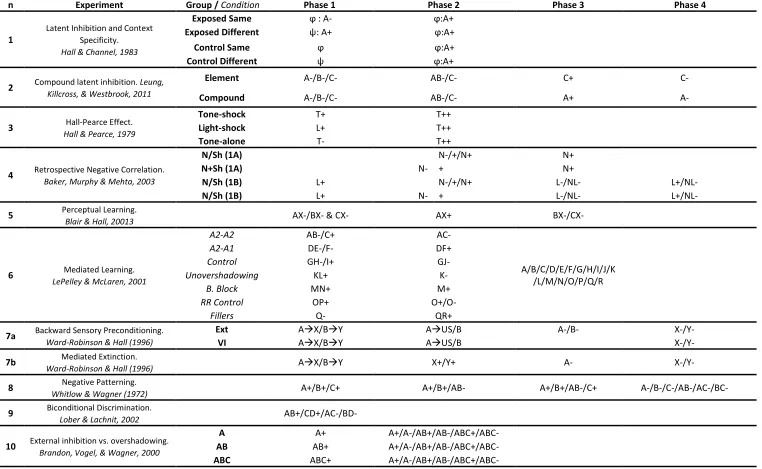
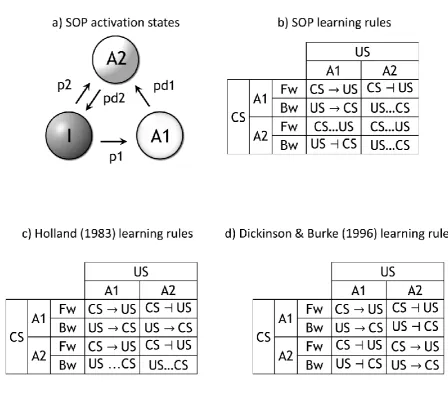
FIGURE 1 ABOUT HERE
For instance, in BB and UnOv designs, a compound of events, AB, is first
associated to a motivational outcome. Once this association is established, presentations of
one of its components alone, A, follows. While in a backward blocking procedure A is also
reinforced, in a UnOv procedure, subsequent A training is not. Testing of the other element of
the compound, B, afterwards, the BB treatment results in B losing associative strength
compared to the first phase of learning, whereas in the UnOv treatment the excitatory
strength of B increases. That is, strengthening the association between one of the elements of
the compound and the outcome, results in a reduction in strength of the concomitant stimulus
and the outcome, whereas lowering it rises the strength of its associated stimulus.
In a sensory preconditioning procedure, two non-reinforced stimuli, AB, are
initially paired. In a second phase, A is reinforced. Subsequent test trials show that B, which
has never been paired with the outcome, has nevertheless gained associative strength. Thus,
an absent cue B undergoes a change in its associative strength as a consequence of the
reinforcement treatment given to its associated cue. One possible mechanism for this
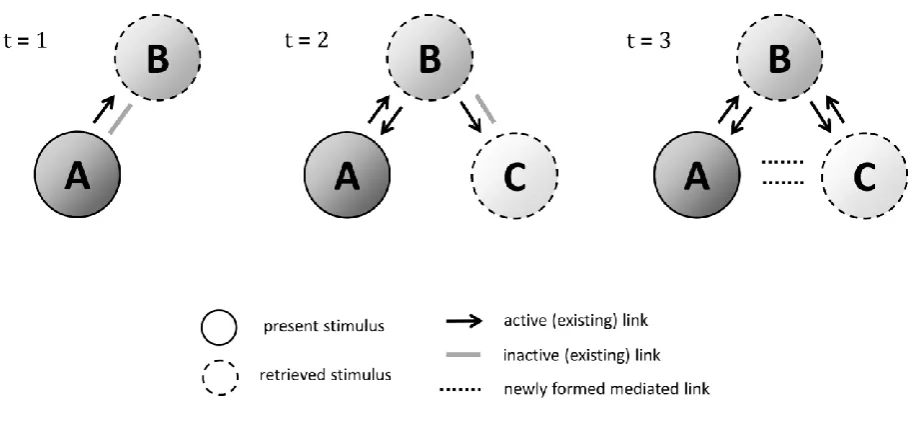
phenomenon relies on the idea of mediated conditioning: during conditioning to A, an
associative activation of stimulus B, which was linked to A during the initial compound
training, is produced. This associatively activated representation of B acquires associative
and the present outcome in SPC and BB proceeds in opposite directions. That is, while in
SPC the absent cue acquires strength, in BB it loses strength.
Empirical research suggests that observing retrospective revaluation or mediated
learning effects may depend on the degree of discriminability of the stimuli (Liljeholm &
Balleine, 2009). Mediated learning will be preferentially obtained when the stimuli are poorly
discriminated, whereas retrospective revaluation effects will be favored as generalization is
reduced. There are other factors that are also known to influence the magnitude of UnOv: For
example, the strength of the within-compound associations between the stimuli, so that the
stronger the association, the higher the probability of observing a UnOv effect (Aitken,
Larkin & Dickinson, 2001). In addition, UnOv is more readily observed with longer CS
durations (Matzel, Schachtman & Miller, 1985). Moreover, a large number of revaluation
trials seems to be required to produce a robust UnOv effect (Blaisdell, Gunther & Miller,
1999). Retrospective revaluation effects are also context dependent (Boddez, Baeyens,
Hermans & Beckers, 2011). Finally, unovershadowing is more likely to emerge when the
two cues hold differential saliences and the most salient member of the compound undergoes
extinction (Liljeholm & Balleine, 2006).
Different models have been proposed to explain specific sets of mediated
phenomena that can be ascribed to a single learning rule, either an increase or a decrease in
strength in the same design conditions, but so far, no model can account for all of them. It
would thus seem evident that a comprehensive model of learning should be able to predict
these apparent contradictory results.
In the McLaren-Mackintosh model (McLaren & Mackintosh, 2000) stimuli are
represented by sets of mutually overlapping elements in a connectionist network. Each node
in the network has both an external (sensory) input, as well as a modifiable internal
these two inputs is considered the prediction error for that node, and thus determines the
amount of associative learning from other nodes to it, as well as acting as a modulator of the
associability from that node to other nodes. The internal input is precisely what allows for the
retrieval of absent cues and therefore mediated conditioning in the model. McLaren and
Mackintosh postulate that in sensory preconditioning, the preexposure of the compound AB
results in the formation of bidirectional excitatory associations between the two CSs.
Subsequently, when A is presented together with reinforcement, A associatively retrieves the
representation of B. This associatively retrieved representation in return is capable of
supporting learning towards the present outcome. Therefore, mediated conditioning is treated
equivalently to learning between present stimuli. It is uncertain however whether the model
can account for the revaluation effects of backward blocking and unovershadowing. For
instance, in the case of backward blocking the delta rule employed would suggest that the
retrieved cue B could potentially gain additional excitatory strength rather than losing it, as
its prediction for the outcome would be lower than if it were directly present. That is, the
delta error term would still support further excitatory learning, predicting an increase rather
than the observed decrease in strength, thus the model would not be able in principle to
account for BB, but would be able to predict UnOv.
Another partially successful model in accounting for mediated phenomena is SOP
(Wagner, 1981). SOP postulates that inactive (I) stimulus representations are activated from
long-term storage into short-term memory through either stimulus presentation or associative
retrieval. The short-term memory system consists of an elemental network of processing units
containing elements in primary (A1) and secondary, weaker (A2) states of activation for each
stimulus center/unit, as seen in panel a) of Figure 2. Direct stimulus presentation results in the
activation into A1 of a given proportion (p1) of its elements. Active elements (or
with previous models such as RW, it is assumed that the total quantity of all stimulus A1
elements is limited. Therefore, increasing the number of A1 elements increases the speed at
which these elements decay into the A2 state. Over time, elements in the A2 state of
activation decay back into the inactive state. The model specifies that the direction of
learning (excitatory or inhibitory) depends on the ratio of A1 to A2 elements of the outcome.
Thus, a more novel outcome supports more excitatory learning, whereas an over-predicted
outcome supports only inhibitory learning. These processes are summarized as learning rules
in panel b) of Figure 2.
FIGURE 2 ABOUT HERE
SOP and its extensions (CSOP (Wagner & Brandon, 2001), and AESOP (Brandon,
Vogel, & Wagner, 2003)) assume excitatory conditioning between fully active elements, and
the formation of bidirectional inhibitory links between a present CS and an absent outcome
(Figure 2, panel b), but do not offer further associative rules. Such rules are introduced by
Holland (Holland, 1983), and Dickinson and Burke (Dickinson & Burke, 1996). The former
(Figure 2, panel c) accounts for mediated conditioning and predicts that two stimuli in the A2
state undergo inhibitory learning. The latter (Figure 2, panel d) predicts backwards blocking
(A2:A1 inhibitory) as well as mediated conditioning between two A2 stimuli. As is evident,
these rules are in multiple instances (e.g., A2:CS A2:US and A2:CS A1:US rules) the reverse
of one another. Indeed, experimental data has been collected to support each model (Dwyer,
1999), leaving the problem unresolved from the point of view of these two SOP extensions.
That is, whether A2-A2 learning should be either excitatory or inhibitory is unclear. Hence,
there exist conditions under which A2-A1 learning appears to lead to both excitation and
Nonetheless, it is conceivable to explain mediated learning through mechanisms
different from alterations in the associative learning rules. For instance, the comparator model
produces retrospective revaluation through the competition of associative links during
retrieval. That is, the B→US link is relatively larger than the A→US link after the latter has
lost associative strength in the second phase. However, a formal analysis of various
comparator models has cautioned that such revaluation effects might be harder to reproduce
than originally conjectured (Ghirlanda & Ibadullayev, 2015, p. 18). Though the TD model
does not presume learning between neutral stimuli, the Predictive Representations (Ludvig &
Koop, 2008) extension of it accounts for mediated conditioning by proposing that present
cues retrieve representations of stimuli with which they have been previously presented.
These retrieved cues condition equivalently to present cues, save for having lower levels of
activation. The formulation of the model however seems to preclude explaining backward
blocking without further assumptions, as learning between a retrieved CS and a present
outcome will tend to be excitatory. Hence the model conceptualizes mediated learning as a
form of reasoning about causal relations between events, yet does not seem to capture
reasoning occurring when prior learning is contradicted by subsequent learning in such a
manner that previously formed links should be weakened.
A unique account of mediated learning is conceived of in the 'replayed experience'
model of Ludvig, Mirian, Kehoe, and Sutton (2017). It in contrast postulates that the animal
re-processes previous learning during the inter-trial interval (ITI), thereby consolidating
contradictory learning contingencies. It can account for a wide variety of mediated learning
effects including mediated conditioning and backward blocking in this manner. In a sense, it
accounts for mediated learning by assuming that specific contingencies are intermixed as
replay experiences in the mind of the animal, and for instance backward blocking is therefore
assumption that such post hoc revaluation indeed occurs during the ITI, and must assume that
representations of different outcome-contingencies have already been learned by the animal
for them to be replayed.
There are variations of the TD model and Rescorla-Wagner’s that can capture
backward blocking and other revaluation phenomena based on the Kalman filtering
algorithm. The Kalman Temporal Difference model (KTD) (Gershman, 2015) in particular,
combines the Kalman-filter extension of Rescorla and Wagner’s model introduced in
(Kruschke, 2008) and TD. The former, departs from Rescorla and Wagner’s (and most
traditional models of classical conditioning) assumption of single reward predictions by
accommodating distributions of beliefs that are updated according to Bayes’ rule; the latter
renders an instantiation of Rescorla and Wagner’s in real-time and allows for predictions on
long-term cumulative rewards. KTD can predict effects, such as latent inhibition, backward
blocking and recovery from overshadowing, but, to our knowledge, the model does not offer
a solution to other mediated learning phenomena which seem contradictory in nature such as
mediated conditioning and mediated extinction.
The Latent Causes Theory (LCT) (Gershman & Niv, 2012; preliminary versions in
Courville, Daw, & Touretzky, 2006; and Gershman, Blei, & Niv, 2010) is an alternative
Bayesian model that diverges from the traditional assumption that associations are formed
between conditioned and unconditioned stimuli, and postulates that animals infer models of
the hidden (latent) structure of the environment over which beliefs are updated using
Bayesian rules. Whereas LCT can predict a number of conditioning effects, early versions of
the model failed to account for fundamental classical conditioning phenomena, such as
blocking, and the authors themselves acknowledged that it was inadequate as a general model
of classical conditioning (Gershman & Niv, 2012, p. 265). Integrating the rational theory of
2001; Soto, Gershman & Niv, 2014) adapted LCT to account for several compounding
effects. Nonetheless, their model fails to provide a mechanism that would explain such
phenomena, instead it posits that learners infer what latent causes are more likely to be active
from a pool of possible causes. LCT thus rely heavily on a potentially infinite capacity
distribution of latent causes and may be susceptible to a combinatorial explosion of
cause-stimuli configurations.
In summary, if mediated phenomena are to be explained purely through learning
rules, what seems to be needed is therefore an operation that subsumes conflicting sets of
rules. This supra-rule should reverse the direction of learning between present and absent
cues in a principled manner depending on the prior reinforcement history. For instance,
through a learning process, which can be justified as a form of approximate Bayesian
inference. This is precisely the approach we follow in the DDA model.
To conclude, a plethora of models have been developed to account for wide
varieties of classical conditioning phenomena. However, the sets of phenomena explained by
models are quite distinct. Latent inhibition is predicted by diverse models, nevertheless the
accounts given by the SLGK, McLaren-Mackintosh, and SOP models excel due to their
ability to incorporate context modulation. Similarly, solving various non-linear
discriminations, such as negative patterning, and modeling exposure effects on stimulus
generalization, seem to necessitate a more elaborated stimulus representation than standard
elemental and configural approaches. In terms of mediated learning, most of the models
incorporating neutral stimulus associations can account for some but not all effects, with
different models displaying different strengths.
The DDA model introduced next aims at accounting for all the highlighted classes
of learning effects through a general framework of real-time error correction learning,
second error term denoting the expectancy of an outcome predictor, a revaluation alpha
which turns outcome uncertainty into a source of information, and critically, a dynamic
asymptote of learning regulated by the similarity/discrepancy in the levels of activation of the
elements of the association.
THE MODEL
The DDA model introduced in this paper conceptualizes a formal, computational
model of classical conditioning. It is instantiated as a connectionist network, with nodes
representing clusters of elements belonging to stimuli. When two or more clusters of
elements are activated, the elements of one node enter into association with other active
clusters (including between non-US clusters, and clusters of the same stimulus). Unlike the
element activity, which is binary (active, 1, or not, 0), the cluster’s activity is given by the
mean number of its active elements. Elements in a cluster can be unique to a stimulus or
shared between two stimuli. The model operates based on an error correction learning
framework, thereby inheriting the properties of extant error correction models. Its associative
learning rule includes a prediction error term for both the predicting and predicted stimuli,
with both influencing the associability of a CS with an outcome. That is, a more novel
predictor will undergo faster conditioning toward an outcome. Crucially, the asymptote of
learning between any two clusters of elements measures the similarity of their activity.
Hence, clusters of elements with similar activity patterns form stronger associative links.
Finally, a process governing changes in attention-based associability is introduced and
operates based on the time-discounted uncertainty in the occurrence of these stimuli being
The activity of elements is time-dependent, with groups of elements assembled into
‘temporal clusters’ allowing the model to predict differential responding early and late during
a CS presentation. At a high level, learning occurs between motivationally neutral stimuli as
well as between a neutral stimulus and a US, and the associations so learned modulate each
other. Thus, the model accounts for preexposure effects such as latent inhibition. The
predictor error term, which produces the so called 'double error' learning rule, along with the
unique asymptote of learning used, endows the model with the capability of accounting for
apparently contradictory mediated learning phenomena (e.g., BB and mediated conditioning).
It does so by positing that the crucial factors influencing the direction of mediated learning
are the strength of retrieval of the retrieved cue and the prior strength of the link between the
retrieved cue and the outcome. Lastly, the attentional processes of the model contribute
towards the model’s capability of predicting a wide range of phenomena including
preexposure, non-linear discriminations, and contextual effects.
The model ontology is as follows: a stimulus,
A, B, C..., US, context
, canfunction either as a predictor or as an outcome
(
po)
and consists of a set of clusters
i j, ,...
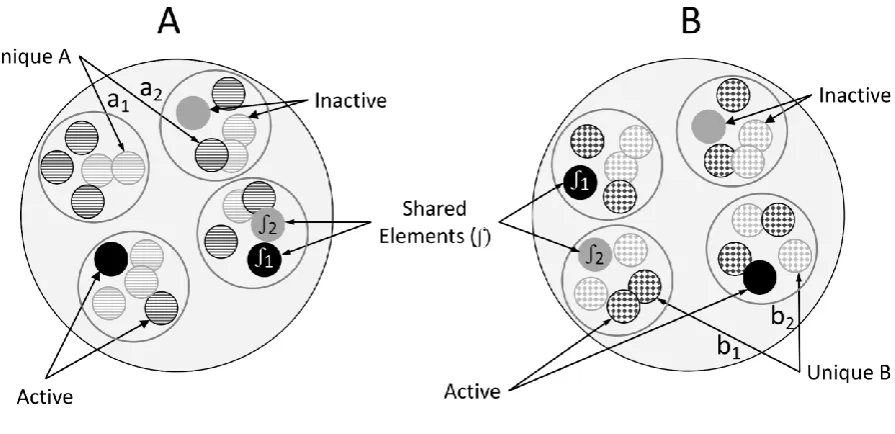
. Each cluster, in turn, is a collection of elements, such that each element e can beunique to a given cluster and stimulus or shared between clusters of two different stimuli.
That is, e
(
iA) (
(
iA) (
j B)
)
. Elements are shared only between neutral stimuli.Although contexts and reinforcers could potentially share elements with other stimuli, their
specific characteristics, the context ubiquitous distribution and its numerous and sensory
diverse attributes, and the strong motivational value of the USs, would render their
Stimulus Representation and Activation
In the DDA model, a stimulus representation is constituted by a set of elements that
are related to the physical attributes of the stimulus. These elements can be unique to the
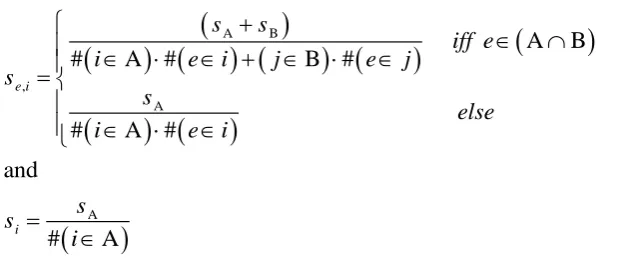
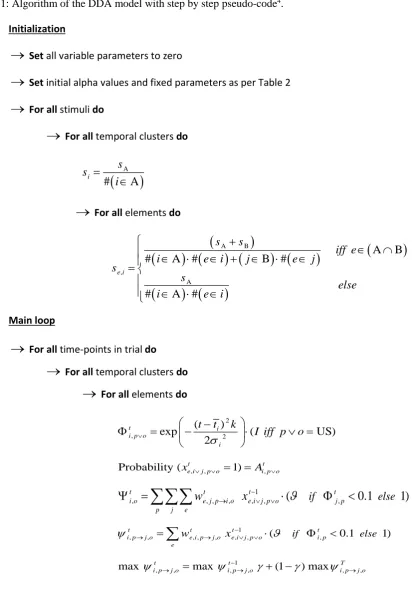
stimulus or shared with other stimuli. Shared elements (Figure 3) are sampled (in a binary
fashion) whenever one of their 'parent' stimuli is active.
FIGURE 3 ABOUT HERE
Each element of a given temporal cluster, of a given stimulus, is capable of
developing associative links to other temporal clusters (including temporal clusters within the
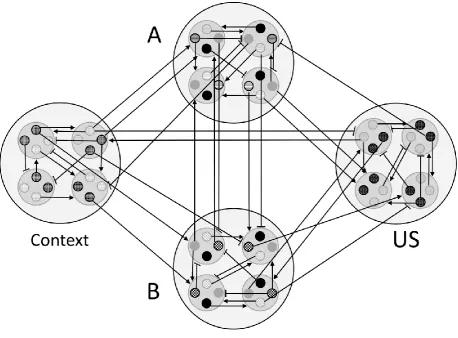
same stimulus). Therefore, the model’s ontology presumes an elemental connectionist
network structure (Figure 4) of the total stimulus representation, with links between elements
of a given cluster and an ‘outcome cluster’ (i.e., elements modulate activity of clusters of
elements). The DDA model postulates that elements learn to predict clusters of other
elements, instead of forming direct element-element associations because the probability of
sampling a given pair of elements (or the neural spiking behavior theorists attempt to
approximate with them) is very low in comparison to the co-occurrence of an element and a
cluster of elements. It is thus more plausible that a prediction would engender activation over
a temporally stable cluster node than over a single element.1 In addition, learning is modelled
1To illustrate this idea mathematically, if an element 1
e is active at time t, and a second element e2
in this form to represent the temporal structure of events which reconciles evidence for
elements representing binary attributes of stimuli (that can hence be potentially shared in
common between stimuli), together with evidence for associative activity operating in a
continuous time interval. That is, learning is not modelled between elements due to their
binary state of activity leading to a loss of the temporal information of the stimulus.
Similarly, learning is not modelled between temporal clusters of stimuli, as this would disrupt
the predictive temporal flow and render the contributions between elements unique to the
cluster/stimulus and elements shared between stimuli indistinguishable. Finally,
hypothesizing that temporal clusters as a whole could be shared between stimuli would
impose unwarranted assumptions about stimulus commonality being dependent upon
temporal dynamics.
FIGURE 4 ABOUT HERE
It is assumed that the stimulus representation varies through time, with some
elements being differentially active early or late during the presentation of a stimulus. Hence,
elements in a cluster are differentially active throughout the stimulus presentation: the
probability of binary activation of each element in a cluster at a given time equals to that
cluster’s temporal activation at that time (e.g.,if the activation value of the cluster is 0.3 at
time t, then each element has a 0.3 chance of being sampled at t). To clarify, the total activity
of a temporal cluster is conceived of as resulting of a bottom up process of element sampling
in which each element has a given probability of being sampled at a given moment in time.
Elements that are correlated in their probability of being sampled will cluster temporally, and
thus the total activity of the temporal cluster will correspond to the averaged binary activity