The Changing Role of EU Education Policy – a
Critical Assessment
by
Heiko Walkenhorst
Department of Government
University of Essex
UK
Paper for the EUSA Ninth Biennial International Conference
2
The Changing Role of EU Education Policy – a Critical
Assessment
Heiko Walkenhorst
Introduction
Since its beginning, the European integration process has developed an educational dimension. However, in contrast to highly integrated EU policies such as competition and external trade, education has merely been subject to intergovernmental policy co-ordination. As a cost intensive policy national education generally belongs to the realm of high politics in which the EU does not claim responsibility. But it is not only the budgetary factor that has contributed to the low level of policy integration. Apart from its function as a provider of skilled and prepared generations, education policy is an important national political steering instrument. In the way an education system is designed, it influences people’s perceptions about the political past (historical nationalism), contributes to changes in the division of labour (vocational training) and has a considerable impact on the future elites of societies (higher education). Education, similar to social policy, is an important part of the national welfare systems; hence, state governments are very reluctant to cede sovereignty. Furthermore, education policy is one of the remaining parts of identity politics in which national governments still possess the power of control; here, education policy operates as a cross-generational transmitter of political culture. It is still perceived as a vital tool for creating social legitimacy, promoting political socialization, developing democratization and preserving national identity. Consequently, as Beukel (2001: 126) observed, ‘the very notion of “Europeanization of education” causes concern in most countries in Europe, one reason being that it is equated with homogenization of the educational systems that could imply a loss of national identity’.
Community activities in education matters: already an EU policy?
From a national perspective it becomes quite clear that there is hardly any national policy in the EU that remains isolated from EU legislation (Sbragia 2003: 112). From the supranational perspective, however, the involvement of the EU in domestic policies does not automatically create a supranational policy regime. The question I would like to clarify first is when we can speak of an ‘EU policy’ if it should not simply be equated with ‘EU competence’ or ‘action’. As so often in political science, a conceptualization depends on the definition. Whereas both the ‘Penguin Dictionary of Politics’ and ‘Oxford Dictionary of Politics’ refuse to define ‘policy’ at all, other accounts do not help to define this political process either: Following Heywood (2002: 400), a policy is a ‘plan of action adopted by […] an individual, group business or government’, based on ‘a formal decision giving official sanction to a particular course of action.’ Hence, the EU measures in education do constitute a policy. According to Lowi and Ginsburg (1996: 607-8), ‘[public policy] constitutes an officially expressed intention backed by a sanction, which can be rewarded as reward or punishment’; the authors link policy to the polis, that entails the requirement of coercion, which is a condition EU education does not fulfill.
3
If it is a policy, what kind of policy is it? To begin with, it turns out to be difficult to locate EU education policy in the classical national welfare and market-oriented scheme of distributive, constituency, regulatory and redistributive policy, as introduced by Lowi (1964; 1972 cit op. John 2002: 7). A characteristic feature of EU policies is that they often complement or even compete with national policies but hardly replace them, following Milwards logic of integration (1999). Scholars of EU policy making have therefore developed own patterns of conceptualizations which aim to identify certain families of EU policies. The most simplistic of those models distinguishes between ‘high’ and ‘low’ policies in order to explain the difference between scarcely and highly integrated fields (Moravscik 1998; Richardson 1996). Within this scheme, EU education policy accounts to the realm of the former category (Moravscik 2001), without, however, discriminating very active, dynamic and complex cooperation like the Common Foreign and Security Policy and the relatively EU limited scope of EU educational policy.
Sbragias differentiation of market-building, market-correcting, market-cushioning policies (2003: 131) neither adds much to the location of education among the EU policies, since it would need to be assigned the first category, to which also the common agricultural policy belongs. A closer look at the decision-making mode in EU education matters with its rather supportive, non-harmonizing and non-regulative character reveals the existence of similar policies. In Wallace’s model of EU policy-making (2001: 72), education is placed in the same category as research and development, culture, sports and language, the decision-making mode being used is primarily co-operation and benchmarking on a systemic level.
Although conceptualizations and groupings of policy families help to distinguish and clarify the nature and functioning of policy regimes in the EU (especially from a comparative perspective), I strongly support John’s proposition that ‘policy-sectors vary according to the instruments and resources to decision-makers therefore each policy sector is unique and should be studied in its own right’ (2002:6). And although education still accounts to the most nationalized matters in Europe, transnational projects like the Bologna process indicate a growing consensus among the majority of the EU member states about a future European area of education. For the countries in Western Europe, having been at the forefront at the development of post-industrial, post-modern societies in the world, education counts more than a human resource; it is a societal value, a guarantee for democratic stability and economic prosperity. EU education policy as one of the last bastions of state power exemplifies the modern struggle between national preservation and the need for intense trans-governmentalism. The extend, to which the EU member states are willing to cede sovereignty in education can be seen as a sensitive seismograph for political integration.
Synopsis
Initiation (1951-1969)
The earliest decisions and treaty provisions related to education matters affected vocational training. In article 56 ECSC-T the member states assigned the community the task to financially contribute to retraining of employers. The EURATOM treaty included both a provision to develop training programs and centers for professionals (Articles 7 and 9) and to found a European University (which, however never happened). The Treaty on European Economic Community (T-EEC) extended the scope on vocational training measures, such as the provision in article 41. The inclusion of article 128 (General guidelines for vocational training) formally created a legal basis for education matters which proved to be highly relevant with regard to later judgments by the European Court of Justice. In connection with article 48 T-EEC (free movement of workers) the Luxemburg judges interpreted a general entitlement of migrant workers for equal access to the education system of the host country, including higher education.
Consolidation (1969-83)
4
the mutual recognition of diplomas, certificates and other evidence of formal qualifications were adopted by the national education ministers. In this phase EC education policy assembles all features of an instrument for market creation. The Tindemans-Report (1976), however, changed the scope. The paper called ‘European Union’ criticized the lack of citizen-orientation of the European integration process and subsequently called for at a ‘People’s Europe’. As a result, the EC education policy developed a political dimension, following Commission proposals for intensified cooperation in political education by targeting specifically school curricula. Two initiatives called ‘education with European contents’ from 1978 (Council 1988a: 23-7) and ‘the European dimension in education’ from 1988 (Council 1988a: 19-21) were adopted by the Council of Ministers in order to increase awareness of the European integration process at school level. The sensitiveness of the matter is reflected in the disagreement over the implementation of the European Dimension which resulted in cancelled meetings between the ministers of education for a couple of years, as Beukel (2001: 129) observed. In the course of the 1980s some member states, and in Germany especially the Länder governments, increasingly feared uncontrolled sovereignty transfer towards Brussels via international cooperation, ‘soft law’ and ECJ rulings. Especially with regard to an emerging EC education policy security measures both on national and supranational level were demanded.
Expansion (1983-1993)
Despite ongoing struggles about its legal basis, EC education policy entered a new and intensified stage from 1983 onwards, identified by Trondal (2002: 9) as ‘supranationalist turn’. Initiated by the Solemn Declaration of European Union and continued by the Single European Act, a wide range of new educational activities was introduced in order to complement the re-launched integration process. The novel measures to be implemented triggered the euphoric prospect of a ‘citizen’s Europe’, for which the first direct European Parliamentarian elections seemed to have paved the way. Aimed at closing the democratic gap within the European integration process, concepts of ‘a people’s Europe’ and the already mentioned ‘European dimension in education’ embraced various action programs, projects and events with an educational dimension. Most importantly, the national ministers agreed to follow Commission proposals about the intensified use of information technology, a general guideline on mutual recognition of diploma’s and finally a number of exchange programs for university students, teachers, pupils, youngsters and professionals (ERASMUS, COMMETT, LINGUA, PETRA, TEMPUS). In the beginning of this expansion phase primarily oriented towards the vocational part of education, the programs soon embraced parts of the whole education sector. The budget accordingly expanded from 18.9 Mio Ecu in 1984 to 77.2 Mio Ecu in 1987 and 140 Mio Ecu in 1990.
It is important to note at this point, that the Community at that time still lacked a proper treaty basis for such an expansion. Although all education matters on EC level had to pass the Council’s unanimous vote, the growing discrepancy between factual policy-making and the absence of legal provisions on which those could be based upon, became too apparent. It was during this period of legal uncertainty that the European Court of Justice emerged as a strong political actor. In its notorious pro-integrationist interpretation of existing primary law, the Luxemburg judges repeatedly dismissed complaints about the EC’s competence in general education matters by applying an unusually broad definition of vocational training.
Institutionalization (1993-1999)
In order to solve the ongoing educational competence question, the EU member states decided to amend Community law during the Maastricht negotiations by simultaneously setting rigorous restrictions to a future EU education policy. Although positioned in the first or ‘supranational’ Pillar (EC Treaty), article 149 TEC clearly limits the EU education measures to a
5
The period before the Maastricht Treaty can be characterized by leading towards a genuine EC education policy without legal basis. The activities in the 1980s especially showed the lack of accountability, strategy and coordination, hence the direction of integration in this policy area proved to be hardly predictable. The novel education articles in the 1993 Treaty therefore helped to elucidate the role of the EU in education matters (as a forum) and revealed the strong political interest of the member states in maintaining their national education policies and systems. In order to prevent a continuation of ‘policy competence creep’ (Pollack 2000), additional measures were introduced in Maastricht, namely the principle of subsidiarity and the Committee of the Regions, in order to give sub-national units (notably the German Länder) a voice in the policy-making process.
These safeguards against Europeanization notwithstanding, education in general became a ‘legalized’ community matter, assigning the supranational institutions with respective political powers. The European Commission (in line with the European Parliament) developed a remarkable number of initiatives, ideas and proposals with regard to education in the EU, including a Green Papers, White Papers and General Guidelines (see graphs below). The most prominent proposal was the 1995 White Paper on ‘Teaching and learning: towards the learning society’ which was aimed to prepare the community for the challenges of the 21st century. The Commission’s strategy was basically twofold: Education was perceived as becoming an important resource of and for the European Single Market. Secondly, education was identified as the namely tool or mechanism to overcome one of the most significant hindrances towards deeper integration: the lack of public identification, information and participation. On programme level, the EU continued its overwhelmingly successful exchange and education programmes. In order to simplify the organization of the meanwhile numerous activities, the EU introduced two the new framework programs LEONARDO (vocational training) and SOCRATES (general education). Until 1999, SOCRATES received 850 m. ECU, LEONARDO 620 m. ECU and for YOUTH FOR EUROPE 126 m. ECU. All community programs, from 1997 onwards, were gradually opened up for the new applicant countries.
For most of the 1990s the Community was preoccupied with the accommodation of the former European communist states and the respective reform of its supranational system. The preparations for the biggest enlargement in the history of the integration process explains to a great extend the relative inactivity in cultural and education matters. The settlement of the competence dispute in the Maastricht treaties accounted for the new feature of EU education, namely its non-expanding character. Most EU decisions on education amended or simply renewed already existing legislation, such as the education programs, the mutual recognition of diplomas, vocational training and international agreements with non-EU countries (including Canada and the United States).
Functionalization and transgovernmentalism (1999)
At the turn of the century the EU education programs SOCRATES (1.850 m Euro) and LEONARDO (1.150 m Euro) became streamlined and extended towards the financial framework 2000-6. In the year 2000, the guidelines for Community action in education, training and youth came into effect, aiming to build up a ‘European education area’, following the European Commission communication from 1997 entitled ‘Towards a Europe of knowledge’. The ‘Lisbon strategy’, adopted by the European Council in 2000, eventually assigned education in a key role in the new community strategy. Targeting employment, economic reform and social cohesion the member state leaders decided to make the Union the leading world market until 2010, especially in terms of qualification and training systems. Subsumed under the title ‘The new challenge’ the document begins with a clear focus on education:
6
and economic reform, and modernizing social welfare and education systems’ (European Council 2000).
In the following, both Council of Ministers and Commission have developed follow-up mechanism especially designed for the successful implementation of the ‘Lisbon strategy.’ The most important one is the Open Method of Co-ordination, which describes a new implementation instrument based on benchmarking and peer review. Attached to the Union’s educational strategy is the so-called ‘Bologna-process’. Launched in 1999, meanwhile 40 European states have joined the project that aims to create a European Higher Education Area (EHEA) by 2010. The participating countries plan a higher degree of harmonization and convergence across Europe by adopting a similar system of two-tier university degrees, introducing a common system of quality assurance and by increasing student and teacher mobility on academic level.
Analysis of policy change
From the outset, the synopsis of EU education appears to reflect a gradual development in policy terms. In the following analysis, however, I believe to demonstrate a functional-transgovernmental turn in this policy since about the late 1990s. Applying a standard format of public policy analysis introduced by Andersson and Eliassen(2002), EU education policy
change is identified as dependent variable; policy aims serve as independent variables whereas policy context (development; internal and external environment) and policy process
(decision-making procedure; legal basis; implementation) become explanatory variables. Due to the recentness of the occurrences, policy outcome or implementation (such as ‘Europeanization of national educational policy’) as a third possible explanatory variable emerged to be largely irrelevant with regard to changes in EU education policy.
What is meant by ‘policy change’? Public policy is constantly reviewed, debated and altered. Following Kingons policy stream approach, it is subject to continual change and influenced by a huge variety of actors, interests and ideas (1984, cit op. John 2002: 173). The policy process implies a permanent dynamic which is coupled with the flow of state action and output. Social policy, for example had a completely different connotation in the 1960s compared with today, which is true for both the national and the EU level. A ‘change’ in policy terms should therefore not be mistaken with modifications or adjustments of financial, organizational or administrative nature but rather be understood as an evident turn in its philosophical or ideational paradigms. For the current analysis, the following indicators of policy change were perceived as significant: EU secondary legislation and official documents (guidelines, conclusions, and communications) about activities, programmes and future plans.
It has to be stressed that EU education policy, however, is not the best example of policy stream, since it has not so much emerged as a result of bargaining, negotiation, package-dealing on EU level, but rather as an outcome of transgovernmental co-operation on ministerial level. As national education policy-making happens without much inclusion of dominant or manifold interest groups, policy formulation is mainly placed in the educational ministries, decided by the legislative and implemented by national agencies, what may explain the notorious slowness and ponderousness of educational reform. Conclusively, it is quite easy to locate the policy power which at the same time simplifies the analysis of co-operation at EU level. The evolution of EC/EU education policy visibly reflects the minimal consensus of the national decision-makers and has developed without much of the EU’s infamous unpredictability (Richardson 1996, cit. op John 2002: 75).
The shift of policy aims
7
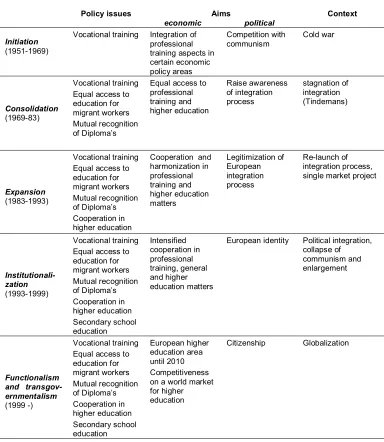
Table 1: Stages in the development of EC/EU education policy
Policy issues Aims Context
economic political
Initiation (1951-1969)
Vocational training Integration of professional training aspects in certain economic policy areas Competition with communism Cold war Consolidation (1969-83) Vocational training Equal access to education for migrant workers Mutual recognition of Diploma’s
Equal access to professional training and higher education Raise awareness of integration process stagnation of integration (Tindemans) Expansion (1983-1993) Vocational training Equal access to education for migrant workers Mutual recognition of Diploma’s Cooperation in higher education
Cooperation and harmonization in professional training and higher education matters Legitimization of European integration process Re-launch of integration process, single market project
Institutionali-zation (1993-1999)
Vocational training Equal access to education for migrant workers Mutual recognition of Diploma’s Cooperation in higher education Secondary school education Intensified cooperation in professional training, general and higher education matters
European identity Political integration, collapse of communism and enlargement Functionalism and transgov-ernmentalism (1999 -) Vocational training Equal access to education for migrant workers Mutual recognition of Diploma’s Cooperation in higher education Secondary school education European higher education area until 2010 Competitiveness on a world market for higher education
Citizenship Globalization
8
practically the same. Its main purpose targeted the functioning of newly established Single Market, accompanied with however slightly increased efforts by the European Commission to establish a political identity among the EU citizens.
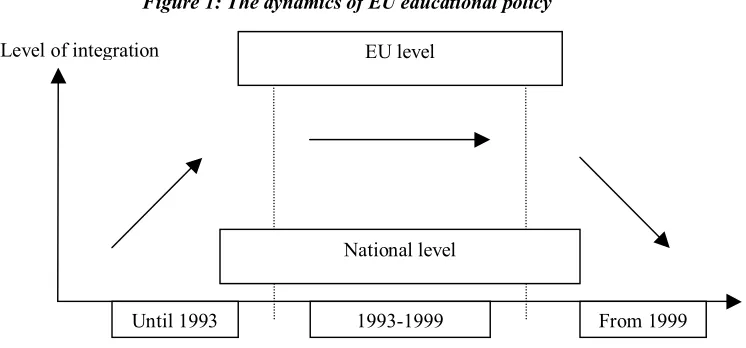
[image:8.595.124.497.211.385.2]The change of EU education policy aims, as occurred after 1999 is not a result of intra-EU legal or political considerations or alterations, but almost exclusively a consequence of transformations on global and subsequently national level. During 1999, EU education policy enters a new stage, allowing the analyst to interpret the time between 1993 and 1999 only as a kind of interim period in which more salient issues dominated the EU agenda, like Economic and Monetary Union and the preparations for Eastern enlargement (Figure 1).
Figure 1: The dynamics of EU educational policy
The new phase, beginning around 1999, suggested here is eventually accompanied by the proclaimed policy change. The new period is marked by a revived expansionism especially in the field of higher education. In order to avoid future disputes about legal competences, the EU member states sought for a new political cooperation strategy, which was found in intensified transgovernmentalism. This new strategy implied two basic features: Firstly, the extension of cooperation matters on an extra-EU basis (notably the Bologna process); secondly, the introduction of new decision-making mechanisms within the EU, notably the Open Method of Coordination (OMC). A new set of strategic goals accomplishes the novel policy design, such as the creation of a European Higher Education Area until 2010, the introduction of European educational quality standards and the positioning of European education as a factor of global competition.
Explaining policy change
The functional-economic turn
Until about the year 1999 it seemed that all education-related measures necessary for the functioning of the single market could be subsumed under the new provisions of primary EU legislation. EU education policy would have therefore being continued as a rudimental, supplementary policy responsible for the approximation of vocational training, the framework for the EU education programmes and a collection of various actions embracing a European dimension in education. Two factors, however, have not only mainly contributed to renewed and extended education activities in the EU but to a general re-definition of this policy altogether.
The first new parameter refers to rapid sectoral change in Europe. In its communication ‘Fostering structural change: an industrial policy for an enlarged Europe’ (European Com-mission 2004a: 2), the European ComCom-mission recognizes the continued demise of industrial production in the EU member states which threatens to lead to a process of deindustrialization in Europe (ibid). Since Europe has not been able to control the delocalization of industrial production with high labour density (OECD 1996), the unchanged problem of unemployment
National level EU level
Until 1993 1993-1999 From 1999
9
(Euro area: from 7.5% in 1991 to 8.8% in 2004; source OECD 2004) remains a central concern in the European economies. In the rapid and parallel growth of information technology the Commission sees, however, the chance for Europe to manage the sectoral change successfully, accompanied ‘by policies that facilitate the development and the use of knowledge (European Commission 2004a: 2).
The urgent need for the establishment of a professionalized higher education area in Europe is amplified by a second feature that has emerged in the new 21st century, namely the globalization of education. According to OECD figures, cross-border higher education through student, academic staff and professional mobility has grown considerably since the 1980s(OECD 2005: 2). Internationalization of higher education, according to the OECD, has triggered national pressures for monitoring and quality insurance as a ‘determining factor affecting the status of that higher education system at the international level’ (ibid: 3). The Council of Europe in line with UNESCO noted a ‘rapid development of transnational education, and of its impact on higher education globally, but also specifically in the Europe Region (Council of Europe/UNESCO 2001). The times, when the highly nationalized education systems in Europe existed largely independently alongside each other, when mobility and exchange largely depended on the motivation of the single student or academic are certainly over.
Globalization has not only contributed to a ‘borderless world of higher education’ (Council of Europe/UNESCO 2001) but has introduced as a new element increased contestation, especially between Europe, the United States and increasingly Asia:
With improvements in infrastructure, knowledge acquired in various high-tech sectors, high levels of education, increasingly qualified workforces, high-quality universities and research costs lower than those in Europe, some emerging countries, particularly China and India, have advantages which cannot be ignored by European or American industrial groups (European Commission 2004a: 13).
Initially developed on the basis of international cooperation and exchange, the international area of education and research has increasingly incorporated market features of rivalry and competition. This is not only reflected in the struggle for the best researchers and ‘high potentials’ (European Commission 2001a) but also in the increasingly contested recruitment of students from Asia and notably China. Student flows have become an important indicator for successful education systems. Until today, the USA attracts by far most of foreign students. Although Germany still accounts for one of the most sought after places to study in the world, it has been replaced since the mid-1990s by the United Kingdom, now second behind the US (OECD 2003).The trend in foreign studies in the last fifteen years has seen the United States having the largest increase of students, with Australia showing the next biggest rise, followed by the UK and Japan (Hatakenaka 2004). The appearance of global rankings about the best research institutions, departments and Universities compliment the picture. And especially since many European states have recently implemented Anglo-Saxon style study schemes in tertiary education (Bachelor and Master), it becomes evident that with the beginning of the 21st century a worldwide competition has been launched for not only the best but also the most attractive education system. The so-called ‘Bologna process’ is the direct response of the member states to these developments. ‘The Bologna Declaration of June 1999 has put in motion a series of reforms needed to make European Higher Education more compatible and comparable, more competitive and more attractive for our own citizens and for citizens and scholars from other continents’ (European Commission 2003a: 2). Since tertiary education had become a crucial factor for global competitiveness (European Commission 2004a: 10), the European Community felt pressured to act. Analyzing Europe’s strengths, the Commission recognized ‘an overall favorable environment, such as the quality of its education and infrastructures, the performances of public services, and the quality of its social dialogue’ (ibid: 14).
10
EU education policy must contribute. The prioritization of education in this period is reflected in the Amsterdam Treaty preamble, which aims ‘to promote the development of the highest possible level of knowledge for their peoples through a wide access to education and its continuous updating’. The policy aims shift from their predominantly internal function to an increasingly external focus. Having mainly been contributing to market-integration policy (and the four freedoms), the new purpose becomes increasingly attached to the EU’s competition policy.
Until the mid 1990s, the EU education policy basically functioned as a ‘contribution to the development of quality education’ as set out in article 126 of the EC-Treaty. In its own interpretation, the European Commission assigned a dual role to EU education policy. Firstly, it served to implement the four freedoms (European Commission 1989) and the subsequent single market project (European Commission 1989) as to contribute to employment (European Commission 1993a), equal opportunities (ibid) and social cohesion (European Commission 2004b). Secondly, EU education policy was used to introduce a ‘European dimension in education’ (Council of the European Communities 1988) - eventually opening into a future ‘European education area’ (European Commission 2000) - in order to increase knowledge (Council of the European Communities 1983) and awareness (European Commission 1993) of the European integration process. This political dimension aimed at ‘civic education’ (Council of the European Communities 1963), a ‘people’s Europe’ (Tindemans 1976), the increase of political participation (ibid), the development of a European citizenship (European Commission 1993b), and even the creation of a European identity (European Commission 1993c) obviously addressing the legitimacy and democratic deficit of the European Union. Various factors have contributed to the fact that with respect to its political dimension the EU educational policy has failed. The controversies about the Maastricht Treaty, the introduction of the single currency, the 1995 enlargement and the prospect of ten new member states in 2004, the predominance of national discourse, communication and media structures and finally the insufficient implementation of the ‘European dimension in education’ supported growing skepticism in public opinion which could not be balanced by EU educational measures.
In education related documents the European Commission has recently widely neglected political education as an identity-creating tool and instead increasingly focuses on the economic value of education. This change may be best demonstrated by two Commission papers on education, one being published in 1995 (European Commission 1995) and the other in 2002 (European Commission 2002). Whereas the White Paper still includes the aim of a broad and general knowledge society, in its 2002 follow-up communication on Lisbon the Commission necessarily accepted the Lisbon strategy, which narrowed down and refined the goal towards a ‘knowledge-based economy’. In its new definition of EU education policy, the Commission applies a strong emphasis on functional-economic goals: […] economic growth is determined, in the first instance, by productivity growth, which itself depends on various factors: investment in capital and in ICT, technological progress, organizational moderniza-tion, and education
(
European Commission 2004a, 24).
The common position of Council and Commission on EU education reads as follows:Human resources are the European Union's main asset. They are central to the creation and transmission of knowledge and a determining factor in each society's potential for innovation. Investment in education and training is a key factor of the Union's competitiveness, sustainable growth, and employment and therefore a prerequisite for achieving the economic, social and environmental goals set in Lisbon for the European Union (European Council 2004).
11
The study of all EU-education related documents in the last ten years indicates a strong economization and functionalization, due to rapid and fundamental changes in Europe’s economic environment. The originally equally important political wing of EU education policy has been minimalised, leaving only EU Citizenship education on the current political agenda. As Trondal observed, the 5th framework programme of the EU strongly reflected questions of citizenship and identity; its predessor predominantly deals with technological and economic fields of research, providing only one theme with regard to citizenship and governance (Trondal 2002: 9). The turn from a politico-economic to economic-functional philosophy towards the role of education in the European integration process indicates a strengthened link between economy and education, the latter becoming rather a tool for economic progress and global competitiveness. Changes in the global economy are however not the only driving forces behind this change in educational policy aims. The second and not least powerful factor lies in the decision of the member states to change the locus of supranational coordination of the European educational project and hence to switch from the traditional community method to a new form of EU transgovernmentalism.
The transgovernmentalist turn
In order to justify the claim of policy change, I would like to present another crucial factor in order to support the argument that EU educational policy after 1999 has not only been subject to major alterations, but developed into of a new kind of policy at all. Alone the assessment of policy contents, strategy and aims may not be sufficient, since a considerable part of what policy consists of belongs to its legislative nature – or to be more precise – to the process of decision-making.
As the Graph 1 shows, between the mid-1970s and 1991 the Council of Ministers increasingly dealt with education matters. First limited to vocational training measures, the scope of EC education soon opened qualitatively and quantitatively towards higher and secondary education.
Graph 1: Council legislation in education1960-20031
0 5 10 15 20 25
1
961 1963 1965 1967 1969 9711 1973 1975 1977 1979 1981 1983 1985 1987 1989 1991 9931 1995 1997 1999 2001 2003
Vocational Training General education
National education systems in Europe are still perceived as part of the national societies and as a cornerstone of Europe’s cultural diversity. Above that, education policy is possibly the last remaining state instrument for political socialization, identity formation and creating legitimacy. Supranational coordination of education matters therefore followed strict principles, such as non-harmonization and subsidiarity. In order to avoid ‘uploading’ educational competence to and ‘top-down’ (binding) legislation from the supranational level, the EC member states in the 1970s developed a special mode of decision-making in the Council, called the ‘mixed formula’ (‘Resolution of the Council and of the Ministers of
1 Data base: EUR-Lex; time frame: 1960-2004; 1187 EU documents on education; filter ‘Council of Ministers’ and ‘secondary ‘legislation’; 220 documents found with direct relevance to education: regulations (13), directives (40), decisions (30), recommendations (3), conclusions (5), mixed conclusions (6), resolutions (10), mixed resolutions (7), guidelines (1).
12
Education, meeting within the Council’). The nature of this clause is strictly inter-governmental, which allowed taking decisions within the institutional setting but outside the legal framework of the Community treaties. This mode generated the so-called ‘soft law’ which became a prominent feature in the phase of EC education policy consolidation. It not only protected national sovereignty but also kept the influence of the Commission and European Parliament at the lowest possible level. It was only with regard to the education programmes (from 1986 onwards) and after the inclusion of the educational articles in the Maastricht treaty that the European Commission became an actor in this policy area (Graph 2).
Graph 2: Commission legislation in education (1968-2002)2
0 5 10 15 20 25 30
196
8
197
0
197
2
197
4
197
6
197
8
198
0
198
2
198
4
198
6
198
8
199
0
199
2
199
4
199
6
199
8
200
0
200
2
This ‘mixed formula’, however, entailed a considerable degree of legal uncertainty which caused enduring constitutional problems in federal states, where sub-national states held competences in education matters, notably Germany. It was therefore the German government on behalf of the Länder that insisted on the clarification of education competences in the Maastricht negotiation, also because of another feature of community policy making until the 1990; that is the jurisdiction of the European Court of Justice. Whereas the above described measures in EU education policy left the mode of implementation to the subsequent administrative body, another more direct method of Europeanization did not grant such flexibility. Often labeled as ‘back-door integration’ or ‘Europeanization without European policy making’ certain rulings of the European Court of Justice directly referred to the education sector, demanding legal approximation at member state level. Reservations about the Court’s competence to rule on these matters because of the absence of legal provisions were rejected several times by the Luxembourg judges, which usually applied a very flexible and broad definition of vocational training. In a number of judgments in which EC citizens claimed equal treatment with nationals, the Court derived its indirect competence on educational matters from combining various treaty provisions. The most prominent articles being referred by the ECJ were art. 6 EEC-T (‘non-discrimination’), art. 48 EEC-T (‘freedom of movement of workers’), and art. 128 EEC-T (‘common provisions on vocational training’). As Fechner (1994) observed, the prohibition of discrimination has become the central principle of European education legislation. Soon after the Maastricht Treaty came into force, the EU member states realized that the new educational provisions only clarified the competence struggle between Commission and Council, but it did not prevent the European Court of Justice to continue the application of EU legislative principles to educational matters (Graph 3).
2 Data base: EURLex; time frame: 1960-2004; 1187 EU documents on education; filter ‘European Commission’; 210 documents found with direct relevance to education: regulations (1), directives (5), decision (1), recommendation (1), reports (63), communications (25), miscellaneous (guidelines, Green papers, white papers, joint declarations: 114).
13
Graph 3: ECJ jurisdiction on education (1970-2004)3
0 1 2 3 4 5 6 7 8 9
1
970 1972 1974 1976 9781 1980 1982 1984 1986 1988 1990 1992 1994 9961 1998 2000 2002 2004
Since the mid-1990s, the EU member states started to realize a dilemma: The increased significance of education for Europe’s competitiveness, the growing demands for internationalization, and rising pressures from globalization demanded more political activity and cooperation on European level. At the same time there was common determination to detach future mutual activities from judicial scrutiny of the ECJ. Hence, the EU member governments started to search for a new mode of policy-making which needed to fulfill the following requirements: Firstly, allowing the member states to permanently stay in control of the decision-making process, especially with regard to agenda-setting, which was traditionally occupied by the European Commission; secondly, allowing to include the EU Commission with its operational infrastructure and its rich resources of information, experience and research capacities; thirdly, securing EU education from package-deals; fourthly, disabling ECJ scrutiny; and finally, enabling non-EU countries to join common efforts in education.
The final decision taken in Lisbon in the year 2000 (in relation to the ‘Manifesto on the Future of Europe’) was to base and scrutinize future decisions on education on the ‘open method of coordination’ (OMC).
‘The open method of co-ordination is used on a case by case basis. It is a way of encouraging co-operation, the exchange of best practice and agreeing common targets and guidelines for Member States […]. It relies on regular monitoring of progress to meet those targets, allowing Member States to compare their efforts and learn from the experience of others.
In some areas, such as employment and social policy or immigration policy, it sits alongside the programme-based and legislative approach; in others, it adds value at a European level where there is little scope for legislative solutions. This is the case, for example, with work at a European level defining future objectives for national education systems (European Commission 2001b).
This open method reflects a general tendency in EU politics towards more flexibility and less supranational regulation. The new strategy of ‘intensive transgovernmentalism’ (Wallace 2001) seems to have put an end the long pursued competence-creep in EU policy-making, as Pollack (2000) observed. On institutional level the OMC introduces a distinct circle of key international players with special arrangements for cooperation in order to deliver substantive joint policy. It encourages the active involvement of the European Council, with the predominance of the Council of Ministers; a limited role is foreseen for the Commission whereas European Parliament and ECJ are basically excluded. The open method of co-ordination introduces a new mode of governance in the EU which allows policy-making
3 Data base: EUR-Lex; time frame: 1960-2004; 1187 EU documents on education; filter ‘European Court of Justice’; 64 judgments and preliminary ruling found with direct relevance to education.
14
without legislating (Heritier 2002), marking ‘a shift from coercive “top-down” imposition to negotiated co-ordination and imitation’ (Dyson and Goetz 2003) This has resulted in a novel attitude towards Europeanization in education, which Jeffery describes as ‘roll-back’ or ‘de-Europeanization’ (2003). For example, the number of EU projects governed by the European Commission has been reduced recently in favour of a more de-centralized administration by the member states.
The change in EU education policy-making basically introduces a new policy regime, in which the EU as an institutional system only occupies a part with limited control and influence. It changes the locus of policy co-ordination locus away from Brussels to national capitals and summits (Paris, Bologna, Berlin, Malmo) which places the member states back in the centre of policy shaping. For the European Commission as agent, however, the open method of coordination does not only entail restrictions on active participation. Following Heritier (2002) the Commission recognizes the OMC as ‘a possibility to expand European policies in the face of national governments’ resistance’ and to keep a ‘foot in the door’ of transnational cooperation.
EU Education policy, having gone through a ten-year phase of relative peaceful policy-sharing, has re-entered the arena of policy contestation. In 2003, the Commission has made it clear that it does not intend to give policy competences back to the member states and that it would not welcome further attempts to outsource policy. With regard to the Bologna process, the Commission stated that – although it supported ‘most [sic!] of the member states action lines’(2003a), ‘generally speaking, the case for unintegrated parallel action will be increasingly weaker in the future, be it in higher education or in vocational training, unless it is manifestly more ambitious and more effective(European Council 2004: 16).
Conclusion
In the last decade EU education policy has undergone a process of transformation or change. The nature of this change is firstly the de-politization with regard to functions national education policies normally fulfil (legitimization, democratization, identity). Instead, a strong emphasis is placed on utilization of education as an instrument for employment and global economic competitiveness. Secondly, one can observe a strong tendency towards intensive transgovernmentalism. The open method of coordination is a clear indicator for a two-faced process which can be witnessed with the beginning of the 21st century. This process is characterized by a common agreement on member state level that the higher education in Europe has increasingly become subject to global competition and that its success in the future to a large extend depends on intense cooperation in order secure transparency, permeability and quality. This understanding is accompanied by the member states decision to place new common action on a policy regime, which to a great extend excludes the institutions of the European Union, namely Court of Justice and European Parliament. The European Commission is assigned the role of a classical agent. The new policy-making formula which is centrally based upon the open method of coordination redirects educational policy-formulation back to the national ministries. Therefore, in contrast to Ruberti (2001) and Trondal (2002) I do not see the advent of supranational education policy. Although European education has experienced a qualitative and quantitative boost in the last decade, the undisputed need for cooperation has not translated in supranational integration, as neo-functional theory would have expected. The political and legal restrictions on EU education in the Maastricht Treaty could have sufficed as an explanation for why the wide-ranging process of Europeanization in higher education is located outside the EU institutional framework. I argue, however, that the decision to place the Bologna process outside the EU is better explained by deliberative institutional choice than absence of alternatives.
15
References
Andersen, S. and K. Eliassen (2001), Making Policy in Europe (London: Sage, 2nd ed.). Beukel, E. (2001), ‘Educational Policy: Institutionalization and Multi-Level Governance’, in
S. Anderson and K. Eliassen (eds), Making Policy in Europe (London: Sage), pp. 124-39.
Council of the European Communities (1963). Decision of 2 April 1963 Laying Down General Principles for Implementing a Common Vocational Training Policy
(63/266/EEC).
Council of the European Communities (1983). Schlußfolgerungen der gemeinsamen Tagung Rat (Arbeit und Sozialfragen)/Rat und im Rat vereinigte Minister für Bildungswesen vom 3. Juni 1983 betreffend den Übergang der Jugendlichen von der Schule in das Erwachsenen- und Berufsleben. (Luxemburg: Office for Official Publications of the European Communities).
Council of the European Communities (1988a), European Educational Policy Statements
(Luxemburg: Office for Official Publications of the European Communities).
Council of the European Communities (1988b). Entschließung des Rates und der im Rat vereinigten Minister für das Bildungswesen zur Europäischen Dimension im Bildungswesen vom 24.5.1988. – In: Amtsblatt 088, C 177 vom 6. Juni 1988, 2. Council of the European Union (2004). Education & Training 2010. ‘The success of the
Lisbon strategy hinges on urgent reforms — Joint interim report of the Council and the Commission on the implementation of the detailed work programme on the follow-up of the objectives of education and training systems in Europe.’ Official Journal C 104 , 30/04, pp. 1 – 19.
Council of Europe/ UNESCO (2001) Code of Good Practice in the Provision of Transnational Education (adopted by the Lisbon Recognition Convention Committee at its second meeting, Rīga, 6 June).
Dyson, K. and K. Goetz (2003), ’Living with Europe: Power, Constraint, and Contestation’, in K. Dyson and K. Goetz (eds), Germany, Europe and the Politics of Constraint
(Oxford: Oxford University Press), pp.3-36.
EUR-Lex. The Access to European Union Law. http://europa.eu.int/eur-lex/lex/en/index.htm European Commission (1989). Mitteilung der Kommission an den Rat: Allgemeine und
berufliche Bildung in der Europäischen Gemeinschaft. Mittelfristige Leitlinien 1989-1992. KOM, (89) 236 endg. vom 2. Juni 1989 (Luxemburg: Office for Official Publications of the European Communities).
European Commission (1993a). Guidelines on Education and Training for the medium term 1989-1992. COM 263 (89), 2.6.1993. Brussels
European Commission (1993b). Green Paper on the European Dimension of Education. COM (93) 457 final, 29.9.1993 (Brussels).
European Commission. Wachstum, Wettbewerbsfähigkeit, Beschäftigung. Herausforderungen der Gegenwart und Wege ins 21. Jahrhundert - Weißbuch. (Luxemburg: Office for Official Publications of the European Communities).
European Commission (1993c). Guidelines for Community action - in the field of education and training. - Commission Working Paper -. COM (93) 183 final. (Brussels). European Commission (1995). White Paper on Education and Training. Teaching and
Learning. Towards the Learning Society (Luxemburg: Office for Official Publications of the European Communities).
European Commission (2000). Memorandum zum lebenslangen Lernen, 30.10.2000 (SEK). (Luxemburg: Office for Official Publications of the European Communities).
European Commission (2001a). A Mobility Strategy for the European Research Area. COM(2001) 331 final, 20.6.2001 (Brussels 2001).
European Commission (2001b). European Governance. A White Paper. Brussels, 25.7.2001 COM (2001) 428 final (Brussels).
16
European Commission (2003a). Berlin Conference of European Higher Education Ministers. Realizing the European Higher Education Area. Contribution of the European Commission Berlin, 18/19 September 2003 (Brussels).
European Commission (2003b) Cooperation on Policy Issues. http://europa.eu.int/comm/ education/ policy_en.html).
European Commission (2004a). Fostering Structural Change: An Industrial Policy for an Enlarged Europe. Communication COM(2004) 274 final (Brussels).
European Commission (2004b). Green paper - Equality and non-discrimination in an enlarged European Union. COM/2004/0379 final. (Brussels).
European Council (2000). Presidency Conclusions. Lisbon European Council 23 and 24 March 2000 (Brussels).
Fechner, F. (1994), ’Einwirkungen des Europarechts auf die Nationale Bildungsordnung’, in R. Lassahn and B. Ofenbach (eds.) Bildung in Europa. Beiträge zur Pädagogik
(Frankfurt).
Hatakenaka, S. (2004). ‘Internationalism in Higher Education: A Review’. HEPI Papers. (http://www.hepi.ac.uk/downloads/12Internationalism%20in%20Higher%20Educatio n%20A%20Review.pdf).
Heywood, A. (2002), Politics (Basingstoke: Palgrave 2nd ed. ).
Heritier, A. (2002), ‘New Modes of Governance in Europe: Policy-Making without Legislating?’ In: A. Héritier (ed.). Common Goods: Reinventing European and International Governance (Rowman & Littlefield Publishers: Lanham, Md.), pp. 185-206.
John, P. (2002), Analysing Public Policy (London: Continuum).
Lowi, T and B. Ginsburg (1996), American Government. Freedom and Power (New York: Norton).
Moravcsik, A. (1998), The Choice of Europe. Social Purpose and State Power from Messina to Maastricht. (London: UCL Press).
Moravcsik, A (2001), ‘Federalism in the European Union: Rhetoric and Reality’, in K. Nicolaidis and R. Howse (eds) The Federal Vision: Legitimacy and Levels of Governance in the United States and the European Union (Oxford: Oxford University Press), pp. 161-190.
OECD (1996).Technology, Productivity and Job Creation, Highlights. (Paris, OECD). OECD (2003). Education at a Glance. (Paris, OECD).
OECD (2004) Economic Outlook No. 76 Annex Tables - Table of Contents OECD Economic Outlook No. 76 - Statistical Annex Tables (Paris: OECD).
OECD (2005). Annex Guidelines for Quality Provision in Cross-Border Higher Education. Jointly Elaborated by UNESCO and the OECD. 15/02/2005 Draft (Paris: OECD). Pollack, M. (2000), ‘The End of Creeping Competence? EU Policy-Making Since Maastricht’,
Journal of Common Market Studies, 38/3.
Richardson, J. (1996), European Union – Power and Policy-making (London: Routledge) Ruberti, A. (2001)’ The Role and Position of Research and Doctoral Training in the European
Union’, in J. Huisman, P. Maassen and G. Neave, Higher Education and the Nation-State. The International Dimension of Higher Education (Amsterdam: Pergamon). Thiele, B. (2000), Die Bildungspolitik der Europäischen Gemeinschaft (Münster: LIT). Trondal, J. (2002). ‘The Europeanisation of Research and Higher Educational Policies – Some
Reflections’, European Integration online Papers, 6.
Sbragia (2003), ‘Key Policies’, in E. Bomberg and A. Stubb (eds), The European Union - How Does it Work? (Oxford: OUP).
Tindemans, L., (1976). Report on European Union. (Brussels: Ministry on Foreign Affairs). Walkenhorst, H. (2005), ‘Europeanisation of the German Education System’ (Paper presented
at the German Studies Association Conference in Washington, D.C. 3. October 2005).