ζ
o
ui
o
o
o
Fischerei
J a h r b u c h 2 0 0 0
Fisheries
Y e a r b o o k 2 0 0 0
Pêche
Annuaire 2 0 0 0
' i l l
D E
Eurostat hat den Auftrag, der
Europäischen Union
einen qualitativ hochwertigen statistischen Informationsdienst bereitzustellen.
Eurostat-Reihen: ein an den Bedarf aller Nutzer angepaßtes Angebot.
Pressemitteilungen: Sie enthalten die Schlüsselzahlen zur EU, zu ihren Mitgliedstaaten und ihren Partnern. Die Pressemitteilungen werden kostenlos zur Verfügung gestellt. Unmittelbar nach ihrer Veröffentlichung sind sie auch im Internet zu finden:
www.europa.eu.int/comm/eurostat/
Statistik k u r z g e f a ß t : aktuelle Zusammenfassungen der wichtigsten Ergebnisse von statistischen Erhebungen, Studien und Analysen.
Sdiliisselindikatoren: Diese Reihe enthält in einem handlichen Buch von maximal 100 Seiten die wichtigsten Indikatoren zu einem Themenbereich oder einem Teilbereich.
P a n o r a m a d e r Europäischen Union: In dieser Reihe geht es um die Merkmale und Trends in multisektoralen
Themenbereichen oder sektoralen Teilbereichen.
M e t h o d e n und N o m e n k l a t u r e n : Diese Veröffentlichungen richten sich an Fachleute; sie beschreiben die Methoden und Systematiken, die für einzelne Themen, Themenbereiche oder Sektoren verwendet werden.
Detaillierte Tabellen: Diese Veröffentlichungen richten sich an Fachleute; darin sind ein Teil oder die Gesamtheit der statistischen Angaben zu einem Thema, Themenbereich oder Sektor zu finden. Studien und Forschung: Zusammenfassungen der Ergebnisse von Studien und Forschungsarbeiten im Bereich der europäischen Statistik.
Kataloge: Die kostenlosen Kataloge informieren rasch und genau über das Produkt und Dienstleistungsangebot von Eurostat.
Our mission is to provide the
European Union
with a highquality statistical information service
EurOStat'S collections are adapted to the needs of all users. E M
ψ
Press releases: key figures on the EU, the Member States and their partners. They are provided free of charge. They are also available on the Internet as soon as they are published: www.europa.eu.int/comm/eurostat/.
Statistics in focus: uptodate summaries of the main results of statistical surveys, studies and analyses.
Key indicators: the main indicators on a theme or subtheme in an easytocarry booklet.
P a n o r a m a o f t h e European Union: highlights the features and trends of a multisectoral theme or a sectoral subtheme.
M e t h o d s a n d nomenclatures are intended for specialists who want to consult the methodologies and nomenclatures used for a theme, a subtheme or a sector.
Detailed tables: statistical data for specialists compiled on a theme, subtheme or sector.
S t u d i e s a n d r e s e a r c h summarise the results of European statistical studies and research and are intended for specialists. Catalogues: free of charge rapid access to concise information on Eurostats products and services.
A
FR
ψ
Notre mission est de fournir à
l'Union européenne
un service d'information statistique de qualité
Les collections d'Eurostat sont une offre adaptée aux besoins de tous les utilisateurs.
Communiqués d e presse: les chiffres clés sur l'UE, les États membres et leurs partenaires. Ils sont distribués gratuitement et sont également disponibles sur Internet dès leur publication. Statistiques e n bref: synthèses actualisées des principaux résultats des enquêtes, des études et des analyses statistiques. Indicateurs clés: les principaux indicateurs concernant un thème ou un sousthème, sous la forme d'un livret facile à emporter.
méthodes e t nomenclatures: les méthodologies et les nomenclatures relatives à un thème, un sousthème ou un secteur. Tableaux détaillés: des données statistiques élaborées concernant un thème, un sousthème ou un secteur, destinées aux spécialistes.
o
Ui
o
o
e
Fischerei
Jahrbuch 2 0 0 0
Fisheries
Y e a r b o o k 2 0 0 0
Pêche
A n n u a i r e 2 0 0 0
; i
•Χ-EUROPAS KOMM,SS,ON
Γ^ΤΆ
K S H I S S S f f i ^ ^ - ™ ' "
=EUROPEAN COMMISSION I Z X l I ■ Jj$>M Agriculture and fisheries
DE
Y
Unmittelbarer Zugriff auf harmonisierte statistische Daten
E u r o s t a t D a t a S h o p s :
bieten ein umfassendes Angebot an „maßgeschneiderten" Dienstleistungen:
■*■ eine unmittelbare Bearbátung von Informationsanfragen; • eine garantiert schnelle und individuelle Antwort; • Wahl des Trägers, auf dem die statistischen Daten geliefert
werden.
Informationen können telephonisch, schriftlich, per Fax oder per EMail angefragt werden.
I n t e r n e t : ")
Die wesentlichen statistischen Nachrichten aus der Gemeinschaft
■Ar EuroIndikatoren: über 100 harmonisierte, vergleichbare und kostenlose Indikatoren der Eurozone;
* Pressemitteilungen: direkter Zugriff auf alle Pressemitteilungen von Eurostat.
Weitere Informationen finden sich auf der InternetSite unter
www.europa.eu.int/comm/eurostaty
USL
EN
Immediate access to harmonized statistical data
E u r o s t a t D a t a S h o p s : )
provide a wide range of tailor-made services: ■k immediate information searches
+ rapid and personalised response ■*■ choice of data carrier
Information can be requested by phone, mail, fax or email.
I n t e r n e t : ")
Essentials on Community statistical news * Euro indicators: more than 100 indicators on the
eurozone; harmonized, comparable, and free of charge; * Press releases: direct access to all Eurostat press releases. For further information, visit us on the Internet at:
www.europa.eu.int/comm/eurostat/
ta
FR w
Accès immédiat à des données statistiques harmonisées
E u r o s t a t D a t a S h o p s :
offrent un large éventail de prestations «sur mesure»: * la prise en charge immédiate de toute recherche d'information, * la garantie d'une réponse rapide et personnalisée,
* le choix du support de fourniture des données.
Les informations peuvent être demandées par téléphone, par courrier, par télécopie ou par courrier électronique.
I n t e r n e t
D
l'essentiel de l'actualité statistique communautaire * Euroindicateurs: plus de cent indicateurs sur la zone euro
(harmonisés, comparables et disponibles gratuitement). * Communiqués de presse: accès direct à tous les
communiqués de presse d'Eurostat.
Pour plus d'informations, visitez le site Internet d'Eurostat:
www.europa.eu.int/comm/eurostal/
Zahlreiche weitere Informationen zur Europäischen Union sind verfügbar über Internet, Server Europa (http://europa.eu.int). A great deal of additional information on the European Union is available on the Internet
It can be accessed through the Europa server (http://europa.eu.int).
De nombreuses autres informations sur l'Union européenne sont disponibles sur Internet via le serveur Europa (http://europa.eu.int). Bibliografische Daten befinden sich am Ende der Veröffentlichung.
Cataloguing data can be found at the end of this publication. Une fiche bibliographique figure à la fin de l'ouvrage.
Luxembourg: Office des publications officielles des Communautés européennes, 2000
ISBN 92-894-0070-6
© Europäische Gemeinschaften, 2000 © European Communities, 2000 © Communautés européennes, 2000 Printed in Luxembourg
m
eurostat
EUROSTAT
L2920 Luxembourg — Tél. (352) 43 011 — Télex COMEUR LU 3423 Rue de la Loi 200, B1049 Bruxelles — Tél. (322) 299 11 11
D E Eurostat ist das Statistische Τ Amt der Europäischen
Gemeinschaften. Es hat den Auftrag, die Union mit europäischen
Statistiken zu versorgen, die Vergleiche zwischen Ländern und Regionen ermöglichen. Eurostat konsolidiert und harmonisiert die in den Mitgliedstaaten erhobenen Daten.
Um die weite Verbreitung der gewaltigen verfügbaren Datenmenge zu gewährleisten und den einzelnen Nutzern zu helfen, diese
Informationen richtig zu verwenden, hat Eurostat sein Veröffentlichungs und Dienstleistungsprogramm geschaffen. Um sich gezielt an das breite Publikum oder an Fachleute wenden zu können, wurden für die einzelnen Nutzergruppen spezielle Reihen entwickelt.
Im Rahmen des neuen Programms hat Eurostat eine WebSite entwickelt. Sie umfaßt ein breites Angebot von OnlineInformationen über die Erzeugnisse und
Dienstleistungen, Pressemitteilungen, Kataloge, OnlineVeröffentlichungen sowie Indikatoren für die Eurozone.
E N Eurostat is the Statistical Office
'Ψ of the European Communities. Its task is to provide the European Union with statistics at a European level, that allow comparisons to be made between countries and regions. Eurostat consolidates and harmonizes the data collected by the Member States.
To ensure that the vast quantity of accessible data is made widely available, and to help each user make proper use of the information, Eurostat has set up a publications and services programme.
As part of the new programme Eurostat has developed its website. It includes a broad range of online information on Eurostat products and services, newsletters, catalogues, online publications as well as indicators on the eurozone.
Yves Franchet Director-General
F R Eurostat est l'Office statistique
Y des Communautés
européennes. Il a pour tâche de fournir à l'Union européenne des statistiques au niveau européen, qui permettent des comparaisons entre pays et régions. Eurostat consolide et harmonise les données collectées par les États membres.
Pour assurer que l'ensemble des données disponibles soit largement accessible et pour aider chaque utilisateur à faire bon usage de toute cette information, Eurostat a mis en place un programme de publications et de services.
Dans le cadre du nouveau programme, Eurostat a développé son site Internet. Celuici comprend toute une série d'informations en ligne sur les produits et les services d'Eurostat, ses bulletins d'information, ses catalogues et ses publications en ligne ainsi que des indicateurs sur la zone euro.
Yves Franchet Directeur-Général
Weitere Auskünfte zu den in dieser Veröffentlichung enthaltenen Angaben erteilt gerne: David Cross
Referat "Fischerei"
Direktion "Agrar-, Umwelt- und Energiestatistik" Eurostat,
L-2920 Luxembourg
Tel: +352 4301 37249 Fax: +352 4301 37318
Email: [email protected]
For further information regarding the data contained in this publication please contact: Mr David Cross,
Sector "Fisheries"
Directorate for Agriculture, Environment and Energy statistics, Eurostat,
L-2920 Luxembourg
Tel: +352 4301 37249 Fax: +352 4301 37318
Email: [email protected]
Pour toute information complémentaire sur les données contenues dans le présent document, veuillez vous adresser à:
David Cross, Secteur "Pêche"
Direction "Statistiques de l'agriculture, de l'environnement et de l'energie" Eurostat,
L-2920 Luxembourg
Tel: +352 4301 37249 Fax: +352 4301 37318
Email: [email protected]
Manuskript abgeschlossen im September 2000
Manuscript completed in September 2000
INHALTSVERZEICHNIS
Zeichen und Abkürzungen 4
Anmerkungen 5
Karte der Fanggebiete 21
Erzeugung insgesamt 24
Fischzucht insgesamt 26
Fänge
Alle Gebiete 28
Nordwestatlantik 30
Nordostatlantik 32
Mittlerer Ostatlantik 34
Mittelmeer 36
Südwestatlantik 38
Südostatlantik 40
Westlicher Indischer Ozean 42
Binnengewässer 44
Anlandungen
Menge 46
Wert 47
Außenhandel
Einfuhren: Menge 50
Wert 51
Ausfuhren: Menge 52
Wert 53
Handelsbilanz: Menge 54
Wert 55
Fischereiflotte
Anzahl 58
BRT insgesamt 59
Maschinenstärke insgesamt 60
Beschäftigung 62
ZEICHEN UND ABKÜRZUNGEN
Nichts Weniger als die Hälfte der verwendeten Einheiten Kein Nachweis vorhanden
E U.1 5 EGMitliedstaaten, insgesamt
B Belgien
BLEU/UEBL BelgischLuxemburgische Wirtschaftsunion
PK Dänemark
Q Deutschland
|T|_ Griechenland
E F IRL I
NL
S
Spanien Frankreich Irland Italien
l_ Luxemburg
Niederlande
A Österreich
ρ Portugal
PIN Finnland
Schweden
UK Vereinigtes Königreich
IS Island
NO Norwegen
EEA Europäischer Wirtschaftsraum
BG Bulgarien
CY Zypern
CZ Tschechische Republik
EE Estland
HU Ungarn
LT Litauen
LV Lettland
MT Malta
PL Polen
RO Rumänien
SI Slovenien
SK Slowakei
TR Türkei
CA Kanada
CL Chile
CN China
JP Japan
PE Peru
RU Russische Föderation
US USA
CECAF Fishery Committee for the Eastern Central Atlantic Fisheries
FAO Food and Agriculture Organisation of the United Nations
GFCM General Fisheries Commission for the Mediterranean
ICCAT International Commission for the Conservation of Atlantic Tunas
ICES International Council for the Exploration of the Sea
ICSEAF International Commission for the Southeast Atlantic Fisheries
ANMERKUNGEN
Einführung
Die Datenbank New Cronos1' von Eurostat zur Fischereistatistik enthält etwa 850 000 Zeitreihen und 17 Millionen Daten zu den Fangmengen, den Anlandungen, der Aquakulturerzeugung, der Fischereiflotte, dem Außenhandel mit Fischereierzeugnissen, der Beschäftigung und den Versorgungsbilanzen für Fischereierzeugnisse. Soweit es die Daten und Mittel erlauben, wurde der Inhalt der Datenbank hinsichtlich der Länge der Zeitreihen und der Länderabdeckung maximiert.
Die Veröffentlichung soll eine Zusammenfassung der Fischereidaten für den Zeitraum 1990-1999 für die Mitgliedstaaten des EWR, die EU-Beitrittskandidaten und sonstige wichtige Fischereinationen bieten, zu denen Daten in New Cronos verfügbar sind. Nach jeder Tabelle finden sich detaillierte Angaben zu den Daten, die zu dem jeweiligen Thema in den Datenbank vorhanden sind.
Diese Veröffentlichung begleitet die CD-ROM Fischereistatistik 1950-1999, auf der sich eine Kopie der New-Cronos-Software und die Daten zur Fischereistatistik befinden. Die Veröffentlichung und die begleitende CD-ROM enthalten die zum Zeitpunkt der Veröffentlichung verfügbaren Daten. New Cronos wird kontinuierlich aktualisiert; dem Nutzer dieser Informationen wird daher empfohlen, die Datenbank online für die neusten Informationen zu konsultieren.
Datenquellen
Das fischereistatistische Programm von Eurostat hängt in hohem Maße von der Zusammenarbeit mit anderen internationalen Organisationen ab, die für Fischereistatistiken zuständig sind. Diese Zusammenarbeit wird im Rahmen der Arbeitsgruppe für die Koordinierung der Fischereistatistik (CWP) koordiniert. Eurostat ist für diese Beiträge zu seinem Arbeitsprogramm, ohne die die Quantität und die Qualität der Daten in New Cronos recht begrenzt wären, sehr zu Dank verpflichtet.
Zwar wurden alle Bemühungen unternommen, vollständige, vergleichbare und harmonisierte Daten in allen von der Datenbank erfaßten und in dieser Veröffentlichung behandelten Themen zu liefern, doch sei auf die folgenden Hinweise verwiesen. Zum einen beschreiben sie kurz die im Rahmen der einzelnen Themen verwendeten Definitionen, zum anderen finden sich hier Hinweise darauf, welche Daten mit Vorsicht zu behandeln sind.
Gesamterzeugung
Die Gesamterzeugung ist die Summe aller Fangmengen und der Aquakulturproduktion. Genauere Angaben zu den beiden Komponenten der Gesamterzeugung finden sich im folgenden.
Die Gesamterzeugung wird erfaßt in Lebendgewichtäquivalenten der Produktion (für die Aquakultur) bzw. der Anlandungen (für die Fangmengen).
Aquakulturproduktion
Aquakultur ist definiert als die Aufzucht im Wasser lebender Organismen, einschließlich Fischen, Weich- und Krebstieren sowie Wasserpflanzen. Zucht wird betrieben, sobald in irgendeiner Form, beispielsweise durch regelmäßigen Besatz, Fütterung oder Schutz vor natürlichen Feinden, in den Wachstumsprozeß mit dem Ziel der Produktionssteigerung eingegriffen wird. Ferner bedeutet Zucht, daß sich die Pflanzen oder Tiere im Besitz von Einzelpersonen oder von Unternehmen befinden. Für statistische Zwecke zählen im Wasser lebende Organismen, die von einer Einzelperson oder einem Unternehmen, in deren Besitz sie sich während der Wachstumsperiode bzw. der Aufzucht befanden, gefangen oder geerntet wurden, zur Aquakultur, während im Wasser lebende Organismen, die von der Allgemeinheit mit oder ohne entsprechende Lizenzen als jedermann zugängliche Güter genutzt werden können, als Fischereiertrag anzusehen sind.
Die einzelstaatlichen Behörden der EWR-Länder übermitteln Eurostat Daten zur Aquakulturproduktion im Rahmen der Verordnung (EG) Nr. 788/96 des Rates vom 22. April 1996 über die Vorlage von Statistiken über die Aquakulturproduktion durch die Mitgliedstaaten (ABI. L1Q8 vom 1.5.1996).
Die FAO erhält Daten zur Aquakulturproduktion von den einzelstaatlichen Behörden anhand der FISHSTAT-AQ-Fragebogen. In diesem Fragebogen werden dieselben Konzepte und Definitionen wie im EU-Rechtstext verwendet, so daß die Daten der beiden Quellen vergleichbar sind. Die Fischereiabteilung der FAO überprüft die Qualität der Daten und stellt die Ergebnisse Eurostat zur Aufnahme in die Datenbank New Cronos zur Verfügung.
Die Daten werden in Lebendgewichtäquivalenten des Produktgewichts gemeldet.
Fangmenge
Die Fangmengenstatistiken werden Eurostat von den EWR-Ländern im Rahmen der folgenden EU-Rechtsvorschriften geliefert:
Verordnung (EWG) Nr. 3880/91 des Rates vom 17. Dezember 1991 über die Vorlage von Fangstatistiken durch die Mitgliedstaaten, die im Nordostatlantik Fischfang betreiben
(ABI. L365 vom 31.12.1991)
Verordnung (EWG) Nr. 2018/93 des Rates vom 30 Juni 1993 über die Vorlage von Statistiken über die Fangmengen und die Fischereitätigkeit der Mitgliedstaaten, die im Nordwestatlantik Fischfang betreiben (ABI. L186 vom 30.6.1993)
Verordnung (EG) Nr. 2597/95 des Rates vom 23. Oktober 1995 über die Vorlage von Fangstatistiken durch Mitgliedstaaten, die in bestimmten Gebieten außerhalb des Nordatlantiks Fischfang betreiben (ABI. L270 vom 13.11.1995)
Alle einzelstaatlichen Behörden sind aufgefordert, mit Hilfe einer Reihe von STATLANT-Fragebogen Daten zu Fangmengen an die FAO und die zuständigen regionalen Organisationen zu liefern. In diesen Fragebogen werden dieselben Konzepte und Definitionen wie im EU-Rechtstext verwendet. Die regionalen Organisationen und die FAO stellen Eurostat die Daten für die Nicht-EWR-Länder zur Verfügung.
Die einzelstaatlichen Behörden sind aufgefordert, Fangstatistiken für alle Fische zu liefern, die kommerziell, für den eigenen Gebrauch oder von Freizeitfischem gefangen werden. Bekannterweise sind die Daten für die von Freizeitfischem gefangenen Fische jedoch unvollständig.
Die Fangmengen werden in Lebendgewichtäquivalenten der Anlandung gemeldet (d. h. das angelandete Gewicht eines Produkts, auf das ein geeigneter Umrechnungsfaktor angewandt wird). Nicht enthalten sind also Fischmengen, die zwar gefangen, aber nicht angelandet wurden. Dazu gehört beispielsweise Fisch, der gefangen, aber auf See über Bord geworfen (keine Handelsart, zu kleine Fische usw.) sowie Fisch, der an Bord verspeist wurde.
Die Flagge eines Fischereifahrzeugs wird als primärer Hinweis auf die Nationalität eines Fang herangezogen, obwohl dieses Konzept unter bestimmten Umständen angepaßt wird (z. B. im Falle von Gemeinschaftsunternehmen oder gecharterten Fahrzeugen).
Anlandungen
Alle EWR-Länder liefern monatlich Daten über die Mengen und den Wert der in ihren Häfen angelandeten Fischereierzeugnisse und zwar im Rahmen der
Verordnung (EWG) Nr. 2104/93 des Rates vom 22. Juli 1993 zur Änderung der Verordnung (EWG) Nr. 1382/91 betreffend die Übermittlung von Daten über die Anlandungen von Fischereierzeugnissen in den Mitgliedstaaten (ABI. L191 vom 31.7.1993)
Soweit möglich werden die entsprechenden Angaben für die Nicht-EWR-Länder einer Reihe von
Die Daten beziehen sich auf die Anlandungen (ausgedrückt in Produktgewicht) aller Fischereierzeugnisse in den meldenden Ländern, unabhängig von der Nationalität der Fahrzeuge, die den Fang anlanden. Anlandungen von Fahrzeugen des meldenden Lands in ausländischen Häfen sind nicht enthalten.
Außenhandel
Die Angaben für die EWR-Mitgliedstaaten wurden der Außenhandelsdatenbank COMEXT von Eurostat entnommen. Angaben für Nicht-EWR-Länder wurden mit Hilfe der FAO-Datenbank für Fischereierzeugnisse erstellt.
Die Gesamtwerte für die EU und den EWR enthalten die Daten für den Handel zwischen den jeweiligen Mitgliedstaaten.
Die Angaben zur Handelsbilanz sind wahrscheinlich zu niedrig. Abgesehen davon, daß in vielen Fällen die Ausfuhrdaten weniger vollständig erfaßt sind als die Einfuhrdaten, führen zwei Vorgänge beim Fischfang zur Unterschätzung der Ausfuhren, nämlich:
- das Umladen von Fangmengen auf See auf ein Fahrzeug einer anderen Nationalität und - Anlandungen durch Fischereifahrzeuge in ausländischen Häfen.
Pro-Kopf-Versorgung
Die Quelle für diese Daten ist das FAO-Fischereirundschreiben Nr. 821 (Fish and Fishery products: World Apparent Consumption based on Food Balance Sheets 1961-1997). Die von der FAO-Fischereiabteilung erstellten Versorgungsbilanzen basieren auf folgendem Konzept:
Pro-Kopf-Versorgung = Produktion + Einfuhren - Ausfuhren ± Bestandsveränderunqen Einheimische Bevölkerung
Die Angaben erfolgen in kg Lebendgewichtäquivalenten/pro Kopf der Bevölkerung/Jahr.
Die Umrechnung in Lebendgewichtäquivalente erfolgt mit Hilfe geeigneter Umrechnungsfaktoren auf der Grundlage des angelandeten Gewichts oder des Produktgewichts.
Die nicht für den Verzehr genutzten Fische bzw. Fischereierzeugnisse (z. B. Fisch, der für die Herstellung von Fischmehl oder Fischöl verwendet wird sowie Fisch, der direkt an Tiere verfüttert wird) gehen nicht in die Versorgungsbilanzen ein.
Es sei noch darauf hingewiesen, daß die Daten keine direkte Messung des Pro-Kopf-Verbrauchs
darstellen. Die Daten wurden auf der Grundlage der Versorgungsbilanzen erstellt und enthalten somit die jedem Punkt der Versorgungsbilanzen eigenen Fehler. Einige der Probleme bei der Erstellung von Versorgungsbilanzen für Fischereierzeugnisse sind das Fehlen von Daten zu Bestandsveränderungen sowie die Wahl geeigneter Faktoren für die Umrechnung in Lebendgewichtäquivalente.
Fischereiflotte
Die Daten für die EU-Mitgliedstaaten beruhen auf dem von Eurostat geführten Statistischen Register der Fischereifahrzeuge, das jährlich anhand der entsprechenden Verwaltungsdatei aktualisiert wird, die von der Generaldirektion Fischerei der Europäischen Kommission verwaltet wird.
Die Angaben für die anderen Staaten werden dem fischereistatistischen FAO-Bulletin Nr. 34 zur Fischereiflottenstatistik entnommen. Diese Daten sind nicht notwendigerweise untereinander oder mit den Daten der EU-Mitgliedstaaten vergleichbar.
Beschäftigung
Die Angaben wurden von der FAO bei den einzelstaatlichen Behörden mit Hilfe des FISHSTAT-FM-Fragebogens erfaßt; die Daten wurden im FAO-Fischereirundschreiben Nr. 929 (Zahl der Fischer 1970-1997) veröffentlicht.
Die einzelstaatlichen Behörden sind aufgefordert, Angaben zur Zahl der Fischer (Männer bzw. Frauen) für die Hochseefischerei und die Binnenfischerei sowie die Zahl der Mitarbeiter in Aquakulturbetrieben vorzulegen. Bekannterweise können die einzelstaatlichen Quellen für die Daten und die verwendeten Definitionen erheblich von einander abweichen.
ZUGRIFF AUF DIE EUROSTAT-DATENBANK "NEW CRONOS'
New Cronos steht den folgenden Nutzern kostenlos im Internet zur Verfügung:
• Europäische Kommission, über den Server Europa Plus (http://www.cc.cec)
• Europäische Institutionen über den Server Europa Team (http://www.europateam.cc.cec)
• Institutionelle Daten lieferanten (z.B. statistische Ämter) und Data-Shop-Netz, mit einem Kennwort
Die genannten Nutzer, aber auch alle anderen Nutzer sollten das Team von New Cronos für weitere Angaben kontaktieren, und zwar unter:
Eurostat/Referat C1
Tel.: (+352) 4301 33262 - Fax: (+352) 4301 32594 - E-mail: [email protected]
Zu allen Daten von New Cronos hat man mit derselben Software Zugang, mit der man auch zum WEB Zugang hat; es ist keine zusätzliche Software erforderlich, der vorhandene HTML-Browser (zB. Netscape oder Internet Explorer) genügt.
TABLE OF CONTENTS
Symbols and abbreviations 10
Preliminary remarks 11
Chart of FAO Major Fishing Areas 21
Total production 24
Aquaculture production 26
Catches
All regions 28
Northwest Atlantic 30
Northeast Atlantic 32
Eastern Central Atlantic 34
Mediterranean 36
Southwest Atlantic 38
Southeast Atlantic 40
Western Indian Ocean 42
Internal waters 44
Landings
Quantities 46
Value 47
Foreign trade
Imports: quantity 50
value 51
Exports: quantity 52
value 53
Trade balance: quantity 54
value 55
Fishing fleet
Number 58
Total tonnage 59
Total power 60
Employment 62
SYMBOLS AND ABBREVIATIONS
Nil Data less than half the unit used Data not available py.·! 5 Total of the member countries of the EU □ Belgium BLEU/UEBL Belgo-Luxembourg Economic Union
D K Denmark
Q Germany EL
E F IRL I
Greece Spain France Ireland Italy Luxembourg
N L Netherlands
PRELIMINARY REMARKS
Introduction.
Eurostat's New Cronos data-base2) on fishery statistics contains around 850 000 time series and 17 million data items covering catches, landings, aquaculture production, the fishing fleets, foreign trade in fishery products, employment and supply balance sheets for fishery products. As far as data availability and resources permit, the contents of the data-base have been maximised in terms of the length of the time series and the country coverage.
This publication is intended to summarise the fisheries data for the period 1990-1999 for the EEA member countries, the EU Candidate Countries and other major fishing nations which are available in the New Cronos data-base. Following each table is included information on the detailed content for that particular topic in the data-base.
This publication is a companion volume to the Fishery statistics CD-ROM: 1950-1999 which is a copy of the New Cronos software and data on fishery statistics. By their very nature, this publication and the companion CD-ROM contain the information available at the time of their publication. The New Cronos data-base is being up-dated on a continuous basis and the user is advised to consult the on-line data-base for the latest information.
Data sources.
Eurostat's programme of fishery statistics is highly dependent on collaboration with other international organisations with responsibilities for fishery statistics. This collaboration is co-ordinated through the Co-ordinating Working Party on Fishery Statistics (CWP). Eurostat gratefully acknowledges this contribution to its programme of work without which the quantity and quality of data in New Cronos data-base on fishery statistics would be very restricted.
While every effort has been made to provide complete, comparable and harmonised data in all topics covered in the data-base and in this publication, attention is drawn to the following notes which briefly indicate the definitions used in each of the topics covered and where care has to be exercised in the use of the data.
Total production.
Total production is the sum of the total catches and aquaculture production. See below for the notes on these two components of total production.
Total production is recorded in the live weight equivalent of the production (for aquaculture) or of the landings (for catches).
Aquaculture production
Aquaculture is defined as the farming of aquatic organisms including fish, molluscs, crustaceans and aquatic plants. Farming implies some intervention in the rearing process to enhance production, such as regular stocking, feeding and protection from predators. Farming also implies individual or corporate ownership of, or rights resulting from contractual arrangements to, the stock being cultivated. For statistical purposes, aquatic organisms which are harvested by an individual or corporate body which has owned them throughout their rearing period contribute to aquaculture, while aquatic organisms which are exploited by the public as a common property resource, with or without appropriate licences, are the harvest of fisheries.
The national authorities of EEA countries submit aquaculture production data to Eurostat under the terms of Council Regulation (EC) no. 788/96 of 22 April 1996 on the submission by Member States of statistics on aquaculture production (OJ L108 of 1.5.1996)
FAO receives aquaculture production data from national authorities on the FISHSTAT AQ questionnaire. This questionnaire uses the same concepts and definitions as the EU legislation and the data from the two sources are comparable. The FAO Fisheries Department performs a check on the quality of the data and makes the results available to Eurostat for inclusion in the New Cronos data-base.
The data are recorded in the live weight equivalent of the product weight.
Catch
Catch statistics are submitted to Eurostat by EEA member countries in compliance with the following EU legislation:
Council Regulation (EEC) no. 3880/91 of 17 December 1991 on the submission of catch statistics by Member States fishing in the Northeast Atlantic. (OJ L365 of 31.12.1991)
Council Regulation (EEC) no. 2018/93 of 30 June 1993 on the submission of catch and activity statistics by Member States fishing in the Northwest Atlantic. (OJ L i 86 of 30.6.1993)
Council Regulation (EEC) no. 2597/95 of 23 October 1995 on the submission of catch statistics by Member States fishing in certain regions other than those of the North Atlantic.
(OJ L270 of 13.11.1995)
All national authorities are requested to submit catch data to FAO and the appropriate regional organisations on a series of STATLANT questionnaires. These questionnaires use the same concepts and definitions as are used in the EU legislation. The regional organisations and FAO made the data for non-EEA countries available to Eurostat.
The national authorities are requested to submit catch statistics for all commercial, subsistence and recreational fisheries. However the reporting of data for recreational fisheries is known to be incomplete.
The data are reported as the live weight equivalent of the landings (i.e. the landed weight of a product to which an appropriate conversion factor has been applied). The data therefore exclude quantities of fishery products which are caught but not landed. For example, fish caught but rejected at sea (a non-commercial species, under-sized fish, etc) or fish consumed on board the vessel are excluded.
The flag of the fishing vessels is used as the primary indication of the nationality of the catch though this concept may be varied in certain circumstances (for example, in the case of joint ventures and chartering of vessels).
Landings
Each EEA member country reports monthly data on the quantities and values of fishery products landed in its ports under the terms of
Council Regulation no. 2104/93 of 22 July 1993 amending Regulation (EEC) no. 1382/91 on the submission of data on the landings of fishery products in Member States
(OJ L191 of 31.7.1993)
Where possible data for non-EEA countries have been extracted from a variety of sources, the most notable being the OECD Review of Fisheries in Member Countries.
Foreign trade
Data for EEA Member States have been extracted from Eurostat's COMEXT foreign trade data-base. Data for non-EEA countries have been compiled from FAO's fisheries commodities data-base.
The EU and EEA totals include data for the trade between the component countries.
The data on the trade balance are probably under-estimates. Apart from the fact that, in many situations, export data are less completely recorded than import data, two specific situations with regard to fisheries result in the under-reporting of exports:
- trans-shipping of catches at sea to vessels of a different nationality, - landings by fishing vessels in foreign ports.
Per capita supply
The source of these data is the FAO Fisheries Circular no. 821 (Fish and Fishery products: World Apparent Consumption based on Food Balance Sheets 1961-1997). These balance sheets are compiled by FAO's Fisheries Department using the concept:
Per capita supply = Production + Imports - Exports ± Change in stocks Resident population
The data are expressed in kg live weight/ head of population / year.
The items are converted to the live weight equivalent from the landed weight or the product using appropriate conversion factors.
Quantities of fish or other fishery products not used for human consumption (for example, fish used for the production of meal and oils or fish fed directly to animals) are excluded from the balance sheets.
Particular attention is drawn to the fact that the data are not a direct measure of the per capita consumption. The data result from the compilation of balance sheets and thus are dependent on the errors associated with each item of the balance sheets. Among the problems in compiling balance sheets for fishery products are obtaining data for the changes in stocks and the selection of appropriate factors for the conversion to the live weight equivalent.
Fishing fleet
The data for EU Member States are tabulated from the Eurostat's Statistical Register of Fishing Vessels which is up-dated annually from the administrative file of fishing vessels maintained by the European Commission's Directorate-General for Fisheries.
Data for the remaining countries are derived from the FAO Bulletin of Fishery Statistics no. 34
(Fishery Fleet Statistics). These data may not be comparable either between themselves or with the data for EU Member States.
Data for the tonnage of vessels are recorded as the Gross Register Tonnage (Oslo Convention, 1947) or the Gross Tonnage (London Convention, 1969). These two measures can produce significantly different data and thus care has to be exercised both in comparing data between countries and between years (in the latter case due to changes over time in the proportion of vessels being recorded in each of the units)..
Employment
The data have been collected by FAO from the national authorities in the FISHSTAT FM questionnaire and have been published in FAO Fisheries Circular no. 929 (Numbers of Fishers 1970-1997).
ACCESS TO EUROSTAT'S "NEW CRONOS" DATA-BASE
New Cronos is available on the Internet, free of charge, to the following users:
• European Commission, through the server Europa Plus (http://ww.cc.cec)
• European Institutions, through the server Europa Team (http://www.europateam.cc.cec)
• Eurostat institutional data suppliers (e.g. Statistical Offices) and the Data Shop network with a password
The above categories of users and, indeed, other users should contact the New Cronos team for further information. The contact details are:
Eurostat /Unit C1
Tel: (+352) 4301 33262 - Fax: (+352) 4301 32594 - E-mail: [email protected]
You can access all New Cronos data with the same software you use to access the WEB: no additional software is needed, only your own HTML browser (more commonly called a WEB explorer).
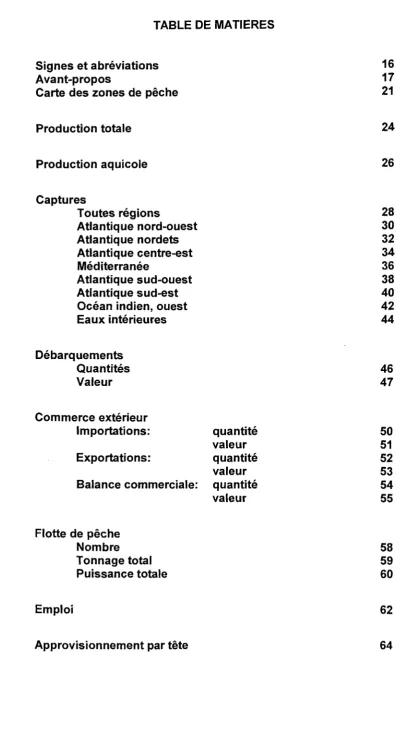
TABLE DE MATIERES
Signes et abréviations 16
Avant-propos 17
Carte des zones de pêche 21
Production totale 24
Production aquicole 26
Captures
Toutes régions 28
Atlantique nord-ouest 30
Atlantique nordets 32
Atlantique centre-est 34
Méditerranée 36
Atlantique sud-ouest 38
Atlantique sud-est 40
Océan indien, ouest 42
Eaux intérieures 44
Débarquements
Quantités 46
Valeur 47
Commerce extérieur
Importations: quantité 50
valeur 51
Exportations: quantité 52
valeur 53
Balance commerciale: quantité 54
valeur 55
Flotte de pêche
Nombre 58
Tonnage total 59
Puissance totale 60
Emploi 62
SIGNES ET ABREVIATIONS
Néant
0 Donnée inférieure à la moitié de l'unité utilisée
Donnée non disponible
EU15 Ensemble des pays membres de l'UE
Q Belgique
BLEU/UEBL Union économique belgoluxembourgeoise
Q« Danemark
Q Allemagne
EL Grèce
E Espagne
ρ France
¡PL Irlande
I Italie
L Luxembourg
NL PaysBas
A Autriche
Ρ Portugal
FIN Finlande
S Suède
UK RoyaumeUni
IS Islande
NO Norvège
EEA Espace économique européen
BG Bulgarie
CY Chypre
CZ République tchèque
EE Estonie
HU Hongrie
LT Lituanie
LV Lettonie
MT Malte
PL Pologne
RO Roumanie
SI Slovénie
SK République slovaque
TR Turquie
CA Canada
CL Chili
CN Chine
JP Japon
Ρ E Pérou
RU Fédération de Russie
US EtatsUnis d'Amérique
CECAF Comité des pêches pour l'Atlantique centreest
FAO Organisation des Nations Unies pour l'alimentation et l'agriculture
GFCM Commission générale des pêches pour la Méditerranée
ICCAT Commission internationale pour la conservation des thonides de l'Atlantique
ICES Conseil international pour l'Exploration de la Mer
ICSEAF Commission internationale des pêches de l'Atlantique sudest
AVANT-PROPOS
Introduction
La base de données New Cronos3' d'Eurostat sur les statistiques de la pêche réunit quelque 850 000
séries chronologiques et 17 millions de données sur les captures, les débarquements, la production de l'aquaculture, les flottes de pêche, le commerce extérieur, l'emploi et les bilans d'approvisionnement des produits de la pêche. Le contenu de la base a été étendu. En effet, dans la mesure où les données et les moyens le permettaient, les séries chronologiques ont été allongées et le nombre de pays couverts a été augmenté.
La présente publication propose un aperçu des données sur la pêche de 1990 à 1999 des pays de
ΙΈΕΕ, des pays candidats et des autres principaux pays pratiquant la pêche figurant dans New Cronos. Chaque tableau est suivi d'un descriptif détaillé des points traités dans la base de données.
La publication est le pendant du CD-ROM Statistiques de la pêche 1950-1999 qui reprend le logiciel et les données sur les statistiques de la pêche de New Cronos. Il va de soi que le document et le CD-ROM présentent les informations disponibles au moment de leur publication. La base de données New Cronos est mise à jour en permanence. Il convient donc de la consulter en ligne pour disposer des informations les plus récentes.
Sources de données
Le programme de statistiques de la pêche d'Eurostat est largement tributaire de la coopération d'autres organisations internationales établissant des statistiques de la pêche. Cette coopération s'exprime par le groupe de travail de coordination pour les statistiques de la pêche (CWP). Eurostat est reconnaissant à ces organisations de leur contribution à son programme de travail sans laquelle la quantité et la qualité des données de la base New Cronos sur les statistiques de la pêche seraient très limitées.
Aucun effort n'a été ménagé pour proposer des données exhaustives, comparables et harmonisées sur tous les thèmes visés par la base de données et la publication. Cependant, les notes qui suivent sont à lire attentivement: elles donnent la définition générale des thèmes abordés et rappellent les précautions d'usage en ce qui concerne l'utilisation des données.
Production totale
La production totale est la somme des captures et de la production de l'aquaculture. Voir ci-après les notes relatives à ces deux éléments de la production totale.
La production totale est exprimée en équivalents-poids vif de la production (pour l'aquaculture) ou des débarquements (pour les captures).
Production de l'aquaculture
L'aquaculture est définie comme l'élevage d'organismes aquatiques, notamment poissons, mollusques, crustacés et plantes aquatiques. L'élevage implique une quelconque forme d'intervention dans le processus d'augmentation de la production, telle que la mise en charge régulière, l'alimentation et la protection contre les prédateurs. L'élevage implique également la propriété individuelle ou collective du stock en élevage. D'un point de vue statistique, les organismes aquatiques récoltés par une personne physique ou morale les ayant eus en propriété tout au long de leur période d'élevage sont donc des produits de l'aquaculture. En revanche, les organismes aquatiques exploitables par le public en tant que ressources de propriété commune, avec ou sans licences appropriées, sont à considérer comme des produits de la pêche.
31
Les administrations nationales des pays de ΙΈΕΕ soumettent les données sur la production de l'aquaculture à Eurostat conformément au règlement (CE) n° 788/96 du Conseil, du 22 avril 1996, relatif à la communication de statistiques sur la production de l'aquaculture par les Etats membres
(JO L108 du 1.5.1996).
Les administrations nationales soumettent à la FAO les données sur la production de l'aquaculture en répondant au questionnaire FISHSTAT AQ qui emploie les mêmes notions et définitions que les règlements de l'UE et dont les données sont comparables. Après avoir vérifié la qualité des données, le département des pêches de la FAO les communique à Eurostat en vue de les intégrer dans New Cronos.
Les données sont exprimées en équivalents-poids vif des produits.
Captures
Les pays membres de ΙΈΕΕ soumettent les statistiques sur les captures à Eurostat conformément à la législation communautaire suivante:
règlement (CEE) η° 3880/91 du Conseil, du 17 décembre 1991, relatif à la communication de statistiques sur les captures nominales des Etats membres se livrant à la pêche dans l'Atlantique du Nord-Est (JO L365 du 31.12.1991);
règlement (CEE) n° 2018/93 du Conseil, du 30 juin 1993, relatif à la communication de statistiques sur les captures et l'activité de pêche des Etats membres se livrant à la pêche dans l'Atlantique du Nord-Ouest (JO L186 du 28.7.1993);
règlement (CE) n° 2597/95 du Conseil, du 23 octobre 1995, relatif à la communication de statistiques sur les captures nominales des Etats membres se livrant à la pêche dans certaines zones en dehors de l'Atlantique du Nord (JO L270 du 13.11.1995).
Les administrations nationales sont invitées à soumettre des données sur les captures à la FAO et aux organisations régionales compétentes en répondant aux questionnaires STATLANT qui emploient les mêmes notions et définitions que les règlements de l'UE. Les organisations régionales et la FAO communiquent à Eurostat les données relatives aux pays tiers de l'EEE.
Si les administrations nationales sont invitées à soumettre les statistiques sur les captures pour toutes les activités de pêche qu'il s'agit de la pêche commerciale, de la pêche sportive ou de la pêche de subsistance, il est évident que le relevé des données relatives à la pêche sportive est incomplet. Les données sont exprimées en équivalents-poids vif des débarquements (c'est-à-dire le poids d'un produit débarqué multiplié par un coefficient de conversion adéquat). Par conséquent, elles excluent les produits de la pêche capturés mais non débarqués. Ainsi le poisson capturé mais rejeté à la mer (espèce non commerciale, poisson n'atteignant pas la taille minimale, etc.) ou le poisson consommé à bord est exclu.
Le pavillon du bateau de pêche détermine la nationalité de la capture, sauf exception (ex.: entreprise conjointe et affrètement).
Débarquements
Chaque pays de l'EEE communique des données mensuelles sur les quantités et le prix des produits de la pêche débarqués dans ses ports conformément au
règlement (CEE) n° 2104/93 du Conseil du 22 juillet 1993 modifiant le règlement (CEE) n° 1382/91 relatif à l'envoi de données sur les débarquements de produits de la pêche dans les Etats membres (JO 1191 du 31.7.1993)
Les données portent sur les débarquements (exprimés en poids du produit) de tous les produits de la pêche dans le pays déclarant quel que soit le pavillon du bateau qui les effectue. Sont exclus les débarquements effectués par les bateaux du pays déclarant dans les ports étrangers.
Commerce extérieur
Les données relatives aux Etats membres de l'EEE sont tirées de Comext, la base de données d'Eurostat sur le commerce extérieur. En ce qui concerne les pays tiers, elles proviennent de la base de données sur les produits de la pêche de la FAO.
Les totaux de l'UE et de l'EEE incluent les données relatives aux échanges entre les pays membres.
Les chiffres relatifs à la balance commerciale sont probablement sous-estimés. Outre le fait que souvent, les données des exportations sont moins complètes que celles des importations, deux aspects particuliers de la pêche expliquent la sous-déclaration des exportations:
- le transbordement de captures en mer sur des bateaux battant un autre pavillon; - les débarquements effectués par les bateaux de pêche dans des ports étrangers.
Approvisionnement par tête
Ces données sont extraites de la Circulaire sur les pêches n" 821 de la FAO (Fish and Fishery products: World Apparent Consumption based on Food Balance Sheets 1961-1997 - Produits des pêches et des pêcheries: Consommation mondiale apparente basée sur les bilans alimentaires
1991-1997). Ces bilans sont établis par le département des pêches de ia FAO selon la formule: Approvisionnement = production + importations - exportations ± variation des stocks
par tête population résidente
Les données sont exprimées en kg de poids vif/habitant/an.
Les éléments sont convertis en équivalents-poids vif à partir du poids débarqué ou du produit.
Les quantités de poisson ou d'autres produits de la pêche non destinées à la consommation humaine (ex.: poisson réduit en farine et en huile ou destiné à la consommation animale) sont exclues des bilans.
Il convient de noter que les données ne constituent pas une mesure directe de la consommation par habitant. Elles résultent des bilans dont elles reproduisent les erreurs. Les bilans posent plusieurs problèmes, et notamment l'obtention de données sur la variation des stocks et le choix de coefficients de conversion adéquats pour obtenir une mesure en équivalents-poids vif.
Flotte de pêche
Les données des Etats membres de l'UE proviennent du registre statistique des bateaux de pêche d'Eurostat, mis à jour chaque année sur la base du fichier administratif des bateaux de pêche de la Direction générale Pêche de la Commission européenne.
Les données relatives aux autres pays sont extraites du Bulletin statistique des pêches nc 34 de la FAO consacré aux statistiques des flottes de pêche. Ces données ne sont pas toujours comparables, que ce soit entre elles ou avec les données des Etats membres de l'UE.
Emploi
Les données ont été soumises à la FAO par les administrations nationales au moyen du questionnaire FISHSTAT FM et publiées dans la Circulaire sur les pêches n° 929 de la FAO (Nombre de pêcheurs 1970-1997).
Les administrations nationales sont invitées à communiquer les données concernant le nombre de pêcheurs (hommes et femmes) pratiquant la pêche en mer ou dans les eaux intérieures et le nombre de salariés dans la production de l'aquaculture. Il est évident que les divergences entre les sources nationales des données et les définitions employées peuvent être grandes.
MODALITES D'ACCES A LA BASE DE DONNEES "NEW CRONOS" D'EUROSTAT
L'accès à New Cronos via Internet est gratuit pour:
• la Commission européenne: serveur Europa Plus (http://www.cc.cec);
• les institutions européennes: serveur Europa Team (http://www.europateam.cc.cec);
• les fournisseurs de données institutionnels d'Eurostat (ex.: instituts nationaux de statistique) et le réseau Data Shop, avec mot de passe.
Pour en savoir plus, s'adresser à l'équipe New Cronos Eurostat/ U n i t e d
Tél. (352) 4301 33262 - Fax (352) 4301 32594 - E-mail: [email protected]
Pour accéder aux données New Cronos, le logiciel de navigation courant suffit et aucun logiciel supplémentaire n'est requis. Le navigateur HTML (explorateur) courant peut être utilisé.
M
O
£
α
ro wΝ
o ro tø
α
roΌ ro>
o
3"
ro
su
$
α.
ro
τι
tø o
3"
ro
co
ro σ
Φ
ff
tu
•Ό O
- h
"Π
tø
3-(Q
>
φ
1TABELLEN
TABLES
ERZEUGUNG INSGESAMT Alle Fischereiprodukten
Tonnen Lebendgewicht
TOTAL PRODUCTION All fishery products
tonnes live weight
PRODUCTION TOTALE Tous produits de la pêche
tonnes poids vif
1990 1991 1992 1993 1994 1995 1996 1997 1998
EU beitrittswillige Länder / EU candidate countries / Pays candidats de l'UE
Sanstige Länder / Other countries ƒ Autres pays
1999 EU-15 Β DK D EL E F IRL I L NL A Ρ FIN S UK IS NO EEA
7 281 519
42 663 1 517 713
411 569 146 367
1 364 760 886 036 290 825 537 447 517 179 3 659 331 376 146 848 260 203 824 875
1 524 908 1 957 476
10 763 903
7 498 548
41 141 1 793 304 302 976 156 818 1 363 016
898 059 313 490 583 070 472 230 3 640 332 130 133 461 245 105 860 108
1 060 477 2 370 588
10 929 613
7 784 908
38 446 1 997 586
309 683 179 551 1 320 355 912 042 307 686 566 834 503 255 3 624 300 880 151 277 314 918 878 770
1 586 064 2 764 444
12135 417
7 576 295
37 060 1 535 521 320 008 199 455 1 284 820 976 924 357 854 572 155 549 566 3 565 298 816 153 828 348 051 938 671
1 730 500 2 768 408
12 075 203
8 022 810
35 265 1 886 668
275 090 224 145 1341634 931 897 363 932 604 644 549 565 3 494 273 867 169 043 394 373 969192
1 576 843 2 777 767
12 377420
8 519 796
36 977 2 043 658 306 495 197 967
1 453 323 955 618 464 457 632 112 541497 3 325 269 216 172 899 412 711 1 009 840
1 632 528 2 994 463
13 146 788
7 968 301
32 347
1 722 638 311 765 202 267 1 437 444
921 114 405 471 584 122 527 267 3 402 268 577 182 736 379 169 979 714
2 086 502 3 133 356
13 188 159
8 104 479
31 984 1 865 788 318 793 219 325 1 489 504
867 235 369 695 561 656 569123 3 486 230 978 182 572 364 115
1 030 226
2 234 914 3 415 403
13 754 797
8 075 459
32 271 1 599 817
333 740 188 164 1 530 685
856 593 403 339 567 218 659 956 3 362 237 170 183 540 416 694 1 062 911
1 713 651 3 439 502
13 228 613
BG CY CZ EE HU LT LV MT PL RO SI SK TR 57 103 2 745 368 866 33 888 350 249 467 448 6 368 476 140 127 734 384 871 57 854 2 748 351 764 22 879 475 043 418 446 5 169 459 616 125 003 364 751 32 118 2 821 132 218 22 908 188 573 157 627 5 270 508 071 95 381 4 773 456 583 21 584 2 963 23 427 147 762 17 378 120 078 143 052 1 373 424 806 34 919 3 002 2 772 561 196 12 505 3 089 22 610 124 676 18 206 51036 138 806 1 799 462 353 42 651 3111 3 488 505 801 12 778 3 045 22 608 133 002 16 674 49 510 149 600 1 758 453 705 69105 2 930 3 565 655 576 13 548 3 426 21 724 110 639 15 686 56 721 143 115 2 377 371 269 32 159 3211 2 366 561 027 16 627 3 358 20 881 128 412 16 740 19 837 106 096 2 667 394 239 19 322 3 261 2 640 504 603 14 954 3 669 21 183 123 611 17 449 22 290 102 841 2 929 280 432 18614 3118 2 007 543 900 CA CL CN JP PE RU US
Welt/ World/ Monde
1 663 272 5 424 055 14 667 162 11 124 462 6 874 400 7 863 709 5 811 776
103 318 440
1 514 382 6 166 043 16 519 587 10 011 006 6 905 099 7 067 607
5 611 546
103 812 920
1 361 676 6 627 361 19 738 044
9 292 549 7 508 289 5 655 531 5 721 511
107 738 390
1 212 490 6 191 764 23 638 140 8 777 800 9 009 882 4 471 549 6 024 878
112 080 390
1 105 864 8 021 080 28 115 756 8 177 990 12 005 290 3 794 387 6 088 701
120 332 000
942 455 7 890 206 32 730 979 7 506 780 8 943 526 4 396 045 5 739 431
124 281 830
997 187
7 230 923 36 542 232 7 437 980 9 522 494 4 757 875 5 413 740
128 656 410
1 074 864 6 365 519 39 936 927 7 404 646 7 877 532 4 750 844 5 414 623
130 826 520
1 113 464 3 824 231 44 472 419 6 664 669 4 347 944 4 553 765 5 197 372
126 907 350
INHALT DER "NEW CRONOS" DATENBANK
Bereich: Gesamte Fischerzeugung Jahre: Ab 1950
Periodizität: Jährlich
Fischarten: Individuell festgelegt Gebiete: Hauptfanggebiete
Länder: Individuell für die jeweiligen Fangnationen Einheit: Tonnen Lebendgewicht
Datenquelle: Eurostat und FAO
CONTENTS OF THE "NEW CRONOS" DATA-BASE
Sector: total fisheries production Years: 1950 onwards
Periodicity: annual
Species: individually identified species Areas: by major fishing areas
Countries: individually by all countries reporting catches in the area Units: tonnes live weight
Data sources: Eurostat and FAO
CONTENU DE LA BASE DE DONNEES "NEW CRONOS"
Secteur: production totale de la pêche Années: à partir de 1950
Périodicité: annuelle
Espèces: individuellement pour toutes les espèces identifiés Régions: par principales zones de pêche
Pays: individuellement pour les pays péchant dans la région Unités: en tonnes poids vif
AQUAKULTURPRODUKTION INSGESAMT Alle Produkte
Tonnen Lebendgewicht
TOTAL AQUACULTURE PRODUCTION All products tonnes live weight PRODUCTION AQUICOLE TOTALE
Tous produits tonnes poids vif
1990 1991 1992 1993 1994 1995 1996 1997 1998 1999
EU15 8 DK D EL E F IRL I NL A Ρ FIN S UK IS NO EEA
943 781 675 41946 64 435 9 559 203 408 256 643 26 673 153 544 100 997 3126 4 968 18 550 9 146 50111 2 829 150 028 1 096 638
946 225
846 42 098 68 392 12 615 224 955 245 084 27 749 175 193 51 648 3 140 6 277 19 271 8 003 60 954 2 873 160 705 1 109 803
916 856 846 43 264 90 354 20 306 168 740 250 234 27 157 170 377 54 105 3 145 6 402 17 909 7 143 56 874 2 524 137 619 1 056 999
921 975
846 43 231 63 000 32 578 126 111 277 183 30 158 176 320 71 125 3 145 5 970 17 526 5 927 68 855 2 917 173 497 1 098 389
1042 016 846 42 892 42 352 33182 177 940 280 804 28 615 206 421 109 379 3 106 6 561 16 682 7 432 85 804 3222 218 471
1 263 709
1114 692 846 44 730 58 096 32 644 223 950 280 625 27 366 235 725 83 938 2 921 4 981 17 345 7 573 93 952 3 485 277 636
1 395 813
1 170 924 946 41 424 75 237 39 854 231 773 285 476 34 925 216 373 99 871 2 952 6 076 17 659 8 267 110 092 3 687 321 542
1 496 153
1192 718 846 38 908 59 433 48 838 239 504 287 332 36 854 218719 98 210 3 021 8 073 16 426 6 709 129 845 3 663 367 298 1 563 679
1 339 573 846 42 368 67 020 59 926 315 674 273 570 40 355 249 625 120 024 2 911 8115 16 024 5 504 137 611 3 868 409 031 1 752 472
73 533 79 307 321 143
15 449 6 064
EU beitrittswillige Länder / EU candidate countries / Pays candidats de l'UE BG CY CZ EE HU LT LV MT PL RO SI SK TR 7 849 125 936 17 600 4 666 2 235 3 26 400 34 950 5 782 7 798 127 1 337 14 434 4 792 2 685 200 29 500 29 530 7 835 8132 155 693 14 230 3 899 641 500 30 200 24 620 868 9 085 7 897 259 20 242 330 9 492 2 907 339 650 18 609 21 100 1 588 718 12 438 6100 291 18 655 417 9 899 1 874 560 904 24 500 20 400 1 861 787 15 998 4 615 452 18 679 315 9 360 1 714 525 904 25 111 19 830 1 617 789 21 607
4 727 787 18 200 272 8 080 1 537 380 1552 27 700 13 900 954 869 33 201 5 437 969 17 560 260 9 334 1516 345 1 800 28 680 11 168 1254
917 45 450
4 252 1 178 17 231 260 10 222 1 516 425 1950 29 791 9 614 648 909 56 700 Sonstige Länder / Other countries / Autres pays
CA CL CN JP PE RU US Welt/World/Monde 36 580 70 464 7 952 632 1 369 680 5 226 259 735 315 448 16 817 021
43 751 105 258 9 067 388 1 359 201 6 866 120 877 363 504 18 270 613
44 564 116 281 11 315492 1 397 020
5 504 104 999 413 531 21 232 440
51 119 135 090 14 162 453 1 359 403 4 862 92 866 417418 24 535 310
54 274 183 747 17 097 920 1 420 461 5 903 77 956 390 781 27 739 971
65 996 206 266 20 018 273 1 389 613
5 771 68 578 413411 31 330 676
71 093 323 115 22 208 495 1 349 405
7 139 53 309 393 331 33 974 243
82 505 375 113 24 030 313 1 339 861 7 506 59 766 438 331 36 021 028
INHALT DER "NEW CRONOS" DATENBANK
Bereich: Aquakulturproduktion Jahre: Ab 1984
Periodizität: Jährlich
Fischarten: Individuell festgelegt Gebiete: Hauptgebiete
Untergliederung: Süßwasser, Brackwasser, Meerwasser Länder: Individuell für die jeweiligen Berichtsländer Einheiten: Menge (t Lebendgewicht) und Wert (ECU/EUR)
Datenquelle: Eurostat und FAO
CONTENTS OF THE "NEW CRONOS" DATA-BASE
Sector: aquaculture production Years: 1984 onwards
Periodicity: annual
Species: individually identified species Areas: by major fishing areas
Environment: for freshwaters, brackish waters and marine waters Countries: individually by all reporting countries
Units: tonnes live weight and value (ECU/EUR)
Data sources: Eurostat and FAO
CONTENU DE LA BASE DE DONNEES "NEW CRONOS"
Secteur: production aquicole Années: à partir de 1984 Périodicité: annuelle
Espèces: individuellement pour toutes les espèces identifiés Régions: par principales zones de pêche
Environnement: eaux douces, eaux saumâtres et eaux de mer Pays: individuellement pour les pays du monde
Unités: en tonnes poids vif et en valeur (ECU/EUR)
FÄNGE Alle Gebiete Tonnen Lebendgewicht
CATCHES All regions tonnes live weight
CAPTURES Toutes régions
tonnes poids vif
1990 1991 1992 1993 1994 199S 1996 1997 1998 1999
EU15 B DK D EL E F IRL I NL A Ρ FIN S UK IS NO EEA
6 337 738 41 988 1 475 767 347134 136 808 1 161 352 629 393 264152 383 903 416182 533 326408 128 298 251 057 774 764 1 522 079 1 807 448 9 667 265
6 552 322 40 295 1 751 206
234 584 144 203 1 138 061 652 975 285 741 407 877 420 582 500 325 853 114 190 237 102 799154 1 057 604 2 209 883 9 819 810
6 868 052 37 600 1 954 322 219 329 159 245 1 151 615
661 808 280 529 396 457 449 150 479 294 478 133 368 307 775 821 896 1 583 540 2 626 825 11078417
6 654 320 36 214 1 492 290 257 008 166 877 1 158 709 699 741 327 696 395 835 478 441 420 292 846 136 302 342 124 869 816 1 727 583 2 594 911 10 976 814
6 980 794 34 419 1 843 776
232 738 190 963 1 163 694
651 093 335 317 398 223 440 186 388 2 6 7 X 6 152 361 386 941 883 388 1 573 621 2 559 296 11 113711
7 405104 36 131 1 998 928
248 399 165 323 1 229 373
674 993 437 091 396 387 457 559 404 264 235 155 554 405 138 915 888 1 629 043 2 716 827 11 750 975
6 797 517 31401 1 681 214
236 528 162 413 1 205 811
635 638 370 546 367 749 427 396 450 262 502 165 077 370 902 869 622 2 082 815 2 811 814 11 692146
6 911 938 31 138 1 826 880 259 360 170 487 1 250 177 579 903 332 841 342 937 470 913 465 222 905 166146 357 406 900 381 2 231 251 3 048105 12191 295
6 736 083 31425 1 557 449
266 720 128 238 1215 207 583 023 362 984 317 593 539 932 451 229 055 167 516 411190 925 300 1 709 783 3 030 471 11476 337
29 841
1 736 246
Sonstige Länder / Other countries / Autres pays CA CL CN JP PE RU US
Welt/ World/ Monde
1 626 692 5 353 591 6 714 530 9 754 782 6869174 7 603 974 5 496 328
1 470 631 6 060 785 7 452 199 8 651 805 6 898 233 6 946 730 5 248 042
1 317112 6 511 080 8 422 552 7 895 529 7 502 785 5 550 532 5 307 980
1 161 371 6 056 674 9 475 687 7 418 397 9 005 020 4 378 683 5 607 460
1 051 590 7 837 333 11 017 836 6 757 529 11 999 387 3 716 431 5 697 920
876 459 7 683 940 12 712 706 6 117 167 8 937 755 4 327 467 5 326 020
926 094 6 907 808 14 333 737 6 088 575 9 515 355 4 704 566 5 020 409
992 359 5 990 406 15 906 614 6 064 785 7 870 026 4 691 078 4 976 292
1 022 838 3 462 801 17 400 477 5 374183 4 340 087 4 487 535 4 752 249 EU beitrittswillige Länder / EU candidate countries / Pays candidats de
BG CY CZ EE HU LT LV MT PL RO SI SK TR
49 254 50 056 23 986 2 620 2 619 2 666 367 930 350 427 131525 16 288 8 445 8 678 345 583 470 251 184 674 465213 415761 156986 6 365 4 969 4 770 449 740 430 116 477 871 92 784 95 473 70 761 3 905 379 089 356 916 447 498
'UE 13 687
2 704 3 185 147 432 7 886 117 171 142 713 723 406 197 13 819 2 284 1 184 548 758 6 405 2 798 3 955 124 259 8 307 49 162 138 246 895 437 853 22 251 2 324 1 627 589 803 8 163 2 593 3 929 132 687 7 314 47 796 149 275 854 428 594 49 275 2 141 1 948 633 969 8 821 2 639 3 524 110 367 7 606 55184 142 735 825 343 569 18 259 2 342 1412 527 826
11 190 2 389 3 321 128 152 7 406 18 321 105 751 867 365 559 8154 2 344 1 386 459153 10 702 2 491 3 952 123 351 7 227 20 774 102 416 979 250 641 9 000 2 209 1359 487 200
INHALT DER "NEW CRONOS" DATENBANK
Bereich: Fänge insgesamt Jahre: Ab 1950
Periodizität: Jährlich
Fischarten: Individuell festgelegt Gebiete: Hauptfanggebiete
Länder: Individuell für die jeweiligen Fangnationen Einheiten: Tonnen Lebendgewicht
Datenquelle: Eurostat und FAO
CONTENTS OF THE "NEW CRONOS" DATA-BASE
Sector: total catches Years: 1950 onwards Periodicity: annual
Species: individually identified species Areas: by major fishing areas
Countries: individually by all countries reporting catches in the area Units: tonnes live weight
Data sources: Eurostat and FAO
CONTENU DE LA BASE DE DONNEES "NEW CRONOS"
Secteur: captures totales Années: à partir de 1950
Périodicité: annuelle
Espèces: individuellement pour toutes les espèces identifiés Régions: par principales zones de pêche
Pays: individuellement pour les pays péchant dans la région Unités: en tonnes poids vif