Int. J. Electrochem. Sci., 9 (2014) 7736 - 7745
International Journal of
ELECTROCHEMICAL
SCIENCE
www.electrochemsci.org
Preparation and Performance of a Non-Precious Metal Catalyst
CoMe/C for Oxygen Reduction Reaction from Modified Carbon
Black Using Melamine as Nitrogen Source
Zhongping Xiong, Yujun Si*, Minjiao Li, Xinlu Liu
College of Chemistry and Pharmaceutical Engineering, Sichuan University of Science and Engineering, Zigong, 643000, China
*
E-mail: [email protected]
Received: 10 September 2014 / Accepted: 16 October 2014 / Published: 28 October 2014
A non-precious metal catalyst for oxygen reduction reaction is prepared by heat-treating a precursor containing acetylene black, melamine and cobalt chloride. The result shows that the method is effective, and a best catalyst can be obtained by heat-treating the precursor at 600℃ for 2 hours. In heat-treating, the cobalt ion is reduced to metallic β-cobalt and the metallic cobalt simultaneously facilitates the nitrogen source reacting with acetylene black to form the active sites to oxygen reduction reaction. The nitrogen source can also react with acetylene black to prepare a metal-free catalyst without the existence of cobalt at a higher temperature, but the activity of resulted catalyst is worse.
Keywords: Oxygen reduction reaction; electrocatalyst; carbon-based; preparation
1. INTRODUCTION
lead to a loss of cell voltage. The oxidized product of methanol will also deactivate the Pt catalyst. So an excellent catalyst for ORR in PEMFCs must meet the following items: (1) low cost; (2) better catalytic activity; (3) better selectivity to four-electron reaction route; (4) better methanol tolerance; (5) good stability. The first and fourth items are exactly the shortage of the Pt-based catalyst.
In the past decades, many non-precious or non-platinum ORR catalysts were developed [5]. Among these catalysts, heat-treated N4-macrocycle compounds, such as phthalocyanine and porphyrin
with transition metal ions (such as Co(II), Fe(II)), have attracted special attentions[6-9]. The catalyst can be labeled as TM-N/C (TM= Co, Fe, Ni, Cr, Mn, etc.). The structure of N4-macrocycle of the
compounds can be destroyed in the heat-treating process, so the active site of the catalyst to ORR is still unclear. Studies on Fe-based compounds indicated that FeN2 or/and FeN4 fragments in the catalyst
are the active sites according to the information from Tof-SIMS[10-13]. A new pyridine-type, pyrrolic type or/and graphite-type C-N structures have been detected by XPS in the TM-N/C catalyst after heat-treatment due to the modification of nitrogen to carbon black. These C-N structures, especially pyridine-like structure at the edge of carbon black, are also widely regarded as the active site of TM-N/C catalyst [14-19].
For the preparation of the TM-N/C catalyst, the TM-N4 (or TM-Nx) structure is necessary in a
traditional viewpoint. The basic step is: (1) transition metal ions are chelated with macrocycle compound to synthesize a complex; (2) carbon black is added into the solution to adsorb the complex onto its surface; (3) the mixture is dried and heat-treated in an inert atmosphere [4, 10, 20, 21]. Recently, the phthalocyanine and porphyrin were also substituted by other nitrogen-containing compounds, such as aniline [22], tripyridyl triazine [19], pyrrole [23], ethylene diamine [4,24], amino acids [25], poly-o-phenylenediamine [26], triethylenetetramine [17], hexacyanoferrate [27], etc. Although the choice of nitrogen source was widen, the synthesis of TM-N/C catalyst was still based on the concept of “generating complex”. The catalyst can also be synthesized by a direct metal reduction method [28, 29]: metallic Co was deposited on polypyrrole/carbon to form a cobalt-polypyrrole-carbon composite. The obtained catalyst has good activity and remarkable stability.
Three conclusions can be summarized from the previous researches: (1) Heat-treatment is necessary to improve the ORR activity, and the active site is formed in this process. (2) The active site is not the initial TM-N4 or TM-Nx structure, but is a new structure formed in the heat-treating process,
such as FeN2 or FeNx fragment, pyridine-type or/and graphite-type C-N structures, etc[14,30,31].
During the heat-treatment, the transition metal facilitates the incorporation of pyridinic and graphitic nitrogen groups into the carbon matrix to form the active sites. (3) Macrocycle compound complex is not necessary to the preparation of the catalyst.
for oxygen reduction reaction was synthesized by using melamine as a nitrogen source. The preparation process was optimized to reveal the formation process of ORR active sites of the catalyst. The experimental data show the prepared catalyst has excellent catalysis activity to ORR.
2. EXPERIMENTAL
2.1 Preparation and characterization
Acetylene black (AB) was used as one of the reactants and the supporter of the catalyst. The AB was pre-treated in 1.5 mol L-1 HNO3 for 12 hours at room temperature, then filtered, washed and
dried at 80 0C. For the preparation of the catalyst, 0.100 g of the treated AB, 0.120 g of melamine (C3H6N6, AR) and 0.050 g of cobalt chloride (CoCl2·6H2O, AR) were mixed and grinded in an agate
mortars for 30 minutes to get a precursor containing AB+C3H6N6+CoCl2·6H2O. Then the precursor
was heat-treated in a tube furnace in N2 atmosphere. The temperature was elevated to a desired value at
10℃ min-1
of ramping rate, and was kept for a series of duration at a desired temperature. The heat-treating temperature in this work was 500 0C, 600 0C, 700 0C, 800 0C, 900 0C, and the obtained catalysts were labeled as CoMe/C500, CoMe/C600, CoMe/C700, CoMe/C800, CoMe/C900, respectively. A series of catalysts were also prepared at 600 0C for 30min, 60min, 120min 180min and 240min to investigate the effect of heat-treating duration on the activity of the CoMe/C catalyst.
A precursor containing 0.100g of AB and 0.120g of melamine was heat-treated at 600 0C, 700
0
C, 800 0C, 900 0C for 2 hours using the same procedure. The obtained products were labeled as Me/C600, Me/C700, Me/C800, Me/C900, respectively.
The phase of CoMe/C was characterized by XRD measured using a Shimadzu XRD-6000 diffractometer with Cu Kα1 radiation at a scanning rate of 5 ° min-1
.
2.2 Evaluation of the catalytic activity of the catalyst
The catalytic activity of the catalyst was evaluated by linear sweep voltammetry (LSV). The measurements were carried out on a CHI660A workstation. The traditional three-electrode cell was used with a saturated calomel electrode (SCE) as the reference electrode and a Pt wire as the counter electrode. A glass carbon electrode coated catalyst layer was used as the work electrode. The work electrode was fabricated as follows: 10 mg of the catalyst, 1 ml of isopropyl alcohol, 1 ml of deionized water and 5 drops of diluted Nafion solution (0.5 wt%, with isopropyl alcohol as solvent) were ultrasonicated for 20 minutes to form a uniform ink. Then a drop of ink was dropped on the clean surface of the glass carbon disk (Ф5mm). The coated electrode was dried for 2 hours before electrochemical tests. The basic electrolyte was 0.5 mol L-1 H2SO4 solution saturated by oxygen or
nitrogen for 15 minutes before tests. The methanol tolerance test was conducted in (0.5 mol L-1 H2SO4
+ 1.0 mol L-1 CH3OH) solution by cyclic voltammetry (CV) test. The LSV and CV tests were carried
3. RESULTS AND DISCUSSION
3.1 Catalytic activity of CoMe/C toward ORR
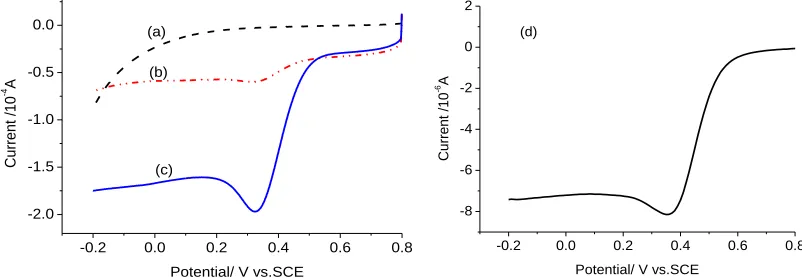
Fig.1 shows the voltammograms of acetylene black, CoMe/C600 catalyst and platinum disc electrode in 0.5 mol L-1 H2SO4 solution. It can be seen that the acetylene black has a little activity to
[image:4.596.94.495.292.431.2]ORR with an onset potential of 0.1V (vs SCE). However, the CoMe/C600 catalyst exhibits good ORR catalytic activity with an onset potential of 0.55V (vs SCE, or 0.79V vs. RHE) which is close to the 0.60V (vs. SCE) of the platinum disc electrode (Ф2mm). The 0.79V (vs. RHE) of onset potential of the CoMe/C600 catalyst is also close to the onset potential of other N-doped catalysts, such as the 0.87V (vs. RHE) in reference [4], the 0.81 V (vs. RHE) in reference [29] and the 0.76V (vs. NHE) in reference [31], etc. These comparisons indicate that the CoMe/C600 catalyst is very effective to oxygen reduction reaction.
Figure 1. Linear sweep voltammograms of different electrodes. (a) AB in 0.5 mol L-1 H2SO4 solution
saturated by O2, (b) CoMe/C600 catalyst in 0.5 mol L-1 H2SO4 solution saturated by N2 , (c)
CoMe/C600 catalyst in 0.5 mol L-1 H2SO4 solution saturated by O2, (d) Pt-disc electrode
(Ф2mm) in 0.5 mol L-1
H2SO4 solution saturated by O2.
3.2 Effects of heat-treating temperature and duration on the ORR catalytic activity
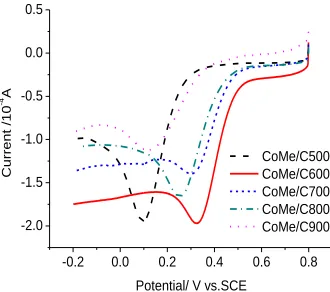
The precursor of AB+C3H6N6+CoCl2·6H2O was heat-treated at 500℃, 600℃, 700℃, 800℃
and 900℃ for 2 hours to synthesize a series of CoMe/C catalyst to investigate the effect of heat-treating temperature on the activity of CoMe/C catalyst. Fig.2 shows the ORR catalytic activity of these samples. The temperature obviously influences the catalytic activity of the resulted catalysts. The catalytic activity can be obtained when the precursor was heat-treated at 500℃, but the ORR onset potential and peak potential are both most negative. The ORR catalytic activity of CoMe/C600 treated at 600℃ is the better, and then the catalytic activity gradually worsens with increasing the heat-treating temperature.
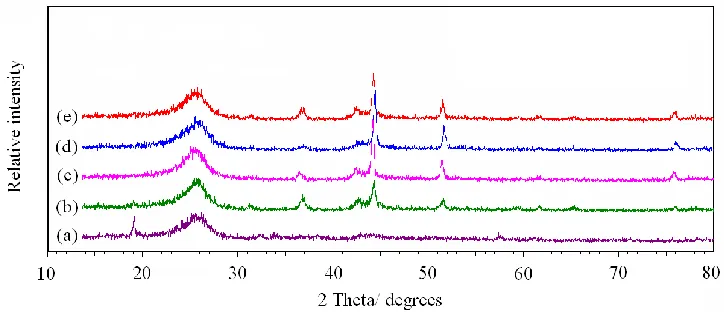
The XRD patterns of the catalysts heat-treated at different temperature are shown in Fig.3. It can be seen that the cobalt element mainly exists as cobalt oxides when heat-treated at 500℃, but exists as metallic β-Co when the temperature is up to 600℃. Based on the results presented in Fig.2 and Fig.3, it can be judged that there exists a close relationship between the ORR catalytic activity and
-0.2 0.0 0.2 0.4 0.6 0.8
-2.0 -1.5 -1.0 -0.5 0.0
Potential/ V vs.SCE
Current /10
-4 A
(a)
(b)
(c)
-0.2 0.0 0.2 0.4 0.6 0.8
-8 -6 -4 -2 0 2
Potential/ V vs.SCE
Current /10
-6A
the metallic β-Co. The catalyst exhibits good activity when the metallic β-Co appears. However, the appearance of the metallic β-Co is not the only indicator to judge the ORR catalytic activity of CoMe/C catalyst, since the ORR catalytic activity decreases when the temperature is above 700℃ and the crystal structure of β-Co tends to perfect.
-0.2 0.0 0.2 0.4 0.6 0.8
-2.0 -1.5 -1.0 -0.5 0.0 0.5
Potential/ V vs.SCE
Current /10
-4A
[image:5.596.207.372.170.316.2]CoMe/C500 CoMe/C600 CoMe/C700 CoMe/C800 CoMe/C900
Figure 2. Linear sweep voltammograms of CoMe/C catalysts obtained at different temperatures in 0.5 mol L-1 H2SO4 solution saturated by O2.
Figure 3. XRD patterns of CoMe/C catalysts obtained at different temperatures. (a) CoMe/C500, (b) CoMe/600, (c) CoMe/C700, (d) CoMe/C800, (e) CoMe/C900.
[image:5.596.141.454.397.558.2]
-0.2 0.0 0.2 0.4 0.6 0.8
-2.0 -1.5 -1.0 -0.5 0.0 0.5
Potential/ V vs.SCE
Current /10
-4 A
[image:6.596.184.387.85.246.2]0.5h 1h 2h 3h 4h
Figure 4. Linear sweep voltammograms of CoMe/C catalysts obtained at 600℃ for different durations
in 0.5 mol L-1 H2SO4 solution saturated by O2.
Figure 5. XRD patterns of CoMe/C catalysts heat-treated at 600℃ for different duration, (a) 30min,
(b) 60min, (c) 120min, (d) 180min, (e)240min.
[image:6.596.116.478.326.482.2]
700℃ and be greater than the formation, which leads to the deterioration of ORR activity of CoMe/C catalyst.
The effect of heat-treating duration can also be explained by the two competitive reactions. The formation of active site dominates the process in short duration and the catalytic activity of the CoMe/C improves with the duration prolonging. The number of decomposition of active site will be greater than the formation of active site when the heat-treating duration is surpass 120min, which leads to the deterioration of the catalytic activity of resulted CoMe/C catalyst.
3.3 Catalytic activity of Me/C catalyst without the existence of cobalt element
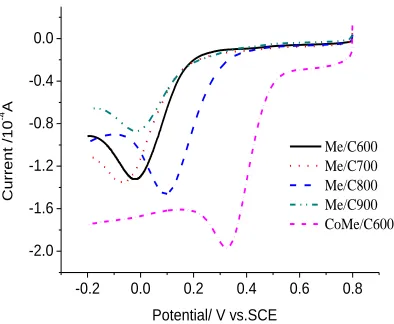
In order to further determine the effect of cobalt element in the CoMe/C catalyst, a precursor just containing AB and melamine was heat-treated at 600℃, 700℃, 800℃, 900℃ for 2 hours, and the product was labeled as Me/C600, Me/C700, Me/C800 and Me/C900, respectively. The catalytic activities of Me/C catalysts to ORR are shown in Fig.6. It can be seen that an ORR catalyst can be prepared by heat-treating a mechanical mixture of AB and melamine without the existence of cobalt element. However, the activity of the resulted Me/C catalyst is worse than that of the CoMe/C catalyst. The greatest onset potential of 0.35V of Me/C800 in the Me/C series is more negative than the 0.55V of CoMe/C600 in the CoMe/C series. According to the common rule in chemistry, higher temperature is beneficial to a reaction rate while without the existence of a catalyst. The Me/C catalysts show the best catalytic activity by heat-treated at 800℃. However, the CoMe/C catalysts exhibit the best activity by heat-treated at 600℃ with the existence of cobalt, which shows the catalytic effect of metallic cobalt to the formation of the active sites in CoMe/C catalysts.
-0.2 0.0 0.2 0.4 0.6 0.8
-2.0 -1.6 -1.2 -0.8 -0.4 0.0
Potential/ V vs.SCE
Current /10
-4 A
Me/C600 Me/C700 Me/C800 Me/C900 CoMe/C600
Figure 6. The linear sweep voltammograms of Me/C catalysts without cobalt element obtained at several temperature
3.4 Methanol tolerance of CoMe/C catalyst
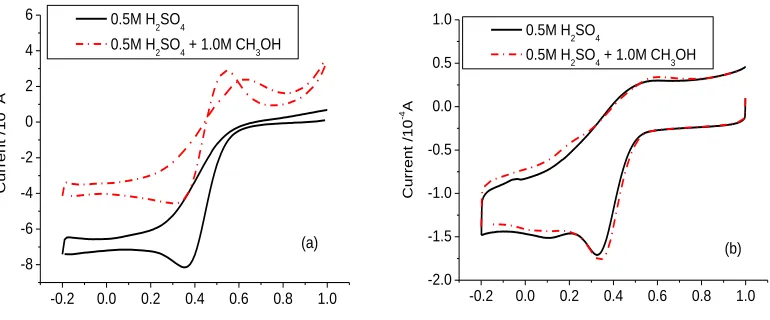
Fig.7 show the cyclic voltammograms of a Pt disc electrode and CoMe/C600 catalyst in 0.5 mol L-1 H2SO4 and (0.5 mol L-1 H2SO4 + 1.0 mol L-1 CH3OH) solution. It can be seen that methanol
[image:7.596.193.390.467.629.2]
oxidization potential is more positive than the onset potential of oxygen reduction in the blank H2SO4
solution. After the oxidization of methanol, the current of oxygen reduction on platinum electrode in (0.5 mol L-1 H2SO4 + 1.0 mol L-1 CH3OH) solution is smaller than that the value in 0.5 mol L-1 H2SO4.
The result shows the platinum electrode was poisoned by the oxidization product of methanol and deactivated. However, the cyclic voltammogram of CoMe/C600 catalyst in 0.5 mol L-1 H2SO4 and (0.5
mol L-1 H2SO4 + 1.0 mol L-1 CH3OH) solution are similar to each other, and the oxidation of methanol
cannot be observed on the CoMe/C600 catalyst. This result shows the CoMe/C catalyst is good at the methanol tolerance.
Figure 7. Cyclic voltammograms of (a) Pt disc electrode and (b) CoMe/C catalyst in 0.5 mol L-1 H2SO4 and (0.5 mol L-1 H2SO4 + 1.0 mol L-1 CH3OH) solution.
4. CONCLUSIONS
A non-precious metal catalyst CoMe/C to oxygen reduction reaction (ORR) was prepared by heat-treating a mechanical mixture of acetylene black, melamine and cobalt chloride. Heat-treating temperature and duration are both important factors influence the catalytic activity of catalyst. There are two types of competitive reactions in the heat-treating process: the formation and decomposition of active site in the CoMe/C catalyst. The formation of active site is slow at low temperature, and the total number of active site is small in short duration. The formed active site will also decompose at high temperature and in long duration, and deteriorates the ORR activity of the resulted catalyst. A good CoMe/C catalyst can be obtained by heat-treating the precursor at 600℃ for 2 hours. This temperature is lower than the most reports in which the heat-treating temperature is always above 800℃. When the temperature is 600℃, the cobalt ions are reduced to metallic β-cobalt by carbon black in the process of heat-treating, and the metallic cobalt simultaneously facilitates the reaction of nitrogen source with acetylene black to form the ORR active site. The nitrogen source can also react with acetylene black to form ORR active site to synthesize a Me/C catalyst without the existence of cobalt, but the best activity of Me/C catalyst must be obtained at a higher temperature upper to 800℃. The activity of Me/C catalyst is also less than CoMe/C catalyst. This result further indicates the
-0.2 0.0 0.2 0.4 0.6 0.8 1.0 -8
-6 -4 -2 0 2 4 6
Current /10
-4 A
Potential/ V vs.SCE 0.5M H2SO4
0.5M H2SO4 + 1.0M CH3OH
(a)
-0.2 0.0 0.2 0.4 0.6 0.8 1.0
-2.0 -1.5 -1.0 -0.5 0.0 0.5 1.0
0.5M H2SO4
0.5M H2SO4 + 1.0M CH3OH
Potential/ V vs.SCE
Current /10
-4 A
[image:8.596.96.481.240.400.2]
facilitation effect of metallic cobalt to the formation of ORR active site in CoMe/C catalyst. In addition, the CoMe/C catalyst is good at the methanol tolerance.
ACKNOWLEDGEMENTS
This work was supported by the Specialized Research Fund for the Doctoral Program of Sichuan University of Science and Engineering (No. 2012RC16), the Opening Project of Key Laboratory of Green Catalysis of Sichuan Institutes of High Education (No. LYJ1401) and the Key Project of the Science and Technology Department of Zigong (No. 2013ZC10).
References
1. S C Thomas, X Ren, S Gottesfeld, P Zelenay, Electrochim Acta, 47 (2002) 3741 2. S Alexey, K Chan, Appl Catal B: Environ, 90 (2009)313
3. E Yeager, Electrochim Acta, 29(1984)1527
4. V Nallathambi, J W Lee, S P Kumaraguru, G Wu, B N Popov, J Power Sources, 183(2008)34 5. B Wang, J Power Sources,152(2005)1
6. Y Y Shao, J H Sui, G P Yin, Y Gao, Appl Catal B: Environ, 79(2008)89
7. J H Zagal, F Bedioui, J P Dodelet, N4-Macrocyclic Metal Complexes, Springer, New York (2006) 8. R Jasinski, Nature, 201(1964)1212
9. C W B Bezerra, L Zhang, K Lee, H Liu, A L B Marques, E P Marques, H Wang, J Zhang, Electrochimica Acta, 53(2008)4937
10.G Faubert, R Cote, D Guay, J P Dodelet, G Denes, P Bertrand, Electrochim Acta, 43(1998)341 11.M Lefevre, J P Dodelet, J Phys Chem B,104(2000)11238
12.M Lefevre, J P Dodelet, P Bertrand, J Phys Chem B, 106(2002)8705
13.H Schulenburg, S Stankov, V Schunemann, J Radnik, I Dorbandt, S Fiechter, P Bogdanoff, H Tributsch, J Phys Chem B, 107(2003)9034
14.H Niwa, K Horiba, Y Harada, M Oshima,T Ikeda, K Terakura, J Ozaki, S Miyat, J Power Sources, 187(2009) 93
15.P Wang, Z Ma, Z Zhao, L Jia, J Electroanal Chem, 611(2007)87
16.P H Matter, E Wang, M Arias, E J Biddinger, U S Ozkan, J Mol Catal A: Chem, 264(2007)73 17.H J Zhang, X Yuan, W Wen, D Y Zhang, L Sun, Q Z Jiang, Z F Ma, Electrochem Commun,
11(2009)206
18.P H Matter, L Zhang, U S Ozkan, J Catal, 239(2006)83
19.C W B Bezerra, L Zhang, K Lee, H Liu, J Zhang, Z Shi, A L B Marquesc, E P Marques, S Wu, J Zhang, Electrochim Acta, 53(2008)7703
20.J Herranz, M Lefevre, N Larouche, B Stansfield, J P Dodelet, J Phys Chem C, 111(2007)19033 21.F Charreteur, F Jaouen, S Ruggeri, J P Dodelet, Electrochim Acta, 53(2008)2925
22.W M Millan, T T Thompson, L G Arriaga, M A Smit, Int J Hydrogen Energy, 34(2009)694 23.A Garsuch, R d’Eon, T Dahn, O Klepel, R R Garsuch, J R Dahn, J Electrochem Soc,
155(2008)B236
24.N P Subramanian, S P Kumaraguru, H Colon-Mercado, H Kimc, B N Popov, J Power Sources,157(2006)56
25.J Maruyama, N Fukui, M Kawaguchi, I Abe, J Power Sources, 182(2008)489 26.P Wang, Z Ma, Z Zhao, L. Jia, J Electroanal Chem, 611(2007)87
27.K Sawai, Y S Maeda, J Electrochem Soc,155(2008)B27 28.R Bashyam, P Zelenay, Nature, 443(2006)63
31.N P Subramanian, X Li, V Nallathambi, S P Kumaraguru, H Colon-Mercado, G Wu, J W Lee, B N Popov, J Power Sources,188(2009)38
32.Y J Si,C G Chen, W Yin, H Cai, Chin Sci Bull, 56(2011)1086