Int. J. Electrochem. Sci., 7 (2012) 3127 - 3134
International Journal of
ELECTROCHEMICAL
SCIENCE
www.electrochemsci.orgStudy of Stacking Structure of Amorphous Carbon by X-Ray
Diffraction Technique
B. Manoj1*, A.G. Kunjomana
*Dept.of Physics ,Christ University, Bangalore-29, Karnataka, 5600029
Research and Development Centre, Bharathiar University, Coimbatore, 641046
*
E-mail: [email protected]
Received: 23 February 2012 / Accepted: 12 March 2012 / Published: 1 April 2012
Random layered (graphene) structural parameters of the coals such as aromaticity fa, coal rank, number of carbon atoms per aromatic lamellae (n), lateral size La and stacking height Lc are determined using X-ray diffraction technique (XRD). It is found that the structural parameters like fa & Lc increases, where as interlayer spacing d002 decreases with increase in carbon content, aromaticity and coal rank. The number of layers and average number of carbon atoms per aromatic graphene are found to be varying from 7 to 8 and 16-21 for the coal samples with carbon content of 72- 77.4%. A good linear relationship exists between number of layers and stacking height of the aromatic lamellae in coal.
Keywords: Coal, Graphene layer, Aromaticity, Turbostratic structure
1. INTRODUCTION
The aim of the present study is to determine the stacking structure of three coal samples with carbon content of 72 – 77.4% from Damodar (B), Korba (K) and Godavari coal (G) fields in India. The parameters include the interlayer spacing and crystalline size along the c-axis (Lc) and in the layer sheet direction (La), the average number of carbon atom (n) per aromatic lamellae and packing.
2.EXPERIMENTAL
2.1. Materials
The samples were de-mineralized to avoid the effect of mineral matter on the quantitative analysis before X-ray diffraction studies 1-4. From the finely powdered coal about 10g of the sample was dispersed in 50ml of HF with a concentration of 40% (B4, K4 and G4) and 10% (B1, K1 and G1) separately and the mixture was stirred for 1hr at 27oC. Finally the treated coal was washed and dried in the air at 70°C for 3 hrs and allowed to cool slowly in a dessicator. The finely ground powdered sample was subjected to chemical analysis and the results are summarized in Table.1.
2.2.X-ray diffraction Analysis
The XRD data collection was performed by a Bruker AXS D8 Advance X-ray powder Diffractometer at the SAIF, CUSAT, Kochi. Powdered samples were scanned from 4-70o in 2θ range with 0.020o step interval and 2s/step counter time. Origin lab-6 software was used for deconvolution of the diffractogram in the 2θ region 12-320
. The broad hump in this region was fitted with two Gaussian peaks around 20o and 26o, namely γ- band and П-band (d002) respectively. Theoretically, the areas under the γ and П-peaks are believed to be equal to the number of aromatic carbon atoms (Car) and aliphatic carbon atoms (Cal) respectively [1-6]. Therefore, the aromaticity (fa) of coal i.e. the ratio of carbon atoms in aliphatic chains vs aromatic rings, can be defined as
fa= Car / Car+Cal = A002 / A002+Aγ ………(1)
where A is the integrated area under the corresponding peak. The coal rank is determined from the peak intensities at position 20o and 26o by the equation
Coal rank = I26/I20……….(2)
The Lateral size (La) and the stacking height (Lc) of the crystallite are determined using the equation
La =1.84λ/Ba Cosφa……….(3) and
where λ is the wavelength of X-ray used, Ba and Bc are the half width of the (100) and (002)
peaks and φa and φc are the corresponding scattering angles [1-4].If each parallel layer consists of N
layers, L002or Lc for a parallel layer group is obtained by L002 = (N-1) d002
or N =L002+ d002 / d002...(5)
Average number of carbon atoms per aromatic lamellae is n= 0.32 N2……….(6)
3. RESULT AND DISCUSSION
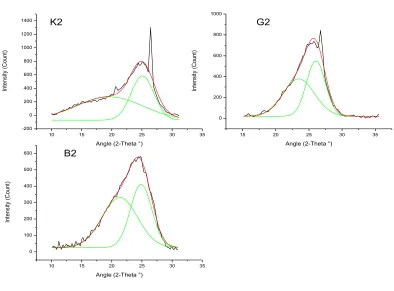
The X-ray diffraction profile of the demineralized coal sample is shown in figure 1. The samples exhibited high background intensity indicating that the coals contained a proportion of highly disordered materials in the form of amorphous carbon [1-9].
10 15 20 25 30 35
-200 0 200 400 600 800 1000 1200 1400
15 20 25 30 35
0 200 400 600 800 1000
10 15 20 25 30 35
0 100 200 300 400 500 600
In
te
ns
ity
(
C
ou
nt
)
Angle (2-Theta °)
K2
In
te
ns
ity
(
C
ou
nt
)
Angle (2-Theta °)
G2
In
te
ns
ity
(
C
ou
nt
)
Angle (2-Theta °)
[image:3.596.96.490.408.699.2]B2
The diffraction profiles show the presence of a clear asymmetric (002) band around ~25.5o, which suggests the existence of another band (γ) on its left. The (γ) band around 20o
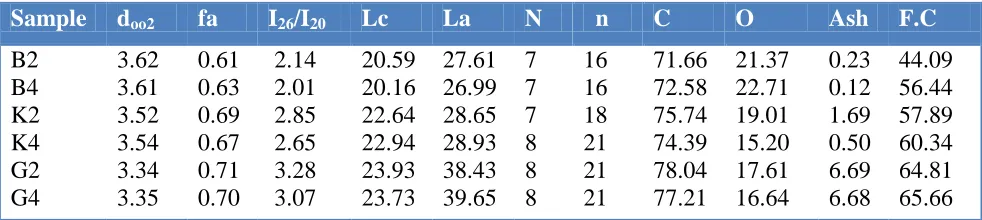
[image:4.596.53.544.329.439.2]was reported by many authors [1-9]. It was attributed to the presence of saturated structures such aliphatic side chains, attached to the edge of the coal crystallites. The (002) band indicates the spacing of aromatic ring layer, while (γ) band reflects the packing distance of saturated structures. In addition, the coals also contained some graphite-like structures (crystalline carbon) indicated by the presence of a clear (002) band at ~ 25.5o and (10) weak band at ~ 42.3o. These observations suggest that, the crystallites in all the coal samples have intermediate structures between graphite and amorphous state called turbostratic structure or random layer lattice structure. The 002 peak of the higher-rank coals are sharper than those of lower rank coals. Position of this peak is found to shift to higher 2θ value with increase in elemental carbon content. The parameters obtained after curve fitting of the (002) and (γ) bands are listed in Table 1. The structural parameters calculated using eqns.(1-4) for all the samples is also presented.
Table 1. Structural parameters extracted from the curve fitting of XRD spectra
Sample doo2 fa I26/I20 Lc La N n C O Ash F.C
B2 B4 K2 K4 G2 G4 3.62 3.61 3.52 3.54 3.34 3.35 0.61 0.63 0.69 0.67 0.71 0.70 2.14 2.01 2.85 2.65 3.28 3.07 20.59 20.16 22.64 22.94 23.93 23.73 27.61 26.99 28.65 28.93 38.43 39.65 7 7 7 8 8 8 16 16 18 21 21 21 71.66 72.58 75.74 74.39 78.04 77.21 21.37 22.71 19.01 15.20 17.61 16.64 0.23 0.12 1.69 0.50 6.69 6.68 44.09 56.44 57.89 60.34 64.81 65.66
(B2, K2,G2-Coal sample leached with 20% HF, B4, K4 and G4- Coal sample leached with 40% HF,d002- Lattice spacing, fa-aromaticity, I26/I20- rank, Lc- average stacking height, La- average lateral size, n-average no.of carbon atoms per lamellae, N-number of layers, C- Elemental carbon wt%, O-elemental oxygen wt%)
The aromaticity (fa) and rank (I26/I20) ratios for the samples ranged from 0.61 to 0.71 and 2.007 to 3.275, respectively. The average lateral sizes (La) and average stacking heights (Lc) of the layer structures in the coals samples, measured using the Scherrer equation ranged from 26.99 Ao to 39.65Ao and 20.16 Ao to 23.93 Ao respectively ( eqn.3 and 4). Interlayer spacing (d002) of the crystallite structure ranges from 3.62 Ao to 3.34A0. The percentage of ordered carbon and the degree of parallel stacking of the lamellae increased with rank of the sample. The volatile matter (V.M) changed from 36.2wt % to 24.9 wt% where as oxygen content varied from 21.37-16.64 wt% for the studied samples. The ash content is reported to have a value of 0.12 wt% to 6.68 wt% for the samples.
71 72 73 74 75 76 77 78 79 0.60
0.62 0.64 0.66 0.68 0.70 0.72
R2 =0.967
fa
C % (dry basis)
A
71 72 73 74 75 76 77 78 79
3.30 3.35 3.40 3.45 3.50 3.55 3.60 3.65
R2 =0.92
d002
C % (dry basis)
B
71 72 73 74 75 76 77 78 79
20.0 20.5 21.0 21.5 22.0 22.5 23.0 23.5 24.0
R2 =0.95
Lc
C % (dry basis)
[image:5.596.159.455.78.637.2]C
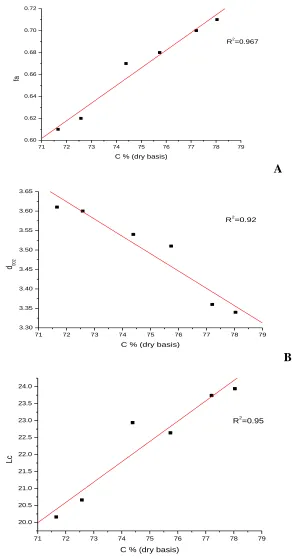
Figure 2. Relationship between the elemental carbon content and (a) aromaticity fa (b) d002 (c) Lc of coal samples
There is a high correlation between the carbon content and the structural parameters (R2= 0.97 to 0.92) of the coal samples. The Lc and fa value increased, while the d002 decreased with increasing
the sample increases. A similar result was reported by Lu et al. [6] in various coals earlier. It was found that Lc increases where as lattice spacing d002 decreased with decrease in V.M content. This
relation is obvious as volatile matter of coal comes from the saturated hydrocarbons and hence decrease of aliphatic side chains increases the aromaticity of coal. The parameter d002 is a measure of the perfection in the stacking structure periodicity. The decrease of d002 with increasing carbon content is related to the development of stacking structure towards graphite structure [1-3]. In the present study G2 and G4 sample (HF leached sub-bituminous coal) has shown more compact structure as that of graphite layer (d002 for the graphite structure is 0.335 nm). In addition to lattice spacing, it is important
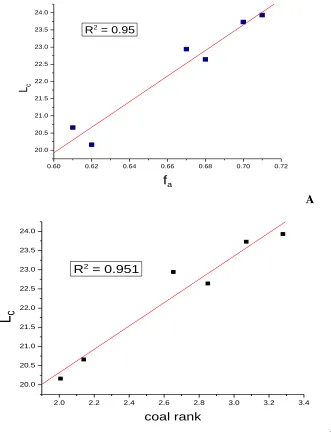
to study the thickness of the stacking structure along the c-axis. In the present study, Lc value increased with increasing rank and aromaticity with high correlation coefficient of 0.95. The Lc value was found to increase with decrease in d002 value as the rank or maturity of coal increased (figure 3).
0.60 0.62 0.64 0.66 0.68 0.70 0.72 20.0
20.5 21.0 21.5 22.0 22.5 23.0 23.5 24.0
R2
= 0.95
Lc
fa
A
2.0 2.2 2.4 2.6 2.8 3.0 3.2 3.4
20.0 20.5 21.0 21.5 22.0 22.5 23.0 23.5 24.0
R2
= 0.951
L
ccoal rank
B
[image:6.596.142.473.285.719.2]
3.1.Determination of number of carbon atom (n) and packing aromatic lamellae
The average number of carbon atoms (n) per aromatic lamellae was calculated from the eqn (6) given elsewhere [3-4]. It was found to be varying from 16 to 21 and also increasing with increase of coal rank (figure 4). This result is in good agreement with the study carried out by Binoy et al. [2] in Assam coals. There exist a high degree of correlation between these two parameters (R2=0.99).
2.0 2.2 2.4 2.6 2.8 3.0 3.2
16 17 18 19 20
21 R
2
=0.989
n
o
.o
f a
to
m
s
/l
a
y
e
r
[image:7.596.176.420.202.408.2]Rank
Figure 4. Relation between coal rank and number of carbon atoms per lamellae
3.2.Packing of aromatic –lamellae
20.0 20.5 21.0 21.5 22.0 22.5 23.0 23.5 24.0 7.0
7.2 7.4 7.6 7.8 8.0
R2=0.94
N
u
m
b
e
r o
f a
ro
m
a
ti
c
l
a
m
e
la
e
(N
)
stacking height
[image:7.596.170.427.511.725.2]
The average interlayer distance of the lamellae were computed from the position of ‘002’ reflection, where as the average dimension of the packets of the lamellae in the direction perpendicular to their planes were estimated from its half width (eqns.1 and 2).
The stacking height of aromatic lamellae (Lc) and number of layers (N) of the higher-rank coals are larger than those of lower ranked coal samples. As the value of Lc increases, N value also increases with increase in carbon content. Figure.5 shows the distribution of number of aromatic layer (N) in the coal with stacking height. The number of layer as determined by this method using Lc was found to be varying from 7 to 8 in the present study.
4. CONCLUSIONS
The results of the structural investigation of three Indian coals showed that the structural parameters like fa & Lc increased with increase in carbon content where as interlayer spacing d002
decreased with increase in carbon content, aromaticity and coal rank. These structural parameters change just opposite with increase in volatile matter content. Considering the ‘turbostratic’ structure for coals, the minimum separation between aromatic lamellae was found to vary between 3.34 to 3.61 Ao for these coals. As the aromaticity increased, the interlayer spacing decreased, which is an indication of more graphitization of the sample. Volatile matter and carbon content had a strong influence on the aromaticity, interlayer spacing and stacking height on the sample. The average number of carbon atoms per aromatic lamellae and number of layers in the lamellae was found to be 16-21 and 7-8 for all the samples. A good linear relationship exists between number of layers and stacking height of the aromatic lamellae in coal.
ACKNOWLEDGEMENT
This work is supported by research grant from the centre for research, Christ University, Bangalore, India
References
1. Takagi, H. Maruyama, K. Yoshizova, N. Yamada, Y. Sato, Y. Fuel.83, (2007) 2427. 2. Binoy, K.S, Boruah, R. K. Gogoi, P. K. J.Chem.Sci.103,(2009)121.
3. Klug P. H. and Alexander L E, X-ray diffraction procedures, John Wiley & Sons, New York (1974)
4. Sanibare, O. O. Tobias,H. Stephen, F. F. Energy.35,(2010)5347 5. Genetti, D. Fletcher, T. H. Pugmire, R. J. Energy Fuels.13,(1999)60 6. Lu, L. Sahajwalla, V. Kong, C. Harris, D. Carbon.39, (2001)1821
7. Mastral, A. M. Mayoral, M .C. Rivera, J. Maldonade, F. Energy Fuels.11, (1997)483 8. Sudip, M. Pinaki, M. Cu.Sci. 91, (2006)337