This is a repository copy of
Distributed processing in vehicular cloud networks
.
White Rose Research Online URL for this paper:
http://eprints.whiterose.ac.uk/127216/
Version: Accepted Version
Proceedings Paper:
Alahmadi, AA, Lawey, AQ, El-Gorashi, TEH et al. (1 more author) (2018) Distributed
processing in vehicular cloud networks. In: Mahmoodi, T, Secci, S, Cianfrani, A and
Idzikowski, F, (eds.) Proceedings of the 2017 8th International Conference on the Network
of the Future (NOF 2017). 8th International Conference on the Network of the Future,
22-24 Nov 2017, London, UK. IEEE , pp. 22-26. ISBN 978-1-5386-0554-7
https://doi.org/10.1109/NOF.2017.8251215
© 2017 IEEE. This is an author produced version of a paper published in the Proceedings
of the 8th International Conference on the Network of the Future (NOF), 2017. Personal
use of this material is permitted. Permission from IEEE must be obtained for all other uses,
in any current or future media, including reprinting/republishing this material for advertising
or promotional purposes, creating new collective works, for resale or redistribution to
servers or lists, or reuse of any copyrighted component of this work in other works.
Uploaded in accordance with the publisher's self-archiving policy.
[email protected] https://eprints.whiterose.ac.uk/
Reuse
Unless indicated otherwise, fulltext items are protected by copyright with all rights reserved. The copyright exception in section 29 of the Copyright, Designs and Patents Act 1988 allows the making of a single copy solely for the purpose of non-commercial research or private study within the limits of fair dealing. The publisher or other rights-holder may allow further reproduction and re-use of this version - refer to the White Rose Research Online record for this item. Where records identify the publisher as the copyright holder, users can verify any specific terms of use on the publisher’s website.
Takedown
If you consider content in White Rose Research Online to be in breach of UK law, please notify us by
Distributed Processing in Vehicular Cloud Networks
Amal A. Alahmadi, Ahmed Q. Lawey, Taisir E. H. El-Gorashi, and Jaafar M. H. Elmirghani
School of Electronic and Electrical Engineering University of Leeds, United Kingdom
{elaaal, a.q.lawey, t.e.h.elgorashi, j.m.h.elmirghani}@leeds.ac.uk
Abstract— Vehicular Clouds processing is a new field of research that aims to exploit the vehicles’ onboard computational resources as a part of a cooperative distributed cloud computing environment. In this paper, we propose a vehicular cloud network architecture where a group of vehicles near a traffic light cluster and form a temporal vehicular cloud by aggregating their computational resources in that cluster. The goal of the proposed architecture is to minimize the processing and network power consumed in the data center of a cloud operator. To this end, arriving processing tasks are optimally assigned to the centralized cloud and/or the formed vehicular clouds to reduce the total power consumption of the centralized cloud by reducing its average processing workload and network traffic. Furthermore, task assignment among vehicular clouds is constrained by tasks completion time. Our proposed system is analyzed using a mixed integer linear programming (MILP) model where two task assignment approaches were considered: single task assignment and distributed task assignment. In the first approach, each task is not split among multiple clouds, while splitting is allowed in the second approach. It was found that the power consumption of the centralized cloud is reduced by 45% (in the first approach) and 60% (in the second approach) compared to the case where all tasks are assigned to the centralized cloud only. The higher power saving of the centralized cloud in the second approach comes from the ability of vehicular clouds to host more processing workload, an average of 37% more workload, compared to the single task assignment approach.
Keywords—vehicular cloud; distributed processing; power consumption; MILP
I. INTRODUCTION
Cloud computing has redefined the computation and communication environment by utilizing multiple resources such as servers, storage devices, and other network hardware to provide on-demand services for end users. The huge growth of the cloud networks as a major computing paradigm in today's communication services calls for more research in new architectures and solutions to offload the computational burden and improve the power consumption in these centralized data centers. The issue of power consumption in information technology equipment has been the focus of attention in recent years and there is growing recognition of the need to manage power consumption across the entire information and communications technology (ICT) sector [1]. A Number of techniques can be applied to achieve energy-efficient datacenters, such as virtualization of cloud resources, using green scheduling methods, improving routing algorithms, and using energy efficient hardware [2]. The conventional version of cloud resources is structured as centralized data centers.
However, the concept of distributed energy efficient data centers has recently emerged into the cloud computing model [3]. Vehicular clouds have recently emerged as one of the possible approaches to realize distributed cloud computing [4]–[6]
In this work, we propose a vehicular cloud framework to minimize the average workload in the centralized cloud and hence, the power consumption of the centralized cloud. This goal is achieved by harnessing the computational resources of vehicular clouds formed in proximity of traffic lights. We introduce a MILP model to study the effects of distributed task assignment on the clouds’ average workload and power consumption compared to single task assignment (non-distributed) approach. The results under both approaches are compared to the case where all tasks are assigned to the centralized cloud. To the best of our knowledge, there is no previous work that proposes a semi-dynamic vehicular cloud formed from vehicles clustered at a traffic light.
The remainder of this paper is organized as follows: In Section II we provide a brief overview of vehicular networks and how they can integrate with cloud computing to generate a new generation of distributed clouds. In section III, an overview of the previous work is highlighted. Section IV introduces our proposed vehicular cloud approach. In Section V, we discuss the model results. Finally, in Section VI, we conclude the paper.
II. VEHICULAR AD HOC NETWORKS AND CLOUD
COMPUTING
Cloud (VuC). Vehicular Cloud Computing (VCC), and Hybrid Vehicular Clouds (HVC).
In the VuC framework, vehicles (as end users) use the conventional cloud storage services to exchange traffic information through different applications [6], [11], [12]. The Vehicles’ roles in this architecture is to provide traffic information to the centralized cloud through a gateway. The centralized cloud then processes the collected information based on the required service and sends the results back to other vehicles.
VCC is a very powerful concept, where vehicles provide cloud resources to process the tasks that are commonly processed in the conventional clouds. VCC is different from the conventional cloud computing due to its dynamic nature and hybrid architecture [13]. VCC, also, has a reasonably reliable power source in the form of vehicle’s battery. Any vehicle with a resource to share, can be a part of the VCC cluster after executing some initial steps based on the chosen protocol. The protocol facilitates how these vehicles communicate to choose a cluster head [14] and set the boundaries of the cloud [10]. From here on, these vehicles can join or leave the cloud based on predefined criteria. As VCC became a leading research area, more applications and services are introduced and evaluated to benefit from such an infrastructure. Some promising applications in this field are driving safety, content distribution, urban sensing, mobile advertising, healthcare, and intelligent transportation applications [15].
The third architecture, HVC, is the combination of VCC and VuC where vehicles can be service providers and consumers in the same architecture. The applications used in HVC are usually P2P applications as the consumer vehicle can either communicate directly with a provider vehicle or with the centralized cloud [6].
III. RELATED WORK
Many studies proposed different architectures where clusters of vehicles can be used as a cloud platform, to provide better service for the end user, to offload the workload burden from the centralized cloud, or to use the underutilized resources in vehicles. All the proposed architectures follow one of two modes of operation: static or dynamic vehicular clouds. Both modes have been the subject of substantial research, focusing mainly on the architecture, communication, stability, and the layering system of the vehicular cloud [16].
In the static mode, the vehicles are clustered in long-term parking lots with a predictable joining and leaving time [4], [17]. The main goal for these studies is to use the underutilized resources of the vehicles to form a computational vehicular cloud [5] or storage-based vehicular cloud [18], [19].
In contrast, the dynamic mode, consists of vehicles on the move [10], [20]. This is considered a challenging framework to implement and study due to the highly dynamic mobility characteristics of the clustered vehicles. Previous research has introduced a general design framework [20], and addressed the resource allocation strategies [21], and connection stability [22]. Promising designs and services platforms were introduced in [23]–[26] using vehicle clusters under the concept of Internet of Vehicles.
Unlike the previous surveyed work, our proposed architecture deals with a semi-dynamic vehicular cloud where the clusters of vehicles are in the vicinity of a traffic light. Therefore, the clusters last for a shorter period of time (depending on the red signal duration of the traffic light) compared to the static mode, and provide more communication stability compared to the dynamic mode as vehicles are temporarily stationary and close to each other near the traffic light.
IV. VEHICULAR CLOUD ARCHITECTURE AND MODEL
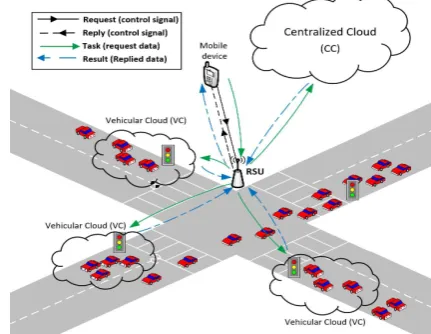
The proposed cloud architecture is shown in figure 1. It consists of one or more temporal vehicular clouds (VC), each with one or more vehicles clustered near a traffic light, which acts as the cluster head for these vehicular clouds. Each traffic light communicates with a roadside unit (RSU). The RSU collects processing requests from nearby mobile devices (end users) and assigns them to the centralized cloud (CC) and/or to the nearby vehicular clouds (VC) based on a certain scheduling strategy implemented at the RSU. Both the traffic light and the RSU are equipped with communication and computational resources to fulfill their roles. When the RSU decides that a task is to be processed by a certain vehicular cloud, the cloud cluster head (traffic light) allocates this task to the participants’ vehicles, and then forwards the processing results back to the RSU, and then, to the end users’ mobile devices.
The task assignment is modelled using a mixed integer linear programming (MILP) with the main goal of minimizing the power consumption of the centralized cloud. Two assignment approaches are considered. The first approach, referred to as single task assignment, assumes that no splitting will be allowed for any task among the available clouds. Each task is assigned to a single cloud, either the centralized cloud or a vehicular cloud. The second approach is referred to as distributed task assignment. It relies on splitting the task among a subset of the available clouds according to the size of the vehicular cloud to achieve better utilization and task completion guarantee within the given time.
[image:3.595.324.540.535.702.2]In this work, the centralized cloud comprises processing servers and an internal LAN that consists of a gateway router and two layers of switches. As mentioned above, the objective of our model is to minimize the power consumption of the
centralized cloud which is the sum of the power consumption of processing servers due to tasks processing and the power consumption generated from the inter-traffic transmission between the centralized cloud and any other vehicular cloud, as given below in equation (1).
Objective: minimize:
where
T is the set of time slots,
PR is the processing server power consumption at the centralized cloud given as:
where is the processing capacity of the centralized cloud node n assigned to task s at time slot t, and is the energy consumption per bit of the server,
and PT is the inter-traffic transmission power consumption at the centralized cloud resulting from dividing the task among the centralized cloud and vehicular clouds.
The MILP model is subject to a number of constraints including:
Assignment of processing demand constraint:
Constraint (3) ensures that the processing demand of a task is satisfied by the processing capacities assigned to it in the different cloud nodes, where is the processing demand of task s at time slot t. The set of tasks, cloud nodes, and the time slots are defined as S, N, and T, respectively.
Cloud processing capacity constraint:
Constraint (4) ensures that the processing demands of the tasks/subtasks assigned to a cloud do not exceed the processing capacity of this cloud, where is the capacity of cloud n at time slot t.
Cloud and job time constraint:
Constraint (5) ensures that the time demand of each task assigned to a cloud does not exceed the availability time of the cloud (the duration of the Red signal of traffic light) where is a binary variable equal 1 if a task s is assigned to cloud n at time slot t, and equal to 0 otherwise. and are the time demand of task s and the time availability of cloud n during time slot t, respectively.
Task assignment constraints:
Constraint (6) ensures that each task is assigned to one cloud in each time slot under the single task assignment approach. Constraint (7) is used to enforce equal distribution of a task processing demand among all cloud nodes selected to serve the same task, where is the portion of task s assigned to each of the clouds serving it at time t.
V. RESULTS
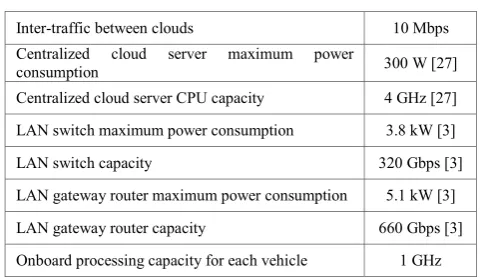
The model is executed to show the effects of the proposed vehicular cloud architecture on the power consumption average workload of the centralized cloud taking into account the two considered assignment approaches. Both approaches are run in many individual time slots (10 times slots), each with 6 generated tasks and 4 temporal vehicular clouds. Fixed values are assumed for all tasks in terms of processing and execution time requirements: 5GHz and 15s respectively. The number of vehicles in each vehicular cloud is uniformly distributed and randomly chosen between 4 and 7 vehicles. The cloud sojourn (presence or duration) is equal to the red signal duration of the traffic light, and is also randomly chosen between 10 and 30 seconds. Table 1 summarizes the rest of the input parameters of the model.
A. The power consumption of the centralized cloud
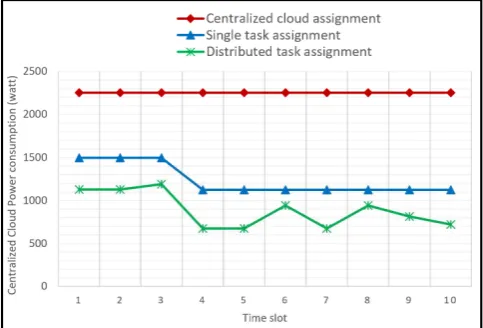
[image:4.595.312.553.552.691.2]The model minimizes the power consumption of the centralized cloud by assigning more tasks to the vehicular clouds. We assume that the power consumption of the processing servers in the centralized cloud is proportional to the assigned workload, and an energy efficient management scheme is employed to power off the un-utilized servers. Figure 2 shows the results of the centralized cloud power consumption in each individual time slot. The results compare the case where all tasks are assigned to the centralized cloud (in the absence of our proposed architecture) and when both approaches (single and distributed task assignment) proposed in our architecture are employed.
TABLE I. INPUT PARAMETERS OF THE MODEL
Inter-traffic between clouds 10 Mbps Centralized cloud server maximum power
consumption 300 W [27] Centralized cloud server CPU capacity 4 GHz [27]
LAN switch maximum power consumption 3.8 kW [3]
LAN switch capacity 320 Gbps [3]
LAN gateway router maximum power consumption 5.1 kW [3]
LAN gateway router capacity 660 Gbps [3]
Fig. 2. The power consumption of the centralized cloud
As shown in Figure 2, the highest centralized clouds power consumption is observed when all the tasks are assigned only to the centralized cloud, namely when the vehicular cloud is not used to process any tasks. The single assignment approach results show a lower power consumption compared to the centralized task assignment. The lowest power consumption is achieved by the distributed task assignment approach, where the model succeeds in assigning more tasks to the vehicular clouds, and therefore, further minimizes the power consumption of the centralized cloud. Note that in some cases, the distributed approach will assign the whole task to the centralized cloud rather than distribute it to multiple vehicular clouds. This is because the traffic transmission power consumption is part of the power consumption objective to be minimized. Therefore, using such decisions, the model minimizes the overall power consumption (processing and transmission). The different individual values of power consumption in different time slots is due to the individual assumed clouds parameters in each time slots. The overall savings in power consumption are 45% and 60% for the first and second approach (single and distributed assignment), respectively, compared to the centralized clouds assignment.
B. The average workload of the centralized/vehicular clouds
In this section, we assess the reduction in the average workload of the centralized cloud due to the two proposed approaches as well as the utilization efficiency and balance of workload among all vehicular clouds for each processed task. Workload balance is modeled to ensure that tasks are completed in the given time by distributing the load optimally (in proportion to the dynamic vehicular cloud size) among a subset of the available clouds at each time slot for each task. In the long run, this can result in a certain level of fairness in average workload distribution among the utilized vehicular clouds.
Figure 3 shows the results of average workload of all clouds for the two proposed approaches, in addition to the centralized assignment case without implementing the vehicular cloud architecture. The average workload of a certain cloud is calculated by summing its workload at each time slot divided by the number of time slots.
In the single task assignment approach, the results show that a lower workload is assigned to the centralized cloud, lower by
43%, compared to the centralized assignment case because vehicular clouds help offload more tasks from the centralized cloud. In contrast, the same approach caused a higher average workload in the centralized cloud compared to distributed task assignment approach. The distributed assignment achieves 29% less workload compared to the single task assignment. This is because whenever the vehicular clouds processing capacity is less than the task processing demand, the single task assignment approach forwards the whole task to the centralized cloud which increases the centralized cloud workload, while the distributed task assignment approach can split the tasks into smaller slices to fill the available capacity in multiple vehicular clouds in a bin packing form to reduce the overall centralized cloud workload.
[image:5.595.310.554.351.515.2]Observing the workload balance between the vehicular clouds shows that a fair load balance distribution is not achieved or even considered in the single task assignment as no task splitting is allowed. Therefore, some vehicular clouds are utilized better than others as the tasks are assigned based on the processing capacity level. On the other hand, the distributed task assignment approach implements workload balance which leads to better utilization and long term fairness among vehicular clouds as shown in the set of results in Figure 3. The small differences between the vehicular cloud average workloads in the second approach are due to the vehicular clouds’ different parameters in each time slot which results in choosing a different subset of clouds depending on the arrived task requirements.
Fig. 3. The average workload of centralized/vehicular clouds
We quantify fairness by calculating the standard deviation of vehicular clouds average workload in both approaches. The results prove that the distributed assignment gave a fairer balance with assignment standard deviation of 0.21 compared to a standard deviation of 0.47 for the single task assignment.
VI. CONCLUSIONS AND FUTURE WORK
completion time within the given duration of the vehicular cloud, where the latter is dictated by the red signal duration.
The framework is modelled using MILP to test two approaches of task assignment: single and distributed task assignment. It was found that the power consumption of the centralized cloud is reduced by 45% (in the first approach) and 60% (in the second approach) compared to the case where all tasks are assigned to the centralized cloud only, given the model’s input parameters. The higher power saving in the second approach is due to the ability of vehicular clouds to host more processing workload, an average of 37% more workload, compared to the single task assignment approach. In addition, it was found that the second approach can induce fairness balance in the vehicular clouds despite the increase in the average workload. We plan to extend the work and develop a heuristic method to enable us to handle a large number of vehicular clouds beyond the MILP computational limitations. An overall fairness among all vehicular clouds will be introduced to achieve better utilization and to balance the vehicular clouds revenue. Furthermore, we will consider adding a middle layer of Fog servers to improve the quality of service for the processed tasks.
ACKNOWLEDGMENTS
The authors would like to acknowledge funding from the Engineering and Physical Sciences Research Council (EPSRC), INTERNET (EP/H040536/1) and STAR (EP/K016873/1) projects. Mrs. Amal Alahmadi would like to thank the Government of Saudi Arabia and Imam Abdulrahman Bin Faisal University for funding her PhD scholarship.
REFERENCE
[1] J. Baliga, R. W. A. Ayre, K. Hinton, and R. S. Tucker, ‘Green Cloud Computing: Balancing Energy in Processing, Storage and Transport’,
Proc. IEEE, vol. 99, no. 1, pp. 149–167, 2011.
[2] A. Hammadi and L. Mhamdi, ‘A survey on architectures and energy efficiency in Data Center Networks’, Comput. Commun., vol. 40, pp. 1–21, 2014.
[3] A. Lawey, T. El-Gorashi, and J. Elmirghani, ‘Distributed Energy Efficient Clouds over Core Networks’, J. Light. Technol., vol. 32, no. 7, pp. 1261–1281, 2014.
[4] S. . Olariu, T. . Hristov, and G. . Yan, the Next Paradigm Shift: From vehicular Networks To Vehicular Clouds, Second. Mobile Ad Hoc Networking: Cutting Edge Directions, 2013.
[5] S. Olariu, I. Khalil, and M. Abuelela, ‘Taking VANET to the clouds’,
Int. J. Pervasive Comput. Commun., vol. 7, no. 1, pp. 7–21, 2011. [6] R. Hussain, Z. Rezaeifar, and H. Oh, ‘A Paradigm Shift from
Vehicular Ad Hoc Networks to VANET-Based Clouds’, Wirel. Pers. Commun., vol. 83, no. 2, pp. 1131–1158, 2015.
[7] S. U. Rehman, M. A. Khan, T. A. Zia, and L. Zheng, ‘Vehicular Ad-Hoc Networks (VANETs) - An Overview and Challenges’, J. Wirel. Netw. Commun., vol. 3, no. 3, pp. 29–38, 2013.
[8] M. A. Al Mamun, K. Anam, M. F. A. Onik, and A. M. Esfar-E-Alam, ‘Deployment of Cloud Computing into VANET to Create Ad Hoc Cloud Network Architecture’, Proc. World Congr. Eng. Comput. Sci., vol. 1, pp. 24–26, 2012.
[9] L. Gu, D. Zeng, and S. Guo, ‘Vehicular cloud computing: A survey’, in 2013 IEEE Globecom Workshops, GC Wkshps 2013, 2013, pp. 403–407.
[10] R. Hussain, J. Son, H. Eun, S. Kim, and H. Oh, ‘Rethinking Vehicular Communications: Merging VANET with cloud computing’, in
CloudCom 2012 - Proceedings: 4th IEEE International Conference on Cloud Computing Technology and Science, 2012, pp. 606–609. [11] M. Eltoweissy, S. Olariu, and M. Younis, ‘Towards autonomous
vehicular clouds’, in International Conference on Ad Hoc Networks. Springer Berlin Heidelberg, 2010, pp. 1–16.
[12] J. Joshi, K. Jain, Y. Agarwal, M. J. Deka, and P. Tuteja, ‘TMaaS : Traffic Management as a Service Using Cloud in VANETs’, in Smart Instrumentation, Measurement and Applications (ICSIMA), 2015 IEEE 3rd International Conference on. IEEE, 2015, pp. 1–6. [13] M. Whaiduzzaman, M. Sookhak, A. Gani, and R. Buyya, ‘A survey
on vehicular cloud computing’, J. Netw. Comput. Appl., vol. 40, no. 1, pp. 325–344, 2014.
[14] C. Caballero-Gil, P. Caballero-Gil, and J. Molina-Gil, ‘Self-Organized Clustering Architecture for Vehicular Ad Hoc Networks’,
Int. J. Distrib. Sens. Networks, vol. 2015, 2015.
[15] M. Gerla, ‘Vehicular cloud computing’, in 2012 the 11th Annual Mediterranean Ad Hoc Networking Workshop, Med-Hoc-Net, 2012, pp. 152–155.
[16] M. R. Jabbarpour, A. Jalooli, A. Marefat, and R. Noor, ‘A Taxonomy-based comparison of Vehicle Cloud Architectures’, 3rd Int. Conf. Inf. Comput. Networks (ICICN 2015), Florence, Italy, 2015.
[17] H. S. Hassanein, S. Abdelhamid, and K. Elgazzar, ‘A framework for vehicular cloud computing’, in 2015 International Conference on Connected Vehicles and Expo, ICCVE 2015 - Proceedings, 2015, pp. 238–239.
[18] S. Singh and S. Anand, ‘Implementing Storage as a Service in Cloud using Network Attached Storage’, Int. J. Comput. Appl., vol. 108, no. 13, pp. 6–9, 2014.
[19] S. Abdelhamid, H. S. Hassanein, and G. Takahara, ‘Vehicle as a resource (VaaR)’, IEEE Netw., vol. 29, no. 1, pp. 12–17, 2015. [20] O. Altintas, F. Dressler, F. Hagenauer, M. Matsumoto, M. Sepulcre,
and C. Sommery, ‘Making cars a main ICT resource in smart cities’, in IEEE Conference on Computer Communications Workshops, 2015, pp. 582–587.
[21] R. Yu, Y. Zhang, S. Gjessing, W. Xia, and K. Yang, ‘Toward Cloud-based vehicular networks with efficient resource management’, IEEE Netw., vol. 27, no. 5, pp. 48–55, 2013.
[22] M. A. Abhale, S. Khandelwal, and P. U. Nagaraj, ‘Shifting VANET to Cloud - Survey’, Int. J. Adv. Res. Comput. Sci. Softw. Eng., vol. 3, no. 11, pp. 1056–1061, 2013.
[23] M. Pasha, M. U. Farooq, H. Atif, and K. Ur, ‘Vehicular Cloud Computing: leading towards tomorrow’s Internet of Vehicles’, J. Wirel. Sens. Networks, pp. 1–6, 2015.
[24] E.-K. Lee, M. Gerla, G. Pau, U. Lee, and J.-H. Lim, ‘Internet of Vehicles: From intelligent grid to autonomous cars and vehicular fogs’, Int. J. Distrib. Sens. Networks, vol. 12, no. 9, pp. 241–246, 2016.
[25] F. Yang, S. Wang, J. Li, Z. Liu, and Q. Sun, ‘An overview of Internet of Vehicles’, China Commun., vol. 11, no. 10, pp. 1–15, 2014. [26] Y. Leng and L. Zhao, ‘Novel design of intelligent internet-of-vehicles
management system based on cloud-computing and Internet-of-Things’, Proc. 2011 Int. Conf. Electron. Mech. Eng. Inf. Technol. EMEIT 2011, vol. 6, pp. 3190–3193, 2011.