White Rose Research Online URL for this paper:
http://eprints.whiterose.ac.uk/144682/
Version: Published Version
Article:
Meier, A., Ordyniak, S. orcid.org/0000-0003-1935-651X, Ramanujan, M.S. et al. (1 more
author) (2019) Backdoors for Linear Temporal Logic. Algorithmica, 81 (2). pp. 476-496.
ISSN 0178-4617
https://doi.org/10.1007/s00453-018-0515-5
[email protected] https://eprints.whiterose.ac.uk/ Reuse
This article is distributed under the terms of the Creative Commons Attribution (CC BY) licence. This licence allows you to distribute, remix, tweak, and build upon the work, even commercially, as long as you credit the authors for the original work. More information and the full terms of the licence here:
https://creativecommons.org/licenses/
Takedown
If you consider content in White Rose Research Online to be in breach of UK law, please notify us by
https://doi.org/10.1007/s00453-018-0515-5
Backdoors for Linear Temporal Logic
Arne Meier1·Sebastian Ordyniak2 ·M. S. Ramanujan3·Irena Schindler1
Received: 31 May 2017 / Accepted: 5 September 2018 / Published online: 18 September 2018 © The Author(s) 2018
Abstract
In the present paper, we introduce the backdoor set approach into the field of temporal logic for the global fragment of linear temporal logic. We study the parameterized complexity of the satisfiability problem parameterized by the size of the backdoor. We distinguish between backdoor detection and evaluation of backdoors into the fragments of Horn and Krom formulas. Here we classify the operator fragments of globally-operators for past/future/always, and the combination of them. Detection is shown to be fixed-parameter tractable whereas the complexity of evaluation behaves differently. We show that for Krom formulas the problem is paraNP-complete. For Horn formulas, the complexity is shown to be either fixed parameter tractable or paraNP-complete depending on the considered operator fragment.
Keywords Linear temporal logic·Parameterized complexity·Backdoor sets
A preliminary version of this work was presented at IPEC 2016 [28].
B
Sebastian Ordyniak [email protected]Arne Meier
M. S. Ramanujan [email protected]
Irena Schindler
1 Institut für Theoretische Informatik, Leibniz Universität Hannover, Appelstrasse 4, 30167
Hannover, Germany
2 Algorithms Group, University of Sheffield, Regent Court, 211 Portobello, Sheffield S1 4DP, UK
3 Institut für Computergraphik und Algorithmen 186/1, Technische Universität Wien, Favoritenstraße
1 Introduction
Temporal logic is one of the most important formalism in the area of program ver-ification and validation of specver-ification consistency. Most notable are the seminal contributions of Kripke [21], Pnueli [32], Emerson, Clarke, and Halpern [7,14] to name a few. There exist several different variants of temporal logic from which, best known are the computation tree logic CTL, the linear temporal logic LTL, and the full branching time logic CTL∗. In this paper, we will consider the global fragment of LTL for formulas inseparated normal form(SNF) which has been introduced by Fisher [15]. This normal form is a generalization of the conjunctive normal form from propo-sitional logic to linear temporal logic with future and past modalities interpreted over the flow of time, i.e., the frame of the integers(Z, <). In SNF the formulas are divided into a past, a present, and a future part. Technically this normal form is not a restriction since one can always translate an arbitrary LTL formula to a satisfiability-equivalent formula in SNF in time linear in the original formula [15]. In fact, the restriction to SNF normal form is crucial for us, because it is known that syntactical restrictions of arbitrary LTL formulas such as Horn or Krom do not lead to tractability [4].
LTL and its two main associated computational problems LTL model checking and LTL satisfiability have been deeply investigated in the past. In this work we focus on the LTL satisfiability problem, i.e., given an LTL formula the question is whether there is a temporal interpretation that satisfies the formula. Sistla and Clarke classified the computational complexity of the satisfiability problem to bePSPACE-complete [36]. Then, later, several restrictions of the unrestricted problem have been considered. These approaches considered operator fragments [29], Horn formulas [4], temporal operator fragments, temporal depth, and number of propositional variables [8], the use of negation [27], an XOR fragment [11], an application of Post’s lattice [3], and the SNF fragment [2].
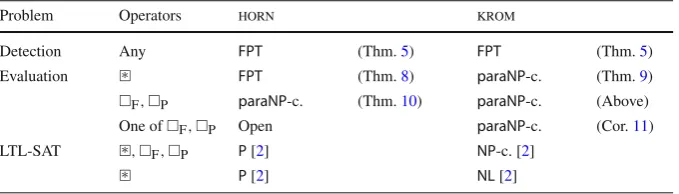
Table 1 Results overview
Problem Operators horn krom
Detection Any FPT (Thm.5) FPT (Thm.5)
Evaluation ∗ FPT (Thm.8) paraNP-c. (Thm.9)
F,P paraNP-c. (Thm.10) paraNP-c. (Above)
One ofF,P Open paraNP-c. (Cor.11)
LTL-SAT ∗,F,P P[2] NP-c. [2]
∗ P[2] NL[2]
The term “Any” refers to any combination of∗,F,P, whereas “Above” denotes that the lower bound from the cell above applies
is usually not provided with the input, it is crucial that small backdoor sets to a given base class can be found efficiently. When employing the backdoor approach one consequently usually considers two subtasks the so-calleddetectionandevaluation
problem, where the former is the task to identify a small backdoor set and the later concerns the solution of the problem using the backdoor set.
Our Contribution In this paper, we introduce a notion of backdoors for the global fragment of LTL formulas that are given in SNF. Namely, we consider backdoor sets to the base classes that have recently been identified by Artale et al. [2]. These base classes are defined by both restrictions on the allowed temporal operators (i.e., to a subset of
{∗,P,F}) and restrictions on the clauses to be eitherhornorkrom. We show that surprisingly a notion of backdoor sets very similar to the strong backdoor sets employed for SAT [18] can also be successfully applied to LTL formulas. Whereas the detection of these backdoor sets can be achieved via efficient fpt-algorithms for all the considered fragments (using algorithms similar to the algorithms employed in the context of SAT), the evaluation of these backdoor sets turns out to be much more involved. In particular, we obtain tractability of the evaluation problem forhornformulas using only the always operator. In fact, LTL restricted to only the always operator, is already quite interesting, since it allows one to express “Safety” properties of a system. For almost all of the remaining cases we show that the evaluation problem is paraNP -hard. Moreover, the techniques used to show these results are very different from and more involved than the techniques employed for SAT, i.e., in the context of SAT the backdoor set evaluation problem is trivial. Our results are summarized in Table1.
2 Preliminaries
Parameterized ComplexityA good introduction into the field of parameterized com-plexity is given by Downey and Fellows [12]. Aparameterized problemΠ is a tuple
(Q, κ)such that the following holds. Q ⊆ Σ∗ is a language over an alphabetΣ, andκ:Σ∗→Nis a computable function; thenκ also is called theparameterization
(of Π).
If there is a deterministic Turing machineMand a computable function f:N→N
bounded by f(κ(x))· |x|O(1), then we say thatMis anfpt-algorithm forΠand that
Πisfixed-parameter tractable(or in the classFPT). IfMis non-deterministic, thenΠ
belongs to the classparaNP. One way to showparaNP-hardness of a parameterized problem(Q, κ)is to show thatQisNP-hard for a specific, fixed value ofκ, i.e., there exists a constantℓ∈Nsuch that(Q, κ)ℓ:= {x|x∈ Qandκ(x)=ℓ}isNP-hard.
Temporal LogicWe assume familiarity with standard notions of propositional logic. LetPROPbe a finite set of propositions and⊥/⊤abbreviate the constants false/true. The syntax of the global fragment of LTL is defined by the following EBNF:
ϕ::= ⊥ | ⊤ | p| ¬ϕ |ϕ∧ϕ |ϕ∨ϕ |Pϕ |Fϕ|∗ϕ,
where p∈PROP. HerePϕcan be read as “ϕholds in every point in the past”,Fϕ
as “ϕ holds in every point in the future”, and∗ϕ as “ϕholds always”. We also will
make use of well-known shortcuts such as→,↔. Now we define the semantics of these formulas. Here, we interpret LTL formulas over the flow of time(Z, <)(for
further information on this approach, see, e.g., Gabbay et al. [17]). Note that all our results can be easily transferred to the case if the formulas are evaluated over the set of natural numbers instead of the set of all integers.
Definition 1 (Temporal Semantics) LetPROPbe a finite set of propositions. Atemporal interpretationM=(Z, <,V)is a mapping from propositions to moments of time, i.e.,V: PROP→P(Z). The satisfaction relation|is then defined as follows where
n∈Z,ϕ, ψ ∈LTL
M,n | ⊤ always, M,n | ⊥ never,
M,n | p iff n ∈V(p),
M,n | ¬ϕ iff M,n |ϕ,
M,n |ϕ∨ψ iff M,n |ϕorM,n |ψ,
M,n |ϕ∧ψ iff M,n |ϕandM,n|ψ,
M,n |Fϕ iff for allk>nit holdsM,k|ϕ, M,n |Pϕ iff for allk<nit holdsM,k|ϕ, and M,n |∗ϕ iff for allk∈Zit holdsM,k|ϕ.
We say thatϕissatisfiableif there is a temporal interpretationMsuch thatM,0| ϕ. ThenMis also referred to as a(temporal) model (ofϕ). Sometimes we also directly writeM(p)instead ofV(p).
Table2exemplifies the semantics with some basic formulas. As shown by Fisher et al. every LTL formula considered over the frame (Z, <) has a satisfiability-equivalent formula in the separated normal form SNF [16], which can be constructed in linear time [15]). We follow the notation of SNF formulas by Artale et al. [2] and directly restrict them to the relevant global fragment of this study:
λ::= ⊥ | p |Fλ|Pλ|∗λ, (1)
ϕ::=λ| ¬λ|ϕ∧ϕ|∗(¬λ∨ · · · ∨ ¬λ∨λ∨ · · ·λ), (2)
Table 2 Temporal semantics
<0 0 1 2 3 4 5 >5
p 1 1 0 1 0 1 1 0
q 0 0 1 1 0 0 1 1
r 0 0 0 0 1 0 0 0
p∧q 0 0 0 1 0 0 1 0
∗ p 0 0 0 0 0 0 0 0
Fq 0 0 0 0 0 1 1 1
FFq 0 0 0 0 1 1 1 1
Pp 1 1 1 0 0 0 0 0
∗(Pp) 0 0 0 0 0 0 0 0
[image:6.439.51.388.241.303.2]∗(p∨Fq∨Pp∨r) 1 1 1 1 1 1 1 1
Table 3 Considered normal forms
Class Description Restrictions onn,m
cnf No restrictions on (2) –
horn At most one positive temporal literal m≤1
krom Binary clauses n+m≤2
Restrictions refer to Eq. (2)
Note that the operator name G instead of F often occurs in literature. Yet,
in contrast to Gϕ, for Fϕ it is not required that ϕ holds in the present world.
We distinguish fragments of LTL by adding superscripts and subscripts as fol-lows. If O ⊆ {F,P,∗} is an operator subset then LTLO is the fragment of
LTL consisting of formulas that are allowed to only use temporal operators from
O for temporal literals, i.e., it is a constraint on the allowed operators in equation (1) from above. We also consider restrictions of the clausal normal form in (2):
∗(¬λ1 ∨ · · · ∨ ¬λn∨ λn+1∨ · · ·λn+m). Table3 lists the relevant cases for this
study. Ifα∈ {cnf,horn,krom}then LTLα is the set of formulas where the subfor-mulas of the type∗(¬λ1∨ · · · ∨ ¬λn∨λn+1∨ · · ·λn+m) (3), obey the normal form α.
The following lemma shows a log-space constructible normal form which prohibits deep nesting of temporal operators of the investigated formulas.
Proposition 2 ([2, Lemma 2])LetL∈ {LTLF,P
α ,LTLαF,LTLαP,LTL
∗
α}be a
for-mula class forα∈ {cnf,horn,krom}. For any formulaϕ∈L, one can construct, in log-space, a satisfiability-equivalentL-formulaΨ ∧∗Φ, whereΨ is a conjunction of propositional variables fromΦ, andΦis a conjunction of clauses of the form (3) containing onlyF,PforLTLαF,P,FforLTLαF,PforLTLαP, and only∗ for LTLα∗, in which the temporal operators are not nested.
3 Introduction of Backdoors for the Global Fragment of LTL
In the following, we will introduce a notion of backdoors for formulas in the global fragment of linear temporal logic. The definition of these backdoors turns out to be very similar to the definition of the so-called strong backdoor sets for propositional formulas [18]. The main difference is that whenever a propositional variable is in the backdoor set then also all of its temporal literals are required to be in the backdoor set as well. A consequence of this is that in contrast to propositional formulas, where a backdoor set needs to consider all assignments of the backdoor set variables, we only need to consider assignments that are consistent between propositional variables and their temporal literals.
LetObe a set of operators. An assignmentθ:Vars(φ)∪ {O x |x∈Vars(φ)∧O∈
O} → {0,1}isconsistentif for everyx ∈Vars(φ)it holds that ifθ (∗x)=1, then
alsoθ (Px)=1,θ (Fx)=1, andθ (x)=1.
Definition 3 (Backdoors) LetCbe a class ofcnf-formulas,Obe a set of operators,
andφbe an LTLOcnfformula. A setX ⊆Vars(φ)is a(strong) (C,O)-backdoorif for every consistent assignmentθ: X ∪ {O x | x ∈ X,O ∈ O} → {0,1}it holds that
φ[θ]is inC.
The reduct φ[θ]is defined similarly to that for standard cnf-formulas, i.e., all clauses that contain a satisfied literal are deleted, and all falsified literals are deleted from their clauses. Here empty clauses are substituted by false, and the empty formula by true. Sometimes if the context ofOis clear, we omit to state it and just mention
the backdoor classC.
Example 4 Letϕ= p1∧p2∧∗(¬Pp4∨Pp2∨P p3)be the considered formula.
ThenB = {p3}is a strong(krom,{P,∗})-backdoor as the following assignments
have to be examined:
p3 Pp3 ∗ p3 ϕ[θ]
0 0 0 p1∧p2∧∗(¬Pp4∨Pp2) ⋆
0 0 1 Irrelevant as inconsistent
0 1 0 p1∧p2 ♥
0 1 1 Irrelevant as inconsistent
1 0 0 p1∧p2∧∗(¬Pp4∨Pp2) ⋆
1 0 1 Irrelevant as inconsistent
1 1 0 p1∧p2 ♥
1 1 1 p1∧p2
First, observe that all relevant rows lead to akrom-formula. Note that for the rows marked with⋆the reduct just removed the temporal literalPp3. All other rows are
either inconsistent (and hence irrelevant) or delete the clause(¬Pp4∨Pp2∨
Pp3)completely, because Pp3 is set to true. At first glance, our definition of
strong backdoor sets for the propositional satisfiability problem. For instance consider the assignments marked with the♥. In these cases we delete the clause(¬P p4∨
Pp2∨Pp3)completely becauseP p3is set to true. However, we also know that,
because ∗ p3 is set to false, the clause will not be satisfied solely byPp3in all
possible worlds of a satisfying model. This indicates that solving the formula using the backdoor will not be as simple as it was for the propositional satisfiability problem, where it was sufficient to enumerate all assignments of the backdoor set and solve the reduced formula. Nevertheless, as we will show in Sect.5.1our backdoor sets can still be used for the efficient evaluation of LTL formulas.
To exploit backdoor sets to obtain efficient fpt-algorithms for LTL one needs to accomplish two tasks: first, one needs to find a small backdoor set, and then one needs to show how the backdoor set can be exploited to efficiently evaluate the formula. This leads to the following problem definitions for every classCof formulas and set
of operatorsO.
Problem: EvalO(C)— Backdoor evaluation to LTLO C.
Input: LTLOcnfformulaφ, strong(C,O)-backdoorX. Parameter: |X|.
Question: Isφsatisfiable?
Problem: DetectO(C)— Backdoor detection to LTLOC. Input: LTLOcnfformulaφ, integerk∈N.
Parameter: k.
Task: Find a strong(C,O)-backdoor of size≤kif one exists.
Of course, this approach is only meaningful if one considers target classes that have polynomial time solvable satisfiability problems. Artale et al. have shown [2] that satisfiability for LTLhorn∗ and LTL
∗
kromare solvable inP. AddingF,Pto the set of allowed operators makes thekromfragmentNP-complete whereas forhornformulas the problem stays inP. Accordingly, we will consider in the following onlykromand hornformulas. Moreover, note that when considering arbitrary CNF formulas instead ofhornorkromformulas, then LTLO
cnfis known to be NP-complete for any (even empty) subsetO⊆ {F,P,∗}[2].
4 Backdoor Set Detection
In this section, we show that finding strongC-backdoor sets (under the parameter size
of the set) is fixed-parameter tractable ifCis eitherhornorkrom. The algorithms that we will present are very similar to the algorithms that are known for the detection of strong backdoors for propositional CNF formulas [18].
We first show how to deal with the fact that we only need to consider consistent assignments. The following observation is easily witnessed by the fact that if one of
Px,Fx,xdoes not hold then¬∗xis true.
Observe that the tautological clauses above are exactly the clauses that are satisfied by every consistent assignment. It follows that once these clauses are removed from the formula, it holds that for every clauseCofφthere is a consistent assignmentθ
such thatCis not satisfied byθ.
Theorem 5 For every O ⊆ {∗,P,F} and C ∈ {horn,krom} the problem DetectO(C)is inFPT.
Proof Let O ⊆ {∗,P,F}. We will reduce DetectO(horn) to the problem VertexCover which is well-known to be fixed-parameter tractable (parameterized by the solution size) and which can actually be solved very efficiently in time
O(1.2738k +kn)[6], where kis the size of the vertex cover and n the number of vertices in the input graph. Recall that given an undirected graphGand an integer
k, VertexCover asks whether there is a subsetC ⊆V(G)of size at mostk(which is called a vertex cover ofG) such thatC∩e= ∅for everye∈E(G). Given an LTLO formulaφ :=Ψ ∧∗Φ, we will construct an undirected graphG such thatφhas a
stronghorn-backdoor of size at mostkif and only ifGhas a vertex cover of size at mostk. The graphGhas vertex set Vars(φ)and there is an edge between two vertices
xand yinGif and only if there is a clause that contains at least two literals from
{x,y} ∪ {O x,O y|O∈O}. Note that ifx=y, the graphGcontains a self-loop. We claim that a set X ⊆Vars(φ)is a stronghorn-backdoor if and only ifX is a vertex cover ofG.
Towards showing the forward direction, let X ⊆ Vars(φ) be a strong horn -backdoor set of φ. We claim that X is also a vertex cover of G. Suppose for a contradiction thatXis not a vertex cover ofG, i.e., there is an edge{x,y} ∈ E(G)such thatX∩{x,y} = ∅. Because{x,y} ∈ E(G), we obtain that there is a clauseCinΦthat contains at least two literals from{x,y} ∪ {O x,O y|O∈O}. Moreover, because of Observation1there is a consistent assignmentθ: X∪{O x |x ∈X∧O∈O} → {0,1}
that falsifies all literals ofCover variables in X. Consequently,φ[θ]contains a sub-clause ofCthat still contains at least two literals from{x,y} ∪ {O x,O y| O∈O}.
As a reason for this,φ[θ]∈/ horn, contradicting our assumption that X is a strong horn-backdoor set ofφ.
Towards showing the reverse direction, letX ⊆V(G)be a vertex cover ofG. We claim thatXis also a stronghorn-backdoor ofφ. Suppose for a contradiction that this is not the case, then there is an (consistent) assignmentθ: X∪ {O x |x ∈ X∧O ∈
O} → {0,1}and a clauseCinφ[θ]containing two positive literals say over variables
xandy. We obtain thatCcontains at least two positive literals from{x,y}∪{O x,O y|
O ∈O}and consequentlyGcontains the edge{x,y}, contradicting our assumption thatX is a vertex cover ofG.
Now we will reduce DetectO(krom)to the 3-HittingSet problem, which is well-known to be fixed-parameter tractable (parameterized by the solution size) [1]. Recall that given a universeU, a familyFof subsets ofUof size at most three, and an integer
k, 3-HittingSet asks whether there is a subsetS⊆Uof size at mostk(which is called a hitting set ofF) such thatS∩F = ∅for every F ∈ F. Given an LTLO formula φ :=Ψ ∧∗Φ, we will construct a familyF of subsets (of size at most three) of a
the set Vars(C)for every setC of exactly three literals contained in some clause of
Φ. We claim that a setX ⊆Vars(φ)is a strongkrom-backdoor if and only ifX is a hitting set ofF.
Towards showing the forward direction, let X ⊆ Vars(φ) be a strong krom -backdoor set of φand suppose for a contradiction that there is a set F ∈ F such
that X ∩F = ∅. It follows from the construction ofF thatΦ contains a clauseC
containing at least three literals over the variables inF. Moreover, because of Obser-vation1there is a consistent assignmentθ: X∪ {O x |x ∈ X∧O ∈O} → {0,1}
that falsifies all literals ofCover variables in X. Consequently,φ[θ]contains a sub-clause ofCthat still contains at least three literals over the variables inF. As a result,
φ[θ]∈/krom, contradicting our assumption thatXis a strongkrom-backdoor set of
φ.
Towards showing the reverse direction, letX ⊆Ube a hitting set ofFand suppose
for contradiction that there is an (consistent) assignmentθ: X∪ {O x |x ∈X∧O∈
O} → {0,1}and a clauseCinφ[θ]containing at least three literals. LetC′be a set of
at exactly three literals fromC. It follows from the construction ofF, thatFcontains
the set Vars(C′), however, Vars(C′)∩X = ∅contradicting our assumption that Xis
a hitting set ofG. ⊓⊔
Having shown that the detection problem is fixed-parameter tractable, we now proceed to the backdoor set evaluation problem. We begin by investigating this problem for the classhornand show that the problem lies inFPT.
5 Backdoor Set Evaluation
5.1 Formulas Using only the Always Operator
We showed in the previous section that strong backdoors can be found to the classes hornandkrominFPTtime. In fact, this result holds independently of the considered temporal operators. In this section, we will consider the question of efficientlyusinga backdoor set to decide the satisfiability of a formula in the case of formulas restricted to the∗operator. We will show that this problem is inFPTfor the class ofhornformulas but not forkromformulas. Our fixed-parameter tractability result forhornformulas largely depends on the special semantics of formulas restricted to the∗ operators.
Consequently, we will start by stating some properties of these formulas necessary to obtain our tractability result.
LetM=(Z, <,V)be a temporal interpretation. We denote by Vars(M)the set of propositions (in the following referred to as variables) for whichV is defined. For a set of variables X ⊆Vars(M), we denote byM|X theprojectionofMontoX, i.e., the temporal interpretation M|X = (Z, <,V|X), where V|X is only defined for the variables in X andV|X(x)=V(x)for everyx ∈ X. For an integerz, we denote by
A(M,z)the assignmentθ:Vars(M)→ {0,1}holding at worldzinM, i.e.,θ (v)=1 if and only ifz∈M(v)for everyv∈Vars(M). Moreover, for a set of worldsZ ⊆Z
we denote byA(M,Z)the set of all assignments occurring in some world in Z of
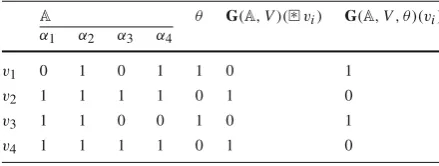
Table 4 An example for the
notionsG(A,V)andG(A,V, θ ) A θ G(A,V)(∗vi) G(A,V, θ )(vi)
α1 α2 α3 α4
v1 0 1 0 1 1 0 1
v2 1 1 1 1 0 1 0
v3 1 1 0 0 1 0 1
v4 1 1 1 1 0 1 0
assignmentθ: X → {0,1}, we denote byW(M, θ )the set of all worldsz∈ZofM
such thatA(M,z)is equal toθon all variables inX.
Let ϕ := Ψ ∧∗Φ ∈ LTL∗
cnf. We denote byCNF(Φ)the propositional CNF formula obtained fromΦafter replacing each occurrence of∗xinΦ with the same
fresh propositional variable (with the same name). For instance,∗a∧∗ais replaced
by∗a∧∗a, where∗ais a fresh propositional variable. For a set of variablesVand a
set of assignmentsAof the variables inV, we denote byG(A,V): {∗v|v∈V} → {0,1}the assignment defined by settingG(A,V)(∗v)=1 if and only ifα(v)=1 for
everyα∈A. Moreover, ifθ:V → {0,1}is an assignment of the variables inV, we denote byG(A,V, θ )the assignment defined by settingG(A,V, θ )(v)=θ (v)and G(A,V, θ )(∗v)=G(A,V)(∗v)for everyv ∈V. An example for these notions is
given in Table4. For a setAof assignments overV and an assignmentθ: V′→ {0,1}
withV′⊆V, we denote byA(θ )the set of all assignmentsα∈Asuch thatα(v)= θ (v)for everyv∈V′.
For a setAof assignments over some variablesV and a subsetV′⊆V, we denote
byA|V′ theprojectionofAontoV′, i.e., the set of assignmentsα ∈Arestricted to
the variables inV′.
Intuitively the next lemma describes the translation of a temporal model into sepa-rate satisfiability checks for propositional formulas.
Lemma 6 Letϕ :=Ψ ∧∗Φ ∈LTL∗. Then,ϕ is satisfiable if and only if there is a setAof assignments of the variables inϕand an assignmentα0 ∈ Asuch that:α0 satisfiesΨ and for every assignmentα ∈ Ait holds thatG(A,Vars(ϕ), α)satisfies the propositional formulaCNF(Φ).
Proof Towards showing the forward direction assume thatϕ:=Ψ∧∗Φis satisfiable
and letMbe a temporal interpretation witnessing this. It is easy to check from the
definition that the set of assignmentsA:=A(M)together with the assignmentα0:=
A(M,0)satisfy the conditions of the lemma.
Towards showing the reverse direction assume thatA := {α0, . . . , α|A|−1}is as
given in the statement of the lemma. We claim that the temporal interpretationM
defined below satisfies the formulaϕ. LetZ<0be the set of all integers smaller than
0 and letZ>|A| be the set of all integers greater than|A|. Then for every variable
Informally, the following lemma shows that for deciding the satisfiability of an LTL∗formula, we only need to consider sets of assignmentsA, whose size is linear
(instead of exponential) in the number of variables.
Lemma 7 Letϕ:=Ψ ∧∗Φ ∈LTL∗and X⊆Vars(ϕ). Thenϕis satisfiable if and only if there is a setΘof assignments of the variables in X , an assignmentθ0∈Θ, a setAof assignments of the variables inVars(ϕ), and an assignmentα0 ∈ Asuch that:
(C1) the setΘis equal toA|X,
(C2) the assignmentθ0is equal toα0|X,
(C3) Aandα0satisfy the conditions stated in Lemma6, and
(C4) |A(θ )| ≤ |Vars(ϕ)\X| +1for everyθ∈Θ.
Proof Note that the reverse direction follows immediately from Lemma6, because the existence of the set of assignmentsAand the assignmentα0satisfying condition
(C3) imply the satisfiability ofϕ.
Towards showing the forward direction assume thatϕ is satisfiable. Because of Lemma6 there is a setA of assignments of the variables inϕ and an assignment
α0 ∈ Athat satisfy the conditions of Lemma6. LetΘ be equal to A|X andθ0 be
equal toα0|X. Observe that settingΘandθ0in this way already satisfies (C1) to (C3).
We will show that there is a subset ofAthat still satisfies (C1)–(C3) and additionally
(C4). Towards showing this consider any subsetA′ofAthat satisfies the following
three conditions: (1)α0∈A′, (2) for everyθ∈Θit holds thatA′(θ )= ∅, and (3) for
every variablevofϕand everyb∈ {0,1}it holds that there is an assignmentα∈A
withα(v)=iif and only if there is an assignmentα′∈A′withα′(v)=i. Note that conditions (1) and (2) ensure thatA′satisfies (C1) and (C2) and condition (3) ensures
(C3). Accordingly, any subsetA′satisfying conditions (1)–(3) still satisfies (C1)–(C3).
It remains to show how to obtain such a subsetA′that additionally satisfies (C4). We
defineA′as follows. LetA′
0be a subset ofAcontainingα0as well as one arbitrary
assignment α ∈ A(θ )for every θ ∈ Θ. Note that A′
0 already satisfies conditions
(1) and (2) as well as condition (3) for every variablev ∈ X. Observe furthermore that if there is a variablev ofϕ such that condition (3) is violated byA′
0then it is
sufficient to add at most one additional assignment toA′
0in order to satisfy condition
(3) forv. LetA′be obtained fromA′
0by adding (at most|Vars(ϕ)\X|) assignments
in order to ensure condition (3) for every variablev∈Vars(ϕ)\X. ThenA′satisfies
the conditions of the lemma. ⊓⊔
We are now ready to show the tractability of the evaluation of stronghorn-backdoor sets.
Theorem 8 Eval∗(horn)is inFPT.
Proof Letϕ :=Ψ ∧∗Φ ∈LTL∗and letX ⊆Vars(ϕ)be a stronghorn-backdoor ofϕ. The main idea of the algorithm is as follows: For every setΘof assignments of the variables inXand everyθ0∈Θ, we will construct a propositionalhorn-formula
FΘ,θ0, which is satisfiable if and only if there is a setAof assignments of the variables
follows from Lemma7 that ϕ is satisfiable if and only if there is such a setΘ of assignments and an assignmentθ0∈Θfor whichFΘ,θ0 is satisfiable. Because there
are at most 22|X|such setsΘand at most 2|X|such assignmentsθ0and for each of these sets the formulaFΘ,θ0is ahorn-formula, it follows that checking whether there areΘ
andθ0such that the formulaFΘ,θ0is satisfied (and as a result decide the satisfiability
of ϕ) can be done in time O(22|X| ·2|X|· |F
Θ,θ0|). Since we will show below that
the length of the formula FΘ,θ0 can be bounded by an (exponential) function of|X|
times a polynomial in the input size, i.e., the length of the formulaϕ, this implies that Eval∗(horn)is inFPT.
The remainder of the proof is devoted to the construction of the formulaFΘ,θ0for a
fixed set of assignmentsΘand a fixed assignmentθ0∈Θ(and to show that it enforces
the conditions of Lemma7).
LetR:=Vars(ϕ)\Xandr := |R|+1. For a propositional formulaF, a subsetV ⊆
Vars(F), an integeri and a labels, we denote bycopy(F,V,i,s)the propositional formula obtained fromF after replacing each occurrence of a variablev ∈V with a novel variablevsi. We need the following auxiliary formulas. For everyθ∈Θ\ {θ0}, let FΘ,θθ
0 be the formula (where the notationΦ[G(Θ,X, θ )] refers to the formula
that is obtained after applying the assignmentG(Θ,X, θ )in the usual sense, that is, removing satisfied clauses and deleting falsified literals):
1≤i≤r
copy(CNF(Φ[G(Θ,X, θ )]),R,i, θ ).
Moreover, letFθ0
Θ,θ0 be the formula:
copy(Ψ[θ0] ∧CNF(Φ[G(Θ,X, θ0)]),R,1, θ0) ∧
2≤i≤r
copy(CNF(Φ[G(Θ,X, θ0)]),R,i, θ0).
Observe that because X is a stronghorn-backdoor set (and the formulaΨ only consists of unit clauses), it holds that the formula FΘ,θθ
0 ishornfor everyθ ∈ Θ.
We also need the propositional formula Fconsthat enforces the consistency between
the propositional variables∗x and the variables in{xi
θ | θ ∈ Θ∧1 ≤ i ≤ r}for everyx∈Vars(ϕ)\X. The formulaFconsconsists of the following clauses: for every θ∈Θ,iwith 1≤i ≤r, andv∈ R, the clause∗v→vi
θ = ¬∗v∨v
i
θand for every
v∈ Rthe clause
¬∗v→
θ∈Θ∧1≤i≤r
¬vθi =∗v∨
θ∈Θ∧1≤i≤r ¬vθi.
Observe thatFconsis ahornformula. Finally the formulaFΘ,θ0 is defined as:
Note thatFΘ,θ0 ishornand the length ofFΘ,θ0 is at most
|FΘ,θ0| ≤
θ∈Θ
|FΘ,θθ
0| + |Fcons|
≤2|X|(|Vars(ϕ)\X| +1)(|Φ| + |Ψ|)+2·2|X|·(|Vars(ϕ)\X| +1)2
and consequently bounded by a function of|X|times a polynomial in the input size. It is now relatively straightforward to verify thatFΘ,θis satisfiable if and only if there is a setAof assignments of the variables in Vars(ϕ)and an assignmentα0∈Asatisfying
the conditions of Lemma7. Informally, for everyθ∈ Θ, each of thercopies of the formulaCNF(Φ[G(Θ,X, θ )])represent one of the at mostr assignments inA(θ ), the formula Fθ0
Θ,θ0 ensures (among other things) that the assignment chosen forα0
satisfiesΨ and the formula Fconsensures that the “global assignments” represented
by the propositional variables∗xare consistent with the set of local assignments inA
represented by the variables in{xθi |θ∈Θ∧1≤i ≤r}for everyx∈Vars(ϕ)\X.
⊓ ⊔
Surprisingly, the next result will show that kromformulas turn out to be quite challenging. Backdoor set evaluation of this class of formulas is proved to beparaNP -complete which witnesses an intractability degree in the parameterized sense.
Theorem 9 Eval∗(krom)isparaNP-complete (theNP-completeness already holds for
backdoor sets of size two).
Proof The membership inparaNPfollows because the satisfiability of LTLcnf∗ can be decided inNP[2, Table 1].
We showparaNP-hardness of Eval∗(krom)by giving a polynomial time reduction from theNP-hard problem 3COL to Eval∗(krom)for backdoors of size two. In 3COL one asks whether a given input graphG=(V,E)has a coloring f:V(G)→ {1,2,3}
of its vertices with at most three colors such that f(v)= f(u)for every edge{u, v}
of G. Given such a graph G =(V,E), we will construct an LTLcnf∗ formulaφ :=
Ψ ∧∗Φ, which has a strongkrom-backdoorBof size two, such that the graphG has a 3-coloring if and only ifφis satisfiable.
For the remainder we will assume that there exists an arbitrary but fixed ordering of the verticesV(G)= {v1, . . . , vn}. Further for the construction we assume w.l.o.g. that any undirected edgee= {vi, vj} ∈ Efollows this ordering, i.e.,i < j. The formula
φcontains the following variables:
(V1) The variables b1 and b2. These variables make up the backdoor set B, i.e., B:= {b1,b2}.
(V2) For everyi with 1≤i ≤n, the variablevi.
(V3) For everye= {vi, vj} ∈E(G)with 1≤i,j ≤nthe variablesebi,1jb2,e
¯
b1b2
i,j , and
eb1b¯2
i,j .
We setΨ to be the empty formula and the formulaΦcontains the following clauses: (C1) For everyi with 1≤ i ≤n, the clause¬∗vi. Informally, this clause ensures
Table 5 Given a graphG=({v1, v2, v3},{{v1, v2},{v1, v3},{v2, v3}})together with a 3-coloringf(vi)=
ifor 1≤i≤3,leads to the depicted temporal interpretationMsatisfyingM|φgiven as a table
b1 b2 v1 v2 v3 eb1,12b2 e
¯ b1b2
1,2 e
b1b¯2
1,2 e
b1b2
1,3 e
¯ b1b2
1,3 e
b1b¯2
1,3 e
b1b2
2,3 e
¯ b1b2
2,3 e
b1b¯2
2,3
1 0 0 0 1 1 1 0 ∗ 1 ∗ 0 ∗ 1 0
2 1 0 1 0 1 1 0 ∗ 1 ∗ 0 ∗ 1 0
3 0 1 1 1 0 1 0 ∗ 1 ∗ 0 ∗ 1 0
Each row of the table corresponds to a world as indicated by the first column of the table. Each column represents the assignments of a variable as indicated in the first row. A “∗” indicates that the assignment is not fixed, i.e., the assignment does not influence whetherM|φ
(C2) For everye= {vi, vj} ∈ E(G)with 1 ≤i,j ≤ n, the clausesvi ∨∗ebi,1jb2 ∨
b1∨b2,vi∨∗e
¯
b1b2
i,j ∨ ¬b1∨b2, andvi∨∗e b1b¯2
i,j ∨b1∨ ¬b2as well as the clauses
vj∨¬∗ebi,1jb2∨b1∨b2,vj∨¬∗e
¯
b1b2
i,j ∨¬b1∨b2, andvj∨¬∗e b1b¯2
i,j ∨b1∨¬b2. Observe that all of these clauses arekromafter deleting the variables inB. (C3) The clause¬b1∨ ¬b2. Informally, this clause excludes the color represented by
settingb1andb2to true. Observe that the clause iskrom.
It follows from the definition ofφthatφ[θ] ∈LTLkrom∗ for every assignmentθof the variables inB. As a consequence,Bis a strongkrom-backdoor of size two ofφ as required. Moreover, sinceφcan be constructed in polynomial time, it only remains to show thatGhas a 3-coloring if and only ifφis satisfiable.
Towards showing the forward direction assume that G has a 3-coloring and let
f: V(G)→ {1,2,3}be such a 3-coloring forG. We will show thatφis satisfiable by constructing a temporal interpretationMsuch thatM|φ. The interpretationM
is defined as follows:
– For everyiwith 1≤i≤n, we setM(vi)=Z\ {f(vi)}. – We setM(b1)= {2}andM(b2)= {3}.
– For everye= {vi, vj} ∈ E(G):
– if f(vi)=1 setM(ebi,1jb2)=Z, else setM(ebi,1jb2)= ∅. – if f(vi)=2 setM(e
¯
b1b2
i,j )=Z, else setM(e
¯
b1b2
i,j )= ∅. – if f(vi)=3 setM(eb1
¯
b2
i,j )=Z, else setM(e b1b¯2
i,j )= ∅.
An example for such a temporal interpretation resulting for a simple graph is illus-trated in Table5. Towards showing thatM| φ, we consider the different types of clauses given in (C1)–(C3).
– The clauses in (C1) hold becauseM, f(vi)|vifor everyiwith 1≤i ≤n. – For everye= {vi, vj} ∈ E(G), we have to show that the clauses given in (C2)
are satisfied for every world. Because f is a 3-coloring of G, we obtain that
f(vi)= f(vj). W.l.o.g. we assume in the following thatf(vi)=1 andf(vj)=2. We first consider the clauses given in (C2) containingvi. BecauseM(vi)=Z\{1}, it only remains to consider the world 1. In this worldb1andb2are false. It follows
for this, it only remains to consider clauses of the formvi∨∗ebi,1jb2∨b1∨b2. But
these are satisfied because f(vi)=1 implies thatM(eib,1jb2)=Z.
Consider now the clauses given in (C2) that containvj. Using the same argumen-tation as used above forvi, we obtain that we only need to consider world 2 and moreover we only need to consider clauses of the formvj∨ ¬∗e
¯
b1b2
i,j ∨ ¬b1∨b2.
Becausef(vi)=1, we obtain thatM(e
¯
b1b2
i,j )= ∅, which implies that these clauses are also satisfied.
– The clause¬b1∨ ¬b2is trivially satisfied, because there is no world in whichb1
andb2hold simultaneously.
Towards showing the reverse direction assume thatφis satisfiable and letMbe a
temporal interpretation witnessing this. First note that because of the clauses added by C1, it holds thatM(vi)= Zfor everyi with 1≤ i ≤ n. Letw: V(G)→ Zbe defined such that for everyiwith 1≤i ≤n,w(vi)is an arbitrary world inZ\M(vi). We define f:V(G)→ {1,2,3}by setting:
– f(vi)=1 ifM, w(vi)|b1∨b2,
– f(vi)=2 ifM, w(vi)| ¬b1∨b2, and
– f(vi)=3 ifM, w(vi)|b1∨ ¬b2.
Note that because of the clause added by (C3), f assigns exactly one color to every vertexvi of G. We claim that f is a 3-coloring ofG. To show this it suffices to show that for everye = {vi, vj} ∈ E(G), it holds that f(vi) = f(vj). Assume for a contradiction that this is not the case, i.e., there is an edgee= {vi, vj} ∈E(G) such that f(vi) = f(vj). W.l.o.g. assume furthermore that f(vi) = f(vj) = 1. Consider the clausevi ∨∗ebi,1jb2∨b1∨b2(which was added by C2). Then, because
of the definition ofwand f, we obtain thatM, w(vi) | vi ∨b1∨b2. It follows
thatM, w(vi)| ∗eib,1jb2. Consider now the clausevj∨ ¬∗eib,1jb2 ∨b1∨b2(which
was added by C2). Then, again because of the choice of w and f, we obtain that
M, w(vj)|vj∨b1∨b2. As a consequence,M, w(vj)| ¬∗eib,1jb2 contradicting M, w(vi)|∗eib,1jb2. This completes the proof of the theorem. ⊓⊔
5.2 Globally in the Past and Globally in the Future
Now we turn to a more flexible fragment where we can talk about the past as well as about the future and show it is possible to encodeNP-complete problems into the horn-fragment yielding aparaNPlower bound.
Theorem 10 EvalF,P(horn) is paraNP-complete (the NP-completeness already
holds for backdoor sets of size four).
Proof The membership inparaNPfollows as the satisfiability of LTLF,P
cnf can be decided inNP[2, Table 1].
f: V(G)→ {1,2,3}of its vertices with at most three colors such that f(v)= f(u)
for every edge{u, v}of G. Given such a graphG = (V,E), we will construct an LTLF,P
cnf formulaφ:=Ψ∧∗Φ, which has a stronghorn-backdoorBof size four, such that the graphGhas a 3-coloring if and only ifφis satisfiable.
For the remainder we will assume that V(G) = {v1, . . . , vn} and E(G) = {e1, . . . ,em}. The formulaφcontains the following variables:
(V1) The variablesc1,c2,c3,p′n. These variables make up the backdoor setB, i.e.,
B:= {c1,c2,c3,p′n}.
(V2) The variables, which indicates the starting world. (V3) For everyi with 1≤i ≤n, three variablesvi1, v2i, vi3. (V4) For everyi with 1≤i ≤nthe variablepi.
We setΨ to be the formulasand the formulaΦ contains the following clauses:
(C1) The clausesc1∨c2∨c3,¬c1∨ ¬c2∨ ¬c3,c1∨ ¬c2∨ ¬c3,¬c1∨ ¬c2∨c3,
and¬c1∨c2∨ ¬c3. Informally, these clauses ensure that in every world it holds
that exactly one of the variablesc1,c2,c3is true. Note thatc1∨c2∨c3is not
horn, however, all of its variables are contained in the backdoor setB. (C2) For everyi andcwith 1 ≤ i ≤ n and 1 ≤ c ≤ 3, the clausesvci → Fvic
andvic→Pvic; note thatvic→Fviccorresponds to the clause¬vic∨Fvci. Informally, these clauses ensure that the variableviceither holds in every world or in no world for everyiandcas above. Observe that both of these clauses are horn.
(C3) Informally, the following set of clauses ensures together that for everyi with 1≤i ≤n, it holds thatpiis true in every world apart from thei-th world (where
pi is false). Here, the first world is assumed to be the starting world.
(C3-1) The clausess→ ¬p1,s→Fp1, ands→Pp1. Informally, these ensure
that p1is only false in the starting world (and otherwise true).
(C3-2) The clause pi ∧Fpi → Fpi+1for everyi with 1≤ i <n. Informally,
these clauses (together with the clauses from C3-1) ensure that for everyi
with 2≤i≤n, it holds that pi is true in every world after thei-th world. (C3-3) The clause¬pi → ¬Fpi+1for everyi with 1≤i <n. Informally, these
clauses (together with the clauses from C3-1 and C3-2) ensure that for every
i with 2≤i ≤n, it holds that pi is false at thei-th world. Observe that the clauses from C3-1 to C3-3 already ensure that¬pi∧Fpiholds if and only if we are at thei-th world of the model for everyiwith 1≤i ≤n.
(C3-4) The clauses¬pn∧Fpn→ p′nand¬pn∧Fpn← p′n= ¬pn∧Fpn∨ ¬pn′ =(¬pn∨ ¬p′n)∧(Fpn∨ ¬p′n). Informally, these clauses (together with the clauses from C3-1 to C3-3) ensure that p′n only holds in then-th world of the model. Observe that all these clauses arehornafter removing the backdoor set variable p′n.
(C3-5) The clause p′n → Ppn. Informally, this clause (together with the clauses from C3-1 to C3-4) ensures thatpnis only false in then-th world of the model. (C3-6) The clause pi ∧Ppi → Ppi−1for everyi with 2 ≤i ≤n. Informally,
v1
1
v2 2
v3
3
s c1c2c3p′n v
1 1v
2 1v
3 1 v
1 2v
2 2v
3 2 v
1 3v
2 3v
3
3 p1p2p3
<1 0∗ ∗ ∗ 0 1 0 0 0 1 0 0 0 1 1 1 1
1 1 1 0 0 0 1 0 0 0 1 0 0 0 1 0 1 1
2 0 0 1 0 0 1 0 0 0 1 0 0 0 1 1 0 1
3 0 0 0 1 1 1 0 0 0 1 0 0 0 1 1 1 0
>3 0∗ ∗ ∗ 0 1 0 0 0 1 0 0 0 1 1 1 1
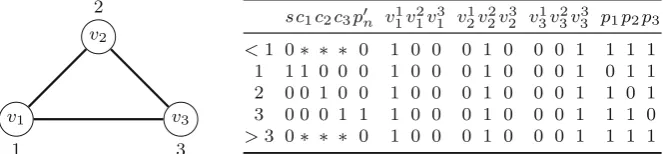
Fig. 1 Left: A graphGwith verticesv1,v2, andv3together with a 3-coloring given by the numbers above
and below respectively of every vertex. Right: A temporal interpretationMthat corresponds to the given 3-coloring ofGand satisfiesM|φgiven as a table. Each row of the table corresponds to a world (or a set of worlds) as indicated by the first column of the table. Each column represents the assignments of a variable as indicated in the first row. A “∗” indicates that the assignment is not fixed, i.e., the assignment does not influence whetherM|φ
Observe that all of the above clauses arehornor becomehornafter removing all variables from B. Note furthermore that all the above clauses ensure that
Ppi∧Fpiholds if and only if we are at thei-th world of the model for every
iwith 1≤i ≤n.
(C4) For everyi and jwith 1≤i ≤nand 1≤ j ≤3 the clausesFpi ∧Ppi ∧
vij → cj andFpi ∧Ppi ∧cj →vij. Informally, these clauses ensure that in thei-th world for every 1≤i ≤n, the variablesc1,c2,c3are a copy of the
variablesvi1,vi2,vi3. Observe that all of these clauses arehorn.
(C5) For every edgee= {vi, vj} ∈ E(G)and everycwith 1≤ c≤ 3, the clause ¬vic∨ ¬vcj. Informally, these clauses ensure that the 3-partition (of the vertices
ofG) given by the (global) values of the variablesv11,v21,v31,. . .,vn1,vn2,vn3is a valid 3-coloring forG. Observe that all of these clauses arehorn.
It follows from the definition ofφthatφ[θ] ∈LTLF,P
horn for every assignmentθ of the variables inB. Consequently,Bis a stronghorn-backdoor of size four ofφas required. Moreover, sinceφcan be constructed in polynomial time, it only remains to show thatGhas a 3-coloring if and only ifφis satisfiable.
Towards showing the forward direction assume that G has a 3-coloring and let
f: V(G)→ {1,2,3}be such a 3-coloring forG. We will show thatφis satisfiable by constructing a temporal interpretationMsuch thatM|φ.Mis defined as follows:
– For every jwith 1≤ j ≤3, we setM(cj)= {i| f(vi)= j}. – We setM(p′n)= {n}.
– For everyiandcwith 1≤i≤nand 1≤c≤3, we setM(vic)=Zifc= f(vi) and otherwise we setM(vci)= ∅.
– For everyiwith 1≤i≤n, we setM(pi)=Z\ {i}.
An example for such a temporal interpretation resulting for a simple graph is illus-trated in Figure1. It is straightforward (but a little tedious) to verify thatM|φby considering all the clauses ofφ.
Towards showing the reverse direction assume thatφis satisfiable and letMbe a
[image:18.439.54.386.58.135.2](M1) For everya∈Zexactly one ofM,a |c1,M,a|c2, andM,a |c3holds.
(M2) For everyi,c,a, anda′with 1≤i ≤n, 1≤c≤3, anda,a′∈Z, it holds that
M,a|vci if and only ifM,a′|vic.
(M3) For everyi with 1 ≤i ≤ nand everya ∈ Z, it holds thatM,a | pi if and only ifa=i.
(M4) For everyi and j with 1 ≤i ≤ nand 1 ≤ j ≤ 3, it holds thatM,i | cj if and only ifM,i |vij.
(M1) holds because of the clauses added by (C1). Towards showing (M2) consider the clauses added by (C2) and assume for a contradiction that there arei,c,a, and
a′ as in the statement of (M2) such that w.l.o.g.M,a |vci butM,a′ | vci. Then,
a =a′. Ifa <a′, then we obtain a contradiction because of the clausevic →Fvic and if on the other handa′<a, we obtain a contradiction to the clausevci →Pvci. This completes the proof of (M2). Considering the explanations for the clauses the proof of (M3) is now reasonably straightforward, however, for completeness we now provide a detailed proof. We will show (M3) with the help of the following series of claims.
(M3-1) For everya∈Zit holds thatM,a| p1if and only ifa =1 (here we assume
that 1 is the starting world).
(M3-2) For everyiandawith 1≤i ≤n,a ∈Z, anda >i, it holds thatM,a | pi. (M3-3) For everyi with 1≤i ≤n, it holds thatM,i | pi.
(M3-4) For everya ∈Z, it holds thatM,a | pn′ if and only ifa =n. (M3-5) For everya ∈Z, it holds thatM,a |pnif and only ifa=n.
Because of the clauses→ ¬p1(added by C3-1) and the fact thats∈Ψ, we obtain
thatM,1 | p1. Moreover, because of the clausess →Fp1ands → Pp1, we
obtain thatM,a | p1for everya =1. This completes the proof for (M3-1).
We show (M3-2) via induction oni. The claim clearly holds fori = 1 because of (M3-1). Now assume that the claim holds for pi−1 and we want to show it for pi. Because of the induction hypothesis, we obtain thatM,i | pi−1∧Fpi−1.
Moreover, becauseφcontains the clausepi−1∧Fpi−1→Fpi(which was added by (C3-2)), we obtain thatM,i|Fpi. This completes the proof of (M3-2).
We show (M3-3) via induction oni. The claim clearly holds fori = 1 because of (M3-1). Now assume that the claim holds for pi−1and we want to show it for pi. Because of the induction hypothesis, we obtain thatM, (i−1)| pi−1. Furthermore,
because of (M3-2), we know thatM,i |Fpi. Sinceφcontains the clause¬pi−1→ ¬Fpi(which was added by (C3-3)), we obtainM, (i−1)| ¬Fpi, which because M,i |Fpican only hold ifM,i | pi. This completes the proof of (M3-3).
Towards showing (M3-4), first note that because of (M3-2) and (M3-3), we have that
M,a | ¬pn∧Fpnif and only ifa =n. Then, because of the clauses (added by C3-4) ensuring that¬pn∧Fpn↔ pn′, the same applies top′n(instead of¬pn∧Fpn). This completes the proof of (M3-4).
It follows from (M3-2) and (M3-3) that (M3-5) holds for everya∈Zwitha ≥n.
Moreover, because of (M3-4), we have thatM,n| pi′. Because of the clause p′n→
We are now ready to prove (M3). It follows from (M3-2) and (M3-3) that (M3) holds for everyiandawitha ≥i. Furthermore, we obtain from (M3-5) that (M3) already holds ifi =n. We complete the proof of (M3) via an induction oni starting from
i =n. Because of the induction hypothesis, we obtain thatM,i+1| pi+1∧Ppi+1.
Accordingly, because of the clause pi+1∧Ppi+1→Ppi (added by (C3-6)), we obtain thatM,i+1|Ppi, which completes the proof of (M3).
Towards showing (M4) first note that it follows from (M3) thatM,i | Fpi ∧
Ppi. Now suppose that there areiandjsuch that eitherM,i |cjbutM,i |vijor M,i |cjbutM,i |vij. In the former case, consider the clauseFpi∧Ppi∧cj →
vij(which was added by (C4)). SinceM,i |Fpi∧Ppi, we obtain thatM,i |vij; a contradiction. In the later case, consider the clauseFpi∧Ppi∧vij →cj(which was added by (C4)). SinceM,i |Fpi∧Ppi, we obtain thatM,i |cj; again a contradiction. This completes the proof of the claims (M1)–(M4).
It follows from (M1) and (M4) that for everyi anda with 1≤i ≤ nanda ∈Z
there is exactly onecwith 1≤ c≤ 3, such thatM,a | vic. Moreover, because of (M2) the choice ofcis independent ofa. Accordingly, the coloring f that assigns the unique colorcto every vertexvi such thatM,a |vci forms a partition of the vertex set ofG. Also f is a valid 3-coloring because for every{vi, vj} ∈E(G)it holds that M,a | ¬vc
i ∨ ¬v c
j for everya ∈Z(using the clause added by C5) and hencevi and
vj must be assigned distinct colors by f. ⊓⊔
Corollary 11 Let O ∈ {F,P} then EvalO(krom) is paraNP-complete (the NP
-completeness already holds for backdoor sets of size zero).
Proof Satisfiability of LTLkromO isNP-hard [2, Theorem 5]. ⊓⊔
6 Conclusion and Discussion
We lift the well-known concept of backdoor sets from propositional logic up to the clausal fragment of linear temporal logic LTL. From the investigated cases we obtain a comprehensive picture of the parameterized complexity for the problem of backdoor set evaluation. The evaluation parameterized by the size of the backdoor intokrom for-mulas becomes in all casesparaNP-complete and as a result is unlikely to be solvable inFPTwhereas the case of backdoor evaluation into the fragmenthornbehaves differ-ently. While allowing only∗ makes the problem fixed-parameter tractable, allowing
both,FandP, makes itparaNP-complete. The last open case, i.e., the restriction to
eitherForPis open for further research and might yield anFPTresult. We want to
note here that all of our results still hold if LTL is evaluated over the natural numbers instead of the integers.
simple nor straightforward task. We see our work as a first attempt to come up with such a notion for LTL, and, given the notorious difficulty of the LTL-satisfiability problem, we believe our tractability result for LTL formulas restricted to the always operator that are almosthornis an encouraging result that justifies further investigation of this approach. As mentioned earlier, LTL restricted to the always operator, is already pretty interesting, since it allows one to express “Safety” properties of a system (e.g.,
∗(¬x), wherexencodes something bad to happen). Also, see the work of Kupferman
and Vardi on this topic [24]. Moreover, our intractability results for the remaining fragments of LTL indicate that a different notion of “closeness” is required to obtain tractability results for these fragments.
Acknowledgements The first and last author gratefully acknowledge the support by the German Research Foundation DFG for their grant ME 4279/1-1. The second and third author acknowledge support by the Austrian Science Fund (FWF, project P26696). We thank the anonymous referees for their valuable com-ments.
Open Access This article is distributed under the terms of the Creative Commons Attribution 4.0 Interna-tional License (http://creativecommons.org/licenses/by/4.0/), which permits unrestricted use, distribution, and reproduction in any medium, provided you give appropriate credit to the original author(s) and the source, provide a link to the Creative Commons license, and indicate if changes were made.
References
1. Abu-Khzam, F.N.: A kernelization algorithm for d-hitting set. J. Comput. Syst. Sci.76(7), 524–531 (2010)
2. Artale, A., Kontchakov, R., Ryzhikov, V., Zakharyaschev, M.: The complexity of clausal fragments of LTL. In: Proc. 19th LPAR, LNCS, vol. 8312 (2013)
3. Bauland, M., Schneider, T., Schnoor, H., Schnoor, I., Vollmer, H.: The complexity of generalized satisfiability for linear temporal logic. LMCS5(1), 1–21 (2009)
4. Chen, C.C., Lin, I.P.: The computational complexity of satisfiability of temporal Horn formulas in propositional linear-time temporal logic. IPL45(3), 131–136 (1993)
5. Chen, J., Chor, B., Fellows, M., Huang, X., Juedes, D., Kanji, I., Xia, G.: Tight lower bounds for certain parameterized NP-hard problems. Inf. Comput.201(2), 216–231 (2005)
6. Chen, J., Kanj, I.A., Xia, G.: Improved upper bounds for vertex cover. Theor. Comput. Sci.411(40–42), 3736–3756 (2010)
7. Clarke, E.M., Emerson, E.A.: Design and synthesis of synchronization skeletons using branching time temporal logic. Logic of Programs. LNCS, vol. 131, pp. 52–71. Springer, Berlin (1981)
8. Demri, S., Schnoebelen, P.: The complexity of propositional linear temporal logics in simple cases. Inf. Comput.174(1), 84–103 (2002)
9. Dilkina, B.N., Gomes, C.P., Sabharwal, A.: Tradeoffs in the complexity of backdoor detection. In: Proc. 13th CP, Lecture Notes in Computer Science, vol. 4741, pp. 256–270. Springer (2007) 10. Dilkina, B.N., Gomes, C.P., Sabharwal, A.: Backdoors in the context of learning. In: Proc. 12th SAT,
Lecture Notes in Computer Science, vol. 5584, pp. 73–79. Springer, Berlin (2009)
11. Dixon, C., Fisher, M., Konev, B.: Tractable temporal reasoning. In: Proc. of IJCAI, pp. 318–323 (2007) 12. Downey, R.G., Fellows, M.R.: Fundamentals of Parameterized Complexity. Springer, London (2013) 13. Dvorák, W., Ordyniak, S., Szeider, S.: Augmenting tractable fragments of abstract argumentation.
Artif. Intell.186, 157–173 (2012)
14. Emerson, E.A., Halpern, J.Y.: Decision procedures and expressiveness in the temporal logic of branch-ing time. Journal of Computer and System Sciences30(1), 1–24 (1985)
15. Fisher, M.: A normal form for temporal logic and its application in theorem-proving and execution. J. Logic Comput.7, 429–456 (1997)