o
ι
ό
UJ
Oí
β»Oí
EU international
nsactJDDS
E U R O P E A N
COMMISSION
,Our mission is to provide the
European Union
with a high-quality statistical information service
EurOStat's collections
are adapted to the needs of all users.
You will find them in each of the nine themes proposed by Eurostat.
1 General statistics
2 Economy and finance
3 Population and social conditions
4 Industry, trade and services
5 Agriculture and fisheries
m
¿Q
j&BÎ
6 External trade
7 Transport
8 Environment and energy
9 Research and development
C o n t e n t
Press releases:
Eurostat publishes around 100 press releases every year in
connection with the release of new data. The press releases include the key figures
on the EU, the Member States and their partners. They are provided free of charge.
They are also available on the Internet as soon as they are published:
http://europa.eu.int/eurostat.html
F o r m a t
Paper
Html
Statistics in focus:
This collection is published regularly by Eurostat and provides
up-to-date summaries of the main results of statistical surveys, studies and analyses.
It covers all themes and consists of about four to eight pages per issue. Eurostat issues
around 150
Statistics in Focus
per year. Available as single copies or on subscription.
Mm
Paper
Key indicators:
This collection provides the main indicators on a theme or
sub-theme in an easy-to-carry booklet of up to 100 pages. Available as single
copies or on subscription.
Paper
Html
Panorama of the European Union:
This collection highlights the features
and trends of a multi-sectoral theme or a sectoral sub-theme. The publications
consist of around 200 pages and include analysis as well as tables and graphs.
Available as single copies or on subscription.
m
Paper
CD-ROM
Methods and nomenclatures
are intended for specialists who want to
consult the methodologies and nomenclatures used for a theme, a sub-theme or a
sector. Available as single copies.
Paper
CD-ROM
Detailed tables
are intended for specialists. They present part, or all, of the
statistical data compiled on a theme, sub-theme or sector. Available as single
copies or on subscription.
I n i *
Paper
CD-ROM
Studies and research
summarise the results of European statistical studies
and research and are intended for specialists. Available as single copies or on
subscription.
Paper
CD-ROM
Catalogues
provide rapid access to concise information on Eurostat's products
and services. They are free of charge and include the
Mini guide,
a selection of
Eurostat products and services, and
Statistical references,
the quarterly newsletter
on Eurostat's latest products and services.
o
LII
(J)
ω
EU international
transactions
Data 1987-98
/
EUROPEAN
COMMISSION
J
eurostat
mm
immediate access to harmonized statistical data
E u r o s t a t D a t a S h o p s
A personalised data retrieval service
In order to provide the greatest possible number of people with access to high-quality statistical
information, Eurostat has developed an extensive network of Data Shops (').
Data Shops provide a wide range of tailor-made services:
• immediate information searches undertaken by a team of experts
in European statistics;
• rapid and personalised response that takes account of the specified search
requirements and intended use;
• a choice of data carrier depending on the type of information required.
Information can be requested by phone, mail, fax or e-mail.
(
1) See list of Eurostat Data Shops at the end of the publication.
I n t e r n e t :
Essentials on Community statistical news
* Euro indicators: more than 100 indicators on the euro-zone; harmonized, comparable,
and free of charge;
* About Eurostat: what it does and how it works;
* Products and databases: a detailed description of what Eurostat has to offer;
* Indicators on the European Union: convergence criteria; euro yield curve and further
main indicators on the European Union at your disposal;
* Press releases: direct access to all Eurostat press releases.
For further information, visit us on the Internet at: h t t p : / / e u r o p a . e U . i n t / e U I O S t a t . h t l T l l
A great deal of additional information on the European Union is available on the Internet.
It can be accessed through the Europa server (http://europa.eu.int).
Cataloguing data can be found at the end of this publication.
Luxembourg: Office for Official Publications of the European Communities, 1999
ISBN 92-828-8454-6
© European Communities, 1999
Printed in Belgium
STATISTICAL OFFICE OF THE EUROPEAN COMMUNITIES
L-2920 Luxembourg — Tel. (352) 43 01 -1 — Telex COMEUR LU 3423
e u r O S t a t
Rue de la Loi 200, B-1049 Bruxelles — Tel. (32-2) 299 11 11
Eurostat ¡s the Statistical Office of the European Communities. Its task is to provide the
European Union with statistics at a European level, that allow comparisons to be made
between countries and regions. Eurostat consolidates and harmonizes the data collected by
the Member States.
To ensure that the vast quantity of accessible data is made widely available, and to help
each user make proper use of the information, Eurostat has set up a publications and
services programme.
This programme makes a clear distinction between general and specialist users and
particular collections have been developed for these different groups. The collections
Press
releases, Statistics in focus, Panorama of the European Union, Key indicators
and
Catalogues
are aimed at general users. They give immediate key information through
analyses, tables, graphs and maps.
The collections
Methods and nomenclatures, Detailed tables
and
Studies and research
suit
the needs of the specialist who is prepared to spend more time analysing and using very
detailed information and tables.
All Eurostat products are disseminated through the Data Shop network or the sales agents
of the Office for Official Publications of the European Communities. Data Shops are
available in 12 of the 15 Member States as well as in Switzerland, Norway and the United
States. They provide a wide range of services from simple database extracts to tailor-made
investigations. The information is provided on paper and/or in electronic form via e-mail, on
diskette or CD-ROM.
As part of the new programme Eurostat has developed its website. It includes a broad range
of on-line information on Eurostat products and services, newsletters, catalogues, on-line
publications as well as indicators on the euro-zone.
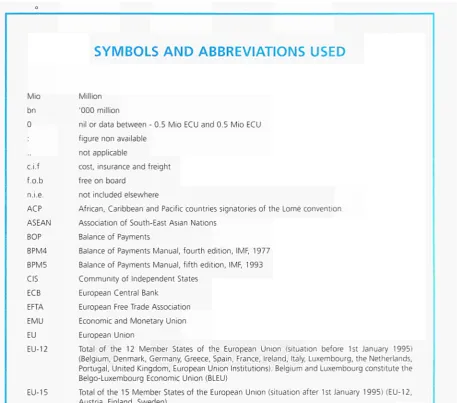
Mio
bn
0
c.i.f f.o.b n.i.e. AC Ρ ASEAN
BOP
BPM4 BPM5CIS
ECB
EFTAEMU
EU
EU-12EU-15
EUR-11 euro-zone Eurostat GATS
IMF
MERCOSUR NAFTA NICsl NICs2A NICs2LA OECD OPECWTO
SYMBOLS AND ABBREVIATIONS USED
Million Ό00 million
[image:7.595.95.553.90.493.2]nil or data between - 0.5 Mio ECU and 0.5 Mio ECU figure non available
not applicable
cost, insurance and freight free on board
not included elsewhere
African, Caribbean and Pacific countries signatories of the Lomé convention Association of South-East Asian Nations
Balance of Payments
Balance of Payments Manual, fourth edition, IMF, 1977 Balance of Payments Manual, fifth edition, IMF, 1993 Community of Independent States
European Central Bank European Free Trade Association Economic and Monetary Union European Union
Total of the 12 Member States of the European Union (situation before 1st January 1995) (Belgium, Denmark, Germany, Greece, Spain, France, Ireland, Italy, Luxembourg, the Netherlands, Portugal, United Kingdom, European Union Institutions). Belgium and Luxembourg constitute the Belgo-Luxembourg Economic Union (BLEU)
Total of the 15 Member States of the European Union (situation after 1st January 1995) (EU-12, Austria, Finland, Sweden)
Total of the 11 Member States of the Economic and Monetary Union (Belgium, Germany, Spain, France, Ireland, Italy, Luxembourg, the Netherlands, Austria, Portugal, Finland)
Statistical Office of the European Communities General Agreement on Trade in Services International Monetary Fund
Countries of the South Cone Common Market North American Free Trade Association The Core Newly Industrializing Countries Asian NICs of the second wave of industrialization Latin American NICs of the second wave of industrialization Organisation for economic co-operation and development Organization of Petroleum Exporting Countries
World Trade Organisation
Foreword
Analytical aspects
1998 preliminary results
1997 main features
Description of the tables
Statistical tables
Tables 2.1.
Tables 2.2.
Tables 2.3.
9
9
15
31
37
37
39
63
2
LU
I—
-ζ.
o
u
Methodological framework 81
Annexes 89
Exchange rates 89
BOP geographical zones 90
BOP economic zones 92
UO
FOREWORD
Did you know that the EU is the leader in World current exchanges?
Did you know that the EU and Japan have steady external current surpluses while the USA has a
persistent deficit?
Did you know that the USA is the main EU trade partner?
Did you know that the EU is a net exporter of services to Japan?
Did you know that the EU is a net importer of Royalties and license fees and Audiovisual services
from the USA?
This publication provides you with the most recent and comparable statistics of the EU, euro-area,
USA and Japan on:
( · " Annual
« * International
* * Current transactions
Particular emphasis is put on Trade in Services and on the diversity of trading partners. Therefore,
these statistics can be used to monitor the external commercial performance of different
economies and thus assist trade negotiations in the context of the General Agreement on Trade in
Services (GATS).
In the first part of this publication you can find an analysis of 1998 preliminary results and 1997
main features through comments, graphics and tables. The second part provides a detailed review
of 1997, displaying a complete set of tables for the EU, euro-zone, the USA and Japan. Finally, the
third part gives a short description of the methodological framework.
Your needs as a user are our main concern. We can only improve with your help, so please make
your comments and suggestions. Contact:
Ms Maria-Helena Figueira
EUROSTAT ~
Unit B5 - International Trade in Services, Direct Investment, Balance of Payments
European Commission
Bâtiment Jean Monnet
Bech E4/806
Eurostat - L 2920 - Luxembourg
Tel.: 352 4301 34730
Fax: 352 4301 33859
E-mail: [email protected]
Û
ai
O
cc
O
h-U
LU
û_
LO
<
<
U
I—
>
-I
<
1998 preliminary results
The EU current account surplus with the rest of the world
^'
fell by 79% from ECU 56.2 bn in
1997 to ECU 11.9 bn in 1998.
This deterioration was explained by contractions in the surpluses of goods
&'
(down from ECU
39.9 bn in 1997 to ECU 25.0 bn in 1998), services, and the reversal of the income balance from
an ECU 20.4 bn surplus to a deficit of ECU -4.4 bn in 1998.
Trade in services registered a surplus of ECU 11.2 bn, which was about ECU 6 bn less than in
1997, despite the transportation balance moving to an ECU 3.1 bn surplus.
The EU current balance with the USA deteriorated from ECU 17.9 bn in 1997 to ECU -0.9 bn in
1998.
The EU current deficit with Japan enlarged by 46% to ECU -24.0 bn in 1998.
The EU current balance with Canada, available for the first time in 1998, showed a current
surplus of ECU 4.4 bn.
r
-U
LU
Q_
<
I
<
U
h-> ■
I
<
~z.
<
Notice
The results presented in this chapter are preliminary and subject to revision according
to the data transmission timetable agreed with the Member States.
These early trends outline the forthcoming scenario for the main current account
items (goods, services, income, and current transfers) with the main trading blocs
(Europe, USA, Japan and for the first time with Canada).
o
A complete and geographically detailed presentation of all the components of the
balance of services will be released later (approximately 40 items and 50 countries,
geographic or economic zones).
C' Excluding intra-EU transactions
(
2' According to Balance of Payments concept (exports FOB - imports FOB)
υπ
U
LU
Q_
un
<
<
U
In 1998 the EU current external surplus fell by 79% to ECU 11.9 bn
Preliminary 1998 results revealed a sharp drop of 79% in the European Union (EU) current external surplus to
ECU 11.9 bn from ECU 56.2 bn in 1997. With the exception of the broadly unchanged deficit in current
transfers, all the current account sub-balances recorded a significant deterioration. The surplus in goods
decreased from ECU 39.9 bn in 1997 to ECU 25.0 bn in 1998. This trend was confirmed by foreign trade
statistics (exports FOB - imports CIF) which reported surpluses of ECU 49.0 bn in 1997 against ECU 19.0 bn
in 1998. The surplus in services decreased from ECU 17.2 bn in 1997 to ECU 11.2 bn. Finally, the income
balance reversed from an ECU 20.4 bn surplus to a deficit of ECU -4.4 bn in 1998.
Nevertheless the EU total 0) current international transactions with the rest of the world rose by 4% to ECU
2351.9 bn.
EU Current account with the rest of the world
ι
<
<
(Mio ECU)
Current account
Goods
Services
Transportation
Travel
Other services
Services not allocated
Income
Current transfers
Exp
1997
1
161 979
693 344
227 709
59 131
57 308
110 430
840
213 608
27 317
orts
1998*
1
181 926
700 698
234 829
59 459
60 953
113 538
880
219 503
26 896
Imports
1997
1
105 756
653 421
210 479
59
324
55 863
94 504
788
193
222
48 633
1998*
1
170 014
675 817
223 584
56 379
62 762
103 242
1
201
223 920
46 693
Net
1997
56 224
39 923
17 230
-193
1
445
15 927
52
20
386
-21 316
1998*
11 912
24 881
11 245
3
080
-1
809
10 296
-321
-4
418
-19 796
Net
change
(%)
-79%
-38%
-35%
-35%
7%
* Preliminary results
. . Not applicable - sign change
EU transportation services balance increased from equilibrium to an
ECU 3.1 bn surplus
The sharp 5% contraction of EU imports of transportation services changed the transportation balance from
a small deficit (ECU -0.2 bn) to a surplus of ECU 3.1 bn in 1998, confirming the upward trend observed since
1996.
However, trade in services as a whole registered a surplus of ECU 11.2 bn, about ECU 6 bn less than in 1997.
Much of this decrease was attributable to the deterioration of the travel balance, from a surplus of ECU 1.4 bn
in 1997 to a deficit of ECU -1.8 bn in 1998, and to the reduction of the surplus in other services to ECU
10.3 bn.
Mio ECL
18 000
15 000
12 000
9 000
6 000
3 000
0
3 000
-EU services balance with the rest of the world
Transportation
I
I
Travel Other services
SI 1997
Services not allocated
D 1998
(
1' Credits + Debits
Euro-zone <
1
>: the services surplus declined by 37% in 1998
As with the EU, the euro-zone (EUR-11 ) services surplus declined in 1998, from ECU 1.6 bn to ECU 1.0 bn. In
the case of EUR-11 this contraction was entirely due to the deficit in other services which enlarged from ECU
-6.0 bn to ECU -11.6 bn.
On the other hand, the balances in travel and transportation services improved: the surplus in travel grew by
almost ECU 1.0 bn and the transportation services balance changed from a deficit to a surplus of ECU 3.2 bn
in 1998.
Euro-zone trade in services with the rest of the world
(Mio ECU)
Services
Transportation
Travel
Other services
Services not allocated
Exports
1997
220 117
56
914
62
323
99 718
1
161
1998*
229 953
56 740
65 776
105 860
1
576
Imports
1997
218 552
57 952
53
847
105 689
1
064
1998*
228 961
53 532
56
366
117
469
1
594
Net
1997
1
565
-1
038
8
476
-5
971
97
1998*
992
3 208
9411
-11 609
-18
Net
change
(%)
-37%
11%
-94%
Preliminary results
. Not applicable - sign change
Main differences between EU and euro-zone: the importance of the
United Kingdom
The differences between EU and euro-zone trade in services were mainly due to other services. These
registered a surplus of ECU 10.3 bn for the EU opposing a deficit of ECU -11.6 bn in the case of the
euro-zone.
un
h-U
LU
CL
un
<
<
U
h-<
Z.
<
Mio ECU 15 000
EU/euro-zone services balance with the rest of the world in 1998
10 000 5 000 0 -5 000 10 000 15 000
Transportation Travel Other services Services not allocated
D E U Deuro-zone
(1) Belgium, Germany, Spain, France, Ireland, Italy, Luxembourg, Netherlands, Austria, Portugal, Finland
un
h"
U
L U
CL·
un
<
<
U
h-<
<
The relative importance of the United Kingdom was evident: this country alone accounted for 21 % of EU total
external transactions in services and 74% of the transactions of the European Union non-EUR-11 countries <
Ί>.
These non-EUR-11 Member States represented 28% of the EU total transactions in services with the rest of
the World. This share was 31 % for transportation services, 29% for travel and 26% for other services.
Composition of the 1998 EU transactions in services
(credits + debits) with the rest of the World by areas
Denmark, Sweden, Greece and the EUI*
7%
United Kingdom
21%
EUR-11
72%
* European Union Institutions
The direction of EU-15 trade: the USA remained the main extra-EU-15
partner in 1998
The European Union remained its own main trading partner in 1998: 62% of the EU current international
transactions were carried out among EU Member States. The United States, with a share of 28% continued
:o be the main partner of the EU in its current transactions with the rest of the world. Japan and Canada came
-ar behind and represented respectively 6% and 2% of the total EU current external transactions.
The EU current balance with the USA changed from a surplus of ECU 17.9 bn in 1997 to a deficit of ECU
-0.9 bn in 1998. This was due to the income balance - down from a surplus of ECU 6.0 to a deficit of ECU
-8.7 bn.
EU current balances with USA
Mio ECU 20 000
15 000
10 000
5 000
5 000
10 000
Current account Good-; S e r v i c e s Income Current transfers
11997 D1998
Denmark, Greece, Sweden and United Kingdom
Ln
The EU current account deficit with
Japan
enlarged by 46% from ECU -16.4 bn in 1997 to ECU -24.0 bn in
1998. The decisive weight of the deficit in trade in goods offset the surpluses registered in trade in services
(ECU 5.3 bn) and income (ECU 4.9 bn).
Mio ECU 12 000
EU current balances with Japan
6 000 0 - 6 000 12 000 18 000 24 000 30 000 - 3 6 000
Current account Goods Services Income Current transfers
D1997 G199E
u
LU
Q_
un
<
<
U
r—
>-<
Ζ
<
EU results for the current account with
Canada,
available for the first time, revealed a slightly expanding
surplus, which reached ECU 4.4 bn in 1998 against ECU 2.6 bn in 1997. This was due to increases in the
surpluses registered in trade in goods (from ECU 1.5 bn to ECU 2.1 bn) and in income (from ECU 1.3 bn to
ECU 2.8 bn).
Mio ECU
2 000
EU current balances with Canada
Current account Goods Services Income Current transfers
11997 D1998
1997 main features
U
In 1997 transactions with the rest of the world (excluding intra-flows) rose strongly for both the
EU-15 and EUR-11. The current external surpluses of the EU and euro-zone increased to levels
70% and 57% higher than the previous year.
The EU balance of services reached a record surplus of ECU 17.2 bn. EUR-11 services were also
in surplus (ECU 1.6 bn).
The EU was still leading the World exchanges, representing 20% of the total World current
transactions. Current transactions outside the EU and euro-zone represented a bigger share in
their total transactions than in 1996 (39% against 37% in 1996 for the EU, 54% against 53% for
the euro-zone).
EU-15 and EUR-11 current accounts showed large surpluses with USA (ECU 17.9 bn a
respectively) but deficits with Japan grew deeper (ECU -16.4 bn and -17 bn in 1997).
bn
Q_
U")
<
<
<
Methodological note
The balance of payments (BOP) of the European Union (and of the euro-zone) is
compiled as the sum of harmonised balance of payments accounts of the fifteen
(respectively eleven) Member States.
The balance of payments of the European Union Institutions is added to the European
Union aggregate. On the contrary, the European Union Institutions are regarded as
non-residents of the euro-zone. The estimates previously published by Eurostat did
not follow this concept (the European Union Institutions were considered as residents
of the euro-zone). Therefore they differ from those herewith published and are simply
not comparable.
The EU/euro-zone balance of payments is compiled by Eurostat in accordance with a
methodology agreed with the ECB based on extra-EU/extra-euro-zone transactions,
i.e by aggregating cross border transactions of EU/euro-zone residents vis-à-vis
non-EU/euro-zone residents as reported by the 15/11 participating Member States. This
approach is considered to be the best way to compile the EU/euro-zone aggregates.
The methodological framework is that of the fifth edition of the International
Monetary Fund (IMF) Balance of Payments manual.
NB: data for the euro-zone have provisionally been validated by the ECB and will be
revised later this year. In fact, in order to conform to the internationally agreed
methodology, Member States are changing the geographical allocation of
intra-EU/euro-zone imports of goods from country of origin to country of consignment. EU
and euro-zone external imports are expected to decrease and the corresponding
external balances are expected to increase substantially.
un
U
LU
CL
un
<
ι
<
U
h
->
ι
<
Ζ
<
The European Union
In 1997, two major events shaped international exchanges. On the one hand, the appreciation of the US dollar
accelerated during the first half of the year and on the other hand, Asian countries underwent a serious
financial crisis during the second semester.
The 1997 boom in EU current international transactions pulled up a
new increase of the current surplus
Following a moderate increasing trend (6.2% average annual growth rate from 1992 to 1996), the EU total
current international transactions with the rest of the world (i.e. excluding intra-EU flows) rose by 18% to ECU
2267.7 bn in 1997. Together with this considerable rise, the current surplus increased by 70% to ECU 56.2 bn.
With a surplus valued at ECU 17.2 bn, the balance of services registered the most significant increase (+65%)
in relation to the previous year. This expansion was fuelled by the combined improvement in the balances of
transportation, travel and other services. The surplus in goods and income rose by 28% and 37% respectively,
whereas the current transfers' deficit decreased slightly (from ECU -23.4 bn in 1996 to ECU -21.3 bn). The
!
atter deficit is structural by definition because the EU, as a member of the group of most-highly-developed
countries, is a donor of funds for less-developed countries. This feature is visible in the structure of the current
account. Indeed, the shares of goods, services and income in current transactions are almost the same on the
credit and debit sides, whereas current transfers payments represent the 4% of the current account debits
against 2% on the credit side.
EU current account (partner extra-EU)
(Mio ECU)
Current account
Goods
Services
Transportation
Travel
Other services
Services not allocated
Income
Current transfers
Cre
1996
981.101
595.820
195.263
49.251
49.363
95.608
1.040
172.357
17.661
dits
1997
1.161.979
693.344
227.709
59.131
57.308
110.430
840
213.608
27.317
Debits
1996
948.086
564.635
184.848
50.943
49.654
81.278
2.973
157.519
41.083
1997
1.105.756
653.421
210.479
59.324
55.863
94.504
788
193.222
48.633
Net
1996
33.016
31.185
10.415
-1.691
-290
14.330
-1.933
14.838
-23.422
1997
56.224
39.923
17.230
-193
1.445
15.927
52
20.386
-21.316
Net
change
(%)
70%
28%
65%
-89%
1 1 %
37%
-9%
Not applicable - sign change
The trade balance in Goods, according to the Balance of payments concept includes all movable
property whose
ownership
is transferred from a resident to a non-resident or vice versa. Both, exports
and imports are valued free on board (f.o.b.). These figures should be based on customs data, which
are imports at
c.i.f.
values (including costs relating to transport and insurance) and exports at
f.o.b.
values (excluding transport costs). Imports at
c.i.f.
values are corrected to imports at
f.o.b.
values in
order to classify costs relating to transport and insurance as transport services and insurance services.
Transactions on goods crossing a border without change of ownership are not regarded as exports, but
transactions on goods between residents and non-residents are regarded as exports, even if the goods
do not cross a border. This explains why external trade statistics and balance of payments figures for
goods are not the same.
^
In 1997, the nominal GDP reached ECU 7158 bn. Thus, the degree of openness of the EU (measured as the
ratio of the average value of exports and imports of goods and services to GDP) swelled to 12.5%, (11.3% in
1996). Still, the EU continued to trade mainly with itself and extraEU transactions represented the 39% of
total transactions (compared to 37% in 1996).
200000
Main items of the EU current account in 1997
credits and debits
Goods Services Income Current transfers
□ Credit flows □ Debit flows
u
L U
C L
LT)
<
I
<
U
l·—
<
ζ
<
The EU current balance keeps its upward trend, reaching a ECU 56.2 bn
surplus in 1997
From 1988 to 1991, the EU current account deficit enlarged from ECU 6.8 bn to 59 bn. After a slight
improvement in 1992 (16% in absolute terms), the current deficit narrowed significantly in 1993, reaching
ECU 8 bn. Since then, the current balance turned positive and the surplus increased regularly, reaching ECU
56.2 bn in 1997.
This expansion arose mostly from the continuous improvement of the trade balance since 1992. However, the
1997 increases in the income and services surpluses played a substantial role in the expansion of the current
surplus.
Breakdown of EU^'current account balance with the rest of the world
- 1 0 0 0 0 0
1 9 8 8 1 9 8 9 1 9 9 0 1991 1992 1993 1994 1995 1996 1997
I Ifínnris (Services Income I ¡Current transfers X — C u r r e n t account
('
From 1988 to 1991 data refer to EU12, current and capital account, and from 1992 onwards data refer to EU15.
un
r
-U
L U
Q_
un
<
<
U
h-> ■
_ j
<
<
Persistent trends all through the decade: deficit for the USA and
surplus for Japan
During the last decade, the current balances of the EU and the USA had an almost symmetrical behaviour. This
seems to show their strong partnership. From 1988 to 1991, the US current deficit decreased from ECU -108.7
bn to -3.8 bn whereas the EU deficit increased to its maximum (ECU -59 bn). After 1991-the year when the
EU current balance started to improve-the US deficit enlarged until 1997, reaching ECU -137 bn.
Contrary to the United States, Japan registered a positive current balance all through the decade. The current
surplus lowered from ECU 67 bn in 1988 to 34.6 bn in 1990, then rose regularly to ECU 112.4 bn in 1993. It
decreased again until
1996 (ECU 51.9 bn) and grew to ECU 83.2 bn in 1997.
Mio ECL
1 5 0 0 0 0
1 0 0 0 0 0
5 0 0 0 0
o
-- 5 0 0 0 0
-1 0 0 0 0 0
-1 5 0 0 0 0
Current balance of EU(*), USA and Japan with the rest of the world
Δ
A—
.
— ~ á
-1988 1989 1990 1991 1992 1993 1994 1995 1996 1997
EU USA Japan
(*) From 1988 to 1991 data refer to EU-12, current and capital account, and from 1992 onwards data refer to EU-15.
The EU current surplus with USA up to ECU 17.9 bn in 1997
The fast appreciation of the US dollar during the first half of the year boosted EU exports and seemed to be
particularly favourable to trade in services. In fact, the credit of the EU current account with partner USA grew
by 25% (against 20% on the debit side), a much greater increase than the 18% growth of EU credit with the
extra-EU. This led to an improvement of the EU current surplus which reached ECU 17.9 bn compared to 4
bn the previous year.
The EU surpluses in goods and income rose sharply (reaching ECU 4.4 bn and 6 bn respectively) and the
current transfers deficit narrowed (to ECU -0.2 bn). As far as services are concerned, the EU-15's surplus
attained ECU 7.6 bn, up from 0.9 bn in 1996. Commercial services alone turned from a deficit to a significant
surplus of ECU 5.3 bn in 1997.
Current transactions of the EU with partner Japan: new deficit in 1997
Total exchanges with partner Japan grew by 9% in 1997. The current account deficit widened by ECU 6 bn
to 16.4 bn, due to a ECU 7.2 bn fall of the trade balance (to ECU -27.8 bn). The services surplus grew slightly
(ECU 6.8 bn) and the current transfers remained at a low level (ECU 60 Mio). Income consistent surplus
increased to ECU 4.5 bn.
Mio ECU 30000 20000 10000 0
30000
EU current balance with USA and Japan in 1997
I
|
|
ι
Goods Services D U S A
Income Current transfers Current account D J a p a n
Mío ECU 20000
E U ^ current account balance with USA and Japan through the decade
10000 0 - 1 0 0 0 0 - 2 0 0 0 0 - 3 0 0 0 0
1988 1989 1990 1991 1 9 9 2 1 9 9 3 1994 1995 1 9 9 6 1997
USA ■ Japan
(*) From 1988 to 1991 data referto EU-12, current and capital account, and from 1992 onwards data refer to EU-15.
The EU top exporter
In 1997, the EU ranked first in the world total current exports with a share of 2 1 % (excluding mtra-EU
transactions). USA and Japan followed with respective shares of 19% and 11%. As regards world total current
transactions (credit + debit), the EU and USA tied for first place, accounting for 20% each.
The EU and USA were leader in exports of services as well, with shares in the world total of 24% each,
whereas Japan accounted for 7%. The EU was also the main importer of services in the world with a 23%
share, before USA (16%) and Japan (12%).
The degree of openness (measured as the ratio of the average value of exports and imports of goods and
services to GDP) of the EU was 12.5%, almost the same as the USA's (12.3%) compared with 10.9% in the
case of Japan.
Total World current transactions in 1997
Current account
Goods
Services
Income
Current transfers
EU
Credits
1 161 979 1
693 344
227 709
213 608
27 317
Debits
105 756
653 421
210 479
193 222
48 633
USA
Credits
1 045 572
600 747
225 885
213 349
5 592
Debits
1 182 586
773 587
146 550
221 714
40 731
Japan
Credits
623 176
360 869
61 111
195 896
5 300
Debits
539 975
271 278
108 862
146 744
13 090
Rest of the World
Credits
Debits
2 793 221 2 881 345
2 071 688 2 029 044
421 803
467 398
191931
310 760
107 825
74 209
(Mio ECU)
World
1'
1total
Credits
Debits
5 623 949 5 709 662
3 726 648 3 727 330
936 509
933 290
814 784
872 441
146 035
176 664
un
\—
u
L U
C L
L/l
<
I
<
U
h-<
Ζ
<
Mio ECU 6000000
Total W o r l d ' ' c u r r e n t transactions in 1997
5000000
4000000
3000000
2000000
1000000
o
Goods Services Current transfers Current account D E U D U S A Π Japan D Rest of the world
(*)
World excluding intra-EU transactions (source IMF).
un
r
-u
EU trade in services
C u
UO
<
>
In 1997, an increased international competition pushed EU services
suppliers into carrying out many strategic changes.
On the one hand, significant progress was achieved for opening national markets in the framework of the
GATS«
1);
- negotiations on financial services (which cover actually both financial and insurance services) were reopened
in April. The 12th of December, a new set of commitments to be put into force on 1st March 1999 was
agreed by 52 WTO member governments, including the EU Member States with the exception of
Luxembourg. The new commitments involved the elimination or relaxation of (i) limitations on foreign
ownership of local financial institutions, (ii) limitations on the juridical form of commercial presence and (iii)
limitations on the expansion of existing operations.
- a new set of commitments was agreed by 69 WTO member states (including the 15 EU Member States) on
February 15th, at the end of 3 years negotiations on basic telecommunication services. This agreement, due
to enter into force on 5 February 1998, aimed at establishing a regulatory environment conductive to market
entry.
On the other hand, threatening concentration movements took place abroad (e.g. declaration of the merger
of Boeing and Mc Donnell-Douglas in the United States, the Union des Banques Suisses and Société des
Banques Suisses in Switzerland, of WorldCom and MCI (telecommunications) in the United States...).
In reaction to this external pressure, the EU services companies made an effort to improve their
competitiveness.
In 1997, privatisations proceeded all over the EU in the sectors of air transport and telecommunications:
Lufthansa, Telecom Italia and Telefonica (Spain) were entirely privatised this year, KLM (the Netherlands),
France Telecom and Portugal Telecom were partly privatised.
In addition, many concentration efforts occurred in the banking and insurance sectors. For instance, Cariplo
and Ambroveneto (two Italian banks) made arrangements for closer cooperation; in Germany the Bayerische
Vereinsbank and Bayerische Hypobank announced their intention to merge, like the Nord/LB and the
Bankgesellshaft Berlin; in France, the Société Générale bought the Credit du Nord. As regards insurance
companies, Allianz (Germany) acquired the AGF (France) and Munich Ré concentrated its direct insurance
subsidiaries into a single holding company, Ergo.
The EU trade in services seemed to benefit from all these liberalisation reactions, as exports of air transport,
communications, insurance and financial services increased significantly in 1997.
The breakdown of EU services: financial, transportation, travel and
computer services made the 1997 exceptional surplus
As in previous years, transport (with a 27% share), travel (26%) and other business services (22%) accounted
for more than three quarters of the EU external transactions in services.
In general, the weight of each item in services stayed the same as in 1996. The EU external trade in services
experienced a significant growth in 1997 for all the items with the exception of personal, cultural and
recreational services and government services n.i.e (whose total transactions decreased by 8% and 2%
between 1996 and 1997).
The sharp rise (+65%) in the EU services surplus resulted from different sources.
'
1' The World Trade Organisation General Agreement on Trade in Services
LT)
On the one hand, several items increased their surplus or decreased their deficit. Firstly, financial services
surplus gained ECU 2.8 bn, reaching ECU 6.8 bn. In spite of the deterioration of the sea transport balance to
ECU -5.4 bn, total transportation deficit narrowed remarkably and approached equilibrium (ECU -0.2 bn) due
to the 65% widening of the air transport surplus and the reversal of the "other transportation" balance to
ECU +0.6 bn. In addition, the travel balance turned from a deficit to a ECU 1.4 bn surplus and computer and
information services recorded a ECU 1.1 bn surplus (from 0.1 bn in 1996).
On the other hand the contraction of the other business services surplus to ECU 6.5 bn and the fall of the
personal, cultural and recreational services deficit (to ECU -2.9 bn) limited the expansion of the services
surplus.
EU balances with the rest of the world by type of services
Government services, n.i.e.Personal, cultural and recreational services Other business services Royalties and license fees Computer and information services Financial services Insurance services Construction services Communications services Travel Other transport Airtransport Sea transport
ι —
L
I 1
I
h
--'
cF=
1
I '
1
— H
1 1 —
1 i — '
1
=1
-
1I ■ I
I
1
1
3000
-6000
-4000
-2000
2000
4000
6000
D1995
D1996
D1997
8000
10000
Ί Mio ECU
u
LU
CL
un
<
ι
<
U
I—
<
ζ
<
Share of each services item in EU external trade in services in 1997
r, . ,. , ,
_ Government services, n.i.e.
Personal, cultural and „
0,
recreational services /
2%
Services not allocated
, - r T
Other business services-
/
\ \
22% / \ \
Royalties and license fees / \\
6% / 1
~ ~ ~ - ^ - ^ 0%
\ Transportation
\ 27%
Computer and " ^ - ^ ' y
^yW/l\ 1
information services —-^__^
\ ^ y ^ / /
¡\ /
T r a v e'
2%
\r / / \ /
26%Financial services \ y / II /
4%
-~~~~^C / ^/
Insurance services _ - - ^ - ¿ - i . -^
2 %
Construction services Communications services
4% 2%
UO
h"
U
LU
CL.
U")
<
<
U
h-<
<
EU 1988-1997: commercial services m in continuous growth
Over the last decade, total exchanges (exports + imports) in government services declined from ECU 16.2 bn
in 1988 to 11.8 bn in 1997. The traditional surplus of this item followed the same regular decrease, lowering
from ECU 6.8 bn to 1.7 bn during this period of time.
On the other hand, trade in commercial services (that make the bulk of total services with a share of 97% in
1997) rose continuously since 1988 (ECU 227 bn), soaring to 426.4 bn in 1997 (16% increase on 1996).
Both exports and imports experienced this increasing trend: in 1997, exports were 83% higher than in 1988,
imports increased by 93% between 1988 and 1997.
Commercial services were in permanent surplus since 1988. Until 1992, imports grew faster than exports,
leading to a significant deterioration of the balance, from ECU 13.8 bn to 7.9 bn. From 1992 onwards, the
commercial services surplus recovered: it first grew slightly until 1996, then increased markedly in 1997 to a
record ECU 15.5 bn, representing a 77% growth on 1996.
Mio ECU 250000
EU(*) trade in commercial services with the rest of the world 1988-1997
Exports, imports and balance
200000
150000
100000
\-50000
0
Mio ECU 16000
12000
8000
4000
1988 1989 1990 1991 1992 1993 1994 1995 1996 1997
Ώ Exports I Imports Β alance (right scale)
*) From 1988 to 1991 data refer to EU-12 and from 1992 onwards data refer to EU-15.
Intra-EU-exchanges still prevailing, USA main extra-EU partner
The bulk of EU total trade in services (including
¡ntraEU flows) took place among the EU Member States with
a share of 54%. However, the relative importance of ¡ntraEU trade shrank (56% in 1996).
In general, the EU trade in services widened significantly with all the major geographic partner zones,
especially with America (services transactions grew by 22% compared to 1996). The USA remained as the
main extraEU partner accounting for 35% of total transactions in services. Asia was in second position with
a share of 2 1 % (5% for Japan), followed by EFTA (15%) and Other European countries (10%).
(D
Commercial services are services excluding government services n.i.e.Total extra-EU transactions (credits + debits)
by geographic partner zone
Australia, Oceania and other territories
2
V
Japan
_ _ _ ^ Λ τ —
5%
~χ^
\ \
Asia (excluding Japan)"'
/
\ M
16%
I
\ |
USA
^
35%
in services
_
EFTA
15%
ν
Other European
\
countries (*)
\
10%
/
Africa
/
6%
America (excluding USA)
9%
UO
h-U
LU
CL·
<
I
<
U
h-<
Ζ
<
(*' Other European countries than EU and EFTA countries.
As regards the economic partner zones of the EU, the OECD (excluding EU member countries) and the North
American Free Trade Association were by far the biggest partners, due to the fact that the USA belongs to
both economic zones. In relation to 1996, trade in services rose with all the economic partner zones except
OPEC and ACP countries (transactions with both areas fell by 11%). This growth was particularly big (more
than 20%) with Latin American NICs of the 2nd wave of industrialisation, Mashrek countries, MERCOSUR and
Core Newly Industrialising Countries.
EU external trade in services by economic partner zone in 1997
Mashrek countries
MERCOSUR
Asian NICs of the 2nd wave of industrialization Maghreb countries
CIS countries
Latin American NICs of the 2nd wave of industrialization
ASEAN
ACP countries
Core Newly Industrializing Countries
Countries from Central and Eastern Europe
OPEC
Mediteranean Basin countries
NAFTA
OECD nonEU countries
3
i l
α
Ξ?
3
α
ι
τ
1— L
ι ι Ι ι '
-Ι 1
0
20000
40000
60000
80000
100000 120000 140000
160000
Mio ECU D Exports D Imports
un
I—
U
The euro-zone
C L
LT)
<
I
<
U
I—
<
Ζ
<
Current surplus with the rest of the World up to ECU 51 bn
The euro-zone accounted for around 70% of the EU total external current transactions. Like the EU, the
current surplus of the euro-zone with the rest of the world grew widely (to ECU 51 bn, representing a 57%
progress on 1996), and total current international transactions experienced a consistent increase in 1997
(13% up from their 1996 value).
However, the improvement of the EUR-11 current balance was almost entirely due to the large increase of the
goods surplus (+26% compared to the previous year), which hit ECU 88.2 bn (39.9 bn for the EU).
The surplus in services grew also, reaching ECU 1.6 bn. This 9% expansion was much less than for the EU
(+65%) in spite of comparable improvements of the transportation and travel balances. Other services made
the difference as the deficit registered by the euro-zone in 1996 was multiplied by three whereas EU's surplus
increased by 11%.
The income surplus was in the order of ECU 2.1 bn, a very small amount in comparison to the 20.4 bn surplus
of the European Union. This difference is explained by the decisive weight of the UK in EU income flows.
The deficit in current transfers amounted to ECU -40.9 bn, broadly the same as in 1996. This deficit was twice
as big as the EU's, stemming from the fact that the European Union Institutions are regarded as non-resident
of the euro-zone (contrary to the EU). Thus, the net payments of the Member States towards these institutions
for current transfers (ECU 24 bn for EUR-11 in 1997) were taken into account in the euro-zone's balance of
payments with the rest of the world.
Another essential difference between EU-15 and EUR-11 is that the euro-zone's exchanges were mainly
directed outside its borders. In fact, extra-transactions represented the 54% of total transactions in 1997 for
EUR-11, against 39% for the EU. Thus, the degree of openness was much bigger for the euro-zone (16.4%)
than for the EU (12.5%).
Euro-zone current account (partner extra-EUR-11)
(Mio ECU)
Current account
Goods
Services
Transportation
Travel
Other services
Services not allocated
Income
Current transfers
C re
1996
1
028 067
641 363
194 452
49 138
53 340
90 436
1
539
144 056
48 195
dits
1997
1
173 532
736 755
220 117
56 914
62 323
99 718
1
161
164 199
52 460
De
1996
995 634
571 501
193 021
51 260
48
669
91 877
1
214
141 221
89 892
Dits
1997
1
122 512
648 533
218
552
57 952
53 847
105 689
1
064
162 105
93 322
Net
1996
32 433
69 862
1
431
-2
122
4
671
-1
441
324
2
835
-41 697
1997
51 020
88 222
1
565
-1
038
8
476
-5
971
97
2
095
-40 862
Net
change (%)
57%
26%
9%
-51%
81%
314%
-70%
-26%
-2%
Ln
Mio ECU
100000
80000
60000
40000
20000
0
-20000
-40000
-60000
EU-15 and EUR-11 current account balance with the rest of the world in 1997
Goods Services Income Current transfers Current account
D E U 1 5 D E U R 1 1
As regards the structure of the current account, the main differences between the EU and the eurozone were
in income and current transfers. Income receipts and payments represent the 14% of total current transactions
of the eurozone against 18% for the EU. Those differences are due to the UnitedKingdom whose income
flows are very large in comparison to other Member States. The fact that the European Union institutions are
regarded as nonresident of the eurozone explains that current transfers with the rest of the world represent
the 6% of EUR11 total current transactions against 3% for the EU.
u
L U
C L
LT)
<
I
<
U
I—
>
ι
<
Ζ
<
Balances of services: UK made the difference between the EU-15 and
the EUR-11
In 1997, the EUR11 surplus in services was 9% up on 1996, reaching ECU 1.6 bn. A large difference with
EU's consistent surplus (ECU 17.2 bn) remained. This discrepancy was generated by the items other business
services and insurance services, for which EU registered surpluses while the eurozone showed negative
balances (ECU 3.4 bn and 0.8 bn respectively). Furthermore, the equilibrium of EUR11 in financial services
contrasted with EU15 large surplus. The eurozone's remarkable surplus in travel (ECU 8.5 bn compared with
1.4 bn for the EU) could not offset these discrepancies.
These results were clearly linked to the relative importance of United Kingdom: this country alone accounted
for 21 % of EU total transactions in services with the extraEU, and its ECU 18 bn surplus made the EU balance
positive in relation to the eurozone's deficit. In particular, for the services where the EU15 recorded the
largest surpluses (compared to EUR11), the United Kingdom accounted for a decisive part of the EU15
exports: 25% for other business services, 60% for insurance services and 55% for financial services.
Euro-zone current balance with USA reverses to a sizeable surplus
The eurozone's current transactions with the USA showed similar features as EU's in 1997: a sizeable
extension of total exchanges (+20%) with a large improvement of the current balance, from a deficit to a
remarkable ECU 12.7 bn surplus.
The surpluses in goods and income roseto ECU 8.5 bn (4.4 bn for the EU) and 5.1 bn respectively. The balance
of services turned positive to ECU 1.2 bn but commercial services stayed in the red at ECU 1.3 bn, against
EU's 5.3 bn surplus.
un
h-U
LU
C L
un
<
<
U
I—
<
Ζ
<
The differences between EU-15 and EUR-11 were mainly caused by the United Kingdom. UK's ECU 5.4 bn
surplus in commercial services backed the positive EU balance (compared with a negative balance for the
euro-zone). Again, UK's ECU -4.8 bn deficit in goods made EU-15 surplus half as big as the one registered
by EUR-11.
Current balance of EU-15/EUR-11 with partner USA in 1997
Mio ECU 20000
15000
10000
5000
0
-5000
Goods Services Income Current transfers Current account D E U - 1 5 D E U R - 1 1
When considering the total current transactions with the USA, the share of United Kingdom in the EU-15 was
28%. This share was over 40% regarding income and current transfers.
Total transactions with the USA in 1997
(Mio ECU)
Current account
Goods
Services
Income
Current transfers
Total transactions
EU-15
608 867
289 783
151 623
147 094
20 368
EUR-11
403 730
203 499
111 038
79 273
9919
with the USA
UK
167 936
65
179
33 221
60 811
8
724
non ■EUR-11
n37 201
21 104
7
364
7
009
1
725
Share
EUR-11
66%
70%
73%
54%
49%
in EU-15 total
UK
non-EUR-11
n28%
6%
22%
7%
22%
5%
4 1 %
5%
43%
8%
' ' Non EUR-11 members excluding UK (Denmark, Greece and Sweden)
Deficit with partner Japan: ECU -20 bn against EU's -27.8 bn
Total current transactions of the euro-zone with partner Japan increased by 5% in 1997. The current deficit
widened in the same way as EU's, mainly due to the negative balances of trade in goods (down from ECU
-14.8 bn to -20 bn). The services surplus grew slightly (to 5.1 bn) and the current transfers remained ata low
level (ECU 129 Mio). Euro-zone's income balance contrasted with EU's 4.5 bn surplus as it reversed to a deficit
of ECU -2.2 bn. UK's 7.5 bn surplus with Japan explained this difference.
Current balance of EU-15/EUR-11 with partner Japan in 1997
Goods Services Income Current transfers Current account
DEU-15 GEUR-11