SKELETAL MUSCLE AND MALIGNANT HYPERPYREXIA
by
PAUL STEPHEN FOSTER
A thesis submitted for the degree of Doctor of
of the Australian National University, May
(i) .
STATEMENT
The investigations described in this thesis are my
own original work.
DEDICATION
( i ü ) .
ACKNOWLEDGEMENTS
I would like to thank Dr M.A. Denborough
for his guidance and constant encouragement throughout
the course of this study and his assistance in the
preparation of this thesis.
I am indebted to Drs B. Creese and M.D. White
for their invaluable assistance and constructive comments
during the preparation of this thesis. Gratitude is
also expressed to Mr K. Hopkinson for his technical
assistance.
A special thanks is extended to my wife Kim for her unerring support during my university studies, for the maintenance of my nutritional state and the
excellent work in typing this manuscript.
I gratefully acknowledge the support of a Commonwealth Postgraduate Scholarship.
Finally, I would like to thank my family for their support
during my tertiary endeavours and Mr G. Cooper and
ABSTRACT
Susceptibility to the anaesthetic-induced syndrome
Malignant Hyperpyrexia (MH) is diagnosed by in vitro
contractile responses of muscle fibres. In both human
and porcine MH, skeletal muscle fibres contract in the
presence of 3% halothane, 2mM caffeine and 80mM KC1,
while normal or control muscle contracts only at higher caffeine concentrations.
Like the skeletal muscle relaxant dantrolene, the calcium channel antagonist diltiazem inhibited and
reversed the abnormal contractile responses of isolated MH susceptible human and porcine skeletal muscle fibres. Dantrolene and diltiazem also inhibited contractile
responses to caffeine in control muscle. However, in
detubulated MH susceptible and control porcine muscle
diltiazem failed to affect contractile responses to caffeine while dantrolene inhibited responses.
Furthermore, dantrolene could still induce relaxation in
the presence of maximally effective concentrations of
diltiazem and the converse was also true.
In the presence of diltiazem MH susceptible pigs
failed to express the clinical features of MH, after
being challenged with the precipitating agents
(v ) .
absence of diltiazem. Administration of diltiazem during a MH crisis dramatically prevented any further expression of the syndrome. Diltiazem may be an effective therapeutic agent in the treatment of MH if administered early in the onset of a crisis or before the initiation of anaesthesia.
These results also suggest that C a2+ influx through
transverse tubules may be important in the aetiology of the MH syndrome.
The calcium channel antagonists verapamil and
nifedipine failed to be effective in inhibiting all the abnormal drug-induced responses of isolated MH susceptible human and porcine muscle. Nifedipine and verapamil
potentiated halothane-induced contractures in MH susceptible pig muscle. Nifedipine also potentiated
responses to caffeine and halothane in isolated control human muscle preparations. Verapamil also had no effect on C a 2+ release by isolated terminal cisternae
membrane fractions. In view of these observations it is
unlikely that these calcium channel antagonists would
inhibit a MH response in vivo.
A detailed biochemical characterisation of the
(v i ) .
in the membrane elements of the terminal cisternae and longitudinal tubules. Characteristics of membrane
fractions derived from MH susceptible muscle did not
differ from those of control preparations. Morphological
studies and protein polyacrylamide gel electrophoresis
showed the same membrane elements in corresponding
fractions. C a 2+ fluxes associated with the terminal
cisternae membrane did not vary nor did Ca2+ uptake by
the longitudinal tubules. In this study no distinction
could be made between the membrane elements or Ca2 +
fluxes associated with these functionally distinct regions
of MH susceptible and control sarcoplasmic reticulum
m em b ra n es .
Diltiazem did not affect C a 2+ fluxes associated with isolated porcine SR membrane fractions from the terminal
cisternae or longitudinal tubules. Dantrolene inhibited
C a 2+ release from the terminal cisternae membrane but had no affect on the sequestration of C a 2+ by the longitudinal tubules. Both drugs failed to effect C a 2+-dependent
ATPase activities of the terminal cisternae and longitudinal tubules. These results suggested that
diltiazem and dantrolene have a separate site of action. Diltiazem probably acts by modifying contractile responses at the level of the transverse tubular membrane while dantrolene acts directly on the terminal cisternae membrane
to inhibit Ca2+ release. Results with diltiazem also
(v i i ).
pathogenesis of MH. Caffeine did not to modify C a 2+
uptake or Ca 2+-dependent ATPase activities of longitudinal sarcoplasmic reticulum membranes, but increased Ca2+
efflux and exchange across the terminal cisternae membrane. This suggested that caffeine acts selectively at the
junctional region of the sarcoplasmic reticulum to release C a 2+.
Changes in the phosphate metabolite profile of MH susceptible skeletal muscle occurs more readily under conditions of anoxia when compared to control muscle. Increased oxygen consumption may occur in anoxic MH muscle which leads to accelerated glycolysis, a rapid fall in intracellular high energy phosphates and acidosis. Accelerated muscle metabolism is also observed in the presence of 2mM caffeine and 3% halothane in MH muscle. Changes in the concentrations of metabolites and
intracellular pH can be mapped under anoxic conditions using Topical 31-P-NMR. 3 1 p _ N M R spectroscopy may therefore
( v i i i ) .
TABLE OF CONTENTS
Page
Statement i
D e dication ii
A c k n owledgements iii
Abstract iv
Table of Contents viii
List of Figures xvii
List of Tables xxii
Abbreviations xxvi
Chapter 1 - General Introduction
1.1 Malignant H y p e r p y r e x i a 1
1.2 Summary 11
1.3 Aims of Thesis 12
Chapter 2 - The Muscle Cell A bn or m a l i t y in Malignant H y perpyrexia
2.1 Introduction 14
2.2 Excitation C o n t r a c t i o n Coupling 14 2.2.1 The Role of Ca l c i u m in Contractile
A c tivation 14
2.2.2 The Role of the T r ansverse Tubule in
Excitation C o n tr a c t i o n Coupling 16 2.2.3 The M e c h anism of Signal Transmission 20 2.3 The Site of the Muscle Cell Abnor m a l i t y
in Malignant Hype r p y r e x i a 27
( i x ) .
Chapter 3 - The Effect of Calcium Channel
Antagonists and Detubulation on the Contractility of
Porcine Skeletal Muscle Fibres
3.1
Introduction
37
3.1.1
Calcium Channels and Calcium Channel
Antagonists
37
3.1.2
Calcium Channels, Calcium Channel
Antagonists and Skeletal Muscle
40
3.1.3
Calcium Channel Antagonists and
Malignant
Hyperpyrexia
45
3.2
Effect of Calcium Channel Antagonists
on Contractility
46
3.3
Materials and Methods
47
3.3.1
Experimental Animals
47
3.3.2
Muscle Biopsy Procedures
47
3.3.3
The Isolated Skeletal Muscle Preparation
and the Diagnosis of Susceptibility to
Malignant Hyperpyrexia
48
3.3.4
Isometric Twitch Experiments
49
3.3.5
Calcium Channel Antagonists and
Dantrolene
Pretreated Fibres
49
3.3.6
Glycerol Pretreated Fibres
50
3.3.7
Concentration-effect Responses
50
3.3.8
Solutions
51
3.3.8.1
Drug Solutions
51
3.3.8.2
Ringer Solutions
51
3.3.9
Drugs
5 2
( X ) .
3.4
Results
52
3.4.1
Identification of Malignant Hyperpyrexia
Susceptible and Control Swine
52
3.4.2
Cumulative Concentration-Effect Curves to
Caffeine
55
3.4.3
The Effect of DMSO on Contractile
Responses to Halothane and Caffeine
55
3.4.4
The Effect of Calcium Channel Antagonists
on the Resting Tension of Isolated Muscle
Preparations
58
3.4.5
The Effect of Calcium Channel Antagonists
and Dantrolene on Isometric Twitch
58
3.4.6
The Effect of Calcium Channel Antagonists
and Dantrolene on the Contractile
Responses Induced by Halothane and KC1
60
3.4.7
The Effect of Calcium Channel Antagonists
and Dantrolene on Cumulative Concentration
Effect Curves to Caffeine
60
3.4.8
The Relaxant Effects of Calcium Channel
Antagonists and Dantrolene on Contractures
Induced by Halothane and Caffeine in MH
Susceptible and Control Muscle
65
3.4.9
The Effect of Glycerol-Induced Detubulation
on Contractile Responses to Caffeine in
Malignant Hyperpyrexia and Control
( x i ) .
3 . 4 . 1 0 Th e E f f e c t o f D a n t r o l e n e a n d D i l t i a z e m on
C o n t r a c t u r e R e s p o n s e s t o C a f f e i n e i n
D e t u b u l a t e d M a l i g n a n t H y p e r p y r e x i a
S u s c e p t i b l e a n d C o n t r o l P r e p a r a t i o n s 67
3 . 5 D i s c u s s i o n 71
3 . 6 Summar y 78
C h a p t e r 4 - T h e E f f e c t o f C a l c i u m C h a n n e l
A n t a g o n i s t s a n d D a n t r o l e n e on t h e C o n t r a c t i l i t y
o f Human I s o l a t e d S k e l e t a l M u s c l e
4 . 1 I n t r o d u c t i o n 80
4 . 2 M a t e r i a l s a n d M e t h o d s 80
4 . 2 . 1 S o u r c e o f Human S k e l e t a l M u s c l e 80
4 . 2 . 2 D i a g n o s i s o f S u s c e p t i b i l i t y t o M a l i g n a n t
H y p e r p y r e x i a 81
4 . 2 . 3 D r u g s a n d S o l u t i o n s 82
4 . 2 . 4 S t a t i s t i c s 82
4 . 3 R e s u l t s 83
4 . 3 . 1 I d e n t i f i c a t i o n o f C o n t r o l a n d M a l i g n a n t
H y p e r p y r e x i a S u s c e p t i b l e M u s c l e F i b r e s 83
4 . 3 . 2 Th e E f f e c t o f C a l c i u m C h a n n e l A n t a g o n i s t s
a n d D a n t r o l e n e o n I s o m e t r i c T w i t c h 83
4 . 3 . 3 Th e E f f e c t o f C a l c i u m C h a n n e l A n t a g o n i s t s
a n d D a n t r o l e n e o n t h e C o n t r a c t i l e R e s p o n s e s
I n d u c e d b y H a l o t h a n e 86
4 . 3 . 4 T h e E f f e c t o f C a l c i u m C h a n n e l A n t a g o n i s t s
a n d D a n t r o l e n e on C o n t r a c t i l e R e s p o n s e s
(xi i ).
4.3.5 The Effect of C a l cium Channel Antagonists
and Dantrolene on the C ontractile Responses
Induced by KC1 88
4.3.6 The Relaxant Effects of Calcium Channel
Antagonists and Dantrolene on Contractures
Induced by Halothane and Caffeine 91
4.4 Discussion 91
4.5 Summary 98
Chapter 5 - The Biochemical C h a r a c t e r i s a t i o n and the Measurement of C a l cium Fluxes of Sarcoplasmic
Reticulum Preparations from Malignant Hyperpyrexia Susceptible and Control Porcine Skeletal Muscle
5.1 Introduction 99
5.1.1 Charact e r i s a t i o n of the Sarcoplasmic
Reticulum 101
5.2 Materials and Methods 103
5.2.1 Surgical Technigues 103
5.2.2 Preparation of Crude or Fragmented
Sarcoplasmic Ret i c u l u m 104
5.2.3 Isolation of Heavy and Light Sarcoplasmic
R e t i culum Vesicles 105
5.2.4 Isolation of M i t o c h o n d r i a 105
5.2.5 Proteins and Phospho l i p i d Estimations 106
5.2.6 Marker Enzyme A ssays 106
5.2.6.1 5* - Nucleotidase A c tivity 106
5.2.6.2 Na+ -K+ -ATPase A c t i v i t y 107
( x i i i ).
5.2.6.4
Acid Phosphatase Activity
108
5.2.7
Calcium - Dependent ATPase Activity
108
5.2.8
Calcium Transport Studies
109
5.2.8.1
Calcium Uptake
109
5.2.8.2
Calcium Release Studies
111
5.2.8.2.1 Equilibrium Calcium Exchange Experiments
111
5.2.8.2.2 Ca^+ Efflux Experiments
111
5.2.9
Polyacrylamide Gel Electrophoresis (PAGE) 112
5.2.10
Atomic Absorbtion Spectroscopy (AAS)
113
5.2.11
Electron Microscopy
113
5.2.12
Isolation of Calsequestrin
113
5.2.13
Drugs and Reagents
114
5.3
Results
114
5.3.1
Fractionation Profile of Crude
Sarcoplasmic Reticulum
114
5.3.2
Analysis of Enzymatic Activities of
Sarcoplasmic Reticulum Fractions
116
5.3.3
Phospholipid/Protein Ratios of
Sarcoplasmic Reticulum Fractions
116
5.3.4
The Calcium Content of Sarcoplasmic
Reticulum Fractions
118
5.3.5
Morphological Studies on Sarcoplasmic
Reticulum Preparations
118
5.3.6
Protein Polyacrylamide Gel
Electrophoresis of Sarcoplasmic Reticulum
Fractions
123
5.3.7
Calcium-Dependent ATPase Activities of
(x i v ).
5.3.7.1
EGTA Titration of Endogenous
Ca2+-dependent ATPase activity
126
5.3.7.2
Exogenous Ca^+-dependents ATPase
Activities of Sarcoplasmic Reticulum
Membrane Fractions
129
5.3.8
Calcium Uptake by Isolated Membrane
Fractions in the Presence and Absence
of Oxalate
130
5.3.9
Calcium Release by Isolated Mambrane
Fractions from Malignant Hyperpyrexia
Susceptible and Control Pig Muscle
137
5.3.9.1
Eguilibrium Exchange
137
5.3.9.2
Calcium Efflux
137
5.3.9.3
The Effect of Various Agents on
Equilibrium Calcium Exchange from Heavy
Sarcoplasmic Reticulum Vesicles
139
5.3.9.4
The Effect of Various Agents on Calcium
Efflux from the Heavy Sarcoplasmic
Reticulum Membrane
142
5.4
Discussion
144
5.4.1
Characterisation of Sarcoplasmic
Reticulum Fractions
144
5.4.2
Comparisons Between MH Susceptible and
Control SR Preparations
148
5.4.3
The Effect of Various Agents on Ca^+
Fluxes and Ca^+ ATPase Activity
149
( xv) .
Chapter 6 - The Effect of Diltiazem on Porcine
Malignant Hyperpyrexia Induced by Succiny1choline
and Halothane
6.1
Introduction
154
6.2
Materials and Methods
155
6.2.1
Experimental Protocol
155
6.2.1.1
Inhibition Experiments
156
6.2.1.2
Reversal Experiments
157
6.2.2
Criteria for Establishing the
Initiation
of a MH Episode
158
6.2.3
Physiological Measurements
159
6.2.4
Biochemical Measurements
161
6.2.5
Administration of Diltiazem
161
6.3
Results
163
6.3.1
Reversal Experiments
163
6.3.2
Inhibition Experiments
166
6.3.3
Succinylcholine and Halothane
Anaesthesia
in Control Pigs
169
6.4
Discussion
169
6.5
Summary
174
Chapter 7 - Observations on the Metabolic
Profiles
of Malignant Hyperpyrexic Susceptible and Control
Porcine Skeletal Muscle Using 3iphosphorus Nuclear
Magnetic Resonance
7.1
Introduction
175
7.1.1
Application of -^P-NMR to Malignant
(x v i )
7.2
Materials and Methods
177
7.3
Results
181
7.3.1
Metabolite Profiles of Control and MH
Susceptible Porcine Skeletal Muscle
181
7.3.2
The Effect of Halothane and Caffeine
on
the Metabolite Profiles of Control and MH
Susceptible Muscle
184
7.3.3
The Effect of Anoxia on the
Metabolite
Profiles of Control and MH Susceptible
Muscle
191
7.4
Discussion
193
7.5
Summary
200
Chapter 8 - General Discussion
202
(xvi i ) .
L I S T OF F I G U R E S
Page Figu r e 2.1 S c h e m a t i c D r a w i n g of Part of a
M a m m a l i a n S k e l e t a l M u s c l e Fibre. 17
F i g u r e 2.2 L o n g i t u d i n a l S e c t i o n of T o a d f i s h
S w i m - b l a d d e r M u s c l e . 18 F i g u r e 2.3 A M o d e l for the T r i g g e r C a l c i u m
M e c h a n i s m for EC C o u p l i n g . 25 F i g u r e 3.1 T y p i c a l C o n t r a c t i l e R e s p o n s e s of
M a l i g n a n t H y p e r p y r e x i a S u s c e p t i b l e and C o n t r o l P o r c i n e S k e l e t a l M u s c l e to
C a f f e i n e , KC1 and H a l o t h a n e . 54 F i g u r e 3.2 C u m u l a t i v e C o n c e n t r a t i o n - e f f e c t C u r v e s
to C a f f e i n e in I s o l a t e d M a l i g n a n t H y p e r p y r e x i a S u s c e p t i b l e and C o n t r o l
P o r c i n e S k e l e t a l M u s c l e . 56 Fig u r e 3.3 R e p r e s e n t a t i v e T r a c i n g s of I s o m e t r i c
T w i t c h R e s p o n s e s in I s o l a t e d M a l i g n a n t H y p e r p y r e x i a S u s c e p t i b l e M u s c l e in the A b s e n c e of any A d d i t i o n s and in the P r e s e n c e of D a n t r o l e n e and C a l c i u m
C h a n n e l A n t a g o n i s t s . 59 Fig u r e 3.4 The E f f e c t s of D a n t r o l e n e a nd C a l c i u m
C h a n n e l A n t a g o n i s t s on C o n t r a c t i l e R e s p o n s e s of M a l i g n a n t H y p e r p y r e x i a S u s c e p t i b l e M u s c l e to H a l o t h a n e and
[image:18.550.73.496.62.766.2]( x vi i i ) .
Figure 3.5
Figure 3.6
Figure 3.7
Figure 3.8
Figure 3.9
Cumulative c o n c e n t r a t i o n - e f f e c t curves to Caffeine in the Presence of Calcium
Channel A n t a g o n i s t s and Dantrolene in
Control Porcine Skeletal Muscle. 63
Cumula t i v e C o n c e n t r a t i o n - e f f e c t curves
to Caffeine in the Presence of Calcium
Channel A n t a g o n i s t s and Dantrolene in
MH Susceptible Porcine Skeletal
Muscle. 64
Effect of Dantrolene and Diltiazem on
Cont r a c t i l e R e s ponses of Malignant
Hyp e r p y r e x i a Susceptible Isolated Pig
Skeletal Muscle to Halothane and
Caffeine. The Effects of Nifedipine and
Ver a p a m i l on H a l o t h a n e - i n d u c e d
Cont r a c t u r e s are also shown. 66
Effect of 400mM Glycer o l - i n d u c e d
D e t ubulation on C u mulative
C o n c e n t r a t i o n - e f f e c t Curves to Caffeine in M a l i gnant H y p e r p y r e x i a Susceptible
and Control Pig Skeletal Muscle. 68
The Effect of Dantrolene and Diltiazem
on Cumulative C o n c e n t r a t i o n - e f f e c t
Curves to C a ffeine in Glycerol
D e t u bulated M a l i gnant Hyperpyrexia Susceptible and Control Pig Skeletal
(x i x ) .
Figure 3.10
Figure 4.1
Figure 4.2
Figure 4.3
Figure 4.4
Figure 4.5
The Effect of Diltiazem and Dantrolene on Contractures Induced by Caffeine in Glycerol Detubulated Control and Malignant Hyperpyrexia Susceptible
Isolated Pig Skeletal Muscle. 70 Representative Tracings of Isometric Twitch Responses in Isolated Control
Skeletal Muscle. 85
The Effect of Calcium Channel Antagonists and Dantrolene on Contractile Responses Induced by Halothane in MH Susceptible and
Control Muscle. 87
The Effect of Calcium Channel Antagonists and Dantrolene on Contractile Responses Induced by
Caffeine in MH Susceptible and Control
Skeletal Muscle. 89
Effect of Calcium Channel Antagonists and Dantrolene on Contractile Responses Induced by KCl in MH Susceptible and
Control Skeletal Muscle. 90
( xx) .
Figure 4.6
Figure 4.7
Figure 5.1
Figure 5.2
Figure 5.3
Figure 5.4
Figure 5.5
Figure 5.6
Figure 5.7
The Relaxant Effects of Diltiazem or Dantrolene in MH Susceptible and Control Muscle Exposed to Caffeine. The Relaxant Effects of Diltiazem and Dantrolene in MH Susceptible Muscle Exposed to Caffeine.
Protein Fractionation Profile of the Fragmaented Sarcoplasmic Reticulum Membrane from Porcine MH Susceptible M u s c l e .
Electron Micrographs of Sarcoplasmic Reticulum Fractions from Control Pig Skeletal Muscle.
Freeze Fracture Replicas of Heavy and Light Sarcoplasmic Reticulum Vesicles from Control Pig Skeletal Muscle.
SDS - PAGE of Heavy and Light
Sarcoplasmic Reticulum Proteins from Malignant Hyperpyrexia Susceptible and Control Porcine Skeletal Muscle. Spectrophotometry of SDS - PAGE
Patterns.
Titration of Ca^+ -dependent ATPase Activity of Sarcoplasmic Reticulum
Fractions.
Exogenous Ca ^ - d e p e n d e n t ATPase Activity of Sarcoplasmic Reticulum
[image:21.550.65.491.49.761.2](x x i ).
Figure 5.8
Figure 5.9
Figure 5.10
Figure 6.1
Figure 6.2
Figure 7.1
Figure 7.2
Figure 7.3
Figure 7.4
Figure 7.5
Figure 7.6
Calcium Uptake by Isolated Sarcoplasmic
Reticulum Fractions. 134
Equilibrium Exchange of Ca^+ across Sarcoplasmic Reticulum Membrane
Fractions 138
Ca^+ Efflux from Isolated Sarcoplasmic
Reticulum Membrane Fractions. 140
Equipment Used to Measure Physiological
Parameters. 160
An Overview of the Experimental
Equipment. 162
An Overview of Spectometer, Superfusion
System and Muscle Preparation. 179
31p_NMR Spectra of MH Susceptible and
Control Porcine Skeletal Muscle. 182
31p_NMR Spectra of MH Susceptible
Porcine Skeletal Muscle. 183
31p_NMR Spectra of Control Porcine Skeletal Muscle Before and After the
Addition of 3% Halothane. 185
31P-NMR Spectra of Control Porcine Skeletal Muscle Before and After the
Addition of 2mM Caffeine. 186
31P—NMR Spectra of MH Susceptible Porcine Skeletal Before and After the
(x x i i )
Porcine Skeletal Muscle Before and
After the Addition of 2mM Caffeine and
6uM Dantrolene.
188
Figure 7.8
^-*-P-NMR Spectra of Control Porcine
Skeletal Muscle Before and After the
Addition of lOmM Caffeine.
189
Figure 7.9
^l-P-NMR Spectra of MH Susceptible
Porcine Skeletal Muscle Before and
After the Addition of lOmM Caffeine.
190
Figure 7.10 3-*-P-NMR Spectra of MH Susceptible
Muscle Before and After Periods of
Anoxia.
192
Figure 7.11
3Ü-P-NMR Spectra of Control Muscle
Before and After Periods of Anoxia.
194
Figure 7.12
^ ^P-NMR Spectra of Control Muscle
[image:23.550.61.505.58.777.2](x x i i i ).
Table 3.
Table 3.
Table 4.
Table 5.
Table 5.
Table 5.
LIST OF TABLES
Page
1 Contractile Responses of Isolated
Malignant Hyperpyrexia Susceptible and Control Porcine Skeletal Muscle Induced
by Halothane, Caffeine and KC1. 53
2 The Effect of Dime thylsulphoxide on
Contractile Responses to Halothane and Caffeine in Malignant Hyperpyrexia
Susceptible and Control Muscle. 57
1 Contractile Responses of Isolated
Malignant Hyperpyrexia Susceptible and Control Human Vastus Lateralis Muscle
Induced by Halothane, Caffeine and KC1. 84
1 Endogenous Ca^+ -ATPase and other Enzyme
Activities of Isolated Control and Malignant Hyperpyrexia Susceptible Pig
Skeletal Muscle SR Fractions. 117
2 Phospholipid to Protein Ratios of
Isolated Sarcoplasmic Reticulum Membrane Fractions from Control and Malignant Hyperpyrexia Susceptible Pig Skeletal
Muscle. 119
3 The Effect of Various Agents on the
C a ^+ -dependent ATPase Activity of
Sarcoplasmic Reticulum Membrane Fractions from Control Pig Skeletal Muscle in the
[image:24.550.68.503.89.787.2](x x i v ).
Table 5.
Table 5.
Table 5.
Table 5.
Table 5.
4 The Effect of Various Agents on the Ca^+- dependent ATPase Activity of Sarcoplasmic Reticulum Fraction from Malignant
Hyperpyrexia Susceptible Pig Skeletal Muscle in the Presence of EGTA (80uM). 5 The Effect of Various Agents on Calcium
Accumulation by Light Sarcoplasmic Reticulum Vesicles from Malignant Hyperpyrexia Susceptible and Control Pig Skeletal Muscle in the Absence of Oxa l a t e .
6 The Effect of Various Agents on the Accumulation of Calcium by the Light Sarcoplasmic Reticulum Fraction from Malignant Hyperpyrexia Susceptible and Control Pig Skeletal Muscle in the Presence of Oxalate.
7 The Effect of Various Agents on
Equilibrium Ca^+ Exchange from Heavy Sarcoplasmic Reticulum Vesicles from Control and Malignant Hyperpyrexia Susceptible Porcine Skeletal
muscle.
8 Ca^+ Efflux from Heavy Sarcoplasmic Reticulum Vesicles from Control and
Malignant Hyperpyrexia Susceptible
132
135
136
141
( X X V ).
Table 6.1
The Effect of Diltiazem in Malignant
Hyperpyrexia Pigs in the Presence of
Succinylcholine and Halothane:
Physiological Parameters.
164
Table 6.2 The Effect of Diltiazem in Malignant
Hyperpyrexia Pigs in the Presence of
Succinylcholine and Halothane: Biochemical
Parameters.
165
Table 6.3 The Effect of Succinylcholine and
Halothane on the Physiological and
Biochemical Parameters of Control
[image:26.550.57.504.44.762.2](x x v i ).
T A B L E O F A B B R E V I A T I O N S
A A S - a t o m i c a b s o r b t i o n s p e c t r o s c o p y
AC - a d e n y l a t e c y c l a s e
A D P - a d e n o s i n e d i p h o s p h a t e
AK - a d e n y l a t e k i n a s e
A M P - a d e n o s i n e m o n o p h o s p h a t e
A T P - a d e n o s i n e t r i p h o s p h a t e
BE - b a s e e x c e s s
C - c o n t r o l
C a 2+ - c a l c i u m i o n s
C A F F - c a f f e i n e
C a m b - t r i g g e r C a 2+
C a m y - Ca c o n c e n t r a t i o n in t h e m y o p l a s m
C a SR - a c t i v a t o r C a 2+
C a t - e x t r a c e l l u l a r Ca2 +
C a t j
2+
- Ca c o n c e n t r a t i o n in t h e t r i a d i c j u n c t i o n
C a ts - Ca in t h e l u m i n a l s u r f a c e of t he T - t u b u l e
C C A - c a l c i u m c h a n n e l a n t a g o n i s t s
CP - c r e a t i n e p h o s p h a t e
C P K - c r e a t i n e p h o s p h o k i n a s e
D M S O - d i m e t h y l s u l p h o x i d e
E C c o u p l i n g - e x c i t a t i o n - c o n t r a c t i o n c o u p l i n g
E G T A - e t h y l e n e - b i s - ( B - a m i n o e t h y l e t h e r ) N,
N '- e t r a - a c e t i c a c i d
F S R - f r a g m e n t e d s a r c o p l a s m i c r e t i c u l u m
H A L - h a l o t h a n e
[image:27.550.62.492.132.770.2](x x v i i ).
I n s P 3 - i n o s i t o l 1 , 4 , 5 - t r i p h o s p h a t e K C 1 - p o t a s s i u m c h l o r i d e
L R - l a t e n c y r e l a x a t i o n
L S R - l i g h t s a r c o p l a s m i c r e t i c u l u m f r a c t i o n s M H - m a l i g n a n t h y p e r p y r e x i a
M H S - m a l i g n a n t h y p e r p y r e x i a s u s c e p t i b l e N a + - s o d i u m i o n
P A G E - p o l y a c r y l a m i d e g e l e l e c t r o p h o r e s i s
P i - i n o r g a n i c p h o s p h a t e P S E - p a l e s o f t e x u d a t i v e P S S - p o r c i n e s t r e s s s y n d r o m e
3 1p-n m r - 3 3 P h o s p h o r u s n u c l e a r m a g n e t i c r e s o n a n c e
S D S - s o d i u m d o d e c y l s u l p h a t e s . e .m - s t a n d a r d e r r o r o f t h e m e a n S I D S - s u d d e n i n f a n t d e a t h s y n d r o m e S R - s a r c o p l a s m i c r e t i c u l u m
T - t u b u l e s - t r a n s v e r s e t u b u l e s
CHAPTER 1
GENERAL INTRODUCTION
1.1 MALIGNANT HYPERPYREXIA
Malignant Hyperpyrexia (MH) was first described
by Denborough and Lovell as familial hypersensitivity
to general anaesthesia in 1960. Ten relatives of a
patient who was to undergo general anaesthesia for the
reduction of a compound fracture had died during or
shortly after ether anaesthesia. During surgery the
propositus also exhibited a drastic reaction to general
anaesthesia, developing unexplained fever, tachycardia,
a falling blood pressure, sweating and cyanosis of the
skin. The anaesthetic was ceased, the patient was packed
in ice and he survived. Later, investigations on the
genetic relationship elucidated the mode of inheritance of MH susceptibility as autosomal dominant, (Denborough, Forster, Lovell, Maplestone and Villiers, 1962).
MH is now widely recognised as an inherited muscular abnormality which presents clinically as a syndrome of life threatening complications during general anaesthesia. An explosive and sustained rise in core body temperature and gross muscle rigidity are striking clinical features of an MH episode. Clinical manifestations of MH follow
2
.
inhalation anaesthetic. Halothane and succinylcholine are most commonly incriminated (Britt and Kalow, 1970a; Gordon, Britt and Kalow, 1973 ). The onset of an MH episode can occur immediately after induction, several hours after initiation or shortly after cessation of general anaesthesia (Britt and Kalow, 1970b; Denborough, 1980; Fletcher, Blennow, Olsson, Ranklev and Tornebrant, 1982). Masseter muscle rigidity and subseguent difficulty in intubating a patient who has received a skeletal muscle relaxant is an early warning sign of an MH crisis (Denborough, 1980; Flewellen and Nelson, 1984; Ellis and Halsall, 1984). During anaesthesia unexplained ventricular arrhythmia, tachycardia, sweating, patchy cyanosis of the skin, a falling blood pressure and increased respiratory rate and depth are indicative of a pending MH crisis (Britt, 1977, 1979; Nissen and Yonkers, 1982). As the episode develops, a rapid and sustained rise in body temperature, elevated serum potassium concentration and high blood carbon dioxide levels are observed. Severe metabolic and respiratory acidosis also occur. Skeletal muscle rigidity develops in 70-80% of reactions (Britt, 1969; Stephen, 1977; Britt, 1979; Denborough, 1980). Large increases in the serum levels of enzymes such as creatine phosphokinase (CPK), glutamate oxaloacetate
transaminase, lactate dehydrogenase and hydroxybutyryl dehydrogenase are observed, indicating sarcolemmal
damage (Britt, 1979; Gronert, 1980). Myoglobinuria
3
.
such as fixed dilated pupils, convulsions and coma may also occur.
Successful management of MH requires early
diagnosis, immediate cessation of anaesthesia, prompt
intravenous administration of the drug dantrolene sodium, peripheral cooling with ice, hyperventilation with oxygen and correction of metabolic acidosis by intravenous
administration of sodium bicarbonate (Britt and Gordon
1969; Brit^t and Kalow, 1970a; Denborough, 1975 ; Kolb,
Horne and M a r t z , 1982).
While the incidence of MH is rare, ranging from
1:14,000 to 1:75,000 general anaesthetics (Ellis, Keany, Harriman, Sumner, Kyei-mensah, Tyrrell, Hargreaves,
Parikh and Mulrooney, 1972; Williams, 1976; McPherson and Taylor, 1982) a mortality rate of 60-70% indicates that awareness of MH is important for safe anaesthetic practice
(Britt and Kalow, 1970b).
MH may also present after severe physical stress as heat stroke (Denborough, 1982) or as rhabdomyolysis after serious infections (Denborough, Collins and
Hopkinson, 1984). An association between MH and sudden
infant death syndrome (SIDS) has also been described
(Denborough, Galloway and Hopkinson, 1982). In this
investigation, 5 out of 15 parents whose children had
4
.
association between SIDS and MH has been confirmed
(Peterson and Davis, 1986).
Although various musculoskeletal abnormalities had
been reported in patients with MH (Saidman, Havard and
Eger, 1964; Hogg and Renwick, 1966; Relton, Creighton,
Johnston, Pelton and Conn, 1966) it was not until 1968
that the skeletal musculature was first incriminated as
the site of the abnormality predisposing to MH (editorial
British Medical Journal,
1968).
It was proposed that
there was a relationship between the administration of
succinylcholine, hypermetabolism in skeletal muscle
tissue and the onset of an MH crisis.
The observation of
generalized muscular rigidity in an MH susceptible
individual undergoing anaesthesia, while a limb which had
a tourniquet on it remained flaccid, further suggested
skeletal muscle as the sight of the anaesthetic-induced
abnormality (Drury and Gilbertson, 1970). The finding of
markedly elevated
serum CPK and other muscle enzyme
levels in a susceptible individual after an MH episode
indicated that
the anaesthetic was
indeed acting on
skeletal muscle, inducing severe muscle damage
5
.
Three myopathies which predispose to MH have now been described (King, Denborough and Zapf, 1972;
Denborough, 1978). The Evans myopathy, which is the most
common myopathy predisposing to MH, is inherited as a
Mendelian dominant characteristic and is usually
subclinical although some muscle wasting in the thigh region may occur (Denborough et al., 1970b; King et al.,
1972) . The second myopathy occurs in young boys and is
probably inherited as a recessive characteristic (King
and Denborough, 1973). The boys are usually small in
stature and have unusual facial appearances with a small chin, low set ears and ant imongoloid obliquity of the
palpebral fissures. Other physical abnormalities may
include undescended testes, lumbar lordosis, thoracic
kyphosis and pectus carinatum. Central core disease is
also associated with MH (Denborough, Dennett and Anderson,
1973) . This myopathy is only evident after histological
examination of muscle tissue and is characterised by
'core' lesions in type I fibres (Denborough, 1979). MH
episodes have also been reported in individuals with
Duchennes and congenital muscular dystrophies (Rowland, 1980; Fletcher et al., 1982; Brownell, Paasuke, Elash, Fowlow, Seagram, Diewold and Friesen, 1983; Keifer,
Singer and Reynolds, 1983). However, Moulds and
Denborough (1974a) failed to find any pharmacological
abnormality in muscle from patients with myotonia
congentia, dystrophia myotonica and hypokalaemic periodic
6
.
muscular dystrophy is normally uneventful (Richards, 1972) .
Further evidence that MH is an underlying disease of skeletal muscle came from experiments using isolated skeletal muscle fibres from susceptible individuals.
Isolated susceptible skeletal muscle fibres display
hypercontractility to caffeine (Kalow, Britt, Terreau and Haist, 1970), halothane (Ellis, Harriman, Keaney,
Kyei-mensah and Tyrrell, 1971; Moulds and Denborough,
1974b) and potassium chloride (KC1) (Moulds and Denborough, 1974b). The distinction between control and MH muscle can be made by challenging the muscle preparation with 2mM caffeine, 3% halothane, or 80mM potassium chloride
(Denborough, 1980). Also, MH susceptible muscle strips pretreated with 4mM caffeine produce a larger contracture
than control strips in response to succinylcholine (6.29mM) (Halsall and Ellis, 1979).
While the exact aetiological mechanism which
predisposes to the occurrence of MH is unknown, it is now widely accepted that anaesthetic-induced MH results from
an increased level of free calcium ions (Ca^+ ) in the
myoplasm (Kalow et al., 1970; Moulds and Denborough,
1972; Nelson, Jones, Venable and Kerr, 1972; Moulds and
Denborough, 1974c; Denborough, 1980). The strength of
muscular contraction is related to the concentration of
suggests that the observed hypercontractility of MH
skeletal muscle in v i t r o , and the generalised muscular rigidity usually associated with MH in v i v o , is due to a dysfunction in the mechanism of Ca^+ regulation by the
muscle cell which leads to a raised myoplasmic Ca^+
concentration.
A rise in the myoplasmic Ca^+ will also have
several heat producing effects (Blinks, Rudel and Taylor,
1978; Britt, 1979). Phosphorylase will become activated
resulting in the catabolism of glycogen to lactic acid, carbon dioxide and the liberation of heat (Ozawa, Hosi and Ebashi, 1967; Heilmeyer, Meyer, Haschke and Fischer, 1970). Further increases in the myoplasmic Ca^+
concentration would induce muscle contraction. Actomyosin ATPase would be activated, hydrolysing ATP to ADP,
inorganic phosphate and heat. Prolonged elevation of
Ca2+ levels reguired to sustain muscular rigidity during an MH episode may result in the seguestration of Ca^+ by the
mitochondria. Consequently oxidative phosphorylation
would be uncoupled from electron transport, thereby
decreasing ATP production and further increasing oxygen consumption and lactate, carbon dioxide and heat output
(Britt, 1979). Once the muscle stores of creatine
phosphate are depleted in an attempt to maintain ATP
8
.
sarcolemmal and sarcoplasmic reticulum (SR) ATPases. A decrease in the ability of these enzymes to function effectively would further exacerbate the MH crisis. Once ions and molecules can flow freely into and out of the muscle cell serum pH and electrolyte composition will change. This will have adverse effects on the functioning of other body tissues, which are expressed as the
clinical manifestations of the MH syndrome (Gronert, 1980; Denborough, 1980; Aldrete, 1981; Britt, 1983).
Raised serum CPK levels, identification of mild or subclinical myopathies, abnormal skeletal muscle function
in v i t r o , and muscular rigidity and fever in vivo indicate that the primary abnormality in MH is an underlying disease of skeletal muscle (Britt, 1979;
Denborough, 1980; Gronert, 1980). However, the site of the inherited muscle anomaly which predisposes to the abnormally high myoplasmic Ca^+ concentration is yet to be defined, although a number of possibilities have been investigated (these are discussed in Section 2.3 in more detail). These include a dysfunction in the regulation of intracellular Ca^+ by the SR (Nelson, 1978; Gronert, Hefferon and Taylor, 1979; Blank, Gruener, Suffecool and Thompson, 1981; Nelson, 1983a; Ohnishi, Taylor and
Gronert, 1983), an abnormality in the mechanism of
9 .
mitochondria (Cheah and Cheah, 1978, 1979), an abnormality of C a 2 + binding proteins (Lorkin and Lehman, 1983 a,b) and increased adenylate cyclase activity leading to raised cyclic AMP levels (Willner, Cerri and Wood, 1981).
Biochemical and pharmacological investigations on MH
muscle tissue indicate that the major lesion is most likely to involve processes that primarily regulate
myoplasmic C a 2+ levels which are post synaptic (Nelson, Flewellen and Arnett, 1983) and prior to the activation of the contractile proteins (Wood, Mozo and Willner, 1979). Late events of EC coupling, such as the mechanism of signal transmission at the triadic junction or Ca2+ release from the SR have been incriminated (Nelson et al., 1983).
Susceptibility to MH is not only confined to humans but also occurs in cats (De Jong, Heavner and Amory, 1974),dogs (Short and Paddleford, 1973; Leary, Anderson, Manning, Blache and Zweber, 1976), horses (Williams, 1976) and pigs (Hall, Woolf, Bradley and Jolly, 1966). Much of the understanding of MH stems from the predominant use of the pig as the animal model for human MH.
1 0
.
MH with human MH. The MH syndrome has been described in
the Dutch Pietrain (Sybesma and Eikelenboon, 1969),
Poland China (Steward and Thomas, 1971) and Dutch Landrace
(Nelson, 1973) breeds of swine. The expression of the MH
syndrome in swine may be more florid and extreme than in man, but the clinical manifestations of the syndrome on exposure to a precipitating agent are similar in both
species (Berman et al., 1970; Berman and Kench, 1973;
Gronert and Theye, 1976 a, b; Gronert, Milde and Theye,
1976; Sybesma and Eikelenboom, 1978; Lucke and Hall,
1983). These include hyperpyrexia, muscular rigidity,
metabolic acidosis, elevated plasma potassium, CPK and inorganic phosphate levels. Tachycardia, dysrhythmia,
increased blood PaCo2 and a falling blood pressure are
also consistently observed. Also, isolated muscle
contracture responses to a variety of chemical stimuli from pigs which are susceptible to MH (Okumura, Crocker and Denborough, 1979) are similar to those observed in muscle from humans who are susceptible to MH (Moulds and
Denborough, 1974c). The use of MH susceptible swine as a
model for human MH is now firmly established (Denborough, 1980; Gronert, 1980).
The porcine MH syndrome occurs in swine which
develop the porcine stress syndrome (PSS). PSS susceptible swine die suddenly when subjected to stressful situations
(Topel, Bricknell, Preston, Christian and Matsushima,
1 1
.
f e a t u r e s o f a s t r e s s e d a n i m a l a r e i d e n t i c a l t o t h e c l i n i c a l
a n d b i o c h e m i c a l c h a n g e s o b s e r v e d i n t h e p o r c i n e MH
s y n d r o m e ( S y b e s m a a n d E i k e l e n b o o m , 1 9 7 8 ) . P i g s s u s c e p t i b l e
t o PSS o r MH h a v e a h i g h l i a b i l i t y t o d e v e l o p a p a l e s o f t
e x u d a t i v e ( PSE) c o n d i t i o n o f t h e m u s c u l a t u r e p o s t m o r t e m
( N e l s o n , 1 9 7 3 ) . T h e PSE m e a t c o n d i t i o n i s a s s o c i a t e d w i t h
t h e r a p i d a n a e r o b i c b r e a k d o w n o f g l y c o g e n t o l a c t i c a c i d
( B r i s k e y , 1 9 6 4 ) . T h i s c a u s e s i n t r a c e l l u l a r pH t o f a l l ,
d e n a t u r i n g t h e m u s c l e p r o t e i n s a n d r e d u c i n g t h e w a t e r
h o l d i n g c a p a c i t y o f t h e c a r c a s s .
1 . 2 SUMMARY
M a l i g n a n t h y p e r p y r e x i a , a l i f e t h r e a t e n i n g
c o m p l i c a t i o n o f g e n e r a l a n a e s t h e s i a i s c h a r a c t e r i s e d by
s k e l e t a l m u s c l e r i g i d i t y a n d e l e v a t e d b o d y t e m p e r a t u r e .
Th e i d e n t i f i c a t i o n o f m i l d o r s u b c l i n i c a l m y o p a t h i e s ,
e l e v a t e d s e r u m CPK l e v e l s a n d a b n o r m a l s k e l e t a l m u s c l e
f u n c t i o n i n v i t r o , s u g g e s t t h a t s u s c e p t i b l e i n d i v i d u a l s
h a v e a n u n d e r l y i n g d i s e a s e o f s k e l e t a l m u s c l e . C l i n i c a l
f e a t u r e s o f MH a n d t h e o b s e r v e d h y p e r c o n t r a c t i l i t y o f
i s o l a t e d MH s u s c e p t i b l e m u s c l e f i b r e s i n d i c a t e t h a t t h e
b a s i c a b n o r m a l i t y i n MH i s a d e f e c t i n t h e p r o c e s s w h i c h
r e g u l a t e s m y o p l a s m i c C a ^ + c o n c e n t r a t i o n . T h e p r e c i s e s i t e
o f t h e l e s i o n w h i c h p r e d i s p o s e s t o t h e a b n o r m a l l y h i g h
C a ^ + l e v e l i s u n k n o w n . H o w e v e r , t h e p r o c e s s e s w h i c h
p r i m a r i l y c o n t r o l m y o p l a s m i c f r e e C a ^ + l e v e l s , s u c h a s t h e
1 2
.
been implicated.
Much of the information on MH stems
from the use of MH susceptible swine as a model for human
MH.
1.3 AIMS OF THESIS
Many Ca2+-dependent cellular processes can be
inhibited by calcium channel antagonists (CCA). The basic
abnormality in MH susceptible muscle leds to an elevation
in the level of free Ca2+ in the myoplasm.
The main aim
of the investigations described in this thesis was to
examine the effects of CCA on Ca2+-dependent functions
which are primarily involved in the regulation of
myoplasmic Ca2+ in skeletal muscle. Thus investigations
focused on 3 main aspects:
1)
The effects of CCA on the hypercontractility of
isolated MH susceptible porcine and human
skeletal muscle fibres.
2)
A detailed biochemical characterisation of the
SR membrane,
isolated
from MH
susceptible and
control porcine skeletal muscle. This included a
comparative study on the properties of Ca2+ uptake
and release and Ca2+-dependent ATPase activity from
functionally distinct regions of control and
1 3
.
3) An investigation into the effect of diltiazem on the porcine MH syndrome in v i v o .
These studies were conducted with a view to establishing the effectiveness of CCA in regulating the abnormal Ca^+ fluxes in MH susceptible muscle and to further defining the site of the muscle abnormality. Access to human MH susceptible muscle was limited and therefore
investigations were predominantly focussed on the porcine
MH model. ,
Another aim was to investigate the phosphate
1 4.
CHAPTER 2
THE MUSCLE CELL ABNORMALITY IN MALIGNANT HYPERPYREXIA
2.1 INTRODUCTION
The mechanism whereby depolarization of the surface membrane results in an increase in myoplasmic Ca 2+ is
called EC coupling (Ebashi, 1979). An abnormality in the
mechanism of EC coupling has been proposed to result in
the raised myoplasmic Ca2 + concentration in MH susceptible
skeletal muscle (Denborough, 1980). Relatively little is known about the events of EC coupling that lead to the release of stored C a 2+ from the SR. This chapter briefly describes the structure and function of systems involved in EC coupling and the evidence incriminating this process as the primary dysfunction in MH skeletal muscle.
2.2 EXCITATION CONTRACTION COUPLING
2.2.1 The Role of Calcium in Contractile Activation
An action potential on the surface membrane of a muscle fibre is followed by a transient rise in myoplasmic C a 2+ and soon thereafter by a rapid increase in force. The
importance of C a 2+ for the initiation of muscular
1 5
.
normally present in muscle, calcium was the only one which when injected at very low concentrations could cause rapid shortening of muscle fibres. The role of Ca^+ as the sole physiological activator of the contractile proteins has since been firmly established (Ebashi and E n d o , 1968).
Muscle contraction is initiated by the nerve impulse that depolarizes the surface membrane of the muscle cell. The depolarization wave is conducted longitudinally along the sarcolemma and radially into the interior of the muscle fibres along the membranes of the transverse tubules (T-tubules) (Huxley and Taylor, 1958; Costantin, 1975). T-tubules terminate at specialized junctions,
where the action potential initiates EC coupling events that lead to a massive release of Ca^+ from the SR, raising the myoplasmic Ca^+ concentration above the threshold for contractile activation (Sandow, 1965; Costantin, 1975). The binding of Ca^+ to the C-subunit of the
troponin-tropomyosin-actin complex (thin filament)
1 6
.
by the I-subunit of the troponin-tropomyosin system
(Ebashi et a l ., 1969; Ebashi, 1976; Asheley, 1978; Ebashi, 1979; Martonosi, 1982). A schematic drawing of part of a mammalian skeletal muscle fibre is shown in Figure 2.1.
2.2.2 The Role of the Transverse Tubule in Excitation Contraction Coupl i n g .
EC coupling involves the activity of the internal membrane systems, the T-tubular and SR networks, and is
composed of two successive steps: signal transmission
from the T-tubular system to the terminal cisternae of
the SR, and Ca^+ release from the terminal cisternae
(Ebashi, 1979) .
In vertebrate skeletal muscle, two components of SR
are connected with one T-tubule forming a triad or
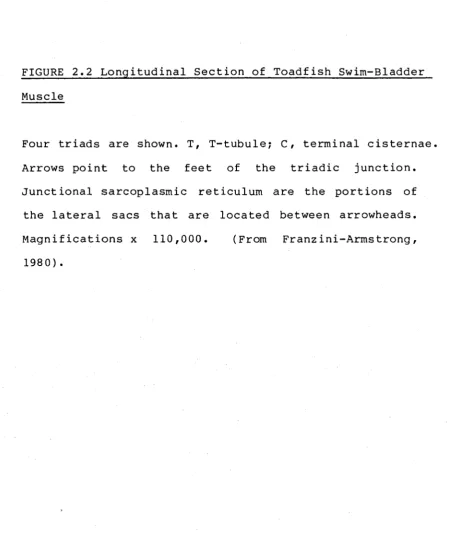
triadic junction (Franzini-Armstrong, 1980) (Fig.2.2).
The junctional surfaces of a T-tubule and the lateral sacs or terminal cisternae of the SR, face each other at a distance of 110 - 130 A 0 . The SR and T-tubule surfaces
are connected by electron dense feet at intervals of
about 300 A° (Franzini-Armstrong, 1975; Heusser, Reese, Somlyo and Somlyo, 1978; Franzini-Armstrong, 1980).
Membranous pillars wihh- electron lucent- -interiors also span the junctional gap directly connecting the myoplasmic
components of the T-tubule and SR membranes (Somlyo,
FIGURE 2.1 Schematic Drawing of Part of a Mammalian
Skeletal Muscle Fibre.
[image:45.550.30.494.194.766.2]17
I BAND SARCOPLASMIC RETICULUM T R I A D MITOCHONDRIA '
TERMINAL CISTERNAE T SYSTEM
-A B-AND SARCOPLASMIC RETICULUM
✓
^ 'p e r i p h e r a l
MITOCHONDRIA
CORE
MITOCHONDRIA '
FIGURE 2.2 Longitudinal Section of Toadfish Swim-Bladder Muscle
Four triads are shown. T, T-tubule; C, terminal cisternae. Arrows point to the feet of the triadic junction. Junctional sarcoplasmic reticulum are the portions of the lateral sacs that are located between arrowheads. Magnifications x 110,000. (From Franzini-Armstrong,
[image:47.550.39.495.231.782.2]1 9.
unclear. However, the T-tubule membrane is essential for
the inward transmission of excitation from the sarcolemma
to the
triadic
junction.
This has been dramatically
demonstrated in muscle
fibres detubulated by osmotic
shock treatment with glycerol. Detubulated fibres fail to
contract in response to electrical stimulation although
an action potential is still produced
(Eisenberg and
Gage, 1967).
Also, potassium-induced depolarization and
subsequent muscle contraction is abolished after osmotic
shock treatment (Eisenberg and Eisenberg, 1968; Howell,
1969; Gage and Eisenberg, 1969a; Eisenberg, Howell and
Vaughan, 1971). Caffeine, a drug that is thought to act
directly on the SR, can still induce contractures in
detubulated fibres, suggesting that SR function and the
contractile system are unaffected by the treatment
(Axelsson and Thesleff, 1968; Weber, 1968).
The skinned fibre preparation is obtained by
20
.
after resealing by re-establishing a potassium gradient across the internal membrane, making the lumina of the T-tubule more positive than the myofibrillar space and generating a resting potential (Costantin and Podolsky,
1967; Caputo, 1983). The skinned fibre preparation,
although not physiological, provides further evidence of T-tubular participation in EC coupling.
2.2.3 The Mechanism of Signal Transmission
Hodgkin and Horowicz (1960) demonstrated that
potassium is the major carrier of ionic current across the T-tubule membrane and induces muscular contraction. The density of feet and pillars in the triadic junction increases after potassium-induced depolarizart ion or low frequency stimulation of single muscle fibres, but remains unchanged when Ca 2+ is directly released from the SR by caffeine, suggesting that the role and formation of these structures is a cause and not an effect of C a 2+ release (Eisenberg and Gilai, 1979; Eisenberg and Eisenberg, 1982; Caputo, 1983).
2 1.
depolarization with the opening of Ca2+-channeIs in the junctional region of the SR, releasing stored Ca^+
(Adrian and Aimers, 1 9 7 6; Schneider and Chandler, 1 9 7 3;
Schneider, 1 9 8 1). Feet located in the triadic junction
may link charge movement with Ca^+ release. Ebashi (1 9 7 6)
suggested that each charge movement exerts its effect on
a corresponding foot. Thus, the magnitude of charge
movement and the number of electron dense feet localized in the triadic junction appear to be related
(Franzini-Armstrong, 1 9 8 0). The charge movement may be
in the form of a current that is gated (opened or closed), corresponding directly to the opening and closing of Ca^+ channels located in the feet of the terminal cisternae of
the SR (Martonosi and Beeler, 1 9 8 3). After glycerol-induced
detubulation, a large fraction of intramembrane charge movement is removed, indicating again the essential role of the T-tubule for EC coupling (Chandler, Rakowski and
Schneider, 1 9 7 6). Mathias, Levis and Eisenberg (1 9 8 0)
proposed that the pillars of the triadic junction act as conductive channels. These channels may open transiently during excitation, facilitating the flow of ionic current into the SR through the interiors of the pillars linking the T-tubules and SR membranes. This would produce a
voltage-dependent increase in the permeability of the
SR to Ca2+, initiating Ca2+ release. It was proposed
therefore that Ca^+ release was controlled by voltage in both membrane systems. Studies using optical
2 2.
generated by permeable dyes such as Nile blue A during contractile activity have associated latency relaxation
(LR) (observed as a small decrease in tension which
precedes a twitch following a stimulus) with potential
changes in the SR that lead to Ca^+ release (Bezanilla
and H or owicz, 1975; Baylor and Oetliker, 1977; Oetliker
and Schumperci, 1979). Recently, this model for the
mechanism of EC coupling was withdrawn from consideration
as the model imposed unrealistic restrictions on the
membrane capacitance and conductance of the SR (Martonosi, 1984) .
Alternative theories on the mechanism of EC coupling
in skeletal muscle provide no definite role for the
pillars and feet of the SR. Heilbrunn ( 1943) proposed that upon excitation, Ca^+ bound to external regions of the muscle fibre entered the muscle cell to induce contraction. Although Hill (1952) disputed the role of extracellular Ca^+ in muscular contraction, indicating that diffusion of a substance from the extracellular to the intracellular regions of muscle was too slow to account for the rate of contractile activation, further evidence of the
involvement of extracellular Ca^+ in muscle excitation was forthcoming. In 1952 Sandow proposed that
electrostatic attractions between the myofibrils and Ca^+ increased the rate of Ca^+ mobilization to the interior of
the muscle fibre. Bianchi and Shanes (1959) then