SPECIF ICA'l'ION AND FUNCTIONAL SIGN IF I CANCE OF THE LEAF ANATOMY OF c
4 PLANTS
by
Paul Wayne Hattersley
A thesis submitted for the degree of Doctor of Philosophy of the Australian National University.
December 1976
STATEMENT
D
ACKNOWLEDGEMENTS
Primarily, I thank my supervisor, Les Watson, for his continued
advice, encouragement, and patience throughout my Ph.D. work, and especially for the time he has devoted to me in discussion and criticism. The
extensive collection of grass leaf blade transections in the Taxonomy
Unit (prepared by Les Watson and Chris Johnston) has been a great asset to me from the outset, and I am grateful to have had access to it.
I thank too, my co-supervisor, Barry Osmond for much invaluable discussion, especially on physiological and biochemical matters. He also measured RuP 2Case and PEPCase activities in the immunoassay (Chapter 5.3.4.).
I am indebted to George Lorimer for his expert guidance in the preparation of wheat RuP 2Case, and to Liz Marchant for extensive help in that area.
I thank George Lorimer too, for a gift of spinach RuP2Case, against which to test my anti-wheat RuP 2Case serum in double irnmunodiffusion
(Chapter 5.3.3.), and for helpful discussion. Gifts of anti-spinach
RuP 2Case (Chapter 5.3.2.) and anti-maize pyruvate Pi dikinase (Appendix A.2.) from Ors. T. Akazawa and T. Sugiyama are gratefully acknowledged, as is a gift of Euglena RuP 2Case from Dr. E.H. Creaser (Chapter 5.3.3.).
I thank Prof. D.J. Carr for helpful advice, especially during the first year of my work, and for reading two of the Chapters; Dr. Eichler
(Herbarium Australiense) for loan of herbarium specimens; Ian Oliver for leaf material of twelve species; Prof. B.E.S. Gunning for use of the epifluorescence microscope, and Joanne Hughes for guidance in its use; Ors. 0. Bjorkman and M.A. Nabs for seeds of Atriplex hybrids; and Barry Parr and associates for photographic advice, and for developing and printing black and white films.
My appreciation goes to members of the Taxonomy Unit and R.S.B.S. for making my time in the School a happy and stimulating one. I thank Mrs. Anne Clugston for her excellent typing.
V
ABSTRACT
Leaf transections of over 300 plant species have been observed light microscopically with the aims of specifying leaf anatomical features
assoc-iated with the
c
4-dicarboxylic acid pathway of photosynthesis, and ofrelating these to
c
4 plant biochemistry and physiology. The sample, mainly grasses, includes bothc
4 andc
3 species, and representatives of most of thec
4 anatomical variants currently known.For grasses, two parameters have been found which reliably distinguish
c
3 fromc
4 species. A "maximum lateral cell count" of 2-4, and a "maximum cells distant count11of l, are characteristic of
c
4 grass leaves, and appear to be of fundamental physiological significance.c
3 grass leaves have a maximum lateral cell count of >4, and a maximum cells distant count of >l.The grass family also contains different biochemical
c
4 type species, and these can be distinguished using the XyMS character. Primary vascular bundles of leaves of 11NAD-Malic Enzyme" or 11PhosphoenolpyruvateCarboxy-kinase (PCK) type" species are characterised by the presence of cells in the mestome sheath position between metaxylem vessels and laterally adjacent
bundle sheath(= 11
Kranz11
= "photosynthetic carbon reduction [PCR]") cells: i.e., they are XyMS+. 11
NADP-Malic Enzyme type" c4 species lack such cells, and a~e classed as XyMS-. The XyMS character was used to predict c4 type for over 250 grass species. The character may indicate that routes of photosynthate transport to phloem loading sites may differ between c4 species types.
The existence of a variety of c4 leaf anatomical types is not only of value in defining constant anatomical features of c4 plant leaves. In the future, these variants should help in assessing the functional significance of intra-c 4 anatomical variation (e.g., the XyMS character). Identification of the two chlorenchymatous cell types in c
-vi
(c
3,c
4, and one CAM species) from seven monocotyledonous and dicot yled-onous families. It is especially useful for species with leaves of unusual
(= 11non-classical 11 )
c
4 anatomy, for hybrids (e.g., of Atriplex ), and for putative
c
3;c
4 intermediates (e.g., Panicwn milioides). The result for P. milioides, considered in relation to other known experimentation on thisspecies, has led to a hypothesis on the intermediate nature of its photo-synthetic carbon metabolism. Irrununofluorescent labelling of RuP 2Case supports previous evidence on the cellular location of this enzyme in species with normal (= "Kranz" = "classical")
c
4 leaf anatomy.I conclude that five anatomical features are characteristic of
c
4 plant leaves (and these are discussed in relation to the biochemistry andphysiology of
c
4 photosynthesis); 1) that two chlorenchymatous cell types exist which perform the bicellularly compartmented biochemical events ofc
4 photosynthesis: PCR cells, and "primary carbon-assimilation (PCA) 11(= 11
mesophyll 11
) cells; 2) that PCA and PCR tissues are usually juxtaposed, but if not, they are separated by cells usually ~lOµm in diameter;
3) that PCA cells are always found between PCR cells and the atmosphere; 4) that PCR-PCA and PCR-intercellular gas space contact is small: viz, PCR cells are arranged in some sort of layer on one side only of which do gas spaces in contact with the atmosphere occur (exceptions are isolated PCR strands); inter-PCR cell gas spaces do not exist; PCR cel l surface area/volume ratio is low; 5) that PCA and PCR tissues are quantitatively balanced, and this mirrors the stoichiometry of bicellularly compartmented biochemical events in
c
4 photosynthesis. This "anatomical stoichiometry" is reflected in such parameters as the maximum lateral cell count of 2-4, the maximum cells distant count of 1, low interveinal distance, low PCA/ PCR numerical cell ratio, and low PCA/PCR volume ratio.Preliminary data on PCA/PCR volume ratios are of interest with respect to different
c
4 types also, NAO-ME and PCK type ratio ranges bei ng lower than that for NADP-ME type species. Such ratios may be related to PCR cell shape, PCR cell radial dimensions, and/or different PCA/PCR tissue capacity requirements for the differentc
4 species types.STATEMENT
ACKNOWLEDGEMENTS ABSTRACT
CHAPTER l : INTRODUCTION
CONTENTS
1.1 Initial Research Ideas 1.2 Terminology
1.3 Scope of Thesis 1.4 Presentation
CHAPTER 2 : ANATOMICAL PARAMETERS FOR PREDICTING PHOTOSYNTHETIC PATHWAYS OF GRASS LEAVES: THE
"MAXIMUM
LATERAL CELL COUNT" AND THE "MAXIMUM CELLS DISTANT COUNT"2. l Abstract 2.2 Introduction
2.3 Materials and Methods
2.4 Observations and Discussion
2.5 Addendum
Table l Table 2 Table 3
CHAPTER 3 C4 GRASSES: AN ANATOMICAL CRITERION FOR DISTINGUISHING BETWEEN NADP-MALIC ENZYME SPECIES AND PCK OR NAD-MALIC ENZYME SPECIES
3. l Abstract 3.2 Introduction 3.3 Methods
3.4 Observations 3.5 Discussion
3.6 Addendum
Table l Table 2
CHAPTER 4 : METABOLITE TRANSPORT IN LEAVES OF C4 PLANTS: SPECIFICATION AND SPECULATION
4. l Abstract 4.2 Introduction 4.3 Specification
4. 3. l Biochemical Bases
4.3.2 Structural Bases
4.4 Speculation
[image:7.782.7.750.23.1084.2]Contents cont1 d.
4. 4. l 4.4.2
Transport of Photosynthetic Intermediates
Transport of Photosynthetic Products Table 1
CHAPTER 5 IN SITU IMMUNOFLUORESCENT LABELLING OF RIBULOSE-1 ,5 -BISPHOSPHATE CARBOXYLASE IN C3 AND C4 PLANT LEAVES
5.1 Abstract 5.2 Introduction
5.3 Materials and Methods
5.3.1 Preparation of Ribulose-1, 5-Bisphosphate
viii Page 49 50 53 54 55
Carboxylase 57
5.3 .2 Preparation of Antisera 58 5.3.3 Ouchterlony Double Diffusion Analysis 58 5.3.4 Immunoassay of RuP2Case and PEPCase Activities 59 5.3.5 In situ Immunofluorescent Labelling of RuP2Case 60 5.4 Results and Discussion
5.4.1 Specificity and Properties of Anti-RuP2Case
Sera 61
5.4.2 In situ Immunofluorescent Labelling of RuP2Case
5.4.2.A General Considerations 62 5.4.2.B General Labelling Results 64 -5.4.2.C Labelling in Species with 11
Non-classical C4 Leaf Anatomy 66 5.4.2.D Labelling in Panicum milioides
and Hybrids of C3 and C4
Atriplex Species 68
Table 1 72
Table 2 73
CHAPTER 6 THE ANATOMY OF GRASS LEAF SHEATHS IN RELATION TO PHOTOSYNTHETIC PATHWAY
6. 1 Abstract 6.2 Introduction
6.3 Materials and Methods
6.4 Observations and Discussion 6. 4. 1
6.4.2 6.4.3 6.4.4
General Characteristics of Leaf Sheath Anatomy
C and C Leaf Sheath Anatomy
P~otosynthetic Pat"JTuJays in Blades and Sheaths
Leaf Sheath Bundle Sheaths, and XyMS and c4 Species Type
Table 1 Table 2
/continued
Contents cont'd.
CHAPTER 7 : A NOTE ON RELATIVE VOLUMES OF MESOPHYLL AND BUNDLE SHEATH TISSUES IN GRASS LEAVES
7.1 Introduction
7.2 Observations and Discussion
Table 1
CHAPTER 8 : C4 LEAF ANATOMY IN RELATION TO C4 PHOTOSYNTHESIS 8.1 Introduction
8.2 Anatomy
8.3 C4 Photosynthesis
8.4 Leaf Anatomy and
c
4 PhotosynthesisLITERATURE CITED
FIGURES
APPENDIX A. l . General Areas
A. 2. Some Further Applications of in situ Immunofluorescent Labelling
A. 3. Panicwn milioides
Table 1
Page
91 92 97
98 98 101 105 109
111-134
135-159
160
CHAP'J'EH 1
---,
l.l INITIAL RESEARCH IDEAS
The work presented in this thesis had its origins in a written review in which I set out to integrate detailed information on the
biochemistry and physiology of the
c
4-dicarboxylic acid pathway ofphotosynthesis, photorespiration, anatomy and ultrastructure, carbon
iso-tope discrimination, and grass systematics. I also considered briefly,
such topics as
c
3;c
4 intermediacy,c
3;c
4 hybrids, evolution ofc
4photo-synthesis, photochemistry, and chlorophyll a/b ratios.
1
This rather exhaustive review, which occupied most of my time from
November 1973 to late 1974, has now been extensively superseded, and many
of the topics I considered have since been dealt with in symposia and
reviews (Bielski et al. 1974; Bjorkman et al. 1974; Laetsch 1974; Avron
1975; Chollett and Ogren 1975; Marcelle 1975; Zelitch 1975; Burris and
Black 1976; Hatch 1976a; Hatch and Osmond 1976; Kelly et al. 1976). In addition, I have accumulated more than 250 relevant papers, which have
been published in the last two years.
Presentation of an updated version of my review has seemed super-fluous. The aim in preparing the review, however, was to map out areas promising to repay further study, to ask pertinent questions, and to generate ideas which seemed worth testing. The questions and ideas, as
conceived in 1974~ are set out below. Some of them remain relatively
unexplored, while others were partly pursued by me in this thesis as indicated by the Chapter references given.
(l) Can
c
4 leaf anatomy be characterised precisely? Or, what are the functionally-essential anatomical features ofc
4 plant leaves? Unusualc
4 leaf anatomical types (e.g., see Johnson and Brown 1973) might provide useful clues. (Chapters 2, 5, and 8).---...~
section, leaf blades of Digitaria anguinalis exhibited bundle sheath
cells elongated in the longitudinal axis of the leaf blade (illustrated
Edwards and Black 1971~). From available information, it was reasonable 2
to assume that this species was an NADP-malic enzyme species (= "malate
former"). By contrast, paradennal sections of leaf blades of Panicwn
miliacewn ("aspartate former"; NAD-malic enzyme species), Atriplex
spongi,osa ("aspartate former"), and Amaranthus edulis ("aspartate former") (illustrated Hatch and Mau 1973) revealed square-shaped bundle sheath
cells. In longitudinal section, Panicwn maximwn (11
aspartate former";
PEP carboxykinase species) exhibited bundle sheath cells tending to be
elongated radially to the vascular bundles (illustrated Hatch and Mau 1973).
(Chapters 3 and 7).
(3) Can ribulose-1,5-bisphosphate carboxylase (RuP2Case), and
other enzymes, be localised in any other way than by using cell separation
techniques? Several reports question the cellular compartmentation of
enzymes such as RuP2Case: viz. Bal dry et al . 1971; Bucke and Long 1971; Bednarz and Rasmussen 1972; Poincelot 1972). Can Fraction I protein be
observed in all grasses electron microscopically (as done, perhaps, in
Avena : Gunn i n g et a l . 1 9 6 8 ) . ( Ch a pt e rs 4 and 5 ) .
(4) Can the cellular compartmentation of photosynthetic enzymes
be demonstrated in
c
4 plants exhibiting unusualc
4 leaf anatomy: viz.Aristida., Arundinella., Cyperus., Fimbristylis., and Triodia types; e.g., using cell separation techniques? (Chapter 5).
( 5 ) H ow do o the r green pa rt s of a C
4 g r a s s ( e . g . , 1 ea f s he a th s , stems, glumes, paleas, lemmas) compare with leaf blades anatomically,
physiologically, and biochemically? (Chapter 6).
(6) Is the stoichiometry of the in-series biochemical events of
3
of mesophyll to bundle sheath tissue? (e.g., Expressed as numerical cell
ratio, area or volume ratio; related to organelle concentration.) (Chapter
7) .
(7) What is the developmental basis and control of the cellular
compartmentation of
c
4 plant leaves? There is a need, at least, forcomparative
c
3;c
4 leaf development studies.(8) Are conflicting species designations in the literature, with
respect to photosynthetic pathway, of any significance? viz. Panicwn
rrrilioides (C 4: Downton 1971~;
c
3: Moss et al . 1969, Wynn et al. 1973); Uniola paniculata (C 4: Brown and Gracen 1972, Gracen et al. 1972;c
3: Smith and Brown 1973. But see Brown and Smith 1974); Suaeda fruticosa(C4: Bender 1971;
c
3: Smith and Epstein 1971. See also Welkie and Caldwell 1970). In what way can a plant be ac
3;c
4 intermediate (cf. Mollugo cerviana : Kennedy and Laetsch 1974), and how could intermediates be
recognised? Genera containing both
c
3 andc
4 species could provide clues(see list in Bjorkman 1973). (Chapter 5.4.2.D, Appendix A.3).
(9) What is the significance of Ellis's (1974~ and l974Q) reports
that both
c
3 andc
4 individuals occur in Alloteropsis semialata in SouthAfrica? Do
c
3 andc
4 individuals of A. semialata occur in disjunct pop-ulations, can or do they interbreed, or are there two species? If theclaim is substantiated, how is this polymorphism controlled genetically?
(By a supergene?)
(10) Have
c
3 Panicum species evolved fromc
4 Panicwn species?(W. Hartley and G.L. Stebbins - pers. commun.). Is the predominance of a
unique type of grass leaf anatomy in many
c
3 Pani um spp., and in many other
c
3 eu-panicoid genera, of any relevance in this context (viz. the"I a hne-type" leaf anatomy: Metcalfe 1960)?
c
3 Pani wn spp. are pre-dominantly diploid (cf. tetraploids and higher ploidy levels in other
(11) Is there any meaningful relationship in grasses, between
c
4 type, classification, geographical distribution, and climate? For example, the Eragrosteae are a tribe predominantly occurring in arid,
hot areas with a high winter temperature, and probably comprise NAD-malic
enzyme or PEP carboxykinase species. Species in the Paniceae tend to
occur in areas with long wet growing seasons, and are probably mostly
NADP-malic enzyme type. (See Hartley 1950, 1958~, l958Q; 1973; Hartley
and Slater 1960).
1.2 TERMINOLOGY
Before outlining the actual scope of this thesis in the next
section (Chapter 1.3), there is a need to explain some of the terminology
used there and in subsequent Chapters.
5
Initial descriptions of
c
4 leaf anatomy were based on plant leavesexhibiting a 11Kranz11 structure, as first characterised by Haberlandt in
1882 (see Haberlandt 1884; Brown 1975). The term "Kranz leaf anatomy"
has tended to become synonymous with ''C4 leaf anatomy", referring to the
arrangement of leaf cells in transection where: the "vascular bundles
are surrounded by two concentric chlorophyllous layers, an inner
parench-yma bundle sheath layer and an outer mesophyll layer. The bundle sheath
layer contains specialized plastids" (Downton 1971.9._). I refer to this
type of anatomy (omitting the reference to "specialized plastids11
) as
"classical"
c
4 leaf anatomy in the next section (1.3) and in Chapters 4to 8. Any type of
c
4 anatomy deviating from this simple arrangement Iterm "non-classical".
In plant leaves with "classical"
c
4 leaf anatomy, the 11mesophyll"
and "parenchyma(tous) bundle sheath" (PBS or PS) constitute the two
tissue types between which the biochemical events of
c
4 photosyntheticmetabolism are compartmentalised (e.g., see Downton 1971d). "Mesophyll"
and "parenchyma bundle sheath", however, are descriptive histological
terms and can be used for both
c
4 and
c
3 plant leaves. This terminology is used in Chapter 2, where I first question the anatomical characteristicsusually associated with
c
4 plant leaves. It is worth noting that theterm "mesophyll" itself, is recognised by Esau (1965) as referring to all
the "ground tissue" in a leaf, including therefore the "parenchyma bundle
sheath", whether in a
c
3 or ac
4 plant leaf.
The use of the term "ch l orenchyma tous pa renc hyma bundle she a th 11
(CPBS) was introduced by Akita and Miyasaka (1969), and generally, its
c
4 andc
3 plant leaf PBS 1s. To use the term CPBS or PBS, however, assumes that the chlorenchyrnatous bundle sheath 1n
c
4 plant leaves is always parenchymatous; an assumption which has yet to be substantiated. For these reasons, I used the term 11chlorenchymatous bundle sheath11(CBS) at the time Chapter 3 was written. Biochemists themselves, have always tended to use the simple term 11bundle sheath11
(BS), but from an anatomical viewpoint this is not specific enough, since it ignores the existence of bundle sheaths other than those already mentioned (e.g., the sheath of cells interpolated between the two chlorenchymatous bundle sheaths in some Cyperaceae).
6
With the recognition of an increasing number of
c
4 species with 11non-classical 11c
4 leaf anatomy, it became clear that the terms PBS, PS, CPBS, CBS or BS were not always appropriate for referring to the anatomical sites of cells in which the
c
4 acid decarboxylase system and Calvin Cycle operate. I therefore introduced (Chapter 4) two terms which are based on function rather than histology: (i) 11primary carbon-assimilation11(PCA) cells, and (ii) 11photosynthetic carbon-reduction11 (PCR) cells, being equivalent to 11mesophyll 11
and 11
bundle sheath11
respectively. These terms are used in Chapter 1.3. and Chapters 4-8.
The PCA/PCR terminology has the advantage of being applicable to all
c
4 anatomical types and of being brief for reference to chloren-chymatous cells in plants with 11non-classical 11c
4 leaf anatomy. Further-more, for the first time, the 11mesophyll 11 of
c
4 plant leaves is referred to by a different label than the 11
mesophyll 11 of
c
the terms PCA and PCR for the anatomical terms employed in Chapters 2
and 3. In the literature on
c
4 photosynthetic biochemistry andphysio-logy, the terms (i) mesophyll, and (ii) bundle sheath, PBS, PS, CBS, or
CPBS are generally equivalent to PCA and PCR respectively. Brown's
7
(1975) 11 Kranz 11 cells are equivalent to PCR cells. The German word 11 Kranz 11
means 11 wreath 11 or 11 garland 11 , and in a literal (but not historical) sense,
seems no more appropriate than "bundle sheath".
Taxonomic nomenclature of suprageneric taxa could also be a
source of confusion for the Gramineae. Grass group names (e.g., 11
---
...
8
1.3 SCOPE OF THESIS
The main aim of my work has been to define
c
4 plant leaf anatomy,and to relate this to
c
4 photosynthetic function. Although it is generallyaccepted that plants exhibiting
c
4 photosynthesis havec
4 leaf anatomy(or ''always have the Kranz complex": Hatch and Osmond 1976), the latter
has never been adequately defined. My initial survey of grass leaf blade
transections, and reports by Bisalputra et al . (1969), Black and Mollenhauer
(1971), Jacobs (1971), Laetsch (1971), Carolin et al . (1973), Crookston
and Moss (1973), and Johnson and Brown (1973), had shown that "classical"
c
4 leaf anatomy is not manifested in all c4 species. Subsequent reports(Bjorkman et al. 1974; Chen et al. 1974; Ellis 1974a, 1974b; McWilliam
and Mison 1974; Oleson 1974; Brown 1975; Carolin et al . 1975; Shomer-Ilan
et al. 1975; Rathnam et al . 1976; Chapters 2,4, and 5), and re-examination
of "pre-c4 photosynthesis" reports (Rikli 1895; Holm 1899a, 1899b, 1901; Henrard 1929; Vickery 1935; Burbidge 1946, 1953; Tateoka 1956~, 1956b,
1958, 1961, 1963; Lornmasson 1957; Brown 1958; Metcalfe 1960; De Winter
1965) greatly extend the list of species with "non-classical" c
4 leaf anatomy, and extend the types of
c
4 leaf anatomy recognised.Recent articles have called for a redefinition of c4 plant leaf
anatomy (Shomer-Ilan et al. 1975; Rathnam et al. 1976). Such demands
reflect disquiet over the existence of
c
4 anatomical variants, and people are beginning to doubt whether there are any specific anatomical features
associated with c4 photosynthesis (Jolivet 1976; Kelly et al. 1976).
Furthermore, the similarity of the leaf anatomy of the putative c3;c4
intermediate, Panicum milioides (Kanai and Kashiwagi 1975; Chapters 4.3.2,
5.4.2.D) emphasises the need for identification of consistent
c
4anat-omical features which are correlated with physiology. Only when this is done, will it be possible to relate anatomy and c4 photosynthesis in a
functional sense.
9
anatomy constant to
c
4 plants (Chapter 2). Two such features were found (the 11maximum lateral cell count11of 2 to 4, and 11
maximum cells distant count11 of l); and their existence suggested that the functional importance of
c
4 leaf architecture may be related, in part, to the necessity for close proximity of PCA and PCR tissues and/or for an 11anatomical stoichiometry" compatible with the biochemical stoichiometry of the cellularly compart-mented events inc
4 photosynthesis. With respect to the predictive value of the two parameters, for grasses, this has been extensively verified since Chapter 2 was published in Phytomorphology, and the supplementary data are presented in the addendum (Chapter 2.5). Observations on leaf sheaths of over 50 grass species (Chapter 6) are consistent with those of the blades with respect to the 11maximum lateral cell count11 and the "maximum cells distant count11• The overall architecture of the two parts of the leaf, however, differs considerably: sheaths of grasses with
c
4blades are apparently
c
4 , but they usually lack 11classical 11
c
4 anatomy. While making observations on leaf sheaths, my attention was drawn to sclerenchyma-bundle sheath relations, and to apparent differences
between chloridoid (eragrostoid) and eu-panicoid grasses. This led to the recognition of the XyMS character which seems to provide a reliable method of distinguishing
c
4 species types (Chapter 3; an addendum, Chapter 3.6, contains XyMS information on 11 species examined subsequent to publication of the original data).
c
4 species types also appear to have somewhat dif-ferent ranges of PCA/PCR volume ratios (Chapter 7). Data on PCA/PCRratios, however, have as yet been obtained for too few species, and the observations are insufficiently detailed to provide a firm basis for functional-anatomical theories.
Initial results of imrnunofluorescent labelling of ribulose-1, 5-bisphosphate carboxylase (RuP2Case), which identifies PCR cells,are introduced in the context of intercellular metabolite transport in
c
4 plant leaves, with especial emphasis on species exhibiting 11c
4 leaf anatomy (Chapter 4). The XyMS character is also considered inthis Chapter, and is probably of significance with respect to the
transport of photosynthate from PCR tissue to phloem, and/or to water
transport. Chapter 4 is mainly speculative, and the data on which it
rests are presented in Chapters 2, 3, and 5.
In situ immunofluorescent labelling of RuP 2Case in leaf blades
10
of 42 species (Chapter 5) confirms earlier conclusions on the location of
this enzyme in leaves of species with 11
classical 11
c
4 leaf anatomy, and 1n
c
3 and CAM plant leaves. The technique is shown to be especially valuable,n identifying PCR cells 1n leaves of species with 11
non-classical 11
c
4 leaf blade anatomy (Chapter 5), and in leaf sheaths (Chapter 6). The
labelling results for Atriplex hybrids and for the putative
c
3;c
4inter-mediate, Panicum milioides , are of especial interest. Chapter 5 also
contains
c
4 leafsheaths
fu 11 y in
anatomy.
a brief
anatomy.
(Chapter
Chapter
synthesis of my present conception of the essentials of
This conception, supported by the observations on leaf
6) and PCA/PCR ratios (Chapter 7), is considered more
8 in relation to the functional significance of
c
4 leaf
Since this thesis provides information on the gross architecture
of
c
4 leaf anatomy, and not ultrastructure, the latter is not discussed(but see review by Laetsch 1974; and subsequent papers: Gutierrez et al .
1974a; Oleson 1974; Chapman et al . 1975; Hatch et al . 1975; Shomer-Ilan
etal. 1975; Carolin et al. 1975).
Appendix 1 outlines very briefly areas for future work which do not
appear in the thesis text. In particular, further applications of
---
...
,
l l
1.4 PRESENTATION
Since much of the work described in this thesis has already been published (Chapters 2, 3, and 4) or submitted for publication (Chapter 5), the presentation is basically that of a collection of papers. The format
adopted throughout the thesis has been standardised, and conforms to that of the Australian C.S.I.R.O. journals.
The Chapters are all inter-related pieces of work, as outlined 1n the last section (Chapter 1.3.). The order in which the Chapters are presented, is that in which they were written, since this retains the
meaning of much of the cross-referencing in the text, and shows the develop-ment of ideas during the course of my study. However, extra
cross-referencing has been introduced, especially with respect to illustrations,
so that further continuity is provided. For convenience, (i) Chapter
headings are referred to by a numbering system, (ii) the cited literature has been pooled, and (iii) the Figures have been pooled and are numbered consecutively throughout the thesis.
Chapters 2 and 3 include addenda which contain data acquired since publication, and which also draw attention to subsequent relevant liter-ature.
The immunofluorescent labelling work described in Chapter 5 has been illustrated, of necessity, with colour photographs. Financial limitations have prevented presentation of better quality (1
cibachrome 1 )
colour prints or of adequate reproductions of original Ektachrome colour transparencies. Consequently, the colour balance of the subject in the
---..,
CflAPTEH 2
ANATOMICAL PARAMETERS FOR PREDICTING PHOTOSYNTHETIC
PATHWAYS OF GRASS LEAVES : THE "MAXIMUM LATERAL
CELL COUNT" AND THE ''MAXIMUM CELLS DISTANT COUNT"
Published
Hattersley, P.W., and Watson, L. (1975). Phytomorphology 25, 325-33.
-2. l ABSTRACT
Leaf transections from 121 grass species (80 genera) have been
examined histologically in relation to features associated with type of
photosynthetic pathway. Those most highly correlated with
c
4photo-synthesis are the 11maximum lateral cell count" (2-4 chlorenchymatous
mesophyll cells intervening between PBS cells of laterally adjacent
vascular bundles in
c
4 species; more than 4 in
c
3 species) and the12
11
maximum cells distant count11
(in
c
4 species no chlorenchymatous mesophyllcell is separated from the nearest PBS cell by more than one other
chlor-enchymatous mesophyll cell; i.e., the 11
one cell distant criterion").
These parameter values, especially the latter, provide clues to what may
be the true functional significance of the various types of organisation
of chlorenchyma found in leaves of
c
4 grasses. Using them, photosyntheticpathways are predicted for a further 87 grass species (79 genera) yet to
be investigated experimentally.
---~-,
132.2 INTRODUCTION
The
c
4 pathway of photosynthesis is now well documented biochem-ically and physiologbiochem-ically (Hatch and Slack 1970~, 1970.Q_; Hatch et al. 1971; Black 1973; Bjorkman 1973).
c
4 andc
3 species, especially grasses,have also been compared quite widely both histologically and
ultra-structurally (see review by Laetsch 1974) and the former are generally
held to possess a specialised type of leaf anatomy, referred to as "Kranz
anatomy" by Johnson and Brown (1973). This 1s an interesting phenomenon,
which has offered scope for speculation and ideas for experimentation in
the realm of functional plant anatomy. The discovery that certain
anat-omical features generally occur in association with a particular kind of
physiology, and may be an integral part of it, emphasizes that details of
comparative plant anatomy are relevant to physiology and biochemistry,
and that plant anatomists should always work with this in mind.
Various histological and ultrastructural features have been held
to characterise
c
4 plants and to distinguish them fromc
3 plants; i.e.,relatively low interveinal distances and thin leaf blades, a low numerical
ratio of chlorenchymatous mesophyll cells to parenchymatous bundle-sheath
(PBS) cells, radiate chlorenchyma, well developed and thick-walled PBS
cells which accumulate abundant starch, characteristic patterns of
organelle distribution between PBS and mesophyll cells, and presence of
a chloroplast peripheral reticulum 1n both these cell types (e.g. Chonan
1970, 1972; Takeda and Fukuyama 1971; Monteny 1973; Crookston and Moss 1974;
Laetsch 1971, 1974; Huang and Beevers 1972; Imai et al. 1973; Johnson and Brown 1973; Black and Mollenhauer 1971). However, all these features
are either imperfectly correlated with the photosynthetic pathway as
detected physiologically, or are inadequately quantified, or they have
been surveyed over too small a sample of species for the reliability of
14
clearly of great interest from the standpoint of fundamental physiological
anatomy, are relatively inaccessible, and do not lend themselves to
large-scale surveys (often of necessity involving use of herbarium material)
aimed at pinpointing species promising to repay the attentions of
experi-mentalists.
No attribute which fails to correlate absolutely with possession
of the
c
4 pathway can be structurally essential to it. An imperfectcorrelation such as that involving chlorenchyma radiateness may arise
coincidentally, because like the
c
4 pathway itself it is extensivelytaxonomically correlated (e.g., Smith and Brown 1973); or it may be a
slightly imperfect reflection of another, physiologically more critical,
feature. In any case, in view of the biological and possible economic
significance of the
c
4 pathway there is abundant incentive for makingfurther comparative anatomical observations on leaves, in the hope of
use-fully re-defining aspects of Kranz anatomy or of finding new,
physiologically-informative and perhaps more definitive characteristics of it.
While examining preparations of grass leaves made for another
purpose (Watson and Milne 1972), it seemed to me that a simple count of
interveinal mesophyll cells afforded a relatively unambiguous and
theor-etically interesting criterion for accurately distinguishing
c
3 fromc
4species; and I commenced gathering extensive data. Meanwhile, Crookston
and Moss (1974) published a significant short paper, upholding the general
validity of distinguishing between
c
3 andc
4 grasses in terms of inter-veinal distances and showing that, for the 20 species of their sample at
least, this difference reflects a difference in numbers of mesophyll cells
between adjacent vascular bundle sheaths (9-15 in their
c
3 species; only2 in their
c
4 species). They also discussed the possible physiologicalimportance of these features. However, their sample was small, and did not include examples for which other Kranz anatomical indicators of
---...""-radiate chlorenchyma) . Nor did it include species with interveinal "distinctive cells" (Tateoka 1956..Q_) or "circular cells" (Metcalfe 1960) (e.g., Arundin lla , Fig. 8), which might be expected to provide inter-pretive difficulties and a test for physiological theories.
2.3 MATERIALS AND METHODS
15
10-l5µm transverse sections were cut by hand from the mid-region of leaf blades from 208 grass species (159 genera), using either fresh or
herbarium material. Permanent preparations were made after staining in
phenolic Bismarck Brown (Metcalfe 1960).
All preparations were scored wherever possible for the conventional
Kranz anatomical characters, namely radiateness of the mesophyll; presence
or absence of well-defined parenchymatous bundle sheaths; PBS cells larger
than the other mesophyll cells; and (where it was feasible to do so)
relative abundance of chloroplasts in chlorenchymatous mesophyll and PBS
cells. In addition, they were scored for nwnbers of chlorenchymatous
mesophyll cells between the PBS cells of laterally adjacent vascular bundles, with special reference to the maximum number observable in a given leaf
(referred to hereafter as the "maximwn lateral cell count"). The count was made along a straight line from the centre of one bundle to the centre
of the next (see Figs. l ,2). Ground tissue other than typical
chloren-chymatous mesophyll cells was ignored in the count; e.g. "colourless cells"
(found especially in many chloridoid grasses; see Metcalfe 1960), aerenchyma.
The maximum nwnber of ells separating any individual chlorenchymatous mesophyll ell from its nearest PBS cell was also recorded for each
tran-section, giving rise to the "maximwn cells distant count" and the "one
cell distant criterion".
To test the closeness of association of these anatomical parameters with alternative photosynthetic systems , the anatomical observations have
means (mainly CO 2 compensation points and carbon isotope ratios; for references, see Table l).
2.4 OBSERVATIONS AND DISCUSSION
16
A more or less radiate arrangement of mesophyll cells characterises
the vast majority of
c
4 grass leaves (e.g . , Figs. lA, 21A). However, Arundinella nepalensis (Fig. 8), Garnotia stricta (Fig. l~) and Triodiapungens (Figs. 14A, 14~) have non-radiate mesophyll but are
c
4, or are
presumed to be
c
4 from data on other species of the same genus (see Table 1).Furthermore, many grass leaves fall into the category of 11 indistinctly
radiate11
• Of these, some are
c
4 (e.g., Paspalum dilatatwn; Zea mays; Stenotaphrwn secundatum, Fig. lC) while others are
c
3 or presumed
c
3(e.g., Arundo donax; Catapodium rigidum ; Danthonia pallida ; Figs. 2A, 2~).
c
3 species having clearly radiate mesophyll include many of thec
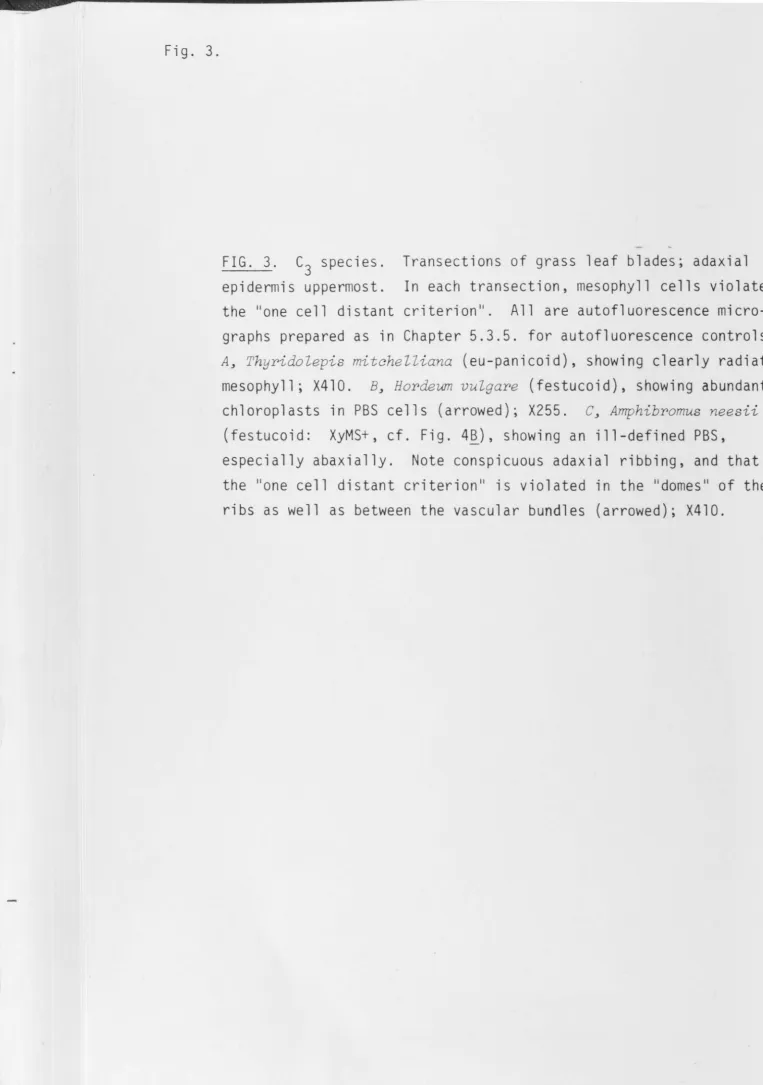
3eu-panicoids (e.g., Coelachne pulchella; Cyrtococcwn sp.; Entolasia stricta , Fig. 2C; Isachne globosa; Sacciolepis indica1 Thyridolepis mitchelliana, Fig. 3~_) plus Cortaderia selloana.
The PBS is well-defined not only in
c
4 species examined but in most
c
3 species as well, exceptions being Holcus lanatus and Amphibromusneesii (Fig. 3f). Furthermore, relatively large PBS cells are by no means
diagnostic of the
c
4 pathway. Leaves ofc
3 species such as Arundo donax(Fig. 2A), Cortaderia selloana~ Hymenachne amplexicaulis and Phragmites
australis (Fig. 2.Q_) have PBS cells larger in transection than the other
mesophyll cells, while the PBS cells are smaller than those of the sur-rounding mesophyll in the
c
4 species Ari tida vagans (outer PBS), Setariageniculata (Fig. l.Q_) and Stenotaphrwn secundatwn (Fig. lf). In other
species the PBS and surrounding mesophyll cells are much the same size
[image:27.777.16.753.13.1084.2] [image:27.777.2.757.23.890.2]-
..
---
...,.
17
only in most
c
4 species (see Figs. lA, l_Q_), but in suchc
3 species asDanthonia carphoides, Hordewn vulgare (Fig. 3~_), Panicwn clandestinwn and Phragmites australis (Fig. 2_Q_).
Both the 11
maximum lateral cell count11
and the "maximum cells
distant count11 are easily recorded even in quite distorted herbarium
material, and they provide clearer indications of photosynthetic pathway
than do any of the aforementioned criteria. In all
c
4 species and presumed
c
4 species (Tables l), the lateral cell count is extremely regular forall bundle-pairs of a section, and its maximum value for a leaf exceeds
4 only in Arundinella nepalensis and Garnotia stricta (but see below).
The regularity of the count draws attention to a little-emphasized aspect
of
c
4 anatomy, namely that the histological organization in many species 1s very uniform across the whole blade, even through thickened midribs
(e.g., Echinochloa crus-galli, Lepturus repens, Saccharwn officinarwn). Known and presumed
c
3 species, by contrast, exhibit counts which tend tobe variable in any one leaf blade; in particular, they are often lower
near the leaf margins. Lateral cell counts in
c
3 leaves fall in the range0 to 12, minimal counts of O having been recorded for Arundo dona.x; of l for Danthonia nivicola, D. pallida, D. procera and Phragmites australis; of 2 for Arrrphibromus neesii, Dactylis glomerata, Avena fatua, Dactyli s
glomerata, Danthonia carphoides, Oryza sativa and Stipa verticillata;
of 3 for Triticwn aestivwn, Hymenachne arrrplexicaulis and Stipa teretifolia; and of 4 for Poa annua, P. helmsii, Festuca littoralis, Stipa filifolia, S. ramosissima and S. juncoides. However, these and all other known or
presumed
c
3 species (Table l) exhibit at least some bundle-pairs (usuallymany) separated by more than 4 (usually many more) chlorenchymatous
mesophyll cells (Fig. 2~_). In fact, for the vast majority of
c
3 leaves,the minimal lateral cell count 1s greater than 6, so that the distinction
between
c
18
Of the species in Table l, only 2, viz. Arundinella nepalensis (presumed
c
4) and Garnotia stricta (C 4; Fig. l~_) would be incorrectly assigned by the anatomical criterion of 11maximum lateral cell count11 as
defined above. Species of these genera possess longitudinal strands of
cells between the parallel veins of the leaves, variously called
11distinctive cells11
(Tateoka 1956!?._; Johnson and Brown 1973), 11
circular
cells" (Metcalfe 1960), and 11specialised cells11
(Crookston and Moss 1973).
They are held to be equivalent to PBS cells, both ultrastructually
(Carolin et al. 1973) and functionally (Crookston and Moss 1973).
Interestingly (see below), if the lateral cell count is made between these
cells (Fig. 8) and the PBS of an adjacent vascular bundle, or between
laterally adjacent strands, values typical of
c
4 species are obtained.Species of Triodia (and also Plectrachne ) exhibit a peculiar leaf anatomy (Burbidge 1946, 1953; Jacobs 1971), which at first sight does not lend
itself to lateral cell counting. However, if the count is made between
laterally adjacent PBS extensions, across the grooves of the lamina and
ignoring epidermal cells, a maximum count of 2 is obtained for Triodia
pungens. Such a count, if taken to indicate
c
4, is compatible with theknown physiology of another species of the same genus (T. irritans ; McWilliam and Mi son 1974).
The 11
maximum cells distant count11 seems even more effective than
the 11
maximum lateral cell count11
for correctly assigning species as
c
3 orc
4, being more readily applicable to leaves of the Arundinella and Triodiatypes. Among the known and presumed
c
4 species listed in Table 1, I havenever found any typically chlorenchymatous mesophyll cell to be separated
by more than one cell from the nearest PBS cell (Figs. lA-I_, 10, 11, 12).
By contrast, in leaves of known and presumed
c
3 species (Table 1), thereare always some, and usually many, chlorenchymatous mesophyll cells that
---
...
,
19
(e.g., Cynodon dactylon~ and especially Pennisetwn villoswn and
Stenotaphrwn secundatwn~ all with lateral cell counts of 2-4; Figs. lA,f,I_)
call for a small qualification. Here, some mesophyll cells are more than
one cell distant (Figs. lA, lf), but they are generally larger and contain
distinctly fewer chloroplasts than do typical mesophyll cells. They are
never adjacent to PBS cells, and in Stenotaphrwn secundatwn there is a
gradation of these cell types in some parts of the leaf, away from the
vascular bundles, into colourless cells.
In Table 2 I list 87 grass species (79 genera) which to my
know-ledge have not yet been investigated either experimentally or (with 19
exceptions : Carolin et al. 1973; Smith and Brown 1973) anatomically with
respect to photosynthetic pathway, and nominate them tentatively
c
3 orc
4. The physiologically-uninvestigated species of Panicwn in my sampleare included here, rather than in Table 1, since this genus is known to
exhibit both
c
3 andc
4 species. The assignments in Table 2 are basedprimarily on 11
maximum lateral cell counts11 and on 11maximum cells distant
counts11
, which taken together seem to constitute by far the most accessible
and reliable of the known anatomical indicators of photosynthetic pathways
1n grasses. However, the better-known features of Kranz anatomy when
taken in combination are largely in accord.
Amphibromus neesii (Fig. 3C) has leaves with conspicuous adaxial
ribbing, and sometimes a lateral cell count of only 4. However, in the
domes of the ribs there are usually 3-5 mesophyll cells separating the
epidermis from the PBS, so that many are two or more cells distant from
the nearest PBS cell. This contrasts with adaxially-ribbed
c
4 grassleaves, which never have more than 2 mesophyll cells dorsal to the PBS
and where the one cell distant criterion holds. I would therefore expectt
this species to be
c
3, like all experimentally-tested festucoid grasses.Pyrrhanthera exigua provides a similar instance, having a 11
maximum lateral
cell count11
of 4. However, its PBS/ vascular bundle complexes are small
relative to the depth of the lamina, so that here too, many mesophyll
cells violate the one cell distant criterion. I assign this species too
as
c
3.Tables l and 2 provide data of considerable taxonomic interest.
20
For example, Amphipogon is sometimes placed in the Aristideae with Ari stida
(Prat 1960; Watson and Clifford 1976; cf. De Winter 1965). Aristida (C4;
Smith and Brown 1973) is unusual in that it has a double PBS (Fig. 13).
I determine Amphi pogon strictus to be
c
3, however, and it does not possessa double PBS. A comparison of Table l with the data of Smith and Brown
(1973) supports the view that most grass genera are probably consistently
either
c
3 orc
4, Panicum rema1n1ng the only known exception. In the absence of a thorough taxonomic revision of generic limits among eu-panicoid
grasses, there is no good reason to suppose that Panicwn as currently
entertained is meaningful 1n any evolutionary sense. The modern Panicum
s.str. consists of species that have been left over after the removal from
Panicwn s. l . of EntolasiaJ EchinochloaJ OttochloaJ Paspalum, etc., and
further seemingly inevitable breakup may remove the physiological
in-consistency (e.g., see Gould 1974). Therefore, evolutionary speculation
about the
c
4 pathway should probably be directed towards the eu-panicoidassemblage as a whole, since this is readily defensible as a sound taxonomic
grouping. Tables 1 and 2 are in accord with the impression that festucoid
grasses are probably all
c
3, that all andropogonoids and all definitechloridoids (eragrostoids) are probably
c
4; but that the eu-panicoidassemblage takes in substantial suites of both
c
3 andc
4 genera (asterisked
in Tables). The situation vis-a-vi s arundinoid and danthonioid grasses
remains unclear, because of taxonomic uncertainties clouding this area
of grass classification.
The examples provided by unusual leaf forms in PyrrhantheraJ
21
predictor of photosynthetic pathway in grasses. Furthermore it may hold fundamental physiological significance. The proximity of the clorenchyma as a whole to the vascular tissue in
c
4 species, as reflected by short interveinal distances, thinness of laminae and low lateral cell counts, is thought to facilitate rapid transport of photosynthate from the leaf and to contribute to the alleged greater photosynthetic efficiency ofc
4 species (Downton and Tregunna 1968; Monteny 1973; Crookston and Moss 1974).However, the situation in Plectrachne, Triodia, Pennisetwn and Stenotaphrwn and more especially in Arundinella and Ga.rnotia, vis-a-vis the "one cell distant criterion", suggests rather that the true meaning of
c
4 anatomical organisation may lie at least in part in the distance (or number ofmembranes) separating chlorenchymatous mesophyll cells from PBS cells (see also Carolin et al . 1973). This interpretation makes sense in terms of the cellular compartmentation of biochemical events in
c
4 photosynthesis(see e.g., Hatch and Slack 1970~, l970Q; Black 1973; Kanai and Edwards 1973~, 1973Q, 1973~; Gutierrez et al. 1974~). The balanced system presum-ably calls for spatial and biochemical co-ordination, requirements demanding
close proximity of the two cell types and also determining the relative
abundances of cells and organelles 1n the mesophyll and PBS. These
limitations have not always led to an anatomical arrangement recognisable
as Kranz anatomy, but the "maximum cells distant count" of one appears to be a constant characteristic of
c
Table l. Grasses for which non-anatomical evidence of photosynthetic pathway is available, recorded for "maximum lateral cell count" and "maximum cells distant count11
t
"Maximum lateral cell count" 2-4; "maximum cells distant count11
l.
c
4._Andropogon virginicus; Aristida ramosa; A. vagan~ ; Arundinella nepalensis; *Axonopus affinis; Bothriochloa
nu.era; *Brachiaria foliosa ; *Cenchrus echinatus; Chloris truncata ; Chrysopogon fallax; Cymbopogon refractus ; Cynodon dactylon; *Digitaria brm.mii ; D. sanguinalis; Distichlis distichophylla ; *Echinochloa crus-galli; Eleusine indica; Eragrostis benthamii ; Eremochloa bimaculata; Erianthus fastigiatus; *Eriochloa sp ;
Garnotia stricta; lmperata cylindrica; Leptochloa digitata ; Lepturus repens; Miscanthus sinensis; Muehlenbergia
arisanensis; *Panicum antidotale; P. laevifolium; *Paspalum dilatatum; P. distichum; *Pennisetum alopecuroides;
P. villoswn ; *Rhynchelytrum repens ; Saccharum officinarum; *Setaria geniculata; Sorghum bicolor; S. leiocladum;
Spartina maritima; Sporobolus elongatus ; *Stenotaphrum secundatum; Themeda australis; *Thuarea involuta;
Tragus australianus; Triodia pungens; *Xerochloa barbata; X. imberbis; X. laniflora; Zea mays; Zoysia macrantha.
/continued
[image:33.1114.0.1109.64.739.2]Table l. cont'd.
"Maximum lateral cell count" >4; "maximum cells distant count" 2 or more.
c
3._Agropyron scabrwn; Agrostis avenacea; Anthoxanthum odoratum; Arrhenatherum elatius; Arundo donax; Avena fatua;
A. sativa; Briza minor; Bromus unioloides; Centosteca sp; *Coelachne pulchella; Cortaderia selloana;
*Cyrtococcum sp.; Dactylis glomerata; Danthonia alpicola; D. bipartita; D. carphoides; D. dimidiata; D. frigida;
D. nivicola; D. nudiflora; D. pallida; D. procera; D. robusta; Deschampsia caespitosa; Ehrharta erecta;
Festuca arundinacea; F. littoralis; Hierochloe rariflora; Hordeum vulgare; *Hymenachne amplexicaulis; *I sachne
globosa; Leersia hexandra; Lolium perenne; *Oplismenus aemulus; 0. undulatifolius; Oryza sativa; Oryzopsis
miliacea; *Ottochloa gracillima; *Panicum clandestinum; Parapholis incurva; Phalaris aquatica; Phleum pratense;
Phragmites australis; Phyllostachys sp.; Paa annua; P. helmsii; P. queenslandica; *Sacciolepis indica; Schismus
barbatus; Secale cereale; Stipa aristiglumi s; S. bigeniculata; S. blackii; S. columbiana; S. comata;
S. densiflora; S. elegantissima; S. falcata; S. filiculmis; S. filifolia; S. gigantea; S. ichu; S. juncoides;
S. leucotricha; S. nervosa; S. pubescens; S. ramosissima; S. teretifolia; S. verticillata; Triticum aestivum.
t Roman type indicates that non-anatomical evidence of photosynthetic pathway exists for the same species;
elsewhere the probable pathway has been deduced from data available for other species of the same genus
(experimental data from Akita and Miyasaka 1969; Akita and Tanaka 1973; Akita et al . 1969; Bender 1971; Bender and Smith 1973; Chen et al. 1970; Downes and Hesketh 1968; Downton and Tregunna 1968; Gutierrez
et al . 1974c; Hatch et al . 1967; Hofstra et al . 1972; Krenzer and Moss 1969; McWilliam and Mison 1974;
Moss et al .- 1969; Schoch and Kramer 1971; Smith and Brown 1973; Smith and Epstein 1971). For qualifications
regarding Arundinella, Garnotia, Pennisetum, Stenotaphrum and Triodia, see text.
* Eu-panicoid genera.
N
[image:34.1116.0.1109.43.742.2]Table 2. Probable photosynthetic pathways of grasses on which direct evidence is not available,
based on "maximum lateral cell count" and the "one cell distant criterion"
Probable
c
4 species ("maximum lateral cell count" 2-4; "maximum cells distant count" 1).Apluda mutica; Austrochloris dichanthioides; Brachyachne convergens; Capillipedium spicigerum; *Chamaeraphis
hordeacea; *Chionachne cyathopoda; Coelorhachis rottboellioides; Dimeria sp.; Dinebra retroflexa; Diplachn
parviflora; Enneapogon nigricans; Enteropogon acicularis; Eulalia fulva; Eustachys distichophylla; Hackelochloa
granularis; Hemarthria uncinata; Heterachne brownii; Hyparrhenia filipendula; Iseilema vaginifloI'WTI; Microchloa
indica; Ophiurus exaltatus; *Panicum australiense; P. effusum; P. simile; *Paraneurachne muelleri;
*Paspalidium gracile; P. jubiflorum; P. rarum; Pheidochloa gracilis; Plectrachne schinzii; Pogonatherum
pan~ceum; Polytoca macrophylla; Polytrias amaura; *Pseudochaetochloa australiensis; Pseudopogonatherum
irritans; Rottboellia exaltata; Sclerandrium truncatiglume; Thaumastochloa sp.~ Tripogon loliiforrnis;
Triraphis mollis.
/continued
N
Table 2. cont'd .
Probable
c
3 species ("maximum lateral cell count' 1
>4; 11
maximum cells distant count11
2 or more) .
Amphibrorrrus neesii; Amphipogon strictus; *Ancistrachne sp.; Anisopogon avenaceus; Avellinia michelii;
Brachypodiwn distachywn; Catapodiwn rigidwn; Chionochloa conspicua; Cynosurus echinatus; Desmazeria acutiflora;
Deyeu.xia quadriseta; Dichelachne sciurea; *Dimorphochloa rigida; Echinopogon cheelii; Elytrophorus spicatus; *Entolasia marginata; E. stricta; E. hlhiteana; Erythranthera australis; Gastridiwn ventricoswn; Gaudinia
fragilis; Holcus lanatus; Lagurus ovatus; Leptaspis banksii; l.Dphatherwn gracile; Lophochloa phleoides;
Mibora verna; Microlaena stipoides; Monerma cylindrica; Nassella trichotoma; *Neurachne alopecuroidea;
Notochloe microdon; *Panicum milioides; Pentapogon quadrifidus; Pentaschistis airoides; Polypogon monspeliensis; Potamophila parviflora; *Pseudechinolaena polystachya; Psilurus incurvus; Pyrrhanthera exigua; Sclerochloa dura; Sphenopus divaricatus; Tetrarrhena laevis; *Thyridolepis mitchelliana; Thysanolaena maxima; Trisetwn spicatum;
Vulpia bromoides.
* Eu-panicoid genera.
26
2. 5 ADDENDUM·
Since March 1975, when this Chapter was submitted for publication,
I have made observations on a further 74 grass species and 19 genera.
These have been assigned as
c
4 (64 spp. : Table 3) orc
3 (10 spp.) usingthe "maximum lateral cell count" and the 11
maximum cells distant count11 •
Of the 10 species designated
c
3, two have been tested forlocalis-ation of ribulose-1 ,5-bisphosphate carboxylase (RuP2Case) using imm
uno-fluorescent labelling (Chapter 5.4.2.; Fig. 19A), and their leaves exhibit a C3
labelling response (Panicwn pygmaewn, Paa sieberana). Micraira subulifolia
exhibits a low
o
13c
value (Smith and Brown 1973), typical ofc
3 species,and a further four species belong to genera containing other species which
have been recognised as
c
3 (Danthonia linkii var. fulva, Festuca asperula,Hordewn leporinwn and Stipa neesiana) (Krenzer et al . 1975; Troughton
et al . 1974). The remaining three species assessed to be
c
3 are Airacupaniana, Cleistochloa subjuncea, and Panicwn trichoides. In total, I
have examined 127
c
3 species in this thesis (86 genera).Of the 64 species designated
c
4 (Table 3), 49 have been classed asc
4 by other workers, and for two more,immunofluorescent localisation ofRuP 2Case gives a
c
4 labelling response (Chapter 5.4.2 : Aristida behriana,A. biglandulosa). In no case has there been a conflict between anatomical
prediction and conclusions based on experiment. Most, but not all of the
c
4 species in Table 3, are also listed in Chapter 3 (Table l), but arepresented here for convenience. In total, I have examined 154
c
4 grassspecies (92 genera) in leaf blade transection (this Chapter : Tables l ,2,3).
Some species and genera listed in Table 2 (this Chapter), where I
predicted photosynthetic pathway for 87 species, have been investigated
experimentally since March 1975, and the predictions were verified in all
..
---.,
( i )
( i i )
Iseilema vaginiflorum, Pani um effusum, and species of
Apluda, Enteropogon, and Hyparrhenia other than those in Table 2.
27
Amphibromus neeS&&, Entolasia stricta, Holcus lanatus,
Microlaena stipoides, Polypogon monspeliensis, Thyridolepis mitchelliana, and species of Brachypodium and Trisetum
other than those in Table 2.
( Krenzer et al . 1975; Raghavendra and Das 1976; Trough ton et al. 1974; Chapter 5.4.2.).
Predictions for 14 species 1n Table 1 (this Chapter), which were
based on results for other species of the same genus, have also since been
verified:
( i )
( ; ; )
Aristida ramosa, Ar~ndinella nepalensis, Brachiaria foliosa, Chloris truncata, Digitaria broumii, Pennisetum villosum, Rhynchelytrum repens, Sporobolus elongatus.
Briza m&nor, Danthonia bipartita, Deschampsia caespitosa, Isachne globosa, Oryzopsis miliacea, Stipa verticillata.