Realms as Entity Location Services
A study of object orientation for the conceptual
structure of the Internet
Oliver F. J. Snowden
for
Summary
New methods for organising the Internet need to be investigated and a new interface concept called
Realms explored. It is hoped that Realms will enable access to a variety of devices not typically accessible over the Internet.
This is needed since the Internet is rapidly expanding and huge numbers of devices are expected to be connected simultaneously (e.g. electricity meters, TVs, washing machines, individual lights, pipeline sensors). This introduces many difficulties, especially in referencing and organising such vast numbers of devices. Without efficient organisation current priority services, such as telephony, will be degraded.
We have researched the following topics:
• Current and potential Internet devices
• Current and planned structure of the Internet
• The Internet as an Object Oriented distributed database
• The Realm concept with respect to the conceptual structure of the Internet. In addition we have
• Ascertained any potential increase in productivity from Internet users using this concept
• Conducted interviews with potential end-users and experts
• Studied realm interfaces, and written critical analyses of
• The Realm concept for the Internet structure
• The Realm concept for widening access.
The results of this study suggest that the scope of the devices connected to the Internet is likely to increase and that there are mechanisms which can facilitate the increased number of devices, both physically and virtually.
Object Orientation (OO) was explained briefly to help highlight the benefits it can bring to users and computational systems. This provided a grounding for the Realms concept: an attempt to apply the OO technique to Internet systems. A number of potential human and computation benefits were explored which were primarily focused around human context and computation standardisation. These ideas were proposed to both potential end users and University of Southampton networking experts. The response from the limited number of end users was largely positive, although it was evident that their desire for Realms may have been influenced by their desire for an unfulfilled need, as opposed to the Realm structure to bind the services. However, the networking experts questioned largely gave a negative response to the Realms concept. They felt that the concept was primarily too complex and stated that there were other approaches to solving the problems associated with the benefits that Realms could provide.
categorisation. Other categorisation facilities were mentioned, although this subject was too extensive for a research project of this size. Further to categorisation, the realm interface was discussed in terms of current Internet systems (such as DNS). JXTA was mentioned as a system capable of supporting such a realm system.
The remaining study focused on criticising the various aspects that the Realms concept covered. It was evident that there were significantly adverse human factors associated with content
categorisation and that there were limitations in the management of peer-to-peer systems. Universal Description, Discovery and Integration (UDDI) was briefly studied as an alternative approach to a peer-to-peer architecture.
Widening access was the final aspect to be studied. The critique factors were taken from “sensor web” documentation and it was largely concluded that if the Realms concept, or any similar concept, were to be widely used it would be likely that there would be increased access to information.
Acknowledgements
Contents
Introduction... 5
Icons Used in This Document... 6
Section 1: Analysis of current and potential Internet devices... 7
Section 2: Analysis of current and planned structure of the Internet...20
Section 3: Investigation of the Internet as an Object Oriented distributed database... 29
Section 4: Investigation of the Realm concept with respect to the conceptual structure of the Internet... 38
Section 5: Interviews with potential end-users and experts...48
Section 6: Study of realm interfaces...59
Section 7: Critical Analysis of the Realm concept for the Internet structure... 69
Section 8: Critical Analysis of the Realm concept for widening access... 81
Introduction
The number of Internet addresses will rapidly increase over the next few years as the new Internet Protocol (IP) standard is introduced (Ipv6).
Abilene (2003) states that IPv6 will vastly increase the number of Internet addresses from a mere ~ 4.3 × 10⁹ (~4 billion) to ~3.4 × 1038 (~340 undecillion), thus enabling more devices to connect to the
Internet simultaneously. For example, washing machines could be connected to enable the manufacturer to diagnose problems remotely.
The domain of interest is how a specific device can be located, and how like devices should be conceptually organised and accessed. The project will focus around Object Orientation and peer-to-peer collaboration rather than more traditional approaches. The rationale for the community focus is that it could help businesses create cheaper computational systems, promote the establishment of virtual marketplaces, and provide human understandable context to computation systems.
Icons Used in This Document
The “Note” icon marks extra information that the reader may find useful.
The “side thought” icon indicates information that provokes further thought, which is typically outside the scope of this document.
The “example” icon is identifies significant examples.
Section 1: Analysis of current and potential Internet devices
Internet Device aliases: Internet appliance, net appliance, smart appliance, information appliance. It is important to draw a distinction between an Internet device and an Internet appliance.
Whatis.com (2004) defines an IA as “a machine designed for a specific function that also has a built-in Web-enabled computer” and gives the following examples: E-mail devices, personal digital assistants (PDAs), web-enabled refrigerators. It is thus a device with a specific application.
However, Internet Device is used in the document as a more general term to include any device that accesses the Internet/Intranet.
1.1 Computing Development
Weiser (1996a, p.2), perceived by many as the father of ubiquitous computing, identified three “waves” of computing:
➢ The first wave of computing, from 1940 to about 1980, was dominated by many people serving
one computer. – Mainframes
➢ The second wave, still peaking, has one person and one computer in uneasy symbiosis, staring
at each other across the desktop without really inhabiting each other’s worlds. – PCs
➢ The third wave, just beginning, has many computers serving each person everywhere in the
world. I [Weiser]call this last wave “ubiquitous computing” or “ubicomp”.
Weiser (1996b) described ubiquitous computing as the age of calm technology. He stated that virtual reality puts people inside a computer-generated world whereas ubiquitous computing forces the computer to live out here in the world with people, and is therefore a very difficult integration of human factors, computer science, engineering, and social sciences.
1.2 Current Devices
Dingli (2001) provides four broad categories of consumer Internet device. We have identified two additional categories, “Other (Specialist)” and “Virtual” Devices as being useful to our approach. 1.2.1 Personal Computer (PC) – Fat Internet Client
A device that is typically found in homes and offices that is used to provide a user with a vast range of facilities. There are two generic types of PC, desktops and laptops, with the latter designed specifically to overcome the mobility constraints of traditional desktops.
1.2.2 Web Enabled TV – Thin Internet Client
Dingli (2001) states that this method of accessing the Internet has been popular in America for several years. NTL (2004) show that TV Internet access is now provided by the major UK cable and satellite companies, NTL and Sky.
Web-pages are made available by using standard modems and communication networks, such as POTS (Plain Old Telephone System) and Cable Television networks for Sky and NTL respectively. The web-pages can be displayed on traditional TVs. The quality (screen resolution) of the standard TV, however, is limited. This causes a number of problems including that of maintaining legibility. Traditional web-page buttons and text below 18 point (size) can become “fuzzy” on a standard TV screen. NTL (2002) provide guidelines to help overcome the problems, although it is evident that this is a significant limitation for the use of the web on TVs today. Despite this limitation, there are clear uses, especially when integration with interactive content is important (e.g. interaction with a live TV game show).
1.2.3 Personal Digital Assistants (PDAs)
Aliases: Palmtops, hand-held PCs
Bocij et al. (2003) states that these devices are typically no larger than a pocket calculator and have only a limited functionality (e.g. address book, appointment scheduler and note taking). However, many provide ample processing power to provide a range of services such as word processing and Internet access.
For example, PalmOne Inc. (2004) provide a web-browser and e-mail client for use when the device is connected to the Internet. Input is accomplished through a number of means; touch screens, miniaturised keyboards and microphones are common. However, after speaking to an experienced end user, we identified a number of problems. (Snowden (2004))
• Hardware is far slower than PCs, the screen is small and makes some aspects difficult to navigate (such as standard web pages). Further to this, memory is very expensive compared to PC counterparts.
• Software is typically limited in features, is often supplied by one provider and is expensive (proprietary software). This means it can be costly to “buy” functionality. An exception to this is the Linux-based Sharp Zaurus, which is able to use popular Open Source software.
• Internet access can be difficult to achieve. Specialist cables and phones are typically required to establish an Internet connection; although 802.11 and 802.15 wireless standards have been implemented in some of the newer PDAs to make the devices more versatile.
1.2.4 Mobile Phones
Alias: Wireless Internet Device.
These devices range in size, although 3G phones are currently comparable to PDAs. Mobile phones are able to provide many of the traditional PDA features (e.g. Scheduler, Calculator etc.) and have access to communication networks with good geographical coverage.
1.2.5 Other Devices (Specialist)
listed above. These devices range in popularity, but haven’t been as popular as the devices listed above.
• Portable MP3 players
Devices, such as the Apple Ipod, see Apple (2004), are becoming increasing popular. A user is able to use relevant software to download music (legally) from the Internet directly onto the MP3 player. According to the BBC (2004), Apple Inc's iTunes service has been incredibly popular, with approximately 85 million song downloads within the first 15 months of opening. The service has been available in Europe since June 2004.
• IP Phones
These devices enable voice and, optionally, video communications between two or more parties. Their use has been limited due to the Internet quality of service (QoS) constraints. Tanenbaum (2003, p.398) discusses various techniques for achieving good QoS, although he notes that good QoS can only be achieved across the Internet if these techniques are employed. After discussion with a Cisco network engineer, Howarth (2004), the QoS techniques that Tanenbaum has provided have not been fully implemented. Further to this, Howarth states that Internet usage is incredibly volatile, citing that any sudden influx of use has a significant impact on QoS. He states that the Internet as a whole is not ready for such activity and has left Voice over IP largely to the confines of businesses that have dedicated lines to help maintain QoS.
• Digital Picture Frame
This is a specialist device that allows the user to display a “slide show” of pictures and, in some cases, a video in a traditional picture frame. This can be used in homes and offices, for business or pleasure, and can be set up to display any picture (e.g. pictures of stock market results, advertisements, wildlife images).
These devices can be made available on-line, allowing remote administration of the pictures. The images can be controlled by authorised personnel or, optionally, the public. An example of this type of product is provided by Digi-Frame Inc. (2004).
• Network Webcam
This is a video camera that provides a streaming video feed accessible via the Internet or an intranet. This type of device is popular with a vast range of users, e.g. radio hosts (for greater public interaction) and hoteliers (to display tranquil surroundings).
1.2.6 Virtual Devices
Alias:soft-devices.
The above documentation listed physical devices, yet there is strong evidence that many of the devices are converging to offer standardised “services”. It is these services that one can name “virtual devices” – systems that provide an interface to a particular service accessible via the Internet.
• Childlocate (2004) – this enables a parent/guardian to locate their child/children using mobile phone technology via the Internet.
• Napster (2004) – similar to iTunes, this provides the user with an interface to millions of soundtracks.
• Google (2004) – this enables a user to search many different aspects of the Internet, predominantly web-pages.
• ScienceDirect (2004) – this enables a user to search through and gain access to over 1500 journals.
• Xdrive (2004) – this enables a user to have an on-line filestore (hard-disk), enabling a user to access saved data anywhere in the world with Internet access.
1.3 Scope of current Internet Devices/Product Scope
It is evident that current devices are, by and large, still part of Weiser’s “second wave” of computer systems, where the user commands the computer actions via clumsy desktops. They are
predominantly pervasive (device focused and user led) with few systems/devices that actively serve a human.
Dertouzos (2001) states that “pervasive computing is easy. It’s what we already have, only more of it...The Information Revolution won’t fulfil its promise until we stop thinking as though we’re still in the Industrial Revolution”. This view suggests that most of the current devices are simply tools that are designed to make what were manual tasks, easier, faster and more reliable. Dertouzos insinuates that mankind cannot progress by merely applying pervasive computing to more and more situations, which is what the current trends show.
The perceived lack of progression in this area can be partly explained by the relatively recent mass use of the Internet, and the corresponding recent investment by companies into Internet technology providing the information ether. However, there have been significant technological advancements which are laying the foundations that Weiser, in IEEE Computer Society (1998), once predicted. One of the most significant aspects was the advent of wireless communications standards such as
802.11 (Wireless LAN) – enables TCP/IP to be utilised by wireless devices.
802.15 (Bluetooth) – enables small devices to be interconnected, e.g. Mobile phones. 802.16 (Wireless Broadband) – this technology enables a wireless local loop.
These open standards are allowing all electronic manufacturers to make “ubicomp” products that are both interchangeable and interoperable.
For example: It is currently possible to create a wireless LAN consisting of 802.11 devices from different manufacturers that work seamlessly together. This applies in a similar fashion to Bluetooth devices and Personal Area Networks (PANs).
Home/Office wireless devices are highly likely to be ubiquitous in the not so distant future. It may be possible to extend the Internet architecture to exploit these wireless LANs.
Example: Mr Smith has a wireless access point (AP) that he allows to communicate with a nearby neighbour’s AP (and vice versa). In turn, the neighbour permits access to another neighbour. This extends the network architecture at relatively little cost (and relieves the dependence on some proprietary networks).
Request for Comment (RFC) no. 1876 provides a means for expressing location information in the Domain Name System (DNS). This could be used to enable routing based on location information.
1.4 Future Direction
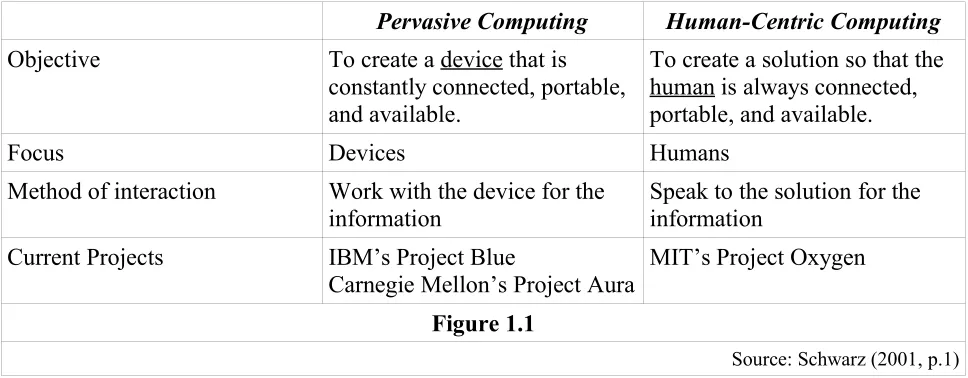
Different organisations have taken different approaches to ubiquitous computing. It has become apparent that there are two strands, shown in Figure 1.1.
Pervasive Computing Human-Centric Computing
Objective To create a device that is
constantly connected, portable, and available.
To create a solution so that the human is always connected, portable, and available.
Focus Devices Humans
Method of interaction Work with the device for the information
Speak to the solution for the information
Current Projects IBM’s Project Blue
[image:11.595.56.540.334.523.2]Carnegie Mellon’s Project Aura MIT’s Project Oxygen
Figure 1.1
Source: Schwarz (2001, p.1)
Schwarz (loc.cit.) suggests that pervasive computing technology is likely to continue to be the focus of the consumer and organisations, since human-centric computers require a shift in the way
computers are conceptualised.
1.5 Examples of Future Devices
1.5.1 Home Appliances
There is mounting evidence that the Internet will be used to support some traditional home appliances such as fridges and washing machines (Pervasive Computing).
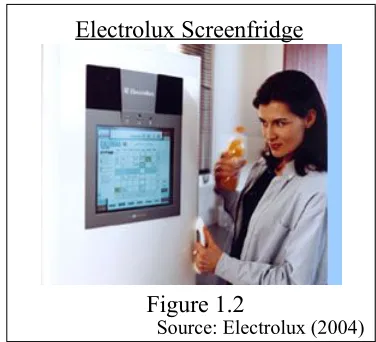
Electrolux (2004) provides details of its prototype “Screenfridge” (see Figure 1.2) that offers the following facilities:
• Internal Communication – allows a user to leave internal messages.
• External Communication – provides e-mail, web and potentially telephone and video conference facilities. Food items could be ordered, and bills paid.
• Food Management – the device could automatically download details on how to prepare food stored in the fridge.
• News, Radio and Home Security – The Screenfridge is equipped with a TV, radio receiver and surveillance system access points.
• Digital Cook book – The Screenfridge also features a powerful cookbook with hundreds of recipes which could potentially be connected to an Internet database (enabling
updates/amendments etc.)
1.5.2 Radio Frequency Identification (RFID)
A significant amount of research suggests that RFID is an extremely promising technology. It is concerned with small devices that are able to broadcast wireless signals. According to Hornby (1999, p.3), the devices consist of a silicon chip that is “bonded” onto an aluminium antenna. They are cheap and small enough to be disposable, and can be attached to inanimate objects for
identification purposes.
Foroohar (2004) states that some retail stores are beginning to use them as advanced bar codes on individual products (within the store) and batches of products (during product transit). This technology essentially reduces the staffing overhead required to identify items, because a scanner isn’t required to be physically placed next to each item. The wireless transmissions enable
[image:12.595.196.384.350.521.2]“hidden”items to be identified (e.g. items within a box). If adopted, this technology could enable shoppers to place items into a shopping bag, leave the store and provoke automated systems to take care of the bill (known as mobile-commerce or m-commerce).
Figure 1.2 Electrolux Screenfridge
Whilst this initial use may seem rather mundane, it must be noted that this technology has the potential to have a significant impact on Internet systems. For example, this system could be incorporated with the Screenfridge listed above, making it possible for the fridge to detect what items are within (and possibly in nearby cupboards), and could automatically connect onto an Internet database to determine the recipes that the user can follow with the available items. 1.5.3 Mobile Communication Devices
Mobile communication companies have largely concluded that there will be three broad categories of mobile communicators. Mitra (1997) identifies the following categories and their perceived associated technologies:
• Communicator Voice, Data, Fax Smart Messaging pJAVA
• Smart Phone Voice
Smart Messaging eJAVA
• Cellular Phone Voice
Smart Messaging
It should be noted that Mitra (1997) is a publication by Sun Microsystems, the proprietors of Java. However, current trends do suggest that Java will play an important part in future systems because it provides a cross platform programming standard (although
not currently open source). One example of its success is the amount of Java mobile phone games from companies such as MyPhoneGames.co.uk (2004).
It is evident that the mobile devices illustrate different degrees of convergent technology. The most extreme is the Communicator that fully combines PDA and mobile phone systems. This device has the potential to be fully integrated with Internet systems, whilst the Cellular Phone omits this functionality and provides similar features to current mobile phones.
This functionality has largely been achieved by the mobile communication companies. For example, Hutchison 3G UK Limited offer a number of facilities which include video calling (in addition to voice calling), location services, multimedia messaging, e-mail/fax services, entertainment (games, movie clips, sport videos, horoscopes etc.), news and finance data repositories, travel information, are examples of the many services provided (Hutchison (2004)). These are available on a range of mobile handsets which can be categorised in accordance with Mitra (1997).
Figure 1.3 OQO model 01 - uPC
However, there appears to be some evidence which suggests there is demand for traditional PC functionality on PDA-sized mobile device which could converge with mobile phone technology. 4G.co.uk (2004) state that mobile phone operators “have demanded products that will offer PC capabilities in a PDA form factor”.
Figure 1.3 provides an illustration of the OQO model 01 ultra personal computer (uPC). This device provides a fully-functional Windows XP computer that is merely 4.9 inches long, 9 inches wide, 0.34 inches thin, and weighs only 14 ounces. Zucker (2004, p.16) states that he believes the
principle usage of the product will be as a primary desktop computer, capable of connecting to fully sized external peripherals, such as keyboard, monitor, and disk drives. We note that Zucker (2004)
does not discuss the use of this device with telecommunications.
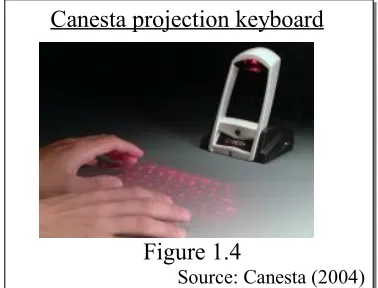
A further interesting and related technology is the development of projection keyboards. Canesta (2004) claim to offer “the world’s first projection keyboard capable of being fully integrated by OEMs into smart phones, cell phones, PDAs, or other mobile or wireless devices”. This device is capable of projecting the image of a full-sized keyboard onto a convenient flat surface
between the device and the user, such as a tabletop, and enables a user to press virtual buttons. See Figure 1.4. It has been evident from general reading that the categories that Mitra (1997) described are well established. However,
the next generation of mobile device is very difficult to predict due to the number of constraints associated with this technology. In spite of this, it is clear that many companies are actively involved in overcoming usability and functionality constraints to provide the user with increased ability.
1.5.4 Sensors
The word ‘sensor’ covers a vast range of devices. Indeed, all of the devices discussed so far can be considered sensors. However, there are a significant number of authors that predict a “sensor boom” where a vast number of tiny devices, such as thermostats, lighting controls, environmental sensors, and medical monitors are implemented. Hardy (2004) states that networks consisting of these automated devices will be capable of generating tremendous amounts of information, allowing scientists to discover patterns that provide insight into “how the world works”.
Low Power Sensors
ZigBee Alliance (2004a) describe themselves as “an association of companies working together to enable reliable, cost-effective, low-power, wirelessly networked, monitoring and control products based on an open global standard”. The consortium consists of leading semiconductor manufacturers, technology providers, OEMs, and end users that all have a shared interest in this technology. Brands include: Honeywell, Invensys, Mitsubishi Electric, Motorola, Philips, and Samsung.
Summary of 802.15.4:
> low-data-rate
[image:14.595.343.532.250.394.2]> low-power-consumption > low-cost applications
Figure 1.4
Canesta projection keyboard
The ZigBee consortium is focused on the IEEE 802.15.4 standard for low-rate Wireless Personal Area Networks (WPANs). This standard must be distinguished from its IEEE 802.15.3a counterpart (also known as ultra wideband or UWB), discussed later in this section.
Zheng and Lee (2004) provide various examples to describe where and how this technology could be used.
1) Life saving – the sensors could be used to detect and shutdown gas leakage.
2) Household Convenience – the sensors could be used to mute the television when the phone rings, or dim a room’s lights when the TV is turned on.
Furthermore, Zheng and Lee describe prioritised household user profiles, where members of a house have an 802.15.4 device and a corresponding private electronic profile capable of adjusting the lights, temperature, music, and TV channel etc.
3) Enhanced GPS – the sensors could be combined with signposts and other displays to provide more detailed and accurate information to motorists. They could provide the traffic status, whether a road is one or two way, and offer relevant accident information. Similarly, this
technology could enhance public transport by providing detailed vehicle location details and the corresponding estimated time of arrival.
However, they are quick to state that these particular applications may not become reality. Furthermore, they state that it may take some time to prove the technology and create a viable market. Figure 1.5 puts ZibBee into context with other wireless technologies.
Figure 1.5
Diagram Illustrating various wireless technologies in terms of bandwidth and range
High Power Sensors
This topic is potentially very large and is a research area of its own. Consequently, for the purposes of this document UWB is the only standard to be discussed.
Ultrawidebandplanet.com (2004) state that UWB is a wireless communications technology capable of transmitting data in short pulses which are spread over a relatively wide section of the
electromagnetic spectrum. There are two major advantages over single frequency transmissions: 1) Data can be transmitted in large bursts (high bandwidth) because the data is spread across several frequencies simultaneously. One’s initial reaction may be that this would interfere with other
communications systems, however because UWB devices only transmit for very short periods, there isn’t any apparent interference with other transmissions.
Consequently
2) Frequencies employed by other systems can be utilised because UWB transmissions merely appear as white noise, thus eliminating the interference concerns.
In spite of these benefits, the implementation of this technology has largely been stifled by the various radio spectrum regulators. These have expressed grave concern about interference with existing radio transmissions, such as those which Global Positioning Systems (GPSs) use.
However, Freescale Semiconductor Inc. claimed, on the 9th August 2004, to be the first company to receive Federal Communications Commission (FCC) certification for its Ultra-Wideband (UWB) communications solution; see Electronic News (2004) for further details.
Other countries, such as UK, have enabled UWB solutions before 2004, see Roke Manor Research (2002, p.11), however the FCC approval is significant for widespread adoption of the technology. Devices that employ this technology are able to transmit data through walls, and communicate at up to one Gigabit per second. This makes it a suitable technology for wireless Local Area Networks (WLANs) and Personal Area Networks (PANS), especially for domestic entertainment, where it could be possible to transmit several videos streams simultaneously; for example, connecting a DVD player or surveillance system to the TV without the need for cables.
Bibliography
Abilene (2003) IPv6, Michigan, Internet2.
Available from: http://abilene.internet2.edu/services/ipv6.html, [Date Accessed: 21 November 2003]
Apple Computer Inc. (2004) Apple-iPod, California, Apple Computer Inc. Available from: http://www.apple.com/ipod/, [Date Accessed: 23 June 2004]
BBC (2004) Europe launch for Apple’s iTunes, London, British Broadcasting Corporation.
Available from: http://news.bbc.co.uk/2/hi/entertainment/3805565.stm, [Date Accessed: 23 June 2004]
Bocij, P., Chaffey, D., Greasley, A., Hickie, S. (2003) Business Information Systems. Technology Development and Management Second edition, London: Pearson Education Limited.
Canesta (2004) Canesta, Inc. -- Products, California, Canesta.
Available from: http://www.canesta.com/products.htm, [Date Accessed: 20 September 2004]
ChildLocate (2004) Childlocate-Mobile Phone Tracking,Guildford UK, ChildLocate. Available from: http://www.childlocate.co.uk/, [Date Accessed: 24 June 2004]
Department of Electrical Engineering and Computer Sciences (1999) Mark D. Weiser Bio, California, Berkeley. Available from: http://www.cs.berkeley.edu/Weiser/bio.shtml, [Date Accessed: 24 June 2004]
Dertouzos, M. L. (2001) Future computing: Human-centric systems, Massachusetts, Accela Communications, Inc. Available from: http://utilitycomputing.itworld.com/4605/CWD010507STO60203/page_1.html, [Date Accessed: 27 June 2004]
Digi-Frame Inc. (2004) ::: Digi-Frame Inc. - Digital Picture Frames :::, New York, Pragmatic Designs Inc. Available from: http://www.digi-frame.com/home.html, [Date Accessed: 24 June 2004]
Dingli, A. (2001) Internet Enabled Devices, Sheffield, The University of Sheffield.
Available from: http://www.dcs.shef.ac.uk/~alexiei/WebSite/University/MultiPLAT/WebDocs/ AdditionalDocs/Internet%20Enabled%20Devices.htm, [Date Accessed: 22 June 2004]
Electrolux (2004) Electrolux – Screenfridge, Stockholm, AB Electrolux.
Available from: http://www.electrolux.com/screenfridge/, [Date Accessed: 23 June 2004]
Electronic News (2004) Electronic News - Freescale Lands First FCC Certification for UWB, Ohio, Reed Elsevier Inc.
Available from: http://www.reed-electronics.com/electronicnews/article/CA443752, [Date Accessed: 25 August 2004]
Electronic News (2002) Is Wider Really Better?, Ohio, Reed Elsevier Inc.
Available from: http://www.reed-electronics.com/electronicnews/article/CA240098, [Date Accessed: 25 August 2004]
Foroohar, R. (2004) The Future of Shopping, New York, Newsweek, Inc.
Available from: http://msnbc.msn.com/id/5093197/site/newsweek/, [Date Accessed: 26 June 2004]
Hardy, Q. (2004) Forbes.com: The Wireless Boom That Won’t Need Us, California, Data Depth Corporation. Available from: http://www.forbes.com/technology/networks/2004/06/09/cz_qh_0609robonet.html
[Date Accessed: 24June 2004]
Other/02BobHeile.pdf, [Date Accessed: 24 August 2004]
Hornby, R. M (1999) RFID Solutions for the express parcel and airline baggage industry,RFID Technology (Ref. No. 1999/123), IEE Colloquium.
Howarth, R. (2004) Personal Communication 23 June 2004.
Hutchison 3G UK Limited (2004) Services: Overview, Hemel Hempstead, Hutchison 3G UK Limited. Available from: http://three.co.uk/explore/services3/detail.omp, [Date Accessed: 19September 2004]
IEEE Computer Society (1998) Virtual Roundtable: Ubiquitous Computing, Washington, Institute of Electrical and Electronics Engineers, Inc.
Available from: http://www.computer.org/internet/v2n2/round1.htm, [Date Accessed: 24June 2004]
Mitra, S. (1997) Personal Communicators of the Future, California, Sun Microsystems Inc.
Available from: http://java.sun.com/javaone/sessions/slides/JC04/JC04_4.ppt.pdf, [Date Accessed: 27 June 2004]
MyPhoneGames.co.uk (2004) Mobile Phone Games, Java Games, Mobile Games, Kentucky, MaximumASP LLC. Available from: http://www.myphonegames.co.uk/, [Date Accessed: 27 June 2004]
Napster (2004) Napster.co.uk, California, Roxio Inc.
Available from: http://napster.co.uk/, [Date Accessed: 24 June 2004]
NTL (2004) ntl: - Simply Better Digital TV -ntl vs Sky, Newport, NTL Group Ltd
Available from: http://www.ntlhome.com/ntl_tv/sky.html, [Date Accessed: 22 June 2004]
NTL (2002) Text on TV, Newport, NTL Internet Ltd.
Available from: http://www.digitalcabletv.co.uk/doc_disp.asp?HTDocID=479, [Date Accessed: 22 June 2004]
PalmOne Inc. (2004) palmOne - Software - Palm Web Browser Pro, California, Palm Inc. Available from: http://www.palmone.com/us/software/palm/ , [Date Accessed: 22 June 2004]
Picsel Technologies (2002) Browser Product Information Sheet Picsel, Glasgow, Picsel Technologies Ltd. Available from: http://www.picsel.com/pdf/picselbrowser.pdf, [Date Accessed: 27 June 2004]
Roke Manor Research (2002) Sensor Technology, Hampshire, Roke Manor Research Limited.
Available from: http://www.roke.co.uk/download/brochures/sensor_technology.pdf, [Date Accessed: 25August 2004]
Schwarz, A. (2001) ISRC Future Technology Topic Brief - Human-Centric Computing, Texas, University of Houston.
Available from: http://www.uhisrc.com/FTB/Humancentric/Humancentric.pdf, [Date Accessed: 25 June 2004]
ScienceDirect (2004) ScienceDirect,Elsevier B.V., Amsterdam.
Available from: http://www.sciencedirect.com/, [Date Accessed: 24 June 2004]
Snowden, O.F.J. (2004) Entity Location Service (ELS) Phase 1 Specification IPv6 (Internet Protocol version 6) Address Translation specific to domain of interest, Southampton: University of Southampton.
Snowden, N. (2004), Personal Communication 22 June 2004.
Tanenbaum, A. S. (2003), Computer Networks Fourth edition, New Jersey: Prentice Hall.
Thompson, K. (2000) Internet Appliances, California, Rogers Communications Inc.
Available from: http://www.kristi.ca/web_appliances/content.html, [Date Accessed: 23 June 2004]
Wideband (UWB), Connecticut, Jupitermedia Corporation.
Available from: http://www.ultrawidebandplanet.com/faq/article, [Date Accessed: 25 August 2004]
Whatis.com (2004) Internet appliance, Massachusetts, TechTarget Inc.
Available from: http://whatis.techtarget.com/definition/0,,sid9_gci914561,00.html, [Date Accessed: 22 June 2004]
Xdrive (2004) Xdrive | Secure Online Storage, California, Xdrive Inc. Available from: http://www.xdrive.com/, [Date Accessed: 24 June 2004]
Weiser, M. (1996a) Open House, California, Xerox PARC.
Available from: http://www.ubiq.com/hypertext/weiser/wholehouse.doc, [Date Accessed: 24 June 2004]
Weiser, M. (1996b) Ubiquitous Computing, California, Xerox PARC.
Available from: http://www.ubiq.com/hypertext/weiser/UbiHome.html, [Date Accessed: 24 June 2004]
Weiser, M. (1996c) IN Department of Electrical Engineering and Computer Sciences(1999)
ZigBee Alliance (2004a) About the Alliance, California, ZigBee Alliance.
Available from: http://www.zigbee.org/about/index.asp , [Date Accessed: 24 August 2004]
Zheng, J. and Lee, M. J. (2004) Will IEEE 802.15.4 make ubiquitous networking a reality?: a discussion on a potential low power, low bit rate standard, IEEE Communications Magazine, 42(6), 140-146.
Zhuge, H. (2002) Clustering Soft-devices in the Semantic Grid, IEEE Computing in Science & Engineering, 4(6), 60-62.
Zucker, D. F. (2004) New Products: OQO POCKET-SIZED PC, IEEE Pervasive Computing, 3(3), 16-17.
4G.co.uk (2004) 4G Mobile PC Capabilities, Newport, 4Gcouk Limited.
Section 2: Analysis of current and planned structure of the Internet
2.1 Physical Structure of the Internet today
Woodcock (2004) states that the “Internet is an internetwork, a global conglomeration of smaller networks able to communicate and transfer information among themselves”. Figure 2.1 provides an overview of the Internet today.
• Clients (users) can connect to their Internet Service Provider (ISP) via a range of means:
• a standard phone line
• Digital Subscriber Line (DSL)
• Cable
• Satellite
A modem is typically required to access a communications medium. They then establish a point of presence (POP).
• The ISP’s regional network consists of interconnected routers, enabling communication between nodes within the ISP. However, the ISP is connected to a “backbone” operator.
• The backbone contains thousands of routers, typically connected by high-bandwidth fibre optics, which provide access to the global Internet. They are operated by the telecom conglomerates such as AT&T, Sprint and BT. See Figure 2.2 for the backbone structure of the UK and the rest of Europe.
1) there are a number of “backbones” throughout the world, which are connected to one another via Network Access Points (NAPs).
2) within the UK there are several backbones including UUNET, BTnet and JANET (UK academic and research network). This is typically the case in other parts of the world, where several companies have their own backbone in a geographical region.
Source: Tanenbaum (2003, p.58)
Physical Structure
Source: Dodge (2004)
UUNET'sUK Backbone in 1999 Graphical Representations of a UK and European backbone
EuroRINGS European Backbone in 2004
• Server farms (machines serving thousands of Web pages per second), are connected directly onto the Internet backbone for performance reasons. Corporate LANs are typically integrated closely with server farms, although smaller organisations may be connected via a standard ISP.
(Explanation summarised from: Tanenbaum (2003, p.58))
2.2 Virtual Structure of the Internet today
The virtual structure is important to the Internet community because essentially it defines the conceptual model of the Internet.
Two fundamental principles of the Internet’s Virtual Structure are, according to the American Registry for Internet Numbers (2004):
• Internet Protocol (IP) Address
The IP address defines the identity of an Internet connected device, and the IP dictates how information passes the many networks, Bisson (2000). IP addresses enable routing of packets (chunks of data) throughout the world, and the IP address ranges are controlled by four organisations:
ARIN – American Registry for Internet Numbers – American Registry
RIPE NCC – Réseaux IP Européens Network Co-ordination Centre – European Registry
APNIC – Asia Pacific Network Information Centre – Asia Pacific Registry
LACNIC – Latin American and Caribbean Network Information Centre – Latin American and Caribbean Registry
However, IP addresses are difficult for humans to recognise and remember. Consequently, a naming system was required to represent the IP addresses. Initially this was a simple text file (hosts.txt) linking names to IP addresses, although this solution wasn’t scalable which gave rise to the DNS (see below).
• Domain Name System (DNS)
DNS is a classification system, devised by Mockapetris (1987), to provide a consistent name space for referring to resources. Further to this, DNS distributes the processing required to translate node names into IP addresses which makes the system scalable.
DNS has given the Internet a logical structure (despite it physically being chaotic) and allows for an orderly and continual growth.
An example of how DNS works:
• Initially, one of the root “.” domain name servers (which know the top level domain names such as .com, .au and .uk etc.) is contacted and returns the IP address of the “.com” DNS server(s).
• The “.com” is then queried and returns the IP address of “.somewhere”.
• “.somewhere” is finally contacted which knows the address of “ns” and returns its IP. The processing and data required for domain IP lookup is distributed between nodes.
2.3 Internet Protocols (Client Level)
Internet protocols are vitally important because they specify the communication standard that Internet devices use to communicate.
It is convention to communicate using a protocol on a protocol specific port, an access means to a computer system. IANA (2004) provide a full list of known ports and their intended service.
Note: a port is merely an access means to a computer system. Alone, they don’t specify the protocol, although there are conventions which should be adhered to, see IANA(2004). For example, port 80 is the standard hypertext transfer protocol (HTTP) access port).
2.3.1 Example specification of Internet Protocols in a standard web-browser.
The following is a valid string for connecting to a web page:
• “http://www.somewhere.com.:80” One can dissect this as:
• “http:” - This informs the web-browser that it is to expect data conforming to the HTTP protocol.
• “//” - The double slash (//) informs the web-browser that the next part is the name of the server.
• “www.somewhere.com.” - this a valid Domain Name to obtain its corresponding IP address.
• “:80” - this informs the web-browser that it is to communicate with the server on port 80. Typically, the default protocol in a web-browser is “http”, which it will (typically) automatically associate with port 80 without the user specifying otherwise. Other protocols are: ftp, gopher, https, telnet, etc.
2.4 The Planned Physical Internet Structure
This is ultimately explained by the increase in Internet user demands. Sullivan (2004) states that one-third of all adult Americans have a broadband connection at home or work, and that broadband growth is especially strong with home users. Home user Internet activities normally include web-browsing, instant messaging, voice over IP telephony, game playing, software updates, and
listening/watching to streaming audio/video. Many of these services have different requirements and are putting an increasing demand on the current physical hardware. Some services require real-time and relatively small bandwidth networks (e.g. Instant messaging), whilst others simply require large amounts of bandwidth (e.g. File downloading).
Further to simply increasing network capacity, the physical network structure of the Internet is changing to accommodate the new and evolving IP services. Cisco Systems (2000) state that organisations are looking for strategies to integrate disparate networking into one single common network infrastructure. Volpi (2004) reiterates this and states that for the past hundred years every time an organisation needed to implement a new application, a new network had to be built.
However, on 24 May 2004 Cisco Systems revealed their new technology based on the fundamental principles that organisations only want (primarily due to cost) one network infrastructure, that will be future proof and compatible with the past. Gofus (2004), for the MCI telecommunications company, states that it is the ability to differentiate service and support a variety of digital media over the IP infrastructure that is vital.
Grubb (2004) provides a demonstration of a 40Gbps system (single CRS-1 nodes) able to support the following services simultaneously:
• run a high-definition live video conference with a MCI representative several miles away,
• simulated 4000 MP3 downloaders (including 5 real users to confirm QoS),
• simulated 100,000-125,000 gamers on-line (including some real users to confirm QoS),
• simulated 2500 IP set-top boxes + 200 televisions displayed as part of the demonstration,
Source: TeleGeography Research (2003) Note: Permission was granted to use image.
International Internet Bandwidth Growth by Region, 2000-2003
• protocol installation to support IP videophones (whilst maintaining ALL network activity – QoS was maintained),
• simulated 1000 videophone conversations + several customer videophone conversations as part of the demonstration to confirm QoS,
• simulated 1,000,000 web-browser users.
It is evident that the above demonstration referred to a specific product, yet it demonstrated that future Internet technology will be required and able to support users with different QoS needs simultaneously across the same communications medium.
Trusted computing (TC) is a further aspect that in the long term may be adopted within the Internet structure. The Trusted Computing Group (2003, p.2) state that “concerns about the security of communications, transactions, and wireless networks are inhibiting realization of benefits associated with pervasive connectivity and electronic commerce”. The group’s plans are to make computing (and therefore the Internet) more secure by working with both hardware and software vendors. The infrastructure could be used to enforce digital rights management (DRM), ensuring users only have access to “legal” software and entertainment and enable authorities to carry out what many describe as “Big Brother” activities. This could split the Internet into two distinguishable structures and categorise users into those prepared to fully accept TC, those that totally reject TC, and those that use both systems (e.g. TC for on-line banking etc. and non-TC for other activities such as movie watching).
An example of a TC failure was the introduction by Intel of unique CPU identifiers. Critics complained that the technology could expose computer users to privacy intrusions. This prompted such strong public opposition, with many customers putting a boycott on Intel products, that Intel swiftly disabled this functionality, citing there must be an acceptable balance between privacy and
security. Source: O’Harrow, R. and Corcoran, E. (1999)
It is evident from the convergence of networks, TC and the new wireless standards (e.g. 802.11 and 802.16), that the entire Internet is becoming more mature and wider reaching, essentially laying the foundations for the evolving software applications.
2.5 Planned Virtual Structure
The planned virtual structure of the Internet appears to be uncertain. IPv6 (Internet Protocol version 6) was planned to be the successor to IPv4 for a number of reasons, summarised from: Tanenbaum (2003, p.472):
• It provides a very large address space (2128 addresses), thus enabling more devices to connect to
the Internet simultaneously;
• is more efficient than IPv4 (the protocol structure and routing tables are simplified);
• and it provides better support for QoS.
Note: features of IPv6 which have since been adopted in IPv4 are ignored and only the most significant reasons have been listed.
to remain reachable whilst roaming in the IPv6 Internet and can be likened to cellular phone roaming, where a mobile phone is reachable (by the same phone number) in different locations. However, Francis (2003, p.1) sheds doubt over the entire IPv6 concept and states that IPv6 may never be widely adopted. He was the founder of Network Address Translation (NAT) which he created in 1993. At that time, he thought it was a temporary solution giving organisations extra time before the IPv4 addresses were depleted, but he now sees it as part of a technology that relieves the need for IPv6.
He cites: “If the commercial world hasn’t accepted IPv6 so far, what will make it do so in the future?... Nothing...NAT provides enough addresses for each human on the planet to have an endless number of private connections and about 250 simultaneous active ‘global’ connections.”
His proposed alternative to IPv6, NUTSS (see below), accomplishes the same end result, although in a far more complex way:
• NAT effectively extends the IP address space.
• URIs (Uniform Resource Identifier) restore end-to-end stable addressing; these look similar to e-mail addresses, such as [email protected] or [email protected].
• Tunnels allow protocols like IPsec and mobile IP (and even TCP) to run through NATs over UDP (Universal Datagram Protocol).
• SIP (Session Initiation Protocol) routes messages with URIs, end-to-end, and lets hosts signal their intentions to each other in real time.
• STUN (simple traversal of UDP through NATs) tells hosts how to establish direct IP connectivity through NATs.
However, in spite of the Francis’ view, the general consensus is that IPv6 will replace IPv4. Koprowski (2003) states that the governments of Japan, European Union, and United States have mandated that, in the near future, network devices must support IPv6.
Bibliography
Austein, R. (2002) Tradeoffs in Domain Name System (DNS) Support for Internet Protocol version 6 (IPv6), Virginia, The Internet Society.
Available from: ftp://ftp.rfc-editor.org/in-notes/rfc3364.txt, [Date Accessed: 2 July 2004]
American Registry for Internet Numbers (2004) Registration Services,
Available from: http://www.arin.net/registration/index.html, [Date Accessed: 30June 2004]
Bechtold, S. (2003) The Present and Future of Digital Rights Management – Musings on Emerging Legal Problems, Tübingen, Eberhard Karls Universität Tübingen.
Available from: http://www.jura.uni-tuebingen.de/bechtold/pub/2003/Future_DRM.pdf, [Date Accessed: 2 July 2004]
Bisson, S. (2000) How the Internet works: IP, Bath, PC Plus.
Available from: http://www.pcplus.co.uk/tutorials/default.asp?pagetypeid=2&articleid=4430&subsectionid=376,
[Date Accessed: 30 June 2004]
Cisco Carrier Routing System Enabling Next-Gen IP Networks (2004) Webcast, Conducted by Cisco Systems. California: Cisco Technology Inc.
Available from: http://cisconews.feedroom.com/index.jsp?fr_story=6c7d28661aeeafa22a0f134f0a35d8eeed487c8b,
[Date Accessed: 2 July 2004]
Cisco Systems (2000) Technical Considerations for Converging Data, Voice, and Video Networks, California, Cisco Technology Inc.
Available from: http://www.cisco.com/warp/public/cc/so/neso/vvda/avvid/tecon_wp.htm, [Date Accessed: 2 July 2004]
Cisco Systems (2004a) Cisco - Multiservice Networking, California, Cisco Technology Inc.
Available from: http://www.cisco.com/warp/public/cc/so/neso/vvda/avvid/, [Date Accessed: 2 July 2004]
Deering, S. and Hinden, R. (1998) Internet Protocol, Version 6 (IPv6) Specification, Virginia, The Internet Society. Available from: http://www.faqs.org/rfcs/rfc2460.html, [Date Accessed: 1 July 2004]
Dodge, M. (2004) An Atlas of Cyberspaces- ISP Backbone Maps,
Available from: http://www.cybergeography.org/atlas/isp_maps.html , [Date Accessed: 29 June 2004]
EuroRINGS International Services (2004) KPN – EuroRings network, The Netherlands, KPN International. Available from: http://www.kpn.com/kpn/show/id=397137/sc=3b4042, [Date Accessed: 29 June 2004]
Fairlie, R. (2003) In matters of privacy, whom can you trust?, California, CNET Networks Inc. Available from: http://reviews.cnet.com/4520-3000_7-1009386-1.html, [Date Accessed: 2 July 2004]
FAQS.ORG (2004) RFC By Category, Illinois, FAQS.ORG.
Available from: http://www.faqs.org/rfcs/np.html, [Date Accessed: 30 June 2004]
Francis, P. (2003) Is the Internet Going NUTSS?, IEEE Internet Computing, 7 (6), 94-96.
Freesoft (1997) HTTP Protocol Overview, Maryland, Freesoft.
Available from: http://www.freesoft.org/CIE/Topics/102.htm, [Date Accessed: 2 July 2004]
Graham, I. (1998) URLs for HTTP Servers, Toronto, University of Toronto.
Gofus, N. (2004) IN One Network for the Future (2004).
Grubb, J. (2004) IN Cisco Carrier Routing System Enabling Next-Gen IP Networks (2004).
Howarthson, T. (2004) BT to save £1bn a year with IP network, London, Situation Publishing.
Available from: http://www.theregister.co.uk/2004/06/09/bt_ip_network/, [Date Accessed: 2 July 2004]
IANA (2004) Port Numbers, California, The Internet Assigned Numbers Authority.
Available from: http://www.iana.org/assignments/port-numbers, [Date Accessed: 30June 2004]
Interoute (2004) Glossary, Interoute Telecommunications (UK) Ltd, London.
Available from: http://www.interoute.com/glossary.html, [Date Accessed: 28 June 2004]
Koprowski, G. J. (2003) Internet Protocol for the Future: IPv6 Poised for Adoption, California, ECT News Network Inc.
Available from: http://www.technewsworld.com/story/31230.html, [Date Accessed: 2 July 2004]
Mockapetris, P. (1987) DOMAIN NAMES - CONCEPTS AND FACILITIES, Virginia, The Internet Society. Available from: ftp://ftp.rfc-editor.org/in-notes/rfc1034.txt, [Date Accessed: 30 June 2004]
O’Harrow, R. and Corcoran, E. (1999) Intel Drops Plans to Activate Chip IDs, Washington DC, The Washington Post Company.
Available from: http://www.washingtonpost.com/wp-srv/washtech/daily/jan99/intel26.htm , [Date Accessed: 2 July 2004]
One Network for the Future (2004) Webcast. Conducted by Cisco Systems. California: Cisco Technology Inc. Available from:
http://cisconews.feedroom.com/index.jsp?fr_story=5414aec62185948a1aed2074b896b407da185b2b, [Date Accessed: 2 July 2004]
Sullivan, A. (2004) Net users demand wider broadband, New Delhi, Cyber India Online Ltd
Available from: http://www.ciol.com/content/search/showarticle1.asp?artid=56536, [Date Accessed: 2 July 2004]
Tanenbaum, A. S. (2003) Computer Networks Fourth edition, New Jersey: Prentice Hall.
TeleGeography Research (2003) Executive Summary: Global Internet Geography, Exeter, PriMetrica Inc. Available from: http://www.telegeography.com/products/gig/exec_sum.php, [Date Accessed: 2 July 2004]
Trusted Computing Group (2003) Truster Computing Group Backgrounder, Oregon, Trusted Computing Group. Available from: https://www.trustedcomputinggroup.org/downloads/TCG_Backgrounder.pdf, [Date Accessed: 2 July 2004]
Valente, O. (2004) IN One Network for the Future (2004).
Volpi, M. (2004) IN One Network for the Future (2004).
Section 3: Investigation of the Internet as an Object Oriented
distributed database
3.1 Definition of an Object Oriented (OO) database
An OO database provides the persistent storage of objects and facilitates all the aspects of the OO data model (discussed below).
Note: an OO database inherits all the features of a standard database such as Data Definition, Data Maintenance, Data Retrieval and Data Control. See Beynon-Davies (2004, p.36).
Thomson Learning (2004) confirms this and states that an OO Database “keeps track of objects, entities that contain both data and the action that can be taken on the data”. They further note that this facilitates the storage of non-traditional data (i.e. non text) such as photographs, video, and audio clips.
3.1.1 Objects
Beynon-Davis (2004, p.116) defines an object as a package of data and procedures, where data are contained by an object’s attributes and the procedures (actions that can be performed) defined by an object’s methods.
Figure 3.1 provides a visual representation of an object. The single and double headed arrows represent one-way and two-way communication respectively (i.e. Procedures can communicate without being invoked).
Figure 3.2 provides an overview of inter-object communication. Sun Microsystems (2004a) state that objects interact and communicate by sending messages to each other.
Graphical Representation of an Object
Figure 3.1 Data
Methods
Provided that permission is granted, data (attributes) can be accessed directly by another object
Methods can be invoked and provoked by environmental changes. (e.g. It is possible to directly action a method,
Classes are often referred to as the blueprints that define objects. They provide the schema which defines an object.
E.g. The class ‘person’ can be instantiated to create objects ‘Adam’ and ‘Emma’, of type ‘person’, which inherit the properties (attributes and methods) from the ‘person’ class.
Note: The terms Objects and Classes are used interchangeably. 3.1.2 Abstraction mechanisms
The object-oriented data model consists of two abstraction mechanisms:
Note:
1) Solid lines have been used to show the direction of single messages. 2) Grey lines show the possible communication directions.
Graphical Representation of communication between Objects
Figure 3.2
Object B Object C
Message C to B
Object A Message
A to B
[Parent Child Relationship]
Name ________________________________________________________________
Sex ________________________________________________________________
DOB _________________________
startWalking()
Adam ________________________________________________________________
Male ________________________________________________________________
13/03/1981 _________________________
startWalking()
Emma ________________________________________________________________
Female ________________________________________________________________
03/07/1983 _________________________
• Generalisation
A class is able to be a sub-class of another object class, e.g. it is possible to define Dog and Cat as sub-classes of the Animal class.
• Aggregation
A class can consist of lower-level classes. E.g. a robot may consist of ‘head’, ‘arm’, ‘torso’ and ‘leg’ classes.
3.1.3 Inheritance
There are two types of inheritance:
• Structural inheritance
A sub-class inherits the attributes of a superclass (also known as its parent-class). E.g. Suppose the Animal class has attributes ‘Size’ and ‘Colour’, then the sub-class Dog inherits those attributes.
• Behavioural inheritance
In a similar fashion to attributes, a sub-class is able to inherit methods (actions) from its superclass. E.g. The Animal class may consist of a method ‘eat()’; this would be inherited by sub-classes such as Dog.
3.2 The World Wide Web as an OO System
It has long been the goal of the W3C to exploit the benefits of Object Orientation in the context of the WWW. They have developed a number of OO systems including Object-Oriented XML 2.0, Web Services Architecture*, OWL Web Ontology Language and SOAP†, primarily to aid computational systems to extract information. However, it has been difficult to locate W3C work describing the application of OO systems and categorisation techniques for altering the structure and conceptual model of the WWW. This is possibly because the W3C see that the future of the WWW lies in computation agents that are able to seamlessly traverse the semantic web to retrieve the required data. This area has long been the focus of research and applications for well understood reasons. Consequently, this research will investigate alternative approaches with an emphasis on human collaboration, computer collaboration and distributed computing.
* “A Web service is a software system designed to support interoperable machine-to-machine interaction over a network. It has an interface described in a machine-processable format (specifically WSDL). Other systems interact with the Web service in a manner prescribed by its description using SOAP messages, typically conveyed using HTTP with an XML serialization in conjunction with other Web-related standards.” W3C (2004b)
GRID computing* is a form of parallel computing that can encompass some of the OO concepts.
A Grid can be defined as the combined computing resources (e.g. processing, storage, bandwidth) that as a whole can be utilised. This can provide immense computational power as demonstrated by projects such as Oxford University’s “Screensaver Lifesaver” which utilises GRID technology for cancer research, see University of Oxford (2004).
Summarised from: Globus Alliance (2004) and Pham et al. (2004, p.3)
Pham et al. (2004) describe “The Integration of Peer-to-peer and the Grid to Support Scientific Collaboration”. They state that scientific communities can benefit from the collaboration of resources through both peer-to-peer and Grid technologies.
They propose an architecture of two layers:
• Computation layer: a placeholder for computational resources, i.e. Data storage, CPU Processing, database, etc.
• Collaboration layer: The collaborative environment for the front end user, using a community approach for delivering and sharing services, and other types of resource.
An example to help illustrate this concept is shown below.
A chemist in Combustion Chemistry has found a new way to calculate a parameter for experimental data. He has implemented his method in a software program on the Grid. In the Grid environment, the software program is exposed as a service. Now he wants to share his new way of calculation with his colleagues.
Through the collaboration layer, he publishes an advertisement about his new services to other peer members. If a member is interested in the service, that member can contact the chemist for
authorisation. Then the member can get access to the Grid and execute the service.
Source: Pham et al. (2004, p.9) The work of Pham et al. (2004) links the integration of peer-to-peer and the Grid with the Semantic Grid, see Figure 3.3.
The diagram shows two perspectives; Part A illustrates different peer-to-peer communities (collections of nodes) which have formed different ontologies, see part B.
*“Grids are persistent environments that enable software applications to integrate instruments, displays, computational and information resources that are managed by diverse organizations in widespread locations.” Globus Alliance (2004)
Graphical Representation of a Peer-to-peer Community forming a semantic Grid
A Key
Node:
Community:
Identification of sub-community: (Various colours)
Ontology (Communities) at different levels and their corresponding nodes
[image:33.595.57.540.100.727.2]Figure 3.3
All diagrams have been adapted from: Pham et al. (2004, p.11 - 14)
Ontology
Ontology
Ontology
Ontology
Ontology Global Community
Level 1
Level 2
One criticism of Pham et al. (2004) is that they don’t illustrate their concept particularly well in terms of OO. Fortunately their work can be extended relatively easily to accommodate OO, see the basic example in Figure 3.4, illustrating the “Book Repository” super object, the category objects and the individual book nodes. Their availability can be likened to e-Books available on the WWW.
Graphical Representation of a hierarchical, peer-to-peer system to form objects
Figure 3.4
Book Repository
Science
Travel
Romance
Fantasy
Node B
Node C
The Borrowers
Key
Objects/Groups/Ontologies
Implementation
Node Lookup Services (NLSs) <-- It is more likely that this service would run on multiple nodes.
This is discussed in later sections. NLS Root Domain Server
Nodes
Interface (only shown on the fantasy object):
Note:
* The ontologies (Objects) have attributes, methods and interface codecs. * The objects could theoretically be public, private or protected.
Furthermore, they (and the nodes) can be seen as products or services. * A NLS is aware of the address for each internal object's NLS
(similar to the current Domain Name System),
* The object is supported by the combined computational power each node within provides (CPU cycles, storage space etc.) i.e. they form a Grid.
Further explanation is required to show how this example is related to the work provided by Pham et al. (2004). With reference to the WWW, the “community” that Pham et al. describe, are the servers that provide the web-pages (web-servers). It is these that provide the computational
resources required to support the objects. Together they form a Grid creating an ontology, as shown in Figure 3.3. The nodes within the object are related by the subject that they are concerned with. It is evident that the objects (in this methodology) could easily incorporate the abstraction and
Bibliography
Beynon-Davies P. (2004). Database Systems Third edition, Basingstoke: Palgrave.
Chuanfeng, C. and Zengzhi, L. (2000) Internet Object-oriented Information Model, Technology of Object-Oriented Languages and Systems, International Conference, 285-290.
Connolly, D. and Soley, R. M. (1996) Joint W3C/OMG Workshop on Distributed Objects and Mobile Code,
Massachusetts, Massachusetts Institute of Technology.
Available from: http://www.w3.org/OOP/9606_Workshop/, [Date Accessed: 26 August 2004]
E-Science (2004) GGF Semantic Grid Research Group (SEM-RG), Southampton, University of Southampton. Available from: http://www.semanticgrid.org/GGF/ggf11/, [Date Accessed: 17 July 2004]
Francis, P. (2003) Is the Internet Going NUTSS?, IEEE Internet Computing, 7 (6), 94-96.
Globus Alliance (2004) The Globus Alliance, California, The Globus Project. Available from: http://www.globus.org, [Date Accessed: 17 July 2004]
Nilsson, J. (2002) A Pure Object-oriented Domain Model by a DB Guy, Part 1, Connecticut, Jupitermedia Corporation.
Available from: http://www.devx.com/vb2themax/Article/19892/0/page/1, [Date Accessed: 15 July 2004]
Pham, T. V, Lau, L. M., Dew, P. M. (2004) The Integration of Peer-to-peer and the Grid to Support Scientific Collaboration, Leeds, University of Leeds.
Available from:http://www.semanticgrid.org/GGF/ggf11/GGF11-final.ppt, [Date Accessed: 17 July 2004]
Sun Microsystems (2004a) What Is a Message?, California, Sun Microsystems Inc.
Available from: http://java.sun.com/docs/books/tutorial/java/concepts/message.html , [Date Accessed: 15 July 2004]
Sun Microsystems (2004b) Grid Adoption Trends, California, Sun Microsystems Inc.
Available from: http://www.sun.com/aboutsun/media/presskits/sgeee/gat.gif, [Date Accessed: 16 July 2004]
Thomson Learning(2004) O Glossary page, Kentucky, Thomson Corporation.
Available from: http://www.scsite.com/dc/main_glossary_o.htm, [Date Accessed: 15 July 2004]
University of Oxford (2004) Screensaver Lifesaver - University of Oxford, Oxford, University of Oxford. Available from: http://www.chem.ox.ac.uk/curecancer.html, [Date Accessed: 17 July 2004]
W3C (1999a) WWW and OO: Objects on the web, Massachusetts, Massachusetts Institute of Technology. Available from: http://www.w3.org/Consortium/Prospectus/OO.html [Date Accessed: 26 August 2004]
W3C (1999b) Schema for Object-Oriented XML 2.0, Massachusetts, Massachusetts Institute of Technology. Available from: http://www.w3.org/TR/NOTE-SOX/, [Date Accessed: 26 August 2004]
W3C (2003a) Web Services Architecture, Massachusetts, Massachusetts Institute of Technology.
Available from: http://www.w3.org/TR/2004/NOTE-ws-arch-20040211/, [Date Accessed: 26 August 2004]
W3C (2003b) SOAP Version 1.2 Part 1: Messaging Framework, Massachusetts, Massachusetts Institute of Technology.
Available from: http://www.w3.org/TR/2003/REC-soap12-part1-20030624/, [Date Accessed: 26 August 2004]
W3C (2004b) Web Services Glossary, Massachusetts, Massachusetts Institute of Technology.
Available from: http://www.w3.org/TR/2004/NOTE-ws-gloss-20040211/, [Date Accessed: 26 August 2004]
Section 4: Investigation of the Realm concept with respect to the
conceptual structure of the Internet
4.1 Realm Introduction
Section 3 provided a grounding and introduction to OO and the WWW. This concept, however, is not limited to the WWW as it can be applied to many aspects of the Internet and other
telecommunications systems. The application of OO in this way is known throughout this documentation as Realms, and each group is known as a realm. We provide the following definition:
A realm may be defined as the interconnection (cluster) of devices to form an ontology based on semantic reasoning. The realm concept is an abstraction method to allow the identification of nodes logically rather than arbitrarily.
For example, a fishing web page can be located in a public fishing realm, where all fishing related material can be located. A node in this context is NOT necessarily a computer, but can be a computational resource available at a specific location (e.g. Web-page or streaming video). The purpose of the realm concept is to enhance the virtual structure and NOT necessarily physical performance, although the latter may be a by-product in some instances. Further to this, a realm specifies the communication methods and supports inheritance and generalisation mechanisms. This could be used to promote the existence of “loosely coupled”* systems.
Two important properties of the Realm are: logical existence and standardised interface. It is important to make a distinction between information and interface web-pages. The former merely presents information in a similar way to paper whereas the latter provides an interface to access an abstract system, e.g. a Short Message Service (SMS) sending web-page is an interface web-page as it provides an interface to an SMS sending system.
It is evident from the W3C publications that their work covers a diverse range of topics. It is possible that the W3C will develop an information structure that extends the WWW’s scope, suppressing any of the “realm” benefits.
4.2 Realms and the Structure of the Internet
The Realms concept could dramatically enhance the conceptual model that users have of the Internet. It could provide an interface that enable users to seamlessly locate nodes based on meaning, and interact with nodes in the most appropriate way. Realms need not replace any of the current systems, but rather act as an enhancement, see Figure 4.1.
This means that (initially at least), the Internet structure would NOT be altered, i.e. once a node has been located, from within a Realm, the Domain Name/IP/URL is established and contact can be made in the standard way. However, in the future, it may be possible, using Grid technology