AN EMPIRICAL EVALUATION OF AUTOMATED THEOREM PROVERS IN SOFTWARE CERTIFICATION
EWEN DENNEY RIACS/NASA Ames Research Center M/S 269-2, Moffett Field, California 94035, USA
BERND FISCHER RIACS/NASA Ames Research Center M/S 269-2, Moffett Field, California 94035, USA
JOHANN SCHUMANN RIACS/NASA Ames Research Center M/S 269-2, Moffett Field, California 94035, USA
Received ()
We describe a system for the automated certification of safety properties of NASA software. The system uses Hoare-style program verification technology to generate proof obligations which are then processed by an automated first-order theorem prover (ATP). We discuss the unique requirements this application places on the ATPs, focusing on automation, proof checking, traceability, and usability, and describe the resulting system architecture, including a certification browser that maintains and displays links between obligations and source code locations. For full automation, the obligations must be aggressively preprocessed and simplified, and we demonstrate how the individual simplification stages, which are implemented by rewriting, influence the ability of the ATPs to solve the proof tasks. Our results are based on 13 comprehensive certification experiments that lead to 366 top-level safety obligations and ultimately to more than 25,000 proof tasks which have been used to determine the suitability of the high-performance provers DCTP, E-Setheo, E, Gandalf, Otter, Setheo, Spass, and Vampire, and our associated infrastructure. The proofs found by Otter have been checked by Ivy.
Keywords: software certification, automated theorem proving, program synthesis, proof checking, traceability, verification condition generator, Hoare logic
1. Introduction
Software certification aims to show that the software in question achieves a certain level of quality, safety, or security. Its result is a certificate, i.e., independently checkable evi-dence of the properties claimed. Certification approaches vary widely, ranging from code reviews to full formal verification, but the highest degree of confidence is achieved with ap-proaches that are based on formal methods and use logic and theorem proving to construct the certificates.
We have developed a certification approach which uses Hoare-style techniques to demonstrate the safety of aerospace software which has been automatically generated from high-level specifications. Our core idea is to extend the code generator so that it simultane-ously generates code and the detailed annotations, e.g., loop invariants, that enable a fully
automated safety proof. A verification condition generator (VCG) processes the annotated code and produces a set of safety obligations, which are provable if and only if the code is safe. An automated theorem prover (ATP) then discharges these obligations and the proofs, which can be verified by an independent proof checker, serve as certificates. This approach largely decouples code generation and certification and is thus more scalable than, e.g., ver-ifying the generator or generating code and complete safety proofs in parallel. The ultimate goal of our work is to indirectly increase trust in the code generator by providing explicit evidence of the safety of the generated programs.
In this paper, we evaluate the extent to which the current generation of ATPs is capa-ble of supporting the formal certification of software. In our view, this covers three main aspects. First, full automation is crucial since the practicability of our approach depends on it. Second, the ability to generate proof objects and to carry out proof checking is es-sential to create explicit certificates. Third, the extent to which a prover supports various forms of traceability has a significant bearing on the ability of an ATP to create meaningful certificates.
Program certification is a demanding application for ATPs because the number of proof obligations is potentially very large and program verification is generally a hard problem domain. However, in our case there are several factors which make a successful ATP ap-plication possible. First, we certify separate aspects of safety and not full functional cor-rectness. This separation of concerns allows us to show non-trivial properties like matrix symmetry but results in more tractable obligations than are required for full functional cor-rectness. Second, the extensions of the code generator are specific to the safety properties to be certified and to the algorithms used in the generated programs. This allows us to fine-tune the annotations which, in turn, also results in more tractable obligations. Third, we take advantage of domain-specific knowledge to aggressively simplify the obligations before they are handed over to the prover.
In this paper, we evaluate three hypotheses. The first hypothesis is that the current gen-eration of high-performance ATPs is—in principle—already powerful enough for practical application in program certification. The second hypothesis is that ATPs can still not be considered entirely as black boxes but require careful integration with the application at hand; in particular, the application must carefully preprocess the proof tasks to make them more tractable. The final hypothesis is that proof checkers for first-order logic have not yet reached the same level of maturity as the ATPs themselves, despite the fact that proof checking is, prima facie, conceptually simpler than proof finding.
hard obligations remain, and a successful certification (i.e., proof of all obligations) can be achieved only after even more tuning. Section 5 then discusses the proof checking experi-ments, and Section 6 looks at some traceability issues and describes a graphical interface. Finally, Section 7 draws some conclusions.
Conceptually, this paper continues work described before1,2but the actual implemen-tation of the certification system has been completely revised and substantially extended. We have expanded the range of both algorithms and safety properties which can be cer-tified; in particular, our approach is now fully integrated with the AUTOFILTERsystem3 as well as with the AUTOBAYESsystem4and the certification process is now completely automated. We have also implemented a new generic VCG which can be customized for a given safety policy and which directly processes the internal code representation instead of Modula-2 as in the previous version. All these improvements and extensions to the un-derlying framework result in a substantially larger experimental basis than reported before. Preliminary versions of the current paper describing smaller experimental evaluations have been published at ESFOR 20045and IJCAR 2004.6
Related Work Program verification is a popular application domain for theorem provers;
we mention only a few systems here. KIV7,8 is an interactive verification environment which can use different ATPs but relies heavily on term rewriting and user guidance. Sunrise9is a fully automatic system that uses custom-designed tactics in HOL to discharge the obligations. The Bali10 project uses Isabelle to formalize the type system and opera-tional semantics of Java as well as parts of the Java Virtual machine. This approach can be used to perform bytecode verification and to prove type safety. ESC/Java11is an automatic verification system but relies on the user to provide additional information on the program, e.g., loop invariants. Houdini12is an automatic annotation assistant developed for ESC/Java which guesses invariants, but a significant amount of user interaction remains. The LOOP project13has continued this work with ESC/Java2. It is centered on the LOOP compiler,14 which contains a VCG for Java code which has been annotated with the Java mark-up lan-guage JML,15and produces proof obligations for the semi-automatic higher-order theorem prover PVS. As with ESC/Java, however, the need for extensive annotations remains a sub-stantial drawback. Also, since the semantics of the language has been formalized using a so-called shallow embedding (where program terms are represented by their semantic de-notation in the theorem prover, rather than as an equivalent syntactic datatype), the proof obligations tend to be unwieldy and quickly overwhelm the theorem prover.
Our approach is also conceptually related to proof-carrying code (PCC).16However, PCC works on the machine-code level instead of the source-code level (as we do) and concentrates on very simple safety policies (mainly array-bounds safety) which leads to comparatively simple proof obligations. Hence, PCC is complementary to our approach, and a certifying compiler17could be used to ensure that the final compilation step does not compromise the demonstrated safety policies. PCC also spawned an entire cottage industry of proof checkers18; however, these tend to use various higher-order logics and are thus not applicable for our purposes.
our Hoare-style formulation of safety policies and so they can be handled by first-order ATPs. Over the years, a large number of high-performance provers have been developed, using many different calculi and implementation techniques. A systematic evaluation of the performance of the leading ATPs is carried out annually in the CASC theorem prover competition19,20 using the TPTP21,22 benchmark library of problems drawn from vari-ous domains, including program verification. One aim of these competitions is to evalu-ate prover performance over a broad range of examples. However, the library tends to be dominated by problems from more mathematical domains, such as algebra, group theory, geometry, planning, and puzzles. A detailed comparison of automated provers for proof obligations arising in the software reuse domain is described in (Ref. 23, 24). Here, the first-order proof obligations generated by matching components from a software library to VDM specifications are processed by earlier versions of the provers Gandalf, Otter, Spass, and Setheo.
Other approaches to program verification based on static analysis25(which trades pre-cision for scalability) or model checking26 (which typically looks at a different class of problems, such as concurrency errors) are complementary to our use of theorem proving. However, their biggest shortcoming for our purposes is that they are unable to provide explicit evidence of correctness (such as proofs).
2. System Architecture
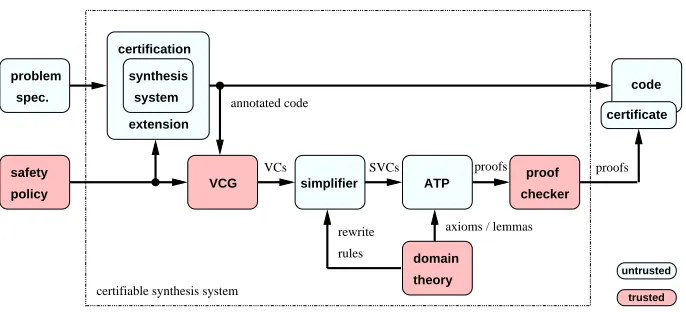
Our certification tool is built as an extension to the AUTOBAYES4and AUTOFILTER3 pro-gram synthesis systems. AUTOBAYES works in the statistical data analysis domain and generates parameter learning programs while AUTOFILTERgenerates state estimation code based on variants of the Kalman filter algorithm. Figure 1 gives an overview of the overall system architecture. The individual components are described in more detail in the sub-sequent sections. Both underlying synthesis systems take as input a high-level problem specification and generate code that implements the specification. This process is based on the repeated application of schemas. Schemas are generic algorithms which are instantiated in a problem-specific way after their applicability conditions have been proven to hold for the given problem specification. The systems first generate C++-style intermediate code which is then compiled down into any of the different supported languages and runtime environments.
For the certification tool, we extended the schemas such that the synthesis systems gen-erate code that is marked up with annotations relevant to the chosen safety policy. These annotations encode local safety information which is then propagated throughout the pro-gram. In the next stage, an analysis is carried out by a VCG applying rules from the safety policy to generate verification conditions which are then simplified by a rewrite system. Finally, certification is achieved by sending these simplified verification conditions to an automated theorem prover and checking the resulting proofs.
compo-code
theory
VCG simplifier ATP
checker proof
domain
annotated code
trusted untrusted
certifiable synthesis system
system synthesis
certificate
proofs SVCs
VCs
axioms / lemmas
certification
extension
proofs
rewrite
rules
spec. problem
[image:5.612.141.484.168.324.2]safety policy
Fig. 1. Certification system architecture.
nents do not affect soundness because their results can be checked by trusted components. In particular, the assurance provided by our certification system does not depend on the correctness of the two largest subsystems: the synthesizer, and the theorem prover; instead, we need only trust the safety policy, the VCG, and the proof checker. This lets us adopt an approach to certification which we call product-oriented certification, in contrast to process-oriented approaches, which rely on the qualification (i.e., verification) of the tools being used. A product-oriented approach is more feasible when using complex tools like theorem provers and hence is more scalable.
2.1. Safety Properties and Safety Policies
The certification tool automatically certifies that a program satisfies a given safety property, i.e., an operational characterization that the program “does not go wrong”. It uses a corre-sponding safety policy, i.e., a set of Hoare-style proof rules and auxiliary definitions which are specifically designed to show that programs satisfy the safety property of interest. The distinction between safety properties and policies is explored in related work.27
We further distinguish between language-specific and domain-specific properties and policies. Language-specific properties can be expressed in the constructs of the underlying programming language itself (e.g., array accesses), and are sensible for any given program written in the language. Domain-specific properties typically relate to high-level concepts outside the language (e.g., matrix multiplication), and must thus be expressed in terms of program fragments. Since these properties are specific to a particular application domain, the corresponding policies are not applicable to all programs.
usage (inuse) is a variation of the general init-property which guarantees that each sensor reading passed as an input to the Kalman filter algorithm is actually used during the compu-tation of the output estimate. These two examples are specific to the Kalman filter domain. The final example (norm) ensures that certain one-dimensional arrays represent normalized vectors, i.e., that their contents add up to one; it is specific to the data analysis domain.
[image:6.612.156.439.330.422.2]The safety policies can be expressed in terms of two families of definitions. For each command the policy defines a safety condition and a substitution, which captures how the command changes the environmental information relevant to the safety policy. The rules of the safety policy can then be derived systematically from the standard Hoare rules of the underlying programming language.27
Table 1. Safety conditions for different safety policies.
Policy Safety condition Domain theory
array ∀a[i]∈c·alo≤i≤ahi arithmetic
init ∀read-varx∈c·init(x) propositional
inuse ∀input-varx∈c·use(x) propositional
symm ∀matrix-expm∈c· ∀i, j . m[i, j] =m[j, i] matrices norm ∀vectorv∈c·Σvhi
i=vlov[i] = 1 arithmetic, summations
From our perspective here, the safety conditions are the most interesting aspect since they have the greatest bearing on the form of the proof obligations. Table 1 summarizes the different conditions and the domain theories needed to reason about them. Both vari-able initialization and usage as well as array bounds certification are logically simple and rely just on propositional and simple arithmetic reasoning, respectively, but can require a lot of information to be propagated throughout the program. The symmetry policy needs reasoning about matrix expressions expressed as a first-order quantification over all matrix entries. The vector norm policy is formalized in terms of the summation over entries in a one-dimensional array, and involves symbolic reasoning over finite sums.
2.2. Generating Proof Obligations
For certification purposes, the synthesis system annotates the code with mark-up informa-tion relevant to the selected safety policy. These annotainforma-tions are part of the schema and are thus instantiated in parallel with the code fragments. The annotations contain local infor-mation in the form of logical pre- and post-conditions and loop invariants, which is then propagated through the code. Figure 2 shows as an example code fragment an assignment within a nested loop that is annotated for initialization safety; the annotations shown here include the generated invariants but omit the postconditions.
for(i = 0; i <= 5; i++)
/*{ inv forall x,y:int . 0<=x<=i-1 && 0<=y<=5 => tmp2_init[x][y]==init
}*/
for(j = 0; j <= 5; j++)
/*{ inv forall x,y:int . 0<=x<=5 && 0<=y<=5 => (x<i => tmp2_init[x][y]==init) && (x==i && y<j => tmp2_init[x][y]==init)
}*/
tmp2[i][j] = id[i][j] - tmp1[i][j];
Fig. 2. Generated Code with Annotations.
. . .∀x, y·0≤x≤5∧0≤y≤5⇒sel(id init, x, y) =init
∧ ∀x, y·0≤x≤5∧0≤y≤5⇒sel(tmp1 init, x, y) =init
)
environmental information
. . .∀x, y·0≤x≤i−1∧0≤y≤5⇒sel(tmp2 init, x, y) =init
∧ ∀x, y·0≤y≤5∧0≤x≤5⇒
(x < i⇒sel(tmp2 init, x, y) =init∧
(y < j∧x=i⇒sel(tmp2 init, x, y) =init)))
invariants
. . .0≤i≤5∧0≤j≤5 oloop bounds
⇒ (sel(id init, i, j) =init∧sel(tmp1 init, i, j) =init) osafety condition
Fig. 3. Structure of a safety obligation.
safety substitutions are applied. The VCG has been designed to be “correct-by-inspection”, i.e., to be sufficiently simple that it is straightforward to see that it correctly implements the rules of the logic. Hence, the VCG does not implement any optimizations, such as structure sharing on verification conditions (VCs) or even apply any simplifications; in par-ticular, it does not actually apply the substitutions but maintains explicit formal substitution terms. Consequently, the generated VCs tend to be large and must be simplified separately; the more manageable simplified verification conditions (SVCs) which are produced are then processed by a first-order theorem prover. The resulting proofs can be sent to a proof checker, e.g., Ivy.28
2.3. Processing Proof Obligations and Connecting the Prover
The simplified safety obligations are exported as a number of individual proof obligations using TPTP first-order logic syntax.22A small script then adds the axioms of the domain theory, before the completed proof task is processed by the theorem prover. Parts of the do-main theory are generated dynamically in order to facilitate reasoning with (small) integers. The domain theory is described in more detail in Section 3.3.
The connection to a theorem prover is straightforward. For provers that do not ac-cept the TPTP syntax, the appropriate TPTP2X-converter is used before invoking the the-orem prover. In the experiments, run-time measurement and prover control (e.g., aborting provers) were performed with the same TPTP tools as in the CASC competition.
3. Experimental Setup
3.1. Program Corpus
As a basis for the certification experiments we generated annotated programs from four dif-ferent specifications which were written prior to and independently of the experiments. The size of the generated programs ranges from 431 to 1157 lines of commented C-code, in-cluding the annotations. Table 3 in Section 4 gives a more detailed breakdown. The first two examples are AUTOFILTERspecifications.ds1is taken from the attitude control system of NASA’s Deep Space One mission.3issspecifies a component in a simulation environment for the Space Shuttle docking procedure at the International Space Station. In both cases, the generated code is based on Kalman filter algorithms, which make extensive use of ma-trix operations. The other two examples are AUTOBAYESspecifications which are part of a more comprehensive analysis29,30of planetary nebula images taken by the Hubble Space Telescope. Although these data analysis applications are not safety-critical, they can run on board a spacecraft, thus making the software subject to qualification.segmdescribes an image segmentation problem for which an iterative (numerical) statistical clustering al-gorithm is synthesized. Finally,gaussfits an image against a two-dimensional Gaussian curve. This requires a multivariate optimization which is implemented by the Nelder-Mead simplex method. The code generated for these two examples has a substantially different structure from the state estimation examples. First, the numerical optimization code con-tains many deeply nested loops. Also, some of the loops are convergence loops which have no fixed upper bounds but are executed until a dynamically calculated error value gets small enough. In contrast, in the Kalman filter code, all loops are executed a fixed (i.e., known at synthesis time) number of times. Second, the numerical optimization code accesses all arrays element by element and contains no operations on entire matrices (e.g., matrix mul-tiplication). The example specifications and all generated proof obligations can be found at
http://ase.arc.nasa.gov/autobayes/ijait.
3.2. Simplification
can have a significant impact on the performance of a theorem prover. In order to evaluate this impact, we used six different rewrite-based simplifiers to generate multiple versions of the safety obligations. We focus on rewrite-based simplifications rather than decision procedures because rewriting is easier to certify: each individual rewrite stepT ; Scan
be traced and checked independently, e.g., by using an ATP to prove thatS⇒T holds.
Baseline The baseline for all simplifications is given by the rewrite systemT∅which
elim-inates the extra-logical constructs (including explicit formal substitutions) which the VCG employs during the construction of the safety obligations. Our original intention was to axiomatize these constructs in first-order logic and then (ab-) use the provers for this elim-ination step, but that turned out to be infeasible. The main problem is that the combelim-ination of large terms and equality reasoning produces tremendous search spaces.
Propositional Structure The first two proper simplification levels only work on the
propositional structure of the obligations. T∀,⇒ splits the few but large obligations
gen-erated by the VCG into a large number of smaller obligations. It consists of two rewrite rules∀x·P∧Q ;(∀x·P)∧(∀x·Q)andP ⇒ (Q∧R); (P ⇒ Q)∧(P ⇒ R)
which distribute universal quantification and implication, respectively, over conjunction. Each of the resulting conjuncts is then treated as an independent proof task.Tpropsimplifies
the propositional structure of the obligations more aggressively. It uses the rewrite rules
¬true;false ¬false;true
true∧P;P false∧P ;false
true∨P;true false∨P ;P
P ⇒true;true P⇒false;¬P
true⇒P ;P false⇒P ;true
P ⇒P ;true (P∧Q)⇒P;true
P ⇒(Q⇒R);(P∧Q)⇒R ∀x·true;true
in addition to the two rules in T∀,⇒. The rules have been chosen so that they preserve
the overall structure of the obligations as far as possible; in particular, conjunction and disjunction are not distributed over each other and implications are not eliminated. Their impact on the clausifier should thus be minimal.
Ground Arithmetic This simplification level additionally handles common extensions of
plain first-order logic, i.e., equality, orders, and arithmetic. The rewrite systemTevalcontains
rules for the reflexivity of equality and total orders as well as the irreflexivity of strict (total) orders, although the latter rules are not invoked on the example obligations. In addition, it normalizes orders into≤and>using the rules
x≥y;y≤x ¬x > y;x≤y x < y;y > x ¬x≤y;x > y
Since the programs and thus the generated safety obligations contain occurrences of the different symbols, these eliminations have to be applied explicitly by the simplifier. How-ever, the choice of the specific symbols is to some extent arbitrary; choosing for example
a single rulex > y;¬x≤yand thus eliminate all but one ordering symbol but instead
decided to minimize the term size rather than the signature size.
Tevalalso contains rules to evaluate ground integer operations (i.e., addition, subtraction,
and multiplication), equalities, and partial and strict orders. Moreover, it converts addition and subtraction with one small integer argument (i.e.,n ≤ 5) into Pressburger notation, using rules of the formn+ 1;succ(n)andn−1;pred(n). For many safety policies
(e.g., init), terms of this form are introduced by relativized bounded quantifiers (e.g.,∀x·
0≤x≤n−1⇒P(x)) and contain the only occurrences of arithmetic operators. A final group of rules handles the interaction between succ and pred, as well as with the orders.
succ(pred(x));x pred(succ(x));x
succ(x)≤y;x < y succ(x)> y;x≥y x≤pred(y);x < y x >pred(y);x≥y
Language-Specific Simplification The next level handles constructs which are specific
to the program verification domain, in particular array-expressions and conditional ex-pressions, encoding the necessary parts of the language semantics. The rewrite system
Tarray adds rewrite formulations of McCarthy’s array axioms,32 i.e., sel(upd(a, i, v), j)
; i = j?v:sel(a, j)for one-dimensional arrays and similar forms for
higher-dimen-sional arrays. Some safety policies are formulated using arrays of a given dimenhigher-dimen-sionality which are uniformly initialized with a specific value. These are represented by a constarray-term, for which similar rules are required, e.g., sel(constarray(v, d), i);v.
Nested sel/upd-terms, which result from sequences of individual assignments to the same array, lead to nested conditionals which in turn lead to an exponential blow-up during the subsequent normalization step.Tarraythus also contains two rules true?x:y ;xand
false?x:y;yto evaluate conditionals.
In order to properly assess the effect of these domain-specific simplifications, we also experimented with a rewrite systemTarray*, which applies the two sel-rules in isolation.
Policy-Specific Simplification The most aggressive simplification levelTpolicyuses a
num-ber of rules which are fine-tuned to handle specific situations that frequently arise with the individual safety policies. The init-policy uses a rule
∀x·0≤x≤n⇒(x= 06 ∧. . .∧x6=n⇒P);true
which is derived from the finite induction axiom to handle the result of simplifying nested sel/upd-terms. For inuse, we need a single rule def=use;false, which follows from the fact that the two tokens def and use used by the policy are distinct. For symm, we make use of a lemma about the symmetry of specific matrix expressions:A+BCBT is already symmetric if (but not only if) the two matricesAandCare symmetric, regardless of the symmetry ofB. The rewrite rule
sel(A+BCBT, i, j) =sel(A+BCBT, j, i)
;sel(A, i, j) =sel(A, j, i)∧sel(C, i, j) =sel(C, j, i)
For the norm-policy, the rules become a lot more specialized and complicated. Two rules are added to handle the inductive nature of finite sums:
Ppred(0) i=0 x;0
P∧x=Ppred(n)
i=0 Q(i)⇒x+Q(n) = Pn
i0=0Q(i0) ;P∧x=Pipred=0(n)Q(i)⇒
Pn
i=0Q(i) = Pn
i=0Q(i)
The first rule directly implements the base case of the induction; the second rule, which implements the step case, is more complicated. It requires alpha-conversion for the sum-mations as well as higher-order matching for the body expressions, both of which are, however, under explicit control of this specific rewrite rule and not the general rewrite en-gine, and are implemented directly as Prolog predicates. Note that the right hand side can easily be simplified into true by the application of further rules. A similar rule is required in a very specific situation to substitute an equality into a summation:
P∧(∀i·0≤i≤n⇒x=sel(f, i))⇒Pn
i=0sel(f, i) = 1
;P∧(∀i·0≤i≤n⇒x=sel(f, i))⇒Pni=0x= 1
The above rules capture the central steps of some of the proofs for the norm-policy and mirror the fact that these are essentially higher-order inferences.
Another set of rewrite rules handles all occurrences of the random number generator by asserting that the number is within its given range, i.e.,l≤rand(l, u)≤u. Since no other property of random numbers is used, rand is treated as an uninterpreted function symbol.
Normalization The final preprocessing step transforms the obligations into pure
[image:11.612.168.452.569.626.2]first-order logic. It eliminates conditional expressions which occur as top-level arguments of predicate symbols, using rules of the formP?T:F =R ;(P ⇒T =R)∧(¬P ⇒ F = R)and similarly for partial and strict orders. A number of congruence rules move nested occurrences of conditional expressions into the required positions. Finite sums, which only occur in obligations for the norm-policy, are represented with a de Bruijn-style variable-free notation.
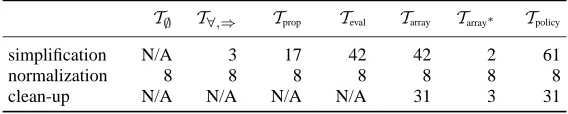
Table 2. Number of rewrite rules used in consecutive phases of different simplifications.
T∅ T∀,⇒ Tprop Teval Tarray Tarray∗ Tpolicy
simplification N/A 3 17 42 42 2 61
normalization 8 8 8 8 8 8 8
clean-up N/A N/A N/A N/A 31 3 31
Control The simplifications are performed by a small but reasonably efficient rewrite
“clean-up” phase. This consists of the normalization followed by the propositional simpli-ficationsTpropand the finite induction rule. Similarly,Tarray*is followed by the normalization
and then byT∀,⇒ to split the obligations. Table 2 shows the number of rewrite rules for
each simplification level, as well as for normalization and clean-up.
3.3. Domain Theory
Each safety obligation is supplied with a first-order domain theory. In our case, the do-main theory consists of a fixed part which contains 44 axioms, and a set of axioms which is generated dynamically for each proof task. The static axioms define the usual prop-erties of equality and the order relations, as well as axioms for Pressburger arithmetic and for the domain-specific operators (e.g., array accesses and matrix operations). This part axiomatizes 22 different predicate and function symbols. The dynamic axioms are added to avoid the generation of large terms of the form succ(. . .succ(0). . .). They are required because most theorem provers cannot calculate with integers. For all different in-teger literalsn, moccurring in the proof task, we generate the corresponding axioms of the formm > n. For small integers (i.e., n ≤ 5), we also generate axioms for explicit successor-terms, i.e.,n=succ(. . .succ(0). . .)and add a finite domain schema of the form ∀x·0≤x≤n⇒(x= 0∨x= 1∨. . .∨x=n). In our application domain, these axioms are needed for some of the matrix operations; thusncan be limited to the statically known maximal size of the matrices. The default set of axioms contains all the formulas required for each of the safety policies. A second, reduced domain theory omits axioms that are only relevant to a specific policy. This is described and evaluated in Section 4.5.
3.4. Theorem Provers
For the experiments, we selected several high-performance theorem provers for untyped first-order formulas with equality. Most of the provers participated in the the CASC-1919 or CASC-J220prover competitions and ranked highly in the FOL or MIX categories. In the experiments, we used the default parameter settings or the competition parameter settings and none of the special features of the provers. None of the provers were tuned in any way for this set of proof tasks, with the exception of Otter, where the developer provided an alternative parameter setting since the defaults proved unsuitable. The ATPs were given first-order formulas in TPTP syntax as input when applicable; we then relied on their re-spective built-in clausification modules, unless otherwise noted. However, ATPs that accept only clausal normal form (i.e., DCTP, Gandalf, and Otter) were provided with the results of the TPTP clausifier as their input. For each proof obligation, we limited the run-time to 60 seconds; the CPU time actually used was measured with the TPTP tools on a 2.4GHz standard Linux PC with 4GB memory.
minor improvements over the original CASC-19 version. We also used the CASC-J2 ver-sion E-Setheo-04 “as-is”, from which we derived two further variants E-Setheo-04F and E-Setheo-04T by replacing E’s clausifier with Flotter V2.1 and the TPTP clausifier, respec-tively. Finally, we used an “E-free” variant of E-Setheo by removing E from all schedules; this is denoted here by Setheo but note that this does not correspond to any of the earlier Setheo-versions (i.e., before version 3.3). For E,37 we used version 0.82 which was ob-tained directly from the developer. For Gandalf,38we used version c-2.6. The clausal nor-mal form produced by the TPTP clausifier was post-processed so that the set of support only contained clauses originating in the actual proof task, while all clauses originating from the axioms were put into thelist(usable)section. We also used a variant Gandalf-F, in which the TPTP clausifier was replaced by Flotter V2.1. Spass 2.1 was obtained from the developer’s website.35For Vampire,39 we used the three most recent CASC competition versions (Vampire 5.0, Vampire 6.0, and Vampire 7.0), taken directly “out of the box.” For comparison purposes, we also used Otter V3.0.6,40which is from April 2000 but has been essentially unchanged since 1996.
4. Empirical Results
4.1. Generating and Simplifying Obligations
Table 3 summarizes the results of generating the different versions of the safety obligations. For each of the example specifications, it lists the size|P|of the generated programs (with-out annotations), the applicable safety policies, the size|A|of the generated annotations, and then, for each simplifier, the numberNof generated obligations and the elapsed timeT. The elapsed times include synthesis of the programs as well as generation, simplification, and file output of the safety obligations; synthesis alone accounts for approximately 90% of the times listed under the array safety policy. In general, the times for generating and simplifying the obligations are moderate compared to both generating the programs and discharging the obligations. All times are CPU times and have been measured in seconds using the Unixtimecommand.
Almost all of the generated obligations are valid, i.e., the generated programs are safe. The only exception is the inuse-policy which produces one invalid obligation for each of the ds1and issexamples. This is a consequence of the original specifications which do not use all elements of the initial state vectors. The invalidity is confined to a single conjunct in one of the original obligations, and since none of the rewrite systems contains a distributive law, the number of invalid obligations does not increase with simplification.
The first four simplification levels show the expected results. The baselineT∅ yields
relatively few but large obligations which are then split up byT∀,⇒into a much larger (on
average more than an order of magnitude) number of smaller obligations. The next two levels then eliminate a large fraction of these obligations. Here, the propositional simplifier Tpropalone already discharges between 50% and 90% of the obligations while the additional
effect of evaluating ground arithmetic (Teval) is much smaller and generally well below 25%.
Table 3. Generation of safety obligations.
T∅ T∀,⇒ Tprop Teval Tarray Tarray∗ Tpolicy
Example |P|Policy |A| N T N T N T N T N T N T N T
ds1 431array 0 11 5.5 103 5.3 55 5.4 1 5.5 1 5.5 103 5.6 1 5.5
init 87 21 9.5 339 14.1 150 11.3 142 11.0 74 10.5 543 20.1 74 11.4
inuse 61 19 7.3 453 12.9 59 7.7 57 7.6 21 7.4 682 16.2 21 8.1
symm 75 17 4.8 101 5.7 21 4.7 21 4.9 858 66.7 2969 245.6 865 70.8
iss 755array 0 1 24.6 582 28.1 114 24.8 4 24.2 4 24.0 582 27.9 4 24.7
init 88 2 39.5 957 65.9 202 42.3 194 41.8 71 39.2 1378 82.6 71 39.7
inuse 60 2 33.4 672 68.1 120 36.7 117 35.7 28 32.6 2409 79.1 1 31.6
symm 87 1 33.0 185 34.9 35 28.1 35 27.9 479 71.0 3434 396.8 480 66.2
segm 517array 0 29 3.0 85 3.3 8 2.9 3 2.9 3 3.0 85 3.3 1 3.0
init 171 56 6.5 464 12.1 172 7.8 130 7.7 121 7.6 470 12.8 121 7.6
norm 195 54 3.8 155 5.0 41 3.8 30 3.6 32 3.8 157 5.2 14 3.6
gauss 1039array 20 69 21.0 687 24.9 98 21.2 20 21.0 20 20.9 687 24.3 20 21.3
init 118 85 49.8 1417 65.5 395 54.1 324 53.2 316 53.9 1434 66.2 316 54.3
the large number of obligations which have the form¬(n≤n)⇒Pfor an integer constant
nrepresenting the (lower or upper) bound of an array. The effect of the domain-specific simplifications is at first glance less clear. Using the array-rules only (Tarray*) generally leads
to an increase overT∀,⇒ in the number of obligations; this is even greater than an order
of magnitude for the symm-policy. However, in combination with the other simplifications
(Tarray), most of these obligations can be discharged again, and we generally end up with
fewer obligations than before; again, the symm-policy is the only exception. The effect of the final policy-specific simplifications is, as should be expected, highly dependent on the policy. For inuse and norm a further reduction is achieved, while the rules for init and symm only reduce the size of the obligations.
4.2. Running the Theorem Provers
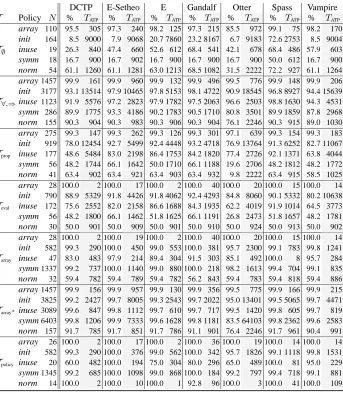
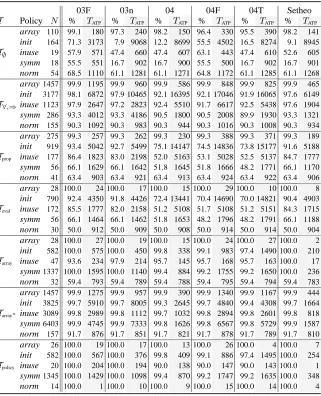
Table 4 summarizes the results obtained from running the theorem provers on all proof obligations (except for the two invalid obligations from the inuse-policy). For the “prover families” E-Setheo and Vampire, however, the table only contains entries for the best vari-ants, E-Setheo-03n and Vampire 6.0, respectively. The results are grouped by the different simplification levels. Each line in the table corresponds to the proof tasks originating from a specific safety policy (array, init, inuse, symm, and norm). Then, for each prover, the percentage of solved proof obligations and the total CPU time are given. Note thatTATPalso
includes the actual CPU times for failed proof attempts.
For the fully simplified version (Tpolicy), all provers are able to find proofs for all tasks
originating from at least one safety policy; E-Setheo-03F can even discharge all the emerg-ing safety obligations. This result is central for our application since it shows that current ATPs can in fact be applied to certify the safety of synthesized code, confirming our first hypothesis.
unaccept-Table 4. Theorem prover results: Percentage of solved proof tasks and total ATP-times.
DCTP E-Setheo E Gandalf Otter Spass Vampire
T Policy N % TATP % TATP % TATP % TATP % TATP % TATP % TATP array 110 95.5 305 97.3 240 98.2 125 97.3 215 85.5 972 99.1 75 98.2 170
init 164 8.5 9000 7.9 9068 20.7 7860 23.2 8167 6.7 9183 72.6 2753 8.5 9004 T∅ inuse 19 26.3 840 47.4 660 52.6 612 68.4 541 42.1 678 68.4 486 57.9 603 symm 18 16.7 900 16.7 902 16.7 900 16.7 900 16.7 900 50.0 612 16.7 900
norm 54 61.1 1260 61.1 1281 63.0 1213 68.5 1082 31.5 2222 72.2 927 61.1 1264
array1457 99.9 161 99.9 960 99.9 132 99.9 496 99.5 776 99.9 148 99.9 206
init 3177 93.1 13514 97.9 10465 97.8 5153 98.1 4722 90.9 18545 96.8 8927 94.4 15639 T∀,⇒inuse 1123 91.9 5576 97.2 2823 97.9 1782 97.5 2063 96.6 2503 98.8 1630 94.3 4531
symm 286 89.9 1775 93.3 4186 90.2 1783 90.5 1710 80.8 3501 89.9 1859 87.8 2968
norm 155 90.3 904 90.3 983 90.3 906 90.3 904 76.1 2246 90.3 915 89.0 1030
array 275 99.3 147 99.3 262 99.3 126 99.3 301 97.1 639 99.3 154 99.3 183
init 919 78.0 12454 92.7 5499 92.4 4448 93.2 4718 76.9 13764 91.3 6252 82.7 11067 Tprop inuse 177 48.6 5484 83.0 2198 86.4 1753 84.2 1820 77.4 2726 92.1 1371 63.8 4044 symm 56 48.2 1744 66.1 1642 50.0 1710 66.1 1188 19.6 2706 48.2 1812 48.2 1772
norm 41 63.4 902 63.4 921 63.4 903 63.4 932 9.8 2222 63.4 915 58.5 1025
array 28 100.0 2 100.0 17 100.0 2 100.0 40 100.0 20 100.0 15 100.0 14
init 790 88.9 5329 91.8 4426 91.8 4062 92.4 4293 84.8 8060 90.1 5332 80.2 10638 Teval inuse 172 75.6 2552 82.0 2158 86.6 1688 84.3 1935 62.2 4019 91.9 1014 64.5 3773 symm 56 48.2 1800 66.1 1462 51.8 1625 66.1 1191 26.8 2473 51.8 1657 48.2 1781
norm 30 50.0 901 50.0 909 50.0 901 50.0 910 50.0 924 50.0 913 50.0 902
array 28 100.0 2 100.0 19 100.0 2 100.0 40 100.0 20 100.0 15 100.0 14
init 582 99.3 290 100.0 450 99.0 553 100.0 381 95.7 2300 99.1 783 99.8 1241
Tarray inuse 47 83.0 483 97.9 214 89.4 304 91.5 303 85.1 492 100.0 8 95.7 284
symm1337 99.2 737 100.0 1140 99.0 880 100.0 218 98.2 1613 99.4 704 99.1 835
norm 32 59.4 782 59.4 789 59.4 782 56.2 843 59.4 783 59.4 818 59.4 886
array1457 99.9 156 99.9 957 99.9 130 99.9 356 99.5 775 99.9 166 99.9 215
init 3825 99.2 2427 99.7 8005 99.3 2543 99.7 2022 95.0 13401 99.5 5065 99.7 4471
Tarray∗inuse 3089 99.6 847 99.8 1112 99.7 610 99.7 717 99.5 1420 99.8 605 99.7 819
symm6403 99.8 1206 99.9 7333 99.6 1628 99.8 1181 83.5 64103 99.8 2362 99.6 2583
norm 157 91.7 785 91.7 851 91.7 786 91.1 901 76.4 2246 91.7 961 90.4 991
array 26 100.0 2 100.0 17 100.0 2 100.0 36 100.0 19 100.0 14 100.0 14
init 582 99.3 290 100.0 376 99.0 562 100.0 342 95.7 1826 99.1 1118 99.8 1531
Tpolicy inuse 20 60.0 482 100.0 194 75.0 304 80.0 296 65.0 489 100.0 81 95.0 229
symm1345 99.2 685 100.0 1098 99.0 868 100.0 184 99.2 797 99.4 718 99.1 881
norm 14 100.0 2 100.0 10 100.0 1 92.8 96 100.0 3 100.0 41 100.0 109
ably large number of obligations to the user. The only exception is the array-policy, which produces by far the simplest safety obligations. This confirms our second hypothesis: ag-gressive preprocessing is absolutely necessary to yield reasonable results.
Looking more closely at the different simplification stages, we can see that breaking the large original formulas into a large number of smaller but independent proof tasks (T∀,⇒)
boosts the relative performance considerably. However, due to the large absolute number of tasks, the absolute number of failed tasks (and thus the total response time) also increases. With each additional simplification step, the percentage of solved proof obligations in-creases further. Interestingly, however,T∀,⇒andTarray seem to have the biggest impact on
[image:15.612.141.484.187.581.2]T∅(N=365) T∀,⇒(N=6198) Tprop (N=1468) Teval (N=1076) Tarray (N=2026) Tpolicy(N=1987)
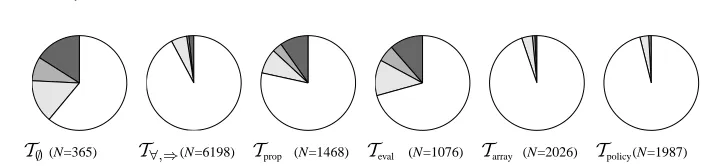
Fig. 4. Distribution of easy (Tproof < 1s, white), medium (Tproof <10s, light gray), difficult (Tproof <60s, gray) proofs, and failing proof tasks (dark gray) for the different simplification stages (prover: E-Setheo-03F).N is the total number of proof tasks at each stage.
formula structures can then be avoided, albeit at the cost of the substantial increase in the number of proof tasks. The results with the simplification strategyTarray∗, which only
con-tains the language-specific rules, also illustrates this behavior. The norm-policy clearly pro-duces the most difficult safety obligations, requiring essentially inductive and higher-order reasoning. Here, all simplification steps are required to make the obligations go through the first-order ATPs.
Since our proof tasks are generated directly by a real application and are not hand-picked for certain properties, many of them are (almost) trivial—even in the unsimplified case. Figure 4 shows the resources required for the proof tasks as a series of pie charts for the different simplification stages. All numbers are obtained with E-Setheo-03F; the figures for the other provers look similar. Overall, the charts reflect the expected behavior: with additional preprocessing and simplification of the proof obligations, the number of easy proofs increases substantially and the number of failing proof tasks decreases sharply from approximately 16% to zero. The relative decrease of easy proofs fromT∀,⇒ toTprop
andTevalis a consequence of the large number of easy proof tasks already discharged by the
respective simplifications.
4.3. Comparing Prover Variants
The results in Table 4 indicate there is no single best theorem prover. Even variants of the “same” prover can differ widely in their results. Tables 5 and 6 thus compare the results within the same “prover families” in more detail.
For some proof obligations, the choice of the clausification module makes a big dif-ference. The TPTP-converter implements a straightforward algorithm similar to the one described in (Ref. 41). Flotter35,36uses a highly elaborate conversion algorithm which per-forms many simplifications and avoids exponential increase in the number of generated clauses. This effect is most visible on the unsimplified obligations (e.g.,T∅ under init),
where variants using the Flotter clausifier perform substantially better than the other vari-ants.
Table 5. Detailed results for E-Setheo variants: Percentage of solved proof tasks and total ATP-times.
03F 03n 04 04F 04T Setheo
T Policy N % TATP % TATP % TATP % TATP % TATP % TATP array 110 99.1 180 97.3 240 98.2 150 96.4 330 95.5 390 98.2 141
init 164 71.3 3173 7.9 9068 12.2 8699 55.5 4502 16.5 8274 9.1 8945 T∅ inuse 19 57.9 571 47.4 660 47.4 607 63.1 443 47.4 610 52.6 605 symm 18 55.5 551 16.7 902 16.7 900 55.5 500 16.7 902 16.7 901
norm 54 68.5 1110 61.1 1281 61.1 1271 64.8 1172 61.1 1285 61.1 1268
array1457 99.9 1195 99.9 960 99.9 586 99.9 848 99.9 825 99.9 465
init 3177 98.1 6872 97.9 10465 92.1 16395 92.1 17046 91.9 16065 97.6 6149 T∀,⇒inuse 1123 97.9 2647 97.2 2823 92.4 5510 91.7 6617 92.5 5438 97.6 1904
symm 286 93.3 4012 93.3 4186 90.5 1800 90.5 2008 89.9 1930 93.3 1321
norm 155 90.3 1092 90.3 983 90.3 944 90.3 1016 90.3 1008 90.3 934
array 275 99.3 257 99.3 262 99.3 230 99.3 388 99.3 371 99.3 189
init 919 93.4 5042 92.7 5499 75.1 14147 74.5 14836 73.8 15177 91.6 5188 Tprop inuse 177 86.4 1823 83.0 2198 52.0 5163 53.1 5028 52.5 5137 84.7 1777 symm 56 66.1 1629 66.1 1642 51.8 1645 51.8 1666 48.2 1771 66.1 1170
norm 41 63.4 903 63.4 921 63.4 913 63.4 924 63.4 922 63.4 906
array 28 100.0 24 100.0 17 100.0 15 100.0 29 100.0 10 100.0 8
init 790 92.4 4350 91.8 4426 72.4 13441 70.4 14690 70.0 14821 90.4 4903 Teval inuse 172 85.5 1777 82.0 2158 51.2 5108 51.7 5108 51.2 5151 84.3 1715 symm 56 66.1 1464 66.1 1462 51.8 1653 48.2 1796 48.2 1791 66.1 1188
norm 30 50.0 912 50.0 909 50.0 908 50.0 914 50.0 914 50.0 904
array 28 100.0 27 100.0 19 100.0 15 100.0 24 100.0 27 100.0 2
init 582 100.0 575 100.0 450 99.8 338 99.1 983 97.4 1490 100.0 210
Tarray inuse 47 93.6 234 97.9 214 95.7 145 95.7 168 95.7 163 100.0 17
symm1337 100.0 1595 100.0 1140 99.4 884 99.2 1755 99.2 1650 100.0 236
norm 32 59.4 793 59.4 789 59.4 788 59.4 795 59.4 794 59.4 783
array1457 99.9 1275 99.9 957 99.9 390 99.9 1340 99.9 1167 99.9 444
init 3825 99.7 5910 99.7 8005 99.3 2645 99.7 4840 99.4 4308 99.7 1664
Tarray∗ inuse 3089 99.8 2989 99.8 1112 99.7 1032 99.8 2894 99.8 2601 99.8 818
symm6403 99.9 4745 99.9 7333 99.8 1626 99.8 6567 99.8 5729 99.9 1587
norm 157 91.7 876 91.7 851 91.7 821 91.7 878 91.7 789 91.7 810
array 26 100.0 19 100.0 17 100.0 13 100.0 26 100.0 4 100.0 7
init 582 100.0 567 100.0 376 99.8 409 99.1 886 97.4 1495 100.0 254
Tpolicy inuse 20 100.0 204 100.0 194 90.0 138 90.0 147 90.0 143 100.0 1
symm1345 100.0 1429 100.0 1098 99.4 870 99.2 1747 99.2 1635 100.0 348
norm 14 100.0 1 100.0 10 100.0 9 100.0 15 100.0 14 100.0 4
proof times. A similar pattern also holds in the case of E-Setheo, where the most recent version E-Setheo-04 is generally outperformed by both the earlier development snapshot E-Setheo-03n and the E-free variant Setheo.a
a
Table 6. Detailed results for Vampire and Gandalf variants: Percentage of solved proof tasks and total ATP-times.
Vampire 7.0 Vampire 6.0 Vampire 5.0 Gandalf Gandalf-F
T Policy N % TATP % TATP % TATP % TATP % TATP array 110 98.2 123 98.2 170 98.2 122 97.3 215 98.2 140
init 164 8.5 9004 8.5 9004 8.5 9003 23.2 8167 78.0 2712
T∅ inuse 19 47.4 607 57.9 603 47.4 610 68.4 541 78.9 352
symm 18 16.7 900 16.7 900 16.7 900 16.7 900 61.1 464
norm 54 64.8 1146 61.1 1264 64.8 1163 68.5 1082 72.2 919
array1457 99.9 148 99.9 206 99.9 138 99.9 496 99.9 328
init 3177 94.3 12449 94.4 15639 93.5 14421 98.1 4722 98.0 6283 T∀,⇒inuse 1123 93.8 4451 94.3 4531 94.2 4013 97.5 2063 98.6 1558 symm 286 89.5 1919 87.8 2968 87.8 2467 90.5 1710 92.7 1384
norm 155 89.0 1026 89.0 1030 89.0 1020 90.3 904 90.3 965
array 275 99.3 141 99.3 183 99.3 128 99.3 301 99.3 182
init 919 82.6 10585 82.7 11067 81.8 11122 93.2 4718 93.0 4722 Tprop inuse 177 61.0 4206 63.8 4044 64.4 3885 84.2 1820 91.0 1454 symm 56 48.2 1750 48.2 1772 48.2 1758 66.1 1188 60.7 1353
norm 41 58.5 1024 58.5 1025 58.5 1021 63.4 932 63.4 933
array 28 100.0 6 100.0 14 100.0 2 100.0 40 100.0 28
init 790 79.9 10357 80.2 10638 80.0 9875 92.4 4293 91.8 4753 Teval inuse 172 59.3 4322 64.5 3773 65.7 3647 84.3 1935 90.7 1458 symm 56 48.2 1751 48.2 1781 48.2 1742 66.1 1191 58.9 1416
norm 30 43.3 1023 50.0 902 43.3 1020 50.0 910 50.0 905
array 28 100.0 7 100.0 14 100.0 2 100.0 40 100.0 27
init 582 99.1 1528 99.8 1241 99.0 902 100.0 381 100.0 532
Tarray inuse 47 89.4 371 95.7 284 87.2 364 91.5 303 93.6 271
symm1337 98.8 1017 99.1 835 99.0 900 100.0 218 99.7 363
norm 32 46.9 1024 59.4 886 46.9 1020 56.2 843 59.4 789
array1457 99.9 136 99.9 215 99.9 123 99.9 356 99.9 215
init 3825 99.3 3761 99.7 4471 98.6 5674 99.7 2022 99.7 2937
Tarray∗ inuse 3089 99.7 656 99.7 819 99.6 777 99.7 717 99.7 618
symm6403 99.6 2028 99.6 2583 99.6 2071 99.8 1181 99.9 829
norm 157 89.2 1026 90.4 991 89.2 1021 91.1 901 91.7 850
array 26 100.0 6 100.0 14 100.0 2 100.0 36 100.0 23
init 582 99.1 1116 99.8 1531 99.0 903 100.0 342 100.0 724
Tpolicy inuse 20 75.0 368 95.0 229 70.0 397 80.0 296 85.0 266
symm1345 98.8 1017 99.1 881 99.0 902 100.0 184 99.7 364
norm 14 71.4 244 100.0 109 71.4 240 92.8 96 100.0 12
4.4. Difficult Proof Tasks
Since all proof tasks are generated in a uniform manner through the application of a safety policy by the VCG, it is expected that many of the difficult proof tasks share some structural similarities. Most safety obligations generated by the VCG are of the formA ⇒ B1∧. . .∧ Bnwhere theBiare variable disjoint. These obligations can be split up intonsmaller proof obligations of the formA ⇒ Bi and most theorem provers can then handle these smaller independent obligations much more easily than the large original.
formulas of the form symm(r) ⇒ symm(diag-updates(r)). Here,r is a matrix variable which is updated along its diagonal, and we need to show thatrremains symmetric after the updates. For a 2x2 matrix and two updates (i.e.,r00 =xandr11 =y), we obtain the following simplified version of an actual proof task:
∀i, j·(0≤i, j≤1⇒sel(r, i, j) =sel(r, j, i))⇒
(∀k, l·(0≤k, l≤1⇒
sel(upd(upd(r,1,1, y),0,0, x), k, l) =sel(upd(upd(r,1,1, y),0,0, x), l, k))).
This already pushes the provers to their limits—E-Setheo cannot prove this while Spass succeeds here but fails if the dimensions are increased to 3x3, or if three updates are made. In our examples, matrix dimensions up to 6x6 with 36 updates occur, yielding large proof obligations of this specific form which are not provable by current ATPs without further preprocessing.
Another class of seemingly trivial but hard examples, which frequently shows up in the init-policy, results from the expansion of deeply nestedsel/upd-terms. These problems have the form
∀i, j·0≤i≤n∧0≤j≤n⇒(¬(i= 0∧j= 0)∧. . .∧ ¬(i=n∧j=n)⇒false)
and soon become intractable for the clausifier, even for smalln(n= 2orn= 3), although the proof would be easy after a successful clausification.
4.5. Policy-Specific Domain Theories
The domain theory described in Section 3.3 and used in the experiments summarized in Tables 4–6 contains all axioms required to prove any of the obligations; in particular, it also contains axioms which are specific to the symbols used only in one policy and which should thus not be required for any obligation from the other policies. However, experience shows that the ATPs have problems detecting such redundant axioms.23,42,31
In order to evaluate the effect of redundant axioms in our case, we used a reduced domain theory for the array, init, and inuse safety policies and then re-ran E-Setheo-04 and E. Here we used E-Setheo-04 because previous experiments with E-Setheo-03F have shown6 that its scheduling algorithm is much more sensitive to modifications than that of E-Setheo-04. The reduced domain theory uses the same dynamic axiom generator as the full theory but omits seven axioms that specify the behavior of matrix operations (i.e., addition, subtraction, multiplication, transposition, and inversion) which do not occur in the obligations resulting from the above policies. The reduced set thus contains 37 axioms and 17 symbols.
Table 7 summarizes this experiment and gives the results and times for both the original full and the reduced domain theory. Note thatTproof only includes the CPU times for
suc-cessful proof attempts;Tmeanis the average CPU time for these cases. However, as common
Table 7. Proof results and times—policy-specific domain theories.
E-Setheo-04 E
Full theory Reduced theory Full theory Reduced theory Policy N % Tproof Tmean % Tproof Tmean % Tproof Tmean % Tproof Tmean array 110 98.2 29.5 0.27 98.2 22.6 0.20 98.2 5.2 0.04 98.2 4.6 0.04 T∅ init 164 12.2 59.2 2.96 12.2 50.7 2.53 20.7 60.3 1.77 22.6 175.2 4.73 inuse 19 47.4 6.9 0.76 47.4 0.7 0.07 52.6 71.8 7.18 47.4 2.6 0.28
array 1457 99.9 465.6 0.32 99.9 349.5 0.24 99.9 11.5 0.00 99.9 9.1 0.00 T∀,⇒ init 3177 92.1 1395.4 0.47 92.1 1087.1 0.37 97.8 952.8 0.30 97.3 371.3 0.12
inuse 1123 92.4 409.8 0.39 92.5 303.5 0.29 97.9 341.5 0.31 98.5 62.6 0.05
array 275 99.3 110.3 0.40 99.3 93.1 0.34 99.3 5.9 0.02 99.3 4.1 0.01 Tprop init 919 75.1 406.7 0.58 75.1 185.9 0.26 92.4 248.2 0.29 90.6 261.9 0.31 inuse 177 52.0 63.3 0.68 52.5 29.6 0.31 86.4 313.0 2.04 90.4 16.3 0.10
array 28 100.0 14.8 0.52 100.0 10.8 0.38 100.0 2.4 0.08 100.0 2.4 0.08 Teval init 790 72.4 361.0 0.63 72.3 167.5 0.29 91.8 161.9 0.22 89.2 742.8 1.05 inuse 172 51.2 68.5 0.77 51.7 37.6 0.42 86.6 308.0 2.06 90.1 43.5 0.28
array 28 100.0 15.1 0.53 100.0 11.1 0.39 100.0 2.5 0.08 100.0 2.2 0.07
Tarray init 582 99.8 277.5 0.47 99.8 270.2 0.46 99.0 192.6 0.33 100.0 30.7 0.05
inuse 47 95.7 24.8 0.55 95.7 6.9 0.15 89.4 4.5 0.10 93.6 5.0 0.11
array 1457 99.9 270.1 0.18 99.9 351.0 0.24 99.9 10.3 0.00 99.9 10.5 0.00
Tarray∗ init 3825 99.3 1084.9 0.28 99.3 1201.9 0.31 99.3 1043.2 0.27 99.5 221.5 0.05
inuse 3089 99.7 552.5 0.17 99.7 451.8 0.14 99.7 10.2 0.00 99.7 27.3 0.00
array 26 100.0 13.0 0.50 100.0 9.9 0.38 100.0 2.3 0.08 100.0 1.8 0.06
Tpolicy init 582 99.8 348.7 0.60 99.8 264.0 0.45 99.0 202.2 0.35 100.0 30.4 0.05
inuse 20 90.0 18.3 1.01 90.0 13.9 0.77 75.0 4.2 0.28 85.0 4.7 0.27
extent already be explained by the fact that the preprocessing steps (mainly clausification) run faster on the smaller problems. For E, the effects are much more pronounced, but also much less uniform. In some cases, in particular for the unsimplified or only slightly simpli-fied variants, E can find a substantial number of additional proofs, The average proof times are usually slightly better for the reduced axiom set but they can vary widely—up to one order of magnitude in both directions.
5. Proof Checking
For certification purposes, assurance or, better yet, explicit evidence must be provided that none of the individual tool components can yield incorrect results. The VCG is designed so that it can be manually inspected for correctness and, similarly, the rewrite rules used for simplification can be inspected and even individually proven correct. However, the state-of-the-art high-performance ATPs in our system use complicated calculi, elaborate data structures, and optimized implementations to increase their deductive power and to provide results quickly. This makes a formal verification of their correctness impossible in practice. Although they have been extensively validated by the theorem proving community (using the TPTP benchmark library), the ATPs remain the weakest link in the certification chain.
system to generate annotated code, rather than directly verifying the system itself. How-ever, although this idea is very simple in theory, there are currently (as of 2005) almost no dedicated proof checkers for high-performance ATPs.bThis has a number of practical reasons. (i) Not all ATPs generate the detailed proofs which are required, mainly due to implementation effort and the run-time overheads this incurs. (ii) On-going changes in the ATP require frequent updates and re-verification of the proof checker. (iii) Almost all ATPs (in particular all the provers used here) work on problems in clausal normal form, so the proof checking can only be done on the clausal level, and not on the original formula level. Since clausification is an important step in the proof process, this reduces the confidence that proof checking can bring. (iv) Most ATPs contain a large number of high-level infer-ence rules (such as splitting) which cannot easily be expanded into sequinfer-ences of low-level inferences, making a proof checker more complicated and thus hard to verify.
In our experiments, we used the Ivy system,28 which combines a clausifier and the Otter theorem prover with a proof checker. Ivy is implemented within the ACL2 logic,43 and both the clausifier and the proof checker have been formally verified in ACL2. Ivy thus provides the same functionality as a verified theorem prover for first-order logic, but unlike a “correct-by-inspection” prover such as leanTAP44it generally achieves relatively good performance by using Otter to find the proofs. The formal verification of the Ivy clausifier and proof checker are based on finite domains28but since the implementation of Ivy does not actually rely on the finiteness, the system can be used for arbitrary proof tasks.
A more serious practical limitation of Ivy is caused by the implementation of the clausi-fication algorithm, which only returns an unstructured clause set but does not maintain traceability between the clauses (or literals) and the positions they had in the original for-mula. This has a negative influence on the prover’s behavior. Like many ATPs, Otter can be sped up considerably if it is known which parts of the formula are axioms and which belong to the original conjecture. This distinction allows the prover to apply goal-oriented rules. Our application naturally provides this information, but this is ignored by Ivy. Thus, Ivy can only use Otter’s auto-mode which is not very well suited for our proof obligations. Experiments also revealed that Ivy has problems in handling the full axiom set. With the policy-specific domain theory described in Section 4.5, we obtained the following results for the fully simplified tasks: 100% in 34.8s for the array property, 89.2% in 4929.2s for init, and 65.0% in 657.5s for inuse.
6. Traceability
The successful application of an automated theorem prover to verification and, in partic-ular, to certification problems such as we have described here, places more requirements on the prover than just raw deductive power. Since the aim of certification is to provide explicit evidence that software meets a specified standard of safety, it is important that domain experts can assess the evidence for successful checks of the safety properties and
b
any places where they are violated. This traceability is also mandated by standards such as DO-178B.45
In practice, safety checks are generally carried out during code reviews,46where re-viewers look in detail at each line of the code and check the individual safety properties statement by statement. The successful outcome of a code review, therefore, consists of the marked-up code, where each statement is labeled either with “complies with safety prop-ertyP”, or with information about the violation. Automating the link between code and certificates requires the system to generate two additional artifacts: (i) location information which links the safety obligations (or their proofs) to specific lines of code in the program being certified, and (ii) a summary which interprets the obligation in terms of the safety policy, program, and specification.
Source code locations are added by the VCG to the safety conditions and safety substi-tutions it constructs as it processes a statement with a given location. We currently use sim-ple line numbers as locations and do not break them further down into individual subterm positions47because this finer level of detail it is not required for our purposes. However, the source locations need to be threaded through all stages of our certification architecture (cf. Figure 1), in particular the simplifier, in order to trace the resulting VCs back to their origins. Since each VC is generally linked to multiple statements, the location information for the entire program needs to be maintained, even if we just want to know whether a single line in the code satisfies a given safety property. We have thus extended the rewrite rules described in Section 3.2 to preserve the associated labels through the simplification process, similar to the labeled rewrite rules used in the Simplify prover.48 This approach requires careful engineering to maintain the relevant location information while minimiz-ing the scope of the labels and thus preventminimiz-ing the introduction of too much noise into the linking process.
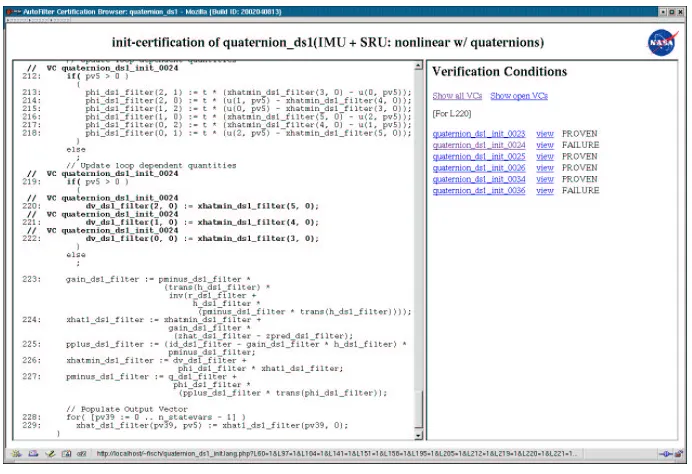
We have also implemented a certification browser that displays the links between the verification conditions and the lines of the (annotated) code. This is especially useful when a VC cannot be proven, and it is not clear whether the error is due to a genuine safety violation in the program, an inadequate or erroneous annotation, an incorrect propagation, or a weakness in the domain theory or the prover.
Figure 5 shows a screen-shot of the browser which displays the program in the left frame, and the list of VCs (including their status and a link to the actual proof task) in the right frame. Linking works in both directions: clicking on a statement or annotation displays all VCs to which it contributes (i.e., which are labeled with its line number), and clicking on a VC highlights all statements and annotations that are affected by it. This two-way linking allows users not only to review the program line by line but also to quickly identify all potential error sources associated with an unproven VC.
In general, useful information extracted from an ATP can be used for purposes of auto-generating documentation. In (Ref. 49), we describe a safety documentation tool, which generates a natural language description explaining the safety of a program, by converting the VCs into text. We are currently integrating this with the certification browser, which requires the labels to be extended with other semantic information.
Fig. 5. Screen-shot of certification browser linking program and VCs.
simplifier as an intermediate step to using the full proofs. More detailed information (such as which axioms have been used) could be obtained by threading the tracing through the ATP itself and into the proof it generates. For example, the analysis needs to reveal which annotations are actually required to satisfy a property. The extraction of this information requires knowledge of which parts of the formula contributed to the proof, as well as their location information. The tracing problem is again aggravated by the fact that most the-orem provers work on clausal normal form, which usually loses the important location information.
7. Conclusions
We have described a system for the automated certification of safety properties of NASA state estimation and data analysis software. The system uses a generic VCG together with explicit safety policies to generate policy-specific safety obligations which are then auto-matically processed by a first-order ATP. We have evaluated several state-of-the-art ATPs on more than 25,000 proof tasks generated by our system. We believe this to be the first comprehensive set of experiments looking at the suitability of a range of ATPs for software verification.
0 20 40 60 80 100
0 20 40 60 80 100
[image:24.612.120.474.174.312.2]T∅ T∀,⇒ Tprop Teval Tarray Tarray* Tpolicy T∅ T∀,⇒ Tprop Teval Tarray Tarray* Tpolicy
Fig. 6. Comparison of proof results (left) and certification results (right) for E-Setheo-03F, E, Gandalf, Otter, Spass, and Vampire 6.0 (left to right).
However, the percentage of solved proof tasks is a very ATP-centric metric; it is also somewhat artificial because it can easily be boosted by splitting the original obligations into a larger number of small proof tasks (cf. the results forT∅andT∀,⇒). An empirically
more meaningful metric for the success of this ATP-application is the percentage of solved certification tasks, i.e., the relative number of cases in which the ATP solves all safety obli-gations resulting from the application of a safety policy to an individual program. Figure 6 shows this metric (on the right) for the different simplification stages and provers. This change in perspective leads to a dramatic change in the interpretation of the same results. The two major differences are: (i) the numbers go down and (ii) the variation between the provers becomes smaller for the unsimplified versions and substantially larger for the sim-plified versions. Both differences result from a few hard proof tasks which are distributed evenly over the different certification tasks. Consequently, empirical success is a lot harder to come by if it is defined in terms of the application rather than in terms of the TPTP corpus. However, as our experiments show it is clearly not impossible.
It is well-known that, in contrast to traditional mathematics, software verification re-quires large numbers of mathematically shallow (in terms of the concepts involved) but structurally complex proof tasks, yet current provers are not well suited to this. Since the propositional structure of a formula is of great importance, we believe that clausification algorithms should integrate more simplification and split goal tasks into independent sub-tasks. Likewise, certain application-specific constructs (e.g., sel/upd) can easily lead to proof tasks which cannot be handled by current ATPs. The reason is that simple manipu-lations on deeply nested terms, when combined with equational reasoning, can result in a huge search space.
need of further work.
With our approach to certification of auto-generated code, we are able to automatically produce safety certificates for code of considerable size and structural complexity. By com-bining rewriting with state-of-the-art automated theorem proving, we obtain a safety cer-tification tool which compares favorably with tools based on static analysis (see (Ref. 50) for a comparison).
Our current efforts focus on extending the certification system in a number of areas. One aim is to develop a certificate management system, along the lines of the Programatica project.51We are extending the interactive browser described in Section 6 to also link to proofs and design documents, and provide rich explanations of proof obligations, thus com-bining our work on certification with automated safety and design document generation.49 In another thread of future work we plan to experiment with other reasoning systems and tools based on decision procedures (such as PVS and Simplify) to process our verification conditions. In this paper we have deliberately concentrated on using first-order theorem provers. Finally, we continue to integrate additional safety properties.
Acknowledgments
Bill McCune, Tanel Tammet, Stephan Schulz, Gernot Stenz, and Geoff Sutcliffe helped with the installation and integration of the different provers. Phil Oh helped with the eval-uation scripts.
References
1. M. Whalen, J. Schumann and B. Fischer, AutoBayes/CC — Combining Program Synthesis with Automatic Code Certification (System Description), in Proc. 18th Int. Conf. Automated Deduction, Lect. Notes Artif. Intelligence 2392, ed. A. Voronkov (Springer, Berlin, 2002), pp. 290–294. 2. M. Whalen, J. Schumann and B. Fischer, Synthesizing Certified Code, in Proc. Int. Symp. Formal
Methods Europe 2002: Formal Methods—Getting IT Right, Lect. Notes Comp. Sci. 2391, eds. L.-H. Eriksson and P. A. Lindsay (Springer, Berlin, 2002), pp. 431–450.
3. J. Whittle and J. Schumann, Automating the Implementation of Kalman Filter Algorithms. ACM Transactions on Mathematical Software, 2005. To appear.
4. B. Fischer and J. Schumann, AutoBayes: A System for Generating Data Analysis Programs from Statistical Models, J. Functional Programming, 13(2003) 483–508.
5. E. Denney, B. Fischer and J. Schumann, An Empirical Evaluation of Automated Theorem Provers in Software Certification, in Proc. IJCAR 2004 Workshop on Empirically Successful First Order Reasoning (ESFOR), 2004.
6. E. Denney, B. Fischer and J. Schumann, Using Automated Theorem Provers to Certify Auto-Generated Aerospace Software, in Proc. Second Int. Joint Conf. Automated Reasoning, Lect. Notes Artif. Intelligence 3097, eds. D. Basin and M. Rusinowitch (Springer, Berlin, 2004), pp. 198–212. 7. W. Reif, The KIV Approach to Software Verification, in KORSO: Methods, Languages and Tools for the Construction of Correct Software, Lect. Notes Comp. Sci. 1009, eds. M. Broy and S. J¨ahnichen (Springer, Berlin, 1995), pp. 339–370.
8. W. Reif, G. Schellhorn, K. Stenzel and M. Balser, Structured Specifications and Interactive Proofs with KIV, in (Ref. 52), pp. 13–40.