A Grid Service Infrastructure for Mobile Devices
Tao Guan, Ed Zaluska, and David De Roure
Electronics and Computer Science, University of Southampton, UK, SO17 1BJ {tg04r, ejz, dder}@ecs.soton.ac.uk
Abstract. One of the visions of Grid computing is to access computational resources automatically on demand to deliver the services required with appropriate quality. Because mobile devices are now increasingly common, an infrastructure is required to allow mobile devices to use Grid services, and thus enable the execution of complex resource-intensive applications on the resource-constrained devices. We present a system infrastructure that allows local mobile devices to interact with the Grid. Central to this infrastructure is a proxy with the ability of dual connectivity to transfer the request from the mobile device to the Grid. This system infrastructure combines the mobility of mobile devices with the processing power of the Grid.
1 Introduction
One of the visions of Grid computing is to access computational resources automatically on demand in order to deliver the services required with the appropriate quality. As a service-oriented approach to Grid computing is increasing adopted, many systems which can discover Grid resources on-the-fly and access them automatically are developed. At the same time, a similar requirement exists in pervasive computing. In the past few years, small mobile computing devices such as cell phones, Personal Digital Assistance (PDAs), and other embedded devices have gradually become ubiquitous. With improvements in both hardware and software (such as processing performance, battery efficiency, service discovery, and wireless communication), new opportunities have been provided for these devices.
Pervasive mobile devices form the intersection between the physical world and the digital world [1]. The available Grid services provide augmentation of mobile devices to run complex computational applications which cannot be executed directly on mobile devices themselves due to resource limitations. In additional to enabling new and interesting complex applications, Grid services can save energy, storage space, and mobile device processing cycles, hence reducing the size, weight, and cost of mobile devices. Mobile devices will therefore tend to use Grid services for complicated tasks and local resources for straightforward, less complicated applications.
In this paper, we describe a system infrastructure that allows users to access Grid services using mobile devices. Section 2 introduces related work. Section 3 describes the two kinds of service the user needs, both of which can be unified into Grid services. Section 4 introduces the system infrastructure. In section 5, the status and future work is discussed, with the conclusions in section 6.
2 Related
Work
Grid services on mobile devices can be traced to the concept of “Cyber Foraging”. The purpose of Cyber Foraging is to augment computing capability dynamically on demand by exploiting various nearby high-performance computing infrastructures through ubiquitous networking [2]. A lightweight secure cyber foraging infrastructure [3] for resource-constrained devices has been proposed based on virtual machine technology. Although it does not mention the notion of Grid services, wide-area deployment of such a cyber foraging infrastructure could give clients access to a multitude of servers on which they could perform Grid-like computation. Slingshot [4] is another architecture which solves the challenge of creating applications that execute on small, mobile computers. Central to its solution is remote execution using wireless networks to access compute servers, to combine the mobility of handhelds with the processing power of desktops.
WSRF will improve support for Grid clients on mobile devices because it is based completely on web services and has a simplified API.
3 Service Models for Mobile Devices
The mobile device can assist in the completion of various tasks, hence a variety of services are required by the mobile device. From a user viewpoint, we have identified two kinds of service models for mobile devices: a remote access service model, and a substitution service model.
3.1 Remote access service model
The remote access service model enables the mobile device to act as a universal remote access for interaction with other nearby systems. The users are able to gather information and control any embedded devices inside the nearby environments with their handheld devices using services provided by the local Grid. Central to this service model is the uninterrupted connectivity of mobile devices with the Grid, including the local Grid and the “wide-area” Grid. When mobile devices arrive at a new location, they can connect to the available Grid easily with their short-range connectivity and the Grid will provide Internet connectivity. Grid technologies enhance the ability to integrate various sets of devices together, creating significant potential for building interesting applications.
3.2 Substitution service model
In additional to an access service, users usually need to execute relatively complex application software to achieve specific tasks on their mobile devices. However, due to resource limitations, most complex programs cannot be executed on a handheld device. At this time, the users will offload the resource-demanding components of the software [11] to the Grid and use a Grid service as their agent to complete the execution for them. This kind of Grid service model is called a substitution service model. The substitution service can assist users to solve complex problems using all the available resources of the Grid.
4 System
Infrastructure
4.1 Overview
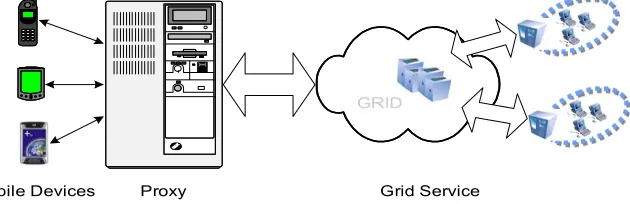
In our system, there are mobile devices, proxy devices, and Grid services. Mobile devices are usually portable but resource-limited devices with various sorts of networking capability. Proxy devices might be a desktop computer or a small server available for nearby mobile devices via the local wireless LAN. It is also connected to the Grid via a high-speed network. All kinds of Grid services are registered at the proxy, providing a convenient mechanism for mobile devices to find the needed Grid service. The requests from mobile devices are first processed on the proxy, and if necessary suitable Grid services requests are invoked. Once the proxy receives the result from the Grid, it generates and serves the appropriate display form to the mobile devices (Figure 1).
[image:4.595.161.476.289.391.2]Mobile Devices Proxy Grid Service
Fig. 1. Outline System Architecture
4.2 Mobile Device Software Architecture
In Figure 2, the Wireless Network Module is responsible for low-level communication with the proxy and other mobile devices through the wireless network protocol. The wireless network protocol could use the IEEE 802.11 families or Bluetooth, depending on resource. The Device Proxy Module is a process responsible for proxy discovery, initializing and terminating the communication between mobile devices and their proxy within the local environment. At present, it uses a mature service discovery protocol (such as UPnP) to discover the nearby proxies in its surrounding network environment.
Device Proxy Module Execution
Module
Personal Information
Module
Cache Module
Wireless Network Module
Device Name
Data Data
Data Data
[image:5.595.147.421.148.317.2]Data Conmmand
Fig. 2. Mobile Device Software Architecture
4.3 Proxy Design
A proxy may be used by many mobile devices at the same time, but these different mobile devices must not affect each other. Virtual machine technology has been adopted to implement the proxy because it enables a single hardware platform to run a number of virtual servers with complete isolation, flexibility, resource control, and ease of cleanup [3].
Mobile Device Proxy Grid Service
Wireless Network Internet
Request for Proxy ID and initializing data
Proxy ID, Name, and connection contract
Request for information, resources, or Grid service Command and raw data
Results and data from execution
Data formulated as appropriate for mobile devices Timeline
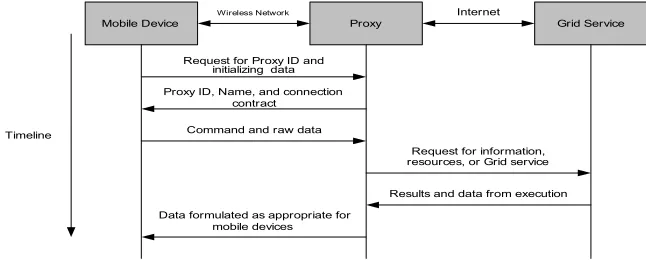
Fig. 3. Interaction Protocol
[image:5.595.144.467.453.583.2]the scope of the proxy, the proxy can transfer the entire application to the Grid, enabling the Grid to execute the program with the full enhanced distributed Grid resources. When the mobile device terminates the connection to the proxy, the proxy manager cleans up the virtual server built for that mobile device and releases the resources allocated for that mobile device.
4.4 Interaction Protocol
Figure 3 shows the interaction protocol which takes place when mobile devices request a Grid service. It is assumed that all of the local Grid services are registered at the proxy. There is a trust relationship between the proxy and the Grid, so that the proxy can interact with the Grid easily and conveniently.
5 Status and Future Work
We are currently implementing this system infrastructure using Grid services. Our first stage is to build a basic device-proxy computing infrastructure to enable interesting applications to be performed which cannot be executed on the resource-constrained mobile devices. We have chosen to use virtual machine technology because it decouples the user-perceived behavior of system resources from the specific implementation providing considerable isolation, flexibility, resource control, and ease of cleanup. To enable mobile devices to make effective use of Grid service, various services need to be deployed on the Grid, involving service descriptions, registries, automatic discovery and composition. Semantic web technology is developing rapidly to information in a standard, machine-processable form, which can be adopted to meet these demands [12]. We anticipate describing Grid services for mobile devices with the OWL-S [13] language. Because OWL-S is not quite ready yet, we will initially adopt the existing approach of describing services with a mature language (e.g. RDF [14]) and move to OWL-S later.
Although the current system infrastructure provides a certain level of security, a more transparent security mechanism needs to be developed. We will investigate multiple lightweight encryption algorithms and suitable authentication mechanisms. User certified models also need to be supported to address the problem that maintaining complex lists becomes infeasible as the number of servers grows [15].
6 Conclusion
objective because such small devices are typically resource-constrained, with limited processing, memory, storage, energy, and network resources. A solution to this challenge is to allow mobile devices to harness Grid services, offloading resource-demanding work to more powerful devices or computer servers. In this paper, we present a system infrastructure that allows mobile devices around us to interact with Grid services using wireless networks. Although many challenges must be overcome before the long-term vision will come into being, our current work has demonstrated the benefit of the existing system infrastructure and shown the combination of the mobility of mobile devices with the processing power of Grid services.
Reference
[1] David De Roure, Nicholas R. Jennings, and Nigel R. Shadbolt, “The semantic Grid: Past, Present and Future”. Procedings of the IEEE 93(3), March, 2005, pp. 669-681.
[2] M. Satynanrayanan. “Pervasive Computing: Vision and Challenges”, IEEE Personal Communication, Volume 8, Issue 4, 2001, pp. 10-17
[3] Sachin Goyal and John Carter, “A Lightweight Secure Cyber Foraging Infrastructure for Resource-Constrained Devices”. Appears in Sixth IEEE Workshop on Mobile Computing Systems and Applications (WMCSA2004), pp. 186-195
[4] Ya-Yunn Suu and Jason Flinn. “Slingshot: Deploying Stateful Services in Wireless Hotspots”. Appear in the 3rd Annual Conference on Mobile Systems, Applications, and Services (MOBISYS '05), Seattle, WA, June 2005, pp79-92
[5] David E. Millard, Arouna Woukeu, Feng(Barry) Tap, Hugh C. Davis. “Experiences with Writing Grid Clients for Mobile Devices”. Proc' of 1st International ELeGI Conference, Vico Equense - Napoli(Italy), 2005
[6] D.Chu, and M.Humphrey, "Mobile OGSI.NET: Grid Computing on Mobile Devices", 5th IEEE/ACM International Workshop on Grid Computing - Grid2004 (at Supercomputing 2004). Nov 8 2004, Pittsburgh, PA
[7] Stan Kurkovsky, Bhagyavatim Arris Ray, and Mei Yang, “Modeling a Grid-Based Problem Solving Environment for Mobile Devices”, In Proceedings of the International Conference on Information Technology: Coding and Computing (ITCC’04), Las Vegas, Nevada, April 05-07, 2004
[8] Bhagyavati and S. Kurkovsky. “Wireless Grid Enables Ubiquitous Computing”. In Proceedings of the International Conference on Parallel and Disttributed Computing Systems (PDCS-2003), Reno, NV, Aug, 2003
[9] GT3: www.globus.org/toolkit/ [10] OGSI: www.gridforum.org/ogsi-wg/
[11] Rajesh Balan, Jason Flinn, M.Satyanarayanan, Shafeeq Sinnamohideen and Hen-I Yang, “The Case for Cyber Foraging”, In 10th ACM SIGOPS European Workshop, 2002 [5], pp. 411-428
[12] Ryusuke Masuoka, Bijan Parsia, and Yannis Labrou, "Task computing: the Semantic Web neets Pervasive Computing". the Second International Semantic Web Conference (ISWC 2003), Sanibel Island, FL, USA October 2003
[13] OWL-S: www.w3.org/Submission/OWL-S/ [14] RDF: www.w3.org/RDF/