A. Emir G¨umr¨uk¸c¨uo˘glu,1 Mehdi Saravani,2 and Thomas P. Sotiriou2, 3 1
Institute of Cosmology and Gravitation, University of Portsmouth, Portsmouth PO1 3FX, UK 2School of Mathematical Sciences, University of Nottingham, University Park, Nottingham, NG7 2RD, UK 3
School of Physics and Astronomy, University of Nottingham, University Park, Nottingham, NG7 2RD, UK
The recent detection of gravitational wave GW170817 has placed a severe bound on the deviation of the speed of gravitational waves from the speed of light. We explore the consequences of this detection for Hoˇrava gravity.
I. INTRODUCTION
Hoˇrava gravity [1] has been proposed as an ultraviolet (UV) complete theory for the gravitational interaction. The improved behaviour at high energies is due to the presence of higher-order terms in spatial derivatives and this requires violations of local Lorentz invariance. The action of Hoˇrava gravity is [1, 2]
S= M 2 p 2
Z
N dt√hd3x
KijKij−λ K2+ξ(3)R+η aiai
+ 1
M2 ?
L4+ 1
M4 ?
L6
. (1)
N,Ni, andg
ij are the lapse function, the shift and the induced metric on a given spacetime foliation by spacelike hypersurfaces, whileKij is their extrinstic curvature. L4 and L6 contain terms that are fourth-order and sixth-order in spatial derivatives, respectively. Hence, they contribute fourth and sixth powers of momenta in the dispersion relations. These contributions are suppressed at momenta below some scaleM∗, where the theory be-comes effectively an infrared (IR) modification of General Relativity (GR), but dominate in the UV and are ex-pected to render interactions renormalizable. The action is not invariant under the full group of diffeomorphisms, but only under diffeomorphisms that respect the folia-tion. This underscores that the foliation is preferred.
The first line of eq. (1) can be thought of as the IR limit of Hoˇrava gravity. Elevating the space-time symmetry to full diffeomorphisms by introducing a St¨uckelberg field
φ, one can write the IR action as [3]
SIR=
M2 Æ 2
Z √
−g d4x
(4)R+α uµuν
∇µuα∇νuα
−β∇µuν∇νuµ−γ(∇µuµ)2
, (2)
where we defineduµ≡ −∇µφ/
√
−∇νφ∇
νφ. This action coincides with the first line of action (1) after the partial gauge fixingφ=tand with the following correspondence of parameters through
λ = 1 +γ
1−β , η = α
2(1−β),
ξ= 1
1−β , M
2
p= (1−β)M 2
Æ. (3)
Moreover, the covariant formulation is equivalent to a re-stricted version of the Einstein-Æther theory [4], in which the æther is forced to be hypersurface-orthogonal at the level of the action (i.e. before the variation) [5]. The correspondence of parameters is given in Appendix A.
Hoˇrava gravity propagates two tensor and one scalar polarization. All three polarizations satisfy higher-order dispersion relations, as mentioned earlier. Their speeds in the infrared limit are
c2T = 1
1−β , c
2 S=
(2−α)(γ+β)
α(1−β)(2 + 3γ+β). (4)
The recent detection of a binary neutron star merger with coincident gamma ray emission has introduced remark-ably strong constraints on cT [6]. The purpose of this brief note is to discuss the implications of this constraint for Hoˇrava gravity and to clarify how this constraint can be effectively combined with existing ones. It has recently been pointed out in Ref. [7] that the speed of the scalar polarisation is almost unconstrained and our results high-light that this feature persists even after GW170817.
It is worth pointing out that our focus is on infrared viability. Hence, the higher order terms contained inL4 and L6 in action (1) will not be relevant and we will not attempt to give them explicitly. We will, however, discuss constraints on M? and mention how theoretical considerations related to the UV properties of the theory can restrict M?. We will also not consider any version of Hoˇrava gravity where additional restrictions of the ac-tion are considered in order to reduce the numbers of independent couplings, e.g. [8–12]. Even though some of these restricted models have been shown to have in-teresting properties — the so called ‘projectable’ theory [8], for instance, has been shown to be renormalizable beyond power-counting [13]1 — they also tend to suffer from infrared viability issues [16–22].
II. DIRECT CONSTRAINTS AND BOUNDS
In this section we list all of the available constraints in terms of the parameters (α, β, γ) of action (2).
1Projectable theory in 2+1 dimensions [14] has actually been shown to be asymptotically free [15].
dient terms should have the right sign for stability [2]:
0< α <2, β <1. (6)
This condition, along with the previous one ensures that c2
T andc2S are always positive.
3. BBN. Cosmology provides further constraints. On a cosmological background, the effective gravita-tional constant that appears in the Friedmann equation is [2]
GC=
1 4πM2
Æ(2 + 3γ+β)
, (7)
while from the Newtonian limit, one can infer [23]
GN =
1 8π M2
Æ(1−α/2)
. (8)
This effective gravitational constant affects the expansion rate during Big Bang Nucleosynthesis (BBN) with respect to the standard one. As a re-sult the primordial helium abundance is modified by [24, 25]
∆Yp= 0.08
G
C
GN
−1
. (9)
Using the current bound|∆Yp|<0.01 (99.7% C.L.) [26–28] we obtain the following constraint
α+ 3γ+β
2 + 3γ+β
< 1
8. (10)
4. Vacuum Cherenkov bounds. Photons could decay into spin-2 or spin-0 modes in vacuum when Lorentz symmetry is violated. Cosmic rays pro-vide a lower bound on the speed of gravitational polarizations [29]. Specific constraints for Einstein-Æther theory have been derived in Ref. [30] and they exclude subluminal propagation to very high precision.2 There is no detailed calculation for
2 There is no compelling reason to a priori exclude
superlumi-nal propagation, unlike what seems to be suggested in Ref. [30]. Hence, vacuum Cherenkov constraints are one-sided.
|α1|<10−4,
|α2|<4×10⁻⁷. (11)
Using the weak field expressions for Hoˇrava gravity [3, 32], these constraints translate into
4 (α−2β) 1−β
.
10−4,
α
−2β
2−α 1−
(α−2β)(1 +β+ 2γ) (1−β)(β+γ)
.
10−7.
(12)
6. Binary pulsars. The presence of a scalar polarisa-tion can lead to dipolar emission and this would affect the dynamics of binary pulsars. The cor-responding bounds are discussed in details in Ref. [33]. Figs. 1b and 8 of Ref. [33] present the constraints on the α= 2β plane. We will not re-produce these figures here. On this plane the ppN parameters α1 and α2 vanish but, as will be dis-cussed below, considering this plane is no longer well motivated.
7. Black holes. The structure of isolated black holes can, in principle, provide constraints [34–37]. How-ever, such constraints are significantly weaker than the binary pulsar constraints (at least on the α= 2β plane).
8. Gravitational Waves. The observation of the binary neutron star merger GW170817 with coincident gamma ray emission [6] yields
−3×10⁻¹⁵≤cT −1≤7×10⁻¹⁶, (13) which implies that
|β|.10−15. (14) Gravitational wave observations also provide a very mild lower bound onM? of the order ofeV [7, 38]. This bound comes from considering the effect of the p4 term in the dispersion relation (where pis momentum) that is suppressed byM2
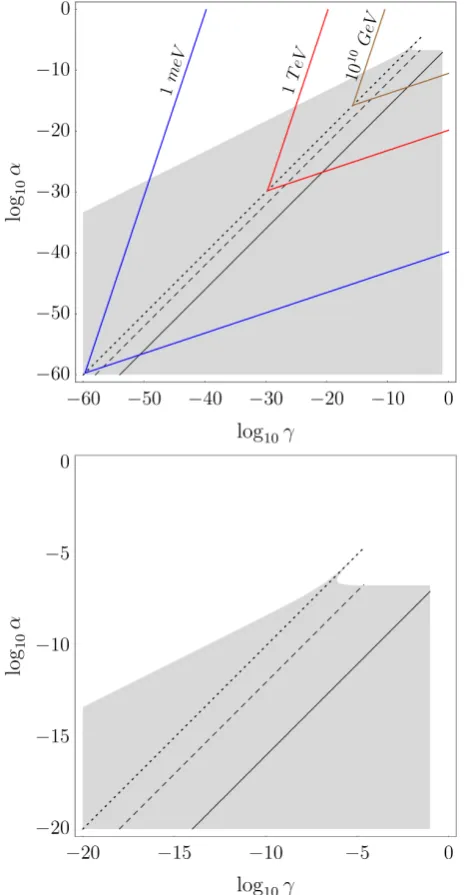
FIG. 1: The grey area shows the region of parameter space which is compatible with the constraints (Sec. (II)) forβ= 0. The dotted, dashed and solid lines
correspond to cS = 1,cS = 10 andcS = 1000, respectively. The blue, red and brown lines show
MSC = 1 meV,MSC = 1 TeV andMSC = 1010 GeV. The lower panel focuses on the regionα , γ >10−20.
III. THEORETICAL CONSIDERATIONS AND INDIRECT CONSTRAINTS
The direct observational bounds obtained in the previ-ous Section affect mainly the parameters of the IR effec-tive theory. The parameters that become relevant in the UV are very weakly affected. In particular, gravitational waves provide only a very weak bound of M?, as men-tioned above. In principle, laboratory test of gravity at
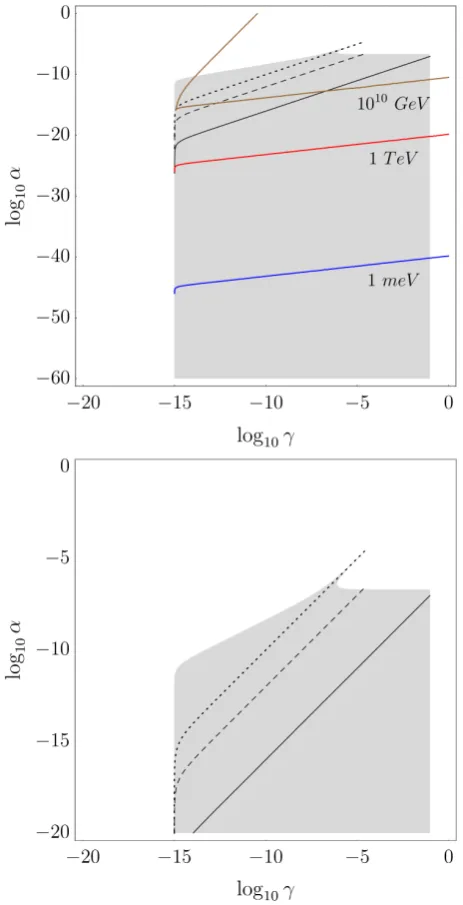
FIG. 2: Same as Fig. 1 but forβ= 10−15.
small length scales can place a direct lower bound onM? (as an energy scale), but current precision would place this bound in the meV range [39], so it would be also particularly weak.
[image:3.595.329.556.54.503.2]FIG. 3: Same as Fig. 1 but forβ=−10−15.
dimension operators in the standard model [41]. It has been suggested that the weak coupling between gravity and matter might suffice to suppress the percolation [42] but it is not clear how well this works in practice for Hoˇrava gravity [43–45].
Irrespective of the details, it is intuitive that experi-ments will impose a lower bound on M?. Interestingly, theoretical considerations can yield an upper bound. This is because the IR part of Hoˇrava gravity, or equiv-alently action (2) exhibits strong coupling at a certain scaleMSC [20]. In particular, derivative self-interactions of the scalar mode compromise perturbativity. Provided thatMSCis sufficiently high, strong coupling is not an is-sue for infrared viability. However, power-counting renor-malizability for Hoˇrava gravity has been argued on the
TheMSC can been calculated in the decoupling limit, which for action (2) corresponds toMÆ2 → ∞while keep-ing αM2
Æ, βMÆ2, γMÆ2 fixed. This requires α, β, γ → 0. A detailed calculation was presented in Ref. [21]. It is worth pointing out that β has been set to zero there. This can indeed be done without loss of generality by a suitable time rescaling in action (1) or field redefini-tions in action (2). We have avoided it here because the rescaling affects the various speeds. We discuss in more details how what we report corresponds to the results of Ref. [21] in Appendix B.
In the limit where (α, β, γ) 1 (consistent with the decoupling approximation),MSCcan have one of two dif-ferent values depending on the magnitude ofc2
S, namely
MSC ≈
(√
αMÆc 3/2 S , c
2 S <1
√
αMÆc
−1/2 S , c
2 S >1
. (15)
It is worth stressing that when (α, β, γ)1, and hence in the decoupling limit as well,MÆ∼Mpand both scales could be taken to be equal to the gravitational coupling scale as measured by experiments.
IV. ALLOWED REGION OF THE PARAMETER
SPACE
Prior to GW170817, ppN constraints were considered particularly restrictive because, assuming that β 1, they require|α−2β|.10−4. Hence, they restrict the 3-dimensional parameter space to a 2-3-dimensional surface with a width of 10−4. All other constraints were either one-sided or weaker, so it was common practice to impose
α= 2β in order to satisfy both ppN bounds to infinite accuracy (modulo tunings) and present graphically ex-isting and new constraints on theα= 2β plane, see for example Refs. [33, 34, 37]. The double-sided constraint oncT or β from GW170817 changes the picture drasti-cally. The allowed region of theα= 2β plane shrinks to a line segment with width less than 10−15, as one can al-ways think of this plane as parametrised byβ itself and some other combination of the couplings (c.f. with the figures in Refs. [33, 34, 37]).
the region α, γ > 10−20. The dotted, dashed and solid lines correspond to choice ofαandγthat lead tocS = 1,
cS = 10 andcS = 1000, respectively. They have been in-cluded to highlight that thecS remains virtually uncon-strained. It should be stressed that we have not imposed the vacuum Cherenkov constraints. Imposing them in a conservative fashion corresponds to excluding the part of the shaded region above the c2
S = 1 dotted line in each plot.
V. DISCUSSION
The detection of gravitational waves with an electro-magnetic counterpart (GW170817), emitted by a binary neutron star merger, has put a stringent constraint on the speed of tensor modes. This translates to the tight-est constraint so far in one of the parameters of Hoˇrava gravity and it motivates revisiting the allowed region of the 3-dimensional parameter space. Instead of focussing on the 2-d plane that leads to exact agreement with gen-eral relativity in the weak field limit, as had been done in the literature so far, we focussed on 2-dimensional sec-tions that satisfy the gravitational wave speed constraint and considered all other known constraints. The graphic representation of these constraints turns out to be quite illuminating in at least two respects:
1. The strong coupling scaleMSC is bounded from be-low by the Lorentz breaking scaleM?, as discussed extensively in the text. M?is in turn bounded from below by observations that probe the higher order terms in the dispersion relation. Improving bounds on M? can hence reduce the parameter space sig-nificantly or rule out Hoˇrava gravity entirely as a perturbatively renormalizable theory of gravity.
2. Even though the constraints on the parametersα,β
andγare very tight, the speed of the scalar polari-sation remains virtually unconstrained. This stems from the type of dependencecShas on these param-eters and, more fundamentally, from the fact that the limit to general relativity is not smooth. Re-markably, even a very mild constraint oncS would rule out a vast portion of the parameter space.
The aboves motivate finding novel ways to improve con-straints onM? andcS.
The prospects of measuring or constrainingcS and its importance in the context of Lorentz violations in gravity have been recently discussed in Ref. [7]. In the context of Hoˇrava gravity, one could hope to obtain stricter bounds on M? and cS by precise gravitational waveform mod-elling. In principle, trustworthy bounds onM?could also be obtained from nongravitational experiments (along the lines of Ref. [40]), if percolations of Lorentz symme-try from gravity to matter were well understood. Both prospects are quite challenging but would significantly enhance our understanding of the role of Lorentz sym-metry in gravitation.
ACKNOWLEDGMENTS
We are grateful to Ted Jacobson and Tony Padilla for illuminating discussions. AEG acknowledges financial support from the European Research Council (ERC) un-der the European Union’s Horizon 2020 research and in-novation programme (grant agreement 646702 ”CosTes-Grav”). M.S. is supported by the Royal Commission for the Exhibition of 1851. TPS acknowledges funding from the European Research Council under the European Union’s Seventh Framework Programme (FP7/2007-2013) / ERC grant agreement n. 306425 “Challenging General Relativity” and partial support from the STFC Consolidated Grant ST/P000703/1. TPS would also like to acknowledge networking support by the COST Action GWverse CA16104.
Appendix A: Correspondence with hypersurface orthogonal Einstein-Æther theory
The action for Einstein-Æther theory [4] is given by
S =M 2 Æ 2
Z √
−g d4x[(4)R−c1∇µuν∇µuν
−c2(∇µuµ)2−c3∇µuν∇νuµ +c4uαuβ∇αuµ∇βuµ], (A1) where the norm of the æther field is constrained by
uµuµ=−1. If the æther field is hypersurface orthogonal it can simply be written as the (normalized) gradient of a single scalar:
uµ=−
∇µφ
√
−∇νφ∇νφ
. (A2)
When this form of the vector field is imposed at the level of the action,i.e. before the variation, thec1term is no longer independent, and can be written as a combination of thec3 and c4. The resulting action matches the one in Eq. (2), and the correspondence of parameters is
α=c1+c4, β=c1+c3, γ=c2. (A3)
Appendix B: Time rescaling and the value ofβ
parameter
In action (1) one can setξ= 1 by performing the time rescaling
d˜t=pξdt . (B1)
be emphasized that the speed of light also changes and, assuming it was 1 initially, it becomes √1−β after ei-ther of the two equivalent procedures discussed above. The complete mapping of couplings is
˜
α=α , γ˜= γ+β 1−β
˜
β = 0, M˜Æ2 =p1−βMAE2 , (B2) where an overtilde denotes the new couplings.
Ref.[21] performs calculations in the decoupling limit but it resorts to this limit after having set ˜β to zero as described above. Hence, the limit is taken to be
˜
MÆ2 → ∞ while keeping ˜αM˜Æ2,˜γM˜Æ2 fixed. This im-plies that ˜α,γ˜ → 0. while there is no further explicit reference to β. The speed of the scalar polarisation in this limit is ˜c2
dec = ˜γ/α˜. In the process of determining the smallest suppression scale for cubic interactions, and therefore identifying the strong coupling scale, the au-thors of Ref.[21] impose ˜cdec ≤1, with the justification
Lorentz violating theory with a preferred foliation there is no pertinent reason to exclude superluminal propaga-tion. On the contrary, the vacuum Cherenkov bounds disfavour subluminal modes.
The decoupling limit as defined in Sec. III is M2 Æ →
∞while keepingαM2
Æ, βMÆ2, γMÆ2 fixed. This requires
α, β, γ→0, so it does not correspond exactly to the limit taken in Ref.[21]. However, whenβ →0 there is perfect agreement. Moreover, ˜c2dec ∼ c2S and the first point of caution above becomes moot. Indeed, following the line of Ref. [21] but relaxing the assumption ˜cdec ≤ 1, the strong coupling scale is
MSC =
(√
αMÆc 3/2
S (1−β)3/4, c2S(1−β)<1
√
αMÆc
−1/2
S (1−β)− 1/4, c2
S(1−β)>1
where we have purposefully not taken the limit β →
0. These expressions agree with that of eq. (15) when
α, β, γ1.
[1] P. Horava, Phys. Rev. D 79, 084008 (2009) doi:10.1103/PhysRevD.79.084008 [arXiv:0901.3775 [hep-th]].
[2] D. Blas, O. Pujolas and S. Sibiryakov, Phys. Rev. Lett. 104, 181302 (2010) doi:10.1103/PhysRevLett.104.181302 [arXiv:0909.3525 [hep-th]].
[3] D. Blas, O. Pujolas and S. Sibiryakov, JHEP1104, 018 (2011) doi:10.1007/JHEP04(2011)018 [arXiv:1007.3503 [hep-th]].
[4] T. Jacobson and D. Mattingly, Phys. Rev. D 64, 024028 (2001) doi:10.1103/PhysRevD.64.024028 [gr-qc/0007031].
[5] T. Jacobson, Phys. Rev. D 81, 101502 (2010) Erratum: [Phys. Rev. D 82, 129901 (2010)] doi:10.1103/PhysRevD.82.129901, 10.1103/Phys-RevD.81.101502 [arXiv:1001.4823 [hep-th]].
[6] B. P. Abbottet al.[LIGO Scientific and Virgo and Fermi-GBM and INTEGRAL Collaborations], Astrophys. J. 848, no. 2, L13 (2017) doi:10.3847/2041-8213/aa920c [arXiv:1710.05834 [astro-ph.HE]].
[7] T. P. Sotiriou, arXiv:1709.00940 [gr-qc].
[8] T. P. Sotiriou, M. Visser and S. Weinfurt-ner, Phys. Rev. Lett. 102, 251601 (2009) doi:10.1103/PhysRevLett.102.251601 [arXiv:0904.4464 [hep-th]].
[9] S. Weinfurtner, T. P. Sotiriou and M. Visser, J. Phys. Conf. Ser. 222, 012054 (2010)
doi:10.1088/1742-6596/222/1/012054 [arXiv:1002.0308 [gr-qc]].
[10] P. Horava and C. M. Melby-Thompson, Phys. Rev. D 82, 064027 (2010) doi:10.1103/PhysRevD.82.064027 [arXiv:1007.2410 [hep-th]].
[11] D. Vernieri and T. P. Sotiriou, Phys. Rev. D85, 064003 (2012) doi:10.1103/PhysRevD.85.069901, 10.1103/Phys-RevD.85.064003 [arXiv:1112.3385 [hep-th]].
[12] D. Vernieri and T. P. Sotiriou, J. Phys. Conf. Ser.453, 012022 (2013) doi:10.1088/1742-6596/453/1/012022 [arXiv:1212.4402 [hep-th]].
[13] A. O. Barvinsky, D. Blas, M. Herrero-Valea, S. M. Sibiryakov and C. F. Steinwachs, Phys. Rev. D93, no. 6, 064022 (2016) doi:10.1103/PhysRevD.93.064022 [arXiv:1512.02250 [hep-th]].
[14] T. P. Sotiriou, M. Visser and S. Weinfurtner, Phys. Rev. D 83, 124021 (2011) doi:10.1103/PhysRevD.83.124021 [arXiv:1103.3013 [hep-th]].
[15] A. O. Barvinsky, D. Blas, M. Herrero-Valea, S. M. Sibiryakov and C. F. Steinwachs, arXiv:1706.06809 [hep-th].
[16] T. P. Sotiriou, M. Visser and S. Weinfurtner, JHEP 0910, 033 (2009) doi:10.1088/1126-6708/2009/10/033 [arXiv:0905.2798 [hep-th]].
[17] C. Charmousis, G. Niz, A. Padilla and P. M. Saffin, JHEP 0908, 070 (2009) doi:10.1088/1126-6708/2009/08/070 [arXiv:0905.2579 [hep-th]].
0910, 029 (2009) doi:10.1088/1126-6708/2009/10/029 [arXiv:0906.3046 [hep-th]].
[19] K. Koyama and F. Arroja, JHEP 1003, 061 (2010) doi:10.1007/JHEP03(2010)061 [arXiv:0910.1998 [hep-th]].
[20] A. Papazoglou and T. P. Sotiriou, Phys. Lett. B 685, 197 (2010) doi:10.1016/j.physletb.2010.01.054 [arXiv:0911.1299 [hep-th]].
[21] I. Kimpton and A. Padilla, JHEP 1007, 014 (2010) doi:10.1007/JHEP07(2010)014 [arXiv:1003.5666 [hep-th]].
[22] S. Mukohyama, Class. Quant. Grav.27, 223101 (2010) doi:10.1088/0264-9381/27/22/223101 [arXiv:1007.5199 [hep-th]].
[23] T. Jacobson, PoS QG-PH, 020 (2007) [arXiv:0801.1547 [gr-qc]].
[24] X. l. Chen, R. J. Scherrer and G. Steigman, Phys. Rev. D 63, 123504 (2001) doi:10.1103/PhysRevD.63.123504 [astro-ph/0011531].
[25] S. M. Carroll and E. A. Lim, Phys. Rev. D 70, 123525 (2004) doi:10.1103/PhysRevD.70.123525 [hep-th/0407149].
[26] Y. I. Izotov, T. X. Thuan and N. G. Guseva, Mon. Not. Roy. Astron. Soc. 445 (2014) no.1, 778 doi:10.1093/mnras/stu1771 [arXiv:1408.6953 [astro-ph.CO]].
[27] E. Aver, K. A. Olive and E. D. Skillman, JCAP 1507, no. 07, 011 (2015) doi:10.1088/1475-7516/2015/07/011 [arXiv:1503.08146 [astro-ph.CO]].
[28] C. Patrignani et al. [Particle Data Group], Chin. Phys. C 40, no. 10, 100001 (2016). doi:10.1088/1674-1137/40/10/100001
[29] G. D. Moore and A. E. Nelson, JHEP0109, 023 (2001) doi:10.1088/1126-6708/2001/09/023 [hep-ph/0106220]. [30] J. W. Elliott, G. D. Moore and H. Stoica, JHEP
0508, 066 (2005) doi:10.1088/1126-6708/2005/08/066 [hep-ph/0505211].
[31] C. M. Will, Living Rev. Rel.9, 3 (2006) doi:10.12942/lrr-2006-3 [gr-qc/0510072].
[32] D. Blas and H. Sanctuary, Phys. Rev. D 84, 064004 (2011) doi:10.1103/PhysRevD.84.064004 [arXiv:1105.5149 [gr-qc]].
[33] K. Yagi, D. Blas, E. Barausse and N. Yunes, Phys. Rev. D89, no. 8, 084067 (2014) Erratum: [Phys. Rev. D90, no. 6, 069902 (2014)] Erratum: [Phys. Rev. D 90, no. 6, 069901 (2014)] doi:10.1103/PhysRevD.90.069902, 10.1103/PhysRevD.90.069901,
10.1103/Phys-RevD.89.084067 [arXiv:1311.7144 [gr-qc]].
[34] E. Barausse, T. Jacobson and T. P. Sotiriou, Phys. Rev. D 83, 124043 (2011) doi:10.1103/PhysRevD.83.124043 [arXiv:1104.2889 [gr-qc]].
[35] E. Barausse and T. P. Sotiriou, Phys. Rev. Lett.109, 181101 (2012) Erratum: [Phys. Rev. Lett. 110, no. 3, 039902 (2013)] doi:10.1103/PhysRevLett.110.039902, 10.1103/PhysRevLett.109.181101 [arXiv:1207.6370 [gr-qc]].
[36] E. Barausse and T. P. Sotiriou, Phys. Rev. D 87, 087504 (2013) doi:10.1103/PhysRevD.87.087504 [arXiv:1212.1334 [gr-qc]].
[37] E. Barausse and T. P. Sotiriou, Class. Quant. Grav. 30, 244010 (2013) doi:10.1088/0264-9381/30/24/244010 [arXiv:1307.3359 [gr-qc]].
[38] B. P. Abbottet al.[LIGO Scientific and VIRGO Collab-orations], Phys. Rev. Lett. 118, no. 22, 221101 (2017) doi:10.1103/PhysRevLett.118.221101 [arXiv:1706.01812 [gr-qc]].
[39] E. G. Adelberger, J. H. Gundlach, B. R. Heckel, S. Hoedl and S. Schlamminger, Prog. Part. Nucl. Phys. 62, 102 (2009). doi:10.1016/j.ppnp.2008.08.002
[40] S. Liberati, L. Maccione and T. P. Sotiriou,
Phys. Rev. Lett. 109, 151602 (2012)
doi:10.1103/PhysRevLett.109.151602 [arXiv:1207.0670 [gr-qc]].
[41] R. Iengo, J. G. Russo and M. Serone, JHEP 0911, 020 (2009) doi:10.1088/1126-6708/2009/11/020 [arXiv:0906.3477 [hep-th]].
[42] M. Pospelov and Y. Shang, Phys. Rev. D 85, 105001 (2012) doi:10.1103/PhysRevD.85.105001 [arXiv:1010.5249 [hep-th]].
[43] M. Colombo, A. E. Gumrukcuoglu and T. P. Sotiriou, Phys. Rev. D 91, no. 4, 044021 (2015) doi:10.1103/PhysRevD.91.044021 [arXiv:1410.6360 [hep-th]].
[44] M. Colombo, A. E. Gumrukcuoglu and T. P. Sotiriou, Phys. Rev. D 92, no. 6, 064037 (2015) doi:10.1103/PhysRevD.92.064037 [arXiv:1503.07544 [hep-th]].
[45] A. Coates, M. Colombo, A. E. Gumrukcuoglu and T. P. Sotiriou, Phys. Rev. D 94, no. 8, 084014 (2016) doi:10.1103/PhysRevD.94.084014 [arXiv:1604.04215 [hep-th]].