IOP Conference Series: Materials Science and Engineering
PAPER • OPEN ACCESS
Finite element analysis of rectangular reinforced concrete columns
wrapped with FRP composites
To cite this article: Abdurra’uf M Gora et al 2018 IOP Conf. Ser.: Mater. Sci. Eng. 431 072005
View the article online for updates and enhancements.
1234567890‘’“”
14th International Conference on Concrete Engineering and Technology IOP Publishing IOP Conf. Series: Materials Science and Engineering 431 (2018) 072005 doi:10.1088/1757-899X/431/7/072005
Finite element analysis of rectangular reinforced concrete
columns wrapped with FRP composites
Abdurra’uf M Gora1*, Jayaprakash Jaganathan2, M P Anwar3, U Johnson
Alengaram4
123 Department of Civil Engineering, University of Nottingham Malaysia
4 Faculty of Engineering, Department of Civil Engineering, University of Malaya, Kuala Lumpur, Malaysia
*Email: [email protected]/[email protected]
Abstract. Fibre reinforced polymer (FRP) wrapping of reinforced concrete (RC) columns has
increasingly become the most suitable method used to strengthen and rehabilitate RC columns. It is clear that limited studies have investigated the behaviour of eccentrically loaded RC columns wrapped with FRP composites. In the present study, a three-dimensional finite element (FE) model was developed to simulate the behaviour of rectangular RC columns wrapped with glass fibre-reinforced polymer (GFRP) sheets under concentric and eccentric loading. The FE model
was developed in the finite element analysis software ANSYS. The variables within the FE model are the number of GFRP layers and the magnitude of load eccentricity. The FE analysis results showed thatGFRP wrapping significantly improved the performance of the strengthened columns by delaying concrete rupture. The presence of load eccentricity reduced the load carrying capacity and performance of the strengthened RC columns. The FE model correlated well with the stress distribution trends observed in the literature.
1. Introduction
Advanced fibre reinforced polymer (FRP) composites are becoming increasingly popular in the strengthening and rehabilitation of damaged civil engineering structures, such as beams, columns and slabs. FRP composites are used to improve load carrying capacity and structural integrity. A considerable number of experimental studies have been undertaken showing how effective FRP composites are in enhancing the structural performance of columns [1–5]. Most studies focused on concentrically loaded RC columns with circular sections. However, it is apparent that most columns are non-circular in section and are subjected to both axial compression and bending.
2 1234567890‘’“”
14th International Conference on Concrete Engineering and Technology IOP Publishing IOP Conf. Series: Materials Science and Engineering 431 (2018) 072005 doi:10.1088/1757-899X/431/7/072005
concentric and eccentric loadings. The primary effort focused on the influence of the number of GFRP wraps and the magnitude of eccentricity of loading on the performance and load carrying capacity of rectangular RC columns wrapped with GFRP.
2. Finite Element Modelling
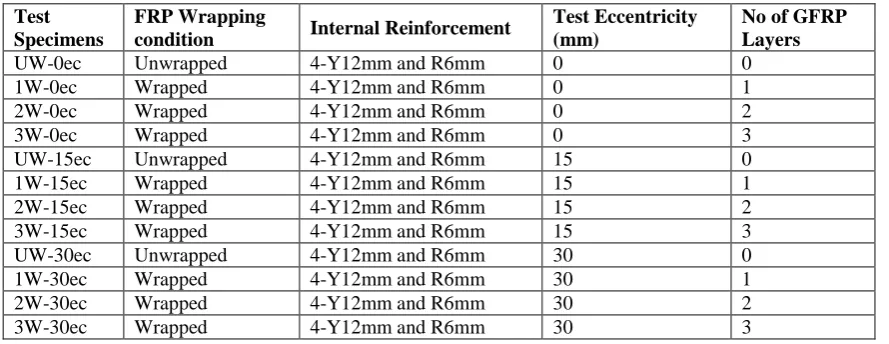
This study develops a nonlinear finite element model for FRP confined rectangular RC columns under eccentric loads. A series of 100 × 150 × 500mm rectangular RC columns were wrapped with one, two and three layers of unidirectional GFRP sheets. Figure 1 illustrates the reinforcement details of the column specimens. All the RC columns have a uniform grade of concrete fco′ = 30MPa. A clear concrete cover of 20mm was used. Table 1 summarizes the details of the test program and the specimen properties. All the column specimens were simulated in ANSYS workbench (Products 18.1) at the University of Nottingham Malaysia. ANSYS is well-established FE engineering simulation program that can execute simple static analysis as well as sophisticated nonlinear dynamic analysis. However, like all other finite element packages, the ANSYS program has its own nomenclature and analysis procedures that need to be specified before executing the analysis. In the present study, SOLID65, SHELL181, LIINK180 and MASS21 were used to model concrete, FRP, steel reinforcement and end corbels, respectively. The following subsections discuss the detailed formulation of the finite element model.
[image:3.595.79.523.352.711.2]Figure1. Details of column specimen
Table 1. Detail of the Column specimens
Test Specimens
FRP Wrapping
condition Internal Reinforcement
Test Eccentricity (mm)
No of GFRP Layers
UW-0ec Unwrapped 4-Y12mm and R6mm 0 0
1W-0ec Wrapped 4-Y12mm and R6mm 0 1
2W-0ec Wrapped 4-Y12mm and R6mm 0 2
3W-0ec Wrapped 4-Y12mm and R6mm 0 3
UW-15ec Unwrapped 4-Y12mm and R6mm 15 0
1W-15ec Wrapped 4-Y12mm and R6mm 15 1
2W-15ec Wrapped 4-Y12mm and R6mm 15 2
3W-15ec Wrapped 4-Y12mm and R6mm 15 3
UW-30ec Unwrapped 4-Y12mm and R6mm 30 0
1W-30ec Wrapped 4-Y12mm and R6mm 30 1
2W-30ec Wrapped 4-Y12mm and R6mm 30 2
3W-30ec Wrapped 4-Y12mm and R6mm 30 3
2.1. Material Properties
2.1.1. Concrete
[image:3.595.78.523.533.705.2]1234567890‘’“”
14th International Conference on Concrete Engineering and Technology IOP Publishing IOP Conf. Series: Materials Science and Engineering 431 (2018) 072005 doi:10.1088/1757-899X/431/7/072005
The material properties required for a SOLID65 element in ANSYS include: elastic modulus (Ec),
ultimate uniaxial compressive strength (fco), ultimate uniaxial tensile strength (modulus of rupture ft),
Poisson’s ratio (v), shear transfer coefficient (βt) and the uniaxial stress-strain relationship for concrete
in compression. The elastic modulus and tensile strength (modulus of rupture) of concrete are calculated using the equations below [9].
𝐸𝑐 = 4700√𝑓𝑐′ (1)
𝑓𝑡 = 0.7√𝑓𝑐′ (2)
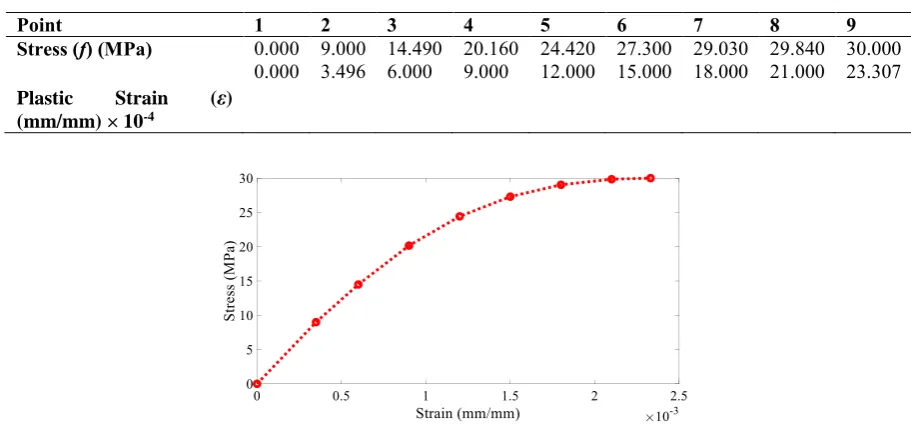
Poisson’s ratio for concrete was assumed to be 0.2 for all the specimens. The shear transfer coefficient is 0.2 for a smooth crack (complete loss of shear transfer) and 0.8 for a rough crack (no loss of shear transfer). The stress-strain curve for concrete is constructed using the numerical expressions proposed by Desayi and Krishnan [10] (equations 3 and 4) together with expressions developed by Grere JM [11] (equation 5). The uniaxial stress-strain relationship for concrete in compression is presented in Table 2 and illustrated in Figure 2.
𝑓 = 𝐸𝑐𝜀
1+(𝜀 𝜀⁄ )𝑜 2
(3)
𝜀𝑜=2𝑓𝑐 ′
𝐸𝑐
⁄ (4)
𝐸𝑐 =𝑓⁄𝜀 (5)
where f is stress at any given strain ε and εo is the strain corresponding to the ultimate compressive
[image:4.595.68.524.398.615.2]strength 𝑓𝑐′.
Table 2.Summary of stress-strain results for concrete 30MPa
Point 1 2 3 4 5 6 7 8 9
Stress (f) (MPa) 0.000 9.000 14.490 20.160 24.420 27.300 29.030 29.840 30.000
Plastic Strain (ε) (mm/mm) × 10-4
0.000 3.496 6.000 9.000 12.000 15.000 18.000 21.000 23.307
Figure 2. Stress-strain curve for grade 30MPa concrete
2.1.2. Steel Reinforcement
The steel reinforcement in RC columns used in this study consisted of a 12mm diameter bar as longitudinal reinforcement and a 6mm diameter bar as a hoop tie with nominal properties: Ese= 2 ×
105MPa, E
sp = 0.01Ese, fy =560MPa, fy' = 290MPa and ν = 0.3.
2.1.3. FRP Composites
4 1234567890‘’“”
[image:5.595.85.507.132.180.2]14th International Conference on Concrete Engineering and Technology IOP Publishing IOP Conf. Series: Materials Science and Engineering 431 (2018) 072005 doi:10.1088/1757-899X/431/7/072005
Table 3. Orthotropic material properties of the GFRP composites [7]
Elastic Modulus (MPa) Poisson’s Ration Ultimate Strength (MPa) Shear Modulus (MPa)
Ex = 65000 vxy = 0.31 Gxy = 1761
Ey = 4000 vyz = 0.39 900 Gyz = 1660
Ez = 4000 vxz = 0.02 Gxz = 1761
2.1.4. End Corbels
To subject the column specimens to an eccentric load, end corbels were provided at the extents of the column. The primary function of the end corbel is to transfer load to the column in the test region. In this study, the end corbel was modelled as a single mass element: MASS21. However, the stiffness behaviour of the end corbels was defined as rigid to prevent deformation and damage in the corbels during the solution process. In this model, a modulus of 200,000MPa was used for the end corbels.
2.2. Modelling and Meshing of Rectangular RC Columns
The geometry was created in the ANSYS workbench design modeler. Due to the longitudinal symmetry, only one-half of the full-size rectangular column was modelled in this study. A rectangular solid with end corbels was first created with specified dimensions and corner radii. A hollow rectangular surface body with a specified thickness and corner radius was also created. A corner radius of 20mm was maintained for all the specimens. The internal steel reinforcements were also created as line bodies within the rectangular solid. In this model, the rectangular solid represents the concrete and the hollow rectangular surface body acts as the bonded FRP composites. Mapped meshing was used to mesh the generated model because it helps in controlling the number of elements/nodes. An element size of 20mm is used to mesh this model. The adjacent mesh nodes of concrete and steel reinforcements were connected using the node merge tool. Figure 3 shows the finite element model of eccentrically loaded GFRP wrapped rectangular RC columns.
Figure 3. Finite element model of eccentrically loaded GFRP wrapped rectangular RC columns
2.3. Boundary Conditions and Load Application
In this model, the y-axis of the coordinate system corresponds to the axis of the rectangular RC column. The following boundary conditions were applied:
The bottom surface of the column was sliced according to the location of the fixed support. All the coupled nodes on the bottom sliced line are restrained from all degrees of freedom in three directions.
[image:5.595.242.354.442.616.2]1234567890‘’“”
14th International Conference on Concrete Engineering and Technology IOP Publishing IOP Conf. Series: Materials Science and Engineering 431 (2018) 072005 doi:10.1088/1757-899X/431/7/072005
2.4. Simulation
The ANSYS program employs the Newton-Raphson method to solve problems that involve nonlinear structural behaviour. In the present nonlinear analysis, the automatic load stepping feature was activated, as it enabled the solver to predict and control the number of load steps. However, the automatic time stepping was defined in terms of steps to enable loads to be applied gradually. The number of sub-steps used varied from 20 to 200 with the minimum sub-step set to 1/200th of the applied load. The large deflection feature in the solver controls was also activated.
3. Results and discussions
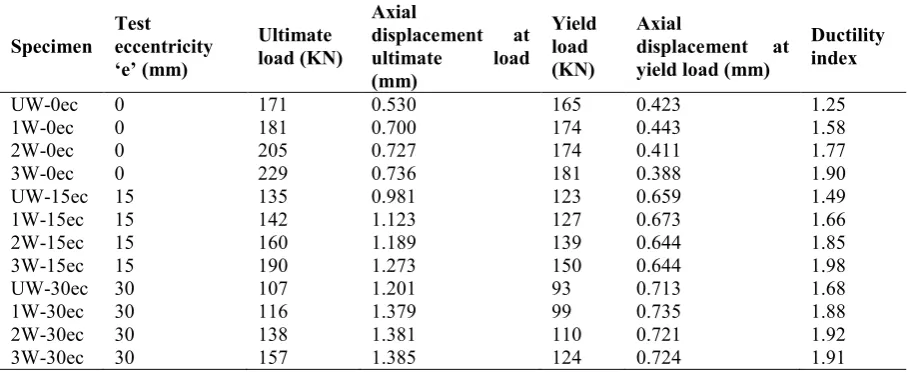
[image:6.595.71.525.299.485.2]A series of twelve rectangular RC concrete columns wrapped with GFRP under concentric and eccentric loads were analysed in ANSYS 18.1. The variables considered in this FE model include the number of GFRP layers and the intensity of load eccentricity. All the simulated column specimens experienced small deformations. The FEA results are summarised in Table 4.
Table 4. Summary of FE analysis results for the simulated columns
Specimen Test eccentricity ‘e’ (mm)
Ultimate load (KN)
Axial
displacement at
ultimate load
(mm)
Yield load (KN)
Axial
displacement at yield load (mm)
Ductility index
UW-0ec 0 171 0.530 165 0.423 1.25
1W-0ec 0 181 0.700 174 0.443 1.58
2W-0ec 0 205 0.727 174 0.411 1.77
3W-0ec 0 229 0.736 181 0.388 1.90
UW-15ec 15 135 0.981 123 0.659 1.49
1W-15ec 15 142 1.123 127 0.673 1.66
2W-15ec 15 160 1.189 139 0.644 1.85
3W-15ec 15 190 1.273 150 0.644 1.98
UW-30ec 30 107 1.201 93 0.713 1.68
1W-30ec 30 116 1.379 99 0.735 1.88
2W-30ec 30 138 1.381 110 0.721 1.92
3W-30ec 30 157 1.385 124 0.724 1.91
3.1. Axial Load-Displacement Behaviour
[image:6.595.181.412.590.721.2]Figure 4 illustrates the load-displacement curves for axially loaded columns. It is evident that the GFRP-wrapped columns experienced a stiffness enhancement with an increase in the number of GFRP wraps. It is also evident that the GFRP wraps have significantly improved the performance and load carrying capacity of the RC columns by increasing their displacement at failure. A maximum load capacity enhancement of 34%, 20% and 6% were realised by columns 3W-0ec, 2W-0ec and 1W-0ec, respectively relative to the unwrapped column.
6 1234567890‘’“”
14th International Conference on Concrete Engineering and Technology IOP Publishing IOP Conf. Series: Materials Science and Engineering 431 (2018) 072005 doi:10.1088/1757-899X/431/7/072005
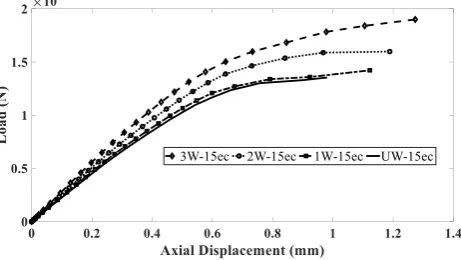
[image:7.595.181.412.195.325.2]The axial load-displacement curves of columns simulated under 15mm of eccentricity are shown in Figure 5. Similar to the axially loaded columns, all the GFRP wrapped columns under 15mm of load eccentricity experienced a significant increase in stiffness with an increasing number of GFRP wraps. Among all the samples, column 3W-15ec achieved the highest maximum load with a 41% enhancement compared to the unwrapped column. Columns 2W-15ec and 1W-15ec achieved a 19% and 5% increase in the maximum load carrying capacity relative to column UW-15ec.
Figure 5. Axial load-displacement curves of the 15mm eccentrically loaded columns
[image:7.595.180.413.415.543.2]Figure 6 shows the axial load-displacement curves for columns simulated under 30mm of load eccentricity. All the GFRP wrapped columns demonstrated a significant increase in performance and load carrying capacity, as well as stiffness enhancement. A maximum load capacity increase of 46%, 29% and 8% were achieved by columns 3W-30ec, 2W-30ec and 1W-30ec relative to column UW-30ec.
Figure 6. Axial load-displacement curves of the n30mm eccentrically loaded columns
3.2. Ductility
The ductility index was utilised in this FE model to assess the influence of the number of GFRP wraps on the performance of the simulated columns. The ductility index ‘μ’ of the columns was defined as the ratio of the axial displacement at ultimate load ∆u to the axial displacement at yield load ∆y:
μ =Displacement at ultimate load ∆u
Displacement at yield load ∆y (6)
1234567890‘’“”
[image:8.595.227.370.115.231.2]14th International Conference on Concrete Engineering and Technology IOP Publishing IOP Conf. Series: Materials Science and Engineering 431 (2018) 072005 doi:10.1088/1757-899X/431/7/072005
Figure 7. Definition of ductility [13]
3.3. Influence of Eccentricity
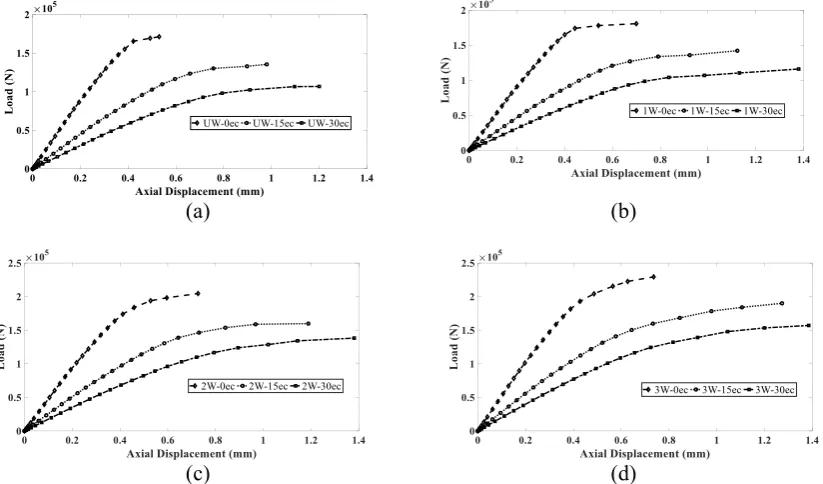
Figure 9 shows the axial load-displacement curves for columns simulated under different eccentricity of loading. The overall performance of the GFRP wrapped columns increases with an increase in the number of GFRP wraps. However, when the columns are subjected to eccentric loading, the columns experienced a decrease in load carrying capacity and performance.
(a) (b)
[image:8.595.92.504.336.578.2]
(c) (d)
Figure 8. Axial load-displacement curves for columns under different eccentricity of loading
(a) (b) (c)
Figure 9. Axial stress distribution in concrete at the plane section of (a) concentrically loaded column (b) eccentrically loaded column (e = 15mm) (c) eccentrically loaded column (e = 30mm)
3.4. Stress Distribution in concrete at the Plane section of the column
8 1234567890‘’“”
14th International Conference on Concrete Engineering and Technology IOP Publishing IOP Conf. Series: Materials Science and Engineering 431 (2018) 072005 doi:10.1088/1757-899X/431/7/072005
with the experimental observations reported by Mirmiran et al. [6], Feng et al. [7] and Youssef et al. [14]. Regarding the eccentrically loaded columns, the stress distribution is maximum in the compression zone and gradually drops to a minimum in the tension zone of the column section.
4. Conclusions
A nonlinear FEA was performed on rectangular RC columns wrapped with GFRP under concentric and eccentric loading. Based on the results, the following conclusions were made:
1. The GFRP wrapping is significant in enhancing the load carrying capacity and ductility of the columns. Columns wrapped with three layers of GFRP wraps achieved the highest maximum load carrying capacity.
2. The GFRP wrapped columns experienced a general loss in load carrying capacity when subjected to eccentricity of loading.
References
[1] A. Ilki and N. Kumbasar, "Compressive Behaviour of Carbon Fibre Composite Jacketed Concrete with Circular and Non-Circular Cross-Sections", Journal of Earthquake Engineering, vol. 7, no. 3, pp. 381–406, 2003.
[2] A. Mirmiran and M. Shahawy, "Behavior of Concrete Columns Confined by Fiber Composites", Journal of Structural Engineering, vol. 123, no. 5, pp. 583–590, 1997.
[3] A. Mirmiran, M. Shahawy, M. Samaan, H. El Echary, J. C. Mastrapa, and O. Pico, "Effect of Column Parameters on FRP-Confined Concrete", Journal of Composites for Construction, vol. 2, no. 4, pp. 175–185, 1998.
[4] S. T. Smith, M. Asce, S. J. Kim, and H. Zhang, "Behavior and Effectiveness of FRP Wrap in the Confinement of Large Concrete Cylinders", Journal of Composites for Construction, vol. 14, no. October, pp. 573–582, 2010.
[5] Garyfalia G. Triantafyllou; Theodoros C. Rousakis; and Athanasios I. Karabinis, "Axially Loaded Reinforced Concrete Columns with a Square Section Partially Confined by Light GFRP Straps", Journal of Composites for Construction, vol. 17, no. 6, pp. 1–9, 2015.
[6] A. Mirmiran, K. Zagers, and W. Yuan, "Nonlinear finite element modeling of concrete confined by fiber composites", Journal of Finite Element in Analysis and Design, vol. 35, pp. 79–96, 2000. [7] P. Feng, X. Z. Lu, and L. P. Ye, "Experimental research and finite element analysis of square concrete columns confined by FRP sheets under uniaxial compression", in 17th Australasian Conference on the Mechanics of Structures and Materials, 2002, pp. 60–65.
[8] K. Willam and E. Warnke, "Constitutive model for the triaxial behavior of concrete", Proceedings of Interna- tional Association for Bridge and Structural Engineering 19,. ISMES, Bergamo, Italy, pp. 1–30, 1975.
[9] Jack C. McCormac, Russell H. Brown, Design of Reinforced Concrete, Ninth., no. 9. United State of America: John Wiley & Sons, 2013.
[10] P. Desayi and S. Krishnan, "Equation for the Stress-strain Curve of Concrete", Journal of the American Concrete Institute, vol. 61, no. 3, pp. 345–350, 1964.
[11] J. M. Gere, Mechanics of Materials, Sixth edit. United State of America: Bill Stenquist, 2004. [12] Y. F. Wu, "The effect of longitudinal reinforcement on the cyclic shear behavior of glass fiber
reinforced gypsum wall panels: Tests", Engineering Structures, vol. 26, no. 11, pp. 1633–1646, 2004.
[13] L. M. Wang and Y. F. Wu, "Effect of corner radius on the performance of CFRP-confined square concrete columns: Test", Engineering Structures, vol. 30, no. 2, pp. 493–505, 2008.
![Table 3. Orthotropic material properties of the GFRP composites [7]](https://thumb-us.123doks.com/thumbv2/123dok_us/8556557.364375/5.595.242.354.442.616/table-orthotropic-material-properties-gfrp-composites.webp)