AN ANALYSIS OF THE PERFORMANCE
CHARACTERISTICS OF CONTINUOUS-WAVE
OPTICAL PARAMETRIC OSCILLATORS
Finlay G. Colville
A Thesis Submitted for the Degree of PhD
at the
University of St Andrews
1995
Full metadata for this item is available in
St Andrews Research Repository
at:
http://research-repository.st-andrews.ac.uk/
Please use this identifier to cite or link to this item:
http://hdl.handle.net/10023/14887
An Analysis of the Performance
Characteristics of Continuous-Wave
Optical Parametric Oscillators.
F. G. Colville
o 0
/.
F, Allen Physics Research Laboratories,
Department of Physics & Astronomy,
University of St, Andrews,
Fife, Scotland,
A thesis submitted to the University of St. Andrews in application for the degree of Doctor of Philosophy,
ProQuest Number: 10166534
All rights reserved INFORMATION TO ALL USERS
The quality of this reproduction is dependent upon the quality of the copy submitted. In the unlikely event that the author did not send a com plete manuscript and there are missing pages, these will be noted. Also, if material had to be removed,
a note will indicate the deletion.
uest
ProQuest 10166534
Published by ProQuest LLO (2017). Copyright of the Dissertation is held by the Author. All rights reserved.
This work is protected against unauthorized copying under Title 17, United States C ode Microform Edition © ProQuest LLO.
ProQuest LLO.
789 East Eisenhower Parkway P.Q. Box 1346
v \
«Ho
X
01
I
CX m V 0g
C1
I
'QY
3
'Q oTI
I
c
U^ T o) tX
Is
ii
l gi*
o «
%
T) Ç/5s •§
ftl
Ut Q)Q)
ÎÎ
Q> ri1 1
Vh to c (QII
i}
0) OI I
:
o
Ü ^
2 I
rs a Wi
0>
cn (A O
N O
E |
§1
II
(Q %^
w(Q 0>
II
il
%
II
I I
If
II
II
I 8
II
(Q (AV '2 (Q C J3 ^
■ I t
^8
f g
It
$ 8Declaration.
I hereby certify that this thesis has been composed by myself, that it is a record of my own work, and that it has not been accepted in partial or complete fulfilment of any other degree or professional qualification.
This research was carried out in the J. F. Allen Physics Research Laboratories w ithin the Departm ent of Physics and Astronomy at the University of St. Andrews, under the supervision of M. H. Dunn.
Certificate.
I hereby certify that the candidate has spent nine terms of research work towards the degree of Doctor of Philosophy in the J. F. Allen Physics Research Laboratories w ithin the Departm ent of Physics and Astronomy at the University of St. Andrews, under my supervision, that he has fulfilled the conditions of Ordinance General No. 12 (St. Andrews), and that he is qualified to submit the following thesis in application for the degree of Doctor of Philosophy.
Abstract.
An analysis of the performance characteristics of
continuous-wave optical parametric oscillators.
F. G. Colville
/. F. Allen Physics Research Laboratories, D epartm ent o f Physics & Astronom y, U niversity o f St. A ndrews, Fife, Scotland.
This thesis gives a description of studies relating to the development of continuous-w ave (cw) optical param etric oscillators (OPOs) and their application to schemes that require high-precision, narrow-linewidth, and frequency-tunable radiation.
There are three separate aims to the work presented within this thesis. First, the requirements on pum p sources, nonlinear materials, OPO cavity resonances and phase-matching geometries are analysed with a view to operating cw OPOs with stability above threshold. Second, the results of four distinct experiments are outlined, compared to theory, and discussed within the general context of cw OPO development. Third, this thesis is the first comprehensive review of the above-mentioned performance characteristics of cw OPOs, and focuses on their role as optical frequency dividers within frequency synthesis chains spanning the optical spectrum.
The modelling sections highlight the importance of cavity resonances in cw OPOs w hen evaluating pum p pow er thresholds, conversion efficiencies, and mode-selection properties. Simultaneous signal and idler cavity resonances are shown to be critical when relying upon cw laser sources to reach OPO threshold powers. Such arrangements require the use of stable pum p lasers and servo-locked OPO cavity lengths to maintain this double resonance condition. There is an in-depth analysis of OPO cavity geometries that can generate frequency-stable and continuously-tunable outputs. The selection of nonlinear materials for cw OPOs is also considered with regard to providing signal and idler frequencies in integral-related frequency ratios, thereby satisfying an im portant requirem ent within optical frequency division techniques.
within cw OPOs; a cw OPO which used a pump source operating in the ultra violet spectral region; the highest frequency output from a cw OPO; a cw OPO which used a tunable pump source operating in the near infra-red spectral region; multiple parameter pum p / OPO coarse frequency tuning; a non degenerate type II cw OPO phase-matching geometry; and a dual-cavity doubly-resonant cw OPO. Other notable features of the experimental designs included stabilized single-frequency output from a single-cavity cw OPO geometry, continuous frequency tuning from a dual-cavity, doubly-resonant OPO resonator, and the general characteristics of low pump power thresholds and moderate conversion efficiencies.
An important feature discussed in detail throughout the thesis is the comparison between type I and type II phase-matching geometries. These two cases give rise to different polarization states for the signal and idler fields within OPO cavities. Type II phase-matching geometries are shown, both in theory and experiments, to be preferable to equivalent type I geometries, when considering stable OPO operation, fine frequency tuning, and multiple cavity oscillators. This is so because type II phase-matching geometries, in general, provide significantly different signal and idler refractive indices which in turn yield a considerable mis-match in the signal and idler free spectral ranges. Subsequently this relaxes the stability requirements within single-cavity doubly-resonant OPOs, and allows for polarization separation to form dual-cavity resonators which are vital to the effective operation of cw OPOs within metrology and spectroscopy.
Contents.
Page.
Chapter
I
Intr
oduction.
1. 1 Tunable radiation from optical parametric oscillators. 1 1. 2 Narrow-linewidth and frequency-stable radiation. 4 1.3 Development of continuous-wave parametric oscillators. 6
1.4 Present requirements for down-conversion schemes. 18 1.5 Outline of the work within the thesis. 19
References. 20
Chapter
II Theoretical background.
II. 1 Introduction. 25
II. 2 Parametric gain analysis. 27
II. 2 (i) The nonlinear susceptibility. 31
II. 2 (ii) The coupled amplitude equations for plane waves. 33 II. 2 (iii) Parametric amplification of focused Gaussian beams. 36
II. 3 Pump power thresholds. 40
II. 3 (i) Ring cavity resonators. 41
II. 3 (i) (a) Doubly-resonant oscillator with resonant pump field. 42 II. 3 (i) (b) Doubly-resonant oscillator with single-pass pump. 53 II. 3 (i) (c) Singly-resonant oscillator with resonant pump field. 55 II. 3 (i) (d) Singly-resonant oscillator with single-pass pump. 57
II. 3 (ii) Ring cavity resonators. 58
II. 3 (ii) (a) Doubly-resonant oscillator with resonant pump field. 59 II. 3 (ii) (b) Doubly-resonant oscillator with non-resonant pump field. 63 II. 3 (ii) (c) Singly-resonant oscillators. 66
II. 3 (iii) Summary. 68
II. 4 Conversion efficiencies. 70
II. 4 (i) Doubly-resonant oscillators. 70
II. 4 (ii) Singly-resonant oscillators. 72
II. 4 (iii) Gaussian wave modifications. 74
II. 5 Tuning, spectral outputs, and stability requirements. 75
II. 5 (i) Coarse frequency tuning. 75
II. 5 (ii) Fine frequency tuning, 75
II. 5 (ii) (a) (1) Singly-resonant oscillator with a non-resonant pump field. 78 II. 5 (ii) (a) (2) Singly-resonant oscillator with a resonant pump field. 80 II. 5 (ii) (a) (3) Singly-resonant oscillator with a multi-mode pump source. 82
II. 5 (ii) (b) Doubly-resonant oscillators. 83
II. 5 (ii) (b) (1) Doubly-resonant oscillator with a non-resonant pump field. 83
II. 5 (ii) (b) (1) (A) Mode-hopping. 86
II. 5 (ii) (b) (1) (B) Stability conditions. 87 II. 5 (ii) (b) (1) (C) Smooth frequency tuning. 91
II. 5 (ii) (b) (2) Computer model. 93
II. 5 (ii) (b) (3) Doubly-resonant oscillator with a resonant pump field. 100
II. 5 (iii) Summary. 101
II. 6 Further properties of the doubly-resonant oscillator. 104
II. 6 (i) Phase-diffusion linewidths and coherence properties. 104
II. 6 (ii) Squeezed states of light. 105
II. 6 (iii) Frequency division and comb generation, 108
II. 7 Mode-matching. 110
II.8 Conclusions. 114
References. 116
Chapter III
Pump sources and nonlinear materials.
III. 1 Introduction. 123
III. 2 Pump sources. 126
III. 2 (i) Pump sources in the ultra-violet spectral region. 130 III. 2 (ii) Pump sources in the visible spectral region. 131 III. 2 (iii) Pump sources in the near infra-red spectral region. 132 III. 2 (iii) (a) Diode-laser pumped Nd-based lasers. 133 III. 2 (iii) (b) Titanium doped sapphire lasers. 133 III. 2 (iii) (c) Single-frequency diode-lasers. 134
III. 3 Nonlinear materials. 135
III. 3 (i) Magnesium-oxide doped lithium niobate (MgOiLiNbOg). 138 III. 3 (i) (a) Type I non-critical phase-matching. 139 III. 3 (i) (b) MgO-.LüMbOs phase-matching conclusions. 140
III. 3 (ii) Potassium niobate (KNbOg). 141
III. 3 (iv) Potassium titanyl arsenate (KTiOAsO^: KTA). Caesium titanyl arsenate (CsTiOAsO^: CTA). III. 3 (iv) (a) Type II non-critical phase-matching in KTA. III. 3 (iv) (b) Type II non-critical phase-matching in CTA. III. 3 (iv) (c) KTA & CTA phase-matching conclusions. III. 3 (v) Lithium triborate (LiBgOg).
III. 3 (v) (a) Type I non-critical phase-matching. III. 3 (v) (b) Type II non-critical phase-matching. III. 3 (v) (c) LBO phase-matching conclusions. III. 3 (vi) Silver gallium selenide (AgGaSe2).
Silver thiogallate (AgGaS2).
III. 3 (vi) (a) Type I non-critical phase-matching in AgGaSe2 -III. 3 (vi) (b) Type I non-critical phase-matching in AgGaS2.
III. 4 Conclusions.
III. 5 Outline of experimental work within this thesis. References. 148 149 150 151 152 154 157 158 159 159 161 162 165 166
Chapter IV
IV. 1 IV. 2 IV. 3 IV. 4 IV. 5 IV. 6IV. 7
Type
I
phase-matching in lithium triborate with signal
and idler frequencies near frequency-degeneracy.
Introduction. 175
Single-frequency pump source operating at 583 THz. 178 Optical parametric oscillator design. 185 Pump frequency and cavity length requirements. 194
Experimental arrangement. 203
Results and discussion. 206
Conclusions. 212
References. 215
Chapter V
Type
II
phase-matching in lithium triborate with
signal and idler frequencies in a near 3:1 ratio.
V. 1 Introduction. 219
V. 2 Single-frequency pump source operating at 824 THz. 222 V. 3 Optical parametric oscillator design. 226 V. 4 Pump frequency and cavity length requirements. 232
V. 5 Experimental arrangement. 238
V. 6 Results and discussion. 240
V. 7 Conclusions. 248
C hapter V I
VI. 1 VI. 2 VI. 3 VI. 4 VI. 5
Dual-cavity, d
oubly-resonant oscillator with separate
signal and idler cavity length control.
Introduction. 253
Optical parametric oscillator design. 257 Pump frequency and cavity length requirements. 258
Results and discussion. 260
Conclusions. 267
References. 270
Chapter VII
VII. 1 VII. 2 VII. 3 VII. 4 VII. 5 VII. 6 VII. 7
Multiple parameter tuning through use of a
frequency-tunable titanium-sapphire laser.
Introduction.
Widely-tunable single-frequency pump source. Optical parametric oscillator design.
Pump frequency and cavity length requirements. Experimental arrangement.
Results and discussion. Conclusions.
References.
273 278 280 284 287 288 290 293
Chapter VII Conclusions.
296Acknowledgements.
Glossary of symbols.
Appendix I.
Appendix II. Appendix III.
Chapter I.
Introduction.
Contents. Page.
1.1 Tunable radiation from optical parametric oscillators. 1 1. 2 Narrow-linewidth and frequency-stable radiation. 4 1.3 Development of continuous-wave parametric oscillators. 6
1.4 Present requirements for down-conversion schemes. 18
1. 5 Outline of the work within the thesis. 19
References. 20
1.1 Tunable radiation from optical parametric oscillators.
Over the last four decades, the introduction of the laser has prom pted significant progress in the fields of optics and spectroscopy. One important attribute of laser sources is their high spectral brightness (flux density per unit solid-angle per unit of frequency interval). This has made possible the study of nonlinear phenomena that are not accessible when using conventional optical sources. While significant advances have been achieved by using lasers as sources of fixed frequency radiation, there has also been considerable interest in developing coherent light sources whose precise operating frequency can be tuned continuously. For example, such tunable sources could be applied within spectroscopy to tune through resonances of interest at any point in the optical spectrum.
A number of nonlinear techniques are available which allow for frequency shifting the radiation of an input laser beam, while maintaining the coherence of the original laser source. These include stimulated Raman scattering, harmonic generation, and sum and difference frequency mixing. However, in general, to obtain tunable output using these processes, one of the input beams is required to be tunable. Another form of frequency shifting involves the use of optical parametric generation [1].
Optical parametric oscillators (OPOs) are generally powerful solid-state sources of coherent radiation with broad tuning ranges, and they have already been demonstrated to be versatile and practical devices [2]. OPOs are similar to conventional lasers, in both converting energy from a primary source to coherent radiation through light amplification in a resonant cavity.
The optical parametric process is a nonlinear optical process in which a pum p photon, propagating in a nonlinear optical crystal, breaks down into two lower-energy photons (termed the signal and the idler), such that the total photon energy is conserved. Radiation is produced simultaneously at these two distinct frequencies which build up from parametric noise: the parametric process relies on the zero point energy (vacuum fluctuations) of one photon per mode as the starting point in the amplitude of the other two waves.
However, the exact frequencies of the two emitted photons cannot be determined uniquely on the basis of energy conservation. For a given pump frequency, there can be a continuous choice of signal and idler frequencies for which energy conservation is satisfied. This forms the basic source of tunability within OPOs. In any given situation, the specific pair of frequencies that will result is dictated by the momentum (phase) conservation condition, or phase-matching condition, that must also be satisfied. Phase-matching dictates that the sum of the wave-vectors of the generated photons is equal to the wave-vector of the pum p photon, thus maintaining the relative phase between the waves.
medium (with a non-centrosymmetric symmetry) to compensate for material dispersion. In this way, the signal and idler frequencies can be amplified sim ultaneously as they propagate through the nonlinear medium in an efficient manner. Gain at the signal and idler frequencies is provided through parametric interaction of the three optical fields with the nonlinear medium. This interaction is a consequence of the nonlinear polarization exhibited by the material.
For a given orientation of the nonlinear crystal with respect to the axis of propagation, conservation of phase-matching will be satisfied for a specific combination of signal and idler frequencies. Therefore, since the refractive indices are dependent on the direction of propagation and on the polarizations of the three waves, the orientation of the nonlinear crystal provides one means for tuning coarsely the output frequencies over a potentially wide spectral bandwidth. In general, the extent of this bandwidth is defined by the optical transparency of the nonlinear material chosen as the gain medium. Another commonly used tuning method involves altering the birefringence through temperature control.
Within experimental OPO configurations, the nonlinear gain element is typically placed within an optical resonator formed by external cavity mirrors, and a pump field is fed into the resonator. At a critical pum ping intensity, or pum p power threshold, parametric gain causes steady-state oscillation to be set up at either the signal or idler frequency, or at both frequencies, as defined by the level of feedback provided by the cavity mirrors at these two frequencies. The fine output frequencies of the OPO correspond to resonances of the optical structure, or are near such resonances.
To stimulate oscillation within a laser cavity, an incoherent pum p source is sufficient as the initial energy source. However, for an OPO, this initial pump source is constrained to be a high intensity source of coherent radiation in its own right. Until recently, the absence of pum p sources of high spectral and spatial coherence had delayed widespread interest in the use of OPOs as practical sources of tunable coherent radiation. This requirement is particularly important since the temporal, spatial, and spectral nature of the OPO outputs reflects that of the input pump source.
the first critical requirement is the use of a narrow-linewidth pump source, and this topic is discussed in the following section.
1.2 Narrow-linewidth and frequency-stable radiation.
A fundamental limit to the linewidth, or frequency bandwidth, of an optical source is the temporal nature of the source. For example, for radiation derived from a Q -sw itched laser, w ith a pulse d u ratio n of At « 10 nanoseconds, the transform -lim ited linew idth is A v«50M H z, assuming a Gaussian pulse shape. Further, if this pump source operates in the visible spectral region, at a pum p w avelength of A « 0.5 pm, corresponding to a frequency of v « 600 THz, then the fractional stability, or precision, of this frequency is known to within ~ 1 part in 10^. While the precision of such laser radiation represents a considerable improvement over conventional sources of optical radiation, it is not accurate enough to be used within a number of high-precision experiments in quantum optics.
The coherence, phase stability, and narrow spectral width of lasers are of p aram ount im portance w ithin the study of high-resolution spectroscopy [3], optical frequency standards [4], fundam ental constant determ ination [5], space-based measurements [6], metrology [7], coherent comm unications [6], and gravitational wave detection [8]. U ltra-high resolution intrinsically requires ultra-narrow laser linewidths, as provided specifically from continuous-wave (cw) laser sources. Therefore, to apply an OPO to generate tunable high precision frequency outputs, the OPO should be pumped by a cw laser source, forming a cw OPO device.
transmission fringe of a laser reference cavity to the frequency of an auxiliary laser which is then frequency-offset-locked to a stable laser such as an iodine- (I2) or methane- (CH4) stabilized He:Ne laser [11].
At present, time and frequency are the most accurately measurable physical quantities [12,13] and so measurements of other physical quantities, if possible, are reduced to measurements of time and frequency; for example, the definition of the speed of light [14]. The current technique for measuring an optical frequency relative to the primary time standard, the caesium beam standard at v « 9.2 GHz, or some intermediate frequency standard (CO2 laser or He:Ne laser), utilizes a complex frequency synthesis chain involving harmonics of laser and klystron sources, which typically occupy the physical space of several optical benches [15,16]. For example, such a method has been extended to the visible spectral region, in which the A ~ 633 nm He:Ne laser has been locked to a molecular iodine transition line, with an accuracy of « 10"^^ [16]. In view of the complexity of such optical frequency synthesis techniques, alternative methods have been proposed for m easuring and synthesizing new frequencies in terms of low-frequency signals that can be controlled by an atomic clock [17 - 20]. Such devices are often called optical frequency dividers.
Nonlinear frequency conversion processes form an integral part of such optical frequency dividers. For example, consider locking the second harmonic frequency of a NdiYAG laser to a hyperfine line of iodine [21], as opposed to the example discussed above (He:Ne laser). Through this method, both the fundamental and the second harmonic frequencies are stabilized in frequency to the one optical standard. Indeed, the available power levels of such diode-laser-pum ped solid-state lasers are sufficient to generate efficiently, through further nonlinear frequency up-conversion stages, a series of stabilized harmonic frequencies throughout the ultra-violet and near infra red spectral regions. Therefore, there are potential advantages when locking discrete frequencies that form part of a chain of harmonically related optical frequencies, and when this chain uses laser oscillators only in the visible and near infra-red spectral regions.
and microwave spectral regions. The OPO is ideally suited to provide such frequency down-conversion, when operated with a cw, narrow-linewidth, frequency-stable pum p source, and when the outputs of the OPO are determined precisely in relation to the pump frequency [20,22].
Therefore, cw OPOs are in principle ideal for implementation within frequency chains although the development of such devices has been particularly slow, with relatively few experimental designs compared to their pulsed counterparts. A brief historical perspective of this progress in outlined in the following section.
I. 3 Development of continuous-wave parametric oscillators.
The first demonstrations of OPOs used high peak power pulsed lasers as their pum p sources [23]. Shortly after these experiments, considerable attention Ifl was directed towards the cw equivalent of these devices, as a source of
■]j continuous-wave, narrow-linewidth, and frequency-tunable radiation.
.^1 The first cw OPO was reported in May 1968 [24], and used the frequency-I doubled multi-longitudinal-mode radiation from a lamp-pumped Nd:YAG laser to pump a doubly-resonant OPO (both signal and idler waves resonant) near frequency degeneracy (signal and idler frequencies approximately equal). From a tuning perspective, visible radiation derived from a fixed frequency cw pump source had been converted efficiently into near infra-red radiation that was tunable over a frequency bandw idth of Av « 45 THz around A « 1 pm. The success of this experiment prompted a short-lived period of optimism regarding the use of cw OPOs within high precision frequency applications. Consider the editorial comments, taken from the June 1968 issue of Laser Focus World [25];
"Infrared light from a neodymhim-doped, yttrium-alum inium-garnet laser (YAG;Nd) has been converted to coherent...light via a tunable, continuously-pumped, parametric oscillator recently described by scientists at Bell Telephone Laboratories (M urray Hill, N. J.). This is the first such system ever built, according to the American Institute of Physics, which further notes that previously the only reported optical parametric,
or variable parameter, oscillators were operated with pulsed lasers. In initial
angstroms - that is, from the yellozu to the infrared regions of the light spectrum. An oscillator with this tuning range could provide large numbers of carriers for a future optical communication system."
However, the amplitude and frequency stability of the OPO output from this initial device was unsuitable for any further applications, caused primarily by using a multi-mode frequency pum p source. Figure I. 1 confirms the undesirable temporal behaviour (output stability) from this first cw OPO, over millisecond timescales [24].
[image:19.613.102.462.267.492.2]Timescale « 100 ms.
Figure 1.1.
Amplitude fluctuations of the first cw OPO (reference [24]). The width of a typical spike was a few microseconds [24].
frequency ratio [26, 27, 29]. The latter geometry, with signal frequency radiation in the red spectral region, was not guided by a sudden requirement to implement OPOs as practical optical frequency dividers operating with high-order integral-related output frequencies, but by a misguided notion that cw OPOs could then provide a practical source of usable cw radiation throughout the visible spectral region. In retrospect, the most noteworthy experimental configuration involved the construction of a ring cavity geometry to eliminate feedback coupling back to the pump source and causing further pump frequency instabilities [27]. This cavity geometry is shown in figure I. 2 [27].
OVE N
5 I 4 5 Â
L i N b O s C R Y S TA L
M, AND M j : 5 c m RADIUS D I EL E C T R I C MIRRORS M a : F L A T G OL D M I R R O R
Figure I. 2.
Early cw OPO ring cavity geometry (from reference [27]), reducing feedback to the pump source, and providing increased OPO conversion efficiencies.
In 1969, cw dye lasers were demonstrated and subsequently marketed [31], discouraging even the most ardent supporters of cw OPOs. Dye lasers provided a convenient source of high power, narrow -linew idth, and frequency tunable radiation throughout the visible spectral region.
w ith stable single-frequency pum p sources effectively isolated from back reflections and back conversion from the OPO resonator, a requirement which had been intially neglected. When using an isolated and stabilized single-frequency pum p source, free-running, am plitude-stable, single frequency radiation was obtained from a cw OPO, for time periods of a few seconds [32]. Single-frequency operation of this device is displayed in figure I. 3 [32], as viewed on a scanning interferometer.
If
I f
Interferometer FSR ~ 30 GHz.
Frequency bandwidth (« 50 GHz).
Figure I. 3.
Free-running single frequency operation from a cw OPO (from reference [32]). Only the signal frequency of the signal-idler mode-pair is displayed.
As a final statement, consider the concluding remarks of reference [32], in marked contrast to the initial burst of enthusiasm in cw OPOs.
At this time (late 1960s / early 1970s), the emphasis in the design of pulsed OPOs had shifted from the initially unstable, but low threshold, doubly- resonant configurations [23], to OPO cavities in which only one of the signal or idler waves was brought to resonance within the OPO cavity [33]. These singly-resonant oscillators provided tunable radiation that was stable in amplitude and frequency; a consequence of eliminating the requirement of resonating two discrete frequencies within the same OPO cavity. This transition was possible because the peak powers available from pulsed or Q-switched lasers were still well in excess of the higher pum p power thresholds required for singly-resonant OPO operation. The low power levels associated with cw laser sources did not allow for this transition in cw OPOs. Combined with the lack of high-precision cw pump frequency sources, this explains why only pulsed OPO configurations were investigated throughout the 1970s and early 1980s.
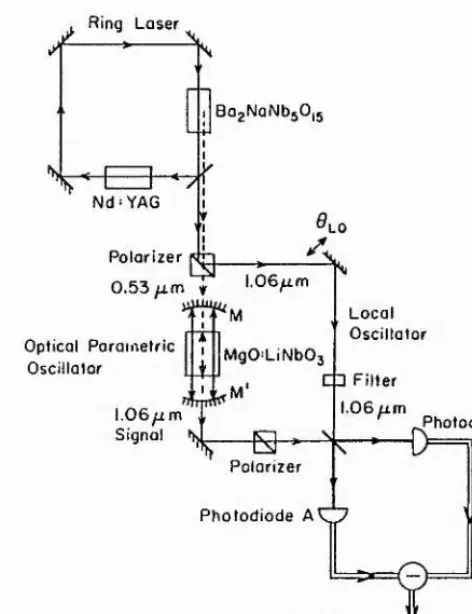
After the early cw OPO experiments, thirteen years elapsed before any subsequent reports of cw OPOs [34]. Renewed interest was the result of extensive theoretical modelling of the parametric process, which had begun in the earliest days of quantum optics; see reference [34] and references therein. Specifically, it was predicted that cw OPOs could deliver twin outputs whose intensity difference was squeezed below the usual shot noise level that is common to laser radiation in a coherent state. Extensive experimental progress was performed in the field of squeezed light by using cw OPOs, in the late 1980s [34 - 46].
Ring L a se r
LO
Pol ar iz er ^ ^ ^ 0.53fj.(T\ V J,06^m
L ocal Oscilialor Optical P a ra me tr ic
Oscillator
C 3 Filter 1.06 / zm
^^ t i o t o d iode B
Polorizer
P h o t o d i o d e A
[image:23.612.157.393.77.384.2]S p e c t r u m Analyzer
Figure I. 4.
Schematic illustration of the use of cw OPOs for the observation of squeezed states of light (from reference [34]).
down-conversion technique [48]. The monolithic ring cavity OPO is illustrated in figure I. 5 [49].
V 12.5 mm \ 2.2 mm
0-1200 V 5% MgO:LiNbO;
T ~ 1 0 8 “C
Figure I. 5.
Monolithic cw OPO ring cavity resonator, with high passive stability (from reference [49]). The electric-field applied to the crystal permits fast electro-optic tuning of the refractive indices.
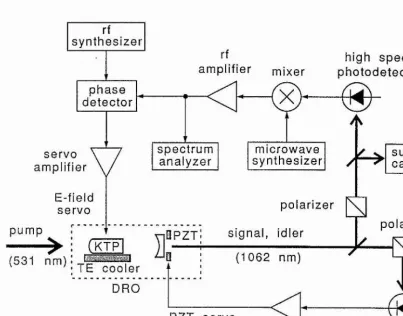
Following such stable and reliable cw OPO operation, their use was proposed as optical frequency dividers within frequency chains spanning the optical spectrum [20, 50 - 51]. Using the technique of offset-locking signal and idler frequencies with a known frequency difference, a highly stable potassium titanyl phosphate (KTP) cw OPO was demonstrated [52], illustrating the potential of using nonlinear materials that could provide type II phase- matching geometries with orthogonally polarized signal and idler fields. Electro-optic tuning and low temperature sensitivity allowed the signal and idler frequency difference to be determined precisely, compared to a known frequency standard, and held stable indefinitely. A schematic of this experimental configuration is illustrated in figure I. 6 [52].
frequency sources. It forms the basis of current research involving cw OPOs, including the work described within this thesis.
rf synthesizer
phase detector
servo am plifier
E-field servo pump
(531 nm) TE cooler(K T P l DRO
rf
amplifier mixer
Ï
-spectrum
analyzer synthesizerm icrowave
high speed photodetector
/
polarizer signal, idler
(1062 nm)
PZT servo
servo am plifier
super cavity
“7
polarizer
[image:25.612.70.473.162.478.2]photodetector
Figure I. 6.
Schematic representation of tunable optical frequency division from a cw OPO, with the signal and idler frequency difference locked to a microwave frequency reference (from reference [52]).
I
odI
r-HI
%
O%
01
a,I
§-tu 5«
I
J
as
r
I
tj!t
o a o§
t
§
e
to11
S-S Î Itl
s
“II
ft
II
a . t
I
V.i s
•u •si (
It
If
I
i
It
CD g iO V
a ^ Q O
§")(
to
II
g 'i
O V
4-k
I
I
1
if
If
•Ma o&
K
i
§ .S’
w
I
i
1
g
r-iI I
I
I I
<Nurn
<N
I
a
I
8
o
è
II
g g
ii
c3 M
II
M O tN <3\
ii
o c4
II
R 3
8 S
d cl
II
Së
T-t rH
II
u
d ri
I8 II38
rH tHI
8
8
I
8
I
I-
4
c?
CQ
I I
CT-io
Î
I
(5 cy îà <rl1
1 1
>I
01
«NI
aIs
l i
a in0
1
<N
11
|3
11
Ii
Is
lOa <N?.s
0
1
CN
■| i
o 00Ï
0 0 CO o>
t£) CO CO
O i <Ti O i
r-i rH rH
CO N
N tN N
K
rn
a
Krna
R
Oirsg
cr,R
rH5
CO K N
00 00ty^ 00<Z)
rH tH tH
ID CO
CD CD CD
I«
tu :S CD a*
aI
c2d V.
1 i
CD An
i
tu
I
u
II
I I
21
1
Î
Èi
g
I
I
il
I
i
3
QÎ
Î
I
I
V% s
If
f I
I]
f i
g
o . §s
I
SI
QjI
1
■g
a
I
i i
Qj(/)
I
i
V15
% CNIf
P
§i
Ï
I
Qj "§ V■
r
+4
T
I
a . %«
a
I
i
K4 Qj^1"
ïè
s
O1
I
s
I
§ s
oCOI
<N Ma
I
I
I
NI
§
I
<N§
o
o
Ig II
m I s3 3
tH tHVO
O
3S
II
II
VO CO
s s
I I
s a
II
lO IsII
33
II
gs
o o rH tH
I
VO O
II
o COO iH
rH «0
3 3
rH rH
I
ucS’
%
o
I i
CT
&
<S
I I
%I
CNg
S■| i
O GO0
1
CN
g
0
1
HCN
§
CN■| i
? %I
CN
g
R
11
1
0« CN Is
%
5
CO K%
1-H 00 COI I
§
I
rH5
I
I
I
rH9
I
1-H9
I
rH9
I
rnI
I
'k
H-*%
CS
%
o <uI
SS ti
I
H-4Q)
I:§
cu52o«
+4
ü î ï
lî
p
f§■
il
i K
lî
II
3
2
iî
ît
W Q
I
I
i
I
O5
I
o a, 3^ g .k
îi
Î I
II
il
II
N%
s i K ' Ia
II
f
I
lî
1
A,l
ao Oi
g:
'&■
8
i
"o1
grH
I I
I
g
I
S
if>S
I
§
I
Ovd
33+4
a
1-4g
§
Ig I
Os
g
gII
CO o
Ii
d rH
II
q q
rH rH
II
9 g
9?
K S
O rH g
II
O o>o rH
33
as o d rH
II
g S
I
g
o
s
o
S
I
<5
I
ë
fS
oÜ
H <NÎ!
fis
H es 3S H ^ es§
it
|S
g
II
R ir>P
0
1
fS
s
II
R 00M
l î
0
1
}H es 01
H CNg
I
rnS
i
rH5
i
I
i
ffii
rn
g
I
rnïoin
iS
ir>I
I
I
i
%
o
4 I
.J*i2(2
o
%)I
%
!
rj <U S U «wvuî
a VU VU UI
<%)
il
| l
a*
Q
<3
il
il
i
HII
^ «If
iî
f
..î
K a vuI
vuI
l i s '
•t
i
1 j
0s
I +41
0 8
%
a . 5
§
vuI
I
od
o
+4§
S ot
s if
VA i Sis
S #
?*. bo
îl
il
l .
lî
II
v O ^ %)t|
S.
i
î
1
(g
i
VI
3
01
i
I
I
i
I
i
I§ 3
inir>s
I
oGOI
g
OrHI
i
33+4 R U
a
§
I I i n ooII
2 3I5:! I
i
i i
II
r H f H
IS
O rHII
<N VO
rH <N
ït (I
II
S 5
ri c4
S 3
ri rl
II
co in ov rH
U
d rHI
i
r-în
I
cS^%
o
s
o
s
6
«
I
o
S ë
0
1
H CNvu
R •rk & O S a ; ru R » , 00
§ 9
ë S
< m H v d
{<
§;S
^
___ enN
H CN§
il
^
___ti
VA <R)
0
1
I
R R
.O % Q S:
•T41 R T R
R m s i r
S
S
m in
I
rn
g
I
rnS
I
rHvo
I
i
I
$
rnI
I
i
3* '«vhCP) "4VV31
Gft (T) Vî)
rn rn rH
Vf) IS 00
VO VO VO
52
o
4 s
V^)I
vu
a
a
" a
+4VU « »<u 52
1O vup
u CQ
VU
î I
v2da
"%
t:
IÆ
1
t
vy)+4
VU
I. 4 Present requirements for down-conversion schemes.
As discussed earlier, recent advances in stable lasers, trapped ions, and atomic fountains offer the possibility of obtaining a precision of 1 part in 10^^ or better in the next generation of high-resolution optical measurements. To achieve a similar result in accuracy relative to an optical frequency reference, it is necessary to develop the technology that can measure, compare, and synthesize optical frequencies with precision and accuracy. One of the desirable capabilities of such a measurement system is frequency division in the optical domain.
Optical frequency division using OPOs relies upon determ ining accurately the sum and difference frequencies of the signal and idler outputs. The sum frequency is set by the precision of the pump source, which can be referenced to, for example, an absorption line in the visible spectral region. The difference frequency can take several different forms. If the signal and idler frequencies are close to one another (near frequency degeneracy) then the difference frequency can be referenced to a microwave frequency source. If the signal and idler frequencies are in higher order integral ratios, then up- conversion techniques (e.g. second harmonic generation or sum frequency mixing) can be used to provide exact frequency ratios. This can be obtained by directly comparing one of the pump, signal, or idler frequencies to the new frequency, as generated from the up-conversion scheme, or by taking the difference of these two frequencies and referencing this to a microwave frequency source.
I. 5 Outline of the work within the thesis.
The work described in this thesis aims to fulfil two separate requirements; an understanding of the operating conditions necessary to obtain amplitude stable and frequency tunable cw OPO outputs, and the experimental construction of different types of cw OPOs. Therefore, the thesis is divided into two distinct parts.
The theory and modelling of the cw OPOs are included in chapters II and III. Chapter II examines the effects of resonating different optical fields on the pum p pow er required to reach threshold, and on the conversion efficiencies of the output fields, for both linear, standing-wave cavities and ring, travelling-wave cavities. The number of cavity resonances within the OPO gives rise to significantly different mode-selection properties, and these are examined for different cavity arrangements that can allow for multiple parameter control to obtain smooth frequency tuning. Chapter III examines currently available pump sources and nonlinear materials that can be used for implementation within cw OPO schemes. In particular, suitable pump sources are identified that can operate in different spectral regions, and phase- matching geometries in nonlinear crystals are outlined that can allow for the generation of integral-related signal and idler frequencies.
Four distinct experiments are discussed in chapters IV to VII. These involve the use of single-frequency cw pump sources operating in the ultra violet, visible and near infra-red spectral regions. The pum p radiation is derived from both fixed-frequency and widely-tunable laser pump sources. Type I and type II phase-matching geometries are analysed, with respect to coarse and fine frequency tuning, and amplitude-stable OPO operation. Finally, two different types of doubly-resonant optical resonators are constructed that allow for the transition from a single-cavity resonator to a three-mirror dual-cavity resonator that allowed for independent signal and idler cavity length control.
the basis of this text, and these should be staisfied when considering the most appropriate pump sources, nonlinear materials and detectors.
Chapter VIII provides conclusions to this thesis with regard to the two separate studies, as outlined above. Possible directions for future research involving the use of cw OPOs as optical frequency dividers are discussed in detail. This is related also to the progress that has been made by other groups within the field of cw OPOs during the course of this work.
References.
1. D. L. Weinberg,
"Tunable optical parametric amplifiers and generators," in Laser Focus World, p35 (April 1969).
R. W. Wallace & S. E. Harris,
"Extending the tunability spectrum," in Laser Focus World, p42 (November 1970).
2. C. L. Tang, W. R. Bosenberg, T. Ukachi, R. J. Lane, & L. K. Cheng, "NLO materials display superior performance,"
in Laser Focus World, p87 (September 1990). J. Hecht,
"Tunable mid-infrared sources entice spectroscopists," in Laser Focus World, pl09 (September 1993).
3. See the special issue on ultra sensitive spectroscopy, J. Opt. Soc. Am. B 2,1427 (1985).
J. L. Hall et a l,
in "Advances in laser spectroscopy," (F. T. Arecchi, F. Strumia, & H. Walther, Eds.), Plenum, New York, p99 (1983).
4. J. L. Hall, M. Zhu, & P. Buch,
"Prospects for using laser-prepared atomic fountains for optical frequency standards applications,"
J. Opt. Soc. Am. B 6,2194 (1989). L. L. Lewis,
"An introduction to frequency standards," Proc. IEEE 79,927 (1991).
5. P. Zhao, W. Lichten, Z.-X. Zhou, H. P. Layer, & J. C. Berquist, "Rydberg constant and fundamental atomic physics," Phys. Rev. A 39, 2888 (1989).
6. M. Sokolowski & J. Lesh,
in Proc. Soc. Photo-Opt. Instrum. Eng. 810,172 (1987). 7. R. Clark,
"Optical measurement with direct traceability to the primary standards of length and time...,"
Opt. Eng. 32, 571 (1993).
8. M. M. Davis, J. H. Taylor, J. M. Weisberg, & D. C. Backer,
9. R. L. Barger, M. S. Sorem, & J. L. Hall, "Frequency standards of a cw dye laser," Appl. Phys. Lett. 22, 573 (1973).
10. F. Y. Wu, R. E. Grove, & S. Ezekiel,
"CW dye laser for ultrahigh-resolution spectroscopy," A p pl Phys. Lett. 25, 73 (1974).
11. J. L. Hall, D. Hils, C. Salomon, & J. M. Chartier,
in "Laser spectroscopy VIII," (W. Persson & S. Svanberg, Eds.), Springer-Verlag, New York, p376 (1987).
12. J. L. Jesperson, B. E. Blair, & L. E. Gatterer, Eds., Special issue on time and frequency,
Proc. IEEE 60,476 ff. (1972). 13. J. L. Jesperson & D. W. Hanson, Eds.,
Special issue on time and frequency, Proc. IEEE 79, 894 ff. (1991).
14. Comité International des Poids et Measures, Recomdation 1 (CI-1983), See "Editor's note," Metrologia 19, 163 (1984).
15. D. A. Jeimings, C. R. Pollock, F. R. Peterson, R. E. Drullinger, K. M. Evenson, J. S. Wells, J. L. Hall, & H. P. Layer,
"Direct frequency measurement of the l2-stabilized He-Ne 473-THz (633-nm) laser," Opt. Lett. 8, 136 (1983).
16. O. Acef, J. J. Zondy, M. Abed, D. G. Rovera, A. H. Gerard, A. Clairon, Ph. Laurent, Y. Millerioux, & P. Juncar,
"A CÜ2 to visible optical frequency synthesis chain: accurate measurement of the 473 THz H eN e/l2 laser,"
Opt. Comm. 97,29 (1993). 17. D. J. Wineland,
"Laser-to-microwave frequency division using synchrotron radiation," J. Appl. Phys. 50, 2528 (1979).
18. A. E. Kaplan,
"Optical high-order sub-harmonic excitation of free cyclotron electrons," Opt. Lett. 12, 489 (1987).
19. H. R. Telle, D. Meschede, & T. W. Hansch,
"Realization of a new concept for visible frequency division: phase-locking of harmonic and sum frequencies,"
Opt. Lett. 15, 532 (1990).
R. Wylands, T. Mukai, & T. W. Hansch,
"Coherent bisection of optical frequency intervals as large as 532 THz," Opt. Lett. 17, 1749 (1992).
20. N. C. Wong,
"Optical frequency division using an optical parametric oscillator," Opt. Lett. 15, 1129 (1990).
21. A. Arie, S. Schiller, E. K. Gustafson, & R. L. Byer,
"Absolute frequency stabilization of diode-laser-pumped Nd:YAG lasers to hyperfine transitions in molecular iodine,"
Opt. Lett. 17, 1204 (1992). 22. R. Graham & H. Haken,
"The quantum-fluctuations of the optical parametric oscillator," Z. Phys. 210, 276 (1968).
J. Y. Courtois, A. Smith, C. Fabre, & S. Reynaud,
"Phase diffusion and quantum noise in the optical parametric oscillator: a semi-classical approach,"
J. Mod. Opt. 38,177 (1991). 23. J. A. Giordmaine & R. C. Miller,
24. R. G. Smith, J. E. Geusic, H. J. Levinstein, J. J. Rubin, S. Singh, & L. G. Van Uitert,
"Continuous optical parametric oscillation in BagNaNbgOjg at optical frequencies," Appl. Phys. Lett. 12, 308 (1968).
25. "Tunable parametric oscillator produces coherent...light from...laser source," in Laser Focus World, p l6 (June 1968).
26. R. L. Byer, M. K. Oshman, J. F. Young, & S. E. Harris, "Visible cw parametric oscillator,"
Appl. Phys. Lett. 13, 109 (1968). 27. R. L. Byer, A. Kovrigin, & J. F. Young,
"A cw ring-cavity parametric oscillator," Appl. Phys. Lett. 15, 136 (1969).
28. R. G. Smith & J. V. Parker,
"Experimental observation of and comments on optical parametric oscillation internal to the laser cavity,"
J. Appl. Phys. 41, 3401 (1970). 29. C. Laurence & F. Tittel,
"Visible cw parametric oscillator using barium sodium niobate," J. Appl. Phys. 42, 2137 (1971).
30. J. F. Weller, T. G. Giallorenzi, & R. A. Andrews,
"Time-resolved spectral output of a doubly resonant cw optical parametric oscillator," J. Appl. Phys. 43, 4650 (1972).
31. B. B. Snavely,
"Continuous-wave dye lasers,"
in "Dye lasers," (F. P. Schafer, Ed.), Springer-Verlag (1973). 32. R. G. Smith,
"A study of the factors affecting the performance of a continuously pumped doubly resonant optical parametric oscillator,"
IEEE J. Quant. Electron. QE-9,530 (1973). 33. J. E. BjorWiolm,,
"Efficient optical parametric oscillation using doubly and singly resonant cavities," Appl. Phys. Lett. 13, 53 (1968).
34. L.-A. Wu, H. J. Kimble, J. L. Hall, & H. Wu,
"Generation of squeezed states by parametric down conversion,"
Phys. Rev. Lett. 57, 2520 (1986). 35. L.-A. Wu, M. Xiao, & H. J. Kimble,
"Squeezed states of light from an optical parametric oscillator," J. Opt. Soc. Am. B 4,1465 (1987).
36. S. Reynaud, C. Fabre, & E. Giacobino,
"Quantum fluctuations in a two-mode parametric oscillator," J. Opt. Soc. Am. B 4,1520 (1987).
37. P. Grangier, R. E. Slusher, B. Yurke, & A. LaPorta,
"Squeezed-light-enhanced polarization interferometer," Phys. Rev. Lett. 59, 2153 (1987).
38. A. Heidmaim, R. J. Horowicz, S. Reynaud, E. Giacobino, & C. Fabre, "Observation of quantum noise reduction on twin laser beams," Phys. Rev. Lett. 59, 2555 (1987).
39. M. Xiao, L.-A. Wu, & H. J. Kimble
"Detection of amplitude modulation with squeezed light for sensitivity beyond the shot-noise limit,"
Opt. Lett. 13, 476 (1988).
40. T. Debuisschert, S. Reynaud, A. Heidmann, E. Giacobino, & C. Fabre,
"Observation of large quantum noise reduction using an optical parametric oscillator," Quant. Opt. 1, 3 (1989).
41. J. Mertz, A. Heidmann, C. Fabre, E. Giacobino, & S. Reynaud,
"Observation of high-intensity sub-poissonian light using an optical parametric oscillator,"
42. C. D. Nabors & R. M. Shelby,
"Two-colour squeezing and sub-shot-noise signal recovery in doubly resonant optical parametric oscillators,"
Phys. Rev. A 42, 556 (1990).
43. K. W. Leong, N. C. Wong, & J. H. Shapiro,
"Non-classical intensity correlation from a type I phase-matched optical parametric oscillator,"
Opt. Lett. 15, 1058 (1990).
44. J. Mertz, T. Debuisschert, A. Heidmann, C. Fabre, & E. Giacobino,
"Improvements in the observed intensity correlation of optical parametric oscillator twin beams,"
Opt. Lett. 16, 1234 (1991). J. Mertz, A. Heidmann, & C. Fabre,
"Generation of sub-Poissonian light using active control with twin beams," Phys. Rev. A 44, 3229 (1991).
J. G. Rarity, P. R. Tapster, J. A. Levenson, J. C. Garreau, I. Abram, J. Mertz, T. Debuisschert, A. Heidmann, C. Fabre, & E. Giacobino,
"Quantum correlated twin beams," Appl. Phys. B. 55, 250 (1992). 45. E. S. Polzik, J. Carri, & H. J. Kimble,
"Spectroscopy with squeezed light," Phys. Rev. Lett. 68, 3020 (1992).
"Atomic spectroscopy with squeezed light for sensitivity beyond the vacuum-state lim it,"
Appl. Phys. B 55, 279 (1992).
46. Z. Y. Ou, S. F. Pereira, H. J. Kimble, & K. C. Peng,
"Realization of the Einstein-Podolsky-Rosen paradox for continuous variables," Phys. Rev. Lett. 68, 3663 (1992).
"Realization of the Einstein-Podolsky-Rosen paradox for continuous variables in non degenerate parametric amplification,"
Appl. Phys. B 55, 265 (1992).
47. C. D. Nabors, R. C. Eckardt, W. J. Kozlovsky, & R. L. Byer,
"Efficient, single-axial-m ode operation of a monolithic MgO:LiNbOg optical parametric oscillator,"
Opt. Lett. 14, 1134 (1989).
48. C. D. Nabors, S. T. Yang, T. Day, & R. C. Eckardt,
"Coherence properties of a doubly resonant monolithic optical parametric oscillator," J. Opt. Soc. Am. B 7, 815 (1990).
49. R. C. Eckardt, C. D. Nabors, W. J. Kozlovsky, & R. L. Byer, "Optical parametric oscillator frequency tuning and control," J. Opt. Soc. Am. B 8, 648 (1991).
50. N. C. Wong,
"Optical frequency counting from the UV to the near IR,"
Opt. Lett. 17, 1155 (1992). 51. N. C. Wong,
"Proposal for a 10-THz precision optical frequency comb generator," IEEE Phot. Tech. Lett. 4,1166 (1992).
52. D. Lee & N. C. Wong,
"Tunable optical frequency division using a phase-locked optical parametric oscillator,"
Opt. Lett. 17, 13 (1992).
53. F. G. Colville, A. J. Henderson, M. J. Padgett, J. Zhang, & M. H. Dunn, "Continuous-wave parametric oscillation in lithium triborate," Opt. Lett. 18, 205 (1993).
54. S. T. Yang, R. C. Eckardt, & R. L. Byer,
"Continuous-wave singly resonant optical parametric oscillator pumped by a single frequency resonantly doubled Nd:YAG laser,"
55. F. G. Colville, M. J. Padgett, A. J, Henderson, J. Zhang, & M. H. Dunn, "Continuous-wave parametric oscillator pumped in the ultra-violet," Opt. Lett. 19, 1065 (1993).
56. D. Lee & N. C. Wong,
"Stabilization and tuning of a doubly-resonant optical parametric oscillator," J. Opt. Soc Am. B 10,1659 (1993).
57. D, C, Gerstenberger & R. W. Wallace,
"Continuous-wave operation of a doubly resonant lithium niobate optical parametric oscillator system tunable from 966 to 1185 nm,"
J. Opt. Soc Am. B 10,1681 (1993). 58. S. T. Yang, R. C. Eckardt, & R. L. Byer,
"Power and spectral characteristics of continuous-wave parametric oscillators: the doubly to singly resonant transition,"
J. Opt. Soc Am. B 10,1684 (1993). 59. S. Schiller & R. L. Byer,
"Quadruply resonant optical parametric oscillation in a monolithic total-internal-reflection resonator,"
J. Opt. Soc Am. B 10,1696 (1993). 60. F. G. Colville, M. J. Padgett, & M. H. Dunn,
"Continuous-wave, dual-cavity, doubly resonant, optical parametric oscillator," Appl. Phys. Lett. 64, 1490 (1994).
61. F. G. Colville, M. Ebrahimzadeh, W. Sibbett, & M. H. Dunn,
"Continuous-wave LiBgOg optical parametric oscillator pum ped by a tunable Ti:sapphire laser,"
Appl. Phys. Lett. 64, 1765 (1994). 62. L. R. Brothers, D. Lee & N. C. Wong,
"Terahertz optical frequency comb generation and phase locking of an optical parametric oscillator at 665 GHz,"
Opt. Lett. 19, 245 (1994).
63. S. T. Yang, R. C. Eckardt, & R. L. Byer,
"1.9-W cw ring-cavity KTP singly resonant optical parametric oscillator," Opt. Lett. 19, 475 (1994).
64. D. Lee & N. C. Wong,
"Tuning characteristics of a cw dual-cavity KTP optical parametric oscillator,"
in Conference on Lasers and Electro-Optics, Vol. 8 of OSA 1994 Technical Digest Series (Optical Society of America, Washington, D. C., 1994), paper CWE 5.
65. R. Knappe, J. Barschke, C, Becher, B. Beier, M. Scheldt, K.-J. Boiler, & R. Wallenstein, "Injection-locked high power diode arrays and their application as pump sources for blue and green Nd:YAB lasers, monolithic Nd:YAG ring lasers, and cw KTP optical parametric oscillators,"
in Conference on Lasers and Electro-Optics, Vol. 8 of OSA 1994 Technical Digest Series (Optical Society of America, Washington, D. C., 1994), paper CThL 4.
66. D. K. Serkland, R. C. Eckardt, & R. L. Byer,
"Continuous-wave total-internal-reflection optical parametric oscillator pumped at 1064 nm,"
Opt. Lett. 19, 1046 (1994).
67. G. Robertson, M. J. Padgett, & M. H. Dunn,
"Continuous-wave singly resonant pump-enhanced type II LiBgOg optical parametric oscillator,"
Opt. Lett. 19, 1735 (1994). 68. S.-H. Youn, J.-H. Lee, & J.-S. Chang,
"Quantum-mechanical noise characteristics in a doubly-resonant optical parametric oscillator"
Chapter IL
Theoretical Background,
Contents. Page.
II. 1 Introduction. 25
II. 2 Parametric gain analysis. 27
II. 3 Pump power thresholds. 40
II. 4 Conversion efficiencies. 70
II. 5 Tuning, spectral outputs, and stability requirements. 75 II. 6 Further properties of the doubly-resonant oscillator. 104
II. 7 Mode-matching. 110
II. 8 Conclusions. 114
References. 116
II. 1 Introduction.
This chapter reviews the specific criteria involved when considering the formation of continuous-wave (cw) optical parametric oscillators (OPOs). These criteria are analysed within different sections, each of which describes an important operating condition that must be addressed. The conclusions from each section should be satisfied within the eventual experimental design of a cw OPO.
Before constructing a cw OPO, there are a num ber of critical assessments that must be performed to establish how the device will operate in practise. These requirements include the following key parameters: incident pum p power to reach threshold, optical resonator geometry including material selection, resonance conditions of the cavity, mode- selection properties of the signal and idler frequencies, and effective coupling of the pump radiation into the cavity modes of the signal and idler fields.
is defined in terms of the effective nonlinear coefficient, the phase- synchronism factor, and the spatial overlap of the Gaussian modes over the length of the gain medium. The analysis is valid for the case of small parametric gain, and is restricted to the near field.
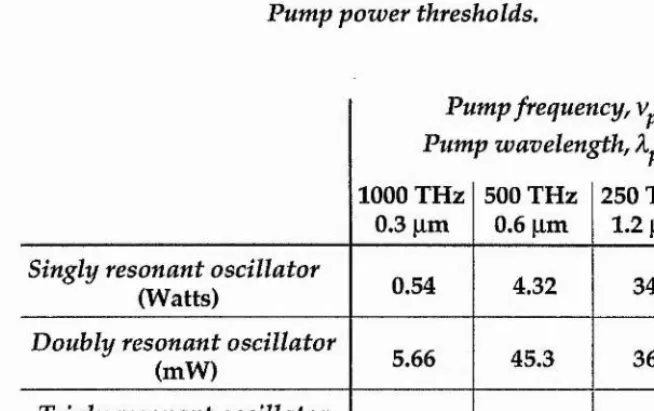
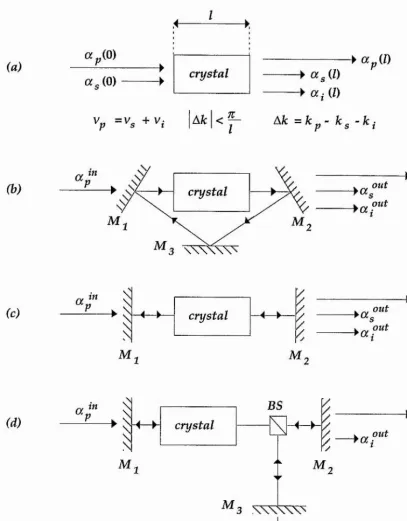
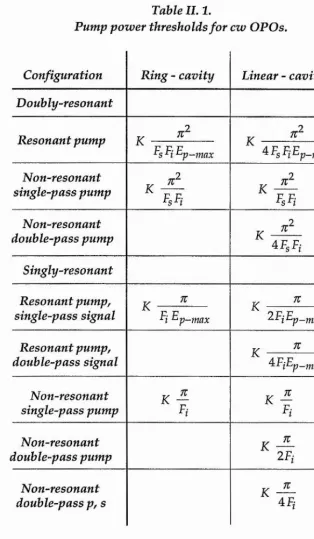
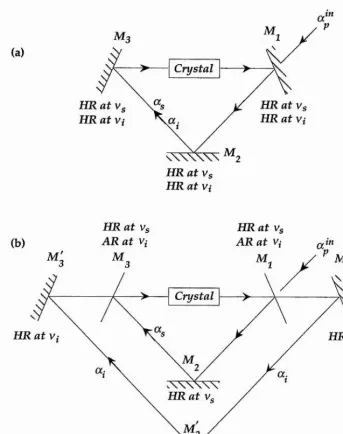
Historically, the most important parameter for a cw OPO has been the pum p power required to reach threshold, and this is studied in detail in section II. 3. When the pum p radiation is derived from a cw laser source, with significantly lower pum p powers available, compared to the more familiar pulsed pum p sources used for OPOs, then the design of the OPO cavity becomes critical. In particular, within any phase-matching geometry, the resonance conditions must be selected carefully to maximize the gain of the system to reach threshold. Different optical cavities are studied to show the effects on threshold when resonating different fields within the OPO cavity. In addition, the nature of the interaction of the pump field with the signal and idler fields must be examined. In this context, ring-cavities and standing-w ave cavities provide significantly different threshold values. When standing-wave cavities are analysed, it is important to consider the relative phasings of the forward and backward travelling waves within the resonator, to reduce the pump power threshold to a minimum.
Once above pum p power threshold within an OPO, the conversion efficiency of the pum p radiation to signal and idler powers can be considerable. Once again, these conversion efficiencies are dependent on the type of resonator employed (single-pass travelling-wave ring cavity, or double-pass standing-wave linear cavity), and the number of fields that are brought to resonance within the OPO cavity. These different configurations are reviewed in section II. 4.
![Figure 1.1.Amplitude fluctuations of the first cw OPO (reference [24]). The width](https://thumb-us.123doks.com/thumbv2/123dok_us/8555051.363949/19.613.102.462.267.492/figure-amplitude-fluctuations-cw-opo-reference-width.webp)
![figure I. 3 [32], as viewed on a scanning interferometer.](https://thumb-us.123doks.com/thumbv2/123dok_us/8555051.363949/21.619.115.449.221.444/figure-i-viewed-scanning-interferometer.webp)
![Figure II. 14.Schematic configurations of an OPO divider for (a) synthesizing new frequencies, and (b) for measuring an unknown input frequency (from reference [64]).](https://thumb-us.123doks.com/thumbv2/123dok_us/8555051.363949/121.615.112.435.373.629/figure-schematic-configurations-synthesizing-frequencies-measuring-frequency-reference.webp)