Formal Modelling and Verification of
Trust in a Pervasive Application
(Deliverable WP4-01)
June 2004
Trusted Software Agents and Services for
Pervasive Information Environments project
DTI Next Wave Technologies and Markets Programme
Editor
Stéphane Lo Presti
University of Southampton
Other contributors
University of Southampton:
Michael Butler
Michael Leuschel
Colin snook
Phillip Turner
Contact
Stéphane Lo Presti
School of Electronics and Computer Science
University of Southampton
SOUTHAMPTON SO17 1BJ
United Kingdom
Email:
[email protected]
Web:
http://www.ecs.soton.ac.uk/~splp/
Phone:
+44 (0)23 8059 7684
Fax:
+44 (0)23 8059 3045
Record of changes
Issue Date Detail of changes 1.0 25/06/04 First Draft submitted to DTI.
Executive summary
This report is deliverable WP4-01 of the project “Trusted Software Agents and Services for Pervasive Information Environments.” The deliverable reports on the activities of formal modelling and verification of a pervasive application which follows from previous results in the project.
The pervasive application is based on several pervasive scenarios already devised and is centred on the user location. This location-based system is first architecturally simplified, while trust requirements are derived from the Trust Analysis Framework presented in the deliverable WP2-01.
This first abstraction is then completed by formal modelling of the system in the B formal method. These models enable us to clarify the decision decisions leading to fulfil the trust requirements. We show that the system policy structure is influenced by the priorities given to the system operations and that a sufficiently high level of abstraction is required to model trust properties.
The modelling activity is completed by formal verification using the ProB model-checker to automate part of this process. Several models are checked successfully, while detection of errors in other models enables us to understand better the behaviour of the system. In particular, issues relative to the dynamicity of modelled elements are highlighted.
The overall methodology followed during these activities proved useful at helping us specifying accurately the trust requirements, so that the pervasive application can be completed in consequence, and is as follows:
1) Model important features of the system
First vaguely type the variables; then write a set of operations corresponding to complementary features while (possibly) modifying the variable types to ease this writing; consider the variables by group of similar dynamic properties;
2a) Model-check the model
2a.a) Property violation detected
Examine the various aspects of the model (variables, enabled operations, history of operations) to see what part of the property is “false”; Correct the model accordingly; 2a.b) No property violation detected
Go back to 2a until coverage rate is enough; possible changes to the model include: modify the initialisation to test other situations (in B use “choice by predicate”); add inconsistencies in the model;
2b) Animate the model
Table of Contents
1 INTRODUCTION ... 5
1.1 BACKGROUND... 5
1.2 AIM OF THE PROJECT... 5
1.3 AIM OF THE REPORT... 5
1.3.1 Structure of the document ... 5
2 MODELLED PERVASIVE APPLICATION ... 6
2.1 INTRODUCTION... 6
2.2 ARCHITECTURE... 6
2.3 TRUST REQUIREMENTS... 7
3 FORMAL MODELLING ... 8
3.1 INTRODUCTION... 8
3.2 BRIEF INTRODUCTION TO THE B METHOD... 8
3.3 ASSUMPTIONS MADE FOR THE MODELLING... 9
3.4 FIRST CASE:FIXED POLICY... 10
3.4.1 Sets, Constants, Variables and Typing Invariant... 10
3.4.2 Second Part of the Invariant... 11
3.4.3 Operations ... 11
3.4.4 Initialisation... 11
3.5 SECOND CASE:CHANGING POLICY... 11
3.5.1 Data and operation changes to the previous model ... 12
3.5.2 Invariant ... 12
3.5.3 Initialisation... 12
3.5.4 Different models of the Policy ... 13
3.6 CONCLUSION... 13
4 FORMAL VALIDATION AND VERIFICATION ... 14
4.1 INTRODUCTION... 14
4.2 SHORT PRESENTATION OF PROB ... 14
4.3 RESULTS OF THE FORMAL VERIFICATION... 15
4.3.1 Constraints imposed on the Models... 15
4.3.2 First Case ... 15
4.3.3 Second Case... 16
4.4 CONCLUSION... 17
5 CONCLUSIONS... 18
5.1 SUMMARY... 18
5.2 GUIDELINES... 18
5.3 FUTURE WORK... 18
6 ANNEX 1 B MACHINES AND THEIR STATE-SPACES ... 20
6.1 FIXED POLICY MODEL... 20
6.1.1 FixedPolicy B machine ... 20
6.1.2 FixedPolicy State-space... 21
6.2 CHANGING POLICY MODELS... 23
6.2.1 ChangingPolicy B machine... 23
6.2.2 ChangingPolicy State-spaces... 26
1 Introduction
This deliverable WP4-01 of the project “Trusted Software Agents and Services for Pervasive Information Environments” reports on the formal modelling of a pervasive application that implements ideas developed in previous deliverables of the project, and the verification of the models created using formal tools.
1.1 Background
Pervasive Computing is a new paradigm that places the user at the centre of a system made of computing devices embedded in physical objects. It is materialised by the convergence of small footprint computing platforms (PDA, mobile phones), next-generation wireless networks (UMTS, Wi-Fi, Bluetooth) and new modalities of human-machine interaction where trust and security play a crucial role.
Trust has recently been the focus of much effort, as much for research scientists [3] as for application developers, with growing concerns on security and privacy. Our initial investigation into the trust issues in pervasive environment [5] concluded that a Trust Analysis Grid could be used to analyse the trust issues in a variety of pervasive scenarios. For further details, the reader should refer to the deliverable WP2-01 [5].
1.2 Aim of the project
This project aims to identify the critical trust issues in pervasive computing, and to exploit formal techniques for validating the trustworthiness of emerging agent, Semantic Web and Grid technologies to support pervasive systems.
The approach taken to address this aim is to:
1. Investigate issues of trust, such as security, dependability and privacy, within the context of software agents and services in pervasive information environments;
2. Develop strategies to introduce trust in these systems, underpinned by formal validation techniques;
3. Build small-scale realistic demonstrators that highlight the problems and solutions in the healthcare domain, with a view towards eventual productisation.
1.3 Aim of the report
This report addresses step 2 of the approach chosen for this project and aims at presenting the formal modelling and verification of models of a pervasive application implemented by QinetiQ. We will present the various methods and tools that were used to model the pervasive system, focusing on the important features from a design and implementation point of view. The formal verification of these models provides us with interesting results on the way to introduce trust in the system. The methodology used throughout the modelling and verification activities are summarised in a set of guidelines.
1.3.1 Structure of the document
2 Modelled Pervasive Application
This Section describes the pervasive application that is under consideration in this report. It is the starting point of the efforts and the results that this report delivers. We start from a description of the origin and architecture of the system, and then select the important element that will drive the remaining of our work.
2.1 Introduction
The first deliverable of the project specified five pervasive scenarios that were validated by domain experts. All of them shared common trust issues that were highlighted and analysed in the deliverable WP2-01 [5].
The various pervasive systems described in these scenarios have in common the use of services based on the location of the user, a feature that is representative of pervasive systems currently designed and implemented and, thus, that represents an interesting and important application to model and verify.
The location-based system has been implemented by QinetiQ in Java and for Pocket PC PDAs (the pervasive devices). It uses the Wi-Fi (IEEE 802.11) communication technology and exports some services (e.g. exchange of images between users) as Web Services (WS). The Wi-Fi technology is used in indoor environments and corresponds to the situation of most of our pervasive scenarios. The Royal Glamorgan Hospital (Llantrisant, Wales) has been contacted to trial the prototype in their working environment.
[image:6.595.90.508.417.696.2]2.2 Architecture
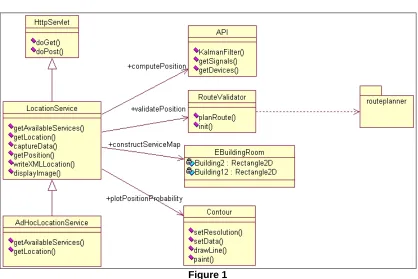
Figure 1
PDA requesting, either its location, or the set of currently available services around the PDA. The location is first estimated (position with associated probability) from the current Wi-Fi signal strengths received by the PDA from the various Access Points, and then corrected by filtering the signals (e.g. KalmanFilter) taking into account the route followed by the PDA. The class AdHocLocationService inherits from LocationService and overrides two methods to define a more specific system behaviour adapted to the environment where the prototype is executed. Various classes (Contour in Figure 1) are used to display graphically the current state of the system. These display classes, as well as details about storage of data in files, the manipulation of Wi-Fi communication signals and position probabilities, and the classes that bind the other classes together, are implementation details that are abstracted in this view of the architecture.
2.3 Trust Requirements
Following the Trust Analysis Framework described in the deliverable WP2-01 [5], a new pervasive scenario was devised to illustrate the use of the prototype (by combining elements from the previous scenarios “A Pre-hospital Incident” and “A stay in a pervasive hospital environment”). The scenario highlighted the following trust issues:
Ö Accuracy, with accuracy of the location estimate; Ö Audit trail, with the log files of the Web server;
Ö Authorisation, with the centralised and restricted access to the shared resources; Ö Identification (Privacy), with confidentiality of exchanged information;
Ö Availability, due to the possibility that the Wi-Fi signals do not reach all the PDAs; Ö Usability, which corresponds in this case to context-aware authorisation and is thus
considered in other categories;
Ö Harm (Privacy), with safety of wireless communications.
Several trust requirements of the prototype are not considered from an abstract point of view because they are dealt with at a low level or are not applicable:
Ö Accuracy is solved via appropriate mathematical computations which estimate the position based on the physical communication signal strengths and then correct it, including how the signals from the wireless access points are represented; these elements of the system also contribute to the Reliability (integrity) issue;
Ö Availability depends on the coverage of the set of Wireless Access Points and can be increased by adding some; in practice, the Wi-Fi bandwidth and signal coverage and largely enough;
Ö Harm: current state-of-the-art research and legislation means that Wi-Fi is not an RF-safety issue.
We focus on requirements that are amenable to formal modelling and verification in this report. Usability aspects are thus not considered because they are not easily suited to formal modelling and verification.
3 Formal Modelling
We describe the formal modelling activity that follows from the presentation of the pervasive application in the Section 2. The formal modelling language is briefly introduced in section 3.2, so that the various models of the pervasive application can be presented in sections 3.4 and 3.5.
3.1 Introduction
The computer programs which implement a software system are usually too detailed and complex to analyse the system at a sufficient level of abstraction for understanding its purpose and rigorously detect its faults. Modelling this system is necessary to be able to validate it against the set of desired abstract properties.
Formal methods are computing methodologies and techniques that stem from mathematics and, as such, are solid and powerful methods to produce accurate models of a system. This property of accuracy contrasts with the conceptual looseness of programming languages and forces the modeller to think about the system in a different way, what generally brings to clarification about design decisions and system properties. In the T-SAS project, we chose the B method as a formal method to model the pervasive application.
3.2 Brief Introduction to the B method
The B method is a formal method of software engineering. It is based on the B notation [1] and is supported by two commercial toolkits (Atelier B/B4FREE from ClearSy and the B-Toolkit from B-Core), with several other tools under development. It has been used to model and verify several industrial systems, for example in the railway industry, thus proving its applicability and usefulness to industrial systems.
The B notation is used to define Abstract Machines which have:
Ö a state, made of variables and constants satisfying an invariant,
Ö and various operations, that can modify the state, but must satisfy the invariant. All data in B is modelled as simple mathematical entities (sets, functions, sequences) and the various logical formulas are expressed in predicate logic. Operations have preconditions and express desired postconditions via composition of basic substitutions. A B machine is composed of a sequence of clauses, typically of the following form:
MACHINE machine_name
DEFINITIONS syntactic_elements
SETS set1={...}; set2={...}; set3; ...
CONSTANTS constant1, constant2, ...
PROPERTIES properties_of_the_constants
VARIABLES variable1, variable2, ...
INVARIANT invariant_over_variables
INITIALISATION initial_state
OPERATIONS operation1=…; operation2=…; ...
END
refinement is correct. The semantics underlying the B notation defines the mathematical Proof Obligations (POs) that must be met to ensure these properties. In the final step of the B method, the POs must then be proven with the B toolkits, automatically for most of them, interactively for the most difficult.
The B notation is a modelling language and not a programming language (unless only implementations are considered), because it is used at a different level of abstraction. The following features show this difference:
Ö Complex data structures can be represented more simply using abstract mathematical structures;
Ö The definition of a variable or a constant can be deferred, or its value can be given by properties expressed in predicate logic;
Ö The substitutions used in operations can be non-deterministic.
The following is an example of a B machine modelling a dictionary, which could correspond for example to a spellchecker program. This machine declares a set WORD representing the words that a dictionary can have; a constant natural number, MaxSize, which limits the size of the dictionary (the actual value is in the PROPERTIES clause); a variable Words corresponding to the set of words currently in the dictionary (the type information is in the INVARIANT clause); and three self-explanatory operations (only checkWord returns a value). This machine is consistent because one can verify that the operation preconditions (between the keywords PRE and THEN) ensure that the operation substitutions (between the keywords THEN and END) do not violate the invariant.
MACHINE Dictionary
SETS WORD
CONSTANTS MaxSize
PROPERTIES MaxSize: NAT1 & MaxSize=50
VARIABLES Words
INVARIANT Words: POW(WORD) & card(Words)<=MaxSize
INITIALISATION Words:={}
OPERATIONS
addWord(w) =
PRE w: (WORD-Words) & card(Words)<MaxSize THEN Words := Words \/ {w} END;
removeWord(w) = PRE w: Words
THEN Words := Words - {w} END; present <-- checkWord(w) =
PRE w: WORD
THEN present := bool(w: Words) END
END
3.3 Assumptions made for the Modelling
The modelling of the pervasive application is first based on the architecture that was presented in Section 2.2, which already made some simplifications and abstractions. Accordingly, the model will ignore the low-level details of the application and concentrate on the abstract aspects so that trust properties can be appropriately modelled.
The model will more specifically focus on the user’s point of view of the system, a necessary assumption in order to adequately reflect the pervasive nature of the system. For example, when choosing the operations of the B machines, we will give priority to those related to the user of the system and simplify, if possible, those related to the administration and configuration of the system.
system to make a decision automatically. This concept in itself is the subject of a lot of research (not only in computer science but also in law and social sciences) and we will not discuss it specifically in this report.
Lastly, our models are constrained by the model-checking that we will apply later. Model-checking consists in the automatic exploration of the state-space of a specification and will be presented in more details in Section 4. The size and complexity of some elements of the B machines are limited so that model-checking is facilitated and, in some situations, exhaustive. This puts some limitation on the scope of the models, since they cannot model “large” systems, but the models are still useful at helping at designing the system and detecting faults.
3.4 First Case: Fixed Policy
We here describe the first B model, named FixedPolicy, where the policy was considered constant. The complete specification of the B machine can be found in Annex 6.1, while we explain here the principles and design decisions.
The FixedPolicy B machine is composed of two operations that model the authorisation decisions relative to the execution of a service offered by a pervasive device and relative to the registration of a device to the system. The trust properties of the model are that documents belong to one and only one pervasive device, all service executions should be authorised and an audit trail of the service calls is maintained.
3.4.1 Sets, Constants, Variables and Typing Invariant
The sets DEVICE, SERVICE, DOCUMENT, and LOCATION correspond respectively to the devices known to the system (in the sense that they can be registered), the services offered by the devices, the documents stored on the devices and used by the services, and the possible locations of the devices. The variables ProvidedServices, Documents and Locations (defined in the typing invariant invariant1) are functions that represent the associations between devices and the respective sets. The services Display and Access correspond to the location-based services that the pervasive application implements. The limited number of locations (three here) can be interpreted conceptually as rooms in a building.
The variable RegisteredDevices is a set of devices (elements of DEVICE) that corresponds to the devices registered to the system. Any device not yet registered is considered an “intruder”.
An important element of our B models is the notion of SERVICECALL (SC) defined as the Cartesian product DEVICE*SERVICE*DEVICE*DOCUMENT. A tuple (a |-> b |-> c |-> d) from the set SERVICECALL models the fact that the caller device a requests the execution of the service b by the callee device c on a document d. The variable ServiceCalls is the actual set of requested service calls, i.e. the Audit Trail.
The model contains two constants: the Policy and MAXNumServCalls, the maximum number of service calls stored in the variable ServiceCalls. Their type and values are given in the PROPERTIES clause.
3.4.2 Second Part of the Invariant
The second part of the invariant (definition invariant2) defines the meaningful constraints over the variables and constants that model the trust properties. It is the conjunction of two main conditions:
Ö The documents are stored on one and only one device; this constraint on the variable Documents expresses in simple terms the privacy issue that a document is only stored on its owner’s device (but it can be accessed by calling an Access service if the Policy enables it);
Ö The elements of ServiceCalls are in Policy, i.e. the Authorisation issue.
3.4.3 Operations
We should start by saying that the operations of FixedPolicy have preconditions, but the preconditions do not correspond to an Identification issue. More precisely, B operation preconditions indicate that the given substitutions only apply when preconditions are met, while nothing is guaranteed otherwise. In other words, the call to an operation outside of its precondition is not modelled but may be possible in the pervasive application.
The operation executeService models the query by a caller to execute a service on a callee relative to a document. Its semantics is composed of a SELECT statement conditioned by four conjuncts:
Ö The Audit Trail is not full;
Ö The caller and callee are registered devices; Ö This service calls is authorised by the Policy;
Ö The locations of the two devices are close (because this is a location-based service). If the four conditions are met, the service call is “executed” by being added to the ServiceCalls set. This is an abstraction of the real execution of the service in the pervasive application, which will do something useful for the user, but the effect of a particular service are not modelled here. We assume that the offered services are not administrative (and thus do not change the machine variables). If one of the four conditions is not met, the substitution is skip, which does nothing (once more, the pervasive application will probably do something in that case, like record the request to unauthorised service calls or create a new audit trail, but it is not modelled here).
The registerDevice operation models in simple terms the registration of a new device to the pervasive system. The only condition that the operation checks is that the person asking for the registration is a doctor, not a patient.
3.4.4 Initialisation
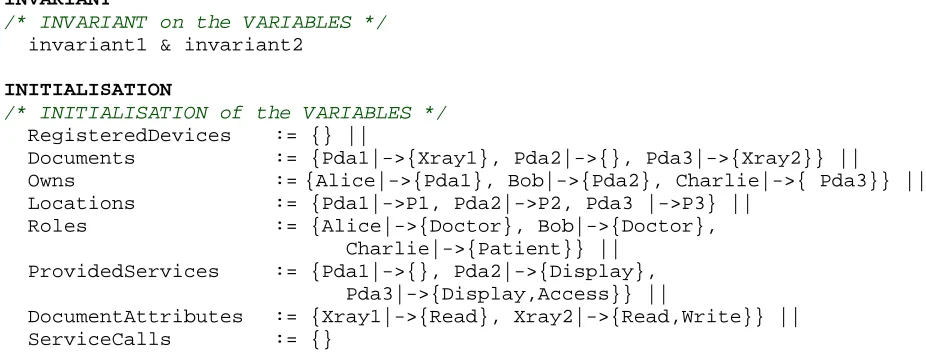
The prototype starts with a certain knowledge of the system, what corresponds to the initialisation of the B machine. For example, the identity of the PDAs and their owners are known to the system, as exemplified by the fact that the Policy uses the PDA identities (textual names, but it could be more complex, e.g. a cryptographic public key). Furthermore, the initial values of the prototype’s variables can be given here, like the audit trail ServiceCalls that is initially empty.
The other initialisations correspond to environment of the prototype when it starts: where the documents are, what their attributes are; who owns what device, where it is located and what services it offers; and what are the roles of users.
3.5 Second Case: Changing Policy
automatically, so that the user’s attention remain on its meaningful tasks and is not focused on system administration tasks.
Complete specifications of the B machine ChangingPolicy can be found in Annex 6.2.
3.5.1 Data and operation changes to the previous model
The various SETS definitions are unchanged, apart from the introduction of a role Administrator. Policy is a new variable, and ServiceCalls is divided into two sets: RequestedSC for the service calls that have been requested, and GrantedSC for those who have been granted (the structure of SC remains unchanged here). The first part of the invariant invariant1 is modified accordingly.
The operation executeService is split into grantService and denyService, similarly to the SC variables. Those two methods have very similar bodies to executeService (denyService being the “negative” form of grantService, except that only the RequestedSC set is updated).
In addition to registerDevice, the ChangingPolicy machine specifies an unregisterDevice operation to unregister a device from the system. The definition of these methods is very different from those in FixedPolicy, because they express the additional feature that device (un)registration modify the Policy. The Policy is updated so that SC authorised for the other devices of the device owner are also authorised for the new device (and then removed after unregistration).
3.5.2 Invariant
Due to the changes to the B machine, the second part of the invariant invariant2 becomes more complex. The first condition relative to documents remains unchanged, while the second condition relative to the size of Policy is removed (since the Policy may change a lot, this is no longer relevant).
The third condition is split into two conditions: GrantedSC must be a subset of RequestedSC (granted service calls must have been requested, this corresponds to the non-repudiation property) and of Policy (Authorisation issue).
A fourth condition is added to model an Identification issue: it states that only registered devices can have authorised (in Policy) or granted (in GrantedSC) service calls. This property is expressed as a logical formula ranging over all the SC (the symbol “!” corresponds to the logical operator !). One can notice that the second part of this condition and the fact that GrantedSC is a subset of Policy (previous condition) imply the first part, nevertheless the condition is left for the sake of clarity.
A fifth condition clarifies the privacy property by saying that if a service call is granted, then a call to the Access service from the same caller to the same callee regarding the same document should be authorised. Since the set SERVICE has only two elements, service to be granted, the access to the document should be authorised if a Display service is to be granted.
3.5.3 Initialisation
While the style of initialisation used in FixedPolicy is still valid, we chose to use another style of initialisation here. The B notation enables to define the value of a variable by “choice by predicate”:
The reason why we specify the machine initialisation this way will be explained in Section 4.3.2, but roughly corresponds to the fact that we are using here more complex structures for the policy (see Section 3.5.4) and wish to test how they behave.
3.5.4 Different models of the Policy
The main activity regarding the modelling of this B machine consisted in experimenting with different representation of the Policy. As shown above, we first started with tuples of size four (caller,service,callee,document), as for the FixedPolicy machine. Although this structure is simple and intuitive, treatments of its elements can be quite complex as the bodies of the operations registerDevice and unregisterDevice show.
We experimented with another way to structure the Policy in order to simplify the writing the operations. In this other B machine, Policy was defined (in the second part of the INVARIANT) as:
Policy: DEVICE --> SERVICECALL
With SERVICECALL == SERVICE*DEVICE*DOCUMENT. This way, the operation unregisterDevice was reduced to a simple domain subtraction:
Policy := Policy <<| {device}
But on the other hand, the body of the operation registerDevice was made more complex by the use of a lambda expression (not detailed here) to define the function to update Policy by its properties.
3.6 Conclusion
We showed that several models of the pervasive application can be created using the B method and depending on the various assumptions made. The simple FixedPolicy machine proved useful at first getting an idea of the modelling task and difficulties. The more complex and complete ChangingPolicy enabled us to model more precisely the application properties and experiment with the policies.
The principal observation that resulted from the modelling activity is that, after a certain level of model complexity, data structure is greatly influenced by the choice of operations that are deemed important (either because they are used frequently or because they are critical to the system functioning). More interestingly, the structure of the Policy depends on the operations that will frequently modify it and reversely makes more complex some other operations.
4 Formal Validation and Verification
We describe the formal verification and validation that follows from the modelling in Section 3. The formal verification and validation tool is presented in Section 3.2. Basic assumptions are presented in Section 3.3 and then the two modelling cases are considered in Sections 3.4 and 3.5.
4.1 Introduction
The modelling task can bring insight into the flaws and the difficulties relative to the design of a system, but it is not sufficient to discover detailed errors. It is essential to spend time and efforts verifying that the model is correct, and try to discover errors that will reveal a design fault or an unexpected behaviour.
Many techniques exist for the validation and (formal) verification of models, including testing, theorem proving and model-checking. They are all supported by tools to automate the verification task. In the case of the B method, rather than using the B toolkits to mathematically prove our B machines, we chose to use the ProB model-checker, which automatically explores the state-space of a B machines. It automates the verification of several checks on the B machines and provides an animator for B machines so that they can be validated against a given scenario.
4.2 Short Presentation of ProB
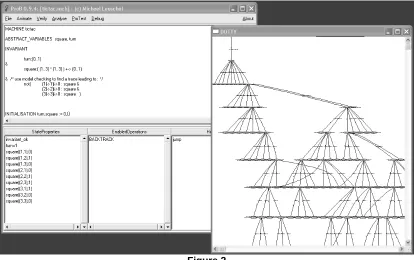
ProB [4] is a model-checker which attempts to automatically find inconsistencies of B machines. Figure 2 shows a snapshot of the tool. It applies to the B machine a certain number of basic checks (syntax, types), then tries to find a set of valid initialisations and finally gives the choice to the verifier to either animate the model, or model-check it.
Animation corresponds to the process of displaying the effects of B machine operations on its state. Usually implemented via an interactive visual interface, it is a method that enables a designer to test its models against a given scenario (i.e. sequence of operations) and the expected final state, in that way validating the model. ProB automatically computes at each step of the animation a set of enabled operations (i.e. such that their parameters meet the preconditions), with values for their parameters, so that the modeller only have to click on the desired element of the list of enabled operations. ProB also proposes a BACKTRACK operation to go back to the previous step in the animation, and can animate a B machine by randomly selecting operations.
Model-checking of a B machine is the exploration of its state-space, by enumerating possible values for the various undetermined elements (deferred sets and variables, parameter values for the operations). In fact, ProB offers the option to manipulate certain elements symbolically, i.e. working on the expression of these elements rather than on their enumerated values. ProB has two modes of model-checking:
Ö Temporal model-checking, to look for sequences of operations starting from a valid initial state and leading to a violation of the invariant (or other situations, like deadlock and abort when no operations are enabled due to the impossibility to find values satisfying respectively the guards and the preconditions for their parameters),
Ö Constraint-based model-checking, to look for a state satisfying the invariant where a single operation can be applied to reach a state where the invariant is violated.
operations leading to the current state. Many aspects of the ProB tool can be configured via a preference menu to adapt the animation, or model-checking, to a particular need.
[image:15.595.91.505.175.435.2]The coverage of the model-check depends on the size of the sets and the number, and complexity, of the operations. The model-check can be exhaustive if these numbers are small, thus proving that the B machine is consistent. But, contrarily to proving the POs with the B toolkits, non-exhaustive model-checking can generally only show the presence of errors, not their absence.
Figure 2
4.3 Results of the Formal Verification
4.3.1 Constraints imposed on the Models
Though modelling and model-checking are activities that can work independently, the models must, in practice, often be adapted to the model-checking technique and tools in order to make those later efficient, because the coverage rate depends on elements of the models. In the case of B and ProB, the sets have to be limited in size and the operations in complexity, so that the state-space is not too big.
In the examples of Section 3, positions are modelled by a very small number of locations. This implies that the condition of device locations proximity is overly simplified by an equality comparison, while the pervasive application computes the Euclidian distance between the two devices. This particular case seems, nevertheless, a reasonable abstraction.
We can also notice that in the second case, the sets are even more limited in size than in the first case (two devices, IDs and locations, and one document) because there are more variables and operations.
4.3.2 First Case
This simple model was easy to model-check, because the set sizes and operation complexity were low. Different versions of the B machine were checked depending on:
Ö The initialisation of RegisteredDevices;
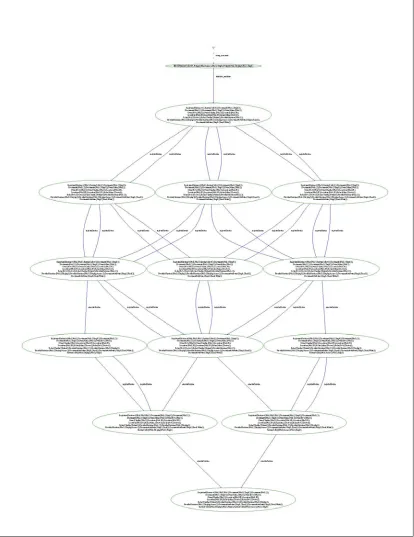
The most difficult situation to check is when RegisteredDevices is initialised to the empty set {} and the test is present. The state-space size is then 15 (see Figure 3 in Annex 6.1.2). The state-space is reduced if devices are added to RegisteredDevices and if the test is removed, for example Figure 4 (Annex 6.1.2) shows the situation of an empty initialisation and no test with a state-space of size 8. We can notice on the two figures in Annex 6.1.2 that the state-spaces have a similar structure, what corresponds to the fact that the behaviours are the same.
The reason why the state-space is small is that ServiceCalls remains empty, which itself is due to the fact that the Policy only authorises two service calls on different services and that executeService requires the locations to be the same. This in turn comes from the fact that the three devices are in three different locations, but no operation changes the locations. We modified this behaviour by adding a changeLocation operation to the B machine:
changeLocation(device,location)= PRE
device: DEVICE & location: LOCATION THEN
Locations(device) := location END
The corresponding B machine has a state-space of size approximately 350 and is still proven consistent via an exhaustive model-checking with ProB.
4.3.3 Second Case
Animation and model-checking of the ChangingPolicy B machines was more interesting than for the FixedPolicy machine as it brought up several situations that lead us to correct (for example, to ensure the privacy property in operations grantService and denyService, or to initialise the B machine with Access services available so that privacy properties can be met) and modify the models. Furthermore, some powerful features of ProB enabled the exploration of the behaviour of those B machines.
For example, as shown in Section 3.5.3, the initialisation of the ChangingPolicy is written with a choice by predicate as follows:
Policy, RegisteredDevices, Documents, Owns, Location, Roles, ProvidedServices, DocumentAttributes, RequestedSC, GrantedSC
:(invariant1 & invariant2 &
Documents = {Pda1|->{Xray1}, Pda2|->{}} & ...) This initialisation states that all the initial values of the variables should satisfy the invariant and some explicit assignments (if those assignments are incompatible with the invariant, the B machine is inconsistent). When launching the B machine, ProB tries to enumerate the valid assignments for all the the variables, which can then be used by the modeller to animate the machine or which can be followed further during model-checking.
Some other detected invariant violations were caused by a more general problem. This problem is that GrantedSC would no longer be a subset of Policy due to the updates of this Policy after unregistration of devices, thus invalidating the condition “GrantedSC :> Policy” of the invariant. This meant that this later condition was too strong and that the model of Policy was incomplete to ensure some trust properties (Authorisation in the above example). More generally, it expresses the idea that variables evolving during the system execution should be considered by group of “dynamic properties”, in the sense that modifications on one group during execution should be reflected by equivalent modifications on the other groups. Applied to the above example, Policy could be completed by a set Unregistered recording the unregistration of devices, so that the two groups (Policy, Unregistered) and (GrantedSC) can be kept consistent.
4.4 Conclusion
5 Conclusions
5.1 Summary
In conclusion, we have clarified the trust properties highlighted in the previous deliverable by modelling and verifying formally a pervasive application inspired from the previous pervasive scenarios. We have shown that the modelling task, using the B method, and the verification task, using the ProB model-checker, work hand in hand very well. They enabled us to discover some interesting behaviours, which lead us to solve non-obvious problems, and progress step by step towards an accurate model of the pervasive application. But, as said previously, modelling is an ongoing activity that requires a lot of maturation.
Finally, the fact that only one particular pervasive application is considered in this deliverable does not limit the scope of the discovered results (similarly to the fact that the pervasive scenarios developed in the deliverable WP2-01 did not limit the scope of Trust Analysis Grid created on top of them). We concretise this by giving some guidelines in the form of a methodology in the next Section.
5.2 Guidelines
As a conclusion, we would like to highlight the methodology we used during our modelling and verification activities. This methodology summarises several of the results given in this report. It could be helpful to guide users of formal method and tools during their first attempts to formally prove the (trust) properties of their system. The methodology follows and does not assume any particular formal method or tool:
1) Model important features of the system
First vaguely type the variables; then write a set of operations corresponding to complementary features while (possibly) modifying the variable types to ease this writing; consider the variables by group of similar dynamic properties;
2a) Model-check the model
2a.a) Property violation detected
Examine the various aspects of the model (variables, enabled operations, history of operations) to see what part of the property is “false”; Correct the model accordingly; 2a.b) No property violation detected
Go back to 2a until coverage rate is enough; possible changes to the model include: modify the initialisation to test other situations (in B use “choice by predicate”); add inconsistencies in the model;
2b) Animate the model
2b.a) Execute the desired sequence of operations (validation); 2b.b) Find an interesting state, then 2a.a or 2a.b applies; 2b.c) Backtrack from a state where the invariant is violated; 3) Go back to 1 (complete the model) or refine the model.
5.3 Future work
As we said, more modelling of the pervasive application is needed to solidify our results and translate them back to concrete proposals for the prototype. Regarding that aspect, we would like to use UML diagrams in order to ease the presentation of the formal models to the prototype developers. In particular, we could use the UML-B Profile [6] to automate the process of translation between B and UML. Refinements of our models will provide interesting supports for discussion between the modellers and the development team.
Acknowledgements
The authors would like to acknowledge the help of Andrew Edmunds in the creation and correction of the B models.
Bibliographic references
[1] J.-R. Abrial, The B-Book, Cambridge University Press, 1996.
[2] J.-R. Abrial, Extending B without changing it (for developing distributed systems), in H. Habrias, ed., 1st Conference on the B method, 1996, pp. 169-190.
[3] C. Jensen, S. Poslad and T. Dimitrakos, eds., Trust Management, Second
International Conference on Trust Management, iTrust 2004, Springer, Oxford, UK, 2004.
[4] M. Leuschel and M. Butler, ProB: A Model Checker for B, in S. G. A. Keijiro, M. Dino, ed., Formal Methods Europe, Springer, Pisa, Italy, 2003, pp. 855-874.
[5] S. L. Presti, M. Cusack, C. Booth, D. Allsopp, M. Kirton, N. Exon, P. Beautement, M. Butler, M. Leuschel and Phillip Turner, Trust Issues in Pervasive Environments, Deliverable WP2-01 (version 1.1),
http://www.trustedagents.co.uk/TSA-WP2-01v1.1.pdf, 2003.
6 Annex 1
B machines and their State-spaces
6.1 Fixed Policy Model
6.1.1
FixedPolicy
B machine
MACHINE FixedPolicySETS
DEVICE = {Pda1, Pda2, Pda3}; SERVICE = {Display, Access}; DOCUMENT = {Xray1, Xray2};
ID = {Alice, Bob, Charlie}; ROLE = {Doctor, Patient}; LOCATION = {P1, P2, P3}; ATTRIBUTE = {Read, Write}
CONSTANTS
Policy, MAXNumServCalls
DEFINITIONS
/* ServiceCall correspond to tuples (caller,service,callee,document) */ SERVICECALL==DEVICE*SERVICE*DEVICE*DOCUMENT;
/* invariant defining the type of variables */ invariant1 == (
RegisteredDevices: POW(DEVICE) &
Documents: DEVICE --> POW(DOCUMENT) & Owns: ID --> POW(DEVICE) &
Locations: DEVICE --> LOCATION & Roles: ID --> POW(ROLE) &
ProvidedServices: DEVICE --> POW(SERVICE) & DocumentAttributes: DOCUMENT --> POW(ATTRIBUTE) & ServiceCalls: POW(SERVICECALL)
);
/* second part of the invariant with the interesting properties */ invariant2 == (
/* documents are not shared */
!(a1,a2).(a1: dom(Documents) & a2: dom(Documents) & a1/=a2 => Documents(a1)/\Documents(a2)={}) & union(ran(Documents)) = DOCUMENT &
/* limit on the audit trail size */ card(ServiceCalls) <= MAXNumServCalls &
/* Authorisation: all ServiceCalls should be authorised by the Policy */ ServiceCalls <: Policy)
PROPERTIES
/* PROPERTIES defining the CONSTANTS */ Policy: POW(SERVICECALL) &
Policy = {Pda1 |-> Display |-> Pda2 |-> Xray1, Pda2 |-> Access |-> Pda3 |-> Xray2} & MAXNumServCalls: NAT & MAXNumServCalls = 10
VARIABLES
INVARIANT
/* INVARIANT on the VARIABLES */ invariant1 & invariant2
INITIALISATION
/* INITIALISATION of the VARIABLES */ RegisteredDevices := {} ||
Documents := {Pda1|->{Xray1}, Pda2|->{}, Pda3|->{Xray2}} || Owns :={Alice|->{Pda1}, Bob|->{Pda2}, Charlie|->{ Pda3}} || Locations := {Pda1|->P1, Pda2|->P2, Pda3 |->P3} ||
Roles := {Alice|->{Doctor}, Bob|->{Doctor}, Charlie|->{Patient}} ||
ProvidedServices := {Pda1|->{}, Pda2|->{Display}, Pda3|->{Display,Access}} ||
DocumentAttributes := {Xray1|->{Read}, Xray2|->{Read,Write}} || ServiceCalls := {}
OPERATIONS
/* the operation executeService models the attempt to execute a service */ executeService(caller,service,callee,document) =
PRE
caller: DEVICE & callee: DEVICE & service: SERVICE & document: DOCUMENT & service: ProvidedServices(callee)
THEN
SELECT card(ServiceCalls) < MAXNumServCalls &
[image:21.595.61.524.78.258.2]caller: RegisteredDevices & callee: RegisteredDevices & caller |-> service |-> callee |-> document: Policy & Locations(caller) = Locations(callee) THEN
/* Audit Trail: kept track of the service call */
ServiceCalls := ServiceCalls \/ {(caller|->service|->callee|->document)} END;
/* the operation registerDevice models the attempt to register a new device in the system */
registerDevice(person,device)= PRE
person: ID & device: DEVICE THEN
IF Doctor: Roles(person) THEN
/* Identification (Privacy): only doctors KNOW the process to register a device */
RegisteredDevices := RegisteredDevices \/ {device} ELSE
/* Authorisation: unauthorised registration */ skip
END END
END
6.1.2
FixedPolicy
State-space
Figure 3
Figure 4
6.2 Changing Policy Models
6.2.1
ChangingPolicy
B machine
MACHINE ChangingPolicySETS
DEVICE = {Pda1, Pda2}; SERVICE = {Display, Access}; DOCUMENT = {Xray1};
ID = {Chris, Michael};
LOCATION = {P1, P2}; ATTRIBUTE = {Read, Write}
DEFINITIONS
/* ServiceCall: (caller,service,callee,document) */ SERVICECALL==DEVICE*SERVICE*DEVICE*DOCUMENT; /* invariant1: typing invariant */
invariant1 == (
Policy: POW(SERVICECALL) & RegisteredDevices: POW(DEVICE) &
Documents: DEVICE --> POW(DOCUMENT) & Owns: ID --> POW(DEVICE) &
Location: DEVICE --> LOCATION & Roles: ID --> POW(ROLE) &
ProvidedServices: DEVICE --> POW(SERVICE) &
DocumentAttributes: DOCUMENT --> POW(ATTRIBUTE) & RequestedSC: POW(SERVICECALL) &
GrantedSC: POW(SERVICECALL) );
invariant2 == (
/* documents are not shared between devices and they are all are stored on a device */
!(a1,a2).(a1: dom(Documents) & a2: dom(Documents) & a1/=a2 => Documents(a1)/\Documents(a2)={}) & union(ran(Documents)) = DOCUMENT &
/* SC granted must have been requested and be in the policy */ GrantedSC <: RequestedSC &
GrantedSC <: Policy &
/* identification: only registered devices can be in the policy or be granted authorisations */
!(a,b,c,d).(a:DEVICE & b: SERVICE & c: DEVICE & d: DOCUMENT & (a|->b|->c|->d):GrantedSC => a:RegisteredDevices
& c:RegisteredDevices & a/=c) &
!(a,b,c,d).(a:DEVICE & b: SERVICE & c: DEVICE & d: DOCUMENT & (a|->b|->c|->d): Policy => a /= c & a:RegisteredDevices) &
/* privacy: for a service to be called, the device should have "Access" to the document */
!(a,b,c,d).(a:DEVICE & b: SERVICE & c: DEVICE & d: DOCUMENT & (a|->b|->c|->d): GrantedSC => (a|->Access|->c|->d): Policy) )
VARIABLES
Policy, RegisteredDevices, Documents, Owns, Location, Roles, ProvidedServices, DocumentAttributes, RequestedSC, GrantedSC
INVARIANT
invariant1 & invariant2
INITIALISATION
Policy, RegisteredDevices, Documents, Owns, Location, Roles, ProvidedServices, DocumentAttributes, RequestedSC, GrantedSC
:(invariant1 & invariant2 &
Documents = {Pda1|->{Xray1}, Pda2|->{}} &
Owns = {Chris|->{Pda1}, Michael|->{Pda2}} & Location = {Pda1|->P1, Pda2|->P1} &
Roles = {Chris|->{Doctor,Administrator}, Michael|->{Doctor}} & ProvidedServices = {Pda1|->{}, Pda2|->{Display}} &
DocumentAttributes = {Xray1|->{Read}} & RequestedSC = {} & GrantedSC = {})
grantService(caller,service,callee,document) = PRE
caller: DEVICE & callee: DEVICE & service: SERVICE & document: DOCUMENT THEN
/* Authorisation mechanism, decomposed into: */
/* devices must be registered AND service offered by callee */ SELECT (caller: RegisteredDevices & callee: RegisteredDevices &
service: ProvidedServices(callee) /* service call must be authorised */
& (caller |-> service |-> callee |-> document): Policy /* devices not close enough */
& Location(caller) = Location(callee) /* to ensure privacy */
& (service /= Access) => (caller|->Access|->callee|->document): Policy) THEN
RequestedSC := RequestedSC \/ {caller|->service|->callee|->document} || GrantedSC := GrantedSC \/ {caller|->service|->callee|->document}
END END;
denyService(caller,service,callee,document) = PRE
caller: DEVICE & callee: DEVICE & service: SERVICE & document: DOCUMENT THEN
/* see grantService operation for details about the guard */
SELECT not (caller: RegisteredDevices & callee: RegisteredDevices & service: ProvidedServices(callee)
& (caller |-> service |-> callee |-> document): Policy & Location(caller) = Location(callee)
& (service /= Access) => (caller|->Access|->callee|->document): Policy) THEN
RequestedSC := RequestedSC \/ {caller|->service|->callee|->document} END
END;
registerDevice(person,device)= PRE
person: ID & device: DEVICE THEN
SELECT device: Owns(person) & Administrator: Roles(person) THEN /* only administrators KNOW the process to register a device */ RegisteredDevices := RegisteredDevices \/ {device} ||
/* all the authorisations of the person are granted for the new device */ Policy := Policy \/ {varx| varx: SERVICECALL &
#(aa,bb,cc,dd).(aa: DEVICE & aa: Owns(person) & bb: SERVICE &
cc: DEVICE & dd: DOCUMENT & varx=(device|->bb|->cc|->dd) & (aa|->bb|->cc|->dd): Policy)}
END END;
unregisterDevice(person,device)= PRE
person: ID & device: RegisteredDevices THEN
SELECT device: Owns(person) & Administrator: Roles(person) THEN RegisteredDevices := RegisteredDevices - {device} ||
/* all the authorisations granted for the device are removed */ Policy := Policy - {varx| varx: SERVICECALL &
#(aa,bb,cc,dd).(aa: DEVICE & aa: Owns(person) & bb: SERVICE &
END END
END
6.2.2
ChangingPolicy
State-spaces
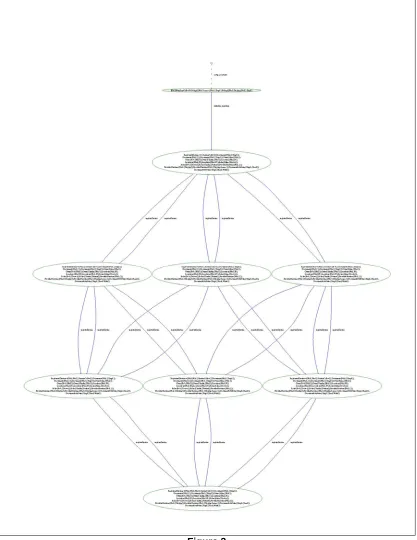
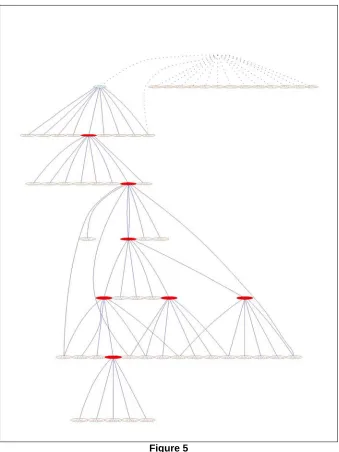
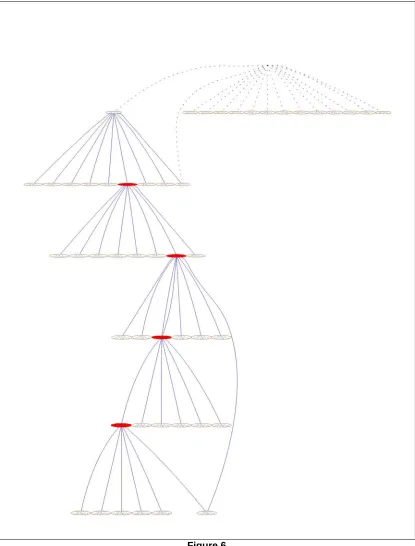
[image:26.595.129.468.185.637.2]In the following graph, node labels are simplified, red nodes correspond to invariant violation and transition labels are removed. Figure 5 represents the model-checking of ChangingPolicy with the default ProB exploration:
Figure 5
Figure 6