EUROPEAN COMMUNITIES
MONETARY COMMITTEE/
POLICY
ON THE BOND MARKETS
Wi
IN THE COUNTRIES OF THE EEC
Current instruments and the use made of them
EUROPEAN COMMUNITIES
,,
MONETARY COMMITTEE/-POLICY
ON THE BOND MARKETS
IN THE COUNTRIES OF THE EEC
r
~~·
Current instruments and the use made of them
from 1966 to 1969
/,/Report by an Expert Working Party established by the Monetary Committee
Brussels - October 1970 /
CONTENTS
INTRODUCTION •••••..••.•••••••••.•••••.••••••••••••••••••••••••••••• 1
PART I
Maintenance of equilibrium of the bond markets of the EEC countries:
procedures and instruments •••••••••••••••••••••••••••••••••••••••••
3
Chapter I
Intervention by the authorities at the issue stage •••••••••••••••••
5
A.
Comparison of objectives and methods ••••••••••••••••••••••••••••5
1. Objectives
5
2. Methods •••••••••••••••••••••••••••••••••••••••••.••••••••••••
6
B.
Legal basis and scope of the powers available to the authoritiessupervising the markets for public issues floated by residents •• 9
1. Main features
9
2. Analysis of intervention on the primary market by country •••• 10
C. Control of tap issues and issues placed privately 22
1. Tap issues . . . . . . . . . . . . . . . . . . . . . . . . . . . . . . . . . . . . . . . • . • . • • 22
2. Issues placed privately •••••••••••••••••••••••••••••••••••••• 26
D.
Control of issues in relations with countries abroad ••••••••••••29
Chapter II
Instruments to regulate the secondary market
38
A. Intervention by the public authorities to regulate o~ support
bond prices . . . . . . . • . . . . . . . . . • . . • . • . . . • • . • . • . . . . . • . . • . • . • • • • • •
38
B.
Measures of monetary policy affecting the market for fixed-interest sec uri ties • . . . . . . . . . . . • . . . . . . . . . . . . . . . . . . . . . . . . . . . . . . . • . • . . • •40
c.
Privately sponsored mechanisms to support bond prices •••••••••••42
PART IIMember States' policies on their bond markets from
1966
to theChapter I
General approach to bond market policy •••••••••••••••••••••••••••••
49
Chapter II
Policies on domestic demand for capital ••••••••••••••••••••••••••••
53
Chapter III
Poiicies on domestic supply of capital •••••••••••••••••••••••••••••
70
Chapter IV
Policies on supply of and demand for capital in relations with
countries abroad •••••••••••••••••••••••••••••••••••••••••••••••••••
80
CONCLUSIONS
ANNEX I
Statistics on the bond markets of the EEC countries
ANNEX II
I. INTRODUCTION
The Working Party on Securities Markets, consisting of experts nominated by the
Member States and the Commission, was set up on 30 October 1967 by the Monetary Committee to gather information concerning the ways in which equilibrium is
established on the bond markets in each of the member countries.
It began by making an inventory of the procedures and instruments used to ensure
equilibrium. Then, from October 1968 onwards, it analysed the policies pursued by
the Member States with regard to their bond markets from 1966 till mid-1969. For
this purpose the Working Party used statistical information prepared by a sub-group.
The results of this work were summarized in a report in two parts, the first of
which was completed by the end of 1968 and the second early in 1970. They were laid
before the Monetary Committee as they became available. While the report was being
drafted and after its completion, appreciable changes occurred in the conditions unde~ which equilibrium was brought about in the bond markets. It has not been always
possible to take account of these: what is certain is that the very rapid development
of these markets compels the authorities, in general, to make continuous changes in
the instruments and procedures used to ensure equilibrium and leads to even greater
changes in the conditions under which these instruments are used. These changes were
on a particularly large scale in the period studied, during which many political and monetary events had a marked influence on the development of the capital markets and
on official policy in this field.
It being impossible to bring the report up to date to cover these developments,
it was decided to fix the conclusions reached in the two parts of the report at the
date on which each was submitted to the Monetary Committee, having due regard to the
statistics then available.
up-dated to the end of 1969.
Much of the statistical annex has, however, been
The main value of this work is probably that it has provided an opportunity for
the representatives of the national authorities and of the Commission to carry out
detailed discussion of the conditions under which equilibrium on the bond markets is
adjusted and by this very process to improve understanding of the machinery and the
way it is used.
-An improved understanding of the bond markets enables each Member State to gain
more from the experience of the partner countries and is a first necessary step
towards any alignment at Community level. The Monetary Committee felt, however,
that the value of these comparative studies warranted their dissemination outside the Community and the national agencies for which they were originally intended. It
therefore decided to publish the report.
But the work already done has also shown the usefulness of closer cooperation in
the planning of schemes to reform the structure of the capital market and in the
implementation of the policies of the Member States. The Committee therefore
decided, when approving the report, to keep the Working Party in being and to extend
its mandate to cover all problems connected with the capital markets.
The Working Party's tasks will include:
(i) The drafting, at the request of the Committee, of any opinions called for in
this field;
(ii) Periodical discussion of developments on Community markets and of their
contacts with international markets;
(iii) The examination of all aspects of the policies pursued by the Member States
with regard to the capital markets and of practical opportunities for
PART I
MAINTENANCE OF EQUILIBRIUM
ON THE BOND MARKETS OF THE EEC COUNTRIES:
PROCEDURES AND INSTRUMENTS
In all member countries the public authorities endeavour to maintain equilibrium
on the bond markets, using instruments and procedures made up of a variable mix of
official intervention and restraint on the part of issuers. Some of these
instruments and procedures were evolved after the world economic crisis, most of them
after the Second World War; since then they have been modified everywhere and adapted to the institutional background of the particular country.
The situation on the bond markets, which after the war suffered from a structural
shortage owing to a fundamental disequilibrium between the supply of and the demand
for long-term capital, has changed in such a way that today the difficulties can in
most cases be mitigated by adjustments to the timing of supply and demand and to the
terms of issues.
In addition, the authorities in certain Member States have, in the light of their
own experience and that of other countries, changed and improved their methods of
regulating the markets. While initially the approaches adopted had varied
appreciably, with some countries taking a decidedly liberal line while others were
more interventionist, the arrangements have been changed repeatedly in Qome countries and have tended to come closer together.
The scale of market intervention by the authorities cannot be assessed
exclusively in terms of the regulations which lay down what they can do in this field; a better means of assessing it is to examine the forms which intervention on the
market takes in practice, for in some cases the authorities have not used their
powers while in other cases they have used 'moral suasion', their intervention in
fact going further than seemed possible in the light of their powers as set down on
paper.
The French system is particularly difficult to describe. In April 1968 this
system was radically changed along more liberal lines; owing to the events of May,
however, the authorities ordered a three-month ban on certain issues, so that the new
procedures were tried out for a relatively short period only. It has therefore
appeared expedient to describe not only the principles and the working details of the
current arrangements but also to recall certain aspects of the system in effect before
CHAPTER I. INTERVENTION BY THE AUTHORITIES AT THE ISSUE STAGE
In all member countries the floating of a public loan is subject to certain
controls ensuring at least that the authorities supervising the market are informed
and also, in most cases, that the equilibrium of the market is maintained.
There are, however, major differences in the oojectives, legal bases and the
practical implementation of these controls.
A. Comparison of objectives and methods
Although it is very difficult to give a summary account bringing out resemblances
and differences between official policy objectives in the member countries and between
the methods used to safeguard market equilibrium, they may be summed up as follows,
fuller details for each country being given in the pages that follow.
1. Objectives
The objectives which the authorities of the member countries pursue in practice,
explicitly or implicitly, are the following:
(i) Protection of the saver: all countries;
(ii) Elimination of temporary overloading of the market: all countries;
(iii) Stabilization of rates of yield: France, Italy, Netherlands;
(iv)
~ ~
priority for satisfaction of public sector needs:1 Belgium, Italy,France (particularly before the reform);
(v) Priority for domestic issuers over foreign issuers: all countries except
Germany and Luxembourg.
1
Here, the public sector is to be understood in the broad sense and includes central government, local authorities, credit institutions and public and semi-public enterprises.
-2. Methods
To attain these objectives, the countries endeavour to stagger issues
(procedures used vary in rigour). Methods may be classified as follows:
(i) Establishment of a time-table by the public authorities: Belgium (for
public-sector loans), Italy, France (before the reform);
(ii) Arrangements to coordinate action between the public authorities and the
banks: Netherlands, France (after the reform);
(iii) Arrangements (a) within a committee of banks to coordinate domestic block
issues by the private sector and DM issues by foreign borrowers, and (b)
within a committee of public borrowers to coordinate public-sector issues; action to fix the terms and dates of issues by banks: Germany;
(iv) Autonomous fixing of the date of issue by the banks: Luxembourg;
(v) Possibility of using rules designed primarily to protect the saver but which
can also be used to avoid serious overloading of the market: Germany, Belgium, Luxembourg;
(vi) Possibility of limiting private-sector issues by administrative action:
France, Italy;
(vii) Possibility of limiting private-sector issues by administrative action;
all countries in a period of crisis.
In practice the methods used by the individual countries differ more widely in normal times than in times of a market crisis. Even in the countries where the
policy is to regulate the market by relying on issuers' restraint and market forces,
the authorities have power, used only in case of serious strain, to limit
public-sector issues (Germany, the Netherlands), and even private-sector issues as
well (France).
Although three countries have made arrangements to coordinate the timing of
issues, the implementing arrangements are in no two cases the same.
In Germany, issues are floated in normal periods without official intervention
to regulate the amount, timing or terms. The decision on these points lies with the banks, which take the market situation as a guide. Temporary strains are also
eliminated without official intervention thanks to voluntary restraint on the part
Some groups of issuers have a special coordinating body - the Central Capital Market Committee (Zentraler Kapitalmarktausschuss des Bankgewerbes, ZKA) - for
private-sector issues floated throu~h a banking consortium, and the Council on Economic Trends (Konjunkturrat) for pu~lic-sector issues. It should, however, be emphasized that the timing of public-sector issues is fixed by the one body
independently of the timing arrangements for private-sector issues established by the
other.
In normal times, the authorities can influence the timing of public-sector issues only, and their role is confined to ensuring that the public borrowers
coordinate action among themselves.
In the case of serious disturbances on the market, which so far have occurred
only once, in 1965/66, when the volume of operations dropped by roughly 60%, the authorities may ration public-sector demand (provided an appropriate Decree has been
published previously), and also curb in some measure private-sector demand if public
issues are affected.
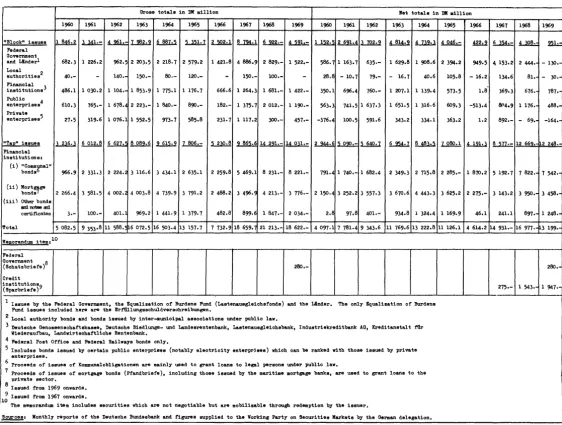
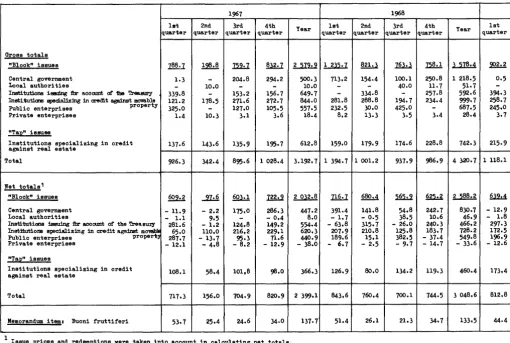
Private placings, however, which constitute a considerable share of the market
(25%), are not subject to control by the public authorities, even in times of crisis. These mainly take the form of loans against borrowers' notes1 (the principal
creditors being private insurance companies, which in 1967 granted loans totalling some DM 2 400 million), and registered bonds,2 which in 1967 accounted for some 10%
of the gross sales of bonds and even less in the normal years prior to 1967 (it is mainly the mortgage institutions which raise additional funds through registered
bonds).
In France, by contrast, since the refo~m of April
1968,
the arrangements tocoordinate action between the public authorities and the Banking Committee have
covered the whole of public- and private-sector issues.
In case of serious strain, the Minister of Economics and Finance may use his
powers to delay or suspend all issues.
In the Netherlands, the Central Bank may bring its influence to bear on the
banks, particularly as regards the date and possibly also the terms of public issues
floated by the private sector and, for certain issues, also by the public sector.
1 Schuldscheine.
2
Namensschuldverschreibungen.
-When the market is under strain, the Government may also, by means of a
comparatively cumbersome procedure, limit the calls which the public sector makes on
the market. There is, however, no way of limiting private-sector demand, except by
moral pressure brought to bear on the banks.
Private placings, which in the Netherlands account for a much larger part of the
market than in any other EEC country (four times the volume of net domestic issues
floated publicly, against at most one fourth or one fifth in the other countries) are
not subject to control by the public authorities, and this is a major obstacle to
effective public control.
In Belgium and Italy, where the authorities heavily influence or actually control
the timing of issues without the banks participating in their decisions, the volume
of private-sector issues is relatively small compared with that of public-sector issues (central government, nationalized industries, public credit institutions).
This is said to be not so much the result of any rationing of the private sector in
order to give the public sector priority as of two special factors: firstly, there
are few private-sector enterprises large enough to use the market directly;
secondly, enterprises which are able to do so prefer to call on credit institutions,
which grant them loans at subsidized rates of interest, and consequently at a cost
lower than that of raising funds on the bond market. As loans at subsidized rates
are widely available in these countries, many enterprises take advantage of this way
of raising funds.1
In Italy the public credit institutions are also able - quite apart from any
subsidization of interest rates - to raise funds on the market and relend them to
enterprises at interest rates that are lower than the ones the latter would have to
pay if they used the market directly.
There is in Belgium a substantial latent demand from the public sector, which
makes as many calls on the market as it can take. This no doubt tends to discourage
calls from potential private issuers, without there being a need for a recommendation,
let alone an express decision, ~Y the authorities supervising the market.
In Italy and Belgium, then, the structure of demand for capital explains why the
time-table for issues is established by the authorities without official coordination
with the banks. The time-table is mainly a function of planned public-sector issues.
B. Legal basis and scope of the powers available to the authorities supervising the
markets for public issues floated by residents
1. Main features
Official intervention has three types of legal basis that differ widely:
(i) Some rules explicitly provide for intervention by the authorities to maintain
market equilibrium by rationing demand; this applies in Germany and the
Netherlands only in exceptional situations of disequilibrium and only to public-sector demand, in France to all issues but only in case of strain, and
in Italy to all issues at all times.
(ii) Some rules are mainly designed to protect the saver, but may be used in
exceptional cases or regularly to maintain market equilibrium as well, by rationing private-sector demand; in Germany these rules have been used in one
year only (1966), in Belgium they have been used only at certain moments and
only informally, while in Luxembourg they are available but have never yet been
used.
In these countries, the market for private-sector issues is regulated less
by the actual use of such formal powers than by informal recommendations issued
by the relevant authorities.
(iii) In the Netherlands there is an original type of legal basis for Central Bank
intervention in respect of public issues: this is a gentlemen's agreement with
the banks, requiring them to keep the Central Bank informed of their issue
plans and giving the Central Bank a power of recommendation concerning the date
of the issues and the terms upon which they are made.
-2. Analysis of intervention on the primary market by country
Germany
(a) Private-sector issues and issues by local authorities
Articles 795 and 808a of the German Civil Code (BGB) make the issue of all bearer
or order bonds other than those of the Federal Government, the Lander, the Federal
Railways, the Federal Postal Administration and the Equalization of Burdens Fund
subject to authorizations. Even issues by local authorities are subject to
authorization, as are foreign issues floated in Germany. Similarly, authorization
is necessary for tap issues (mortgage bonds and "communal" bonds of the mortgage
institutions, and medium-term securities issued by the credit institutions to refinance medium-term investment loans).
The authorization procedure is mainly intended to protect the saver, but as an
exception it can in case of crisis also be used to ensure, in the interest of market
equilibrium, improved timing of issues.
A law of'26 June 1954 defined the powers of the Ministry for Economic Affairs
under this procedure, bringing into effect again Article 795 of the HGB, which had
been abrogated by the capital movements laws of 1949 and 1952.
It should, however, be noted that the powers conferred on the Ministry for
Economic Affairs were used only in 1965-1966, as an exception, to ensure better
spacing out of issues. No express decision was taken to suspend issues, the granting
of authorizations being merely delayed in agreement with the issuers.
Normally, temporary fluctuations on the market are avoided by coordination and
voluntary restraint on th~ part of the issuing houses, without public authority
intervention. This coordination takes place in the Central Capital Market Committee, composed of eleven representatives of the banks, of whom six are representatives of
the credit institutions which issue bonds of their own (tap issues), and one observer
from the Bundesbank who informs the Committee of the issue plans of the public
(b) Publio-seotor issues
The Aot for Economic Stability and Growth of 8 June 1967 gave the Federal Government certain powers of intervention.
This Act set up a Council on Economic Trends (Konjunkturrat fUr die 5ffentliohe Hand), presided over by the Federal Minister for Economic Affairs and composed of
representatives of the Federal Ministry of Finance, the LMnder and local authorities.
The Bundesbank also sends an observer.
In normal times the Council is nothing more than a body ensuring concerted action
and voluntary restraint among public borrowers. It examines the credit requirements of
the public sector, assesses the market situation and formulates recommendations
concerning priorities among public borrowers and the size of their issues. In doing so,
the Council takes into account the urgency of the financing requirements of the private
sector as shown in the applications for authorization filed with the Ministry for Economic Affairs and in the information received from the Central Capital Market
Committee. It makes no more than a general examination of the terms of the issue, their
fixing being normally left to the banks.
In this way the Council has given official status to the round-table talks which
have been organized by the Federal Ministry for Economic Affairs since 1965 with the same participants and the same objectives.
In the event of an exceptional situation of market disequilibrium arising the Act
confers increased powers of intervention on the Federal Government. It may issue
decrees making the Council's recommendations binding and thus:
(i) Limit public-sector indebtedness in the form of loans or other credit for a
specific period;
(ii) Fix the maximum amount and the terms of loans; (iii) Make the issue time-table binding for three months.
These decisions would, however, have to be approved by the Bundesrat (the Upper
House of the Federal Parliament).
Furthe~ore, when loans are loans floated by the Federal Government, the Federal
Railways, the Federal Postal Administration and the Linder, the Bundesbank is also
associated with the operation. The issues are floated either through the Bank or in
-11-agreement with it (Article 20(2)
or
the Federal Bank Law - Bundesbankgesetz). As the Bundesbank is represented on the Council on Economic Trends and on the Central CapitalMarket Committee, and as on account of its activities it is in permanent touch with the
banks and the stock exchanges and therefore has an overall view of the situation on the
capital market, it is in a position to give opinions concerning the date, the amount and
the terms of public loans. In these opinions, it takes account of the recommendations
made by the Council on Economic Trends.
(c) Formalities prior to flotation
To obtain authorization under Articles 795 and 808a of the Get"JDan Civil Code, the
issuer has to file an application with the Federal Ministry for Economic Affairs via the
appropriate Ministry of the Land where he resides (generally the Land Ministry of
Economics but sometimes also the Land Ministry of Finance), which renders an opinion on
the credit rating of the company or the indebtedness of the issuing municipality.
Authorization is in general granted within three weeks; five or six weeks may, however,
be required if enterprises are involved whose credit standing takes longer to
investigate. Costs are very low (0.025% of the amount of the issue, with an upper limit
of Dl4 2 000).
The Federal Ministry for Economic Affairs issues a written authorization valid for
one year, and this may be renewed free of charge if necessary.
Belgium
(a) Private-sector issues
The Royal Decree No. 185 of 9 July 1935 setting up the Banking Commission
(Commission bancaire), amended by Royal Decree No. 67 of 30 November 1939 (Article Be),
vested this body with the right to supervise private-sector issues.
These supervisory arrangements are designed not only to protect the saver but also
to out down or spread over a longer period issues liable to disturb equilibrium on the
capital market. To this end, the Banking Commission sends recommendations to the issuing company and the issuing banks which have filed an application. These
recommendations take into account the information available to the Commission on issue
plans in the public sector and on the market situation. If its opinion is not complied
with, it may delay the operation by three months by means of a decision accompanied by
It also makes recommendations on interest rates in an effort to ensu_~ that the
yields on issues of private-sector bonds do not differ unduly from the yields on
issues of public-sector bonds or from yields on other securities.
There are no coordinating problems between the Banking Commission, which
supervises the issuing projects of the private sector, and the Ministry of Finance,
which draws up the time-table for public-sector issues, as the volume of public issues
by the private sector is relatively small when compared with the public issues floated
by the public sector (for the years 1966-1968 they represent some 15% of the net value
of all public issues). Contacts are maintained among officials with a view to
exchanging information on planned issues.
(b) Public-sector issues
The law of 16 March 1954 and the statutes of the various quasi-public bodies,
which all include a clause preventing them from floating loans unless they have
received prior authorization from the Minister of Finance, give the Minister considerable influence over the fixing of the time-table.
Loans rai·eed by the quasi-public bodies must also be authorized by the competent
Minister.
Every year the Minister of Finance draws up an overall list of the needs of the
central government and the various public borrowers and establishes at the beginning
of the year the issue time-table, taking into account the national budget and the
financial equilibrium of the various quasi-public bodies, the capacity of the market,
the trend of the economy and of the balance of payments, and the redemption dates for
earlier loans. He also takes account of the issue plans of the private sector, of
which he is informed by the Banking Commission. It rarely happens that the time-table
is changed during the year but there is nevertheless some room for flexibility despite
the structural deficit of the central government and the obligations in connection
with redeption.
In regulating the market, the Minister may be assisted by two consultative
bodies:
(i} The Conseil des institutions publiques de credit (Council of Public Credit
Institutions, statute of 1937 amended by Royal Decree No. 18 of 25 May 1967) may
be consulted on matters such as the terms of issues by the quasi-public credit
institutions;
13-{ii) The Conseil superieur des Finances {Higher Finance Council, statute amended by
Royal Decree No. 17 of 23 May 1967) may be instructed to assist the Minister in
the preparation and implementation of the finance policy measures applicable to
the various capital markets; it has, however, not been set up yet.
In short, the Minister of Finance not only regulates the market in the short term
but also structural developments in the rates of interest.
{c) Formalities prior to flotation
Any person intending to "display for sale, offer for sale or sell publicly company
shares of any kind {actions, titres ou parts beneficiaires de societas) or bonds" must
inform the Banking Commission at least fifteen days before the proposed date of issue
of the details of the operation envisaged and attach all the information and statements
of accounts required in such oases.
The Banking Commission may ask for additional information and address
recommendations to the company in an informal way by getting in touch with its
management.
If these recommendations are not complied with, the Banking Commission may, by a reasoned decision sent by registered letter, delay the issue for a maximum of three
months from the date of notification of the decision to the party concerned.
The quasi-public institutions submit their applications to the Minister of Finance
via the competent Minister, who renders an opinion.
{a) The powers of the Minister of Economic Affairs and Finance
The law of 23 December 1946 {Article 82) introduced a procedure for prior
authorization by the Minister of Economic Affairs and Finance in case of "any increase
in capital, no matter what form it takes, any issue, display, offer for sale or
introduction on the French market of loans, bonds, shares and securities of French
corporations or French private-sector companies".
For issues exceeding FF 250 000, this law gives the Minister the power to regulate
maturity, redemption arrangements and any additional benefits) and to establish a
time-table for the issues. This time-table is an effective instrument for the
allocation of resources in accordance with the guidelines of the economic plan.
Various ministerial decisions {16 January 1958, 16 June 1958,
7
March 1959,22 August 1963,
7
January 1966), however, exempted certain issue operations from theprior authorization requirement while retaining the obligation to inform the Minister
and his power to delay these io:'l'.H::t or rnorlify their terms. Despite this concession,
any bond issue exceeding FF 15 million remained subject to prior authorization and any
issue exceeding FF 30 million had to be included in the time-table.
By a ministerial decision of 18 April 1969, the Minister of Economic Affairs and
Finance waived some of the rights he had under the law of 1946 by abolishing the
obligation to seek authorization for any issue of bonds and retaining only the
obligation to notify issues of FF 15 million and more.
He reserved, however, the right to depart again from this more libe~al system
without formality and without notice. Since this reform, all the procedure of 1946 does
is to furnish the legal 'hasis for the Ministel''s discretionary power to delay or suspend
issues in case of heavy strain on the market (right of veto).
(b) The role of the banks and of the Banking Commission
The role of the banks and the details of the coordinating arrangement introduced
between them and the Minister of Economic Affairs and Finance were set out in a joint
declaration of intent by the Minister and the main banks in March 1968.
The absolute powers for fixing the time-table and all ·terms of an issue enjoyed by the Minister before the reform were replaced by coordination between the Miniater
and the banks concerning the timing of the issues and the general level of coupon
interest rates. The dates, amounts and terms of issues are thus fixed jointly, but in
case of conflict the final decision lies with the Minister of Finance.1 This applies
not only to private-sector issues but also to issues by the publie and semi-public
1 During the capital market crisis caused by the events of May 1968, the temporary ban on issues was agreed between the Minister and the banks.
-sectors; theiT needs are still given priority ranking although in 1968 the necessary
adjustments affected primarily the public and semi-public sectors. Since the reform of
placing techniqueo, the floating of public-sector loans depends in greater measure than
before on smooth cooperation by the banks, as the latter may now refuse to underwrite a
public-sector issue which they believe to be too big or made on terms incompatible with
the market situation.1
The banks align their views and coordinate their measures within a Banking
Committee consisting of representatives of the three nationalized banks, two
non-nationalized deposit banks and one investment bank {banque d'affaires).
(c) Forrr.alities prior to flotation
Since the reform of April 1968, companies are merely required to notify the
Ministry of Economic Affairs and Finance fifteen ~ays in advance of any planned issue
of an amount of FF 15 mil1ion or more.
There are no other written formalities, but a period of about a fortnight is
needed for the coordinating contacts between the bankers participating in the issue
and the Ministry.
Under the special rules governing loans floated by the Government and its
agencies, the local authorities and public enterprises or establishments, all
public-and semi-public-sector issues are subject to authorization by decree or ministerial
order.
The combined powers of the Ministers responsible for the Treasury, and for Industry,
Commerce and Crafts, of the Central Bank and of the Inter-Ministerial Credit and
Savings Committee make it possible to fix all terms of a bond iasue and to channel the
resources into schemes that enjoy pric>rity under the Government's e.conomic policy.
(a) Lesal basis for official intervention in the authorization procedure
The powers of the various authorities vary somewhat with the type of issuer and
the methods of issue.
Banking law No.
375
of13
March 1936 (Articles 2, 44 and 45) makes all thefollowing types of issue subject to authorization by the Bank of Italy:
(i) Issue through credit establishments subject to supervision by the Bank of Italy
(except for government and government-guaranteed bonds);
(ii) Securities admitted or to be admitted to quotation on an Italian stock
exchange;
(iii) All issues by credit establishments and institutions, except mortgage bonds
(cartelle fondiarie) issued by those institutions entitled to lend on mortgage
and those issued by credit institutions which finance public works (cartelle
opere pubbliche) and by those institutions entitled to make agricultural loans,
if they have been placed on a similar basis to institutions issuing mortgage
bonds.
Law No. 428 of 3 May 1955 makes company issues exceeding Lit. 500 million subject
to prior authorization from the Ministries responsible for the Treasury, for Industry,
and for Commerce and Crafts; the Inter-Ministerial Credit and Savings Committee must
be consulted before the authorization is given.
Lastly, the statutes and bye-laws of certain bodies and authorities regulate the
terms of issues floated by them:
(i) Local authorities (Article 300 of the communal and proVincial law, amended by
law No. 10 of
5
January 1950): authorization by the Ministries of the Treasuryand the Interior; the Central Committee for Local Finance and the Council for
Provincial Administration (Giunta) must be consulted before authorization is
given;
(ii) IRI: authorization by the Bank of Italy;
(iii) ERI: authorization from the Ministers responsible for the Treasury, Industry,
and Commerce and Crafts, the Ministry of State Participations, and the Bank of
Italy;
(iv) ENEL: authorization by the Inter-Ministerial Credit and Savings Committee and the
Bank of Italy;
-n-(v) Autonomous administrative agencies: authorization by a decree of the Ministers
of the Treasury and of State Participations, following an opinion rendered by the
Inter-Ministerial Credit and Savings Committee;
(vi) Motorway companies: authorization by the Ministries of the Treasury, of Industry
and of Commerce and Crafts, the Bank of Italy and the Inter-Ministerial Credit
and Savings Committee;
(vii) Finance companies set up by special laws: authorization by the Inter-Ministerial
Credit and Savings Committee.
(b) The roles of the various authorities
Each authority has a special task:
The Inter-Ministerial Credit and Savings Committee, presided over by the Minister
of the Treasury and consisting of representatives of any of the above-mentioned
ministries that are likely to be involved and of the Bank of Italy, must in some cases
give its authorization but usually merely renders an opinion; it seeks to achieve
stable interest rates by putting out general directives on the terms and details of
issues and by ensuring, where it· participates in the authorization procedure through endorsement or rendering an opinion, that the yields of similar securities do not show
unjustified disparities.
The Treasury reviews the market to establish whether or not the issues can be
absorbed, given the needs of official departments, and plays a key role in the vetting
of applications.
The Ministries of Industry, of Commerce and Crafts and of State Participations
endeavour to channel resources into uses that are in line with the desired development
of investment in the various sectors.
The Bank of Italy has the special task of protecting the saver; it examines the
issues from a legal and technical point of view and also looks into the financial
situation of the issuers. By virtue of a mandate from the Treasury and the
Inter-Ministerial Credit and Savings Committee, it also fixes the exact dates and terms for
the flotation of issues. The authorization given for issues does not specify the dates when they are to be floated and leaves some latitude as to the terms. In the final
analysis it is therefore the Bank of Italy which fixes, under powers delegated to it,
the time-table and the details of the issues. It maintains constant contact with
(c) Authorization procedure
The law does not specify the procedure to be followed in authorizing issues. The
following "administrative practice" has, however, emerged.
Applications which fall entirely within the competence of the ministries are
submitted to the Ministry of Industry or the Ministry of Commerce and Crafts, which
pass them on to the Treasury, with a note signifying their approval. The Treasury
examines the application in consultation with the Bank of Italy, which is required to
obtain the opinion of the Inter-Ministerial Credit and Savings Committee.
The Treasury then issues the authorization requested, referring to the opinion of
the Committee and the agreement of the Ministries of Industry and of Commerce and
Crafts. If one of the ministries refuses to give its authorization, the procedure is
blocked.
Applications for which the Bank of Italy is also responsible are dealt with in the
same way, but when the Bank passes the matter on to the Committee it states explicitly
whether or not it intends to endorse them. If it withholds its approval, ministerial
authorization may still be given, provided the issuing company waives any right to
effect the operation through the banks and/or have the securities quoted on the stock
exchange.
The procedure takes two to four weeks and the cost (representing stamp tax) is
negligible. The applicant then receives an authorization under which he may in principle
float a loan within a period varying from a few weeks to several months. The Bank of
Italy then informs the issuer of the date and the exact terms for the flotation.
Luxembourg
The Grand-Ducal Decree of 19 June 1965 setting up a Commissariat to supervise
banking laid down the respective contributions t.o be made by the supervising
Com~issioner an•i by the Minister at the Treasury to the maintenance of market
equilibrium (Article 16) and to the protection of the saver (Article 17), the intention
bei~g to put teeth into the company law of 10 August 1915.
19-Like the Belgian Banking Commission, which served as a model, the supervising
Commissioner must be informed of the terms of the operation
15
days before the date offlotation. He may address recommendationsto the issuer if a proposed public issue is
likely to disturb equilibrium on the market.
If the issuer faiis to comply with the recommendations of which he has been
notified, the Commissioner may propose to the Minister at the Treasury that he should
give a decision accompanied by an explanation, which may be made public. Under such a
decision, the issue can be delayed for a maximum of three months.
The same procedure may be followed in the interests of the protection of the saver, but even in this case there is only a power of delay.
In practice, the Commissioner has so far done no more than collect information and
has never used his powers, leaving it entirely to the banks to fix the date and the
terms of an issue.
For public-sector issues, the Treasury fixes the date of issue independently of
any other authority, while the Commissioner ensures that during the period of issue
there are no privat~-sector issues to distut"b it.
Netherlands
(a) Powers of the Central Bank
In normal times, the main power to regulate the market lies with the Central Bank
by virtue of a gentlemen's agreement concluded with ~he other banks in
1954.
Under thisagreement, which is based on an exchange of letters between. the Central Bank and the
bankers' association, the members of the association are required to inform the Central
Bank before floating any public loan of more than Fl. 10 million. The Central Bank then
draws up an issue time-table and may recommend that certain issues be held over in order
to avoid overloading of the market and an undesirable rise in interest rates; it holds
informal discussions with the various banks.
Although there is no sanction for non-compliance with the gentlemen's agreement,
it has, to all intents and purposes, the same force as a law, since legal provisions
The Central Bank implements the gentlemen's agreement autonomously, reserving the
right toa
(i) Modify its programme should the central government want to use the markets;
(ii) Take account of the continuing needs of the local authorities and enable the Bank
for Netherlands Municipalities (Bank voor Nederlandsche Gemeenten) to float one
or two public loans every quarter.
(b) Powers of the Government
The Government contributes to market equilibrium by being careful to adjust its
borrowing policy to the capacity of the market, its principle being to give priority to
the borrowing requirements of trade and industry and the municipalities.
In addition, the law of 1963 on municipal and provincial expenditure empowers the
Minister of Finance, in agreement with the Ministers of Home Affairs and Transport and
with the subsequent approval of the Parliament, to place a limit on loans floated by the
local authorities or to prescribe certain forms for them in specific circumstances.
(i) Article
4
of the law authorizes the GoYernment, in case of overheating or athreat of overheating of the economy, to place, for a period of no more than
one year, a ceiling on the debts contracted for more than one year by the
municipalities and public corporations (in the form of public loans or in any
other form) with a view to indirectly curbing investment.
(ii) Article 5 empowers the Government, when there are strains on the capital market that jeopardize the supply of capital to the municipalities and public corporati~
or prevent the supply of capital reaching the ceiling fixed under Article 4, to
rule that the municipalities and public corporations m~ contract loans for more
than one year with only one or more specific institutions, chiefly the Bank for
Netherlands Municipalities. Such central financing is designed to mitigate as
far as possible the harmful effects which a serious disturbance of the capital market would have on the financing of the local authorities and the public
institutions.
If the eoonomy overheats at a time when the capital market is also under
strain-which often happens ~ a choice must be made between these two instruments, that are
mutually exclusive. In practice, loans have been centralized since 1965.
-(c) Control p~ocedure
In addition to the re~~lar contacts between the Central Bank and the four or five
banks usually leading the issue consortia, the banks have informal contacts with each
other before each issue. On this occasion, the Central Bank m~ make semi-official
recommendations on the terms and the timing of an issue. The banks fix the exact date
within the margin of two or three weeks given to them. It seldom happens that the
Central Bank asks private-sector companies to reduce the amount of the proposed issue, and if the latter have to wait for more than two months they prefer to use the private
1
market, to which they have always had completely free access and which is, depending
on the year, three or four times larger than the market for public issues. The market
regulation measures of the Central Bank therefore cover only about one fifth of the
to~al market in long-term loans.
c.
Control of tap issues and issues placed privatelyIn all the member countries, these issues are subject to simpler formalities than
issues in large tranches.
1. Tap issues
These issues are so1newhat difficult to define. Issued continuously o~ in regular
series, they are roughly classifiable as bonds or certificates of deposits, depending on their characteristics, which vary from country to country. Despite these peculiarities
they may be considered as part of the medium- and long-term fixed-interestwbearing
securities market because t~ey are an alternative means of finance for the issuer or of investment for the saver and because the trend in these issues is often linked to the
trend on that market.
1
These securities are considered in this study even where they are not called bonds,
provided they have all of the following features• maturity mo~e than one year,
availability to the public, "mobilizabili ty" (even if on a special market o~ only with the issuer), yield close to that of bonds with the same life. The yield on ~edium-term
securities is, of course, generally lower than that on long-term securities.
Germany
In Germany, tap issues pl~ a more important role than in the other EEC countries
(from 1960 to 1968, they accounted fo~ two thirds of the amount of domestic public issues).
Mortgage bonds, issued to finance, in particular, construction loans, and municipal
bonds, issued to finance loans to public bonds o~ authorities (especially the local authorities) constitute by far the most important kind of tap issue. These are normal
bearer bonds, quoted on the stock exchange and running over a long periodJ very many
of them have a life of 20 to 3~ years, but they can aiso ~un for 50 years or more. They are issued by the same bodiess public and private mortgage banks and central giro
institutions (Giro0entralen).
The flotation of mortgage bonds and municipal bonds is subject to the procedure of
Article 795 of the German Civil Code. There are no consultations in the Central Capital Market Committee although the mortgage banks sit on this Committee. But as residential
construction is comparatively sensitive to variations in the rate of interest, a rise in
interest rates is also reflected in the terms of new mortgage bonds, automatically
curbing new issues when the market is under strain.
Nor are issues of mortgage bonds and municipal bonds the subject of consultations
within the Council on Economic Trends, even where their purpose is to finance the
authorities; they are, however, influenced indirectly by the decisions on the borrowing
requirements of the public sector.
The fact that most tap issues are not regulated (except by Article 795 of the German Civil Code), although they pl~ a special role in Germany, is therefore not considered as a serious drawback, and the appropriate authorities see no need to take
measures to exercise direct control.
A second type of tap issue is that of medit~m-term securities issued, in particular, by the Girozentralen,especially to finance industry. Although these issues are
23-theoretically public, they are in fact mainly placed with institutional investors. Such medium-term securities are subject to t~e same procedures as the mortgage bonds and municipal bonds.
A third type is the medium-term notes (Kassenobligationen) issued directly or indirectly by the Federal Government, the Linder, the Federal Postal Administration and the Federal Railways. These too are mainly placed with institutional investors. Their issue is not subject to the Article 795 procedure, but it is taken into account
in the coordinating talks held within the Council on Economic Trends. Since the second half of 1967, these securities have been offered by tender.
Belgium
Tap issues by private-oecto!' coD•panies (banks, savings banks, mortgage companies, hire-purchase companies) play a comparatively important role and account, varying with the year, for 30 to 55% of the net domestic issues of public loans.
These are securities with a life of from 1 to 20 yearsJ mostly they are medium-term securities (bona de caisse) that are ~ot q~oted on the stock exchange but are traded on a special mark~t and oan often be encashed with the issuer.
Public tap issues are subject to supervision by the Banking Commission, which authorizes the floating of a certain amount during the following twelve months but must be informed before the floating of each tranche. If the issuer changes the terms during the year, a new authorization by the Banking Commission is required.
The most important tap issues floated by the public sector are those of the public credit institutions and the Cr,dit Communal de Belgique. They are limited
by annual ceilings fixed by law, their statutes or the Minister of Finance. Furthermore, in moat cases each tranche has to be authorized by the Minister of Finance.
The only tap issues of lo~term (more than five years) bonds are grouped loans of the local authorities. These loans are subject to supervision by the Minister of Economic Affairs and Finance and the Minister of the Interior.
and bills issued by the Caisse Nationale de Cr,dit Agricola, which are considered as forms of saving that can be mobilized at short term.1
Before the reform of April
1968,
all these issues escaped the "discipline" of the queue, and they are not subject to the coordination arrangement introduced under the reform.Tap issues, which account for about one sixth of net domestic issues on the open market, are limited by various ceilings.
The "cartelle fondiarie" issued by the institutions authorized to grant mortgage credit are mortgage securities issued to borrowers of funds for building. In most cases these borrowers therefore sell them iu~ediately on the secondary market to obtain the aeoeesary fundsJ they may also use them to repay their loans. The issue of these securities is not subject to authorization but is limited by ceilir~s of 20 to 30 times the capital of the issuing institutions, which generally make full use of them. There is indirect control over the issues in that the institutions are required to obtain
auth~rization if they wish to raise their capital in an effort to increase their scope
for issuing cartelle fondiarie.
There are also "cartalla opere pubbliche" for the financing of public work• · and "cartelle agrarie• for the financing of agriculture, these are securities issued by special departments of certain credit institutions.
In addition there are securities which are issued in ".oper. series'' by the large public corporations IMI (Istituto Mobiliare Italiano), CCOP (Consorzio di Credito per le Opere Pubbliche) and ICIPU (Istituto di Credito per le Imprese di Pubblica Utilitl), after the Bank of Italy has authorized specific ceilings. Security issues within this limit are not controlled, but the Bank of Italy does not issue a new authorization if the previous one has not been fully used or at least fully committed. A new authorization is required if the interest rate is changed while the authorized amour1t is being used.
1
It should be noted that the yield on these medium-term securities is lower than that on long-term loans (in September
1968 5.8%
as against7.4%).
No doubt the French authorities are more inclined to classify these securities as time deposits rather than as bonds. For the purposes of this study it has nevertheless appeared preferable to add them to the issues of medium- and long-term fixed-interest-bearing securities with a view to facilitating as far as possible a comparison with the situation in the other Member States, in most of which no distincti.on is made between medium-term and long-term securities although the yield of the former is generally lower.-luxembourg
There are no tap issues in this country.
Netherlands
The main securities issued on tap are mortgage bonds floated by the mortgage banks
and the ship mortgage banks. As these banks are not members of the bankers' association
which concluded the gentlemen's agreement with the Central Bank, this agreement does not
apply to bonds issued by them. However, although mortgage securities are issued on a
considerable scale, they account for a smaller proportion of total issues than in Germany and Italy.
There are also medium-term sa~ings bonds (from 3 to 6 years) which are issued by the banks and quoted on the stock exchange; their yield is much the same as that of ordinary
bonds but they are of comparatively small impo~tance. These issues are theoretically
subject to control by the Central Bank, but authorization is normally alw~s granted.
The Bank for Netherl~~ds Municipalities issues savings bonds (generally with a term of 10 years), on wh1ch the Government can place a limit only indirectly.1
In addition, there are Treasury certificates which are issued by the Government and may be subscribed to by the banks onlyJ they aTe an instrument of monetary rather than
of credit policy.
2. Issues placed privately
These issues are also somewhat difficult to define because they rank half-w~
between public issues of bonds and borrowings. "Issues placed privately" should be
considered as covering those intermediate forms whose legal characteristics differ from
those of bonds but which perform the same economic function as bonds.
(i) Most of them are loans which are contracted in the form of bonds from a limited
number of borrowers but in respect of which the formalities required for public
issues have not been complied withJ this is why they must be r~~ked as issues
placed privately.
1
(ii) Included are also issues against borrowers' notes, which in the legal sense
a~e not bonds but loans, and are of great importance in Germany and the
Netherlands.
(iii) Registered bonds rank among the non-public issues if the registered fo~m is chosen not because it is obligatory but simply because the bonds involved are
to be reserved to certain subscribers.1
Treasury bills which are issued by the Government and may be subscribed by certain
institutions only must be left out of account here. These securities are often used as an instrument of monetary policy or simply to raise funds for the Government, there
are special rules on issuing and trading them, so that they cannot be ranked with
securities placed privately.
Issues in respect of which the formalities required for public loans have been
complied with but which have been fully placed before being announced also rank as
public issues. The securities are often quoted on the stock exchange and are therefore
likely to be sold to the public. The issues must therefore be considered as public
although placed pri~ately.
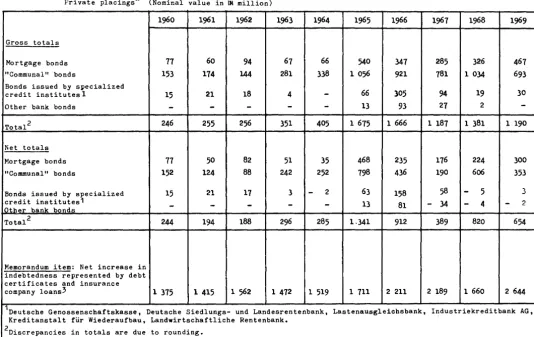
In all member count~ies except France, issues placed privately (or non•public issues) are wholly exempt from c~ntrol by the public authorities, but their importance varies very widely from country to country.
Germany
The private placing of registered bonds and loans against borrowers' notes
(Schuldscheindarlehen) is not subject to the authorization procedure of Article
795
of the German Civil Code and is therefore completely free.
The private placing of these securities may be restricted only in an exceptional
case of serious disequilibrium and only in respect of public borrowers, provided an
upper limit is put on total indebtedness under the procedure of the law of
1967.
1 In Germany, for instance, there is a legal difference between registered bonds on
the one hand and bearer bonds and bonds to order on the other, and the terms governing them are often aligned on the specific needs of subscribers.
-v-Loans against borrowers• notes (Schuldscheindarlehen) are the most important form
of non-public issue. These acknowledgments of debt are not fungible, they may not be
traded on the stock exchange and there is no secondary market for them. They can,
however, be mobilized since they are assignable (provided there are no stipulations
to the contrary), but no~mally they aay not be assigned more than once.
It has been estimated that the volume of loans against borrowers' notes floated
between 1962 and 1967 averaged DM 2 000 million per year. These securities are mainly
issued by industry, but increasingly also by the public authorities, and placed with
insurance companies and mortgage lending institutions (for acknowledgments of debt by
the Federal Government, the Linder and the municipalities).
Registered bonds, which are generally issued by the mortgage lending institutions,
accounted for only about lo% of the total volume of security issues in 1967J the
proportion had been decidedly lower in the preceding, normal years and rose to an exceptional 2~ in 1966 because of strain on the market and of the measures taken by the authorities to curb the issue of bearer bonds.
Belgium
The non-public issue of bonds is free and is not subject to supervision by the Banking Commission. The volume of these issues varies from year to year and m~
account for up to 2~ of net domestic public issues. The form most frequently used is the private placing, similar in character to the public issue but not subject to the
type of supervision that would enable them to be sold publicly. In certain cases,
nevertheleas, the underwriting technique is used.
The proportion of non-public issues represented about 4~ of the total volume of gross issues in 1966 and 6~ in 1967. They are placed with insurance companies, provident societies and pension funds. Eowever, since the rules of these institutions require
them to subscribe in practice only to securities that are listed on the stock exchange
or guaranteed by the Government, a guarantee decree must be issued to allow the placing of these non-public issues, which as a result are mainly floated by the public or the