Micro Virtual Machines:
A Solid Foundation for Managed
Language Implementation
Kunshan Wang
A thesis submitted for the degree of
Doctor of Philosophy
The Australian National University
c
Except where otherwise indicated, this thesis is my own original work.
Acknowledgments
I would like to express my gratitude to the individuals and organisations that gener-ously supported me during the course of my PhD.
First and foremost, I would like to thank my supervisor Prof. Steve Blackburn, and my advisors Prof. Antony Hosking and Dr. Michael Norrish, who supported me with their foresight, expertise, experience, guidance and patience. This thesis would not be possible without their continued support.
I would like to thank the Chinese government, the Australian National University and Data61 (formerly NICTA), who supported me financially. I would also like to thank my master supervisor Prof. Zhendong Niu, who guided me during my study in China and supported my study overseas.
I would like to thank my colleagues. Thank you Vivek Kumar, Ting Cao, Rifat Shahriyah, Xi Yang, Tiejun Gao, Yi Lin, Luke Angove, Javad Ebrahimian Amiri, and all other members of the Computer Systems Research Group. Your talent and friend-liness made my study in the ANU enjoyable. Special thanks to Yin Yan, a visiting student, who accompanied me and restored my hope when I was overwhelmed by despair.
I would like to thank John Zhang, Nathan Young, Andrew Hall, who made contributions to the Mu project as Honours students or Summer scholars. It is my honour to work with you.
I would like to thank Prof. Eliot Moss at the University of Massachusetts, and all researchers who collaborated in the development of the Mu project. Your feedback and suggestions helped us make greater progress.
Finally I would like to thank my parents who supported me selflessly in my life and my study.
Abstract
Today new programming languages proliferate, but many of them suffer from poor performance and inscrutable semantics. We assert that the root of many of the perfor-mance and semantic problems of today’s languages is that language implementation is extremely difficult. This thesis addresses the fundamental challenges of efficiently developing high-level managed languages.
Modern high-level languages provide abstractions over execution, memory man-agement and concurrency. It requires enormous intellectual capability and engineer-ing effort to properly manage these concerns. Lackengineer-ing such resources, developers usually choose naïve implementation approaches in the early stages of language de-sign, a strategy which too often has long-term consequences, hindering the future development of the language. Existing language development platforms have failed to provide the right level of abstraction, and forced implementers to reinvent low-level mechanisms in order to obtain performance.
My thesis is that the introduction of micro virtual machines will allow the devel-opment of higher-quality, high-performance managed languages.
The first contribution of this thesis is the design of Mu, with the specification of Mu as the main outcome. Mu is the first micro virtual machine, a robust, performant, and light-weight abstraction over just three concerns: execution, concurrency and garbage collection. Such a foundation attacks three of the most fundamental and challenging issues that face existing language designs and implementations, leaving the language implementers free to focus on the higher levels of their language design.
The second contribution is an in-depth analysis of on-stack replacement and its efficient implementation. This low-level mechanism underpins run-time feedback-directed optimisation, which is key to the efficient implementation of dynamic lan-guages.
The third contribution is demonstrating the viability of Mu through RPython, a real-world non-trivial language implementation. We also did some preliminary research of GHC as a Mu client.
We have created the Mu specification and its reference implementation, both of which are open-source. We show that that Mu’s on-stack replacement API can gracefully support dynamic languages such as JavaScript, and it is implementable on concrete hardware. Our RPython client has been able to translate and execute non-trivial RPython programs, and can run the RPySOM interpreter and the core of the PyPy interpreter.
With micro virtual machines providing a low-level substrate, language developers now have the option to build their next language on a micro virtual machine. We believe that the quality of programming languages will be improved as a result.
Contents
Acknowledgments vii
Abstract ix
1 Introduction 1
1.1 Thesis Statement . . . 1
1.2 Problem Statement . . . 1
1.3 Scope and Contributions . . . 3
1.4 Thesis Outline . . . 5
2 Background 7 2.1 Difficulties in Managed Language Implementation . . . 7
2.2 Three Major Concerns . . . 8
2.2.1 Just-in-time Compilation . . . 8
2.2.2 Concurrency . . . 10
2.2.3 Garbage Collection . . . 12
2.3 Consequences and Summary . . . 13
3 Related work 15 3.1 Monolithic Language Implementations . . . 15
3.2 Multi-language Virtual Machines and Frameworks . . . 16
3.2.1 The Java Virtual Machine . . . 16
3.2.2 LLVM . . . 17
3.2.3 VMKit . . . 18
3.2.4 Common Language Infrastructure . . . 19
3.2.5 Truffle/Graal . . . 19
3.2.6 PyPy/RPython . . . 19
3.3 Summary . . . 20
I Mu: A Concrete Micro Virtual Machine 21 4 Mu’s High-level Design 23 4.1 Goals . . . 23
4.2 Design Principles . . . 24
4.3 Architecture . . . 26
4.4 Reference Implementation . . . 28
xii Contents
4.5 Summary . . . 28
5 Mu Intermediate Representation 29 5.1 Overview . . . 29
5.2 Type System . . . 29
5.2.1 Untraced numerical types . . . 32
5.2.2 Composite types . . . 32
5.2.3 Traced reference types . . . 33
5.2.4 Miscellaneous types . . . 34
5.3 Instruction Set . . . 35
5.3.1 Basic Instructions . . . 35
5.3.2 Control Flow . . . 38
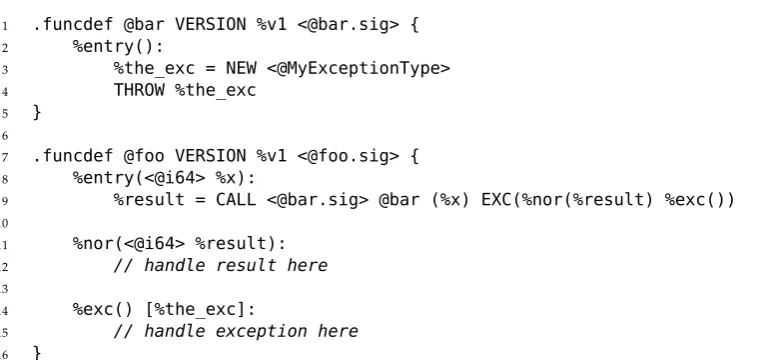
5.3.3 Function Calls and Exception Handling . . . 39
5.3.4 Memory Operations . . . 41
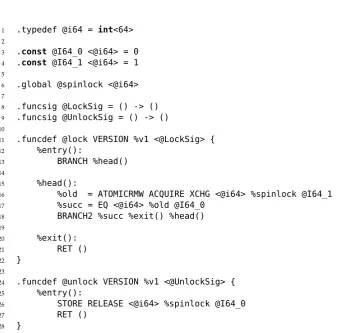
5.3.5 Atomic Instructions and Concurrency . . . 44
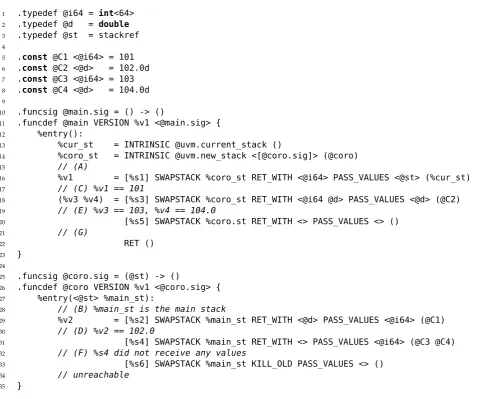
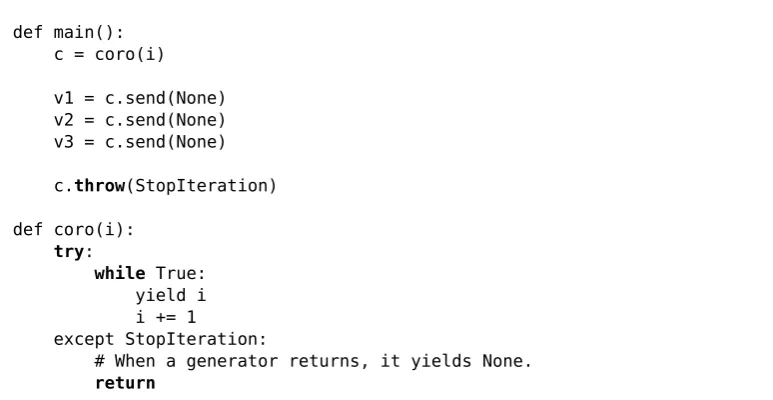
5.3.6 Stack Binding and the SWAPSTACK Operation . . . 46
5.3.7 Unsafe Native Interface . . . 49
5.3.8 Intrinsics . . . 53
5.4 Summary . . . 53
6 Mu’s Client Interface 55 6.1 Overview . . . 55
6.2 Bundle Building and Loading . . . 56
6.2.1 Bundle as the Unit of Loading . . . 56
6.2.2 The IR-building API . . . 57
6.3 Trap Handling and Run-time Optimisation . . . 58
6.3.1 Trap Handling . . . 58
6.3.2 Function Redefinition . . . 59
6.3.3 Stack Operations . . . 60
6.4 Summary . . . 61
II On-stack Replacement and Its Implementation 63 7 A Practical OSR API for the Client 65 7.1 Background of On-stack Replacement . . . 65
7.2 Case Study of Two Real-world JavaScript Runtimes . . . 66
7.2.1 Overview of SpiderMonkey and V8 . . . 66
7.2.2 Excessive Use of Assembly for OSR . . . 67
7.2.3 Conclusion: SpiderMonkey and V8 Depends on Assembly . . . 69
7.3 An API for Stack Operations . . . 70
7.3.1 Overview . . . 70
7.3.2 Abstract View of Stack Frames . . . 71
Contents xiii
7.3.4 The Swapstack Operation . . . 73
7.3.5 Stack Introspection . . . 74
7.3.6 Removing Frames . . . 75
7.3.7 Creating New Frames Using Return-oriented Programming . . . 75
7.4 Demonstration of the OSR API . . . 77
7.4.1 Supported Subset of JavaScript . . . 77
7.4.2 Baseline Compiling and Trap Placement . . . 78
7.4.3 Optimisation and On-stack Replacement . . . 78
7.4.4 Result . . . 79
7.5 Summary . . . 79
8 Implementation of the Mu Stack API 83 8.1 Resumption Points and Resumption Protocols . . . 83
8.1.1 Frame Cursors and Introspection . . . 83
8.1.2 Resumption Point . . . 84
8.1.3 Resumption Protocol . . . 84
8.1.4 Adapter Frames . . . 88
8.1.5 Conclusion . . . 90
8.2 Stack Operations in Native Programs . . . 90
8.2.1 Stack Unwinding Information . . . 91
8.2.2 Implementing OSR for Native Functions . . . 92
8.2.3 LLVM and Stack Maps . . . 96
8.2.4 Difficulties in Implementing Stack Operations in Uncooperative Native Programs . . . 97
8.3 Related Work . . . 98
8.4 Summary . . . 99
III Supporting Real-world Language Runtimes Using Mu 101 9 RPython and GHC as Mu Clients 103 9.1 Supporting RPython and PyPy on Mu . . . 103
9.1.1 The RPython Framework . . . 103
9.1.2 Adding Mu as a Backend of the RPython Framework . . . 105
9.1.3 Translating RPython Programs into Mu IR . . . 105
9.1.4 Building Boot Images . . . 110
9.1.5 Preliminary Results . . . 112
9.1.6 Supporting the Meta-tracing JIT Compiler . . . 112
9.1.7 Summary and Future Work . . . 112
9.2 Supporting GHC on Mu . . . 113
9.2.1 Haskell and GHC . . . 113
9.2.2 Targeting Mu . . . 113
xiv Contents
IV Conclusions 117
10 Conclusion 119
10.1 Future Work . . . 121
10.1.1 Refining the Design of Mu . . . 121
10.1.2 Client-side Development . . . 122
10.1.3 High-performance Mu Implementation . . . 123
10.1.4 Formal Verification . . . 123
10.2 Final Words . . . 123
List of Figures
2.1 Optimisation of A Hot Loop . . . 9
2.2 Unordered Reads and Writes . . . 11
4.1 Mu Architecture . . . 27
4.2 Non-metacircular vs Metacircular Clients . . . 27
5.1 Sample Mu IR bundle . . . 30
5.2 Multiple Return Values . . . 39
5.3 Mu Exception Handling . . . 40
5.4 Spin Lock Implementation in Mu Memory Model . . . 45
5.5 BasicSWAPSTACKExample . . . 48
5.6 Python Generator Example . . . 49
5.7 SWAPSTACKLoop Example . . . 50
5.8 Cookies of Exposed Functions . . . 54
6.1 Bundle Loading from Different Perspectives . . . 57
7.1 Excerpt ofDeoptimizer::TableEntryGenerator::Generate . . . . 68
7.2 Summary of Mu API functions related to stack introspection and OSR. 71 7.3 Example of Nested Calls . . . 72
7.4 OSR Points . . . 74
7.5 ROP Example . . . 76
7.6 Result of JS-Mu Compiling a JS Program . . . 80
8.1 Stack-top Structure of Unbound Stacks . . . 86
8.2 Naïve ROP Frame Implementation on x64 . . . 87
8.3 Correct ROP Frame Implementation with Adapter Frames . . . 89
8.4 SwapstackImplementation inlibyugong . . . 94
8.5 Structure of Newly-created Stacks . . . 95
List of Tables
5.1 The Complete Mu Type System . . . 31
9.1 Mapping Between the LL Type System and the Mu Type System . . . . 106 9.2 Mapping Between LL Operations and the Mu Instruction Set . . . 108
Chapter1
Introduction
1
.
1
Thesis Statement
Micro virtual machines will allow managed languages to be developed more easily and with higher quality.
1
.
2
Problem Statement
Today’s programming language landscape is littered with inefficient, hard-to-use but otherwise important languages. Despite their active user community and their application in critical settings, their performance overheads in many cases are best measured on a log scale, and their inscrutable semantics make software maintenance a nightmare.
Many of the performance and semantic issues that befall such languages can be traced to fundamental implementation challenges. PHP’s confounding copy-on-write semantics [Tozawa et al., 2009] can be traced back to a bug report dating to 2002 [PHP, 2002], when the behaviour was first observed by a user. However, realising the challenges in fixing the semantics, the PHP developers chose not to fix the bug, but instead declared the semantics a language feature, and it has remained so to this day. The engineering challenge of implementing a garbage collector has led many languages to depend on naïve reference counting in their earliest implementations despite its well-known performance limitations and inability to collect cycles, as observed by Jibaja et al. [2011]. Similarly, the intellectual challenges in correctly implementing concurrency have led many programming languages to have weak, broken or absent models of concurrency; CPython’s1 use of the infamous global interpreter lock (GIL) [Behrens, 2008] is one such example.
The few high-performance language implementations that successfully fought through the challenges are invariably the result of non-trivial investments. It took twenty years for the Java Virtual Machine (JVM) to reach the maturity it has to-day, with heavy support from Sun, Oracle, and many researchers from academia.
1CPython is the official implementation of Python (https://www.python.org/). The source code is hosted
athttps://github.com/python/cpython. The letter ‘C’ indicates that it is implemented in C, and distinguishes it from other Python implementations, such as Jython, IronPython and PyPy.
2 Introduction
Another example is the PyPy project [Rigo and Pedroni, 2006], which derives perfor-mance from advanced specialising meta-tracing technology. A series of successful publications are tribute to the substantial intellectual input underpinning PyPy’s per-formance. Other VM projects, such as SpiderMonkey, V8, JavaScriptCore and HHVM, are the results of substantial investment from large organisations, such as Mozilla, Google, Apple and Facebook, each of which could justify the investment because of its impact on their bottom line.
Despite these challenges, the demand for high-quality languages remains high, while the complexity of systems increases, and new languages emerge to address the needs that arise in specialised domains. Many languages, such as R, are developed by domain experts rather than computer scientists. However, most development teams do not have access to the same intellectual resources as large companies, thus cannot afford building their next language implementation from scratch while still guaranteeing high quality.
This leads to a question: Is there a platform for language developers where existing lan-guages can be built with higher quality, and new lanlan-guages can be designed and implemented properly?
Existing Platforms Building a language on a well-established platform simplifies development and saves engineering effort.
LLVM is exactly this kind of platform. Created by Lattner and Adve [2004], LLVM is a popular compiler framework which has many built-in optimisers, supports many targets and provides a JIT compiler. However, LLVM was designed for non-garbage-collected languages, such as C, C++ and Objective-C. Consequently, LLVM does not provide any readily-usable garbage collectors for its clients, and adding GC support is difficult despite LLVM providing mechanisms intended to support GC. In addition, some concurrency primitives, such as the creation of threads, are still platform-dependent. An alternative to using LLVM as a language foundation is generating C source code directly. However, this approach also suffers from the lack of GC support.
§1.3 Scope and Contributions 3
We identify concurrency, execution and garbage collection as the three major concerns that contribute to the complexities of language development.2 Thus, we propose the concept of a micro virtual machine which only provides abstractions over these three concerns, but otherwise keeps the abstraction level as low as possible, so as to minimise unnecessary dependencies and semantic gaps. Micro virtual machines will serve as an ideal language-neutral platform for supporting managed languages.
1
.
3
Scope and Contributions
The aim of this thesis is to design a concrete micro virtual machine — Mu.
We provide a detailed description of the design of the Mu micro virtual machine, comparing and contrasting Mu with existing work. We show the principles that underpin our design decisions, and discuss the pros and cons of existing work and alternative designs. We describe the on-stack replacement API of Mu, and its im-plementation. We demonstrate the real-world applicability of Mu by using Mu as a backend for RPython.
This work serves as a proof of existenceand a proof of concept, but not a proof of performance.3 Because the micro virtual machine is a new concept without estab-lished prior work, designing a consistent system that involves all of the three major concerns is very difficult, and developing a high-performance implementation will be even more difficult.
Therefore, an explicitnon-goal of this thesis is the efficient implementation of the Mu micro virtual machine itself, including instruction selection, register allocation, and the implementation of the garbage collector. The Mu micro virtual machine project is a joint effort of the Computer Systems Research Group at the ANU, where the focus of my work is the high-level VM design, while the efficient implementation of the Mu micro virtual machine is the concern of others. However, for every feature in the design, we will give reasons to show that it can be implemented efficiently.
Mu Design In Part I, we discuss the design of Mu. Mu is defined as a specification that allows multiple compliant implementations. We will discuss the design process which lead to the specification, including various issues we took into consideration, and compromises we made. The specification defines the Mu intermediate represen-tation (IR) and its API. We use LLVM as the frame of reference for the IR design. As a micro virtual machine, it has a low-level type system and instruction set similar to that of LLVM. However, as an abstraction over memory, Mu also features GC-traced
2Geoffray et al. [2010] already identified concurrency, JIT compilation and garbage collection as
the three major concerns when developing VMKit. We generalise JIT compilation into execution in general, because the cross-cutting concerns involving execution is not specific to JIT compilation, and our experience from the RPython client (see Section 9.1.4) shows that ahead-of-time compilation is also important. It is also noteworthy that VMKit’s approach is to combine three existing software components, but our goal is to design and implement a minimalist platform that supports these concerns from first principles. See Section 3.2.3 for more details.
3Details of these terms are discussed in Page 17–20 of the book Academic Careers for Experimental
4 Introduction
object reference types and has heap object allocation as a primitive operation. To address run-time feedback-based optimisation that is required to efficiently imple-ment dynamic languages, Mu provides APIs for trap handling, stack introspection, function redefinition and on-stack replacement, which conventional VMs seldom ex-pose to the client. Mu provides threads as a primitive, a C++11-like memory model for synchronisation, and the Swapstack operation [Dolan et al., 2013] to support coroutines and massively concurrent languages such as Erlang.
Stack Operations and OSR In Part II, we take a deeper look into the topic of on-stack replacement (OSR), a very important mechanism for JIT compiling. We introduce a versatile stack model which powers the Swapstackoperation, introspec-tion and OSR. In a case study, we examine the well-known SpiderMonkey and V8 JavaScript engines, and learn that such crucial mechanisms are tricky to implement, but real-world virtual machines have to reinvent the wheel because they are devel-oped from scratch. We demonstrate our Mu OSR API by constructing an experimental JavaScript client on the Mu reference implementation. We also show concretely how the Mu stack model can be natively implemented. System libraries already pro-vide similar stack-related mechanisms, such as the stack unwinding metadata which supports C++ exception handling. However, we show that such mechanisms are insufficient and not portable, and this provides evidence supporting our thesis that a well-defined substrate such as Mu is much needed.
§1.4 Thesis Outline 5
1
.
4
Thesis Outline
The body of this thesis is structured around the three contributions outlined above. Chapter 2 describes the difficulties in language implementation; Chapter 3 discusses related work that attempt to facilitate language development.
Part I, II and III comprise the main body of the thesis, covering the three key contributions. Part I provides a detailed description of the design of the Mu abstract machine, and its underpinning principles. Part II takes a deeper look into on-stack replacement and its implementation. Part III introduces our RPython client and our preliminary work on GHC, and shows Mu’s real-world applicability.
Chapter2
Background
This chapter provides background information about the difficulties in managed language development. Section 2.1 provides an overview of the issue; Section 2.2 discusses the three major concerns that our micro virtual machine addresses, namely just-in-time (JIT) compilation, concurrency and garbage collection, and their cross-cutting concerns; Section 2.3 discusses the consequences of not properly handling these concerns, and summarises this chapter.
2
.
1
Difficulties in Managed Language Implementation
A large fraction of today’s software is written in managed languages. The term ‘managed languages’ originates from the .NET Framework [Microsoft]. There is no precise definition, but such languages can be characterised as high-level languages that run on managed runtimes (i.e. virtual machines) which provide various ab-stractions, notably automatic memory management (i.e. garbage collection). Many modern languages, including Java, C#, Python, Ruby, JavaScript, PHP, etc., belong to this category. Some languages or implementations, such as RPython, GHC, and Go, are implemented by ahead-of-time (AoT) compilation and do not have any explicit virtual machines, but we still take these languages into consideration because of their use of garbage collection. Managed languages are economically important. For ex-ample, Facebook depends on servers running PHP for its core business of efficiently delivering hundreds of billions of page views a month, while Google depends on Java for its Android apps, and uses JavaScript to power its most widely used web applications including search and Gmail.
However, implementing such languages properly is difficult. As Geoffray et al. [2010] already identified in the VMKit project, JIT compilation, concurrency and garbage collection are the three major concerns that contribute to complexity. Each are technical minefields in their own right but when brought together in a language runtime, their respective complexities combine in very challenging ways. Each of these concerns is rich enough to support a well-developed research sub-community and rich literature of its own.
8 Background
2
.
2
Three Major Concerns
In this section, we will take a deeper look at each of these concerns, as we must understand the challenges concretely in order to address them appropriately.
2.2.1 Just-in-time Compilation
In theory, all programming languages can be implemented by either compiling or interpreting. By traditional ahead-of-time (AoT) compiling, programs written in a high-level language are translated into executable machine code before execution, and the machine code is executed directly on the processor. Alternatively, by interpreting, an interpreter reads and decodes the program source code or byte code at run time, and executes on behalf of the program. Interpreting makes the program portable to any supported platforms without recompilation, but the ‘interpretation loop’ is a ma-jor performance bottleneck because the interpreter must decode every abstract syntax tree node or bytecode instruction before carrying out the corresponding operation.
Just-in-time (JIT) compilation is another approach to language implementation. The compiler is placed on the user’s machine instead of the developer’s, and the program is compiled into machine code on demand at run time. This gives the per-formance advantage of compilation while still allowing the program to be distributed in a machine-independent form. Some virtual machines, such as the HotSpot JVM, use a hybrid approach that supports both interpretation and JIT compilation.
However, JIT compilers are difficult to develop. Like ahead-of-time compilers, constructing JIT compilers requires deep knowledge of the machine architecture of each platform to be supported, while interpreters themselves can be simply developed in other high-level languages that are already portable. A JIT compiler must also take the overhead of compilation into consideration, as the overhead will be applied to the execution of the program, while ahead-of-time compilers are relatively unconstrained.
A unique challenge to JIT compilation is run-timefeedback-directed optimisation. For responsiveness, language runtimes initially execute the program using interpreters or baseline JIT compilers, which have fast compilation speed, but generate suboptimal code. During initial execution, the language runtime detects frequently executed (hot) code, usually hot functions or hot loops, using timer-based (as in JikesRVM [Alpern et al., 2009]) or counter-based (as in SpiderMonkey [Mozilla] and V8 [Google]) pro-filing mechanisms. Various optimisations in the JIT compiler are then applied to the hot code only. Thus the language runtime needs to properly handle profiling and the transition between the user programs and the JIT compiler, which is not necessary for AoT compilers.
§2.2 Three Major Concerns 9
1 THRESHOLD = 1000 2
3 def sum_between(low, high): 4 s = 0
5 i = low 6
7 hotness = 0 8 while i <= high:
9 s += i
10
11 hotness += 1
12 if hotness >= THRESHOLD:
13 optimise()
14
[image:27.595.96.277.120.278.2]15 return s
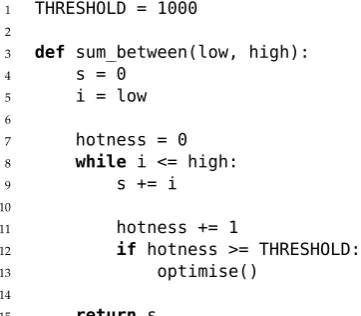
Figure 2.1: Optimisation of a hot loop. Lines 11–13 emulate the counter-based profiling mechanism generated by the compiler to detect hot loops. Assumelow = 1 andhigh = 1000000. Sincelowandhighare sufficiently far apart, optimisation will be triggered after the 1000th iteration. The optimiser may generate a newer version of the functionsum_between
which will be executed the next time it is called. However, after optimisation, there are still 999000 additional iterations of loops in theunoptimisedversion, which could be orders of magnitude slower than the optimised version. The runtime cannot simply restart the function, because the function may have other side effects that have already taken place. The correct solution is to replace the execution context (the stack frame) of the current sum_between
activation with a new context (stack frame) for the optimised version, and let the program continue at the equivalent point of execution in the optimised version. In this way, the transition from the unoptimised version to the optimised version will take place immediately after optimisation. This mechanism is called ‘on-stack replacement’ (OSR).
is observed to always hold integers, then all operations on it will be specialised for integers without checking in the specialised version of the compiled code. This elides most of the type checking that slows down the execution, and greatly speeds up the execution of dynamic languages.
On-stack replacement (OSR) is an important low-level mechanism that supports feedback-directed optimisation. Consider the example in Figure 2.1. When optimisa-tion happens at a loop inside a funcoptimisa-tion, we want the optimised code to take effect immediately rather than having to wait for the unoptimised loop to end, which will be extremely slow. Initially developed for the Self VM [Hölzle et al., 1992; Hölzle and Ungar, 1994], the OSR mechanism replaces stack frames on the stack in order to transition the execution context to the optimised version. OSR can also be used during de-optimisation (invalidating speculatively specialised code) or during online code modification (usually used for debugging). However, OSR is very difficult to implement because it requires clear knowledge about the stack layout to decode stack frames at run time. This thesis dedicates Chapter 7 to discuss this topic in greater detail.
10 Background
together to support run time optimisation.
2.2.2 Concurrency
As processor clock frequency stopped increasing exponentially, hardware vendors instead resorted to parallel hardware, such as multi-core processors, to improve per-formance. Such hardware potential cannot be fully utilised unless software is also designed with parallelism in mind. Meanwhile, concurrent programming models, such as multi-threading and the actor model, provide intuitive tools for the program-mers to solve certain problems.
However, with the advent of parallel hardware, certain properties, such as se-quential consistency, can no longer be taken for granted. Sequential consistencyis the property that the result of the execution of concurrent threads is equivalent to an execution where all operations from all threads are executed in a specific sequential order. Unconditionally enforcing sequential consistency will significantly degrade performance. Counter-intuitive bugs manifest on parallel hardware. Memory opera-tions may appear to be out of order, and may observe values that seem to come out of thin air.
For example, on architectures where the memory is read and written at 32-bit granularity, writing a 64-bit value may take two separate 32-bit store operations. Another thread may see an out-of-thin-air value with 32 bits being old and the other 32 bits being new. This phenomenon is known asword tearing.
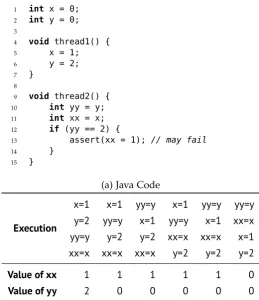
Figure 2.2 shows another example where the execution of a multi-threaded pro-gram may not be equivalent to any sequentially consistent execution. This can be caused by either the reordering of memory accesses inside the processor, or optimisa-tions performed by the compiler, or both.
Compiler transformations which were valid on single-threaded programs become erroneous in the face of concurrency. These phenomena force us to think carefully about support for concurrency at the programming language level, since pure library approaches cannot guarantee correctness of the resulting code, as pointed out by Boehm [2005].
§2.2 Three Major Concerns 11
1 int x = 0; 2 int y = 0; 3
4 void thread1() { 5 x = 1; 6 y = 2; 7 }
8
9 void thread2() { 10 int yy = y; 11 int xx = x; 12 if (yy == 2) {
13 assert(xx = 1); // may fail
14 }
15 }
(a) Java Code
Execution
x=1 x=1 yy=y x=1 yy=y yy=y
y=2 yy=y x=1 yy=y x=1 xx=x
yy=y y=2 y=2 xx=x xx=x x=1
xx=x xx=x xx=x y=2 y=2 y=2
Value of xx 1 1 1 1 1 0
Value of yy 2 0 0 0 0 0
[image:29.595.187.447.189.490.2](b) All Sequentially Consistent Executions and Their Results
Figure 2.2: Example of concurrent reads and writes without ordering. In the Java program in Figure 2.2(a), xandy are shared variables with initial values of 0. Thread 1 writes to
xand then y, and thread 2 reads from the two variables in the opposite order. There is a chance that thread 2 may observe yy == 2andxx == 0. Figure 2.2(b) enumerated all possible sequentially consistent executions, and none of them may havexx==0 && yy==2
12 Background
treat every memory operation as a synchronisation operation. This makes C++11 efficiently implementable on both strongly ordered architectures such as x86, as well as weakly ordered architectures such as ARM, POWER and Alpha. Newer programming languages, such as Go, also have their own memory models that define the semantics of multi-threaded programs.
Higher-level synchronisation mechanisms, such as mutex locks, condition vari-ables, semaphores and message queues, can be implemented on top of atomic mem-ory operations, such as compare-and-swap (CAS)1, provided by the memory model. On modern systems such as GNU/Linux, these mechanisms are mostly implemented in user space for efficiency, with minimal assistance from the operating system kernel, such as the Futex system call.
The proper implementation of a memory model needs support from the JIT com-piler, because the JIT compiler understands the instruction set of the platform, and the guarantees the machine instructions provide. For example, on x86, the plainMOV
instruction has the ACQUIRE semantics when loading from memory, and has the RELEASE semantics when storing to memory; on AArch64, ordinary load and store instructions do not have such guarantees, but there are special instructions such as
LDARandSTLRthat provide the ACQUIRE and the RELEASE semantics, respectively. The JIT compiler is responsible for generating the correct instruction sequences to support the intended memory order on the concrete platform.
2.2.3 Garbage Collection
Garbage collection (GC) was introduced in LISP [McCarthy, 1960], and has become an integral part of modern programming languages. It is a manifestation of the principle of ‘separation of concerns’ in the way that it frees the programmers from having to manually deal with memory deallocation of every object they create.
Garbage collection consists of three key facets: a) object allocation, b) garbage identification, and c) garbage reclamation, as described by Blackburn and McKinley [2008]. Different garbage collection algorithms employ different approaches to handle each facet.
High-performance garbage collection algorithms are difficult to implement. Effi-cient garbage collectors must be co-designed with the compiler. For example, astack mapis a data structure to identify object references in stacks, and must be generated by the compiler, which knows the layout of stack frames. Stack maps are an integral part of exact GC, which can identify all object references in the entire virtual machine. Copying collectors, which bestow good locality and offer cheapen massereclamation, depend on exact GC [Jibaja et al., 2011]. Another example, write barriers are code generated by the compiler around every write operation of reference fields. Gen-erational collectors, which effectively manage high-mortality young objects, require write barriers to record references from the old generation to the nursery [Jibaja et al., 2011]. All of these advanced techniques are hard to implement, but state-of-the-art
§2.3 Consequences and Summary 13
GC algorithms, such as Immix [Blackburn and McKinley, 2008], require many such techniques.
Efficient garbage collectors must also be co-designed with concurrency. If the garbage collector desires to make use of the parallel hardware resources, itself needs to implement parallel and concurrent scanning and collection algorithm, which will interact with the memory model. And the JIT compiler must also help the GC insert GC-safe points (yieldpoints) in the JIT-compiled machine code to perform handshakes between application threads and GC threads. Lin et al. [2015] provide an in-depth analysis of the challenges in the efficient implementation of yieldpoints.
Due to the difficulties in garbage collection implementation, language imple-menters often choose naïve garbage collection strategies in their initial VM design. Some implementations, such as Lua [Ierusalimschy et al., 1996], use naïve non-generational mark-sweep GC which does not perform as well as its non-generational counterpart; some implementations, such as CPython, use naïve reference counting2 which performs worse than mark-sweep by 30% or more, as measured by Shahriyar et al. [2012]; others simply use conservative collectors, such as the off-the-shelf Boehm-Demers-Weiser garbage collector [Boehm and Weiser, 1988], which cannot support copying collectors. Using naïve GC algorithms degrades overall performance. What is worse, as Jibaja et al. [2011] pointed out in their paper, ‘retrofitting support for high-performance collectors is typically very hard, if not impossible’. This is because fixing the collector alone is not enough. It is more important and more difficult to fix the compiler which is supposed to generate stack maps and write barriers. Al-though some language implementations, such as Mono [Mono], successfully migrated from conservative garbage collection to exact garbage collection, others, such as PHP, are stuck with naïve reference counting because its semantics depend on reference counting. Pyston [Pyston], a JIT-compiling Python implementation, attempted to use mark-sweep GC for better performance in its early versions, switched back to naïve RC in version 0.5, because Pyston intended to maintain compatibility with existing C extension modules written for the official CPython which depends on naïve RC, and there were cases where they ‘wouldn’t be able to support the applications in their current form’ [Kevin Modzelewski, 2016].
2
.
3
Consequences and Summary
As shown in the previous section, many challenging issues, such as memory model, stack maps, write barriers and yieldpoints, arise when handling more than one of the three major concerns in the same system. Language implementers who are not prepared for such complexity often choose naïve implementation strategies to get their language up and running without initially worrying about performance. As we mentioned in Chapter 1, CPython uses a slow but easy-to-implement interpreter
2Not all reference-counting-based GC algorithms are naïve. Shahriyar et al. [2014] developed a
14 Background
as its sole execution engine, which avoided the complexity of JIT compiling; it uses a global interpreter lock (GIL) [Behrens, 2008] to prevent parallel execution because the interpreter is not designed for concurrent execution; and it uses a naïve reference counting GC algorithm which further slows down performance. At the time of writing, PyPy [Bolz et al., 2009] still has GIL in its mainline code [PyPyGIL], although there is ongoing work of eliminating the GIL using software transactional memory. The official Ruby [Ruby] implementation also has a ‘global VM lock’ which is similar to CPython’s GIL.3PHP’s confounding copy-on-write semantics also originates from the fact that it uses naïve reference counting. These early decisions get baked into the languages themselves, and hinder their long-term development. Now, many CPython native modules assume the presence of the GIL which makes its removal even more difficult. And so GIL-free Python implementation remains a research topic. The copy-on-write semantics [Tozawa et al., 2009] of PHP persists until today as a documented ‘feature’.
These cross-cutting concerns exist because of the tightly coupled nature of JIT compilation, concurrency and GC. This is why we propose ‘micro virtual machines’ to address these concerns inonecarefully designed system. The details of Mu design will be discussed in Part I. In the next chapter, we will look at existing systems that address the issue of language implementation.
3Seevmcore.hin the Ruby source code.
Chapter3
Related work
In the preceding chapter, we introduced some of the difficulties in language develop-ment. This chapter discusses related work that attempt to address these difficulties, and explains why those solutions are insufficient to achieve the goal of manged language development.
This chapter is structured around two fundamental ways to implement a language. Section 3.1 discusses monolithic language implementations; Section 3.2 discusses existing multi-language platforms for language development; Section 3.3 summarises this chapter.
3
.
1
Monolithic Language Implementations
One way to efficiently implement a managed language may be to implement the virtual machine from scratch. Many real-world language implementations, including HHVM [Adams et al., 2014], SpiderMonkey [Mozilla], V8 [Google] and LuaJIT [Pall], were developed this way. Compared to naïve implementations, these carefully de-veloped implementations indeed significantly improved the performance of the lan-guage.
However, this approach has several problems. One problem is the lack of code reuse. Since such virtual machines are written for one language, their core compo-nents, such as the JIT compiler, cannot be reused for other language implementations. As a notable example, both SpiderMonkey and V8 are written in C++, and both implement the JavaScript programming language using similar techniques including JIT compilation, feedback-directed optimisation, specialisation, OSR and generational GC. Yet no code is shared between these two projects. Given that programming language implementation is difficult, such an approach can only be afforded by those with sufficient expertise and engineering power, usually large companies or organisations such as Mozilla, Google and Facebook. Another problem is that such implementations still tend to be naïve compared to mature systems. For example, despite the powerful tracing JIT compiler, LuaJIT [Pall] still uses a non-generational mark-sweep collector, and does not have any language-level threading support.1
1LuaJIT does have plans to implement more sophisticated garbage collectors in the future version
LuaJIT 3.0 [LuaJITGC].
16 Related work
3
.
2
Multi-language Virtual Machines and Frameworks
An alternative to the monolithic approach is to build the language on a well-established virtual machine or compilation framework. In addition to micro virtual machines which we will discuss in the next chapter, there have been several existing language-neutral platforms that aimed to support the implementation of languages.
3.2.1 The Java Virtual Machine
The Java Virtual Machine (JVM) [Lindholm et al., 2014] was originally designed for the Java programming language, but its portable Java Bytecode, clearly specified behaviors and performance attracted a wide range of language implementations to be hosted on the JVM, including Jython [Jython], JRuby [JRuby], Scala [Scala] and X10 [Ebcio ˇglu et al., 2004].
This approach—reusing the existing JVM for new languages—raises several funda-mental problems. The obvious one is the semantic gap between the new language and Java. The JVM implements many Java-specific semantics, including the Java object layout, thread model and object-oriented programming, which are irrelevant to other dissimilar languages. The JVM JIT compiler is tailored for Java, a static language. Re-purposing such a JIT compiler for dynamic languages does not automatically deliver the hoped-for performance boost, unless appropriate language-specific optimisations, such as specialisation, are also added [Castanos et al., 2012]. Jython [Jython], for example, ‘almost never exceeds CPython in performance, and is generally slower’, according to the measurement from Bolz and Tratt [2015], because ‘features that make use of Python’s run-time customisability have no efficient implementation on a JVM’. On the other hand, useful low-level mechanisms, such as vector instructions, on-stack replacement, Swapstackand tagged references, are non-existent in the JVM specifi-cation. This omission makes it difficult to efficiently support other languages. For example, values in Lua, JavaScript or other dynamic languages, could be represented as tagged references which would elide heap allocations for numerical types. It would also be expensive to map the light-weight Erlang processes to Java threads which are usually mapped to native threads, and the Swapstackmechanism [Dolan et al., 2013] could be a better match.
Because JVM is designed to support the Java platform, it comes with a compre-hensive Java standard library. Such a well-implemented library can be useful in practice, but it also introduces huge dependencies for other light-weight languages (such as Python) which usually have their own standard library more suitable for the language.
§3.2 Multi-language Virtual Machines and Frameworks 17
3.2.2 LLVM
The Low Level Virtual Machine (LLVM) [Lattner and Adve, 2004] is a compiler framework including a collection of modular and reusable compilation and toolchain technologies. The LLVM compiler framework and its code representation (LLVM IR) together provide a combination of key capabilities that are important for language implementations.
However, LLVM is designed for C-like languages. Like C, the LLVM IR type system contains raw pointer types but not reference types, and LLVM does not provide a garbage collector. Instead it provides the@gcread2and@gcwriteintrinsic functions which are place holders for read and write barriers which the language front needs to implement and insert. LLVM also provides several mechanisms to identify references held on the stack. This kind of approach to GC is problematic. Remember that high-performance GC is extremely difficult to implement, therefore not providing a working garbage collector already imposes a considerable burden to language developers who are not GC experts. For stack roots, the@gcrootintrinsic function can tag allocalocations as GC roots, but it will force reference values to be held in the stack memory, which has performance problem. The@stackmapand the @patchpoint intrinsics can identify references in registers, but cannot update stack roots when the copying GC moves their referenced objects. The@statepoint
intrinsic function handles object movement by creating a new SSA variable for the new address of each stack root after the statepoint. This exposes the change of object addresses to the language developers, forcing them to handle field access and reference equality tests3using knowledge about the specific GC. None of those stack root mechanisms are fully satisfactory. LLVM also does not help its client generate object maps for finding references inside heap objects,4 forcing the client to consult the platform ABI for object layout, consequently compromising LLVM’s abstraction over architecture. The LLVM client also has to implement yieldpoints, but Lin et al. [2015] showed that the efficient implementation involves carefully crafted machine instruction sequences and code patching, which are also architecture details. Overall, LLVM has made very little effort to address the cross-cutting concerns of GC and compilation, making it difficult to support high-performance GC on LLVM.
LLVM is also designed to be maximalinstead of minimal. LLVM tries to minimise
2We abbreviated the names for simplicity. The full names of the intrinsic functions discussed in this
paragraph [email protected], @llvm.gcwrite, @llvm.gcroot, @llvm.experimental.stackmap,
3In concurrent copying GC, a process may simultaneously contain two references, one of which
refers to an object in the ‘from-space’, while the other refers to the same object copied to the ‘to-space’. Those two references must be considered equal even though they have different addresses, because they logically refer to the same object.
4According to the LLVM documentation, object maps (called ‘type maps’ in the LLVM
18 Related work
the work for language frontends and provides many ready-to-use optimisation passes inside LLVM. The provision of such optimisations also shows that LLVM is now a mature production project. However, just like the case of JVM, optimisations designed for one kind of language (such as C) are usually unhelpful for other languages which are very different (such as Python). Although LLVM provides many language-neutral optimisations, the most important optimisation, specialisation, is language-specific, and is not provided by LLVM. This can be observed from the LLVM-based Unladen Swallow project [UnladenSwallow, 2011] which failed to meet its goal of 5x speed improvement over the official CPython [CPython]. Unladen Swallow uses template compilation. It translates a Python byte code operation (for example,BINARY_ADD) into an LLVM-level call instruction which calls CPython’s C API functions (for example,PyNumber_Add) that realises the same functionality. The implementation of each bytecode in CPython usually has a very long code path [Castanos et al., 2012] which usually tests the types and unboxes the operands. Stock optimisations in LLVM are unable to eliminate such long code paths, which are the real bottleneck, using specialisation as PyPy [Bolz et al., 2009] does. Therefore, although Unladen Swallow managed to eliminate the interpretation loop, it never achieved its desired speedup.
LLVM is the main reference according to which we design Mu. But we design Mu to explicitly support managed languages and handle garbage collection internally inside Mu. We also assume most optimisations are the obligation of the client rather than Mu.
3.2.3 VMKit
VMKit [Geoffray et al., 2010] is a common substrate for the development of high-level managed runtime environments, providing abstractions for concurrency, JIT-compiling and garbage collection. VMKit glues together three existing libraries: LLVM [Lattner and Adve, 2004] as the JIT compiler, MMTk [Blackburn et al., 2004] as the memory manager, and POSIX threads for threading. The VMKit developers built two clients, for the CLI and JVM respectively as a proof of concept.
As the name suggests, VMKit is not a self-contained virtual machine, but a toolkit that provides incomplete abstractions over certain features. For example, VMKit leaves the object layout to be implemented by the client. As a consequence, the client runtime, which is developed by the high-level language developer, must participate in object scanning and the identification of GC roots. However, object scanning is not a trivial job [Garner et al., 2011].
§3.2 Multi-language Virtual Machines and Frameworks 19
Nonetheless, VMKit demonstrates that a toolkit that abstracts over the common key features can ease the burden of the development of language implementations, which is also part of the motivation for a micro virtual machine. Bearing out our design decisions, they have identified execution, concurrency and garbage collection as the three fundamental concerns.
3.2.4 Common Language Infrastructure
The Common Language Infrastructure (CLI) is Microsoft’s counterpart to the JVM. Its Common Intermediate Language (CIL) is designed for several languages with similar level to VB.NET, C#, etc., but also hosts many different languages including Managed C++, F# and JavaScript. The CLI shares similar problems to the JVM in that it is monolithic and was designed for particular kinds of languages. For example, it has object-oriented primitives, such as inheritance and polymorphism, built into its Common Type System (CTS).
3.2.5 Truffle/Graal
Truffle and Graal [Würthinger et al., 2013] are reusable VM components for code execution developed by Oracle. Truffle is a language implementation framework, while Graal is a compilation infrastructure. Language developers implement a lan-guage by writing an abstract syntax tree (AST) interpreter using the Truffle API. The AST interpreter handles node rewriting which is essentially rules for specialising a language. Truffle optimiser implements dynamicpartial evaluation, i.e. compilation with aggressive method inlining, on top of the API that the Graal compiler provides. When an AST is stabilised, i.e. the tree is invoked for a number of times without being rewritten, Truffle uses partial evaluation to compile the AST into the Graal compiler’s high-level intermediate representation, and further optimisation is performed. The optimised code is executed on the Graal VM, a modification of the Java HotSpot VM that uses Graal as its dynamic compiler.
Truffle and Graal aim to provide a reusable code execution engine for implemen-tations of object-oriented languages. This goal sits on a much higher level than Mu, and we consider it as a complement to the lower-level virtual machine such as Mu. A micro virtual machine will also benefit language frameworks like Truffle by pro-viding abstraction over machine architectures. A Mu client can implement a partial evaluation framework like Truffle, and compile multiple languages to Mu IR.
3.2.6 PyPy/RPython
20 Related work
(PyPy) which interprets the high-level language (Python), and compiles the traces into machine code.
Meta-tracing (as used by Truffle/Graal) and partial evaluation (as used by PyPy/ RPython) are two alternative higher-level meta-compilation techniques for inter-preters to make JIT compilation language-independent [Marr and Ducasse, 2015]. They complement lower-level VMs such as Mu.
Our research group has ported the RPython framework to Mu as a client, hoping that it will enable the many languages that are already implemented on RPython to run on Mu instead. Details of this effort are described in Chapter 9.
This work will not only benefit Mu, but may also benefit the PyPy project as well. Currently, the official RPython backend has to implement JIT compilers by writing machine code generators for many platforms. Because the backend translates RPython code to C code, it also has to implement exception handling and garbage collectors for the generated C code. To do this, every function call is followed by a check for pending exception, which introduces a cost. The GC finds roots from the C stack using shadow stacks or a deprecated compiler-specific ‘assembler hack-ery’ [PyPyGC], neither of which is satisfactory. Mu can provide RPython with a cross-platform compiler supporting ‘zero-cost’ exception handling [Itanium] and an exact garbage collector, and therefore ease the engineering of the RPython toolchain. Moreover, once ported, the abstraction provided by Mu means that RPython benefits from any improvement to Mu, such as the addition of new garbage collectors or new compiler targets.
3
.
3
Summary
Programming language implementation is difficult, and execution (especially JIT compilation), concurrency and garbage collection are the three major concerns that contribute to the complexity of language implementation. Their cross-cutting con-cerns, including memory model, stack maps, GC barriers and yieldpoints, often overwhelm people without expertise in computer systems. We also described vari-ous existing platforms, such as the JVM, LLVM, VMKit, etc., that have attempted to provide general platforms for language development.
Part I
Mu: A Concrete Micro Virtual
Machine
Chapter4
Mu’s High-level Design
In the preceding chapters, we discussed the challenges and the status quo of language implementation. In this chapter, we flesh out the high-level design of Mu, our concrete micro virtual machine. In the following two chapters, we will continue to discuss the Mu intermediate representation (IR) and the Mu client interface (API).
This chapter presents the high-level perspective of the Mu design. Section 4.1 introduces the design goals of Mu; Section 4.2 presents the principles that underpin the design of Mu; Section 4.3 presents the overall architecture of Mu; Section 4.4 introduces the Mu reference implementation; Section 4.5 summarises this chapter.
The work described in this part is presented in ‘Draining the Swamp: Micro Virtual Machines as Solid Foundation for Language Development’ [Wang et al., 2015].
4
.
1
Goals
We design Mu based on our goals as follows:
1. Mu provides abstraction over execution, concurrency and garbage collection.
2. We design Mu to facilitate high performance language implementations.
3. We aim to support diverse languages.
4. There shall be a formally verified Mu instance in the long term.
We design Mu with performance in mind. We make careful design decisions based on state-of-the-art implementation strategies, and avoid making flawed short-term decisions that may hinder the development in the long run. It is not our goal to release Mu early for production use.
We design Mu as a general platform for managed languages. Our focus is on languages most exposed to these concerns, namely dynamic managed languages. However, we are exploring clients for languages as diverse as Python, Haskell, Go, Lua and Erlang. It is not our goal to provide an implementation layer that will compete with mature, highly tuned runtimes such as the HotSpot JVM, which have benefited from enormous investment over a decade or more.
24 Mu’s High-level Design
We also have the formal verification of Mu as one of our ultimate goals. Following the formal verification of the seL4 microkernel [Klein et al., 2009], a formally verified micro virtual machine will make a further step towards a fully verified system. It is important that although the formal verification of Mu is not part of this thesis, this goal shapes the design of Mu, and we sometimes have to make compromises for the ease of verification. Other members of our research group are actively working the formal verification of Mu.
4
.
2
Design Principles
To achieve our design goals, we have a number of principles which underpin the design of Mu.
1. Mu aims to be asminimalas practical; any feature or optimisation that can be deflected to the higher layers will be, provided that the three major concerns can be efficiently addressed.
2. Mu’s client (the higher-level program that uses Mu. See Section 4.3) istrusted; improper use of Mu may result in undefined behaviours which may have arbi-trary consequence, including crashing the entire system.
3. We use the LLVM intermediate representation (LLVM IR) [Lattner and Adve, 2004] as acommon frame of reference for our own IR, deviating only where we find compelling cause to do so.
4. We separate specification and implementation; Mu is an open specification against which clients can program and which different instantiations may implement.
Minimalism is the number one principle. Because we aim to support a wide range of dissimilar languages, the level of the micro virtual machine must be kept as low as possible in order to avoid introducing intruding design decisions which are harmful to the high-level language implementation. The minimalist design also means the VM is easier to implement correctly, which will facilitate the creation of a formally verified implementation.
§4.2 Design Principles 25
The client is trusted. We fully trust the client, because the client has more knowl-edge than Mu about the concrete language. It understands all the requirements and constraints of the language semantics, such as array bounds checking, to enforce them correctly. Therefore, we trust the client to make the right decisions, and do not impose extraneous protection layers which may lead to unnecessary overhead.
Moreover, according to Castanos et al. [2012], the optimisations that have the great-est impact on the performance of programs are usually language-specific. It is true that there exist many language-neutral optimisations that work for many languages, such as common sub-expression elimination, loop-invariant code motion, dead code elimination, and many others provided by LLVM. Those optimisations may have the effect of doubling or tripling the throughput of programs. However, for higher-level languages, especially dynamic languages, the most important optimisations, such as specialisation, can achieve 10x or, in certain cases, over 100x performance gain over naive implementations [Castanos et al., 2012]. Such optimisations depend on intimate knowledge about the semantics of the concrete language. Therefore, we give the client the power and the responsibility for high-level optimisations. Mu trusts the client to make the right decisions, and assumes, for example, that the transformations made by the client’s optimiser are valid. When Mu API functions are invoked, Mu loyally carries out operations according to the specification with no obligatory vali-dations, especially during function redefinition and on-stack replacement which we will introduce in Chapter 6.
We use LLVM IR as a frame of reference for our IR. After LLVM’s inception, it has developed into a production compilation framework known for high performance. It is not good practice to develop everything from scratch and abandon such a mature system. Therefore, we follow LLVM IR as closely as possible to design a performant virtual machine, deviating only when we have a compelling reason to do so. For example, Mu is designed for garbage-collected languages while LLVM is not, so the Mu type system has traced reference types which are absent in the LLVM type system.
It is worth noting that Mu is neither an extension to LLVM nor built upon LLVM. Mu is an independent project, and its design principles are very different from that of LLVM. LLVM IR was only used as a frame of reference for the design of Mu IR.
26 Mu’s High-level Design
The specification allows many different compliant Mu implementations to co-exist, such as a reference implementation, a high-performance implementation, and a formally verified implementation. The JVM is defined similarly [Lindholm et al., 2014], and that specification has allowed many implementations.
Mu is designed by a committee, but a rather small one. Our team at the Computer Systems research group at ANU holds weekly meetings to discuss the design, in order to ensure that the Mu design adheres to our design principles. We take input from the people working on different aspects of the project, including client development, high-performance Mu implementation, and formal verification. Sometimes, a decision may undergo hot debates, and compromises must be made, because a subtle change in one part of the system may have a chain of implications in other parts. Therefore, in this thesis, we will not only describe the details of the Mu design, but also the reasons behind the seemingly arbitrary design decisions.
4
.
3
Architecture
A Mu-based language system consists of Mu and a client, as illustrated in Figure 4.1. The clientis a program which sits above Mu and implements concrete programming languages.
The Mu specification defines the Mu intermediate representation (IR) and the Mu client interface(API). The Mu IR is the low-level language accepted by and executed on Mu, while the Mu client interface defines the programming interface for client language runtimes. The client language runtime is responsible for (JIT-)compiling source code, bytecode, or recorded traces into Mu IR, which is delivered to Mu via the API. The Mu client interface specifies how the client may directly manipulate the state of Mu, including loading Mu IR code by sending messages to Mu, and how Mu-generated asynchronous events are handled by the client (i.e. trap handling).
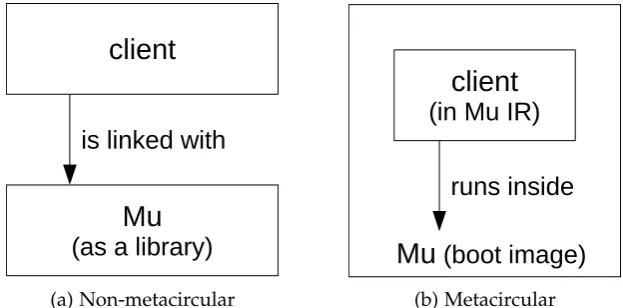
Note that the separation between the micro virtual machine and the client is con-ceptual. Mu allows clients to bemetacircular. Metacircular Mu clients are implemented in Mu IR, just like other metacircular virtual machines, such as JikesRVM [Alpern et al., 2009], which are implemented in their own languages. Such clients run on Mu, and control Mu using the Mu API from inside. Metacircular clients are usually built into aboot image(see Section 9.1.4) which contains both Mu and the client, as depicted in Figure 4.2.
§4.3 Architecture 27
client
micro virtual machine (Mu) operating system
source code/ bytecode
parse/load
Mu IR
[image:45.595.223.415.120.369.2]Mu API trap
Figure 4.1:Mu architecture. A Mu-based language system consists of Mu and aclientsitting above it. The client implements the concrete language. At run time, the client loads the source code or bytecode of the language, and translates into the Mu intermediate representation (IR). The client controls Mu via its API. Mu is responsible for the execution of Mu IR programs, usually via JIT compilation. During execution, Mu calls back to the client via traps (see Section 6.3.1) so that the client can handle events which cannot be handled by Mu, such as lazy code loading and run-time optimisation. As illustrated in the figure, the client is much bigger than the micro virtual machine, because Mu aims to be a thin abstraction layer, while the client handles all language-specific work and most optimisation.
client
Mu
(as a library)
is linked with
(a) Non-metacircular
client
(in Mu IR)
runs inside
Mu
(boot image)
(b) Metacircular
[image:45.595.161.473.504.658.2]28 Mu’s High-level Design
4
.
4
Reference Implementation
Despite being a ‘micro’ virtual machine, the engineering effort required to build a high-performance Mu implementation is non-trivial, precisely because it implements three of the most vexing abstractions managed languages depend on. However, from the perspective of Mu design, we need a working Mu instance to show whether the design really works, and to expose design flaws as early in the design process as possible. We also need to let client developers evaluate the Mu design on a runnable Mu instance, and provide feedback. It was therefore essential to develop a reference implementation that was functionally correct and easy to maintain, even if performance was poor.
We developed the reference implementation, codenamed ‘Holstein’1 , in Scala. This implementation executes as an interpreter, uses green threads to execute multiple Mu threads, and has a simplified but realistic copying region-based garbage collector based on Immix [Blackburn and McKinley, 2008]. Although Scala is a JVM-based language, we avoided using the JVM garbage collector to manage Mu heap objects, but allocated the Mu heap natively as raw memory. Mu memory access operations are always performed using raw addresses, which allows interaction with native programs.
The execution of Mu IR code on Holstein is hundreds of thousands of times slower than the equivalent C program compiled with GCC. Nonetheless, Holstein can run the RPySOM interpreter and the minimum core of the PyPy interpreter, as will be described in Chapter 9.
In addition to Holstein, our research group also has high-performance Mu imple-mentation, codenamed ‘Zebu’, under active development. That implementation is beyond the scope of this thesis, except inasmuch our design principle of permitting efficient implementation allows Zebu to exist.
4
.
5
Summary
This chapter introduced the design of Mu. Mu is minimalist. It only deals with the three major concerns, and offloads language-specific concerns to the client. Mu is defined as a specification, which allows multiple implementations, and also facilitates formal verification.
Mu is open source. Both the specification and the source code of reference imple-mentations are available on our website [MicroVM].
In the next chapter, we will present the Mu Intermediate Representation.
1Holstein is the name of a cow breeds. We use this name because ‘Mu’, when read as ‘moo’, is the
Chapter5
Mu Intermediate Representation
In the preceding chapter, we presented Mu’s high-level design. This chapter discusses the details of the Mu Intermediate Representation (IR). The Mu IR consists of the Mu type system and the Mu instruction set, both of which are designed to address the major concerns of Mu. We will introduce the Mu IR design, as well as the reasons behind the design decisions.
This chapter is structured as follows. Section 5.1 presents the overall structure of the Mu IR; Section 5.2 describes the Mu type system; Section 5.3 introduces selected parts of the Mu instruction set; Section 5.4 summarises this chapter.
5
.
1
Overview
The Mu intermediate representation (IR) uses LLVM IR as a frame of reference, because LLVM is a well-established framework known for good performance.
Figure 5.1 shows an example of a Mu IR bundle. A bundle contains many top-level definitions. Lines 1–4,9,12–13 define types. Line 15 defines a function signature. Lines 6–7 define constants. Line 10 allocates memory in the static space1. Both line 17 and line 19 define functions, but only the function on line 19 has a body. The function on line 17 has no body, but can be lazily added by the client (see Section 6.3.2).
The Mu IR uses a form equivalent to the static single information (SSI) form [Ana-nian, 1999]. SSI is a variant of the static single assignment (SSA) form [Cytron et al., 1991] which LLVM uses. We will cover the details of the IR in the rest of this section.
5
.
2
Type System
As a low-level VM, the Mu type system is simple and low-level. Like LLVM, Mu has primitive numeric and aggregate types, but also has reference types built into the type system to support garbage collection.
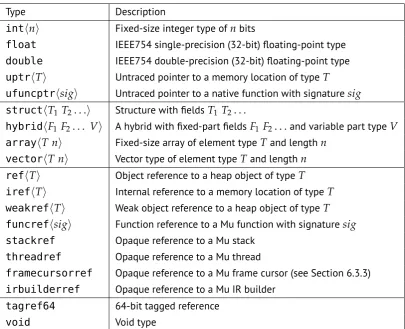
As shown in Table 5.1, the types can be divided into four categories: untraced numerical types, composite types, traced reference types, and miscellaneous types.
1The Mu specification currently calls it ‘global’ memory instead of ‘static’ memory. This name is
confusing because both the garbage-collected heap and the permanent static space are globally accessible. We plan to change the name.
30 Mu Intermediate Representation
1 .typedef @i64 = int<64> 2 .typedef @double = double 3 .typedef @void = void 4 .typedef @refvoid = ref<@void> 5
6 .const @i64_0 <@i64> = 0 7 .const @answer <@i64> = 42 8
9 .typedef @some_global_data_t = struct <@i64 @double @refvoid> 10 .global @some_global_data <@some_global_data_t>
11
12 .typedef @Node = struct<@i64 @NodeRef> 13 .typedef @NodeRef = ref<@Node>
14
15 .funcsig @BinaryFunc = (@i64 @i64) -> (@i64) 16
17 .funcdecl @square_sum <@BinaryFunc> 18
19 .funcdef @gcd VERSION %v1 <@BinaryFunc> { 20 %entry(<@i64> %a <@i64> %b):
21 BRANCH %head(%a %b) 22
23 %head(<@i64> %a <@i64> %b): 24 %z = EQ <@i64> %b @i64_0
25 BRANCH2 %z %exit(%a) %body(%a %b) 26
27 %body(<@i64> %a <@i64> %b): 28 %b1 = SREM <@i64> %a %b 29 BRANCH %head(%b %b1) 30
31 %exit(<@i64> %a):
32 RET %a
33 } 34
35 .expose @gcd_native = @gcd #DEFAULT @i64_0
Figure 5.1: Sample Mu IR bundle. Mu IR is similar to LLVM IR. In this example, there are top-level definitions for types (.typedef), constants (.const), static variables (.global), function signatures (.funcsig) and functions (.funcdef and .funcdecl). The function