A thesis submitted in partial fulfilment of the requirements for the degree of Master of Arts
in Linguistics
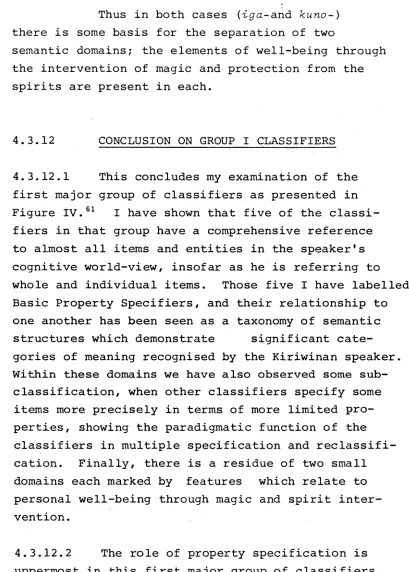
by
Ralph S. Lawton
February 1980
School of General Studies AUSTRALIAN NATIONAL UNIVERSITY
I hereby certify that this thesis, "The Kiriwinan Classifiers", is my own work, and that all sources used have been acknowledged.
TABLE OF CONTENTS
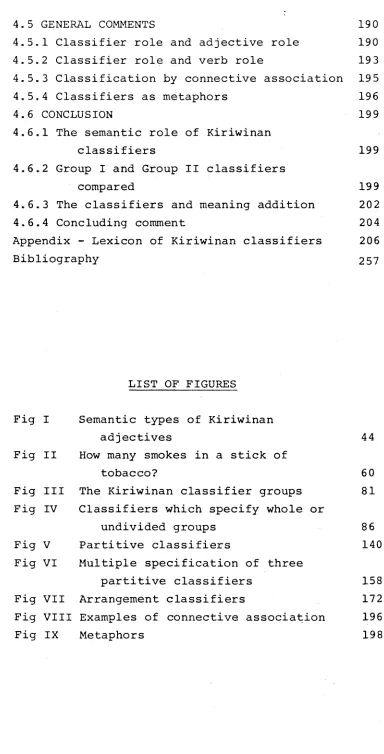
List of figures v
Abbreviations and conventions vi
Acknowledgements viii
Preface ix
Introduction x
Chapter I "CLASSIFIERS - CURRENT LITERATURE* 1
1.1 Cognitive arrangements 1
1.2 Writers on classifiers 7
1.3 Friedrich on "Shape in grammar" 8
1.4 Benton on Trukese 9
1.5 Becker on Burmese 15
1.6 Malinowski on Kiriwinan 17
1.7 Adams, Becker and Conklin 22
1.8 Allan's study "Classifiers" 26 Chapter II "THE KIRIWINAN CLASSIFIERS
-MORPHOLOGY" 3 2
2.1 The noun phrase 32
2.2 The deictic word 35
2.3 The numeral word 39
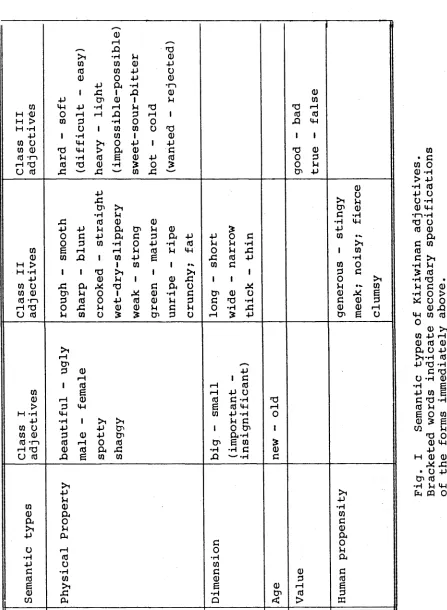
2.4 The adjective 43
2.5 The classifier in the noun phrase 47 Chapter III "THE KIRIWINAN CLASSIFIER IN
RELATION TO THE NOUN11 51 3.1 Classifier a formal constituent of
noun phrase 51
3.2 The classifier labels semantic domains 52
3.3 Taxonomy 54
3.4 Paradigmatic function of Kiriwinan
classifiers 55
3.5 Repeaters 61
3.6 Noun-free constructions 64
3.7 Some classifiers analogous to repeaters 65 3.8 Classifiers, deletion and discourse
cohesion 68
3.9 Classifiers as linguistic correlates
Chapter IV "THE KIRIWINAN CLASSIFIERS
-SEMANTICS11 76
4.1 INTRODUCTION 76
4.2 THE CLASS OF KIRIWINAN CLASSIFIERS 80
4.3 GROUP I CLASSIFIERS 84
4.3.1 Introduction 84
4.3.2 Basic Property Specifiers 85 4.3.3 To- Human specification 85 4.3.4 Na- Nonhuman specification 97
4.3.5 An animate domain 101
4.3.6 Kai- Rigid/long specification 103 4.3.7 Ya- Flexible/thin specification 109 4.3.8 Kwai- Thing specification 113
4.3.9 An inanimate domain 122
4.3.10 A world-view taxonomy 125
4.3.11 Residue 129
4.3.12 Conclusion on Group I classifiers 132
4.4 GROUP II CLASSIFIERS 134
4.4.1 Introduction 134
4.4.2 Activity specifiers 136
4.4.3 Partitive classifiers 140
4.4.3.1 Introduction 140
4.4.3.2 Partitives - topographical reference 141 4.4.3.3 Partitives - parts within wholes 145
4.4.3.4 Partitives - pieces 150
4.4.3.5 Partitives - multiple reference 156 4.4.3.6 Conclusion on partitive classifiers 167
4.4.4 Arrangement classifiers 170
4.4.4.1 Inherent grouping 170
4.5.1 Classifier role and adjective role 190 4.5.2 Classifier role and verb role 193 4.5.3 Classification by connective association 195 4.5.4 Classifiers as metaphors 196
4.6 CONCLUSION 199
4.6.1 The semantic role of Kiriwinan
classifiers 199
4.6.2 Group I and Group II classifiers
compared 199
4.6.3 The classifiers and meaning addition 202
4.6.4 Concluding comment 204
Appendix - Lexicon of Kiriwinan classifiers 206
Bibliography 257
LIST OF FIGURES
Fig I Semantic types of Kiriwinan
adjectives 44
Fig II How many smokes in a stick of
tobacco? 60
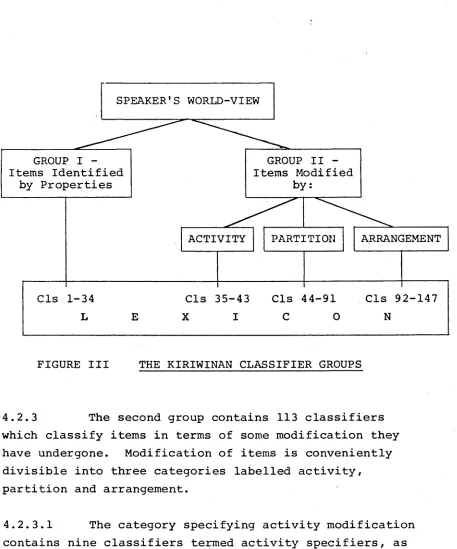
Fig III The Kiriwinan classifier groups 81 Fig IV Classifiers which specify whole or
undivided groups 86
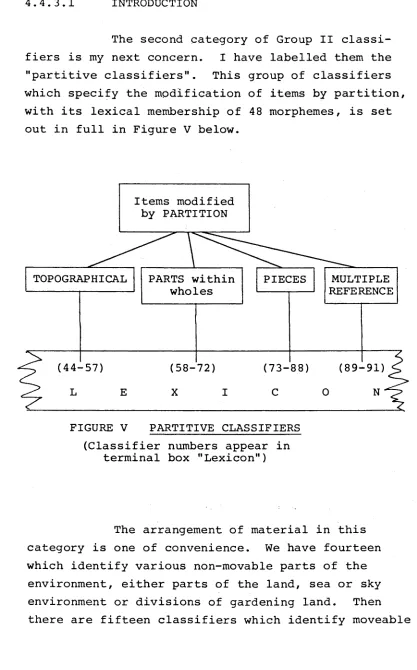
Fig V Partitive classifiers 140
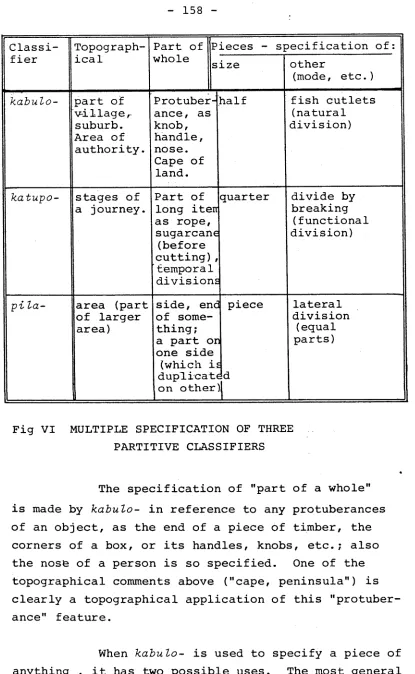
Fig VI Multiple specification of three
partitive classifiers 158
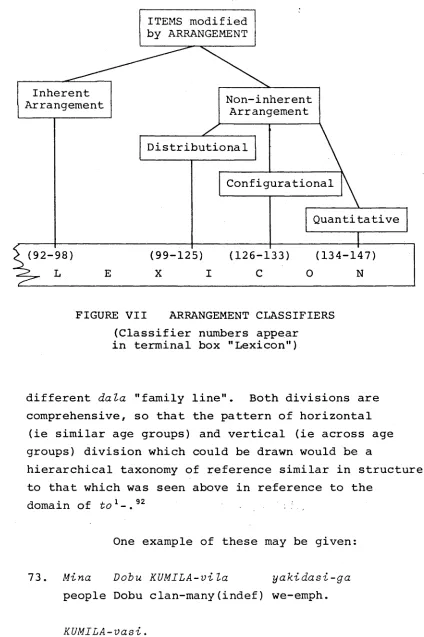
Fig VII Arrangement classifiers 172 Fig VIII Examples of connective association 196
[image:6.541.91.475.49.803.2]Adj adjective word adj adjective morpheme alt alternative morpheme Cl classifier
Cls classifiers Deic deictic word deic deictic morpheme emph emphatic morpheme
excl exclusive (hearers excluded by pronominal reference)
hn head noun
incl inclusive (hearers included by pronominal reference)
Mai form cited by Malinowski neg negative word
NP noun phrase Num number word num number morpheme ord ordinal suffix pi plural reference S sentence
sg singular Vb verb word VP verb phrase
OTHER CONVENTIONS
In writing Kiriwinan text, italics are used throughout. Where necessary, syllable breaks are indic ated by periods placed on syllable boundaries, and stress is marked by a single stroke. Thus: *ka.i "sharp-edged tool". A hyphen placed on the initial and/or final margin of a Kiriwinan form indicates that the form is obligator
ily associated on that margin with some other morpheme. Forms marked with an initial asterisk indicate that the
In giving translation of Kiriwinan text, I give first a morpheme-by-morpheme translation, followed by a free translation which does not conform to the shape of the Kiriwinan segments.
As classifiers are frequently cited, each classifier when first cited in a section is identified by the number it bears in the lexicon in the appendix. When a classifier+plus+word combination is cited, the
classifier is put in upper case; if I feel that morpheme breaks help to explicate the word, they are indicated in the normal fashion, with hyphens. Thus:
ACKNOWLEDGEMENTS
The United Church in Papua New Guinea released me for a year of linguistic study in 1973; then the subsequent award of an A.N.U. scholarship enabled me to undertake a Master's degree course. When that scholarship terminated I was enabled to continue as a part-time student through my wife's willing assumption of the role of breadwinner. The Mission Board of the (then) Methodist Church gave
financial assistance for three years towards hous ing costs. I make grateful acknowledgement to all these, for by these means I have been enabled to follow this course of study.
I must also acknowledge help from my friends and the members of my family, who have play ed their part in making possible our continued stay in Canberra and my continuation as a student.
During the compilation of this thesis I have been deeply indebted to my supervisor, Dr. William A. Foley, and also to Professor R.M.W.
Dixon, who have given me discerning and sympathetic guidance whenever I sought it; and I here express my
thanks to them.
Finally, a special word of thanks to my daughter, Mrs. Jenny Borck, who has willingly
PREFACE
My association with Kiriwina began with a visit in 1961. Then from 1962 to 1973 I with my family were resident at Oyabia, Kiriwina, as missionaries of the Methodist (now the United) Church. Since 1973 we have had continued associations with Kiriwinan friends, especially as colleagues in the work of translation.
My Kiriwinan friends early sensed the interest I had in their language, and over the years they have
been eager to teach me. My first teacher of Kiriwinan was Inose Ugwalubu, an old man at the time of my first arrival in Kiriwina, who had been a tokubukwabuya "un married young man" when the first resident missionary,
Rev. Samuel Fellows, arrived in Kiriwina in 1894. Another early associate, still a close friend, was
INTRODUCTION
The Kiriwina language is spoken by a population of 16,000 people on the Northern fringe of the Milne Bay Province in Papua New Guinea.
The majority of this number live in the Trobriand Islands Group, some 12,000 on the main island, Kiriwina, and 2,500 on other islands of the group. The rest of the Kiriwina-speaking people are mostly resident in the Marshall Bennett Islands, with two small Kiriwina-speaking communities in Yanabwa
(the Northern fringe of Egum Atoll) and the Lusancay Islands.
Kiriwinan society is marked by the feature, unique in Papua New Guinea, of an hereditary order of chiefs. The Kiriwinans are subsistence gardeners, the yam being their staple food. Magic holds a strong place in their society. They are artists renowned for the fine quality of their carvings, which adorn ethnol ogical collections all over the world. Their culture features traditional specialities in various areas of technical skills or food procurement.
The mythical origin of the Kiriwinan
people is the ground of the island of Kiriwina itself; each data "family line" being able to identify the geographical point from which their ancestors issued from the earth. Their earliest contacts with other cultures were with Malay and European pearlers and blackbirders in the period 1850 - 70. The Methodist Church first established its workers there in 1894; they were followed by permanent Government staff in 1908, and Roman Catholic missionaries in 1935.
here a greater adherence to simple forms of tradit ional dress and the "old ways" of life than in any other group within the Milne Bay Province; and the pressure of other languages (English, Motu both Pure and Hiri, the Dobuan lingua franca, Pidgin, and others) has made little incursion into the Kiriwinan language. The Kiriwinan uses his own language with a steady pride in its suitability for all phases of his life, and
rather tends to scorn other languages.
The Kiriwinan language is a member of the Oceanic subgroup as delineated by Milke, within Austro- nesian,1 having a place within his suggested "New Guinea Cluster".2 There are a number of different dialects of Kiriwinan, determined mainly by regional phonological differences. The five dialects spoken on the main
island of Kiriwina are Kilivila (North Kiriwina Island, 5,200 speakers); Kuboma (Central Western Kiriwina
Island, 1,700 speakers); Luba (Central Eastern Kiri wina Island, 3,100 speakers); Kavataria (Central Kiriwina Island, 1,200 speakers); and Kaibwagina
(South Kiriwina Island, 800 speakers).
When the Methodist Church commenced work in the Trobriand Islands, its headquarters was established in the central area where the Kavataria dialect is spoken, and it has thus been this dialect which has been the
vehicle of most literature and vernacular education to date. The Kavataria dialect has been the basis for my
1 Milke, 1965:330. He notes here that he treats the Austronesian languages of New Guinea as "members of the Oceanic subgroup of the Austro nesian languages."
2
linguistic study, and is thus the language dealt with in this thesis. Although the number of its speakers is small, it has acquired status in Kiriwina as the language which is acceptable to all Kiriwinan-speaking people for any literary work. A recent (1970-72)
attempt to change to the numerically and politically dominant Kilivila dialect was strongly opposed by all Kiriwinans.
The phoneme inventory of the Kiriwina language includes nineteen consonants, five vowels and six diphthongs. They are: p3 b3 t3 d3 k3 g3 m 3 n3 pw3 bw 3 kw3 gw3 mw3 r3 s3 v3 l3 w 3 y; i3 u3 e3 c 3 a; ai3 au3 ei3 eu3 oi3 ou. Stress has phonemic status.
Features of interest include the labialis ation of all consonants articulated at the (front and back) extremes of the oral cavity; the dual role of /m/ either as a consonant or as a syllabic nasal; and fluc tuation between the three consonants /l/, /r/ and /n/, part of which is free, and part symptomatic of current
language change. The syllable pattern is represented by (C)V , where C may be optionally filled by any consonant from the above inventory, and V must be any vowel, diph thong, or the syllabic nasal. Thus there are no conson ant clusters, those which apparently occur with /m/
being the syllabic nasal followed by a regular CV syllable, as for example in the classifier Cl 117 m.mo-"conical bundle", or the noun m.seu "smoke".
Within the phonological word, stress place ment is generally on the penultimate syllable. Two
CLASSIFIERS - CURRENT LITERATURE
1.1 COGNITIVE ARRANGEMENTS
1.1.1 Introduction
The major difference between the world of objects in nature and the world of objects modified by man is that the former appear to be scattered about in a random fashion, whereas the latter are arranged, related or associated in some way by the mind of man. Trees in
a natural forest stand here and there, spaced in no regular fashion, and with no pattern to the occurrence of species beyond the natural selection of environmental suitability. Where the landscape is modified by man we may find growing
things arranged in a geometrical association of regular spacing and arranged open space, or plants associated on the basis of colour of foliage or flower, or trees of specific utility in one area and those of aesthetic worth in another, and so on. The landscape modified by man thus shows the mind of man at work, in the way different things have been associated, grouped or arranged.
This feature of cognitive arrangement of objects is the stamp which the mind of man puts on his whole world, both in the way he orders his own environment and in the way he signifies his grouping or association of objects by
means of speech. In the process of speaking of his world of objects, man classifies entities in a way significant to him. He does this because, as Tyler suggests in
"Cognitive Anthropology",1 life in a world with no discernable pattern would be life without intelligence.
l
In a world where each item was distinctive and unrelatable to other items, where in fact everything was "unique", there would be no place for a mind to operate, as the function of intelligence is to identify, associate,
recognise sameness and difference, and so on. "We classify because life in a world where nothing was the same would be intolerable. It is through naming and classification that the whole rich world of infinite variability shrinks to manipulable size and becomes bearable."2
1.1.2 Classifications
The classes of objects which a man identifies are classes which are significant for him, and do not necessarily reflect a reality universally identifiable. In practice, a culture or a language group consists of a group of people who share the same general classifications of their world of entities. The cognitive arrangements
which they recognise and name are for the most part indicative of what that whole society or language group accepts as
being the same in their cognitive world.
Thus we may speak of this cognitive process, which takes place in all languages, as classification; and
the groups or classes which a language asserts to have
cognitive identity, as semantic domains. Tyler defines the concept of the semantic domain. "A semantic domain consists of a class of objects all of which share at least one feature in common which differentiates them from other semantic
domains."3 Such a semantic domain may be the area of meaning covered by a single class of items, or it may be the larger domain which incorporates several classes of items.
.2
3
1.1.3 Culture as Cognitive Organisations
Different cultures approach the classification of their cognitive world in distinctive ways, using different semantic arrangements. This universal feature of differences between cultures is so prominent that Tyler adopts it as a means of defining the nature of the concept "culture".
In reference to the field of study of the anthropologist, he says, "The object of study is not material phenomena themselves, but the way they are organised in the minds of man ... Cultures are not material phenomena; they are
cognitive organisations of material phenomena."4 Thus he is able to go on and say in reference to the concept of a "semantic domain" that "A culture consists of many semantic domains organised around numerous features of meaning, and no two cultures share the same set of semantic domains or features of meaning, nor do they share the same methods of organising these features."5
1.1.4 The Semantic Domain
The semantic domain and its methods of organi sation either from the point of view of the analyst or the culture thus must concern me briefly here. In particular, the cognitive arrangements termed taxonomy and paradigm are relevant to my discussion. Tyler speaks of taxonomic
arrangements of things - classes of phenomena organised into larger groups "hierarchically arranged by a process of inclusion",6 so that items may be uniquely located within a related structure of classes of items. He also speaks of paradigmatic arrangements where multiple features of different items intersect in such a way as to state
different things about the same items.7 A culture may in
4 Tyler, 1969:3 5 Tyler, 1969:11
Tyler, 1969:7 7
some cases use both taxonomic and paradigmatic arrangements to identify one group of items in different ways: the
taxonomic to express dependence, so that sets of items are included within larger sets wholly dominating them; and the paradigmatic to tabulate features of items, so that certain features held by many items intersect in such a way as to describe by what feature one item differs from
another. A taxonomy defines objects in terms of their dependence on, and inclusion in, other items; a paradigm defines objects in terms of the features or components which distinguish an object in contrast with other objects.
1.1.5 Taxonomy and Paradigm in Frake
Examples of both taxonomic and paradigmatic
arrangements of entities are seen, in Frake's "The diagnosis of disease among the Subanun of Mindanao". Frake has
arranged disease names in taxonomic sets where the items within a set contrast with one another,8 and the sets of disease names are named by a single disease term which is
itself included in a superordinate set contrasting with it. His categories of superordinate disease terms he calls
prodromes, and the subordinate categories he labels terminal diagnostic categories.
In order to establish the disease name within the taxonomy the Subanun applies a paradigmatic arrangement of diagnostic criteria as an examining tool. The Subanun enquirer looks at a set of symptoms, or in some cases more than one set of symptoms, which may be minimally labelled by one of 186 disease names, or may be more extensively described by the sufferer. His description may include a number of features, as "hurts, itches, throbs, burns, hard to
8
breathe";9 and "the 'real' world of disease presents a continuum of symptomatic variation which does not always fit neatly into conceptual pigeonholes."10 One disease may be uniquely describable by a single name; or it may progress through several stages and be relabelled (often with disagreement over a change from one diagnosis to another, such as at what point a sore becomes a spreading sore) ; or it may be given more than one name because of more general and more specific labels being used con
currently, as when a rash may be specifically labelled as measles or as smallpox. The application of these diagnostic criteria enables the Subanun to "define conceptually distinct, mutually exclusive categories at each level of contrast."11 His identification of "the same linguistic form (appearing) at different levels of contrast" 12 is also of interest here, as several examples of "multiple semantic uses of single linguistic forms" 13 having the similar feature of contrast at different levels are noted in my examination of Kiriwinan data.14 Frake's use of both taxonomy and paradigm to describe disease categories is clear when he comments in his conclusion that "Conceptually the disease world ... exhaustively divides into a set of mutually
exclusive categories. Ideally every illness either fits into one category or is describable as a conjunction of several categories." 15
9
F rake, 1961:203. See also the paradigmatic contrasts he has tabulated in Fig 3 on p 204.
10
Frake, 1961:205 •*
11
Ibid. 12
F rake, 1961:197 13
Frake, 1961:198 14
For example, see discussion on cl 1 to1- "human" and cl 6 to2- "male human" on pp 90-92, and suggestions on cl 91 pila-"part/piece" on p 161-3.
15
1.1.6 Language Analysis and Cognitive Arrangements
1.1.6.1 Recognition of such arrangements of items within a language is not an assertion that people of any culture arrange their world with full cognitive appreciation of such semantic arrangements. Rather, a language analyst studies some language, and his analysis reveals cognitive arrangements which he describes as taxonomic, or by means of a paradigm, or by some other cognitive arrangement of data. It may be said however that these cognitive arrange ments are linguistic evidence of classificatory processes at work within a culture.
1.1.6.2 In my examination of one particular set of cognitive arrangements in this study I am conscious of the difficulty involved in presenting an analysis of the semantic domains within that language as if they were categories
psychologically significant for the native users of that language. In his article "Cognition and Componential
Analysis - God's Truth or Hocus-Pocus?" Robbins Burling is critical of this assertion which he detects in Frake's
analysis. He asks, "Is (the linguist) discovering something about the language which is 'out there' waiting to be des cribed and recorded or is he simply formulating a set of rules which somehow work?"16 He suggests that even when the most thorough study takes into account "all aspects of behaviour , we may be able to narrow down the alternatives. I expect however that a large degree of indeterminacy will always remain." 17
In organising the Kiriwinan classifiers into categories and attempting to specify the relationships between domains, my arrangement of material can only express my own Western culture and education. This is
particularly so when, with no formal differences in functions and roles, I decide that one category is partition and another arrangement, etc; here the various domains are interrelated on a basis of heuristic convenience, which must approach Burling1s "hocus-pocus" viewpoint. There is however a
different standpoint involved in the description of semantic arrangements within a domain, for here we are able to see that the Kiriwinan speaker has indicated by a morphemic label what is the same for him, and thus we are able to view which cognitive categories are "God’s truth" or psychologically acceptable for the Kiriwinan speaker.
1.2 WRITERS ON CLASSIFIERS
There is a considerable literature which testifies to the modern linguistic interest in the lexemes generally called classifiers. It is beyond the scope of this study to survey the progress of ideas on this theme from their beginnings up to modern times. Such a survey could perhaps begin with Locke, continue with Humboldt and Malinowski, and go on through Sapir and Boas to Haas, Burling and Hla Pe to arrive at the most recent writers. What I wish to do instead is to examine briefly three recent writers who report on the classifiers of three distinct languages,16 and then to consider two articles which make collective studies of a number of classifier languages.19 I will also consider briefly Malinowski's work on the "classificatory
formatives" of Kiriwinan.20 Although this last does not fall within the period of the other writers, Malinowski's conclusions have relevance for this study.
18
19
2 o
Friedrich on Tarascan, Benton on Trukese and Becker on Burmese. Adams, Becker and Conklin, 1975; Allan, 1977.
The reason behind my choice of these writers is that there is a measure of similarity between the systems they describe and the Kiriwinan classifier system, and I will wish to draw attention at points within my study to the parallels which exist. Also, I will use part of the insights of these writers to set up a coherent pattern of relationship and function within the Kiriwinan classifier group; for example Allan's study of the various categories of classifiers exhibit a number of close parallels to what I see as the system of Kiriwinan classifiers.
1.3 FRIEDRICH ON "SHAPE IN GRAMMAR"
1.3.1 Friedrich's study "Shape in grammar" is based on the Tarascan language in Mexico. His article deals with three elements within the language: numeral classifiers, classificatory verbs and locative suffixes. While he sees all three of these as intersecting and interdependent, I
wish to comment only on his analysis of the numeral classifiers. Friedrich records the existence of three classifiers which
imply classes of things having "longish, flattish or roundish" visual shapes, and have as their "more essential feature" the "saliency or emphasis of one, two or three dimensions." 21 These in turn form part of a larger interconnected system. Friedrich describes this system: "The crucial part of this article is the existence of a clear contrast between (1) a dimensionless set, (2) a dimensional set of masses and
shapes, and (3) a speech-capable and apparently human set." 22 The dimensionless set consists of items such as wind, sickness, hunger, which are never classified; the dimensional set
consists either of objects of definite dimensions which are regularly classified by the three numeral classifiers, or
of mass nouns which are normally identified by their container; and the human set,which may be classified under particular
conditions.
21
22
1.3.2 Friedrich notes that the classifiers have an anaphoric function;23 in answers to questions, the number- plus-classifier form functions as a grammatical substitute, referring backwards to the item which has been the subject of the question. In considering the meaning of the numeral
classifiers, Friedrich comments that while in their anaphoric role they "mean the word they replace"24, in their general classifying role they may indicate specific dimensions of things actually perceived, or they may indicate "shape as perceived in the context of a particular speech situation."^5 Thus their meaning is frequently dependent on situational context, either as to the word they may have replaced, or as to the type of dimension which is either directly or metaphorically attached to an item. "The usage" comments Friedrich, "obviously depends on individual intelligence
and character, and might well serve as an index in studies of personality and bilingualism."26 Finally, Friedrich
identifies similar patterns of shape as a semantic category in languages of North and South America, the Pacific
(including Kiriwinan), and also Asian and African languages, and concludes that "the overt, obligatory morphology of
perhaps the majority of the world's languages functions partly to express categories of shape, and that such
categories are probably universally present in the semantic substructure of all languages."27
1.4 BENTON ON TRUKESE
1.4.1 Benton's study is of a language of the
Austronesian group. His article, "Numeral and attributive classifiers in Trukese", reveals a dual system of classifi cation which "provide a means of ordering the universe, and
23 Friedrich, 1970:381. 25 Friedrich, 1970:: 385 See also his comment
on grammatical substi
26 27
Friedrich, 1970:: 386 tution, p 384. Friedrich, 1970:: 40 3 24
a method of structuring concepts without multiplying
vocabulary."28 It is not relevant to my study to present the system in full here, as the pattern of the two
virtually autonomous29 classificatory systems which he describes is not paralleled in Kiriwinan. I wish however to sketch in broad outline his analysis and conclusions on the Trukese numeral classifiers, as there are numerous similarities and helpful insights in his study.
1.4.2 Benton finds in the Trukese numeral system a pattern consisting of a numeral prefix which obligatorily occurs with a descriptive base. The descriptive base morphemes consist of some forms which he terms true
classifiers,30 and a number of others. In order to analyse the classifier forms, he cites the system described by
Hla Pe for Burmese. Hla Pe "has analysed three distinct types of classificatory elements, which he calls CLASSI FIERS, REPEATERS and QUANTIFIERS. Classifiers (Hla Pe) defines as words 'for an attribute of a specific object, some of which may have more than one.' ... A repeater is diagnosed 'when the specific object itself (or part of it) is used as a numerative'. ... A quantifier 'concerns itself with the estimating of things by some sort of measure - size, extension, weight, amount, or number, especially ten or multiples of ten'."31 Benton finds
this insight applicable with some modification for Trukese.
1.4.3 In regard to the repeaters he finds it necess ary to distinguish two types: the OVERT repeater which parallels the repeater as Hla Pe defines it, and the COVERT repeater which "may be followed in the surface structure of the sentence by a completely different base ... (but which) may always be followed by a noun with the same underlying form,
B e n t o n , 1 9 6 8 : 1 4 3 30 B e n t o n , 1 9 6 8 : 1 2 4
and this construction may be assumed to be present in the
deep structure even when ... it does not actually appear
in the surface representation of the p h r a s e . " 32 This
category of covert repeater is examined, and examples given,
on p 62f below, where its similarity to certain Kiriwinan
classifiers is being studied. There may be cases when a
repeater adds no semantic content to a phrase, as it "is
of no special significance except that its presence is
required by the structure of the Trukese numeral."33
The distinction between overt and covert repeaters is
however necessary, as a "more complex (relationship between
noun and classifier)"34 applies in the case of covert
repeaters.
1.4.4 Thus Benton lists 100 classificatory bases,
thirteen of which are classifiers, sixty five are repeaters
(eighteen overt, 23 covert and 24 questionable), and twenty
one are quantifiers.35 Although the number of true classi
fiers is in the minority, Benton comments that "the true
classifiers ... have as a group a much wider distribution
than either the repeaters or the quantifiers."35 In
reference to the syntagmatic function of the classifiers,
Benton notes the use of the numeral plus classifiers as
"the anaphoric representative of a noun phrase, the
remainder of which has been deleted because of prior
reference in the conversational context."37
pp 117f. He notes that Hla Pe has a similar distinction between 'explicit' and 'implicit' repeaters in Burmese. 33 Benton, 1968:111
34 Ibid.
35 See Benton 1968:119-123; one form (*/mb)ek/) is unlabelled. 36 Benton 1968:137
37
1.4.5 Benton employs the idea of the semantic domain in discussing the selection of classifiers; for his own purposes he qualifies the general usage of this concept:
"I intend to use the concept of 'domain' to include groupings of classifiers marked explicitly for the same features,
and which may or may not be used contrastively with the same noun."38 Thus his modification of the domain concept would seem to include the possibility of a hierarchical relationship between groups of classifiers, with domains wholly included within superordinate domains, allowing contrastive features to be included within some domains.
1.4.6 Addressing himself to the meaning of the classi- ficatory base, Benton sees the true classifier as being
composed of a feature or group of features. "The numeral classificatory base generally seems to be concerned with
the actual state of the item enumerated. The true classifiers may be separated into three semantic domains: shape, nature and generality."39 A classifier thus specifies a "certain bundle of features"40 in reference to any Trukese noun, while other classifiers may identify "other potential com
binations"41 of features for the same noun. While he is only considering the true classifiers at this point, Benton suggests that repeaters and quantifiers operate similarly in terms of bundles of features.
1.4.7 Contextual information is frequently necessary to elucidate meaning; thus Benton suggests that each form has a characteristic or unmarked meaning, which "in another context"42 may be differently labelled. Benton suggests, for example, that the wider context of a noun phrase such as erjon nuu "one-ten coconut" may designate that phrase as either "ten coconuts (fruit)" or "ten coconut palms."43
3 8
B e n t o n , 1968:: 136
3 9
B e n t o n , 1968:: 137
4 0
B e n t o n , 1968:: 138
4 1
B e n t o n , 1968:: 138
42
B e n t o n , 1968:: 111
4 3
The classifiers may make the "vague general meaning" of a word "specific".44 Thus he quotes the Trukese example mwoonu
"anything used to fix a leak", which according to which repeater is used with it, may be understood to mean "a leaf of coconut used for this purpose ... a quantity of material (either thatch or roofing iron) for a portion of roof ... or one of a series of leaves attached to a stick . . . " . 45 Alternatively, they may by the association of a different bundle of features specify a different meaning, so that "a change in domain will also signal a change in meaning."46 Benton uses as an example suupwa
"tobacco", which unmarked by a numeral classifier will have the general meaning of tobacco; but marked by various
numeral classifiers it may have the meaning of a cigarette, or a packet of cigarettes, or a cigarette butt.47
1.4.8 Concluding his study of the Trukese classifier system, Benton comments on two features which have some bearing on the Kiriwinan system studied in chapter 4 below: that is, the ready adaption of loan words, and the function of the classifiers as metaphors.48 Benton sees in the
Trukese classifiers a flexible means of reference which is readily able to adapt new words and concepts; loan words are readily assimilated into the system, though some
fluctuate in position. Finally Benton notes the metaphorical adaptions of meaning by means of uncharacteristic classifier specificationswhich enable the speaker to express fine shades of meaning. "The classifiers of Trukese thus at the same time provide a means for ordering the universe, and a method for structuring concepts without multiplying vocabulary."49
44
B e n t o n , 1 9 6 8 : 1 4 2 47 S e e t h i s e x a m p l e in B e n t o n , 1968::1 1 1
45
Ibid. 48 S e e h i s c o m m e n t s i n B e n t o n , 1968:: 142
46
1.5 BECKER ON BURMESE
1.5.1 In his study of the Burmese numeral classifier system, Alton Becker reveals, as did Benton for Trukese, two separate classificatory systems at work. However,
where Benton found the Trukese systems to be largely autono mous, Becker finds that in Burmese the two systems are
complementary. One system consists of a series of sets of items "sometimes obvious ... sometimes more esoteric ...
(which) represent, taken together, a taxonomy of the phenomeno logical universe of the Burmese."50 The second system, con sisting of the Burmese classifier system (as discussed by Burling51 and Hla Pe52 ) , Becker describes as a "second phenomenological universe".53
1.5.2 The first system is taxonomically based, and the items in it are easily discussed and understood. The second system however locates items relationally by paradig matic association; but the classifiers which form the basis of the association often seem obscure and are hard to discuss independent of their associated items. Of these two systems of classification, Becker notes that "certain semantic
polarities appear over and over again ... What is striking is that the same semantic polarities do not appear in both systems."54 Thus with each set being concerned with different semantic viewpoints, the two systems are complementary. This difference in semantic polarity Becker explains as the
difference between the taxonomic system (the encyclopaedic sets) and the paradigmatic system (the numerative classifiers).
The taxonomies which determine the membership of the encyclopaedic sets are culturally predetermined; the more that "one learns to see things in a Burmese way"55
50 B e c k e r , 1 9 7 5 : 1 0 9 5 2 S e e H l a P e " A r e - e x a m i n a t i o n 51 S e e R. B u r l i n g " H o w t o c h o o s e o f B u r m e s e c l a s s i f i e r s " L i n g u a
a B u r m e s e n u m e r a l c l a s s i f i e r " 1 5 , 1 9 6 5 .
i n M . S p i r o (ed) " C o n t e x t a n d 53 B e c k e r , 1 9 7 5 : 1 1 0 m e a n i n g i n c u l t u r a l a n t h r o - 54 I b i d .
the more a student of the language is able to view them with proper insight and appreciation. Each item listed within the hierarchical taxonomy has one place only which
it may occupy in that system. The second, paradigmatic, system enables a noun to appear in a number of different places within the relational system, so that the speaker is able to speak of the same thing in several different ways; thus the second system is open to inventiveness in
the speaker's choice of words and to stylistic beauty in the associations he makes between items. It is this explication of the Burmese numerative classifiers as "a paradigm, in which items are located relationally,"56 which is the main burden of Becker's study, and is the
reason for its inclusion here.
1.5.3 Becker sees the use of the classifiers in Burmese as "in part an art and not just a grammatical convention ... The choice (of a classifier) depends on the universe of discourse. One might speak of a river in at least eight contexts ... The classifier is, in part, an indication of the context in which one is speaking
about something."57
Becker pays particular attention to the
semantic specifications of different parts of the Burmese classifier system. He comments that while quantifiers and classifiers, commonly considered discrete entities, may in reality only be "quantity and quality ... polarities
in a semantic continuum",58 yet there is evidence that the classifiers are in some respects semantically different
from the quantifiers. While the quantifiers may be precisely translated into English, this is not the case with the
classifiers.
56
57
58
Becker, 1975:111
The true classifiers have a locative function, being explainable as "a locus on a conceptual map,"59
which is literally a "linguistic map of the world".60 Animate beings, together with some secondarily associated items, are located in a succession of four orbits around the Buddha as centre. Beings are not necessarily fixed in one place in this system, but may move closer in or further out depending on the speech act being performed. The loci of inanimate objects are more complex, but are positioned
in relation to the speaker. "The structure underlying classification starts with the self at the centre, divides that self into head and body, and then arranges objects at four distances from the self, associating them either with the head (metaphorically top, round) or with the body
(metaphorically bottom, straight)."61 This complex locative pattern is to be seen not as "an inductively derived tax onomy but (as) an applied metaphor",62 applied as a para digm to inanimate items. Items which are placed at the
same point in the system do not thus have features in common with one another which would mark them as belonging together
for some discernable reason; nor is there anything which would show them as belonging in that place. The only thing they have in common is that one speaker has located them in that one place in relation to himself; another speaker may relocate them, according as the metaphor of location serves his spoken message.
1.5.5 In conclusion Becker comments that "the Burmese classifier system is coherent because it is based upon a single, elementary semantic dimension: deixis."63 The speaker relates himself to his universe of discourse,
5 9
B e c k e r , 1975:115 6 0
B e c k e r , 1975:118 6 1
Ibid.
62 Ibid.
locating himself in relation to other animate beings
and locating the things he is speaking about in relation
to himself. "The Burmese classifier system has purpose
because ... it establishes in the surface structure of
the language the universe of discourse (ie the sense in
which someone is speaking of something) of a speech act,
within a culturally shared image of nature."54
1.6 MALINOWSKI ON KIRIWINAN
Before proceeding to a study of the articles
dealing with a number of different classifier systems, I
must include at this point a brief summary of Malinowski's
work on the Kiriwinan classifiers.
1.6.1 Malinowski's work on classifiers was based
on field studies made in 1915-18, when his central
interest was ethnological rather than linguistic. When
writing his "Classificatory particles in the language of
Kiriwina",65 he noted that he was not adequately equipped
for linguistic observation because of the general lack
of a generally accepted theoretical basis to linguistic
study. He comments that "there can be no successful
observation of facts without the guidance of a sound
theory"66 , and thus exemplifies in his own conclusions
on classifiers how "a very characteristic and theoreti
cally important phenomenon has fared badly, when treated
on the foundation of insufficient theory."67
Malinowski suggests that the same lack of
theory in part explains the deficiencies evident in the
only grammar of Kiriwinan, that written by Rev. Samuel B.
Fellows. He concludes an examination of the deficiencies
in Fellows' "Grammar of the Kiriwina Dialect" with, "So much on the score of criticism, which negatively
shows us how lack of theoretical guidance and of realising the theoretical importance of linguistic phenomena must lead, and does lead, to blurred vision of facts."68
1.6.2 Malinowski refers to the Kiriwinan classifiers as classificatory particles. Under this generic description he distinguishes three main functions, which he labels
with the terms "classificatory formatives", "naming forma- tives" (or root-repeating formatives), and formatives
which "possess a pronounced nominal character"69 . I now look briefly at each of these terms used by Malinowski.
1.6.2.1 Malinowski uses the term formative as a
shortened form of class-formative, to indicate the function of a particle in any language in the process of forming or building words, and thereby creating a group of words in a language with an identical affix "characteristic of certain limited classes of words"70 as certain kinship terms, diminutives, and so on. He does not see this
how-71
ever as entailing "a general principle of classification. 68
69
70
71
P 72. His criticism of Fellows was, however, tempered by Malinowski's"admiration and indebtedness" (p 70) for his work. Some of Malinowski's "corrections" of Fellows' data were how ever wrong. Thus he says, "It would appear to anyone who reads the Grammar that classifying formatives enter into the formation of numerals only." But Fellows says, "The adjective follows the noun or pronominal particle which it qualifies",
(Fellows 1902:173). Fellows also shows the formation of the demonstratives, (Fellows, 1902:174) in spite of Malinowski's claim to the contrary, (Malinowski 1920: footnote to pp 65f), giving paradigms of three forms using classifiers.
Malinowski, 1920:59
Malinowski, 1920:38
1.6.2.2 His term alas sificatory formative specifically details those class formatives which by their use indicate
"the degree of unity and consistency of those things of which they are the names, as determined by their natural position and shape, their proper motion, effects, relative strength, etc."72 Elsewhere Malinowski refers to the
classificatory formatives as "the real classifiers."73
1.6.2.3 Those which he refers to as naming formatives are the formatives which are limited in their use to a very small number of items, on occasions "restricted to one object only".74 He says, "If we have a formative of a very narrow application and definite meaning ... the resultant word will not possess any power to stamp the noun as belonging to any class, because it simply repeats the noun and adds nothing to its meaning ... - an extremely interesting phenomenon, but one which could not by any
stretch of the imagination be called classification (his italics). Thus we may say that where both phonetically and semantically the formatives and the nominal root coincide, there we have a naming formative but not a classificatory one."75
There is no Kiriwinan classifier with such a limited field of reference. He uses two examples which he asserts demonstrate this restriction, (kada- "road" and sisi- "branch"). Both of these however are readily shown to specify a small domain of items rather than a single item. Kada- may specify not only keda "road", but also the names of particular categories of tracks, as kadaula "main road" (which is a compound noun, the particle -ula having no independent existence in this sense) or
T 2
Malinowski, 1920:38. Malinowski is here quoting Torrend in relation to Bantu classes, as an example of the classi fier role in language.
73 Malinowski, 1920:58
74 Malinowski, 1920:58
kowalawa "track from the beach"; or it may specify the sort of country to be crossed by someone, as raibwaga "stony country" or pwadidiweta "swamp"; and also meta phorically it is used to specify a way or method of
doing anything, as in the phrase maKADAna nanamsa "that- road thought" ie "that way of doing (something)". His second example sisi- may specify sisila "branch", and in addition a large number of items, as wood, names of
trees, etc; and also it may specify a part of a magic spell.
1.6.2.4 The formatives which Malinowski distinguishes apart from the naming formatives as those "which possess a pronounced nominal character" are those which "are as a rule used without the corresponding nouns."76 That is to say, they may be used in isolation, or may specify only one noun (or a small number of nouns) with a different root from that of the classifier. He suggests that some of the words containing such classifiers must in reality be considered the basic noun; so that where for example the formative sa- "betel bunch" is used in the phrase sa-tala buwa "betel bunch-one betel nut", then "sa-tala is the individualised, differentiated thing, whereas buwa is the generic expression ... Thus in this case the
grammatical relations between classificatory and naming word seem to be reversed."77
1.6.3 Malinowski enumerated only 42 "particles" stating that "the list here given can be considered with this reservation as a complete enumeration and not as an exemplification only."78 He assembles these into eight groups comprising the nature of things, bunches of fruit, parts of a divided whole, parts of an undivided whole,
76 Malinowski, 1920:59
77 Malinowski, 1920:60
7 R
conglomerates, rows and heaps, baskets of yams (one only) and a measure of length (one only). He observes that "the fourteen particles of the first group possess in
the most pronounced degree both the classificatory meaning and the grammatical function of a real word-formative."79 He sees them as "the real classifiers", which "refer directly to the nature of things, which they express, and this group contains in itself a comprehensive classi fication of things."80 He notes also that "within this group the principles of classification are inconsistent and at cross-purposes with one another ... several of the classes are not properly exclusive"81 ; and also that "this direct classification (within Group I) could stand no logical test."82 Within the other groups, Malinowski sees the classifiers as being of a much more restricted nature, wherein is "emphasised one special point of view - usually very concrete and sometimes very narrow in
connotation."83 Within these groups he places those classifiers which he categorises as either naming formatives or as the formatives which are in his view substantival in character.
1.6.4 Malinowski comments also on the function of all the Kiriwinan classifiers, which are able to stand in isolation "as independent nominal expressions wherein the formative stands for the thing (naming or classifying it) and the root gives it an attribute."84
1.6.5 Malinowski sees the Kiriwinan classifiers as being a heterogeneous group. Some of them classify words into semantic groups and so are in his view real classifiers. Others have a root-repeating role, and are
T 9
M a l i n o w s k i , 1 9 2 0 : 6 2 8 2 M a l i n o w s k i , 1 9 2 0 : 4 8
8 0
M a l i n o w s k i , 1 9 2 0 : 4 6 8 3 Ibid.
8 1
too limited in their reference to be regarded as classi fying in a semantic sense. Yet others use the place
of the noun, so that in some cases the word which contains the classifier becomes the substantive, and the noun is merely an attributive word.
Thus in Malinowski's examination of the Kiriwinan classifiers, written some fifty years before most scholars discussed in this chapter, we find a fore
shadowing of the classifiers, repeaters and pronominals of the later writers. He also observes correctly the anaphoric role of the classifier in deletion processes. Finally, in his comments on classes "not properly
exclusive"3“ he puts his finger on, without being able to name, the paradigmatic nature of the classifiers
(which he clearly expected to form a taxonomy of the Kiriwinan world), to which Becker later drew attention.
(See above p 15.)
1.7 ADAMS, BECKER AND CONKLIN - SAVORING CLASSIFIERS
Two studies of the classifier, across the boundaries of a number of languages, must now be made as a conclusion to this chapter. I attend first to the monograph of Adams, Becker and Conklin "Savoring the differences among classifiers."
1.7.1 By a study of classifier phenomena in a number of languages, Adams,Becker and Conklin seek bases for comparison and contrast. A number of South-East Asian languages provide data on which are based some paradig matic comparisons; and Thai, Vietnamese, Indonesian and Burmese are the data sources for some syntagmatic
comparisons. I do not wish to present their arguments in full, being concerned rather with drawing out features which parallel Kiriwinan phenomena.
85
1.7.2 Among the paradigmatic comparisons, of
interest are comments on systems of classifiers, semantic domains, repeaters and numeral systems.
1.7.2.1 Two Indonesian languages are discussed as examples of the extension of referential role within
languages. The first, Mori, is shown to have what appears more like a word list than a system, with little if any relation between the classifier forms. On the other hand, Palauan is quoted as an example of a language with a
set of classifiers in which most concrete nouns are
classified, with the whole set displaying an organisation of the classifiers in relation to one another. Animacy and shape are together important features of Palauan classification which with a number of mainland South- East Asian languages "have this hierarchical semantic
structure of animacy vs inanimacy, and inanimacy elaborated along lines of shape as their central organising
principle" . 86
1.7.2.2 Considering the different semantic fields
which different languages specify by classifier reference, the authors note a "tendency to proliferate classes for things one is particularly conscious of (or) particularly concerned with", so that "in Oceanic languages, many
classes are devoted to foods and the sets in which foods are expected to be arranged."87 There is a tendency for some classes of a general nature, and often a class for items not included in any other class. A frequent
phenomenon is for "one noun to have more than one appro priate classifier"88 so that the selection of a suitable classifier may be a matter of literary taste or personal inventiveness.
80
87
8 8
Adams, Becker and Conklin, 1975:4 Ibid.
noted by the authors as being of varying importance in a number of languages, namely the "use of a noun to classify itself ... This phenomenon has been variously called self-classification, auto-classification and repeaters."89 The true repeater is defined as the form which classifies itself and no other noun; many languages however display a form analogous to the repeater, when a classifier repeats its own form and classifies other nouns as well.
1.7.2.4 In relation to numeral systems, many languages eg Gilbertese and Palauan, attach classifiers only to
small numbers, with the large round numbers being used without classifiers. The classifying of units of tens
is noted as a feature of Oceanic languages, in some cases by means of special classifiers.
1.7.3 Under the general heading of syntagmatic comparisons, Adams, Becker and Conklin include some con sideration on enumeration, substitution, demonstratives and adjectives; nominalisation; textual cohesion, register and style. I make a brief mention of each of these.
1.7.3.1 Enumeration is stated to be the "most central role90 " of the classifier, which varies in usage from language to language. The use of the classifier as a nominal substitute is noted in all languages studies by the authors except Indonesian. Both Thai and Vietnamese use the classifier in conjunction with demonstratives and adjective constructions.
8 9 A d a m s , B e c k e r a n d C o n k l i n , 1 9 7 5 : 6
1.7.3.2 The same two languages also feature classi fier constructions which function as names and as nomina- lisers; the authors note that "the total meaning of the numeral phrase is a combination of the meaning of the classifier and the classified noun."91 When a classifier acts as a nominalising representative of one noun and is followed by a different noun, the phrase needs the semantic
in Vietnamese, information of each in order to be understood. Thus,jsai when added to nan "foundation", comes to mean "foundation as of a building". The authors suggest that "this process might be analysed as a form of compounding rather than
classification. " 92
1.7.3.3 The discourse function of the classifiers is mentioned, particularly in reference to Burmese, which
"exploits the possibility of using more than one classifier with a single item extensively for textual cohesion."93
Related to this would be the phenomenon, found in all
four languages, of classifier usage differing with changes of style and register. Idiosyncratic usage of classifiers
is noted, so that personal inventiveness in language use would be seen in a speaker's relative freedom in classifier usage. In Burmese and Vietnamese especially "reclassing is an important literary device. Texts manipulate the choice of classifier to change the way they want the reader to regard something. Since the classifiers in these languages do add a great deal of semantic content to the noun phrase, the effect is quite profound."94 This flexibility of usage does not however occur in Indonesian.
91
Adams, Becker and Conklin, 1975:13 92 Ibid.
93 Ibid.
Adams, Becker and Conklin, 1975:14
1.8 ALLAN'S STUDY "CLASSIFIERS"
1.8.1 As a conclusion to this chapter I outline the categories of classifiers identified by Allan in the latter part of his study "Classifiers". Allan's analysis of classifier language types is of dubious worth, and many of his assertions are open to question. What I have found of value however is his section on the
"Categories of Classification" (section 5, pp 297-306), most of which is paralleled by my own categorisation of classifier roles in Kiriwinan. I have found it helpful in my own analysis to adopt some of the terms Allan has used.
1.8.2 Allan names seven categories of classification, which indicate the breadth of the classifier's role in identifying meaning: (i) material, (ii) shape, (iii) con sistency, (iv) size, (v) location, (vi) arrangement, and
(vii) quanta. He observes that "the seven categories intermesh; many classifiers combine two or more of them, and so are subject to componential analysis in terms of these categories and their respective subcategories."95 1.8.2.1 Within his first category labelled "material", Allan places three subcategories namely animacy, abstract and verbal nouns, and inanimacy. The three subcategories do not appear cohesive, until it is noted that Allan
confesses that the label "material" is not an appropriate one, but that "All classifiers which typically refer to the essence of the entities referred to by nouns are instances of this category."96 Thus Allan's "material" category is a category of essence of entities, animate, abstracts, activities, etc.
95
96
Allan's use of the term essence in relation to this category is perhaps unfortunate, as in general terms his second category of shape may also be understood as part of the essence of an item. There is in fact some overlap between this category and the second and third categories, as I have noted below. It would have been better if his first category was defined in terms of the polarities of animacy and inanimacy. 97
Allan notes that the animate category varies greatly from language to language, but that humans are generally classified in some way distinct from other beings. The abstract and verbal nouns are rarely classi fied (though Allan discusses and dismisses action
classifiers identified by Berlin for Tzeltal). The subcategory of inanimacy "covers a large number of
classifiers"98 and Allan names the one which classifies trees and wooden objects as the commonest. Also within this inanimate subcategory he includes the residue type of classifier which is "used of a large number of hetero geneous inanimate objects, some of which may be alter natively classified by some specialised classifiers."99
1.8.2.2 Allan's second category, shape, "has three dimensional subcategories of long, flat, and round" or
"saliently one-dimensional, two-dimensional and three- dimensional."100 Tarascan, which has been studied above
(p 8 ) has shape as its only classificatory domain. Also included within this category are three subcategories or non-dimensional shape, which we may identify as exterior curved shape as in heaps, protuberances, etc; hollow shape, as in bottle-like; and annular shape, as in entrances, holes, etc.
97
Such a category label however may have made it necessary for abstracts and action classifiers to be placed in a separate category, unless they could be seen as related to animate function.
98 Allan, 1977:300
99 Ibid.