ENGAGING TECHNOLOGIES-SAVVY CONSUMERS WITH THE INTERNET
OF THINGS
John R. Hamilton, James Cook University, Cairns, Australia, [email protected]
Singwhat Tee, James Cook University, Cairns, Australia, [email protected]
ABSTRACT
Consumers today engage in and with interactive online activities. These activities are compiled from a vast array of online-hosted components loosely termed the Internet of Things (IoT). At the same time innovative corporates are delivering latest IoT-related and consumer-targeted smart solutions. This paper proposes the MVL model as a pathway to examine consumer value relationships, and to then map these relationships against relevant IoT-generated revenue streams. Hence, by capturing and tracking their IoT savvy consumer’s actions and activities, the corporate can gauge the success of their IoT offerings.
Keywords: Internet of things (IoT), value, customer, behavior, motivation, social, loyalty
INTRODUCTION
The internet continues to tap numerous consumer-tracking mechanisms and to extend business-reach mechanisms further towards real-time interactive consumer engagement [22][24]. Early studies considered the reasoned action of consumers [9] where technology acceptance [7] by consumers provided beliefs and motives, that in-turn, influenced attitude, then instilled intention, and then expanded behavior. Concept extensions by [7] linked consume-perceived-usefulness and a technology’s ease-of-use into attitude (to using), behavioral intention (to use) and actual system use. Other researchers considered marketing, technologies and/or design when mapping consumer actions across a website, and added ways to estimate effectiveness [4]. Tracking studies included site recognition, comprehension, connection, interactivity, value, quality, performance, and outcomes-focused studies in satisfaction, trust, loyalty, and revisit intention [5][33]. In general, these measurement inclusions have incrementally added to the position of web analytics [6] and to understanding web consumers [6][25].
LITERATURE REVIEW
Today consumers are diversifying and pursuing emerging ideas appearing across the ‘internet of things’ (IoT). The IoT offers virtual efficiencies, and connects multiple cloud systems [12]. The IoT also interlinks across mobile devices, measurement devices (such as gym monitors, thermometers, and apps), transporters, appliances, residences, workplaces, and it further interconnects with selected global databases. In this IoT age business can engage and offer po werful value creation tools that enable consumers to make astute decisions and this in-turn allows corporates to differentiate themselves from competitors [26].
The industrial IoT is a rich economic wealth generator where new innovations interlink consumers and business in unique economically-satisfying, social-engaging and emotionally-connecting ways [31]. The industrial IoT also expands its external wealth generators with technology-deployments extending and reaching consumers across the globe [2].
Image from: http://cybject.wordpress.com/2010/02/07/2010-technology-forecast-the-internet-of-things-slowly-comes-of-age.
Accenture estimate the globally-interconnected industrial IOT can grow the gross domestic product of the top 20 developed and emerging national economies by $US14.2T [20]. Thus, the IoT is a productivity accelerator [30]. It is enabling new market-reach and overcoming infrastructure gaps by integrating technology breakthroughs [12]across its embedded unique innovations, and it is delivering radical new solutions [28]. These IoT deliverables are ‘collectively creating future industrial-game-changers for leading global economies’ [29].
[image:1.596.194.402.503.594.2]The Fifteen International Conference on Electronic Business, Hong Kong, December 6-10, 2015
Hamilton & Tee
Table 1. Four critical enabling frameworks for industrial IoT [20]
Corporate Commonalities Supporting infrastructures Transference systems Innovative Dynamics
Communications infrastructure
Government support & R&D investment
Formal & informal knowledge transfers
Entrepreneurial culture
Human capital Science, technology, engineering,
mathematics talent
Embracing new technologies within corporates
“Makerism” movement
Quality of governance & research institutions
Quality of scientific research institutions
Consumer willingness to adopt new technologies
University - industry R&D collaboration
Access to capital Standards setting Data privacy and security
concerns
Economic openness Urbanization
Expanding middle class
Technology
development clustering
Consumer focused corporates
Within this suite of IoT enabling framework lies the innovative dynamics ‘consumer-focused corporates’ - who value-target their consumers in real-time. This value servicing is beneficial to both the corporate – with automatic sensing, communicating and feedback, enhanced augmentation and lower labour/processing servicing costs, and the consumer with direct, convenient and more precise servicing [10]. To win transactions from consumers, and to build a new market for their innovative IoT product or service these corporates are very consumer focused.
Hence, this paper proposes the research question: how can corporates meet the IoT savvy consumer expectations and value requirements? In considering this question we first segregate the IoT consumers and only consider those who are innovative adopters and link these with the corporates who innovate and bring these smart IoTs into their business solutions. To assess this relationship between innovative IoT corporates and their innovative adopters we develop a model that links consumers through their utilitarian and hedonic behaviours through social interactions and proposes a IoT values servicing system for such consumer-focused corporates.
RESEARCH MODEL
In the servicing domain, IoT consumers are in collective pursuit of differing degrees (and varieties) of servicing. They are moving from pursuing smart objects towards even smarter objects that can translate the awareness of causal relationships (or the knowledge of change and evolution over time) into actions [3].
Today isolated IoT objects are linking together and providing fragmented sections of heterogeneous smart-objects - where consumers choose to engage and also experience actual degrees of social consciousness [3]. An engaged IoT consumer actions (by sharing or sensing) a level of IoT-selected experiences across available social, mobile, analytical and cloud offerings. If suitably motivated the consumer actions the IoT at a level that acquires the intended stimulation patterns, and in so doing acquires some unintended stimulation patterning. Where this stimulation patterning can be measured an indirect IoT interaction pattern is determinable. Such measures in-turn may be socially and behaviourally differentiated [17]. Further, these social motivators can be linked into consumptive values and through to personal gratification levels [14]. Thus a behavioural approach to the IoT can elicit a measurement model by which corporates can identify who are their core consumers, and so can potentially track if its IoT- related offerings are changing over time [13][27] in line with consumer behaviors.
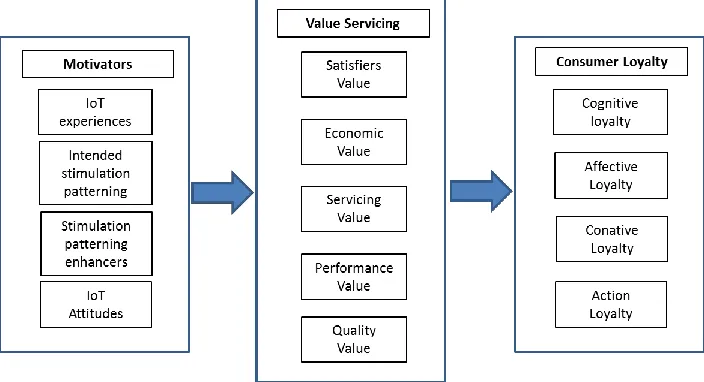
Hence we fit the consumer motivations for the corporate’s IoT offerings into four groupings. First, the consumers experience the corporate’s IoT offerings and related resources. The consumers discuss their IoT experiences as interlinked with the corporate’s integrated social and cloud offerings, and they discuss if their experiential and mobility demand pathways match their experiential demands. Second, the consumer holds a level of expected stimulation that is to be met by the corporate’s IoT offerings. This primary and intended motivator is a must deliver position by the corporate, and is the minimum consumer needs and wants expectation-set trigger to advance the consumer into a potential values engagement sequence. Third, to further convince the consumer their expectations are further stimulated with pattern enhancers. Here, the consumer’s corporate IoT expectations are enhanced and stimulated by desirable and fun patterning across functional, knowledge and design aspects. The consumer sees these as specifically enhancing their intended IoT business value solution. These motivating solutions in-turn draw the consumer towards engaging and transacting further with the corporate’s IoT offerings. Fourth, the consumer’s attitude to the corporate’s IoT offerings hinges on the consumer’s skills set being made (or assisted) sufficient to deliver them their desired experiences. This connectivity can motivate consumers and encourage them to engage further, and so help move the consumer towards the corporate’s strategic attempts to match the consumer’s projected consumptive value propositions.
IoT Value Offerings
[image:2.596.50.546.73.242.2]targeted consumers. From table 1 this study considers the ‘consumer-faced corporates’ sector. Here, the corporate IoT value offerings typically reside within Table 2’s five customer experienced value dimensions [11].
Table 2. Consumer IoT behavioral motive sensors [11] linked with value propositions [13][21]
Satisfiers Facilitation Economic Reward Servicing Performance Quality
Make consumers’ biz Presents rewards Offer new opportunities to Track information trails and Building customerized experiences easy, accessible targeted at past (retained) consumers decision making of consumers personalized solutions and convenient consumers New consumers
Connect, transact, validate Rewards for: time, Proactive servicing as Empowers consumers with the Embedding new R&D or
fast sensing data via mobiles money, effort, convenient or augmented ability to act and to access improvements
and wearables downloads and resolved responses intelligences
engagement(s) Fast consumer-requested Provide feedback Capturing and servicing
responses incorporating feedback
into biz solutions
Create fun, desirable, need Incentives via Speed and accuracy of Drives consumers via Sensing product and
and want environments for promotions, or service-resolved responses to convenient closest location- service movement of
consumers intrigues consumers consumer based triggers (plus min consumers
into deeper number of steps to an output)
engagement. Sales extension suggestions Biz analytics & path analysis
Entertains via against the consumer’s past align biz capabilities towards
aesthetic or history consumer actions and behaviors
extended consumer
life experiences Predictive recommendations
and purchases
The corporate IoT value offerings typically reside within the following five value dimensions [13][21].
satisfiers (or the consumer’s internal emotional feelings of value - typically meeting needs, wants, desires or contentment) economic values (or the consumer’s value requirements on a cost to personal-benefits scale – typically connecting with
chosen others, receiving something for their time commitment, best price, features per item)
servicing (or a values suite providing the customer’s chosen item(s) – in the fastest, point-to-point (precision), correct, and consumer-matched formats)
performance (or a value measure of how well the item can execute or accomplish a desired set of consumer directed tasks) quality (or a measure of reliability (consistent dependable, accurate performance of expected service), assurance (or
knowledge/courtesy) of others in conveying trust/confidence), tangibles (or appearance of physical aspects such as facilities, plant/equipment, people and communications), empathy (or like-mindedness/personal caring towards others), responsiveness (or promptly serving/helping others).
For still more concise consumer focusing, the corporate’s value deliverance systems are further sectioned [21], and assessed using [14][16] the following overarching retail, psychological and sport group classifications [1][32].
actors seek to fulfil their chosen role plays, inquirers keep current and pursue new information valuers chase value for the money they expended
socializers mix with friends and family
adventurers thrill-seek and challenge themselves
gratifiers (reduce their tension by treat themselves to something they perceive as new and special).
The IoT encompasses the corporate’s strategic positioning in providing its specific-consumer-targeted IoT business offerings. Where these are suitably directed, the consumer’s motive behaviors engage and move the consumer towards the corporate’s consumptive value propositions. The values derived then influence the consumer’s gratification choices – as exemplified by their IoT corporate loyalty.
Consumer Loyalty
Where the consumer is delivered sufficient value, a personal gratification growth can ensue. This loyalty is captured as belief and opinion (or cognitive loyalty); favorable (satisfying) attitudes (or affective loyalty); actioned tendencies via commitment o r purchase intentions (or conative loyalty); and overt behavior (or action loyalty) [8].
The Fifteen International Conference on Electronic Business, Hong Kong, December 6-10, 2015
Hamilton & Tee reuse, or to continue to use. Lastly loyalty has a behavioral or actioning dimension where encouragement or a commitment to do something is actually carried through.
[image:4.596.44.396.132.323.2]Thus the IoT offers the corporate new ways to engage with the global consumer market, and a starting measurement model for internet of things and its human interfacing behavior is shown as Figure 1
Figure 1. The MVL Model (IoT values servicing system model for consumer-focused corporates)
RESEARCH METHODS AND DATA ANALYSIS
The MVL (motivators, values, loyalty) links a consumer’s value acquisition/creation through three, related, time -sequenced blocks. The motivators block captures a consumer’s perceptions and expectations of desired values they can acquire. The value servicing block captures the consumptive values sensing, exchanges and transactions experienced by a consumer. The value outcomes block captures the gratification or value recognitions and realizations formed by a consumer.
To examine the relationships around Figure 1 and the innovative corporate we engage a mixed (qualitative and quantitative) methods approach. To analyse quantitative data we develop literature-supported online social environments surveys. Qualitative data is captured throughout the three MVL blocks using content analysis. From the descriptions of each dimension within each block we extract the actions/activities consumer’s preform in the social environment. This may be in the form of the consumer’s ideas, opinion, reviews, comments, tweets, images, feedback, etc. Themes and keywords are then isolated and grouped into measures for pathway analysis between blocks, and for interrelationships between dimensions. The strength of these relationships provides indirect evidence as to a consumer’s adoption of the corporate’s IoT opportunities. Even more concise consumer focusing, is achievable through [14][16] six segmenting (actors, valuers, socializers, adventurers, gratifiers).
Regression analysis can also be deployed to examine the success of the corporate’s IoT offerings through its revenue stream generation and the dimensions established through this mixed methods approach.
CONCLUSION
Thus an indirect pathway through social exchange is available to track and assess each consumer and their chosen use of the IoT through to the corporate’s transaction processes.
REFERENCES
[1] Arnold, M.J. & Reynolds, K.E. (2003) ‘Hedonic shopping motivations’, Journal of Retailing, Vol. 79, No. 2, pp. 77-95. [2] Atzori, L., Iera, A., & Morabito, G. (2010) ‘The internet of things: A survey’, Computer Networks, Vol. 54, No. 15, pp.
2787-2805.
[3] Atzori, L., Iera, A., & Morabito, G. (2014) ‘From ‘smart objects’ to ‘social objects’: The next evolutionary step of the internet of things’, Communications Magazine, IEEE, Vol. 52, No. 1, pp. 97-105.
[4] Cassidy, L.J. & Hamilton, J.R. (2014) ‘Tropical tourism website qualities’, 24th Cauthe Conference, Brisbane, Australia, 10-13 Feb, Vol. 24, No. 1, pp. 232-245.
[5] Chi, C. G. Q., & Qu, H. (2008) ‘Examining the structural relationships of destination image, tourist satisfaction and destination loyalty: An integrated approach’, Tourism Management, Vol. 29, No. 4, pp. 624-636.
[6] Cyr, D. (2008) ‘Modeling web site design across cultures: Relationships to trust, satisfaction, and e-loyalty’, Journal of Management Information Systems, Vol. 24, No. 4, pp. 47-72.
Hamilton & Tee
theoretical models. Management Science’, Vol. 35, No. 8, pp. 982-1003.
[8] El-Manstrlya, D., & Harrisona, T. (2013) ‘A critical examination of service loyalty measures’, Journal of Marketing Management, Vol. 29, No. 15–16, pp. 1834–1861.
[9] Fishbein, M., & Ajzen, I. (1975) Belief, attitude, intention and behavior: An introduction to theory and research, Reading, MA:.
[10] Fleisch, E. (2010) ‘What is the internet of things? An economic perspective’, Economics, Management, and Financial Markets, Vol. 2, pp. 125-157.
[11] Groopman, J. (2015) ‘Customer experience in the Internet of Things: Five ways brands ca use sensors to build better customer relationships’, Altimeter Group, available at: http://www.altimetergroup.com/2015/03/new-research-customer- experience-in-the-internet-of-things/ (Accessed 1 Sept 2015).
[12] Gubbi, J., Buyya, R., Marusic, S., & Palaniswami, M. (2013) ‘Internet of Things (IoT): Avision, architectural elements, and future directions’, Future Generation Computer Systems, Vol. 29, No. 7, pp. 1645-1660.
[13] Hamilton, J.R., & Tee, S. (2013) ‘Understanding social network site consumer engagements’, 24th ICIS Conference, Melbourne, Australia, 4-6 Dec, Vol. 17, No. 1, pp. 1-10.
[14] Hamilton, J.R., & Tee, S. (2015) ‘Inbound event tourism attendees: a group qualities-values approach at destination’, The Total Quality Management Journal, Vol. 27, No. 2, pp. 121-140.
[15] Hamilton, J.R., Prideaux, M.C., & Tee, S. (2013) ‘Linking car racing expectations and value with satisfaction, trust and loyalty outcomes’, 12th International Decision Sciences Institute and 18th Asia-Pacific Decision Sciences Institute Conference, Nusa Dua, Bali, Indonesia, 9th -13th July, Vol. 12, No. 1, pp. 875-888.
[16] Hamilton, J.R., Tee, S., & Prideaux, M.C. (2015) ‘Gauging major auto racing event tourists at a regional destination’, Event Management, In Press Vol. 18, No. 4, pp. 1-16.
[17] Kees, A., & Rosemann, M. (2015) ‘Understanding the Internet of Things: A conceptualisation of business-to-thing (B2T) interactions’, 23rd European Conference on Information Systems, Munster, Germany, May, pp. 1-15.
[18] Kim, Chan W., & Renee Mauborgne (2005) Blue ocean strategy: How to create uncontested market space and make the competition irrelevant, Boston, MA: Harvard Business School Press.
[19] McGuire, W. (1974) '"Psychological motives and communication gratification." In J.F. Blumer & Katz (Eds.)', The uses of mass communication: Current progression on gratification research , pp. 106-167, Beverly Hills, Sage.
[20] Purdy, M., & Davarzani L. (2015) ‘The growth game-changer: How the industrial internet of things can drive progress and
prosperity’, Accenture, pp. 1-24.
[21] Roig, J.C., Sánchez, J., & Moliner, M.A. (2006) ‘Customer perceived value in banking services’, International Journal of Bank Marketing, Vol. 24, No. 5, pp. 266-283.
[22] Sashi, C.M. (2012) ‘Customer engagement, buyer-seller relationships, and social media’, Management Decision, Vol. 50, No. 2, pp. 253-272.
[23] Sniderman, B., & Raynor, M.E. (2015) ‘Power struggle customers, companies and the internet of things’, Deloitte Review, Vol. 17, pp. 85-99.
[24] Sawhney, M., Verona, G., & Prandelli, E. (2005) ‘Collaborating to create: The Internet as a platform for customer engagement in product innovation’, Journal of Interactive Marketing, Vol. 19, No. 4, pp. 4-17.
[25] Selnes, F. (1998) ‘Antecedents and consequences of trust and satisfaction in buyer-seller relationships’, European Journal of Marketing, Vol. 32, No. 3/4, pp 305-322.
[26] Sniderman, B., & Raynor, M.E. (2015) ‘Power struggle customers, companies and the internet of things’, Deloitte Review,
Vol. 17, pp. 85-99.
[27] Sun, P., Mellahi, K., & Wright, M. (2012) ‘The contingent value of corporate political ties’, The Academy of Management Perspectives, Vol. 26, No. 3, pp. 68-82.
[28] Swan, M. (2012) ‘Sensor mania! the internet of things, wearable computing, objective metrics, and the quantified self 2.0’,
Journal of Sensor and Actuator Networks, Vol. 1, No. 3, pp. 217-253.
[29] Vein, C.A., (2015) ‘The internet of things and big data summit’, available at http://www.theinnovationgroup.it/ archivio- eventi/internet-everything-big-data-summit/( Accessed 11 June 2015).
[30] Vuppala, S.K. & Kiran Kumar, H.S. (2014, April) ‘Service applications-exploiting the internet of things’, 2014 Annual IEEE SRII Conference, pp. 195-202.
[31] Xu, L.D., He, W., & Li, S. (2014) ‘Internet of things in industries: A survey’, IEEE Transactions on Industrial Informatics, Vol. 10, No. 4, pp. 2233-2243.
[32] Yang, K., & Kim, H-Y. (2012) ‘Mobile shopping motivation: An application of multiple discriminant analysis’,
International Journal of Retail & Distribution Management, Vol. 40, No. 10, pp. 778-789.
![Table 1 summarizes Accenture’s 2015 IoT list of industrial critical enabling frameworks [20]](https://thumb-us.123doks.com/thumbv2/123dok_us/151608.28752/1.596.194.402.503.594/table-summarizes-accenture-iot-industrial-critical-enabling-frameworks.webp)
![Table 1. Four critical enabling frameworks for industrial IoT [20]](https://thumb-us.123doks.com/thumbv2/123dok_us/151608.28752/2.596.50.546.73.242/table-critical-enabling-frameworks-industrial-iot.webp)