Jack Reacher’s Rules - Always Keep your Exit in View: Using an ePortfolio
from Day 1 to Foster Work Ready Students
Romy Lawson, Alf Kuilboer, Laurie Murphy & Mandy Shircore Faculty of Law, Business and the Creative Arts
James Cook University
Abstract
Kift (2009) developed a transition pedagogy to enhance the first year experience. The principle of transition relates to providing students with explicit and consistent assistance to move from their earlier context to their new higher education context. When implemented effectively the first year curriculum will enable successful student transition into first year, through first year, into later years and ultimately out into the world of work, professional practice and career attainment. This paper showcases how an ePortfolio has been introduced to a degree program during orientation to engage students in their life post university, requiring them to collect, reflect and select evidence throughout their degree that can be used both in a final year work integrated learning capstone subject and beyond into the world of work.
Background
Transition pedagogy discusses six phases to support the first year experience: design; diversity; transition; engagement; assessment; and evaluation and monitoring. The transition phase not only applies to entering the first year of higher education but throughout the degree and then the transition out and into the workplace (Kift, 2009). Work Integrated Learning (WIL) and capstone experiences can be used to assist in the transition of students from their university studies to the workplace; a transition “out” that can be as demanding as the transition “in” to university in the first year. Therefore designing effective capstone WIL experiences requires an understanding of transition pedagogies and a commitment to a holistic curriculum framework that carefully positions skill acquisition and WIL experiences from the first to the final year of study (McNamara et al., 2011; Van Aker & Bailey, 2011).
There are a number of curriculum design principles that have been developed for capstone experiences. A holistic view of the program demonstrating the contribution of each unit of study to the course learning goals and to the development of graduate attributes has been shown to be a critical factor in developing work ready students (Lawson, Freeman & Thompson, 2012). Removing the focus from a single course or unit of study to viewing the delivery of content, skills development and assessment as a scaffolded continuum is essential for the learning processes, ensuring that where WIL forms part of the curriculum, it is designed as an ‘integral and integrated part of the curriculum, rather than as a “bolt on” experience’ (Patrick, Peach, Pocknee, Webb, Fletcher & Pretto).Another vital principle has to also be assessment, as it is assessment that is known to drive - learning (Ramsden, 1992). Aiding the students to make judgements about their ability through reflection and self- assessment puts the emphasis on student responsibility, developing “a necessary skill for lifelong learning” (Boud, 1995, p.11).
the use of self-assessment and reflection as both a learning and assessment tool is seen as an integral component of both WIL and capstone experiences (McNamara et al, 2010).
ePortfolios are a collection of artefacts to provide evidence of ability, a series of reflections on experiences or a combination of both. ePortfolios allow students to demonstrate competencies and reflect upon experiences, documenting academic preparation and career readiness. Creating ePortfolios is said to enable students to enhance their learning by giving them a better understanding of their skills and attributes, as well as where and how they need to improve to meet academic and career goals (Yancey, 1999). For the students, the challenge is to acquire the necessary skills to build a portfolio to appreciate its worth and, more fundamentally, to develop the ability to reflect on and accept greater responsibility for their own professional development.
The innovation discussed in this paper, considers transitioning students in and out of their degree program through a whole of course approach, which used work integrated learning experiences and an ePortfolio as vehicles to engage students in the course learning outcomes, in order to prepare for a final authentic WIL capstone subject before graduating.
Implementation WIL Capstone
The Faculty of Law, Business and the Creative Arts at James Cook University has introduced three common WIL capstone subjects of which students must choose (and be accepted into) one in their final year of study. The three common subjects include a professional internship, multi-disciplinary industry / community project and independent project.
1. The internship is designed to integrate knowledge and skills developed throughout the degree in a practical workplace setting. Through a number of tasks students reflect upon personal and professional growth, demonstrate their discipline learning and skills and evaluate the theory / practice nexus.
2. The independent subject is designed to allow students already employed in a workplace to develop a workplace / industry project. Students prepare a detailed project proposal and complete a project relevant to their degree and workplace. The proposal is required to demonstrate how the project assists in developing/improving workplace skills; addresses an industry issue and contributes to industry.
3. The multi-disciplinary subject enables final year students from law, business, information technology and creative arts disciplines to work together to design, implement, and evaluate a real life project sourced primarily from industry partner organisations. Identification of suitable student projects occurs through collaboration between faculty and industry partner organisations and / or students.
of study and developed further during their intermediate year/s. One of the assessment pieces in each of these capstone subjects is to compile a job application addressing the selection criteria (internship) or tender (projects) to show that the student has the necessary competencies and knowledge to undertake the job/project. In order to do this, the students will use the evidence they have compiled during their degree in their ePortfolio.
• The courses have been developed, and continue to evolve, based on the needs of industry. This, together with the embedding of work integrated learning throughout the course, provides students with real work experience in their chosen field, and an opportunity for our graduates to be ‘job ready’. To achieve this Kift’s (2009) transition pedagogy with its focus on transition, diversity, engagement, assessment and evaluation has been applied.
ePortfolio(PebblePad)
In order to engage students from day one of their degree with the course learning outcomes, and the importance of self-assessing and evidencing their abilities, and to take control of their learning experiences, an ePortfolio workbook was designed to accompany students throughout the whole degree. This workbook was developed using the PebblePad platform and consisted of various sections:
• Introduction and Instructions – providing a rational for the process
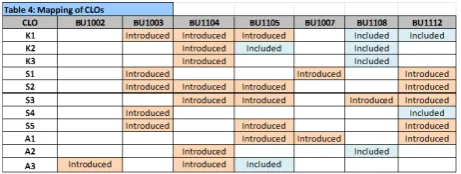
• Course Learning Outcomes and Curriculum Mapping – this engaged the students with the expectations for the course and showed them where they would get opportunities to practice, self-assess and collect evidence for their skill and knowledge development (see figure 1)
• WIL Assessment – a prompt to remind the students how the ePortfolio is a pivotal part of their WIL capstone subject
• A series of pages that outline the knowledge, skills, application and WIL specific skills required as part of the degree. This includes further detail for each of the course learning outcomes, as well as a whole-of-course rubric to indicate the standards expected for each outcome at each level of the degree. These pages allow students to self-assess for each outcome as well as provide evidence of examples of their competence. At each point of self-assessment/evidence collecting students are prompted to reflect on why they have scored themselves in such a way, why they have used a piece of evidence, and what actions they are going to take to utilise their strengths or improve on areas of development.
[image:3.595.183.414.615.702.2]• Action Plan – asking students to consider where they are now (self-assessment), where they want to go (goals for the degree), and planning how they will get there (actions for development).
This ePortfolio was then introduced to business students in their orientation week emphasising the expectations for the whole of course, the use of WIL to develop skills, how students can take ownership of their learning through self-assessment, reflection and action planning, and links to the real world which will aid them in transitioning at the end of the degree. Students are then prompted in subjects throughout the degree (see for example figure 1) to self-assess, reflect, plan and collate evidence to demonstrate their abilities.
The final step in the process is the capstone subject where students are asked to complete assessment in which they are required to showcase their knowledge and ability in relation to the internship/project. This step requires students to carefully reflect and select the most appropriate evidence supplying a narrative about how this demonstrates their ability to succeed. This assessment replicates the real world and so supports the transitions out of university.
Discussion
The reasons for introducing e-portfolios in the Bachelor of Business were numerous and varied. The process will drive students to explore their own competence and achievement, it will lead to a more fulfilling learning experience through providing a mechanism to understand the integration of both WIL and disciplines, and it will also provide a process of selecting and recording samples of one’s own work, reflecting on experiences and assembling them into a e-portfolio which is seen as profoundly important to students whilst at university and in their lifelong learning (Stefano, Mason & Pegler, 2007).
The e-portfolio will act as a vehicle for promoting integration across subjects both horizontally and vertically, as well as a record of the students’ capability for employment opportunities (Lawson, Freeman & Thompson, 2012; Stefani, Mason & Pegler, 2007). Student support for developing e portfolios will be introduced in the foundation subject when students complete a weekly reflective posting. One challenge will be engaging students to continue through the core subjects and majors (Tosh, D., Light, P., Flemming K., & Haywood J., 2005). Students will be prompted to develop their portfolio throughout, but the only assessable element is in the final year of study. This evidence will form an e- portfolio where students self-assess their progress in order to submit their best examples of competence, understanding and critical reflections. The completed e-portfolio (referred to as a Capstone portfolio) will then form part of the “real life” activity assessment within the Capstone subjects.
The Capstone portfolio will also identify an important connection with extra-curricular activities. Throughout the degree students will be encouraged, and supported where possible, to gain relevant practical experience to better prepare for a career in business. Students will be able to further develop their knowledge and skills that complement activities directly related to the curriculum, from which experiences can be recorded in the Capstone portfolio.
References
Andrade, H. & Du, Y. (2007). Student responses to criteria-referenced self-Assessment. Assessment and Evaluation in Higher Education, 32 (2), 159-181.
doi:10.1080/02602930600801928Boud, D. (1995) Enhancing Learning through Self Assessment. London, Routledge. Boud, D. & Falchikov, N. (2007). Developing assessment for informing judgement. In Boud, D. & Falchikov, N. (Eds.) (2007). Rethinking Assessment for Higher Education: Learning for the Longer Term (pp 181-197). London: Routledge.
Kift, S. (2009). Articulating a transition pedagogy to scaffold and to enhance the first year student learning experience in Australian higher education. [Australian Learning and Teaching Council ALTC Final report]. Brisbane: Queensland University of Technology. Available online at: www.altc.edu.au.
Lawson, R., Freeman, M., & Thompson, D.G. (2012, July). Are we there yet? Supporting TEACHERS and Students in Understanding Expectations and Standards of Graduate Attributes in Degree Programs. Paper presented at the 4th EDULEARN, Barcelona, Spain.
McNamara, J., Brown, C., Field, R., Kift, S., Butler, D., & Treloar, C. (2011, June). Capstones: transitions and professional identity. In 2011 WACE World Conference – Conference Proceedings, Philadelphia.
Patrick, C-j., Peach, D., Pocknee, C., Webb, F., Fletcher, M. & Pretto, G. (2008, December).
The WIL [Work Integrated Learning] report: A national scoping study. [Australian Learning and Teaching Council ALTC Final report]. Brisbane: Queensland University of Technology. Available online at: www.altc.edu.au and www.acen.edu.au.
Ramsden, P. (1992). Learning to teach in higher education. London: Routledge.
Stefani,L., Mason,R., Pegler,C (2007) The Educational Potential of e-Portfolios. London: Routledge.
Tosh, D., Light, P., Flemming K.,Haywood J., (2005) Engagement with Electronic Portfolios: Challenges from the Student Perspective. Canadian Journal of Learning and
Technology Volume 31(3). Retrieved from
http://cjlt.csj.ualberta.ca/index.php/cjlt/article/view/97/91
Van Aker, L.,& Bailey, J. (2011). Embedding Graduate Skills in Capstone Courses. Asian Social Science 7(4),69. doi: 10.5539/ass.v7n4p69
Yancey, K. B. (2009). Electronic portfolios a decade into the twenty-first century: What we know, what we need to know. Peer Review: Emerging trends and key debates in undergraduate education, 11(1), 28-32.
Issues for the audience:
Engaging students throughout the whole degree program – how do we keep motivation for the ePortfolio high when the only assessment piece in in the final year? Should the process link to assessment throughout the whole degree? How do we ensure student and staff buy-in?