Reduction Types and Intensionality in the
Lambda-Calculus
by
David Amson Wright, BSc(Hons) MSc (Rhodes)
Submitted in fulfilment of the requirements for the Degree of
Doctor of Philosophy
UNIVERSITY OF TASMANIA
Declaration
This thesis contains no material which has been accepted for the award of any other higher degree or graduate diploma in any tertiary institution. To the best of my knowledge and belief, this thesis contains no material previously published or written by another person, except where due reference has been made in the text of the thesis.
David A. Wright
To Merridy
Abstract
In this thesis I introduce a new approach to the automated analysis of the reduction behaviour of A-calculus terms. This new approach improves on earlier analysers in several ways, not least in its treatment of higher-order terms and polymorphism, two notably troublesome issues.
In addition, this thesis introduces a stronger notion of reduction behaviour than strictness. This concept, called strong head neededness, forms the basis for a new notation for describing the reduction behaviour of terms. This notation is a kind of type, elements of which are built using a Boolean algebra of function type constructors. Thus the form of the methodology proposed is that of a type system.
Consideration is given to a variety of type assignment systems for the new type system. This supports the hypothesis that the approach proposed is suit-able as a framework for building a range of analyses. Having established this framework it is then a matter of engineering to determine the appropriate trade off between information derived and performance achieved.
An investigation is conducted into the formal semantics of all the constructs introduced. In particular, the investigation proves a range of soundness and completeness results. Also examined is the semantics of the new notion of type and the development of a model for reduction types. The model is of interest in its own right, as it gives further insight into the reduction behaviour of A-terms. The thesis includes detailed implementations of all the type assignment systems and ascertains the correctness of these implementations.
Acknowledgements
I would like to thank my supervisor, Clem Baker-Finch, for listening patiently to many partially developed ideas, reading many drafts and lots of discussion about this work. Thank you Clem for all your encouragement.
I thank Geoffrey Burn for always being prepared to give of his especially valuable time. Geoffrey has read many drafts of my work and we have had many discussions about the ideas as described in this thesis. In lots of ways Geoffrey was like a supervisor, even though we were separated by many thousands of miles.
Phil Collier has been a source of much wisdom, especially during some of the darker days. Thank you Phil for stepping in as supervisor when Clem left to take up his new post.
Andrew Partridge has been, and is, an excellent colleague. Andrew, I have enjoyed discussing with you, and learnt much about, dynamic and static tech-niques for detecting parallelism.
Tony Dekker and I had many useful and enlightening conversations about all manner of things to do with functional programming, types and theory in the earlier days of this project. Also much involved at this time was Ed Kazmierczak whose enthusiasm for the "great works" was an inspiration.
I would like to thank Arthur Sale for providing time to allow me to finish and for good advice.
Thanks to Bernard Gunther for opposing functional programming—for a while!
Contents
Abstract
Acknowledgements 1 Introduction
iv
1
1.1 Functional Languages and Static Analysis
1
1.2 A-Calculus
3
1.2.1 A-terms
3
1.2.2 The Theory A
5
1.2.3 Head Reduction
6
1.2.4 Labelled Reduction and Descendants
6
1.2.5 Some Common Combinators
7
1.3 Curry Types and Type Deduction
8
1.3.1 The Curry Type System
8
1.4 A Guide to Reading this Thesis
9
1.4.1 Plan of this Thesis
10
2
Strong Head Neededness and Irrelevance 132.1 Strong Head Neededness
14
2.2 Variations
15
2.3 Irrelevance
16
2.4 Properties
17
2.5 Discussion
20
3 Reduction Types and Type Assignment 22
3.1 Introduction to Reduction Types
22
3.1.1 Boolean Algebras
25
3.2 Curry-style Type Assignment
26
3.2.1 Preliminaries
26
3.2.2 The Type Assignment Rules
28
3.2.3 Examples
30
3.2.4 An Extension of the Curry-style System
35
3.2.5 Multiple Occurrences of Term Variables
37
3.3
3.4
3.2.6 Properties of the Curry-style System 3.2.7 Syntactic Variations
3.2.8 Discussion
LET-Polymorphic Type Assignment 3.3.1 Generic Types
3.3.2 The Type Assignment Rules 3.3.3 Examples
3.3.4 Properties of the LET-Polymorphic System 3.3.5 Discussion
Intersection-style Type Assignment
39 47 48 49 49 50 53 53 61 61 3.4.1 Intersection Boolean Reduction Types 63 3.4.2 The Type Assignment Rules 65 3.4.3 Extending Intersection-style Inference 67
3.4.4 Examples 69
3.4.5 Properties of the Intersection-style System 70
3.4.6 Discussion 79
4 The Semantics of Reduction Types 80
4.1 Models of Terms 81
4.1.1 A Model of the A-calculus 81 4.1.2 A Semi-Model of the A-calculus 83 4.2 Models of Boolean Reduction Types 88 4.2.1 What is a Type Interpretation? 89 4.2.2 The Semantics of Simple Reduction Types 90 4.2.3 The Semantics of LET-Polymorphic Reduction Types 92 4.2.4 The Semantics of Intersection Reduction Types 92 4.3 The Intensional Applicative Behaviour of A-terms 93
4.4 Type Assignment is Sound 97
4.4.1 Soundness of 1-c 97
4.4.2 Soundness of EL 98
4.4.3 Soundness of 1-/ 98
4.5 Type Assignment is Complete 98
4.5.1 Completeness of I-c 99
4.5.2 Completeness of EL. 100
4.5.3 Completeness of 1-1 101
4.6 Discussion 102
5 Implementation 104
5.1 Preliminaries 105
5.1.1 Substitutions 105
5.1.2 Triples 106
5.1.3 Unification of Boolean Rings 106
5.2
5.3
5.4
Implementation of the Curry-style System
5.2.1 Preliminaries
5.2.2 Unification of Types
5.2.3 Type Inference
5.2.4 Decidability
Implementation of the LET-Polymorphic System
5.3.1 Substitution
5.3.2 Unification of Types
5.3.3 Type Inference
5.3.4 Decidability
Implementation of the Intersection-style System
108
121
109
109
112
115
115
115
116
117
121
5.4.1 Substitution
121
5.4.2 Normal Forms
122
5.4.3 Expansion of a Deduction
122
5.4.4 Principal Triples
129
5.4.5 Unification of Intersection Types
130
5.4.6 The Type Inference Algorithm
133
5.4.7 Decidability
136
6 Extensions and Future Work 137
6.1 Constants
137
6.1.1 Term Constants
138
6.1.2 Type Constants
138
6.1.3 Type Assignment
138
6.1.4 An Example: The Conditional
139
6.2 Adding a Fixpoint Constant
140
6.3 Data Structures
143
6.3.1 A Detailed Example
145
6.4 Second-Order Polymorphism
147
6.5 Algebraic Reduction Types
149
6.5.1 Constants
152
6.5.2 Fixpoints and Algebraic Reduction Types 153
6.5.3 Data Structures
153
6.5.4 Implementation
155
6.6 Non-termination
156
6.7 A Two Step Strong Head Neededness Algorithm
158
7 Conclusion 160
7.1 Related Work
161
7.1.1 Analyses based on Types
161
7.1.2 Abstract Interpretations not based on Types 163
7.1.3 Other Techniques
165
7.2 Summary 166
7.2.1 Strong Head Neededness 166
7.2.2 Boolean Reduction Types and Type Deduction 166 7.2.3 Intensional Semantics for Reduction Types 167 7.2.4 Implementation of Reduction Type Inference 168
7.2.5 Extensions 168
A An Implementation in Orwell 170
A.1 Orwell 170
A.2 Preliminaries 171
A.2.1 Auxiliary functions 171
A.2.2 Parsing 173
A.2.3 Printing 177
A.2.4 Association Lists 179
A.3 An Implementation of Boolean Algebra 181
A.3.1 Parsing and Printing 182
A.3.2 Sum-of-Products Normal Form 183 A.3.3 Unification of Boolean Rings 184
A.4 Lambda Terms 186
A.4.1 Parsing A-terms 186
A.4.2 Printing A-terms 187
A.5 Intersection Reduction Types 187
A.5.1 Parsing Reduction Types 188
A.5.2 Simplification of Reduction Types 189 A.5.3 Printing Reduction Types 190
A.5.4 Substitution for types 191
A.5.5 State-based functions 191
A.5.6 Expansion 193
A.6 Unification 195
A.6.1 Guaranteeing Termination 196
A.7 Constants 197
A.8 Type Inference 198
A.9 The Top-level of the Type Inference System 199
A.10 Examples 200
List of Figures
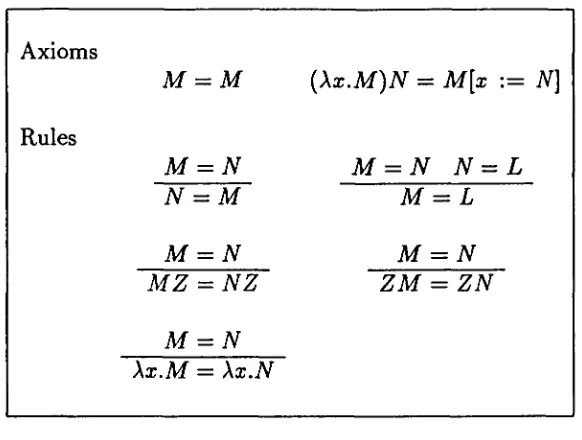
1 The Theory A
5
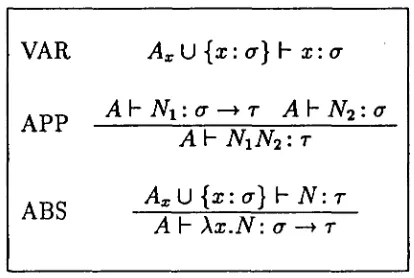
2 Curry's system for Type Deduction
9
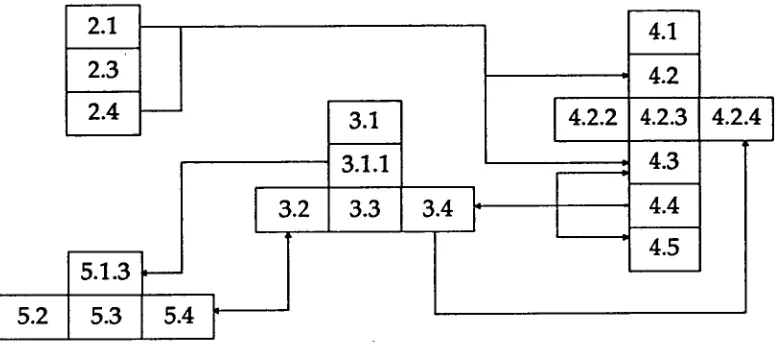
3 A Diagram of the Structure of the Thesis
11
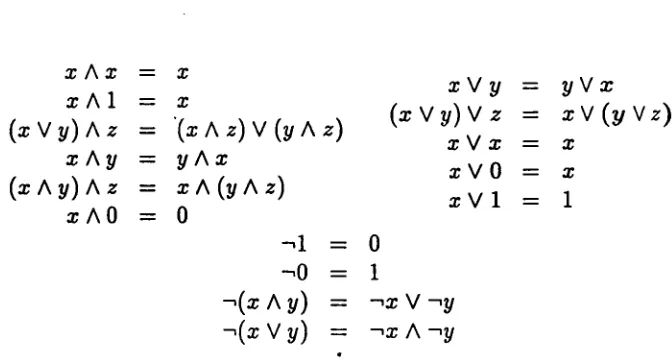
4 The Axioms of a Boolean Algebra
25
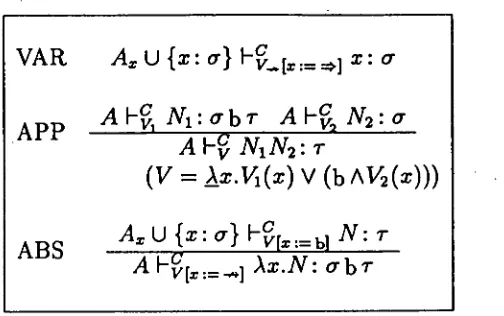
5 The Curry-style Rules for deducing Reduction Types 29
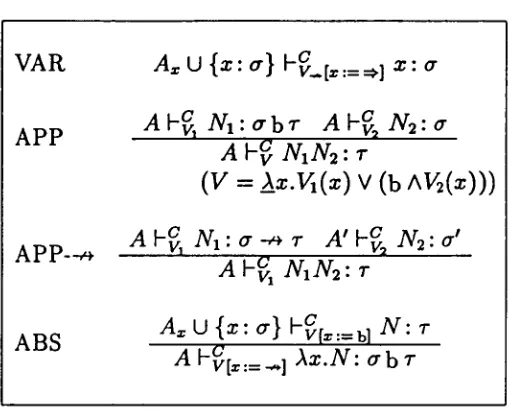
6 Extended Curry-style Rules for deducing Reduction Types . 35
7 The Alternative Curry-style Rules for deducing Reduction Types 47
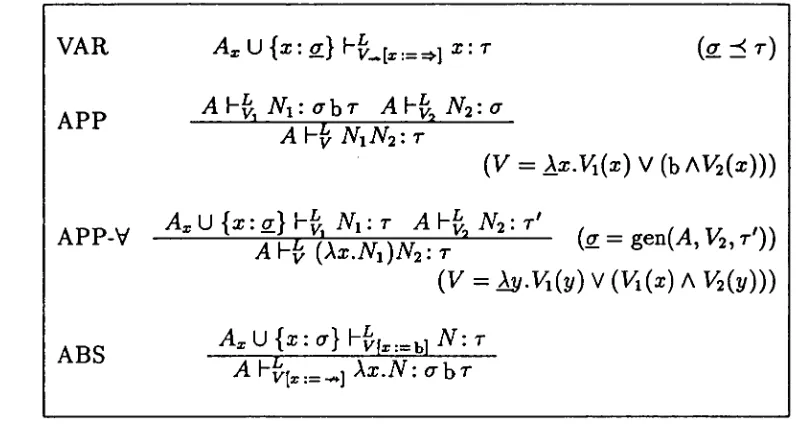
8 The LET-Polymorphic Rules for deducing Reduction Types . . 51
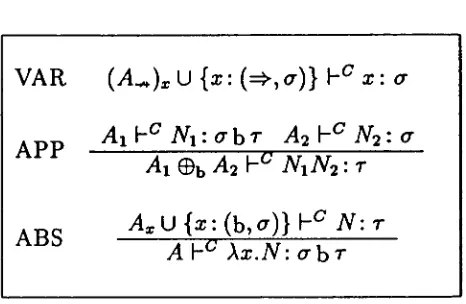
9 The Intersection-style Rules for deducing Reduction Types . . . 66
10 The Extended Intersection-style Rules for deducing Reduction
Types
68
11 The Semantics of Simple Boolean Reduction Types 90
12 The Semantics of LET-Polymorphic Reduction Types 92
13 The Semantics of Intersection Boolean Reduction Types 93
14 The Algorithm for unifying Boolean Arrow Expressions 108
15 The Algorithm for unifying Simple Boolean Reduction Types . 110
16 The Algorithm for solving a set of Equations
110
17 The Type Inference Algorithm for Simple Boolean Reduction
Types
112
18 The Type Inference Algorithm for LET-polymorphic Reduction
Types
118
19 The Algorithm for unifying Intersection Reduction Types . . . 132
20 The Type Inference Algorithm for Intersection Reduction Types 134
21 The Delta Rules for Some Term Constants
138
22 The Delta Rules for Data Structures
143
23 The Second-Order System for deducing Reduction Types . . . 148
24 The Rules for deducing Intersection Algebraic Reduction Types 151
25 The Rules for Non-termination
157
Chapter 1
Introduction
1.1 Functional Languages and Static Analysis
Functional languages are closely related to the A-calculusl—for the most part they may be considered as "syntactically sugared" versions of this calculus. Functional languages may be divided into two classes: strict and non-strict. Strict languages typically employ a call-by-value left-to-right evaluation strat-egy for arguments to functions. Non-strict languages employ a graphical form of call-by-name evaluation strategy, in which once the value of an argument is calculated this value replaces the expression representing the argument. This ensures that an argument is reduced at most once in the evaluation of the func-tion call. (This latter strategy is often known as a "lazy" evaluafunc-tion strategy). Each of these methods of evaluation has an associated cost. The most serious cost is in the case of strict languages: certain expressions which may reasonably be expected to have a defined value fail to have such a value in this evaluation scheme. This is because under the call-by-value scheme an argument to a function is evaluated whether or not it is required by the function. This forces the programmer to bear the additional burden of having always to ensure explicitly the finiteness of any argument passed to a function.'In the case of a non-strict language the cost incurred is in the implemen-tation of the language. Each time the value of an argument is requested in such a language it is necessary to first test whether or not the argument has been evaluated. If it has not been evaluated, then its value must be computed, otherwise its value can be immediately looked up. Thus, if a value is definitely required then the call-by-value strategy is more "lazy" than the lazy strategy in the sense that less work is required to implement it.
However, it is possible to have the best of both schemes if the program is
'The A-calculus is described in a later section of this chapter.
1.1 FUNCTIONAL LANGUAGES AND STATIC ANALYSIS 2
analysed so as to determine exactly which arguments are required and which are not required. With this information a compiler can
transform
the program to use amixed
evaluation strategy: it can use the call-by-name strategy for arguments which are not required and the call-by-value strategy for those that are required.Unfortunately, things are not quite so simple. The problem of determining which arguments are required in an arbitrary program is reducible to the halting problem. Hence, this task is undecidable in general. The phrase "in general" does offer some hope: can an analysis technique be found which determines a high proportion of the arguments which are definitely required or are definitely not required? Moreover, can such a technique be found which is reasonably economical with time?
In this thesis,
I
examine the first question afresh. Although good answers to this question have been found, 3 no satisfactory answer to the combination of these questions has been found. My goal has been to introduce and explore a new method for performing such an analysis. This new method returns very precise information about higher-order terms. The major departure from other analysis techniques is the use of a form of type to express intensional proper-ties of functions. Traditionally, types have been used to express extensional information about functions: what their inputs are and what their outputs are. My addition to this concept involves types containing extra information about the functions with which they are associated. This additional information is whether or not an argument to a function is actually usedin an essential
way to produce the output of the function.A further use for an analysis technique such as is described in this thesis is that of allowing the
parallel evaluation
of a program written in a non-strict language. The restriction to only evaluating an argument when it is determined that it is required during the evaluation of the function call enforces a sequential evaluation strategy. If it is known that the argument is required before the function call is actually made, then the evaluation of the argument may be rescheduled by the compiler to occur at an earlier time.There
is
an alternative method for conducting the parallel evaluation of a program written in a non-strict language, but discussion of this method is delayed until Chapter 2.In this chapter some preliminary subjects are reviewed which are required in order to understand the rest of the thesis. At the end of the chapter is a guide to reading the thesis.
1.2 A-CALCULUS 3
1.2 A-Calculus
This section serves to remind the reader of some well known concepts associated with the A-calculus. It is recommended that the reader at least briefly peruse this section.
1.2.1
A-terms
Definition 1.2.1 (A-terms)
Let
X
= { ...} be a set of term variables, then the set A of A-terms is inductively defined to be the smallest set containing X which is closed under function application and abstraction, namely• if M E A and N E A then MN E A and
• if x E
X
and N E A then Ax.N E A.Following the usual conventions, application associates to the left, and the scope of an abstraction is as far to the right as possible. Parentheses will often be omitted where these conventions make clear the intended meaning. Also, a term of the form (Axi .Ax2 . • • • Axn .N) will often be written as (\x1 x2 • • xn .N). Definition 1.2.2
In a A-term
(Ax.N)
the object Ax is the binder of the term, and x in Ax is the binding occurrence of x. A variable x occurs bound in a term M if M has a subterm (Ax.N) and x occurs in N, in which case the term N is the scope of this binding occurrence of x. A variable x occurs free in M if it is a subterm of M, and occurs outside the scope of any binding occurrence of x. The set of all free variables of a term M is denoted by FV(M). The set of all bound variables of a term M is denoted by BV(M).Barendregt [3] describes the following useful variation on the set of A-terms: Definition 1.2.3
1. The set of contexts is defined as the least set satisfying:
• x E X implies x is a context, • is a context, and
• if C10
and
C20 are contexts, then so are C 1 []C2 [] and Ax.Ci • 2. If C0 is a context and M E A, then C[M] E A is that term which resultsby replacing each occurrence of in CO by M.
1.2 A-CALCULUS 4
By convention terms which are identical modulo change of bound variables are identified. Essentially, it is now the de Bruijn representation (see Baren-dregt [3], Appendix C) of terms which will be used in the rest of this work, though the above more readable notation for terms will be adhered to in the naive way. The symbol will be used to denote syntactic identity, modulo this convention. If
M C[N],
then writeN C M
and sayN
is asubterm
ofM.
Similarly definedN
is aproper subterm
ofM
(notationN
CM),
ifN
CM,
butN 0 M.
Substitution on .X-terms can now be defined in a straightforward manner:
1. x[x :=
N] N,
2. y[x :=
N] y (y x),
3. (MN)[x := N] (M[x := N])(N[x := N]),
and 4. (Ay.N)[x :=N] Ay.N[x := N].
Note that in the last case above no "confusion of bound variables" can occur by the convention concerning bound variables described above.
Definition 1.2.4
The rules of
A-reduction
are:(13) (Ax .N)M pAr[x := M]
and (77) ifx
FV(N), then()ix.Nx)—>
n
N.
If a A-term
M
has the form of any of the left-hand sides of these rules, thenM
is a (/3 orn)-redex.
If a term contains no /3-redexes then it is in/3-normal form
(and similarly for 77- and /371-normal forms). Let the reflexive, transitive closure of —)r3 be denoted by (and similarly for and the reflexive, transitive and symmetric closure of ->0 be denoted by =0 (similarly =n), this relation being called(3-conversion.
From now on only /3-reduction will be considered unless explicitly indicated otherwise, and so "reduction" will mean 13-reduction, "redex" will mean P-redex and "normal form" will mean fl-normal form.
The following is standard, see Chapter 3 of Barendregt [3]. A
notion of
reduction, R,
is a binary relation on A.Definition 1.2.5
Let
R
be a notion of reduction.Axioms
Rules
M = M (Ax.M)N = M[x := N]
M=N
N=M
M=N
MZ = NZ
M=N
Ax.M = Ax.N
M=N N=L
M=L
M=N
ZM = ZN
[image:15.558.151.442.117.337.2]1.2 A-CALCULUS 5
Figure 1: The Theory A
2.
R
is Church-Rosser if its compatible'', reflexive and transitive closure satisfies the diamond property.Theorem 1.2.6
/3 is Church-Rosser.
Proof
This is shown several times in Barendregt [3]. See any of Theorem 3.2.8, The-orem 11.1.10, Corollary 11.2.29 or Corollary 14.2.4 (the simplest). 0
1.2.2 The Theory
A
The theory A is axiomatised in Figure 1. Write A 1-
M=NifM= N
is a consequent of this deduction system. The following well-known result expresses the relationship between the theory A and the notion of /3-conversion:Proposition 1.2.7 (Barendregt [3], Proposition 3.2.1)
AFM=Niff
M=0N.
This Proposition is essential in relating the results of Chapter 2 to those of Chapter 4.
1.2 A-CALCULUS 6
1.2.3 Head Reduction
The concept of
head normal form
plays a central role in the A-calculus, in particular, a term has a head normal form if it issolvable,
see Barendregt [3] pp41-42 for discussion. Associated with the notion of head normal form is a particular reduction strategy known ashead reduction.
In Chapter 2, head reduction is used to define a property calledstrong head need edness.
This property is chosen as a test bed for the idea of using types asthe
notation for performing analyses of terms proposed by this thesis.Definition 1.2.8
A subterm
N
of a termM
is at thehead
ofM
if• M N,
or• M Ax.N'
andN
is at the head ofN',
or• M 24: N1 N2
andN
is at the head of N1.Suppose
M
is not in normal form. Theleftmost
redex ofM
is the redex whose binder is to the left of the binder of every other redex inM.
The leftmost redex,R,
ofM
is ahead
redex ofM
ifR
is at the head ofM. M
is inhead
normal form
if it has no head redex. Thehead reduction path
of
a termM
is a sequence of reduction steps in which every redex which is reduced is a head- redex. SupposeM
has a head redex, then writeM ,
ifM'
results fromM
by contraction of the head redex ofM.
Let be the transitive, reflexive closure of the least relation generated byThe opposite of head reduction is
internal
reduction, i.e.,M—NN
if no head redex is contracted in this reduction path fromM
toN.
1.2.4 Labelled Reduction and Descendants
The following is taken from Klop [40], see also Barendregt [3].Definition 1.2.9
Let
A
be a set of symbols, calledlabels.
The labelled A-terms, AA, are induc-tively defined by• xa E AA, for all
x
EX
and a E1.2 .X-CALCULUS
'7
A
E AA may also be written as MI whereM
E A is obtained from A by erasingall the labels and
I
is a map from the set of occurrences of subterms ofM
to labels such thatI(M) is A.
The map / is called alabeling
ofM.
A notion of reduction can be formulated for the labelled terms. Firstly, labelled substitution is defined by
• xa[x
:=B] B,
• ya[x :=
Ey, y x,
• (AA')a[x := B] ((A[x := B])(Alx :=
Bll)a,
and• (Ay.A)a[x :=
B]
E(Ay.A[x :=
B]r.
(By the variable convention it is not necessary to specifyx y).
Now the reduction relation can be generated from the schema
: (()x.A)aB)b
A[x := 13].
Suppose
M—N,
then thedescendants
of some subtermM'
ofM
can be found inN
(if any exist), by markingM'
and following it through the reduction fromM
toN.
More formally:Definition 1.2.10
Suppose
M—>oAr
by contraction of a redexR.
LetI
be a labeling ofM.
ThenR
andI
uniquely determine a corresponding labelled reduction,M/
-40, N
J
,
for some labelingJ
ofN.
A labeling is
initial
if the labels it assigns to distinct subterm occurrences of a term are distinct. Let / be an initial labeling (assume A is sufficiently large). LetP
be a subterm occurrence ofM
andQ
be a subterm occurrence ofN,
thenQ
is adescendent
ofP
ifJ(Q)
=I(P).
This concept generalises to—4+ in the obvious fashion.
Any descendent of a redex,
R,
is itself a redex, and is called aresidual.
This is so since ifR
is contracted inM—,pN,
then clearlyR
has no descendants inN.
A redexR
of a termM is erased
in a particular reduction path ofM
to a termN
if no residual ofR
is contracted on this reduction path and there is no residual ofR
inN.
1.2.5 Some Common Combinators
1.3 CURRY TYPES AND TYPE DEDUCTION 8
Three well known combinators are S, K and I. These have the following definitions:
• S Afgx.fx(gx); • K Axy.x; and
• I Ax.x.
The simplest example of a function incorporating a self application is to -=- Ax.xx. From this term is constructed the simplest unsolvable term: f/
An example of an unsolvable term which becomes progressively longer with each reduction step taken is 9 3 a' (Ax.xxx)Ax.xxx.
The two best known fixpoint combinators are Y A f .(Ax. f(xx))Ax f (xx) (due to Curry) and e (Ax (xxf))Axf.f(xxf) (due to Turing).
1.3 Curry Types and Type Deduction
In this section a brief introduction to type deduction systems is given. The type deduction system studied here, the Curry type system, is the simplest system for assigning types to (a fragment of) the A-calculus. A much more complete discussion of this and other type systems is given in Hindley and Seldin [30].
The basic philosophy of Curry's type system is to avoid building the notion of type into the terms themselves. This approach preserves the operator ori-ented flavour of the A-calculus, as opposed to a set-oriori-ented view of functions as particular sets of pairs. Thus it is quite possible for an operator such as Ax.x to have many types, rather than requiring an identity for each type. (For more polemic on this point see Barendregt [3] and Hindley and Seldin [30]).
The main goal of this thesis is to extend Curry's style of describing the extensional behaviour of A-terms to include a description of their reduction behaviour. Thus the question asked is not just "what terms may be accepted as input?", but instead the question is "what terms may be accepted as input and how are they used to compute the result?".
Curry's approach is to specify a type deduction system in which types may be assigned to terms according to a logic specified in a natural deduction style (Gentzen [63]). Below is given a description of Curry's system.
1.3.1 The Curry Type System
Let r.„ be a sufficiently large set of type variables. (The initial lowercase Greek letters a, fl, ... are used to range over type variables). The set of Curry types T, ranged over by a and T, is inductively defined to be the least set satisfying:
VAR
A
x
U {x : cr} : APP A I- : a TA F-
N2 : aA F N1 /V2 : T
A
z
U
{x: o- } N : TABS Al- Ax.N : r
[image:19.559.195.402.116.255.2]1.4 A
GUIDE TO READING THIS THESIS9
Figure 2: Curry's system for Type Deduction
• a, T E T implies a r E T.
Clearly, in order to assign types to A-terms, types must be assumed for free variables of the term. A type assumption for Curry's deduction system is a term of the form x: a, where x is a term variable and a is a Curry type.5
Statements of Curry's logic6 are written as A I- M: r,
where A is a set of type assumptions in which no term variable occurs more than once, M is a term and 7 is a Curry type. Such a statement may be
read as "M has type r in context A". An assumption set containing no type assumption of the form x: a, for any type a, is denoted by A.
Curry's type deduction system is specified by one axiom and two rules, as detailed in Figure 2. Note the correspondence between the structure of A-terms and the structure of the proofs resulting from the use of this type deduction system. Hindley and Seldin [30] develop this theme further, see Sections 14C, 14D, 15C and 15D of that work.
1.4 A Guide to Reading this Thesis
Since this is a fairly long document with many technical results, some advice is appropriate on how to read the report. To start with, all of the current chapter should be read. In Chapter 2 it would be best to read all sections through to the end of Section 2.3, with Section 2.4 being left for later. This will introduce the reader to strong head neededness, but leave the examination
'Curry originally wrote assumptions as oz (see [18]), though the notation chosen here has become widely used in recent times.
1.4 A
GUIDE TO READING THIS THESIS 10of the properties of strong head neededness until later. Section 2.5 contains the concluding remarks for this chapter.
In Chapter 3, Section 3.1 introduces and motivates Boolean Reduction Types and so this should be read on a first pass of the report. Then Sec-tion 3.2 studies the case of a Curry-style type deducSec-tion system for Boolean Reduction Types. Within this section, Section 3.2.6 could be omitted on an initial reading. Sections 3.3 and 3.4, which give two more case studies of type deduction for Boolean Reduction Types, may be left for a later reading.
Within Chapter 4, on the semantics of the various constructs introduced in this thesis, all sections after Section 4.2.2 may be omitted on first read-ing. These latter sections present the semantics of forms of Boolean Reduction Types which are introduced in the case studies of Sections 3.3 and 3.4; establish a connection between strong head neededness and Boolean Reduction Types and prove the correctness of all the type deduction systems.
Following the theme of concentrating only on the Curry-style system, in Chapter 5 read Sections 5.1 and 5.2.
At this stage the reader will have seen most of the major innovations of this thesis and have witnessed a complete development of the analysis methodology for one particular type system. The only major omission in the reading was a study of the semantic correctness proofs for the simplest system of logic and the semantic connection between strong head neededness, Boolean Reduction Types and the applicative behaviour of terms (Section 4.3). The reader could now go back to Section 2.4 and commence from there a more detailed reading of Chapters 2 through 5. Alternatively, the reader could press on and read Chapter 6. This chapter contains several extensions to the work already pre-sented, though some of these extensions use or discuss material from parts of the report which the reader will have omitted on this first reading.
1.4.1 Plan of this Thesis
The thesis is divided into chapters which deal with the following topics:
• strong head neededness,
• Reduction Types and type deduction systems,
• semantics,
• implementation, and
• extensions.
1.4 A GUIDE TO READING THIS THESIS 11
2.1 4.1
2.3 4.2
2.4 3.1 4.2.2 4.2.3 4.2.4
3.1.1 4.3
3.2 3.3 3.4 4.4
4.5 5.1.3
[image:21.557.99.488.109.282.2]5.2 5.3 5.4
Figure 3: A Diagram of the Structure of the Thesis
the report. A box which is placed directly on top of a second box is meant to be read before the second box. Boxes placed side by side are relatively in-dependent of each other, though for didactic purposes there is a left-to-right preference. Lines joining boxes indicate that these sections are linked by im-portant theorems. In reading the paragraphs below it may prove useful to refer to this Figure.
In Section 2.1 the concept of
strong head neededness
is introduced and motivated. This leads onto Section 2.3 in which a notion which is the opposite of strong head neededness is introduced, namelyirrelevance.'
Then Section 2.4 examines these properties in further detail.In Section 3.1 the concept of Boolean Reduction Types is introduced and mo-tivated. Section 3.1.1 contains an overview of Boolean algebras—these are used in the definition of Boolean Reduction Types. Then Sections 3.2 through 3.4 each describe a case study (in some detail) of the use of Boolean Reduction Types in a type deduction system.
Up until this point no formal connection between strong head neededness and Boolean Reduction Types has been established. This is achieved in Chap-ter 4. Section 4.1 commences this chapChap-ter by introducing models of )-Chap-terms. This is followed by Section 4.2 in which models of Boolean Reduction Types are constructed. In this section is first constructed a formal link between the strong head neededness and irrelevance of Chapter 2 and models of terms. Then, in the three concurrent sections 4.2.2 through 4.2.4, semantics are given to the three forms of Boolean Reduction Type introduced in Sections 3.2 through 3.4. Section 4.3 relates the semantics given to Boolean Reduction Types to the con-cept of strong head neededness, making use of the connection between strong head neededness and models of terms already shown, as well as results from
1.4 A GUIDE TO READING THIS THESIS 12
Section 2.4. Sections 4.4 and 4.5 prove that the type deduction systems de-scribed in Sections 3.2 through 3.4 are semantically correct.
With the logics of type deduction for Boolean Reduction Types shown to be correct Chapter 5 proceeds to provide algorithms so as to allow the auto-matic inference of Boolean Reduction Types for terms. Section 5.1.3 describes an algorithm for solving equations in a Boolean algebra. This is followed, in Sections 5.2 through 5.4, by implementations corresponding to each of the type deduction systems of Sections 3.2 through 3.4. Within each of Sections 5.2, 5.3 and 5.4 the algorithms described are proved to be correct with respect to the appropriate type deduction system. Thus the semantic correctness of these algorithms is shown, since it is already known that the type deduction systems are semantically correct.
Chapter 6 (not shown in the Figure) contains a number of extensions to the work introduced in earlier chapters. In particular, analysis techniques are given for certain constructs which commonly occur in programming languages, such as constants and data structures. In addition, some discussion is given of a natural generalisation of Boolean Reduction Types.
Chapter 2
Strong Head Neededness and
Irrelevance
In this Chapter
strong head neededness
is introduced and examined. Strong head neededness is a slight variation on a property commonly explored in other works calledstrictness
(defined below). Strong head neededness is similar to the notion ofhead neededness
proposed by Barendregt et al [5].An important reason for considering strong head neededness rather than head neededness or strictness is the parallel reduction strategy known as
spec-ulative evaluation,
see Partridge [53]. This strategy is based on the idea of evaluating arguments to terms even when it is not known whether they are required. Non-strict semantics are preserved by terminating the evaluation of an argument as soon as it becomes known that the argument is not required.As shown by Proposition 2.1.4 below, an implementation which performs parallel evaluation based on the notion of head neededness or strictness may needlessly evaluate certain sub-expressions of a non-terminating expression. This is because
all
redexes of a non-terminating expression are considered to be head needed and so in a parallel machine all of the redexes will be evalu-ated. Of course, it is trivial to see that it is semantically safe to perform this extra evaluation, at least for sequential implementations. However, in paral-lel implementations employing speculative evaluation, the designation of these sub-expressions as required for the computation might cause premature over-loading of the machine. Strong head neededness on the other hand, determines exactly which redexes are required—even in a non-terminating term. Hence, this work introduces and examines this sharper notion of neededness.As an example of this phenomenon, consider the term Ax.S2.
2.1 STRONG HEAD NEEDEDNESS 14
required. If this term is applied to an argument,
M,
(suppose computingM
requires a large amount of memory), then head neededness will indicate that the evaluation ofM
should commence at the highest priority. Furthermore, if the expression (Ax.f/)M
occurs in aspeculative
context, then initiating the computation ofM is particularly undesirable. In the case of strong head
need-edness, the evaluation ofM
will proceed at a lower (speculative) priority.'This chapter starts by introducing strong head neededness and comparing it with head neededness (strictness). Then some different ways of expressing the concept are introduced—chiefly to allow the concept to be assigned to non-redex terms. Strong head neededness has a natural dual, namely
irrelevance,
and this is also introduced in this chapter. After this, a section is given which establishes many properties concerning strong head neededness. In particular its relation is explored with reduction and conversion.2.1 Strong Head Neededness
Firstly, the new property:
Definition 2.1.1 (Strong Head Neededness)
Suppose
R
is a redex of M, thenR is strongly head needed
inM if the head
reduction path of M reduces a residual ofR.
In contrast:
Definition 2.1.2 (Barendregt et al [5])
Suppose
R is a redex of M,
then R is head needed inM if every reduction path
of M to head normal form reduces a residual ofR.
Terms which cannot be reduced to head normal form are identified with the symbol I. A function
f is strict
on its argument if f± ...L. The process of determining whether a function is strict is referred to asstrictness
analy-sis.
Similarly the process of determining whether a redex is head needed is referred to ashead neededness analysis.
By Proposition 5.1 of Barendregt et al [5] (due to H. Mulder), strictness analysis is equivalent to head neededness analysis, since a function is strict on its argument if the function head needs its argument.Note that the notion of strongly head neededness introduced above is a some-what sharper notion than that of
head neededness,
as introduced by Barendregt et al [5]. SupposeR
E A is a redex, then in the case of a function such as2.2 VARIATIONS 15
never reduced in the head reduction path of (Ax.Si)R. (The difference between these two concepts arises entirely when the term involved does not have a head normal form).
Lemma 2.1.3 (Theorem 3.6 (ii) of Barendregt et al [5])
Let
R
be a redex inM
E A andM
be solvable, thenR
is head needed if a residual ofR
is contracted on the head reduction path ofM.
Now the following is easily shown. Proposition 2.1.4
Let M E A and
R
C M be a redex.1. If
M
is solvable, thenR
is strongly head needed in M ifR
is head needed inM.
2. If
M
is not solvable, then ifR
is any redex inM,
thenR
is a head needed redex inM.
Proof
For part 1 the result follows by the Lemma. Part 2 is trivial. 0
The second part of this proposition demonstrates that every redex of a non-terminating expression is designated as head needed. The same cannot be said for strong head neededness which can distinguish redexes which are required even in a non-terminating expression. This extra information is expected to be important for parallel machines using a speculative evaluation strategy. This is because speculative evaluation is implemented using a priority scheme for choosing which redexes to reduce (Partridge [53]). Thus, marking extra redexes of a non-terminating term as demanded will cause these redexes to be given greater or equal preference to other tasks at the same priority level. Naturally this phenomenon should be minimised, and it is strong head neededness which appears to best fit the requirements.
2.2 Variations
The following variations on Definition 2.1.1 are sometimes useful. The main utility of these is the ability to talk of the strong head neededness of terms which are not redexes.
Definition 2.2.1
2.3 IRRELEVANCE 16
Definition 2.2.2
Let
N
E A. For an arbitraryM C N, M is strongly head needed
inN
if a descendent ofM
occurs at the head of some term on the head reduction path ofN.
These definitions of strong head neededness are related as follows:
Proposition 2.2.3
Let
R
E A be a redex andM
E A.I.
M
is strongly head needed in CPI/1 2 ifR
is strongly head needed in C[R], and2. N1 N2 strongly head needs its argument N2 iff N2 is strongly head needed in NI N2 •
Proof
Note that a residual is just a special kind of descendent, then the results are immediate. 0
2.3 Irrelevance
The opposite of strong head neededness is irrelevance:
Definition 2.3.1
M is irrelevant
inN
ifM
is not strongly head needed inN.
Lemma 2.3.2 (Barendregt [3], Lemma 11.4.6)
If
M
-opN,
then3P.M
,,
hP
-NN.
3
Proposition 2.3.3VM,
N.C[M]
=C[N]
impliesVP.P
is irrelevant inC[P].
Proof
By the Church-Rosser Theorem for /3-reduction, C[M] =
C[N]
implies there existsZ
E A such thatC[M]-0Z44--#C[N].
Since this is true for allM
andN,
all descendents of bothM
andN
must be erased in eachZ.
4
By the Lemma, there existsP
E A such thatC[M]--*hP—oiZ
and again there existsP'
E A such that C[N]—RhP'—"Z. Suppose that a residual ofM
(and hence ofN)
is reduced on the head reduction path fromC[M]
toP (C[N]
toP'),
then setM
fl andN
S/ 3 to arrive at a contradiction. (Since it 0 03 and if eitheroccurs at the head of some term then neither may be erased in any reduction of that term). 0
2Contexts are defined in Chapter 1.
is internal reduction, as defined in Chapter 1.
2.4 PROPERTIES 17
2.4 Properties
In this section the relations between reduction, conversion and strong head neededness are explored. The work of Barendregt et al [5] serves as a suitable structure upon which to base the following investigation. Some additional results are also developed outside this structure, in particular the preservation of the strong head neededness of a subexpression which is not contracted during a fl-conversion (Proposition 2.4.10).
The main results used outside of this present chapter are Proposition 2.4.10, Corollary 2.4.8 and Theorem 2.4.15. The latter theorem establishes the unsur-prising result that determining strong head neededness is in general undecid-able.
Definition 2.4.1
A
reduction path
is a (possibly infinite) sequence of terms, Mo , such that M0—>I3M1—+0 .. Reduction paths will be denoted by the calligraphic letters R.,S.Let 111.—f3N by contraction of a redex R C M and
S : M-00AP,
then the projection ofR
byS
is obtained by contracting all residuals ofR
inN'
after reductionS
has occurred. This can be generalised to the projection of a reduction path R. :M-00N
1
by another path$
:M-0,3N
2
in the obvious manner. In Klop [40] it is shown that as a consequence of the Church-Rosser property for /3 that the projection of a sequence R. by a sequenceS
always ends in exactly the same term as the projection of$
by 7Z.Lemma 2.4.2 (Barendregt et al [5], Proposition 2.6)
Let 7Z :
M—M'
andS : M-00N
be two reduction paths. SupposeR C M
is a redex none of whose residuals are contracted in$
and letR' C M'
be a residual of R after the reduction R., then no residual ofR'
is contracted in the projection of 7Z byS.
Theorem 2.4.3
Let M—)+,01F and let
S
be a redex inM
andS'
be a residual ofS
inM',
thenS
is not strongly head needed inM
impliesS'
is not strongly head needed inM'.
(Equivalently,S'
is strongly head needed inM'
impliesS
is strongly head needed inM).
Proof
S
not strongly head needed implies that no residual ofS
is contracted in the (possibly infinite) head reduction ofM.
Then the result follows by iterated use of Lemma 2.4.2. 0Theorem 2.4.4
2.4 PROPERTIES 18
Proof
The "if" part is immediate from the definition of strong head neededness. For the "only if" part, the result follows from Theorem 2.4.3. 0
The above result can be summarised as:
R
is strongly head needed inM
ifR
is not erased in the head reduction ofM
ifR
has a residual in the head reduction ofM
which is a head redex.Let
S C M'
be a redex andM'
results fromM
by contraction of a redexR,
thenS is created
inM.-40M'
ifS
is not a residual of a redex inM.
Proposition 2.4.5
Suppose
M—>oM'
by contraction of a redexR
inM.
IfQ is
a strongly head needed redex inM'
created by this contraction, thenR
is strongly head needed inM.
Proof
Suppose
R
is not strongly head needed inM.
SinceQ
is strongly head needed inM'
it has some residualQ'
which is contracted in the head reduction ofM'.
Since the head reduction ofM'
is the projection of the reduction ofR
by the head reduction ofM, Q'
is a residual of a redex in the head reduction ofM.
Then by Proposition 2.8 (ii) of Barendregt et al [5]Q
is not created, which is a contradiction. 0Definition 2.4.6
Let SHN(M) = {N E
AIM pM
1
; N
is strongly head needed inM'}.
Lemma 2.4.7
M
—RoN
implies SHN(M) D SHN(N). ProofThe case
M
already in head normal form is trivial. SupposeM
not in head normal form.Consider the case
M-40N
by contraction of the head redex ofM.
Then the result is immediate by definition of SHN(M).Consider the case
M--+pN
by contraction of a non-head redex ofM.
Then the result follows by Proposition 2.4.5.The result now follows by induction on the reduction path
M-N.
0Corollary 2.4.8
Let
M-noN,
then ifR
is the head redex ofN,
thenR
is strongly head needed inM.
Proof
2.4 PROPERTIES 19
Proposition 2.4.9
Suppose
R
is a strongly head needed redex ofM
and supposeM
,
pAr
and no residual ofR
is contracted in this reduction. ThenR
has a strongly head needed residual inN.
Proof
Immediate by Lemma 2.4.7 and Theorem 2.4.4. 0
Write M1=f3M2 without contracting M if 3Z E A.M1-00Z, M2f3Z and no
residual of
M
is contracted in either of these reductions.'Proposition 2.4.10
Suppose Mi =aM2 without contracting
M,
thenM
strongly head needed in Mi impliesM
strongly head needed in M2Proof
By definition, 3Z
E A.1t4
1
0Z, M2
-
00Z
and no residual ofM
is contracted ineither of these reductions. Hence, the result follows by application of Proposi-tion 2.4.9 to both reducProposi-tions. 0
Lemma 2.4.11
Suppose
R
andS are redexes such that
R
is a subterm of S andS is a subterm
ofM,
thenR
is strongly head needed inM
implies S is strongly head needed inM.
Proof
Suppose
S is not strongly head needed in
M,
then no residual of S is contracted in the head reduction ofM.
SinceS is
to the left ofR
(and the same is true for residuals ofS
andR,
see Barendregt et al [5]), it follows that no residual ofR
is contracted in the head reduction ofM.
By Theorem 2.4.3,R
is not strongly head needed inM.
0Proposition 2.4.12
Let M--pAr by contraction of a redex
R
inM,
andS be a strongly head needed
redex inM.
SupposeR
is not strongly head needed, thenS has a strongly head
needed residualS'
inN.
Proof
If S is multiplied by contracting
R,
then by Lemma 2.4.11R
is strongly headneeded, which is a contradiction. So
S'
is the unique residual ofS
inN.
By Proposition 2.4.9S' is strongly head needed. 0
Proposition 2.4.13
If M=
r
3N,
thenR
strongly head needed inMR
impliesR
strongly head needed inNR.
2.5 DISCUSSION 20
Proof
By the Church-Rosser Theorem for
M
—opP
and N--.+,3P, for someP E
A. ThusMR
—PR
andNR
—PR.
By Proposition 2.4.9R
strongly head needed inMR
impliesR
strongly head needed inPR
and hence inNR
byTheorem 2.4.3. 0
Proposition 2.4.14
If M=hN, then
R
strongly head needed inMR
impliesR
strongly head neededin
NR.
ProofSimilar to the proof of Proposition 2.4.13 (simply replace —>p and —op by --4h and -4+11, respectively, and note that implies M—+aN). 0
Theorem 2.4.15
1. It is undecidable whether a redex in some term is strongly head needed. 2. It is undecidable whether a redex in some term is irrelevant.
Proof
1. By the definition of strong head neededness,
R
is strongly head neededin
MR
if there exists a head context C[] such that MR---RhC[R], i.e., MR=hC[R]. Now the result follows by Proposition 2.4.14 since deter-mining MR=hC[R] is undecidable.2. By part 1.
2.5 Discussion
In this Chapter a new notion of subterms required to be contracted in the reduction of a term has been introduced. This new notion has certain advan-tages over previous ideas in that it gives a finer analysis of the properties of unsolvable terms—an advantage expected to have particular relevance to those parallel systems incorporating speculative evaluation.
A very precise characterisation of the new notion of strong head neededness has also been given, and in particular with respect to /3-conversion. This will prove to be of considerable value in Chapter 4.
As in the case of strictness analysis the property that is to be analysed is not in general decidable. Thus, in practice only approximations to the complete information will be decidably determinable.
2.5 DISCUSSION 21
Chapter 3
Reduction Types and Type
Assignment
This chapter introduces an original notation for describing the reduction be-haviour of A-terms. This notation is a form of type and is described in the first of the four parts of this chapter. The remaining sections of the chapter are dedicated to a number of type assignment systems which associate to partic-ular terms a range of possible types. The treatment is semantically informal as Chapter 4 is dedicated to the semantics of all constructs introduced in the current chapter.
Each of the three case studies of type deduction systems for Boolean Re-duction Types takes a similar form. First, the particular sets of types are in-troduced and motivated. Second, the system for type deductions is presented and discussed. Finally, a study is conducted of the relationship between the type deductions systems and /6-conversion.
3.1 Introduction to Reduction Types
In this section the new notation will be introduced for describing the reduc-tion behaviour of )-terms. This notareduc-tion is informally based on the ideas of strong head neededness and irrelevance from Chapter 2. The formal connection between these concepts is investigated in Chapter 4.
Terms which strongly head need their argument (Definition 2.2.1) will be assigned a type of the form a =l T, for some a and T. (Read this type as "cr strongly head needed-to T " ). One example would be the identity function,' which may be assigned the type a . Note that this type contains both
3.1 INTRODUCTION TO REDUCTION TYPES 23
strong head neededness information as well as all the information of a conven-tional type, and so is a true extension of convenconven-tional types.
Similarly, functions which make no use of their argument ("are constant on their argument") will be assigned a type of the form a -4+ T. (Read this type as
"a constant-to r"). An example of such a function is x.y). Also K Ax.Ay.x should be assigned the type a = T -0+ a, for some types a and r.
However, the examples above are of a particularly simple nature—these properties are apparent for the terms above independent of the context in which they are used. If the context in which a term occurs is never taken account of, then this results in a substantially less interesting formalism. Thus the context in which a term occurs must also be expressible in the proposed notation. For example, the type a = r will also be assigned to terms which only strongly head need their argument (of type a) when the term is applied in sequence to some or all other arguments indicated by the type r.
Consider a function such as (A f f x). This function strongly head needs its argument as (A f. fx)M—PhMx. In the reduction sequence
f x)()y .y)—P h(Ay .y)x—Phx ,
it can be seen that the functional argument to Of f x) strongly head needs its argument and therefore the type of (ALM in this instance may be reasonably written as (a = a) a. In contrast, in the reduction sequence
(A f f x)(Ax .y)—P h(Ax .y)x hy, ,
the functional argument of (Af.fx) has a constant type and so the type of (A f f x) in this instance may be written as (a -0+ 13) = )6.
There are two things to note about these two types for (Af.fx). Firstly, both of these types for Of f x) tell us that it strongly head needs its argument. Hence, the second function type constructor in both types is the strongly head needed function type constructor. Secondly, both types disagree on the first function type constructor. While it is easy to decide which is correct given the argument to (A f f x), the problem arises as to what type should be given to (A f f x) when no argument is present. It is of course still desirable that if an argument is eventually given to (A f f x), then the appropriate one of the two types for Of f x) given above should be derivable. This problem is solved by the introduction of variable function type constructors (or "variable arrows"), which are denoted by an arrow with a subscripted number. Thus the type of (A f f x) can be written, for any variable function type constructor —pi, where i is some natural number, as
3.1 INTRODUCTION TO REDUCTION TYPES 24
• (A f f x) is a function,
• that its argument is also a function,
• that this functional argument takes an argument which is possibly inde-pendent of its result type,
• that the result type of the functional argument is the same as the result type of (A f f x),
• that the functional argument to (A f f x) may have any strong head need-edness property, and
• that (A f f x) strongly head needs its argument.
((a /3) = /3 may be read "a function which takes a functional argument of type a variable-i-to # which is strongly head needed-to /3").
Consider the function (A fgx.f(gx)). To capture the kind of reduction in-formation implicit in this term, the function type constructors are extended to a Boolean algebra of function type constructors. So function type construc-tors may now be Boolean expressions built from the function type construcconstruc-tors introduced above. Thus the type for this term may be concisely expressed as:
(P r) P) c• A r•
Now it can be seen that the type (p r) p) = o = T
may also be assigned to this term. This reduction type says that S strongly head needs all three of its arguments—a fact which is only true if the first and second arguments to this term are both functions which strongly head need their respective arguments. Here the proposed formalism precisely captures the additional requirements of context-sensitivity, as is transparent from the structure of the more general type given to (A f gr. f (gx)) above.
An equivalent statement is true for types of the form a -4 T. That is,
this type will be assigned to a term which is constant on its first argument whenever this is made true by the application of the term to sufficient terms, these terms being of an appropriate type as indicated by a -4 T. The definition
of "sufficient" will depend on the form of the type itself.
Similarly, functions such as S (A f gx. f x(gx)) have very much more com-plex reduction behaviours, but these can be concisely expressed using an V operation in conjunction with an A operation in the reduction type. A suitable
type for S is
3.1 INTRODUCTION TO REDUCTION TYPES
25
xAx = x
xAl =
x xVy = yVx=
(xVy)Az = .(xAz)V(yAz)
(xV y)V
z xV (y Vz)
xAy = yAx
xV
x=
x(xAy)Az = xA(yAz)
x xV 0 =
V 1 = 1
xx
A 0 = 0
= 0
= 1
-i(x A y) = -ix V
-i(x V y) A
[image:35.563.129.465.94.276.2]•
Figure
4: The Axioms of a Boolean AlgebraThe nice thing about this notation is the natural way it expresses informa-tion about higher-order usage of terms and the equally natural way it informs us about the polymorphic and context-sensitive attributes of a
term's strong
head neededness information. Indeed, it is conceivable that a most generalBoolean
Reduction Type
might be assignable to a term and that thismost general
type containsall
the possible behaviours of the term. As will be seen such most general types do exist in all of the type assignment systems that are considered in this thesis (see Chapter 5).The formal meaning of reduction types is discussed in detail in Chapter 4.
3.1.1 Boolean Algebras
From the examples above it can be seen that a
Boolean algebra
of function type constructors is required to concisely describe the dependency relations between subterms of a term. In this Boolean algebra, #. plays therole
of the distinguished element 1 of a traditional Boolean algebra and playsthe
role of the 0 element. Although the negation operator, has not yet entered into any of the examples, it is useful to include it, as was illustrated in Wright [72, 74], see also Chapter 6.A Boolean algebra is a set
B containing distinguished elements 0
(the
zero element) and 1 (the unit element) under the operationsA, V and
where for allx,
y
andz
EB
the axioms of Figure 4 are satisfied. Let =BAdenote the
"=" operation over
Boolean algebras defined in this Figure.Function type constructors are built from a set of basic function type con-structors called
arrows:
Definition 3.1.1 (Arrows)
3.2 CURRY-STYLE TYPE ASSIGNMENT 26
• the ground arrows (Ag) are -0+ }, and
• the variable arrows (&.,), also called arrow variables, are {—+ i , ...}. The arrow is called the strong head needed arrow and the arrow -4 is called the constant arrow.
Following Martin and Nipkow [45], write
T(B,
A, V, for the Boolean al-gebra overB
generated by A, V andDefinition 3.1.2 (Arrow Expressions)
Let V be a set of arrows, then the Boolean algebra of arrow expressions over V is By = T(V, A, V, The set of arrow expressions is Bp, the set of ground arrow expressions is Bpg and the set of variable arrow expressions is
Bat,.
In the following, arrow expressions of various kinds will be considered modulo=BA and the letters b, b', , b i , b2 ... will be used to range over them.
3.2 Curry-style Type Assignment
The first type assignment system introduced for Boolean Reduction Types is one in the style of Curry's system for F-deducibility (Curry and Feys [18]). This relatively simple system illustrates some features of the more sophisticated type assignment systems to come. In particular, the treatment of variable strong head neededness functions is elucidated, and this treatment will remain essentially unchanged in later type assignment systems.
In the following subsection the set of types for this type deduction sys-tem are defined. After this subsection the rules for forming deductions within the Curry-style system are presented and discussed. Then several example de-ductions are described in detail, these demonstrating the main features of the deduction system and its use.
The next subsection discusses several extensions which arise due to the unique nature of the type deduction systems presented. Some limitations of the system are discussed and some observations are made regarding the relationship of the terms which may be assigned a type in the Curry-style systems for deducing Boolean Reduction Types and certain other sets of terms.
The final major subsection presents an investigation of the relationship between the present type deduction systems and /6-reduction and /8-expansion. This subsection is of great importance for the following chapter in which the semantics are examined of the various constructs introduced in this chapter.