A PRACTICAL
EVALUATION
OF
THE
TASMANIAN
TASMA..."JIAJ.'1 WORK ORDER SCHEME
by
Meinard Karel Rook, B.A. (Hons.)
Being a report of an investigation, submitted in
fulfilment of the requirements for the Degree of
Master of Arts
in the Department. of Psychology
at the University of Tasmania
27th January, 1978
DECLARATION
I, Meinard Kal'.el Rook, declare that this thesis contains no material which has been accepted for the award of any other degree ox: diploma in any University, and to the best of rny knowledge and belief, coYJ.-tains no copy or paraphrase of material previously published or written by another person, except when due reference is made in the text of the thesis. Substantial sections of this thesis have pre-viously been published in a report prepared for the Australian In-stitute of Criminology, which funded the research, entitled "An Evaluation of the Tasmanian Work Order Scheme" , by J. G. .Mackay and M. K. Rook. I wish to acknowledge the substantial contributioD of J. G. Mackay to the historical introduction contained in Part I of the thesis. The remain~ng chapters, Part II to Part VII, which report on the research undertaken to evaluate the Work Order Scheme including the planning, collection of data, analysis, interpretation and discussion of results are the sole work of the author.
M. K. Rook.
The research for this thesis was made possible by a grant from the Research Coln1cil of the Australian Institute of Criminology to Mr. J.
G. Mackay of the Tasmanian Attorney-General's Department, who adminis-tered the grant. This assistance is gratefully acknowledged.
My thanks are also due to the Committee overseeing the research, not only for selecting me to do the task, but also for the assistance and advice given.
·Thanks are due to the staff of the Attorney-General's Department, Pro-bation and Parole Service, the Police Department's Criminal Inves-tigation Branch, and the Prisons Department, for their co-operation in gathering the dat~.
I would particularly like to thank Mr. J. G. Mackay, Principal Pro-bat..ion Officer, for the leading part he played in the development and implementation of the Work Order Scheme in Tasmania; for sharing his knowledge of these historical and often humorous aspects of the scheme; and for his role in administering the· research.grant. His enthusiasm and dedication towards the scheme had a significant bearing on its success. My thanks are also due to my supervisors, Mr. P.J. Ball and Dr. J. A.
Davidson of the Psychology Department for their sound advice and guid-ance throughout the work involved in this thesis.
I extend my appreciation to Professor J.A. Cardno for his guidance and influence on my work and to Miss Jenny Cook for typing the manuscript. Finally, my thanks are due to my wife Deirdre, not only for dotting the "i's" and crossing the "t's" but also for her support for me d~ring the difficult task of preparing the final document.
(iv)
I
/
ABS'rRACT
The Work Order Scheme was introduced into the 'I'asmanian criminal
jus-'
tice system in 1972 as an optional alternative to imprisonment. It provides for offenders to be sentenced to a maximum of 25 days of work on community pLojects, to be completed during normal leisure periods.
'l'he introduction of the scheme was accompanieq by a reversal of trends 'from an increasing to a decreasing daily average prison population.
Although this would appear to be related to t.he introduction of the Work Order Scheme, a similar reversal of trends occurred in the other Australian States, indicating an Australia-wide change in sentencing policy.
A six-month analysis of the operation of the scheme involving 451 of£-enders showed an average weekly attendance of 63%, 12~s absent without leave and 24% absent with permission. The absconding rate ·,-1as 5. 5% and 1.6>;; were breached for non-compliance with their work order instruc-tions. Significant differences in perforr,1ance were fmmd between the five administrative regions as well as the three different types of work projects.
The characteristics of offenders Elentenced to work orders were simi-lar to those found throughout the criminal justice systems in the ~
western world, namely poorly-educated, young, single males working in semi-skilled or unskilled jobs with a record of prior offences.
A comparison of recidivism rates between ·comparable groups of offenders sentenced to work orders and those sentenced to three months or less of imprisonment, showed that 4490 of the work order group were convicted of
within a six-to-eighteen-month follow-up period. Similar differences were found between the two groups for subsequent imprisonment, with
18% of the work order group being sentenced to prison for subsequent offences compared to 31% of the short-term prison groµp.
A comparison of the costs of imprisonment and the costs of the Work Order Scheme showed the gross cost of imprisor:-ment in 1974/75 to be ·around $145 per prisoner per week, compared to an estimated gross
cost of about $4 per work order employee per week. This cost differ-ential was increased when the value of production was considered.
Qualitative information in the form of anecdotes high lighting
outstand-ing successes and failures on the scheme were considered, and finally a number of suggestions made for improving the scheme.
PART I.
PART II.
TABLE OF CONTEN'l'S
INTRODUCTION AND DESCPJ~TION OF THE TAS}mNIAN
WORK ORDER SCHEME 1
BACKGROUND 2
ALTERl~ATIVES TO IMPRISONMENT 4
Attendance Centres 5
Detention Centres 7
Periodic Detention 10
THE BEGINNINGS OF THE TASMANIAN WCRK OFDER SC&""EME 12
Trades and Labour Council Consultation 12
Feasibility Study 13
The Legislation 15
The Early Development of the Scheme 17
THE SCHEME IN OPERATION 20
Administrative Regions 20
The Legal Process 22
Current Operation 24
Supervision 26
EVALUA'l'ION OF THE SCHEME 28
THE EFFECT OF THE WORK ORDER SCHEME ON THE
SIZE OF THE PRISON POPULATION
METHOD
RESULTS
Daily Average Prison P~pulation
Convicted Prisoners Received
Estimated Proportion of Offenders Sentenced to Work Orders who would not have been
31
32
35
35
38
Sentenced to Prison 41
Proportion of Convictions Resulting in a
Prison Sentence 44
Tasmania's Imprisonment Rate Compared to
the other Australian States 48
DISCUSSION 56
METHOD 64
Variables Considered 66
Attendance 66
Conduct 68
The Projects 69
The Weather 70
Court Breaches 70
RESULTS AND DISCUSSION 70
Regional Distribution of Work Order Sentences 70
State Overview 72
Proportion of Breakdowns 72
Average Weekly Performance 74
Regional Comparisons 80
Average Weekly Performance 80
Direct Regional Comparisons 86
Defaulting 88
Overall Regional Performance 90
Burnie and the West Coast 90
Hobart 91
Devonport 92
Launceston 93
Possible Reasons for Differences in Performance
Paid Supervisor
~'ypes of Offenders
The Regional Administrators Project Type Comparisons
Average Weekly Performance Direct Project Type Comparisons Proportion of Breakdowns
Allocation -of Offenders to Projects Project Success or Failure
The Most Successful Projects The Least Successful Projects
(viii)
94 94 95 95 101
103
PART IV.
PART V.
The Effect of the Weather 118
The Effect of Court Breaches on Attendance 122
CONCLUSIONS 124
QIAR.11.CTEPJSTICS OF OFFENDERS AND BREAKDOWNS ON THE WORK ORDER SGIEME
METli:>D
Variables Considered RESULTS AND DISCUSSION
Characteristics of Offenders Sentenced to Work Orders
Breakdowns in the Work Order Group Defaulting in Attendance
Recidivism CONCLUSIONS
COMPARISON OF RECIDIVISM RATES BETWEEN OFFENDERS SENTENCED TO WORK ORDERS AND OFFENDERS SENT-ENCED TO A SHORT TERM OF I~WRISONMENT
METHOD
RESULTS AND DISCUSSION Recidivism
Court Convictions
Subsequent Imprisonment
Similarities and Differences Between the 1974 Work Order and Short-Term Prison
128
129 130 133 133 144 144 1S5 162
165
167 168 168 169 173
Groups 178
Similarities 178
Differences 179
Factors Influencing the Type of Sentence
Imposed 180
Type of Offence 180
Prior Criminal Record 181
A Recidivism Analysis Betv;een Comparable
Groups 191
PART VIo
Second Analysis 195
Final Analysib 203
The Construction of Matched Groups 205 Prior Convictions and Imprisonments
Compared Between Matched Groups 213 Subsequent Convictions and
Imprison-ments Compared Between Matched
Groups 220
IMPLICATIONS OF THE RECIDIVISM ANALYSIS 226
COMPARATIVE COSTS OF WORK ORDERS AND IMPRISONMENT
Cost of Imprisonment
Cost of the Work Order Scheme Comparison of Costs
Other Costs and Benefits Conclusions
230
231
233
236
238
239
PART VII. CONCLUSIONS 241
Overview · 242
Anecdotal Evidence 246
Suggestions for Improvement 253
Provide Proper Choice of Alternative
Sentences to Offenders 253
Limit the Length of a Work Order Sentence
which can be I1nposed 254
Introduce a System of Remissions 255 Develop a Greater Number of Individual
Assistance Projects 255
Develop Guidelines for Accepted Levels
of Flexibility in Attendance 256
Provide Roving Supervisors 257
Take Steps to Maintain Morale in the Scheme 258
Introduce Welfare Component 258
Appoint a State Work Order Co-ordinator 260
Develop the Scheme to Accommodate More
Female Offenders 260
Extend the Scheme as an Option to Other Penalties
REFERENCES
APPENDICES
Appendix A: Work order legislation
Appendix B: Work order regulations
Appendix C: Results for the effect of
the Work Order Scheme on the size of the prison population
Appendix D: Results for differences
between non-prison, work order and prison
groups for prior convic-tions, prior imprison-ments, subsequent con--victions and subsequent imprisonments
Appendix E: Statistical information
generated in the ~hree
discriminant analyses
(xi)
261
262
267 268 291
296
302
INTRODUCTION
AND
DESCRIPTION
of the
2.
Many different forms of punishment have been imposed for criminal activities over the centuries with imprisonment being the most fre-quently practised for some considerable time. In recent times, however, humanitarian, political and economic considerations i1ave caused authorities to seek alternatives to tlte costly and often ineffective form of punishment which imprisonment has proved to be.
This thesis describes and evnluates one such alternative - the
sen~encing of offenders to work in the community - which was
in-troduced in the State of Tasmania and known as the Work Order Scheme.
BACKGROUND
The Work Order Scheme was introduced into the Tasmanian criminal justice system in 1972 as an optional alternative to a short-term prison sentence.
The number of prisoners received each year and the daily average prison population had been increasing annually with no correspond-ing increase in prison facilities as outlined in the Controller of Prisons Annual Reports.
In 1965 the new Risdon prison had been in use for four years and
the wooden huts at the Hayes Prison Farm had just been replaced by
also removed the problem of overcrowding and provided a
reserve of accommodation which should suffice for at least
the next decade.
1965, p 0 2.)
(Controller of Prisons Annual Report,
The following year a similar sentiment was expressed
Th.is State is most for~unate insofar as prisoner
accommo-dation is concerned. At the present rate of population
increaJe, accommodation should suffice for at least the
next decade.
p. l.)
(Controller of Prisons Annual Report, 1966,
However, by the following year
-Substantial increases were recorded in the number of
con-victed prisoners received during the year and in the daily
average of persons held in custody ••• an increase of some
30% on the previous year's figure. (Controller of Prisons
Annual Report, 1967, p.2.)
This was followed in 1968 by
-Further increases were recorded in the prison population
during the year ••• Overcrowding has not been a problem
••• but reserve accommodation was reduced to forty-five
cells in July of this year, an all time low. (Controller
of Prisons Annual Report, 1968, p.3.)
The situation improved somewhat in 1969
-There was some easement during the year of the alarming
increase,s experienced in prison population during the
preceding two years. Had the previous rate of (prison)
population growth continued,·we would by now have reache~
saturation point as far as accommodation is concerned.
Present accommodation facilities are barely adequate to
4.
to future. requirements. (Controller of Prisons Annual Report, 1969, p. 3.}
By 1970 these fears were confirmed
-As predicted in rrry report for 1969 the prison population continued to rise ••• During the year an all-time high of 405 persons were held in custody. This reduced the amount of accommodation available at Risdon to seven
vac-'
ant ceJls. To provide for future requirements, and to avoid overcrowding in our institutions in the years ahead, is of paramount importance. (Controller of Prisons Annual Report, 1970, p.3.}
By 1971 saturation point was reached
-Available accommodation was a.gain taxed to the limit on a number of occasions during t.l-ie year and to avoid over-crowding at Risdon a number.of prisoners had to be accom-modated at the Charitable Institution at Hayes.
troller of Prisons Annual Report, 1971, p.3.)
(Con-More prison facilities were urgently needed, or the prison popu-lation had to be reduced. A proposal to build a new prison was being considered by the State Government, but the two-and-a-half million dollars required for its construction was not available. A reduction in the prison population appeared to be the only option.
ALTERNATIVES TO IMPRISONMENT
Attendance Centres as developed in the United Kingdom after World
War II gave the courts a means of dealing with young offenders by
imposing a loss of leisure for a. certain period of time. The
scheme applied only to offenders between the ages of ten and 21
years of age and typically involved weekly attendance at a
pre-scribed centre usually for two hours on several consecutive
Satur-day afternoons.
The idea, as outlined in the Ingleby Report (1960}, was
-to vindicate the law by imposing loss of leisure, a
punishment that is generally understood by children:
to bring the offender for a period under discipline
and, by teaching him something of the constructive
use of leisure, to guide him on leaving the centre
to continue organized recreational activity by joinlnq
youth clubs or other organizations. (Walker, 1973,
p .186.)
The activities carried out varied between centres but usually
foll-owed a basic format involving an inspection for cleanliness and
tidiness of dress, a physical training prograrome, physical work
around the centre, and instructions in handicraft or practical
sub-jects such as First Aid.
A detailed account of the Attendance Centre Scheme is given by
Walker (1973)
-An attendance centre order can be imposed for an offe~ce
for which an adult could be sent to prison, for a breach
of the requirements of a probation order, or for
default-ing in the payment of a fine or similar payment ••• The
6.
and must not have previously been sent to prison, borstal,
a detention centre, or an approved school •.• Two-thirds of
the centres are in school premises, lent £or the afternoon
by the local authority; the remainder are more or less
evenly distributed between police buildings, youth clubs,
halls and other places. In Scotland the idea of
atten-dance centres has not found favour, and the innovation
introduced by post-war legislation aj_d not include them.
The attendance centre order itself fixes the time of the
boy's first attendance, and the numJ:.,er of hours for which
he is to attend, which must normally be twelve. The
times and number of occasions for his subsequent
attend-ances, however, are fixed by the officer in charge of the
centre, and he is told of them on his first visit. The
times must not interfere with school or working hours;
he cannot be made to attend more than once on any day, or
for more than three hours at a time. In practice the
times of attendance are always on Saturday, and usually in
the afternoons; and while i t is not unheard of for the
normal twelve-hour order to be spread over twelve Saturuays,
most centres spread i t over six. Many of these, however,
open only on alternate Saturdays, so that in the typical
case the boy would attend for two hours every second
Satur-day over about three months •••
Breaches of discipline are dealt with by admonition,
tem-porary segregation, more disagreeable tasks, extension of
attendance by reducing the hours from two to one on each
day, and in extreme cases by bringing the boy back to
court to, be sentenced for his original offence. If a
boy fails to attend, the police make enquiries at his home.
Corporal punishment is not permitted. (p.186).
A number of elements of the Attendance Centre Scheme made i t
im-practical for direct introduction into Tasmania. The age group
towards which the scheme was geared would have made i t appropriate
for only a limited sector of the prison population and the maximum
---attendance of three hours at any one time was not. s1utable for the types of projects which it was intended to ir..corporate into a Tasmanian scheme. The nature of the activities carried out at attendance centres, necessitating rigid administration and instruc-tion, also detracted from the scheme•s suitability for Tasmania, where the types of supervisors likely to be used required a more flexible administrative approach. Lack of staff and financial re-sources would make i t necessary for the Tasmanian scheme to be ad-ministered largely by volunteers whereas the British scbeme, which used paid staff, allowed for closer supervision.
However, the concept of loss of leisure as o~posed to loss of liberty was.incorporated into the Tasmanian Work Order Scheme to-gether with an emphasis on practical community work rather than the less corrununity-oriented exercises of physical training and handi-crafts.
DETENTION CENTHES:
The purpose of detention centres in Britai~ was described in the Home Secretary's White Paper of 1959 as being
-intended by Parliament to provide a sanction for those who could not be taught to respect the law by such milder measures as fines, probation and attendance centres, but for whom long-term residential training was not yet neces-sary or desirable. (Walker, 1973, p.189).
or si•nilar establishments which had been modified for security. They were typically located in rural oi::- semi-rural areas and owned, staffed
and administered by the Prisons Department of the Home Office. Once again administration was rigid and extensive staff required.
The British Detention Scheme has also been covered by Walker (1973)
A stay in a detention centre •.• is meant to be short but strenl..'ous. The staff of the. centres feel strongly that if they are to achieve the best effect the boys' programme must be carefully planned so that they can aim at passing through the various stages and grades at roughly the same time after admission. The statute r~cognises this to the extent of providing a standard sentence of three months to juveniles who are sent to detention centres, but i11 Eng-land (not ScotEng-land) exceptions are allowed • • • Detainees can earn remission of one-third of the sentence.
Aft.er release, the detainee is subject to compulsory super-vision for twelve months, with the sanction of recall (at the Prison Department's discretion) for one month or two months if he earns full remission on a six-month sentence. Unlike the ex-prisoner • • • he cannot be recalled more than ones. (p.190-191).
Walker also says that the staff of prison officers, assistant gov-ernors and govgov-ernors were selected from the prison service as likely to be in s:~:mpathy with the educational aims of the detention centre regime. But other writers have criticised the scheme.
A review by West (1974) says
somet:imes the !fl\)St delinquent, was shown by me rapid assumption of; c::d.rninal slang and verbal bravado by the previously unsophisticated. This contamination effect
is likely to. become increasingly damaging if all kinos 'and degrees of offender continue to be mixed up together
in the same detention centre. Detention centres have been criticised as retrogra.de institutions, because the purpose is more obviously punitive than -remediaL The things one ex-detainee recalled were being stripped of clothes and possessions, ordered about senselessly, set to scrub already clean floors, paraded in the snow, and made to shave with blunt blades. He summed i t up as "three months of blind obedience in digging holes, end-less P.T. and continual deprivation", and complained that the system merely e:h'})Osed the power of the law without teaching the offender how to change himself in order not to get into trouble again.
Judging by the reconviction rates of those passing through detention centres (more than a half re-convicted in the th:eee years following release) the system is not particul-· "arly successful in deterring future criminality,· but then
neither are the approved schools and borstals, which give more prominance to reform by education, social training, and individual attention. (p.224).
A similar line is taken by Dunlop and McCabe (1965)
-For most of these youths, the energetic organised programme, starting at 6.15 a.m. with long periods of closely super-vised hard work, and the enforcement of extreme orderliness and cleanliness, with frequent changing of clothes, showers, kit inspections, floor scrubbing, and parades, came as a new experience. Some affected indifference, like the boy who commented "It's a lot of shouting, i t can't hurt you
••• ", but most of them expressed resentment at the physical hardship, the prohibition of smoking, and other
10.
Thus, al though detention centres were supposed to be an alternative
to imprisonment, in operation they ~·1ere very similar, involving a
loss of liberty and the use of institutions. Furthe~more, had the
system been adopted, appropriate buildings woulc'l still have had to be
found, and the cost of this would have been prohibitive. These
factors made the direct.implementation of the Detention Centre Scheme
inappropriate for Tasmania.
PEPIODIC DETENTION:
In New Zealand, a system of periodic detention, or weekend
imprison-ment, was introduced in 1963, and was later ac1opted in New South .
Wales.
Such a. scheme, which interferes minimally with the normal life of
the offender, has obvious advantages. Unde:!'.' periodic detention,
offenders can still work during the week, tln1s providing for the
maintenance of themselves and families, but report to a weekend
prison on Friday evening where they .are lockei up for the weekend.
---Various comnmil.ity projects are undertaken on Saturdays and offer,,...
/
ders finally released on the _Sunday afternoon.
/
Although the scheme has a number of points in its favour - such as
causing less disruption to family life th~n conventional
imprison-1
ment and, insofar as the offender Gan continue to work, placing fewer
demands on social welfare services - i t has also a number of
dis-advantages.
If imprisonment of an offender, as opposed to other forms of
sane-tion, is seen as a means to protect the community as well as a
punishment, then periodic detention only protects the commun.tty
the offend8r is allowed to go free. An offender who is considered sufficiently dangerous to warrant imprisonment for two nights of the week might equally be considered to be too dangerous to go free for the remaining five.
I
Periodic detention also presents problems for prison administr"l.tors because of the need to separate the "weekend prisoners" from the
"full-time prisoners". This becomes a necessity because of the possibility of trafficking both in contraband and messages to and
from the outside community. Weekend prisoners are therefore usuaJ.ly placed in separate institutions which adds considerably to the cost of the scheme. These separate institutions are used for only two days a week and extra security staff from the prison system h~ve to be rostered for weekend duty typically involving the payment of penalty and overtime rates.
Clearly, periodic detention was not suitable for Tasmania. A shortage of funds and overcrowding in prisons had prompted the search for an alternative to short-term imprisonment and- this scheme could only exacerbate _the situation. But the concevt of weekend community work was adopted and developed into a unique and original scheme.
12 0
'£HE BEGINNINGS OF 'l'HE TASMANIAN HORK ORDER. SCHEME
The Tasmanian Probation and Parole Service waE" instructed by the Attorney-General in 1970 to co-ordinate with the courts, pol~ce,
prisons and the corrununity in general to develop a scheme which would be
-l. An acceptable alternative to a short-term prison sentence.
2. Flexible in operation.
3. Suitable for a broad range of offenders of both sexes. 4. Readily available throughout the State.
5. Constructive for both the cormnunity and the of£en0.er. 6. Economical to establish and operale.
7. Sui table for, and involve, community participation.
The plan which ultimately emerged was simple jn concept a::1d satis-fied all the specisatis-fied conditions. It provided that courts at all levels might, instead of sentencing an offender to a term of im-prisonrnent, order that he should giv~ a portion of bis free time to working on certain community projects. The offender would have the option of accepting the work order sentence or a term of imprisonment, and sanctions would be provided for non-conpliance with the condi-tions of the order. Citizens and community organizations would be invited to submit proposals for vork proiects and, where possible, the supervision.of offenders working on projects would be undertaken by citizen volunteers.
TRADES AND LABOUR COUNCIL CONSULTATION:
..
to the principles of unionism, and a hostile or negative attitude
on the part of the unions would have effectively prevented the
im-plementation of the scheme or, at least substantially reduced its
effectiveness. Accordingly, the President and Secretary of the
Tasmanian Trades and Lahour Council were informed of the plan and
invited to tak.e part. in the discussions. Extensive discussion
and consultation followed and there is little doubt that the
har-monious relationship which developed led to the proposal being
acc-epted by the Trades and Labour Council and the trade union movement
in general.
However, the Council insisted on certain conditions being
incorporated into any proposed legislation
-1. No work would be performed by offenders under
16 years of age.
2. The scheme would be carried out on a trial basis
for two years.
3. A review committee would be set up.
4. A nominee of the Trades and Labour Council would be
re pre sen te d on the review committee.
5. The committee would not function in the absence of
the Council nominee.
6. No work projects would be undertaken without the
approval of the Council nominee.
FEASIBILITY STUDY:
In January 1971 a feasibility study was begun by the Probation
and Parole Service. This involved canvassing m1~nicipal
author-ities, and representatives of community organizations - such as
church groups, school groups and service groups - throughout the
State. The views of tqe legal profession, judiciary, magistracy
---14.
and the police force were also sought. Although apprehencion was expressed in some quarters, the response was generally favourable and the planners felt able to proceed with the knowledge that there would be ready co-operation fro~ the greater part of the Tasmanian community.
However the type of work to be carried out by the offenders re-mained as a major problem yet to be resolved. While some grandi-ose schemes were suggested, such as the commercial development of wilderness areas, or the repair of community facilities damaged
~-:iy vandals, the most appropriate proposal was that offenders
carry out work of a charitable nature which would not threaten the livelihood of any paid worker. This narro;,.,red the field some-what, but still left open a considerable variety of pro:)ects which
could be undertaken. Gardening for the aged and infirm, mainten-ance of grounds for charitable institutions, house-painting and wood-chopping for pensioners were some of the suggestions put for-ward.
The principle finally adopted was that no work done by offenders would compete with the work of a paid employee, and the initial BUidelines included work for the following types of institutions
(1) non-government institutions, such as homes for the aged, infirm, handicapped and children.
(2) institutions receiving some State support, such as ,sheltered workshops and orphanages.
(3) State institutions lacking regular maintenance staff, such as Welfare Department Children's Hornes.
-( 1) The maintenance of parks, gardens and grounds of -(
historic buildings not normally maintained 'by paia staff.
( 2) Clearing or making bushwalking tracks and removal of fire hazards.
(3) Improving or building picnic areas and children's playgrounds a
(4) Assisting civic and service groups in the develop-ment of local amenities including playgrounds and barbeque areas for the benefit of the general public.
Reconunendations were also made relating to cowpensation for injur-ies, hours and conditions of work, conduct of offenders on work projects, and guidelines for work supervisorso
The final plan was discussed with the Atton1ey-General, approved in principle by Cabinet, and passed on to t..~e Solicitor-General's Department for drafting into ·legislation.
THE LEGISLATION:
Drafting of the necessary legislation was begun early in 1971 and the Bill was presented to Parliament in October of that year. The BiJ 1 made amendments to the Probation of Offenders Act 1934, and introduced a completely new section dealing specifically with Work Orders. (Appendix A) • Finally on the 1st of February, 1972, the Act was proclaimed for a trial period of two years and
sub-sequently extended as permanent legislation. The Work Order Scheme as adopted in Tasmania was apparently t.he first of its kind in the Western World.
Section 7A of the Act is the key to the entire legislation and is set out here in full, (No. 82 of 1971)
-~
Il
16.
7A (1) Instead of sentencing a person to Ui"1dergo a term
of in~risonment, the Supreme Court and courts of
summ-ary jurisdiction may, with the person's consent, adjudg-e that he for his offence attend at such places and such times as shall be notified to him in writing by a pro-bation officer or a supervisor, on so many Saturdays not exceeding twenty-five, as the court may order. and thereafter to do such things for such times as may be required of him under section seven B.
(2) A memorandum of an order undt:.r this section in the prescribed form and supplemented by the prescribed in-formation shall be drawn up, be sealed or signed as pre-scribed, and be given to the person against whom the order is made before he is entitled to depart from the court by which the order is made.
(3) A work order shall be made only where i t appears to the co-:.irt that provisio~ has been or will be made for the doing of work by the person against whom i t is made.
(4) A copy of a work order shall be sent forthwith to the Secretary of the Attorney-General's Department.
An amendment made in 1973 substituted the word "days" for "Saturdays", thus enabling offenders to work on any day of the week. The amend-ment removed a discriminatory aspect of the legislation which oper-ated against Jews and Seventh Day Adventists, whose religion may for-bid working on Saturdays. It also allowed shift workers to parti-cipate in the scheme without interference to their normal employment. In practice, however, most work is still performed.on Saturdays.
with the terms 'and conditions of a work order.
The court may (No. 2 of 1973 and No. 66 of 1973; section 14(2))
-(a) impose a penalty of one hundred dollars: (b) increase the numbe~ of days specified in the
order by not more than twenty-five more; (c) impose a term of imprisonment not exceeding
three months.
There are also a number of detailed l'.egulations which govern the conduct and activities of the employee. For example, inabiJity to work requires a medical certificate, and alcohol is forbidden on work order projects. Normal working conai tiuDs apply and an;! specified in the regulations which are supplied to the supervisors
(Appendix B ) •
'1.1he Attorney-General is given power to appoint supervisor~~, and all
Probation Officers are so appointed. is carried out by citizen volunteers.
'rHE EARLY DEVELOPMENT OF THE SCHEME:
In practice most supervision
As originally devised, the scheme was planned primarily as an economic measure. It was envisaged that existing Probation and Parole staff would be used, thus avoiding any increases in estab-lishment, and that there would be a minimum of expenditure on equipment. However, it was later _claimed by the Probation and Parole Service that while staff and cost restrictions forced the scheme's administrators into being more innovative and inventive, in many ways they impeded the development_of the scheme.
18.
'l'he task of finding suitable work projects, and supervisors in
country areas, proved to be one of the most difficult in the early days of the scheme and, in the urban areas, there seemed to be a general community apprehension towards having "criminals" working around homes. After the initial favourable public response in the feasibility study, this attit'..lde was particularly disappointing to the work order administrators.
The first projects to get underway involved work with va::::-ious comm--unity service groups and with local councils in the developrrent of council land reserves. Both types of projects had their problemso The cornmuni ty service groups began their projects with much gusto and enthusic'-f:3m, but after some months this began to wane. Deing volunteer organisations, punctuality was not alwa.ys enforced and
lat~ starts and early dismissals of the volunteer workers led to
rather lax supervision of the work order employees, who were still required to work an eight-hour day. Council projects were gener-ally supervised by paid council employees so that this particular problem did not arise, but others soon emerged. Work on council projects was usually of a very dull and routine nature, such as picking up stones from a large 250 hectare reserve, or endless clearing of bush usiog a minimum of equipment. Needless to say this type of work had little intrinsic reward for the employees. Further, the attitude adopted by some of the council supervisors was hardly conducive to promoting harmonious relationships. One supervisor, who seemed to view the employees as a convict chain
ga~g' ordered that they wqrk ten feet apart without talking to
each other, and soon ha·d a rebellion on his hands. The employees refused to take any more orders and said they would rather go to
gaol than work under his supervision.
Rapid diplomatic intervention and a certain degree of flexibility was required to save the scheme from dismal failure at this stage and the search for more suitable projects continued.
Approaches were made to old people's homes to see if routine main-tenance work, such as mowing lawns, erecting fences, painting, and similar jobs could be done by work order employees. Although the matrons and Boards of Management were favourably disposed towards the idea, many of the aged residents were more apprehensive and at times down-right antagonistic towards the proposal. Fears of being
bashed and robbed by "criminals" were expressed and many elderly ladies of 80 years and more were frightened they might be raped.
Obviously a great deal of public relations work was still required. A small number of carefully selected employees were sent to selected Old People's Homes where the scheme seemed to be viewed more favour-ably. The employees were closely supervised by.Probation Officers and gradually the fears and apprehensions diminished as the benefits of the scheme were passed on by word of mouth to other aged pension-ers. The demand for work order enployees began to grow.
By
this time the supervision had been taken over by the actu~lsuper-( '
visors and the supervision lmdertaken by corrmmni ty service organisa-tions.
A Work Order Review Corrmittee had been established and was meeting frequently to discuss proposals for projects. It finally adopted a policy of giving blanket approval to projects involving unskilled work in and around such places as geriatric units, pensioners' homes, shelterec workshops, and certain.specified civic projects.
If the projects came within a basic set of requirements.• they could be implemented without first having to be referred to the Review Cornmi ttee for approval. The g'.liding principles adopted specified that no worker's livelihood was to be threatened, no work was to be undertaken which could or would normally be paid for, and projects would not involve work which could or would normally be done by
capable relatives or friends.
It was_ no longer necessary for the Work Order Review Committee to meet so frequently. The Committee now meets three or four times a year when progress reports on the operation of the Scheme are
presented and community attitudes in general are discussed.
THE SCHEME IN OPERATION
ADMINISTRAT~VE REGIONS:
FIGURE 1.
WEST COAST
REGION
Launceston
REGION
HOBART REGION
22.
33,000; Burnie with 20,000 and Devonport with 22,00 people on the North West Coast; and Queenstown on the West Coast with a population of 5,000. (Figure l} •
For administrative purposes, the State is divided into five regions each of which has a regional office of -c.he Probation and Parol<:! Ser-vice. The Senior Probation- Officer in each region was made res-ponsible for the administration of the Work Order Scheme in his local area.
THE LEGAL PROCESS:
A typical example of how the Work Order Scheme operates would be
-A suspect is charged, brought before the court, and found guilty. In cases where the Bench is considering a work order sentence, the Probation Service is usually asked to supply information as to the availability of projects in t.he area, and the suitability of the offender for a work order sentence. · The court, at its own dis-cretion may then, but need not, offer the offender a work order sentence instead of a term of imprisonment. In turn, the off-ender may, but need not, accept a work order sentence or may elect a prison term instead. Sentence is then passed for either a specific term of imprisonment or a speci~ic number of days to be worked.
order.
A probation order can also be imposed with the work
One rather awkward aspect of this process is that although the offender is given the choice between a work order and impriso~ment,
Once a work order is accepted, the employee is required to repo:rt to
the probation office for an interview where an assessment is made as
to which types of projects would be most suitable.
must live within seven miles of the work project}.
(The employee
After an initial
assessment, the employee is formally notified in writing of the date
and time of attendance at an approved project, how to get there, and
the name of the supervisor. Written instructions outlining the
obligations of the work order and the penalties which may be imp.;sed
for non-compliance are also handed to the employee.
The supervisor receives a list uf the names and addresses of
em-ployees allocated to his project, and is required to complete and
sign the roll each day on which the project is active. The
atteu-dance, conduct and diligence of every employee present is indicated
on the rollo A pre-paid return envelope is provided and, upon
com-pletion, the roll is posted back to the Regional Probation Office.
Both supervisors and employees are notified well in adv~nce when
projects are suspended for short periods, as at holiday weekends,
during the Christmas/New Year period, or at Easter.
Time lost due to sickness, accident, for personal reasons, or
im-prisonment for other offences must be made up. There is, however,
provision in the Act for an employee to be returned to the court
upon application to vary the original order.
If inclement weather prevents work from being carried out, the
employee is accredited with the day providing he presents himself
24. CURRENT OPERATION:
At the time this study was begun in February 1975, the Nork Order Scheme had been operating and c3veloped in Tasmanla for nearly three years. The acceptance of the scheme by the courts was appa-rent in the increasing numbers.being sentenced to work orders so that by this stage an average of b&o hundred offenders were work.ing on projects throughout the State each week. Similarly, commlL~ity
acceptance was evident in changes to the types of projects being approved and undertaken. From a beginning 0n large group pro-jects for impersonal institutions such as councils or comrnUi<ity service groups, inroads had been made through projects at geria-tric uni ts, sheltered workshops and Children 1 s Homes, until
even-tually the first employees were placed with in di vi dual pensioners in the pensioners' own homes. Placement of work order employees with individual pensioners was another major breakthrough for the scheme and the first example of individual assistance to a pen-sioner, as related by the Hobart Administrator of the scheme·, demonstrates clearly the benefits of the scheme for both the off-enders and the community.
'Doug' was an aged and invalid pensioner who was con-fined to a wheelchair and partially blind. He and his wife had lived in their house for many years when his wife died. It seemed 'Old Doug' would have to
leave his-home. He was not capable of doing the little maintenance jobs around the house, nor could he afford to pay for the assistance required. But in spite of the ·obvious difficulties ~n living alone, he was reluctant to move into a geriatric unit. It was suggested to him that he apply for a work prder employee but he rejected the idea. He- didn't want 'a bloody criminal' around the
i t finally became obvious that he couldn't cope and would
have to move, he decided to take up ·the offer as a last
resort. Needless to say the employee selected for the
project was hand-picked but 'Old Doug' st.ill had his
qualms thinking t.hat he might be bashed or robbed. On
his first day the employee arrived at eight. o'clock in the
morning accompanied by a Probation Officer who put him to work
in the garden and then left to attend to his other charges.
At .ten o'clock the employee disappeared for half an hour and
'Old Doug' was convinced l}e had gone to fetch his mates
to help bash and rob him. At midday the wife of the
employee arrived with two cooked meals. The employee
had been home to ask his wife to prepare a meal for his
pensioner supervisor and himself. From that da.y on
'Old Doug' has been an enthusiastic supporter of the
scheme. He lives in a pensioner area and now organiz~s
work order employees for other pensioners living nearby.
A number of these employees have befriended 'Old Doug',
paying him visits at evenings or weekends and often
bringing their girlfriends and a couple of bottles of
beer with them. From that of a lone!y invalid widower,
Doug's life has changed. He now has an interest in the
community and other people, and has even asked for, and
got, some of the more 'difficult cases' sentenced to work
orders.
Doug's case is not an isolated one and any one of a number of work
order examples could have illustrated the same point - that community
fear is best overcome by example and once i t has been overcome the
beneficiaries carry out the public relations work much more
effec-tively than any government authorities.
Word pas~ed "along the grapevine" at the Darby and Joan, and Sixty
and Over Clubs so that before long pensioners in many parts of the
26.
Scheme. At the time of this study in 1975, approximately one-third of the work. order employees were working for individual pen--sioners.
With the wide range of projects now available, an offender can readily I:.e matched to a suitablE:: project. If trust is extended to him and he betrays i t through non-attendance or being unco-opera-tive, he is transferred to a less desi:r:able project. If tllere is some doubt about the reliability of an offender, he is placed on an intrinsically less rewarding project and informed that if he performs
we.~l he may be transferred to ~ more desirable one.
The ProLation Service is responsible for finding suitable projectsr matching offenders to projects, checking on performance and re-allocating, if necessary.
No further rebellions have occurred since the early days of the scheme, probably because of the improved selection of supervisors and projects and the matching of these with offenders. Although the work on dll projects is basically the same manual labour -the personal interaction which takes place between employees and needy pensioners or handicapped children is a reward in itself which cannot be found in projects that involve picking up stones on a seemingly endless council reserve.
SUPERVISION:
Changes in the operation of the Work Order Scheme went hand in hand with changes in its supervision. · At first most projects were supervised by Probation Officers, members of community
w.ade in th.e legislation for supervisors to be paid a fee of $20
D. day as well as a mileage allowance where applicable. However,
once the general community became involved in the scheme, voluntary supervisors began to outnumber those who were paid. The important
asp~ct of this is not the small a111ount o.f money saved, but the
type of .supervision and degree of personal involvement that a
voluntary supervisor contributes to the scheme. It would be unfair to say that paid supervisors were "only in i t for the money" for the monetary rewards were small, but the volunteers, who were generally tJ.--.e beneficiaries of the scheme, had a vested interest in ensuring its smooth operation. Most volunteer supervisors were aged pen-s:Loners or matrons in charge of institutions who had many yE:ars 1
experience in extracting the best of their workers, not only in tenns of work but also in personal achievement. Considerable thought had been given to the question' of training supervisors and more particularly to careful screening and selection but eventually i t was decided to ·simply accept offers of assistance on tlw basis of goodwill, with the assumption that the volunteers were decent men and women willing to give of their time and effort to\.'rards the success of the scheme. To date there have been very few reports of supervisors taking advantage of the scheme and in the ~are
cases where exploitation has been evident the supervisors concerned have been rapidly phased out.
pro-28.
jects, but also in tlLe counselling and guidance they offer offenders. Many of the elderly pensioners have taken their your..g employees
under their wings, while offenders often become personally involved iµ the well-·being of their pensioner/supervisors. Cases where an ern.ployee continues to work for a pensioner after completion of a sentence and before a new employee can take over the project, .:i.re not uncommon. '.l""nere are also some examples of employees or ex-· employees who maintain regular social contact v"ith their pensioner/ supervisors.
EVALUATION OF 'I'HE SCHEME
•rhe purpose of this study is to provide an evaluation of the Ho~~
Order Scheme. The manifold aims of the schema, however, posed problems in the selection of suitable criteria for determining an index of success or failure.
A New Zealand evaluation of periodic detention by Te Punga (1973) used subsequent imprisonment for further offences as a basis for determining failure, giving a failure rate of 33% in a two-year follow-up period. An appraisal of the New South Wales periodic detention programme used subsequent convictions while on the pro-gramme as the criterion for success or failure.
success rate.
This gave an 85%
A study of the English Community Service Order Scheme by Pease et. al. (1975) used the number of orders "satisfactorily completed" and "unsatisfactorily terminated" as the criterion for eva:)_ua.tion, which produced a failure rate of 27%.
evaluating a complex scheme like the Work Order Scheme which has
a number of aims capable of being achieved each with varying degrees
of success.
The initial purpose of the Work Order Scheme was to reduce the
prison population in an economical way. To this can be added the
instructions from the Attorney-General which, i t will be recalled,
were that the scheme be
-1. An acceptable alternative t9 a short-term prison sentence.
2. Flexible in operation.
\
3. Suitable for a broad range of offenders of both
sexes.
4. Readily available throughout the state.
5. Constructive for both the community and the
offender.
6. Economical to establish and operate.
7. Suitable for, and involve, community participation.
However, an assessment of t..he scheme on these points alone would
s t i l l be lacking in a fundamental point.
Although the philosophy of punishment is a problem area in its own
right, i t is generally held that one of the primary aims of
pun-ishment is to reduce the incidence of.crime, either through
gener-al deterrence, individugener-al deterrence, rehabilitation, or
educa-tion. (See particularly Andeneas 1952, 1966, 1970, 1975).
Most penal sanctions may be considered to fail in this area
be-cause of high rates of reconviction. So that one of the aims
of-the Work Order Scheme - assumed rather than stated - is that i t
will have a recidivism rate which is not worse than that of the
30.
This evaluation deals with the following aspects of the Work Order
Scheme
-1. The effect of the Work Order Scheme on the size cf the
prison population.
2. 'I'he operational success and failure of the scheme.
That is, the average weekly attendance and absence
without leave rates; the conduct of the employees
whi~st on their work order projects; and the rates
of breaching and absconding.
3. A description of the types of offenders sentenced to
Work Orders.
4. The recidivism rate for work order employees compared
to the recidivism rate for a comparable prison group.
5. The cost of the- scheme cowpared to the cost of
im-prisonment.
each of which will be treated separately in the following sections
THE
EFFECT
of the
V/ORK
ORDER
SCHEME
on the size
of the
'rhis section of the evaluation examines the effect: of the introduction of the Work Order Scheme on the size of the prison population in Tas-mania.
The Work Order Scheme was introduced into tli.e Tasmanian criminal jus-tice system in February 1972 through an amendment to the Probation of
Offender~ Act and t..11.e legislation for the sche!lle specifies in Part IV /
7A ( 1) that work orders are an optional al terna ti ve to a prison sent-ence only. No mention is made of any other sanctions for which i t may be substituted
-Instead of sentencing a person to undergo a term of imprisonment, the Supreme Courts and courts of summary jurisdiction may, with the person's consent, adjudge that he for his offence attend at such places and ti.mes as shall be notified to him in writing •••
However, it was considered by the administering Probation Service that not all offenders sentenced to work orders would have received a prison sentence had work orders not been available. Further, Varne (1976) claimed that, of-a sample of 30 offenders sentenced to work orders, only five, or 17% were likely to have gone to prison had the option of a work order not been available. These findings not only imply that the introduction of the Work Order Scheme in itself made little difference to the size of the prison population but would also suggest that the legislation was not being implemented as i t had been laid down.
METHOD
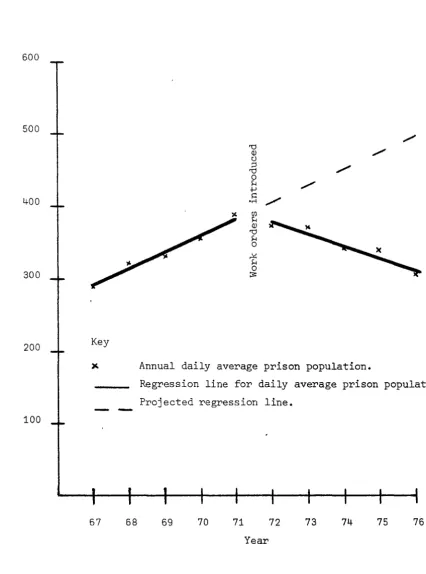
popu-lation was recorded for an eqnal period before and af1:er the intro-duction of the scbeme - from 1966/67 to 1975/76. Regression lines were then calcnlated for the daily average prison population for the five year period before and after the introduction of the scheme and differences between regression co-efficients were testedo
As the Work Order Scheme was introduced in February 1972, and the annual prison figures are based on the financial year, the prison figures for 1970/71 are the last available before the introduction of the scheme, and the figures for 1971/72 the first which could reflect any influence of the new scheme;
operating for five months at that stage).
(albeit i t had only been
A similar analysis as that used to test the effect of the scheme on the size of the prison population was used to determine the pro-portion of offenders sentenced to work orders who would not have received a prison sentence had work orders not been available. The analysis was based on the number of "convicted prisoners received"
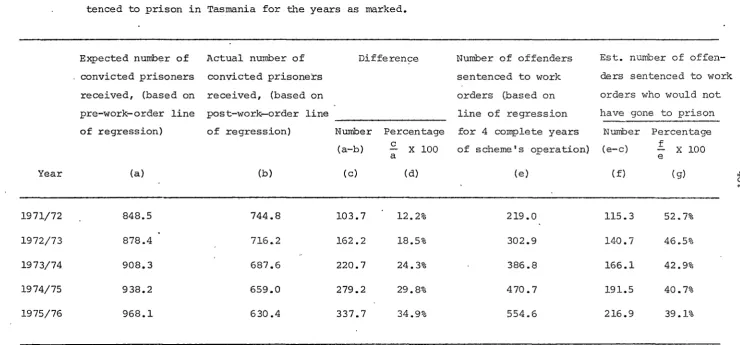
(as distinct from "prisoners received" which includes persons held on remand) and covered a five year period before and after the in-troduction of the scheme. The di~ference between the expected number of convicted prisoners received (based on the pre-work-orders regression line) and the actual number of convicted prisoners re-ceived (based on the post-work-orders regression line) shows the number of offenders who could be expected to have received a prison sentence had work orders not been available. This number can also be shown as a proportion of the work order sentences imposed indi-cating the proportion of of fenders sentenced to work orders who could be expected to have gone to prison had work orders not been available
34.
would not be e~pected to have gone to prison.
Two fr.i.ctors other than the Work Order Scheme itself could have accounted for changes in the prison population and these were also examined"
Any differences in the daily average prison population or the num-ber of convicted prisoners received following the introduction of
the scheme could have been due to the number o:i: convictions made by the courts rather than a change in sentencing policy brought about by the introduction of an alternative sanction. To determine whether there had been a change in the nurriber of convictions made by the
courts, a siwilar test to those described above was applied to the proportion of convictions resulting in ~ prison sentence befo·ce o.nd
after the scheme was introduced. This test w01jld indicate whether any reduction in th8 daily average prison population or in the uum-ber of convicted prisoners received could be attributed to a de-cline in the total nurriber of convictions made rather than a change in sentencing policy.
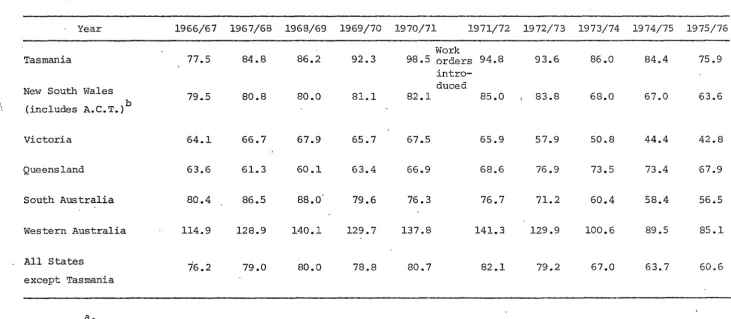
It may have been that Tasmania's prison population was decreasing in line with an Australia~vide trend, and a further comparison was made with the trends in prison population in the other Australian States. An analysis based on differences between regression co-efficients, was carried out to determine whether the trends in Tasmania's rate of imprisonment differed from th0se in the other States - none of which had a Work Order Scheme or its equivalent when the Tasmanian Scheme was introduced. Since then, however,
In this analysis, Tasmania's rate o;f imprisonment, based on the annual daily average prison population per 100,000 head of State population, was compared with the rate of imprisonment in t11e other Australian States for a five year period before and after the intro-duction of. the Work Order Scheme.
RESULTS
DAILY AVERAGE PRISON POPULATION:
The annual daily average prison population, and the annual number of convicted prisoners received from 1966/67 to 1975/76 as recorded in
'
the Controller of Prisons Annual Reports, is presented in Table 1. The numbers of offenders sentenced to work orders are also given where applicable.
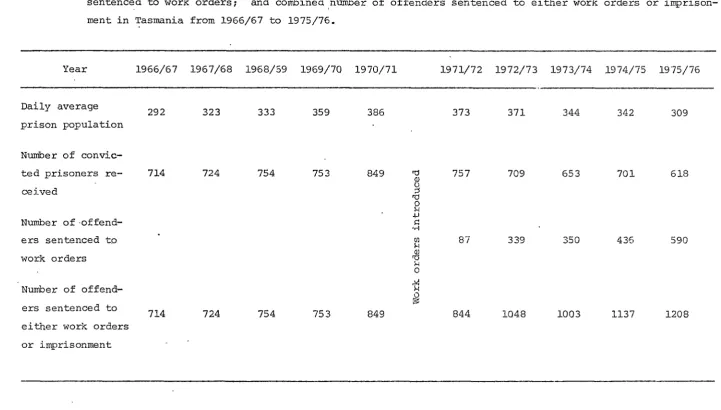
Table 1 shows that in the five years preceding the introduction of the Work Order Scheme, the annual daily average prison population increased by 32.2% - from 292 in 1966/67 to 386 in 1970/71. In the following year, which was the first which could reflect any in-fluence of the new scheme, the number dropped by 3.4% from 386 in
1970/71 to 373 in 1971/72. The daily average prison population
thereafter continued to fall and in 1975/76 the number was 309 - a decrease of 20% from the 1970/71 pre-work-order figure.
\
\
Table 1. Annual daily ave~age prison population; number of convicted prisoners received; ,nurrber of offenders
sentenced to work orders; and conibined number of offenders sentenced to either work orders or
irrprison-ment in Tasmania from 1966/67 to 1975/76.
Year 1966/67 1967/68 1968/59 1969/70 1970/71 1971/72 1972/73 1973/74 1974/75 1975/76
Daily average
292 323 333 359 386 373 371 344 342 309
prison population
Nuniber of
convic-ted prisoners re- 714 724 754 753 849 ro 757 709
()) 653 701 618
(.}
ceived ;:l
rel
0 H
.µ
Nuniber of-offend- ~
•rl
.
ers sentenced to Ul 87 339 350 436 590
H
())
work orders ro
H 0
Nuniber of of fend-
~
ers sentenced to
g
714 724 754 753 849 844 1048 1003 1137 1208
either work orders
or imprisonment
w
(j\
[image:47.836.56.778.96.506.2]c 0 •.-1 .µ rU rl ;:l p.. 0 p.. c 0 Cl) •.-1 H p.. (j) b() rU H (j) > rU >, rl •.-1 rU 0 600 500 / "d / (j) C) ;:l . / "d 0
H . /
.µ
400 •.-1 c /
:ic: Cl)
H (j) "d H 0 ~ H 0
300 ~
200 Key
)(,. Annual daily average prison population.
Regression line for daily average prison population.
Projected regression line.
100
67 68 69 70 71 72 73 74 75
Year
FIGURE 2. Regression lines for the annual daily average prison
population in Tasmania five years before and after the introduction of the Work Order Scheme from 1966/67 to 1975/76.
[image:48.562.99.525.71.645.2]38.
t
=
8. 62 i' d. f. = 6 i p ~. 001CONVICTED PRISONERS RECEIVED:
In the five years prior to the introduction of the Work Order Scheme, the number of convicted prisoners received increased by 18.9% from
714 to 849, as shown in Table 1. In 1971/72, after the Work Order
Scheme had been in operation for only five months, the number of convicted prisoners received had dropped by 10.8% to 757. By
1975/76, the number of convicted prisoners received had dropped,
to 618. This was 231 or 27.2% less than the 1970/71 pre-work-order
figure.
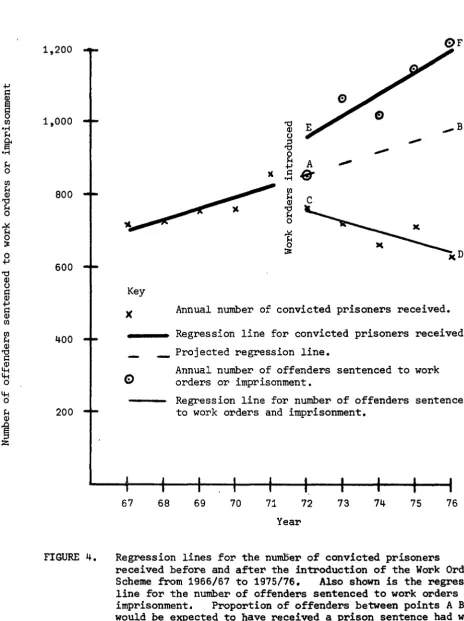
A graph of the annual number of convicted prisoners received, show·-ing the regression lines for the five years before and aft.er t:he introduction of the Work Order Scheme, is presented in Figure 3. Once again i t can be seen that the trend of an increasing nurrber of convicted prisoners received before the introduction of the scheme was reversed to a decreasing trend following the introduction of the
scheme.
A test for differences between the slopes of the regression lines for the number of convicted prisoners received pre- and post-work-order was statistically significant.
t 3.35; d.f. 6; p ...:::. .05
'rhe projected number of convicted prisoners received (based on the pre-work-order regression line) is shown in Figure 3. The difference be,tween the expected and actual number of convicted prisopers