TENCompetence workshop, Barcelona, 2007
Pedagogically informed metadata content and structure for learning
and teaching
Lester Gilbert* and Onjira Sitthisak
Learning Societies Lab, School of Electronics and Computing Science
University of Southampton, Highfield, Southampton, SO17 1BJ, United Kingdom E-mail: {lg3, os05r}@ecs.soton.ac.uk
*Corresponding author
Abstract: In order to be able to search, compare, gap analyse, recommend, and visualise learning objects, learning resources, or teaching assets, the metadata structure and content must be able to support pedagogically informed reasoning, inference, and machine processing over the knowledge representations. In this paper, we present the difficulties with current metadata standards in education: Dublin Core educational version and IEEE-LOM, using examples drawn from the areas of e-learning, institutional admissions, and learners seeking courses. The paper suggests the preliminary expanded metadata components based on an e-learning system engineering model to support pedagogically informed interoperability. We illustrate some examples of the metadata relevant to competency in the nurse training domain.
Keywords: metadata, competency, pedagogy
1 Introduction
In recent years, a variety of materials, tools, and learning environments have been created and installed in schools, universities, and organisations to support learning. Mostly these have been created around e-learning content and collaborative learning activities like a virtual classroom [1]. Learning activities aim at maintaining or developing a learner’s competence, and there are consequent processes of seeking and interpreting evidence to decide where the learners are in their learning, where they want to go, and how they can get there. In order to support these activities and objectives, appropriate metadata content and structure are required for storing, organizing, and sharing pedagogically-related data. A difficulty with current metadata standards for learning objects, learning resources, or teaching assets is their lack of pedagogically-relevant content and structure.
Establishing an appropriate model of metadata to support e-learning is challenging due to the wide-ranging nature of pedagogically-related data and activities, and philosophical differences of opinion amongst experts about what might be considered a relevant pedagogical approach. We deal with these difficulties by taking a general, pedagogically-neutral model of learning and teaching, and to use the model to suggest the necessary metadata content and structure.
2 Some areas of difficulty in E-learning
2.1 E-learning
E-learning remains content-focussed and assessment-oriented. For example, a PDF document is placed into a Virtual Learning Environment (VLE) and students are later required to answer some multiple-choice questions about its content. While we may say that students need to “know” or “understand” the document, exactly how should they be assessed? What is the place of the document content in the curriculum? What are the learning activities which we expect of the students as they engage in their study of the document?
2.2 Institutional admissions
Institutional admissions typically require structured personal profiles, where a prospective student identifies their current competencies and achievements. Matching such a profile against a course's entry expectations of pre-requisite competencies remains the time-consuming and potentially inaccurate job of an admissions tutor, made more difficult by the often incomplete and imprecise expression of such prerequisites.
A usable model of prerequisites would allow the better expression of both course requirements and students’ profiles and their correspondingly better match. A usable model would also facilitate the structured accreditation of prior learning, both experiential and certificated, and the processing of structured e-portfolios which instantiate the resulting claimed learning.
2.3 Learners seeking courses
Learners seeking courses which match their interests, or engaging in professional development planning, often have difficulty discovering appropriate and relevant courses because of the exceptional variability in course description, and the inadequacy of their ability to express their interests or required development in any corresponding way.
A usable model for structuring course purpose and intent would adequately characterise a course by its prerequisites, intended learning outcomes, the competencies it expects to develop in its students, and the anticipated achievements of its successful students at each of a range of levels.
3 Metadata standards for education
Generally, “metadata is information about a resource, either physical or digital” [2]. In the case of educational resources, metadata refers to information about resources used in the context of learning, education, and training [3]. Metadata helps people organize, find, and use resources effectively. For example, metadata helps users of an educational digital library find resources in a particular subject area at a particular grade level that can be used on a particular computer. Metadata can be used to identify multi-lingual resources or to inform a user about where and how to purchase a resource. A software application might use metadata to identify which resources are identified with a particular unit of study. Without metadata, managing these tasks would be difficult or impossible.
There are two important accredited metadata standards in the domain of education and training [4], namely Dublin Core (DC) educational version, and Institute of Electrical and Electronic Engineers Learning Object Metadata (IEEE-LOM).
In order to promote reuse of learning content, automated processes for metadata creation and search are required so that these burdens can be alleviated by machines [5]. However, it is not possible within the existing standards to represent sufficiently fine grained semantic information about learning resources in order to allow the selection of appropriate learning materials from a number of resources within some domain [6].
4 Metadata content and structure
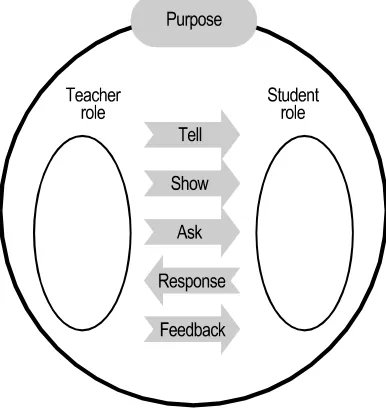
We identify the difficulties illustrated earlier in e-learning and with current standards as a lack of pedagogically-relevant metadata content and structure. An approach to dealing with this difficulty is to take a general, pedagogically-neutral model of learning and teaching and to use the model to suggest relevant metadata content and structure. Figure 1 illustrates the E-Learning SYstems Engineering (ELSYE) model of the “learning transaction” [7], based upon the “conversational” theory of Laurillard [8].
about the transaction as a whole, should form the basis of the pedagogically-informed metadata which would be relevant to any description of content or process in a learning and teaching situation.
Figure 1 ELSYE model of the learning transaction
The content and design of a learning transaction, of the “tell”, “show”, “ask”, and “feedback”, depend upon four considerations:
characteristics of the learner
characteristics of the media and methods being used in the learning and teaching situation characteristics of the subject matter content
[image:3.595.147.454.464.638.2]the intended learning outcomes.
Figure 2 Determiners of the design and content of a learning transaction
Figure 2 illustrates the connection between the components of the learning transaction model and the considerations for the design and production of learning and teaching materials.
In preliminary stage, the purpose, content, and design of a learning transaction may be described by the elements illustrated in Figure 3. These elements may be taken as the basis for the metadata which would be relevant to any learning object, learning resource, or teaching asset.
Figure 3 Metadata derived from the ELSYE model
Figure 4 Ontology underpinning for metadata
[image:4.595.168.428.375.634.2]“context”, acknowledges that “understanding” is always contextual and depends upon a variety of factors which may require explicit expression if the use of a learning object, learning resource, or teaching asset in any learning and teaching situation is to be adequately characterised.
To illustrate the general mechanism, we choose competencies from health care because they are amongst the most sophisticated and challenging to implement [12]. Student practitioners typically undertake a number of clinical placements during their training, and their competencies are typically assessed by geographically dispersed and time-constrained mentors and supervisors. In this scenario, the adoption of electronic competency records and their interoperability will be enhanced via adherence to emerging standards for competency definition.
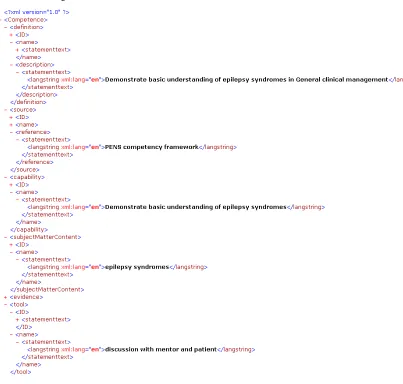
[image:5.595.88.491.254.638.2]We used the Royal College of Nursing (RCN) competency for developing paediatric epilepsy nurse specialist service as an example, and implemented it using XML format and the ELSYE model. XML was chosen to provide interoperability and exchange. The example implemented is shown in Figure 5.
Figure 5 RCN competency
9 Benefits and impacts
Benefits and enhancements are also expected in life-long learning and personal and professional development, since the proposed metadata structure is readily extensible to include learning and development from informal learning in hobbies, sports, and social activities.
To take an example from a European Union perspective, workforce mobility and the transfer and development of skills across member states and across organisational sectors would be facilitated, along with personal and professional development and job progression within employers and organisations. Employers’ requirements may be better matched with workers’ true abilities.
10Applications
Pedagogically-informed metadata would revolutionise the support for technology-enhanced learning and teaching. We can imagine the combination of well-described content with tools and services to yield configurations of useful and effective learning and teaching materials and environments involving machine processing and machine reasoning over semantically rich knowledge representations of pedagogic content.
11Conclusion
Awareness in the sector of education and training on the issue of learning technology standardization is growing fast particularly in the use of metadata. However, with awareness of the importance of these issues also seems to grow some confusion and misunderstanding.
We have looked at the current areas of the difficulties associated with metadata. The lack of pedagogically-relevant content and structure with current metadata standards in education effectively retards the development of technology-enhanced learning. We propose metadata based on a simple but pedagogically sound model of the learning transaction, and find rich suggestions. Such metadata can then support machine processing, flexibility and extensibility, reasoning and interoperability. The paper also gave some examples of competency-related metadata. We have described some related topics involving benefits, impacts and applications of the proposed metadata.
References
1. Koper, R. and M. Specht: TenCompetence: Lifelong Competence Development and Learning. in:Competencies in Organizational E-Learning: Concepts and Tools, M.-A. Sicilia, Editor. (2007), Idea Group.
2. IEEE, IEEE Standard for Learning Object Metadata. Available from http://ltsc.ieee.org/wg12/index.html
3. Duval, E.: Metadata Standards: What, Who & Why. Journal of Universal Computer Science. Vol. 7, No. 7. (2001), 591-601.
4. Stratakis, M., V. Christophides, K. Keenoy, and A. Magkanaraki: E-Learning Standards, p.45, (2003) 5. Al-Khalifa, H.S. and H.C. Davis: The Evolution of Metadata from Standards to Semantics in
E-Learning Applications. in In Proceedings of Hypertext'06. (2006). Odense, Denmark.
6. Al-Khalifa, H.S. and H.C. Davis: Replacing the Monolithic LOM: A Folksonomic Approach. in In Proceedings of The 7th IEEE International Conference on Advanced Learning Technologies (ICALT 2007). (2007). Niigata, Japan.
7. Gilbert, L. and V. Gale: Principles of E-learning Systems Engineering. (2007): Chandos.
8. Laurillard, D.: Rethinking University Teaching: A Conversational Framework for the Effective Use of Learning Technologies (2nd ed). (2001): Routledge Falmer.
9. Gilbert, L., Y.W. Sim, and C. Wang: Modelling the Learning Transaction. in In Proceedings of The 5th IEEE International Conference on Advanced Learning Technologies. (2005). Kaohsiung, Taiwan. 10. Currier, S., L.M. Campbell, and H. Beetham: Pedagogical Vocabularies Review, JISC, (2005).
11. Sitthisak, O., L. Gilbert, H.C. Davis, and M. Gobbi: Adapting health care competencies to a formal competency model. in The 7th IEEE International Conference on Advanced Learning Technologies. (2007). Niigata, Japan: IEEE Computer Society Press.