Reputation Management in The Salvation Army in Australia: a Multi-Stakeholder Analysis
By
Stuart Middleton BEc and BComm(Hons)
Submitted in fulfilment of the Requirements for the Degree of
SIGNED DECLARATION:
This thesis contains no material which has been accepted for a degree or diploma by
the University of Tasmania or any other institution, except by way of background information and duly acknowledged in the thesis, and to the best of my knowledge and belief no material previously published or written by another person except where due acknowledgement is made in the text of the thesis, nor does the thesis contain any material which infringes copyright
STATEMENT OF AUTHORITY OF ACCESS
This thesis may be made available for loan and limited copyrighting in accordance
with the Copyright Act 1968.
ABSTRACT
This work provides an insight into how reputation is managed by The Salvation Army across multiple stakeholder groups. These stakeholders include the media, government, donors, volunteers, and clients - groups with differing needs, wants, and desires. The thesis constructs an argument that The Salvation Army in Australia manages its reputation simultaneously across these stakeholder groups through the management of narrative. In this instance, narrative become a key tool of communication, but also serves to frame the understanding of external stakeholders.
ACKNOWLEDGEMENTS
The support of so many people has made this thesis possible. In particular, I would like to thank Zara Gerven and Patricia Middleton for the immense contribution they have made in helping me through the tough times of this thesis. I know that I could not have done this without them. Thank you.
Of course, no Doctoral Candidate would be in a position to submit without the hard work, dedication, and patience of their Supervisor. Thank you to Dallas Hanson who has provided constructive feedback and comments at all stages during this research process. Without Dallas, I would not have been able to use The Salvation Army as my case study, and this is alone worth thanks. However, I also wish to acknowledge the significant role he has played in my overall development as an academic - it seems amazing that some of the theorists he was mentioning to me almost ten years ago have somehow found their way into this work. And of course, I would also like to thank Dallas for his patience with me whilst I underwent difficult periods in completing this thesis.
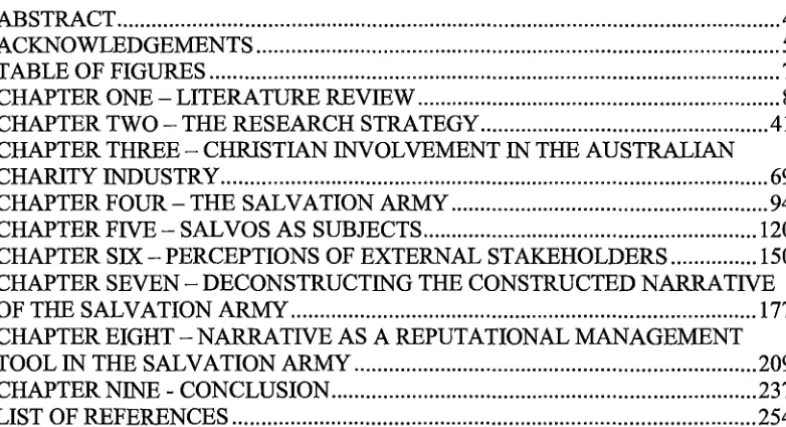
TABLE OF CONTENTS
ABSTRACT ... 4
[image:6.558.62.455.110.323.2]ACKNOWLEDGEMENTS ... 5
TABLE OF FIGURES ... 7
CHAPTER ONE - LITERATURE REVIEW ... 8
CHAPTER TWO-THE RESEARCH STRATEGY ... .41
CHAPTER THREE- CHRISTIAN INVOLVEMENT IN THE AUSTRALIAN CHARITY INDUSTRY ... 69
CHAPTER FOUR-THE SALVATION ARMY ... 94
CHAPTER FIVE- SAL VOS AS SUBJECTS ... 120
CHAPTER SIX- PERCEPTIONS OF EXTERNAL STAKEHOLDERS ... 150
CHAPTER SEVEN - DECONSTRUCTING THE CONSTRUCTED NARRATIVE OF THE SALVATION ARMY ... 177
CHAPTER EIGHT- NARRATIVE AS A REPUTATIONAL MANAGEMENT TOOL IN THE SALVATION ARMY ... 209
CHAPTER NINE - CONCLUSION ... 237
TABLE OF FIGURES
CHAPTER ONE - LITERATURE REVIEW
Introduction
This chapter provides an overview of the literature used to build the argument in this thesis. The first step is to build an understanding of the notion of reputation, beginning with discussion of the etymology of the term so that its historical antecedents can be understood. The use of the term in the organisation studies literature is then presented, particularly the recent understanding which identifies it as an intangible resource, and its subsequent integration into the Resource-Based View (RBV) of the firm as an intangible resource. A definition of reputation is then presented, which is argued to be consistent with characteristics identified by RBV theorists.
A discussion of the importance of stakeholders to an organisation's reputation is then conducted, which provokes an analysis of why and how organisations manage reputation. It is argued that the management of reputation is about managing the meaning of stakeholders through the exercise of unobtrusive power. Structure, strategy, leadership and culture are all mechanisms through which an organisation will seek to manage its reputation. However, these are built on a bedrock of artifacts such as symbols, language, rituals, myth, ceremonies, and settings. It is how these artifacts are communicated to external groups which represent the most :fundamental process of an organisation's reputation management.
From this, the central thesis question is presented, and a brief outline of the case organisation is constructed. This is the first step to answering the question, 'how is reputation managed in The Salvation Army across multiple stakeholders?' A sketch of the process of the thesis is then presented.
The Etymology of Reputation
which the concept has been drawn - including economics and public relations theory. Thus, it would seem useful first to provide an etymology of the term to help understand the essence of what constitutes a reputation.
The concept certainly has a long and rich history. Jones (2003) traces reputation back to Homer, and his use in both The Iliad and The Odyssey of the Greek word kleos. Kleos is defined as 'that true account of yourself which will live on after your death' (Jones, 2003, p.xxii). It is heavily entwined with ancient Greek notions of hero, a notion quite different to the modem concept, and thus requiring some explanation. The Greek hero was a religious figure, and hero status was only conferred upon death. The life of the hero was then constructed by bards and muses into narrative and recorded into song, or kleos. Kleos can then be defined as 'glory, fame, that which is heard', or 'the poem or song that conveys glory, fame, that which is heard' (Harvard, 2006). Kleos is then both the medium and the message of the glory of the heroes, and it was constructed by musicians to follow a structural plot, which documented the hero through ordeal, suffering, and death.
Indeed, the heroes themselves are sometimes portrayed as understanding the process by which they will achieve immortality. As ·an example of this Achilles discusses his own fate in The Iliad (9, 410-416):
'My mother Thetis tells me that there are two ways in which I may meet my end. If I stay here and fight, I shall lose my safe homecoming but I will have a glory (kleos) that is unwilting: whereas if I go home my glory (kleos) will die, but it will be a long time before the outcome of death shall take me'.
The English word 'reputation' can be seen to have been derived from two Latin words, reputare and Jama. Considering firstly reputare, this can be seen to literally mean 'to count back, think over, consider' (Kidd, 1987, p.286). This word is itself derived from two ancient Latin words, putativus (supposed or purported) and putare (to think) (Wiktionary, 2006). The result is the modern French word putative. This notion was adopted into English, where its first acknowledged use is by Geoffrey Chaucer in The Canterbury Tales.
The Latin word Jama provides a more immediately recognisable link to English notions of reputation, Its translation means 'talk, rumour, tradition, public opinion, reputation, fame, infamy' (Kidd, 1987, p.132). This therefore for the first time provides indication that a reputation can be either good or bad. Use of the word Jama can be observed in the work of the Latin poet Ovid, when he says 'Jama tamen clara est; et adhue sine crimine vixi'. This can be translated to 'my good name is
~evertheless unstained; and so far I have lived without blame' (Wiktionary, 2006).
Today, we can see that the word reputation is comprised of two stems - 're', and 'putative'. 'Re' means to do over again. This is actually from the same stem as reputare which conveys the notion in that particular word of 'to think over again'. The stem 'putative' means that something is commonly believed to be true on inconclusive grounds (Wikipedia, 2006). Hence, the dictionary defmition of reputation is 'the social evaluation of the public toward a person, a group of people, or an organisation' (Wikipedia, 2006). Having constructed this etymology it is now possible to begin to understand the way in which the term has been applied to organisations.
The Individual and the Collective
are commonly characterised according to attributes regarding their status (commercial or non-profit), products and services, history, or finances (Bromley, 2000).
This move is not undertaken without some risk however. For instance, the language of the individual will treat the organisation as a singular identity (Cornelissen & Harris, 2001), when an organisation may in fact have several competing identities. Hence, the need to recognise that an organisation may have multiple reputations based across its stakeholder groups (Bromley, 2001), as demonstrated by Carter and Deephouse with regard to Wal-Mart (1999). A further issue is that personal analogies are not necessarily directly transferable to organisations. Bromley (2000) demonstrates this by examining the notion of 'responsibility', which he claims is fairly clear in relation to the individual, but raises awkward legal and ethical problems with regard to organisations. Hence, the need to be careful in characterising corporate reputations.
Despite these concerns, it is logical that notions of corporate reputation have been assimilated into the field of organisation studies. This has in no small part been facilitated by the development of the resource-based view of the firm, which asserts reputation as an intangible resource potentially leading to sustainable competitive advantage.
The Resource Based View (RBV) and Intangible Resources
Barney (1991, p.102) describes a firm as having a competitive advantage, 'when it is implementing a value creating strategy not simultaneously being implemented by any current or potential competitors'. Sustainable competitive advantage for a firm is then 'when it is implementing a value creating strategy not being implemented by any current or potential competitors, and when these firms are unable to duplicate the benefits of this strategy' (Barney, 1991, p.102).
According to proponents of the RBV, the foundation of a competitive advantage is resources. Resources are defined by Daft (1983a) as 'all assets, capabilities, organisational processes, firm attributes, information, knowledge, etc. controlled by a firm that enable the firm to conceive of and implement strategies that improve its efficiency and effectiveness'. For resources to provide a potential source of competitive advantage they must fit four criteria - they must be valuable, rare, costly to imitate, and nonsubstitutable (Barney, 1991 ). Hoskisson et al define these criteria as follows:
'Value refers to the extent to which the firm's combination of resources fits with the external environment so that the firm is able to exploit opportunities and I or neutralise threats in the competitive environment. Rareness refers to the physical or perceived physical rareness of the resources in the factor markets. Inimitability is the continuation of imperfect factor markets via information asymmetry such that resources cannot be obtained or recreated by other firms without a cost disadvantage. Finally, the framework also considers whether the organisations are substitutable by competitors' (1999, p.14).
are intangible. Indeed, Hitt, Keats, & DeMarie (1998) declare that intangible resomces are the primary source of competitive advantage because tangible resomces such as equipment, buildings, and land can usually be imitated.
This has proven to be an important theoretical development for scholars of reputation. By conceptualising reputation as an intangible resource, researchers are able for the first time to treat the concept as a coherent subject with an identifiable taxonomy (Hall, 1993). The case for treating reputation as an intangible resource is clearly articulated by Hall:
' ... reputation has little significance in a legal context other than the redress obtainable with respect to libel and defamation. It is clearly not possible to buy or sell reputation except insofar as it may be construed to reside in a registered brand name. Reputation, which represents the knowledge and emotions held by individuals about, say, a product range, can be a major factor in achieving competitive advantage through differentiation; it also contributes to a defendable position because of the time which can be involved in matching a reputation which is strong in both fame and esteem; fame can be bought with advertising spending in the short term, but esteem has to be earned, usually over a long period of time' (1992, p.138).
Reputational researchers have now seized on this terminology and present a long list of benefits which accrue to organisations able to actively maintain a positive reputation. These include an ability to minimise vulnerability to stakeholder action, claim status as a welcome member of the world community, gain competitive advantage, and gain financial benefit (Fombrun, 1998a).
stakeholders. A prime example is Royal Dutch I Shell, which faced two reputational crises in 1995 (Fombrun & Rindova, 2000). The first related to the proposal to sink an old offshore drilling platform in the North Sea - a notion which attracted strong opposition from Greenpeace. The second was with regard to its dealings with the military junta in Nigeria which took money away from the suppressed Ogoni people. The focus of stakeholders on these events caused the market value of the Royal Dutch
I Shell group of companies to fluctuate wildly (Fombrun & Rindova, 2000).
Fombrun (1998b, p.231) further suggests that organisation wishing to achieve ambitious growth objectives must be understood and accepted as a welcome member of the world community. Those with a reputational edge will meet with the least resistance. This is demonstrated by Hanson and Stuart (2001) in their analysis of BHP's operations at the OK Tedi mine in Papua New Guinea. Their conclusion is that because BHP's operational difficulties at the mine impacted heavily on local communities and smeared the company's reputation, the company faces 'possible difficulties in getting access to other world copper deposits as governments perceive a known despoiler of the environment' (Hanson & Stuart, 2001, p.139).
Dukerich and Carter (2000, p.110) claim 'enhancing an already favourable reputation is a much easier task that trying to defend a faltering reputation'. Hence, it is argued in the literature that companies benefit from employing principles of reputation management. Fombrun (1998b) argues that good reputation will impede rivalry, a claim backed up by Rindova and Fombrun (1999) in their study of IBM. Their case argues that the overwhelming dominance of the IBM model in the early stages of PC development could be attributed to its strong reputation. This competitive advantage was something the organisation continued to enjoy for a long period of time after its strategy ceased to be viable.
Table 1.1: Specific Benefits of a Positive Reputation (Fombrun, 1998a, p.832)
Reputation and
Profitability
Reputation and Market
Value
Reputation and Analysts'
Forecasts
Reputation and Cost of
Capital
Reputation and
Competitive Advantage
Reputation and Job
Applicants
Direct Costs of Reputation
Loss
Reputation and
Market-Value Added
Seeking A Definition
After controlling for other key factors, a study of Fortune 500
companies showed that corporate reputation affected profitability in
excess of the mdustry average.
A study of216 companies found that there was a relative premium on
the stock market values of firms with stronger reputations for social
responsibility, after controlling for financial performance.
An analysis of 303 companies reported that one-year corporate
earnings per share forecasts made by financial analysts were most
heavily explamed by standard performance indicators, but were also
partly influenced by the nonfinancial component of the company's
reputation.
A study of 10 portfolios of companies demonstrated that investors
were willmg to pay more for companies with higher reputation but
comparable risk and return, thereby lowering the company's cost of
capital.
A study of 64 compames showed that intangible resources were a
distinct source of sustainable competitive advantage that enhanced a
company's profitability.
A study of 200 business undergraduate students found that they were
more attracted to jobs in high reputation companies - those whose
workplaces were referenced in various books describing the '100 Best
Companies to WorkFor ... '
A study of 12 major corporate crises showed that they have significant
impact on the market value of companies. Associated with each
negative reputational event in a one-week window around the event
with billion dollar losses that represented gross changes of 5% to 15%
in the market values of those firms.
A study of the relationship between net market-value added (MV A)
and Fortune's index of reputation in 1995 found that a company's
reputation was positively associated with both (MV A) and profitability, and negatively associated with the company cost of
capital
has proved useful in evaluating individuals, and hence has been applied to collectives. The term has been rendered of interest to the study of organisations through development of the notion of intangible resources, which as outlined in the RBV has provided reputational researchers with an identifiable taxonomy for reputation (Hall,
1992).
In adopting a definition of reputation in organisations the preceding discussion provides a list of variables to consider. For instance, such a definition should recognise the subjectivity of reputations as encapsulated in the Latin word reputare, meaning to think. It should also recognise that reputation is a status conferred by others, as implicit in the Greek notion kleos. Finally, the defmition must acknowledge reputation as an intangible resource, for it is this notion which has provided the taxonomy for researchers to consider reputation and its management as a function of organisations.
Gotsi and Wilson (2001) present a useful overview of the debate surrounding the definition of corporate reputation. They argue that definitions are predicated on two schools of theory, one which views corporate reputation as synonymous with corporate image, and one which considers the terms to be different but interrelated. The latter theory considers the terms to be different, based on a belief that image is a shallow concept which implies that organisations manipulate (Olins, 1989) and manufacture (Bernstein, 1984) their image. According to this school of thought, reputation is considered to be a 'deeper' concept, based on a reflection of the organisation over time (Saxton, 1998). From what we have seen through exploring the etymology of the word reputation, it makes sense to associate with the second school and conceptualise it as a deeper concept that if it were simply synonymous with image. A deeper understanding is encapsulated in the Latin word 'reputare', meaning to think over again, and also in the notion of 'kleos', which means to consider the actions of a character over their lifetime.
Table 1.2: Characteristics of Reputation (Gotsi & Wilson, 2001)
• It is a dynamic concept {Balmer, 1991; Barich & Kotler, 1997; Bromley, 1993; Caruana, 1997; Fombrun, 1996; Fombrun &-Shanley, 1990; Gray & Blamer, 1998; Mason, 1993;
Normann, 1984; Rindova, 1997; Saxton, 1998)'
• It takes time to build and manage {Balmer, 1997; Gray & Balmer, 1998);
• There is a bilateral relationship between the concepts of corporate reputation and corporate
image (Rindova, 1997); corporate reputations are largely dependent on the everyday images
that people form of an organisation (Balmer, 1998; Bromley, 1993; Fombrun, 1996; Fombrun
& Shanley, 1990; Gray & Balmer, 1998; Rindova, 1997; Saxton, 1998) based on the
company's behaviour, communication and symbolism (Birkigt & Stadler, 1986), while at the
same time corporate reputations can influence stakeholder's everyday images of a firm
(Banch & Kotler, 1991; Mason, 1993);
• It crystallises a company's perceived ranking in a field of other rivals (Fombrun, 1996); • Different stakeholders may have different reputations of the same company based on their
own economic, social and personal background {Bromley, 1993; Fombrun, 1996).
Finally then, having considered the etymology of reputation, the characteristics of reputation, and examined its evolution in the field of organisation studies, it is now possible to consider a definition of reputation which is consistent with all of the above. Reputation is then:
a stakeholder' s overall evaluation of a company over time. This evaluation is based on the stakeholder's direct experiences with the company and any other form of communication and symbolism that provides information about the firm's actions and I or a comparison with the actions of other leading rivals' (Gotsi & Wilson, 2001).
This definition is consistent with what has been presented thus far. In order to discuss, let's consider the definition as it relates to the understanding of kleos.
worthy. This construction, like that in the definition of reputation was based 'over time'. As kleos was only conferred upon death, the full extent of the person's life could be evaluated before hero status was bestowed. To base the evaluation of the reputation of an organisation over a period of time is therefore consistent with the original concept ofkleos.
On what information was the bard to assess a person's worthiness for kleos? This is harder to determine, but it was likely that it was based on personal knowledge, word-of-mouth, and communication regarding the actions of the hero. This is once again consistent with the definition of reputation, which bases evaluation upon 'direct experiences with the company, any other form of communication, and symbolism that provides information about the firm's actions'.
Finally, the definition of reputation states that it is based on comparison with the actions of other leading rivals. Was this also the case with kleos? The answer is that we may assume it was. Taking Achilles as an example, we are aware that many thousands of others (like him) passed away at the Battle of Troy. Yet, Achilles' life was promoted above those of others and constructed into kleos. At some stage the ancient Greeks there must have engaged in an evaluative process which determined Achilles' life was more worthy of hero status than those of others involved in wars for Greek civilisation.
Thus, the adopted definition from Gotsi and Wilson (2001) is consistent with the original notion of kleos. There are two questions which arise from this definition however. The first is as to why organisations manage reputation, and the second is to how organisations will seek to manage reputation? These questions are considered in the next section.
Stakeholders and Reputation
'on the one hand, they [reputations] are considered assets that are owned and managed by firms; on the other hand, they are perceptions of observers - perceptions over which firms have relatively limited control' (1997).
This provides a dilemma. As Rindova (1997) notes, an organisation does not have perfect control over its reputation, and no amount of management initiative is likely to provide this. What Rindova's dilemma serves to illustrate is the potential volatility of reputation.
Other researchers have also identified this dilemma. For example, Saxton (1998) defmes reputation as 'the reflection of an organisation over time as seen through the eyes of its stakeholders and expressed through their thoughts and words'. In
considering the role of stakeholders in the process of reputation construction, Saxton adds a new variable to the reputation dilemma. Stakeholders can be defined as, 'any group or individual who can affect or is affected by the achievement of the organisation's objectives' (Freeman, 1984, p.46). Stakeholders may include competitors, governments, the media, shareholders, consumers, employees, and the local community. Wood and Jones (1995) list four key roles of stakeholders in regard to the organisation. These are to:
'(1) set expectations; (2) experience effects; (3) evaluate outcomes; and ( 4) act on these evaluations.'
This list demonstrates the importance of stakeholders to the organisation as it seeks to build a positive reputation in its competitive environment. The ability of stakeholders to act on evaluations is key. As Frooman (1999) notes, the organisation must manage the interests of stakeholders such that the firm may still achieve its interests. This suggests stakeholders enjoy a degree of control over the actions of an organisation and are thus critical to the ability of the firm to create sustainable competitive advantage.
Firstly, stakeholders are able to control the flow of resources to an organisation. An organisation with a positive reputation has been variously shown to attract better job applicants (Stigler, 1962), attract investors (Milgrom & Roberts, 1986), facilitate effective joint ventures (Dollinger, Golden, & Saxton, 1997), and improve stock market performance (McMillan & Joshi, 1997). In each case, these advantages accrue through the organisation's ability to procure resources from stakeholder groups. Thus, 'an organisation is dependent on various stakeholders for the critical resources that enable it to operate' (Neville, Menguc, & Bell, 2003). For instance, if a stakeholder withholds resources from an organisation, then financial performance will be negatively impacted' (Frooman, 1999).
However, this interaction should not only be assessed through the eyes of the organisation. Considering the stakeholder groups themselves, under what circumstances are they likely to confer resources upon an organisation? Rindova and Fombrun (1999) argue that constituents will engage with firms in the aim of furthering their own objectives through their resource allocations. The assessment as to which organisation provides the better value for stakeholder investment will be made on perceptions and interpretations - routinely generated in the ambient micro-culture of the industry (Abrahamson & Fombrun, 1992). This will be done through an interpretive evaluation of winners and losers in an industry, with resources flowing to those constructedly assessed as winners.
Director as he outlines the communications challenges faced in eliciting responses he would desire from his organisation's stakeholders:
'The building of confidence in the financial markets requires a great deal of precision. On the one hand you want to radiate strength and confidence and therefore present concrete, strong ambitions. On the other hand at the same time, you obviously want to avoid risking a profit warning. So what do you do?' (in van der Jagt, 2005, p.182).
If stakeholder groups construct a situation in which a particular firm is deemed to be 'successful', then that organisation is likely to enjoy a flow of resources which is superior to that of its rivals. Hence, the interpretations and evaluations by stakeholders of an organisation's actions remain key to securing competitive advantage.
The third way in which stakeholders can confer competitive advantage on an organisation is through the creation of industry paradigms (Rindova & Fombrun, 1999). This means that stakeholder groups will arrive at a collective understanding of an industry - such as whose products are best, and whose actions are most effective. This will then help to define future resource allocations. A prime example is that of IBM, which 'for most of this [20th] century, ... has inspired awe among managers and researchers alike, for the market power it achieved' (Rindova & Fombrun, 1999, p.691). In particular, IBM topped Fortune's survey of the most admired companies throughout most of the 1980's. The result according to Business Week (1983, p.76) was that when 'faced with hundreds of brands of unknown personal computers to choose from, business customers suffered 'computer shock' and turned to the computer giant for relief.
stakeholders, and secondly they need to have their actions defmed as legitimate by stakeholders so they are minimise their exposure to environmental uncertainty. The goal of their reputation management therefore will be to have a reputation which is perceived by important stakeholder groups as superior to their rivals. In other words, they will seek to have power over their reputation.
Reputation Management As The Management of Meaning
It has been shown that stakeholders have much power over an organisation. Through interpretively constructing an organisation's reputation, stakeholder groups are able to make important decisions which will affect the firm's competitiveness. In particular, stakeholders are able to determine whether or not they confer resources upon the organisation, defme whether a firm is successful or unsuccessful vis a vis its competitors, and also label an organisation's actions as legitimate or illegitimate. These decisions are fundamentally vital to the organisation, and thus stakeholders represent a source of potential volatility to the organisation.
In conditions in which organisations face volatility, they have been shown to seek power through management, where power is:
'the probability that one actor within a social relationship will be in a position to carry out his will despite resistance, regardless of the basis on which this probability rests' (Weber, 1968, p.53).
'(1) a widespread exchange of information and interpretations among firms and constituents;
(2) varying degrees of knowledge and understanding about the industry and firms inside it;
(3) a multiplicity of interpretations, many of which are of a self-serving nature;
(4) some degree of agreements about standards of performance in an industry; and
(5) evaluations of firms relative to these standards and their rivals that give content to their reputations' (Rindova & Fombrun, 1999).
Hence, when organisations seek to manage reputation, what they are trying to do is ensure that the interpretations and constructions by the stakeholder groups of their
firm are positive. In other words, the task for the firm is to engage in the management of meaning such that the cues received by the stakeholders are received favourably.
Management of meaning does not directly relate to traditional conceptions of power because such concepts emphasise power as arising only in situations of conflict (Dahl, 1957). However, in managing meaning, organisations will seek to reduce volatility in the environment by actually preventing conflict from arising. The recognition that avoidance of conflict may in fact be the desired outcome for organisations led Bachrach and Baratz (1970) to conceptualise another form of power - that power where issues could be excluded from decision-making so as to allow the powerful to frame the issue of an agenda. This is articulated by Lukes who maintained power could be used to shape:
Under such circumstances therefore, the aim will be to create legitimacy around the organisation's actions and outcomes so that they are immutably beyond the questioning of stakeholders. In this situation, conflict will not be an outcome because stakeholders are presented with a situation in which the organisation's actions are so routinised they appear normal, and therefore not illegitimate. Such a situation has been described by Gramsci as 'ideological hegemony', where hegemony is 'a structure of power relations fully legitimised by an integrated system of cultural and normative assumptions' (Hyman & Brough, 1975, p.199). Hegemony then, seeks to describe those practices which maintain power by preserving the normal functioning of a situation (Clegg, 1979). In order to exercise hegemony, the firm will leverage what Hardy (1985) has described as unobtrusive power:
'Unobtrusive power is used to achieve substantive outcomes by influencing sentiments such that outcomes are deemed legitimate, inevitable, or acceptable. The essence of the unobtrusive aspect of power is the ability to give meaning to events and actions, and to influence the perceptions of others so they either remain unaware of the implications of political outcomes or view them in a favourable way. Unobtrusive power is thus founded in the ability to define reality, not only for oneself, but for others' (Hardy, 1985, p.390).
We may thus understand reputation management as an attempt by organisations to minimise volatility through managing the meaning of groups of stakeholders. This will be done through utilising tools of unobtrusive power, and will seek to legitimise the organisation's actions, and have stakeholders view their organisation in a favourable light. It is now possible to construct an understanding of how firms will enact unobtrusive power in the management of their reputation.
The Management of Unobtrusive Power: How Do Organisations Manage
Meaning?
Hardy (1985) cites five mam mechanisms through which organisations seek to manage meaning for their stakeholders. These are structure and culture, symbols, language, myths, and rituals, ceremonies, and settings. Given that reputation management has been argued to be about the management of meaning through the exercise of unobtrusive power, these five mechanisms also represent the mechanisms of reputation management. These will now be examined in turn.
Reputation Management As Structure and Culture
The work of institutional theorists uses the notion of legitimation to explicate the organisational desire to formally adopt strategies and structures which will allow for control over a situation. Institutional theory was introduced to the field of organisational studies by Meyer and Rowan (1977) in their seminal article 'Institutionalized Organizations: formal structure as myth and ceremony'.
As Fombrun (1998a) declares, well-regarded companies work hard to build legitimacy. Based on Scott and Lyman's (1968) belief that formal structure can signal organisational commitment to rational, efficient standards of organising, institutional theory looks at organisational actions as being defined by legitimating processes. Hence,
'Organisations are driven to incorporate the practices and procedures defined by prevailing rationalised concepts of organisational work and institutionalised in society. Organisations that do so increase their legitimacy and their survival prospects, independent of the immediate efficacy of the acquired practices and procedures' (Meyer & Rowan, 1977, p.340).
within organisations responsible for managing reputation. The relevant function is often determined by the strategy through which the organisation is pursuing its reputational goals. For instance, Deloitte Spain's reputation management function resides within its knowledge management area (Zabala, Panadero, Gallardo, Amate, Sanchez-Galindo, Tena, & Villalba, 2005, 2005), whilst South African Breweries manages from within its Crisis Management area (Tucker & Melawar, 2005). Other organisations place responsibility within the Communication Unit, and others create specific roles such as Chief Ethics and Risk Management Officer (Neef, 2005). Current best practice research also places the role of reputation management as a direct function of both the CEO (Forman & Argenti, 2005) and the Board (Neef, 2005).
Reputation management agents are most commonly advised by researchers to perform their role through a process of continual media monitoring (Tucker & Melawar, 2005). A key objective ofreputation management is to ensure that the company has an ability to meet the expectations of its stakeholders (Fombrun, 1998). Hence, by monitoring the work of media the organisation enhances its ability to create the understanding that will link it to its stakeholders (Varez & White, 2000).
Incorporated into the structural management of reputation are notions of organisational leadership and organisational strategy. Turning firstly to strategy, we can see it is a key factor in an organisation's reputation management practices. Fombrun and Rindova (1998) report that for reputation to be managed effectively it must be linked to the organisation's mission, values, and vision. This is reflected in the words of a Chief Executive Officer surveyed in a benchmarking study of reputation management. 'Reputation is a multi-disciplinary idea, but must be linked to the core strategies and objectives of the company and its mission, values and vision. Anything less will be unsuccessful in the long run' (Fombrun & Rindova, 1998, p.206).
knowledge and risk management strategies in organisations (Neef, 2005). For instance, Deloitte Spain practices reputation management as part of its intellectual capital management strategy (Zabala et al., 2005).
Perhaps the clearest example of reputation management as strategy comes from Royal Dutch I Shell, where the strategy of adopting everyday excellence as a core value has been seen as a key factor in managing the reputation of the organisation (F ombrun & Rindova, 2000). This has enabled the firm to design strategies and systems which place reputation at the heart of the organisation and allow it to communicate effectively with its stakeholders.
Reputation management is also discussed as being a function of the leadership of an organisation. Reputational leadership is variously ascribed to being a responsibility of the CEO (Fombrun & Rindova, 2000), the Chairman (van der Jagt, 2005), or the Board (Neef, 2005). Wiedmann and Buxel (2005) claim that reputation is the responsibility of the top leadership in three quarters of German companies. The role of leadership is vital to set an example on an issue, or to take charge during a crisis.
Tucker and Melewar (2005) cite the example of Johnson & Johnson as an organisation whose leaders averted a reputational crisis. The company's best-selling analgesic product Tylenol had been purposefully contaminated. Johnson & Johnson's management made a conscious decision to forego short term revenues (and indeed, incur short term losses) by issuing a full product recall. Johnson & Johnson's decision gave it a significant boost in the eyes of its stakeholders for acting in the best interests of its consumers (Tucker & Melewar, 2005).
Whilst structure is perhaps the most visible expression of an organisation's efforts to manage its reputation, it is based heavily on organisational culture. Culture is defined by Schein (1985, p.6) as
'the deeper level of basic assumptions and beliefs that are shared by members of an organisation, that operate unconsciously, and that define in a basic 'taken-for-granted' fashion an organisation's view of itself and its environment. These assumptions and beliefs are learned responses to a group's problems of survival in its external environment and its problems of internal integration. They come to be taken for granted because they solve those problems repeatedly and reliably'.
Qrganisational culture plays a key role in reputation management. Strong cultural values have been shown to guide managers by justifying strategies for interacting with key stakeholders (Miles & Cameron, 1982; Porac & Thomas, 1990). Fombrun and van Riel (1998) suggest that firms with strong and coherent cultures are more likely to attend carefully to how key audiences feel about them. Flatt and Kowalczyk (2000, p.356) also conclude that 'when external observers assess a company's reputation, they may be rating them on some of the same attributes that we use to describe a company's culture'.
Neef (2005) suggests that organisations with a good reputation will have built a culture whern its values are understood by all and are integral to its day-to-day operations. This comes through once again in the example of Royal Dutch I Shell, where management made efforts to align culture to its reputational management aims.
Reputation Management Through Cultural Artifacts
Culture and structure are built on visible physical objects, patterns of behaviour, and abstract theatrical productions. These bases of culture are known as artifacts. An
artifcat is a pathway of action, in that it prompts behaviours and decisions. Gagliardi (1990, p.3) defines an artifact as, '(a) a product of human action which exists independently of its creator; (b) intentional, it aims, that is, at solving a problem or satisfying a need; ( c) perceived by the senses, in that it is endowed with its own corporality or physicality'. Symbols, myths, language, rituals, ceremonies, and settings are all organisational artifacts, and hence they form the pathways to action by which an organisation manages its reputation.
Turning firstly to symbols, we can see that a symbol is 'something that 'stands for', or signifies something beyond the liberal properties of the symbol itself (Sims, Fineman, & Gabriel, 1993, p.299). Putnam, Phillips, and Chapman (1996, p.386) discuss deeper underlying contexts of symbols:
'Symbols are complex signs in that they suggest cultural, historical, or political interpretations; that is, they go beyond signalling a political response, like a traffic light indicating stop. The meaning of a symbol is typically rooted in cultural significance, for example, an emblem that represents the values and history of a nation'.
Symbols are not just logos or designs, they may also be actions, relationships, or linguistic formulations whose strength lies in their ability to evoke emotions and impel people to action (Cohen, 1976, p.23). This is based on a view of social cognition as a symbolic process, in which information is socially related to what is already known (Sims, Gioia, & Associates, 1985).
Christmas parties. Rituals serve as communicative acts which make public the private values of a group, and play an important role in maintaining an organisation's infrastructure (Putnam et al., 1996).
Language is the final artifact used by organisations to manage unobtrusive power. Bruner (1986, p.64) says, 'we create realities by warning, by encouraging, by dubbing with titles, by naming, and by the manner in which words invite us to create 'realities' in the world to correspond with them. Constitutiveness gives an extemality and an apparent ontological status to the concepts words embody'. Czamiawska-Joerges and Joerges (1990) identify three verbal tools used to build shared meaning, these being labels, metaphors and platitudes. Labels classify and tell what things are, metaphors give life and say how things are, whilst platitudes establish what is normal (Czamiawska-Joerges & Joerges, 1990).
These artifacts are the bases of culture and structure. Hence, they are central to the organisation's efforts to manage reputation. However, in order to manage the meaning of organisational stakeholders, these artifacts must be communicated externally. Hence, 'communication functions as the creation, maintenance, and transformations of meanings' (Putnam et al., 1993, p.386).
The second element of reputation which effectively emphasises the organisation's need for effective communication as a means of building reputation is contained in the understanding of reputation as legitimacy.
Communication often takes centre stage in an organisation's response to a reputational crisis. This is apparent in Royal Dutch I Shell's response to crises it faced through its proposal to sink the Brent Spar oil drilling platform, and its alleged complicity with human rights abuses in Nigeria. The decision by Shell as a consequence of these developments was to work to become the 'World's Most Admired Corporation' (Fombrun & Rindova, 2000). In order to attain this goal, a reputation management system was institutionalised throughout the organisation. A key component of this system was improved communications through new detailed reports, as outlined by one of Shell's top officers, Corr Herkstroter in 1999:
'We are responding to increasing public interest in Shell companies' activities by developing our reporting ... the first Group Health Safety and Environment (HSE) report was issued last year - as well as separate reports from the main businesses. This year's Group report will include improvement targets against which future progress can be measured. In addition we will be presenting the contribution Shell companies make to economic, social, and environmental progress in the new Shell report' (in Fombrun & Rindova, 2000).
Hence, organisational communication can be seen as central to reputation management on two levels - firstly as a tool to transfer information to groups of stakeholders, and secondly as legitimising an organisation's actions in the eyes of its constituencies. This communication can take many forms including annual reports, press releases, media interviews and direct stakeholder correspondence.
management of reputation unless they are complemented by fundamentally shared values and processes across the organisation. This includes aligning strategy to values, and incorporating these values into organisational culture. It also means creating a structure for incorporating reputation management into everyday organisational practices, and linking this structure to top leadership.
The Central Research Question
From all the debate so far, it is clear that there are two key continuing debates in the reputation literature. The first of these is, how is reputation measured; and the second is, how is reputation managed? A positivistic approach to reputational research would probably link these as part of the same problem, based on a belief that successful reputation management outcomes cannot be managed unless they can be measured. However, I have adopted an interpretivist stance in this thesis, and hence emphasise the subjectivity of the notion and the way it is constructed across an organisation's constituencies. This has ramifications for the development of the thesis question, as will now be discussed.
In order to introduce the thesis question, it is important to return to the reputation dilemma as posed by Rindova. This dilemma is worth repeating:
'on the one hand, they [reputations] are considered assets that are owned and managed by firms; on the other hand, they are perceptions of observers - perceptions over which firms have relatively limited control' (1997).
An effective way of analysing reputation management in organisations is through analysis of a case organisation or case organisations. This necessitates a decision in which the researcher weighs up the potential value in studying one case in depth, as opposed to studying a number of cases for comparative purposes.
Given the undoubted intricacies of reputation management, and many of the contextual issues surrounding its practice in organisations, there is potentially great value in exploring a single case. Even though findings from a single case may be difficult to generalise to a population of organisations, there remains significant potential to generalise to the theory of reputation through a single case. Yin (1994) provides three circumstances in which the selection of a single case can be justified. Of these, the most pertinent to the study in this thesis is the extreme or unique case -whereby the case is worthy of study because its very documentation and analysis has the potential to illuminate theory and provoke future research. In keeping with other single cases which investigate the 'how' of reputation management, such research would need to analyse an organisation whose reputation was constructedly good, such as Johnson & Johnson (Tucker & Melewar, 2005; Forman & Argenti, 2005), or whose reputation was constructedly bad, such as Nestle (Forman & Argenti, 2005), Nike (Boje, 2001), or Enron (Boje, Rosile, Durant, & Luhman, 2004).
The decision was made to study an organisation whose reputation was constructedly 'good'. This organisation is The Salvation Army in Australia. The justification of that decision is presented in the next section.
How is reputation managed in The Salvation Army across
multiple stakeholders?
This question is worthy of consideration on a number of levels. Firstly, it aims to conduct investigation which will, in the words of Fombrun and van Riel (1997, p.5) 'provide well-reasoned and defensible answers to questions about corporate reputation and reputational dynamics'. The reputational dynamics of reputation management are central to the aims of this work. Furthermore, the research aims to look at an organisation with a reputation argued to be constructedly good - that being The Salvation Army in Australia. The efforts of this organisation in managing reputation across a broad range of stakeholders have the potential for generalisability to reputation theory, and this means the research question poses a potentially useful avenue of social inquiry. A brief overview of the case and outline of the thesis will
J.!OW be presented.
Reputation Management in the Salvation Army
Utilising the framework of Rindova and Fombrun (1999), it can be argued that The Salvation Army in Australia has not only been constructed by stakeholders as having a positive reputation, but there is strong evidence to support the assertion that this reputation has been constructed as superior to competitors. This is based on evidence that The Salvation Army receives significant resource allocations, has been defined by individual stakeholders as successful, and that there has been an industry paradigm constructed which views The Salvation Army as superior to its competitors. In short, it is an industry leader. In the terms of Rindova and Fombrun (1999), it can be said that these stakeholder constructions have led to The Salvation Army having a competitive advantage in the charity industry in Australia. Before outlining this argument, it is first of all necessary to outline the types of typical stakeholders faced by nonprofit organisations, and to provide a brief overview of the charity industry in Australia.
but at this stage it is enough to say that the charity industry in Australia is highly competitive, with a high rate of new entrants clamouring for a limited pool of resources. Governments in the past twenty years have had a history of devolving away from the provision of social services, and this has increased the onus on nonprofit organisations to deal with the shortfall. In combination with this, there has typically been a greater level of public scrutiny placed on nonprofit firms than on private firms (Ritchie, Swami, & Weinberg, 1999).
Hence, the charity industry in Australia displays characteristics which would make the management of reputation a vital function of success. In particular, the nonprofit firm must endeavour to manage meaning across its full spectrum of stakeholders. However, the stakeholders of nonprofit organisations are different to those of private companies. Ritchie et al (1999) identify four key publics of nonprofit organisations, these being clients, donors, volunteers, and government. It can be argued that all of these groups have constructed the Salvos as having a good reputation.
Turning firstly to resource allocations, The Salvation Army receives large financial contributions from both donors and governments. The following figures come from the 2004/05 Salvation Army Annual Report (Salvation Army, 2005). In the 2004/05 financial year, the Salvos received a total of $111,833,000 in donations. These include almost $57.5 million in donations to the annual Red Shield Appeal, a figure which was boosted by increased levels of support from all states and territories. Donations from the general public to Salvation Army Stores alone created an income stream of $53 million.
growing commitment from Governments around Australia to The Salvation Army's charity programs.
It can also be seen that some of Australia's largest corporations have constructed The Salvation Army as being successful. Some of the organisations recognised as having made a significant financial contribution to the Salvos include: Adelaide Bank, Adelaide Football Club, Alinta Limited, AXA Asia Pacific Holdings Limited, Channel 9, CSR, Ford Motor Company of Australia, Goldman Sachs JB Were Limited, Government of South Australia, Government of Victoria, Government of Western Australia, JB Hi-Fi, KPMG Foundation, Mallesons Stephen Jacques, Myer Community Fund, National Australia Bank, Orica, Qantas Airways Ltd, Shell Company of Australia Ltd, State Government of Tasmania, Toll Priority, Tower Trust Limited, UBS Investment Bank, Westpac Banking Corporation, Woodside Energy Limited, and Worley Parsons. This is a formidable list, and indeed contains some of Australia's largest corporations in terms of market capitalisation.
This total income for The Salvation Army is then spent on a wide variety of services: aged care and disability support, employment education and training, family stores, homelessness and domestic violence support, individual and family support, children and young people at risk, addictions and substance abuse support, and administration and research. Across Australia, the organisation assists 1.5 million people - an amount almost certainly higher than any other non-profit organisation.
It may also be asserted that an industry paradigm has been constructed by groups of stakeholders which identifies The Salvation Army as an industry leader. This is apparent from the enormous levels of funding received from governments and donors, as well as the wide availability of volunteers to assist with Salvation Army welfare programs.
been a very public face of the Drug and Alcohol Taskforce, whilst Captain David Eldridge is Chairman of the Youth Pathways Action Plan Taskforce. At a state level, the Tasmania state government decided in the late 90's to appoint The Salvation Army as landlord of 200 Housing Division homes, a decision described by Hobart's The Mercury (1998) newspaper as having 'irresistible appeal and sound logic'.
In terms of donors The Salvation Army enjoys a very positive reputation. It is largely recognised as Australia's leading charity fundraiser (O'Keeffe & Partners, 2001; Brook, 2002). Further to this, a Newspoll survey (2002) suggests that The Salvation Army enjoys significant positive benefits over competing charities. When respondents in Sydney and Melbourne were asked to identify the charity to whom they would most likely donate $20, The Salvation Army was supported by 37 per cent of respondents. This put the Salvos well ahead of rival charities such as the Cancer Council (20%), Red Cross (14%), the Smith Family (7%), and the Blind Society (7%). A final important point to be made is that despite periods of recession and economic unease, the National Red Shield Appeal has never failed to reach its financial target (Cleary, 1993). In this sense, it can be said that The Salvation Army's reputation is positive among the general population.
The Salvation Army also attracts a large number of volunteers to assist in the delivery of their programs. These volunteers assist, amongst other things, in distributing children's toys at Christmas, provide service at Salvation Army Family Stores, listening to people with problems on the Salvo Care Line, doorknocking, and fundraising. Volunteers represent a very important part of The Salvation Army's charitable efforts.
The Outline of The Thesis
This thesis examines reputation management in The Salvation Army across multiple stakeholders. Chapter One has argued that The Salvation Army in Australia enjoys a positive reputation as the leader in the charity industry. How this reputation is managed becomes the focus of inquiry for the thesis.
Chapter Two outlines the strategy of research adopted. In particular, it seeks to achieve two objectives. Firstly, an outline is presented of the investigation of the case, with discussion centred on detailing how research material was collated. Secondly, an overview of the strategy to analyse this case is presented. It is argued that the constructed case represents a hegemonic narrative of The Salvation Army. This narrative represents a conglomeration of the artifacts of unobtrusive power - these being symbols, myths, language, rituals, ceremonies, and settings. Hence the task is to determine where the power lies in the narrative such that an explanation can be made of how reputation is managed in The Salvation Army. This analysis will take place through a strategy of deconstruction, the steps of which are outlined.
Chapter Three provides two types of context to the case. Firstly, it provides a context for The Salvation Army's action in the charity industry. This is done by examining the philosophy behind the involvement of Christian organisations in the provision of social welfare. The argument is made that Christian organisations seek to undertake virtuous practices, based on an understanding developed by St Thomas Acquinas in the 12th Century that virtuous action was the key to living a good life. Secondly, this chapter provides context by constructing an understanding of the charity industry in Australia. It is argued that notions of welfare in Australia have long been based on providing assistance only to those deemed as 'deserving poor'. This has created a large role for charity organisations as they struggle to bridge a gap in welfare assistance. However, this role has become more prominent in the last twenty years as successive Federal and State Governments have adopted a neoliberal philosophy which has led to the outsourcing of social services to welfare organisations.
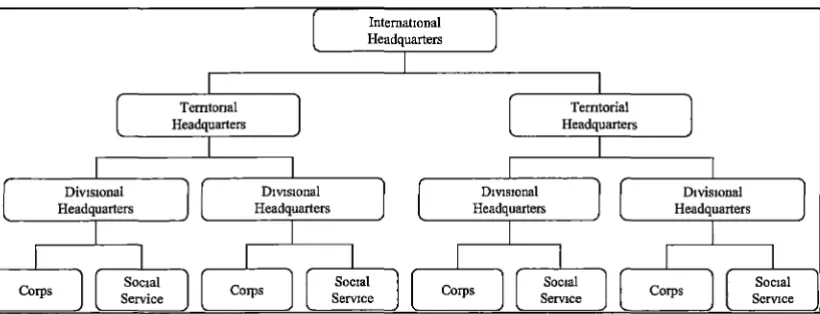
further contextualise the research. An outline of events considered to be significant to the development of the modern day Salvation Army is traced from its founding in East London in the 1860's, through to its work in the trenches with the troops in World War I and II, and the establishment of the Red Shield Appeal in the 1960's. An overview of The Salvation Army is presented according to the elements of unobtrusive power as articulated by Hardy (1985), these being structure, leadership, strategy, symbols, myths, ceremonies, settings, and rituals.
Work in Chapter Five seeks to identify the plausibility of the history constructed in Chapter Four. This is achieved by personal interviews with four Salvationists, and secondary material from one other Salvationist. This seeks to achieve three objectives. Firstly it adds a modern day context to the history constructed in Chapter Four. Secondly, it serves to partially determine the relevance of the history constructed. Finally, it provides an insight into reputation management of internal stakeholders.
Chapter Six looks at the constructions of three other groups of stakeholders - the media, volunteers, and corporate donors. This analysis is undertaken by initially presenting a lens for understanding the relationship between the media and The Salvation Army as constructed from an interview with The Salvation Army's Public Relations Officer for Tasmania. An overview of newspaper articles on The Salvation Army from Tasmania's The Mercury between 1993 and 2005 is then presented. A personal interview with a volunteer for The Salvation Army is also presented, as well as analysis of telephone interviews held with representatives of six corporations who donate funds to The Salvation Army in Australia. The aim of this chapter is once again to determine consistency with Chapters Four and Five.
explores the power in The Salvation Army narrative in a bid to begin to construct an understanding of how The Salvation Army manages its reputation.
Chapter Eight draws the information from the course of the thesis to construct an answer to the central thesis question. It is argued that The Salvation Army manages its reputation through the deliberate use of a powerful and hegemonic narrative. This narrative is effective on three levels. Firstly, it provides an impetus for Salvation Army action in the areas of welfare assistance and evangelism. Secondly, the narrative provides a reputational barrier for The Salvation Army in that it frames an understanding which averts the gaze of key stakeholders. Finally, the narrative serves as a communicative tool, aided by the understanding it has framed for stakeholders, such that stakeholders feel compelled to provide resources to the Salvos.
CHAPTER TWO -THE RESEARCH STRATEGY
Introduction
The Research Strategy Chapter in this thesis represents what is more commonly referred to as the Method. The reasons behind the subtle distinction will be outlined in due course. Suffice to say however that the intention in this chapter is to provide an overview of how the case was constructed and studied, as would be the case in a traditional method chapter. The chapter initially details the adopted ontological and epistemological stance. It is then argued that reputation is a subjective phenomenon, based on perceptions. Hence, the research adopts a constructivist approach to study.
An outline is then presented of how the case was built, concentrating on the sources of information and how these were assimilated into a whole.
Following this, an analysis of the case is outlined. A narrative approach to the study is adopted. This is based on two arguments. Firstly, it is argued that the circumstances in which data was collected have led to the construction of a hegemonic narrative of The Salvation Army. Secondly, it is argued that narrative represents a perfect mechanism for the study of reputation because it embodies the aggregation of artifacts of unobtrusive power such as symbols, myths, rituals, language, ceremonies and settings. Hence, the key to determining how reputation is managed in The Salvation Army is to trace the power of its hegemonic narrative so as to expose the method through which meaning is managed across multiple stakeholders. The process used to undertake this task is a strategy of deconstruction. Deconstruction is then defined, and the steps used to analyse the narrative outlined. Finally, the roles of the researcher and reader in this work are outlined.
Ontological and Epistemological Perspective
the terms of Burrell and Morgan (1975), which mode of theorizing was adopted, and what modus operandi was employed?
Studies of organisation are based on a philosophy of science. This philosophy will have repercussions for the methods which the investigator may use to research the social world. Two assumptions are key. The first are ontological assumptions -concerning the essence of the phenomena of investigation. The second are epistemological assumptions - concerning how knowledge is gained and communicated.
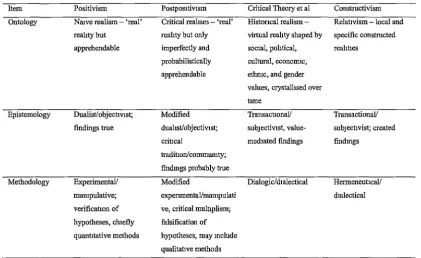
Ontological considerations concern 'reality'. Guba and Lincoln phrase the question researchers must ask as, 'what is the form and nature of reality, and therefore what is there that can be known about it?' (1994, p.108). Burrell and Morgan (1979) base understanding of these questions on a subjective-objective dimension, with researchers treating the nature of reality as being anything from a hard, external, objective reality, to a subjective world based on the experience of individuals.
Epistemological considerations concern how researchers may begin to understand the world and how to communicate this knowledge to others (Burrell & Morgan, 1979). Guba and Lincoln assert that researchers must understand, 'what is the nature between the knower or would-be knower and what can be known?' (1994, p.108). This answer will be constrained by the response to the ontological question, with epistemological beliefs being based on a subjective-objective dimension of anti-positivism-positivism. Positivist epistemologies are based on the assumed existence of an objective reality, in which researchers attempt to verify hypotheses. Anti-positivists base understanding on a relativistic comprehension of the social world, with the aim being to understand the point of view of individuals involved in the environment being studied (Burrell & Morgan, 1979).
acceptance in the literature (Martin & Frost, 1996; Burrell, 1996; Clegg & Hardy, 1996; Guba & Lincoln, 1994).
A paradigm is essential to scientific inquiry. This is because 'no natural history can be interpreted in the absence of at least some implicit body of intertwined theoretical and methodological belief that permits selection, evaluation, and criticism' (Khun, 1962, pp.16-17). A paradigm is what provides this intertwined theoretical and methodological belief by binding scientific communities to their discipline. This is perpetuated by the human life cycle (Burrell, 1996) in that mentors will develop their students to be committed to the same rules and scientific practice as they themselves are. Hence, paradigms bind scientific communities in creating avenues of inquiry, formulating questions, selecting methods for examining the questions, defming areas ofrelevance, and establishing and creating meaning (Pajares, 2006).