i
BEHAVIORAL ANALYSIS OF THERMOELECTRIC MODULE UNDER DIFFERENT CONFIGURATIONS AND TEMPERATURE GRADIENT
LIEW WUN FOO
This Report Is Submitted In Partial Fulfillment Of Requirements For The Bachelor Degree of Electronic Engineering (Industrial Electronics)
Fakulti Kejuruteraan Elektronik dan Kejuruteraan Komputer University Teknikal Malaysia Melaka
ii
UNIVERSTI TEKNIKAL MALAYSIA MELAKA
FAKULTI KEJURUTERAAN ELEKTRONIK DAN KEJURUTERAAN KOMPUTER
BORANG PENGESAHAN STATUS LAPORAN PROJEK SARJANA MUDA II
Tajuk Projek : BEHAVIORAL ANALYSIS OF THERMOELECTRIC MODULE UNDER DIFFERENT CONFIGURATIONS AND TEMPERATURE GRADIENT
Sesi Pengajian
: 1 6 / 1 7
Saya ……….…..LIEW WUN FOO………...………..
mengaku membenarkan Laporan Projek Sarjana Muda ini disimpan di Perpustakaan dengan syarat-syarat kegunaan seperti berikut:
1. Laporan adalah hakmilik Universiti Teknikal Malaysia Melaka.
2. Perpustakaan dibenarkan membuat salinan untuk tujuan pengajian sahaja.
3. Perpustakaan dibenarkan membuat salinan laporan ini sebagai bahan pertukaran antara institusi pengajian tinggi.
4. Sila tandakan ( √ ) :
SULIT* *(Mengandungi maklumat yang berdarjah keselamatan atau
kepentingan Malaysia seperti yang termaktub di dalam AKTA RAHSIA RASMI 1972)
TERHAD** **(Mengandungi maklumat terhad yang telah ditentukan oleh
organisasi/badan di mana penyelidikan dijalankan)
TIDAK TERHAD
Disahkan oleh:
__ ________________________ ___________________________________
(TANDATANGAN PENULIS) (COP DAN TANDATANGAN PENYELIA)
iii
“I hereby declare that the work in this project is my own expect for summaries and quotation which have been duly acknowledge.”
Signature : ……….
iv
“I acknowledge that I have read this report and in my opinion this report is sufficient in term of scope and quality for the award of Bachelor of Electronic Engineering
(Industrial Electronics) with Honors.”
Signature : ……….
v
A very special dedication for my beloved family especially to my parents, Liew Yun Wong and Thong Lee Fung.
vi
ACKNOWLEDGEMENT
By using this opportunity, I would like to express my deepest appreciation to everyone that helping me in completing my final year project and final year project thesis within these two semesters at University Teknikal Malaysia Melaka (UTeM). Specials thanks given to the Faculty of Electronic and Computer Engineering (FKEKK) for providing me sufficient facilities and comfortable place to carry out and complete my final year project.
Next, I would like to express my deepest appreciation to my project supervisor, Dr. Azdiana Binti Md Yusop, who gives me a lot of useful guidance, supervision and encouragement which help a lot in completion of my final year project. Also, Dr. Azdiana helping me to check my grammar mistake and correct me in my final year project presentation slide as well as final year project thesis.
In addition, I would like to express my deepest appreciation to my parents who always support and help me in terms of mentally and physically. They always worry about my healthy and call me frequently to ask for my status during the period of my final year project.
vii
ABSTRACT
Thermoelectric technology is one of the greatest inventions in the field of green technology. It is because thermoelectric technology capable to convert heat energy directly into electrical energy without required external conversion circuit. Also, thermoelectric technology is eco-friendly and it does not emit any polluted substances or gases in its application. There is the only issue that facing by the thermoelectric technology which is its low power generation. Nowadays, applications that use this type of technology are less and limited due to its low power generation. With its low efficiency of power generation, thermoelectric technology is only capable to supply power to low power electronic devices and some niche applications. Therefore, an analysis project is proposed to provide an engineering solution which capable to enhance the efficiency of thermoelectric technology in terms of temperature gradient and output voltage generated. In this paper, an analysis is carried out to analyse the behaviour of thermoelectric module under several arrangements of thermoelectric module. Also, a tested is carried out by using different types of heat sinks in terms of sizes for thermoelectric module to analyse the effect corresponding to its output voltage. It is important to study the relationship between temperature gradient and output voltage of thermoelectric module in order to come out an alternative solution to improve its efficiency of power generation.
viii
ABSTRAK
Teknologi termoelektrik adalah salah satu ciptaan yang paling hebat dalam bidang teknologi hijau. Ia adalah kerana teknologi termoelektrik mampu untuk menukarkan tenaga haba terus kepada tenaga elektrik tanpa memerlukan litar penukaran. Selain itu, teknologi termoelektrik adalah mesra alam dan ia tidak mengeluarkan apa-apa bahan-bahan tercemar atau gas dalam aplikasinya. Terdapat satu-satunya isu yang dihadapi oleh teknologi termoelektrik, ia itu penjanaan kuasa yang rendah. Pada masa kini, aplikasi yang menggunakan jenis teknologi ini kurang dan terhad kerana penjanaan kuasa yang rendah. Dengan menghadapi masalah penjanan kuasa yang rendah, teknologi termoelektrik hanya mampu untuk membekalkan kuasa kepada peranti elektronik yang berkuasa rendah dan beberapa aplikasi am. Oleh itu, projek analisis adalah dicadangkan untuk menyediakan penyelesaian kejuruteraan yang mampu untuk meningkatkan kecekapan teknologi termoelektrik dari segi kecerunan suhu dan voltan output yang dihasilkan. Dalam kertas ini, analisis akan dijalankan untuk menganalisis kelakuan modul termoelektrik dalam beberapa perkiraan modul termoelektrik. Di samping itu, eksperimen telah dijalankan dengan menggunakan pelbagai jenis sinki haba dari segi saiz kepada modul termoelektrik untuk menganalisis kesan yang sepadan dengan voltan output. Adalah penting untuk mengkaji hubungan antara kecerunan suhu dan output voltan modul termoelektrik tujuan untuk mengeluarkan penyelesaian alternatif bagi meningkatkan kecekapan penjanaan kuasa.
ix
TABLE OF CONTENT
CHAPTER TITLE PAGES
PROJECT TITLE i
PROJECT STATUS APPROVAL FOAM ii
DECLARATION iii
SUPERVISOR’S DECLARATION iv
DEDICATION v
ACKNOWLEDGEMENT vi
ABSTRACT vii
ABSTRAK viii
TABLE OF CONTENT ix
LIST OF TABLE xiii
LIST OF FIGURE xv
LIST OF ABBREVIATIONS xx
LIST OF APPENDICES xxi
I INTRODUCTION
1.1 Introduction 1
1.2 Problem Statement 1
1.3 Objectives 2
1.4 Scope of Work 2
1.5 Project Methodology 3
x
II LITERATURE REVIEW
2.1 Waste Heat Energy Harvesting Using Thermoelectric
Generator 6
2.2 Working Principle of Thermoelectric Generator 7 2.3 Thermoelectric System in Different Thermal and
Electrical Configurations 9 2.3.1 TES Thermally and Electrically Connected in
Series (SC-TES) 10
2.3.2 TES Thermally and Electrically Connected in Parallel (PSC-TES) 13 2.3.3 Parallel Thermally and Series Electrical
Connection (SSC-TES) 15 2.3.4 Comparison between Three Types of Different
Configurations of TES 18 2.4 Relationship between Temperature Gradient and
Output Voltage of Thermoelectric Module 19 2.5 Application Using Thermoelectric Module 21 2.6 Heat Sink and Cooling System for Thermoelectric
Module 23
2.7 Chapter Summary 25
III METHODOLOGY
3.1 Thermoelectric Module (TEM) 26
3.2 Heat Sink 28
3.3 Different Arrangements of Thermoelectric Module
Configuration 30
3.3.1 Thermally and Electrically Connected in Series
(TSES) 31
3.3.2 Thermally and Electrically Connected in Parallel
xi 3.3.3 Thermally Connected in Parallel and Electrically
Connected in Series (TPES) 32 3.3.4 Thermally Connected in Series and Electrically
Connected in Parallel (TSEP) 33 3.4 Temperature Gradient Measurement between Both
Sides of Thermoelectric Module 34 3.5 Output Voltage Measurement of Thermoelectric
Module 36
3.6 Completed Set-up of the Analysis Project 37
3.7 Chapter Summary 38
IV RESULT AND DISCUSSION
4.1 First Stage Analysis: Behaviour of Thermoelectric
Module in Several Arrangements of Configuration 39 4.1.1 Thermally and electrically connected in series
(TSES) 40
4.1.1.1 First Set: Two Thermoelectric Modules 40 4.1.1.2 Second Set: Four Thermoelectric
Modules 42
4.1.2 Thermally and Electrically Connected in Parallel
(TPEP) 44
4.1.2.1 First Set: Two Thermoelectric Modules 44 4.1.2.2 Second Set: Four Thermoelectric
Modules 46
4.1.3 Thermally Connected in Parallel and Electrically Connected in Series (TPES) 48 4.1.3.1 First Set: Two Thermoelectric Modules 48 4.1.3.2 Second Set: Four Thermoelectric
Modules 50
xii 4.1.4.1 First Set: Two Thermoelectric Modules 52 4.1.4.2 Second Set: Four Thermoelectric
Modules 54
4.2 Second Stage Analysis: Comparison between Thermal in Series and Thermal in Parallel Connection of TEM 56 4.2.1 Thermal in Series Connection of Thermoelectric
Module 57
4.2.2 Thermal in Parallel Connection of Thermoelectric
Module 59
4.3 Final Stage Analysis: Comparison between TSES
Configuration and TPES Configuration 61 4.4 Analysis the Effect of Different Types of Heat Sinks
on the Output Voltage of Thermoelectric Module 62
4.5 Chapter Summary 67
V CONCLUSION AND RECOMMENDATION
5.1 Conclusion 68
5.2 Recommendation 69
REFERENCES 70
xiii
LIST OF TABLE
NUMBER TITLE PAGES
Table 2.1: Numerical values of Zeq and ηeq in each equivalent thermoelectric system for different arrangements of
the TE-materials [13] 18
Table 4.1: Analysis data of two TEMs connected in TSES
configuration 42
Table 4.2: Analysis data of four TEMs connected in TSES
configuration 44
Table 4.3: Analysis data of two TEMs connected in TPEP
configuration 46
Table 4.4: Analysis data of four TEMs connected in TPEP
configuration 48
Table 4.5: Analysis data of two TEMs connected in TPES
configuration 50
Table 4.6: Analysis data of four TEMs connected in TPES
configuration 52
Table 4.7: Analysis data of two TEMs connected in TSEP
configuration 54
Table 4.8: Analysis data of four TEMs connected in TSEP
xiv Table 4.9: Analysis data of thermal in series connection of TEM 58
Table 4.10: Analysis data of thermal in parallel connection of TEM 60 Table 4.11: The actual size of heat sinks used in terms of width, length
and height 62
Table 4.12: Analysis data of the effect of different types of heat sinks
xv
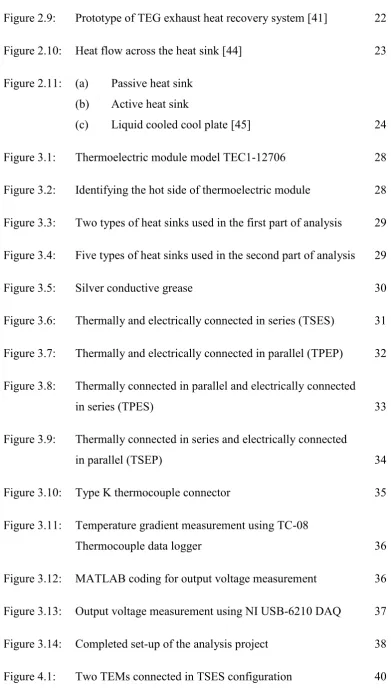
LIST OF FIGURE
NUMBER TITLE PAGES
Figure 1.1: Analysis methodology 4 Figure 2.1: Waste heat energy harvesting using thermoelectric
generator [3] 7
Figure 2.2: Working principle of thermoelectric generator [7] 8 Figure 2.3: Thermoelectric generator segmented, each p-type or n-type
branch consists of two different materials [13] 10 Figure 2.4: (a) TES (two-stages) thermally and electrically connected
in series (SC-TES)
(b) Pratical device related to SC-TES [13] 11 Figure 2.5: (a) Segmented-conventional TES thermally and electrically
connected in parallel thermoelectric system (PSC-TES) (b) Practical device related to PSC-TES [13][21] 14 Figure 2.6: (a) Mixed segmented-conventional TES thermally connected in parallel and electrically connected in series (SSC-TES) (b) Practical device related to SSC-TES [13][25] 16 Figure 2.7: (a) Interconnection of P-N couple of thermoelectric module
(b) Infrared image of temperature flow across hot side to cold side of thermoelectric module [35] 20 Figure 2.8: Temperature gradient and output voltage of thermoelectric
xvi Figure 2.9: Prototype of TEG exhaust heat recovery system [41] 22
Figure 2.10: Heat flow across the heat sink [44] 23 Figure 2.11: (a) Passive heat sink
(b) Active heat sink
(c) Liquid cooled cool plate [45] 24 Figure 3.1: Thermoelectric module model TEC1-12706 28 Figure 3.2: Identifying the hot side of thermoelectric module 28 Figure 3.3: Two types of heat sinks used in the first part of analysis 29 Figure 3.4: Five types of heat sinks used in the second part of analysis 29 Figure 3.5: Silver conductive grease 30 Figure 3.6: Thermally and electrically connected in series (TSES) 31 Figure 3.7: Thermally and electrically connected in parallel (TPEP) 32 Figure 3.8: Thermally connected in parallel and electrically connected
in series (TPES) 33
Figure 3.9: Thermally connected in series and electrically connected
in parallel (TSEP) 34
Figure 3.10: Type K thermocouple connector 35
Figure 3.11: Temperature gradient measurement using TC-08
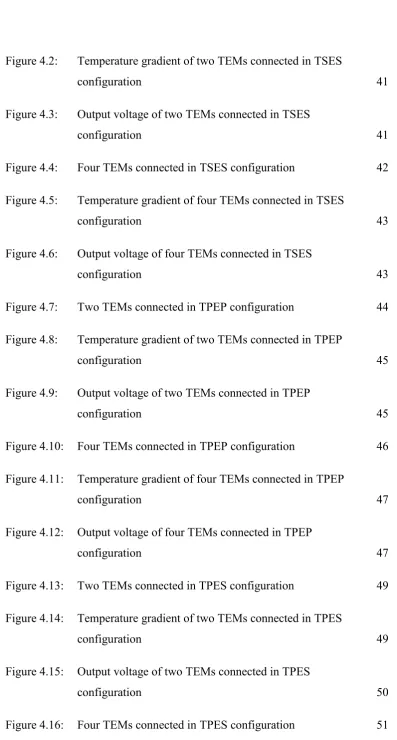
xvii Figure 4.2: Temperature gradient of two TEMs connected in TSES
configuration 41
Figure 4.3: Output voltage of two TEMs connected in TSES
configuration 41
Figure 4.4: Four TEMs connected in TSES configuration 42 Figure 4.5: Temperature gradient of four TEMs connected in TSES
configuration 43
Figure 4.6: Output voltage of four TEMs connected in TSES
configuration 43
Figure 4.7: Two TEMs connected in TPEP configuration 44 Figure 4.8: Temperature gradient of two TEMs connected in TPEP
configuration 45
Figure 4.9: Output voltage of two TEMs connected in TPEP
configuration 45
Figure 4.10: Four TEMs connected in TPEP configuration 46 Figure 4.11: Temperature gradient of four TEMs connected in TPEP
configuration 47
Figure 4.12: Output voltage of four TEMs connected in TPEP
configuration 47
Figure 4.13: Two TEMs connected in TPES configuration 49 Figure 4.14: Temperature gradient of two TEMs connected in TPES
configuration 49
Figure 4.15: Output voltage of two TEMs connected in TPES
[image:17.595.108.506.17.758.2]configuration 50
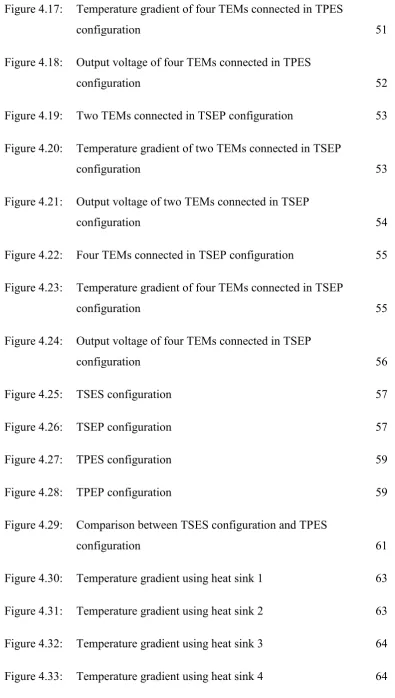
xviii Figure 4.17: Temperature gradient of four TEMs connected in TPES
configuration 51
Figure 4.18: Output voltage of four TEMs connected in TPES
configuration 52
Figure 4.19: Two TEMs connected in TSEP configuration 53 Figure 4.20: Temperature gradient of two TEMs connected in TSEP
configuration 53
Figure 4.21: Output voltage of two TEMs connected in TSEP
configuration 54
Figure 4.22: Four TEMs connected in TSEP configuration 55 Figure 4.23: Temperature gradient of four TEMs connected in TSEP
configuration 55
Figure 4.24: Output voltage of four TEMs connected in TSEP
configuration 56
Figure 4.25: TSES configuration 57 Figure 4.26: TSEP configuration 57 Figure 4.27: TPES configuration 59 Figure 4.28: TPEP configuration 59
Figure 4.29: Comparison between TSES configuration and TPES
configuration 61
xix Figure 4.34: Temperature gradient using heat sink 5 65
Figure 4.35: The effect of different types of heat sinks on the output
xx
LIST OF ABBREVIATIONS
TES - Thermoelectric System TEG - Thermoelectric Generator TEM - Thermoelectric Module DC - Direct Current
SC-TES - TES Thermally and Electrically Connected in Series PSC-TES - TES Thermally and Electrically Connected in Parallel SSC-TES - Parallel Thermally and Series Electrical Connection ICE - Internal Combustion Engine
TSES - Thermally and Electrically Connected in Series TPEP - Thermally and Electrically Connected in Parallel
TPES - Thermally Connected in Parallel and Electrically Connected in Series
xxi
LIST OF APPENDICES
NUMBER TITLE PAGES
A Project Planning (Gantt Chart) 75
1
CHAPTER I
INTRODUCTION
1 HEADING 3
This chapter will discuss the introduction of the analysis project. There are some sub-topics that will be discusses regarding to the analysis, which is the introduction of the project, problem statement, objective of the analysis, scope of work, project methodology and thesis outline.
1.1 Introduction
Thermoelectric is one of the greatest inventions in green technology. One of the useful features in thermoelectric technology is that the electrical energy is converted directly from heat energy through thermoelectric device without required external electronic devices in the conversion process. Although thermoelectric technology is convenient to use but still the applications using this type of technology are very limited due to its low voltage and low power generated. Therefore, an analysis was carried out to study the behaviour of thermoelectric module under different configuration and temperature gradient in order to obtain the high output voltage and high power generation. Also, an analysis was carried out to study the effect of different types of heat sinks on the output voltage of thermoelectric module.
1.2 Problem Statement
2 and limited in the market because the output voltage and output power generated by thermoelectric device is significantly low and unsustainable. The low output voltage and output power generated by the thermoelectric device is sufficient to supply only to low power electronic devices. In order to widely implement thermoelectric technology in high power electronic devices, an analysis must be carried out to investigate the best way to generate high output voltage and output power as well as high sustainable voltage supplied.
1.3 Objectives
The objectives of the analysis are:
a. To analyse the behaviour of thermoelectric module in several arrangements of thermoelectric module configuration.
b. To analyse the effect of different types of heat sinks on the output voltage of thermoelectric module.
c. To analyse the relationship between the temperature gradient and its corresponding output voltage of thermoelectric module.
1.4 Scope of Work
This project consists of two parts of analysis: first part is to analyse the behaviour of thermoelectric module in several arrangements of thermoelectric module configuration; second part is to analyse the effect of different types of heat sinks on the output voltage of thermoelectric module.
3 arrangements of configuration. The heat energy is generated from the hot plate as the heat source for thermoelectric module to generate output voltage with temperature of 100°C within 30 minutes. Due to the limitation operation temperature of the thermoelectric module, the analysis is carried out with temperature of the hot plate set to 100°C for four different arrangements of configuration in order to avoid the malfunction of thermoelectric module.
In the second part of the analysis, total of five types of heat sinks are used to analyse the effect of different types of heat sinks on the output voltage of thermoelectric module. Based on the result of the analysis in the first part, the best thermoelectric configuration is chosen to carry on into the second part of analysis. The analysis is carried out with temperature of the hot plate set to 100°C within 15 minutes for all five types of heat sinks. The minimum time taken for thermoelectric module to achieve equilibrium is around 15 minutes. Therefore, the time taken for this analysis is only set to 15 minutes in order to analyse the different temperature gradient obtained from the different types of heat sinks.
1.5 Project Methodology
An analysis is carried out to study which is the best thermoelectric module configurations in terms of temperature gradient and output voltage. The four types of thermoelectric module configurations are thermally and electrically connected in series; thermally and electrically connected in parallel; thermally connected in parallel and electrically connected in series; thermally connected in series and electrically connected in parallel. A hot plate was used which act as a heat source to supply heat energy for thermoelectric modules to convert it into electrical energy. The temperature was set to 100°C and sample was recorded within 30 minutes for all four types of thermoelectric module configurations. For the analysis of the effect of different types of heat sinks on the output voltage of thermoelectric module, the temperature of hot plate is set to 100°C and sample is recorded within 15 minutes for all five types of heat sinks.