The Brain Injury Personality Scale
M.C. Obonsawin, S. Jefferis and J.R. Crawford
Developed with a grant from the National Lottery Charities Board to Rehab Scotland and the University of Strathclyde, in conjunction with Rehab UK and the
The Brain Injury Personality Scale
SECTION 1 Manual
SECTION 2 Interview with the client
SECTION 3 Description of items for the Interview with the client
SECTION 4 Interview with the significant other
SECTION 5 Description of items for the interview with the significant other
The Brain Injury Personality Scale
Manual
M.C. Obonsawin, S. Jefferis and J.R. Crawford
Developed with a grant from the National Lottery Charities Board to Rehab Scotland and the University of Strathclyde, in conjunction with Rehab UK and the
CONTENTS
1 INTRODUCTION 1
1.1 The structure of the scales 1
1.2 How is the information gathered? 1
2 INTERVIEWS & OBSERVATIONS 3
2.1 Using the semi-structured interview schedule 3
2.2 Making observations 4
2.3 Boundaries and sensitive topics 5
2.4 Audio recording and note-taking 6
3 USING THE RATING SCALES 6
3.1 Interviews with brain-injured clients 6
3.2 Interviews with significant others 6
3.3 Rating criteria (0-5 ratings) 6
4 SCORING THE INTERVIEWS 10
5 TABLES TO TRANSFORM RAW TO SCALED SCORES 11
1 INTRODUCTION
The Brain Injury Personality Scale is designed to provide a profile of the behavioural and emotional difficulties of individuals with brain injury. It is commonly acknowledged that in addition to the cognitive impairments often seen after brain injury, a range of behavioural and emotional – or “personality” – changes may arise. These changes may lead to difficulties in adjustment, but are often overlooked, and there is little understanding of why they occur and how they can best be managed.
1.1 The structure of the scales
There are two Brain Injury Personality Scales: the client scale and the significant other scale. The client version of the BIPS has 103 questions to allow the assessor to rate 29 items. These 29 items are used to calculate scores on seven different dimensions. These seven dimensions were identified by factor analysis. The significant other version of the BIPS has 98 questions to allow the assessor to rate 31 items. These 31 items are used to calculate scores on seven different dimensions also identified by factor analysis.
The items on both scales were drawn from an original pool of 112 items describing behaviours or personality features reported to be a consequence of brain injury. These 112 items were obtained from several sources:
the literature on brain injury and personality change
suggestions from staff working in brain injury rehabilitation, and clients with brain injury
existing scales for the assessment of symptoms of schizophrenia.
Each item is rated on a scale from zero to five. A score of zero indicates that the attribute is absent, and a score of five indicates that the attribute is present, to a severe degree. Scores between zero and five indicate varying degrees of severity, described in detail in Sections 3 and 5.
1.2 How is the information gathered?
In order to gather information to make the ratings, a semi-structured interview is carried out. You can carry out the interview either with the brain-injured client, or their significant other. You will gather the most information by carrying out both interviews.
The semi-structured interview is guided by specific questions related to the items on the scale. Different questions will be used for the client and their significant other. For instance, to gather information to rate the item “Quick Temper”, a client might be asked
2
While, for the same item, a significant other might be asked
Does s/he ever lose his or her temper?
For this reason, there are separate semi-structured interviews for the client and the significant other. It is intended that the questions in these interview schedules are used only as a starting point – in order to gather the richest possible information, additional questions will need to be used depending on the situation, so that the interview is more like a conversation than a “question-and-answer” session.
In addition to the verbal information gained from interviews, ratings should also be made on the basis of observations made during the interview. For instance, in order to rate “Quick Temper” for the client interview, the scorer should consider whether the client lost his or her temper or seemed to become angry at all during the interview. For the most part, the relevant observations should be clear from the item descriptions used in rating, but in addition, scorers should ask themselves the observation questions after completing the interview. All the relevant questions are listed under each item in the rating scale itself.
2 INTERVIEWS & OBSERVATIONS
At the start of all interviews, the interviewer should
give a brief explanation of the purpose of the interview to the client or the significant other,
reiterate that the interviewer will be asking questions about how things have been in the last three months,
give an estimate of how long the interview will last,
remind clients that any information given is confidential,
mention that it would be appreciated if the client can be as frank as possible, but has the right not to answer any question he or she does not wish to, and
ask whether the client has any questions.
2.1 Using the semi-structured interview schedule
Question schedules are available for both the client and significant other interviews. These questions are based on the personality change items that make up the scale, but are intended only as a starting point for gathering the necessary information. In many cases, in order to make an accurate rating for an item, additional questions will be necessary. For instance, consider this question asked of a significant other:
Does s/he help out at home very much?
If s/he answers “No”, we need to know more about it to make a rating on the item “Dependence”. This information might be elicited with follow-up questions such as:
Does s/he tend to rely on other people to do things for him or her? What kind of things does s/he rely on other people for?
Does s/he want to become more independent?
Answers to these extra questions should allow the interviewer to ascertain how severe the problem is, how frequently it happens and how much it interferes with the client’s functioning. In most cases it will be appropriate to ask these additional questions for most items on which clients give a positive response.
There are also circumstances where it may not be appropriate to ask all of the questions on the interview schedule. For instance, if a significant other has responded that the client never loses his or her temper, it would not be necessary then to ask if s/he becomes aggressive having lost his or her temper.
4
whether they have enough information to score each item, or whether they need to ask more questions relating to that item.
The interview is structured so that one topic should lead naturally on to the next, with occasional changes of subject. This structure is intended to be fluid, so that questions do not necessarily have to be tackled in the stated order. However, interviewers should be certain that they have gathered enough information at the end of the interview to score each item on the scale.
2.2 Making observations
For interviews with clients themselves, most items on the scale are scored on the basis of both information given by the client, and observations made during the interview. For instance, for the item “Criticism of others”, a score would be made with reference to answers to questions such as:
What do you think of the other people at your work (or college)?
and by thinking about how critical the client seemed during the interview. The interviewer then uses his or her judgement to score the item. Even if the person didn’t report being critical of his or her workmates, but seemed very critical during the interview, a positive rating would be made for “Criticism of others”.
Familiarity with the scale items will be useful when thinking about what to look out for during the interview. For most items, the kind of observations that are relevant should be self-evident. However, for some items, some cues have been provided for interviewers. These cues take the form of questions about specific behaviours during the interview that the interviewer can consider when scoring the items. For instance, one such question for the item “Depressiveness” is:
How was his or her mood during the interview?
These questions are intended only as a simple guide to the kind of observations that may be relevant. Interviewers should use their own judgement in making the ratings if observations and information from the client seem to contradict one another. It may be relevant to consider the circumstances in which the interview is taking place – e.g. is the interview taking place at the end of the day or week? Has the client told you about recent stressful events that may colour their responses?
2.3 Boundaries and sensitive topics
could cause distress or difficulty to the client or other people, and/or
reveal actual or potential harm to the client or other people.
It is not possible to specify responses for every situation that the interviewer may encounter, but the following should be considered guidelines for difficult situations.
If the client is talking about a difficult topic, understanding and sensitivity will always be important.
If a topic is raised that is important to the client or is causing distress, it may be more appropriate for the client to take the issue further with another person (for example, a member of the rehabilitation team). Interviewers may encourage the client to do this.
If such a course of action is agreed between interviewer and client, the interviewer should let the relevant member of the rehabilitation team know that the client will be approaching them, without breaking confidences.
Wherever possible, if an interviewer or respondent feels an issue should be taken further outside of the interview, possible courses of action should be discussed with the respondent and an agreement reached about what to do next.
If an interview reveals significant risk of harm to the client or others, the interviewer has a responsibility to ensure that the issue is either currently being addressed elsewhere, or that appropriate others involved with the client’s case are fully aware of the problem. Wherever possible this should be done with the agreement and involvement of the client, but where this is not possible and the risk of harm is significant, someone in authority should be informed.
At the end of the interview, interviewers should reiterate that the client may contact the interviewer afterwards to discuss anything further if they wish.
2.4 Audio recording & note taking
6
3 USING THE RATING SCALES
3.1 Interviews with brain-injured clients
Information to be used in these ratings comes from two sources:
Information given during interview
Observations made during the interview
For each item, relevant interview and observation questions are listed under the item in the scoring guide.
3.2 Interviews with a significant other
Information to be used in these ratings will likely come mainly from the questions in the interview. For each item, relevant interview questions are listed under the item in the scoring guide.
3.3 Rating criteria
For each item, choose one score between 0 and 5. Try not to omit any items.
All information refers to how the person has been in the last 3 months.
Each item on the scale has its own descriptions of the ratings from 0 to 5. These should be followed when making the ratings and the descriptions given here are a general guide only. Where descriptions of frequency are used in the ratings, use the following guidelines:
Occasionally – less than once a month
Sometimes / Often – at least once a month, but less than once a week
Frequently – once a week, or more frequently
If you are in any doubt about which rating to use, in addition to the description given with the item, consider the extent to which the feature:
affected your own interaction with the client
interferes with the client’s every-day functioning
0 = None
The feature has not been present at all in the last 3 months.
1 = Questionable
One or more of the following should apply:
the feature may be present, but there is not enough evidence to merit a higher rating,
observations from the interview suggest the feature may be present, but you are not sure,
information from the carers suggests that the feature may be a problem, but the information is sketchy or uncertain.
it is unclear whether the evidence (from observation or either interview) is due to the presence of this feature or to something else (e.g. physical or cognitive impairment, or other personality factors)
2 = Mild
A score of 2 should be entered if the feature in question:
has definitely been present in the last 3 months, but only occasionally, and does not interfere to a large extent with the client’s every-day functioning, or
has definitely been present in the last 3 months, but only to a mild degree, and does not interfere to a large extent with the client’s every-day functioning.
Generally, score a 2 if the feature seems to be present but is not a dominant characteristic of the client’s personality, and does not result in significant interference with the client’s life. Features scoring 2 are also likely to cause a little concern for carers or relatives who have close contact with the client, but not considerable difficulty or stress.
3 = Moderate
A score of 3 should be entered if:
the feature has occurred sometimes (more than once a month, but less than once a week, on average) in the last three months, enough to be a noticeable feature of the client’s personality, and
there are times when the feature is not present, and
8
Generally, score a 3 if the feature is considered to be a problem, but not enough to
dominate that client’s interactions with others, or to severely impair his or her functioning. Features scoring 3 are likely to cause a moderate degree of stress for carers or relatives who have close contact with the client.
4 = Marked
A score of 4 should be entered if either of the following applies:
the feature has occurred frequently over the last 3 months (defined as more than once a week, on average), or
the feature has occurred less frequently, but has caused considerable interference with the client’s everyday functioning.
For instance, the feature may prevent the client from taking part in social activities, finding work, living independently, etc. Generally, score a 4 if the feature is a conspicuous characteristic of the client’s personality, or results in considerable interference with the client’s life. Features scoring 4 are also likely to cause considerable stress for carers or relatives who have close contact with the client.
5 = Severe
A score of 5 should be entered if any of the following apply:
the feature appears to dominate the client’s life or interactions with other people
the feature has occurred with a very high frequency, or almost all the time during the last 3 months
the feature occurs less often, but with great severity (e.g. occasional outbursts of significant physical aggression)
the feature has significantly threatened the person’s environment (e.g. anger has led to exclusion from a rehabilitation programme or workplace),
the feature places the client at risk of significant harm or exploitation
the feature causes constant, significant stress for the client’s relatives or carers
the feature interferes greatly with the client’s functioning, or
4 SCORING THE INTERVIEWS
In addition to the Manual, the BIPS consists of the Interview with the Client, and the Interview with the Significant Other. Each interview consists of a series of leading questions, a description of each item, a description of how to score each item on the 6-point scale, and Score Sheets.
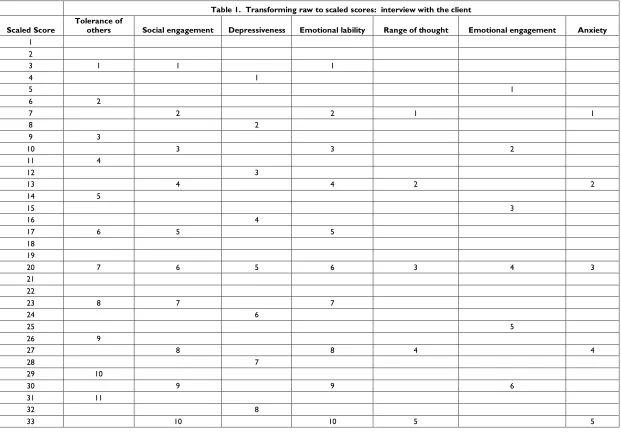
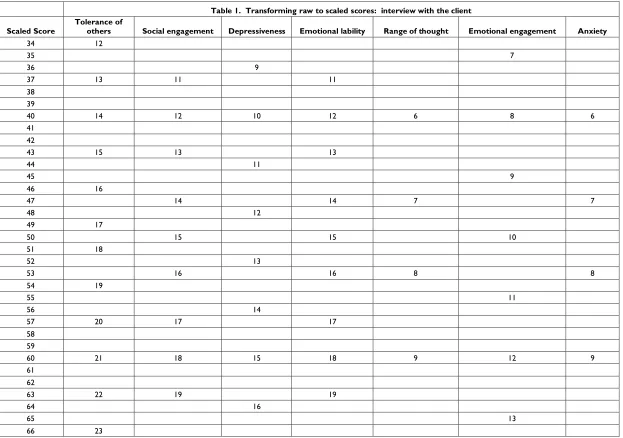
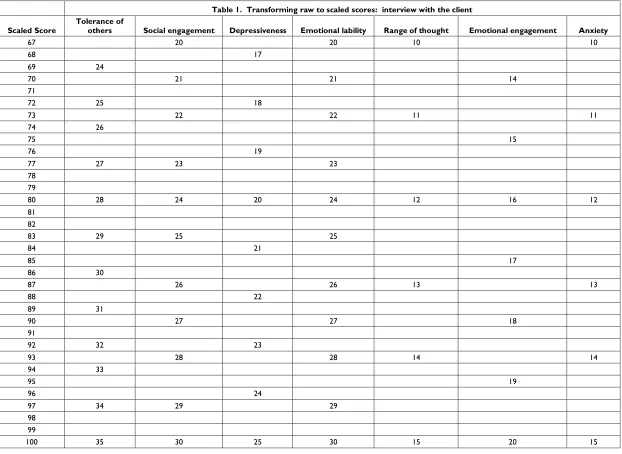
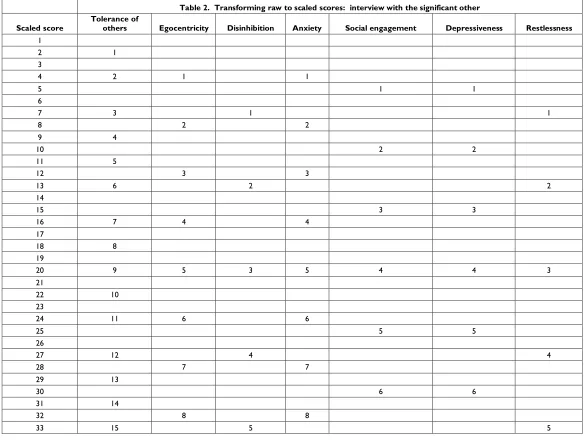
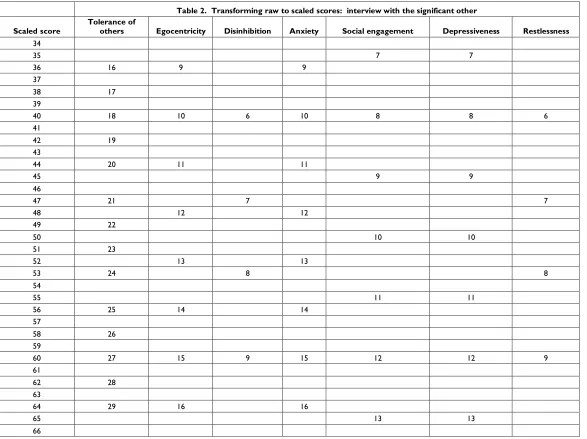
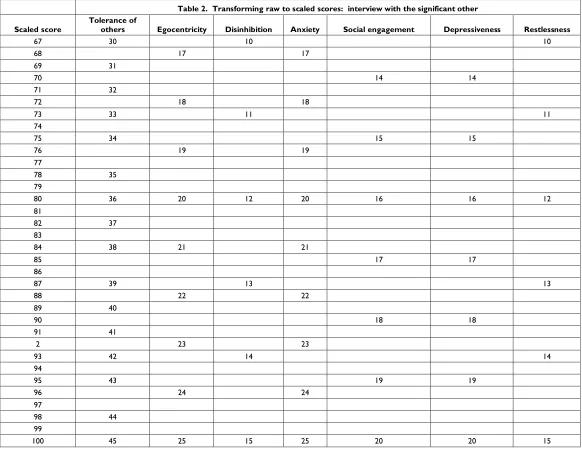
When scoring the interview, the raw score for each item can be entered on the appropriate Score Sheet. The raw score for each dimension is then calculated by summing up the raw scores of the individual items that make up the dimension. The raw score for each dimension is then entered on the Score Sheet. Because the raw score for each dimension is calculated on the basis of a different number of items, the raw scores of different dimensions cannot be compared. For example, the raw score of Depressiveness cannot be compared to the raw score of Range of Thought, because four items are added to determine the score on Depressiveness, but only three items are added to determine the score on Range of Thought. To facilitate comparison, you should transform the raw score pf each dimension to a scaled score ranging from 1 to 100. To obtain a scaled score for each dimension, use the appropriate table in this Manual, either
Table 1. Transforming raw to scaled scores: interview with the client, or
Table 2. Transforming raw to scaled scores: interview with the significant other.
10
Table 1. Transforming raw to scaled scores: interview with the client
Scaled Score Tolerance of others Social engagement Depressiveness Emotional lability Range of thought Emotional engagement Anxiety 1
2
3 1 1 1
4 1
5 1
6 2
7 2 2 1 1
8 2
9 3
10 3 3 2
11 4
12 3
13 4 4 2 2
14 5
15 3
16 4
17 6 5 5
18 19
20 7 6 5 6 3 4 3
21 22
23 8 7 7
24 6
25 5
26 9
27 8 8 4 4
28 7
29 10
30 9 9 6
31 11
32 8
12
Table 1. Transforming raw to scaled scores: interview with the client
Scaled Score Tolerance of others Social engagement Depressiveness Emotional lability Range of thought Emotional engagement Anxiety
34 12
35 7
36 9
37 13 11 11
38 39
40 14 12 10 12 6 8 6
41 42
43 15 13 13
44 11
45 9
46 16
47 14 14 7 7
48 12
49 17
50 15 15 10
51 18
52 13
53 16 16 8 8
54 19
55 11
56 14
57 20 17 17
58 59
60 21 18 15 18 9 12 9
61 62
63 22 19 19
64 16
65 13
Table 1. Transforming raw to scaled scores: interview with the client
Scaled Score Tolerance of others Social engagement Depressiveness Emotional lability Range of thought Emotional engagement Anxiety
67 20 20 10 10
68 17
69 24
70 21 21 14
71
72 25 18
73 22 22 11 11
74 26
75 15
76 19
77 27 23 23
78 79
80 28 24 20 24 12 16 12
81 82
83 29 25 25
84 21
85 17
86 30
87 26 26 13 13
88 22
89 31
90 27 27 18
91
92 32 23
93 28 28 14 14
94 33
95 19
96 24
97 34 29 29
98 99
14
Table 2. Transforming raw to scaled scores: interview with the significant other
Scaled score Tolerance of others Egocentricity Disinhibition Anxiety Social engagement Depressiveness Restlessness 1
2 1
3
4 2 1 1
5 1 1
6
7 3 1 1
8 2 2
9 4
10 2 2
11 5
12 3 3
13 6 2 2
14
15 3 3
16 7 4 4
17
18 8
19
20 9 5 3 5 4 4 3
21
22 10
23
24 11 6 6
25 5 5
26
27 12 4 4
28 7 7
29 13
30 6 6
31 14
32 8 8
Table 2. Transforming raw to scaled scores: interview with the significant other
Scaled score Tolerance of others Egocentricity Disinhibition Anxiety Social engagement Depressiveness Restlessness 34
35 7 7
36 16 9 9
37
38 17
39
40 18 10 6 10 8 8 6
41
42 19
43
44 20 11 11
45 9 9
46
47 21 7 7
48 12 12
49 22
50 10 10
51 23
52 13 13
53 24 8 8
54
55 11 11
56 25 14 14
57
58 26
59
60 27 15 9 15 12 12 9
61
62 28
63
64 29 16 16
65 13 13
16
Table 2. Transforming raw to scaled scores: interview with the significant other
Scaled score Tolerance of others Egocentricity Disinhibition Anxiety Social engagement Depressiveness Restlessness
67 30 10 10
68 17 17
69 31
70 14 14
71 32
72 18 18
73 33 11 11
74
75 34 15 15
76 19 19
77
78 35
79
80 36 20 12 20 16 16 12
81
82 37
83
84 38 21 21
85 17 17
86
87 39 13 13
88 22 22
89 40
90 18 18
91 41
2 23 23
93 42 14 14
94
95 43 19 19
96 24 24
97
98 44
99
18
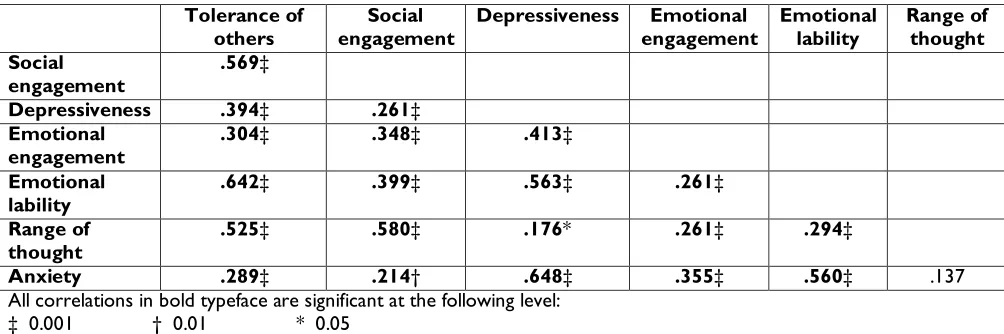
Table 3. Pearson correlations between factors from the same interview: Interview with the client
Tolerance of others
Social engagement
Depressiveness Emotional engagement Emotional lability Range of thought Social
engagement .569‡
Depressiveness .394‡ .261‡
Emotional engagement
.304‡ .348‡ .413‡
Emotional lability
.642‡ .399‡ .563‡ .261‡
Range of
thought .525‡ .580‡ .176* .261‡ .294‡
Anxiety .289‡ .214† .648‡ .355‡ .560‡ .137
All correlations in bold typeface are significant at the following level:
‡ 0.001 † 0.01 * 0.05
Table 4. Pearson correlations between factors from the same interview: Interview with the significant other
Tolerance of others
Egocentricity Depressiveness Social engagement
Anxiety Disinhibition
Egocentricity .702‡
Depressiveness .389‡ .259‡
Social
engagement .342‡ .373‡ .336‡
Anxiety .499‡ .312‡ .702‡ .372‡
Disinhibition .620‡ .485‡ .308* .307‡ .395‡
Restlessness .482‡ .361† .393‡ .374‡ .453‡ .406‡
Table 5. Pearson correlations of factors from different interviews
Interview with the significant
other
Interview with the client Tolerance of
others engagement Social Depressiveness engagement Emotional Anxiety Emotional lability Range of thought
Tolerance of others
.543 .461 .215 .307 .167 .439 .382
Egocentricity .347 .434 .100 .299 .040 .226 .340
Depressiveness .245 .202 .503 .355 .355 .365 .206
Social engagement
.175 .357 .097 .360 .208 .201 .339
Anxiety .225 .245 .422 .347 .485 .490 .277
Restlessness .265 .315 .195* .124 .201 .388 .273
Disinhibition .476 .419 .162 .184 .146 .374 .441
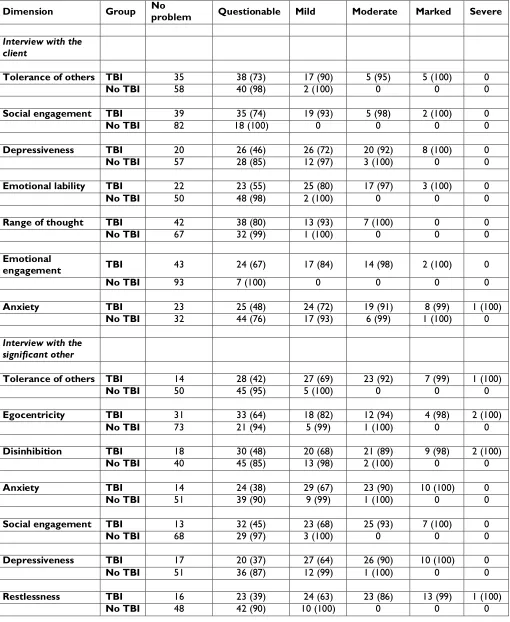
Table 6. Percentage of sample (cumulative percentage in parentheses) at each level of severity for each dimension
Dimension Group No problem Questionable Mild Moderate Marked Severe
Interview with the client
Tolerance of others TBI 35 38 (73) 17 (90) 5 (95) 5 (100) 0
No TBI 58 40 (98) 2 (100) 0 0 0
Social engagement TBI 39 35 (74) 19 (93) 5 (98) 2 (100) 0
No TBI 82 18 (100) 0 0 0 0
Depressiveness TBI 20 26 (46) 26 (72) 20 (92) 8 (100) 0
No TBI 57 28 (85) 12 (97) 3 (100) 0 0
Emotional lability TBI 22 23 (55) 25 (80) 17 (97) 3 (100) 0
No TBI 50 48 (98) 2 (100) 0 0 0
Range of thought TBI 42 38 (80) 13 (93) 7 (100) 0 0
No TBI 67 32 (99) 1 (100) 0 0 0
Emotional
engagement TBI 43 24 (67) 17 (84) 14 (98) 2 (100) 0
No TBI 93 7 (100) 0 0 0 0
Anxiety TBI 23 25 (48) 24 (72) 19 (91) 8 (99) 1 (100)
No TBI 32 44 (76) 17 (93) 6 (99) 1 (100) 0
Interview with the significant other
Tolerance of others TBI 14 28 (42) 27 (69) 23 (92) 7 (99) 1 (100)
No TBI 50 45 (95) 5 (100) 0 0 0
Egocentricity TBI 31 33 (64) 18 (82) 12 (94) 4 (98) 2 (100)
No TBI 73 21 (94) 5 (99) 1 (100) 0 0
Disinhibition TBI 18 30 (48) 20 (68) 21 (89) 9 (98) 2 (100)
No TBI 40 45 (85) 13 (98) 2 (100) 0 0
Anxiety TBI 14 24 (38) 29 (67) 23 (90) 10 (100) 0
No TBI 51 39 (90) 9 (99) 1 (100) 0 0
Social engagement TBI 13 32 (45) 23 (68) 25 (93) 7 (100) 0
No TBI 68 29 (97) 3 (100) 0 0 0
Depressiveness TBI 17 20 (37) 27 (64) 26 (90) 10 (100) 0
No TBI 51 36 (87) 12 (99) 1 (100) 0 0
Restlessness TBI 16 23 (39) 24 (63) 23 (86) 13 (99) 1 (100)
20
Table 7. The median and mean scores (± SD) on each dimension for the client and control groups. A Mann-Whitney U test was used to test the difference between the two groups.
Dimension TBI No TBI U Significance
Mean ±
SD Median Mean ± SD Median Interview with the
client
Tolerance of
others 22.1 ± 20.7 17.2 9.3 ±8.3 8.6 4036 <0.001 Social engagement 21.8 ±19.0 16.7 6.4 ±6.2 6.7 3051 <0.001
Depressiveness 34.8 ±23.5 32.0 14.3 ±15.3 8.0 3703 <0.001
Emotional lability 30.8 ±21.7 26.6 12.5 ±10.2 11.7 3879 <0.001
Range of thought 17.4 ±17.7 13.3 5.6 ±8.3 0.0 4349 <0.001
Emotional
engagement 24.1 ±21.5 20.0 2.7 ±8.8 0.0 2693 <0.001 Anxiety 33.5 ±25.0 33.4 18.7 ±17.8 13.3 4951 <0.001
Interview with the significant other
Tolerance of
others 37.6 ±23.2 37.7 12.3 ±10.2 9.0 2611 <0.001 Egocentricity 26.6 ±24.0 20.0 7.7 ±11.7 0.0 3638 <0.001
Disinhibition 35.1 ±26.3 33.4 14.3 ±14.4 13.3 4090 <0.001
Anxiety 37.9 ±23.5 40.0 12.5 ±12.7 8.0. 2753 <0.001
Social engagement 38.8 ±23.1 40.0 9.2 ±10.3 10.0 2050 <0.001
Depressiveness 40.4 ±24.6 40.0 15.2 ±15.0 10.0 3182 <0.001
Restlessness 38.9 ±25.5 40.0 11.2 ±12.3 13.3 2768 <0.001
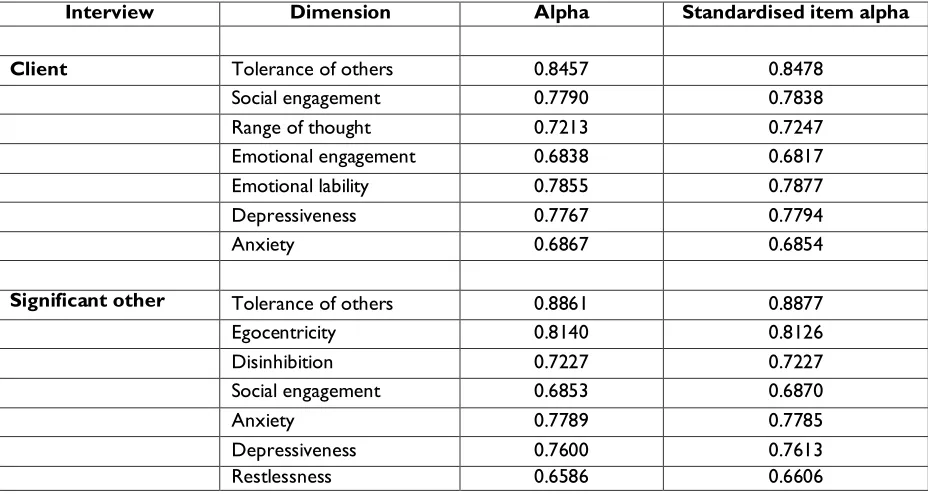
Table 8. Cronbach alpha for each factor
Interview Dimension Alpha Standardised item alpha
Client Tolerance of others 0.8457 0.8478
Social engagement 0.7790 0.7838
Range of thought 0.7213 0.7247
Emotional engagement 0.6838 0.6817
Emotional lability 0.7855 0.7877
Depressiveness 0.7767 0.7794
Anxiety 0.6867 0.6854
Significant other Tolerance of others 0.8861 0.8877
Egocentricity 0.8140 0.8126
Disinhibition 0.7227 0.7227
Social engagement 0.6853 0.6870
Anxiety 0.7789 0.7785
Depressiveness 0.7600 0.7613
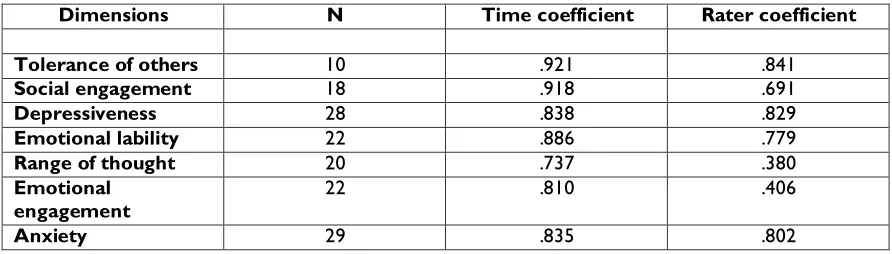
[image:24.612.66.530.465.712.2]Table 9. Generalisability coefficients for the Interview with the client
Dimensions N Time coefficient Rater coefficient
Tolerance of others 10 .921 .841
Social engagement 18 .918 .691
Depressiveness 28 .838 .829
Emotional lability 22 .886 .779
Range of thought 20 .737 .380
Emotional engagement
22 .810 .406
Anxiety 29 .835 .802
Table 10. Generalisatibility coefficients for the Interview with the significant other
Dimensions N Time coefficient Rater coefficient
Tolerance of others 27 .859 .921
Egocentricity 27 .860 .935
Disinhibition 29 .759 .788
Anxiety 33 .809 .803
Social engagement 29 .744 .773
Depressiveness 32 .839 .866
Restlessness 31 .715 .706
Table 11. Evaluation of the final factor solutions
Criterion Interview with TBI Interview with the significant other
N 152 174
KMO .820 .868
Range of individual KMOs .653-.890 .708-.924
Range of communalities .502-.787 .510-.745
[image:25.612.67.522.484.586.2]22
Table 12. Rotated component matrix: for the Interview with the Client
Component
1 2 3 4 5 6 7
Recreational interests and
activity -0.025 0.229 0.086 0.098 0.556 0.064 0.344 Lifelessness / Listlessness 0.120 0.135 0.353 0.089 0.705 -0.233 0.048
Preoccupations 0.246 0.225 0.114 0.003 0.056 0.777 0.074
Out of touch 0.138 0.615 -0.031 0.107 0.310 0.383 -0.077
Blaming others 0.713 0.314 0.040 0.086 -0.037 0.111 0.068
Resentfulness 0.780 0.013 0.094 -0.005 0.159 0.151 0.264
Passive aggression 0.719 0.172 0.063 0.099 0.145 0.215 -0.164
Irresponsibility 0.226 0.708 0.03 -0.060 0.091 0.024 0.103
Dependence -0.090 0.601 -0.035 0.214 0.340 0.228 0.025
Self-centredness 0.253 0.607 0.306 0.233 -0.035 0.040 -0.054
Quick temper 0.456 0.098 0.061 0.688 0.023 -0.149 0.087
Argumentative 0.654 0.136 0.161 0.333 -0.079 0.001 -0.007
Aggressive behaviour 0.476 0.360 -0.042 0.537 0.118 -0.023 0.233
Insensitivity 0.395 0.611 -0.034 0.074 -0.075 0.148 0.009
Awkwardness 0.649 0.198 0.235 0.032 0.170 0.171 -0.172
Social disinhibition 0.425 0.274 0.055 0.204 -0.154 0.470 0.103
Irrationality 0.358 0.494 0.134 0.107 -0.048 0.359 0.164
Intimacy and closeness 0.388 0.125 0.108 -0.205 0.535 0.001 0.112
Loneliness 0.180 0.074 0.698 0.131 -0.031 0.168 0.228
Dissatisfaction/Unhappiness 0.212 0.160 0.762 0.011 0.251 -0.132 0.030
Depressiveness 0.066 -0.056 0.799 0.313 0.060 -0.026 0.153
Self-esteem 0.065 -0.025 0.539 0.087 0.292 0.033 0.592 Confidence -0.026 0.081 0.391 0.120 0.194 0.064 0.685 Anxiety 0.071 0.032 0.010 0.476 -0.055 -0.034 0.629 Changeability -0.013 0.0004 0.487 0.588 -0.017 0.215 -0.074
Catastrophic reactions -0.042 -0.008 0.233 0.619 0.173 0.112 0.186
Emotional disinhibition /
lack of control 0.158 0.238 0.138 0.736 0.019 0.018 0.119 Flattened affect 0.006 -0.078 -0.034 0.137 0.800 0.347 -0.036
Table 13. Rotated Component Matrix for the Interview with the Significant Other
Component
1 2 3 4 5 6 7
Recreational interests
and activities 0.051 0.106 0.092 -0.049 0.249 0.678 0.062 Physical anergia 0.150 0.117 0.095 0.0005 0.150 0.743 0.087
Boredom 0.183 0.060 -0.030 0.079 0.280 0.337 0.653 Criticism of others 0.543 0.315 -0.006 0.340 0.114 0.017 -0.066
Blaming others 0.369 0.478 0.027 0.226 -0.040 0.242 0.181
Restlessness 0.235 -0.060 0.269 0.058 0.019 -0.056 0.732 Dependence 0.244 0.179 -0.006 0.111 -0.138 0.691 0.059
Initiative -0.183 -0.004 0.324 0.425 -0.018 0.585 0.108
Unreasonableness 0.594 0.420 -0.006 0.088 -0.024 0.146 0.164
Self-centredness 0.144 0.754 -0.166 0.097 0.094 0.068 0.116
Irritability 0.638 0.285 0.093 0.056 0.166 -0.015 0.314
Quick temper 0.806 0.053 0.147 0.086 0.101 0.033 0.118
Argumentative 0.670 0.154 0.038 0.193 0.173 0.157 -0.101
Aggressive behaviour 0.674 0.157 0.238 0.201 0.068 0.207 0.180
Insensitivity 0.470 0.637 -0.014 0.285 0.107 0.043 0.156
Lack of empathy 0.219 0.716 0.121 0.116 0.113 0.187 0.011
Tactlessness 0.213 0.199 0.199 0.748 0.099 -0.001 0.066
Social disinhibition 0.359 -0.002 0.048 0.721 0.114 0.112 0.009
Rashness / impulsivity 0.192 0.219 0.004 0.634 0.074 0.042 0.246
Impatience 0.495 0.132 0.320 0.292 -0.081 0.129 0.313
Social inattentiveness 0.066 0.236 0.197 0.330 0.081 0.219 0.557 Intimacy and closeness 0.121 0.667 0.345 0.003 0.0003 0.094 -0.120
Loneliness -0.072 0.203 0.210 0.114 0.619 0.189 0.297
Dissatisfaction /
Unhappiness 0.247 0.017 0.070 -0.011 0.782 0.094 -0.047 Depressiveness 0.205 0.030 0.278 0.148 0.754 -0.018 0.125
Self-esteem -0.045 0.089 0.496 0.197 0.463 0.211 0.057
Worry 0.176 -0.124 0.726 0.082 0.262 0.092 -0.004
Anxiety 0.024 0.060 0.703 -0.079 0.049 0.092 0.319
Changeability 0.461 0.215 0.285 0.149 0.296 0.023 0.274
Catastrophic reactions 0.301 0.216 0.597 0.199 0.191 0.087 0.082
Emotional disinhibition /
Lack of control 0.381 0.103 0.492 0.296 0.316 0.009 0.144
Extraction Method: Principal Component Analysis. Rotation Method: Varimax with Kaiser Normalization. The rotation converged in 8 iterations.
May 2012
The Brain Injury Personality Scale
Interview with the client
M.C. Obonsawin, S. Jefferis and J.R. Crawford
Developed with a grant from the National Lottery Charities Board to Rehab Scotland and the University of Strathclyde, in conjunction with Rehab UK and the
Look for these characteristics
during the interview
1 Is s/he verbally or physically aggressive during the interview? Aggressive behaviour
2 How was his or her mood during the interview? Dissatisafaction / Unhappiness; Depressiveness
3 Does he or she have difficulty controlling their emotions? Does the subject cry easily, or get upset very easily?
Emotional disinhibition/ lack of control
4 Does the subject interrupt often, try to dominate the interview, or break any other rules of social interaction during the
interview?
Social disinhibition
5 Does the subject provide anecdotes in which it is clear that the subject often breaks rules of social interaction?
Social disinhibition
6 Does s/he respond in emotionally appropriate ways at different sections of the interview (laughing or smiling when sharing a joke) or does s/he remain flat during the interview?
Flattened affect
7 Does anything s/he say seem irrational or difficult to follow? Irrationality
8 Is his or her speech relevant and informative, or is it repetitive and long-winded?
Poverty of content of speech
9 Is there any specific topic s/he keeps returning to throughout the interview?
Preoccupations
10 Does s/he come across as concerned for other people, or as self-centred?
Self-centredness / Selfishness
11 Does s/he come across as "difficult, or try to catch the interviewer out?
Awkwardness
12 Does the subject provide anecdotes in which it is clear that the subject is defiant, disruptive and “difficult”?
Awkwardness
13 Does the subject provide anecdotes in which it is clear that the subject has little appreciation of his/her surroundings, and has unrealistic and simplistic expectations of him or herself, of others, or of organisations?
Out of touch
14 Notice how the subject describes his or her relationships with others. Look for signs of passive aggression, that the subject resents someone and shows his/her resentment passively by resisting demands, responsibilities or duties.
2
Interview with the client
1
Tell me about what you do with your time when you're not at work / college / rehab.
Recreational interests & activities; Listlessness / Lifelessness
2 What activities do you really enjoy? Recreational interests & activities; Listlessness / Lifelessness
3 Have the things that you usually enjoy been as fun as usual? Recreational interests & activities; Listlessness / Lifelessness
4 Have your hobbies changed since your brain injury? Recreational interests & activities; Listlessness / Lifelessness
5 Are you learning (or planning to learn) how to do something new?
Recreational interests & activities; Listlessness / Lifelessness
6 Do you like to keep busy? Lifelessness / Listlessness; Recreational interests and activities
7 If so, how do you keep busy? Recreational interests & activities
8 How do you relax? Recreational interests and
activities; Lifelessness/Listlessness
9 Do you watch TV or listen to the radio very much? Lifelessness / Listlessness; Recreational interests and activities
10 Do you often feel tired during the day? Lifelessness / Listlessness
11 Are there times when you lie or sit around for most of the day?
12 How often do you go out? Recreational interests and activities; Lifelessness/Listlessness
13 Do you have strong likes and dislikes? Preoccupations
14 Is there anything you would say you are really passionate about?
Preoccupations
15 Is there anything that gets you really worked up? Preoccupations
16 Do you find you spend a lot of time thinking about one particular issue? Do you think about it every day? How often during the day?
Preoccupations
17 Generally, how are things going for you at the moment? Depressiveness; Dissatisfaction / Unhappiness
18 Do you go to work at the moment, or study at college?
(n.b. if the person does not work or study, these questions can be asked regarding any other appropriate environment - e.g. club, drop-in centre, or alternatively about how things were when the person was last in work or college, if in the recent past)
19 How are things going there?
20 Have you been having any problems there?
21 Do you think you are doing well at work or college? Self-esteem
22 What are you doing? Are you enjoying it? Self-esteem
23 What do you think of the other people at your work or college?
4
24 Are colleagues quite reasonable at work, (or college)? Passive aggression
25 How do your colleagues treat you? Passive aggression
26 Do you feel appreciated? Passive aggression
27 What is your workload like? Passive aggression
28 Do you think the company you work for is a good company? Why or why not?
Out of touch
29 Do you think the college you attend is a good college? Why or why not?
Out of touch
30
Tell me a bit about where you live and who you live with. Dependence
31 At home, which things do you do by yourself? What things do you prefer to leave to other people? (e.g. cooking, washing, ironing…)
Dependence
32 Are you pretty good at house chores (ironing, cooking etc, if it applies)?
Self-esteem
33 How do you feel about doing these chores around the house? Do you like that? Do you think others appreciate what you do?
Passive aggression
34 What things do other people help you with? Dependence
36 Would you like to be more independent? Dependence; Out of touch
37 Do you have a legal case pending regarding the injury? Out of Touch
38 Do you have to claim any benefits at the moment? Out of Touch
39 Are you happy with the way you have been treated by (appropriate authority - solicitors, courts, benefits agency)?
Out of Touch
40 (If none of the above apply): How do you feel you have been treated by this organisation during your time on the programme?
Out of Touch
41 Do you consider yourself assertive? Self-centeredness / Selfishness
42 Being assertive is one thing, but do people ever tell you that you are selfish?
Self-centeredness / Selfishness
43 If so, what do you think about that? Do you think you are selfish?
Self-centeredness / Selfishness
44 What kind of things get on your nerves? Emotional disinhibition
45 How do you react when things get on your nerves? Emotional disinhibition
46 Do you ever get irritated with other people? Emotional disinhibition
6
48 Do you ever find you "snap" when under pressure? Emotional disinhibition
49 What happens when you do snap? Emotional disinhibition
50 Do you find it easy to forgive people if they do something that annoys or upsets you?
Resentfulness
51 Do you find you hold grudges against people very much? Resentfulness
52 Do you ever find you get into arguments with people? Argumentative; Blaming others
53 How often does that happen? Argumentative
54 Why do you think they happen? Argumentative; Blaming others
55 How do you handle disagreements when they arise? Argumentative
56 In general, how do you react when things go wrong? Catastrophic reactions
57 Do you find that you get upset very easily, or cry very easily?
Emotional disinhibition
58 Do you sometimes lose your temper? Quick temper
59 How would other people be able to tell if you lost your temper?
60
What things make you angry? Quick temper
61 How do you behave when someone makes you angry? (e.g. shout, go of in a "huff", lash out, stay silent or try to forget it)
Aggressive behaviour; Quick temper
62 How do you calm yourself down? Emotional disinhibition
63 Do you sometimes worry about the way you act? Aggressive behaviour; Quick temper
64 Do you ever feel afraid that you might physically hurt someone?
Aggressive behaviour
65 Have you done anything that has caused harm to yourself or someone else, even if you didn't mean it?
Aggressive behaviour
66
Do you think of yourself as someone who generally gets on with other people pretty well, or do you sometimes have difficulty getting on with people?
Social disinhibition
67 Do you ever find it hard to keep a conversation going? Social disinhibition
68 Can you think of anything you have done that others might think unusual, or that has called attention to yourself?
Social disinhibition
69
Could you tell me a little bit about your family?
70
Is everyone in the family quite reasonable and easy to get on with?
Passive aggression
71 Is there a problem that someone in your family has had, which you helped them out with?
8
72 Do you find it easy to be supportive to other people who are having a hard time?
Insensitivity
73 What do you think when other people tell you their troubles?
Insensitivity; Self-centredness and selfishness
74 Do you generally like doing things to help other people out?
Insensitivity; Self-centredness and selfishness
75
Do you have a partner? Intimacy and closeness
If yes, go to questions 76, 77 and 78, For clients with partners.
If the answer is No, ask
Who is the person you feel you have the closest relationship with (parent, sibling, close friend)?
Intimacy and closeness
and go to Questions 79, 80 and 81 For clients without partners.
For clients with partners
76 How long have you been together? Intimacy & closeness
78 Is everything all right with your relationship? Intimacy & closeness
Move to Question 82
For clients without partners
79 Who is the person you feel you have the closest relationship with? (e.g. parents, sibling, close friend)
Intimacy & closeness
80 (if a non-family member) How long have you known one another?
Intimacy and closeness
81 How have you been getting on together recently? Intimacy and closeness
Continue on to the following questions
82 Have you been spending much time with your friends? Recreational interests and activities; Intimacy and closeness
83 Do you like your friends? Do you see them often? If not,
why not?
Resentfulness
84
What would you say is your most important responsibility, either in the family or at work?
Irresponsibility
85
How do you feel about having these responsibilities? Do you like that? Do you think others appreciate what you do?
Passive aggression
86
Would you say you ever have problems living up to that responsibility?
10
87
What about other responsibilities? Do you have any trouble living up to them?
Irresponsibility
88 Do you find that you sometimes feel nervous or scared about things?
Anxiety
89 Do you ever get "butterflies" in your stomach, or find yourself panicking over things?
Anxiety; Catastrophic reactions
90 Do you ever find yourself getting tense or stressed? Anxiety
91 What kind of things make you feel nervous or anxious? Anxiety
92 How confident do you feel? Confidence
93 Would you say you generally feel satisfied with life? Dissatisfaction / Unhappiness; Self-esteem
94 Do you often get unhappy, or would you say that you are mostly a pretty happy person?
Dissatisfaction / Unhappiness
95 Do you sometimes feel low? Depressiveness; Changeability
96 Is it sometimes difficult to get out of those low moods? Depressiveness
97 Do you feel pessimistic about the future? Depressiveness
99 Do you ever feel lonely? Loneliness
100 Some people find that they feel quite happy one moment and down the next - feeling "up and down". They find their mood changes in that way fairly often. Do you ever feel that way?
Changeability
101 What kinds of things make you feel that way? Changeability
102 What kind of things do you think you are going to achieve in your life?
Self-esteem
103 Tell me about something you have done which you are proud of.
Self-esteem
Is there anything you would like to add to the things we have talked about today?
Remind the client can s/he can add to or amend his or her answers by contacting the interviewer - leave contact details
May 2012
The Brain Injury Personality Scale
Description of individual items
Interview with the client
M.C. Obonsawin, S. Jefferis and J.R. Crawford
Developed with a grant from the National Lottery Charities Board to Rehab Scotland and the University of Strathclyde, in conjunction with Rehab UK and the
Aggressive behaviour
The subject behaves in an aggressive or agitated manner, often quite unpredictably. S/he may be verbally aggressive, by shouting at, swearing at or threatening other people. In severe cases s/he may be physically aggressive towards others.
0 None
1 Questionable
2 Mild: Occasional instances
3 Moderate: The subject is sometimes verbally aggressive towards others.
4 Marked: The subject has frequent outbursts of verbal aggression. S/he may sometimes threaten others. 5 Severe: The subject has very frequent outbursts of verbal aggression, or has been physically aggressive
towards others.
Client Questions
How do you behave when someone makes you angry? (e.g. shout, go of in a "huff", lash out)
Have you done anything that has caused harm to yourself or someone else, even if you didn't mean it? Do you sometimes worry about the way you act?
Do you ever feel afraid that you might physically hurt someone?
Observer Questions
Was s/he verbally or physically aggressive during the interview?
Anxiety
The subject may display signs of anxious or nervous feelings. S/he may have feelings of fear or apprehension, become panicky, or get "butterflies in the stomach".
0 None
1 Questionable
2 Mild: Occasional instances
3 Moderate: Several instances of anxiety. 4 Marked: Frequent instances of anxiety.
5 Severe: Anxiety is so frequent and/or intense that it is incapacitating.
Client Questions
Do you ever get "butterflies" in your stomach, or find yourself panicking over things? Do you ever find yourself getting tense or stressed?
What kind of things make you feel nervous or anxious?
2
Argumentative
The subject gets into arguments easily, and will argue without provocation.
0 None
1 Questionable
2 Mild: Occasional instances
3 Moderate: The subject often gets into arguments unnecessarily. 4 Marked: The subject is frequently argumentative.
5 Severe: The subject's interactions with others are almost always argumentative.
Client Questions
Do you ever find you get into arguments with people? How often does that happen?
Why do you think they happen?
How do you handle disagreements when they arise?
Awkwardness
The subject is awkward in social situations - not because of anxiety or nervousness, but through being "difficult", unhelpful, sarcastic, defiant or disruptive with other people.
0 None
1 Questionable
2 Mild: Occasional instances
3 Moderate: Several instances of awkwardness 4 Marked: Frequent instances of awkwardness.
5 Severe: The subject is awkward at most social encounters.
Client Questions
None
Observer Questions
Did s/he come across as "difficult", or try to catch the interviewer out?
Blaming others
The subject attempts to evades responsibility for any negative consequences of his or her actions by blaming other people.
0 None
1 Questionable
2 Mild: Occasional instances
3 Moderate: The subject sometimes looks for ways to blame others, but will often take responsibility when challenged.
4 Marked: The subject frequently blames other people, and is stubborn when challenged.
5 Severe: The subject almost always blames others for negative consequences of his or her actions, and refuses to take responsibility.
Client Questions
Do you ever find you get into arguments with people? Why do you think they [arguments] happen?
Catastrophic reactions
The subject tends to see problems as disastrous, or unsolvable. S/he tends to over-react to events, and assumes that events of moderate importance may be disastrous. S/he may also worry excessively about how s/he will be affected by such events.
0 None
1 Questionable
2 Mild: Occasional instances
3 Moderate: The subject often over-reacts to everyday events.
4 Marked: The subject frequently over-reacts to events or assumes they will have catastrophic consequences.
5 Severe: The subject always reacts out of proportion to the significance of events, and worries about terrible effects that everyday events will have on him or her.
Client Questions
How do you react when things go wrong?
4
Changeability
The subject experiences mood-swings. S/he may go from feeling happy or exhilarated to feeling down, or angry. There may not be an obvious precipitating event for these changes, or the event may seem inconsequential to others. Do not score as present if the subject simply shows appropriate emotional reactions to life events.
0 None
1 Questionable
2 Mild: Occasional instances
3 Moderate: The subject's mood is sometimes variable, but there are considerable periods of time when mood appears stable.
4 Marked: The subject's mood changes frequently and unpredictably, and is calm and settled only on few occasions.
5 Severe: The subject's mood seems constantly up and down, and is very difficult to predict.
Client Questions
Some people find that they feel quite happy one moment and down the next. They find their mood changes in that way fairly often. Do you ever feel that way?
What kind of things make you feel that way? Do you sometimes feel low?
Confidence
The subject does not feel confident, or does not present him or herself with confidence. S/he may come across as timid (although this is rated separately from "Shyness" as the latter specifically refers to meeting new people).
0 None
1 Questionable
2 Mild: Occasional instances
3 Moderate: The subject often lacks confidence. 4 Marked: The subject frequently lacks confidence. 5 Severe: The subject almost always lacks confidence.
Client Questions
Dependence
Although the subject has the ability to care for himself/herself, s/he has limited independence and relies on others for meals, housework etc. S/he may not travel independently. The subject may even be dependent on others for opinions and views. Please note that this item refers only to activities that the subject is able to carry out.
0 None
1 Questionable
2 Mild: Occasional instances
3 Moderate: The subject initially relies on others as much as possible but will carry out tasks if no-one else does. The subject does manage to do some things by him/herself.
4 Marked: The subject will not carry out many tasks, but will frequently wait until somebody else does. 5 Severe: The subject does little for or by him/herself.
Client Questions
At home, which things do you do by yourself? What things do you prefer to leave to other people? (e.g. cooking, washing, ironing…)
6
Depressiveness
The subject experiences low moods. These feelings are persistent and appear to be unrelated to specific issues or events. S/he may be pessimistic about the future, and may seem unable to help him or herself.
0 None
1 Questionable
2 Mild: Occasional instances
3 Moderate: The person sometimes becomes pessimistic and low in mood, but this does not last for a long time. Sometimes the subject seems contented and happy.
4 Marked: The subject seems low in mood for most of the time, and feels that there is nothing to look forward to. S/he is still able to enjoy his or her favourite activities.
5 Severe: The subject always feels low and seems unable to enjoy anything. S/he may have discussed taking his or her own life.
Client Questions
Do you sometimes feel low?
Is it sometimes difficult to get out of those low moods? Do you feel pessimistic about the future?
How are things going for you at the moment?
Observer Questions
Dissatisfaction / Unhappiness
The subject is unhappy and dissatisfied with his or her situation. He/she tends not to smile, and dwells on the negative aspects of his or her situation. This is rated separately to "Depressiveness" as it refers to an attitude of dissatisfaction, and unhappy thoughts, rather than to a low mood.
0 None
1 Questionable
2 Mild: Occasional instances
3 Moderate: The subject is sometimes unhappy or dissatisfied, but does have many happy moments.
4 Marked: The subject frequently appears to be unhappy or dissatisfied, but does have periods of happiness. 5 Severe: The subject is almost always in an unhappy state.
Client Questions
Would you say you generally feel satisfied with life?
Do you often get unhappy, or would you say that you are mostly a pretty happy person? How are things going for you at the moment?
Observer Questions
8
Emotional disinhibition / Lack of control
The subject's emotions seem to spiral out of control, leading to extremes of anxiety, sadness, rage, excitement, etc. It is not simply that s/he experiences moodswings, but that s/he is unable to control his or her emotions. This reaction goes beyond irritability. S/he is likely to need another person's help to calm him or herself down. Also, s/he may be unusually or inappropriately open about his or her feelings with other people. S/he may tend to laugh or cry very easily.
0 None
1 Questionable
2 Mild: Occasional instances
3 Moderate: The subject often displays a lack of emotional control. When under significant stress, s/he tends to lose control; or s/he is often inappropriately open with others.
4 Marked: The subject is frequently emotionally disinhibited.
5 Severe: The subject lacks emotional control nearly all the time, and is only rarely calm and relaxed. S/he may be totally disinhibited about sharing his or her feelings with others.
Client Questions
What kind of things get on your nerves?
How do you react when things get on your nerves? Do you ever get irritated with other people? How do you react when other people irritate you? Do you ever find you "snap" when under pressure? What happens when you do snap?
How do you calm yourself down?
Do you find that you get upset very easily, or cry very easily?
Observer Questions
Was s/he inappropriately open about his or her feelings?
Flattened affect
The subject's emotional state comes across as "flat". S/he tends to be emotionally unresponsive - for example, s/he fails to laugh or smile when this would normally expected (with jokes or light-hearted comments).
0 None
1 Questionable
2 Mild: Slight but definite lack in responsivity.
3 Moderate: The subject seems somewhat "flat" in affect, or sometimes misses the cues to respond.
4 Marked: The subject seems to miss the cues to respond most of the time, and/or shows little variation in emotional state.
5 Severe: The subject is essentially emotionally unresponsive, even on prompting, and seems shows virtually no variation in emotional state.
Client Questions
None
Observer Questions
Did s/he seem respond in emotionally appropriate ways at different parts of the interview (e.g. laughing or smiling when sharing a joke, treating personal issues seriously?)
Insensitivity
The subject does not consider other people's feelings or thoughts. S/he acts without considering the potential impact on others, or say things without apparent regard for others' feelings.
0 None
1 Questionable
2 Mild: Occasional instances
3 Moderate: The subject's insensitivity is troublesome, but does not socially isolate him/her. 4 Marked: The subject's insensitivity alienates him or her from other individuals
5 Severe: Most of the subject's behaviours show a complete insensitivity to others.
Client Questions
Is there a problem that someone in your family has had, which you helped them out with? Do you generally like doing things to help other people out?
10
Intimacy and closeness
The subject has difficulty forming close and intimate relationships (appropriate for his or her age and family status). S/he may display few or no feelings of affection to parents or siblings, partners or children. S/he may live alone and make no effort to initiate contact with family or friends.
0 None
1 Questionable
2 Mild: Slight but definite inability to feel closeness and intimacy.
3 Moderate: The subject appears to enjoy company of family or significant others, but express affection much less than would be expected.
4 Marked: The subject seems expresses almost no affection towards family or significant others. 5 Severe: The subject prefers no contact with, or is hostile towards, family or significant others.
Client Questions
Do you have a partner?
Who is the person you feel you have the closest relationship with (parent, sibling, close friend)? How long have you been together?
How have you been getting on together recently? Have you been spending much time with your friends? Is everything all right with your relationship?
(if a non-family member) How long have you known one another? How have you been getting on together recently?
Irrationality
The subject makes irrational arguments, and make unreasonable excuses for some behaviours. His or her conversation may be illogical or difficult to follow.
0 None
1 Questionable
2 Mild: Occasional instances
3 Moderate: Several instances of irrationality. The subject is sometimes difficult to follow. 4 Marked: The subject is frequently difficult to follow.
5 Severe: Irrationality is so frequent that it is never easy to follow the subject's line of thought.
Client Questions
None - observation only
Observer Questions