The word problem for Pride groups
Peter Davidson
Department of Mathematics & Statistics, University of Strathclyde, Glasgow G1 1XH, United Kingdom.
Abstract
Pride groups are defined by means of finite (simplicial) graphs and examples include Artin groups, Coxeter groups and generalized tetrahedron groups. Under suitable conditions we calculate an upper bound of the first order Dehn function for a finitely presented Pride group. We thus obtain sufficient conditions for when finitely presented Pride groups have solvable word problems. As a corollary to our main result we show that the first order Dehn function of a generalized tetrahedron group, containing finite generalized triangle groups, is at most cubic.
2000 Mathematics Subject Classification: 20F05, 20F06, 20F10
1
Introduction
An Artin group has a presentation of the form
ha1, a2, . . . , an;aiajai. . .
| {z }
µij
=ajaiaj. . .
| {z }
µji
for all i6=ji,
where µij = µji is an integer greater than or equal to 2 or µij = ∞, in
groups include free groups, free abelian groups and braid groups. Indeed
Artin groups are sometimes referred to as generalized braid groups, the
latter introduced explicitly by Emil Artin in 1925. It is unknown in general
whether or not Artin groups have solvable word problems, however some
partial results do exist. If we add the defining relation ai =a−i 1 for each
i= 1, . . . , n then we obtain the corresponding Coxeter group
ha1, a2, . . . , an;a2i = 1,(aiaj)µij = 1 for all i6=ji
and we say that an Artin group is spherical (or offinite type) if its
corre-sponding Coxeter group is finite. The word problem is solvable for spherical
Artin groups (see [7] and [4]). The word problem is also solvable for
right-angled Artin groups, where µij = 2 for all i 6= j. If µij ≥ 3 for all i 6= j
then the Artin group is said to be oflarge type. Following joint work with
Schupp, Appel [2] showed that such groups have solvable word problems.
Finally, Altobelli [1] proved that Artin groups of FC type have solvable
word problem. Artin groups of FC type can be characterized as the
small-est class of Artin groups which is closed under free products amalgamated
over special subgroups and which contain spherical Artin groups.
Artin groups, and their corresponding Coxeter groups, are but two
ex-amples of a much wider class of groups. Notice that in each of their
pre-sentations the defining relations involve at most two generators. Finitely
presented groups that have such presentations were first studied by Pride
in [12] and later in [15] under the title “groups given by presentations in
which each defining relator involves at most two types of generators.” It is
common to refer to such groups as simplyPride groups.
Let Γ = {V, E} be a finite simplicial graph with vertex set V and edge set E. To each vertex v ∈ V assign a group Gv with a fixed finite
To each edge assign a sette that consists of cyclically reduced elements of
f
Ge, where each element of te involves at least one term from each of Gu
and Gv. Associated to this edge is a group Ge = Gfe/ << te >>. The Pride group associated with the above data is then
G=
∗
v∈V Gv/ <<
[
e∈E
te>> .
We call Γ theunderlying graph ofG. The groupsGv (v∈V) are called the
vertex groups ofGand the groupsGe (e∈E) are called theedge groups of
G. Thus Artin groups are Pride groups with infinite cyclic vertex groups and one-relator edge groups given by the presentation
hai, aj;aiajai. . .
| {z }
µij
=ajaiaj. . .
| {z }
µji
i.
Coxeter groups have Z2 vertex groups and dihedral edge groups. Further
examples include generalized tetrahedron groups (see Section 5) and groups
given by cyclic presentations.
For each v ∈ V and each e ∈ E there are natural homomorphisms Gv →G and Ge →G. In general, these homomorphisms are not injective;
however, it was shown in [5] that ifGsatisfies theasphericity condition(see end of this paragraph) then the vertex and edge groups embed in G. For each e={u, v} ∈E let ψe be the natural epimorphism of Gfe onto Ge and definemeto be the (free product) length of a shortest non-identity element
of kerψe, when this is non-trivial. If kerψe is trivial then me := ∞. An
edge groupGe(or more precisely a given presentation ofGe) has
property-Wk if and only if me > 2k. So, for example, property-W1 states that no
non-empty word of the formW(u)W(v) where W(u) ∈Gu,W(v)∈Gv is
equal to 1 in Ge. Then Gsatisfies the asphericity condition if and only if
e1, e2, e3, say)
1 me1
+ 1 me2
+ 1 me3
≤ 1 2.
Pride groups which satisfy the asphericity condition are said to be
non-spherical.
Example ([13, Example 2] [8, Example 4.1]). Each edge group of an Artin
group satisfies property-Wµij−1 and each edge group of a Coxeter group
always satisfies property-W1 and satisfies property-W2 ifµij >2.
When the natural homomorphisms Gv → G (v ∈ V) and Ge → G
(e∈E) are injective the aim is then to describe the structure ofGin terms of its vertex and edge groups. We conjecture that a non-spherical Pride
group has solvable word problem if each of its edge groups do. With this
in mind we prove the following result.
Theorem A. Let G be a Pride group for which one of the following two
conditions hold.
1. Each edge group has property-W2.
2. Each edge group has property-W1 and the underlying graph of G is
triangle-free.
Then, if each vertex group is finite,G has a solvable word problem.
We will compute an upper bound for the first order Dehn function of G and show that it is given in terms of the maximum of the first order Dehn
functions of its edge groups. To do this we will estimate the areas of
simply-connected pictures over a particular presentation of a Pride group.
In particular, we will use the following pictorial version of van Kampen’s
W be a word onx±1. Then W represents the identity element of Gif and only if there exists a simply-connected picture for W overP.
2
Pictures
Aclosed punctured disc Π withn≥0 holes is the closure of
D−
n
[
i=1
int(Bi),
where D is a closed disc and B1, . . . , Bn are disjoint closed discs in the
interior ofD. The boundary ∂Π of Π is
∂D∪
n
[
i=1
∂Bi,
where∂D and ∂Bi are the boundaries ofD and Bi (i= 1, . . . , n),
respec-tively.
Definition 1. ApicturePis a geometric configuration consisting of a finite
collection of pairwise disjoint closed discs ∆1, . . . ,∆min a closed punctured
disc Π withn≥0 holes, together with a finite collection of pairwise disjoint compact one-manifoldsα1, . . . , αk (thearcs of P) properly embedded in
Π−
m
[
i=1
int(∆i).
The punctured disc Π has a basepoint 0 on∂Π, each discBihas a basepoint
bi on ∂Bi, and each disc ∆i has a basepoint 0i on ∂∆i. Each arc is either
a simple closed curve having trivial intersection with∂ΠSm
i=1∂∆i or is a
simple curve which joins two points of ∂ΠSm
i=1∂∆i, neither point being a
basepoint.
If Π does not contain any holes then we say P is simply-connected.
picture coincides with the standard definition of a picture (e.g. in [14]) and
we shall use the terms “simply-connected picture” and “picture” to mean
the same. A picturePis spherical if no arc of P meets the boundary ofP,
where the boundary of Pis∂P:=∂Π.
We shall assume the reader is familiar with the theory of pictures over
finite presentations (see [14]) but note that a picturePover a finite
presen-tationP =hx,risatisfies the following conditions.
(a) Each arc ofP is labelled by an element of xand has a normal
orien-tation indicated by a short arrow meeting the arc transversely.
(b) If we travel around ∆ionce in an anticlockwise direction starting at 0i
and read off labels on the arcs encountered (with the understanding
that we read x if we cross an arc labelled x in the direction of its normal orientation, and we read x−1 otherwise) then we obtain a
wordrεii , where ri ∈rand εi=±1.
Let W be a word on x±1. We say that
P is a simply-connected r
-picture for W (or simply a picture for W) if the boundary label of P, i.e. the word obtained by reading the labels of arcs encountered in an
anticlockwise transversal of the boundary beginning and ending at 0, is a
cyclic permutation of W. Thearea A(W) ofW is then defined to be the minimum of the areas of all pictures forW. Recall that the area A(P) ofP is the number of discs contained inP.
Definition 2. Thefirst order Dehn function ofP is the increasing function
δP :N→Ngiven byδP = max{A(W) :l(W)≤nand W = 1 inG},where
IfP is finite thenδP is a group invariant up to∼-equivalence and we write
δG for the first order Dehn function of G= (G(P)). The ∼-equivalence is
defined as follows. For two increasing functions f, g:N→R+ write f g if there exist constantsc1, c2, c3>0 such that
f(n)≤c1g(c2n) +c3.
Then f ∼ g if and only if f g and g f. It is well known that a finitely presented group has a solvable word problem if and only if its Dehn
function is recursive (see e.g. [9]).
LetPbe a picture. The degree of a disc ∆ is defined to be the number of
arcs incident with ∆, counted with mutliplicity, and we denote it byd(∆). The degree of an interior regionR of Pis defined to be the number of arcs contained in the boundary ofR counted with multiplicity. We denote the degree ofR by d(R).
Lemma 1. Let P be a picture in which d(∆) ≥6 for all discs ∆ of P and
d(R) ≥ 3 for all interior regions R of P. If n arcs are incident with ∂P, thend(∆) is at most n+ 3 for each ∆∈P.
Proof. We proceed by induction onA(P). LetCbe a connected component of P. If A(C) = 1 then delete C and its arcs incident with ∂P to obtain a picture P0. Now A(P0) < A(P) and there at most n−1 arcs incident with∂P0. It follows thatd(∆0)< n+ 3 for each disc ∆0∈P0. Furthermore d(C)< n.
Now suppose that each connected component contains at least two discs.
LetDbe the dual diagram ofPso that the discs ofPbecome regions ofD and interior regions of P become the vertices of D. By our hypotheses D satisfies the conditions of [11, Theorem V 4.3] and so must satisfy
∗
X
D
where the sum is taken over boundary regionsR of D such that ∂D∪∂R is a consecutive part of∂D. ThusDmust contain at least two regions that are both boundary regions and each contain at most 3 interior edges, and
whose boundaries form a consecutive part of∂D. Translating this back into the language of pictures we deduce thatPcontains a connected component
C that must contain at least two discs which satisfy the following:
- both discs are boundary discs ofC;
- each disc has at most three interior arcs;
- the boundary arcs of each disc form a consecutive part of∂C.
SinceCcan contain at most one disc whose boundary is a consecutive part of ∂C but not of ∂P, it follows that P must contain at least one disc ∆ that satisfies the above conditions. Delete ∆ and its boundary arcs from
P to obtain a picture P0 with A(P0) < A(P). Since ∆ contained at most three interior arcs and since d(∆0) ≥ 6 for each disc ∆0 of P, we deduce that ∂P0 contains at most n arcs. The induction hypothesis applies to P0 sod(∆0)≤n+ 3 for each disc ∆0∈P0. Moreover,d(∆)≤n+ 3. The result
now follows.
A very similar argument proves the following lemma.
Lemma 2. Let P be a picture in which d(∆) ≥4 for all discs ∆ of P and
d(R) ≥ 4 for all interior regions R of P. If n arcs are incident with ∂P, thend(∆) is at most n+ 2 for each ∆∈P.
distinct colours i, j, k∈I is a spherical triple if 1
mij
+ 1 mjk
+ 1 mki
> 1 2,
where 1/∞:= 0, and acolouring of a picturePby I is anI-valued function on the set of arcs ofP. A picture together with a colouring function intoI is called anI-coloured picture.
Lemma 3 ([5, Lemma 2.2]). Suppose I does not contain any spherical
triples and letPbe a non-spherical simply-connectedI-coloured picture sat-isfying:
(i) no arc is a floating circle nor has both endpoints on the same disc
enclosing a region of degree 1;
(ii) associated to each disc∆are two distinct coloursi, j∈I (withmij 6=
∞) such that each arc incident with ∆ is coloured either i or j and there are at leastmij corners of ∆joining one arc of each colour;
(iii) no interior region has more than one corner in its boundary joining
arcs of the same two distinct colours.
If under the above conditions some arc of P is coloured k, then some arc meeting∂P is coloured k.
3
Pictures over presentations of Pride groups
LetG be a Pride group in which each vertex group is finite. We will now fix a presentations forGthat will be used for the remainder of this paper. For each v ∈ V let xv be a set that is in one-to-one correspondence with
the elements ofGv and define
where each xi (i = 1,2,3) corresponds to a group element gi ∈ Gv such
that g3 = g1g2. Then Pv = hxv;rvi is a finite presentation for Gv. Note
that rv is simply the multiplication table of Gv. For each e= {u, v} ∈E
letxe=xu∪xv and let
re=ru∪rv∪se,
where se is a set of cyclically reduced words on x±e1 that represent the
elements ofte. Then Pe=hxe;rei is a presentation forGe and
P =hx;ri
is a finite presentation forG, where
x= [
v∈V
xv and r=
[
e∈E
re.
Let P be a picture overP. There exists an obvious colouring of P by
V: arcs labelled by an element ofxv (v∈V) are colouredv. For each pair
of vertices u, v∈V define
muv=
me if{u, v}=e∈E;
∞ if{u, v}∈/ E.
Clearlymuv=mvuand ifGis non-spherical, then eachGehas property-W1
and so me>2.It follows that muv≥4 foru6=vsince me is even for each
e∈E. Thus we may view P as a V-coloured picture and it is easy to see that, when viewed as a set of colours,V cannot contain a spherical triple. A (u, v)-subpicture of Pis a subpicture in which each arc has colour u or colourv (u, v∈V) only.
whose labels are fromru∪rv); F is maximal in the sense that ∂F cannot be extended to include any other disc ofPwhose label is an element of se.
Define Σ(F) = e if F contains an se-disc. A federation is
simply-connected if it is a simply-connected (u, v)-subpicture, otherwise it is non-simply-connected. If Fis simply-connected and Σ(F) =e, then the bound-ary labelW(F) of Fis a word on x±e1 that represents the identity element
ofGe. Equivalently, W(F) represents an element of kerψe.
LetF1 be a federation ofP. IfF1 6=P, then construct a federationF2 of
P\F1. IfF26=P\F1, then construct a federationF3 ofP1\(F1∪F2), and so
on. Eventually we end up with a collection of federations F1, . . . ,Fn that
coverP and satisfy the property thatFi+1 is a federation of
P\
i
[
j=1
Fj
(i= 1, . . . , n−1).
As in [15] we call this collection of federations a federal subdivision of P
and denote it byF.
For each e∈E let Ωedenote the set of all words on x±e1 that represent
a non-identity element of kerψe. Denote the union of{Ωe :e∈ E} by Ω.
Let P be a connected picture and suppose F is a federal subdivision of P
that satisfies the following two conditions:
(I) eachF∈ F is simply-connected;
(II) W(F)∈Ω for eachF∈ F.
The derived picture Pb of P corresponding to F (or simply the derived pic-ture) is obtained from P by deleting the arcs and discs contained in each
boundary of a disc ofbP. It is clear that bPis aV-coloured picture and that W(bP) is identically equal toW(P), whereW(P) is the boundary label ofP. Furthermore, the label of a disc ∆ obtained from a federationFis identical
toW(F) and so is an element of Ωe.
The following result appears in [6, Lemma 3.3]. The presentation in the
present paper differs from that in [6], however this does not affect the proof
of the lemma.
Lemma 4. Let P be a connected, non-spherical, simply-connected picture
overP and letbPbe the derived picture corresponding to a federal subdivision of P. Then Pb satisfies Conditions (i), (ii) and (iii) of Lemma 3.
Let
s= [
e∈E
se
and letPbe a picture for a wordW that containsks-discs, i.e. each of the kdiscs is labelled by an element ofs. We shall say thatP isminimal with respect to s if, for any pictureP0 forW that contains l s-discs, then k≤l.
Lemma 5. LetW be a word onx±e1 that represents a non-identity element of kerψe and let P be a picture for W that is minimal with respect to s. ThenP is a picture over Pe.
Proof. SupposePis not a picture overPeand letFbe a federal subdivision
ofP. If eachF∈ F is simply-connected then the boundary label ofFcannot
be freely equal to the empty word nor represent the trivial element ofGeefor somee∈E. Otherwise, we would replaceFwith either the empty picture, by performing bridge moves on∂F, or a picture over Peeto obtain a picture
be an element of Ωe. Thus we may construct the derived picture bP, which,
by Lemma 4, satisfies the conditions of Lemma 3. SinceP is not a picture
over Pe,Pb must contain an arc coloured k such that this colour does not appear on the boundary of bP. However, this contradicts the conclusion of Lemma 3. We deduce thatP must be a picture overPe.
Now suppose that F contains at least one non-simply-connected
fed-eration F. We may assume that F is innermost, meaning that no other
non-simply-connected federation is bounded by F. The simply-connected
picture bounded by F is minimal with respect to s (by the minimality of
P) and must have two colours appearing on its boundary. We deduce that
this simply-connected picture and F are both pictures over Pe (for some
e∈ E) contradicting the fact thatF is a maximal subpicture. The result now follows.
The next result follows easily from the previous lemma.
Lemma 6. LetW be a word on x±1 that represents the identity element of Gand letPbe a simply-connected picture forW that is minimal with respect to s. Then any federal subdivision of P contains only simply-connected
federations.
Proof. The second part of the proof of Lemma 5 applies directly.
We end this section with a description of some modifications that can
be carried out on a derived picture. These are pictorial versions of
dia-grammatic modifications that originally appeared in [12]. The first is the
standard modification of removing all interior regions of degree 2 (see
Fig-ure 1). Both arcs of an interior region of degree 2 must have the same
labelledx∈xv such that
x=xεii xεjj ,
where εi, εj =±1 depending on the orientation of the corresponding arcs
xi, xj.
i
[image:14.595.259.329.219.319.2]x xj
Figure 1: Interior region of degree 2
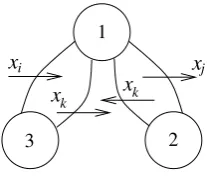
The second modification removes interior regions of degree 3 whose
boundary arcs are each of the same colour.
xi
xk xj
1
2 3
Figure 2: Interior region of degree 3
Adjoin new arcs between discs 1 and 2, and 1 and 3 as in Figure 3. Label
these arcs with the label on the arc incident with discs 2 and 3, and assign
the same orientation as this arc. Finally delete the arc joining discs 2 and 3.
The label of disc 1 has changed, however it remains an element of Ω. Also
[image:14.595.245.346.425.522.2]xi xj
xk xk
1
[image:15.595.243.347.126.216.2]2 3
Figure 3: Adjoing new arcs.
A consequence of these modifications is that if W is the label of a transverse pathαinbPthenl(W) is equal to the number of arcs intersected by α (counted with multiplicity). In particular,the boundary label of each disc ofPb has length equal to the degree of the disc.
Note that if Γ is triangle-free thenbPcannot contain any interior regions of degree 3 whose boundary arcs each have distinct colours from one
an-other. In such a region we would havexi ∈xu,xj ∈xv,xk∈xw for some
distinctu, v, w∈V, i.e.{xi, xj, xk} would form a triangle in Γ.
4
First order Dehn function
LetGbe a Pride group in which each vertex group is finite and define
δE = max{δGe :e∈E},
whereδGe is the first order Dehn function of the edge group Ge.
Proposition B. If each edge group has property-W2, or has property-W1
and the underlying graph of G is triangle-free, then
δG(n)n2δE(n)
Proof. Suppose that each Ge has property-W2. Let W be a non-empty
word of lengthnonx±1that represents the identity element ofG. We may assume, without loss of generality, that W is cyclically reduced. By the van Kampen Lemma, there exists a simply-connected picturePforW that is minimal with respect tos. Letkdenote the number ofs-discs ofP.
If k = 0 or k = 1 then P is either a picture over Pv or a picture over
Pe for some v ∈V ore∈ E. In both cases A(W) ≤δE(n). Assume that
k > 1 and let F be a federal subdivision of P. If F contains only one federation then A(W) ≤ δE(n), so assume that F contains at least two
federations. Each federation ofF must, by Lemma 6, be simply-connected
and the boundary label must be an element of Ω. Otherwise, we would
argue as in the proof of Lemma 5 to contradict the minimality of P with
respect tos.
Let bP be the derived picture corresponding to F. Since each Ge has property-W2 each disc of bP must have degree at least 6. Furthermore, we may assume that each interior region has degree at least 3 by removing all
interior regions of degree 2 as detailed at the end of Section 3. It follows
from [3, Theorem 3.6 p. 182] that there exists a constantc >0 such that
A(bP)≤c·d(bP)2,
whered(bP) is the degree ofbP. Since d(bP)≤l(W) we have
A(bP)≤c·n2.
re-pictureP∆ forU such that
A(P∆)≤δGe(|U|) =δGe(n+ 3).
We now replace ∆ withP∆as follows. First, surround ∆ with a circleS1 in
such a way thatS1 is transverse to the arcs incident with ∆ and does not intersect any other arc of P. Next delete ∆ and the arcs contained in S1 which are incident with ∆ and in their place addP∆. Finally, join together
the boundary arcs of P∆ and the arcs of P which meet S1 in such a way that no two arcs cross each other and only arcs of like label and orientation
are joined. We proceed to replace the remaining discs ofPbin the same way.
In doing so we obtain a simply-connected picture P0 forW with
A(P0)≤M·c·n2,
where M = max{A(P∆)} with the maximum taken over all discs ∆ of bP. SinceM =δE(n+ 3) we have
A(W)≤A(P0)≤c·n2δE(n+ 3).
If each Ge satisfies property-W1 and the underlying graph is
triangle-free, then we modifyPb to remove all interior regions of degree 3 and then
use Lemma 2 to show that
A(W)≤c·n2δE(n+ 2).
The statement of the result then follows.
5
Generalized tetrahedron groups
Generalized tetrahedron groups are defined by the presentation
where eachwi(a, b) (i= 1,2,3) is a cyclically reduced word involving both
a and b and all powers are integers greater than 1. We observe that a generalized tetrahedron groupT is a Pride group with finite vertex groups (cyclic of ordersl, m, n) and generalized triangle edge groups. It was shown in [10, Theorem 3.2] that the generalized triangle group
4=hx, y;xl, ym, w(x, y)Pi,
where w≡xα1yβ1. . . xαkyβk (1≤α
i < l,1 ≤βi < M), satisfies me =pk.
Thus, considered as an edge group of T, 4 has property-W1 ifk ≥2 and
property-W1 ifk >2. It follows that 4 embeds in T if k >2 and, in this
case,T has a solvable word problem precisely when each of its generalized triangle groups do. In particular, if each4is finite, thenδT(n)n3.
Acknowledgements I thank the referee for his/her helpful comments in
improving the readability of this paper.
References
[1] Joseph A. Altobelli,The word problem for artin groups of FC type, J.
Pure Appl. Algebra 129 (1998), no. 1, 1–22.
[2] Kenneth I. Appel,On Artin groups and Coxeter groups of large type,
Contributions to group theory, Contemp. Math., vol. 33, Amer. Math.
Soc., Providence, RI, 1984, pp. 50–78.
[3] Noel Brady, Tim Riley, and Hamish Short,The geometry of the word
problem for finitely generated groups, Advanced Courses in
Mathemat-ics. CRM Barcelona, Birkh¨auser Verlag, Basel, 2007, Papers from the
[4] Ruth Charney,Artin groups of finite type are biautomatic, Math. Ann.
292 (1992), no. 4, 671–683.
[5] J. M. Corson, Amalgamated sums of groups, Proc. Edinburgh Math.
Soc. (2) 39(1996), no. 3, 561–570.
[6] Peter J. Davidson, Second order Dehn functions of Pride groups, J.
Group Theory, to appear.
[7] Pierre Deligne, Les immeubles des groupes de tresses g´en´eralis´es,
In-vent. Math.17 (1972), 273–302.
[8] M. Edjvet, On a certain class of group presentations, Math. Proc.
Cambridge Philos. Soc. 105(1989), no. 1, 25–35.
[9] Steve M. Gersten, Isoperimetric and isodiametric functions of finite
presentations, Geometric group theory, Vol. 1 (Sussex, 1991), London
Math. Soc. Lecture Note Ser., vol. 181, pp. 79–96.
[10] James Howie and Natalia Kopteva,The Tits alternative for generalized
tetrahedron groups, J. Group Theory9 (2006), no. 2, 173–189.
[11] Roger C. Lyndon and Paul E. Schupp, Combinatorial group theory,
Classics in Mathematics, Springer-Verlag, Berlin, 2001, Reprint of the
1977 edition.
[12] Stephen J. Pride, Groups with presentations in which each defining
relator involves exactly two generators, J. London Math. Soc. (2)36
(1987), no. 2, 245–256.
[13] ,The diagrammatic asphericity of groups given by presentations
in which each defining relator involves exactly two types of generators,
[14] ,Identities among relations of group presentations, Group
the-ory from a geometrical viewpoint (Trieste, 1990), World Sci. Publ.,
River Edge, NJ, 1991, pp. 687–717.
[15] , The (co)homology of groups given by presentations in which
each defining relator involves at most two types of generators, J.