Directional Limits on Persistent Gravitational Waves Using LIGO S5 Science Data
J. Abadie,29B. P. Abbott,29R. Abbott,29M. Abernathy,66T. Accadia,27F. Acernese,19a,19cC. Adams,31R. Adhikari,29P. Ajith,29B. Allen,2,78G. S. Allen,52E. Amador Ceron,78R. S. Amin,34S. B. Anderson,29W. G. Anderson,78 F. Antonucci,22aM. A. Arain,65M. C. Araya,29M. Aronsson,29K. G. Arun,11bY. Aso,29S. M. Aston,64P. Astone,22a D. Atkinson,30P. Aufmuth,28C. Aulbert,2S. Babak,1P. Baker,37G. Ballardin,13S. Ballmer,29D. Barker,30S. Barnum,32
F. Barone,19a,19cB. Barr,66P. Barriga,77L. Barsotti,32M. Barsuglia,4M. A. Barton,30I. Bartos,12R. Bassiri,66 M. Bastarrika,66J. Bauchrowitz,2Th. S. Bauer,41aB. Behnke,1M. G. Beker,41aA. Belletoile,27M. Benacquista,59 A. Bertolini,2J. Betzwieser,29N. Beveridge,66P. T. Beyersdorf,48S. Bigotta,21a,21bI. A. Bilenko,38G. Billingsley,29 J. Birch,31S. Birindelli,43aR. Biswas,78M. Bitossi,21aM. A. Bizouard,26aE. Black,29J. K. Blackburn,29L. Blackburn,32
D. Blair,77B. Bland,30M. Blom,41aC. Boccara,26bO. Bock,2T. P. Bodiya,32R. Bondarescu,54F. Bondu,43b L. Bonelli,21a,21bR. Bonnand,33R. Bork,29M. Born,2S. Bose,79L. Bosi,20aB. Bouhou,4M. Boyle,8S. Braccini,21a C. Bradaschia,21aP. R. Brady,78V. B. Braginsky,38J. E. Brau,71J. Breyer,2D. O. Bridges,31A. Brillet,43aM. Brinkmann,2
V. Brisson,26aM. Britzger,2A. F. Brooks,29D. A. Brown,53R. Budzyn´ski,45bT. Bulik,45c,45dH. J. Bulten,41a,41b A. Buonanno,67J. Burguet-Castell,78O. Burmeister,2D. Buskulic,27C. Buy,4R. L. Byer,52L. Cadonati,68G. Cagnoli,17a
J. Cain,56E. Calloni,19a,19bJ. B. Camp,39E. Campagna,17a,17bP. Campsie,66J. Cannizzo,39K. Cannon,29B. Canuel,13 J. Cao,61C. Capano,53F. Carbognani,13S. Caride,69S. Caudill,34M. Cavaglia`,56F. Cavalier,26aR. Cavalieri,13G. Cella,21a C. Cepeda,29E. Cesarini,17bT. Chalermsongsak,29E. Chalkley,66P. Charlton,11aE. Chassande-Mottin,4S. Chelkowski,64
Y. Chen,8A. Chincarini,18N. Christensen,10S. S. Y. Chua,5C. T. Y. Chung,55D. Clark,52J. Clark,9J. H. Clayton,78 F. Cleva,43aE. Coccia,23a,23bC. N. Colacino,21a,21bJ. Colas,13A. Colla,22a,22bM. Colombini,22bR. Conte,73D. Cook,30
T. R. Corbitt,32N. Cornish,37A. Corsi,22aC. A. Costa,34J.-P. Coulon,43aD. M. Coward,77D. C. Coyne,29 J. D. E. Creighton,78T. D. Creighton,59A. M. Cruise,64R. M. Culter,64A. Cumming,66L. Cunningham,66E. Cuoco,13 K. Dahl,2S. L. Danilishin,38R. Dannenberg,29S. D’Antonio,23aK. Danzmann,2,28K. Das,65V. Dattilo,13B. Daudert,29 M. Davier,26aG. Davies,9A. Davis,14E. J. Daw,57R. Day,13T. Dayanga,79R. De Rosa,19a,19bD. DeBra,52J. Degallaix,2
M. del Prete,21a,21cV. Dergachev,29R. DeRosa,34R. DeSalvo,29P. Devanka,9S. Dhurandhar,25L. Di Fiore,19a A. Di Lieto,21a,21bI. Di Palma,2M. Di Paolo Emilio,23a,23cA. Di Virgilio,21aM. Dı´az,59A. Dietz,27F. Donovan,32 K. L. Dooley,65E. E. Doomes,51S. Dorsher,70E. S. D. Douglas,30M. Drago,44c,44dR. W. P. Drever,6J. C. Driggers,29 J. Dueck,2J.-C. Dumas,77T. Eberle,2M. Edgar,66M. Edwards,9A. Effler,34P. Ehrens,29R. Engel,29T. Etzel,29M. Evans,32 T. Evans,31V. Fafone,23a,23bS. Fairhurst,9Y. Fan,77B. F. Farr,42D. Fazi,42H. Fehrmann,2D. Feldbaum,65I. Ferrante,21a,21b F. Fidecaro,21a,21bL. S. Finn,54I. Fiori,13R. Flaminio,33M. Flanigan,30K. Flasch,78S. Foley,32C. Forrest,72E. Forsi,31 N. Fotopoulos,78J.-D. Fournier,43aJ. Franc,33S. Frasca,22a,22bF. Frasconi,21aM. Frede,2M. Frei,58Z. Frei,15A. Freise,64
R. Frey,71T. T. Fricke,34D. Friedrich,2P. Fritschel,32V. V. Frolov,31P. Fulda,64M. Fyffe,31M. Galimberti,33 L. Gammaitoni,20a,20bJ. A. Garofoli,53F. Garufi,19a,19bG. Gemme,18E. Genin,13A. Gennai,21aI. Gholami,1S. Ghosh,79 J. A. Giaime,34,31S. Giampanis,2K. D. Giardina,31A. Giazotto,21aC. Gill,66E. Goetz,69L. M. Goggin,78G. Gonza´lez,34
M. L. Gorodetsky,38S. Goßler,2R. Gouaty,27C. Graef,2M. Granata,4A. Grant,66S. Gras,77C. Gray,30 R. J. S. Greenhalgh,47A. M. Gretarsson,14C. Greverie,43aR. Grosso,59H. Grote,2S. Grunewald,1G. M. Guidi,17a,17b
E. K. Gustafson,29R. Gustafson,69B. Hage,28P. Hall,9J. M. Hallam,64D. Hammer,78G. Hammond,66J. Hanks,30 C. Hanna,29J. Hanson,31J. Harms,6G. M. Harry,32I. W. Harry,9E. D. Harstad,71K. Haughian,66K. Hayama,40 J.-F. Hayau,43bT. Hayler,47J. Heefner,29H. Heitmann,43aP. Hello,26aI. S. Heng,66A. W. Heptonstall,29M. Hewitson,2
S. Hild,66E. Hirose,53D. Hoak,68K. A. Hodge,29K. Holt,31D. J. Hosken,63J. Hough,66E. J. Howell,77D. Hoyland,64 D. Huet,13B. Hughey,32S. Husa,62S. H. Huttner,66T. Huynh–Dinh,31D. R. Ingram,30R. Inta,5T. Isogai,10A. Ivanov,29
P. Jaranowski,45eW. W. Johnson,34D. I. Jones,75G. Jones,9R. Jones,66L. Ju,77P. Kalmus,29V. Kalogera,42 S. Kandhasamy,70J. B. Kanner,67E. Katsavounidis,32K. Kawabe,30S. Kawamura,40F. Kawazoe,2W. Kells,29 D. G. Keppel,29A. Khalaidovski,2F. Y. Khalili,38E. A. Khazanov,24H. Kim,2P. J. King,29D. L. Kinzel,31J. S. Kissel,34
S. Klimenko,65V. Kondrashov,29R. Kopparapu,54S. Koranda,78I. Kowalska,45cD. Kozak,29T. Krause,58V. Kringel,2 S. Krishnamurthy,42B. Krishnan,1A. Kro´lak,45a,45fG. Kuehn,2J. Kullman,2R. Kumar,66P. Kwee,28M. Landry,30 M. Lang,54B. Lantz,52N. Lastzka,2A. Lazzarini,29P. Leaci,1J. Leong,2I. Leonor,71N. Leroy,26aN. Letendre,27J. Li,59 T. G. F. Li,41aN. Liguori,44a,44bH. Lin,65P. E. Lindquist,29N. A. Lockerbie,76D. Lodhia,64M. Lorenzini,17aV. Loriette,26b
N. Man,43aI. Mandel,42V. Mandic,70M. Mantovani,21a,21cF. Marchesoni,20aF. Marion,27S. Ma´rka,12Z. Ma´rka,12 E. Maros,29J. Marque,13F. Martelli,17a,17bI. W. Martin,66R. M. Martin,65J. N. Marx,29K. Mason,32A. Masserot,27 F. Matichard,32L. Matone,12R. A. Matzner,58N. Mavalvala,32R. McCarthy,30D. E. McClelland,5S. C. McGuire,51
G. McIntyre,29G. McIvor,58D. J. A. McKechan,9G. Meadors,69M. Mehmet,2T. Meier,28A. Melatos,55 A. C. Melissinos,72G. Mendell,30D. F. Mene´ndez,54R. A. Mercer,78L. Merill,77S. Meshkov,29C. Messenger,2
M. S. Meyer,31H. Miao,77C. Michel,33L. Milano,19a,19bJ. Miller,66Y. Minenkov,23aY. Mino,8S. Mitra,29 V. P. Mitrofanov,38G. Mitselmakher,65R. Mittleman,32B. Moe,78M. Mohan,13S. D. Mohanty,59S. R. P. Mohapatra,68
D. Moraru,30J. Moreau,26bG. Moreno,30N. Morgado,33A. Morgia,23a,23bT. Morioka,40K. Mors,2S. Mosca,19a,19b V. Moscatelli,22aK. Mossavi,2B. Mours,27C. M. Mow–Lowry,5G. Mueller,65S. Mukherjee,59A. Mullavey,5 H. Mu¨ller-Ebhardt,2J. Munch,63P. G. Murray,66T. Nash,29R. Nawrodt,66J. Nelson,66I. Neri,20a,20bG. Newton,66 A. Nishizawa,40F. Nocera,13D. Nolting,31E. Ochsner,67J. O’Dell,47G. H. Ogin,29R. G. Oldenburg,78B. O’Reilly,31
R. O’Shaughnessy,54C. Osthelder,29D. J. Ottaway,63R. S. Ottens,65H. Overmier,31B. J. Owen,54A. Page,64 G. Pagliaroli,23a,23cL. Palladino,23a,23cC. Palomba,22aY. Pan,67C. Pankow,65F. Paoletti,21a,13M. A. Papa,1,78 S. Pardi,19a,19bM. Pareja,2M. Parisi,19bA. Pasqualetti,13R. Passaquieti,21a,21bD. Passuello,21aP. Patel,29D. Pathak,9 M. Pedraza,29L. Pekowsky,53S. Penn,16C. Peralta,1A. Perreca,64G. Persichetti,19a,19bM. Pichot,43aM. Pickenpack,2 F. Piergiovanni,17a,17bM. Pietka,45eL. Pinard,33I. M. Pinto,74M. Pitkin,66H. J. Pletsch,2M. V. Plissi,66R. Poggiani,21a,21b
F. Postiglione,73M. Prato,18V. Predoi,9L. R. Price,78M. Prijatelj,2M. Principe,74R. Prix,2G. A. Prodi,44a,44b L. Prokhorov,38O. Puncken,2M. Punturo,20aP. Puppo,22aV. Quetschke,59F. J. Raab,30D. S. Rabeling,41a,41bT. Radke,1 H. Radkins,30P. Raffai,15M. Rakhmanov,59B. Rankins,56P. Rapagnani,22a,22bV. Raymond,42V. Re,44a,44bC. M. Reed,30
T. Reed,35T. Regimbau,43aS. Reid,66D. H. Reitze,65F. Ricci,22a,22bR. Riesen,31K. Riles,69P. Roberts,3 N. A. Robertson,29,66F. Robinet,26aC. Robinson,9E. L. Robinson,1A. Rocchi,23aS. Roddy,31C. Ro¨ver,2L. Rolland,27
J. Rollins,12J. D. Romano,59R. Romano,19a,19cJ. H. Romie,31D. Rosin´ska,45gS. Rowan,66A. Ru¨diger,2P. Ruggi,13 K. Ryan,30S. Sakata,40M. Sakosky,30F. Salemi,2L. Sammut,55L. Sancho de la Jordana,62V. Sandberg,30V. Sannibale,29
L. Santamarı´a,1G. Santostasi,36S. Saraf,49B. Sassolas,33B. S. Sathyaprakash,9S. Sato,40M. Satterthwaite,5 P. R. Saulson,53R. Savage,30R. Schilling,2R. Schnabel,2R. M. S. Schofield,71B. Schulz,2B. F. Schutz,1,9P. Schwinberg,30
J. Scott,66S. M. Scott,5A. C. Searle,29F. Seifert,29D. Sellers,31A. S. Sengupta,29D. Sentenac,13A. Sergeev,24 D. A. Shaddock,5B. Shapiro,32P. Shawhan,67D. H. Shoemaker,32A. Sibley,31X. Siemens,78D. Sigg,30A. Singer,29 A. M. Sintes,62G. Skelton,78B. J. J. Slagmolen,5J. Slutsky,34J. R. Smith,7M. R. Smith,29N. D. Smith,32K. Somiya,8
B. Sorazu,66F. C. Speirits,66L. Sperandio,23a,23bA. J. Stein,32L. C. Stein,32S. Steinlechner,2S. Steplewski,79 A. Stochino,29R. Stone,59K. A. Strain,66S. Strigin,38A. S. Stroeer,39R. Sturani,17a,17bA. L. Stuver,31 T. Z. Summerscales,3M. Sung,34S. Susmithan,77P. J. Sutton,9B. Swinkels,13G. P. Szokoly,15D. Talukder,79 D. B. Tanner,65S. P. Tarabrin,2J. R. Taylor,2R. Taylor,29P. Thomas,30K. A. Thorne,31K. S. Thorne,8E. Thrane,70,*
A. Thu¨ring,28C. Titsler,54K. V. Tokmakov,66,76A. Toncelli,21a,21bM. Tonelli,21a,21bO. Torre,21a,21cC. Torres,31 C. I. Torrie,29,66E. Tournefier,27F. Travasso,20a,20bG. Traylor,31M. Trias,62J. Trummer,27K. Tseng,52L. Turner,29 D. Ugolini,60K. Urbanek,52H. Vahlbruch,28B. Vaishnav,59G. Vajente,21a,21bM. Vallisneri,8J. F. J. van den Brand,41a,41b
C. Van Den Broeck,9S. van der Putten,41aM. V. van der Sluys,42A. A. van Veggel,66S. Vass,29R. Vaulin,78 M. Vavoulidis,26aA. Vecchio,64G. Vedovato,44cJ. Veitch,9P. J. Veitch,63C. Veltkamp,2D. Verkindt,27F. Vetrano,17a,17b A. Vicere´,17a,17bA. E. Villar,29J.-Y. Vinet,43aH. Vocca,20aC. Vorvick,30S. P. Vyachanin,38S. J. Waldman,32L. Wallace,29
A. Wanner,2R. L. Ward,29M. Was,26aP. Wei,53M. Weinert,2A. J. Weinstein,29R. Weiss,32L. Wen,8,77S. Wen,34 P. Wessels,2M. West,53T. Westphal,2K. Wette,5J. T. Whelan,46S. E. Whitcomb,29D. White,57B. F. Whiting,65
C. Wilkinson,30P. A. Willems,29L. Williams,65B. Willke,2,28L. Winkelmann,2W. Winkler,2C. C. Wipf,32 A. G. Wiseman,78G. Woan,66R. Wooley,31J. Worden,30I. Yakushin,31H. Yamamoto,29K. Yamamoto,2 D. Yeaton-Massey,29S. Yoshida,50P. Yu,78M. Yvert,27M. Zanolin,14L. Zhang,29Z. Zhang,77C. Zhao,77N. Zotov,35
M. E. Zucker,32and J. Zweizig29
(LIGO Scientific Collaboration) (Virgo Collaboration)
1
Albert-Einstein-Institut, Max-Planck-Institut fu¨r Gravitationsphysik, D-14476 Golm, Germany
4Laboratoire AstroParticule et Cosmologie (APC) Universite´ Paris Diderot, CNRS: IN2P3, CEA: DSM/IRFU,
Observatoire de Paris 10, rue A.Domon et L.Duquet, 75013 Paris - France
5Australian National University, Canberra, ACT 0200, Australia 6California Institute of Technology, Pasadena, California 91125, USA 7California State University Fullerton, Fullerton California 92831, USA
8Caltech-CaRT, Pasadena, California 91125, USA 9Cardiff University, Cardiff, CF24 3AA, United Kingdom
10Carleton College, Northfield, Minnesota 55057, USA 11a
Charles Sturt University, Wagga Wagga, NSW 2678, Australia
11bChennai Mathematical Institute, Siruseri 603103 India 12Columbia University, New York, New York 10027, USA
13European Gravitational Observatory (EGO), I-56021 Cascina (PI), Italy 14Embry-Riddle Aeronautical University, Prescott, Arizona 86301, USA
15Eo¨tvo¨s Lora´nd University, Budapest, 1117 Hungary 16Hobart and William Smith Colleges, Geneva, New York 14456, USA
17aINFN, Sezione di Firenze, I-50019 Sesto Fiorentino, Italy 17bUniversita` degli Studi di Urbino ’Carlo Bo’, I-61029 Urbino, Italy
18INFN, Sezione di Genova; I-16146 Genova, Italy 19aINFN, Sezione di Napoli, Italy
19bUniversita` di Napoli ’Federico II’, Italy
19cComplesso Universitario di Monte S.Angelo, I-80126 Napoli, Universita` di Salerno,
Fisciano, I-84084 Salerno, Italy
20aINFN, Sezione di Perugia, I-06123 Perugia, Italy 20bUniversita` di Perugia, I-06123 Perugia, Italy
21a
INFN, Sezione di Pisa, I-56127 Pisa, Italy
21bUniversita` di Pisa, I-56127 Pisa, Italy 21cUniversita` di Siena, I-53100 Siena, Italy 22aINFN, Sezione di Roma, I-00185 Roma, Italy 22bUniversita` ’La Sapienza’, I-00185 Roma, Italy
23aINFN, Sezione di Roma Tor Vergata, Italy 23bUniversita` di Roma Tor Vergata, I-00133 Roma, Italy
23cUniversita` dell’Aquila, I-67100 L’Aquila, Italy 24Institute of Applied Physics, Nizhny Novgorod, 603950, Russia 25Inter-University Centre for Astronomy and Astrophysics, Pune - 411007, India
26aLAL, Universite´ Paris-Sud, IN2P3/CNRS, F-91898 Orsay, France 26bESPCI, CNRS, F-75005 Paris, France
27Laboratoire d’Annecy-le-Vieux de Physique des Particules (LAPP), Universite´ de Savoie,
CNRS/IN2P3, F-74941 Annecy-Le-Vieux, France
28Leibniz Universita¨t Hannover, D-30167 Hannover, Germany 29LIGO - California Institute of Technology, Pasadena, California 91125, USA
30LIGO - Hanford Observatory, Richland, Washington 99352, USA 31LIGO - Livingston Observatory, Livingston, Louisiana 70754, USA
32LIGO - Massachusetts Institute of Technology, Cambridge, Massachusetts 02139, USA 33Laboratoire des Mate´riaux Avance´s (LMA), IN2P3/CNRS, F-69622 Villeurbanne, Lyon, France
34Louisiana State University, Baton Rouge, Louisiana 70803, USA 35Louisiana Tech University, Ruston, Louisiana 71272, USA 36McNeese State University, Lake Charles, Louisiana 70609, USA
37
Montana State University, Bozeman, Montana 59717, USA
38Moscow State University, Moscow, 119992, Russia
39NASA/Goddard Space Flight Center, Greenbelt, Maryland 20771, USA 40National Astronomical Observatory of Japan, Tokyo 181-8588, Japan
41aNikhef, National Institute for Subatomic Physics, P.O. Box 41882, 1009 DB Amsterdam, The Netherlands 41bVU University Amsterdam, De Boelelaan 1081, 1081 HV Amsterdam, The Netherlands
42Northwestern University, Evanston, Illinois 60208, USA
43aUniversite´ Nice-Sophia-Antipolis, CNRS, Observatoire de la Coˆte d’Azur, F-06304 Nice, France 43bInstitut de Physique de Rennes, CNRS, Universite´ de Rennes 1, 35042 Rennes, France
44a
INFN, Gruppo Collegato di Trento, I-38050 Povo, Trento, Italy
44bUniversita` di Trento, I-38050 Povo, Trento, Italy, 44cINFN, Sezione di Padova, I-35131 Padova, Italy
45bWarsaw University 00-681 Warsaw, Poland
45cAstronomical Observatory Warsaw University 00-478 Warsaw, Poland 45dCAMK-PAN 00-716 Warsaw, Poland
45eBiałystok University 15-424 Białystok, Poland 45fIPJ 05-400 S´wierk-Otwock, Poland 45gInstitute of Astronomy 65-265 Zielona Go´ra, Poland 46Rochester Institute of Technology, Rochester, New York 14623, USA
47Rutherford Appleton Laboratory, HSIC, Chilton, Didcot, Oxon OX11 0QX United Kingdom 48
San Jose State University, San Jose, California 95192, USA
49Sonoma State University, Rohnert Park, California 94928, USA 50Southeastern Louisiana University, Hammond, Louisiana 70402, USA 51Southern University and A&M College, Baton Rouge, Louisiana 70813, USA
52Stanford University, Stanford, California 94305, USA 53Syracuse University, Syracuse, New York 13244, USA
54The Pennsylvania State University, University Park, Pennsylvania 16802, USA 55The University of Melbourne, Parkville VIC 3010, Australia
56The University of Mississippi, University, Mississippi 38677, USA 57The University of Sheffield, Sheffield S10 2TN, United Kingdom
58The University of Texas at Austin, Austin, Texas 78712, USA
59The University of Texas at Brownsville and Texas Southmost College, Brownsville, Texas 78520, USA 60Trinity University, San Antonio, Texas 78212, USA
61Tsinghua University, Beijing 100084 China
62Universitat de les Illes Balears, E-07122 Palma de Mallorca, Spain 63University of Adelaide, Adelaide, SA 5005, Australia 64
University of Birmingham, Birmingham, B15 2TT, United Kingdom
65University of Florida, Gainesville, Florida 32611, USA 66University of Glasgow, Glasgow, G12 8QQ, United Kingdom 67University of Maryland, College Park, Maryland 20742, USA 68University of Massachusetts - Amherst, Amherst, Massachusetts 01003, USA
69University of Michigan, Ann Arbor, Michigan 48109, USA 70University of Minnesota, Minneapolis, Minnesota 55455, USA
71University of Oregon, Eugene, Oregon 97403, USA 72University of Rochester, Rochester, New York 14627, USA
73University of Salerno, I-84084 Fisciano (Salerno), Italy and INFN (Sezione di Napoli), Italy 74University of Sannio at Benevento, I-82100 Benevento, Italy and INFN (Sezione di Napoli), Italy
75University of Southampton, Southampton, SO17 1BJ, United Kingdom 76University of Strathclyde, Glasgow, G1 1XQ, United Kingdom 77University of Western Australia, Crawley, WA 6009, Australia 78University of Wisconsin–Milwaukee, Milwaukee, Wisconsin 53201, USA
79Washington State University, Pullman, Washington 99164, USA (Received 9 October 2011; published 29 December 2011)
The gravitational-wave (GW) sky may include nearby pointlike sources as well as stochastic back-grounds. We perform two directional searches for persistent GWs using data from the LIGO S5 science run: one optimized for pointlike sources and one for arbitrary extended sources. Finding no evidence to support the detection of GWs, we present 90% confidence level (C.L.) upper-limit maps of GW strain power with typical values between 2201050strain2Hz1 and5351049 strain2Hz1sr1
for pointlike and extended sources, respectively. The latter result is the first of its kind. We also set 90% C.L. limits on the narrow-band root-mean-square GW strain from interesting targets including Sco X-1, SN 1987A and the Galactic center as low as71025 in the most sensitive frequency range near
160 Hz.
DOI:10.1103/PhysRevLett.107.271102 PACS numbers: 95.85.Sz, 95.30.Sf, 97.60.Jd, 98.80.k
Introduction.—One of the most ambitious goals of
gravitational-wave (GW) astronomy is to measure the stochastic gravitational-wave background (SGWB), which can arise through a variety of mechanisms including
sources such as core-collapse supernovae [6], neutron-star instabilities [7], binary mergers [8] and persistent emission from neutron stars [9].
We present the results of two analyses using data from the LIGO S5 science run: a radiometer analysis optimized for pointlike sources and a spherical-harmonic decompo-sition (SHD) analysis, which allows for arbitrary angular distributions. This work presents the first measurement of the GW sky in a framework consistent with an arbitrary extended source.
Detectors.—We analyze data from LIGO’s 4 and 2 km
detectors (H1 and H2) in Hanford, WA and the 4 km detector (L1) in Livingston Parish, LA during the S5 science run (Nov. 5, 2005—Sep. 30, 2007). During S5, both H1 and L1 reached a strain sensitivity of31023 strain Hz1=2 in the most sensitive region between 100–200 Hz [10] and collected 331 days of coincident H1L1 and H2L1 data. S5 saw milestones including limits on GWs from the Crab pulsar surpassing those inferred from the Crab’s spindown [11], as well as limits on the isotropic SGWB surpassing indirect limits from big bang nucleosynthesis and the cosmic microwave background [12]. This work builds on [12,13].
Methodology.—Following [13,14] we present a
frame-work for analyzing the angular distribution of GWs. We assume that the GW signal is stationary and unpolarized, but not necessarily isotropic. It follows that the GW energy density GWðfÞ, can be expressed in terms of the GW power spectrum,Pðf;^Þ:
GWðfÞ f c
dGW df ¼
22 3H2 0
f3Z
S2d ^
Pðf;^Þ: (1)
Heref is frequency, ^ is sky location, c is the critical density of the Universe andH0 is Hubble’s constant. We further assume thatPðf;^Þcan be factored (in our analy-sis band) into an angular power spectrum, Pð^Þ, and a spectral shape, HðfÞ ðf=f0Þ, parameterized by the spectral indexand reference frequencyf0. We setf0 ¼ 100 Hz to be in the sensitive range of the LIGO interferometers.
We measurePð^Þfor two power-law signal models. In the cosmological model, ¼ 3 (GWðfÞ ¼const), which is predicted, e.g., for the amplification of vacuum fluctuations following inflation [15]. In the astrophysical model, ¼0 (HðfÞ ¼const), which emphasizes the strain sensitivity of the LIGO detectors.
We estimatePð^Þtwo ways. Theradiometer algorithm
[13,16,17] assumes the signal is a point source character-ized by a single direction^0and amplitude,ð^0Þ:
Pð^Þ ð^
0Þ2ð^;^0Þ: (2)
It is applicable to a GW sky dominated by a limited number of widely separated point sources. As the number of point sources is increased, however, the beam pattern will cause
the signals to interfere and partly cancel. Thus, radiometer maps do not apply to extended sources. Since pointlike signals are expected to arise from astrophysical sources, we use¼0for the radiometer analysis.
The spherical-harmonic decomposition algorithm is
used for both¼ 3and¼0. It allows for an extended source with an arbitrary angular distribution, characterized by spherical-harmonic coefficientsPlmsuch that
Pð^Þ X lm
PlmYlmð^Þ: (3)
The series is cut off at lmax, allowing for angular scale
2=lmax. The flexibility of the spherical-harmonic algo-rithm comes at the price of somewhat diminished sensitiv-ity to point sources, and thus the algorithms are complementary.
We chooselmax to minimizeð^ÞA whereð^Þis the uncertainty associated with Pð^Þ and A is the typical angular area of a resolved patch of sky [18]. I.e., we max-imize the sensitivity obtained by integrating over the typi-cal search aperture. We thereby obtainlmax¼7and 12 for ¼ 3and¼0, respectively.
Both algorithms can be framed in terms of a ‘‘dirty map’’, X, which represents the signal convolved with the Fisher matrix,[14]:
X¼
X
ft ? ðf; tÞ
HðfÞ
P1ðf; tÞP2ðf; tÞCðf; tÞ (4)
¼X
ft ? ðf; tÞ
H2ðfÞ
P1ðf; tÞP2ðf; tÞ ðf; tÞ: (5)
Here both Greek indicesandtake on values of lm for the SHD algorithm and ^ for the radiometer algorithm. Cðf; tÞ is the cross spectral density generated for each interferometer pair.P1ðf; tÞandP2ðf; tÞare the individual power spectral densities, and ðf; tÞ is the angular de-composition of the overlap reduction function ð^; f; tÞ, which characterizes the orientations and frequency re-sponse of the detectors [14]:
ðf; tÞ
Z
S2d ^
ð^; f; tÞeð^Þ (6)
ð^; f; tÞ ¼1 2F
A
1ð^; tÞF2Að^; tÞei2f ^
ð~x12ðtÞÞ=c: (7)
FA
Ið^; tÞcharacterizes the detector response of detector I to a GW with polarizationA,eð^Þis a basis function,cis the speed of light and ~x12 ~x1 ~x2 is the difference vector between the interferometer locations [14].
network is insensitive. This singularity can be handled two ways. The radiometer algorithm assumes the signal is pointlike, implying that correlations between neighboring pixels can be ignored. Consequently, we can replace 1 with ð ^^Þ1 to estimate the point source amplitude ð^Þ.
The SHD algorithm targets extended sources, so the full Fisher matrix must be taken into account. We regularize by removing a fractionF of the modes associated with the smallest eigenvalues, to which the HL network is relatively insensitive. By removing some modes from the Fisher matrix, we obtain a regularized inverse Fisher matrix, R1, thereby introducing a bias discussed below.
We thereby obtain estimators
^
^ ¼ ð ^^Þ1X^ (8)
^
Plm¼
X
l0m0
ð1R Þlm;l0m0Xl0m0; (9)
with uncertainties
rad^ ¼ ð ^^Þ1=2 (10)
sphlm ¼ ½ð1R Þlm;lm1=2: (11)
We refer toP^^ PlmP^lmYlmð^Þas the ‘‘clean map’’ and ^
^ as the ‘‘radiometer map.’’ P^^ has units of strain2Hz1sr1 whereas^
^
has units ofstrain2Hz1. In choosing F, we balance the sensitivity to the kept modes with the bias associated with the removed modes. In practice, we do not know the bias associated withF, which depends on the unknown signal distribution Pð^Þ. Therefore, we chooseF to produce reliably reconstructed maps with minimal bias for simulated signals. Following [14], we use F ¼1=3, which was shown to be a robust choice for simulated signals including maps characterized by one or more point sources, dipoles, monopoles and an extended source clustered in the galactic plane.
The likelihood function for Pð^Þ at each point in the sky can be described as a normal distribution with mean
^
P^ and width sph^
. Regularization introduces a signal-dependent bias. Without knowing the true distribution of
Pð^Þ, it is impossible to know the bias exactly, but it is possible to set a conservative upper limit by assuming that on average the removed modes contain no more GW power than the kept modes. Thus, we calculate P^lm setting ei-genvalues of removed modes to zero, whereas sphlm is conservatively calculated setting eigenvalues of removed modes to the average eigenvalue of the kept modes. These upper limits are25%greater than they would be if we used the same regularization scheme forsphlm andP^lm.
In the case of the SHD algorithm, we also calculate [14],
^ Cl
1 2lþ1
X
m ½jP^
lmj2 ð1R Þlm;lm; (12)
which describe the angular scale of the clean map. The subtracted second term makes the estimator unbiased so thathC^li ¼0when no signal is present. The noise distri-bution ofC^lis highly non-Gaussian for small values ofl, and so the upper limits presented below are calculated numerically. The C^l are analogous to similar quantities defined in the context of temperature fluctuations of the cosmic microwave background [19].
The analysis was performed blindly using the S5 sto-chastic analysis pipeline. This pipeline has been tested with hardware and software injections, and the successful re-covery of isotropic hardware injections is documented in [12]. The recovery of anisotropic software injections is demonstrated in [14]. We parse time series into 60 s, Hann-windowed, 50%-overlapping segments, coarse-grained to achieve 0.25 Hz resolution. We apply a statio-narity cut described in [13], which rejects 3% of the segments. We also mask frequency bins associated with instrumental lines (e.g., harmonics of the 60 Hz power, calibration lines and suspension-wire resonances) as well as injected, simulated pulsar signals. For ¼ 3, 0 we include frequency bins up to 200, 500 Hz, so thatð^Þis within&2%of the minimum possible value. Thirty-three frequency bins are masked, corresponding to 2% of the frequency bins between 40–500 Hz used in the broadband analyses.
In order to determine if there is a statistically significant GW signature, we consider the highest signal-to-noise ratio (SNR) frequency bin or sky-map pixel. We calculate the expected noise probability distribution of the maximum SNR given many independent trials (in a spectral band) and given manydependenttrials (for a sky map).
ForN independent frequency bins, the probability den-sity function,ðmaxÞ, of maximum SNR,max, is
ðmaxÞ / ½1þerfðmax=pffiffiffi2ÞN1e2
max=2: (13)
The Gaussianity of P^^ and^^, calculated by summing over manyOð500 KÞindependent segments, is expected to arise due to the central limit theorem [20]. Additionally, we find the Gaussian-noise hypothesis to be consistent with time-slide studies, wherein we perform the cross-correlation analysis with unphysical time shifts in order to wash out astrophysical signals and thereby obtain differ-ent realizations of detector noise.
Following [12], we marginalize over the H1, H2, and L1 calibration uncertainties [12], which were measured to be 10%, 10%, and 13%, respectively [21]. Using a prior, taken to be flat above Pð^Þ ¼0, we obtain Bayesian upper limits at 90% C.L. [22].
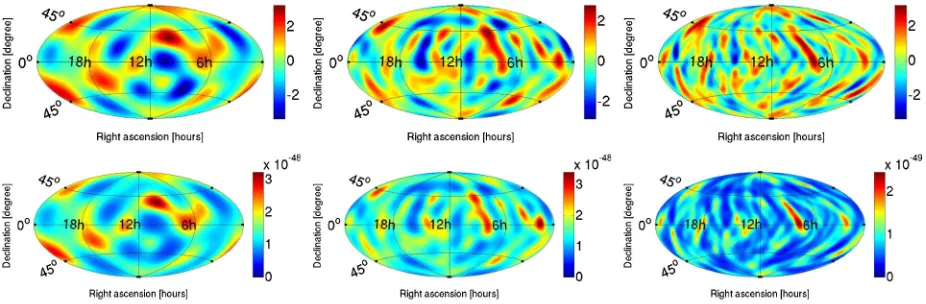
Results.—Figure 1 shows sky maps for SHD ¼ 3
(left), SHD ¼0 (center), and the radiometer ¼0 (right). The top row contains SNR maps. The maximum SNR values are 3.1 (with significancep¼25%), 3.1 (p¼ 56%), and 3.2 (p¼53%), respectively. These p values take into account the number of search directions and covariances between different sky patches. Observing no evidence of GWs, we set upper limits on GW power. The 90% confidence level (C.L.) upper-limit maps are given in the bottom row. For SHD¼ 3, the limits are between 5311049 strain2Hz1sr1; for SHD ¼0, the limits are between 6351049 strain2Hz1sr1; and for the radiometer¼0, the limits are between2 201050 strain2Hz1. Since the radiometer and SHD maps have different units—strain2Hz1 and strain2Hz1sr1 respectively—one must scale the SHD map by the typical diffraction limited resolution A 0:1 srto perform an approximate comparison.
The strain power limits can also be expressed in terms of energy flux per unit frequency [13]:
^
Fðf;^Þ ¼
3:181042 erg cm2s
f 100 Hz
þ2
^
P^: (14)
(Radiometer energy flux is obtained by replacingP^^ with ^
^.) The corresponding values are 210106
ðf=100 HzÞ1ergcm2s1Hz1sr1 and 211106
ðf=100 HzÞ2ergcm2s1Hz1sr1 for the SHD method, and660108ðf=100 HzÞ2 erg cm2s1Hz1for the radiometer. The radiometer limits constitutes a factor of
30improvement over the previous best [13].
Figure2shows 90% C.L. upper limits on theCl. Since the P^lm have units of strain2Hz1sr1, the Cl have the somewhat unusual units ofstrain4Hz2sr2.
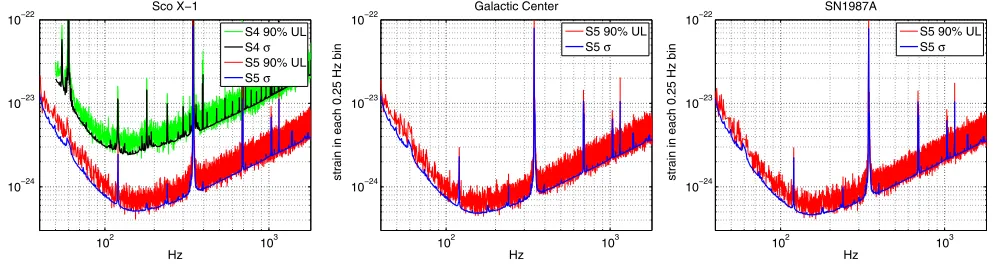
Sco X-1 is a nearby (2.8 kpc) low-mass x-ray binary likely to include a neutron-star spun up through accretion. Its spin frequency is unknown. It has been suggested that the accretion torque is balanced by GW emission [23]. The Doppler line broadening due to the orbital motion is smaller than the chosen f¼0:25 Hz bin width for fre-quencies below930 Hz[24]. At higher frequencies, the signal is certain to span two bins. We determine the maxi-mum value of SNR in the direction of Sco X-1 to be 3.6 (p¼73%given Oð7000Þindependent frequency bins) at f¼1770:50 Hz. Thus in Fig. 3 (first panel) we present limits on root-mean-square (RMS) strain,hRMSðf;^Þ, as a function of frequency in the direction of Sco X-1
ðRA;decÞ ¼ ð16:3 hr;15:6Þ. These limits improve on the previous best by a factor of5[13]. RMS strain is related to narrow-band GW power via
hRMSðf;^Þ ¼ ½ðf;^Þf1=2; (15)
FIG. 1 (color online). Top row: SNR maps for the three different analyses: SHD clean map¼ 3(left), SHD clean map¼0 (center), and radiometer¼0(right). All three SNR maps are consistent with detector noise. Thepvalues associated with each map’s maximum SNR are (from left to right)p¼25%,p¼56%,p¼53%. Bottom row: The corresponding 90% C.L. upper-limit maps on strain power in units of strain2Hz1sr1for the SHD algorithm, and units of strain2Hz1for the radiometer algorithm.
0 1 2 3 4 5 6 7 10−99
10−98 10−97 10−96
l Cl
(strain
4Hz
−2
sr
−2
)
0 2 4 6 8 10 12 10−99
10−98 10−97 10−96
l Cl
(strain
4Hz
−2
sr
−2
)
FIG. 2 (color online). Upper limits onCl at 90% CL vslfor the SHD analyses for¼ 3(left) and¼0(right). TheC^l are
[image:7.612.75.538.47.199.2] [image:7.612.58.531.578.688.2]and is better suited for comparison with searches for peri-odic GWs [25] (see also [26]). These limits apply to a circularly polarized signal from a pulsar whose spin axis is aligned with the line of sight. The limits constrain the RMS strain in each bin as opposed to the total RMS strain from Sco X-1, which might span two bins.
We also look for statistically significant signals associ-ated with the Galactic cCenterðRA;decÞ ¼ ð17:8 hr;29Þ and SN 1987AðRA;decÞ ¼ ð5:6 hr;69Þ. The maximum SNR values are 3.5 (p¼85%) atf¼203:25 Hzand 4.3 at (p¼7%) 1367.25 Hz, respectively. Limits on RMS strain are given in Fig.3.
In summary, no evidence was found to support the detection of either extended or pointlike GW sources. However, the clean maps in Fig.1represent the first effort to look for anisotropic extended sources of GWs. With the ongoing construction of second-generation GW interfer-ometers [27–30], we expect to achieve strain sensitivities that will test plausible astrophysical and cosmological models. The new framework presented here is expected to serve as the paradigm for future stochastic analyses.
The authors gratefully acknowledge the support of the United States National Science Foundation for the con-struction and operation of the LIGO Laboratory, the Science and Technology Facilities Council of the United Kingdom, the Max-Planck-Society, and the State of Niedersachsen/Germany for support of the construction and operation of the GEO600 detector, and the Italian Istituto Nazionale di Fisica Nucleare and the French Centre National de la Recherche Scientifique for the con-struction and operation of the Virgo detector. The authors also gratefully acknowledge the support of the research by these agencies and by the Australian Research Council, the International Science Linkages program of the Commonwealth of Australia, the Council of Scientific and Industrial Research of India, the Istituto Nazionale di
Fisica Nucleare of Italy, the Spanish Ministerio de Educacio´n y Ciencia, the Conselleria d’Economia Hisenda i Innovacio´ of the Govern de les Illes Balears, the Foundation for Fundamental Research on Matter sup-ported by the Netherlands Organisation for Scientific Research, the Polish Ministry of Science and Higher Education, the FOCUS Programme of Foundation for Polish Science, the Royal Society, the Scottish Funding Council, the Scottish Universities Physics Alliance, The National Aeronautics and Space Administration, the Carnegie Trust, the Leverhulme Trust, the David and Lucile Packard Foundation, the Research Corporation, and the Alfred P. Sloan Foundation.
[1] E. W. Kolb and M. S. Turner, The Early Universe
(Westview Press, Boulder, CO, 1994). [2] A. A. Starobinskii, JETP Lett.30, 682 (1979). [3] T. W. B. Kibble,J. Phys. A9, 1387 (1976).
[4] A. Buonanno, M. Maggiore, and C. Ungarelli,Phys. Rev. D55, 3330 (1997).
[5] R. Brustein, M. Gasperini, M. Giovannini, and G. Veneziano,Phys. Lett. B361, 45 (1995).
[6] E. Howell et al., Mon. Not. R. Astron. Soc. 351, 1237 (2004).
[7] V. Ferrari, S. Matarrese, and R. Schneider,Mon. Not. R. Astron. Soc.303, 258 (1999).
[8] T. Regimbau and B. Chauvineaux, Classical Quantum Gravity24, S627 (2007).
[9] T. Regimbau and J. A. de Freitas Pacheco, Astron. Astrophys.376, 381 (2001).
[10] B. P. Abbottet al.,Rep. Prog. Phys.72, 076901 (2009). [11] B. Abbottet al.,Astrophys. J. Lett.683, L45 (2008). [12] B. Abbottet al.,Nature (London)460, 990 (2009). [13] B. Abbottet al.,Phys. Rev. D76, 082003 (2007). [14] E. Thraneet al.,Phys. Rev. D80, 122002 (2009). 102 103
10−24 10−23 10−22
Hz
strain in each 0.25 Hz bin
Sco X−1
S4 90% UL S4σ S5 90% UL S5σ
102 103 10−24
10−23 10−22
Hz
strain in each 0.25 Hz bin
Galactic Center
S5 90% UL S5σ
102 103 10−24
10−23 10−22
Hz
strain in each 0.25 Hz bin
SN1987A
S5 90% UL S5σ
[image:8.612.62.559.48.184.2][15] M. Maggiore,Phys. Rep.331, 283 (2000).
[16] S. W. Ballmer, Classical Quantum Gravity 23, S179 (2006).
[17] S. Mitra, S. Dhurandhar, T. Souradeepet al.,Phys. Rev. D
77, 042002 (2008).
[18] The data were first processed withlmax¼20; the present
method of choosinglmaxwas then adopteda posteriorito
more accurately model the network’s angular resolution. [19] G. Hinshaw et al., Astrophys. J. Suppl. Ser. 180, 225
(2009).
[20] B. Allen and J. D. Romano, Phys. Rev. D 59, 102001 (1999).
[21] We follow the marginalization scheme used in [12], but note that this does not take into account covariance between baselines with a shared detector. Because the H2L1 baseline only contributes about 10% of the sensi-tivity, and the calibration uncertainty is on the order of 10% to start with, this effect is only on the order of 1%.
Work is ongoing to take this effect into account. [22] A prior constructed from [13] would be nearly flat anyway
since the strain sensitivity has improved 10-fold since S4. [23] D. Chakrabartyet al.,Nature (London)424, 42 (2003). [24] D. Steeghs and J. Casares,Astrophys. J.568, 273 (2002). [25] B. Abbottet al.,Phys. Rev. D76, 082001 (2007). [26] C. Messenger, Understanding the Sensitivity of the
Stochastic Radiometer Analysis in Terms of the Strain Tensor Amplitude, LIGO Document T1000195-v1 (2010). [27] G. Harry for LIGO Science Collaboration, Classical
Quantum Gravity27, 084006 (2010).
[28] J. R. Smith for LIGO Science Collaboration, Classical Quantum Gravity26, 114013 (2009).
[29] F. Acernese for Virgo Collaboration,Classical Quantum Gravity23, S63 (2006).