City, University of London Institutional Repository
Citation
:
Teare, Richard Edward (1989). A study of the consumer decision process for hospitality services. (Unpublished Doctoral thesis, City University London)This is the accepted version of the paper.
This version of the publication may differ from the final published
version.
Permanent repository link:
http://openaccess.city.ac.uk/6598/Link to published version
:
Copyright and reuse:
City Research Online aims to make research
outputs of City, University of London available to a wider audience.
Copyright and Moral Rights remain with the author(s) and/or copyright
holders. URLs from City Research Online may be freely distributed and
linked to.
City Research Online: http://openaccess.city.ac.uk/ [email protected]
THE (TTY UNTVRRSITY
BUSINESS SCHOOL
A
Study of the Consumer Decision Process for
Bosvitality Services
Richard Edward Tears
A thesis for the Degree of Doctor of Philosophy
Table of Contents
List of Figures 7
List of Cognitive Maps 8
Acknowledgments 9
Abstract 10
=2t2L3.
Introduction and background to the study1.1 Rationale for the study 11
1.2 The concept and characteristics of hospitality
services 11
1.2.1 Hospitality services and the consumer perspective 13 1.2.2 Hospitality services and the producer perspective 14
1.3 Background to the study 15
1.3.1 Defining the hotel product 15
1.3.2 Trends and developments in the U.K. short break
market 17
1.4 A hypothetical model of the consumer decision
process 18
1.4.1 Implications for the study 21
References 22
Chapter a The consumer decision process:
A paradigm in transition
2.1 Overview of the chapter 24
2.2 Consumer theory and the cognitive paradigm 24 2.3 General models of consumer behaviour 26
2.3.1 Nicosia model 27
2.3.2 Howard and Sheth model 28
2.3.3 Engel, Kollat and Blackwell model 29 2.4 Moutinho's model of vacation behaviour 31
2.4.1 Structure of the model 33
2.5 Implications for the study 35
2.6 The pre-purchase stage of the consumer decision
process 35
2.6.1 Preference structure 36
2.6.2 Search behaviour 37
2.6.3 Information search strategies 38
2.6.4 Individual differences and search behaviour 38 2.6.5 The role of prior product experience in search
behaviour 38
2.6.6 The role of product involvement in search behaviour 39
2.6.7 Perceived risk 40
2.6.8 Role specialisation in information search and brand
selection 41
2.6.9 The evoked set 42
2.6.10 The role of decision rules in choice behaviour 42 2.6.11 Non-compensatory decision rules 43 2.6.12 The role of price information in product choice 44 2.6.13 Family role influences in choice behaviour 44
2.6.14 The purchase decision 45
2.6.15 Research questions arising from the review of
pre-purchase studies 46
2.7 The consumption and post-consumption stages of the
2.7.1 The relationship between consumer expectations and
experience 47
2.7.2 The concept of satisfaction 48
2.7.3 Confirmation/disconfirmation of expectations 49
2.7.4 Experienced-based norms 49
2.7.5 Research questions from the review of consumption
and evaluation studies 50
References 52
Chapter 3 Consumer theory and methodology
3.1 Overview of the chapter 57
3.2 Scientific progress and method in
marketing
57 3.2.1 Qualitative approaches to consumer research 60 3.3 Theorygeneration
using qualitative methods 613.3.1 The grounded theory method 62
3.4 Theoretical sampling 63
3.5 Data collection and categorisation 64
3.6 Personal construct theory 66
3.6.1 Principles of cognitive mapping 66 3.6.2 Computer-based cognitive modelling 68
References 69
OmatmrI
Research design and methods4.1 Overview of the chapter 71
4.2 Factors affecting the research design 71
4.3 Organisation of the field work 72
4.4 Data comparison groups 73
4.4.1 Indirect measures: Age and estimated socioeconomic
group 74
4.4.2 Direct measures: Motives, prior product experience
and
involvement
754.5 Sampling procedure 76
4.5.1 Interviews before and after the short break 76 4.5.2 Interviews during the short break 76
4.6 Data collection and analysis 77
4.7 Constructing individual cognitive maps 78 4.8 The presentation of research findings 78
References 80
Chauter 5 An overview of the consumer decision
process for hospitality services
5.1 Introduction 81
5.2 The data categories and comparison groups 81 5.3 The role of purchase motives in the decision process 82 5.3.1 The purchase motives comparison group 83 5.3.2 Motives associated with physical needs 84 5.3.3 Motives associated with psychological needs 84 5.4 Consumer perceptions and the interpretation of
product information 85
5.5 Word of mouth recommendations and risk reduction 86 5.6 The influence of prior product experience on choice
behaviour 88
5.7 The interactive role of prior product experience and
involvement 88
5.8 The purchase decision 91 5.9 The role of assessment criteria during consumption 92 5.10 The consumption environment and design effects 93 5.11 The assessment of hotel services 94
5.12 Personal rating systems 95
5.13 Post-consumption evaluation 96
5.14 Implications for repeat buying 97
5.15 Conclusion 98
References 100
Chauter 6 Pre-purchase decision-making for
hospitality services
6.1 Introduction 101
6.2 An overview of the cognitive modelling process 103 6.2.1 Constructing a cognitive model 105 6.2.2 Entering and verifying model relationships 105
6.2.3 Model analysis 109
6.2.4 Model output 112
6.2.5 The criteria for selecting cognitive maps 114 6.3 Extensive prior product experience and high
involvement 115
6.3.1 Summary 120
6.4 Extensive prior product experience and moderate
involvement 120
6.4.1 Summary 129
6.5 Extensive prior product experience and low
involvement 130
6.5.1 Summary 139
6.6 Limited prior product experience and high
involvement 140
6.6.1 Summary 149
6.7 Limited prior product experience and moderate
involvement 150
6.7.1 Summary 158
6.8 Limited prior product experience and low involvement 159
6.8.1 Summary 163
6.9 A product experience-involvement matrix for
hospitality services 163
6.9.1 Consumer segmentation 164
6.9.2 (1A) Extensive experience and high involvement 164 6.9.3 (2A) Extensive experience and moderate involvement 164 6.9.4 (3A) Extensive experience and low involvement 166 6.9.5 (1B) Limited experience and high involvement 167 6.9.6 (2B) Limited experience and moderate involvement 167 6.9.7 (3B) Limited experience and low involvement 168
6.10 Conclusion 169
References 171
ghauter 7 The assessment and evaluation of
hospitality services
7.1 Overview of the chapter 172
7.2 Assessment criteria 174
7.2.1 Summary 183
7.3 The consumption environment and design effects 184
7.3.1 Summary 190
7.4.1 Summary 199
7.5 Personal rating systems 200
7.5.1 Summary 209
7.6 Sources of satisfaction during post-consumption
evaluation 210
7.6.1 Summary 218
7.7 Sources of dissatisfaction during post-consumption
evaluation 219
7.7.1 summary 225
7.8 Interrelationships between the procedures for
assessment and evaluation 226
7.9 The impact of prior product experience on the
personal rating system 228
7.9.1 (1A) Extensive experience and pre-purchase
influences 229
7.9.2 . (2A) Extensive experience and consumption stage
assessments 229
7.9.3 (3A) Extensive experience and post-consumption
evaluation 229
7.9.4 (1B) Limited experience and pre-purchase influences 230 7.9.5 (2B) Limited experience and consumption stage
assessments 230
7.9.6 (3B) Limited experience and post-consumption
evaluation 230
7.10 Implications for managing the consumption
experience 230
7.10.1 Interactions between the consumer and the producer 232 7.10.2 Interpersonal interactions between consumers 232 7.10.3 Interactions between producer systems and the
consumer 232
7.10.4 The impact of the physical environment on the
consumer 232
References 234
Chapter 8
Towards a consumer theory for hospitality
services
8.1 Overview of the chapter 235
8.2 The hypothetical decision model for hospitality
services 235
8.2.1 The contribution of Moutinho's tourist decision
model 236
8.2.2 Empirical support for the consumer decision model 237
8.3 The theoretical framework 237
8.3.1 The importance of motives 238
8.3.2 The role of product information 238 8.3.3 The role of the personal category system during
pre-purchase 239
8.3.4 The role of the personal rating system during
consumption 239
8.3.5 The role of the personal rating system during
post-consumption evaluation 240
8.4 Identifying different decision-making strategies 241 8.5 Emerging issues for hospitality marketing 246 8.5.1 Planning promotional strategies 246 8.5.2 Improving internal marketing potential 246 8.5.3 Monitoring the consumption environment 247
8.6 Directions for further research 248
8 . 4
Assizslisau
1: Kelly's theory of personal constructs 250 2: Comparison groups: statistics and definition 252 3: Comparison groups: respondent classification data 254
References and Bibliography 256
Ligt
of FiauresChapter
1
Introduction and background to the study1.1 The interdependency between the consumer and the
producer of hospitality services 12
1.2 A hypothetical model of the consumer decision
process for hospitality services 19
Chapter
2
The COMBUMOS decision process:A paradigm in transition
2.1 Nicosia's model of consumer behaviour 27 2.2 Howard and Sheth's model of buyer behaviour 29 2.3 The Engel, Kollat and Blackwell model of buyer
behaviour 31
2.4 Moutinho's vacation tourist behaviour model 33
Chapter 6 Pre-purchase decision-making for
6.1
hospitality services
Flow chart summary of analytical procedures used in data categorisation and individual model
construction 104
6.2 Entering data into the model 108
6.3 Entering relationships into the model 108 6.4 Analysing the model relationships 110
6.5 Examining key idea groups 111
6.6 Examining the key idea group hierarchy 112 6.7 Mapping key idea group relationships 113
6.8 A product experience-involvement matrix for
hospitality services 165
Chanter 7 The assessment and evaluation of
hospitality services
7.1 Interrelationships between the procedures for selecting, assessing and evaluating hospitality
services 226
7.2 Relationships between prior product experience and
the personal rating system 228
7.3 Key elements of the consumption experience for
Map Nos: 50-58 59-65 66-74 75-84 85-93 94-100
174 184 190 200 210 07-17
121 18-27
130 28-36
141 37-44
150 45-49 Limited prior product experience and low involvement 159 Chanter 7 The assessment and evaluation of
219
joist of Cognitive Mays
Sal=NM—A
Pre-purchase decision-making forhospitality services
Map Nos:
01-06 Extensive prior product experience and high involvement
Extensive prior product experience and moderate involvement
Extensive prior product experience and low involvement
Limited prior product experience and high involvement
Limited prior product experience and moderate
involvement
hospitality services
115
Assessment criteria
The consumption environment and design effects Hotel services
Personal rating systems
Sources of satisfaction during post-consumption evaluation
I would like to thank my supervisors Maureen Guirdham and Tom Payton; and representatives from the collaborating company Mike Davies and Bill Bailey. I am also grateful to Derek Esterson, Nick Light and John Coyne for their support and advice, and above all to my wife Rachel for her love and encouragement throughout the life of this project.
axalAzAtisia
hbatract
The purpose of the study was to investigate the consumer decision process for hospitality services, with particular reference to the interactions occuring between the consumer and the producer during service delivery. As the hospitality industry is very diverse, the hotel short break product was selected as the locus for the study.
At the outset, a hypothetical model of the consumer decision process was constructed, drawing on the characteristics of hospitality services and the differing perspectives of the consumer and the producer. In order to generate a grounded theory which would help to explain the consumer decision process, data was collected by personal interview prior to, during and after the hotel short break. The interview data was then transcribed and analysed using the constant comparative method developed by Glaser and Strauss. Following this, a secondary method of analysis derived from Kelly's personal construct theory was used to elaborate the theoretical framework. To identify decision-making similarities and differences more clearly, each interview was re-constructed in the form of an interactive computer-based cognitive model using- a software program called Cognitive Policy Evaluation (COPE). The output from the models, in the . form of cognitive maps depicting themed relationships, was used to illustrate decision process relationships and distinguish between consumers with extensive and limited prior product experience.
Chapter
1.1 Bationale for the study
Although commercial hospitality services make an important contribution to the service sector of the economy, empirically-based understanding of the interactions between the consumer and the producer is limited to a small number of prior studies. In this context, the purpose of the study was to investigate the consumer decision process for hospitality services and to generate a grounded explanatory consumer theory. As the term 'hospitality' embraces a wide range of catering, accommodation and leisure activities, it was necessary to focus the research in one sector of the industry.
A prominent feature of product development in the hospitality industry during the 1980's has been the integration of a wider range and type of consumer services. The hotel short break product was selected as a basis for the study because it exemplifies this trend, with catering, accommodation and leisure activity components packaged at an inclusive price. As there are many choice options available, and the investment cost is higher than for non-residential hospitality services, the consumer decision process might be expected to vary according to factors such as the level of perceived risk and the extent of prior experience with the product category.
The chapter begins by examining the characteristics of hospitality services and the differing perspectives of the consumer and the producer. Following this, the collaborative nature of the research is explained with reference to definitions of the hotel product and trends and developments in the U.K. short break market. At the end of the chapter a hypothetical model of the consumer decision process for hospitality services is presented. This provides a frame of reference for the theory generating approach to the study which is explained in chapters 3 and 4.
1.2
The concept and characteristics of hospitalitynary-isaLa
The origin of the word hospitality can be traced to the Latin noun 'hospice' meaning a 'place of entertainment or of shelter'. Usage of the generic term
'hospitality industry' to describe what is traditionally known as the 'hotel and catering industry' is a comparatively recent development in the
Standardised productf--- PRODUCT DESIGN ---*Personalised product Limited stafff---SERVICE DELIVERY Extensive staff
discretion/ discretion Short time periodf---- CONSUMPTION ---,Long time period (Burgess, 1982).
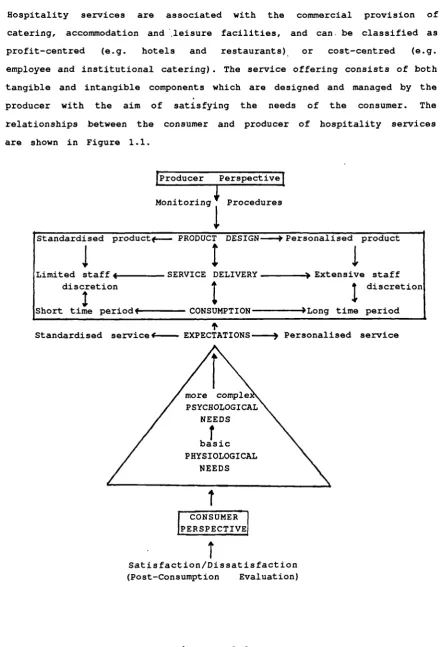
Hospitality services are associated with the commercial provision of catering, accommodation and ,leisure facilities, and can. be classified as profit-centred (e.g. hotels and restaurants) , or cost-centred (e.g. employee and institutional catering). The service offering consists of both tangible and intangible components which are designed and managed by the producer with the aim of satisfying the needs of the consumer. The relationships between the consumer and producer of hospitality services are shown in Figure 1.1.
IProducer Perspectivel
Monitoring Procedures
Standardised service---- EXPECTATIONS----, Personalised service
more comple PSYCHOLOGICAL
NEEDS basic PHYSIOLOGICAL
NEEDS
I
CONSUMER PERSPECTIVE
Satisfaction/Dissatisfaction (Post-Consumption Evaluation)
[image:13.595.70.511.92.740.2]figure 1.1
Promotional activities such as advertising and brochure distribution may lead to the initial contact between the consumer and the producer, usually by telephone or written enquiry. The main consumer-producer interaction occurs at the point of consumption where the effectiveness of service delivery, especially the behaviour of service staff, is a critical determinant of consumer satisfaction.
Referring to the environment in which hospitality managers work, Nailon (1981, 1982) observed that many operational problems occur because the consequences of service interactions are not fully understood. Cassee (1983) agrees and identifies the need for empirical research focusing on the behaviour of consumers and producers of hospitality services in different contexts. As the period of consumption extends over several days for the hotel short break, consumer-producer interactions are necessarily varied and complex.
1.2.1
Hospitality services have both functional and expressive roles to fulfil. The consumer is primarily concerned with the desire to satisfy basic functional (or physiological) needs such as hunger and thirst. These are accompanied by more complex expressive (or psychological) needs such as identity, status and security.
Psychological needs may be determined by expectations derived from the consumer's lifestyle and prior experience. They may also be motivated by aspirations to experience surroundings beyond current lifestyle expecta-tions.
Consumer needs require an immediate response from the producer. If they are not satisfied, complaint behaviour may be triggered by physiological discomfort or psychological ego-defensive mechanisms. The consistency and quality of service delivery are important because the consumer has little or no control over the environment in which consumption takes place. Service efficiency is often vulnerable because of the long operational service periods and demand fluctuations which occur throughout the day, week, month and year.
personalities of the participants. Every consumer has a unique set of expectations about the role of staff during service delivery. If these expectations are not met, the consumer may feel dissatisfied, although the feeling may be internalised if it is not strong enough to cause complaint behaviour. For example, non-verbal communication by staff, relating to the expected payment of gratuities may cause the consumer to feel irritated or embarrassed. This source of dissatisfaction is unlikely to be reported to management.
Consumer satisfaction is derived from different kinds of service experiences and interactions which are unique to the occasion and situation. For example, the time period for using hospitality services can vary from several minutes (a fast food restaurant) to a week or more (staying
in an hotel). Consumption over a longer time period will require a more sophisticated form of consumer evaluation. This is because satisfaction with service delivery is linked to the accumulation of many impressions from successive and usually transient experiences and interactions. The evaluative procedure must be able to cope with this complexity, and provide the consumer with an overall post-consumption measure of satisfaction.
1.2.2 ••'
As hospitality services are usually consumed at the point of consumption, the consumer becomes involved in the production process. This is because the consumer arrives with a set of needs and expectations about the product and the environment in which the service will be delivered. The producer's ability to control and regulate service delivery depends on the use of sensitive monitoring procedures, and corrective measures. When service delivery occurs over a long time period as in an hotel, continuous performance monitoring is necessary in order to minimise service variability.
Hotels are often characterised by high fixed costs and sensitive profit ratios. This is especially the case if the pattern of business is irregular, which may contribute to short-term sales instability (Kotas, 1975; 1977). To minimise these effects, reduced cost options such as the hotel short break product have been used to penetrate new market segments and improve productivity and profitability.
Hospitality services cannot be stored like manufactured products, and hence the revenue from unsold meals or bedrooms over a given time period cannot be recouped. Similarly, product experiences cannot be precisely repli-cated. For instance, the atmosphere and service in a restaurant will be affected by the number of customers being served at any given moment. Too few or too many customers may create an undesirable impression. If the restaurant is too busy and complaints occur, the manager can only offer to compensate the dissatisfied customer, he cannot erase the recollection of an unsatisfactory meal experience.
Service and manufacturing industries have different consumer-producer interface characteristics. As many as 90 per cent of the staff in service organisations have direct contact with the consumer, compared with only 10 per cent in manufacturing (Irons, 1983). The different orientation of service delivery means that management theories and methods developed in manufacturing industries have limited application to service management problems. The natural focus for consumer research in hospitality services therefore lies at the point of simultaneous production and consumption, where consumer-producer interactions are concentrated.
1.3 Background to the study
During a period of employment in operations management with Thistle Hotels Limited, the project collaborators, it became apparent to me that consumers using hotels for leisure purposes had a wide range of needs and expectations. This view was confirmed by two internal secondments to assist with the promotion of the company's branded short break product; Highlife Breaks. I subsequently formulated a proposal to investigate consumer
decision-making which was accepted by the company, who provided the necessary access and support to undertake the research.
1 . 3 . 1
patining_tlis_112t23_szoiagt
unhelpful compared with Levitt's (1981) view which recognises that products and services both have tangible and intangible characteristics. Levitt recognises a common objective (to satisfy the consumer) and a distinction based solely on how satisfaction is derived from differing combinations of tangible (physical) and intangible (emotional) properties.
Buttle (1986, 1986a) applies Levitt's definition to hospitality services, arguing that consumers seek intangible benefits in the form of satisfaction, regardless of whether the product is tangible or intangible. He illustrates this with the example of a restaurant meal occasion characterised by consumer-producer interactions which are both tangible
(such as the experience of food and personal service) and intangible (such as the emotional reaction to the decor and quality of furnishings) Buttle calls the sum of these experiences the 'catering product'.
Nightingale (1983; 1985) describes the 'hotel experience' as a composite of many activities and interactions, each with physical and emotional content. This view implies that the consumer continually assesses the product, combining individual assessments to evaluate overall product satisfaction at the end of the stay.
Doswell and Gamble (1979) define the hotel product as a composite of physical products (such as food, beverages and accommodation) and their associated service elements. Their definition also recognises the importance of product intangibles such as image and atmosphere, which have an emotional impact on the consumer.
Medlik (1980) identifies five factors which may affect the level of consumer satisfaction with the hotel product. These are:
(1) Location - geographical convenience, accessibility, attractive-ness of surroundings, freedom from distractions (such as traffic noise).
(2) Facilities - including bedrooms, restaurants, bars, function and meeting rooms, leisure and recreational facilities for customer use, differentiated in various ways, including by type and size.
(4) Image - defined in terms of the way in which the hotel is perceived by an individual or group. Partly a function of location, facilities and service are also influenced by the name, reputation, appearance, atmosphere and other associations.
(5) Price - value for money expressions about the hotel are made by consideration of location, facilities, service, image and the satisfaction derived by its users from these and other components of the hotel product.
Although this list of product-specific factors affecting consumer satisfaction provides a helpful overview, it requires empirical verifi-cation. The operation of assessment procedures and alternative explana-tions of how consumer satisfaction is derived are discussed in chapter 2.
1.3.2 Trends and developments in the U.K. short break market The hotel short break is a comparatively recent hospitality product, which has become increasingly important to the hotel operators during the 1980's (Teare, 1989d; 1990b). Despite it's significance, no prior consumer research has been reported in the marketing literature, and the information available is limited to surveys of market trends and dimensions.
Mintel (1987) refer to the term short break as a "holiday of two or three nights spent away from home". This definition excludes business trips, visits to friends and relatives and one night stays. Euromonitor (1987) adopt a broader view, including within their definition, holidays of up to four nights duration. This reflects a trend towards increased flexibility in the packaging and marketing of short breaks, which have traditionally been associated with weekend accommodation. The accommoda-tion component may be packaged with meals and other features such as transportation, at a reduced, inclusive price (Travel and Tourism Analyst, 1987).
The economic significance of the short break market is demonstrated by it's rapid development and future growth prospects:
"The commercial market is believed to have doubled in size in the last five years. The operators estimate that the short break market has grown by 20 per cent per annum in the last five years and they forecast that it will continue to grow at this level over the next two or three years." (Travel and Tourism Analyst, 1987)
many specialist operators including hotel groups, tour operators, transport companies and independent hoteliers. An estimated 4-6 million hotel short breaks were taken in Britain during 1985, valued at £320 million. This represents 18 per cent of the total market, estimated at 33 million short break trips (Euromonitor, 1987).
The statistics indicate the significant business potential of short breaks for hotel groups marketing their own product packages. Well established brands include those operated by Crest, Embassy, Ladbroke, Rank, Thistle and Trusthouse Forte Hotels.
Brand image is closely associated with the design of the brochure, the distribution network and the level of national and regional advertising support for the brand (Parker, 1985). The retail distribution network has become especially important during the last few years as competition between the leading brands has intensified (Teare, Davies and McGeary, 1989a). This is because a distribution agreement with the large multiple travel agencies such as Thomas Cook and Pickford's Travel ensures that the brand maintains high visibility in the marketplace and that consumers have easy and convenient access to brochures. As short breaks are now widely available, these are important considerations because consumers expect to be able to collect brochures and other information from a travel agent as they would when planning a long holiday.
It is difficult to estimate the proportion of sales generated from retail distribution because there are no statistics available. However, retailer perceptions of brand performance indicate that the market is very competitive, with only two brands thought to have more than a 10 per cent share of the market (Euromonitor, 1987a).
Growth prospects in the hotel accommodation sector of the short break market are optimistic. Euromonitor (1987) forecast a growth rate of 15 per cent per annum during the period 1985-1995. In particular, they forsee an increased proportion of people in the 30-39 age group taking short breaks, and a more even distribution of demand throughout the year. This suggests that hotel groups and other operators will continue to invest in supporting and developing their brands.
1 . 4
STAGE 3:
Consumer-Dominant Assessment
STAGE 2: Product-Dominant
As
POST-ONSUMPTION
EVALUATION
SERVICE
CONSUMPTION
DELIVERY
Overall evaluation
Experience-based assessment
Time period of information
search selection
----4
CONSUMER'S
t
PREFERENCE STRUCTURESTAGE 1:
Consumer-Dominant Assessment
Increased product knowledge PURCHASE
DECISION
rand selection
(High involvement)
Brand selction
PRE- (low involvement)
PUR HASH
Extent sear
developed from the observations made above, and from personal experience in marketing and operations management. The summary at the end of the section identifies implications for the literature review and for the research methods and design used in the study.
As the hotel short break is primarily a leisure activity, the decision process is likely to be characterised by joint or family decision-making and greater caution than might be expected for non-leisure hotel use or non-residential hospitality services. This is because of the comparatively high financial investment with no tangible return, and the perceived need to assess the associated costs and benefits. Figure 1.2 shows the hypothesised change in emphasis between consumer and producer dominant assessment during the consumer decision process for hospitality services (Teare 1988b; 1990a). The changes correspond to the three main stages of the decision process; pre-purchase, consumption and post-consumption evaluation which are described below.
High Involvement = Longer, more complex search and selection
Low Involvement Shorter, more limited search and selection
rigure
1.2 .
A hypothetical model of the consumer decision process
(1) At the pre-purchase stage, consumer-related factors are likely to be more influential than product-related factors in reaching a purchase decision.
When joint or family decision-making occurs during the course of reaching agreement on a purchase decision, role specialisation is commonplace (Davis and Rigaux, 1974). Role adoption will be determined by personal, consumer-related factors such as self-confidence and assertiveness, and the product-related factor of prior experience. Stage 1 assumes that consumer-product-related factors are the dominant influence on the purchase decision because the subjective interpretation of product information and recommendations feature prominently in pre-purchase activity.
If family members have limited prior experience, the perceived risk is likely to be higher, requiring greater personal involvement in order to resolve sources of anxiety. Conversely, consumers with extensive prior. experience will be able to make a purchase decision more easily and with greater confidence. In this situation, consumer-related factors are less dominant because product knowledge provides a stabilising influence. Therefore, the relationship between prior experience and product involvement is important because it is likely to determine the amount of time, the extent of information search and the level of involvement required to assess the purchase options and reach a decision.
(2) During consumption, product-related factors are likely to be more • influential than consumer-related factors in determining product
satisfaction.
or dissatisfaction.
(3) During post-consumption evaluation, consumer-related factors are likely to be more
influential
than product-related factors indetermining
overall satisfaction.The overall feeling of satisfaction formulated during post-consumption is an enduring, cumulative measure derived from the many assessments made during consumption. Although the consumer may need to recall sensory product-related impressions such as visually appealing guest room design features, the final evaluation is more likely to be influenced by consumer-related factors. These are principally end-state feelings of a psychologi-cal nature such as feeling relaxed and refreshed. If the outcome of stage 2 is a negative psychological state, such as increased tension, then the consumer is likely to experience an overall feeling of dissatisfaction during post-consumption evaluation, this in. turn will influence brand attitudes and future purchase behaviour.
1 . 4 . 1 Imlicationi for the itndv
References
BAKER, Mi. 0981) Services: salvation or servitude? The Ouartertv Review of Marketing ¢ (3): 7-18.
BURGESS, J. (1982) Perspectives on gift exchange and hospitable behaviour. Thternational Journal of Hospitality Management 1(1) 49-51
BUVILE, F.A. (1986) Unserviceable concepts in service marketing. The Quarterly Review of Marketing 11 (3): 8-14.
BUTTLE, FA (1986a) Hotel and food service marketing. (Eastbourne: Holt, Rinehart and Winston).
CASSEE, E (1983) Introduction. la: The management of hospitality, ed. by E Cassee and R. Reuland. (Oxford: Pergamon).
DAVIS, H.L. and FtIGAUX, B.P (1974) Perception of marital roles in decision processes. Journal of Consumer Research I (June): 51-61.
DOSWELL, Rand GAMBLE., PR. (1979) Marketing and planning hotels and tourism projects. (London: Hutchinson): 19-20.
EUROMONITOR (1987) Weekend breaks and day nips. (London: Eraanonitor Publications Limited).
EUROMONITOR (1987a) UK hotels in the 1980s. (London: Euromanitor Publications Limited).
IRONS, K. (1983) How to manage services. jvtanagement Today (November): 90-168.
KOTAS, R. (1975) Market orientation in the hotel and catering industry. (Guildford: Surrey University Press).
KOTAS, R. (1977) Management accounting for hotels and restaurants. (Guildfarl: Surrey University Press).
LEVTIT, T. (1981) Marketing intangible products and product intangibles. Harvard Business Review (May-June): 94-102.
MEDUK, S. (1980) The Business of hotels. (London: Heinanann): 115-116.
MINTEL/BRITISH MARKET RESEARCH BUREAU (1987) Mudd Leisure Intelligence Vol 1. (London: Mintel/British Market Research Bureau).
NAILON, P.W. (1981) Theory and art in hospitality management. Inaugural lecture, University of Surrey, Guildford.
NAMON, P.W. (1982) Theory in hospitality managanatt. International Journal of Hospitality Management j(3): 135-143.
NIGHTINGALE, M. (1983) Determination and control of quality standards in hospitality services. M.Ptul thesis: University of Surrey, Department of Management Studies for Tourism and Hotel Industries.
NIGHTINGALE, M. (1985) The hospitality industry: Defining quality for a quality assurance programme - a study of perceptions. The Service Industries Journal 5(1): 9-22.
PARKER, A. (1985) Branding the hotel product. Paper presented at HOMA Biennial C.onference, March 1985, Bath.
RAMMELL, IM (1974) Marketing in theservices sector. (Cambridge, MA: Wmthrop).
TEARE, R. (1988b) The consumer decision process for hospitality services. Paper presented at Current Issues in Services Research Conference, Dorset Institute, November, 1988.
TEARE, R., DAVIES, M. and McGEARY, B. (1989a) The operational challenge of hotel short breaks. Journal of Contemnorarv Hospitality Management 1(1): 22-24.
TEARE, R. and GUMMESSON, a (1989b) Internal marketing strategy for hospitality organisations. Paper presented at the Journal of Contemporary Hospitality Management launch conference, Dorset Institute, April, 1989.
TEARE, R. (1990a) An exploration of the consumer decision process for hospitality services. In: Managing and Marketing Saviors into the 1990's, ed. by R. Team, L Moutinho and N. Morgan. London: Cassell (fortlicaning).
WARE R., MOU1INHO, L and MORGAN, N. (199(b) Managing and marketing services: Emerging themes for the 1990's.
h:
Managing and Marketing Saviors into the 1990's, ed. by R. Team, L Moutinho and N. Morgan. London: Cassell (forthcoming).Chapter Z
Thst_-0211111/119X—_slacialan_mrsassuuu_IL_Raradigni_irancilisa
2.1
Overview of the chapterThe consumer decision process introduced in chapter 1, broadly describes the task of product assessment and evaluation across the three decision stages of pre-purchase, consumption and post-consumption. There are however, differences of opinion concerning the sources of influence operating at each stage, and the relationships between the stages.
The first part of the chapter reviews three of the general decision process models which have had a formative role in the development of consumer theory. These were developed by Nicosia (1966), Howard and Sheth (1969) and Engel Kollat and Blackwell (1968; 1982) They have influenced the construction of a more recent descriptive model of vacation tourist behaviour, which is also reviewed (Moutinho, 1982; 1984; 1986). As the model describes international long holiday behaviour, it does not necessarily provide an appropriate basis for an empirical study of hospitality services. However, as there are some areas of commonality between decision-making for long and short holidays, the general and specific models collectively provide guidance for theory construction.
The second part of the chapter is concerned with a broad-based review of the literature relating to consumer decision process research. The review is primarily intended to identify influences and relationships which may have implications for the research design, and the development of consumer theory for hospitality services. In order to focus the review as precisely as possible, research findings for each decision process stage have been grouped together by using appropriate themes emerging from the literature.
2.2
Consumer theory and the cognitive naradigmAnderson (1983) and Peter and Olson (1983) identify the need for a theoretical framework or 'paradigm' (Kuhn, 1970) when making empirical observations. This viewpoint is strengthened by the findings of Bagozzi
The dominant tradition in consumer research is the cognitive paradigm. The
most well known models of consumer behaviour assume that consumers have
considerable capacity for receiving and handling quantities of information
and for undertaking pre-purchase search and evaluation. The consumer is
also assumed to process information in a rational way, and by so doing
becomes progressively convinced of the need to purchase the focal brand.
The central component of these models is an extended consumer decision
sequence in which information is received and classified by the individual.
It is subsequently transformed by cognitive processing into attitudes and
intentions, which determine purchase behaviour and brand choice (McGuire,
1976).
In a review of consumer choice models, Hansen (1976) identifies a common
characteristic which is understood to be an ego-involving sequence of
cognitive, affective and conative change. A typical pattern, in situations
where choice is preceded by the evaluation of alternatives, may include
experiences of uncertainty and anxiety. This produces a sense of inner
conflict as the possible outcomes are considered.
Olshavsky and Granbois (1979) suggest that the purpose of cognitive
activity during decision-making is to reduce anxiety and conflict by
gradually resolving sources of uncertainty. This assumes that the consumer
can formulate and apply evaluative criteria to predict the possible
outcomes of each purchase option. The procedure is aided by the use of
decision rules, which are developed from information received, processed
and stored in memory. The role of decision rules is to provide stability
and consistency during decision-making, enabling the consumer to undertake
a standardised form of comparative assessment and evaluation.
The cognitive theories and models of decision-making reviewed in the
following section presuppose that the consumer is motivated to find the
optimum solution for purchase decisions. This requires subjective
assessment of product attributes. However, as the number of alternatives
increase, it becomes more difficult for the consumer to decide. If for
instance product knowledge is limited, the consumer may aim more
realistically to make a satisfactory rather than an optimal decision
(Fletcher, 1986; 1987).
Athough the cognitive paradigm remains influential, Foxall (1986) points
out that there have been a number of sustained criticisms. These can be
(1) Comprehensive models of consumer decision-making are often too complex and/or too generalised to test empirically; (Bagozzi, 1984; Jacoby, 1978) indicating that an alternative approach, located much closer . to observable consumer behaviour, is needed.
(2) Empirical research has often revealed low correlational consis-tency between decision process components (Ajzen and Fishbein, 1977; Foxall, 1983; 1984).
(3) Consumers are thought to use less information than the cognitive paradigm generally assumes (Jacoby, Chestnut and Siberman, 1977; Olshavsky and Granbois, 1979) and too much information may actually impede rational decision-making (Jacoby, Speller and Kohn, 1974; 1974a).
(4) Sequences other than cognition-affect-conation have been shown to describe more accurately the consumer choice process. For example the low involvement hierarchy, and alternative views of the learning of brand preferences in response to advertising have been proposed (Krugman, 1965; Robertson, 1976).
Foxall argues that the success of the cognitive paradigm is actually impeding various forms of theoretical progress which run contrary to the fundamental assumptions of the paradigm. He suggests that this is because there are so many "ready made" explanations which can be inferred for any observed behaviour. In the following section, these criticisms are related to the three selected cognitive decision models.
2.3 General models of consumer behaviouz
A decision process model is typically represented by a set of propositions, or a series of related statements and ideas which attempt to predict how consumers and markets will react. Created by defining the variables and specifying the relationships between them, it also facilitates the prediction of outcomes under specified conditions, and provides a framework
for analysis.
Consumer's Attributes (especially predispositions)
Field Two: Search for, and Evaluation of, Means-End(s) Relation(s) (Preaction Field)
Motivation
Field Mee: The Act of Purchase Storage
Purchasing
Behavior
Figure 2.1 Attitude
Field four:
The ftectack Consumption
with their operationalisation.
2.3.1 Ficosia model
Nicosia's empirical model which is shown in Figure 2.1, was based on the
'funnel' concept, which begins when the consumer recognises the existence
of a problem or need. This activates information search, and a gradual
narrowing of the possible solutions until the best option is recognised
and selected.
Nicosia modelled the consumer decision process on four sequential fields,
starting with the receipt and processing of a persuasive message (message
exposure) by the consumer. The output from Field One is an attitude, which
causes a search and evaluation of attitudes towards the advertised product
and brand alternatives in Field Two. The output from Field Two is a motive
to buy, which is translated into action and the act of purchasing in Field
Three. This behaviour leads to product usage in Field Four: Finally,
feedback to Field One influences the way in which future communications
are received and decisions are made.
Critics of Nicosia's work point to the imprecise definition of variables
and relationships in the model. It was also considered to be premature,
simplistic and too generalised, with no serious concern for the
operationalisation of the flow chart variables (Tuck, 1976). The model was
designed with practical applications in mind, but it received little
attention from practitioners following publication.
2.3.2 loward and Sheth model
Howard and Sheth's model which is shown in Figure 2.2, depicts inputs from a stimulus display and outputs of attention, brand comprehension, attitude, intention and finally purchase. At the centre of the model there are perceptual and learning subsystems. Their operational efficiency is
influenced by variables such as the importance of the purchase and time pressure.
The perceptual subsystem receives inputs from the stimulus display and it's function is to gather and process or 'encode' information relevant to the purchase decision. The elements of the subsystem - attention, stimulus ambiguity, perceptual bias and overt search cope with internal and external search activities. Ambiguity may occur if there is lack of clarity in the stimulus display. Perceptual bias occurs if the consumer selects information in such a way that the overall quality or meaning is distorted.
The learning subsystem, which contains motives, choice criteria, attitudes, brand comprehension and confidence receives input from the perceptual subsystem, which is then evaluated. The output either supports or rejects the purchase decision.
There have been many attempts to operationalise the Howard and Sheth model (for example Farley, Howard and Ring 1970; 1974) resulting in a progressive revision of the theory. Even so, only small sections of the model have been
tested, and the verification of relationships has been inconsistent.
Problems have included relationships which have not been fully developed and articulated in the model, measurement error, difficulty in operation-alising some concepts (such as perceptual bias and stimulus ambiguity) and causal relationships which are difficult to prove. Tuck (1976) concludes:
"The theory produced is untestable and non-specific and fails to meet the criterion of a good science".
Perceptual Attention Bias Stimulus Display
Purchase.
mtmowl 1
Annuchi *7j
Brand
Conhtliehenvore "*Ji
, Attention' &gnaw...five
a. Quality b. Price e. Distinctiveness d. Service
O. Availability
r---Overt
Search Conlidunas 4.
I
Symbolic
a. Quality b. Price e. Distinctiveness d. Service
a. Availability
Stimulus
Ambiguity Attitude
Social • a. Family
b. Reterence groups
e. Social Class Mo ives Choice
Criteria
Intemmn.
L Br nd Complehensionj
action I *
Inputs Perceptual constructs Learning constructs Outputs
Solid lines indicate flow of information; dashed lines, feedback effects.
rigure 2.2
Boward and Sheth's model of buyer behaviour
2.3.3 ngel. Kollat and Blackwell model
The first version of the Engel, Kollat and Blackwell model was published
in 1968. It also used the funnel concept, depicting the decision process
as part of an information processing system. Branches from each stage
-problem recognition, search and evaluation of alternatives, choice and
was initially designed to accommodate the range from extended to routine problem-solving. However, the later version published in 1982 and shown in Figure 2.3, is described more specifically as a high involvement model.
The model was originally conceived for teaching and learning purposes, and has undergone several modifications to reflect current thinking. However, the authors have made no explicit attempt to specify functional relationships which would permit empirical testing. This has resulted in criticisms that the model is too superficial and generalised (Tuck, 1976). Despite this, it remains influential because of it's association with the first major text book on consumer behaviour. The modifications to the model also reflect more recent interest in the information processing approach to modelling consumer behaviour, notably Bettman's information processing model (1979).
To summarise, the utility of general consumer models remains questionable. There are several reasons for this, notably because of the complexity of model relationships, and their unreliability as a means of predicting consumer behaviour or guiding communication strategy. These reasons also account for the limited appeal of decision model research to practitioners, who might usefully employ empirical approaches to solve marketing problems if the model relationships were relevant, and easier to understand.
There is clearly a need to develop theoretical and practical understanding of the consumer decision process in specific product fields and situations. As there are procedural similarities between short and long holiday decision-making activities, a model of tourist decision behaviour is
-4
; earc
;
CD
--•-Beliefs Evaluative
criteria
i Al ternativ
t. evaluation, 'A,4111:14.A4
[ e., Attitude
Intention Stimuli
Marketer dominated
Other
I
1 External search
Exposure
Attention
Comprehension
Yielding/ acceptance
Retention
,Outoomes.::, •
Satisfaction
Figure 2.3
The Engel. Kollat and Blackwell model of buyer behaviour
2.4 Moutinho's model of vacation tourist behaviour
In service industries, the consumer decision process is likely to be
directly influenced by the nature of the service activity. For example,
Moutinho (1982; 1984; 1986) suggests that the tourist product purchase is
rarely spontaneous, being preceded by planning and saving over a long time
period, with no tangible return on investment. The similarities with
hospitality services are evident from the review of consumer and producer
perspectives in chapter 1.
The basic framework of Moutinho's model is derived from general decision
model assumptions and published research relating to vacation tourist
behaviour. The model construction is underpinned by three behavioural
purchase motives initiate the sequence of behavioural events, cognition activates mental processing and learning causes' subsequent ' changes in behaviour. Behaviour is defined as a function of intention to act, which may in turn be influenced by situational factors which intervene between intended and actual behaviour. The model which is shown in Figure 2.4, consists of three parts, pre-decision and decision processes, purchase evaluation and repeat buying probabilities.
The decision process stages in the model are problem recognition, search, alternatives evaluation, choice and outcomes. The assumption is that as the consumer proceeds through these stages, progressive focusing occurs, giving rise to three options at the alternatives evaluation stage:
(1) Destinations may be rejected by the travel decision-maker, because they have no potential to-satisfy travel objectives.
(2) Destinations which are considered to be neutral alternatives may require further information, and discussion inputs from other family members.
(3) Destinations considered after preliminary judgement to be viable alternatives, may require more detailed evaluation.
The model implicitly recognises that during the evaluation of alternatives, the evoked set of brands is unlikely to contain more than seven options for most tourist destination decisions (Woodside, Ronkainen and Reid 1977).
Hesitation
Refusal to buy Repeat buying probability 1 Repeat buying lhigh positive) Repeat buying (medium positive)
F Field S Subfield
Subsequent behaviour:
Straight rebuy • Future rebuy
subsequent short-term medium-term long-lerm - Modified rebuy
-Go to competition
r
crure
2.4Perceived risk
1
EI Decision
El
Purchase Part (—Pre-decision and decision processes
Personality
1
Lifestyle
I I
Attituoe
Perceived Family role set influence
I
I 1
I Motives
1
El Preference structure 1 Intention
a stimulus i
filtration — Search — Evoked set — a — Choice criteria
(stimulus I I
ambiguity' Comprehension
1
Perceptual • bias
Sensitivity Cognitive to information 4111.1CtUre
Attention
Part II—Post- purchase
a and learning
evaluation
•
Latitude of . acceptance (+I Non-commitment High Positive Meidium Information
§ Adequacy evaluation Cost-benefit analysis Product consistency Post-purchase Confirmation
r Expectations
Oisconfirmation Reinforcement cognitive Satisfaction Dissatisfaction Part III—Future I. . decision-making Levels at reward dissonance .-tatitude of tejection (7)\ Medium High negative -4
Moutinho's vacation tourist behaviour
model
2.4.1. Ztructure of _the model
Part One of the model is concerned with pre-decision and decision processes,
beginning with need arousal and the receipt of travel stimuli, and
culminating in product purchase. The pre-decision field of preference
structure has subfields of stimulus filtration, attention and learning
processes and choice criteria. The two decision fields are labelled
decision and purchase.
The assumption is made that the consumer's preference structure for a
tourist destination is influenced by internalised environmental factors
and reference groups, financial status and social class. It is also assumed that affective judgements are influenced by factors such as the consumer's own personality, lifestyle, perceived role set, and purchase motives.
The consumer's preference structure may also be influenced by exposure to travel stimuli, portraying product attributes such as quality, price, distinctiveness, prestige, service and availability. The act of filtering these stimuli enables the consumer to organise information in a meaningful way. If however the stimuli contain ambiguity, the consumer may feel the
need to search for additional information.
When a consumer feels uncertain about the merits of alternative brands and or destinations it is assumed that the extent of external information search activity will be proportional to the degree of perceived risk. In contrast, the consumer with extensive product knowledge derived from prior experience may engage in little or no external information search.
It is assumed that attention to media and other information sources wil lead to active comparison of new information with that stored in memory. Learning occurs as new information and experiences are integrated into the consumer's organised system of beliefs and knowledge, referred to in the model as the cognitive structure. When potential sources of conflict or ambiguity have been resolved by assimilating new information, the consumer may begin to feel more confident about the purchase decision.
The model asssumes that the criteria used to assess the suitability of tourist services are derived from the components of the holiday (such as travel, hotel and resort facilities) and performance expectations for each component. If however, the consumer has relevant prior experience, then individual assessment of each separate component of the holiday package may not be necessary. Instead the consumer may be able to use a decision rule to select the holiday option with the highest perceived overall rating. The consumer does this by recalling overall evaluations of different brands and destinations which are stored in long-term memory.
Part Two of the model is concerned with purchase evaluation, which is the
mechanism by which the consumer's frame of reference for future purchase
intentions is developed. The post-purchase evaluation field is labelled
satisfaction/dissatisfaction and the subfield is referred to as adequacy
evaluation.
The model proposes that during adequacy evaluation, the consumer will
evaluate brand attributes against a notional ideal for each attribute. This
ranking procedure represents a form of mental cost-benefit analysis.
Aggregated scores brand performance assessments are then used to determine
the overall level of satisfaction or dissatisfaction with the brand.
Part Three of the model is concerned with future decision-making, and the
implications arising from a particular vacation destination or tourist
service for repeat buying. The repeat buying probabilities field assumes
that the consumer will consider a number of purchase options, which may
involve straight re-purchasing or modified re-purchasing behaviour.
2.5 ;replications for the study
Although the general decision models have not proved to be very useful in
practice, they have nonetheless helped to identify components of the
decision process, and develop theory about the relationships which may
occur. For instance, the accepted pre-purchase sequence of problem
recognition, search, and choice emerged from this early work. To establish
the nature and dynamics of decision-making for hospitality services, it
is necessary to identify similarities and differences with the literature,
which is reviewed below.
The vacation tourist behaviour model shares a number of similarities with
hospitality services. In particular, the high investment requirement with
no tangible return on investment. It is also assumed that satisfaction is
derived from many transient impressions and experiences which occur during
consumption, which affect the consumer's psychological state of mind at
the end of the consumption period. These factors are likely to affect the
way in which the consumer approaches the decision process for hospitality
services, and the sources and methods used to overcome feelings of perceived
risk associated with the purchase decision.
2.6
The ore-Purchase stage of the consumer decisionvroc-IAA
pre-purchase behaviour may be influenced by many different factors. Consequently, the following review of pre-purchase studies aims to identify research findings and their possible implications for the pre-purchase stage of the decision process for hospitality services.
2.6.1
preferenca structur%
As noted by Moutinho (1982; 1984; 1986) consumer preferences are influenced by internalised environmental factors such as cultural norms and values, family and reference groups, financial status and social class, and by individual differences. In an investigation of households undergoing life status changes such as retirement or unemployment, Andreasen (1984) found that spontaneous changes in brand preferences were also occuring. Consumers were generally more open to persuasion because of this.
The individual differences ' which influence the consumer's preference structure include personality, beliefs, attitudes and purchase motives.
Kassarjian and Sheffet (1981) define personality as "consistent responses to the world of stimuli surrounding the individual". In their review of personality studies they conclude that it is a difficult concept to operationalise because the relative consistency of individual behaviour needs to be measured in a variety of different situations over time. This is further complicated by the interactions in any given situation between personality and other determinants of behaviour such as attitudes and perceived risk. They report that only a few studies have successfully established a strong relationship between personality and consumer behaviour. Kakkar and Lutz (1981) confirm this, and suggest that the relationship between personality and purchasing behaviour is difficult to verify because of the reported high incidence of intervening situational variables.
Motives have an important influence on intention to purchase, as much consumer behaviour is goal orientated.. Beard and Ragheb (1980; 1983) suggest that individuals are motivated to participate in activities which offer opportunities for fulfilment and self-actualisation. They report that these higher order motives are revealed by measurements of leisure motivation and satisfaction. Their findings also support the notion of 'a motivational career' in travel (Pearce and Caltabriano, 1983) in which consumers are motivated by a hierarchy of needs and future travel aspirations.
Motives also affect the type and extent of information search. Where for example, consumers feel confident that a particular external information source is reliable and easily accessible, they are more likely to depend on this information source (Capon and Burke, 1980). In situations where the optimal choice is desirable, both internal and external sources of information are used, because purchase alternatives are likely to be evaluated more carefully (Claxton, Fry and Portis, 1974; Jacoby, Chestnut and Fisher, 1978).
2.6.2
Search behaviourThe extent of search behaviour, especially in connection with external information gathering, has been debated extensively in the literature. Some studies have found that pre-purchase external search is either absent, or restricted to specialised or first time purchases (Newman and Staelin, 1972; Olshavsky and Granbois, 1979). In contrast, large individual differences in the extent of search have also been observed. Duncan and Olshavsky (1982) have classified the factors which may explain these differences as:
(1) Environmental factors - in particular, the availability of information and the number of purchase alternatives present.
(2) Consumer factors - including perceived benefits, risk and household roles, brand preferences and differences between alternatives, knowledge, experience, time and financial pres-sures, personality and socioeconomic and demographic factors.
2.6.3
LastralatiguiLitazahAtratagiia
In a study of search behaviour relating to long holiday purchase decisions, Schul and Crompton (1983) found that consumers may seek information from a variety of sources before. making a decision about the destination and the holiday package. They point out that unlike most shopping decisions consumers cannot observe what they are buying, and because they must rely on secondary and tertiary sources of information the search is longer and involves more informational sources.
Furse, Punj and Stewart (1981; 1984) support the view that systematic search strategies are common among consumers. They suggest that search activity is likely to be a function of product knowledge and experience, individual differences such as ability; situational variables such as time pressure, and product importance. Differences in the type of information search have also been reported (Jacoby, Chestnut, Weighl and Fisher 1976) where brand loyal behaviour was closely associated with stored information about the properties of a particular brand.
2.6.4 Individual differences and search behaviour
Some studies have found significant, but not always consistent relation-ships between information search and age, (Phillips and Sternthal, 1977; Kiel and Layton, 1981; Biehal, 1983) and between information search and educational attainment (Claxton, Fry and Portis, 1974). Newman and Staelin
(1972) reported a drop in external search amongst respondents who had undergone higher education. They suggest that this may be explained by greater information processing efficiency. The relationship between income level and external search remains unclear, with both positive (Claxton, Fry and Portis, 1974) and negative (Furse, Punj and Stewart 1981; Kiel and Layton, 1981) relationships reported. It is possible that as income level increases, the cost-benefit relationship changes. For instance, the cost of time required for external search may begin to outweigh the perceived benefits of engaging in extensive information search.
2.6.5
The role of vrior product exverience in searchbehav-iour
The extent of pre-purchase search is likely to depend on the consumer's
familiarity with the product category (Howard and Sheth 1969; Bettman,
1979; Punj and Staelin, 1983). Search behaviour generally begins with the
recollection of information held in memory, as the consumer tries to
determine whether choice can be based on prior experience. Insufficient
information or experience is likely to activate external information
search.
Consumers who have limited prior • experience are inclined to rely more
heavily on currently available information than on their own product
knowledge (Bettman and Park, 1980). However, as the decision process
continues beyond information search, use of internal and external sources
of information is • more likely to occur (Bettman, 1979).
2.6.6 The rola of product involvement in search behaviour Involvement is considered to be a causal, individual difference variable
which affects purchase behaviour. It has been defined as:
"...an unobservable state reflecting the amount of interest, arousal or emotional attachment evoked by the product in a particular individual..." (Bloch, 1981).
The degree of consumer involvement in a product category is recognised as
an important variable in the context of advertising strategy, as it may
lead to different patterns of consumer decision-making (Vaughn, 1980).
Characteristic differences include the number of attributes used to compare
brands, and the duration of the search and selection process. Product
involvement is also likely to affect information processing activity, as
variables include the extent of information search, receptivity to
advertising, and the type of cognitive responses generated during exposure
to information sources (Krugman, 1967).
In a study of decision-making involvement, Slama and Tashchian (1985) found
that some consumers tend to be more involved in the decision-making process,
regardless of the product class. They conclude that involvement is a useful
marketing variable because product and situational involvement can be
combined to provide a more insightful explanation of decision-making
behaviour.
Involvement is difficult to operationalise as it cannot be measured
directly. However, a number of studies have overcome this problem by
Gardner (1979) measured the relative strength of product importance, commitment and emotional reaction to a group of fourteen products. Their analysis revealed a typology of low, high and special interest involvement in the product group.
The degree of product involvement in pre-purchase decision-making may also be linked to antecedents such as perceptions of product importance, risk, symbolic or sign value and hedonic or emotional value (Laurent and Kapferer, 1985).
Bloch and Richins (1983) argue that product importance has been inadequately defined and understood. In their view product importance has three dimensions:
(1) Perceived product importance - the extent to. which a consumer links a product to salient, enduring or situation specific goals;
(2) Instrumental or situational importance - a temporary perception of product importance based on the consumer's desire to obtain particular extrinsic goals that may derive from the purchase and/ or usage of the product;
(3) Enduring importance - a long term perception of product importance based on the strength of the product's relationship to central needs and values.
Moreover, they argue that perceived product importance as well as beliefs about situational and enduring importance may change at different stages in the decision process. It appears to operate through high involvement, and is associated with products which have symbolic meaning which is closely related to self image and expression ideals.
Most empirical work on product symbolism has paid relatively little attention to how products are used by consumers in social situations. Solomon (1983) suggests that the subjective experience of product usage contributes to the consumers' structuring of social reality, self concept and behaviour. He concludes that the symbolism embedded in many products may in fact be the primary reason for purchase and use.