City, University of London Institutional Repository
Citation
:
Sharma, A. and Agrawal, A. (2006). Non-paraxial Split-step Finite-difference Method for Beam Propagation. Optical and Quantum Electronics, 38(1-3), pp. 19-34. doi: 10.1007/s11082-006-0019-4This is the unspecified version of the paper.
This version of the publication may differ from the final published
version.
Permanent repository link: http://openaccess.city.ac.uk/2473/
Link to published version
:
http://dx.doi.org/10.1007/s11082-006-0019-4Copyright and reuse:
City Research Online aims to make research
outputs of City, University of London available to a wider audience.
Copyright and Moral Rights remain with the author(s) and/or copyright
holders. URLs from City Research Online may be freely distributed and
linked to.
Non-Paraxial Split-Step Finite-Difference Method for
Beam Propagation
Anurag Sharma and Arti Agrawal
Physics Department, Indian Institute of Technology Delhi, New Delhi 110016, India
Email: [email protected]
Abstract
A method based on symmetrized splitting of the propagation operator in the finite difference
scheme for non-paraxial beam propagation is presented. The formulation allows the solution of
the second order scalar wave equation without having to make the slowly varying envelope and
one-way propagation approximations. The method is highly accurate and numerically efficient.
Unlike most Padé approximant based methods, it is non-iterative in nature and requires less
computation. The method can be used for bi-directional propagation as well.
1
Introduction
Modeling of practical guided-wave devices requires solution of the wave equation in a structure
that may have complicated refractive index distribution and/or several branches. In most such
structures, the paraxial approximation for beam propagation is not valid and its use may lead to
large error in simulations. Thus, non-paraxial solutions are required. Several schemes have
been suggested for wide-angle beam propagation through guided-wave devices (Yevick and
Glasner, 1990; Hadley, 1992; Yamauchi et al., 1996; Ilić et al., 1996; Shibayama et al.; 1999,
Ho and Lu, 2001; Lu and Ho, 2002; Lu and Wei, 2002; Luo and Law, 2002). Most methods for
non-paraxial beam propagation discussed in the literature approach this problem iteratively, in
which a numerical effort equivalent to solving the paraxial equation several times is involved.
Most of these methods neglect the backward propagating components and solve the one-way
wave equation. In these methods, the square root of the propagation operator involved in the
wave equation is approximated in various ways. One of the approximations used is based on the
Padé approximants (Yevick and Glasner, 1990; Hadley, 1992). Earlier, we proposed a new
method. (Sharma and Agrawal, 2004) based on symmetrized splitting of the operator for
non-paraxial propagation using the collocation method (Sharma and Banerjee, 1989; Sharma, 1995).
Recently, we have shown that the split-step non-paraxial scheme can be efficiently
2006). In this paper, we describe the method in detail giving a comprehensive computational
scheme and a detailed comparison with the collocation based split-step method and the Padé
approximants based finite-difference methods.
2
Formulation
2.1 Split-Step Non-Paraxial Propagation (SSNP) Method
We consider, for simplicity, two-dimensional propagation; the scalar wave equation is then
given by 0 ) , ( ) , ( 2 2 0 2 2 2 2 z x z x n k z x
. (1)
where (x,z) represents one of the Cartesian components of the electric field (generally
referred to as the scalar field) and n2(x,z) defines the refractive index distribution of the
medium. The time dependence of the field has been assumed to be exp(it) and k0 /c is
the free space wave number. We write Eq.(1) as
) ( )
(z z
z H Φ
Φ
, (2)
where 0 1 0 ) ( and )
( 2 2
0 2 2 n k z z x z H Φ
. (3)
The operator H can be written as a sum of two operators, one representing the propagation
through a uniform medium of index, say nr, and the other representing the effect of the index
variation of the guiding structure; thus,
) ( 0 ) ( 0 0 0 1 0 )
( 2 2 2 1 2
0 2 2 0 2 2 z n n k n k z r r x H H
H
(4)
A formal solution of Eq. (2) after symmetrized splitting of operators can be written as (Sharma
and Agrawal, 2004, 2006)
3
) ( ) ( ) ( )(zz PQ z PΦ z Ο z
where H1z
P 2
1
e and Q(z)eH2z . The operator P represents propagation in the uniform
medium nr over a distance of z/2, and hence, can be evaluated using any method like the
collocation, finite-difference or FFT methods. The concept of splitting of operators is
independent of the scheme used for propagation. The evaluation of Q(z) can be easily done due
to the special form of the matrix H2(z) as we shall see in the next subsection.
2.2 Finite-Difference Implementation of the SSNP Method
In this paper, we use the finite difference scheme to implement the SSNP method. In the
finite-difference scheme, we have a set of j(z)(xj,z); j1,2,,Nx specifying the field at different
nodes xj, at which the refractive index is defined as n2j(z)n2(xj,z). We shall use the
column vector ψ(z) to represent the field with j(z) as its elements. The operator Q(z) can be
easily evaluated due to the specific form of the matrix and it can be seen that
I R 0 I Q ) ( ) ( 2 0 z k z
z , (6)
since [H2(z)]m 0 for m2 due to the form of H2(z). Here R(z) is a diagonal matrix with
2 2
) ( )
( j r
jj z n z n
R as the diagonal elements. The evaluation of P, on the other hand,amounts
to solving the wave equation, Eq. (1), for a medium with a constant refractive index, nr. Thus,
we obtain (Sharma and Agrawal, 2004)
) 2 cos( ) 2 sin( ) 2 sin( ) 2 cos( ) ( 2 exp
e 2 2
0 0 2 1 z z z z n k z r z S S S S S S 0 I S I 0
P H1 (7)
where I and 0 arethe unit and null matrices, respectively, the operator SS0k02nr2I and S0,
in the present case, is a finite-difference representation of 2 x2. The operator P represents
propagation in uniform medium of index nr over a distance of z/2. It is thus a constant
square matrix and needs to be evaluated only once.
Next we consider the finite-difference representation of the 2 x2. The differential
term can be written as (see, e.g., Khabaza, 1965)
2 1 2 6 4 2 2 2 2 2 sinh 2 1 ) 90 1 12 1 ( 1
x
x x x x x x
where x2p p1 2p p1 in the central difference scheme, and the x2 operator can be
represented by a tri-diagonal matrix:
x
x D
2 1 0 0 0 1 0 2 1 0 0 1 2 1 0 0 1 2 2 (9)
By defining the x2operator by the tri-diagonal matrix above, the series representing the transverse operator can be evaluated explicitly. Using the series expansion on the R.H.S. of Eq. (8) we obtain
M x M M M x M M m m M m x b a a x
x ( )
4 4 2 sinh 2 2 1 2 1 1 1 2 1 2 2
2
(10)
where 1 , ) 1 2 ( 2 ) 1 2 ( 4 1 1 2 1 1 1 1
a a m m m a a a b m m M m m M m M M (11)Using the matrix form for x2 from Eq. (9) and the expansion from Eq. (10), we obtain
... 560 1 90 1 12 1 11 3 4
2 2 2 1 2 2 2 x x x x r o M x M M r o x n k b x n
k I D I D D D D
S 2 (12)
Use of the first term (order,M 1) in the series given by Eq. (12), corresponds to the
approximation made in the Crank-Nicholson scheme (truncation error of x2) and the first two
terms (order,M 2), to that in the Generalised Douglas (GD) scheme (truncation error of x4, see, e.g., Sun and Yip, 1993). As the number of terms in the series expansion is increased, the
matrix representation for the transverse derivative becomes denser and no longer remains
tri-diagonal, however, the accuracy of 2 x2 increases. In the GD scheme based implicit p-step
methods (Yamauchi et al., 1996; Shibayama et al., 1999), each propagation step is divided into
p substeps and in each substep a system of Nx linear equations is solved. By truncating the
series for the transverse derivative at the x4 term, the matrix for the system of equation remains tri-diagonal and the efficient Thomas algorithm (Conte and deBoor, 1972) can be used
for its solution. However, retaining higher order terms in the series expansion of the transverse
derivative causes the system to have a matrix which has a bandwidth larger than three and the
Therefore, to retain computational efficiency, these methods neglect higher order terms.
However, in the split-step method, the increase in matrix density does not alter the computation
speed or efficiency significantly as only matrix multiplications are involved.
Physically, increasing the number of terms in the series in Eq. (12) corresponds to an
increase in the number of nodal points which are involved in approximating 2 2
x
, leading to
a better representation of the derivative with respect to x, without having to adopt an iterative,
multi-step procedure required in the conventional Padé analysis. Further since the evaluation of
P has to be done only once, the increase in number of terms in the series expansion leads only
to increase in the one time computation of P and does not noticeably increase the
per-propagation-step computation time. This we have demonstrated in the next section.
2.3 Computation Scheme
The propagation method described by Eq.(5) is implemented as follows:
) ( ) ( ) ( ) ( ) ( )
(z Nz z PQ z {Nz 1} z P2Q z {Nz 2} z P2Q z z P2Q z PΦ z
Φ (13)
where Nz is the number of propagation steps. In the above equation, P2 PP can be
computed along with P and stored for subsequent use to reduce the computational effort. Since
P is a 22 block matrix with each block being an NxNx matrix, we can write it as
22 2 2 ) 2 cos( ) 2 sin( ) 2 sin( ) 2 cos( P P P P S S S S S S P 1 1 11 z z z z
. (14)
Obviously, the matrix P2 is also a similar block matrix. Further, Q is also a block matrix as
defined in Eq. (6) and its sub blocks include two unity matrices, a null matrix and a diagonal
matrix. The first propagation step requires the evaluation of the following matrix products:
dz d z z z ξ ξ ψ ψ ψ ψ P P P P PΦ 22 21 12 11 )
( (15)
and
z dz d z k z z z ξ R ξ PΦ Q ) ( ) ( ) ( 2 0 (16)The computation in Eq. (15) involves 8 multiplications of a NxNx matrix by a column
number of multiplications in the step represented by Eq. (15) is 8Nx2. This remains the same
when one uses P2 instead of P in subsequent propagation steps. On the other hand, the
evaluation of Eq. (16) involves multiplication of a diagonal matrix with a complex column
vector, which uses only 2Nx multiplications. Further, two column vectors have to be
multiplied by z. Thus, the total number of multiplications required in the evaluation of the
step given in Eq. (16) is 6Nx. Therefore, the first step, and each subsequent step, requires
x x N N 6) 8
( multiplications. Since, generally the value of Nx is several hundred, one can
approximate the number of multiplications in each step by 8Nx2. Thus the multiplications
required to propagate Nz step would be nearly 8Nx2Nz.
An estimation of the computational effort in evaluating the matrix P is not very simple
as this evaluation involves the computation of sine, cosine and square root of a matrix.
However, these operations are done on the matrix S and are, therefore, independent of the
order, M , used in obtaining the matrix S. On the other hand, the evaluation of the marix S up
to order M requires M multiplications of NxNx matrices and hence, the computation effort
increases monotonically (almost linearly) as M increases. As an illustrative example, we have
given in Fig. 1, the time, tP, for one-time evaluation of the matrix P, and the time, ts, for
propagating a single step as defined by Eqs. (15) and (16), as a function of order, M . These
computations correspond to the waveguide and other parameters used in the example discussed
in Sec. 3.1. The figure clearly shows that ts is almost independent of M , whereas tP increases
with M . It also shows that tP for M 1 is equal to the time taken in propagating about 200
steps. The increase in tP is of the same order for each increase of order by one, particularly for
larger orders, M 10, which are generally used (see the next section). Thus, the evaluation of
the series in Eq. (12) is a major contributor to tP. In our calculations, we have used MATLAB,
and have made no effort in using the fact that the matrix Dx is sparse. This fact could be used
to economize on matrix multiplications involved in evaluating the series in Eq. (12). One could
also diagonalize the tri-diagonal matrix Dx and then evaluate the series. We are examining
these and other possibilities to economize the evaluation of the matrix P to make overall
3
Numerical Examples
In this section, we present results of some numerical examples to demonstrate the accuracy and
stability of the method presented in the previous section, namely, the finite-difference based
split-step non-paraxial (FD-SSNP) method. In our examples, we have considered three
waveguides, which have been used in the literature for similar studies. The index profiles and
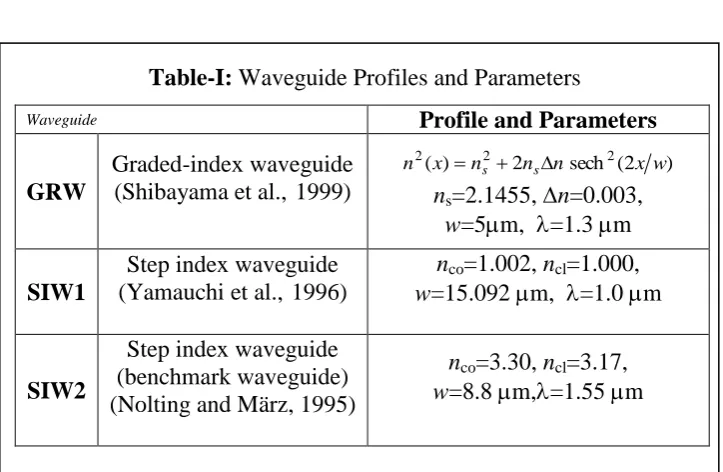
other parameters of these waveguides are given in Table-I. Further, in our examples, we have
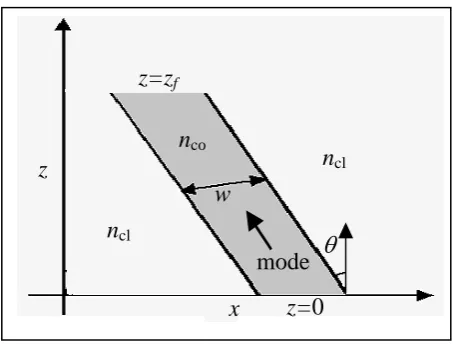
considered the tilted waveguide geometry, which is depicted in Fig. 2. In all the examples, we
launch at z 0, a mode along the tilted waveguide so that we know exactly the field at the
final distance, z zf. Then, we compare the numerically propagated field with the expected
mode field at z zf; specifically we compute the correlation factor, CF:
2 2
2
dx dx CF
mode cal mode
(17)
where mode is the modal field launched at z0 and is also the expected field at z zf, and
cal
is the numerically propagated field at z zf. This definition of the correlation factor
includes the effects of both the dissipation in power as well as the loss of shape of the
propagating mode (Ilić et al., 1996). The error (ERR) in numerical propagation is given by
ERR1-CF (18)
and is a measure of the accuracy of the method used for numerical propagation.
In a tilted waveguide, the field mode(x) at z 0 would be the phase tilted modal field
and would be given by
) sin exp(
) ( )
(
mode x m x i mx (19)
where is the tilt angle (see Fig. 2), and m(x)and m are the modal field and the
propagation constant of the mode launched. The exact modal fields at z0 and z zf would
differ by a constant phase factor, which would not alter the value of the CF and hence the same
field mode(x) is used for the input (z 0) and the expected (z zf) fields in defining CF. Of
course, the field at zzf is shifted along the x-axis by a distance zf tan.
In our examples, we have propagated the TE0 mode in the graded-index waveguide
(GRW) the modal field of which is defined as (Adams, 1981)
) / 2 ( cosh )
(
0 x x w
W
where
4
2 12
(1 4 2)12 1
2 2 2 2 0
2 1
n w V
W s ,
2 / 1 ) 2
( n n
w
V s . (21)
In the examples with the step-index waveguides (SIW1 and SIW2), we have propagated the
TE1 and TE10 modes. The fields of these modes are well documented in several textbooks (see,
e.g. Adams, 1981; Ghatak and Thyagrajan, 1998) and hence, are not repeated here.
3.1 Effect of Order, M
We first show the effect of the order M on propagation. As a test case we consider the
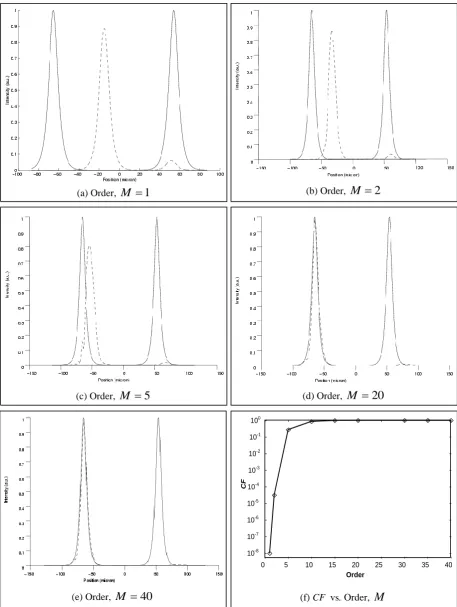
propagation of the TE0 mode in the graded-index waveguide (GRW) tilted at 50. Figure 3
shows the input field intensity and the expected and the numerically propagated field intensities
after propagation up to zf 100m; z used is 0.05 m. Sub-figures (a) to (e) show these
intensities for different orders, M and the sub-figure (f) shows CF as a function of order, M .
From these results, we can see that for M 1 (sub-figure a), the propagated field is distorted
and does not get displaced in the transverse direction to the extent expected, and there is a large
error in propagation. With an increase in order M , both the mode shape and mode
displacement improve dramatically. The value of CF is nearly unity (up to 3 decimal places) for
20
M . This improvement in the accuracy is not accompanied by an increase in computation
time for propagation, but only the time for one-time computation of the matrix P increases.
This fact is illustrated by the computation times shown in Fig.1, which shows separately the
time, tP, required for the one time computation of P and the time, ts required for propagation
of a single step. The figure shows the actual time in seconds for the computations which have
been done using MATLAB version 7 release 14 on a personal computer based on Intel Pentium
4, 3GHz processor with Windows XP Professional operating system.
3.2 Stability and Accuracy of Propagation
An important issue with all propagation methods is their stability. Figure 4 shows the stability
performance of the present method with respect to propagation step-size for a large propagation
distance (1000m) for the untilted graded-index waveguide. From the figure it can be seen,
that even with a step-size as large as 1m, the method remains stable and the error is very low,
of the order of 10-4. To the best of our knowledge, a step-size as large as 1m has not been
reported earlier for the finite-difference based wide-angle propagation method. We have earlier
reported such a large step-size with the collocation based split-step non-paraxial (Coll SSNP)
more efficient. In the results of Shibayama et al. (1999), the largest step-size reported is
0.05m with a 3-step iterative process and 2000 points in a regular grid. This difference in the
step-size itself makes the present method 20 times faster.
As another example to demonstrate the stability of the method, we consider the
propagation of the TE1 mode in a step-index waveguide, namely, the benchmark waveguide
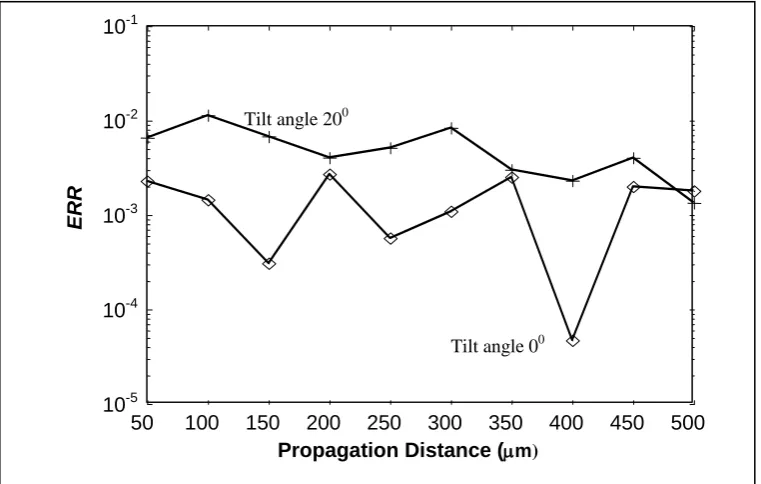
(SIW2). We have plotted in Fig. 5, ERR as a function of propagation distance for the untilted
waveguide and for the waveguide tilted at an angle of 20o. From the figure it is clear that even
at 20o the propagation is stable for a large distance, 500m and the error remains low, of the
order of 10-2-10-3. This demonstrates the stability and the accuracy of the method. It may be
pointed out that due to the relatively large index difference, we have taken a step-size of
0.05m, which corresponds to 10000 steps of propagation.
3.3 Comparison with Other Methods
Next, we consider examples to compare the performance of the present method, the FD-SSNP,
with other methods. First we consider the propagation of the TE0 mode in the graded index
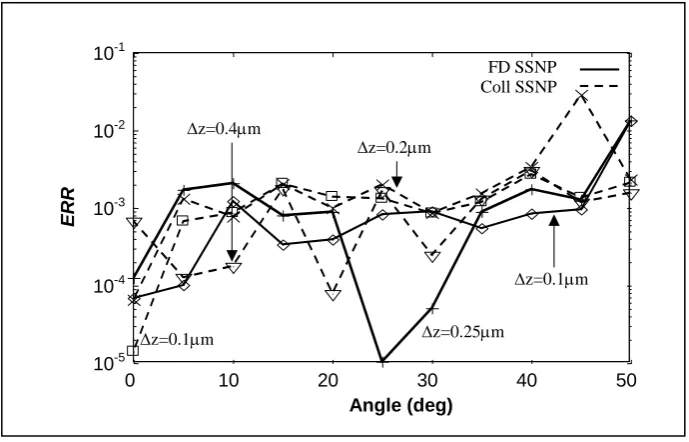
waveguide (GRW) as a function of the tilt angle. Figure 6 shows the variation of ERR with tilt
angle of the waveguide for different propagation step-sizes for the finite difference (FD SSNP,
solid line) and collocation (Coll SSNP, dashed line) implementations. The figure shows that the
FD SSNP method is stable and accurate with a large step-size of 1.0m giving an accuracy of
~10-2, while it gives accuracy of the order of 10-3 –10-4 with a step-size of 0.25m, which is
much better than those obtained by Shibayama et al. (1999). To illustrate the point, let us
consider the error for a tilt angle of 50o. The error in the best results reported by Shibayama et
al. (1999) for the 3-step GD scheme is about 0.04 with z=0.05m and 2000/1273 points
regular/adaptive grid, whereas in our method (FD SSNP) the error is less than 0.001 with
z
=0.25m and only 900 grid points. This would thus mean much faster and more accurate
propagation. From the figure we can also see that at lower angles for all step-sizes the Coll
SSNP shows lower error, while at higher angles the performance of both the FD and the
collocation implementations is similar or that of the FD implementation is better. This is
expected as the collocation method involves interpolation over Nx points while FD
implementation involves fewer points in the transverse domain. The important point is that
even in the FD implementation, the present method performs much better than the Padé based
method (Shibayama et al., 1999) and is faster and easier to implement. The added
expansion for the transverse derivative for higher accuracy if required, and fewer terms if the
accuracy requirement is not as stringent.
We next consider the propagation of the TE1 mode of the step-index waveguide
(SIW1). Figure 7 shows the variation in the error with the waveguide tilt angle for different
propagation step-sizes for the Coll SSNP and FD SSNP for a propagation distance of 100m.
We find that in the FD SSNP, with only Nx 900 and z=0.25 m , the value of CF at all
angles from 0 to 50 degrees is about 0.995 or more which is significantly larger than ~0.92, the
best value reported by Yamauchi et al. (1996) for the 3-step GD based method with a smaller
step-size, 0.1m and 1800 computation points. In the FD SSNP, with a propagation step-size
2.5 times larger and only half the number of transverse grid points, the error in CF is smaller by
an order of magnitude at 50o. It may be noted that the present method is non-iterative unlike the
method of Yamauchi et al. (1996), which is a 3-step iterative process. In this example, both the
FD SSNP and Coll SSNP show similar errors and over all one can conclude that both perform
equally well.
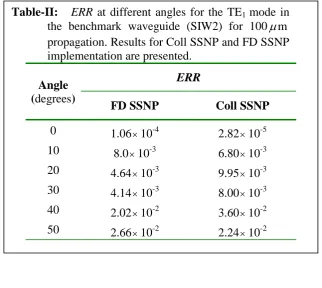
Table II shows the performance of the method for the TE1 mode in the benchmark
waveguide (SIW2). As the refractive index change from core to cladding is very large in this
case, the propagation step-size is smaller than for the step index waveguide in the example
given above. In the FD SSNP, we have used Nx 1200, z0.05m and M=60. At 40o
waveguide tilt angle, the error in propagation is similar to that obtained by Yamauchi et al.
(1996) with Nx 1800 points and a 3-step GD based method. However, our method is
computationally more efficient. Comparing the Coll SSNP and FD SSNP, we can see that the
former is more accurate at lower angles, while the latter is better at larger angles.
The final example is that of the propagation of the TE10 mode in the benchmark
waveguide (SIW2) and we have obtained the power remaining in the guide after propagation
over 100m at a tilt angle of 20o. Table III compares the two SSNP methods with other
methods reported by Nolting and März (1995). It is evident from the table that with smaller
x
N , the SSNP methods show significantly higher accuracy. The FD SSNP is more accurate
than the Coll SSNP. This is probably because the former performs equally well or better than
the latter at larger angles. It may further be noted that in the Coll SSNP, the error does not
decrease much on increasing the number of steps from 1000 to 2000 (by halving z); it
An important parameter to choose is the reference refractive index, nr. Although, in
principle, its value can be arbitrarily chosen, its value may in general affect the accuracy.
Figure 8 shows the ERR as a function of nr for the Coll SSNP and the FD SSNP. These results
show that the accuracy is largely insensitive to the choice of nr for both these methods.
4
Conclusions
A finite difference solution of the second order wave equation implemented in the split step
scheme has been presented. The formulation is non-iterative and allows arbitrary increase in
accuracy in approximating the transverse derivatives, without any significant increase in
computation. The method involves only simple matrix multiplication for propagation, and is
stable with larger step-sizes than reported in other existing methods. The method has excellent
efficiency in terms of increased accuracy, lower computation effort and easier implementation.
Comparison with other methods show that this method gives much better accuracy and
involves less computational effort in comparison to the generalized Douglas (GD) and Padé
approximants based finite-difference methods. However, in comparison to the previously
reported collocation based split-step non-paraxial method, the present method gives better
performance for larger tilt angles (typically more than 20o), while the for smaller angles the
collocation method performs better.
Acknowledgements
This work was partially supported by a grant (No. 03(0976)/02/EMR-II) from the Council of
Scientific and Industrial Research (CSIR), India. One the authors (AS) is a Senior Associate
Member of the Abdus Salam International Centre for Theoretical Physics, Trieste, Italy and the
other author (AA) would like to thank the Centre for hospitality and support during her visit to
the Centre.
References
Adams, M. J., An Introduction to Optical Waveguides, New York, John Wiley, 1981.
Conte, S.D., and C. deBoor, Elementary Numerical Analysis, New York, McGraw-Hill (1972). Ghatak, A.K. and K. Thyagarajan, Introduction to Fiber Optics, Cambridge, University Press, 1998.
Hadley, G.R., Opt. Lett.17 1743, 1992.
Ho, P.L. and Y.Y.Lu, IEEE Photon. Technol. Lett. 13 1316, 2001.
Ilić, I., R. Scarmozzino and R. Osgood, J. Lightwave Technol., 14 2813, 1996.
Lu, Y.Y. and S.H. Wei, IEEE Photon. Technol. Lett.14 1533, 2002.
Luo, Q. and C.T. Law, IEEE Photon. Technol. Lett. 14 50, 2002. Nolting, H.-P. and R. März, J. Lightwave Technol.13 216, 1995.
Sharma, A. and A. Agrawal, J. Opt. Soc. Am. A21 1082, 2004.
Sharma, A. and A. Agrawal, European Conference on Integrated Optics, Grenoble, France, April 5-8, 2005.
Sharma, A. and A. Agrawal, IEEE Photon. Technol. Lett. (In press, 2006).
Sharma A. and S. Banerjee, J. Opt. Soc. Am. A6, 1884, 1989; Errata: 7, 2156, 1990.
Sharma, A., In: Methods for Modeling and Simulation of Guided-Wave Optoelectronic Devices, W.P. Huang, Ed.Cambridge, Massachussettes: EMW Publishers, pp. 143-198, 1995.
Shibayama, J., K. Matsubara, M. Sekiguchi, J. Yamauchi and H. Nakano, J. Lightwave Technol. 17 677, 1999.
Sun L. and G. L. Yip, Opt. Lett.18 1229, 1993.
Yamauchi, J., J. Shibayama, M. Sekiguchi and H. Nakano, IEEE Photon. Technol. Lett.8 1361, 1996.
Figure 1 Computation time for the one-time evaluation of the matrix P and for single step propagation as a function of the order M for the graded-index waveguide (GRW) for
the details of the waveguide see Table-I and for other details see Sec 3.1.
Fig. 2 Geometry of the tilted waveguide
1 10 100 1000
0.1
0.01
0 10 20 30 40
Order, M
T
im
e (
se
c)
Time for single step propagation, ts
Time for one-time evaluation of matrix P, tP
ncl
nco
mode
z
w
x ncl
z=zf
[image:14.595.178.405.460.632.2]Figure 3 (a-e) Plots of the TE0 mode propagated in the graded-index waveguide (GRW) for 100 m at
500 with different orders, M. The input field (rightmost curve), propagated field (dashed curve) and the expected field (leftmost curve) are shown. (f) Variation of the correlation factor (CF) as a function if the
order M.
(a) Order, M 1 (b) Order, M 2
(c) Order, M 5 (d) Order, M 20
(e) Order, M 40
10-8
10-7
10-6
10-5
10-4
10-3
10-2
10-1
100
0 5 10 15 20 25 30 35 40
CF
Order
[image:15.595.71.529.76.684.2]Figure 4 ERR as a function of propagation distance for the graded-index waveguide (GRW). N=900, order=35.
Figure 5 ERR as a function of propagation distance for the step-index waveguide (SIW2) (Nolting and März , 1995). N=1200, order=60.
10-8
10-7
10-6
10-5
10-4
10-3
10-2
100 200 300 400 500 600 700 800 900 1000
ER
R
Propagation Distance (m)
zm
zm
zm
zm
10-5
10-4
10-3
10-2
10-1
50 100 150 200 250 300 350 400 450 500
ER
R
[image:16.595.98.479.380.622.2]Figure 6 ERR as a function of waveguide tilt angle for the graded-index waveguide (GRW) (Shibayama et al., 1999) of length 100 m. For the FD SSNP: N=900, order=35.
Figure 7 ERR as a function of waveguide tilt angle for the step-index waveguide (SIW1) (Yamauchi et al. 1996). .For the FD SSNP: N=900, order=30.
10-6 10-5 10-4 10-3 10-2 10-1
0 10 20 30 40 50
E
RR
Angle (deg)
z=0.25m
z=0.25m z=0.1m
z=0.05m
z=0.1m z=0.05m
z=1.0m
FD SSNP Coll SSNP
10-5 10-4 10-3 10-2 10-1
0 10 20 30 40 50
E
R
R
Angle (deg)
FD SSNP Coll SSNP
z=0.25m
z=0.1m
z=0.1m
z=0.2m
[image:17.595.97.442.403.624.2]Figure 8 Error in propagation with the reference refractive index for the benchmark step-index waveguide (SIW1) for propagation up to 100mwith step size
0.1mat 40o.
10-2
10-1
3.18 3.2 3.22 3.24 3.26 3.28 3.3
E
RR
Reference refractive index
Coll SSNP FD SSNP
Table-I: Waveguide Profiles and Parameters
Waveguide Profile and Parameters
GRW
Graded-index waveguide (Shibayama et al., 1999)
) 2 ( sech 2
)
( 2 2
2
w x n
n n x
n s s
ns=2.1455, n=0.003,
w=5m, =1.3 m
SIW1
Step index waveguide (Yamauchi et al., 1996)
nco=1.002, ncl=1.000,
w=15.092 m, =1.0 m
SIW2
Step index waveguide (benchmark waveguide) (Nolting and März, 1995)
nco=3.30, ncl=3.17,
[image:18.595.116.478.479.715.2]Table-III: Power remaining in the waveguide after propagation through 100m in the benchmark waveguide (SIW2) for TE10 modes using different methods.
Method Nz Nx Power in waveguide at 20o
FD SSNP 2000 320 0.99
Coll SSNP 2000 800 0.96
Coll SSNP 1000 800 0.96
AMIGO* 1429 1311 0.95
FD2BPM* 1000 2048 0.95
FTBPM* 1000 256 0.55
LETI-FD* 200 1024 0.15
* Results taken from Nolting and März (1995).
Table-II: ERR at different angles for the TE1 mode in the benchmark waveguide (SIW2) for 100m
propagation. Results for Coll SSNP and FD SSNP implementation are presented.
Angle (degrees)
ERR
FD SSNP Coll SSNP
0 1.0610-4
2.8210-5
10 8.010-3
6.8010-3
20 4.6410-3
9.9510-3
30 4.1410-3
8.0010-3
40 2.0210-2
3.6010-2
50 2.6610-2
[image:19.595.124.472.301.626.2]