Quadrant marked mesh patterns in 132-avoiding
permutations II
Sergey Kitaev
University of Strathclyde
Livingstone Tower, 26 Richmond Street Glasgow G1 1XH, United Kingdom
Jeffrey Remmel
Department of Mathematics University of California, San Diego
La Jolla, CA 92093-0112. USA
Mark Tiefenbruck
Department of Mathematics University of California, San Diego
La Jolla, CA 92093-0112. USA
Submitted: Date 1; Accepted: Date 2; Published: Date 3. MR Subject Classifications: 05A15, 05E05
Abstract
Given a permutationσ =σ1. . . σnin the symmetric groupSn, we say thatσimatches
the marked mesh pattern MMP(a, b, c, d) inσif there are at leastapoints to the right of σi inσ which are greater than σi, at leastb points to the left ofσi inσ which are
greater thanσi, at leastc points to the left ofσi inσ which are smaller thanσi, and
at leastdpoints to the right of σi inσ which are smaller than σi.
This paper is continuation of the systematic study of the distributions of quadrant marked mesh patterns in 132-avoiding permutations started in [9] where we mainly studied the distribution of the number of matches of MMP(a, b, c, d) in 132-avoiding permutations where exactly one of a, b, c, d is greater than zero and the remaining elements are zero. In this paper, we study the distribution of the number of matches of MMP(a, b, c, d) in 132-avoiding permutations where exactly two of a, b, c, d are greater than zero and the remaining elements are zero. We provide explicit recur-rence relations to enumerate our objects which can be used to give closed forms for the generating functions associated with such distributions. In many cases, we provide combinatorial explanations of the coefficients that appear in our generating functions. The case of quadrant marked mesh patterns MMP(a, b, c, d) where three or more of a, b, c, dare constrained to be greater than 0 will be studied in [10].
Contents
1 Introduction 2
2 Qn,(k,1320,`,0)(x) where k, `≥1 6
2.1 Explicit formulas for Qn,(k,1320,`,0)(x)|xr . . . 7
3 Q(n,k,1320,0,`)(x) = Qn,(k,`,1320,0)(x) where k, `≥1 15
3.1 Explicit formulas for Qn,(k,1320,0,`)(x)|xr . . . 16
4 Q(0n,132,k,`,0)(x) = Qn,(0,1320,`,k)(x) where k, `≥1 20
4.1 Explicit formulas for Q(0n,,k,`,1320)(x)|xr . . . 21
5 Qn,(0132,k,0,`)(x) where k, `≥1 26
5.1 Explicit formulas for Qn,(0132,k,0,`)(x)|xr . . . 28
1
Introduction
The notion of mesh patterns was introduced by Br¨and´en and Claesson [2] to provide explicit expansions for certain permutation statistics as, possibly infinite, linear combinations of (classical) permutation patterns. This notion was further studied in [1, 3, 5, 6, 9, 12].
Kitaev and Remmel [6] initiated the systematic study of distributions of quadrant marked mesh patterns on permutations. The study was extended to 132-avoiding per-mutations by Kitaev, Remmel and Tiefenbruck in [9], and the present paper continues this line of research. Kitaev and Remmel also studied the distributions of quadrant marked mesh patterns in up-down and down-up permutations [7, 8].
Let σ=σ1. . . σn be a permutation written in one-line notation. Then we will consider
the graph ofσ, G(σ), to be the set of points (i, σi) for i= 1, . . . , n. For example, the graph
of the permutation σ = 471569283 is pictured in Figure 1. Then if we draw a coordinate system centered at a point (i, σi), we will be interested in the points that lie in the four
quadrants I, II, III, and IV of that coordinate system as pictured in Figure 1. For any
a, b, c, d ∈ N = {0,1,2, . . .} and any σ = σ1. . . σn ∈ Sn, the set of all permutations of
lengthn, we say thatσi matches the quadrant marked mesh pattern MMP(a, b, c, d) inσ if,
inG(σ) relative to the coordinate system which has the point (i, σi) as its origin, there are
In addition, we shall consider patterns MMP(a, b, c, d) where a, b, c, d ∈ N ∪ {0} ∪ {∅}. Here when a coordinate of MMP(a, b, c, d) is the empty set, then for σi to match
MMP(a, b, c, d) in σ =σ1. . . σn ∈Sn, it must be the case that there are no points in G(σ)
relative to the coordinate system with the origin at (i, σi) in the corresponding quadrant.
For example, if σ = 471569283, the point σ3 = 1 matches the marked mesh pattern MMP(4,2,∅,∅) since in G(σ) relative to the coordinate system with the origin at (3,1), there are 6 points inG(σ) in quadrant I, 2 points inG(σ) in quadrant II, no points in both quadrants III and IV. We let mmp(a,b,c,d)(σ) denote the number of i such that σ
i matches
MMP(a, b, c, d) in σ.
III II I
IV
1 2 3 4 5 6 7 8 9 1
[image:3.612.203.402.217.341.2]2 3 4 5 6 7 8 9
Figure 1: The graph of σ= 471569283.
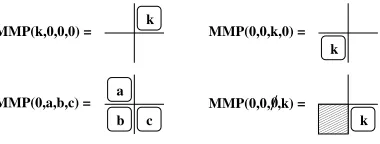
Note how the (two-dimensional) notation of ´Ulfarsson [12] for marked mesh patterns corresponds to our (one-line) notation for quadrant marked mesh patterns. For example,
k
a
b c k
0000 0000 0000 0000 0000 0000 0000
1111 1111 1111 1111 1111 1111 1111
0 0 0 0
1 1 1 1
0 MMP(k,0,0,0) = MMP(0,0,k,0) =
MMP(0,a,b,c) = MMP(0,0, ,k) = k
Figure 2: ´Ulfarsson notation for quadrant marked mesh patterns.
Given a sequencew=w1. . . wnof distinct integers, let red(w) be the permutation found
by replacing the i-th smallest integer that appears in σ by i. For example, if σ = 2754, then red(σ) = 1432. Given a permutation τ =τ1. . . τj in the symmetric group Sj, we say
that the pattern τ occurs in σ =σ1. . . σn ∈ Sn provided there exist 1 ≤i1 <· · ·< ij ≤ n
such that red(σi1. . . σij) =τ. We say that a permutation σ avoids the pattern τ if τ does not occur in σ. Let Sn(τ) denote the set of permutations in Sn which avoid τ. In the
theory of permutation patterns, τ is called a classical pattern. See [4] for a comprehensive introduction to the study of patterns in permutations.
[image:3.612.209.399.420.492.2](see [4, Subsection 6.1.5]). In [9], we started the study of the generating functions
Q(132a,b,c,d)(t, x) := 1 +X
n≥1
Q(n,a,b,c,d132 )(x)tn
where for any a, b, c, d∈N∪ {0} ∪ {∅},
Q(n,a,b,c,d132 )(x) = X
σ∈Sn(132)
xmmp(a,b,c,d)(σ).
For any a, b, c, d, we will writeQ(n,a,b,c,d132 )(x)|xk for the coefficient of xk in Q(n,a,b,c,d132 )(x).
For any fixed (a, b, c, d), we know that Q(n,a,b,c,d132 )(1) is the number of 132-avoiding per-mutations in Sn which is the nth Catalan number Cn = n+11 2nn
. Thus the coefficients in the polynomial Q(n,a,b,c,d132 )(x) represent a refinement of the nth Catalan number. It is then a natural question to ask whether (i) we can give explicit formulas for the coefficients that appear inQ(n,a,b,c,d132 )(x) or (ii) whether such coefficients count other interesting classes of com-binatorial objects. Of course, there is an obvious answer to question (ii). That is, if one has a bijection fromSn(132) to other classes of combinatorial objects which are counted by
the Catalan numbers such as Dyck paths or binary trees, then one can use that bijection to give an interpretation of the pattern MMP(a, b, c, d) in the other setting. We shall see that in many cases, there are interesting connections with the coefficients that arise in our polynomials Q(n,a,b,c,d132 )(x) and other sets of combinatorial objects that do not just arise by such bijections.
In particular, it is natural to try to understand Q(n,a,b,c,d132 )(0) which equals the number of σ ∈ Sn(132) that have no occurrences of the pattern MMP(a, b, c, d) as well as the
coefficient of the highest power of xthat occurs in Q(n,a,b,c,d132 )(x) since that coefficient equals the number of σ ∈Sn(132) that have the maximum possible number of occurrences of the
pattern MMP(a, b, c, d). We shall see that in many cases, Q(n,a,b,c,d132 )(x)|x and Q(n,a,b,c,d132 )(x)|x2,
the number of σ ∈Sn(132) with exactly one occurrence and two occurrences, respectively,
of the pattern MMP(a, b, c, d) also have interesting combinatorics associated with them. There are many more interesting questions of this type that can be pursued, but due to space considerations, we shall mostly restrict ourselves to trying to understand the four coefficients inQ(n,a,b,c,d132 )(x) described above. We should note, however, that there is a uniform way to compute generating functions of the form
Fk(a,b,c,d)(t) =X
n≥0
Q(n,a,b,c,d132 )(x)|xktn.
That is, Fk(a,b,c,d)(t) is just the result of taking the generating function 1
k!
∂k ∂xkQ
(a,b,c,d) 132 (t, x) and then setting x = 0. Due to space considerations, we will not pursue the study of the functions Fk(a,b,c,d)(t) for k≥2 in this paper.
Lemma 1. ([9]) For any a, b, c, d∈N∪ {0} ∪ {∅},
Q(n,a,b,c,d132 )(x) =Q(n,a,d,c,b132 )(x).
In [9], we studied the generating functions Q(132k,0,0,0)(t, x), Q132(0,k,0,0)(t, x) =Q(0132,0,0,k)(t, x), and Q(0132,0,k,0)(t, x) where k can be either the empty set or a positive integer as well as the generating functionsQ(132k,0,∅,0)(t, x) andQ(132∅,0,k,0)(t, x). We also showed that sequences of the form{Q(n,a,b,c,d132 )(x)|xr}n≥scount a variety of combinatorial objects that appear in theOn-line
Encyclopedia of Integer Sequences (OEIS) [11]. Thus, our results gave new combinatorial interpretations of certain classical sequences such as the Fine numbers and the Fibonacci numbers as well as provided certain sequences that appear in the OEIS with a combinatorial interpretation where none had existed before. Another particular result of our studies in [9] is enumeration of permutations avoiding simultaneously the patterns 132 and 1234.
The main goal of this paper is to continue the study of Q(132a,b,c,d)(t, x) and combinatorial interpretations of sequences of the form {Q(n,a,b,c,d132 )(x)|xr}n≥s in the case where a, b, c, d∈N and exactly two of these parameters are non-zero. The case when at least three of the parameters are non-zero will be studied in [10].
Next we list several results from [9] which we need in this paper.
Theorem 2. ([9, Theorem 3.1])
Q(0132,0,0,0)(t, x) =C(xt) = 1−
√
1−4xt
2xt
and, for k ≥1,
Q(132k,0,0,0)(t, x) = 1
1−tQ132(k−1,0,0,0)(t, x).
Hence
Q(1132,0,0,0)(t,0) = 1 1−t
and, for k ≥2,
Q(132k,0,0,0)(t,0) = 1
1−tQ132(k−1,0,0,0)(t,0). (1)
Theorem 3. ([9, Theorem 4.1]) For k≥1,
Q(0132,0,k,0)(t, x) =
1 + (tx−t)(Pk−1
j=0Cjt
j)−q(1 + (tx−t)(Pk−1
j=0Cjtj))2−4tx 2tx
= 2
1 + (tx−t)(Pk−1
j=0Cjtj) +
q
(1 + (tx−t)(Pk−1
j=0Cjtj))2 −4tx
and
Q(0132,0,k,0)(t,0) = 1
1−t(C0+C1t+· · ·+Ck−1tk−1)
It follows from Lemma 1 that Q(0132,k,0,0)(t, x) = Q132(0,0,0,k)(t, x) for all k ≥ 1. Thus, our next theorem (obtained in [9]) gives an expression for Q(0132,k,0,0)(t, x) = Q(0132,0,0,k)(t, x).
Theorem 4. ([9, Theorem 5.1])
Q(0132,1,0,0)(t, x) = Q(0132,0,0,1)(t, x) = 1 1−tC(tx).
For k >1,
Q132(0,k,0,0)(t, x) =Q132(0,0,0,k)(t, x) = 1 +t
Pk−2
j=0Cjtj(Q
(0,k−1−j,0,0)
132 (t, x)−C(tx)) 1−tC(tx)
and
Q132(0,k,0,0)(t,0) =Q132(0,0,0,k)(t,0) = 1 +t
Pk−2
j=0Cjt
j(Q(0,k−1−j,0,0)
132 (t,0)−1)
1−t .
As it was pointed out in [9], avoidance of a marked mesh pattern without quadrants containing the empty set can always be expressed in terms of multi-avoidance of (possibly many) classical patterns. Thus, among our results we will re-derive several known facts in permutation patterns theory. However, our main goals are more ambitious since they are aimed at finding distributions in question.
2
Q
(n,k,1320,`,0)(
x
)
where
k, `
≥
1
Throughout this paper, we shall classify the 132-avoiding permutations σ = σ1. . . σn by
the position ofninσ. That is, letSn(i)(132) denote the set ofσ ∈Sn(132) such thatσi =n.
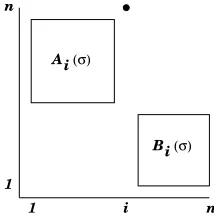
Clearly each σ ∈Sn(i)(132) has the structure pictured in Figure 3. That is, in the graph
ofσ, the elements to the left ofn,Ai(σ), have the structure of a 132-avoiding permutation,
the elements to the right of n, Bi(σ), have the structure of a 132-avoiding permutation,
and all the elements in Ai(σ) lie above all the elements in Bi(σ). It is well-known that the
number of 132-avoiding permutations in Sn is the Catalan number Cn = n+11 2nn
and the generating function for the Cn’s is given by
C(t) =X
n≥0
Cntn =
1−√1−4t
2t =
2 1 +√1−4t.
Ifk ≥1, it is easy to compute a recursion forQ(n,k,1320,`,0)(x) for any fixed `≥1. It is clear that n can never match the pattern MMP(k,0, `,0) for k ≥ 1 in any σ ∈ Sn(132). For
i≥1, it is easy to see that as we sum over all the permutations σ in Sn(i)(132), our choices
for the structure forAi(σ) will contribute a factor ofQ
(k−1,0,`,0)
i−1,132 (x) toQ (k,0,`,0)
n,132 (x) since none of the elements to the right of n have any effect on whether an element in Ai(σ) matches
the pattern MMP(k,0, `,0) and the presence ofnensures that an element inAi(σ) matches
Ai(σ)
(σ)
Bi
i n
n 1
[image:7.612.247.354.70.179.2]1
Figure 3: The structure of 132-avoiding permutations.
choices for the structure forBi(σ) will contribute a factor ofQ
(k,0,`,0)
n−i,132(x) toQ (k,0,`,0)
n,132 (x) since neithern nor any of the elements to the left of n have any effect on whether an element in
Bi(σ) matches the pattern MMP(k,0, `,0). Thus,
Q(n,k,1320,`,0)(x) =
n
X
i=1
Q(ik−−1,1132,0,`,0)(x)Q(nk,−0i,,`,1320)(x). (2)
Multiplying both sides of (2) by tn and summing over all n≥1, we obtain that
−1 +Q(132k,0,`,0)(t, x) =tQ132(k−1,0,`,0)(t, x) Q(132k,0,`,0)(t, x) so that we have the following theorem.
Theorem 5. For all k, `≥1,
Q(132k,0,`,0)(t, x) = 1
1−tQ132(k−1,0,`,0)(t, x). (3) Note that by Theorem 3, we have an explicit formula for Q(0132,0,`,0)(t, x) for all ` ≥ 1 so that we can then use the recursion (3) to compute Q(132k,0,`,0)(t, x) for all k≥1.
2.1
Explicit formulas for
Q
(n,k,1320,`,0)(
x
)
|
xrNote that
Q(132k,0,`,0)(t,0) = 1
1−tQ132(k−1,0,`,0)(t,0). (4) SinceQ(1132,0,0,0)(t,0) = Q132(0,0,1,0)(t,0) = 1−1t, it follows from the recursions (1) and (4) that for all k ≥ 2, Q(132k,0,0,0)(t,0) = Q(132k−1,0,1,0)(t,0). This is easy to see directly. That is, it is clear that if in σ ∈ Sn(132), σj matches MMP(k −1,0,1,0), then there is an i < j such that
σi < σj so that σi matches MMP(k,0,0,0). Vice versa, suppose that in σ ∈ Sn(132), σj
matches MMP(k,0,0,0) where k ≥2. Because σ is 132-avoiding this means the elements in the first quadrant relative to the coordinate system with (j, σj) as the origin must be
and, hence, σj1 matches MMP(k −1,0,1,0). Thus, the number of σ ∈ Sn(132) where
mmp(k,0,0,0)(σ) = 0 is equal to the number of σ ∈ S
n(132) where mmp(k−1,0,1,0)(σ) = 0 for
k ≥2.
In [9], we computed the generating function Q(132k,0,0,0)(t,0) for small k. Thus, we have that
Q132(2,0,0,0)(t,0) =Q132(1,0,1,0)(t,0) = 1−t 1−2t; Q132(3,0,0,0)(t,0) =Q132(2,0,1,0)(t,0) = 1−2t
1−3t+t2;
Q132(4,0,0,0)(t,0) =Q132(3,0,1,0)(t,0) = 1−3t+t 2 1−4t+ 3t2;
Q132(5,0,0,0)(t,0) =Q132(4,0,1,0)(t,0) = 1−4t+ 3t 2 1−5t+ 6t2−t3;
Q132(6,0,0,0)(t,0) =Q132(5,0,1,0)(t,0) = 1−5t+ 6t 2−t3 1−6t+ 10t2−4t3,and
Q132(7,0,0,0)(t,0) =Q132(6,0,1,0)(t,0) = 1−6t+ 10t 3−4t3 1−7t+ 15t2−10t3+t4.
Note that Q(0132,0,2,0)(t,0) = 1−t1−t2 by Theorem 3. Thus, by (4), we can compute that
Q(1132,0,2,0)(t,0) = 1−t−t 2 1−2t−t2;
Q(2132,0,2,0)(t,0) = 1−2t−t 2 1−3t+t3;
Q(3132,0,2,0)(t,0) = 1−3t+t 3
1−4t+ 2t2+ 2t3, and
Q(4132,0,2,0)(t,0) = 1−4t+ 2t 2 + 2t3 1−5t+ 5t2+ 2t3−t4.
We note that {Q(1n,132,0,2,0)(0)}n≥1 is the sequence of the Pell numbers which is A000129 in the OEIS. This result should be compared with a known fact [4, page 250] that the avoidance of 123, 2143 and 3214 simultaneously gives the Pell numbers (the avoidance of MMP(1,0,2,0) is equivalent to avoiding simultaneously 2134 and 1234).
Problem 1. Find a combinatorial explanation of the fact that the number of permutations of Sn which are (132,2134,1234)-avoiding equals the number of permutaions of Sn which
are (123,2143,3214)-avoiding. Can any of the known bijections between 132-avoiding per-mutations and 123-avoiding perper-mutations (see [4, Chapter 4]) be of help here?
The sequence {Q(2n,132,0,2,0)(0)}n≥1 is sequence A052963 in the OEIS which has the gen-erating function 11−−3tt−+tt23. That is,
1−2t−t2
1−3t+t3 − 1 = t
1−t−t2
1−3t+t3. This sequence had no listed
Similarly, Q(0132,0,3,0)(t,0) = 1−t−1t2−2t3. Thus, by (4), we can compute that
Q(1132,0,3,0)(t,0) = 1−t−t
2−2t3 1−2t−t2−2t3;
Q(2132,0,3,0)(t,0) = 1−2t−t
2−2t3 1−3t−t3+ 2t4;
Q(3132,0,3,0)(t,0) = 1−3t−t 3+ 2t4 1−4t+ 2t2+ 4t4, and
Q(4132,0,3,0)(t,0) = 1−4t+ 2t 2+ 4t4 1−5t+ 5t2+ 5t4−2t5.
In this case, the sequence {Q(1n,132,0,3,0)(0)}n≥1 is sequence A077938 in the OEIS which has the generating function 1−2t−1t2−2t3. That is,
1−t−t2−2t3
1−2t−t2−2t3 −1 = t
1
1−2t−t2−2t3. This sequence
had no listed combinatorial interpretation so that we have now given a combinatorial in-terpretation to this sequence.
We can also find the coefficient of the highest power of x that occurs in Q(n,k,1320,`,0)(x) for any k, `≥ 1. That is, it is easy to see that the maximum possible number of matches of MMP(k,0, `,0) for a σ = σ1. . . σn ∈ Sn(132) occurs when σ1. . . σ` is a 132-avoiding
permutation in S` and σ`+1. . . σn is an increasing sequence. Thus, we have the following
theorem.
Theorem 6. For any k, ` ≥ 1 and n ≥ k+`+ 1, the highest power of x that occurs in
Q(n,k,1320,`,0)(x) is xn−k−` which appears with a coefficient of C`.
We can compute the generating functions Q(0132,0,`,0)(t, x) via Theorem 3. For example, one can compute that
Q(0132,0,1,0)(t, x) = 1 +t(−1 +x)−
p
(1 +t(−1 +x))2−4tx
2tx ,
Q(0132,0,2,0)(t, x) = 1 +t(1 +t)(−1 +x)−
p
(1 +t(1 +t)(−1 +x))2−4tx
2tx , and
Q(0132,0,3,0)(t, x) =
1 +t(1 +t+ 2t2) (−1 +x)−q(1 +t(1 +t+ 2t2) (−1 +x))2−4tx
2tx .
We can then use (3) to compute the functions of the form Q(132k,0,`,0)(t, x) for small k and `. The formulas for these functions get more and more complicated so we will not in general give explicit formulas. However, one can easily use any computer algebra system such as Mathematica or Maple to compute the following.
Q(1132,0,1,0)(t, x) = 1 +t+ 2t2+ (4 +x)t3+ 8 + 5x+x2
t4+ 16 + 17x+ 8x2+x3
t5+ 32 + 49x+ 38x2+ 12x3+x4t6+ 64 + 129x+ 141x2+ 77x3+ 17x4+x5t7+ 128 + 321x+ 453x2 + 361x3+ 143x4+ 23x5+x6t8+
Q(2132,0,1,0)(t, x) = 1 +t+ 2t2+ 5t3+ (13 +x)t4+ 34 + 7x+x2
t5+ 89 + 32x+ 10x2+x3t6+ 233 + 122x+ 59x2+ 14x3+x4t7+ 610 + 422x+ 272x2+ 106x3+ 19x4+x5t8+
1597 + 1376x+ 1090x2+ 591x3+ 182x4+ 25x5+x6t9+· · · .
Q(3132,0,1,0)(t, x) = 1 +t+ 2t2+ 5t3 + 14t4+ (41 +x)t5+ 122 + 9x+x2t6+ 365 + 51x+ 12x2+x3t7+ 1094 + 235x+ 84x2+ 16x3+x4t8+
3281 + 966x+ 454x2+ 139x3+ 21x4+x5t9+· · · .
We can explain several of the coefficients that appear in the polynomials Q(n,k,1320,1,0)(x) for various k.
Theorem 7. Qn,(1132,0,1,0)(0) = 2n−1 for n≥1.
Proof. This follows immediately from the fact that Q(1132,0,1,0)(t,0) = 11−−2tt. We can also give a simple inductive proof of this fact.
Clearly Q(11,132,0,1,0)(0) = 1. Assume that Q(1k,132,0,1,0)(0) = 2k−1 for k < n. Then suppose that mmp(1,0,1,0)(σ) = 0 andσ
i =n. Then it must be the case that the elements to the left ofσi
are decreasing so that σ1. . . σi−1 = (n−1)(n−2). . .(n−(i−1)). But then the elements to the right of σi must form a 132-avoiding permutation of Sn−1 which has no occurrence of the pattern MMP(1,0,1,0). Thus, if i = n, we only have one such σ and if i < n, we have 2n−i−1 choices for σ
i+1. . . σn by induction. It follows that
Q(1n,,1320,1,0)(0) = 1 +
n−1
X
i=1
2i−1 = 2n−1.
The sequence {Qn,(1132,0,1,0)(x)|x}n≥3 is the sequence A000337 in the OEIS which has the formulaa(n) = (n−1)2n+ 1, and the following theorem confirms this fact.
Theorem 8. For n ≥3,
Q(1n,,1320,1,0)(x)|x= (n−3)2n−2+ 1. (5)
Proof. To prove (5), we classify the σ =σ1. . . σn ∈ Sn(132) such that mmp(1,0,1,0)(σ) = 1
according to whether the σi which matches MMP(1,0,1,0) occurs to the left or right of
position of n in σ.
First, suppose that σi =n and the σs matching MMP(1,0,1,0) inσ is such thats < i.
It follows that red(σ1. . . σi−1) is an element of Si−1(132) such that mmp(0,0,1,0) = 1. We proved in [9, Theorem 4.3] that Qn,(0,1320,1,0)(x)|x = n2
σ1. . . σi−1. It must be the case that mmp(1,0,1,0)(σi+1. . . σn) = 0 so that we have 2n−i−1
choices for σi+1. . . σn by Theorem 7. It follows that there are n−21
+Pn−1
i=3
i−1 2
2n−i−1 permutationsσ∈Sn(132) where the unique element which matches MMP(1,0,1,0) occurs
to the left of the position of n inσ.
Next suppose that σ = σ1. . . σn ∈ Sn(132), mmp(1,0,1,0)(σ) = 1, σi = n and the
σs matching MMP(1,0,1,0) is such that s > i. Then the elements to the left of σi
in σ must be decreasing and the elements to the right of σi in σ must be such that
mmp(1,0,1,0)(σ
i+1. . . σn) = 1. Thus, we have 1 + (n−i−3)2n−i−2 choices for σi+1. . . σn
by induction. It follows that there are
n−3
X
i=1
(1 + (n−i−3)2n−i−2) = (n−3) +
n−4
X
j=1
j2j+1
permutationsσ∈Sn(132) where the unique element which matches MMP(1,0,1,0) occurs
to the right of the position of n inσ. Thus,
Qn,(1132,0,1,0)(x)|x = (n−3) + n−4
X
j=1
j2j+1+
n−1 2
+
n−1
X
i=3
i−1 2
2n−i−1 = (n−3)2n−2+ 1.
Here the last equality can easily be proved by induction or be verified by Mathematica. We also can find explicit formulas for the second highest coefficient of x inQ(nk,0,1,0)(x)
for k ≥1.
Theorem 9.
Q(n,k,1320,1,0)(x)|xn−2−k = 2k+
n−k
2
(6)
for all n ≥k+ 3.
Proof. We proceed by induction on k.
First we shall prove that Q(1n,,1320,1,0)(x)|xn−3 = 2 + n−1
2
for n ≥ 4. That is, suppose that σ = σ1. . . σn ∈ Sn(132) and mmp(1,0,1,0)(σ) = n − 3. If σ1 = n, then σ2. . . σn
must be strictly increasing. Similarly, if σn−1 = n so that σn = 1, then σ1. . . σn−1 must be strictly increasing. It cannot be that σi = n where 1 < i < n−1 because in that
case the most MMP(1,0,1,0)-matches that we can have in σ occurs when σ1. . . σi is an
increasing sequence andσi+1. . . σn is an increasing sequence which would give us a total of
i−2 +n−i−2 =n−4 matches of MMP(1,0,1,0). Thus, the only other possibility is if
σn=n in which case mmp(0,0,1,0)(σ1. . . σn−1) =n−3. We proved in [9, Theorem 4.3] that
Q(0n,,1320,1,0)(x)|xn−2 = n
2
. Thus, if σn = n, we have n−21
choices for σ1. . . σn−1. It follows that Q(1n,,1320,1,0)(x)|xn−3 = 2 + n−1
2
for n≥4.
Now
Q(n,k,1320,1,0)(x)|xn−2−k =
n
X
i=1
(Q(i−k−1,1132,0,1,0)(x)Qn(k,−0i,,1132,0)(x))|xn−2−k.
Since the highest power of x that occurs in Qi(k−−1,1132,0,1,0)(x) is xmax{i−1−k,0} and the highest
power ofxthat occurs inQ(nk,−0i,,1321,0)(x) isxmax{n−i−1−k,0}, (Q(ik−−1,1132,0,1,0)(x)Qn(k,−0i,,1132,0)(x))|xn−2−k = 0 unless i∈ {1, n−1, n}. Thus, we have 3 cases.
Case 1. i= 1. In this case,
(Q(i−k−1,1132,0,1,0)(x)Qn(k,−0i,,1132,0)(x))|xn−2−k =Q (k,0,1,0)
n−1,132(x)|xn−2−k = 1.
Case 2. i = n − 1. In this case, we are considering permutations of the form σ =
σ1. . . σn−2n1. Then we must have mmp(k−1,0,1,0)(red(σ1. . . σn−2)) =n−k−2 = (n−2)−
1−(k−1) so that there is only one choice for σ1. . . σn−2. Thus, in this case, (Q(i−k−1,1132,0,1,0)(x)Qn(k,−0i,,1132,0)(x))|xn−2−k =Q
(k−1,0,1,0)
n−2,132 (x))|xn−2−k = 1.
Case 3. i=n. In this case,
(Qi(−k−1,1132,0,1,0)(x)Qn(k,−0i,,1132,0)(x))|xn−2−k = Q(k
−1,0,1,0)
n−1,132 (x))|xn−2−k = 2(k−1) +
n−1−(k−1) 2
= 2(k−1) +
n−k
2
for n−1≥k−1 + 3.
Thus, it follows that Q(n,k,1320,1,0)(x)|xn−2−k = 2k+ n−k 2
for n ≥k+ 3. Similarly, we have computed the following.
Q(1132,0,2,0)(t, x) = 1 +t+ 2t2+ 5t3+ (12 + 2x)t4+ 29 + 11x+ 2x2t5+ 70 + 45x+ 15x2+ 2x3t6+ 169 + 158x+ 81x2+ 19x3+ 2x4t7+ 408 + 509x+ 359x2+ 129x3+ 23x4+ 2x5t8+
985 + 1550x+ 1409x2+ 700x3+ 189x4+ 27x5+ 2x6t9+· · · .
Q(2132,0,2,0)(t, x) = 1 +t+ 2t2+ 5t3 + 14t4+ (40 + 2x)t5+ 115 + 15x+ 2x2
t6+ 331 + 77x+ 19x2+ 2x3t7+ 953 + 331x+ 121x2+ 23x3+ 2x4t8+
In this case, the sequence (Q(2n,,1320,2,0)(0))n≥1 is A052963 in the OEIS which satisfies the recursion a(n) = 3a(n−1)−a(n−3) with a(0) = 1, a(1) = 2 and a(2) = 5, and has the generating function 11−−3tt−+tt23.
Q(3132,0,2,0)(t, x) = 1 +t+ 2t2+ 5t3+ 14t4 + 42t5+ (130 + 2x)t6 + 408 + 19x+ 2x2t7+ 1288 + 117x+ 23x2+ 2x3t8+ 4076 + 588x+ 169x2+ 27x3+ 2x4t9+· · · .
We have also computed the following.
Q(1132,0,3,0)(t, x) = 1 +t+ 2t2+ 5t3+ 14t4 + (37 + 5x)t5+ 98 + 29x+ 5x2t6+ 261 + 124x+ 39x2+ 5x3t7+ 694 + 475x+ 207x2 + 49x3+ 5x4t8+ 1845 + 1680x+ 963x2+ 310x3+ 59x4+ 5x5t9+
4906 + 5635x+ 4056x2+ 1692x3+ 433x4+ 69x5 + 5x6
t10+· · · .
Q(2132,0,3,0)(t, x) = 1 +t+ 2t2+ 5t3+ 14t4 + 42t5+ (127 + 5x)t6+ 385 + 39x+ 5x2t7+ 1169 + 207x+ 49x2+ 5x3t8+
3550 + 938x+ 310x2+ 59x3+ 5x4t9+
10781 + 3866x+ 1642x2+ 433x3+ 69x4+ 5x5
t10+· · ·.
Q(3132,0,3,0)(t, x) = 1 +t+ 2t2+ 5t3+ 14t4+ 42t5+ 132t6+ (424 + 5x)t7 + 1376 + 49x+ 5x2t8+ 4488 + 310x+ 59x2+ 5x3t9+
14672 + 1617x+ 433x2+ 69x3+ 5x4t10+· · · .
We can also find a formula for the second highest coefficient in Q(n,k,1320,m,0)(x) form ≥2.
Theorem 10. For all k≥1, m≥2 and n ≥m+k+ 2,
Q(n,k,1320,m,0)(x)|xn−m−k−1 =Cm+1+ (2k+ 1)Cm+ 2Cm(n−k−m−2).
Proof. First we establish the base case which is when k = 1 andm ≥2. In this case,
Q(1n,132,0,m,0)(x) =
n
X
i=1
Q(0i−,10,,m,1320)(x)Q(1n−,0i,,m,1320)(x).
Since the highest power of x that can appear inQn,(0132,0,m,0)(x) is xn−m forn > m and the
i= 2, . . . , n−2. Thus, we have three cases to consider.
Case 1. i = 1. In this case, Q(0i−,10,,m,1320)(x)Q(1n−,0i,,m,1320)(x) = Q(1n−,01,m,,1320)(x) and we know by Theorem 6 that
Q(1n−,01,m,,1320)(x)|xn−m−2 =Cm for n≥m+ 2.
Case 2. i=n−1. In this case,Qi(0−,01,,m,1320)(x)Qn(1−,0i,,m,1320)(x) =Qn(0−,02,m,,1320)(x) and it was proved in [9, Theorem 4.2] that
Q(0n−,02,m,,1320)(x)|xn−m−2 =Cm for n≥m+ 2.
Case 3. i =n. In this case, Qi(0−,10,,m,1320)(x)Q(1n−,0i,,m,1320)(x) = Q(0n−,01,m,,1320)(x) and it was proved in [9, Theorem 4.2] that
Q(0n−,01,m,,1320)(x)|xn−m−2 =Cm+1−Cm+ 2Cm(n−2−m) forn ≥m+ 3.
Thus, it follows that
Q(1n,,1320,m,0)(x)|xn−m−2 = Cm+1+Cm+ 2Cm(n−2−m)
= Cm+1+ 3Cm+ 2Cm(n−3−m) for n≥m+ 3.
For example, for m = 2, we get that
Q(1n,,1320,2,0)(x)|xn−4 = 11 + 4(n−5) for n≥5
and, for m= 3, we get that
Q(1n,,1320,3,0)(x)|xn−5 = 29 + 10(n−6) for n ≥6
which agrees with the series that we computed.
Now assume thatk > 1 and we have proved the theorem fork−1 and all m≥2. Then
Q(n,k,1320,m,0)(x) =
n
X
i=1
Q(ik−−1,1132,0,m,0)(x)Q(nk,−0i,,m,1320)(x).
Since the highest power ofxthat can appear inQ(n,k−1321,0,m,0)(x) isxn−m−(k−1)forn≥m+k
and the highest power of x that can appear in Q(n,k,1320,m,0)(x) is xn−m−k for n > m+k, it
follows that the highest power of x that appears in Qi(−k−1,1132,0,m,0)(x)Qn(k,−0i,,m,1320)(x) will be less than xn−m−k−1 for i= 2, . . . , n−2. Thus, we have three cases to consider.
Case 1. i = 1. In this case, Qi(k−−1,1132,0,m,0)(x)Qn(k,−0i,,m,1320)(x) = Qn(k,−01,m,,1320)(x) and we know by Theorem 6 that
Case 2. i =n−1. In this case, Q(ik−−1,1132,0,m,0)(x)Q(nk,−0i,,m,1320)(x) = Q(nk−−21,132,0,m,0)(x) and we know by Theorem 6 that
Q(nk−−21,,1320,m,0)(x)|xn−m−k−1 =Cm for n≥m+k+ 2.
Case 3. i = n. In this case, Qi(k−−1,1132,0,m,0)(x)Q(nk,−0i,,m,1320)(x) = Q(nk−−11,132,0,m,0)(x) and we know by induction that
Qn(k−−11,132,0,m,0)(x)|xn−m−k−1 =Cm+1+(2(k−1)+1)Cm+2Cm(n−m−(k−1)−1) for n≥m+k+2.
Thus, it follows that
Q(n,k,1320,m,0)(x)|xn−m−k−1 =Cm+1+ (2k+ 1)Cm+ 2Cm(n−m−k−2) for n ≥m+k+ 2.
3
Q
(n,k,1320,0,`)(
x
) =
Q
(n,k,`,1320,0)(
x
)
where
k, `
≥
1
By Lemma 1, we know that Q(n,k,1320,0,`)(x) = Q(n,k,`,1320,0)(x). Thus, we will only consider
Q(n,k,1320,0,`)(x) in this section.
Suppose that n ≥`+ 1. It is clear thatn can never match the pattern MMP(k,0,0, `) for k ≥ 1 in any σ ∈ Sn(132). For i ≤ n −`, it is easy to see that as we sum over all
the permutations σ in Sn(i)(132), our choices for the structure for Ai(σ) will contribute a
factor of Q(i−k−1,1132,0,0,0)(x) to Qn,(k,1320,0,`)(x). That is, all the elements of Ai(σ) have the elements
in Bi(σ) in their fourth quadrant, and Bi(σ) consists of at least ` elements, so that the
presence ofn ensures that an element in Ai(σ) matches MMP(k,0,0, `) in σ if and only if
it matches MMP(k−1,0,0,0) in Ai(σ). Similarly, our choices for the structure for Bi(σ)
will contribute a factor ofQ(nk,−0i,,0132,`)(x) toQ(n,k,1320,0,`)(x) since neithern nor any of the elements to the left ofn have any effect on whether an element inBi(σ) matches MMP(k,0,0, `).
Now suppose i > n−` and j = n−i. In this case, Bi(σ) consists of j elements. In
this situation, an element of Ai(σ) matches MMP(k,0,0, `) in σ if and only if it matches
MMP(k − 1,0,0, ` − j) in Ai(σ). Thus, our choices for Ai(σ) contribute a factor of
Qi(−k−1,1132,0,0,`−j)(x) = Q(nk−−j1−,01,,0132,`−j)(x) to Qn,(k,1320,0,`)(x). Similarly, our choices for the structure for Bi(σ) will contribute a factor of Q
(k,0,0,`)
n−i,132(x) to Q (k,0,0,`)
n,132 (x) since neither n nor any of the elements to the left of n have any effect on whether an element in Bi(σ) matches the
pattern MMP(k,0,0, `). Note that since j < `, we know thatQn(k,−0i,,0132,`)(x) = Cj.
It follows that for n≥`+ 1,
Q(n,k,1320,0,`)(x) =
n−`
X
i=1
Q(ik−−1,1132,0,0,0)(x)Q(nk,−0i,,0132,`)(x) +
`−1
X
j=0
CjQ
(k−1,0,0,`−j)
Multiplying both sides of (7) bytn, summing forn ≥`+ 1 and observing thatQj,(k,1320,0,`)(x) =
Cj for j ≤`, we see that for k, `≥1,
Q(132k,0,0,`)(t, x)−
`
X
j=0
Cjtj = tQ
(k−1,0,0,0)
132 (t, x) Q (k,0,0,`)
132 (t, x)−
`−1
X
j=0
Cjtj
!
+
t
`−1
X
j=0
Cjtj Q
(k−1,0,0,`−j)
132 (t, x)−
`−j−1
X
s=0
Csts
!
.
Thus, we have the following theorem.
Theorem 11. For all k, `≥1,
Q(132k,0,0,`)(t, x) =
C`t`+P`
−1
j=0Cjt
j(1−tQ(k−1,0,0,0)
132 (t, x) +t(Q
(k−1,0,0,`−j)
132 (t, x)−
P`−j−1
s=0 Cst
s))
1−tQ132(k−1,0,0,0)(t, x) . (8) Note that we can compute generating functions of the formQ(132k,0,0,0)(t, x) by Theorem 2 and generating functions of the form Q(0132,0,0,`)(t, x) by Theorem 4 so that we can use (8) to compute Q(132k,0,0,`)(t, x) for any k, `≥0.
3.1
Explicit formulas for
Q
(n,k,1320,0,`)(
x
)
|
xrBy Theorem 11, we have that
Q(132k,0,0,1)(t, x) = t+ (1−tQ
(k−1,0,0,0)
132 (t, x)) +t(Q
(k−1,0,0,1)
132 (t, x)−1) 1−tQ132(k−1,0,0,0)(t, x)
= 1−tQ
(k−1,0,0,0)
132 (t, x) +tQ
(k−1,0,0,1) 132 (t, x)
1−tQ132(k−1,0,0,0)(t, x) . (9) We note that Q(0132,0,0,0)(t, x) = C(tx) so that Q(0132,0,0,0)(t,0) = 1. As described in the previous section, we have computed Q(132k,0,0,0)(t,0) for small values of k in [9]. Plugging those generating functions into (9), one can compute that
Q(1132,0,0,1)(t,0) = 1−t+t 2 (1−t)2 ,
Q(2132,0,0,1)(t,0) = 1−2t+t 2+t3 1−3t+ 2t2 ,
Q(3132,0,0,1)(t,0) = 1−3t+ 2t 2+t4 1−4t+ 4t2 −t3,
Q(4132,0,0,1)(t,0) = 1−4t+ 4t
2 −t3+t5 1−5t+ 7t2−3t3 , and
Q(5132,0,0,1)(t,0) = 1−5t+ 7t
It is easy to see that the maximum number of MMP(1,0,0,1)-matches occurs when eitherσ ends with 1n orn1. It follows that forn ≥3, the highest power ofxinQ(1n,,1320,0,1)(x) is xn−2 and its coefficient is 2C
n−2. More generally, it is easy to see that the maximum number of MMP(k,0,0,1)-matches occurs whenσ ∈Sn(132) ends with a shuffle of 1 with
(n−k+ 1)(n−k). . . n. Thus, we have the following theorem.
Theorem 12. For n ≥ k + 1, the highest power of x in Q(n,k,1320,0,1)(x) is xn−k−1 and its coefficient is (k+ 1)Cn−k−1.
In general, the formulas for Q(132k,0,0,`)(x, t) become increasingly complex as ` increases. For ` = 1, the formulas are reasonable. For example, using (9) and Theorem 4, we have computed that
Q(1132,0,0,1)(x, t) = 1−t+ 2t
2−2tx−2t2x+ (1−t)√1−4tx 1−2t+ 2t2−2tx+ (1−2t)√1−4tx ,
Q(2132,0,0,1)(x, t) = 1−2t+ 2t
2+ 2t3−2tx−2t3x+ (1−2t)√1−4tx 1−3t+ 3t2−2tx+ 2t2x+ (1−3t+t2)√1−4tx ,and
Q(3132,0,0,1)(x, t) = 1−3t+ 3t
2+ 2t4−2tx+ 2t2x−2t4x+ (1−3t+t2)√1−4tx 1−4t+ 5t2−2t3−2tx+ 4t2x+ (1−4t+ 3t2)√1−4tx . We have also computed that
Q(1132,0,0,1)(t, x) = 1 +t+ 2t2+ (3 + 2x)t3+ (4 + 6x+ 4x2)t4+ (5 + 12x+ 15x2+ 10x3)t5+ (6 + 20x+ 36x2+ 42x3+ 28x4)t6+ (7 + 30x+ 70x2+ 112x3+ 126x4 + 84x5)t7+
(8 + 42x+ 120x2+ 240x3+ 360x4+ 396x5+ 264x6)t8+
(9 + 56x+ 189x2+ 450x3+ 825x4+ 1188x5+ 1287x6+ 858x7)t9+· · · .
It is easy to explain some of these coefficients. That is, we have the following theorem.
Theorem 13.
(i) Qn,(1,1320,0,1)(0) =n for all n ≥1,
(ii) Q(1n,,1320,0,1)(x)|x = (n−1)(n−2) for all n≥3, and
(iii) Q(1n,,1320,0,1)(x)|xn−3 = 3Cn−2 for all n≥3.
Proof. To see that Qn,(1132,0,0,1)(0) =n for n ≥1 note that the only permutations σ ∈Sn(132)
that have no MMP(1,0,0,1)-matches are the identity 12. . . nplus the permutations of the formn(n−1). . .(n−k)12. . .(n−k−1) for k = 0, . . . , n−1.
For n≥3, we claim that
This is easy to see by induction. That is, there are three ways to have a σ ∈ Sn(132)
with mmp(1,0,0,1)(σ) = 1. That is, σ can start with n in which case we have a(n−1) = (n−2)(n−3) ways to arrange σ2. . . σn or σ can start with (n−1)n in which case there
can be no MMP(1,0,0,1) matches in σ3. . . σn which means that we have (n−2) choices
to arrange σ3. . . σn or σ can end with n in which case σ1. . . σn−1 must have exactly one MMP(0,0,0,1)-match so that [9, Theorems 3.1, 3.3, and 5.1], we haven−2 ways to arrange
σ1. . . σn. Thus, a(n) = (n−2)(n−3) + 2(n−2) = (n−1)(n−2).
For Qn,(1132,0,0,1)(x)|xn−3, we note that
Qn,(1,1320,0,1)(x) = Qn(0−,01,,0132,1)(x) +
n−1
X
i=1
Q(0i−,10,,1320,0)(x)Q(1n−,0i,,0132,1)(x)
= Q(0n−,01,,0132,1)(x) +
n−1
X
i=1
Ci−1xi−1Q (1,0,0,1)
n−i,132(x). Thus,
Qn,(1132,0,0,1)(x)|xn−3 =Qn(0−,01,0,132,1)(x)|xn−3 +
n−2
X
i=1
Ci−1Q (1,0,0,1)
n−i,132(x)|xn−i−2.
It was proved in [9, Theorem 5.2] that Q(0n,,1320,0,1)(x)|xn−2 = Cn−1 for n ≥ 2 and, by
Theorem 12,
Q(1n,,1320,0,1)(x)|xn−2 = 2Cn−2 for n ≥2. Thus, forn ≥3,
Q(1n,,1320,0,1)(x)|xn−3 = Cn−2+
n−2
X
i=1
Ci−12Cn−i−2
= Cn−2+ 2
n−2
X
i=1
Ci−1Cn−i−2 =Cn−2 + 2Cn−2 = 3Cn−2.
One can also compute that
Q(2132,0,0,1)(t, x) = 1 +t+ 2t2+ 5t3+ (11 + 3x)t4+ (23 + 13x+ 6x2)t5+ (47 + 40x+ 30x2 + 15x3)t6+ (95 + 107x+ 104x2+ 81x3+ 42x4)t7+ (191 + 266x+ 308x2+ 301x3+ 238x4+ 126x5)t8+
(383 + 633x+ 837x2+ 949x3+ 926x4+ 738x5+ 396x6)t9+· · ·
and
Here the sequence (Q(2n,,1320,0,1)(0))n≥1 which starts out 1,2,5,11,23,47,95,191, . . . is the sequence A083329 from the OEIS which counts the number of set partitionsπof{1, . . . , n}, which when written in increasing form, is such that the permutation flatten(π) avoids the permutations 213 and 312. For the increasing form of a set partitionπ, one write the parts in increasing order separated by backslashes where the parts are written so that minimal elements in the parts increase. Then flatten(π) is just the permutation that results by removing the backslashes. For example, π= 13/257/468 is written in increasing form and flatten(π) = 13257468.
Problem 2. Find a bijection between the σ ∈Sn(132) such that mmp(2,0,0,1)(σ) = 0 and
the set partitions π of n such that flatten(π) avoid 231 and 312.
None of the sequences {Q(n,k,1320,0,1)(0)}n≥1 fork = 3,4,5 appear in the OEIS. Similarly, one can compute that
Q(132k,0,0,2)(t, x) = 1−(t+t
2)Q(k−1,0,0,0)
132 (t, x) +tQ
(k−1,0,0,2)
132 (t, x) +t2Q
(k−1,0,0,1) 132 (t, x) 1−tQ132(k−1,0,0,0)(t, x)
.
Then one can use this formula to compute that
Q(1132,0,0,2)(t, x) = 1 +t+ 2t2+ 5t3 + (9 + 5x)t4+ (14 + 18x+ 10x2)t5+ (20 + 42x+ 45x2+ 25x3)t6+ (27 + 80x+ 126x2+ 126x3+ 70x4)t7+ (35 + 135x+ 280x2+ 392x3 + 378x4 + 210x5)t8
(44 + 210x+ 540x2+ 960x3 + 1260x4+ 1088x5+ 660x6)t9+· · · .
It is easy to see that permutations σ ∈ Sn(132) which have the maximum number
of MMP(1,0,0,2)-matches in σ are those permutations that end in either n12, n12, 21n, 2n1 or n21. Thus, the highest power of x that occurs in Qn,(1,1320,0,2)(x) is xn−3, which has a coefficient of 5Cn−3.
Q(2132,0,0,2)(t, x) = 1 +t+ 2t2+ 5t3+ 14t4 + (33 + 9x)t5+ (72 + 42x+ 18x2)t6+ (151 + 135x+ 98x2+ 45x3)t7+ (310 + 370x+ 358x2+ 266x3+ 126x4)t8+ (629 + 931x+ 1093x2+ 1047x3+ 784x4+ 378x5)t9+· · · .
It is easy to see that permutations σ ∈ Sn(132) which have the maximum number of
MMP(2,0,0,2)-matches in σ are those permutations that end in either a shuffle of 21 and (n−1)n or (n−1)n12, (n−1)12n, and 12(n−1)n. Thus, the highest power of x that occurs in Q(2n,,1320,0,2)(x) is xn−4 for n≥5, which has a coefficient of 9C
n−4.
Q(3132,0,0,2)(t, x) = 1 +t+ 2t2+ 5t3+ 14t4+ 42t5+ (118 + 14x)t6+ (319 + 82x+ 28x2)t7+ (847 + 329x+ 184x2+ 70x3)t8+
It is easy to see that permutations σ ∈ Sn(132) which have the maximum number of
MMP(3,0,0,2)-matches in σ are those permutations that end in either a shuffle of 21 and (n−2)(n−1)nor (n−2)(n−1)n12, (n−2)(n−1)12n, (n−2)12(n−1)n, and 12(n−2)(n−1)n. Thus, the highest power of x that occurs in Qn,(3132,0,0,2)(x) is xn−5 for n ≥ 6, which has a coefficient of 14Cn−5. More generally, the maximum number of MMP(k,0,0,2)-matches in
σ are those permutations that end in either a shuffle of 21 and (n−k+ 1). . .(n−1)n or
(n−k+ 1). . .(n−1)n12,(n−k+ 1). . .(n−1)12n, . . . ,12(n−k+ 1). . .(n−1)n.
Thus, the highest power of x that occurs in Q(n,k,1320,0,2)(x) is xn−k−2 for n ≥ k + 3, which has a coefficient of k+22
+k+ 1
Cn−k−2 = 12(k + 4)(k + 1)Cn−k−2. None of the series
{Q(n,k,1320,0,2)(0)}n≥1 for k = 1,2,3 appear in the OEIS.
4
Q
(0n,,k,`,132 0)(
x
) =
Q
n,(0132,0,`,k)(
x
)
where
k, `
≥
1
By Lemma 1, we know that Q(0n,,k,`,1320)(x) = Qn,(0,1320,`,k)(x). Thus, we will only consider
Q(0n,,k,`,1320)(x) in this section.
Suppose that n ≥ k. It is clear that n can never match the pattern MMP(0, k, `,0) for k ≥ 1 in any σ ∈ Sn(132). For i ≥ k, it is easy to see that as we sum over all the
permutationsσ inSn(i)(132), our choices for the structure for Ai(σ) will contribute a factor
of Q(0i−,k,`,1,1320)(x) to Q(0n,,k,`,1320)(x) since none of the elements to the right of Ai(σ) have any
effect on whether an element ofAi(σ) matches MMP(0, k, `,0). The presence of n and the
elements of Ai(σ) ensures that an element in Bi(σ) matches MMP(0, k, `,0) in σ if and
only if it matches MMP(0,0, `,0) in Bi(σ). Thus, our choices for Bi(σ) contribute a factor
of Q(0n−,0i,,`,1320)(x) to Q(0n,132,k,`,0)(x).
Now suppose i < k and j = n−i. In this case, Ai(σ) consists of i−1 elements. In
this situation, an element of Bi(σ) matches MMP(0, k, `,0) in σ if and only if it matches
MMP(0, k−i, `,0) inBi(σ). Thus, our choices forBi(σ) contribute a factor ofQ
(0,k−i,`,0)
n−i,132 (x) toQ(0n,,k,`,1320)(x). As before, our choices for the structure for Ai(σ) will contribute a factor of
Q(0i−,k,`,1,1320)(x) to Q(0n,,k,`,1320)(x) but in such a situationQ(0i−,k,`,1,1320)(x) = Ci−1. It follows that for n≥k,
Q(0n,,k,`,1320)(x) =
n
X
i=k
Q(0i−,k,`,1,1320)(x)Q(0n−,0i,,`,1320)(x) +
k−1
X
j=1
Cj−1Q
(0,k−j,`,0)
n−j,132 (x). (10)
Multiplying both sides of (10) bytn, summing forn≥kand observing thatQ(0,k,`,0)
for j ≤k+`, we see that for k, `≥1,
Q(0132,k,`,0)(t, x)−
k−1
X
j=0
Cjtj = tQ
(0,0,`,0)
132 (t, x) Q (0,k,`,0)
132 (t, x)−
k−2
X
s=0
Csts
!
+
t
k−2
X
i=0
Citi Q
(0,k−i−1,`,0)
132 (t, x)−
k−i−2
X
s=0
Csts
!
.
It follows that we have the following theorem.
Theorem 14. For all k, `≥1,
Q(0132,k,`,0)(t, x) =
Ck−1tk−1 +Pk
−2
j=0Cjt
j1−tQ(0,0,`,0)
132 (t, x) +t
Q(0132,k−j−1,`,0)(t, x)−Pk−j−2
s=0 Cst
s
1−tQ(0132,0,`,0)(t, x) . (11) Since we can compute Q(0132,0,`,0)(t, x) by Theorem 3, we can use (11) to compute
Q(0132,k,`,0)(t, x) for all k, `≥1.
4.1
Explicit formulas for
Q
(0n,132,k,`,0)(
x
)
|
xrOur first observation is that we have the following theorem.
Theorem 15. For all `≥0,
Q132(1,0,`,0)(t, x) =Q132(0,1,`,0)(t, x). (12)
Proof. By Theorems 2 and 4, Q(1132,0,0,0)(t, x) = Q132(0,1,0,0)(t, x) = 1−tC1(xt). By (2), we have that
Q(1n,,1320,`,0)(x) =
n
X
i=1
Q(0i−,10,,`,1320)(x) Q(1n−,0i,,`,1320)(x). (13)
On the other hand, by (10), we have that
Q(0n,,1321,`,0)(x) =
n
X
i=1
Q(0i−,11,`,,1320)(x)Q(0n−,0i,,`,1320)(x) (14)
or, equivalently,
Q(0n,,1321,`,0)(x) =
n
X
i=1
Q(0i−,10,,`,1320)(x)Q(0n−,1i,,`,1320)(x). (15)
Comparing (13) and (15), we see that we can easily prove by induction that
In fact, one can recursively construct a bijection Θn:Sn(132)→Sn(132) such that for
allσ ∈Sn(132),
mmp(1,0,`,0)(σ) = mmp(0,1,`,0)(Θn(σ)).
Forn ≤1+`, we simply let Θnbe the identity map. Then ifn >1+`, we inductively define
Θn as follows. First, for any permutation σ = σ1. . . σn ∈ Sn and i ≥ 1, we let ↑i (σ) =
(σ1+i). . .(σn+i). Similarly, if γ =γ1. . . γn is some rearrangement of {i+ 1, . . . , i+n},
then we let ↓i (γ) = (γ1−i). . .(γn−i).
Then if σ ∈ Sn(i)(132), we can write σ = Ai(σ)nBi(σ) as in Figure 2. Thus Bi(σ) ∈
Sn−i(132) and Ai(σ) is a rearrangement of {n−i+ 1, . . . , n−1} such that red(Ai(σ)) ∈
Si−1(132). Then we let
Θn(σ) =↑n−i (Θn−i(Bi(σ))) n ↓n−i (Ai(σ)). (16)
It is then easy to check from our proofs of (13) and (14) that Θnis the desired bijection.
We note that it is not true that Q(2132,0,`,0)(t, x) = Q(0132,2,`,0)(t, x). For example, we have computed that
Q(2132,0,1,0)(t, x) = 1−t+ 2x+tx−
p
1 + (1−x)2t−4xt 1−t−2x+ 3tx−p1 + (1−x)2t−4xt and
Q(0132,2,1,0)(t, x) = 1 + 4tx 2
1−t+ 2x+tx−p
1 + (1−x)2t−4xt2
.
It follows from Theorem 14 and Theorem 3 that
Q(0132,1,`,0)(t,0) = 1
1−tQ(0132,0,`,0)(t,0)
= 1
1−t 1
1−t(C0+C1t+···+C`−1t`−1)
= 1−t(C0+C1t+· · ·+C`−1t
`−1) 1−t(1 +C0+C1t+· · ·+C`−1t`−1)
.
Thus, one can compute that
Q(0132,1,1,0)(t,0) = 1−t 1−2t; Q(0132,1,2,0)(t,0) = 1−t−t
2 1−2t−t2;
Q(0132,1,3,0)(t,0) = 1−t−t
2 −2t3 1−2t−t2−2t3, and
Q(0132,1,4,0)(t,0) = 1−t−t
Similarly, one can compute
Q(0132,2,`,0)(t, x) = 1−tQ (0,0,`,0)
132 (t, x) +tQ (0,1,`,0) 132 (t, x)
1−tQ(0132,0,`,0)(t, x) = 1 +
tQ(0132,1,`,0)(t, x) 1−tQ(0132,0,`,0)(t, x). Note that
Q(0132,2,`,0)(t,0) = 1 + t
1−t(C0+C1t+···+C`−1t`−1)
1−t(1+C0+C1t+···+C`−1t`−1)
1−t1−t(C 1
0+C1t+···+C`−1t`−1)
= 1 + t(1−t(C0 +C1t+· · ·+C`−1t
`−1))2 (1−t(1 +C0+C1t+· · ·+C`−1t`−1))2
.
Thus, it follows that
Q(0132,2,1,0)(t,0) = 1 +t
1−t
1−2t
2
;
Q(0132,2,2,0)(t,0) = 1 +t
1−t−t2 1−2t−t2
2
;
Q(0132,2,3,0)(t,0) = 1 +t
1−t−t2−2t3
1−2t−t2−2t3
2
, and
Q(0132,2,4,0)(t,0) = 1 +t
1−t−t2−2t3 −5t4 1−2t−t2−2t3−5t4
2
.
We can use our previous computations ofQ(0132,0,`,0)(t, x) and (11) to computeQ(0132,2,`,0)(t, x) for all ` ≥1. For example, we have computed
Q(0132,2,1,0)(t, x) = 1 +t+ 2t2 + 5t3+ (12 + 2x)t4+ (28 + 12x+ 2x2)t5+ (64 + 48x+ 18x2+ 2x3)t6 + (144 + 160x+ 97x2 + 26x3+ 2x4)t7+ (320 + 480x+ 408x2+ 184x3+ 36x4+ 2x5)t8+
(704 + 1344x+ 1479x2+ 958x3+ 327x4+ 48x5+ 2x6)t9+· · · .
Q(0132,2,2,0)(t, x) = 1 +t+ 2t2+ 5t3+ 14t4 + (38 + 4x)t5+ (102 + 26x+ 4x2)t6+ (271 + 120x+ 34x2+ 4x3)t7+ (714 + 470x+ 200x2+ 42x3+ 4x4)t8+
(1868 + 1672x+ 964x2+ 304x3+ 50x4 + 4x5)t9+· · · .
Q(0132,2,3,0)(t, x) = 1 +t+ 2t2+ 5t3+ 14t4+ 42t5+ (122 + 10x)t6+ (351 + 68x+ 10x2)t7+ (1006 + 326x+ 88x2+ 10x3)t8+
Q(0132,2,4,0)(t, x) = 1 +t+ 2t2+ 5t3+ 14t4+ 42t5+ 132t6+
(401 + 28x)t7+ (1206 + 196x+ 28x2)t8+ (3618 + 964x+ 252x2+ 28x3)t9+· · · .
We note that the sequence (Qn,(0,1322,1,0)(0))n≥1 is sequence A045623 in the OEIS. The nth term of this series counts the number of 1s in all compositions of n+ 1. Moreover, using the fact that (1−12t)2 =
P
n≥0(n+ 1)2
ntn, it follows that forn ≥3,
Q(0n,132,2,1,0)(0) = 1−2t−t 2 (1−2t)2 |tn−1
= n2n−1−2((n−1)2n−2 + (n−2)2n−3
= 2n−3(4n−4(n−1) +n−2)) = (n+ 2)2n−3.
Since 2 = (2 + 2)22−3, we see that we have the following theorem.
Theorem 16. For all n≥2, Qn,(0,1322,1,0)(0) = (n+ 2)2n−3.
In this case, we can explicitly calculate the highest and second highest coefficients that appear in Q(0n,,1322,`,0)(x) for sufficiently large n. That is, we have the following theorem.
Theorem 17.
(i) For all ` ≥ 1 and n ≥ 3 +`, the highest power of x that appears in Q(0n,,1322,`,0)(x) is
xn−2−` which appears with a coefficient of 2C `.
(ii) For all n≥5, Q(0n,132,2,1,0)(x)|xn−4 = 6 + 2
n−2 2
.
(iii) For all `≥2 and n ≥4 +`, Qn,(0,1322,`,0)(x)|xn−3−` = 2C`+1+ 8C`+ 4C`(n−4−`).
Proof. For (i), it is easy to see that the maximum number of MMP(0,2, `,0)-matches occurs for a σ ∈ Sn(132) if σ starts with (n −1)n or n(n−1) followed by any permutation of
S`(132) followed by `+ 1, `+ 2, . . . , n−2 in increasing order. Thus, the highest power of
x inQ(0132,2,`,0)(t, x) is xn−`−2 and its coefficient is 2C
`.
For parts (ii) and (iii), we use the fact that
Qn,(0,1322,`,0)(x) = Qn(0−,11,`,,1320)(x) +
n
X
i=2
Q(0i−,12,`,,1320)(x)Q(0n−,0i,,`,1320)(x).
It was proved in [9, Theorem 4.2] that for n > `, the highest power of x that occurs in
Q(0n,,1320,`,0)(x) is xn−` and its coefficient is C`. Moreover, it was proved in [9, Theorem 4.3]
that
Qn,(0132,0,1,0)(x)|xn−2 =
n
2
and in [9, Theorem 4.2] that, for `≥2,
Q(0n,,1320,`,0)(x)|xn−1−` =C`+1−C`+ 2C`(n−1−`) for n≥1 +`. It follows that for 4 ≤i≤n−1, the highest power ofx that appears in
Q(0i−,12,,`,1320)(x)Qn(0−,0i,,`,1320)(x) is less than n −`−3. Thus, we have four cases to consider when computing Qn,(0132,2,1,0)(x)|xn−4.
Case 1. Qn(0−,11,1,132,0)(x)|xn−4. In this case, by Theorems 6 and 15, we have that,
Qn(0−,11,,1132,0)(x)|xn−4 = 2 +
n−2 2
forn ≥5.
Case 2. i= 2. In this caseQi(0−,12,,1321,0)(x)Qn(0−,0i,,1132,0)(x) =Q(0n−,02,,1132,0)(x) and
Qn(0−,02,,1132,0)(x)|xn−4 =
n−2 2
for n ≥4.
Case 3. i = 3. In this case Qi(0−,21,,1132,0)(x)Qn(0−,0i,,1132,0)(x) = 2Q(0n−,03,,1132,0)(x) so that we obtain a contribution with 2Q(0n−,03,1,132,0)(x)|xn−4 = 2C1 = 2 for n ≥5.
Case 4. i = n. In this case Qi(0−,21,,1132,0)(x)Q(0n−,0i,,1132,0)(x) = Q(0n−,21,,1132,0)(x) so that we obtain a contribution with Q(0n−,21,,1132,0)(x)|xn−4 = 2C1 = 2 for n≥5.
Thus, it follows that
Qn,(0132,2,1,0)(x)|xn−4 = 6 + 2
n−2 2
for n≥5.
Similarly, we have four cases to consider when computing Q(0n,,1322,`,0)(x)|xn−3−` for` ≥2.
Case 1. Q(0n−,11,`,,1320)(x)|xn−3−`. In this case, by Theorems 6 and 15, we have that
Q(0n−,11,`,,1320)(x)|xn−3−` =C`+1+ 3C`+ 2C`(n−4−`) for n≥4 +`.
Case 2. i= 2. In this caseQ(0i−,12,,`,1320)(x)Q(0n−,0i,,`,1320)(x) = Q(0n−,02,`,,1320)(x) and
Q(0n−,02,`,,1320)(x)|xn−3−` =C`+1−C`+ 2C`(n−3−`) for n≥3 +`.
Case 4. i = n. In this case Qi(0−,12,`,,1320)(x)Q(0n−,0i,,`,1320)(x) = Q(0n−,21,`,,1320)(x) so that we obtain a contribution with Q(0n−,21,,1132,0)(x)|xn−3−` = 2C` for n ≥4 +`.
Thus, it follows that forn ≥4 +`,
Q(0n,,1322,`,0)(x)|xn−3−` = 2C`+1+ 4C`+ 4C`(n−3−`) = 2C`+1+ 8C`+ 4C`(n−4−`).
For example, when ` = 2, we obtain that
Q(0n,,1322,2,0)(x)|xn−5 = 26 + 8(n−6) for n≥6
and, when `= 3, we obtain that
Q(0n,,1322,3,0)(x)|xn−6 = 68 + 20(n−7) for n ≥7
which agrees with the series that we computed.
5
Q
(0n,,k,1320,`)(
x
)
where
k, `
≥
1
Suppose that n≥k+`. It is clear that n can never match the pattern MMP(0, k,0, `) for
k ≥ 1 in any σ ∈ Sn(132). There are three cases that we have to consider when dealing
with the contribution of the permutations of Sn(i)(132) to Qn,(0132,k,0,`)(x).
Case 1. i≤k−1. It is easy to see that as we sum over all the permutationsσ inSn(i)(132),
our choices for the structure for Ai(σ) will contribute a factor of Ci−1 toQ (0,k,0,`)
n,132 (x) since no element in Ai(σ) can match MMP(0, k,0, `). The presence of n plus the elements in
Ai(σ) ensure that an element inBi(σ) matches MMP(0, k,0, `) inσif and only if it matches
MMP(0, k−i,0, `) inBi(σ). Hence our choices forBi(σ) contribute a factor ofQ
(0,k−i,0,`)
n−i,132 (x) toQ(0n,,k,1320,`)(x). Thus, in this case, the elements ofSn(i)(132) contribute Ci−1Q
(0,k−i,0,`)
n−i,132 (x) to
Q(0n,,k,1320,`)(x).
Case 2. k ≤i≤n−`. Note that in this case, there are at leastk elements inAi(σ)∪ {n}
and at least ` elements in Bi(σ). The presence of the elements in Bi(σ) ensures that an
element in Ai(σ) matches MMP(0, k,0, `) in σ if and only if it matches MMP(0, k,0,0) in
Ai(σ). Hence our choices for Ai(σ) contribute a factor of Q
(0,k,0,0)
i−1,132(x) to Q (0,k,0,`)
n,132 (x). The presence of n plus the elements inAi(σ) ensures that an element in Bi(σ) matches
MMP(0, k,0, `) in σ if and only if it matches MMP(0,0,0, `) in Bi(σ). Thus, our choices
for Bi(σ) contribute a factor of Q
(0,0,0,`)
n−i,132(x) to Q (0,k,0,`)
n,132 (x). Thus, in this case, the elements of Sn(i)(132) contribute Q(0i−,k,1,1320,0)(x)Q
(0,0,0,`)
n−i,132(x) to Q (0,k,0,`)
n,132 (x).
permutationsσ inSn(i)(132), our choices for the structure for Bi(σ) will contribute a factor
of Cj to Q
(0,k,0,`)
n,132 (x) since no element in Bi(σ) can match MMP(0, k,0, `). The presence
of the elements in Bi(σ) ensures that an element in Ai(σ) matches MMP(0, k,0, `) in σ if
and only if it matches MMP(0, k,0, `−j) inAi(σ). Hence our choices forAi(σ) contribute
a factor of Qn(0−,k,j−0,`1,−132j)(x) to Q(0n,,k,1320,`)(x). Thus, in this case, the elements of Sn(i)(132)
con-tribute CjQ
(0,k,0,`−j)
n−j−1,132(x) to Q (0,k,0,`)
n,132 (x). It follows that for n≥k+`,
Q(0n,,k,1320,`)(x) =
k−1
X
i=1
Ci−1Q
(0,k−i,0,`)
n−i,132 (x) +
n−`
X
i=k
Q(0i−,k,1,1320,0)(x)Q(0n−,0i,,0132,`)(x) +
`−1
X
j=0
CjQ
(0,k,0,`−j)
n−j−1,132(x). (17) Multiplying both sides of (17) by tn and summing, we see that
Q(0132,k,0,`)(t, x)−
k+`−1
X
j=0
Cjtj =t k−2
X
j=0
Cjtj Q
(0,k−j−1,0,`)
132 (t, x)−
k+`−j−2
X
s=0
Csts
!!
+
t Q(0132,k,0,0)(t, x)−
k−2
X
u=0
Cutu
!
Q(0132,0,0,`)(t, x)−
`−1
X
v=0
Cvtv
!
+
t
`−1
X
j=0
Cjtj Q
(0,k,0,`−j)
132 (t, x)−
k+`−j−2
X
s=0
Csts
!!
.
Thus
Q(0132,k,0,`)(t, x) =
k+`−1
X
j=0
Cjtj+t k−2
X
j=0
Cjtj Q
(0,k−j−1,0,`)
132 (t, x)−
k+`−j−2
X
s=0
Csts
!!
+
t Q(0132,k,0,0)(t, x)−
k−2
X
u=0
Cutu
!
Q(0132,0,0,`)(t, x)−
`−1
X
v=0
Cvtv
!
+
t
`−1
X
j=0
Cjtj Q
(0,k,0,`−j)
132 (t, x)−
k+`−j−2
X
w=0
Cwtw
!!
. (18)
Note the first term of the last term on the right-hand side of (18) is t(Q(0132,k,0,`)(t, x)−
Pk+`−2
w=0 Cwtw) so that we can bring the term tQ
(0,k,0,`)
132 (t, x) to the other side and solve
Q(0132,k,0,`)(t, x) to obtain the following theorem.
Theorem 18. For all k, `≥1,
Q(0132,k,0,`)(t, x) = Φk,`(t, x)