An adaptive stabilized finite element method
for the generalized Stokes problem
Rodolfo Araya
1Gabriel R. Barrenechea
2and Abner Poza
1Departamento de Ingenier´ıa Matem´atica Universidad de Concepci´on Casilla 160-C, Concepci´on, Chile
Abstract
In this work we present an adaptive strategy (based on an a posteriori error estima-tor) for a stabilized finite element method for the Stokes problem, with and without a reaction term. The hierarchical type estimator is based on the solution of local problems posed on appropriate finite dimensional spaces of bubble-like functions. An equivalence result between the norm of the finite element error and the estima-tor is given, where the dependence of the constants on the physics of the problem is explicited. Several numerical results confirming both the theoretical results and the good performance of the estimator are given.
Key words: Stokes equation, a posteriori error estimator, bubble function, stabilized finite element method, adapted mesh
1 Introduction
A posteriori error analysis and adaptive finite element methods for prob-lems in fluid dynamics has been a very active subject of research in the last decades. For instance, for the advective-diffusive model we can quote the works [22,17,5,6], among others. Now, for the Stokes problem, the works by Verf¨urth
Email addresses: [email protected] (Rodolfo Araya),
[email protected] (Gabriel R. Barrenechea),[email protected]
(Abner Poza).
[20,21] and Bank and Welfert [7], laid the basic foundation for the mathe-matical analysis of practical methods (see also [11] for error estimators in the nonconforming case). More recently, in [3,2] and [12], a posteriori error esti-mators rigorously bounding the discretization errors have been addressed. All previous references deal with stable (in the sense of the discrete inf-sup condi-tion [9]) discretizacondi-tions for the Stokes problem. In [18] and [4], an a posteriori error analysis of stabilized formulations for the Stokes problem was performed, but the analysis was restricted to the pure Stokes case (i.e., without a reaction term).
In this paper we introduce and analyze from theoretical and experimental points of view an adaptive scheme to efficiently solve the generalized Stokes problem. The scheme is based on the unusual stabilized finite element method introduced in [8], combined with an error estimator which is based on an idea from [2], building an auxiliary problem, whose solution is equivalent with the norm of the finite element error. Since this auxiliary problem is posed on an infinite dimensional setting, we build a hierarchical estimation for the solution of this problem, which turns out to be equivalent with the norm of its solution, and hence the resulting finite element approximation is equivalent to the original finite element error.
An outline of the paper is as follows. The model problem is stated in Section 2, and the bases of the discrete approximation are settled in Section 3. Next, in Section 4 we propose the auxiliary problem and prove that we can define a norm based on the solution of this auxiliary problem, which is equivalent to the norm of the error. This auxiliary problem is applied to the solution of the residual equation and hence we state, at the end of Section 4.1, a first equivalence result between the norm of the error and the solution of the auxiliary problem (with the residual as right-hand side). As we told before, the auxiliary problem is posed on an infinite dimensional space, and hence in Section 5 we define a finite dimensional approximation (based on a hierarchical idea) of its solution. Finally, in Section 6 we present several numerical results confirming the theoretical results and showing the good performance of our estimator, and in Section 7 we give some conclusions.
2 The model problem
Let Ω ⊆ R2 be a bounded open set with polygonal boundary Γ. We
de-note by Hm(Ω) the usual Sobolev space of order m ≥ 0, with norm k· k m,Ω and seminorm |· |m,Ω, respectively (with the convention H0(Ω) = L2(Ω) and
Stokes problem reads: Find a velocity u and the pressure field p such that
(P)
σu−ν∆u+∇p = f in Ω,
div u = 0 in Ω,
u = 0 on Γ.
Let then H:=H1
0(Ω)2 and Q:=L20(Ω) :={q ∈ L2(Ω) : (q,1)Ω = 0}, where (·,·)D stands for the inner product in L2(D) (or inL2(D)2, L2(D)2×2, if
nec-essary) be the functional spaces to be used. The weak formulation of the problem (P) reads:Find (u, p)∈H×Q such that
a(u,v) +b(v, p) +b(u, q) = (f,v)Ω ∀(v, q)∈H×Q, (2.1)
where
a(u,v) := σ(u,v)Ω+ν(∇u,∇v)Ω, (2.2)
b(v, q) := −(q,divv)Ω. (2.3)
Furthermore, let c:Q×Q→R be the symmetric bilinear form defined by:
c(p, q) := 1
ν (p, q)Ω.
Using bilinear forms a and c we define the following norms:
kvka := a(v,v)1/2 ∀v ∈H,
kqkc := c(q, q)1/2 ∀q∈Q ,
and the following norm on the product space H×Q:
k(v, q)k:=
(
kvk2a+kqk2c
)1/2
∀(v, q)∈H×Q. (2.4)
The following result states the main properties of these bilinear forms.
Lemma 1 Let a andb be the bilinear forms given by (2.2) and (2.3), respec-tively. Then
|a(v,w)| ≤ kvkakwka ∀v,w ∈H, (2.5)
|b(v, q)| ≤√2kvkakqkc ∀(v, q)∈H ×Q , (2.6)
sup v∈H
b(v, q)
kvka ≥
αb
s
ν
σ+ν kqkc ∀q ∈Q , (2.7)
PROOF. The proof follows from the norms definition and the well-known properties of these bilinear forms (see Theorem 4.1 in [15]). 2
Then, using the classical theory of Babuska-Brezzi (cf. [15]), we can state the following result.
Lemma 2 The weak problem (2.1) has a unique solution (u, p)∈H×Q.
3 Notations and preliminary results
Let {Th}h>0 be a regular family of triangulations of Ω and let us denote by
Eh the set of all sides of Th with the usual splitting Eh = EΩ ∪ EΓ, where EΩ stands for the sides lying on the interior of Ω. Also, for T ∈ Th, we denote by
N(T) the set of nodes ofT and byE(T) the set of sides ofT. Also, forT ∈ Th
and F ∈ Eh we define the following neighborhoods:
ωT :=
[
E(T)∩E(T′)6=∅
T′ , ωeT :=
[
N(T)∩N(T′)6=∅
T′,
ωF:=
[
F∈E(T′)
T′ , ωeF :=
[
N(F)∩N(T′)6=∅
T′.
Next, forT ∈ Th and F ∈ EΩ, let hT be the diameter of T,hF :=|F|, and let
us define the following mesh-dependent constants:
θT :=
ν−1/2h
T , σ= 0,
σ−1/2 min{h
T σ1/2ν−1/2,1} , σ >0.
θF :=
ν−1/2h1/2
F , σ = 0,
ν−1/4σ−1/4 min{h
Fσ1/2ν−1/2,1}1/2 , σ > 0.
In the rest of the paper we will use the notation
ab ⇐⇒a ≤K b,
a≃b ⇐⇒a b and ba,
where the positive constant K is independent of h, σ and ν.
Hh := {ϕ∈C(Ω)2 : ϕ|T ∈Pk(T)2, ∀T ∈ Th} ∩H01(Ω)2,
Qh := {ϕ∈C(Ω) : ϕ|T ∈Pl(T), ∀T ∈ Th} ∩L20(Ω).
Lemma 3 The following estimates hold for all vh ∈Hh and σ≥0:
k∇vhk0,T hT−1θT kvhka,T , (3.1)
k∆vhk0,T hT−2θT kvhka,T . (3.2)
PROOF. Ifσ = 0 the proof follows from the inverse inequality
k∇vhk0,T h−T1kvhk0,T ∀vh ∈Hh, (3.3)
(see Lemma 1.138 in [14]) and the definition of θT. For σ > 0, from the
definition of k · ka,T we see that
k∇vhk0,T ≤ν−1/2kvhka,T. (3.4)
On the other hand, using the inverse inequality (3.3) we obtain
k∇vhk0,T hT−1kvhk0,T h−T1σ−1/2kvhka,T. (3.5)
Then (3.1) arises using (3.4)-(3.5). For the second estimate, (3.3) and (3.1) lead to
k∆vhk0,T h−T1k∇vhk0,T h−T2θT kvhka,T,
and the result follows. 2
Let now Ih : H −→ Hh denote the Cl´ement interpolation operator (cf.
[10,15]). For all T ∈ Th and all F ∈ E(T) this operator satisfies
|v−Ihv|m,T hTn−m|v|n,eωT , (3.6)
kv−Ihvk0,Fh n−1
2
F |v|n,eωF , (3.7) for all v ∈ Hn(Ω)2, and all 0 ≤ m ≤ 1, 1 ≤ n ≤ k+ 1. The following result holds for the Cl´ement interpolation operator:
Lemma 4 For all T ∈ Th, F ∈ E(T), v ∈H1(Ω)2, there holds
kv−Ihvk0,T θT kvka,eωT, (3.8)
kv−Ihvk0,FθFkvka,eωF, (3.9)
PROOF. First and third estimates arise using (3.6)-(3.7), the previous lemma and the mesh regularity. In order to prove the second one, from [22], Lemma 3.1, we obtain
kv−Ihvk0,F hT−1/2kv−Ihvk0,T +kv−Ihvk10/,T2|v−Ihv|11/,T2. (3.11)
Then, using (3.11) and (3.8) we arrive at
kv−Ihvk0,FhT−1/2θT kvka,eωT +ν
−1/4θ1/2
T kvka,eωT
"
h−T1/2θT +ν−1/4θ1T/2
#
kvka,eωT .
Finally, since the mesh is regular
h−T1/2θT +ν−1/4θT1/2=ν−1/4σ−1/4 min{hTν−1/2σ1/2,1}1/2×
"
1 + min{1, h−T1ν1/2σ−1/2}1/2
#
θF,
and the second estimate follows. 2
Corollary 5 For all φ∈H, the following estimates hold
X
T∈Th
θ−T2kφ−Ihφk20,Ta(φ,φ),
X
F∈ EΩ
θ−F2kφ−Ihφk20,Fa(φ,φ).
PROOF. First, from (3.8) and the mesh regularity we obtain
X
T∈Th
θ−T2kφ−Ihφk20,T
X
T∈Th
θT−2θ2T kφk2a,eω
T a(φ,φ).
Next, from (3.9) and the mesh regularity we obtain the second estimate. 2
4 The auxiliary problem
Let (e, E)∈H ×Q, and let us define (φ, ψ)∈H ×Qas the solution of the weak problem:
The well-posedeness of this problem arises from the fact that a and c are elliptic bilinear forms on H and Q, respectively.
Let||| · ||| :H×Q→Rbe the mapping defined by
(e, E)7−→ |||(e, E)|||:=
(
kφk2a+kψk2c
)1/2
, (4.2)
where (φ, ψ) is the solution of (4.1).
Lemma 6 The mapping (4.2) defines a norm on H×Q.
PROOF. Sincek · ka and k · kc are norms onH and Q, respectively, we only
have to prove that |||(e, E)|||= 0 implies (e, E) =0. If |||(e, E)||| = 0, then
a(e,v) +b(v, E) +b(e, q) = 0 ∀(v, q)∈H ×Q . (4.3)
If we consider v =0 in (4.3), then e ∈ Ker(div ). Next, if q = 0 and v = e, then b(e, E) = 0 and hence a(e,e) = 0, which implies e = 0. Finally, since e=0, we have
(E,divv)Ω = 0 ∀v ∈H,
and, since div : H −→ Q is a surjective operator, there exists v ∈ H, such that divv =E. HenceE = 0. 2
The next result shows the equivalence between ||| · ||| and (2.4).
Theorem 7 There exists a positive constant K2, independent of σ and ν,
such that
1
4|||(e, E)||| 2
≤ kek2a+kEk2
c ≤K2
σ+ν
ν
2
|||(e, E)|||2,
for all (e, E)∈H×Q.
PROOF. Upper bound: Using (2.7), q = 0 in (4.1), Cauchy-Schwarz’s in-equality and (2.5), we have
αb
s
ν
σ+ν kEkc ≤ vsup∈H
|b(v, E)| kvka
= sup v∈H
|a(φ,v)−a(e,v)|
and then
kEkc ≤α−b1
s
σ+ν ν
(
kφka+keka
)
. (4.4)
Now, considering q = −E, v = e in (4.1), using (2.5), Cauchy-Schwarz’s inequality and (4.4), we obtain
kek2a=a(e,e)
=a(φ,e)−c(ψ, E)
≤ kφkakeka+kψkckEkc
≤
(
kφka+α−b1
s
σ+ν ν kψkc
)
keka+αb−1
s
σ+ν
ν kψkckφka
≤12
(
kφka+α−b1
s
σ+ν ν kψkc
)2 +1
2kek 2
a+
1 2
σ+ν α2
bν
kφk2a+ 1 2kψk
2
c
≤ kφk2a+ σ+ν
α2
bν
kψk2c +1 2kek
2
a+
1 2
σ+ν α2
bν
kφk2a+1 2kψk
2
c
≤C σ+ν ν
n
kφk2a+kψk2
c
o
+1 2kek
2
a,
which leads to
kek2a≤C σ+ν ν
n
kφk2a+kψk2
c
o
. (4.5)
Hence, from (4.4) and (4.5), we have
kek2a+kEk2c ≤ K2
σ+ν
ν
2
|||(e, E)|||2.
Lower bound: Taking v=φ, q= 0 in (4.1) and using (2.6), we obtain
kφk2a = a(φ,φ) = a(e,φ) +b(φ, E) ≤ kekakφka+√2kφkakEkc,
and then, dividing by kφka we obtain
kφka ≤ keka+√2kEkc. (4.6)
Next, taking v =0, q =ψ in (4.1) and using (2.6), we obtain
kψk2c = c(ψ, ψ) = b(e, ψ) ≤ √2kekakψkc ≤ kek2a+
1 2kψk
2
c,
which leads to
kψk2
c ≤2kek2a. (4.7)
Hence, from (4.6) and (4.7), we finally obtain
|||(e, E)|||2 ≤ 4{kek2a+kEk2
and the result follows. 2
Remark 8 It is worth remarking that if we are dealing with a “pure” Stokes
problem, i.e., ifσ = 0, then the previous result gives an equivalence result with
constants independent of ν (of course, ν is present in the definition of k· ka
and k· kc).
4.1 Application to the residual equation
The finite element method to be considered in this paper is the following stabilized finite element method for (2.1) (cf. [8]): Find (uh, ph) ∈ Hh×Qh
such that:
Aδ((uh, ph),(vh, qh)) = Fδ(vh, qh) ∀(vh, qh)∈Hh×Qh, (4.8)
where
Aδ((uh, ph),(vh, qh)) := a(uh,vh) +b(vh, ph) +b(uh, qh)
− X
T∈Th
δT (σuh −ν∆uh+∇ph, σvh−ν∆vh+∇qh)T,
and
Fδ(vh, qh) := (f,vh)Ω−
X
T∈Th
δT(f, σvh−ν∆vh+∇qh)T.
Ifσ > 0, the stabilization parameter δT is given by:
δT :=
h2
T
σ h2
T max{λT,1}+ 4ν/mk
, (4.9)
where
λT := 4ν mkσ h2T
,
mk := min
1
3, Kk
, (4.10)
and Kk is the positive constant appearing in the inverse inequality
Kkh2T k∆vhk20,T ≤ k∇vhk20,T ∀vh ∈Hh,
which depends only on k and the mesh regularity. If σ = 0, we recover the GLS method [16] withδT =h2Tmk/8ν.
pressure may be also be considered, but in that case appropriate jump terms on the interelement boundaries should be added (see [13] for a discussion on the subject and [4] for a residual a posteriori error analysis for a stabilized method using discontinuous pressures).
Next, let e and E be the errors in approximating the velocity and pressure, respectively, i.e.
e := u−uh,
E := p−ph.
Then, with this choice for (e, E), the variational problem (4.1) reads:
a(φ,v) +c(ψ, q) = (f,v)Ω−a(uh,v)−b(v, ph)−b(uh, q), (4.11)
for all (v, q) in H×Q, or, written in another way
a(φ,v) +c(ψ, q) =Rh(v, q) ∀(v, q)∈H×Q , (4.12)
where Rh : H×Q−→R stands for the residual functional given by
Rh(v, q) := (f,v)Ω−a(uh,v)−b(v, ph)−b(uh, q).
This auxiliary problem is clearly uncoupled. Indeed, defining the linear bounded operators A :H →H′, Au(v) :=a(u,v), and C :Q →Q′, Cp(q) :=c(p, q), then (4.12) may be rewritten as:
A 0
0 C
φ
ψ
=
R
1
h
R2
h
, (4.13)
where R1
h ∈H′ and R2h ∈Q′ are given by
R1
h(v) := (f,v)Ω−a(uh,v)−b(v, ph),
R2h(q) := −b(uh, q).
Remark 10 Considering v =0 in (4.11), we have
Z
Ω(ν
−1ψ−divu
h)q dx= 0 ∀q∈Q ,
and hence, since ν−1ψ −divu
h ∈Q, we can see that
ψ =νdivuh,
Now, from the previous remark, in (4.13) we only need to solve
Aφ=R1
h,
which is equivalent to the following variational equation:
a(φ,v) = R1
h(v) ∀v ∈H. (4.14)
In order to give a more precise (and useful in what follows) expression for R1
h,
denoting εh:=ν∇uh −phI (where I stands for the R2×2 identity matrix),
integration by parts leads to
R1
h(v) =
X
T∈Th
(RT,v)T +
X
F∈EΩ
(RF,v)F , (4.15)
where RT ∈L2(T)2 and R
F ∈L2(F)2 are given by
RT := (f −σuh+ν∆uh− ∇ph)|T ,
and
RF := −hhεh·nii
F,
hh
vii
F being the jump of v across F. Note that in our case ph is a continuous
function, and then RF reduces to −hhν∇uh·nii
F.
Finally, we remark that if (φ, ψ) is the solution of (4.12), then ψ = νdivuh,
and hence, applying Theorem 7 we see that
kφk2a + νkdivuhk02,Ω kek2a + kEk2
c
σ+ν
ν
2
kφk2a + νkdivuhk20,Ω
.
Based on this remark in the next section we will build an a posteriori error estimator for φ.
5 The hierarchical error estimator
LetWh be a finite element space such thatHh ⊆Wh ⊆H. Let us suppose
that there existM subspaces Hi of Wh such that
Wh =H0+
M
X
i=1 Hi,
whereH0:=Hh. Associated with each subspace Hi there exists a projection
operator Pi :H −→Hi given by the solution of the local problem
Using these notations we define our hierarchical a posteriori error estimator
ηH by
ηH:=
(M X
i=1
a(Piφ, Piφ)
)1/2
,
where φis the solution of (4.14). Let us recall that Piφ is the solution of the
local problem: FindPiφ∈Hi such that
a(Piφ,vi) = Rh1(vi) ∀vi ∈Hi.
We remark that, ifHi is local enough and of small dimension, then the
com-putation ofPiφis easy and cheap. In which follows, we will define a spaceHi
associated to each element T ∈ Th and each side F ∈ EΩ. In this way, our a posteriori error estimator ηH reduces to:
ηH =
X
T∈Th
a(PTφ, PTφ) +
X
F∈EΩ
a(PFφ, PFφ)
1/2
. (5.1)
These finite element spaces Hi may be spanned by appropriate bubble
func-tions. Let us define the finite dimensional spaces Hb, called bubble function
spaces, by
Hb =
HbT for each T ∈ Th,
HbF for each F ∈ EΩ, with the restrictionHbT ⊂H1
0(T)2 andHbF ⊂H01(ωF)2. Moreover, we will sup-pose that these bubble spaces are affine-equivalent to fixed finite dimensional spaces on a reference configuration, so that the following estimate holds
kbk2
0,T h2T |b|21,T, (5.2)
for all b∈Hb, and all T ∈ Th.
Finally, we will suppose that these bubble function spaces satisfy the following inf-sup condition (LBB): There exists β >0, independent of h, σ and ν, such that
sup BT∈HbT
(BT,RT)T
aT(BT,BT)1/2 ≥
β θTkRTk0,T ∀T ∈ Th,
sup BF∈HbF
(BF,RF)F
aωF(BF,BF)1/2
≥β θFkRFk0,F ∀F ∈ EΩ,
where aD(·,·) stands for integration over D⊆R2.
Lemma 12 If (LBB) holds, then
R1h(v)
X
T∈Th
a(PTφ, PTφ)1/2θT−1kvk0,T
+ X
F∈EΩ
a(PFφ, PFφ)1/2+
X
T′⊂ωF
a(PT′φ, PT′φ)1/2
θF−1kvk0,F,
for all v in H.
PROOF. We first note that from (4.15) and Cauchy-Schwarz’s inequality we arrive at
R1h(v)
X
T∈Th
kRTk0,Tkvk0,T + X
F∈EΩ
kRFk0,Fkvk0,F.
Next, using Cauchy-Schwarz’s inequality, (LBB) condition and the definition of PTφ we obtain
θTkRTk0,T≤
1
β BTsup∈HbT
(BT,RT)T
aT(BT,BT)1/2
=1
β BTsup∈H b T
R1
h(BT)
aT(BT,BT)1/2
=1
β BTsup∈HbT
a(PTφ,BT)
a(BT,BT)1/2
≤ 1
β a(PTφ, PTφ)
1/2. (5.3)
Moreover, for each F ∈ EΩ we have
θFkRFk0,F≤
1
β BFsup∈HbF
(BF,RF)F
a(BF,BF)1/2
=1
β BFsup∈HbF
R1
h(BF)−PT′⊂ωF(RT′,BF)T′
a(BF,BF)1/2
≤β1 sup BF∈H
b F
a(PFφ,BF)
a(BF,BF)1/2
+ 1
βBFsup∈H b F
X
T′⊂ωF
kRT′k0,T′kBFk0,T′
a(BF,BF)1/2
a(PFφ, PFφ)1/2+
X
T′⊂ωF
θT′kRT′k0,T′,
since, on each T′ ⊂ωF there holds
kBFk20,T′
aT′(BF,BF)
In fact, ifσ > 0, applying (5.2) and the definition ofθT yields to
kBFk20,T′
aT′(BF,BF)
=
R
T′BF · BF
σ RT′BF · BF +ν
R
T′∇BF :∇BF
R
T′BF · BF
σ RT′BF · BF +ν h−T2′
R
T′BF · BF
1
σ+ν h−T′2
σ
−1
max{1, ν σ−1 h−2
T′}
σ−1 min{1, ν−1σ h2T′}
θT2′.
The result for σ= 0 follows in an analogous way. 2
Up to now we have not used any particular feature of the stabilized finite element method (4.8). The following technical result, whose proof may be found in Appendix A, will be useful in the proof of the reliability of our error estimator (5.1) (see Lemma 14 below).
Lemma 13 For all vh ∈Hh there holds
R1
h(vh)
X
T∈ Th
θT kRTk0,Tkvhka,T.
Lemma 14 Let φ be the solution of (4.14). Then, if (LBB) holds, then
a(φ,φ) ηH2 .
PROOF. From Lemma 12 applied to v = φ−Ihφ, Cauchy-Schwarz’s
R1h(φ−Ihφ)
X
T∈Th
a(PTφ, PTφ)1/2θ−T1kφ−Ihφk0,T
+ X
F∈EΩ
a(PFφ, PFφ)1/2+
X
T′⊂ωF
a(PT′φ, PT′φ)1/2
θF−1kφ−Ihφk0,F
X
T∈Th
a(PTφ, PTφ) +
X
F∈EΩ
a(PFφ, PFφ)
1/2
×
X
T∈Th
θT−2kφ−Ihφk20,T +
X
F∈ EΩ
θF−2kφ−Ihφk20,F
1/2
X
T∈Th
a(PTφ, PTφ) +
X
F∈EΩ
a(PFφ, PFφ)
1/2
kφka.
Hence, from Lemmas 12, 13, (5.3), (3.10) and Cauchy-Schwarz’s inequality we obtain:
a(φ,φ) = R1h(φ) =R1
h(φ−Ihφ) +R1h(Ihφ)
X
T∈Th
a(PTφ, PTφ) +
X
F∈EΩ
a(PFφ, PFφ)
1/2
kφka+
X
T∈ Th
θT kRTk0,TkIhφka,T
X
T∈Th
a(PTφ, PTφ) +
X
F∈EΩ
a(PFφ, PFφ)
1/2
kφka+
X
T∈ Th
a(PTφ, PTφ)1/2kφka,eωT
X
T∈Th
a(PTφ, PTφ) +
X
F∈EΩ
a(PFφ, PFφ)
1/2
kφka,
and the result follows from the definition of k· ka. 2
Using the previous results we can state the following equivalence theorem:
Theorem 15 Let φ be the solution of (4.14). If (LBB) holds, then
a(φ,φ)≃η2H,
where ηH is given by (5.1) and the equivalence constants are independent of
PROOF. The upper bound has already been stated in Lemma 14. For the lower bound, for simplicity let us write
X
T∈Th
a(PTφ, PTφ) +
X
F∈EΩ
a(PFφ, PFφ) = M
X
i=1
a(Piφ, Piφ),
for some positive integerM. From the definition ofPiφand Cauchy-Schwarz’s
inequality we have
"M X
i=1
a(Piφ, Piφ)
#2 =
"M X
i=1
a(φ, Piφ)
#2
=
"
a(φ,
M
X
i=1
Piφ)
#2
≤a(φ,φ)a(
M
X
i=1
Piφ, M
X
i=1
Piφ). (5.4)
Using Cauchy-Schwarz’s inequality once more we arrive at
a(
M
X
i=1
Piφ, M
X
i=1
Piφ) = M
X
i=1
X
j∈Ii
a(Piφ, Pjφ)
≤
M
X
i=1
X
j∈Ii
1
2a(Piφ, Piφ) + 1
2a(Pjφ, Pjφ)
≤Kmax M
X
i=1
a(Piφ, Piφ), (5.5)
where Ii denotes the set of spaces Hj which are neighbors ofHi, i.e.
Ii:={j : ∃vj ∈Hj and vi ∈Hisuch that a(vi,vj)6= 0},
and where Kmax is the maximum number of neighbors, i.e.
Kmax:= max{card(Il) : 1≤l ≤M},
which is uniformly bounded from the mesh regularity. Hence, from (5.4) and (5.5) we obtain
M
X
i=1
a(Piφ, Piφ)≤Kmaxa(φ,φ),
and the result follows. 2
Theorem 16 Let (u, p), (uh, ph) and φ be the solutions of (2.1), (4.8) and
(4.14), respectively. If (LBB) holds, then the following equivalence holds
X
T∈ Th ˜
ηH,T2 ku−uhka2+kp−phk2c
σ+ν
ν
2 X
T∈ Th ˜
ηH,T2 ,
where
˜
ηH,T:=
a(PTφ, PTφ) +
1 2
X
F∈ E(T)∩EΩ
a(PFφ, PFφ) +νkdivuhk20,T
1/2
.
Remark 17 It is worth remarking that the above results hold supposing only the (LBB) condition, which is simpler to verify than the saturation assump-tion. In fact, Appendix B is devoted to show a concrete example of bubble function spaces satisfying the (LBB) condition.
6 Numerical results
In this section we report some results obtained for the standard Stokes problem (i.e. σ = 0), and the generalized one (σ 6= 0). In both cases we show the ability of the adaptive scheme based on our a posteriori error estimator to generate adapted meshes and to improve the discrete solution without using a highly refined uniform mesh. We first test the theoretical results concerning the reliability and efficiency of the a posteriori error estimator given by (5.1) using an analytical solution as reference and comparing the exact finite element error and the estimated error. Afterward, we test the adaptive finite element scheme in test cases for which we do not know the exact solution, but we have some a priori information about the location of singularities and/or boundary layers. All the numerical results of this section have been obtained using equal-order [P1]2 ×P1 elements, and from now on d.o.f. will denote the degrees of
freedom associated with a particular mesh.
The adaptive procedure consists of solving problem (4.8) on a sequence of meshes up to finally attain a solution with an estimated error within a pre-scribed tolerance. To attain this purpose, we initiate the process with a quasi-uniform mesh and, at each step, a new mesh better adapted to the solution of problem (2.1) is created. This is done by computing the local error estima-tors ˜ηH,T for all T in the “old” mesh Th, and refining those elements T with
˜
ηH,T ≥ θmax{η˜H,T : T ∈ Th}, where θ ∈(0,1) is a prescribed parameter. In
all our experiments we have chosen θ = 1 2.
We have used the mesh generatorTriangle. This generator allows us to create
This process provides a sequence of refined meshes that form a hierarchy of nodes, but not a hierarchy of elements (for details, see [19]).
6.1 The Stokes problem (σ = 0)
6.1.1 An analytical solution
For this test case, the domain is taken as the square Ω = (0,1)×(0,1), ν= 1, and f is set such as the exact solution of our Stokes problem is given by
u1(x, y) = −256x2(x−1)2y(y−1)(2y−1), u2(x, y) = −u1(y, x),
p(x, y) = 150(x−0.5)(y−0.5).
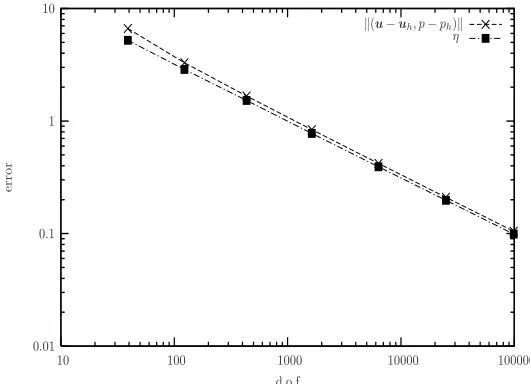
In order to test our a posteriori error estimator in Figure 1 we depict the error, in the norm defined in (2.4), and the estimator ˜ηH as h→0. We can observe
that both values are in good accordance, which is confirmed in Table 1 where we show the effectivity index
Ei :=
˜
ηH
k(u−uh, p−ph)k
,
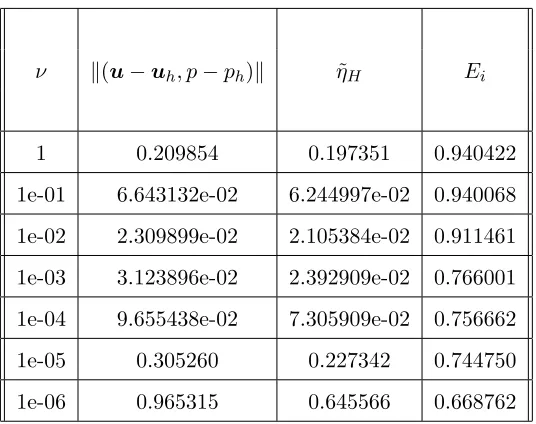
which remains bounded as h → 0. Finally, in order to study the sensitivity of the effectivity index as ν → 0, we present in Table 2 the behavior of ˜ηH
and k(u−uh, p−ph)k for a fixed mesh and for ν = 1,10−1, . . . ,10−6. We
observe that, as was predicted by Theorem 16, the estimator ˜ηH follows the
same pattern of k(u−uh, p−ph)k, and hence, the effectivity index remains
η
k(u−uh, p−ph)k
d.o.f
e
rr
o
r
100000 10000
1000 100
10 10
1
0.1
[image:19.612.156.421.76.268.2]0.01
Fig. 1. Exact error and the a posteriori error estimate.
d.o.f k(u−uh, p−ph)k η˜H Ei
39 6.641955 5.216376 0.785367 123 3.292848 2.873238 0.872569 435 1.671618 1.523188 0.911205 1635 0.838908 0.775193 0.924050 6339 0.419710 0.392412 0.934960 24963 0.209854 0.197351 0.940422 99075 0.104919 9.900770e-02 0.943655 Table 1
[image:19.612.153.425.483.696.2]ν k(u−uh, p−ph)k η˜H Ei
[image:20.612.156.424.68.280.2]1 0.209854 0.197351 0.940422 1e-01 6.643132e-02 6.244997e-02 0.940068 1e-02 2.309899e-02 2.105384e-02 0.911461 1e-03 3.123896e-02 2.392909e-02 0.766001 1e-04 9.655438e-02 7.305909e-02 0.756662 1e-05 0.305260 0.227342 0.744750 1e-06 0.965315 0.645566 0.668762 Table 2
Sensitivity of the estimator toν.
6.1.2 The lid-driven cavity problem
For this case we use the same domain as in previous section, we setf =0, and the boundary conditionsu=0on [{0} ×(0,1)]∪[(0,1)× {0}]∪[{1} ×(0,1)] and u = (1,0)t on (0,1)× {1}. We show in Figure 2 the initial mesh and
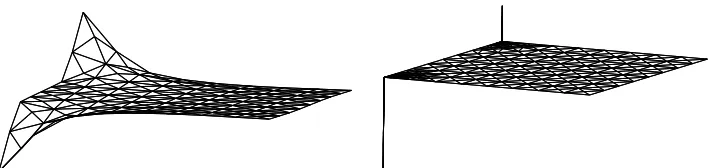
the adapted one obtained using our error estimate. In Figure 3 we depict the discrete pressure field obtained using the initial and adapted meshes where we note the improvement in the quality of the computed solution since the singular nature of the pressure is better captured in the adapted mesh.
[image:20.612.126.456.535.688.2]Fig. 3. The pressure in the initial and adapted meshes.
6.1.3 The backward facing step problem
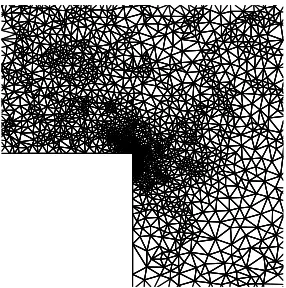
This test case is posed on the backward facing step configuration. The step is located at (x, y) = (2.5,0), the entry of the channel is at x = 0 and the exit of the channel at x= 22. The channel width is 1 at entry and 2 at exit. The boundary conditions are inflow parabolic profiles and free outflow. We assume f =0. In this case a singularity arises at the step from the re-entrant corner. Hence we can expect the meshes to be locally refined around the corner. In Figure 4 we depict the initial mesh, and in Figure 5 we show a zoom of the adapted mesh where we can observe the local behavior of the adapted mesh. Isovalues of the vertical component of the velocity are depicted in Figure 6 for both meshes. We remark the improvement in the quality of the discrete solution if we use the adapted mesh.
Fig. 5. A zoom, near the singularity, of the adapted mesh.
Fig. 6. A zoom, near the singularity, of the vertical velocity in the initial and the adapted meshes.
6.2 The generalized problem (σ6= 0)
6.2.1 An analytical solution
For this test case we consider Ω = (0,1)×(0,1), and with the aim of testing our approach using non-polynomial solutions, we set f such that the exact solution of our generalized Stokes problem is given by
u1(x, y) = sin(πx) sin(πy), u2(x, y) = cos(πx) cos(πy),
p(x, y) = 150(x−0.5)(y−0.5).
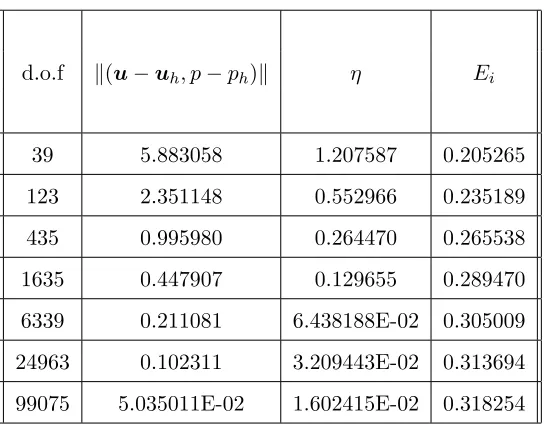
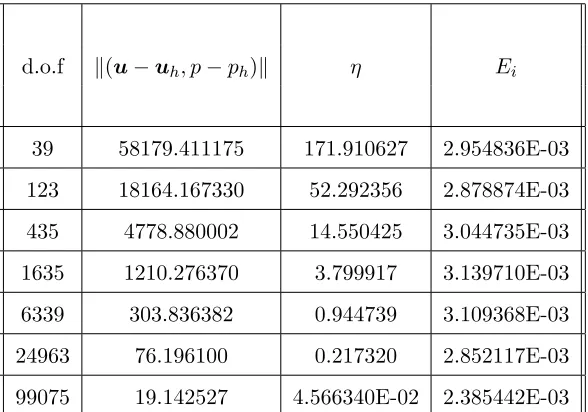
[image:22.612.113.467.285.399.2]the same kind of information plus the effectivity index. Note that this case is not covered by our theoretical results since condition (F) is not satisfied. Nevertheless, the exact error follows the same pattern of our a posteriori error estimator.
η
k(u−uh, p−ph)k
d.o.f
e
rr
o
r
100000 10000
1000 100
10 10
1
0.1
[image:23.612.156.421.172.366.2]0.01
Fig. 7. Exact error and the a posteriori error estimate (ν = 1 andσ = 1).
d.o.f k(u−uh, p−ph)k η Ei
39 5.883058 1.207587 0.205265 123 2.351148 0.552966 0.235189 435 0.995980 0.264470 0.265538 1635 0.447907 0.129655 0.289470 6339 0.211081 6.438188E-02 0.305009 24963 0.102311 3.209443E-02 0.313694 99075 5.035011E-02 1.602415E-02 0.318254 Table 3
[image:23.612.154.428.481.693.2]η
k(u−uh, p−ph)k
d.o.f
e
rr
o
r
100000 10000
1000 100
10 100000
10000
1000
100
10
1
0.1
[image:24.612.157.421.76.271.2]0.01
Fig. 8. Exact error and the a posteriori error estimate (ν = 1 and σ= 106).
d.o.f k(u−uh, p−ph)k η Ei
39 58179.411175 171.910627 2.954836E-03 123 18164.167330 52.292356 2.878874E-03 435 4778.880002 14.550425 3.044735E-03 1635 1210.276370 3.799917 3.139710E-03 6339 303.836382 0.944739 3.109368E-03 24963 76.196100 0.217320 2.852117E-03 99075 19.142527 4.566340E-02 2.385442E-03 Table 4
Error, a posteriori error estimator and effectivity index (ν = 1 and σ= 106).
6.2.2 The lid-driven cavity problem
[image:24.612.143.437.327.533.2]Fig. 9. Initial and final adapted meshes.
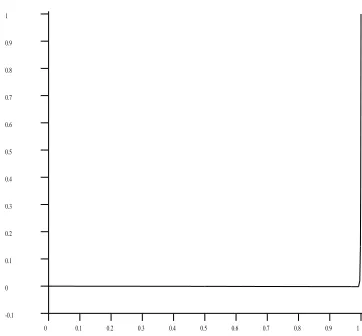
0 0.1 0.2 0.3 0.4 0.5 0.6 0.7 0.8 0.9 1 -0.1
0 0.1 0.2 0.3 0.4 0.5 0.6 0.7 0.8 0.9 1
Fig. 10. A cross section of the tangential velocity atx= 12.
7 Concluding remarks
An adaptive finite element scheme for the generalized Stokes equation has been introduced and analyzed. This scheme is based on a stabilized finite element method combined with an a posteriori error estimator. This error estimator is cheap and easy to calculate once we have chosen the bubble function spaces to be used. The equivalence between the estimator and the finite element error has been proved using a general hypothesis on the auxiliary bubble function spaces, thus avoiding the use of a saturation assumption, and we have provided a concrete pair of bubble spaces satisfying this requirement.
[image:25.612.190.371.301.469.2]de-pending on the physics of the problem, we remark that, for the pure Stokes problem, they provide equivalence constants which are independent of the vis-cosity. We also note that this dependence arises from the auxiliary problem posed on the continuous setting, and not from the hierarchical approach.
Finally, it is worth remarking that, even if the basic idea is closely related to the idea from [3] (see also [18]), our presentation is more general and the actual error estimator is quite different, and easier to compute. The extension of this idea to the Oseen and to the fully nonlinear Navier-Stokes equations will be the subject of future research.
A The proof of Lemma 13
First, we give the following result concerning the stabilization parameterδT.
Lemma 18 Let T ∈ Th and let δT be given by (4.9). Then, the following
estimates hold
ν δT ≤
1 12h
2
T , (A.1)
σ δT ≤min{hTν−1/2σ1/2,1}. (A.2)
PROOF. In order to prove the first estimate we use (4.9) and (4.10) to obtain
δT ≤
h2
T
4ν/mk ≤
1 12ν
−1h2
T ,
estimate which is valid independently of the value of σ. Second estimate is obvious ifσ = 0, hence we will suppose from now on that σ >0. First, we use (4.9) to get
σ δT ≤
1 max{λT,1}
≤1. (A.3)
On the other hand, we know from (A.1) that δT ≤ 121ν−1h2T, and then
σ δT ≤
1 12h
2
T ν−1σ . (A.4)
Taking then the geometric mean of (A.3) and (A.4), we have
σ δT ≤
1
√
12hT ν
−1/2σ1/2. (A.5)
Now, we are ready to prove Lemma 13. We will prove the result only for the case σ >0, the other one being completely analogous. From the definition of
R1
h, using (4.8) with qh = 0, we have
R1h(vh) =
Z
Ωf·vh−a(uh,vh)−b(vh, ph) =
X
T∈ Th
Z
T δT RT (σvh−ν∆vh).
Next, from Cauchy-Schwarz’s inequality, (3.2) and (A.1), we obtain
νδT
Z
T
RT ∆vh≤νδT
Z
T|
RT||∆vh|
≤h
2
T
12kRTk0,Tk∆vhk0,T
θT kRTk0,Tkvhka,T.
On the other hand, using (A.2), Cauchy-Schwarz’s inequality and the defini-tion of θT we obtain
σ δT
Z
T
RTvh≤min{ν−1/2σ1/2hT,1} kRTk0,Tkvhk0,T
≤θT kRTk0,Tkvhka,T,
and the result follows.
B Bubble function spaces satisfying (LBB) condition
For each element T ∈ Th we define the element bubble function bT by
bT := 27
Y
x∈N(T)
λx, (B.1)
where λx denotes the barycentric coordinate associated to node x. Following
Verf¨urth [22], let Tb be the standard reference element, of vertices (1,0),(0,1) and (0,0). Given any number α ∈ (0,1] let us denote by Φα : R2 → R2 the
transformation which maps (x, y) onto (x, αy). Let
b
Tα:= Φα(Tb),
and let us denote by ˆλ1,α,λˆ2,α and ˆλ3,α its barycentric coordinates (see Figure
(0,0) (1,0)
ˆ
T
(0,1)
(1,0) (0, α)
(0,0)
ˆ
Tα
ˆ
λ1,α ˆ
λ2,α
Φα( ˆT)
ˆ
[image:28.612.177.401.79.191.2]λ3,α
Fig. B.1. TrianglesTband Tbα.
Set
bF ,αb :=
4 ˆλ3,αλˆ1,α on Tbα,
0 on Tb\Tbα,
where Fb:={(t,0) ∈R2 : 0 ≤ t ≤1}. Let F ∈ EΩ and let us denote by T1, T2
two triangles which have F in common. Let GF,i, i = 1,2, be the orientation
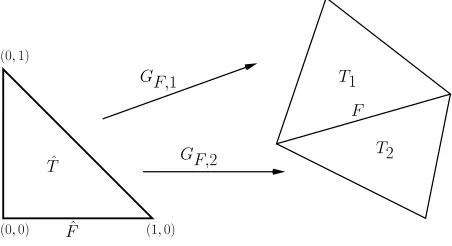
preserving affine transformation which maps Tb onto Ti and Fb onto F (see
Figure B.2).
(0;0) (0;1)
(1;0) ^
T
^ F
T 1
F
T 2 G
F;2 G
F;1
Fig. B.2. Affine transformationGF,i,i= 1,2.
Set
bF,α:=
bF ,αb ◦G−F,i1 on Ti, i= 1,2,
0 on Ω\ωF.
(B.2)
Let ˆΠ := {(x,0) : x∈ R} and let ˆQ : R2 → Π be the orthogonal projectionˆ
fromR2 to ˆΠ. We introduce the lifting operator ˆPˆ
F :Pk( ˆF)→Pk( ˆT) by
ˆ
PFˆ(ˆs) = ˆs◦Q.ˆ
[image:28.612.176.402.382.505.2]We define the lifting operator PF,Ti :Pk(F)→Pk(Ti) by
PF,Ti(s) = ˆPFˆ(s◦GF,i)◦G −1
F,i.
Using these notations, we can define a lifting operator
s∈Pk(F)−→PF(s) :=
PF,T1(s) in T1,
PF,T2(s) in T2,
and, for s= (s1, s2)∈Pk(F)2, we denote
PF(s) = (PF(s1), PF(s2)).
Finally, for allF ∈ EΩ let αF be the positive parameter given by
αF:=
min{ν1/2σ−1/2h−1
F ,1} , σ >0,
1 , σ= 0.
Theorem 19 Let k∈N. For all σ≥0, the following estimates hold
kvk20,T(v, bTv)T ,
ksk20,F(s, bF,αFs)F,
kbT vka,TθT−1kvk0,T, (B.3)
kbF,αF PF(s)ka,ωF θ −1
F ksk0,F, (B.4)
for all T ∈ Th, F ∈ EΩ, and every polynomial v, s of degree k defined in T
and F, respectively.
PROOF. The first two inequalities are proved (for the scalar case) in [22], Lemma 3.3. To prove the latter ones, let us first suppose that σ > 0. Using the inverse inequality (3.3) and the fact that bT ≤1,
kbT vk2a,T=νk∇(bT v)k20,T +σkbT vk20,T
(ν h−T2+σ)kvk20,T
σ(ν σ−1hT−2+ 1)kvk20,T
σ max{ν1/2σ−1/2h−T1,1}2kvk20,T
σ min{ν−1/2σ1/2hT,1}−2kvk20,T,
kbF,αF PF(s)k 2 0,ωF =
X
Ti⊂ωF
kbF,αF PF(s)k 2 0,Ti
X
Ti⊂ωF
h2TikbF ,αb F ˆ
PFˆ(ˆs)k20,Tb (B.5)
Now, Lemma 3.3 in [22] applied to the vectorial case leads to
kbF ,αb
F ˆ
PFˆ(ˆs)k0,Tb√αFksˆk0,Fb, (B.6)
kc∇(bF ,αb
F ˆ
PFˆ(ˆs))k0,Tb
s
αF +
1
αF k
ˆ
sk0,Fb, (B.7)
and hence, using (B.5),(B.6) and the mesh regularity, we obtain
kbF,αF PF(s)k 2
0,ωF αFh 2
F kˆsk20,Fb αFhF ksk20,F.
Moreover
σ hFαF = ν1/2σ1/2 min{1, ν−1/2σ1/2hF}
≤ ν1/2σ1/2 min{1, ν−1/2σ1/2hF}−1 = θF−2,
and then
σkbF,αF PF(s)k 2
0,ωF θ −2
F ksk20,F. (B.8)
On the other hand, from (B.7) andαF ≤1, it holds
k∇(bF,αFPF(s))k 2 0,ωF =
X
Ti⊂ωF
k∇(bF,αFPF(s))| 2 0,Ti
k∇ˆ(ˆbF,αFPˆFˆ(ˆs))k 2 0,Tb
α−F1ksˆk2 0,Fb
h−F1α−F1ksk20,F,
and using that ν h−F1α−F1 = θ−F2, we obtain
νk∇(bF,αF PF(s))k 2
0,ωF θ −2
F ksk20,F . (B.9)
Hence, the result for σ >0 follows from (B.8) and (B.9). The proof for σ= 0 follows in an analogous way. 2
In order to satisfy the (LBB) condition we need to impose the following con-dition on f:
(F) f is a piecewise polynomial function, i.e., there exists a positive integer
t such that
f ∈ {g∈L2(Ω)2 : g|
Remark 20 One possibility to overcome condition (F) above is to split the error between the error due to data approximation and the error due to the numerical method, as it has been done, for instance, in [1]. In any case, we
remark that, since the degree t of the polynomial from condition (F) is not
upper bounded, the error between f and its local projection onto the piecewise
polynomial space may be seen as a higher order term.
Next, we define the following bubble function spaces:
HbT :=h{bTRT}i ∀T ∈ Th,
HbF :=h{bF,αF PF(RF)}i ∀F ∈ EΩ,
wherebT and bF,αF are the bubble functions given by (B.1) and (B.2), respec-tively.
Remark 21 We remark that this definition of bubble functions allows us use any polynomial order to approximate the velocity and the pressure. In fact,
for every k, l ≥ 1 the bubble function bTRT belongs to Pmax{t,k,l−1}+3(T) and
bF,αF PF(RF) belongs to Pk+1(T). Hence, H
b
T and HbF are not subspaces of
Hh.
Since bT RT ∈HbT, using Theorem 19 we arrive at
sup BT∈H b T
(RT,BT)T
θTkRTk0,T aT(BT,BT)1/2 ≥
(RT, bT RT)T
θT kRTk0,TaT(bT RT, bT RT)1/2
kRTk
2 0,T
θT kRTk0,T θT−1kRTk0,T
β .
The same analysis may be carried out for every F ∈ EΩ. In fact, we have
sup BF∈H b F
(RF,BF)F
θF kRFk0,FaωF(BF,BF) 1/2
≥ (RF, bF,αF RF)F
θFkRFk0,FaωF(bF,αF PF(RF), bF,αF PF(RF)) 1/2
kRFk
2 0,F
θFkRFk0,F θF−1kRFk0,F
References
[1] M. Ainsworth. A posteriori error estimation for lowest order Raviart-Thomas mixed finite elements. Technical Report 23, University of Strathclyde, Department of Mathematics, 2006.
[2] M. Ainsworth and J. T. Oden. A posteriori error estimation in finite element analysis. John Wiley & Sons, New York, 2000.
[3] M. Ainsworth and J.T. Oden. A posteriori error estimators for the Stokes and Oseen equations. SIAM J. Numer. Anal., 34:228–245, 1997.
[4] R. Araya, G.R. Barrenechea, and F. Valentin. A stabilized finite-element method for the Stokes problem including element and edge residuals. IMA J. Numer. Anal., 27(1):172–197, 2007.
[5] R. Araya, E. Behrens, and R. Rodr´ıguez. An adaptive stabilized finite element scheme for the advection-reaction-diffusion equation. Appl. Num. Math., 54:491–503, 2005.
[6] R. Araya, A. Poza, and E.P. Stephan. A hierarchical a posteriori error estimate for an advection-diffusion-reaction problem. Math. Models Methods Appl. Sci., 15(7):1119–1139, 2005.
[7] R.E. Bank and B.D. Welfert. A posteriori error estimators for the Stokes problem. SIAM J. Numer. Anal., 28:591–623, 1991.
[8] G. Barrenechea and F. Valentin. An unusual stabilized finite element method for a generalized Stokes problem. Numer. Math., 92(4):653–677, 2002.
[9] F. Brezzi and M. Fortin. Mixed and hybrid finite element methods. Springer-Verlag, New York, 1991.
[10] P. Cl´ement. Approximation by finite element functions using local regularization. R.A.I.R.O. Anal. Numer., 9:77–84, 1975.
[11] E. Dari, R. Dur´an, and C. Padra. Error estimators for nonconforming finite element approximations of the Stokes problem. Math. Comp., 64:1017–1033, 1995.
[12] W. D¨orfler and M. Ainsworth. Reliable a posteriori error control for nonconformal finite element approximation of Stokes flow. Math. Comp., 54(252):1599–1619, 2005.
[13] H. Elman, D. Silvester, and A. Wathen. Finite elements and fast iterative solvers: with applications in incompressible fluid dynamics. Oxford University Press, New York, 2005.
[14] A. Ern and J.-L. Guermond. Theory and practice of finite elements. Springer-Verlag, New York, 2004.
[16] T.J.R. Hughes and L.P. Franca. A new finite element formulation for computational fluid dynamics: VII. The Stokes problem with various well-posed boundary conditions: Symmetric formulations that converge for all velocity/pressure spaces. Comput. Methods Appl. Mech. Engrg., 65(1):85–96, 1987.
[17] V. John. A numerical study of a posteriori error estimators for convection-diffusion problems. Comput. Methods Appl. Mech. Engrg., 190:757–781, 2000. [18] D. Kay and D. Silvester. A posteriori error estimation for stabilized mixed
approximations of the Stokes equations. SIAM J. Scientific Computing, 21:1321–1336, 1999.
[19] J.R. Shewchuk. Delaunay refinement algorithms for triangular mesh generation. Computational Geometry: Theory and Applications, 22(1–3):21–74, 2002. [20] R. Verf¨urth. A posteriori error estimators for the Stokes problem. Numer.
Math., 55:309 – 325, 1989.
[21] R. Verf¨urth. A posteriori error estimators for the Stokes problem II. Non-conforming discretizations. Numer. Math., 60:235 – 249, 1991.