Abstract: Conventional types of slabs are not generally preferred for long span structures, but whereas grid slab and ribbed slab are most suitable for long spans and also economical. However recently these two slabs are developing in India extensively, generally both of grid slab and ribbed slab consisting of ribs which makes them comparable. A complete assessment was done for the two slab systems in order to evaluate the seismic response to each slab system. The considered models in this study are OMRF frame with shear walls in addition to adopting 4,6,8 numbers of the storey by using ETABS software for analyzing and design, the followed analysis methods are Equivalent static method, response spectrum, and time history. The criteria for assessment are storey drift, base shear, time period, storey shear and axial force in columns.
Keywords: Grid slab, Ribbed slab, Storey drift, Base shear, ETABS, Storey shear
1. INTRODUCTION: 1.1 Problem statement:
There has been an expanding interest for construction earthquake resistant structures or buildings which leads to developing tremendous amount research in this regards, the main objective of these studies is to obtain an economic as well as safer structures which can be accomplished even if some of the essential structural elements have collapsed during the high intensity or major earthquakes [1]. Thus modelling and design of seismic loads have to be done accurately, furthermore detailing also has a lot of importance to assure that the structure is having adequate ductility. Moreover the slab is an essential part of the RCC frame which should be designed to withstand both vertical and lateral load resulting during earthquakes especially where failure during the earthquakes especially the areas near to shear walls and columns where failure is expected subsequently a proper selection of the suitable type of slab can contribute extremely in overall behaviour of the structure and strength.
1.2 Grid slab vs ribbed slab:
Slab is usually horizontal member developed to give level surfaces, typically flat, in building floors and the other different kinds of structures. Ribbed slab or hollow blocks ribbed slab commonly is used in Saudi Arabia, Dubai, some other Middle East countries and recently India. Ribbed slab
Revised Manuscript Received on April 12, 2019.
Atif Zakaria, P.G Student, VFSTR University, Vadlamudi, Guntur, Andhra Pradesh 522213, India. (Email [email protected])
M. Shiva Rama Krishna, Assistant professor, VFSTR University, Vadlamudi, Guntur, Andhra Pradesh 522213, (Email [email protected])
S.V.Surendhar, Asst.Professor, VFSTR University, Vadlamudi, Guntur, Andhra Pradesh 522213, India, (Email [email protected])
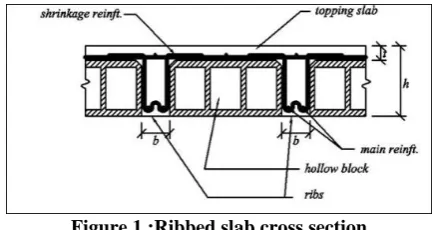
[image:1.595.317.537.286.401.2]consist of ribs in one direction along with hollow Bricks, these bricks could be made up of various types of materials such as burnt Clay, sand Lime and concrete the schematic view of the ribbed slab is shown in figure (1). Using such bricks not only helps to reduce the amount of concrete in the slab but also providing more thermal isolation to the structure.
Figure 1 :Ribbed slab cross section
In the other hand Grid slab have been broadly utilized in both of residential buildings as well as commercial buildings, grid floor can be defined as concrete floor consists of rectangular or square grids with ribs in two directions then it is also called as waffle slab [4].
Based upon recent study was done regarding the dynamic of response dynamic of gird slab [3] reported that grid slab having less displacement and base shear than the flat slab. However, there is no clear investigation of the seismic behaviour of hollow block floor.
A complete evaluation is done in order to assess the response of each type of slab to the seismic loads. In order to evaluate the seismic behaviour of slab have been considered six models (three for each slab) of RCC building with 4 stories, 6 stories, and 8 stories, the models were designed for high-intensity earthquake (zone IV) along with considering medium soil (type II).
2. OBJECTIVES:
To analysis multistoried RCC
buildings(4,6,8Storey) considering building system as OMRF with ductile shear wall and adopting ribbed slab and grid (waffle) slab where the used analysis methods are Equivalent Static Method, Response Spectrum Analysis, and Time History Analysis as per IS: 1893-2002 part-I: Criteria for Earthquake resistant structure.
Comparative Study of the Seismic
Performance of Rcc Building with Ribbed
Slab and Grid Slab
To evaluate and compare the seismic behaviour of multistoried RCC building having ribbed slab vs grid slab in high-intensity earthquake based upon various criteria
3. LITERATURE SURVEY:
Salman I. Khan and Ashok R. Mundhada (2015) have conducted a comparative research on multistoried R.C.C buildings with flat slab and grid slab, the dynamic analysis (response spectrum method) was performed using ETABS software to three different high rise buildings having 12, 15 & 18 stories, the study can be epitomized that gird slab has better performance than the flat slab based upon grid slab has 4% less base shear and lateral displacement additional to flat slab has significantly more story drift.
Makode R K and Akhtar (2014) have compared the seismic response of multistoried structures (12-storey building) with flat and grid slabs using response spectrum method, the study concludes that at the columns in the center of the plan was less in grid slab as compared to the building with flat slab, moreover at each storey the building with grid performed less storey drift than flat slab.
B. Doering, C. Kendrick and R.M. Lawson (2013) studied the thermal capacity of a composite slabs and ribbed slab along with a comparative study to flat slab system. The research resulted in that composite slabs generates a maximum heat compare to flat slab according to numerical studies the difference is approximately 20%
Bothara SD and Varghese V (2012) haveassessed the seismic response of both grid slab and flat slab in this study 9-Storey building was adopted to evaluate the behaviour by using response spectrum method, until 4 stories the slabs performance was identical, however the difference is clear in terms of storey drift for more than 4 storey building.
4. MODELLING AND ANALYSIS:
In this research, a regular existing plan was considered with regard to study the behaviour of multistory RCC structure along with the comparative study of the response of grid slab ribbed slab subsequently 6 different cases of multistory RCC structure were adopted.
4.1 Building specifications:
The grade of concrete: M30
The grade of longitudinal rebar: Fe 415 N/mm2 The seismic zone: IV
Importance factor: 1
Soil type: Medium soil (type (II)) Response reduction factor: 4.5
4.2 Structural elements dimension:
4.2.1 Slabs properties:
Grid slab and hollow block ribbed slab are analogous in diversified aspects for instance in construction the two systems comprise of ribs and segments of slabs this which
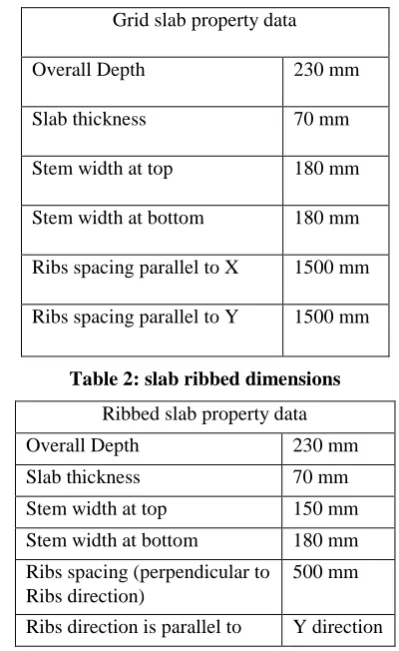
makes them comparable in the table (1) and table (2) the show selected slabs specifications.
Table 1: slab grid dimensions Grid slab property data
Overall Depth 230 mm
Slab thickness 70 mm
Stem width at top 180 mm
Stem width at bottom 180 mm
Ribs spacing parallel to X 1500 mm
[image:2.595.324.524.93.419.2]Ribs spacing parallel to Y 1500 mm
Table 2: slab ribbed dimensions Ribbed slab property data
Overall Depth 230 mm
Slab thickness 70 mm
Stem width at top 150 mm
Stem width at bottom 180 mm
Ribs spacing (perpendicular to Ribs direction)
500 mm
Ribs direction is parallel to Y direction
4.2.2 Beams and shear wall properties:
In all the models two beams categories were utilized the internal beams with a rectangular cross-section having 500mm width and 250mm depth, plus exterior a rectangular beams owning dimension of 250mm and 450mm width and depth respectively. Nevertheless the shear walls thickness 250mm has been maintained in all models.
4.2.3 Column properties:
In order to have a comprehensive understanding of the response of the various slab system in the reinforced concrete residential building, three different models were adopted depending on increasing the number of floors [7].
The followed analysis cases are 6 models 3 for each slab system using 4, 6, 8 storied OMRF building, for every case the columns were divided into three categories based on the amount of load acting on the column.
The columns cross-section dimensions are reduced by approximately 10 mm in all cases after each 4 floors not to mention that 250 mm has maintained ass the minimum dimension even after reduction of size.
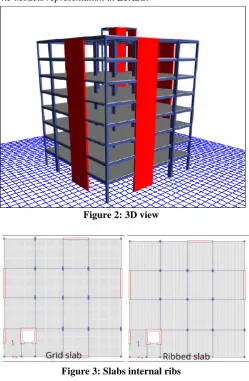
[image:3.595.47.297.113.495.2]4.3 Models representation in ETABS:
[image:3.595.316.540.329.651.2]Figure 2: 3D view
Figure 3: Slabs internal ribs 4.4 Endorsed analysis methods:
Three diverse analysis strategy has been pursued in order to acquire an idealistic comprehension of the behaviour of the various floor system.
4.4.1 Linear-static analysis:
The nature of earthquake loads are a dynamic force, however, in this method, the seismic loads assumed to be static more precisely the dynamic essence of seismic force should not be taken in the account furthermore using this strategy in the different codes predominantly permitted for regular buildings [9]. When the difference between center of mass and of center rigidity is negligible compared to the plan dimensions.
This method was used following the properties mentioned in (4.1), principally this sort of analysis method beneficial for reducing computational time due to it is simplicity [1].
4.4.2 Linear-dynamic analysis:
Whilst approaching this method the first assumption is the dynamic nature of loads
The linear-dynamic, in the design standers idealized graph of the structure maximum response vs time period for serval damping values [1].
4.4.3 Nonlinear-dynamic analysis:
This method is the most convoluted nonetheless a realistic simulation of the earthquake force could be resulted by performing this type of analysis. However, the nonlinear-dynamic analysis might be demonstrated as an analysis of the dynamic response of the buildings at every time intervals when the structure undergoes a particular ground motion, recently in ETABS software matching of the ground motion function or time history function with response spectrum function given in in design codes became possible subsequently accurate and feasible results can be gained from nonlinear-dynamic method [11].
5. RESULTS:
After performing the analysis for the considered models the following results were obtained:
5.1 Storey drift:
Story drift is the drift of one floor in a multistoried-building with respect to the level below, after performing the analysis for the different models the resulted Story drift values are shown fig 4, 5, 6.
Fig.4: The maximum drifts in 4 storey building.
[image:3.595.318.538.332.497.2]
Fig.6: The maximum drifts in 8 storey building. 5.2 Base shear:
[image:4.595.322.529.87.205.2]The seismic design base shear (VB) in X&Y was calculated, the figure (7) shows the maximum base shear values.
Fig.7: The seismic design base shear 5.3 Time period:
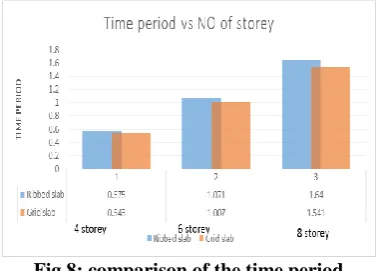
The Time required for the undamped system to complete one cycle of free vibration is the natural period of vibration of the system in units of seconds.
[image:4.595.314.541.229.546.2]The following figure (8) showing the results of the natural time period for Ribbed Slab & Grid Slab.
Fig 8: comparison of the time period 5.4 Storey displacement:
For all models, storey displacement in X-direction was greater owing to the fact that distribution of shear walls has an enormous impact on the resulted lateral displacement.
The figures 9, 10, 11 present the maximum storey displacements.
Fig.9: The maximum displacements in 4 storey building.
Fig.10: The maximum displacements in 6 storey building.
Fig.11: The maximum displacements in 8 storey building.
5.5 Self-weight:
[image:4.595.49.291.295.486.2] [image:4.595.74.264.583.718.2]Fig.12: Self-weight of the models.
5.6 Storey shear:
Storey shear has importance in designing the structure elements in buildings, the following figures (13, 14, 15) illustrate the variation in storey shear between grid and ribbed slab.
Fig.13: Storey shear in 4 storey building.
Fig.14: Storey shear in 6 storey building.
Fig.15: Storey shear in 8 storey building
5.7 Time history results:
In the non-linear dynamic analysis (TH) based upon previous earthquakes data the response of each floor can be obtained with different ratio of damping, the following figures (16, 17, 18) represent the storey response with various damping ratios for the critical models (8 storey structures).
Fig.16: Roof response with 0.1% damping
Fig.17: Roof response with 0.05% damping
Fig.18: Roof response with 0% damping 6. DELIBERATIONS OF RESULTS:
cloud be resulting in the additional bending moment in the elements and shear force. Therefore the shear wall and columns in such systems would be designed to withstand more loads.
Grid slab buildings subjected to less base shear than building with ribbed slab system. The variation percent between grid and ribbed slab in the range 9% to 12% due to the extra slab self-weight in building with ribbed slab, this difference might lead to increasing of the lateral load in the structure.
The time period for building with grid slab is less than ribbed slab structures due to the more value of the natural frequency in the structures with grid slab building the difference between grid and ribbed slabs varies about 5% to 6%.
Storey displacement in grid slab building is significantly less than ribbed slab, as consequence of the existence of ribs in the both directions in gird slab building, this privilege plays important role in reducing the loads in beams and columns in grid slab system.
Self-weight in ribbed slab is more compare to grid slab because of the presence of hollow blocks or bricks in ribbed slab, in the other hand utilization of such bricks would considerably increase the stiffness in ribbed slab.
Ribbed slab building having more storey shear as compare to grid slab building due to the more amount lateral seismic load attracted by ribbed slab structure owing to the fact that the mass of building with ribbed slab is noticeably higher than waffle slab.
7. CONCLUSION:
According to the obtained results the conclusions could be stated in the following points:
The appropriate selection of the slab system plays an important role in the structure stability against the both of lateral and gravity forces.
Grid slab building has a better seismic response than ribbed slab building.
When the total height of the structure increases the base shear, displacement, Storey shear and drift increases simultaneously.
In OMRF building shear wall takes the immense percentage of the base shear and the storey shear. Approximately above 95% from the load would be withstood by shear walls.
8. REFERENCE:
1. Duggal S K (2010), Earthquake Resistance Design of Structure, Fourth Edition, Oxford University Press, New Delhi.
2. Wilkinson S and Hiley R (2006), A Non- Linear Response History Model for the Seismic Analysis of High-Rise Framed Buildings, Computers and Structures, Vol. 84.
3. Khan, S. I., & Mundhada, A. R. (2015). Comparative study of seismic performance of multistoried RCC buildings with flat slab and grid slab. International Journal of Structureal and Civil Engineering Research (IJSCER).
4. Cahís, X., Benavent-Climent (2008), A., & Catalan, A. seismic evaluation of old RC waffle flat-plate systems. The 14th World Conference on Earthquake Engineering (WCEE).
5. Makode, R. K., Akhtar, S., & Batham, G. (2014). Dynamic analysis of multi-storey RCC building frame with flat slab and grid slab. Al Int. Journal of Engineering Research and Applications, 4(2), 416-420.
6. Döring, B., Kendrick, C., & Lawson, R. M. (2013). Thermal capacity of composite floor slabs. Energy and Buildings, 67, 531-539.
7. Pahwa, S., Tiwari, V., & Prajapati, M. (2014). Comparative Study of Flat Slab with Old Traditional Two Way Slab. International Journal of Latest Trends in Engineering and Technology (IJLTET).
8. Bothara, S. D., & Varghese, V. (2012). Dynamic analysis of special moment resisting frame Building with flat slab and grid slab. International Journal of Engineering Research and Applications, 2(4), 275-280.
9. Code, U. B. (1997). Uniform building code. In International Conference of Building Officials, Whittier, CA.
10. Standard, I. (1893). Criteria for earthquake resistant design of structures. Bureau of Indian Standards, Part, 1.