2007
Effectiveness evaluation of the Hispanic Workforce
Research Project (HWRP)
Fernando Aveiga Iowa State University
Follow this and additional works at:https://lib.dr.iastate.edu/rtd
Part of theCivil Engineering Commons,Labor Economics Commons, and theLatina/o Studies Commons
This Thesis is brought to you for free and open access by the Iowa State University Capstones, Theses and Dissertations at Iowa State University Digital Repository. It has been accepted for inclusion in Retrospective Theses and Dissertations by an authorized administrator of Iowa State University Digital Repository. For more information, please [email protected].
Recommended Citation
Aveiga, Fernando, "Effectiveness evaluation of the Hispanic Workforce Research Project (HWRP)" (2007).Retrospective Theses and Dissertations. 15085.
Fernando Aveiga
A thesis submitted to the graduate faculty
in partial fulfillment of the requirements for the degree of
MASTER OF SCIENCE
Major: Interdisciplinary Graduate Studies (International Development Studies)
Program of Study Committee: Edward Jaselskis, Major Professor
Francis Owusu Douglas Bonett Thomas Stout
Iowa State University
Ames, Iowa
2007
1446121
2007
UMI Microform
Copyright
All rights reserved. This microform edition is protected against unauthorized copying under Title 17, United States Code.
ProQuest Information and Learning Company 300 North Zeeb Road
P.O. Box 1346
Ann Arbor, MI 48106-1346
For William and Acacia
TABLE OF CONTENTS
ABSTRACT
CHAPTER 1. Overview of the Hispanic Immigration and the Construction Workforce
CHAPTER 2. Overview of Phases I and II of the Hispanic Workforce Research Project
CHAPTER 3. Identifying and Implementing Effective Training for Hispanic Craft Workers, American Supervisors, and DOT Inspectors through the Hispanic
Workforce Research Project
CHAPTER 4. Delivering Effective Construction Training for American Supervisors and Hispanic Craft Workers
CHAPTER 5. Effect of Cultural Diversity on Productivity, Quality of Work, and Conflict Resolution among Construction Hispanic workers and American
Supervisor Workers
CHAPTER 6. Evaluating the Hispanic Workforce Research Project (HWRP)
SHORTEN VITA
APPENDIX A. Questionnaire for Construction Employees:
Iowa DOT Inspectors, Contractor’s Supervisors and Hispanic Employees (ENGLISH VERSION)
APPENDIX B. Cuestionario Para Empleados en Construcción:
Inspectores de Iowa DOT. Supervisores y Trabajadores Hispanos en Constructora (Versión en Español)
APPENDIX C. Toolbox Integration Course for Hispanic workers and American supervisors TICHA’s Flash Cards
APPENDIX D. Toolbox Integration Course for Hispanic workers and American supervisors TICHA’s Reference Sheets
APPENDIX E. Questionnaire Evaluation of the Toolbox Integration Course for Hispanic workers and American supervisors
APPENDIX F. Evaluación de Curso de Integración en el Lugar de Trabajo entre Trabajadores Hispanos y Supervisores Americanos
APPENDIX G. Questionnaire Evaluation of the Safety Record Post Training for Hispanic Workers
APPENDIX H. Cuestionario de Evaluación del Record de Accidentes Pos-Entrenamiento
APPENDIX I. Pretest General Knowledge
Toolbox Integration Course for Hispanic workers and American supervisors
APPENDIX J. Pre-examen Conocimiento General
Curso de Integración entre Trabajadores Hispanos y Supervisores Americanos
APPENDIX K. TICHA’s Attendance Sheet
APPENDIX L. American Supervisor Measuring Frictions, Relations, and Implicit Productivity on the Jobsite
APPENDIX M. Measuring Frictions, Relations, and Implicit Productivity on the Jobsite
APPENDIX N. American Supervisor and Worker
Measuring Class Effectiveness in Improved Communications and Train the Trainer Perspectives
ABSTRACT
Hispanics are a large and growing part of the United States workforce. Official projection state that by the year 2050 Hispanics will account for 25 percent of the population. For the Midwest in particular, the Hispanic population is expected to increase 35 percent by the year 2025. The construction industry is expected to experience greater percentage increase of its Hispanic population due to the labor intensive nature of the industry.
This study addresses the expected increase of Hispanic workers in the construction industry by investigating the best approaches for delivering training to construction crews with Hispanic workers as well as American supervisors and laborers in the State of Iowa. It also involved developing an integration on-site course. The Toolbox Integration Course for Hispanic workers and American supervisors (TICHA) is put to test during the construction season 2006 with the collaboration of three construction companies. The research
methodology consisted of assessing the effects on communication, safety, work environment, and productivity as a result of the integration training.
Results show that integration on-site training decreases worker’s desirability to move and increases quality of work and productivity. Most importantly, experimental design was used to show the increasing levels of direct construction communication due to TICHA.
CHAPTER ONE. Overview of the Hispanic Immigration and the Construction
Introduction
Is there a need to develop a Multicultural, Communication, and Safety Management Training Program for the Construction Industry in the U.S. Midwest? The answer to this question is a cautious yes. Hispanics1 constitute the group with the largest migration numbers to the United States. Traditionally, the construction industry has been a labor intensive field. This industry attracts low skill labor and due to the inherent risks in construction, wages tend to be higher than most low skill jobs (e.g. agriculture). Nevertheless workers are the most important factors in the production process, especially in labor intensive industries such as the construction industry. These are some of the reasons why a great number of Hispanic immigrants have pursued working in the construction industry. The continuous changes of the demographic composition of the U.S. forces different industries to be in a state of constant adaptation.
With the intention of making the construction industry more adaptable for these demographic changes, different players surrounding the industry have developed training materials. This training material as well as other research findings suggests that a
multicultural, communication and management training program is necessary for the
continue success of the industry in terms of its productivity and safety culture. While there is no debate whether the increasing inflow of Hispanic workers need adjusting for effective training, it is not yet clear who should bare the cost for implementing it. The construction industry is legally required to train its workers with courses ranging from safety to flagging; all which are not being properly delivered to the increasing Hispanic worker population in the industry. It is found that traditional methodology for delivering the training material will not work under such a labor diverse industry (Canales et al., 2007). Yet, a program of these characteristics is required for optimizing the industry’s training requirements, but it is the industry and/or the government who should request the creation of such a program.
Why then to remain cautious about the developing this training program when there is evidence for its need? As it is described in this article, implementing such a program needs the affirmation that a dynamic industry needs institutions that provide support for the
1 The term Hispanic refers to those individuals with a Spanish speaking heritage. Though Brazilians and other
changes it experiences. In addition, a joint collaboration of the industry2 and government and the cautious structuring of the training to be the most efficient possible are both requirement. While the training needs have been identified and benefits from training quantified3,
developing a program brings about new and unknown challenges that can only be faced with the government and industry joint collaboration.
This article highlights some of the official statistics on Hispanic immigration found in the U.S. Census Bureau and Bureau of Labor Statistics. The article continues reporting how Hispanic immigration is affecting the dynamics of various industries; in particular, the safety record of the construction industry. A review the current scholarly, government and industry efforts for confronting the changes happening in the construction industry’s labor force is reported. In terms of the capacities of the creation of the program suggested in this article, the problem of unauthorized workers in the industry impacts the industry negatively. Finally, this article concludes with a general summary of the issues and solutions for construction
industry and illustrates the lessons that would help in the quest for developing the Midwest Multicultural Construction Workforce Program (MWP), possibly at the Center for
Transportation Research and Education at Iowa State University4.
U.S. Hispanic Demographics and projections
Population
Hispanics are considered the largest ethnic minority in the U.S. and are projected to make up about 25% of the workforce by 2050 (U.S. Census Bureau, 2000a).
Today, Hispanic workers in the U.S. comprise nearly 18% of the workforce (Canales et al., 2007). Due to the rapid growth of the Hispanic population in the U.S. during the past decade, Hispanics calls for recognition and an understanding of their influence over time in American society. By the year 2025, the U.S. population is expected to reach 419.9 million
2 Trade associations could take a major role in this effort due to their advertisement capacity and the services
they could provide within their structural operative system.
3 See Nash’s (2004) for safety improvements due to training. Also refer to Chapter 4 for a study on increased
productivity and quality of labor due to training.
and Hispanics are projected to make up about a quarter (24.4%) of that total (U.S. Census Bureau, 2004d).
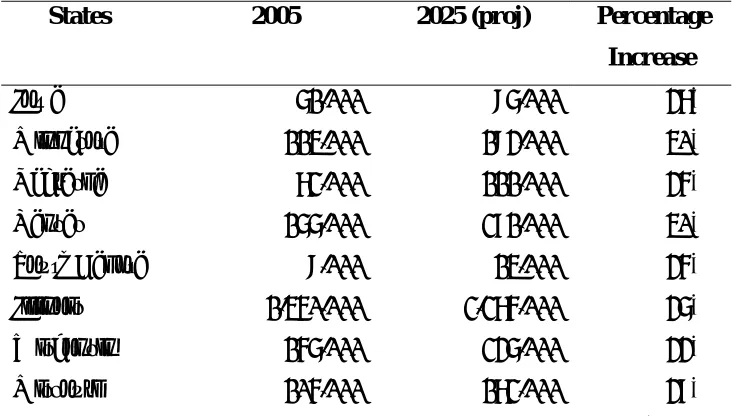
[image:11.612.84.450.262.470.2]Table 1.1 shows all the Iowa neighboring states with the Hispanic populations for the year 2005 and its current projections for the year 2025. A common denominator in Table 1.1 is the similarity in the percentage increase in the Hispanic population over the next 20 years for all the reported Midwestern states.
Table 1.1. Iowa and neighboring States projected population increase for 2025
States 2005 2025 (proj) Percentage
Increase
Iowa 61,000 96,000 37%
Minnesota 114,000 193,000 40%
Nebraska 72,000 111,000 35%
Kansas 166,000 281,000 40%
South Dakota 9,000 14,000 35%
Illinois 1,450,000 2,275,000 36%
Wisconsin 156,000 236,000 33%
Missouri 105,000 172,000 38%
Source: Chicano Latino Affairs Council of the State of Minnesota5 http://www.clac.state.mn.us/english/usproj.htm
As of July of 2005 the Hispanic population of the U.S. was 42.7 million6, with 27.3 million coming from Mexico alone. In perspective, between July of 2004 and July 2005, one of every two people added to the U.S.’s population was Hispanic. In addition, within that period there was a 3.3 percent increase in the Hispanic population; making Hispanics the fastest-growing minority (U.S. Census Bureau, 2004a).
Not long ago, during the 1990 Census the Hispanic population was just slightly over 22.4 million. Today, the projections for 2050 are that the Hispanic population will be 102.6 million (U.S. Census Bureau, 2004a).
In terms of current language statistics, about 47 million Americans speak a language other than English of which ~28 million speak Spanish at home (U.S. Census Bureau, 2004d).
More than 10 million people living in the U.S. were born in Mexico and this is by far more than any country in the world. Other countries of birth that contribute large numbers of Hispanics are El Salvador (937,000), Guatemala (590,000) and Colombia (500,000) (U.S. Census Bureau, 2004c).
Businesses
In 2000, about 1.6 million businesses nationwide were Hispanic-owned. The rate of growth of Hispanic-owned business between 1997 and 2001 is of 31 percent while the national average is only 10 percent. The increase in Hispanic entrepreneurial activities has generated revenues of $222 billion for all industries in 2002. That is 19 percent higher than the revenues from 1997 (U.S. Department of Commerce, 2005). Forty four percent of all the Hispanic-owned firms are run by people of Mexican origin. Maybe the most relevant statistic is that one third of the all the Hispanic-owned businesses are related to construction. In addition, 15 percent of all the Hispanic labor force work in the construction industry (U.S. Department of Commerce, 2005) while 20 percent of all construction workers are Hispanics (Nash, 2003).
Income and Poverty
In 2004 the real median income of Hispanic households was $34,241 while the poverty rate was just below 22 percent. In addition, the Economic Research Service (2003) found that the increase in Hispanic immigration to rural areas has reduced the real wage level for both skilled and unskilled Hispanic workers in those areas. As well, it has contributed to a decrease of the real wage for all unskilled workers in rural areas (Neuman, 2003; Goodrum, 2004).
Education level is strongly correlated to income levels. In this case by 2004 only 12 percent of the Hispanic population of 25 years or older have a bachelor’s degree while 58 percent had at least a high school education (U.S. Department of Commerce, 2005). Table 1.2 shows that this figure has improved over the past two decades, but there is still an extremely large pool of unskilled workers with low education levels; the type usually used for the construction activities.
Table 1.2. Percent of Hispanic population age 25 and older, by years of school completed
Less than 5 years of elementary
school
High school completion or
higher
4 or more years of college
1980 15.8 44.5 7.6
1990 12.3 50.8 9.2
2000 8.7 57.0 10.6
2005 7.9 58.5 12.0
Source: U.S. Department of Commerce, Bureau of the Census, March 2005.
Twenty percent of construction workers and about 18 percent of the labor force are Hispanics7. In proportion, that is, Hispanics are quite important for the construction industry.
Hispanics, the Workplace, and a Construction Safety Mishap
Hispanic industries, dynamic training
Every industry in the United States is facing new challenges of growing numbers of minorities and immigrants speaking their native languages with limited or no knowledge of English. As the U.S. economy continues to expand and the baby boom generation retires over the next 30 years, the need for immigrant workers will increase significantly, creating new challenges to the U.S. economy (Sincavage, 2004). Numerous industries have already had to hire bilingual employees to communicate to workers, who come from numerous backgrounds (Canales et al. 2007).
7 According to the Bureau of Labor Statistics the total U.S. labor force was 152.8 million in January of 2007.
That is certainly the case for the Agricultural, Landscaping, and Golfing industries which have created extension programs to address the lack of training and safety education necessary for success. For instance, the agricultural extension program at the University of Florida has created and currently delivers the following programs in Spanish:
1. Worker Protection Standard for Worker and Handler. 2. Train the Trainer.
3. Private applicator.
4. General Standards (Core).
5. Ornamental and Turf and Landscaping for Limited Certification. 6. Commercial landscape maintenance.
7. Pest control technician training.8
In a Golf -Course Magazine article, Perry (2006)9 suggests that no solution to the Hispanic workforce contribution to the golfing industry happens at low costs. On the same note, Maloney (1996) at the Department of Applied Economics and Management at Cornell University considers the communication problem in the golf course maintenance industry generates two different types of issues. The lack of communications due to language and the lack of communications due to cultural differences are two separate issues, he argues.
The landscaping industry is facing similar issues and is reacting promptly to correct them. The Landscape Industry no longer operates without direct labor of Hispanics (Perry, 2006). According to the Hispanic Business Magazine, so far, most of the English training required for regular domestic workers has been translated to Spanish10.
These are only a few of the industries that have implemented aggressive training programs adapted for Hispanic worker’s culture and language. However, it is in the construction industry where the lack of such training has caused not only the common communication and productivity issues faced by other industries, but a safety record in decline.
Hispanics in construction
Population trends indicate that the number of Hispanic workers in construction
continue to grow creating the need to develop strategies to blend cultures in the workplace. In some states such as California, New Mexico and Texas, Hispanics are already the majority of the construction workforce (Goodrum 2005).
In construction, Hispanic immigrants directly affect the labor composition of the industry. Traditionally, this industry has been male-dominated. In 2005, there were 108 Hispanic males per every 100 Hispanic females. This was in sharp contrast to the overall population, which had 97 males per every 100 females on the same year (U.S. Census Bureau, 2004c). This could be significant for the increasing pool of workers of a male-dominated industry.
Other demographic factors directly impact the construction industry. In 2005 the median age of Hispanic workers was of 27.2 years. This compares with 36.2 years for the population as a whole (U.S. Census Bureau, 2004c). A great number of these young workers prefer to work in construction11 (NIOSH, 2003).
Hispanics constitute about 20 percent of construction employees. In addition, one third of all Hispanic-owned businesses are related to construction and 15 percent of all the Hispanic labor force work in the construction industry (Nash, 2004).
In a rigorous socio-economic study conducted for the State of North Carolina, it was found that Hispanic workers contribute immensely to the state’s economic output and cost competitiveness in the construction industry. It was found that without Hispanic labor the state’s construction industry output would likely be considerably lower and the state’s total private-sector wage bill as much as $1.9 billion higher (Kasarda et al., 2006).
According to Mike Weiss, past chairman of the National Association of Home Builders (NAHB), Hispanics represent a significant solution to the semiskilled construction labor shortage12. “Many who have worked with and around Latino crews are aware that they have drive and desire to be productive. They came to this country for the same reason our
11 In fact, the construction industry ranks 3rd in the number of work-related fatalities to youth (NIOSH, 2003).
ancestors did, to find a better life and being able to communicate is key to that”, Weiss adds. And so far the greatest challenges for increase productivity are language barriers and poor safety records.
A safety misfortune
The current wave of globalization has encouraged the mobilization of not only American construction firms into Latin-American countries to facilitate building their infrastructure but a great number of Hispanic13 construction workers to go to the United States. Despite the complex nature of blending the cultures in a dynamic construction
industry, it is still possible to develop productive relationships between American supervisors and Latin-American workers. These productive relationships are extremely important. So far, however, the industry has failed to sustain a relationship that produces safer and more
productive jobsites with higher effectiveness in the work quality. While the issues the industry faces go far beyond the topic of safety, it is this factor the most worrying.
The construction industry employed 2.9 million Hispanic workers in 2006, which accounts for 25 percent of the total employment of 11.8 million workers in the construction sector (Sarmiento, 2007).
Nationwide, Hispanic workers make up about 18% percent of the workforce, but they account for 13.8 percent of industrial workplace fatalities (Allen, 2007). Along with the population increase, Hispanic workers continue to have the highest fatalities (4.5/100,000 Hispanic workers) among cultural groups in the construction industry, as reported by the BLS in the National Census of Fatal Occupational Injuries in 2003. Furthermore, the
construction sector carried the highest number (1,126) of fatal occupational injuries in 2003, especially among construction laborers (BLS 2003a).
In his well cited Visual Essay, Richardson (2005) shows the Hispanic fatality statistics in the construction industry. Richardson differentiates between U.S. born and foreign born Hispanics for comparison statistics. Overall, it is found that regardless of birthplace (or “nativity” as he calls it), Hispanic workers have the highest fatality rates of all
13 The term Hispanic refers to those individuals with a Spanish speaking heritage. Though Brazilians and other
workers of any race. In Figure 1.1 Richarson reports that most foreign-born Hispanic
construction workers are not U.S. citizens. In the last decade, as the number of fatal incidents has risen for Hispanic workers, the proportion of foreign-born Hispanics who die on the jobsite has also increased as depicted in Figure 1.2.
The problem of the illegality facing many of these workers sometimes translates into less accessibility to training and general civil rights. There are Hispanic workers who would receive language or safety training if they had a legal authorization to work. On the other hand, the larger number of foreign-born Hispanic fatalities could be due to their lack of language knowledge.
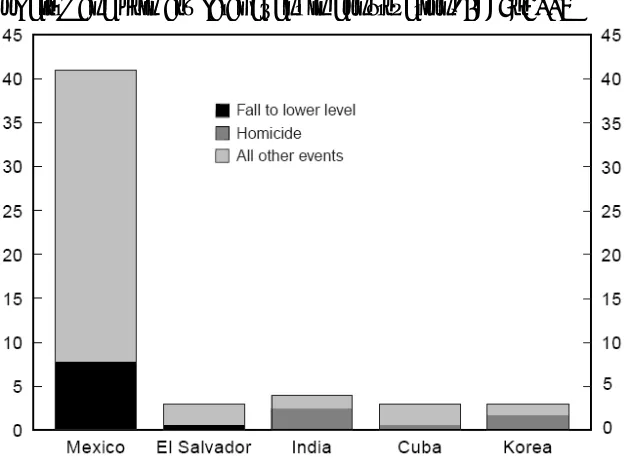
As shown in Figure 1.3, homicide is not a cause of fatality for Hispanic workers in the jobsite. “Fall to lower level” and “all other events” account for most of the fatality incidents in construction.
Also Figure 1.4 highlights the need for safety training of foreign born Hispanic workers as their fatality rate per 100,000 workers is significantly higher than U.S. born Hispanic construction laborers. In conclusion, when the fatality rate of foreign-born
Figure 1.1. Hispanic employment by number (in thousands) and percent aged 16 and older, 2004
Source: Richardson, Scott. 2005. Occupational safety and health. Fatal work injuries among foreign-born Hispanic workers. Visual Essay: Hispanic Worker Fatalities. Monthly Labor Review October 2005
Figure 1.2. Fatal work injuries involving Hispanic workers in private construction by nativity, 1993–2002
Figure 1.3. Percent of total fatal work injuries occurring to foreign-born workers by country of birth and primary fatal event in construction, 1996–2004
Source: Richardson, Scott. 2005. Occupational safety and health. Fatal work injuries among foreign-born Hispanic workers. Visual Essay: Hispanic Worker Fatalities. Monthly Labor Review October 2005
Figure 1.4. Fatal construction work injury rates for Hispanic workers, 2004
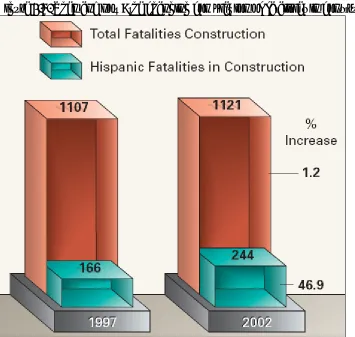
[image:19.612.96.399.416.639.2]There is no doubt Hispanic workers are affecting the dynamics of the construction industry. Specially, as Nash (2004) reports, the safety record for all construction workers has not worsened dramatically while the same statistic for Hispanic construction workers are hitting all time records. The Hispanic safety record of the last decade, as shown in Figure 1.5, impedes the safety success of the construction industry while highlights the worsening of the working safety conditions of the Hispanic increasing population.
Figure 1.5. Then and now: the changing complexion of fatalities in construction
Source: Nash, J. 2004. Construction Safety: Best practices in training Hispanic workers. Occupational Hazards, Penton Media, Inc., Cleveland, Ohio, 35-37.
should now realize that the Hispanic workforce, foreign and U.S. born will continue to increase and that, up to now, at least 15 percent work in construction14.
Current Hispanic Construction Worker Training Programs
Government
The Occupational Safety and Health Administration (OSHA) has special concerns for non-English speaking workers. According to the OSHA Trade News Release (2002), more than $2.2 million in new funding was allocated for outreach to Spanish and other non-English-speaking workers during the 2004 fiscal year. This is the first time OSHA’s budget included additional funding for Hispanic outreach (Canales, 2005). Moreover, OSHA is forming alliances with Hispanic leadership and community-based organizations and offering an ever-increasing number of publications and fact sheets in Spanish. OSHA will continue to expand ongoing Hispanic outreach projects such as the community-based efforts to
disseminate safety and health information among immigrants in New York and New Jersey (OSHA, 2002).
OSHA’s most recent action has been the establishment of a help-hot-line15 for Hispanic workers who are concerned about safety and health hazards at their construction jobsites (OSHA, 2005). This project has taken place in conjunction with the Mexican Consulate located in Atlanta, Georgia. Bi-lingual consulate employees have been trained by the U.S. Labor Department to screen calls and connect workers with appropriate department staff for assistance. While this hotline serves for all industries under the U.S. Labor
Department jurisdiction, about 90 percent of the callers have been Hispanic construction workers16.
Industry
Just in 2000, the state of Texas reported 81 Hispanic construction worker accidents that ended in death on the job. It is important to mention the efforts being made to minimize
14 That takes into account both male and female. Few women work in construction. In consequence, it wouldn’t
be pure guesswork to think that, ceteris paribus, at least 30 percent of the male Hispanic increasing workforce works and will work in construction for years to come.
injuries among Hispanic workers on the $2.6 billion Dallas/Forth Worth
Airport (DFWA) expansion project. The airport's safety program appears to be decreasing the high mortality rates for Hispanic workers by breaking down barriers of language, literacy, and culture. According to Nash (2004), the DFWA's Capital Development Program17, may have one of the best construction training programs in the United States due to its efforts in training Hispanic workers in health and safety as well as offering classroom instruction including helping workers understand basic construction terms, while hands-on training focuses on job skills.
In conjunction with the two primary contractors on the expansion project, BEST Institute, Inc., of Garland, Texas, developed this 40 hour training program for the Hispanic construction workers.
Nearly 13,000 workers have taken the BEST Institute's course18, which is offered in Spanish as well as in English. This course intends to teach the basic vocabulary and phrases used in everyday work situations and focus its teaching on vocabulary and phrases correlated to safety and health procedures.
Because the expansion of the DFWA is a large, publicly funded construction project that could afford such an extensive training program for Hispanic workers, the cost-effective usability of this training for private contractors has been doubtful. However, BEST Institute, Inc., and the contractors involved with originally developing this training course have considered the possibility of adapting it for use in other and smaller projects.
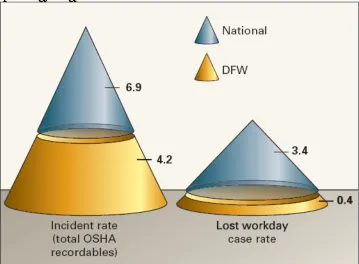
But what is most unique about DFWA’s safety program is its mandatory 40-hour bilingual safety training program. Nash (2004) shows that a safety training program for Hispanic workers reduces the fatality rate dramatically. This safety training program at the Dallas/Ft. Worth airport was successful in reducing operation costs related to lost time injuries and work casualties for Hispanic construction workers. In Figure 1.6, Nash is able to portray the potential gains from training. Compared to the national average for large
construction endeavors, the DFWA experiences lower lost-work day cases rate as well as lower accident rates.
It is apparent that gains in productivity are related to decreasing lost-work days. As Nash (2004) shows, safety pays. As of December 2003, the average cost of Texas workers’ compensation claim was $11,058 while the same number for DFWA was $9,272.
Nash hopes DFWA’s expansion project is setting and example for others to follow. The cost of an ambitious training program is immediate. A small number of construction project are large enough for economies of scale to decrease aggressive training costs. For that reason, creating DFWA-like programs will need the joint support of construction
[image:23.612.90.449.302.566.2]associations, unions, academia, and government.
Figure 1.6. DFW’s Impressive Safety Record Incidence rates of injuries and illnesses per 100 full-timeworkers
Source: Nash, J. 2004. Construction Safety: Best practices in training Hispanic workers. Occupational Hazards, Penton Media, Inc., Cleveland, Ohio, 35-37.
Academia
Hispanic construction workers. GTRI’s areas of study are divided in five categories: fall protection, scaffolding, trenching and excavation, electrical hazards, and materials handling. This material has been prepared for computer presentation for job orientations and has been distributed through building associations, statewide and regional OSHA offices and the Hispanic Chamber of Commerce (Anonymous 2004).
The state of Massachusetts has also given priority to this type of training program for Hispanic construction workers. The Department of Work Environment, University of
Massachusetts-Lowell senses there is the need for linguistically and culturally appropriate occupational and health resources targeted to Spanish speaking workers (Brunett 2005). This entity has developed a complete set of safety and health educational materials for Hispanic construction workers that have been federally funded to be implemented in Lawrence, Massachusetts, a city with a majority Hispanic population. The structure of the training includes 13 modules of one hour duration each where 6 are mandatory and 7 are elective (Brunett 2005).
At the University of Kentucky, Paul Goodrum investigated possible factors
explaining high mortality rates for Hispanic construction workers related to other races and ethnicities (Goodrum 2005). In addition, Michael Schulman from North Carolina State University and Tom O’Connor at the National Academy of Science have also given contributions in reaching adequacy in health and safety training for Spanish speaking construction workers (O’Connor 2004; Schulman 2005).
Trade associations and the ideal private-government joint success
Most of the efforts for tackling the communication, productivity and safety problems on construction jobsites have been led by academicians, entrepreneurs, and government agencies which have had little if none joint collaboration for implementing the programs. Moreover, these efforts only exist in blueprints or with courses sitting in shelves ready for the government and/or the industry’s cry for its practical use. Implementing a self-regulated and self-sustained quasi-governmental program19 is the next step forward the construction
industry needs to take in other to assure its success. Alone, none of the parties would provide
successful solutions to the socioeconomic issues arising from the changing dynamics of the construction labor force. The most effective way to solve the challenges facing the
construction industry is for all parties surrounding the construction industry to join efforts and solve common problems in a systematic and cooperative manner.
For instance, the Home Builders Institute20 created Sed de Saber™-Construction Edition to help builders address the language barrier and improve safety, quality and communication on the job site. This learn-at-your-own-pace course format gives Hispanic workers the opportunity to learn general and residential construction-specific English in about 16 weeks. The idea is to empower Hispanic workers by educating them at the same time builders cultivate a loyal and skilled workforce. Sed de Saber™ first appeared in the hospitality industry in 2005 and has impacted over 26,000 workers in this industry21. Sed de Saber translates as “Thirst for Knowledge” and its construction edition is currently being developed. It includes seven self-paced, interactive books that use Leap Frog Enterprise, Inc.™ technology to teach workers 500 vocabulary words and more than 340 phrases
commonly used in home building. Preliminary versions of this course material have had great reviews22. However, there is no clear explanation on the strategies for delivering the training
material. It is important to note, however, that the development of training material by trade associations is a positive sign that the industry demands new training for the needs of its workforce.
In the State of South Carolina, the private and public sector have teamed to develop short-term courses that tailor different types of work situation by teaching job-specific words and phrases. The Home Builders Association of South Carolina has teamed up with the creators of Command Spanish, a company from Massachusetts which has created various training materials for Hispanic construction workers. Dr. Sam L. Slick, president and CEO, says that Command Spanish focuses on “imparting psycho-metric skills to workplace
employees instead of relying on the type of grammatical Spanish language skills people learn in high school.” He believes that Hispanic construction workers do not need to learn the English language as long as they can communicate effectively on the jobsite. The same
20 The workforce development arm of the National Association of Home Builders; a Trade Association. 21 http://www.hbi.org/
works for American supervisors who should also know the basics of Spanish for construction (Allen, 2007).
There are several colleges in South Carolina that have instructors certified and licensed by Command Spanish to teach workplace Spanish at worksite through South Carolina. “One workplace fatality is one too many” has been the motto of the Hispanic Workforce Task Force program of the State of South Carolina23.
The Licensing and Regulation Agency (LRA) of the South Carolina Department of Labor (LLR) decided it was time to take action and formed the Hispanic Worker Safety Task Force. The Task Force was charged with evaluating the situation in South Carolina and coming up with ways to help employers make their worksites safer for Hispanics.
The joint collaboration of this Task Force is made up of representatives from LLR and OSHA office, industry leaders, safety experts and Hispanic leaders. In addition, colleges have contributed with the personnel for training. As stated above, no program would function properly without the joint collaboration of all the parties surrounding the construction
industry. By 2006, the Task Force has provided training to more than 1,500 Hispanic workers in their language. Meanwhile, in comparison to previous years, the number of workplace fatalities among Hispanic workers in South Carolina declined in 2005 and 2006 according to its website (footnote 22).
What is most unique about the Hispanic Worker Task Force (HWTF) is its
community development goal. The idea is that more safety on jobsites not only reduces costs and increases productivity to the industry, but builds better communities as a whole. This is the result of a State-Private sector effort: safer and more productive business and better communities.
Unfortunately, South Carolina is the only state which has implanted a formal
research-training Hispanic support program for the construction industry. The overall gain of institutions such as the HWTF should be perused by more than just one state. In addition, creating programs that work with an interstate collaboration, may not be far from reachable.
Citizenship
As a whole, this article reports relevant information to the construction industry and the changing dynamics of its labor force. Also, this document lays the bases justification for the “cautious” implementation of a training program. A training program limited to training only per se? The demand for providing effective training for Hispanic workers is evident and the need irrefutable. Yet we argue that the proposed multicultural, communication, and safety management aspects of the training program would become the backbone of this effort. But such program should function comprehensively; its structure and objectives should contain factors that seek more than training and better numbers in the construction record (i.e. the safety, productivity and quality of work). The program should include aspects that address current socio-economic issues such as citizenship, labor rights, and exploitive relations. At first glance, the industry would think that developing a program which, on top of training, provides support to the social welfare of its Hispanics employees, would be costly and unattractive. As it turns out, Hispanics want to fit in by learning the language and the
customs. Hispanics would become better workers when they and their families can enjoy the tranquility that legal citizenship, labor rights, and productivity-based pay systems could provide. Companies that treat their workers well keep them longer and they are loyal to the company. Including a citizenship24 package in the training program could not only benefit the worker, but also the companies. Developing a training program of this sort leads to all parties in the construction industry benefiting. In implementing this program nobody is worse off. This concept is as industry and socially desirable as it sounds. The citizenship aspect of the proposed program is, today, beyond the control of the individual employers. However, the employers could demand the government improvements in the immigration agenda.
Planning for a prosperous industry: developing the program for the U.S. Midwest
There has been no planning in construction industry for the increasing Hispanic population and the problems incurred in the industry. Hispanics and the problems that they bring to the industry are evident today. What is more evident, by 2010, more than 30 percent
24 The author doesn’t underestimate the potential of also including in the program an office for legal issues that
of the construction industry will be Hispanic authorized25 workers (NIOSH, 2004). That is not even considering those who work without a legal status which is the majority of workers (Richardson, 2005). What does this mean? That at least 3 out of 10 construction industry workers will be Hispanic in less than three years! This article acts as a sound alert which suggests the solution to the increasing problems the construction industry faces. Developing and delivering proper training to the evermore multicultural construction crews is a difficult but achievable task. Training material has been developed by different entities. However, with the exception of few large self-funded construction training programs, the
implementation of such training has not existed or been efficient. While most construction companies are not large enough to conduct this effort alone and the projections for foreign-born Hispanics to arrive in this country will not decrease at least for the next 20 years, the construction industry still experiences lack of proper training and motivation to do something about it.
As it was shown in Table 1.1, the Hispanic migration projections to the Midwest are uniformly high for all the States. The solving of the various issues presented in this paper has been the primary goal of the Hispanic Workforce Research Project (HWRP) at the Center for Transportation Research Education at Iowa State University. This project is currently funded by the Iowa Department of Transportation and the Federal Highway Administration. The HWRP has two major components: the training and research component. In terms of the former, the HWRP has delivered a total of 156 hours of various training to about 30 different construction companies. Among the various training the HWRP has developed are:
• English as a Second Language for Construction • Spanish as a Second Language for Construction • Concrete Paving Construction Basics for Hispanics • Stepping up to supervisor
• Toolbox Integration Course for Hispanic workers and American supervisors • Train the trainer
In terms of the research effort, the HWRP has been successful in understanding the training needs of crews with significant number of Hispanic workers. In general, it has been found that the most effective training is the one provided to American and Hispanic workers together at the jobsite during the construction season in simple 30 minute sessions26.
Making the case for the development of program at CTRE is difficult considering State’s individual interests. However, we believe that CTRE has the administrative set up for a program of this sort to benefit all the neighboring state’s construction industry. That is the case with the current Midwest Transportation Consortium based at CTRE.
Developing a finite project, from one that only benefits considerably few companies and one State in the Midwest, one that is a permanent training program to benefits all the construction industry in the Midwest is the HWRP’s vision of the future. As this article illustrates, the need to develop a multicultural, communication, and safety management Training Program for the Construction Industry in the U.S. Midwest is eminent. Now the next step forward is to sit the industry and the government in the table and show them that training pays for both business and society. Sooner or later the construction industry in the Midwest will have to implement a program of this sort. We hope it is sooner than later for the best of the industry.
REFERENCES
Allen, Joseph. 2007. Hispanic Worker Safety Taskforce. Spanish in the workplace: Educators respond to workers’ needs. Construction industry shows crucial need.
http://www.llr.state.sc.us/HispanicTaskForce/index.asp
Anonymous. 2004. Hispanic Worker Safety: GTRI Develops Safety Training Program for Hispanic Workers. Professional Safety. Vol. 49(1) pp16. ABI/INFORM Global.
Brunette M. 2005. Development of Educational and Training Materials on Safety and Health: Targeting Hispanic Workers in the Construction Industry. Journal of Family and Community Health, Vol. 28, No3, pp. 253-266 University of Massachusetts-Lowell.
Bureau of Labor Statistics (BLS). 2003. National Census of Fatal Occupational Injuries in 2003. http://www.bls.gov/news.release/cfoi.nr0.htm
Canales, Augusto; Arbelaez, Mauricio; Vazquez, Edna; Aveiga, Fernando; Strong, Nelly; Assoc. Member, Walters, Russell; Jaselskis, Edward; Assoc. Member, Jahren, Charles. Submitted May 2007. “Exploring Training Needs and Development of Construction Language Courses for American Supervisors and Hispanic Craft Workers.” Journal of Construction Engineering and Management.
Canales, Augusto. 2005. PhD Dissertation. Developing Effective Integration between American Supervisors and Hispanic Craft Workers in Construction. Ames, IA: Iowa State University.
Chan, E. H. W., and Tse, R. Y. C. 2003. “Cultural considerations in international
construction contracts” Journal of Construction Engineering and Management, 129(4), pp 375-381
Construction Spanish. 2002. Construction Communication Corp.
www.constructionspanish.com. [email protected].
Goodrum P. and Dai J. 2005. Differences in Occupational Injuries, Illnesses, and Fatalities among Hispanic and Non-Hispanic Construction Workers. Journal of Construction Engineering and Management, Vol. 131, No.9. University of Kentucky
Goodrum, Paul. 2004. Hispanic and Non-Hispanic Wage Differentials: Implications for United States Construction Industry. Journal of Construction Engineering and Management. Vol. 130, Issue 4, pp. 552-559
Hofstede, 1984. Culture's consequences : international differences in work-related values. By Hofstede, Geert H. Beverly Hills : Sage Publications, c1984.
Kasarda, John and Johnson, James Jr. 2006. The Economic Impact of the Hispanic Population on the State of North Carolina. Frank Hawkins Kenan Institute of Private Enterprise Kenan-Flager Business School. The University of North Carolina at Chapel Hill. CB 3440, Kenan Center, Chapel Hill, NC 27599-3440. www.kenaninstitute.unc.edu Milligan, R. A., and T. R. Maloney. 1996. Human resource management for golf course
Nash, J. 2004. Construction Safety: Best practices in training Hispanic workers. Occupational Hazards, Penton Media, Inc., Cleveland, Ohio, 35-37.
Neuman, Constance. 2003. Impacts of Hispanics population growth on Rural Wages. Agricultural Economic Report. Economic Research Service Washington DC
NIOSH. 2004. Progress Review. Healthy People 2010. Occupational Safety and Health Occupational Safety and Health Administration (OSHA). 2002. OSHA Reaches Out to Hispanics About…. Job Safety and Health Quarterly 13.3.
http://www.osha.gov/Publications/JSHQ/spring2002/oshahisp.htm.
NIOSH. 2003. NIOSH Publication No. 2004-113. Safe Work for Youth in Construction - Information for Employers. http://www.cdc.gov/niosh/docs/2004-113/
O’Connor T, 2003. Reaching Spanish-speaking workers and employers with occupational safety and health information: In: Safety is Seguridad. Washington, DC: The National Academy of Science.
O’Connor T., Loomis D., Runyan C., Abboud dal Santo J., Schulman M. 2005. Adequacy of health and safety training among young Latino construction workers. Journal of
Occupational and Environmental Medicine, March 2004 v47 i3 p272(6) Lippincott/Willians & Wilkins.
Richardson, Scott. 2005. Occupational safety and health. Fatal work injuries among foreign-born Hispanic workers. Visual Essay: Hispanic Worker Fatalities. Monthly Labor Review October 2005
Sincavage, Jessica. 2004.”The labor force and unemployment: three generations of change: the influence of the baby-boom generation on the U.S. unemployment rate continues unabated today; the subsequent, smaller generation X'ers and echo boomers have had considerably less of an influence on the rate.” Monthly Labor Review, June, 2004 Sarmiendo, Sheila. 2007. Worker's Death Raises Concern Over Safety of Hispanic
Immigrant Workers. BYU NewsNet. 9 Apr 2007. http://newsnet.byu.edu/story.cfm/63984
U.S. Census Bureau. 2004a. Labor Force, Employment, and Earnings. Statistical Abstract of the United States: 2004-2005. 124th Edition.
U.S. Census Bureau. 2004b. Population. Statistical Abstract of the United States: 2004-2005. 124th Edition. http://www.census.gov/prod/www/statistical-abstract-04.html.
U.S. Census Bureau. 2004c. Population Projections for States by Sex, Race, and Hispanic Origin: 1995 to 2025. Table PPL #47. Washington, DC: U.S. Census Bureau, U.S Department of Commerce.
U.S. Census Bureau. 2004d. Profile of the Foreign-Born Population in the United States: 2000, U.S. Census Bureau, 2001.
U.S. Census Bureau. 2000. Census 2000, Summary File 3, Table PCT 10, released Feb. 25, 2003.
U.S. Department of Commerce. 2005. Bureau of the Census, U.S. Census of Population, 1960, Vol. 1, part 1; Current Population Reports, Series P-20 and unpublished data; and 1960 Census Monograph, “Education of the American Population,” by John K. Folger and Charles B. Nam. From U.S. Dept. of Education, National Center for Education Statistics, Digest of Education Statistics 2003, and U.S. Census Bureau, Current Population Survey, March 2005.
Teran, S. 2002. LOHP Projects: immigrant workers. The Working Immigrant Safety and health Coalition (WISH). [email protected].
ACKNOWLEDGEMENTS
CHAPTER TWO. Overview of Phases I and II of the Hispanic Workforce
Introduction
A large part of the construction industry’s success relies on how well workers are trained for the different trades. Most importantly, the literature demonstrates that companies with more safety training are more productive and incur fewer costs as a whole (Jeffress, 2000). The Department of Civil, Construction and Environmental Engineering at Iowa State University conducted two studies for understanding the issues in construction due to the changing demographics in the workplace; changes that happen due to the increasing Hispanic population to the country and the Midwest. These two studies focused on understanding the issues in the construction jobsite from the Hispanics (Phase I) and then American
supervisors’ perspectives (Phase II).
The development of both projects had independent functions and rationale but used the same research methodology. Nevertheless, the findings in Phase I led to the development of Phase II of a project now known as the Hispanic Workforce Research Project27. As it will be reported, both studies not only use the same research methodology, but come to the same conclusion: the language barrier is the major cause of the many issues involving the
construction industry today. In this article, we summarize the main findings and activities of Phases I and II of the HWRP.
Research Methodology of Phases I and II
The objective of Phase I and II of this project were to understand the issues of the construction industry from the Hispanic laborer (Phase I) and American Supervisors perspectives (Phase II). It is important to notice that the courses and research described in this article are divided in two phases. For all two of the phases, a process was developed which involved designing, developing, and delivering training courses targeting the Hispanic worker and American supervisor. These courses were developed as a result of the findings of each of the phases of the research. The progression of both phases resulted in the
development of three different courses with consistent research results. The methodology used for reporting the activities in Phases I and II, consists of three parts: (1) questionnaire survey development, data collection, data analysis, and survey results for the two phases; (2)
development and delivery of the training courses product of the two phases and; (3)
Conclusions and how these two phases led to the development of Phases III and IV described in the rest of this Master’s Thesis.
Questionnaire Survey and Design
One questionnaire was designed for each of the phases: one for Hispanic craft workers and another for American supervisors. During Phases I and II, the goal of the questionnaires was to provide data necessary to bridge the gap between American supervisors and Hispanic construction workers by identifying the problems created by blending the two cultures into the workplace. The questionnaire for Hispanic workers (Phase I) was arranged in four parts related to the worker’s: (1) English speaking capabilities, (2) management training background, (3) safety awareness, and (4) personal background information. The questionnaire for the American supervisors (Phase II) was arranged in the following four categories: (1) Spanish speaking capabilities, (2) Hispanic cultural awareness, (3) safety aspects, and (4) personal background information.
Data Collection
Data collection for the Hispanic workers during Phase I of the research project was carried out through face-to-face interviews with construction workers on the jobsites. Several construction companies in Iowa were willing to collaborate and ten of them were contacted prior to conducting the interviews. Data collection was carried out with construction workers on the jobsites and a total of 97 responses were obtained.
It is important to note that all the interviewers were bilingual fluent in English and Spanish (Arbelaez , 2003; Vazquez, 2005; Aveiga, 2006).
Data Analysis and Evaluation
Data analysis and evaluation were completed and used for the selection and development of the training courses. Microsoft Excel was used to store respondents’
information. Data analysis continued with the evaluation of the generated charts. Variability and similarities were extracted from the bar charts obtained for each question. Given the number of respondents, the data were subsequently exported to statistical software called JMP 5.0.1 for analysis.
Understanding Training Needs Hispanic Construction Workers
Survey Results-Phase I
Arbelaez (2003), find that traditional construction and safety training will no longer be effective in the industry as Hispanics are increasingly changing the cultural and language dynamics of the crew.
The survey was conducted to 97 Hispanic Construction Workers in the State of Iowa, results reflect the need of Hispanic workers to take ESL courses that are short and construction-focused. In other words, “language” was identified as the primary factor affecting productive relations on the jobsite.
In this initial phase of the HWRP, Arbelaez (Ibid) found that about 80 percent of Hispanic construction workers have lived in the U.S. from one to fifteen years and 67 percent of all the respondents plan to permanently stay in the U.S. In addition, 51 percent of Hispanic workers had less than one year or no experience in construction prior to living in the U.S. While a large number of them have never received formal construction training, language problem impedes Hispanics to receive the information needed to achieve the industry productive, quality, and safety standards.
Hispanic workers would like to take English courses, only 32 percent of the workers said they had already taken courses to help them learn English with little success.
The vast majority (80%) recognized that it was very important to improve
communication with supervisors and American co-workers. The survey clearly revealed that communication is the main problem on the jobsite and there is a lack of adequate training.
The need for future technical training of Hispanic construction workers was also revealed in this study. Eighty nine percent of Hispanic workers were interested in taking a technical training course. A technical training course is differentiated from the English as a Second Language (ESL) course in that it could further facilitate the use of machinery and heavy equipment and also enhance the work status of the worker within the crew. Moreover, about 55 percent of Hispanic workers prefer instruction in areas of carpentry and equipment while 78 percent of these workers currently have tasks that have to do with concrete and carpentry.
The overall jobsite condition was also a concern in this survey. Twenty three percent of the Hispanic workers have experienced a construction related accident. Also, 62 percent of these respondents were not satisfied with their ability to communicate at the jobsite.
Finally, it was also necessary to measure the desire of these workers to grow and step up to a supervisory position. When workers were asked whether or not they would like to take a course to be promoted to supervisor28, 86 percent of them answered positively.
All of the above were fundamental considerations to develop both the ESL and the Stepping Up to Supervisor (SUTS) courses for Hispanic craft workers.
Understanding Training Needs American Construction Supervisors
Survey Results-Phase II
Vazquez (2005) found that about 60% of the interviewed American supervisors have a total of 7 or more Hispanics in their crew29. Other key findings from the American
supervisor survey are as follows:
28 A supervisory position was understood as a leadership position such as foreman, crew leader, or supervisor,
• Eighty two percent of the respondents stated that “Language” barriers are the most common problems encountered on the jobsite by American supervisors.
• Seventy eight percent of the American supervisors communicated with Hispanic workers in their crew using the English language.
• Seventy five percent of American supervisors have a link person (facilitator) who helps in communicating with the Hispanics in a crew. This confirms that many American supervisors are not capable of communicating directly with their Hispanic crewmembers because of language differences. This extra step for delivering the information may impact productivity.
Other problems encountered by the American supervisor were “Nonpunctuality,” “Collective protest,” “Lack of attention,” and “Leader development” on the part of the Hispanic worker. For instance, “Collective protest” is when a worker is suspended from the job temporarily (for any reason) and the rest of the crew does not show up to work the next day as a form of protest and support to the fellow worker. “Lack of attention” refers to subordinates that do not show interest and/or attention when tasks are assigned by a supervisor. Some supervisors find it difficult to assign a leader whom they believe has the appropriate capabilities to indirectly lead the crew and this problem is labeled as “Leader development.” Many Hispanics believe in “seniority,” and in many cases the assigned crew leader may not correspond with who the crew believes the leader should be. As a result, the assigned leader and/or the crew may not perform according to expectations. These problems arise mostly because American supervisors are unfamiliar with the differences between Hispanic and American cultures30.
29 This number is higher than the average official reporting that on average 2 out of 10 crew members are
Hispanic (Nash, 2004). This difference could be explained by higher number of unauthorized workers coming into the industry (Richardson, 2005).
30 Hofstede’s (1984) model of culture explains these further, as described in chapter 3 of this document.
Training Courses Development, Content, and Delivery
Based on available data and the results and recommendations obtained from the surveys conducted, two training courses were developed: ESL Survival Course and Stepping Up to Supervisor Course for Hispanic Construction Workers. The courses are intended for both Hispanic construction craft workers who need to develop language skills focused on construction and those with the willingness and skills that meet the requirements to advance to a supervisory position within an American construction company.
According to Canales (2005), a systematic approach to diversity training was necessary for the development of the proposed courses. Goldstein (1993) forces training developers to consider why training is needed, what should be covered in training, and how training outcomes should be measured. This approach was adapted and simplified for the purpose of training development for both Phases of the project.
English and Spanish as a Second Language Survival Course: Phases I and II
In the ESL and SSL Survival Courses, participants are provided with a booklet containing all the material, and a presentation is given by the instructor. The presentation has four parts: (1) meaning in English, (2) meaning in Spanish, (3) pronunciation of the word in English (for ESL) and Spanish (for SSL), and (4) a photo of the word. Every word included in the booklet is presented to participants in these four ways. The teaching process has the following sequence: (1) the word is shown and read to participants by the instructor in English and Spanish; (2) participants repeat the word several times; (3) participants write the pronunciation of the word (phonetic sound); and (4) comments are discussed.
booklet provided to trainees consists of a list of words sorted alphabetically and organized by categories. These categories include general vocabulary (alphabet, vowels, numbers and hand tools), resources (materials, workforce, and equipment), safety (safety equipment and safety signs), and other information (productivity, quality and survival phrases). The visual
[image:40.612.89.478.300.456.2]presentation contains pictures of the words and their meanings in English and Spanish. In addition to providing “survival words,” the course includes “survival phrases” to facilitate communication between the Hispanic worker and the American supervisor. This course is designed to be taught in one 8 hour session
Figure 2.1. Inside Look at Pocket Size Booklet
Stepping Up to Supervisor Course for Hispanic Construction Workers
This is the name of a course developed by Arbelaez (2003) as a result of the Phase I research results. One of the results from Phase I survey suggested Hispanics are willing to learn leadership skills which in time will allow them to step up to a supervisory position. A construction craft worker who will become a supervisor is expected to be fluent in English since this is one of the initial requirements for advancement opportunities within an American construction company
The following are the contents of the course by topic and subtopic:
• Part II: How to work with an individual • Part III: How to work with a group • Part IV: Key points
• Evaluating yourself
The full course lecture is offered in Spanish with heavy emphasis in English
terminology. The course material (workbooks) is delivered to the participant in both versions (English and Spanish). This course was offered three times with a total of 9 participants.
Training Evaluation
Survey results reflect the needs of Hispanic workers to take ESL courses that are short enough and construction-focused. Sixty five percent of the workers said they had not taken courses to help them learn the language, 57 percent expressed that duration (too long a course) was a concern since their courses were more than 40 hours. Learning construction-focused terminology was “very important” according to 55% and “important” to 28% of the workers.
The Concrete Pavement Construction Basics Course (CPCB)
In Phase II of the project Canales (2005) took a slightly different training approach, but with the same structural components as the SSL Survival Course. The CPCB course was designed to execute the specific technical and contextual needs of American supervisors within an appropriate timeframe. Some of the topics developed are concrete placement, finishing, and curing, among many others.
The CPCB course was successfully delivered in April 2005. A total of five people described as “foremen” and one “field supervisor” attended the training session. The subtopic selected by the construction organization for this session was Safety, and it lasted
Evaluating Phases I and II of the HWRP
Why was there need for a Phase III of the HWRP project? Evaluations for all the four courses developed and delivered in Phases I and II were graded as “excellent” by the
attendees. However, while the training material developed in these two phases go beyond any other effort for the problems of the recently “Hispanicized” construction industry, the
approach to language instruction and orthodox class setting for delivering the course proved to attract few companies and attendees. The main argument was that 8-hour seminars during the construction season is not an effective way for training. In addition, Hispanics are not used to being in a class setting for long periods of time; retention of the material was one of the issues with the current methodology for teaching the courses. The training material needed for improving communications on the jobsite had successfully been developed. Now it was time to discover how training could be delivered to the American and Hispanic workers in a efficient and effective manner.
Phase III intends to add to the effort of the HWRP by exploring innovative and effective ways for delivering the training material developed by Arbelaez (2003), Canales (2005), and Vazquez (2005) (Aveiga, 2006).
REFERENCES
Arbelaez, Mauricio. 2003. Developing an Effective Construction Training Program for Hispanic Supervisors and Craft Workers. Iowa DOT Report.
http://www.ctre.iastate.edu/reports/HispanicWorkforce.pdf
Aveiga, Fernando. 2006. Effective Language and Cultural Training for Hispanic Workers and American Supervisors. Iowa DOT Report.
http://www.ctre.iastate.edu/reports/hispanic_workforce3.pdf
Canales, Augusto. 2005. PhD Dissertation. Developing Effective Integration between American Supervisors and Hispanic Craft Workers in Construction. Ames, IA: Iowa State University.
Hofstede, G. (1983). "The Cultural Relativity of Organisational Practices and Theories". Journal of International Business Studies, 14:2, 75-89.
Hofstede, 1984. Culture's consequences : international differences in work-related values. By Hofstede, Geert H. Beverly Hills : Sage Publications, c1984.
Jeffress, Charles. 2000. Construction Safety. Presented to OSHA’s Construction Safety Council. 10th Annual Construction Safety Conference. Chicago, Illinois. February
16th.www.osha.gov/pls/oshaweb/owadisp.show_document?p_table=SPEECHES&p_id=2 62
Nash, J. 2004. Construction Safety: Best practices in training Hispanic workers. Occupational Hazards, Penton Media, Inc., Cleveland, Ohio, 35-37.
Richardson, Scott. 2005. Occupational safety and health. Fatal work injuries among foreign-born Hispanic workers. Visual Essay: Hispanic Worker Fatalities. Monthly Labor Review October 2005
Vazquez, Edna. 2005. Developing an Effective Construction Training Program for American Supervisors and Hispanic Craft Workers. Iowa DOT Report.
http://www.ctre.iastate.edu/reports/hispanic_workforce2.pdf
ACKNOWLEDGEMENTS
This article constitutes the summary of Phases I and II of the Hispanic Workforce Research Project funded by the Iowa Department of Transportation and the Federal Highway Administration for supporting this project. Special thanks to Edna Vazquez, Mauricio
Arbelaez, Augusto Canales, and Edward Jaselskis for building such a strong research
CHAPTER THREE. Identifying and Implementing Effective Training for Hispanic Craft Workers, American Supervisors, and DOT Inspectors through the Hispanic
Abstract
The number of Hispanic workers in the U.S. construction industry has been steadily increasing, and language and cultural barriers have sometimes arisen on the jobsite. Due in part to these barriers, the number of fatalities among Hispanics at construction sites in 2001 jumped 24%, while construction fatalities overall dropped 3% (Vazquez, 2004). This article, which constitutes Phase III of the Hispanic Workforce Research Project (HWRP, 2003), addresses these language and cultural barriers by investigating the most effective way to deliver training and how to restructure training material and methodology for Hispanic workers, American supervisors and workers, and department of transportation (DOT) inspectors.
The research methodology consisted of assessing the needs and interests of potential and current course participants in terms of exploring innovative ways to deliver the training. Using survey results, the traditional methodology and training material were then adapted and delivered to fit the specific needs of each audience. The survey findings suggested restructuring the courses described in Canales et al. (2007)31 which were delivered to eight highway construction companies and two DOT groups during the 2004 construction season and the winter of 2005. The courses described by Canales et al., consisted of four
construction-focused language training courses. In adjusting the survey results, the research team developed a course for the construction season called Toolbox Integration Course for Hispanic workers and American supervisors (TICHA), which consists of nine 45-minute modules delivered to one construction company over 11 weeks in the summer of 2005. The TICHA training was developed to be a tool to facilitate integration among U.S. and Hispanic workers with the potential to increase productivity, and motivation at the jobsite, and
decrease the existing high mortality rate for Hispanic workers. .
Introduction
Population trends indicate that the number of Hispanic workers in construction will continue to grow creating the need to develop strategies to blend cultures in the workplace. In some states such as California, New Mexico and Texas, Hispanics are already the majority of