RESEARCH NOTE
The effect of an active video game
intervention on physical activity, motor
performance, and fatigue in children
with cancer: a randomized controlled trial
Lotta Hamari
1,2*, Liisa S. Järvelä
3, Päivi M. Lähteenmäki
3, Mikko Arola
4, Anna Axelin
1,2, Tero Vahlberg
5and Sanna Salanterä
1,2Abstract
Objective: To evaluate the effect of active video games in promoting physical activity and motor performance, and reducing fatigue in children with cancer. A randomized controlled trial was conducted. The intervention included playing Nintendo Wii™Fit (Nintendo Co., Ltd., Kyoto, Japan) for 30 min/day for 8 weeks. Physical activity was estimated with accelerometers, physical activity diaries and questionnaires. Movement-ABC2 and PedsQL™ were used to exam-ine motor performance and fatigue. Intervention experiences and fidelity were examexam-ined with an interview.
Results: Participants (n = 36 children with cancer, 3–16 years-old) were randomly assigned to the intervention and control groups. The median [min–max] accelerometer counts/h (500 [131–1130] vs 385 [116–1012], p = 0.63) and physical activity min/day (34 [0–150] vs 23 [0–260], p = 0.95) did not differ between the groups. Change between the pre-test and post-test regarding motor performance and fatigue was similar in both groups (motor performance p = 0.77; fatigue p = 1.00). Participants experienced playing active video games meaningful, but the intervention was not followed completely as instructed. Overall, the physical activity levels were low and one fourth of the children had or were at risk of having movement difficulties.
Trial registration: ClinicalTrials.gov identifier: NCT01748058 (October 15, 2012)
Keywords: Physical activity, Motor performance, Fatigue, Active video games, Randomized controlled trial
© The Author(s) 2019. This article is distributed under the terms of the Creative Commons Attribution 4.0 International License (http://creativecommons.org/licenses/by/4.0/), which permits unrestricted use, distribution, and reproduction in any medium, provided you give appropriate credit to the original author(s) and the source, provide a link to the Creative Commons license, and indicate if changes were made. The Creative Commons Public Domain Dedication waiver (http://creativecommons.org/ publicdomain/zero/1.0/) applies to the data made available in this article, unless otherwise stated.
Introduction
Children with cancer have to spend long periods at the hospital and are suggested to be less physically active than their healthy peers [1, 2], and lag behind in motor skill development [3]. Together with the disease and its intensive medical treatment, low levels of physical activ-ity (PA) may lead to secondary health problems during and after cancer [4].
Increasing PA and exercise training, even during treat-ment, are feasible, beneficial and safe [5–8]. For better
engagement, interventions should also be fun [9], flexible to allow for individual tailoring [10], and feasible both at hospital and home. The starting point of this study was the need to activate children with cancer in a fun, enter-taining and effective manner. That is how we settled upon building the intervention around active video games (AVG). Playing AVGs equals to light-to-moderate PA [11].
The aim of this study was to evaluate the effect of AVGs with regard to the promotion of PA and motor perfor-mance, and reducing fatigue in children with cancer. The detailed protocol of the study is reported by Kauhanen et al. [12].
Open Access
*Correspondence: [email protected]
1 Department of Nursing Science, University of Turku, 20014 Turku,
Finland
Main text Methods
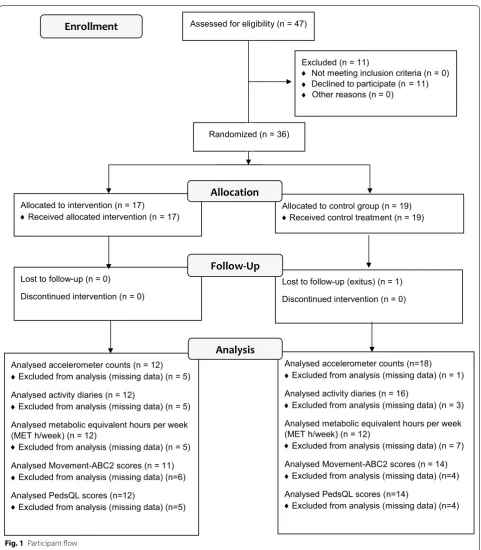
The study was conducted as a randomized controlled trial. Sample size was calculated based on PA measured in accelerometer counts. Mean accelerometer counts at baseline and standard deviation for both groups were set based on the study by Winter et al. [1]. The required sample size was 34 participants (80% power with a 5% significance level). The eligibility criteria for par-ticipants were (1) 3–16 years of age at the time of the diagnosis of acute lymphoblastic leukaemia or other cancer outside the central nervous system, (2) treat-ment included vincristine, and (3) the children were treated in either of the designated hospitals. Participant flow is reported in Fig. 1.
Physical activity was estimated with accelerometers, activity diaries, and two questionnaires. We used Fitbit Ultra (Fitbit Inc., San Francisco, USA) accelerometers. Fitbits were worn on the waist when being awake during the first week of the intervention. The minimum require-ment for daily wear time was 8 h. The follow-up meas-urement was at 1 year. The results are reported as mean activity counts/h (Additional file 1).
Participants filled out activity diary in 10-min peri-ods, for the first week of the intervention. The results are reported as the mean time/day spent on PAs called as “physical activity min/day”. The activity diaries were also used when evaluating the intervention fidelity by calcu-lating how many minutes participants played AVGs. This is reported as “AVG playing min/week” in Table 2.
The metabolic equivalent (MET) questionnaire [13] assessed leisure-time PA in MET h/week pre-test and post-test. The MET questionnaire contained 3 multi-ple-choice questions about PA intensity, duration, and frequency.
Motor performance was estimated using the Movement Assessment Battery for Children-2 (M-ABC2) test [14, 15] pre-test and post-test. The scores are reported in percen-tiles and the higher score indicates better performance.
Fatigue was estimated with PedsQL™
Multidimen-sional Fatigue Scale questionnaire proxy reports [16]. The scores are reported on a scale from 0 to 100. The higher scores indicate lower problems.
Parents filled in the activity diary and questionnaires as a proxy reports of their child for the children below 10 years of age.
Experiences and fidelity of the intervention were exam-ined with an interview. Each child was interviewed after the intervention. The children in the intervention group were asked about their experiences of the intervention and AVGs in order to know how well the intervention was followed. The interview included also a question about PA barriers in the hospital.
Acceptability of the intervention was evaluated based on Bowen et al. [17] and similarly than Nielsen et al. [18] by reporting the participation rate from the eligible patients and by reporting the retention rate of the par-ticipants during follow-up. We also gained information about the acceptability from the interviews.
The baseline characteristics were collected from the electronic patient records.
The intervention was managed by a physical therapist at the hospital ward and via telephone. The intervention included the use of elective Nintendo WiiFit™ games for at least 30 min/day for 8 weeks, both during hospitaliza-tion and at home. The intervenhospitaliza-tion included face-to-face and written information, recommendations for PA, and the education required to use the games with age-specific instructions. In addition, the intervention group received a motivational phone call in the middle of the interven-tion. The control group received general written advice for PA of 30 min/day.
The first intervention meeting or the control interven-tion meeting were at a mean (SD) of 15.4 (13.3) days from the initial diagnosis.
The differences in the changes in scores between groups were compared with Mann–Whitney U-test. Non-parametric tests were used due to the skewed distri-bution of the outcome variables. The statistical computa-tions were performed with SPSS Statistics for Windows 23 (IBM Corp., Armonk, NY). If p-values were less than 0.05 they were considered statistically significant. The interview data were analysed using qualitative content analysis.
Results
The final sample size was 36/47 eligible participants (10 girls; 26 boys, participation rate 77%). The baseline characteristics of the study participants are reported in Table 1.
Physical activity
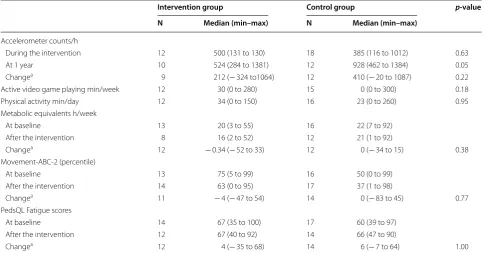
The difference between median (min–max) acceler-ometer counts for the intervention group (n = 12) 500 counts/h (131–1130) and control group (n = 18) 385 counts/h (116–1012) during the first week of the inter-vention was not significant (p = 0.63). Similarly, the dif-ference between median of PA min/day, counted from the PA diary for the intervention group (n = 12) 34 min/ day (0–150) and for the control group (n = 16) 23 min/ day (0–260) was not significant (p = 0.95). The change in accelerometer counts between the first and the fol-low-up measurement did not differ between the groups (p = 0.22) (Table 2).
control group 22 (7–92). The median MET h/week post-test scores were 16 (2–52) for the intervention group and 21 (1–92) for the control group. The change in MET h/week did not differ between the groups (p = 0.38)
(Table 2).
Motor performance
The median (min–max) M-ABC2 pre-test score in the intervention group was 75 (5–99) and post-test 63 (0–95). Median (min–max) M-ABC2 pre-test score for control group was 50 (0–99) and post-test 37 (1–98). At Analysed accelerometer counts (n = 12)
Excluded from analysis (missing data) (n = 5) Analysed activity diaries (n = 12)
Excluded from analysis (missing data) (n = 5) Analysed metabolic equivalent hours per week (MET h/week) (n = 12)
Excluded from analysis (missing data) (n = 5) Analysed Movement-ABC2 scores (n = 11)
Excluded from analysis (missing data) (n=6) Analysed PedsQL scores (n=12)
Excluded from analysis (missing data) (n=5)
Assessed for eligibility (n = 47)
Excluded (n = 11)
Not meeting inclusion criteria (n = 0) Declined to participate (n = 11) Other reasons (n = 0)
Lost to follow-up (n = 0)
Discontinued intervention (n = 0) Allocated to intervention (n = 17)
Received allocated intervention (n = 17)
Lost to follow-up (exitus) (n = 1) Discontinued intervention (n = 0) Allocated to control group (n = 19)
Received control treatment (n = 19)
Allocation
Follow-Up
Enrollment
Analysed accelerometer counts (n=18) Excluded from analysis (missing data) (n = 1) Analysed activity diaries (n = 16)
Excluded from analysis (missing data) (n = 3) Analysed metabolic equivalent hours per week (MET h/week) (n = 12)
Excluded from analysis (missing data) (n = 7) Analysed Movement-ABC2 scores (n = 14)
Excluded from analysis (missing data) (n=4) Analysed PedsQL scores (n=14)
Excluded from analysis (missing data) (n=4)
Analysis
♦ ♦ ♦ ♦ ♦
♦ ♦ ♦ ♦ ♦ ♦
♦ ♦ ♦
♦
Randomized (n = 36)
[image:3.595.58.540.83.634.2]Table 1 The baseline characteristics of the study participants
SR standard risk, IR intermediate risk, HR high risk
Study cohort (n = 36) Intervention group (n = 17) Control group (n = 19)
Age at recruitment (years)
Mean (min–max) 7.8 (3–16) 7.8 (3–16) 7.9 (3–15)
Gender (N, female:male) 10:26 5:12 5:14
Diagnose
Acute lymphocytic leukemia (SR:IR:HR) 17 (8:6:3) 7 (4:2:1) 10 (4:4:2)
Wilms’ tumor 2 2 0
Burkitt lymphoma 3 1 2
Non-Hodgkin lymphoma 5 3 2
Hodgkin lymphoma 3 1 2
Other neoplasm 6 3 3
Vincristine/vinblastine during first 3 months from diagnose (mg/sqm)
Mean (STD) 10.2 (4.2) 10.2 (4.0) 10.1 (4.4)
Min–Max 1.4–17.5 3.3–16.2 1.4–17.5
Physical therapy (visits during the intervention period)
Mean (STD) 3 (2.2) 2.4 (1.6) 3.6 (2.6)
Min–Max 0–9 1–7 0–9
Days admitted (during the intervention period)
Mean (STD) 32.7 (13.6) 30.5 (12.1) 34.7 (14.8)
Min–Max 10–59 12–59 10–57
Hospital visits (during the intervention period)
Mean (STD) 11.2 (7.2) 12.5 (7.4) 10.1 (7.1)
Min–Max 1–35 4–35 1–26
Table 2 Descriptive values of the outcome measures
a Only participants with data at both measurement points were included in the analysis
Intervention group Control group p-value N Median (min–max) N Median (min–max)
Accelerometer counts/h
During the intervention 12 500 (131 to 130) 18 385 (116 to 1012) 0.63
At 1 year 10 524 (284 to 1381) 12 928 (462 to 1384) 0.05
Changea 9 212 (− 324 to1064) 12 410 (− 20 to 1087) 0.22
Active video game playing min/week 12 30 (0 to 280) 15 0 (0 to 300) 0.18
Physical activity min/day 12 34 (0 to 150) 16 23 (0 to 260) 0.95
Metabolic equivalents h/week
At baseline 13 20 (3 to 55) 16 22 (7 to 92)
After the intervention 8 16 (2 to 52) 12 21 (1 to 92)
Changea 12 − 0.34 (− 52 to 33) 12 0 (− 34 to 15) 0.38
Movement-ABC-2 (percentile)
At baseline 13 75 (5 to 99) 16 50 (0 to 99)
After the intervention 14 63 (0 to 95) 17 37 (1 to 98)
Changea 11 − 4 (− 47 to 54) 14 0 (− 83 to 45) 0.77
PedsQL Fatigue scores
At baseline 14 67 (35 to 100) 17 60 (39 to 97)
After the intervention 12 67 (40 to 92) 14 66 (47 to 90)
[image:4.595.57.542.100.408.2] [image:4.595.56.542.460.714.2]pre-test, 8% of the intervention group and 31% of the control group, and at post-test 21% of the intervention group and 29% of the control group had or were at risk of having movement difficulties. The change in M-ABC2 scores between the pre- and post-tests did not differ between the groups (p = 0.77) (Table 2).
Fatigue
The median (min–max) fatigue pre-test scores in the intervention group were 67 (35–100) vs 60 (39–97) in the control group. Post-test fatigue score were 67 (40–92) in the intervention group vs 66 (47–90) in the control group. The change in fatigue scores between the pre- and post-tests did not differ between the groups (p = 1.00) (Table 2).
Intervention experiences
Based on the interviews, most of the participants expe-rienced playing AVGs to be meaningful and enjoy-able. However, some guardians of the youngest children (3 years old) reported that the games were too difficult, and the child lost focus when playing. One guardian told that they did not install the games at home as there was too much going on at the beginning of the treatment. One child told getting bored to the games due to playing them so much. One child would have wanted to continue playing even after the intervention, since enjoyed it so much with friends and family. The most positive experi-ences about the games were reported by primary school-aged children and their guardians. The games were liked specifically when participants were instructed to stay in their own patient room and they felt not having many other possibilities to be active.
Barriers for physical activity during the hospital stays were infusion cannula (lack of ideas how to be active with it), fatigue and lack of space (too little patient rooms and lack of play/exercise area). Being stuck in the patient room or with the infusion lines, were lowering mood which in turn lessened their activity. Participants wished for gym or exercise area (including soccer goals, basket-ball hoops, pedal cars and tractors) on the ward. Older children told they miss organized PA for children with cancer since they could not take part to their own hob-bies which they missed a lot.
Intervention fidelity
Based on the PA diaries 6/12 children in the interven-tion group and 3/15 children in the control group had played AVGs during the first week of the interven-tion. Only one participant in the intervention group reported that he/she had played as instructed (30 min/ day = 210 min/week). The AVG minutes (median) per week per group are reported in the Table 2. Based on
the PA diaries and the interviews, the intervention was not followed as recommended.
Acceptability of the intervention
Based on the participation rate (77%), the intervention was accepted relatively well. Even though we had miss-ing data, no-one of the 36 participants self-wanted to withdraw from the study during the 2.5 year follow-up. Participants in the intervention group were satisfied to get the possibility to play AVGs even though they did not use them in the end as instructed.
Discussion
In the present study, we did not find differences between the intervention and control group in PA, motor performance, or fatigue. However, the interven-tion was not successfully followed, and therefore defi-nite conclusions about the intervention effects cannot be made. The intervention was well accepted based on the study participation and retention rate and mostly enjoyed based on the interviews. Adverse effects were not reported. Our results are partly in discrepancy and partly in line with the earlier findings [19, 20]. Active video gaming has been suggested to improve body coordination in survivors of childhood brain tumors [19] and to be feasible as a part of home-based exer-cise program in paediatric patients after hematopoietic stem cell transplantation [20].
Our intervention was likely to be too early, at least without supervision and personalized guidance, which might be one reason for poor fidelity. Nonetheless, recent evidence is reasoning early PA interventions since Nielsen et al. found 24% reduction at 3 months in physi-cal function in children with ALL [18]. Motivating chil-dren to be physically active from the beginning of the treatment with the existing resources remains a chal-lenge. Every-day personalized guidance to PA might not be possible in many hospitals, and therefore also inde-pendently performed daily activity is important to be promoted. Families might need psychosocial support for PA, and education regarding the benefits of PA during the cancer treatment [8].
Limitations
Limitations of the study include poor fidelity of the inter-vention and problems with data collection. Missing ques-tionnaires and problems with the accelerometer data (devices got lost or the data was erroneous) resulted to data loss. At present, we also acknowledge that the data collection period with the accelerometer and activity dia-ries were too short to gain precise information about the main outcome and the intervention fidelity.
The common challenges with eHealth interventions, the rapid development speed of technology and relatively slow speed of implementing research, were present in our study. When the study protocol was ready and the imple-mentation of the study began, the game console that we used was replaced with a newer one by the manufacturer. Also, those Fitbit accelerometers that we used in our data collection are no longer in production. Despite these challenges, the results and lessons learned from our study may be used in similar studies and in justifying the efforts in PA promotion in children with cancer.
Supplementary information
Supplementary information accompanies this paper at https ://doi. org/10.1186/s1310 4-019-4821-z.
Additional file 1: Figure S1. Individual changes for physical activity (Fitbit step counts) during the intervention and at follow-up measurement at 12 months.
Abbreviations
PA: physical activity; AVG: active video games; M-ABC2: Movement Assessment Battery for Children-2; MET: the metabolic equivalent.
Acknowledgements
We gratefully thank all study participants and their families for taking part in this study. The assistance of the research nurses and physiotherapists in both designated hospitals and the staff of both of the study wards in Turku Univer-sity Hospital and Tampere UniverUniver-sity Hospital are gratefully acknowledged.
Authors’ contributions
LH, LSJ, PML, MA, AA, TV and SS participated in the design of the study. The original manuscript was drafted by LH and reviewed and commented by all authors LH, LSJ, PML, MA, AA, TV and SS. LH and TV conducted the statistical analyses. All authors read and approved the final manuscript.
Funding
The study was funded by the Cancer Society of South-West Finland, TYKS Foundation, and Finnish Association of Physiotherapists. The primary inves-tigator held an UTUGS-funded (University of Turku Graduate School-funded) doctoral training position. The funders had no role in the design of the study, in the data collection, analysis, the interpretation of data or writing the manuscript.
Availability of data and materials
The datasets used and analysed during the current study are available from the corresponding author (LH) on reasonable request.
Ethics approval and consent to participate
The study was approved by the Joint Commission on Ethics of Hospital district of South-West Finland (15.5.2012 § 153), and the research approvals were obtained from both participating institutions (24.9.2012 K66/12 No. 13059
and 21.3.2013 65 § R13030). Research was performed in accordance with the Declaration of Helsinki. All study participants over 6 years of age and their guardians signed a written informed consent. Younger participants gave oral acceptance of their participation and their guardians a written informed consent. Participants could withdraw at any time without the need to justify their decision [21].
Consent for publication Not applicable.
Competing interests
The authors declare that they have no competing interests.
Author details
1 Department of Nursing Science, University of Turku, 20014 Turku, Finland. 2 Turku University Hospital, PL 52, 20521 Turku, Finland. 3 Department of
Pedi-atric and Adolescent Medicine, Turku University Hospital, PL 52, 20521 Turku, Finland. 4 Department of Pediatrics, Tampere University Hospital, PL 2000,
33521 Tampere, Finland. 5 Department of Biostatistics, University of Turku,
20014 Turku, Finland.
Received: 30 April 2019 Accepted: 22 November 2019
References
1. Winter C, Muller C, Brandes M, Brinkmann A, Hoffmann C, Hardes J, et al. Level of activity in children undergoing cancer treatment. Pediatr Blood Cancer. 2009;53(3):438–43.
2. Winter C, Muller C, Hoffmann C, Boos J, Rosenbaum D. Physical activity and childhood cancer. Pediatr Blood Cancer. 2010;54(4):501–10. 3. Green JL, Knight SJ, McCarthy M, De Luca CR. Motor functioning during
and following treatment with chemotherapy for pediatric acute lympho-blastic leukemia. Pediatr Blood Cancer. 2013;60(8):1261–6.
4. Diller L, Chow EJ, Gurney JG, Hudson MM, Kadin-Lottick NS, Kawashima TI, et al. Chronic disease in the childhood cancer survivor study cohort: a review of published findings. J Clin Oncol. 2009;27(14):2339–55. 5. Braam KI, van der Torre P, Takken T, Veening MA, van Dulmen-den Broeder
E, Kaspers GJ. Physical exercise training interventions for children and young adults during and after treatment for childhood cancer. Cochrane Database Syst Rev. 2013;4:CD008796.
6. Mizrahi D, Wakefield CE, Fardell JE, Quinn VF, Lim Q, Clifford BK, et al. Distance-delivered physical activity interventions for childhood cancer survivors: a systematic review and meta-analysis. Crit Rev Oncol Hematol. 2017;118:27–41.
7. Rustler V, Hagerty M, Daeggelmann J, Marjerrison S, Bloch W, Baumann FT. Exercise interventions for patients with pediatric cancer during inpa-tient acute care: a systematic review of literature. Pediatr Blood Cancer. 2017;64(11):e26567. https ://doi.org/10.1002/pbc.26567 .
8. San Juan AF, Wolin K, Lucia A. Physical activity and pediatric cancer survi-vorship. Recent Results Cancer Res. 2011;186:319–47.
9. Martins J, Marques A, Sarmento H, Carreiro Costa F. Adolescents’ perspec-tives on the barriers and facilitators of physical activity: a systematic review of qualitative studies. Health Educ Res. 2015;30(5):742–55. 10. Gotte M, Kesting SV, Winter CC, Rosenbaum D, Boos J. Motor
perfor-mance in children and adolescents with cancer at the end of acute treatment phase. Eur J Pediatr. 2015;174(6):791–9.
11. Ainsworth BE, Haskell WL, Herrmann SD, Meckes N, Bassett DR Jr, Tudor-Locke C, et al. 2011 Compendium of physical activities: a second update of codes and MET values. Med Sci Sports Exerc. 2011;43(8):1575–81. 12. Kauhanen L, Jarvela L, Lahteenmaki PM, Arola M, Heinonen OJ, Axelin
A, et al. Active video games to promote physical activity in children with cancer: a randomized clinical trial with follow-up. BMC Pediatr. 2014;5(14):94.
•fast, convenient online submission
•
thorough peer review by experienced researchers in your field
• rapid publication on acceptance
• support for research data, including large and complex data types
•
gold Open Access which fosters wider collaboration and increased citations maximum visibility for your research: over 100M website views per year
•
At BMC, research is always in progress.
Learn more biomedcentral.com/submissions
Ready to submit your research? Choose BMC and benefit from:
14. Henderson SE, Sugden DA. The movement assessment battery for chil-dren: manual. London: Psychological Corporation; 1992.
15. Henderson SE, Sugden DA, Barnett AL. Movement assessment battery for children. Examiner’s manual, vol. 2. London : Harcourt Assessment; 2007. 16. Varni JW, Burwinkle TM, Katz ER, Meeske K, Dickinson P. The PedsQL in
pediatric cancer: reliability and validity of the pediatric quality of life inventory generic core scales, multidimensional fatigue scale, and cancer module. Cancer. 2002;94(7):2090–106.
17. Bowen DJ, Kreuter M, Spring B, Cofta-Woerpel L, Linnan L, Weiner D, et al. How we design feasibility studies. Am J Prev Med. 2009;36(5):452–7. 18. Nielsen MKF, Christensen JF, Frandsen TL, Thorsteinsson T, Andersen LB,
Christensen KB, et al. Testing physical function in children undergoing intense cancer treatment—a RESPECT feasibility study. Pediatr Blood Cancer. 2018;65(8):e27100.
19. Sabel M, Sjolund A, Broeren J, Arvidsson D, Saury JM, Blomgren K, et al. Active video gaming improves body coordination in survivors of child-hood brain tumours. Disabil Rehabil. 2016;38(21):2073–84.
20. Chamorro-Viña C, Valentín J, Fernández L, González-Vicent M, Pérez-Ruiz M, Lucía A, et al. Influence of a moderate-intensity exercise program on early NK cell immune recovery in pediatric patients after reduced-intensity hematopoietic stem cell transplantation. Integr Cancer Ther. 2017;16(4):464–72.
21. Ministry of Justice. Finland FINLEX® 9.4.1999/488 Medical Research Act 9.4.1999/488. Finland: Edita Publishing Oy; 2010.
Publisher’s Note