Auto-tuning in Molecular Dynamics
Simulations: Efficient Dynamics of Ions
near Polarizable Nanoparticles
Reprints and permission:
sagepub.co.uk/journalsPermissions.nav DOI: 10.1177/ToBeAssigned www.sagepub.com/
JCS Kadupitiya
1, Geoffrey C. Fox
1and Vikram Jadhao
1Abstract
Simulating the dynamics of ions near polarizable nanoparticles (NPs) is extremely challenging due to the need to solve the Poisson equation at every simulation timestep. Recently, a molecular dynamics (MD) method based on a dynamical optimization framework bypassed this obstacle by representing the polarization charge density as virtual dynamic variables, and evolving them in parallel with the physical dynamics of ions. We highlight the computational gains accessible with the integration of machine learning (ML) methods for parameter prediction in MD simulations by demonstrating how they were realized in MD simulations of ions near polarizable NPs. An artificial neural network based regression model was integrated with MD and predicted the optimal simulation timestep and critical parameters characterizing the virtual system on-the-fly with94.3%success. The integration of ML method with hybrid OpenMP/MPI parallelized MD simulations generated accurate dynamics of thousands of ions in the presence of polarizable NPs for over10million steps (with a maximum simulated physical time over30ns) while reducing the computational time from thousands of hours to tens of hours yielding a maximum speedup of≈3from ML-only acceleration and a maximum overall speedup of≈600from ML-hybrid Open/MPI combined method. Extraction of ionic structure in concentrated electrolytes near oil-water emulsions demonstrates the success of the method. The approach can be generalized to select optimal parameters in other molecular dynamics applications and energy minimization problems.
Keywords
Machine Learning, Nanoscale Simulations, Energy Minimization, Hybrid MPI/OpenMP, Parallel Computing, Auto-tuning
1
Introduction
Many biological and synthetic nanoparticle (NP) systems are polarized in the presence of electric fields generated by surrounding ions and other macromolecular charged
species (Levin 2005; Clapham 2007; Abrua et al. 2008).
Examples include proteins and DNA in an aqueous cel-lular medium, emulsions where oil and water are parti-tioned, and gold NPs dispersed in water. Accurate knowl-edge of ionic structure near the surface of these NPs enables the understanding of many nanoscale phenomena associated with these materials such as protein
confor-mational changes (Honig and Nicholls 1995), DNA
pre-cipitation (Raspaud et al. 1998), spontaneous
emulsifica-tion (Sacanna et al. 2007), and nanoparticle self-assembly
(Levin 2005). Extracting this structure by simulating the dynamics of ions in the presence of polarizable NPs using coarse-grained models is challenging due to the need to compute polarization (induced) charges in order to
propa-gate the ion configuration (Allen et al. 2001; Marchi et al.
2001;dos Santos et al. 2011;Fahrenberger et al. 2014). This computation typically involves solving the second-order Poisson differential equation in 3-dimensional space at each simulation timestep, making the use of conventional nanoscale simulation methods very time consuming and inefficient. Because of these computational challenges, the problem of extracting ionic structure near polarizable NPs
has been a subject of intense research (Marchi et al. 2001;
Boda et al. 2004; Allen et al. 2001; dos Santos et al. 2011;
Jadhao et al. 2012,2013;Fahrenberger et al. 2014;Gan et al. 2015;dos Santos and Netz 2018).
The problem is often re-casted in terms of energy minimization for which different candidate functionals and associated minimization methods have been proposed (Marchi et al. 2001; Boda et al. 2004; Allen et al. 2001). Among these techniques, a molecular dynamics (MD) method based on the dynamical optimization of an energy functional enabled the replacement of the expensive solution of the Poisson equation at each simulation step with an on-the-fly computation of surface polarization charges (Jadhao et al. 2012,2013;Jing et al. 2015). The main focus of this paper is to highlight the computational gains accessible by integrating machine learning (ML) methods for parameter auto-tuning in MD simulations by demonstrating how these gains were realized in the MD simulations of ions near polarizable NPs based on the aforementioned dynamical optimization framework.
1Intelligent Systems Engineering, Indiana University, 2805 E. 10th
Street, Bloomington, Indiana 47408, USA
Corresponding author:
Vikram Jadhao, Intelligent Systems Engineering, Indiana University, 2805 E. 10th Street, Bloomington, Indiana 47408, USA
In the dynamical optimization framework, inspired by the Car-Parrinello method for simulating ion-electron systems (Car and Parrinello 1985), an energy functional of the polarization charge density was dynamically optimized resulting in the physical dynamics of ions in parallel with the update of the virtual variables characterizing the polarization (induced) charge density. The virtual system was evolved in a manner that kept the induced charges close to the free-energy minimum (“ground state”) corresponding to the evolving ionic configuration. The advantages associated with the on-the-fly computation of polarization effects in conjunction with the reduction in computational costs achieved by solving for the scalar induced density variable enabled the study of electrolyte ion solutions near polarizable NPs
using this framework (Jadhao et al. 2012; Jing et al. 2015).
However, the applicability of the original method was limited by the absence of a framework that automates the process of selecting the “good” parameters characterizing the virtual system as well as the optimal simulation timestep. These quantities determine the stability, accuracy, and overall efficiency of the dynamical optimization framework and they were found by a tedious process of trial and error that was informed by in-domain experience. Further, these parameters were selected at the start of the simulation and held fixed throughout the simulation, to often relatively conservative values, in order to ensure the long-time stability of the dynamics of ions.
Recent years have witnessed a remarkable growth in the use of ML to enhance computational methods aimed at understanding phenomena in materials science, biology,
neuroscience, and physics (Bart´ok et al. 2017; Ch’ng et al.
2017; Balakrishnan and Puthusserypady 2005; Schoenholz 2018; Liu et al. 2017; Long et al. 2015; Ferguson 2017). ML has been applied to identify interesting parameter
spaces (Spellings and Glotzer 2018), predict parameters
(Balakrishnan and Puthusserypady 2005), update
configura-tions (Botu and Ramprasad 2015), infer assembly landscapes
(Long et al. 2015; Ferguson 2017), and classify phases of
matter (Ch’ng et al. 2017). Inspired by these recent
devel-opments, we describe an approach to integrate ML with MD methods to predict and auto-tune relevant parameters and simulation timestep. This approach is applied to the dynamical optimization framework to predict on-the-fly the virtual system parameters and simulation timestep that keep the polarization charge density close to the ground state determined by the evolving ionic configuration at all times during the simulation. The demonstration of the use of ML to predict and tune the MD simulation timestep has broad applicability. Similarly, we expect that the idea of using ML for predicting virtual system parameters can be extended to enhance the original Car-Parrinello molecular dynamics
techniques (Car and Parrinello 1985) for simulating
ion-electron systems.
The use of ML to enhance the performance of the dynamical optimization framework is demonstrated using anO(n2)
algorithm to propagate the dynamics of ions and virtual system variables that is accelerated by implementing a hybrid OpenMP/MPI parallelization approach to reduce the computing time associated with the evaluation of the forces and energies. The target applications of the framework are systems where the effects of NP surface charge and
ion correlations typically lead to ion distributions that reach constant bulk value within a few nanometers of the NP surface such that a comprehensive study of ion densities near NP surfaces can be performed by including thousands of ions in a large simulation cell with reflective boundaries (dos Santos et al. 2011; Messina 2002; Boda et al. 2004). Many synthetic and biological systems including oil-water emulsions, gold nanoparticles (1 - 10 nm in diameter), and globular proteins exhibit this scenario, and ion distributions
in these systems have been analyzed using O(n2)
methods
that are competitive with O(nlogn) methods for these
moderately-sized systems (Allen et al. 2001; Boda et al.
2004; dos Santos et al. 2011;Messina 2002; Hatlo and Lue 2008; Jadhao et al. 2012). Further, attempts to ameliorate
this scaling via the use of Ewald sums (Deserno and Holm
1998) or multigrid methods (Sagui and Darden 2001) would
introduce more variables and parameters into the system making the assessment of the coupling of the ML-enabled parameter selection process with the simulation of ions and virtual system difficult. The use of such methods is thus avoided in this first study of developing ML-based enhancements for the treatment of polarizability effects in ionic soft-matter simulations; future work will include integrating this approach with fast Ewald solvers for incorporating long-range effects.
As we discuss later in the results section, the ML-enhanced dynamical optimization framework leads to an increase in both the efficiency and stability of the associated MD simulations, while retaining the accuracy of the unautomated, non-adaptive framework. This combination of ML and parallel computing in the context of nanoscale simulation of ions is the first of its kind and paves the way for employing the simulation framework for developing online applications for web-based platforms like nanoHUB (Klimeck et al. 2008), where the user interacts with the simulation software under limited interaction with the developer and/or in-domain expert. An application that simulates the self-assembly of ions near polarizable NPs by employing the unique features of this framework was
recently deployed on the nanoHUB cloud (Kadupitiya et al.
2018). As is evident by the use of ML in numerous
commercial platforms, scientific simulation workflow and software applications will increasingly employ an ML layer in the future. Understanding the integration of ML in scientific applications is thus critical; the work presented here contributes towards this goal.
2
Background and Related Work
2.1
Model and the Energy Functional
The problem of evaluating polarization effects in simu-lation of charged systems has been extensively explored by several research groups using different approaches (Marchi et al. 2001;dos Santos et al. 2011;Boda et al. 2004;
Tyagi et al. 2010; Barros et al. 2014; Gan and Xu 2011;
Jadhao et al. 2012; Wynveen and Bresme 2006;Allen et al.
2001). Explicit simulation of solvent (environment) and
NPs is possible (Wynveen and Bresme 2006) using advanced
computational techniques such as fast multipole methods and
local electrostatics algorithms (Rottler and Maggs 2004); the
ion dynamics at the molecular scaleBeckstein et al.(2004). However, many phenomena can not be suitably investigated using fully atomistic models due to the prohibitively large number of degrees of freedom associated with such systems. This has led to the study of coarse-grained models that treat ions explicitly but replace the molecular structure of the solvent and the NP with continuous dielectric environments. Systems where the different material parts are adequately captured by piecewise-uniform dielectric permittivities (e.g. NP and solvent, protein and cellular medium) have attracted
particular attention (Allen et al. 2001; Boda et al. 2004;
dos Santos et al. 2011; Xu 2013; Jadhao et al. 2012,2013;
Barros and Luijten 2014;Tyagi et al. 2010). For these model systems, solving for the polarization (induced) charge den-sity reduces the computational costs because the unknown induced charge density resides only on the two-dimensional interface (boundary) between the NP and the surrounding medium. We work with such a coarse-grained model.
The dynamical optimization framework for extracting ion distributions from simulations of the coarse-grained model that treats the solvent and NP as dielectric continua is based on the true energy functional of induced charge density introduced inJadhao et al.(2012):
F[ω] =1
2 Z Z
ρrGr,r′(ρr′+ Ωr′[ω]) dr′dr
−1
2 Z Z
Ωr[ω]Gr,r′(ωr′−Ωr′[ω]) dr′dr, (1)
where ρ and ω are the ion and induced charge densities
respectively. The functionG(r,r′) =|r−r′|−1is the bare
Green’s function andΩis given by
Ωr[ω] =∇ ·
χr∇ Z
(ρr′+ωr′) dr′
, (2)
where χ(r) is the dielectric susceptibility. χ(r) is related
to the spatially-varying dielectric permittivity ǫ(r) via the
relationǫ= 1 + 4πχ. The minimization ofF[ω]leads to the
equation:
ω= Ω. (3)
Solving this equation is equivalent to solving the Poisson equation; its solution produces the correct induced density (Jadhao et al. 2012,2013). At its minimum,F[ω]evaluates
to the true electrostatic energy of the system. These features
allowF[ω]to be optimized dynamically as the ions move to
their new positions.
The functionalF[ω]can be transformed into a functional
of only the surface (two-dimensional) induced charge density for the case of polarizable NP in a solvent where the NP and the solvent are modeled as materials of different,
but uniform, permittivities (Jadhao et al. 2012, 2013). The
discretized form of this transformed functional obtained by
meshing the NP surface intoM finite elements is given as:
F[{ωk}] = 1
2 N X
i=1
N X
j6=i
qiK
◦◦
ri,rjqj+ 1 2
N X
i=1
M X
k=1 qiK
◦•
ri,skωkak
+1 2
M X
k=1
M X
l=1 ωkK
••
sk,slωlakal, (4)
whereωk,sk, andak are, respectively, the induced charge,
position vector, and area associated with the kth finite
element. Here, N is the total number of ions, and qi
and ri are the charge and position vector of the ith ion
respectively. The termsK◦◦,K◦•, andK•• in (4) are the effective potentials of interaction between two ions, between an ion and an induced charge, and between two induced charges; explicit expressions of these functions can be found in the
original papers (Jadhao et al. 2012, 2013). F[{ωk}] can
be minimized dynamically using MD methods that treat the induced charges on the surface as dynamic variables; the details of this dynamical optimization framework are
provided in Section3.
2.2
Nanoscale Simulation of Ions near
Polarizable Materials
We review the techniques of computing ion distributions in systems described by the coarse-grained model of ions near NP-solvent dielectric interface separating NP and solvent that exhibit different (but uniform) dielectric response (permittivities) (Boda et al. 2004;Tyagi et al. 2010;
Allen et al. 2001; Barros et al. 2014; Jadhao et al. 2012,
2013;Jing et al. 2015), focusing on methods that are broadly applicable and are not limited by the choice of NP geometry or dielectric permittivity profile.
We first outline the methods based on variational approaches to the problem of evaluating the polarization effects as these techniques are most closely related to the work presented here. In this approach, one transforms the original problem of solving the Poisson differential equation into an optimization problem. A variety of functionals employing various electrostatic quantities as field variables have been proposed to formulate the variational optimization
problem (Jackson 1999; Marcus 1956; Felderhof 1977;
Reiner and Radke 1990;York and Karplus 1999;Allen et al. 2001;Attard 2003;Rottler and Maggs 2004;Lipparini et al. 2010; Villasenor and Buneman 1992; Nakano et al. 1994).
Allen et al.(2001) performed an explicit (static) optimization of a functional of the induced surface charge density
ω(s) at each MD step to solve the Poisson equation and
propagate ions. Marchi et al. (2001) worked with a true
energy functional of the polarization vector and implemented a dynamical optimization framework to propagate ion dynamics in parallel with the evaluation of polarization vector fields. However, the choice of the polarization vector as the variable field needed a three-dimensional specification leading to increased computational costs that can be avoided by choosingω(s)as the variable to solve for.
Another class of methods for computing ω(s) involves
transforming the problem into a matrix formulation; examples include the induced charge computation (ICC)
methods (Boda et al. 2004), which use matrix inversions
to solve for ω(s). Evaluating matrix inversion involves
O(M3)
calculations where M is the number of surface
mesh elements. Techniques to improve upon this scaling
have been subsequently developed (Tyagi et al. 2010).
Alternatively, iterative methods to solve the matrix equation
have been proposed (Barros and Luijten 2014). In particular,
the generalized minimum residual method solves the matrix equation without explicitly constructing the inverse matrix
and yields a converged result for ω(s) at each simulation
The evaluation ofω(s)in all the above approaches needs the ionic configuration to be static and requires considerable computational effort, whether in the form of matrix inversions or convergence of the iterative optimization steps, at each simulation step to guarantee the overall stability of
the simulation. In Section 3, we present the details of a
recently developed dynamical optimization framework that
enables the simultaneous (on-the-fly) updates ofω(s)and the
ionic configuration in the same simulation step.
2.3
Parameter Prediction using Machine
Learning
Machine Learning (ML) abstractions for parameter predic-tion and tuning have been extensively employed in the performance enhancement of bigdata or deep learning
frame-works. Denil et al. (2013) used ANN and convolutional
deep learning NN to predict the parameters found in image classification tasks. The ANN was able to obtain an
accu-racy of 95%. Yigitbasi et al. (2013) employed ML-based
auto-tuning for diverse MapReduce applications and cluster configurations in Hadoop framework. Their work showed that support vector regression exhibits good accuracy while being computationally efficient for performance modeling of MapReduce applications.
ML methods have been increasingly employed in predict-ing parameters and classifypredict-ing properties associated with
physical systems (Spellings and Glotzer 2018; Schoenholz
2018; Liu et al. 2017; Morningstar and Melko 2017;
Ch’ng et al. 2017;Behler 2016;Botu and Ramprasad 2015;
Long et al. 2015; Ferguson 2017). Spellings and Glotzer
(2018) applied a simple feedforward artificial neural network
(ANN) to discover interesting areas of parameter space corresponding to crystal formation in the self-assembly of
colloidal building blocks.Balakrishnan and Puthusserypady
(2005) proposed a fast and simple prediction method for
two class Brain-Computer Interface (BCI) simulations using ANN and identified this method as the best ML approach for brain image classification.
In addition to classification based approaches, regression based prediction schemes have been employed in different
domain areas (Eng et al. 2014; Kazemi and Sullivan
2014; Cherkassky and Ma 2004; Chen and Yu 2014;
Balachandran et al. 2016; Quan et al. 2014; Yadav et al. 2016). Eng et al. (2014) used random forest regression algorithm to predict host tropism of influenza A virus
proteins with an accuracy above 96%. Similarly, ensemble
of regression trees were employed to perform face alignment for real-time applications (in one millisecond) by
Kazemi and Sullivan(2014). Support vector machine based regression (SVR) has been used for wind speed prediction by Chen and Yu (2014). Balachandran et al. (2016) have also used SVR to create an adaptive ML model to aid the design of a new materials with desired elastic properties and enhanced long-term performance using minimum number of iterations. ANN based regression has been studied by
Quan et al. (2014) to yield short term load prediction of electrical power systems based on wind power forecasting.
Yadav et al. (2016) have employed ANN based regression for forecasting solar radiation.
Recent research has also focused on exploring ML based approaches to generate trajectories (configurations) in MD and Monte Carlo simulations in order to enhance the
performance of the respective methods.Botu and Ramprasad
(2015) employed kernel ridge regression (KRR) to accelerate
the ab initio MD method for nuclei-electron systems by learning the selection of probable configurations in MD
simulations (Botu and Ramprasad 2015). (Liu et al. 2017)
employed an ANN to select efficient updates for Monte Carlo simulations of classical Ising spin models.
These explorations have inspired us to use ML to predict virtual system parameters and design an adaptive framework that updates the simulation timestep and auto-tunes the virtual parameters characterizing the dynamics of ions near polarizable NPs to yield a more stable and efficient MD simulation. Related work in the area of adapting timestep in a simulation has largely focused on using analytical approaches to multiple time step integration (Luehr et al. 2014;Tuckerman et al. 1992). Recent work has also focused on adaptive ensemble simulations to enhance the computational efficiency of biomolecular simulations
Kasson and Jha (2018). We also note that the development of autotuning technology for high-performance applications, which involves automatic generation of a search space of possible kernels for a computational task to identify the best possible kernel, has been extensively explored to reduce execution time and enhance programmer productivity (Whaley and Dongarra 1998), with recent work involving the use of ML-based approaches for identifying the search
space (Balaprakash et al. 2018). In Section 4, we describe
the results of our experiments with different regression-based ML models to identify and tune optimal virtual parameters for the dynamical optimization framework.
3
Dynamical Optimization Framework for
Simulating Ions near Polarizable NPs
In this section, we provide the details of the dynamical optimization framework for simulating ions in the presence of polarizable NPs. This framework uses Car-Parrinello
molecular dynamics (CPMD) technique (Car and Parrinello
1985; Fois et al. 1993) to dynamically optimize an energy functional of the polarization charge density which results in the propagation of the ionic configuration in tandem with
an accurate update of the polarization charges (Jadhao et al.
2012, 2013). These details will help clarify the use of the
ML-based enhancement strategies outlined in Section4.
3.1
Extended Lagrangian, Equations of
Motion and CPMD Simulation
To implement the dynamical optimization of F[{ωk}],
the induced charges {ωk} are treated as dynamic virtual
variables. A fictitious kinetic energy is associated with this virtual system:
K =
M X
k=1
1 2µkω˙
2
k, (5)
where µk is the mass of thekth virtual variable (ωk). The
extended Lagrangian L with F[{ωk}] as its electrostatic
additional term:
L=K +
N X
i=1
1 2mir˙
2
i −F[{ωk}]−H[{ri}]. (6)
In (6), the second term is the usual total kinetic energy
associated with N ions (physical system), with mi being
the mass of the ith
ion. The final term contains a set of Lennard-Jones potentials to model the ion-ion and ion-NP steric interactions. Note thatF[{ωk}] ≡F[{ωk},{ri}] is also a function of the set of ion positions{ri}.
The Lagrangian L yields the following Euler-Lagrange
equations of motion:
mi¨ri=−∇riF[{ωk},{ri}], (7)
µkω¨k =−∇ωkF[{ωk},{ri}], (8)
for the ith
ion and the kth
induced charge, respectively. These equations are used to evolve the induced charge
configurationon the flyusing the CPMD method. Following
(7), each ion is moved by the force−∇riF[{ωk};ri]in a
timestep∆during which each induced charge is updated via
theforce−∇ωkF[{ωk};ri]following (8). To simulate the
behavior of the ions at temperatureT, the extended system
of ions and the virtual variables is coupled to a set of Nos´ e-Hoover thermostats (this coupling modifies the equations of
motion (7) and (8) similar to a canonical MD routine). This
two-temperature approach is a standard feature of CPMD (Sprik 1991; Bl¨ochl and Parrinello 1992; Fois et al. 1993).
The ions couple to a thermostat at temperatureT, while the
virtual system is coupled to one atTv.
Velocity-Verlet algorithm is used to generate the dynamics of the extended system. The dynamics is associated with a conserved quantity, the total energy of the extended system,
that can be derived from the LagrangianL:
E =
N X
i=1
1 2mir˙
2
i +K +F[{ωk}] +H[ri] +T +Tv. (9)
Here, T and Tv are the energy terms associated with the
thermostats controlling the temperature of the physical and
virtual systems respectively. The extended energy andK are
monitored at periodic intervals during a CPMD simulation to assess the stability and accuracy of the simulation.
Virtual masses µk are chosen to be proportional to the
areas of the mesh points. The value of the proportionality
constantµdepends on the attributes of the physical system
(e.g., NP charge, dielectric profile, ion valencies) as well
as the simulation timestep ∆. The parameters Tv and µ
are optimized to ensure the stability and accuracy of the
simulation (see Section3.3); further technical details of the
method can be found inJadhao et al.(2012).
3.2
OpenMP/MPI Hybrid Parallelization
A system with N ions near an unpolarizable NP surface
effectively translates into a system with M additional
dynamical variables in the case of a polarizable NP within the dynamical optimization framework. Due to the long-range nature of the electrostatic interaction, the
associated computational costs scale roughly as O((N+
M)2
), with a prefactor that can be large owing to the
complexity of the terms involved in the expressions for forces derived fromF[{ωk}]. Indeed, performance profiling
report generated using Performance Counters for Linux (PERF) showed that the sequential program spends the
largest amount of computation time (64.33% of the total)
calculating the forces between the ions for each step of the simulation. To reduce the computing time associated with the evaluation of these forces and enhance the performance of the simulation framework, a hybrid OpenMP/MPI parallel programming model is adopted. The hybrid model has advantages over pure MPI or pure OpenMP, when cache performance is taken into consideration. This strategy provides non-uniform memory access (NUMA) traffic and
inter-node communication (Rabenseifner et al. 2009) to
support maximum access locality and minimum number of cache misses. We note that the simulations associated with the dynamical optimization framework presented in the previous publications employed the OpenMP (shared memory) parallelization model, and consequently, were
limited in their application scope (Jadhao et al. 2012,2013;
[image:5.595.302.547.324.668.2]Jing et al. 2015).
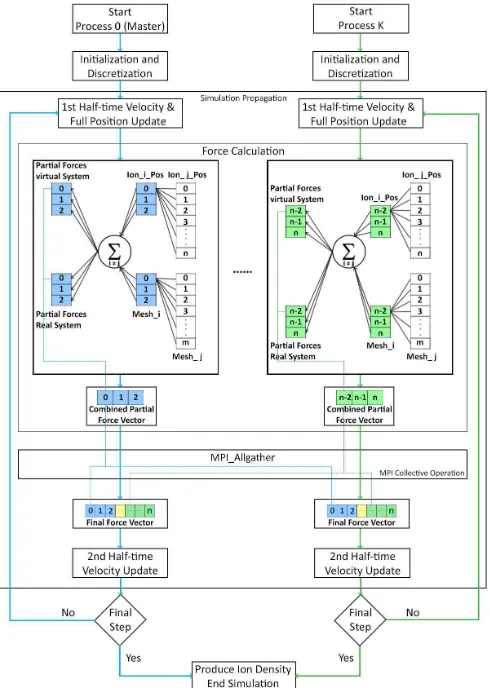
Figure 1. Distributed and shared memory parallelization
approach with MPI and OpenMP. Hybrid parallelization is implemented inside the Force Calculation block.
The hybrid masteronly model is implemented by combining the distributed memory MPI approach and
the shared memory OpenMP approach (Rabenseifner et al.
2009), and is applied to the force and energy calculation
-400 -300 -200 -100 0 100 200 300 400
0 2×10⁶ 4×10⁶ 6×10⁶ 8×10⁶ 1×10⁷
Energy (k
B
T)
Simulation Steps
Extended Kinetic (physical) Potential Kinetic (virtual)
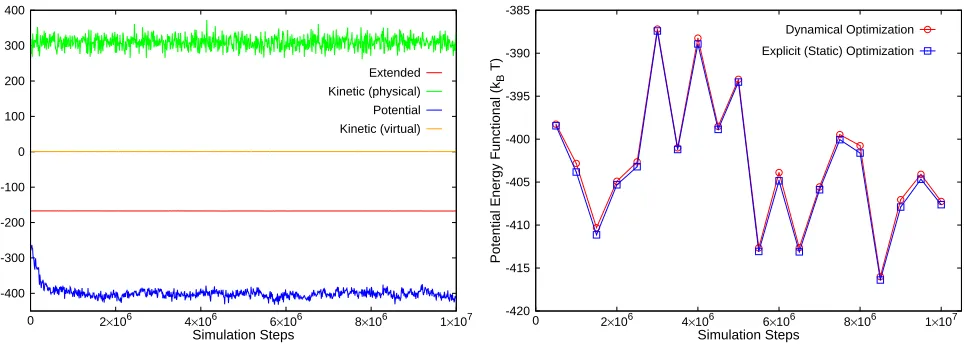
Figure 2. Energy profiles of 206 ions near a polarizable NP
(whose surface is meshed with 1082 grid points). Data is shown for≈10nanoseconds (10 million simulation steps) of
simulation time. Conservation of the extended (total) energy and≈0value for the virtual kinetic energy highlight the first key
feature of the dynamical optimization framework.
model uses one MPI process per node and OpenMP on the cores of the node, with no MPI calls inside the parallel regions. The domain decomposition is enabled under a two-level mechanism. On the MPI level, a coarse-grained domain decomposition is performed using boundary
conditions as explained in Fig. 1. The second level of
domain decomposition is achieved through OpenMP loop level parallelization inside each MPI process.
3.3
Key Framework Features
We identify two key features of the dynamical optimization framework that encode the accuracy and stability of the simulation, and guide the process of designing the ML-based
enhancement strategies presented in Section4. The first key
feature is the conservation of the extended energyE, given
by Eq. (9), and the approximate conservation of the energy
of the physical system that is captured by demanding that the kinetic energy of the virtual system nearly vanishes:
K ≈0. (10)
In other words, the framework ensures that the physical system remains unaffected as much as possible by the presence of virtual system.
The energy profiles of a typical, successful CPMD simulation of ions near a polarizable, spherical NP at room
temperature are shown in Fig.2: the extended energyE is
constant and the total fictitious kinetic energy stays stable
and close to 0 throughout the entire simulation run (for≈10
ns). In practice, this feature is incorporated in the simulation
by appropriately choosing values of simulation timestep∆,
virtual variable massµ, and the virtual system temperature
Tv ≪T (Tv≈0). These parameters are selected to control
large, abrupt rise in the kinetic energy associated with the virtual system as the simulation progresses.
This feature is encoded in the quantityRwhich measures
the ratio of the fluctuations in E and the fluctuations in
the kinetic energy of the physical system. R determines
the stability and accuracy of the simulation. For good
-420 -415 -410 -405 -400 -395 -390 -385
0 2×10⁶ 4×10⁶ 6×10⁶ 8×10⁶ 1×10⁷
Potential Energy Functional (k
B
T)
Simulation Steps
[image:6.595.57.541.56.228.2]Dynamical Optimization Explicit (Static) Optimization
Figure 3. Comparison of the functional optimized dynamically
(circles) and the functional optimized at regular intervals keeping the ionic configuration static during the optimization process (squares). Results are shown for the same system as in Fig.2. The matching of the two functionals illustrates the second key feature of the framework: the accurate tracking of the induced charge density.
energy conservation (constant E), it is demanded that the
simulations satisfy the condition R <0.05 as noted in
the literature (Marchi et al. 2001). The latter inequality
implicitly satisfies the requirement that K is kept close to
the value dictated by the low temperatureTv.
The second important feature considers the effectiveness of the framework to reproduce the induced charge distribution accurately at each simulation time step. At regular intervals during the course of the simulation, the ion coordinates and induced charge densities on the NP surface are stored. Then, an ordinary (static) minimization
of the functional F is carried out to explicitly determine
the (numerically) exact induced density. The tracking of the induced density distributions on the NP surface can
be assessed by evaluating the matching of F optimized
on the fly with the electrostatic energy value obtained by
optimizing the functional explicitly; Fig.3. This functional
matching is the second key feature. In practice, we compute
the functional deviation, fd, which measures the average
difference between the dynamically optimized functional
F and the energy functional obtained via direct (static)
minimization. To pass the test of stability and accuracy, we enforce|fd|<1%.
Randfdare central to the success of the simulations based
on this framework and determine the associated “good”
virtual system parameters µ and Tv. In general, higher µ
leads to better energy conservation and lower R, while
lower Tv keeps the virtual system from excessive heating
and generates lower fd. Having just these two features
biases the prediction ofµ(Tv) towards higher (lower) values
for a system of ions characterized with a generic input
parameter pattern. Very high values of µ and/or very low
values ofTvcan affect the overall stability of the simulation
the stability of the simulation and bias the selection of the virtual parameters towards those picked by a domain
expert, another quantity, Rv is introduced. Rv is the ratio
of the fluctuations inE and the fluctuations inK. Lower
Rv implies that fluctuations in K (that can arise from
lower virtual mass µ or higher Tv) are sufficiently strong
to endow the virtual system with the necessary dynamics
to adapt to the evolving ionic system. Unlike R and fd
that exhibit universal bounds informed by the physical
dynamics of ions, the bound onRv depends on the set of
systems investigated, and is informed largely by past domain experience. For counterion-only systems used as training
set for the ML-based methods,Rv<0.15 is enforced. For
systems characterized with electrolytes that are expected to exhibit a greater number of ions (with both positive and
negative valencies),Rvcan assume larger values depending
on the salt concentration.
Quantities R, fd, and Rv determine the choice of
the optimal virtual parameters. However, these quantities and the success of the simulation depend critically on
another important parameter: the simulation timestep ∆.
The simulation timestep in the CPMD-based dynamical optimization framework depends on both the physical and
virtual system parameters, the latter being unknowna priori.
Conversely, the optimal values of virtual parameters (µ,Tv)
that ensure a long-time stable simulation are dependent on
∆. This complicates the process for choosing a reliable, yet
efficient, value for∆,µ, andTv and one typically chooses
a conservative ∆ that is smaller than the value used in
conventional MD simulations (∆≈1−5femtoseconds for
an MD simulation of monovalent electrolyte ions in water at room temperature).
4
ML-based Enhancement of the
[image:7.595.50.294.482.581.2]Dynamical Optimization Framework
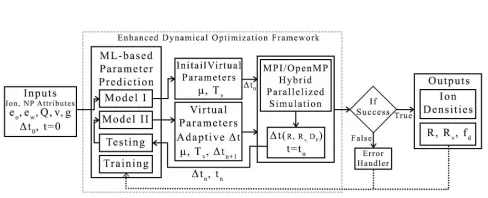
Figure 4. System overview of the enhanced dynamical
optimization framework.
We now describe an ML-based procedure to increase the efficiency and improve the stability of the dynamical optimization framework while retaining the simulation accuracy. We present an ML technique that uses the
aforementioned key features encoded in quantities R, fd,
and Rv to enhance the performance of the dynamical
optimization framework by 1) predicting and auto-tuning the
optimal virtual parameters µ and Tv, and 2) adapting the
timestep to the largest allowable value during the simulation. The ML technique is combined with MPI/OpenMP Hybrid
parallel programming model, described in Section3, to carry
out the simulation.
Figure4shows the overview of the enhanced framework.
ML-based parameter prediction was implemented using two
ML models (ML model I and II). First, the ion and NP
model attributes, as well as the initial timestep ∆ = ∆t0,
were fed to ML model I to predict the initial virtual system
parameters µ and Tv. The predicted parameters and ∆t0
were used to start the simulation that was parallelized using the MPI/OpenMP hybrid programming model. At
intermediate times tn during the simulation, ML model II
was used to predict the new timestep∆tn+1and associated
virtual parameters that continue the simulation for the subsequent time block(tn, tn+1). The ion distributions near the polarizable NP were sampled during the simulation run and the ion densities were stored as simulation output. ML model II also checks if the simulation is successful up to that point in time before dynamically tuning the parameters for next iterations to come. If simulation had failed due to
imposedR,fd, andRvcriteria, program will abort and call
the error handler to display appropriate error messages. In addition, during the simulation, the quantitiesR,fd, andRv
were computed and saved as output for retraining both ML models after a set number of simulation runs are executed. For every 1000 new simulation runs, both models were retrained.
After reviewing and experimenting with many ML techniques for parameter tuning and prediction including polynomial regression, support vector regression (SVR), decision tree regression, and random forest regression
(Section 2.3 and Section 5.1), the artificial neural
network (ANN) was adopted for enhancing the dynamical
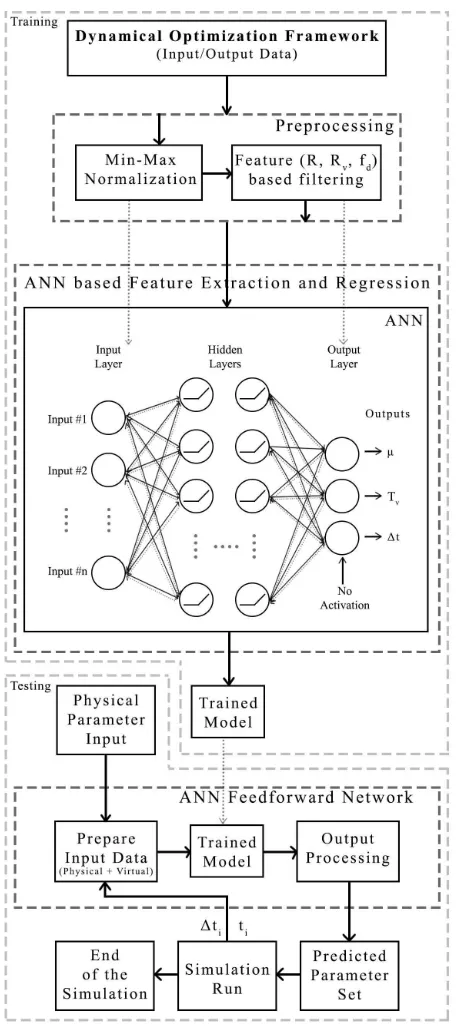
optimization framework. Figure 5 shows the details of the
ANN-based ML model II employed to predict the virtual system parameters and the adaptive timestep for simulations based on the framework; the ANN was trained to select
the largest allowable ∆ that satisfies the tests of stability
and accuracy encoded in the ML features. ML model I exhibits a similar process but is trained without the time and timestep parameters. The data preparation and preprocessing techniques, feature extraction and regression techniques as well as their validation for both models are discussed below.
4.1
Data Preparation and Preprocessing
Counterion-only systems (no added electrolyte) were considered for generating the training set. The polarization effects are expected to be strongest in these systems as added electrolyte screens the ion-NP electrostatic interactions. Further, counterion-only systems are relatively smaller and enable a broader exploration of parameter space to train the ML models. Interestingly, as we discuss later, results from counterion-only systems were employed to successfully extract and infer ionic distributions associated
with electrolyte systems for up to O(0.1)M concentration,
exhibiting the transfer learning aspects of the ML-based procedure employed.
Prior domain experience and backward elimination using the adjusted R squared was considered for creating the training data set. Using this process, 5 input parameters that significantly affect the polarization charges on the
NP surface were identified: NP permittivity ǫNP, solvent
permittivity ǫS, NP charge Q, counterion valency v, and
NP mesh size M. While the temperature of the physical
Figure 5. ML procedure (model II) for determining the parameters of the virtual system and the adaptive timestep defined in the dynamical optimization framework.
this initial study, these were considered fixed; NP diameter
was taken to be ≈7.5 times the ion diameter ( ≈
0.35 nanometers), and temperature was fixed at 298 K.
Despite the aforementioned potential for transfer learning associated with the ML procedure, additional parameters such as salt concentration and co-ion attributes should be included in the training set to predict the optimal parameters associated with the simulation of electrolyte systems; future work will explore the training with these additional input
parameters. Virtual parameter mass µ and virtual system
temperatureTvwere selected as the output parameters. Few
discrete values for each of the input/output parameters were experimented with and swept over to create and run 13600
simulations for training the ML model I. The range for different ionic system parameters were selected based on physically meaningful and experimentally-relevant values: ǫNP ∈(2,160);ǫs∈(2,160);Q∈(−20,−100);v∈1,2,3.
For the mesh size and the virtual system parameters, the range were chosen based on previous trial and error
procedure:M ∈(132,1692),µwas swept from 1 to 40 using
random discrete values to cover the range, andTvwas swept
from 0.001 to 0.005. All the simulations were performed for
≈1nanoseconds.
To support on-the-fly tuning of∆and associated selection
of µ, Tv during the simulation, ML model II was trained
with two additional parameters. Simulation time t≡tn
and timestep ∆≡∆tn+1 were added as input and output
parameters respectively to the system parameters explored
in ML model I. 20 discrete simulation time values tn ≈
0.1,0.2, . . . ,2 ns, and 4 discrete timestep values ∆ = 0.001,0.002,0.003,0.004, were swept to generate 54400 simulation configurations.
As described in Section 3.3, R, fd, and Rv encode the
key features of energy conservation and accurate tracking of the induced charges that measure the success of the dynamical optimization framework. Acceptable threshold
values 0.05, 1 percent, and 0.15 were identified for R,fd,
and Rv respectively for the range of systems included in
the training set. These quantities were treated as output features to filter the datasets to only keep the input parameter configurations resulting in successful simulation runs. From the data set for initial parameter prediction, 4530 input/output configurations were selected as successful. From the data set for adaptive timestep prediction, 15640 input/output configurations were selected. Each of these datasets were separated as training and testing using a ratio
of 0.7:0.3. Min−max normalization filter was applied to
normalize the input data in the data preprocessing stage.
4.2
Feature extraction and Regression
The ANN algorithm with two hidden layers (Fig. 5) was
implemented in Python for regression of two continuous variables in ML model I, and for regression of three continuous variables in ML model II. In both models, outputs
of the hidden layers were wrapped with therelufunction; the
latter was found to converge faster compared to the sigmoid function. No wrapping functions were used in the output layers of the algorithm.
By performing a grid search, hyper-parameters such as the number of first hidden layer units, second hidden layer units, batch size, and number of epochs were optimized to 13, 8, 25, and 150 respectively. Adam optimizer was used as the back propagation algorithm. The weights in the hidden layers and in the output layer were initialized to random values using a normal distribution at the beginning. The mean square loss function was used for error calculation in both ML models. To stop overtraining the network, a drop out mechanism for hidden layer neurons during the training time was employed. ANN implementation, training and testing was programmed
with the aid of keras and sklearn ML libraries (Chollet et al.
5
Results and Discussion
5.1
Initial Virtual Parameter Prediction
Several regression models were implemented and tested to
predict the initial virtual parametersµandTv. These models
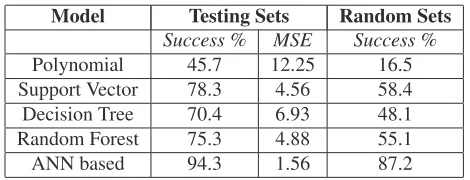
were tested on 1359 input parameter sets comprising of values within the range for which the models were trained for. Additionally, the models were tested on 450 completely random input sets of parameters selected without any range
restrictions. Table1shows the success rate and mean square
error for testing data sets as well as random input data
sets. Success rate was calculated based onR, fd, andRv.
Reported mean square error (MSE) values are calculated
using k-fold cross-validation techniques withk = 10. ANN
based regression model was able to predict the initial virtual
system parameters correctly with94.3%success rate (MSE
of 1.56), outperforming other non-linear regression models
as evident from the Table1. ANN based regression model
[image:9.595.53.288.347.437.2]was also able to achieve success rate of 87.2 on completely random input parameters. This ANN based regression model was adopted as ML model I.
Table 1. Comparison of the regression models for initial virtual
parameter prediction (numbers are percentages)
Model Testing Sets Random Sets
Success % MSE Success %
Polynomial 45.7 12.25 16.5
Support Vector 78.3 4.56 58.4
Decision Tree 70.4 6.93 48.1
Random Forest 75.3 4.88 55.1
ANN based 94.3 1.56 87.2
Table2shows the predictedµandTvfor selected systems
along with the quantities R, fd, and Rv that characterize
the key features of the framework, energy conservation and tracking of induced charges, that determine the accuracy and
stability of the simulation. The predictedµ andTv values
produced stable dynamics of ions near polarizable NP as
evidenced by the values ofR, Rv, and fd that lie within
allowed ranges (R <0.05,|fd|<1%,Rv<0.15).
Table 2. Predicted parameters by ML model I and simulation
accuracy and stability
Inputs Prediction Results
ǫNP,ǫS,Q, v µ Tv R fd Rv
2, 10, -60, 1 9 0.001 0.001 -0.01 0.12
2, 78.5, -30, 3 7 0.002 0.003 -0.6 0.13
50, 78.5, -60, 2 18 0.001 0.001 -0.4 0.06
80, 160, -90, 3 30 0.002 0.002 -0.7 0.09
100, 120, 30, 2 36 0.005 0.002 -0.1 0.10
5, 71, -24, 2 42 0.001 0.007 -0.6 0.13
44, 37, -114, 1 38 0.006 0.002 -0.11 0.11
30, 35, -108, 3 43 0.007 0.002 -0.12 0.05
15, 78, -102, 1 17 0.025 0.005 -0.27 0.11
We note that when the ANN was trained utilizing only
R and fd quantities, higher µ and lower Tv values were
predicted as expected from the arguments presented in
Section3.3. These virtual parameter choices are not optimal
for the stability of the simulation and will not be picked
by the experienced, in-domain expert. Inclusion of Rv as
another feature for training the model enabled the ANN to predict the virtual system parameters that were likely to enhance the stability of the simulation and be selected by a domain expert.
5.2
Auto-tuning CPMD Simulation Parameters
Similar to ML model I, ML model II employed the ANN based regression model trained with two additional
parameters: simulation timestep ∆ and timet. This model
was trained to select the largest allowed∆and auto-update
the associated optimal virtual parametersµ, Tvattnfor the
simulation during the interval (tn, tn+1) based on the ML
output featuresR, fd, andRvcomputed in the previous time
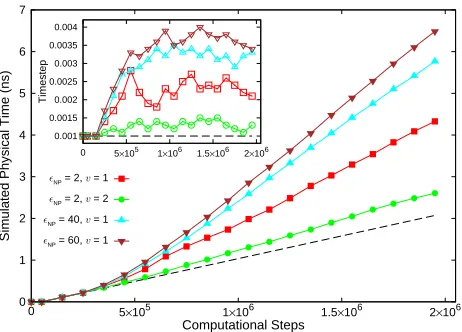
interval (tn−1, tn). Figure 6 illustrates the computational
gains resulting from the auto-tuning of∆using ML model
II for systems of counterions near a nanoparticle (NP). NPs
of different dielectric permittivity (2,40 and 60) in water
(dielectric permittivity 78.5) are considered. The effect of
varying ion valency (v= 1,2) is also probed. Other input
parameters are NP chargeQ=−100, NP mesh sizeM =
1272, andǫS= 78.5. Symbols indicate the gains associated
with the enhanced framework with adaptive timestep, dashed line is the result from the non-adaptive simulation with static timestep. Compared to the simulation with non-adaptive
∆, the auto-tuning of ∆ extended the simulation of the
ionic system to a longer physical time for the same number
of simulation steps; a speedup of 1.5−3× was observed
depending on the system configuration, also see Table3. For
the system with ǫNP= 2, v= 1, the auto-tuning yielded a
total simulated physical time of 4.5 ns compared to the 2.2
ns obtained with non-adaptive simulation. Figure 6 (inset)
shows the variation in∆as a function of the computational
steps for the same systems. The tuning of∆ changed with
the attributes of the ions and nanoparticle. Generally, longer
∆values (and associated higher speedup) were obtained for
systems exhibiting a weaker dielectric contrast.
Table3quantifies the speed by showing the performance
comparison of the aforementioned ion-NP systems for two million time steps on 4 MPI nodes each with 16 OMP threads
and a fixed walltime of ≈20 hours. ML-based adaptive
timestep tuning enabled the simulation of the system for a longer physical time under fixed compute resources and
walltime. A maximum speedup of 3.02×was achieved for
the ion-NP system defined with the input parameters:ǫNP =
60, ǫS= 78.5,Q=−100 ,v= 1 andM = 1272, without
adjusting any MPI or OpenMP parameters.
The ML-enhanced framework with adaptive timestep also
improved the overall stability of the MD simulation. Figure7
shows the key output features associated with the simulation
of the ion-NP system characterized with ǫNP= 2, v= 1
and other input parameters being the same as in Fig. 6.
Fluctuations in the output feature fd, which measures the
deviation of the on-the-fly optimized functional from the statically optimized functional, illustrate the stability of the simulation. Auto-tuning of parameters produced diminished
fluctuations infdcompared to the non-adaptive framework.
Figure7(inset) shows the variation of virtual parameter (µ)
0 1 2 3 4 5 6 7
0 5×10⁵ 1×10⁶ 1.5×10⁶ 2×10⁶
Simulated Physical Time (ns)
Computational Steps
ǫNP = 2, v = 1
ǫNP = 2, v = 2
ǫNP = 40, v = 1
ǫNP = 60, v = 1
0.001 0.0015 0.002 0.0025 0.003 0.0035 0.004
0 5×10⁵ 1×10⁶ 1.5×10⁶ 2×10⁶
[image:10.595.303.536.55.221.2]Timestep
Figure 6. Simulated physical timetassociated with the
dynamics of ions as a function of computational stepsSfor a system of counterions near a charged, polarizable NP. The legend denotes the dielectric permittivity of the NP and ion valency (ǫNP;v) associated with each system. Symbols (closed) are the results from using ML-enabled tuning of simulation timestep∆and dashed line is the result for the non-adaptive case. For a givenS, the adaptive framework yields a longer simulated physical time compared to the non-adaptive framework. (Inset) Simulation timestep (in units of≈1.09
[image:10.595.54.285.56.222.2]picoseconds) for the same systems; open symbols correspond to the system denoted with the corresponding closed symbols in the outset legend. ML-enabled adaptive framework produces comparatively higher timestep values; black dashed line denotes∆ = 0.001associated with the non-adaptive case.∆ values represent the average timestep over a period of tn→tn+1.
Table 3. Performance comparison of different ion-NP systems
simulated for 2 million time steps (≈20 hrs walltime) on 4 MPI
nodes each with 16 OMP threads.
Physical System Time (ns) Speedup Stability
Non-adaptive
2, 78.5, -100, 1 2.18 1.00x 0.01552
ML-based Adaptive
2, 78.5, -100, 1 4.24 1.95x 0.00048
2, 78.5, -100, 2 2.87 1.35x 0.00088
40, 78.5, -100, 1 6.08 2.79x 0.00076
60, 78.5, -100, 1 6.57 3.02x 0.00063
definition, the non-adaptive model produced constantµ. On
the other hand, the adaptive model produced the auto-tuning
ofµwhich was correlated with the more stable dynamics (red
circles characterizingfdin the outset of Fig.7) generated by
the ML-enhanced adaptive framework. Indeed, the variance
in fd data for non-adaptive model (fd|σ2= 0.01552) was
much higher than that for adaptive model (fd|σ2 = 0.00048).
Table 3 shows the variance of fd for the same ion-NP
systems analyzed above; in all cases, variance was found to be significantly smaller (indicating higher stability) for the adaptive model compared to the non-adaptive case. This enhanced stability can be attributed to the optimal updates
of parameters µ, Tv during the intermediate times of the
simulation.
-0.6 -0.5 -0.4 -0.3 -0.2 -0.1 0 0.1
0 0.5 1 1.5 2 2.5 3 3.5 4 4.5
Key Framework Features
Simulation Time (ns)
fd (adaptive)
R (adaptive)
Rv (adaptive)
fd (non-adaptive)
20 25 30 35 40 45
0 0.5 1 1.5 2 2.5 3 3.5 4 4.5
Virtual Parameter
µ
Adaptive Non-adaptive
Figure 7. Key output featuresR, fd, Rvas a function of
simulated physical timetfor the counterion-NP system characterized with NP chargeQ=−100, ion valencyv= 1,
NP permittivityǫNP= 2, solvent permittivityǫS= 78.5, and mesh sizeM = 1272. ML-enabled auto-tuning of∆and virtual parameters produces enhanced stability (diminished
fluctuations infd) compared to the non-adaptive case (strong
fluctuations infd). (Inset) ML-enabled auto-tuning of the virtual
parameterµfor the same system (closed circles) and fixedµfor the non-adaptive case (closed diamonds).
In addition to increasing the efficiency and stability of the simulation, the framework with ML-enabled auto-tuning of parameters (adaptive framework) retained the accuracy associated with the framework with non-adaptive timestep and virtual parameters (non-adaptive framework). The accuracy can be assessed by comparing the density profiles of the ions computed using the two approaches.
For different ǫNP values (other input parameters same as
above), the peak densities computed using simulations based on adaptive framework were found to be in agreement with those calculated using the non-adaptive framework as shown
in Figure8; data from either approach falls on the dashed line
which indicates linear correlation. Top-left inset of Figure
8 shows the variation of the counterion density (in σ−3
,
whereσ= 0.357nm is the ion diameter) as a function of the
distance from the NP (of radius 7.5σ) for the specific case
ofǫNP= 2. The density profiles extracted from the adaptive
and non-adaptive frameworks were found to be in good agreement (relative error in either distributions was found to
be≈1%). Bottom-right inset of Fig.8shows the variation of
the peak density of counterions as a function of the dielectric
permittivity ǫNP of the NP. Both approaches yield similar
peak densities. Lowering ǫNP leads to an increase in the
repulsive force on the counterions due to the induced charges on the surface of the NP, leading to the reduction in the peak density of counterions near the NP surface.
5.3
Benchmarking ML-enhanced Simulations
[image:10.595.56.287.476.578.2]0.02 0.03 0.04 0.05 0.06 0.07
0.02 0.03 0.04 0.05 0.06 0.07
Peak Density (
σ
-3; Adaptive)
Peak Density (σ-3; Non-adaptive) Adaptive Non-adaptive
0 0.005 0.01 0.015 0.02 0.025
6 7 8 9 10 11 12 13 14 15
Ion Density (
σ
-3)
r (σ)
Adaptive Non-adaptive
0.02 0.03 0.04 0.05 0.06 0.07
0 10 20 30 40 50 60 70
Peak Density (
σ
-3)
[image:11.595.53.287.55.219.2]ǫNP
Figure 8. Correlation between the peak densities associated
with the distribution of counterions for ion-NP systems characterized by different NP permittivityǫNP; other parameters are the same as listed in the caption of Figure7. Blue squares are values from non-adaptive simulation, red circles are results from ML-enabled adaptive simulation. (Top-left inset) Density distribution of counterions for the system withǫNP= 2; symbols are the results from adaptive model, line corresponds to the non-adaptive case. (Bottom-right inset) Peak densities from the two models as a function ofǫNP.
Dhabi x86 64 CPUs and 64 GB of RAM; each XK7 node has one AMD Opteron 16-core Interlagos x86 64 CPU, and 32 GB of RAM.
0 50 100 150 200
0 100 200 300 400 500
Speedup
Number of Processes or Threads
ML + Hybrid
ML + Hybrid
Hybrid Only
Hybrid Only 60 ions (adaptive)
[image:11.595.54.285.406.571.2]60 ions (non-adaptive) 2908 ions (adaptive) 2908 ions (non-adaptive)
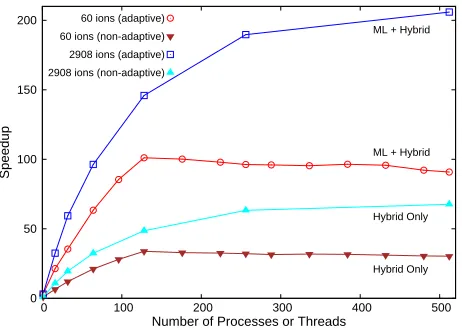
Figure 9. Strong scaling plot of the performance of
MPI/OpenMP hybrid method with and without ML-enabled adaptive timestep enhancement. Data is shown for 60 and 2908 ions; in both systems, NP is meshed with 1082 mesh points (induced charges). For both systems, ML + hybrid method outperforms hybrid-only implementation.
Figure 9 compares the strong scaling plot of the
performance of the dynamical optimization framework parallelized using the MPI/OpenMP hybrid model with and without adaptive timestep enhancement. The reported speedup is defined as the ratio of serial run-time to the time taken by the parallelized simulations (with and without
ML-enabled auto-tuning of timestep) to simulate a set tb
nanoseconds of physical system dynamics. In Figure 9,
results are shown for simulation of a system of 60 ions and 1082 mesh points as well as a larger system of 2908 ions and
1082 mesh points fortb≈2nanoseconds. The larger system
of 2908 ions is comprised of both positive and negative
ions characterized by an electrolyte concentration c≈0.2
M (with 60 counterions, 1424 positive electrolyte ions, and 1424 negative electrolyte ions). While the ML models were
not trained withcas an input parameter, simulations of the
electrolyte systems using ML-predicted timestep and optimal virtual parameters associated with counterion-only systems
were successful for over c≈0.2 M (see Section 5.4),
enabling the benchmarking of simulations of larger systems. With non-adaptive timestep, the hybrid model produced the maximum speedup of 33.80 with 128 processes (8 MPI nodes and 16 OpenMP threads inside each MPI node) for the smaller system. For the same configuration, the hybrid model with ML-enabled auto-tuning of the simulation timestep was able to achieve a maximum speedup of 101.07 with 128 processes. Thus, the runtime for the this system was reduced from 55 hours to 30 minutes (68 minutes without adaptive time-stepping). We note that the maximum speedup was calculated without considering the execution time reduction gained from the memory optimization techniques. For the hybrid model, we found that the optimal configuration of OpenMP threads is socket bound as noted in the literature (Rabenseifner et al. 2009). As a result, the number of optimal OpenMP threads in our experiment was 16 for any number of MPI processes.
When implemented to a larger system with a total number of 2908 ions and 1082 mesh points exhibiting induced charges, the combination of the hybrid methodology and the ML-based selection of adaptive timestep reduced the execution time of simulation for 2 nanoseconds from 88 days to 10.2 hours (32 hours without adaptive time-stepping) with a speedup of over 200. Clearly, the optimum number of MPI processes are proportional to the problem size when OpenMP thread affinity is set to the socket resulting in a well weak scaling system. The maximum speedup of 620.76 was obtained for 1024 processes (threads) executing a simulation
of 5816 ions and 1272 mesh points fortb ≈0.5nanoseconds.
5.4
Application: Concentrated Electrolytes
near an Oil-Water Emulsion Droplet
The ML-enhanced framework was applied to compute the distribution of monovalent electrolyte ions outside a
charged oil-in-water emulsion droplet (de Graaf et al. 2008;
Bier et al. 2008) at room temperature T = 298 K. Positive and negative ions were considered to be of the same size to simplify the system and focus on analyzing the effects of polarization charges on the density distributions. Such model systems have been considered in previous numerical studies
of electrolyte ions near polarizable nanospheres (Messina
2002;dos Santos et al. 2011;Shen et al. 2017). All ions were
modeled as Lennard-Jones (LJ) spheres of diameter σ=
0.357nm. The oil-water emulsion droplet was modeled as a
spherical, dielectric interface with surface chargeQ=−60e
and radius a= 7.5σ≈2.7 nm. The whole system of ions
and the droplet was taken to be in a large spherical simulation
cell of radius b= 40σ≈14nm. The emulsion surface and
the simulation cell boundary were modeled as spherical LJ walls. All excluded-volume interactions were modeled using
the repulsive 6-12 LJ potential withǫLJ = 1kBT and cutoff
The dielectric permittivity of oil was taken to beǫo = 2,
while water was associated withǫw= 78.5. The difference
in the polarizable properties of oil and water lead to surface polarization charges. Electrostatic interactions arising from the bare and induced charge interactions in the system were modeled using the forces originating from the functional described in Eq. (4). The oil-water dielectric interface (which can be considered as the surface of the NP) was meshed withM = 1082mesh points; higherM values were found to
yield similar densities indicating thatM = 1082was large
enough to obtain converged density profiles. In addition to
the system with no added electrolyte, systems with c≈
0.02,0.1,0.2 M were considered to analyze the effects
of changing the electrolyte concentration c on the ionic
distributions. Together with the 60 counterions (associated with the charged oil-water droplet), these concentrated
electrolytes correspond to systems with a total of350,1514,
and2968ions respectively. Simulation of the smallest system
(60 ions) assuming non-polarizable NP surface was also
performed for assessing the role of surface polarizability. It should be noted that the ML procedure was only trained
for smaller systems with counterions (c= 0, thus in the
absence of co-ions). Further the training was performed for relatively smaller computational time (up to 2 million). With the application of the ML-enhanced framework to the aforementioned systems, we are elucidating the transferability of the features learned for the smaller system
to different but related physical systems (with finite c,
presence of co-ions, and long-time dynamics). Such an extended application of the developed ML models is possible, in part, because addition of electrolytes weaken the effective interaction between counterion and oil-water surface as a result of the screened electrostatic forces.
The aforementioned attributes of the physical system supply the input parameters for the enhanced dynamical optimization framework. Following the process elucidated
in Fig.4, these system inputs were first passed to the ML
model I to predict the required virtual system parameters to kickstart the simulation. Then, ML model II was employed to auto-tune the timestep and virtual parameters during the simulation executed using the hybrid OpenMP/MPI method up to 2 million time steps. For the rest of the simulation run, ML model II was disabled and ML model I was
used. The total number of steps S were selected based
on the convergence of the density distributions; S was
system-dependent and converged results were obtained after
≈5−20 nanoseconds (14−60 hours) depending on the
electrolyte concentration.
In all simulations, regardless of system sizes and presence/absence of electrolytes, good energy conservation
was observed withR <0.05. Similarly, the induced charges
on the oil-water dielectric interface were accurately tracked by the on-the-fly optimization framework (fd <1%; inset in
Figure10shows the accurate tracking on the functional for
thec= 0.02M case). These two key features demonstrated
the success of the ML-based virtual parameter selection
process. As noted before, the bound onRvis system-size and
system-feature-dependent that is informed by prior domain
experience; for counterion-only systems,Rv<0.15 as per
the expected limit while for electrolyte systems the bound
on Rv was higher and increased with increasing c. These
0 0.2 0.4 0.6 0.8 1 1.2 1.4 1.6 1.8
2.5 3 3.5 4 4.5 5 5.5
Density of Positive Ions (M)
Distance from Emulsion Droplet Surface (nm) 0.0 M
0.02 M 0.1 M 0.2 M
-470 -460 -450 -440 -430 -420 -410 -400
2×10⁶ 4×10⁶ 6×10⁶ 8×10⁶ 1×10⁷
Potential Energy (k
B
T)
Simulation Steps Dynamic Optimization
[image:12.595.305.539.56.222.2]Static Optimization
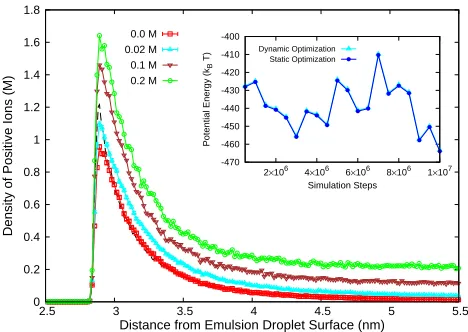
Figure 10. Ionic density profiles extracted from ML-enhanced
MD simulations based on the dynamical optimization framework. Outset shows the density of positive ions for electrolytes of concentrationc≈0.0,0.02,0.1,0.2M near
negatively-charged oil-water emulsion with dielectric permittivity of oil and water as 2 and 78.5 respectivley. Black dashed line refers to the result for the emulsion assumed to be
unpolarizable (with oil permittivity as 78.5). (Inset) Comparison of the functional optimized dynamically (diamonds) and the functional optimized at regular intervals keeping the ionic configuration static during the optimization process (circles) for c≈0.02M system.
findings demonstrated that ML models could be trained on smaller systems and applied to larger systems to obtain efficient and stable dynamics of ions in the latter case.
Figure 10shows the density profiles of the positive ions
associated with the four systems. For all concentrations, the densities reach a constant value in the bulk away from the polarizable oil-water surface (negative ion densities, not shown, also reach a constant value in the bulk). Positive ions are found to accumulate near the dielectric interface,
with the peak density increasing withc. Similarly, negative
ions are depleted near the interface due to the repulsion from the bare charge on the oil-water surface as well as the induced charge. Comparison of the no electrolyte result with the case where the surface is considered to be unpolarizable (with a permittivity equal to that of water) is also shown. The polarization charges on the surface lead to depletion of ions from the interface. Increasing concentration leads to the rise in the peak density; the overall behavior is determined by the competition between the ion-induced charge repulsion near the surface and the ion-ion electrostatic and steric correlations. The position of the peak
density remains relatively unaltered regardless of c value,
as observed previously for monovalent electrolytesMessina
(2002).
The inset in Fig.10shows the comparison of the potential
energy functional optimized dynamically with the energy obtained after optimizing at regular intervals keeping the ionic configuration static during the optimization process
for the c≈0.02 M system. The potential energy and the
associated induced charges it characterizes were accurately tracked at all times for up to 10 million time steps
(≈20 ns). The stability and accuracy evident from this