
salsaDPI: a dynamic provisioning interface for IaaS cloud Tak-Lon (Stephen) Wu
Computer Science, School of Informatics and Computing Indiana University, Bloomington, IN
Abstract
On-demand private cloud environment has become popular due to its flexibility and scalability. However, the complicated setup and installation process to obtain the computing resource has deterred users away. Inspired by the batch job model, we introduce a dynamic provisioning software, salsaDPI, to simplify these complications which allows domain scientists to focus on their scientific problems and run their applications on clouds with dynamic and automated installation and configurations.
1. Introduction
Batch job has been widely adopted by scientists and commercial companies to handle daily tasks that analyze terabyte of data on different computing resources. These tasks execute well in traditional static environment such as high performance cluster. However, it is not easy to run them in a dynamic environment such as clouds. Clouds provide Infrastructure-as-a-service (IaaS), enabling users to take control of the computing nodes. The on-demand elastic model utilizes computing resources, which allows applications to scale up to hundreds of nodes and hides the complicated cluster settings. Scientists may take advantage of this computing model whenever they have a urgent deployment request of computing resources. But before users submit a request to startup compute nodes, they need to choose the type of virtualization image that is prepackaged from resource providers, such as FutureGrid [1]. Users can even bundle and upload their own image with specified software stack installation. The progress of resource selection and software configuration may be repeated daily by different cloud users [2, 3]. In addition, once the VM image is up and running, users normally run their applications and obtain the output by typing commands line by line. Although users can write scripts to run these applications remotely via ssh connection, it’s hard to be automatic of this batch-like job from selecting the resources, starting the compute nodes, installing software on-the-fly once nodes are running, executing user-defined applications, to releasing the computing resources. Based on these considerations, we develop an experimental on-demand dynamic provisioning software, hereafter written as salsaDPI, which automates the job executions running on FutureGrid Eucalyptus cloud service.
This paper is structured as follows. Section 2 gives an overview of dynamic resource provisioning and management technologies. Section 3 discusses the related works. Section 4 describes the system design and architecture of SalsaDPI. Section 5 presents an educational use case. Section 6 draws the conclusion and discusses the future directions.
2. Background
providers. In order to run applications on cloud, users may have to create and upload their own images with installing special software stack on a base image. This image generation progress is normally handled by system administrators as it requires system background knowledge and goes through several complicated steps.
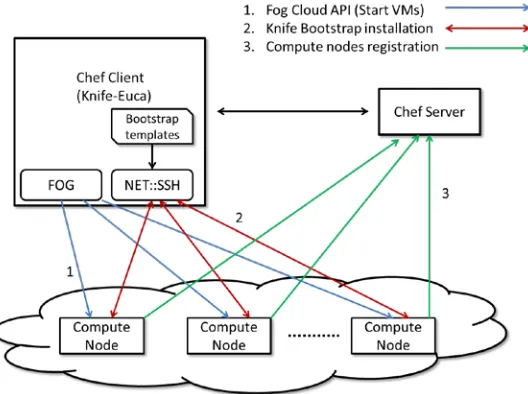
[image:2.612.174.438.360.557.2]Opscode Chef [4] is a provisioning and configuration management tools that deploys cloud resources and user-specified applications throughout different IaaS cloud and phyicial cluster automatically. It is an open source system written in Ruby, which makes the configuration plan (chef recipes) can be easily built. Also, Chef is implemented as a traditional client-server model, where it invokes system and API calls through a RESTful API service or through the default command line tool knife. Starting from Chef 0.10, chef project provides contributor programming interface to write plugins which enables more functionalities. Knife-eucalyptus is one of the plugins that enables cloud support, it provisions compute nodes directly on various clouds, such as Amazon Cloud, Eucalyptus Cloud, and OpenStack Cloud. Figure 1 shows the internal communication when chef client is provisioning compute nodes on clouds. Knife-eucalyptus utilizes several Ruby and Chef libraries to achieve this compute node provisioning task, they are Fog, Chef::Knife:Bootstrap, Chef::Knife:EucaBase, Chef::Json_compat, Net::Ssh, and Net::Ssh::Multi; here, Fog Library is the key component to communicate with cloud infrastructure API, meanwhile, Chef::Knife:Bootstrap takes chef-client installation task by loading default or user-defined ruby template based on the started VM’s Operation System. In addition, this tool utilizes standard ssh library Net::Ssh and Net::Ssh::Multi to execute related software installation command.
Figure 1. Chef knife-eucalyptus internal communication
3. Related Work
as Chef, also, it focus on definition of resource type, software dependencies, software installation order in a concrete model.
Cloudinit.d [3, 6] presents a Unix-like init.d tool for launching, configuring, monitoring, and fault tolerating a set of interdependent VMs over a set of IaaS cloud. Cloudinit.d is similar to Engage system, but it provide a monitoring component to periodically check the system status before and after the first successful software deployment. This feature helps the system to detect and recover from unexpected failure in a distributed environment.
J. Klinginsmith [2] introduces a reproducible framework which developed based on FutureGrid and Amazon Cloud. As data locality is one of the key features of Cloud Computing, his works mainly focuses on moving computational infrastructure as close as the location of data in a dynamically deployed environment; his goals is to help users, especially eScience scientists, to repeat their daily experiments by going through two processes, which constructs on-demand infrastructure level resources and installs selected software/runtime on-the-fly when resources are booting up. Also, he writes a customized Chef Plugin (with Chef 0.10+) to read different configuration parameter in order to support various cloud IaaS API.
In addition, this work has been presented at NCSA Science Cloud Summer School 2012 [7] as an educational package; SalsaDPI framework has been installed within a pre-packaged portable VirtualBox [8] image which is distributed to 200 students of this event.
4. SalsaDPI
Based on our experience using and running different IaaS on FutureGrid, we have developed an initial framework, SalsaDPI, to automate the scientific data analysis applications of CINET project. Users of this framework can easily prepared their one-click configuration plan and launch their applications.
4.1. Overview of System Design
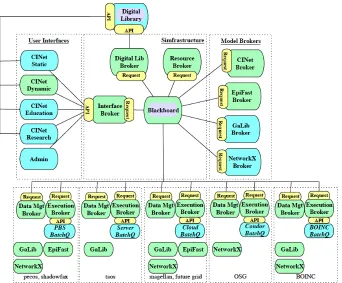
As shown in figure 2, requests sent to FutureGrid data management and execution brokers involve jobs running on FutureGrid Eucalyptus cloud service. Currently, we provide support and advice to CINET project from Virginian Tech about system design and test several potential components which may be integrated into data management and execution brokers. Mainly, these tasks focus on the FutureGrid resources utilization in a Cloud Computing fashion which enables elastic resource allocation. Meanwhile, we are working on an on-demand dynamic provisioning software, SalsaDPI, which automates the job executions running on FutureGrid Eucalyptus cloud service. As previously discussed, SalsaDPI will potentially be a component of the execution broker.
4.2. Features of salsaDPI
Reproducibility environment on public/private cloud is very important for any commercial and science executable binaries. With this reproducible feature, many data analysis could be done without worrying the complicated system setup progress, the learning curve of different cloud infrastructure tools, and detail background knowledge of Cloud. Programmers or Scientists can focus on writing their own applications and fires them on Cloud with the support of scalability. salsaDPI, an on-demand dynamic provisioning software runs on public/private cloud, has been tested and runs user-defined binaries with more than 80 VM instances on FutureGrid Eucalyptus cloud.
Figure 2. Current CINET Blackboard System Architecture
1. Automate environment settings and application execution 2. Support various cloud infrastructure and permanent storage 3. Execute user-defined binary and obtain result
4.2.2. System Overview
Each design goal will be explained with a description as following.
Automate environment settings and application execution
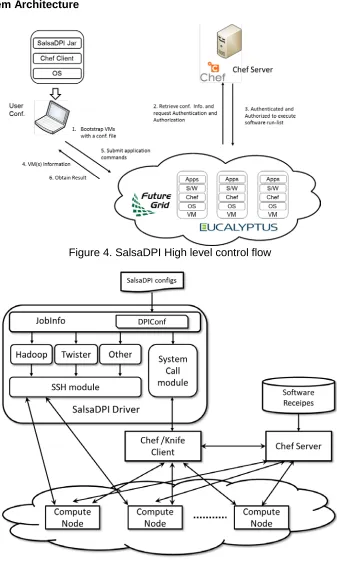
release the resources back to the Eucalyptus service pool. The detail control flow can be seen in Figure 4. Noted that current interface could be extended to support more features if needed.
{ 'mode':'sandbox', 'chef':{'chefSoloRecipeUrls':'http://129.79.49.248/chef-solo.tar.gz', 'chefSoloConfFilePath':'/root/salsaDPI/solo.rb'}, 'ssh':{'SSHLoginUsername':'root', 'SSHPrivateKeyPath':'/root/.ssh/id_rsa' }, 'softwareRecipes':['recipe[hadoopSandbox]'], 'applicationParameters':{'applicationType':'Hadoop', 'localPathOfProgramBinary':'/root/salsaDPI/apps/hadoopWordCount.jar', 'localPathOfProgramInput':'/root/salsaDPI/input/hadoopWordCountInput.txt', 'localPathOfBinaryDependency':'', 'programExecuteLocation':'',
'programArgs':'bin/hadoop jar #_JAR_# #_HDFS_INPUTDIR_# #_HDFS_OUTPUTDIR_#'} }
Figure 3. Hadoop wordcount configuration example
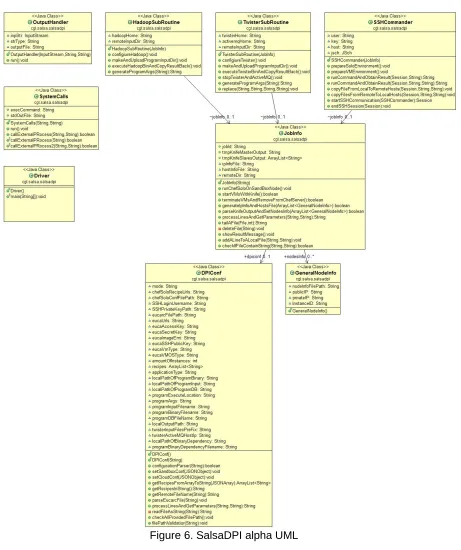
Figure 5 shows the architecture of SalsaDPI internal communication. From the client side, we run a java executable, SalsaDPI driver program, which validates and converts the configuration file into an object DPIConf. This DPIConf contains information defined by the user interface. Then, the Driver creates a Job Information object JobInfo which is used to construct the infrastructure and software level resources deployment. Based on the JobInfo, we utilizes the java external process (java.lang.Process) class to call knife binary and starts compute nodes with the support of an external hosted Chef Server. In between pending the resources and the compute nodes is ready to the next stage, we rely on Chef to monitor the deployment progress. Once compute nodes has been booted and been installed user-defined software, all the resources information such as hostname and IPs are stored within this JobInfo object. Driver continues to upload the user applications and inputs to each compute node via general ssh communication (a java library Jsch), and at the end, we remotely call the application execution commands and obtain the result back to the working client. Figure 6 presents the detail UML of the driver program.
Support various cloud infrastructure and permanent storage
FutureGrid Eucalyptus cloud has been tested and supported, and we aims to support different cloud infrastructures such as OpenStack [10] and Nimbus [11] cloud deployed on FutureGrid in next stage. In addition to computing resources, we have already added permanent storage support such as Walrus (Open source S3-like storage) to store program related read-only files and output.
Execute user-defined binary and obtain result
4.3. System Architecture
[image:6.612.147.459.92.326.2]Figure 4. SalsaDPI High level control flow
Figure 6. SalsaDPI alpha UML
4.4. User Interface
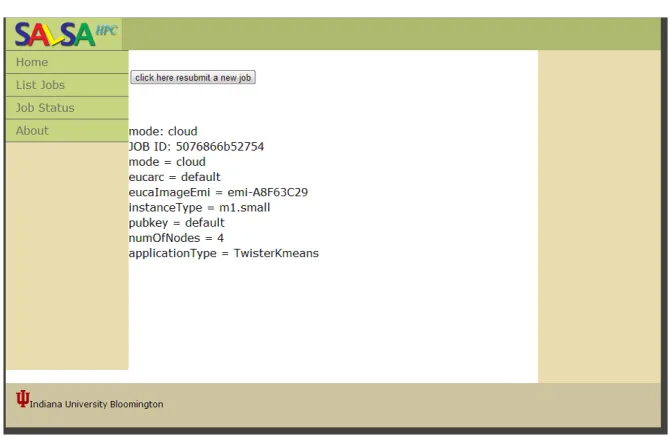
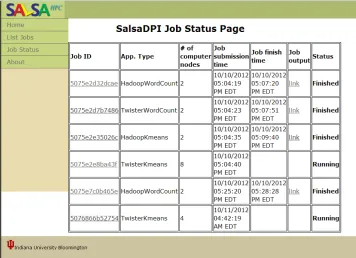
Eucalyptus instance type, total amount of compute nodes, and type of applications. Once the job is submitted from the portal, it executes a backend salsaDPI job on the same machine as mentioned in the above section. Submitted Job is traceable from the real-time job list page. After the job is finished, it provides a direct link to the program output. These features are shown in Figure 7.
Figure 7 a). Online job submission interface
[image:8.612.132.479.163.411.2] [image:8.612.138.473.438.657.2]Figure 7 c). Job status page
[image:9.612.127.483.73.331.2] [image:9.612.125.490.138.647.2]Figure 7 e). Example of Twister Kmeans output
5. Show case: salsaDPI in Science Cloud Summer School 2012
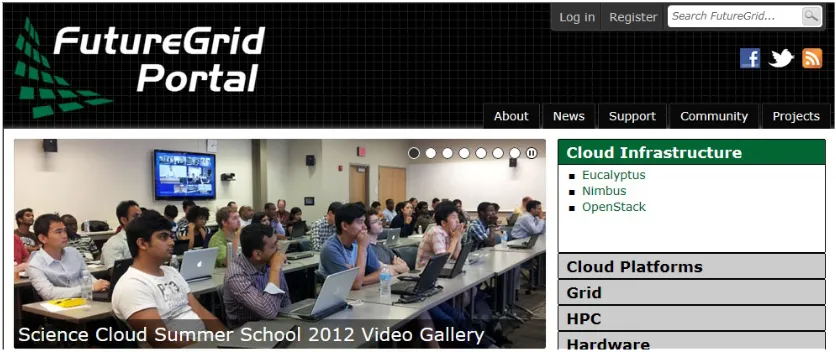
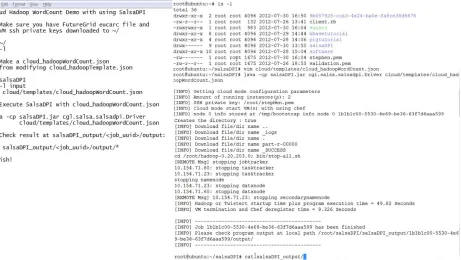
[image:10.612.97.515.480.656.2]In summer 2012, Indiana University and other 9 sites of university (http://www.vscse.org/summerschool/2012/scss.html), has held an virtual conference across nations. This conference mainly introduces and educates cloud technologies to graduate-level students and staffs. salsaDPI, online tutorial page is located at http://salsahpc.indiana.edu/ScienceCloud/reproduce-intro.html, has been taking part as one of the main tutorials of this activity. Figure 8 is one of the photos taken from this activity. It has shown the abilities of deploying single node and virtual runtime environment for Hadoop and Twister applications from raw OS environment (without any software pre-installed). Also, it automatically executes Hadoop and Twister applications such as WordCount and Kmeans once after installing the selected software stack (see Figure 3 for configuration details). Figure 9 shows the snapshots when salsaDPI is running with a user-defined Hadoop WordCount configuration file, the video link can be seen at http://www.youtube.com/watch?feature=player_embedded&v=kWom0lj8qxI (please view it with video quality of 1080p).
Figure 9. running salsaDPI HadoopWordCount on FutureGrid
6. Conclusion and Future Works
We have implemented a command-line runnable, programmable, and user-friendly online framework salsaDPI for reproducible applications in dynamic computing environments. salsaDPI still has room for improvement, especially, we have not reached the real research level yet. Possibilities such as performance analysis among related works, suitable use cases for scientific applications, and understanding of the internal data communications. So, in sum, research and software engineering possibilities are listing below
1. Test different runtimes, different algorithms, and various applications to understand their behaviors.
2. Record the internal communication time of each component of salsaDPI. 3. Record and investigate SSH message redirect time and weight of salsaDPI
4. Test salsaDPI with different permanent storage such NFS, SFTP/HTTP, Object-storage Walrus.
5. How many nodes could salsaDPI handle? What are the system behaviors when running salsaDPI with multiple clouds?
Acknowledgment
Reference
[1] FutureGrid. Available: https://portal.futuregrid.org/
[2] J. Klinginsmith, M. Mahoui, and Y. M. Wu, "Towards Reproducible eScience in the Cloud," presented at the Proceedings of the 2011 IEEE Third International Conference on Cloud Computing Technology and Science, 2011.
[3] J. Bresnahan, T. Freeman, D. LaBissoniere, and K. Keahey, "Managing appliance launches in infrastructure clouds," presented at the Proceedings of the 2011 TeraGrid Conference: Extreme Digital Discovery, Salt Lake City, Utah, 2011.
[4] Opscode Chef. Available: http://www.opscode.com/chef/
[5] J. Fischer, R. Majumdar, and S. Esmaeilsabzali, "Engage: a deployment management system," SIGPLAN Not., vol. 47, pp. 263-274, 2012.
[6] K. Keahey, P. Armstrong, J. Bresnahan, D. LaBissoniere, and P. Riteau, "Infrastructure Outsourcing in Multi-Cloud Environment," presented at the the 8th Open Cirrus Summit, San Jose, CA, 2012.
[7] (2012). Science Cloud Summer School 2012. Available:
https://portal.futuregrid.org/projects/241
[8] Oracle VM VirtualBox. Available: https://www.virtualbox.org/ [9] JSON metadata format. Available: http://www.json.org/
[10] Open Stack. (2010, November 7). Open source, Open standards Cloud. Available: http://openstack.org/index.php
![Node js Design Patterns Casciaro, Mario [PDF][StormRG] pdf](data:image/gif;base64,R0lGODlhAQABAIAAAP///wAAACH5BAEAAAAALAAAAAABAAEAAAICRAEAOw==)