International Journal of Innovative Technology and Exploring Engineering (IJITEE) ISSN: 2278-3075, Volume-8 Issue-12, October 2019
Abstract: An Artificial Neural Network is a well-known AI technique for replicating human brain and offering suitable solution for any unpredictable complicated problem. Taking the advantage of it, this research will analyse the applicability of Neural Network Controller for ship manoeuvring, such as course changing. To train the controller, optimized teaching data are used to keep the consistency in the data as it could enhance the learning ability of the controller while training. A double layered feed-forward neural network and back propagation method are found suitable for this purpose. Later-on, simulations are done to justify the effectiveness of the trained controller for unknown situations.
Index Terms: Artificial Neural Network, Intelligent Controller, Numerical Analysis, Optimisation, Ship Manoeuvring
I. INTRODUCTION
Manoeuvring of a ship greatly depends on the knowledge of an operator that he gains through years of experience. Therefore, an inexperienced captain often faces difficulties in unfavourable situations, such as manoeuvring through narrow channels or navigating under high wind disturbances. In such a situation, relying on the automation would be a great relief for them. However, while using conventional control, a successful application could only be found within a well-constrained environment. As a result, researchers are very keen on developing intelligent controllers, which can deal with the robustness and propose a suitable solution for any given problem. One of such intelligent systems is Artificial Neural network, which is inspired by the central nervous system of human‟s and can replicate the human‟s action in solving complex problems with a lot of uncertainties. Yamato, Uetsuki and Koyama [1] first used ANN as a controller and he chose it for automatic ship berthing. Later on, Fuji and Ura [2] ensured that ANN could be used as both supervised and non-supervised controller. After him, researchers continued to use ANN for temperature control, paper mill waste-water treatment control, process control etc. Hasegawa and Kitera [3] and Im and Hasegawa [4], [5] had continued their research on applying ANN for automatic ship berthing. However, the success was not up to mark as the controller often confused to navigate the ship up to the pier in wind disturbances. By this time, Ohtsu, Mizuno, Kuroda and Okazaki [6] proposed a new strategy to do optimisation using nonlinear programming language (NPL) method which allowed the user to carry out the optimisation
Revised Manuscript Received on October 05, 2019.
Yaseen Adnan Ahmed, Maritime Engineering Technology Department, Umiversity Kuala Lumpur, Malaysian Institute of Marine Engineering Technology, Lumut, Malaysia. [email protected]
Iwan Zamil Mustaffa Kamal, Maritime Engineering Technology Department, Umiversity Kuala Lumpur, Malaysian Institute of Marine Engineering Technology, Lumut, Malaysia. [email protected]
Mohammad Abdul Hannan, Marine Technology Department, Newcastle University in Singapore, Singapore.
for any desired set of equality and non-equality constraints. His strategy helped a number of researchers who were struggling to train the controller effectively as they need to do a lot of experiments to get the data, which were no doubt expensive, but also time-consuming. A paper published by Ahmed and Hasegawa [7], [8] clearly demonstrates how to utilize Ohtsu‟s [6] proposed method in creating consistent teaching data and get a well-trained controller for ship manoeuvring. This research will use the same strategy to create the teaching data, which are consistent and use it to train a neural network for different course changing. Changing heading is a simple manoeuvre, however, to change it within a minimum time is a chal-lenge. Therefore, the research is aimed to propose an ANN controller which is able to change the ship‟s course in minimum time. An optimisation function „fmincon‟ is used for creating teaching data and Levenberg-Marquardt algorithm is used to train the net on Matlab. Several types of networks are then analysed and the one with minimum mean squared error (MSE) is selected for further research. Simulations are also carried out for unknown cases to demonstrate the effectiveness of the proposed controller.
II. METHODOLOGY
Ship Model
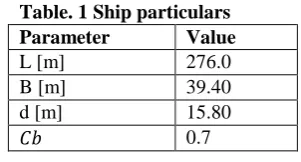
[image:1.595.350.501.495.576.2]As for this research, a S60 container ship has been chosen, which is equipped with a single rudder and a single propeller. The principle particulars of this ship is given in Table I.
Table. 1 Ship particulars
Parameter Value
L [m] 276.0
B [m] 39.40
d [m] 15.80
𝐶𝑏 0.7
Creation of Teaching Data
In order to train a neural network controller, a consistent set of teaching data is needed. As the controller is for course changing manoeuver, and there are a number of possible ways to turn a certain degree of course, this research investigates only the minimum time course changing manoeuvre to make sure the similarity in teaching data.
To do so, optimisation technique is used on Matlab. Among the different types of optimisation functions available on Matlab optimisation toolbox, „fmincon‟ is found to be the best as it uses the nonlinear programming language (NPL) method [6].
An Artificial Neural Network Controller for
Course Changing Manoeuvring
Table II shows the basic constraint conditions that has been in the optimisation process.
Table. 2 Constraint used for optimisation Initial Condition
Velocity [m/s] u=8.86, v= 0 (Fn=0.2)
heading, yaw rate, coordinates, steering angle
Φ = r = x = y = δ = 0
Termination Condition
Equality constraints
heading [deg] Φ = 50,100 etc.
coordinate Free
sway velocity and yaw rate
v=r=0
Non-equality constraints
Rudder restriction |δ|≤100/150/200/250
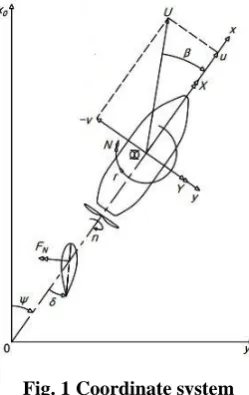
[image:2.595.309.537.107.276.2]During the optimisation process, Manoeuvring Mathematical Group (MMG) model is utilised to predict the response of the ship for different rudder angles [9]. A coordinate system is needed to construct this model, and it is given in Fig. 1.
Fig. 1 Coordinate system
The equations of motions for surge, sway and yaw are considered at the centre of gravity and given as following:
N r J I
Y ur m m v m m
X vr m m u m m
ZZ ZZ
x y
y x
) (
) (
) (
) (
) (
(1)
Where, m is the mass of ship, mx and my are the added mass in x and y direction, Izz is the moment of inertia, Jzz is the polar moment of inertia, u is the surge velocity, v is the sway velocity, r is the yaw rate and the right side includes the total hull, propeller and rudder hydrodynamic forces and moment.
This research only considers the starboard turning of ship at this initial stage and the rudder is restricted to operate within ±100, ±150, ±200 or ±250 as a non-equality constraint. In addition, the change in the ship heading is considered up to 450. By this way, a set of optimized ship trajectories is
obtained and later on used to train neural network controller. Fig. 2 shows a sample teaching data obtained for 250 heading change and in the simulation, rudder is restricted to operate within ±150.
Fig. 2 Heading change 250 and rudder limit ±150 In this figure, the upper left shows the surge and the sway velocity, the upper right shows the heading and the yaw rate, the lower left shows the optimized rudder and lower right shows the optimized ship trajectory. Similar types of simulations are then done in this research and the data are combined into a set shown in Fig. 3 to train the proposed controller.
Fig. 3(a)Heading angles in teaching data
Fig. 3(b)A set of teaching data Tools Used for Training
[image:2.595.104.229.360.558.2] [image:2.595.354.497.403.512.2] [image:2.595.350.496.547.663.2]International Journal of Innovative Technology and Exploring Engineering (IJITEE) ISSN: 2278-3075, Volume-8 Issue-12, October 2019
As the effectiveness of an ANN controller depends on the consistency in teaching data and how well it has been trained, a suitable training function is chosen from the available library and the best network is chosen for minimum error.
Training, Trasfer and Performance Function
Function based on Levenberg-Marquardt algorithm is considered to train the neural net, which uses back propagation technique. This technique is based on a gradient descent algorithm, therefore, the network weights are changed along with the negative gradient of the performance function. The Levenberg-Marquardt algorithm was designed to approach second-order training speed like the quasi-Newton methods, without having any need to compute the Hessian matrix. This algorithm uses the following approximation to the Hessian matrix and follow a Newton-like update.
e
J
I
J
J
x
x
k k T T1
1
[
]
(2)Where, J is a matrix known as Jocobian that usually contains first derivatives of the network errors with respect to the weights and biases, e is a network errors‟ vector and μ is a scalar value.
A large value of μ results in a gradient descent with a small step size and when zero the algorithm is the same as Newton‟s method. Therefore, μ is decreased whenever the performance function is reduced and we call it as a successful step.
As for transfer function, log-sigmoid is used to generate outputs between 0 and 1 and thus reduces the scale effect. It is given as follows:
x
e
x
f
1
1
)
(
(3)Mean Squared Error value (MSE) is used as a transfer function. This function has two optional parameters, which are regularization and normalization. In this research, the normalized data for teaching are considered as following:
}
,
..{
},...
,
{
},
,
{
p
1q
1p
2q
2p
nq
n (4)Where, p is input of network and q is target output Therefore, MSE can be calculated as follows:
n i n i i O i q n i e n MSE 1 2 1 2 )) ( ) ( ( 1 ) (1 (5)
Where, O is the output of network.
Parameters, Input and Output Parameter, and Hidden Layers
The selection of accurate set of input parameters is very imperative, and it has a direct impact on the performance value. This research has investigated nine different parameters available to train ANN. Table 3 shows all the parameters.
Table. 3 Parameters available for training
Parameter Description
u Surge velocity
v Sway velocity
r Yaw rate
ψ Heading angle
x X position
y Y position
𝜓𝑒𝑟𝑟𝑜𝑟 Heading error
𝛿𝑎𝑐𝑡𝑢𝑎𝑙 Actual rudder angle
δ _order Command rudder
angle
Among these, four are considered as inputs while training. The inputs are:
v , r, ψ_error , δ_actual
Whereas, the output is δ_command
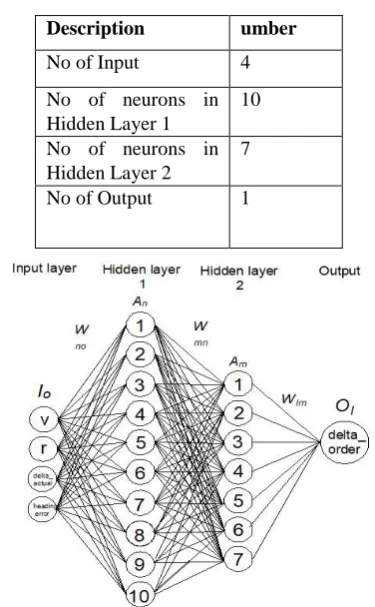
[image:3.595.332.520.370.674.2]To cope with the complex relationship between the inputs and output, two hidden layers are found suitable in this research. The number of neurons for each layer are then determined by trial and error and the best combination is chosen for minimum MSE value. The details of this network‟s structure is given in Table 4 and resulting network is shown in Fig. 4.
Table. 4 Information about the trained network
Description umber
No of Input 4
No of neurons in Hidden Layer 1
10
No of neurons in Hidden Layer 2
7
No of Output 1
Fig. 4 Structure of the trained neural network The outputs from the hidden layers are calculated using the following equations:
n n n o o nn sig W I b
m
m
m n n m
m sig W I b
A
1
, )
(
At last, the desired output for the rudder angle is calculated by
l
l
l m m l
l purelin W A b
O
1
, )
(
(7)
Where, o represents the number of input parameters, n is the number of neurons in 1st hidden layer, m is the number of neurons in 2nd hidden layer, l is the number of output and sig is the log sigmoid function.
III. RESULTSANDDISCUSSION
The proposed ANN controller is an online controller, therefore, it is very crucial to investigate the effectiveness of the controller. As it demands acceptable margin of accuracy, several situations has been tested in this research, among which, some are in known condition, i.e. used as a teaching data and some are completely unknown. By this way, the robustness of the controller has been judged and could be extended for investigation the navigation under wind disturbances.
Known Condition
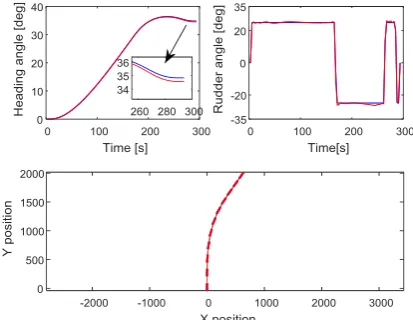
Fig. 5 is simulated for the final heading angle 25° and with the rudder restriction of ± 10°. The figure illustrates both optimized offline control data and the response from online ANN controller. The blue line represents the data gained from optimisation, whereas, the red line represents online control data from ANN. Considering Fig. 5, the upper left figure shows how the heading changes with rudder, upper right shows the optimized rudder and the rudder taken by ANN controller, and the lower one shows the associated ship trajectories. From this figure, it has been clearly seen that the ANN learns the optimized data effectively and is able to replicate it. Same goes to the second figure, Fig. 6.
[image:4.595.318.525.60.220.2]Fig. 5 Comparison: Heading change 250 and rudder limit ±100
Fig. 6Comparison: Heading change 350 and rudder limit ±250
Unknown Condition
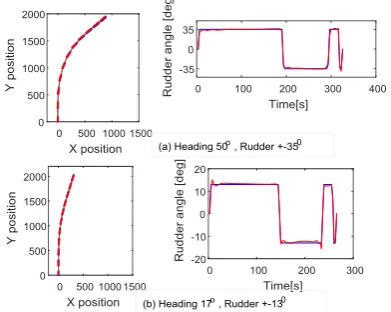
[image:4.595.312.545.491.657.2]Network is also tested for unknown conditions. The situation could be different in terms of heading to achieve and the restricted rudder angle. First of all, different heading angles are tested, which are not used in the teaching data, whereas, the rudders are restricted to ±10°, 20° or 25°, which are used in the teaching data. Fig.7 shows the results where the rudder is restricted to ±10°, but the desired headings are 20° and 35°. Although the ANN result for heading 20° matches with the optimized result perfectly, the result for heading 35° shows some discrepancy as the network needs to extrapolate to get the result. This is due to fact that ANN is good at doing interpolation, but in case of extrapolation it often confuses. So, it would be better to use ANN controller within a boundary created by the teaching data, not beyond it. Same explanation goes to Fig. 8, where the upper part shows the interpolated result, and the lower one is for the ANN needs to extrapolate.
[image:4.595.63.265.517.671.2]International Journal of Innovative Technology and Exploring Engineering (IJITEE) ISSN: 2278-3075, Volume-8 Issue-12, October 2019
Fig. 8 Comparison in unknown situation, rudder restricted to ±250
[image:5.595.62.258.364.520.2]Fig. 9 shows the results for arbitrarily chosen heading and restricted rudder. This is to test the controller‟s ability and judge its robustness. In addition, Fig.10 shows two simulation results for the same heading change but with different rudder angle. It shows that the ANN can replicate the optimisation result with ease and the trajectories are almost merged with each other. Therefore, the ANN controller can be used as an online controller, which was the ability to change the course of a ship in a minimum time.
[image:5.595.56.272.553.728.2]Fig. 9 Comparison for arbitrarily chosen situation
Fig. 10 Comparison for the same heading, but different rudder
This research could be extended further for navigation under wind condition and manoeuvring for a final point
destination. The idea would be to replicate the optimized trajectories on board with trained online controller.
IV. CONCLUSION
This research basically focuses on two scopes of study, the automatic consistent teaching data creation and use this offline data to train for an online ANN controller for course changing manoeuvre. As a first step, optimisation technique is utilized to get the minimum time course changing with different constraints. After the data has been created, a feed-forward neural network is trained using back propagation technique. In order to investigate the effectiveness of ANN in known and unknown situations, simulations are carried out using the trained ANN controller and compared with optimized trajectories. Most of the results show good agreement and it is proved that ANN replicate the optimized trajectories even if in unknown situation. As a conclusion, the proposed online ANN controller can bring more benefit in the voyage of the ship as it can save time by offering the ship to change its course in minimum time.
REFERENCES
1. H. Yamato, H. Uetsuki, and T. Koyama, “Automatic Berthing by Neural Controller,” Proc. Of Ninth Ship Control Systems Symposium, 1990, 3, pp. 183-201.
2. T. Fujii and T. Ura, “Neural-Network-Based Adaptive Control Systems for AUVs,”Journal of Engineering Applications of Artificial Intelligence, 1991, 4, pp. 309-318.
3. K. Hasegawa and K. Kitera, “Automatic Berthing Control System using Network and Knowledge-base,”Journal of Kansai Society of Naval Architects of Japan, 1993, 220, pp. 135-143. (in Japanese).
4. N.K. Im and K. Hasegawa, “A study on Automatic Ship Berthing Using Parallel Neural Controller,”Journal of Kansai Society of Naval Architects of Japan, 2001, 236, pp. 65-70.
5. N.K. Im and K. Hasegawa, “A Study on Automatic Ship Berthing Using Parallel Neural Controller (2nd Report),”Journal of Kansai Society of Naval Architects of Japan, 2002, 237, pp. 127-132.
6. K. Ohtsu, N. Mizuno, M. Kuroda and T. Okazaki, “Minimum Time Ship maneuvering Method Using Neural Network and Nonlinear Model predictive Compensator,”Journal of Control Engineering Practice, 2007, 15 - 6, pp. 757-765.
7. Y. A. Ahmed and K. Hasegawa, “Automatic Ship Berthing using Artificial Neural Network Trained by Consistent Teaching Data using Non-Linear Programming Method,”Journal of Engineering Applications of Artificial Intelligence, 2013, 26 - 10, pp. 2287-2304. 8. Y. A. Ahmed, M. A. Hannan and I. M. Kamal, “Minimum Time Ship
Manoeuvring in Narrow Water Ways Under Wind Disturbances,”Proceedings of the ASME 2018 37th International Conference on Ocean, Offshore and Artic Engineering, 2018. 9. “The Specialist Committee on Esso Osaka. Final Report and
Recommendations to the 23rd ITTC,”Proceedings of the 23rd ITTC, Vol. 2, pp.573-609.
AUTHORSPROFILE
Dr. Yaseen Adnan Ahmed is currently working for UniKL, MIMET as a Senior Lecturer under MaritimeEngineering Technology section. He graduated with BSc. (Hon) in Naval Architecture and Marine Engineering from Bangladesh University of Engineering and Technology (BUET), Bangladesh in 2009 and got his M.Eng and PhD degree in Naval Architecture and Ocean Engineering from Osaka University (OU), Japan in 2012 and 2015 respectively. He was awarded with Presidential award from Osaka University Alumni Association for his outstanding result in Master program. After being awarded with doctorate degree, he worked as a
visited Osaka University occasionally as a visiting lecturer during his stay in Japan. Later on, he moved to Malaysia after getting the opportunity to work as a senior lecturer in Universiti Kuala-Lumpur, Malaysian Institute of Marine Engineering Technology (UniKL-MIMET). Currently he also acts as a reviewer for well renowned journals. His general research interests include Ship Manoeuvring, Intelligent Control, Optimisation, Naval Architecture, Ship Hydrodynamics, CFD and renewable energy.
Dr. IwanMustaffa Kamal is currently a Senior Lecturer and the Head of Maritime Engineering Technology Section (MET). He received his B.Eng (Hon) in Mechanical Engineering from University of Plymouth, United Kingdom in 1997. He obtained his M.Eng in Marine Technology from Universiti Teknologi Malaysia, Skudai, JohorBahru in 2009. In 2018, he received his PhD degree in Maritime Engineering (Ship Propulsion) from Australian Maritime College (AMC) at University of Tasmania. He has been working with Universiti Kuala Lumpur Malaysian Institute of Marine Engineering Technology (UniKL MIMET) since March 2006. He is currently an active member in the Royal Institute of Naval Architect (RINA), Institution of Marine Engineering, Science and Technology (IMarEST) and the Institute of Engineers Malaysia (IEM). He is a registered graduate Mechanical Engineer with the Board of Engineers Malaysia. During his PhD career, at AMC he taught Ship Resistance and Propulsion for 4th year student at AMC, Newham campus and also supervised a few undergraduate student mainly doing some small research in Ship Propulsion. His PhD thesis was investigating the comparison of the powering performance of large highly energy-efficient wave-piercing catamaran in medium-speed regime. The main aim of his research was to quantify the performance of waterjet and screw propulsion in medium-speed regime.